A new upstream API Is being designed to offer an SLA of 500 ms median and 800 ms maximum (99th percentile) response time. The corresponding API implementation needs to sequentially invoke 3 downstream APIs of very similar complexity. The first of these downstream APIs offers the following SLA for its response time: median: 100 ms, 80th percentile: 500 ms, 95th percentile: 1000 ms.
If possible, how can a timeout be set in the upstream API for the invocation of the first downstream API to meet the new upstream API's desired SLA?
-
A
Set a timeout of 100 ms; that leaves 400 ms for the other two downstream APIs to complete
-
B
Do not set a timeout; the Invocation of this API Is mandatory and so we must wait until it responds
-
C
Set a timeout of 50 ms; this times out more invocations of that API but gives additional room for retries
-
D
No timeout is possible to meet the upstream API's desired SLA; a different SLA must be negotiated
with the first downstream API or invoke an alternative API
Reveal answer details
Close answer details
Correct answerD
ExplanationBefore we answer this question , we need to understand what median (50th percentile) and 80th percentile means. If the 50th percentile (median) of a response time is 500ms that means that 50% of my transactions are either as fast or faster than 500ms. If the 90th percentile of the same transaction is at 1000ms it means that 90% are as fast or faster and only 10% are slower. Now as per upstream SLA , 99th percentile is 800 ms which means 99% of the incoming requests should have response time less than or equal to 800 ms. But as per one of the backend API , their 95th percentile is 1000 ms which means that backend API will take 1000 ms or less than that for 95% of. requests. As there are three API invocation from upstream API , we can not conclude a timeout that can be set to meet the desired SLA as backend SLA's do not support it.
Let see why other answers are not correct.
1) Do not set a timeout --> This can potentially violate SLA's of upstream API 2) Set a timeout of 100 ms; ---> This will not work as backend API has 100 ms as median meaning only
50% requests will be answered in this time and we will get timeout for 50% of the requests. Important thing to note here is, All APIs need to be executed sequentially, so if you get timeout in first API, there is no use of going to second and third API. As a service provider you wouldn't want to keep 50% of your consumers dissatisfied. So not the best option to go with.
*To quote an example: Let's assume you have built an API to update customer contact details.
-First API is fetching customer number based on login credentials
-Second API is fetching Info in 1 table and returning unique key
-Third API, using unique key provided in second API as primary key, updating remaining details
* Now consider, if API times out in first API and can't fetch customer number, in this case, it's useless to call API 2 and 3 and that is why question mentions specifically that all APIs need to be executed sequentially.
3) Set a timeout of 50 ms --> Again not possible due to the same reason as above Hence correct answer is No timeout is possible to meet the upstream API's desired SLA; a different SLA must be negotiated with
the first downstream API or invoke an alternative API
A Mule application is being designed to do the following: Step 1: Read a SalesOrder message from a JMS queue, where each SalesOrder consists of a header and a list of SalesOrderLineltems. Step 2: Insert the SalesOrder header and each SalesOrderLineltem into different tables in an RDBMS. Step 3: Insert the SalesOrder header and the sum of the prices of all its SalesOrderLineltems into a table
In a different RDBMS. No SalesOrder message can be lost and the consistency of all SalesOrder-related information in both RDBMSs must be ensured at all times. What design choice (including choice of transactions) and order of steps addresses these requirements?
-
A
1) Read the JMS message (NOT in an XA transaction)
2) Perform BOTH DB inserts in ONE DB transaction
3) Acknowledge the JMS message
-
B
1) Read the JMS message (NOT in an XA transaction)
2) Perform EACH DB insert in a SEPARATE DB transaction
3) Acknowledge the JMS message
-
C
1) Read the JMS message in an XA transaction
2) In the SAME XA transaction, perform BOTH DB inserts but do NOT acknowledge the JMS message
-
D
1) Read and acknowledge the JMS message (NOT in an XA transaction)
2) In a NEW XA transaction, perform BOTH DB inserts
Reveal answer details
Close answer details
Correct answerA
ExplanationOption A says "Perform EACH DB insert in a SEPARATE DB transaction". In this case if first DB insert is successful and second one fails then first insert won't be rolled back causing inconsistency. This option is ruled out.
Option D says Perform BOTH DB inserts in ONE DB transaction. Rule of thumb is when one or more DB connections are required we must use XA transaction as local transactions support only one resource. So this option is also ruled out.
Option B acknowledges the before DB processing, so message is removed from the queue. In case of system failure at later point, message can't be retrieved.
Option C is Valid: Though it says "do not ack JMS message", message will be auto acknowledged at the end of transaction. Here is how we can ensure all components are part of XA transaction: https://docs.mulesoft.com/jms-connector/1.7/jms-transactionsAdditionalInformationabouttransactions:XATransactions-YoucanuseanXAtransactiontogrouptogetheraseriesofoperationsfrommultipletransactionalresources,suchasJMS,VMorJDBCresources,intoasingle,veryreliable,globaltransaction.TheXA(eXtendedArchitecture)standardisanX/Opengroupstandardwhichspecifiestheinterfacebetweenaglobaltransactionmanagerandlocaltransactionalresourcemanagers.TheXA protocol defines a 2-phase commit protocol which can be used to more reliably coordinate and sequence a series of "all or nothing" operations across multiple servers, even servers of different types Use JMS ack if ?Acknowledgment should occur eventually, perhaps asynchronously ?The performance of the message receipt is paramount?Themessageprocessingisidempotent?ForthechoreographyportionoftheSAGApattern
Use JMS transactions
?For all other times in the integration you want to perform an atomic unit of work ?When the unit of work comprises more than the receipt of a single message ?To simply and unify the programming model (begin/ commit/rollback)
-
A
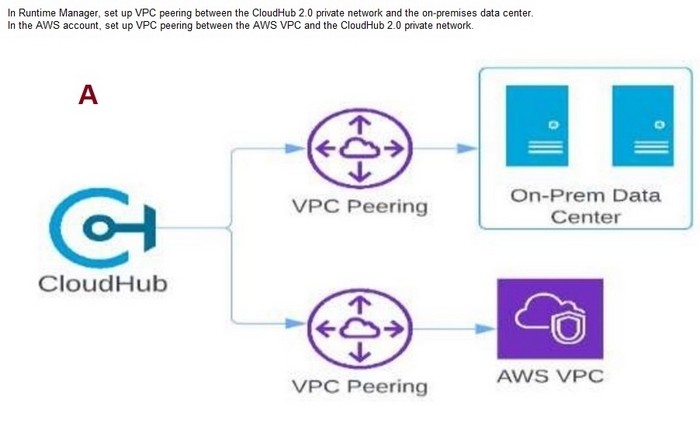
In Runtime Manager, set up VPC peering between the CloudHub 2.0 private network and the on-premises data center.
In the AWS account, set up VPC peering between the AWS VPC and the CloudHub 2.0 private network.
-
B
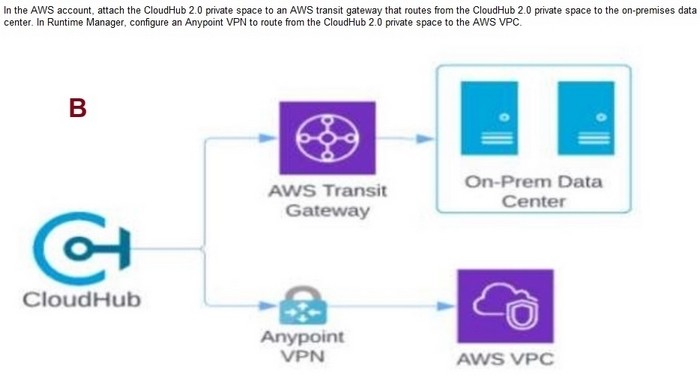
In the AWS account, attach the CloudHub 2.0 private space to an AWS transit gateway that routes from the CloudHub 2.0 private space to the on-premises data center. In Runtime Manager, configure an Anypoint VPN to route from the CloudHub 2.0 private space to the AWS VPC.
-
C
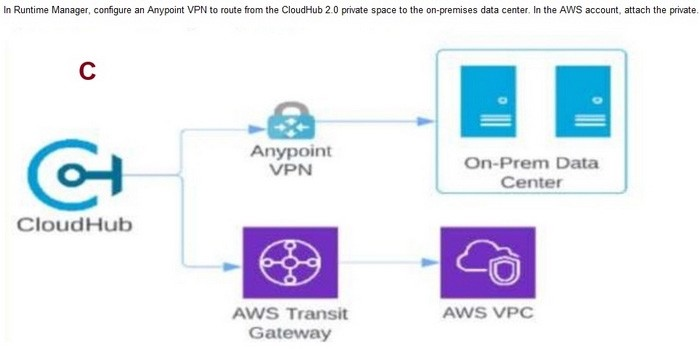
In Runtime Manager, configure an Anypoint VPN to route from the CloudHub 2.0 private space to the on-premises data center. In the AWS account, attach the private.
-
D
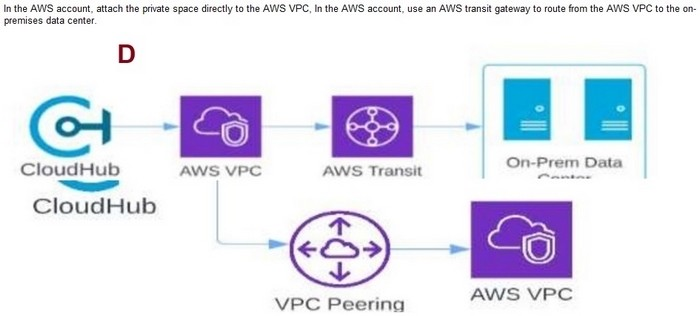
In the AWS account, attach the private space directly to the AWS VPC, In the AWS account, use an AWS transit gateway to route from the AWS VPC to the on-premises data center.
Reveal answer details
Close answer details
Correct answerB
ExplanationTo enable the API to securely connect from its CloudHub 2.0 private space to both the on-premises mainframe application and the Kafka cluster in an Amazon AWS VPC, the following approach is recommended: AWS Transit Gateway: In the AWS account, attach the CloudHub 2.0 private space to an AWS Transit Gateway. This gateway facilitates routing between the CloudHub private space and the on-premises data center. Routing to On-Premises: The AWS Transit Gateway will route traffic from the CloudHub 2.0 private space to the on-premises data center, enabling secure and efficient communication. Anypoint VPN: In MuleSoft Runtime Manager, configure an Anypoint VPN to establish a secure connection from the CloudHub 2.0 private space to the AWS VPC where the Kafka cluster is hosted. This VPN ensures encrypted and secure communication between CloudHub and AWS VPC.
This method uses both AWS Transit Gateway and Anypoint VPN to create a secure and efficient network setup, allowing the API to connect to both on-premises and AWS resources.
References:
AWS Transit Gateway Documentation
Anypoint VPN Configuration
An organization has implemented a continuous integration (CI) lifecycle that promotes Mule applications through code, build, and test stages. To standardize the organization's CI journey, a new dependency control approach is being designed to store artifacts that include information such as dependencies, versioning, and build promotions. To implement these process improvements, the organization will now require developers to maintain all dependencies related to Mule application code in a shared location. What is the most idiomatic (used for its intended purpose) type of system the organization should use in a shared location to standardize all dependencies related to Mule application code?
-
A
A MuleSoft-managed repository at repository.mulesoft.org
-
B
A binary artifact repository
-
C
-
D
The Anypoint Object Store service at cloudhub.io
Reveal answer details
Close answer details
Which role is primarily responsible for building API implementation as part of a typical MuleSoft integration project?
-
A
-
B
-
C
-
D
Reveal answer details
Close answer details
Correct answerA
ExplanationIn a typical MuleSoft integration project, the role primarily responsible for building API implementations is the API Developer. The API Developer focuses on writing the code that implements the logic, data transformations, and business processes defined in the API specifications. They use tools like Anypoint Studio to develop and test Mule applications, ensuring that the APIs function as required and integrate seamlessly with other systems and services. While the API Designer is responsible for defining the API specifications and the Integration Architect for designing the overall integration solution, the API Developer translates these designs into working software. The Operations team typically manages the deployment, monitoring, and maintenance of the APIs in production environments.
References:
MuleSoft Documentation on Roles and Responsibilities Anypoint Platform Development Best Practices
An automation engineer needs to write scripts to automate the steps of the API lifecycle, including steps to create, publish, deploy and manage APIs and their implementations in Anypoint Platform. What Anypoint Platform feature can be used to automate the execution of all these actions in scripts in the easiest way without needing to directly invoke the Anypoint Platform REST APIs?
-
A
Automated Policies in API Manager
-
B
-
C
-
D
Reveal answer details
Close answer details
Correct answerD
ExplanationAnypoint Platform provides a scripting and command-line tool for both Anypoint Platform and Anypoint Platform Private Cloud Edition (Anypoint Platform PCE). The command-line interface (CLI) supports both the interactive shell and standard CLI modes and works with: Anypoint Exchange Access management Anypoint Runtime Manager
Insurance organization is planning to deploy Mule application in MuleSoft Hosted runtime plane. As a part of requirement , application should be scalable . highly available. It also has regulatory requirement which demands logs to be retained for at least 2 years.
As an Integration Architect what step you will recommend in order to achieve this?
-
A
It is not possible to store logs for 2 years in CloudHub deployment. External log management system is required.
-
B
When deploying an application to CloudHub , logs retention period should be selected as 2 years
-
C
When deploying an application to CloudHub, worker size should be sufficient to store 2 years data
-
D
Logging strategy should be configured accordingly in log4j file deployed with the application.
Reveal answer details
Close answer details
Correct answerA
ExplanationCorrect answer is It is not possible to store logs for 2 years in CloudHub deployment. External log management system is required. CloudHub has a specific log retention policy, as described in the documentation: the platform stores logs of up to 100 MB per app & per worker or for up to 30 days, whichever limit is hit first. Once this limit has been reached, the oldest log information is deleted in chunks and is irretrievably lost. The recommended approach is to persist your logs to a external logging system of your choice (such as Splunk, for instance) using a log appender. Please note that this solution results in the logs no longer being stored on our platform, so any support cases you lodge will require for you to provide the appropriate logs for review and case resolution
What is not true about Mule Domain Project?
-
A
This allows Mule applications to share resources
-
B
Expose multiple services within the Mule domain on the same port
-
C
Only available Anypoint Runtime Fabric
-
D
Send events (messages) to other Mule applications using VM queues
Reveal answer details
Close answer details
Correct answerC
Explanation* Mule Domain Project is ONLY available for customer-hosted Mule runtimes, but not for Anypoint Runtime
Fabric
* Mule domain project is available for Hybrid and Private Cloud (PCE). Rest all provide application isolation and can't support domain project.
What is Mule Domain Project?
* A Mule Domain Project is implemented to configure the resources that are shared among different projects. These resources can be used by all the projects associated with this domain. Mule applications can be associated with only one domain, but a domain can be associated with multiple projects. Shared resources allow multiple development teams to work in parallel using the same set of reusable connectors.
Defining these connectors as shared resources at the domain level allows the team to: -Expose multiple services within the domain through the same port. -Share the connection to persistent storage. -Share services between apps through a well-defined interface. -Ensure consistency between apps upon any changes because the configuration is only set in one place.
* Use domains Project to share the same host and port among multiple projects. You can declare the http connector within a domain project and associate the domain project with other projects. Doing this also allows to control thread settings, keystore configurations, time outs for all the requests made within multiple applications. You may think that one can also achieve this by duplicating the http connector configuration across all the applications. But, doing this may pose a nightmare if you have to make a change and redeploy all the applications.
* If you use connector configuration in the domain and let all the applications use the new domain instead of a default domain, you will maintain only one copy of the http connector configuration. Any changes will require only the domain to the redeployed instead of all the applications.
You can start using domains in only three steps:
1) Create a Mule Domain project 2) Create the global connector configurations which needs to be shared across the applications inside the
Mule Domain project 3) Modify the value of domain in mule-deploy.properties file of the applications 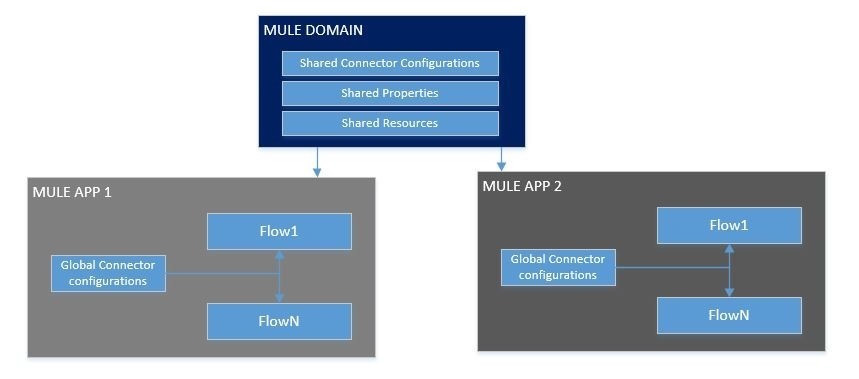
What aspects of a CI/CD pipeline for Mute applications can be automated using MuleSoft-provided Maven plugins?
-
A
Compile, package, unit test, deploy, create associated API instances in API Manager
-
B
Import from API designer, compile, package, unit test, deploy, publish to Am/point Exchange
-
C
Compile, package, unit test, validate unit test coverage, deploy
-
D
Compile, package, unit test, deploy, integration test
Reveal answer details
Close answer details
Question 10
Single choice
What comparison is true about a CloudHub Dedicated Load Balancer (DLB) vs.
the CloudHub Shared Load Balancer (SLB)?
-
A
Only a DLB allows the configuration of a custom TLS server certificate
-
B
Only the SLB can forward HTTP traffic to the VPC-internal ports of the CloudHub workers
-
C
Both a DLB and the SLB allow the configuration of access control via IP whitelists
-
D
Both a DLB and the SLB implement load balancing by sending HTTP requests to workers with the lowest workloads
Reveal answer details
Close answer details
Correct answerA
Explanation* Shared load balancers don't allow you to configure custom SSL certificates or proxy rules
* Dedicated Load Balancer are optional but you need to purchase them additionally if needed.
* TLS is a cryptographic protocol that provides communications security for your Mule app. TLS offers many different ways of exchanging keys for authentication, encrypting data, and guaranteeing message integrity.
* The CloudHub Shared Load Balancer terminates TLS connections and uses its own server-side
certificate.
* Only a DLB allows the configuration of a custom TLS server certificate
* DLB enables you to define SSL configurations to provide custom certificates and optionally enforce two-
way SSL client authentication.
* To use a DLB in your environment, you must first create an Anypoint VPC. Because you can associate multiple environments with the same Anypoint VPC, you can use the same dedicated load balancer for your different environments.
* MuleSoft Reference:
https://docs.mulesoft.com/runtime-manager/dedicated-load-balancer-tutorial
Additional Info on SLB Vs DLB: 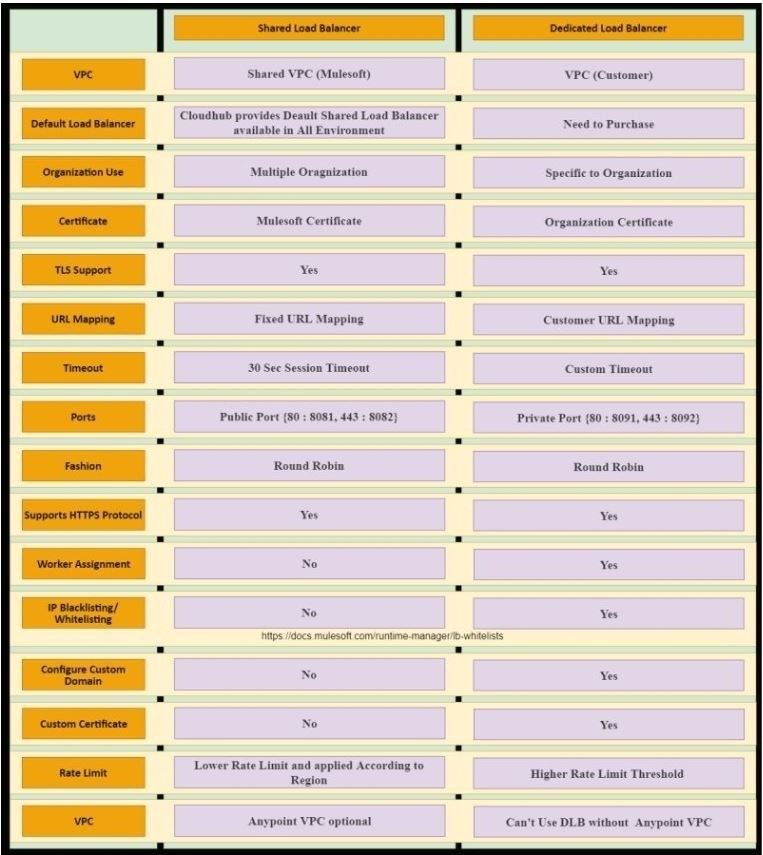
Question 11
Single choice
A system API EmployeeSAPI is used to fetch employee's data from an underlying SQL database. The architect must design a caching strategy to query the database only when there is an update to the employees stable or else return a cached response in order to minimize the number of redundant transactions being handled by the database. What must the architect do to achieve the caching objective?
-
A
Use an On Table Row on employees table and call invalidate cache Use an object store caching strategy and expiration interval to empty
-
B
Use a Scheduler with a fixed frequency every hour triggering an invalidate cache flow Use an object store caching strategy and expiration interval to empty
-
C
Use a Scheduler with a fixed frequency every hour triggering an invalidate cache flow Use an object store caching strategy and set expiration interval to 1-hour
-
D
Use an on table rule on employees table call invalidate cache and said new employees data to cache
Use an object store caching strategy and set expiration interval to 1-hour
Reveal answer details
Close answer details
Correct answerA
ExplanationTo achieve efficient caching and reduce redundant database transactions, the following strategy can be implemented: On Table Row Listener: Implement an "On Table Row" trigger on the employees' table. This trigger will monitor changes (inserts, updates, deletes) in the employee records. Invalidate Cache: Upon detecting changes in the employees' table, the trigger will call a flow to invalidate the current cache. Object Store for Caching: Utilize MuleSoft's object store to cache the employee data. This store can hold the data for quick retrieval. Set Expiration Interval: Configure the expiration interval for the cached data to ensure it is cleared when necessary. For this scenario, since we are invalidating cache on actual data changes, setting the expiration interval to empty can be suitable.
Return Cached Data: If there are no updates, the cached response is returned, reducing database load.
References:
MuleSoft Documentation on Object Store Caching Strategies
Question 12
Single choice
According to MuleSoft's recommended REST conventions, which HTTP method should an API use to specify how AP\ clients can request data from a specified resource?
-
A
-
B
-
C
-
D
Reveal answer details
Close answer details
Correct answerD
ExplanationAccording to MuleSoft's recommended REST conventions, the HTTP method GET should be used to specify how API clients can request data from a specified resource. The GET method is designed to retrieve data from a server at the specified resource. It is one of the most common HTTP methods used in RESTful APIs, ensuring that data retrieval is performed without any side effects on the server or resource.
References:
MuleSoft REST API Design Best Practices
HTTP Methods in RESTful Services
Question 13
Single choice
An organization is creating a Mule application that will be deployed to CloudHub. The Mule application has a property named dbPassword that stores a database user's password. The organization's security standards indicate that the dbPassword property must be hidden from every Anypoint Platform user after the value is set in the Runtime Manager Properties tab. What configuration in the Mule application helps hide the dbPassword property value in Runtime Manager?
-
A
Use secure::dbPassword as the property placeholder name and store the cleartext (unencrypted) value
in a secure properties placeholder file
-
B
Use secure::dbPassword as the property placeholder name and store the property encrypted value in a
secure properties placeholder file
-
C
Add the dbPassword property to the secureProperties section of the pom.xml file
-
D
Add the dbPassword property to the secureProperties section of the mule-artifact.json file
Reveal answer details
Close answer details
Correct answerB
ExplanationReferences:
https://docs.mulesoft.com/runtime-manager/secure-application-properties
Question 14
Single choice
A company is using Mulesoft to develop API's and deploy them to Cloudhub and on premises targets.
Recently it has decided to enable Runtime Fabric deployment option as well and infrastructure is set up for this option. What can be used to deploy Runtime Fabric?
-
A
-
B
Anypoint platform REST API's
-
C
Directly uploading ajar file from the Runtime manager
-
D
Reveal answer details
Close answer details
Correct answerA
ExplanationWhen deploying to Runtime Fabric, there are several tools available within the Anypoint Platform ecosystem that facilitate the deployment process. These include: AnypointCLI: This command-line interface tool provides comprehensive capabilities for deploying applications to Runtime Fabric. Using AnypointCLI, you can script and automate deployments, which is useful for integrating into CI/CD pipelines.
Anypoint Platform REST APIs: These APIs allow for programmatic deployment and management of applications on Runtime Fabric. They provide flexibility for integrating deployment processes with other systems and tools. Mule Maven Plugin: This plugin can be used within a Maven project to package and deploy Mule applications to Runtime Fabric as part of a build process. However, directly uploading a JAR file from the Runtime Manager is not a supported method for deploying to Runtime Fabric.
References:
Anypoint CLI Documentation
Mule Maven Plugin Documentation
Question 15
Single choice
An organization is designing an integration solution to replicate financial transaction data from a legacy system into a data warehouse (DWH). The DWH must contain a daily snapshot of financial transactions, to be delivered as a CSV file. Daily transaction volume exceeds tens of millions of records, with significant spikes in volume during popular shopping periods. What is the most appropriate integration style for an integration solution that meets the organization's current requirements?
-
A
Event-driven architecture
-
B
Microservice architecture
-
C
-
D
Reveal answer details
Close answer details
Correct answerD
ExplanationCorrect answer is Batch-triggered ETL Within a Mule application, batch processing provides a construct for asynchronously processing larger-than-memory data sets that are split into individual records. Batch jobs allow for the description of a reliable process that automatically splits up source data and stores it into persistent queues, which makes it possible to process large data sets while providing reliability. In the event that the application is redeployed or Mule crashes, the job execution is able to resume at the point it
stopped.
Question 16
Single choice
An Order microservice and a Fulfillment microservice are being designed to communicate with their dients through message-based integration (and NOT through API invocations). The Order microservice publishes an Order message (a kind of command message) containing the details of an order to be fulfilled. The intention is that Order messages are only consumed by one Mute application, the Fulfillment microservice. The Fulfilment microservice consumes Order messages, fulfills the order described therein, and then publishes an OrderFulfilted message (a kind of event message). Each OrderFulfilted message can be consumed by any interested Mule application, and the Order microservice is one such Mute application. What is the most appropriate choice of message broker(s) and message destination(s) in this scenario?
-
A
Order messages are sent to an Anypoint MQ exchange OrderFulfilled messages are sent to an Anypoint MQ queue Both microservices interact with Anypoint MQ as the message broker, which must therefore scale to support the load of both microservices
-
B
Order messages are sent to a JMS queue. OrderFulfilled messages are sent to a JMS topic Both microservices interact with the same JMS provider (message broker) instance, which must therefore scale to support the load of both microservices
-
C
Order messages are sent directly to the Fulfillment microservices. OrderFulfilled messages are sent directly to the Order microservice.
The Order microservice interacts with one AMQP-compatible message broker and the Fulfillment microservice interacts with a different AMQP-compatible message broker, so that both message brokers can be chosen and scaled to best support the load of each microservice
-
D
Order messages are sent to a JMS queue. OrderFulfilled messages are sent to a JMS topic The Order microservice interacts with one JMS provider (message broker) and the Fulfillment microservice interacts with a different JMS provider, so that both message brokers can be chosen and scaled to best support the load of each microservice
Reveal answer details
Close answer details
Correct answerB
Explanation* If you need to scale a JMS provider/ message broker, - add nodes to scale it horizontally or - add memory to scale it vertically * Cons of adding another JMS provider/ message broker: - adds cost. - adds complexity to use two JMS brokers - adds Operational overhead if we use two brokers, say, ActiveMQ and IBM MQ * So Two options that mention to use two brokers are not best choice. * It's mentioned that "The Fulfillment microservice consumes Order messages, fulfills the order described therein, and then publishes an OrderFulfilled message. Each OrderFulfilled message can be consumed by any interested Mule application." - When you publish a message on a topic, it goes to all the subscribers who are interested - so zero to many subscribers will receive a copy of the message. - When you send a message on a queue, it will be received by exactly one consumer. * As we need multiple consumers to consume the message below option is not valid choice: "Order messages are sent to an Anypoint MQ exchange. OrderFulfilled messages are sent to an Anypoint MQ queue. Both microservices interact with Anypoint MQ as the message broker, which must therefore scale to support the load of both microservices" * Order messages are only consumed by one Mule application, the Fulfillment microservice, so we will publish it on queue and OrderFulfilled message can be consumed by any interested Mule application so it need to be published on Topic using same broker. *
Correct Answer:
Best choice in this scenario is: "Order messages are sent to a JMS queue. OrderFulfilled messages are sent to a JMS topic. Both microservices interact with the same JMS provider (message broker) instance, which must therefore scale to support the load of both microservices" Tried to depict scenario in diagram: 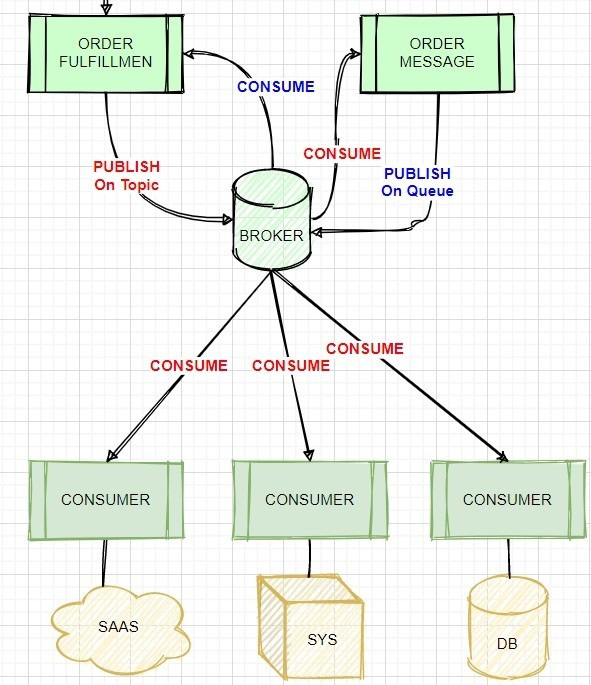
Question 17
Single choice
An organization has strict unit test requirement that mandate every mule application must have an MUnit test suit with a test case defined for each flow and a minimum test coverage of 80%. A developer is building Munit test suit for a newly developed mule application that sends API request to an external rest API. What is the effective approach for successfully executing the Munit tests of this new application while still achieving the required test coverage for the Munit tests?
-
A
Invoke the external endpoint of the rest API from the mule floors
-
B
Mark the rest API invocations in the Munits and then call the mocking service flow that simulates standard responses from the REST API
-
C
Mock the rest API invocation in the Munits and return a mock response for those invocations
-
D
Create a mocking service flow to simulate standard responses from the rest API and then configure the mule flows to call the marking service flow
Reveal answer details
Close answer details
Correct answerC
ExplanationMocking REST API Invocations:
Achieving Test Coverage:
Execution of MUnit Tests:
References:
MuleSoft Documentation on MUnit Testing Best practices for Mocking in MUnit
Question 18
Single choice
An organization has decided on a cloud migration strategy to minimize the organization's own IT resources. Currently the organization has all of its new applications running on its own premises and uses an on-premises load balancer that exposes all APIs under the base URL (https://api.rutujar.com). As part of migration strategy, the organization is planning to migrate all of its new applications and load balancer CloudHub. What is the most straightforward and cost-effective approach to Mule application deployment and load balancing that preserves the public URL's?
-
A
Deploy the Mule application to Cloudhub Create a CNAME record for base URL( httpsr://api.rutujar.com) in the Cloudhub shared load balancer that points to the A record of theon-premises load balancer Apply mapping rules in SLB to map URLto
their corresponding Mule applications
-
B
Deploy the Mule application to Cloudhub Update a CNAME record for base URL ( https://api.rutujar.com) in the organization's DNS server to point to the A record of the Cloudhub dedicated load balancer Apply mapping rules in DLB to map URLto their corresponding Mule applications
-
C
Deploy the Mule application to Cloudhub Update a CNAME record for base URL ( https://api.rutujar.com) in the organization's DNS server to point to the A record of the CloudHub shared load balancer Apply mapping rules in SLB to map URLto
their corresponding Mule applications
-
D
For each migrated Mule application, deploy an API proxy application to Cloudhub with all traffic to the mule applications routed through a Cloud Hub Dedicated load balancer (DLB) Update a CNAME record for base URL ( https://api.rutujar.com) in the organization's DNS server to point to the A record of the CloudHub dedicated load balancer Apply mapping rules in DLB to map each API proxy application who is responding new application
Reveal answer details
Close answer details
Correct answerC
ExplanationFor an organization migrating its Mule applications and load balancer to CloudHub while preserving its public URL, the most straightforward and cost-effective approach involves leveraging CloudHub's shared load balancer (SLB). Here's how to do it: Deploying Mule Applications to CloudHub:
DNS Configuration:
Configuring Shared Load Balancer (SLB):
Steps to Apply Mapping Rules: Benefits of Using SLB:
References:
MuleSoft Documentation on CloudHub Deployment MuleSoft Documentation on Shared Load Balancer
By following these steps, the organization can effectively migrate its applications to CloudHub, ensuring minimal disruption and preserving the existing public URL structure.
Question 19
Single choice
A Mule application is being designed for deployment to a single CloudHub worker. The Mule application will have a flow that connects to a SaaS system to perform some operations each time the flow is invoked. The SaaS system connector has operations that can be configured to request a short-lived token (fifteen minutes) that can be reused for subsequent connections within the fifteen minute time window. After the token expires, a new token must be requested and stored. What is the most performant and idiomatic (used for its intended purpose) Anypoint Platform component or service to use to support persisting and reusing tokens in the Mule application to help speed up reconnecting the Mule application to the SaaS application?
-
A
Nonpersistent object store
-
B
-
C
-
D
Reveal answer details
Close answer details
Correct answerD
ExplanationReferences:
https://docs.mulesoft.com/mule-runtime/4.4/reconnection-strategy-about
Question 20
Single choice
What requirement prevents using Anypoint MQ as the messaging broker for a Mule application?
-
A
When the payload sent through the message broker must use XML format
-
B
When the payload sent through the message broker must be encrypted
-
C
When the messaging broker must support point-to-point messaging
-
D
When the messaging broker must be deployed on-premises
Reveal answer details
Close answer details
Correct answerD
ExplanationAnypoint MQ is a cloud-based messaging service provided by MuleSoft, and it cannot be deployed on-premises. If there is a requirement for the messaging broker to be deployed on-premises, Anypoint MQ would not be suitable. Other considerations such as payload format (XML), encryption, and point-to-point messaging are supported by Anypoint MQ, but the deployment environment requirement is a critical constraint.
References:
MuleSoft Anypoint MQ Documentation
Cloud vs. On-Premises Messaging Solutions
Question 21
Single choice
A company is modernizing its legal systems lo accelerate access lo applications and data while supporting the adoption of new technologies. The key to achieving this business goal is unlocking the companies' key systems and dala including microservices miming under Docker and kubernetes containers using apis.
Considering the current aggressive backlog and project delivery requirements the company wants to take a strategic approach in the first phase of its transformation projects by quickly deploying API's in mule runtime that are able lo scale, connect to on premises systems and migrate as needed. Which runtime deployment option supports company's goals?
-
A
Customer hosted self provisioned runtimes
-
B
-
C
Runtime fabric on self managed Kubernetes
-
D
Runtime fabric on Vmware metal
Reveal answer details
Close answer details
Correct answerC
ExplanationTo support the company's goals of unlocking key systems and data, quickly deploying scalable APIs, and connecting to on-premises systems, while also preparing for future migrations, the best runtime deployment option is using Runtime Fabric on self-managed Kubernetes. Here's why: Scalability: Kubernetes is designed to scale applications easily and efficiently. By deploying Mule runtimes on a self-managed Kubernetes cluster, the company can dynamically scale its APIs based on demand, ensuring performance and reliability. Flexibility: Running on self-managed Kubernetes allows the company to have control over the infrastructure. They can customize the environment to meet their specific needs, integrate with existing on-premises systems, and support their microservices architecture running in Docker containers.
Future-Proofing: Kubernetes supports hybrid and multi-cloud deployments, making it easier to migrate workloads between different environments as needed. This aligns with the company's goal of being able to migrate their systems as part of their strategic approach.
Efficiency: By leveraging Kubernetes, the company can automate deployment, scaling, and management of containerized applications, reducing the burden on IT and DevOps teams.
References:
MuleSoft Documentation on Runtime Fabric: (https://docs.mulesoft.com/runtime-fabric/1.9/)
Kubernetes Documentation: (https://kubernetes.io/docs/home/)
Question 22
Single choice
An integration team uses Anypoint Platform and follows MuleSoft's recommended approach to full lifecycle
API development. Which step should the team's API designer take before the API developers implement the AP!
Specification?
-
A
Generate test cases using MUnit so the API developers can observe the results of running the API
-
B
Use the scaffolding capability of Anypoint Studio to create an API portal based on the API specification
-
C
Publish the API specification to Exchange and solicit feedback from the API's consumers
-
D
Use API Manager to version the API specification
Reveal answer details
Close answer details
Correct answerC
ExplanationBefore API developers implement the API specification, it is crucial for the API designer to publish the API specification to Anypoint Exchange and solicit feedback from the API's consumers. This step aligns with MuleSoft's recommended approach to full lifecycle API development, which emphasizes collaboration and feedback to ensure the API meets the needs and expectations of its consumers. Generating test cases, creating an API portal, and versioning the API specification are important steps in the development lifecycle, but soliciting feedback ensures that any potential issues or improvements are identified early in the process.
This collaborative approach helps in building a more effective and consumer-friendly API.
References:
MuleSoft API Design Best Practices
Anypoint Platform Documentation on API Development Lifecycle
Question 23
Single choice
An organization's IT team must secure all of the internal APIs within an integration solution by using an API proxy to apply required authentication and authorization policies. Which integration technology, when used for its intended purpose, should the team choose to meet these requirements if all other relevant factors are equal?
-
A
-
B
Robotic Process Automation (RPA)
-
C
Electronic Data Interchange (EDI)
-
D
Integration Platform-as-a-service (PaaS)
Reveal answer details
Close answer details
Correct answerA
ExplanationTo secure all internal APIs within an integration solution by using an API proxy to apply required authentication and authorization policies, the organization should use API Management (APIM). APIM provides a comprehensive platform to manage, secure, and analyze APIs. It allows the IT team to create API proxies, enforce security policies, control access through authentication and authorization mechanisms, and monitor API usage. Using APIM for this purpose ensures that internal APIs are protected with standardized security policies, facilitating centralized management and governance of API traffic. This approach is specifically designed for managing APIs and their security, making it the most suitable choice among the options provided.
References:
MuleSoft Documentation on API Management Best Practices for API Security and Governance
Question 24
Single choice
An Organization has previously provisioned its own AWS VPC hosting various servers. The organization now needs to use Cloudhub to host a Mule application that will implement a REST API once deployed to Cloudhub, this Mule application must be able to communicate securely with the customer-provisioned AWS VPC resources within the same region, without being interceptable on the public internet. What Anypoint Platform features should be used to meet these network communication requirements between Cloudhub and the existing customer-provisioned AWS VPC?
-
A
Add a Mulesoft hosted Anypoint VPC configured and with VPC Peering to the AWS VPC
-
B
Configure an external identity provider (IDP) in Anypoint Platform with certificates from the customer provisioned AWS VPC
-
C
Add a default API Whitelisting policy to API Manager to automatically whitelist the customer provisioned AWS VPC IP ranges needed by the Mule applicaton
-
D
Use VM queues in the Mule application to allow any non-mule assets within the customer provisioned AWS VPC to subscribed to and receive messages
Reveal answer details
Close answer details
Correct answerA
ExplanationCorrect answer is: Add a Mulesoft hosted Anypoint VPC configured and with VPC Peering to the AWS VPC * Connecting to your Anypoint VPC extends your corporate network and allows CloudHub workers to access resources behind your corporate firewall.
* You can connect on-premises data centers through a secured VPN tunnel, or a private AWS VPC through VPC peering, or by using AWS Direct Connect. MuleSoft Doc Reference :
https://docs.mulesoft.com/runtime-manager/virtual-private-cloud
Question 25
Multiple choice
A manufacturing company is developing a new set of APIs for its retail business. One of the APIs is a Master Look Up API, which is a System API, The API uses a persistent object-store. This API will be used by almost all other APIs to provide master lookup data. The Master Look Up API is deployed on two CloudHub workers of 0.1 vCore each because there is a lot of master data to be cached. Most of the master lookup data is stored as a key-value pair. The cache gets refreshed if the key is not found in the cache. During performance testing, it was determined that the Master Look Up API has a high response time due to the latency of database queries executed to fetch the master lookup data. What two methods can be used to resolve these performance issues? 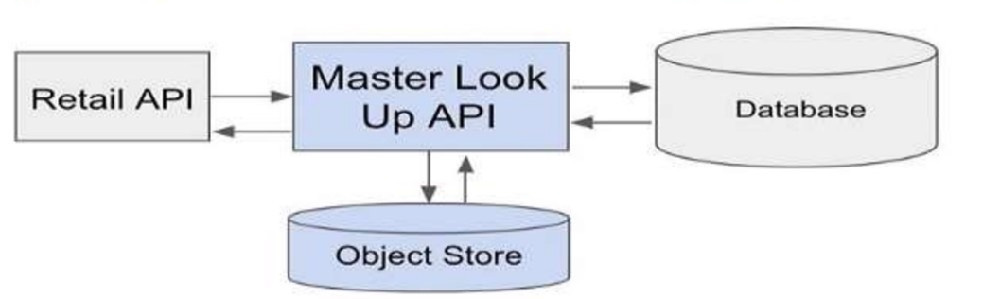 Choose 2 answers
-
A
Implement the HTTP caching policy for all GET endpoints for the Master Look Up API
-
B
Implement an HTTP caching policy for all GET endpoints in the Master Look Up API
-
C
Implement locking to synchronize access to the Object Store
-
D
Upgrade the vCore size from 0.1 vCore to 0.2 vCore
Reveal answer details
Close answer details
Correct answersA, D
ExplanationAnTo resolve performance issues with the Master Look Up API, the following methods can be applied: Implement the HTTP caching policy for all GET endpoints for the Master Look Up API: This caching policy helps reduce the number of database queries by storing frequently accessed data in cache, thus improving response times for subsequent requests.
Upgrade the vCore size from 0.1 vCore to 0.2 vCore: Increasing the vCore size can provide more computational resources, which can improve the processing power and overall performance of the API, particularly under high load conditions.
References:
HTTP Caching Policy
Scaling and Performance
swer: A
Question 26
Single choice
An API implementation is being designed that must invoke an Order API which is known to repeatedly experience downtime. For this reason a fallback API is to be called when the Order API is unavailable. What approach to designing invocation of the fallback API provides the best resilience?
-
A
Redirect client requests through an HTTP 303 temporary redirect status code to the fallback API whenever the Order API is unavailable
-
B
Set an option in the HTTP Requester component that invokes the order API to instead invoke a fallback API whenever an HTTP 4XX or 5XX response status code is received from Order API
-
C
Create a separate entry for the order API in API manager and then invoke this API as a fallback API if the primary Order API is unavailable
-
D
Search Anypoint Exchange for a suitable existing fallback API and them implement invocations to their fallback API in addition to the Order API
Reveal answer details
Close answer details
Correct answerA
Explanation* Resilience testing is a type of software testing that observes how applications act under stress. It's meant to ensure the product's ability to perform in chaotic conditions without a loss of core functions or data; it
ensures a quick recovery after unforeseen, uncontrollable events.
* In case an API invocation fails --even after a certain number of retries --it might be adequate to invoke a different API as a fallback. A fallback API, by definition, will never be ideal for the purpose of the API client, otherwise it would be the primary API.
* Here are some examples for fallback APIs:
-An old, deprecated version of the same API.
-An alternative endpoint of the same API and version (e.g. API in another CloudHub region).
-An API doing more than required, and therefore not as performant as the primary API.
-An API doing less than required and therefore forcing the API Client to offer a degraded service, which is still better than no service at all.
* API clients implemented as Mule applications offer the `Until Successful Scope and Exception' strategies at their disposal, which together allow configuring fallback actions such as a fallback API invocation.
* All HTTP response status codes within the 3xx category are considered redirection messages. These codes indicate to the user agent (i.e. your web browser) that an additional action is required in order to complete the request and access the desired resource 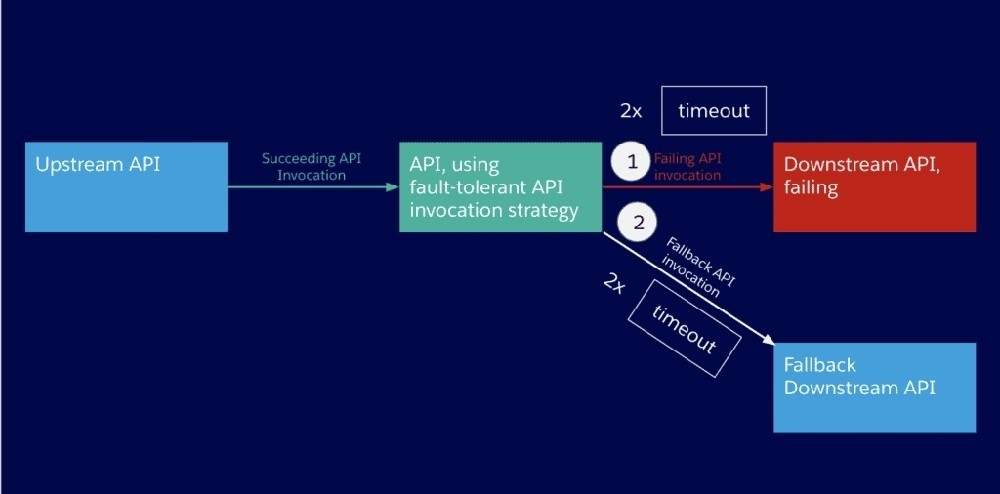 Hence correct answer is Redirect client requests through an HTTP 303 temporary redirect status code to the fallback API whenever the Order API is unavailable
Question 27
Single choice
What is a core pillar of the MuleSoft Catalyst delivery approach?
-
A
-
B
Technology centralization
-
C
-
D
Reveal answer details
Close answer details
Correct answerA
ExplanationA core pillar of the MuleSoft Catalyst delivery approach is focusing on business outcomes. This approach ensures that the integration and API strategies are aligned with the organization's overall business objectives. By emphasizing business outcomes, MuleSoft Catalyst helps organizations realize measurable benefits such as increased efficiency, faster time to market, and improved customer experiences. This outcome-driven methodology ensures that IT initiatives deliver tangible value to the business.
References:
MuleSoft Catalyst: Methodology Overview
Business Outcomes with MuleSof
Question 28
Single choice
A new Mule application under development must implement extensive data transformation logic. Some of the data transformation functionality is already available as external transformation services that are
mature and widely used across the organization; the rest is highly specific to the new Mule application. The organization follows a rigorous testing approach, where every service and application must be extensively acceptance tested before it is allowed to go into production. What is the best way to implement the data transformation logic for this new Mule application while minimizing the overall testing effort?
-
A
Implement and expose all transformation logic as mlaoservices using DataWeave, so it can be reused by any application component that needs it, including the new Mule application
-
B
Implement transformation logic in the new Mute application using DataWeave, replicating the transformation logic of existing transformation services
-
C
Extend the existing transformation services with new transformation logic and Invoke them from the new Mule application
-
D
Implement transformation logic in the new Mute application using DataWeave, invoking existing transformation services when possible
Reveal answer details
Close answer details
Correct answerD
ExplanationCorrect answer is Implement transformation logic in the new Mule application using DataWeave, invoking existing transformation services when possible. * The key here minimal testing effort, "Extend existing transformation logic" is not a feasible option because additional functionality is highly specific to the new Mule application so it should not be a part of commonly used functionality. So this option is ruled out. *
"Implement transformation logic in the new Mule application using DataWeave, replicating the transformation logic of existing transformation services" Replicating the transformation logic of existing transformation services will cause duplicity of code. So this option is ruled out. * "Implement and expose all transformation logic as microservices using DataWeave, so it can be reused by any application component that needs it, including the new Mule application" as question specifies that the transformation is app specific and wont be used outside
Question 29
Multiple choice
What are two reasons why a typical MuleSoft customer favors a MuleSoft-hosted Anypoint Platform runtime plane over a customer-hosted runtime for its Mule application deployments? (Choose two.)
-
A
Reduced application latency
-
B
Increased application isolation
-
C
Reduced time-to-market for the first application
-
D
Increased application throughput
-
E
Reduced IT operations effort
Reveal answer details
Close answer details
Correct answersC, E
ExplanationMuleSoft customers often favor a MuleSoft-hosted Anypoint Platform runtime plane over a customer-hosted runtime for the following reasons: Reduced time-to-market for the first application (C): Using a MuleSoft-hosted runtime plane accelerates the deployment process because MuleSoft manages the infrastructure, allowing customers to focus on developing and deploying their applications quickly. This leads to faster time-to-market for the initial application and subsequent updates.
Reduced IT operations effort (E): By leveraging a MuleSoft-hosted environment, customers offload the operational responsibilities, such as infrastructure maintenance, updates, and scalability management, to MuleSoft. This reduces the IT operations workload and allows internal teams to focus on more strategic initiatives.
In contrast, other options like reduced application latency and increased application throughput are not directly influenced by whether the runtime plane is MuleSoft-hosted or customer-hosted.
References:
MuleSoft Anypoint Platform Documentation
MuleSoft Hosted vs. Customer Hosted Deployment Guides
Question 30
Single choice
A Mule application is running on a customer-hosted Mule runtime in an organization's network. The Mule application acts as a producer of asynchronous Mule events. Each Mule event must be broadcast to all interested external consumers outside the Mule application. The Mule events should be published in a way that is guaranteed in normal situations and also minimizes duplicate delivery in less frequent failure scenarios. The organizational firewall is configured to only allow outbound traffic on ports 80 and 443. Some external
event consumers are within the organizational network, while others are located outside the firewall. What Anypoint Platform service is most idiomatic (used for its intended purpose) for publishing these Mule events to all external consumers while addressing the desired reliability goals?
-
A
-
B
-
C
-
D
CloudHub Shared Load Balancer
Reveal answer details
Close answer details
Correct answerB
ExplanationSet the Anypoint MQ connector operation to publish or consume messages, or to accept (ACK) or not accept (NACK) a message. References:
https://docs.mulesoft.com/mq/
Question 31
Single choice
A global organization operates datacenters in many countries. There are private network links between these datacenters because all business data (but NOT metadata) must be exchanged over these private network connections. The organization does not currently use AWS in any way. The strategic decision has Just been made to rigorously minimize IT operations effort and investment going forward. What combination of deployment options of the Anypoint Platform control plane and runtime plane(s) best serves this organization at the start of this strategic journey?
-
A
MuleSoft-hosted Anypoint Platform control plane CloudHub Shared Worker Cloud in multiple AWS regions
-
B
Anypoint Platform -Private Cloud Edition Customer-hosted runtime plane in each datacenter
-
C
MuleSoft-hosted Anypoint Platform control plane Customer-hosted runtime plane in multiple AWS regions
-
D
MuleSoft-hosted Anypoint Platform control plane Customer-hosted runtime plane in each datacenter
Reveal answer details
Close answer details
Correct answerD
ExplanationCorrect answer is MuleSoft-hosted Anypoint Platform control plane Customer-hosted runtime plane in each datacenter There are two things to note about the question which can help us figure out correct answer.. * Business data must be exchanged over these private network connections which means we can not use MuleSoft provided Cloudhub option. So we are left with either customer hosted runtime in external cloud provider or customer hosted runtime in their own premises. As customer does not use AWS at the moment. Hence that don't have the immediate option of using Customer-hosted runtime plane in multiple AWS regions. hence the most suitable option for runtime plane is Customer-hosted runtime plane in each datacenter * Metadata has no limitation to reside in organization premises. Hence for control plane MuleSoft hosted Anypoint platform can be used as a strategic solution. Hybrid is the best choice to start.
Mule hosted Control plane and Customer hosted Runtime to start with.Once they mature in cloud migration, everything can be in Mule hosted.
Question 32
Single choice
Which productivity advantage does Anypoint Platform have to both implement and manage an AP?
-
A
Automatic API proxy generation
-
B
Automatic API specification generation
-
C
Automatic API semantic versioning
-
D
Reveal answer details
Close answer details
Correct answerA
ExplanationAnypoint Platform provides the productivity advantage of automatic API proxy generation. This feature enables developers to quickly create proxies for their APIs, which act as intermediaries that forward requests to the appropriate backend services. Automatic proxy generation simplifies the process of securing and managing APIs, allowing developers to enforce policies, monitor traffic, and analyze usage without having to manually configure these aspects.
References:
API Proxies on Anypoint Platform Improving API Productivity with Anypoint Platform
Question 33
Single choice
An organization if struggling frequent plugin version upgrades and external plugin project dependencies.
The team wants to minimize the impact on applications by creating best practices that will define a set of default dependencies across all new and in progress projects. How can these best practices be achieved with the applications having the least amount of responsibility?
-
A
Create a Mule plugin project with all the dependencies and add it as a dependency in each
application's POM.xml file
-
B
Create a mule domain project with all the dependencies define in its POM.xml file and add each application to the domain Project
-
C
Add all dependencies in each application's POM.xml file
-
D
Create a parent POM of all the required dependencies and reference each in each application's
POM.xml file
Reveal answer details
Close answer details
Correct answerD
ExplanationRequirement Analysis: The organization wants to standardize dependencies across all new and ongoing MuleSoft projects to minimize the impact of frequent plugin version upgrades and external plugin project dependencies. Solution: Creating a parent POM (Project Object Model) file with all required dependencies and referencing it in each application's POM.xml file is the best practice.
Implementation Steps:
pom</artifactId> <version>1.0.0</version> <packaging>pom</packaging> <dependencyManagement>
<dependencies> <dependency>
<groupId>org.mule.runtime</groupId> <artifactId>mule-core-extensions-maven-plugin</artifactId>
<version>1.0.0</version> </dependency> <!--Add other dependencies here --> </dependencies> </ dependencyManagement> </project> uk.co.certification.simulator.questionpool.PList@1b368240
<project> <modelVersion>4.0.0</modelVersion> <parent>
<groupId>com.example</groupId> <artifactId>parent-pom</artifactId> <version>1.0.0</version> </parent>
<artifactId>child-application</artifactId> <version>1.0.0</version> <!--Application specific dependencies
and configurations --> </ project> uk.co.certification.simulator.questionpool.PList@1b368950 References:
MuleSoft Documentation on Managing dependencies with Maven Apache Maven Documentation on POM Reference
Question 34
Single choice
Additional nodes are being added to an existing customer-hosted Mule runtime cluster to improve performance. Mule applications deployed to this cluster are invoked by API clients through a load balancer. What is also required to carry out this change?
-
A
A new load balancer must be provisioned to allow traffic to the new nodes in a round-robin fashion
-
B
External monitoring tools or log aggregators must be configured to recognize the new nodes
-
C
API implementations using an object store must be adjusted to recognize the new nodes and persist to them
-
D
New firewall rules must be configured to accommodate communication between API clients and the new nodes
Reveal answer details
Close answer details
Correct answerB
Explanation* Clustering is a group of servers or mule runtime which acts as a single unit.
* Mulesoft Enterprise Edition supports scalable clustering to provide high availability for the Mulesoft
application.
* In simple terms, virtual servers composed of multiple nodes and they communicate and share information through a distributed shared memory grid.
* By default, Mulesoft ensures the High availability of applications if clustering implemented.
* Let's consider the scenario one of the nodes in cluster crashed or goes down and under maintenance. In such cases, Mulesoft will ensure that requests are processed by other nodes in the cluster. Mulesoft clustering also ensures that the request is load balanced between all the nodes in a cluster.
* Clustering is only supported by on-premise Mule runtime and it is not supported in Cloudhub. Correct answer is External monitoring tools or log aggregators must be configured to recognize the new nodes
* Rest of the options are automatically taken care of when a new node is added in cluster. References:
https://docs.mulesoft.com/runtime-manager/cluster-about
Question 35
Single choice
A company is designing a mule application to consume batch data from a partner's ftps server The data files have been compressed and then digitally signed using PGP. What inputs are required for the application to securely consumed these files?
-
A
ATLS context Key Store requiring the private key and certificate for the company PGP public key of partner PGP private key for the company
-
B
ATLS context first store containing a public certificate for partner ftps server and the PGP public key of the partner TLS contact Key Store containing the FTP credentials
-
C
TLS context trust or containing a public certificate for the ftps server The FTP username and password
The PGP public key of the partner
-
D
The PGP public key of the partner
The PGP private key for the company
The FTP username and password
Reveal answer details
Close answer details
Correct answerD
ExplanationTo securely consume compressed and digitally signed files from a partner's FTPS server, the following inputs are required: PGP Public Key of the Partner: PGP Private Key for the Company: FTP Username and Password: By using these inputs, the Mule application can securely connect to the FTPS server, verify the integrity and authenticity of the files using PGP, and decrypt the contents for further processing.
References:
MuleSoft FTPS Connector
MuleSoft PGP Module
Question 36
Single choice
A company is building an application network and has deployed four Mule APIs: one experience API, one process API, and two system APIs. The logs from all the APIs are aggregated in an external log aggregation tool. The company wants to trace messages that are exchanged between multiple API implementations. What is the most idiomatic (based on its intended use) identifier that should be used to implement Mule event tracing across the multiple API implementations?
-
A
-
B
-
C
-
D
Reveal answer details
Close answer details
Correct answerB
ExplanationCorrect answer is Mule correlation ID By design, Correlation Ids cannot be changed within a flow in Mule 4 applications and can be set only at source. This ID is part of the Event Context and is generated as soon as the message is received by the application. When a HTTP Request is received, the request is inspected for "X-Correlation-Id" header. If "X-Correlation-Id" header is present, HTTP connector uses this as the Correlation Id. If "X-Correlation-Id" header is NOT present, a Correlation Id is randomly generated. For Incoming HTTP Requests: In order to set a custom Correlation Id, the client invoking the HTTP request must set "X-Correlation-Id" header. This will ensure that the Mule Flow uses this Correlation Id. For Outgoing HTTP Requests: You can also propagate the existing Correlation Id to downstream APIs. By default, all outgoing HTTP Requests send "X-Correlation-Id" header. However, you can choose to set a different value to "X- Correlation-Id" header or set "Send Correlation Id" to NEVER.
Question 37
Single choice
During a planning session with the executive leadership, the development team director presents plans for a new API to expose the data in the company's order database. An earlier effort to build an API on top of this data failed, so the director is recommending a design-first approach. Which characteristics of a design-first approach will help make this API successful?
-
A
Building MUnit tests so administrators can confirm code coverage percentage during deployment
-
B
Publishing the fully implemented API to Exchange so all developers can reuse the API
-
C
Adding global policies to the API so all developers automatically secure the implementation before coding anything
-
D
Developing a specification so consumers can test before the implementation is built
Reveal answer details
Close answer details
Correct answerD
ExplanationA design-first approach in API development focuses on creating a detailed API specification before any implementation begins. This specification acts as a contract that defines the API's endpoints, request/ response formats, and error codes. By developing this specification early, potential consumers can provide feedback, and testing can be conducted against mock implementations to ensure the API meets their needs. This approach helps identify issues early in the development process, improving the likelihood of successful implementation and adoption.
References:
API Design Best Practices
Design-First API Development
Question 38
Single choice
The company's FTPS server login username and password
-
A
TLS context trust store containing a public certificate for the company. The company's PGP public key that was used to sign the files
-
B
The partner's PGP public key used by the company to login to the FTPS server. A TLS context key store containing the private key for the company. The partner's PGP private key that was used to sign the files
-
C
The company's FTPS server login username and password. A TLS context trust store containing a public certificate for ftps.partner.com. The partner's PGP public key that was used to sign the files
-
D
The partner's PGP public key used by the company to login to the FTPS server. A TLS context key store containing the private key for ftps.partner.com The company's PGP private key that was used to sign the files
Reveal answer details
Close answer details
Correct answerC
ExplanationWhen configuring secure communication with an FTPS server and handling signed files, the necessary components include: FTPS Server Login Credentials: The username and password used to authenticate with the company's FTPS server.
TLS Context Trust Store: This should contain the public certificate for the FTPS server (ftps.partner.com) to establish a secure SSL/TLS connection. Partner's PGP Public Key: This is used to verify the signature of the files received from the partner, ensuring data integrity and authenticity. These components collectively ensure secure communication and data validation.
References:
MuleSoft Documentation on FTPS and PGP Encryption Best Practices for Secure File Transfer and Encryption
Question 39
Single choice
What is an advantage of using OAuth 2.0 client credentials and access tokens over only API keys for API authentication?
-
A
If the access token is compromised, the client credentials do not to be reissued.
-
B
If the access token is compromised, I can be exchanged for an API key.
-
C
If the client ID is compromised, it can be exchanged for an API key
-
D
If the client secret is compromised, the client credentials do not have to be reissued.
Reveal answer details
Close answer details
Correct answerA
ExplanationThe advantage of using OAuth 2.0 client credentials and access tokens over only API keys for API authentication is that if the access token is compromised, the client credentials do not have to be reissued.
OAuth 2.0 is a secure protocol for authenticating clients and authorizing them to access protected resources. It works by having the client authenticate with the authorization server and receive an access token, which is then used to authenticate requests to the API. If the access token is compromised, it can be revoked and replaced without needing to reissue the client credentials.
References:
MuleSoft Certified Integration Architect -Level 1 Official Text Book and Resources:
Chapter 7: Security
Section 7.2: OAuth 2.0
According to the National Institute of Standards and Technology (NIST), a hybrid cloud is a cloud computing deployment model that describes a composition of two or more distinct cloud infrastructures (private, community, or public) that remain unique entities but are bound together by standardized or proprietary technology that enables data and application portability. Hybrid clouds allow organizations to leverage the advantages of multiple cloud environments, such as combining the scalability and cost-efficiency of public clouds with the security and control of private clouds. This model facilitates flexibility and dynamic scalability, supporting diverse workloads and business needs while ensuring that sensitive data and applications can remain in a controlled private environment.
References:
NIST Definition of Cloud Computing Hybrid Cloud Overview and Benefits
Question 40
Single choice
An organization has an HTTPS-enabled Mule application named Orders API that receives requests from
another Mule application named Process Orders. The communication between these two Mule applications must be secured by TLS mutual authentication (two-way TLS). At a minimum, what must be stored in each truststore and keystore of these two Mule applications to properly support two-way TLS between the two Mule applications while properly protecting each Mule application's keys?
-
A
Orders API truststore: The Orders API public key Process Orders keystore: The Process Orders private key and public key
-
B
Orders API truststore: The Orders API private key and public key Process Orders keystore: The Process Orders private key public key
-
C
Orders API truststore: The Process Orders public key Orders API keystore: The Orders API private key and public key Process Orders truststore: The Orders
API public key
Process Orders keystore: The Process Orders private key and public key
-
D
Orders API truststore: The Process Orders public key Orders API keystore: The Orders API private key Process Orders truststore: The Orders API public key Process Orders keystore: The Process Orders private key
Reveal answer details
Close answer details
Correct answerC
ExplanationReferences:
https://www.caeliusconsulting.com/blogs/one-way-and-two-way-tls-and-their-implementation-in-mulesoft/
Question 41
Single choice
A developer needs to discover which API specifications have been created within the organization before starting a new project. Which Anypoint Platform component can the developer use to find and try out the currently released API specifications?
-
A
-
B
-
C
-
D
Reveal answer details
Close answer details
Correct answerA
ExplanationTo discover which API specifications have been created within the organization before starting a new project, a developer can use Anypoint Exchange. Anypoint Exchange is a centralized repository on the Anypoint Platform where developers can find, share, and collaborate on API specifications, connectors, templates, and other reusable assets.
In Anypoint Exchange, developers can browse the currently released API specifications, try them out using the built-in testing tools, and access documentation and other resources. This facilitates the reuse of existing APIs and ensures that the new project aligns with the organization's API strategy.
References:
MuleSoft Documentation on Anypoint Exchange Best Practices for API Reuse and Discovery
|