A credit card company wants to build a credit scoring model to help predict whether a new credit card applicant will default on a credit card payment. The company has collected data from a large number of sources with thousands of raw attributes. Early experiments to train a classification model revealed that many attributes are highly correlated, the large number of features slows down the training speed significantly, and that there are some overfitting issues. The Data Scientist on this project would like to speed up the model training time without losing a lot of information from the original dataset. Which feature engineering technique should the Data Scientist use to meet the objectives?
-
A
Run self-correlation on all features and remove highly correlated features
-
B
Normalize all numerical values to be between 0 and 1
-
C
Use an autoencoder or principal component analysis (PCA) to replace original features with new features
-
D
Cluster raw data using k-means and use sample data from each cluster to build a new dataset
Reveal answer details
Close answer details
Correct answerC
ExplanationUsing an autoencoder or PCA can help reduce the dimensionality of the dataset by creating new features that capture the most important information in the original dataset while discarding some of the noise and highly correlated features. This can help speed up the training time and reduce overfitting issues without losing a lot of information from the original dataset.
Given the following confusion matrix for a movie classification model, what is the true class frequency for Romance and the predicted class frequency for Adventure? 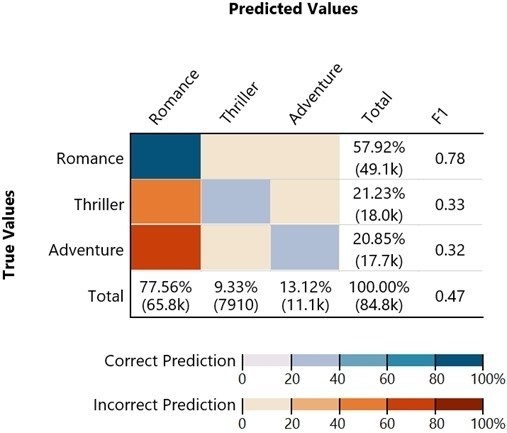
-
A
The true class frequency for Romance is 77.56% and the predicted class frequency for Adventure is
20.85%
-
B
The true class frequency for Romance is 57.92% and the predicted class frequency for Adventure is
13.12%
-
C
The true class frequency for Romance is 0.78% and the predicted class frequency for Adventure is
(0.47-0.32)
-
D
The true class frequency for Romance is 77.56% - 0.78 and the predicted class frequency for Adventure is 20.85% - 0.32
Reveal answer details
Close answer details
Correct answerB
Explanationhttps://vceguide.com/what-is-the-true-class-frequency-for-romance-and-the-predicted-class-frequency-for-adventure/
Question 3
Multiple choice
A company is creating an application to identify, count, and classify animal images that are uploaded to the company's website. The company is using the Amazon SageMaker image classification algorithm with an ImageNetV2 convolutional neural network (CNN). The solution works well for most animal images but does not recognize many animal species that are less common. The company obtains 10,000 labeled images of less common animal species and stores the images in Amazon S3. A machine learning (ML) engineer needs to incorporate the images into the model by using Pipe mode in SageMaker. Which combination of steps should the ML engineer take to train the model? (Choose two.)
-
A
Use a ResNet model. Initiate full training mode by initializing the network with random weights.
-
B
Use an Inception model that is available with the SageMaker image classification algorithm.
-
C
Create a .lst file that contains a list of image files and corresponding class labels. Upload the .lst file to Amazon S3.
-
D
Initiate transfer learning. Train the model by using the images of less common species.
-
E
Use an augmented manifest file in JSON Lines format.
Reveal answer details
Close answer details
A car company has dealership locations in multiple cities. The company uses a machine learning (ML) recommendation system to market cars to its customers. An ML engineer trained the ML recommendation model on a dataset that includes multiple attributes about each car. The dataset includes attributes such as car brand, car type, fuel efficiency, and price. The ML engineer uses Amazon SageMaker Data Wrangler to analyze and visualize data. The ML engineer needs to identify the distribution of car prices for a specific type of car. Which type of visualization should the ML engineer use to meet these requirements?
-
A
Use the SageMaker Data Wrangler scatter plot visualization to inspect the relationship between the car price and type of car.
-
B
Use the SageMaker Data Wrangler quick model visualization to quickly evaluate the data and produce importance scores for the car price and type of car.
-
C
Use the SageMaker Data Wrangler anomaly detection visualization to Identify outliers for the specific features.
-
D
Use the SageMaker Data Wrangler histogram visualization to inspect the range of values for the specific feature.
Reveal answer details
Close answer details
A data scientist is developing a pipeline to ingest streaming web traffic data. The data scientist needs to implement a process to identify unusual web traffic patterns as part of the pipeline. The patterns will be used downstream for alerting and incident response. The data scientist has access to unlabeled historic data to use, if needed. The solution needs to do the following: Calculate an anomaly score for each web traffic entry.
Adapt unusual event identification to changing web patterns over time. Which approach should the data scientist implement to meet these requirements?
-
A
Use historic web traffic data to train an anomaly detection model using the Amazon SageMaker Random Cut Forest (RCF) built-in model. Use an Amazon Kinesis Data Stream to process the incoming web traffic data. Attach a preprocessing AWS Lambda function to perform data enrichment by calling the RCF model to calculate the anomaly score for each record.
-
B
Use historic web traffic data to train an anomaly detection model using the Amazon SageMaker built-in XGBoost model. Use an Amazon Kinesis Data Stream to process the incoming web traffic data. Attach a preprocessing AWS Lambda function to perform data enrichment by calling the XGBoost model to calculate the anomaly score for each record.
-
C
Collect the streaming data using Amazon Kinesis Data Firehose. Map the delivery stream as an input source for Amazon Kinesis Data Analytics. Write a SQL query to run in real time against the streaming data with the k-Nearest Neighbors (kNN) SQL extension to calculate anomaly scores for each record using a tumbling window.
-
D
Collect the streaming data using Amazon Kinesis Data Firehose. Map the delivery stream as an input source for Amazon Kinesis Data Analytics. Write a SQL query to run in real time against the streaming data with the Amazon Random Cut Forest (RCF) SQL extension to calculate anomaly scores for each record using a sliding window.
Reveal answer details
Close answer details
Correct answerD
ExplanationThe algorithm starts developing the machine learning model using current records in the stream when you start the application. The algorithm does not use older records in the stream for machine learning, nor does it use statistics from previous executions of the application.
This graph shows the training and validation loss against the epochs for a neural network. The network being trained is as follows:
1. Two dense layers, one output neuron
2. 100 neurons in each layer
3. 100 epochs
4. Random initialization of weights 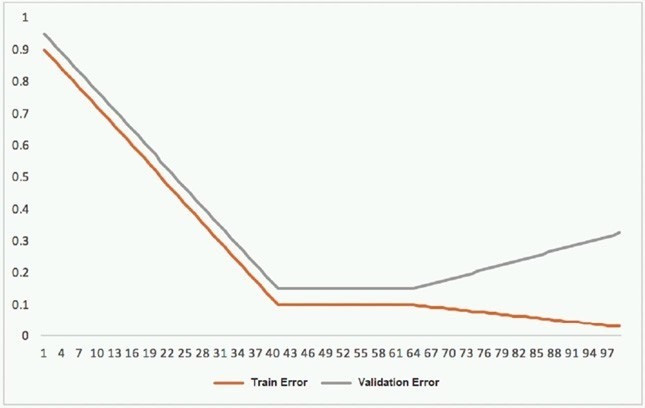 Which technique can be used to improve model performance in terms of accuracy in the validation set?
-
A
-
B
Random initialization of weights with appropriate seed
-
C
Increasing the number of epochs
-
D
Adding another layer with the 100 neurons
Reveal answer details
Close answer details
Correct answerA
ExplanationThe answer is Early Stopping. Stopp the training before accuracy start do decrease.
Question 7
Multiple choice
A company wants to use machine learning (ML) to improve its customer churn prediction model. The company stores data in an Amazon Redshift data warehouse. A data science team wants to use Amazon Redshift machine learning (Amazon Redshift ML) to build a model and run predictions for new data directly within the data warehouse. Which combination of steps should the company take to use Amazon Redshift ML to meet these requirements? (Choose three.)
-
A
Define the feature variables and target variable for the churn prediction model.
-
B
Use the SOL EXPLAIN_MODEL function to run predictions.
-
C
Write a CREATE MODEL SQL statement to create a model.
-
D
Use Amazon Redshift Spectrum to train the model.
-
E
Manually export the training data to Amazon S3.
-
F
Use the SQL prediction function to run predictions.
Reveal answer details
Close answer details
A Machine Learning Specialist is assigned to a Fraud Detection team and must tune an XGBoost model, which is working appropriately for test data. However, with unknown data, it is not working as expected.
The existing parameters are provided as follows. 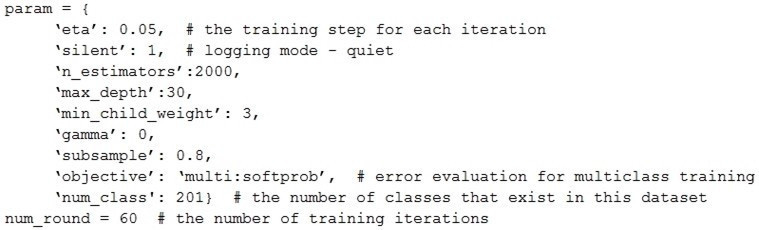 Which parameter tuning guidelines should the Specialist follow to avoid overfitting?
-
A
Increase the max_depth parameter value.
-
B
Lower the max_depth parameter value.
-
C
Update the objective to binary:logistic.
-
D
Lower the min_child_weight parameter value.
Reveal answer details
Close answer details
A company will use Amazon SageMaker to train and host a machine learning model for a marketing campaign. The data must be encrypted at rest. Most of the data is sensitive customer data. The company wants AWS to maintain the root of trust for the encryption keys and wants key usage to be logged. Which solution will meet these requirements with the LEAST operational overhead?
-
A
Use AWS Security Token Service (AWS STS) to create temporary tokens to encrypt the storage volumes for all SageMaker instances and to encrypt the model artifacts and data in Amazon S3.
-
B
Use customer managed keys in AWS Key Management Service (AWS KMS) to encrypt the storage volumes for all SageMaker instances and to encrypt the model artifacts and data in Amazon S3.
-
C
Use encryption keys stored in AWS CloudHSM to encrypt the storage volumes for all SageMaker instances and to encrypt the model artifacts and data in Amazon S3.
-
D
Use SageMaker built-in transient keys to encrypt the storage volumes for all SageMaker instances. Enable default encryption ffnew Amazon Elastic Block Store (Amazon EBS) volumes.
Reveal answer details
Close answer details
Correct answerB
Explanationhttps://docs.aws.amazon.com/kms/latest/developerguide/security-logging-monitoring.html Using customer managed keys in AWS KMS will allow the company to maintain the root of trust for the master keys, and AWS KMS will log key usage. This ensures that the encryption keys used to encrypt the ML data volumes and model artifacts are properly managed and secured. Additionally, using customer managed keys allows the company to have greater control over the encryption process.
Question 10
Single choice
A Machine Learning Specialist is building a supervised model that will evaluate customers' satisfaction with their mobile phone service based on recent usage The model's output should infer whether or not a customer is likely to switch to a competitor in the next 30 days. Which of the following modeling techniques should the Specialist use1?
-
A
-
B
-
C
-
D
Reveal answer details
Close answer details
Question 11
Single choice
A data scientist is designing a repository that will contain many images of vehicles. The repository must scale automatically in size to store new images every day. The repository must support versioning of the images. The data scientist must implement a solution that maintains multiple immediately accessible copies of the data in different AWS Regions. Which solution will meet these requirements?
-
A
Amazon S3 with S3 Cross-Region Replication (CRR)
-
B
Amazon Elastic Block Store (Amazon EBS) with snapshots that are shared in a secondary Region
-
C
Amazon Elastic File System (Amazon EFS) Standard storage that is configured with Regional availability
-
D
AWS Storage Gateway Volume Gateway
Reveal answer details
Close answer details
Question 12
Single choice
A company wants to create a data repository in the AWS Cloud for machine learning (ML) projects. The company wants to use AWS to perform complete ML lifecycles and wants to use Amazon S3 for the data storage. All of the company's data currently resides on premises and is 40 in size. The company wants a solution that can transfer and automatically update data between the on-premises object storage and Amazon S3. The solution must support encryption, scheduling, monitoring, and data integrity validation. Which solution meets these requirements?
-
A
Use the S3 sync command to compare the source S3 bucket and the destination S3 bucket. Determine which source files do not exist in the destination S3 bucket and which source files were modified.
-
B
Use AWS Transfer for FTPS to transfer the files from the on-premises storage to Amazon S3.
-
C
Use AWS DataSync to make an initial copy of the entire dataset. Schedule subsequent incremental transfers of changing data until the final cutover from on premises to AWS.
-
D
Use S3 Batch Operations to pull data periodically from the on-premises storage. Enable S3 Versioning on the S3 bucket to protect against accidental overwrites.
Reveal answer details
Close answer details
Correct answerC
ExplanationConfigure DataSync to make an initial copy of your entire dataset, and schedule subsequent incremental transfers of changing data until the final cut-over from on-premises to AWS. References:
https://aws.amazon.com/datasync/faqs/
Question 13
Single choice
An analytics company has an Amazon SageMaker hosted endpoint for an image classification model. The model is a custom-built convolutional neural network (CNN) and uses the PyTorch deep learning framework. The company wants to increase throughput and decrease latency for customers that use the model. Which solution will meet these requirements MOST cost-effectively?
-
A
Use Amazon Elastic Inference on the SageMaker hosted endpoint.
-
B
Retrain the CNN with more layers and a larger dataset.
-
C
Retrain the CNN with more layers and a smaller dataset.
-
D
Choose a SageMaker instance type that has multiple GPUs.
Reveal answer details
Close answer details
Question 14
Multiple choice
A retail company stores 100 GB of daily transactional data in Amazon S3 at periodic intervals. The company wants to identify the schema of the transactional data. The company also wants to perform transformations on the transactional data that is in Amazon S3. The company wants to use a machine learning (ML) approach to detect fraud in the transformed data. Which combination of solutions will meet these requirements with the LEAST operational overhead? (Select THREE.)
-
A
Use Amazon Athena to scan the data and identify the schema.
-
B
Use AWS Glue crawlers to scan the data and identify the schema.
-
C
Use Amazon Redshift to store procedures to perform data transformations
-
D
Use AWS Glue workflows and AWS Glue jobs to perform data transformations.
-
E
Use Amazon Redshift ML to train a model to detect fraud.
-
F
Use Amazon Fraud Detector to train a model to detect fraud.
Reveal answer details
Close answer details
Correct answersB, D, F
ExplanationTo meet the requirements with the least operational overhead, the company should use AWS Glue crawlers, AWS Glue workflows and jobs, and Amazon Fraud Detector. AWS Glue crawlers can scan the data in Amazon S3 and identify the schema, which is then stored in the AWS Glue Data Catalog. AWS Glue workflows and jobs can perform data transformations on the data in Amazon S3 using serverless Spark or Python scripts. Amazon Fraud Detector can train a model to detect fraud using the transformed data and the company's historical fraud labels, and then generate fraud predictions using a simple API call.
Option A is incorrect because Amazon Athena is a serverless query service that can analyze data in Amazon S3 using standard SQL, but it does not perform data transformations or fraud detection.
Option C is incorrect because Amazon Redshift is a cloud data warehouse that can store and query data using SQL, but it requires provisioning and managing clusters, which adds operational overhead. Moreover, Amazon Redshift does not provide a built-in fraud detection capability.
Option E is incorrect because Amazon Redshift ML is a feature that allows users to create, train, and deploy machine learning models using SQL commands in Amazon Redshift. However, using Amazon Redshift ML would require loading the data from Amazon S3 to Amazon Redshift, which adds complexity and cost. Also, Amazon Redshift ML does not support fraud detection as a use case.
References:
AWS Glue Crawlers
AWS Glue Workflows and Jobs Amazon Fraud Detector
Question 15
Single choice
A data scientist at a retail company is forecasting sales for a product over the next 3 months. After preliminary analysis, the data scientist identifies that sales are seasonal and that holidays affect sales. The data scientist also determines that sales of the product are correlated with sales of other products in the same category. The data scientist needs to train a sales forecasting model that incorporates this information. Which solution will meet this requirement with the LEAST development effort?
-
A
Use Amazon Forecast with Holidays featurization and the built-in autoregressive integrated moving average (ARIMA) algorithm to train the model.
-
B
Use Amazon Forecast with Holidays featurization and the built-in DeepAR+ algorithm to train the model.
-
C
Use Amazon SageMaker Processing to enrich the data with holiday information. Train the model by using the SageMaker DeepAR built-in algorithm.
-
D
Use Amazon SageMaker Processing to enrich the data with holiday information. Train the model by using the Gluon Time Series (GluonTS) toolkit.
Reveal answer details
Close answer details
Question 16
Single choice
A company wants to predict stock market price trends. The company stores stock market data each business day in Amazon S3 in Apache Parquet format. The company stores 20 GB of data each day for each stock code. A data engineer must use Apache Spark to perform batch preprocessing data transformations quickly so the company can complete prediction jobs before the stock market opens the next day. The company plans to track more stock market codes and needs a way to scale the preprocessing data transformations. Which AWS service or feature will meet these requirements with the LEAST development effort over time?
-
A
-
B
-
C
-
D
Reveal answer details
Close answer details
Correct answerA
ExplanationAWS Glue jobs is the AWS service or feature that will meet the requirements with the least development effort over time. AWS Glue jobs is a fully managed service that enables data engineers to run Apache Spark applications on a serverless Spark environment. AWS Glue jobs can perform batch preprocessing data transformations on large datasets stored in Amazon S3, such as converting data formats, filtering data, joining data, and aggregating data. AWS Glue jobs can also scale the Spark environment automatically based on the data volume and processing needs, without requiring any infrastructure provisioning or management. AWS Glue jobs can reduce the development effort and time by providing a graphical interface to create and monitor Spark applications, as well as a code generation feature that can generate Scala or Python code based on the data sources and targets. AWS Glue jobs can also integrate with other AWS services, such as Amazon Athena, Amazon EMR, and Amazon SageMaker, to enable further data analysis and machine learning tasks 1. The other options are either more complex or less scalable than AWS Glue jobs. Amazon EMR cluster is a managed service that enables data engineers to run Apache Spark applications on a cluster of Amazon EC2 instances. However, Amazon EMR cluster requires more development effort and time than AWS Glue jobs, as it involves setting up, configuring, and managing the cluster, as well as writing and deploying the Spark code. Amazon EMR cluster also does not scale automatically, but requires manual or scheduled resizing of the cluster based on the data volume and processing needs 2. Amazon Athena is a serverless interactive query service that enables data engineers to analyze data stored in Amazon S3 using standard SQL. However, Amazon Athena is not suitable for performing complex data transformations, such as joining data from multiple sources, aggregating data, or applying custom logic. Amazon Athena is also not designed for running Spark applications, but only supports SQL queries 3. AWS Lambda is a serverless compute service that enables data engineers to run code without provisioning or managing servers. However, AWS Lambda is not optimized for running Spark applications, as it has limitations on the execution time, memory size, and concurrency of the functions. AWS Lambda is also not integrated with Amazon S3, and requires additional steps to read and write data from S3 buckets.
References:
1: AWS Glue - Fully Managed ETL Service - Amazon Web Services
2: Amazon EMR - Amazon Web Services
3: Amazon Athena -Interactive SQL Queries for Data in Amazon S3 [4]: AWS Lambda -Serverless Compute - Amazon Web Services
Question 17
Single choice
A Data Scientist needs to create a serverless ingestion and analytics solution for high-velocity, real-time streaming data. The ingestion process must buffer and convert incoming records from JSON to a query-optimized, columnar format without data loss. The output datastore must be highly available, and Analysts must be able to run SQL queries against the data and connect to existing business intelligence dashboards. Which solution should the Data Scientist build to satisfy the requirements?
-
A
Create a schema in the AWS Glue Data Catalog of the incoming data format. Use an Amazon Kinesis Data Firehose delivery stream to stream the data and transform the data to Apache Parquet or ORC format using the AWS Glue Data Catalog before delivering to Amazon S3. Have the Analysts query the data directly from Amazon S3 using Amazon Athena, and connect to Bl tools using the Athena Java Database Connectivity (JDBC) connector.
-
B
Write each JSON record to a staging location in Amazon S3. Use the S3 Put event to trigger an AWS Lambda function that transforms the data into Apache Parquet or ORC format and writes the data to a processed data location in Amazon S3. Have the Analysts query the data directly from Amazon S3 using Amazon Athena, and connect to Bl tools using the Athena Java Database Connectivity (JDBC) connector.
-
C
Write each JSON record to a staging location in Amazon S3. Use the S3 Put event to trigger an AWS Lambda function that transforms the data into Apache Parquet or ORC format and inserts it into an Amazon RDS PostgreSQL database. Have the Analysts query and run dashboards from the RDS database.
-
D
Use Amazon Kinesis Data Analytics to ingest the streaming data and perform real-time SQL queries to convert the records to Apache Parquet before delivering to Amazon S3. Have the Analysts query the data directly from Amazon S3 using Amazon Athena and connect to Bl tools using the Athena Java Database Connectivity (JDBC) connector.
Reveal answer details
Close answer details
Correct answerA
ExplanationFirehose does integrate with GLue data catalog and it also "Buffers" the data .
"When Kinesis Data Firehose processes incoming events and converts the data to Parquet, it needs to know which schema to apply." This is achived by glue data catalog and athena and it works on real-time data ingest.See link below. https://aws.amazon.com/blogs/big-data/analyzing-apache-parquet-optimized-data-using-amazon-kinesis-data-firehose-amazon-athena-and-amazon-redshift/
Question 18
Single choice
A Data Scientist needs to migrate an existing on-premises ETL process to the cloud. The current process runs at regular time intervals and uses PySpark to combine and format multiple large data sources into a single consolidated output for downstream processing. The Data Scientist has been given the following requirements to the cloud solution: Combine multiple data sources.
Reuse existing PySpark logic.
Run the solution on the existing schedule.
Minimize the number of servers that will need to be managed. Which architecture should the Data Scientist use to build this solution?
-
A
Write the raw data to Amazon S3. Schedule an AWS Lambda function to submit a Spark step to a persistent Amazon EMR cluster based on the existing schedule. Use the existing PySpark logic to run the ETL job on the EMR cluster.
Output the results to a "processed" location in Amazon S3 that is accessible for downstream use.
-
B
Write the raw data to Amazon S3. Create an AWS Glue ETL job to perform the ETL processing against the input data. Write the ETL job in PySpark to leverage the existing logic. Create a new AWS Glue trigger to trigger the ETL job based on the existing schedule. Configure the output target of the ETL job to write to a "processed" location in Amazon S3 that is accessible for downstream use.
-
C
Write the raw data to Amazon S3. Schedule an AWS Lambda function to run on the existing schedule and process the input data from Amazon S3. Write the Lambda logic in Python and implement the existing PySpark logic to perform the ETL process. Have the Lambda function output the results to a "processed" location in Amazon S3 that is accessible for downstream use.
-
D
Use Amazon Kinesis Data Analytics to stream the input data and perform real-time SQL queries against the stream to carry out the required transformations within the stream. Deliver the output results to a "processed" location in Amazon S3 that is accessible for downstream use.
Reveal answer details
Close answer details
Correct answerB
Explanationhttps://docs.aws.amazon.com/glue/latest/dg/aws-glue-programming-python-samples-medicaid.html
Question 19
Single choice
A company is using a legacy telephony platform and has several years remaining on its contract. The company wants to move to AWS and wants to implement the following machine learning features: 1. Call transcription in multiple languages
2. Categorization of calls based on the transcript
3. Detection of the main customer issues in the calls
4. Customer sentiment analysis for each line of the transcript, with positive or negative indication and scoring of that sentiment Which AWS solution will meet these requirements with the LEAST amount of custom model training?
-
A
Use Amazon Transcribe to process audio calls to produce transcripts, categorize calls, and detect issues. Use Amazon Comprehend to analyze sentiment.
-
B
Use Amazon Transcribe to process audio calls to produce transcripts. Use Amazon Comprehend to categorize calls, detect issues, and analyze sentiment
-
C
Use Contact Lens for Amazon Connect to process audio calls to produce transcripts, categorize calls, detect issues, and analyze sentiment.
-
D
Use Contact Lens for Amazon Connect to process audio calls to produce transcripts. Use Amazon Comprehend to categorize calls, detect issues, and analyze sentiment.
Reveal answer details
Close answer details
Correct answerC
Explanationhttps://aws.amazon.com/connect/contact-lens/
Question 20
Single choice
A growing company has a business-critical key performance indicator (KPI) for the uptime of a machine learning (ML) recommendation system. The company is using Amazon SageMaker hosting services to develop a recommendation model in a single Availability Zone within an AWS Region. A machine learning (ML) specialist must develop a solution to achieve high availability. The solution must have a recovery time objective (RTO) of 5 minutes. Which solution will meet these requirements with the LEAST effort?
-
A
Deploy multiple instances for each endpoint in a VPC that spans at least two Regions.
-
B
Use the SageMaker auto scaling feature for the hosted recommendation models.
-
C
Deploy multiple instances for each production endpoint in a VPC that spans least two subnets that are in a second Availability Zone.
-
D
Frequently generate backups of the production recommendation model. Deploy the backups in a second Region.
Reveal answer details
Close answer details
Question 21
Single choice
A machine learning (ML) specialist is administering a production Amazon SageMaker endpoint with model monitoring configured. Amazon SageMaker Model Monitor detects violations on the SageMaker endpoint, so the ML specialist retrains the model with the latest dataset. This dataset is statistically representative of the current production traffic. The ML specialist notices that even after deploying the new SageMaker model and running the first monitoring job, the SageMaker endpoint still has violations. What should the ML specialist do to resolve the violations?
-
A
Manually trigger the monitoring job to re-evaluate the SageMaker endpoint traffic sample.
-
B
Run the Model Monitor baseline job again on the new training set. Configure Model Monitor to use the new baseline.
-
C
Delete the endpoint and recreate it with the original configuration.
-
D
Retrain the model again by using a combination of the original training set and the new training set.
Reveal answer details
Close answer details
Correct answerB
Explanationhttps://docs.aws.amazon.com/sagemaker/latest/dg/model-monitor-create-baseline.html
Question 22
Multiple choice
A company's data scientist has trained a new machine learning model that performs better on test data than the company's existing model performs in the production environment. The data scientist wants to replace the existing model that runs on an Amazon SageMaker endpoint in the production environment.
However, the company is concerned that the new model might not work well on the production environment data. The data scientist needs to perform A/B testing in the production environment to evaluate whether the new model performs well on production environment data. Which combination of steps must the data scientist take to perform the A/B testing? (Choose two.)
-
A
Create a new endpoint configuration that includes a production variant for each of the two models.
-
B
Create a new endpoint configuration that includes two target variants that point to different endpoints.
-
C
Deploy the new model to the existing endpoint.
-
D
Update the existing endpoint to activate the new model.
-
E
Update the existing endpoint to use the new endpoint configuration.
Reveal answer details
Close answer details
Question 23
Single choice
A company needs to develop a model that uses a machine learning (ML) model for risk analysis. An ML engineer needs to evaluate the contribution each feature of a training dataset makes to the prediction of the target variable before the ML engineer selects features. How should the ML engineer predict the contribution of each feature?
-
A
Use the Amazon SageMaker Data Wrangler multicollinearity measurement features and the principal component analysis (PCA) algorithm to calculate the variance of the dataset along multiple directions in the feature space.
-
B
Use an Amazon SageMaker Data Wrangler quick model visualization to find feature importance scores that are between 0.5 and 1.
-
C
Use the Amazon SageMaker Data Wrangler bias report to identify potential biases in the data related to feature engineering.
-
D
Use an Amazon SageMaker Data Wrangler data flow to create and modify a data preparation pipeline.
Manually add the feature scores.
Reveal answer details
Close answer details
Question 24
Single choice
A Machine Learning Specialist has built a model using Amazon SageMaker built-in algorithms and is not getting expected accurate results The Specialist wants to use hyperparameter optimization to increase the model's accuracy Which method is the MOST repeatable and requires the LEAST amount of effort to achieve this?
-
A
Launch multiple training jobs in parallel with different hyperparameters
-
B
Create an AWS Step Functions workflow that monitors the accuracy in Amazon CloudWatch Logs and relaunches the training job with a defined list of hyperparameters
-
C
Create a hyperparameter tuning job and set the accuracy as an objective metric.
-
D
Create a random walk in the parameter space to iterate through a range of values that should be used for each individual hyperparameter
Reveal answer details
Close answer details
Question 25
Single choice
A data engineer needs to provide a team of data scientists with the appropriate dataset to run machine learning training jobs. The data will be stored in Amazon S3. The data engineer is obtaining the data from an Amazon Redshift database and is using join queries to extract a single tabular dataset. A portion of the schema is as follows: 1. TransactionTimestamp (Timestamp)
2. CardName (Varchar)
3. CardNo (Varchar) The data engineer must provide the data so that any row with a CardNo value of NULL is removed. Also, the TransactionTimestamp column must be separated into a TransactionDate column and a TransactionTime column. Finally, the CardName column must be renamed to NameOnCard. The data will be extracted on a monthly basis and will be loaded into an S3 bucket. The solution must minimize the effort that is needed to set up infrastructure for the ingestion and transformation. The solution also must be automated and must minimize the load on the Amazon Redshift cluster. Which solution meets these requirements?
-
A
Set up an Amazon EMR cluster. Create an Apache Spark job to read the data from the Amazon Redshift cluster and transform the data. Load the data into the S3 bucket. Schedule the job to run monthly.
-
B
Set up an Amazon EC2 instance with a SQL client tool, such as SQL Workbench/J, to query the data from the Amazon Redshift cluster directly Export the resulting dataset into a file. Upload the file into the S3 bucket. Perform these tasks monthly.
-
C
Set up an AWS Glue job that has the Amazon Redshift cluster as the source and the S3 bucket as the destination. Use the built-in transforms Filter, Map, and RenameField to perform the required transformations. Schedule the job to run monthly.
-
D
Use Amazon Redshift Spectrum to run a query that writes the data directly to the S3 bucket. Create an AWS Lambda function to run the query monthly.
Reveal answer details
Close answer details
Correct answerC
Explanationhttps://docs.aws.amazon.com/glue/latest/dg/aws-glue-programming-python-transforms.html
Question 26
Single choice
An insurance company is creating an application to automate car insurance claims. A machine learning (ML) specialist used an Amazon SageMaker Object Detection - TensorFlow built-in algorithm to train a model to detect scratches and dents in images of cars. After the model was trained, the ML specialist noticed that the model performed better on the training dataset than on the testing dataset. Which approach should the ML specialist use to improve the performance of the model on the testing data?
-
A
Increase the value of the momentum hyperparameter.
-
B
Reduce the value of the dropout_rate hyperparameter.
-
C
Reduce the value of the learning_rate hyperparameter
-
D
Increase the value of the L2 hyperparameter.
Reveal answer details
Close answer details
Correct answerD
ExplanationFeature selection: consider using fewer feature combinations, decrease n-grams size, and decrease the number of numeric attribute bins.
Increase the amount of regularization used.
https://docs.aws.amazon.com/machine-learning/latest/dg/model-fit-underfitting-vs-overfitting.html
Question 27
Single choice
A Machine Learning Specialist works for a credit card processing company and needs to predict which transactions may be fraudulent in near-real time. Specifically, the Specialist must train a model that returns the probability that a given transaction may fraudulent. How should the Specialist frame this business problem?
-
A
-
B
-
C
Multi-category classification
-
D
Regression classification
Reveal answer details
Close answer details
Correct answerB
ExplanationLogistic regression will give the probability, and logistic regression is a binary classification algorithm.
https://machinelearningmastery.com/logistic-regression-for-machine-learning/
Question 28
Multiple choice
A Machine Learning Specialist is creating a new natural language processing application that processes a dataset comprised of 1 million sentences. The aim is to then run Word2Vec to generate embeddings of the sentences and enable different types of predictions. Here is an example from the dataset: "The quck BROWN FOX jumps over the lazy dog." Which of the following are the operations the Specialist needs to perform to correctly sanitize and prepare the data in a repeatable manner? (Choose three.)
-
A
Perform part-of-speech tagging and keep the action verb and the nouns only
-
B
Normalize all words by making the sentence lowercase
-
C
Remove stop words using an English stopword dictionary.
-
D
Correct the typography on "quck" to "quick."
-
E
One-hot encode all words in the sentence
-
F
Tokenize the sentence into words.
Reveal answer details
Close answer details
Correct answersB, C, F
Explanationhttps://towardsdatascience.com/nlp-extracting-the-main-topics-from-your-dataset-using-lda-in-minutes-21486f5aa925
Question 29
Multiple choice
A logistics company needs a forecast model to predict next month's inventory requirements for a single item in 10 warehouses. A machine learning specialist uses Amazon Forecast to develop a forecast model from 3 years of monthly data. There is no missing data. The specialist selects the DeepAR+ algorithm to train a predictor. The predictor means absolute percentage error (MAPE) is much larger than the MAPE produced by the current human forecasters. Which changes to the CreatePredictor API call could improve the MAPE? (Choose two.)
-
A
Set PerformAutoML to true.
-
B
Set ForecastHorizon to 4.
-
C
Set ForecastFrequency to W for weekly.
-
D
-
E
Set FeaturizationMethodName to filling.
Reveal answer details
Close answer details
Correct answersA, D
ExplanationSetting PerformAutoML to true will enable Amazon Forecast to automatically select the best algorithm and hyperparameters for your data and problem. This can help improve the MAPE by finding the optimal combination of algorithm and hyperparameters that minimize prediction error. Setting PerformHPO to true will enable Amazon Forecast to perform a hyperparameter optimization search to find the best combination of hyperparameters that result in the best prediction performance. This can help improve the MAPE by finding the optimal combination of hyperparameters that minimize prediction error.
Question 30
Multiple choice
A financial company is trying to detect credit card fraud. The company observed that, on average, 2% of credit card transactions were fraudulent. A data scientist trained a classifier on a year's worth of credit card transactions data. The model needs to identify the fraudulent transactions (positives) from the regular ones (negatives). The company's goal is to accurately capture as many positives as possible. Which metrics should the data scientist use to optimize the model? (Choose two.)
-
A
-
B
-
C
-
D
Area under the precision-recall curve
-
E
Reveal answer details
Close answer details
Correct answersD, E
ExplanationThe goal is to accurately capture as many fraudulent transactions (positives) as possible. To optimize the model towards this goal, the data scientist should focus on metrics that emphasize the true positive rate and the area under the precision-recall curve. True positive rate (TPR or sensitivity) is the proportion of actual positive cases that are correctly identified as positive by the model. A higher TPR means that more fraudulent transactions are being captured. The precision-recall curve is a graph that shows the trade-off between precision and recall for different thresholds
Question 31
Single choice
A manufacturing company has a large set of labeled historical sales data The manufacturer would like to predict how many units of a particular part should be produced each quarter Which machine learning approach should be used to solve this problem?
-
A
-
B
-
C
Principal component analysis (PCA)
-
D
Reveal answer details
Close answer details
Correct answerD
Explanationhttps://docs.aws.amazon.com/zh_tw/machine-learning/latest/dg/regression-model-insights.html
Question 32
Single choice
A company is building a predictive maintenance model for its warehouse equipment. The model must predict the probability of failure of all machines in the warehouse. The company has collected 10,000 event samples within 3 months. The event samples include 100 failure cases that are evenly distributed across
50 different machine types. How should the company prepare the data for the model to improve the model's accuracy?
-
A
Adjust the class weight to account for each machine type.
-
B
Oversample the failure cases by using the Synthetic Minority Oversampling Technique (SMOTE).
-
C
Undersample the non-failure events. Stratify the non-failure events by machine type.
-
D
Undersample the non-failure events by using the Synthetic Minority Oversampling Technique (SMOTE).
Reveal answer details
Close answer details
Question 33
Single choice
A Machine Learning Specialist is working for a credit card processing company and receives an unbalanced dataset containing credit card transactions. It contains 99,000 valid transactions and 1,000 fraudulent transactions The Specialist is asked to score a model that was run against the dataset The Specialist has been advised that identifying valid transactions is equally as important as identifying fraudulent transactions. What metric is BEST suited to score the model?
-
A
-
B
-
C
Area Under the ROC Curve (AUC)
-
D
Root Mean Square Error (RMSE)
Reveal answer details
Close answer details
Question 34
Multiple choice
A Data Scientist is building a model to predict customer churn using a dataset of 100 continuous numerical features. The Marketing team has not provided any insight about which features are relevant for churn prediction. The Marketing team wants to interpret the model and see the direct impact of relevant features on the model outcome. While training a logistic regression model, the Data Scientist observes that there is a wide gap between the training and validation set accuracy. Which methods can the Data Scientist use to improve the model performance and satisfy the Marketing team's needs? (Choose two.)
-
A
Add L1 regularization to the classifier
-
B
Add features to the dataset
-
C
Perform recursive feature elimination
-
D
Perform t-distributed stochastic neighbor embedding (t-SNE)
-
E
Perform linear discriminant analysis
Reveal answer details
Close answer details
Correct answersA, C
ExplanationKey Words:
1. 100 continuous numerical features ?too many features 2. No feature selection has been done
3. Easy interpretation - direct relationship between X and Y are preferred 4. gap between the training and validation set accuracy ?overfitting
A: L1 regularization solves overfitting, interpretation is easy, direct relationships between x and y
B: More features, Overfitting will be worse.
C: Recursive feature elimination solves overfitting, interpretation is easy, direct relationships between x and y
D: Perform t-distributed stochastic neighbor embedding (t-SNE)= Amazon's favorite dimensionality reduction technique, frequently show up in the questions. However, same as PCA, less interpretable. You won't be able to see the direct impact of relevant features on the model outcome.
E: If you have more than two classes then Linear Discriminant Analysis is the preferred linear classification technique.
Question 35
Single choice
A web-based company wants to improve its conversion rate on its landing page. Using a large historical dataset of customer visits, the company has repeatedly trained a multi-class deep learning network algorithm on Amazon SageMaker. However, there is an overfitting problem: training data shows 90% accuracy in predictions, while test data shows 70% accuracy only. The company needs to boost the generalization of its model before deploying it into production to maximize conversions of visits to purchases. Which action is recommended to provide the HIGHEST accuracy model for the company's test and validation data?
-
A
Increase the randomization of training data in the mini-batches used in training.
-
B
Allocate a higher proportion of the overall data to the training dataset
-
C
Apply L1 or L2 regularization and dropouts to the training.
-
D
Reduce the number of layers and units (or neurons) from the deep learning network.
Reveal answer details
Close answer details
Correct answerC
ExplanationIf this is a ComputerVision problem augmentation can help and we may consider A an option. However in analyzing customer historic data, there is no easy way to increase randomization in training. If you go deep into modelling and coding. When you build model with tensorflow/pytorch, most of the time the trainloader is already sampling in data in random manner (with shuffle enable). What we usually do to reduce overfitting is by adding dropout.
Question 36
Single choice
A company stores its documents in Amazon S3 with no predefined product categories. A data scientist needs to build a machine learning model to categorize the documents for all the company's products. Which solution will meet these requirements with the MOST operational efficiency?
-
A
Build a custom clustering model. Create a Dockerfile and build a Docker image. Register the Docker image in Amazon Elastic Container Registry (Amazon ECR). Use the custom image in Amazon SageMaker to generate a trained model.
-
B
Tokenize the data and transform the data into tabular data. Train an Amazon SageMaker k-means model to generate the product categories.
-
C
Train an Amazon SageMaker Neural Topic Model (NTM) model to generate the product categories.
-
D
Train an Amazon SageMaker Blazing Text model to generate the product categories.
Reveal answer details
Close answer details
Question 37
Single choice
A data scientist is working on a public sector project for an urban traffic system. While studying the traffic patterns, it is clear to the data scientist that the traffic behavior at each light is correlated, subject to a small stochastic error term. The data scientist must model the traffic behavior to analyze the traffic patterns and reduce congestion. How will the data scientist MOST effectively model the problem?
-
A
The data scientist should obtain a correlated equilibrium policy by formulating this problem as a multi-
agent reinforcement learning problem.
-
B
The data scientist should obtain the optimal equilibrium policy by formulating this problem as a single-
agent reinforcement learning problem.
-
C
Rather than finding an equilibrium policy, the data scientist should obtain accurate predictors of traffic flow by using historical data through a supervised learning approach.
-
D
Rather than finding an equilibrium policy, the data scientist should obtain accurate predictors of traffic flow by using unlabeled simulated data representing the new traffic patterns in the city and applying an unsupervised learning approach.
Reveal answer details
Close answer details
Correct answerA
ExplanationReferences:
https://www.hindawi.com/journals/jat/2021/8878011/
Question 38
Single choice
A Data Science team within a large company uses Amazon SageMaker notebooks to access data stored in Amazon S3 buckets. The IT Security team is concerned that internet-enabled notebook instances create a security vulnerability where malicious code running on the instances could compromise data privacy. The company mandates that all instances stay within a secured VPC with no internet access, and data communication traffic must stay within the AWS network. How should the Data Science team configure the notebook instance placement to meet these requirements?
-
A
Associate the Amazon SageMaker notebook with a private subnet in a VPC. Place the Amazon SageMaker endpoint and S3 buckets within the same VPC.
-
B
Associate the Amazon SageMaker notebook with a private subnet in a VPC. Use IAM policies to grant access to Amazon S3 and Amazon SageMaker.
-
C
Associate the Amazon SageMaker notebook with a private subnet in a VPC. Ensure the VPC has S3 VPC endpoints and Amazon SageMaker VPC endpoints attached to it.
-
D
Associate the Amazon SageMaker notebook with a private subnet in a VPC. Ensure the VPC has a NAT gateway and an associated security group allowing only outbound connections to Amazon S3 and Amazon SageMaker
Reveal answer details
Close answer details
Correct answerC
Explanationhttps://docs.aws.amazon.com/sagemaker/latest/dg/notebook-interface-endpoint.html
Question 39
Single choice
A large JSON dataset for a project has been uploaded to a private Amazon S3 bucket The Machine Learning Specialist wants to securely access and explore the data from an Amazon SageMaker notebook instance A new VPC was created and assigned to the Specialist How can the privacy and integrity of the data stored in Amazon S3 be maintained while granting access to the Specialist for analysis?
-
A
Launch the SageMaker notebook instance within the VPC with SageMaker-provided internet access enabled Use an S3 ACL to open read privileges to the everyone group
-
B
Launch the SageMaker notebook instance within the VPC and create an S3 VPC endpoint for the notebook to access the data Copy the JSON dataset from Amazon S3 into the ML storage volume on the SageMaker notebook instance and work against the local dataset
-
C
Launch the SageMaker notebook instance within the VPC and create an S3 VPC endpoint for the notebook to access the data Define a custom S3 bucket policy to only allow requests from your VPC to access the S3 bucket
-
D
Launch the SageMaker notebook instance within the VPC with SageMaker-provided internet access enabled. Generate an S3 pre-signed URL for access to data in the bucket
Reveal answer details
Close answer details
Question 40
Single choice
A company is building a demand forecasting model based on machine learning (ML). In the development stage, an ML specialist uses an Amazon SageMaker notebook to perform feature engineering during work hours that consumes low amounts of CPU and memory resources. A data engineer uses the same notebook to perform data preprocessing once a day on average that requires very high memory and completes in only 2 hours. The data preprocessing is not configured to use GPU. All the processes are running well on an ml.m5.4xlarge notebook instance. The company receives an AWS Budgets alert that the billing for this month exceeds the allocated budget. Which solution will result in the MOST cost savings?
-
A
Change the notebook instance type to a memory optimized instance with the same vCPU number as the ml.m5.4xlarge instance has. Stop the notebook when it is not in use. Run both data preprocessing and feature engineering development on that instance.
-
B
Keep the notebook instance type and size the same. Stop the notebook when it is not in use. Run data preprocessing on a P3 instance type with the same memory as the ml.m5.4xlarge instance by using Amazon SageMaker Processing.
-
C
Change the notebook instance type to a smaller general purpose instance. Stop the notebook when it is not in use. Run data preprocessing on an ml.r5 instance with the same memory size as the ml.m5.4xlarge instance by using Amazon SageMaker Processing.
-
D
Change the notebook instance type to a smaller general purpose instance. Stop the notebook when it is not in use. Run data preprocessing on an R5 instance with the same memory size as the ml.m5.4xlarge instance by using the Reserved Instance option.
Reveal answer details
Close answer details
Question 41
Single choice
A data engineer wants to perform exploratory data analysis (EDA) on a petabyte of data. The data engineer does not want to manage compute resources and wants to pay only for queries that are run. The data engineer must write the analysis by using Python from a Jupyter notebook. Which solution will meet these requirements?
-
A
Use Apache Spark from within Amazon Athena.
-
B
Use Apache Spark from within Amazon SageMaker.
-
C
Use Apache Spark from within an Amazon EMR cluster.
-
D
Use Apache Spark through an integration with Amazon Redshift.
Reveal answer details
Close answer details
Question 42
Single choice
A Machine Learning Specialist is working with a large company to leverage machine learning within its products. The company wants to group its customers into categories based on which customers will and will not churn within the next 6 months. The company has labeled the data available to the Specialist. Which machine learning model type should the Specialist use to accomplish this task?
-
A
-
B
-
C
-
D
Reveal answer details
Close answer details
Correct answerB
ExplanationThe goal of classification is to determine to which class or category a data point (customer in our case) belongs to. For classification problems, data scientists would use historical data with predefined target variables AKA labels (churner/non-churner) ?answers that need to be predicted ?to train an algorithm.
With classification, businesses can answer the following questions: 1. Will this customer churn or not?
2. Will a customer renew their subscription?
3. Will a user downgrade a pricing plan?
4. Are there any signs of unusual customer behavior? References:
https://www.kdnuggets.com/2019/05/churn-prediction-machine-learning.html
Question 43
Multiple choice
A data engineer is using AWS Glue to create optimized, secure datasets in Amazon S3. The data science team wants the ability to access the ETL scripts directly from Amazon SageMaker notebooks within a VPC.
After this setup is complete, the data science team wants the ability to run the AWS Glue job and invoke the SageMaker training job. Which combination of steps should the data engineer take to meet these requirements? (Choose three.)
-
A
Create a SageMaker development endpoint in the data science team's VPC.
-
B
Create an AWS Glue development endpoint in the data science team's VPC.
-
C
Create SageMaker notebooks by using the AWS Glue development endpoint.
-
D
Create SageMaker notebooks by using the SageMaker console.
-
E
Attach a decryption policy to the SageMaker notebooks.
-
F
Create an IAM policy and an IAM role for the SageMaker notebooks.
Reveal answer details
Close answer details
Correct answersB, C, F
Explanationhttps://docs.aws.amazon.com/glue/latest/dg/dev-endpoint-tutorial-sage.html
Question 44
Single choice
A Machine Learning Specialist needs to be able to ingest streaming data and store it in Apache Parquet files for exploration and analysis. Which of the following services would both ingest and store this data in the correct format?
-
A
-
B
Amazon Kinesis Data Streams
-
C
Amazon Kinesis Data Firehose
-
D
Amazon Kinesis Data Analytics
Reveal answer details
Close answer details
Correct answerC
ExplanationAmazon Kinesis Data Firehose is a fully managed service that can automatically load streaming data into data stores and analytics tools. It can ingest real-time streaming data such as application logs, website clickstreams, and IoT telemetry data, and then store it in the correct format, such as Apache Parquet files, for exploration and analysis. This makes it a suitable option for the requirement described in the question.
Question 45
Single choice
A Machine Learning Specialist working for an online fashion company wants to build a data ingestion solution for the company's Amazon S3-based data lake. The Specialist wants to create a set of ingestion mechanisms that will enable future capabilities comprised of: 1. Real-time analytics
2. Interactive analytics of historical data
3. Clickstream analytics
4. Product recommendations Which services should the Specialist use?
-
A
AWS Glue as the data dialog; Amazon Kinesis Data Streams and Amazon Kinesis Data Analytics for
real-time data insights; Amazon Kinesis Data Firehose for delivery to Amazon ES for clickstream
analytics; Amazon EMR to generate personalized product recommendations
-
B
Amazon Athena as the data catalog; Amazon Kinesis Data Streams and Amazon Kinesis Data
Analytics for near-realtime data insights; Amazon Kinesis Data Firehose for clickstream analytics; AWS
Glue to generate personalized product recommendations
-
C
AWS Glue as the data catalog; Amazon Kinesis Data Streams and Amazon Kinesis Data Analytics for
historical data insights; Amazon Kinesis Data Firehose for delivery to Amazon ES for clickstream
analytics; Amazon EMR to generate personalized product recommendations
-
D
Amazon Athena as the data catalog; Amazon Kinesis Data Streams and Amazon Kinesis Data
Analytics for historical data insights; Amazon DynamoDB streams for clickstream analytics; AWS Glue
to generate personalized product recommendations
Reveal answer details
Close answer details
Correct answerA
ExplanationAWS Glue is a fully managed extract, transform, and load (ETL) service that makes it easy to move data between data stores. It can be used as a data catalog to store metadata information about the data in the data lake. Amazon Kinesis Data Streams and Amazon Kinesis Data Analytics can be used together to collect, process, and analyze real-time streaming data. Amazon Kinesis Data Firehose can be used to deliver streaming data to destinations such as Amazon ES for clickstream analytics. Finally, Amazon EMR can be used to run big data frameworks such as Apache Spark and Apache Hadoop to generate personalized product recommendations.
Question 46
Single choice
A company is using Amazon Textract to extract textual data from thousands of scanned text-heavy legal documents daily. The company uses this information to process loan applications automatically. Some of the documents fail business validation and are returned to human reviewers, who investigate the errors.
This activity increases the time to process the loan applications. What should the company do to reduce the processing time of loan applications?
-
A
Configure Amazon Textract to route low-confidence predictions to Amazon SageMaker Ground Truth.
Perform a manual review on those words before performing a business validation.
-
B
Use an Amazon Textract synchronous operation instead of an asynchronous operation.
-
C
Configure Amazon Textract to route low-confidence predictions to Amazon Augmented AI (Amazon
A2I). Perform a manual review on those words before performing a business validation.
-
D
Use Amazon Rekognition's feature to detect text in an image to extract the data from scanned images.
Use this information to process the loan applications.
Reveal answer details
Close answer details
Question 47
Single choice
A Machine Learning Specialist is building a model that will perform time series forecasting using Amazon SageMaker. The Specialist has finished training the model and is now planning to perform load testing on the endpoint so they can configure Auto Scaling for the model variant. Which approach will allow the Specialist to review the latency, memory utilization, and CPU utilization during the load test?
-
A
Review SageMaker logs that have been written to Amazon S3 by leveraging Amazon Athena and Amazon OuickSight to visualize logs as they are being produced
-
B
Generate an Amazon CloudWatch dashboard to create a single view for the latency, memory utilization, and CPU utilization metrics that are outputted by Amazon SageMaker
-
C
Build custom Amazon CloudWatch Logs and then leverage Amazon ES and Kibana to query and visualize the data as it is generated by Amazon SageMaker
-
D
Send Amazon CloudWatch Logs that were generated by Amazon SageMaker lo Amazon ES and use Kibana to query and visualize the log data.
Reveal answer details
Close answer details
Correct answerB
ExplanationReferences:
https://docs.aws.amazon.com/sagemaker/latest/dg/monitoring-cloudwatch.html
Question 48
Single choice
An ecommerce company discovers that the search tool for the company's website is not presenting the top search results to customers. The company needs to resolve the issue so the search tool will present results that customers are most likely to want to purchase. Which solution will meet this requirement with the LEAST operational effort?
-
A
Use the Amazon SageMaker BlazingText algorithm to add context to search results through query expansion.
-
B
Use the Amazon SageMaker XGBoost algorithm to improve candidate ranking.
-
C
Use Amazon CloudSearch and sort results by the search relevance score.
-
D
Use Amazon CloudSearch and sort results by the geographic location.
Reveal answer details
Close answer details
Question 49
Single choice
A credit card company wants to identify fraudulent transactions in real time. A data scientist builds a machine learning model for this purpose. The transactional data is captured and stored in Amazon S3. The historic data is already labeled with two classes: fraud (positive) and fair transactions (negative). The data scientist removes all the missing data and builds a classifier by using the XGBoost algorithm in Amazon SageMaker. The model produces the following results: 1. True positive rate (TPR): 0.700
2. False negative rate (FNR): 0.300
3. True negative rate (TNR): 0.977 4. False positive rate (FPR): 0.023
5. Overall accuracy: 0.949 Which solution should the data scientist use to improve the performance of the model?
-
A
Apply the Synthetic Minority Oversampling Technique (SMOTE) on the minority class in the training dataset. Retrain the model with the updated training data.
-
B
Apply the Synthetic Minority Oversampling Technique (SMOTE) on the majority class in the training dataset. Retrain the model with the updated training data.
-
C
Undersample the minority class.
-
D
Oversample the majority class.
Reveal answer details
Close answer details
Correct answerA
Explanationhttps://www.google.com/url?sa=t&rct=j&q=&esrc=s&source=web&cd=&cad=rja&uact=8&ved=2ahUKEwjLkqfb1OX9AhXkQ0EAHYlVDq0QFnoECBMQAw&url=https%3A%2F%2Ftowardsdatascience.com%2F5-smote-techniques-for-oversampling-your-imbalance-data-b8155bdbe2b5&usg=AOvVaw1FdrxDEbLDjNhacXn3d-Tu
Question 50
Single choice
A digital media company wants to build a customer churn prediction model by using tabular data. The model should clearly indicate whether a customer will stop using the company's services. The company wants to clean the data because the data contains some empty fields, duplicate values, and rare values. Which solution will meet these requirements with the LEAST development effort?
-
A
Use SageMaker Canvas to automatically clean the data and to prepare a categorical model.
-
B
Use SageMaker Data Wrangler to clean the data. Use the built-in SageMaker XGBoost algorithm to train a classification model.
-
C
Use SageMaker Canvas automatic data cleaning and preparation tools. Use the built-in SageMaker XGBoost algorithm to train a regression model.
-
D
Use SageMaker Data Wrangler to clean the data. Use the SageMaker Autopilot to train a regression model
Reveal answer details
Close answer details
Question 51
Multiple choice
A machine learning (ML) specialist is developing a deep learning sentiment analysis model that is based on data from movie reviews. After the ML specialist trains the model and reviews the model results on the validation set, the ML specialist discovers that the model is overfitting. Which solutions will MOST improve the model generalization and reduce overfitting? (Choose three.)
-
A
Shuffle the dataset with a different seed.
-
B
Decrease the learning rate.
-
C
Increase the number of layers in the network.
-
D
Add L1 regularization and L2 regularization.
-
E
-
F
Decrease the number of layers in the network.
Reveal answer details
Close answer details
Correct answersD, E, F
ExplanationA: possible but unlikely for movie reviews
B: wrong
https://www.google.com/url?sa=t&rct=j&q=&esrc=s&source=web&cd=&cad=rja&uact=8&ved=2ahUKEwi31N_10eX9AhWYQ0EAHXDFCAwQFnoECA8QAw&url=https%3A%2F%2Fdeepchecks.com%2Fquestion%2Fdoes-learning-rate-affect-overfitting%2F&usg=AOvVaw19RT-u_XyEe8FG_10R6aFC
C: wrong because would increase complexity and potentially overfitting
D: correct
E: correct
F: correct
Question 52
Single choice
An insurance company developed a new experimental machine learning (ML) model to replace an existing model that is in production. The company must validate the quality of predictions from the new experimental model in a production environment before the company uses the new experimental model to
serve general user requests. Which one model can serve user requests at a time. The company must measure the performance of the new experimental model without affecting the current live traffic Which solution will meet these requirements?
-
A
-
B
-
C
-
D
Reveal answer details
Close answer details
Correct answerC
ExplanationThe best solution for this scenario is to use shadow deployment, which is a technique that allows the company to run the new experimental model in parallel with the existing model, without exposing it to the end users. In shadow deployment, the company can route the same user requests to both models, but only return the responses from the existing model to the users. The responses from the new experimental model are logged and analyzed for quality and performance metrics, such as accuracy, latency, and resource consumption 12. This way, the company can validate the new experimental model in a production environment, without affecting the current live traffic or user experience. The other solutions are not suitable, because they have the following drawbacks: A: A/B testing is a technique that involves splitting the user traffic between two or more models, and comparing their outcomes based on predefined metrics. However, this technique exposes the new experimental model to a portion of the end users, which might affect their experience if the model is not reliable or consistent with the existing model 3.
B: Canary release is a technique that involves gradually rolling out the new experimental model to a small subset of users, and monitoring its performance and feedback. However, this technique also exposes the new experimental model to some end users, and requires careful selection and segmentation of the user groups 4.
D: Blue/green deployment is a technique that involves switching the user traffic from the existing model (blue) to the new experimental model (green) at once, after testing and verifying the new model in a separate environment. However, this technique does not allow the company to validate the new experimental model in a production environment, and might cause service disruption or inconsistency if the new model is not compatible or stable 5.
References:
1: Shadow Deployment: A Safe Way to Test in Production | LaunchDarkly Blog
2: Shadow Deployment: A Safe Way to Test in Production | LaunchDarkly Blog
3: A/B Testing for Machine Learning Models | AWS Machine Learning Blog
4: Canary Releases for Machine Learning Models | AWS Machine Learning Blog
5: Blue-Green Deployments for Machine Learning Models | AWS Machine Learning Blog
Question 53
Single choice
A company is building a new version of a recommendation engine. Machine learning (ML) specialists need to keep adding new data from users to improve personalized recommendations. The ML specialists gather data from the users' interactions on the platform and from sources such as external websites and social media. The pipeline cleans, transforms, enriches, and compresses terabytes of data daily, and this data is stored in Amazon S3. A set of Python scripts was coded to do the job and is stored in a large Amazon EC2 instance. The whole process takes more than 20 hours to finish, with each script taking at least an hour.
The company wants to move the scripts out of Amazon EC2 into a more managed solution that will eliminate the need to maintain servers. Which approach will address all of these requirements with the LEAST development effort?
-
A
Load the data into an Amazon Redshift cluster. Execute the pipeline by using SQL. Store the results in Amazon S3.
-
B
Load the data into Amazon DynamoDB. Convert the scripts to an AWS Lambda function. Execute the pipeline by triggering Lambda executions. Store the results in Amazon S3.
-
C
Create an AWS Glue job. Convert the scripts to PySpark. Execute the pipeline. Store the results in Amazon S3.
-
D
Create a set of individual AWS Lambda functions to execute each of the scripts. Build a step function by using the AWS Step Functions Data Science SDK. Store the results in Amazon S3.
Reveal answer details
Close answer details
Correct answerC
ExplanationLambda execution time has hard limit of 15 mins which might not be enough for data processing
Question 54
Single choice
A retail company wants to combine its customer orders with the product description data from its product catalog. The structure and format of the records in each dataset is different. A data analyst tried to use a spreadsheet to combine the datasets, but the effort resulted in duplicate records and records that were not properly combined. The company needs a solution that it can use to combine similar records from the two datasets and remove any duplicates. Which solution will meet these requirements?
-
A
Use an AWS Lambda function to process the data. Use two arrays to compare equal strings in the fields from the two datasets and remove any duplicates.
-
B
Create AWS Glue crawlers for reading and populating the AWS Glue Data Catalog. Call the AWS Glue SearchTables API operation to perform a fuzzy-matching search on the two datasets, and cleanse the data accordingly.
-
C
Create AWS Glue crawlers for reading and populating the AWS Glue Data Catalog. Use the FindMatches transform to cleanse the data.
-
D
Create an AWS Lake Formation custom transform. Run a transformation for matching products from the Lake Formation console to cleanse the data automatically.
Reveal answer details
Close answer details
Correct answerC
Explanationhttps://docs.aws.amazon.com/glue/latest/dg/machine-learning-transform-tutorial.html
Question 55
Multiple choice
A machine learning (ML) specialist is developing a model for a company. The model will classify and predict sequences of objects that are displayed in a video. The ML specialist decides to use a hybrid architecture that consists of a convolutional neural network (CNN) followed by a classifier three-layer
recurrent neural network (RNN). The company developed a similar model previously but trained the model to classify a different set of objects. The ML specialist wants to save time by using the previously trained model and adapting the model for the current use case and set of objects. Which combination of steps will accomplish this goal with the LEAST amount of effort? (Choose two.)
-
A
Reinitialize the weights of the entire CNN. Retrain the CNN on the classification task by using the new set of objects.
-
B
Reinitialize the weights of the entire network. Retrain the entire network on the prediction task by using the new set of objects.
-
C
Reinitialize the weights of the entire RNN. Retrain the entire model on the prediction task by using the new set of objects.
-
D
Reinitialize the weights of the last fully connected layer of the CNN. Retrain the CNN on the classification task by using the new set of objects.
-
E
Reinitialize the weights of the last layer of the RNN. Retrain the entire model on the prediction task by using the new set of objects.
Reveal answer details
Close answer details
Question 56
Single choice
Each morning, a data scientist at a rental car company creates insights about the previous day's rental car reservation demands. The company needs to automate this process by streaming the data to Amazon S3 in near real time. The solution must detect high-demand rental cars at each of the company's locations.
The solution also must create a visualization dashboard that automatically refreshes with the most recent data. Which solution will meet these requirements with the LEAST development time?
-
A
Use Amazon Kinesis Data Firehose to stream the reservation data directly to Amazon S3. Detect high-demand outliers by using Amazon QuickSight ML Insights. Visualize the data in QuickSight.
-
B
Use Amazon Kinesis Data Streams to stream the reservation data directly to Amazon S3. Detect high-demand outliers by using the Random Cut Forest (RCF) trained model in Amazon SageMaker.
Visualize the data in Amazon QuickSight.
-
C
Use Amazon Kinesis Data Firehose to stream the reservation data directly to Amazon S3. Detect high- demand outliers by using the Random Cut Forest (RCF) trained model in Amazon SageMaker.
Visualize the data in Amazon QuickSight.
-
D
Use Amazon Kinesis Data Streams to stream the reservation data directly to Amazon S3. Detect high-demand outliers by using Amazon QuickSight ML Insights. Visualize the data in QuickSight.
Reveal answer details
Close answer details
Question 57
Multiple choice
A financial services company wants to adopt Amazon SageMaker as its default data science environment.
The company's data scientists run machine learning (ML) models on confidential financial data. The company is worried about data egress and wants an ML engineer to secure the environment. Which mechanisms can the ML engineer use to control data egress from SageMaker? (Choose three.)
-
A
Connect to SageMaker by using a VPC interface endpoint powered by AWS PrivateLink.
-
B
Use SCPs to restrict access to SageMaker.
-
C
Disable root access on the SageMaker notebook instances.
-
D
Enable network isolation for training jobs and models.
-
E
Restrict notebook presigned URLs to specific IPs used by the company.
-
F
Protect data with encryption at rest and in transit. Use AWS Key Management Service (AWS KMS) to manage encryption keys.
Reveal answer details
Close answer details
Question 58
Multiple choice
A health care company is planning to use neural networks to classify their X-ray images into normal and abnormal classes. The labeled data is divided into a training set of 1,000 images and a test set of 200 images. The initial training of a neural network model with 50 hidden layers yielded 99% accuracy on the training set, but only 55% accuracy on the test set. What changes should the Specialist consider to solve this issue? (Choose three.)
-
A
Choose a higher number of layers
-
B
Choose a lower number of layers
-
C
Choose a smaller learning rate
-
D
-
E
Include all the images from the test set in the training set
-
F
Reveal answer details
Close answer details
Correct answersB, D, F
Explanationhttps://www.kdnuggets.com/2019/12/5-techniques-prevent-overfitting-neural-networks.html
To solve this issue, we will present five techniques prevent overfitting while training neural networks.
1. Simplifying The Model (reduce number of layers)
2. Early Stopping
3. Use Data Augmentation
4. Use Regularization (L1 + L2)
5. Use Dropouts
Question 59
Single choice
A real estate company wants to create a machine learning model for predicting housing prices based on a historical dataset. The dataset contains 32 features. Which model will meet the business requirement?
-
A
-
B
-
C
-
D
Principal component analysis (PCA)
Reveal answer details
Close answer details
Question 60
Single choice
An Machine Learning Specialist discover the following statistics while experimenting on a model. 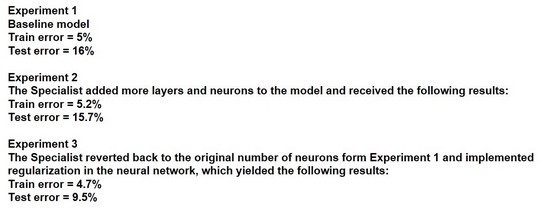 What can the Specialist from the experiments?
-
A
The model In Experiment 1 had a high variance error lhat was reduced in Experiment 3 by regularization Experiment 2 shows that there is minimal bias error in Experiment 1
-
B
The model in Experiment 1 had a high bias error that was reduced in Experiment 3 by regularization Experiment 2 shows that there is minimal variance error in Experiment 1
-
C
The model in Experiment 1 had a high bias error and a high variance error that were reduced in Experiment 3 by regularization Experiment 2 shows thai high bias cannot be reduced by increasing layers and neurons in the model
-
D
The model in Experiment 1 had a high random noise error that was reduced in Expenment 3 by regularization Expenment 2 shows that random noise cannot be reduced by increasing layers and neurons in the model
Reveal answer details
Close answer details
|