A healthcare portal needs to validate the token that it sends to a Mule API. The developer plans to implement a custom policy using the HTTP Policy Transform Extension to match the token received in the header from the heathcare portal. Which files does the developer need to create in order to package the custom policy?
-
A
Deployable ZIP file, YAML configuration file
-
B
JSON properties file, YAML configuration file
-
C
JSON properties file, XML template file
-
D
XML template file, YAML configuration file
Reveal answer details
Close answer details
Correct answerD
ExplanationTo package a custom policy using the HTTP Policy Transform Extension, the developer needs to create an XML template file and a YAML configuration file. The XML template file defines the policy logic using Mule components and placeholders for user-defined properties. The YAML configuration file defines the metadata of the policy, such as its name, description, category, parameters, and dependencies.
References:
https://docs.mulesoft.com/api-manager/2.x/http-policy-transform#packaging-the-policy
A custom policy needs to be developed to intercept all cutbound HTTP requests made by Mule applications. Which XML element must be used to intercept outbound HTTP requests?
-
A
It is not possible to intercept outgoing HTTP requests, only inbound requests
-
B
-
C
-
D
Reveal answer details
Close answer details
Correct answerD
ExplanationThe http-policy:processor element is used to intercept outbound HTTP requests made by Mule applications. It allows customizing the request before it is sent to the target API and modifying the response after it is received from the target API.
References:
https://docs.mulesoft.com/api-manager/2.x/policy-mule4-custom-policy#policy-xml-file
Which pattern should be used to invoke multiple HTTP APIs in parallel and roll back failed requests in sequence?
-
A
A database as a transactional outbox and an Until Successful router to retry any requests
-
B
A Parallel for Each scope with each HTTP request wrapped in a Try scope
-
C
Scatter-Gather as central Saga orchestrator for all API request with compensating actions for failing routes
-
D
VM queues as a reliability pattern with error handlers to roll back any requests
Reveal answer details
Close answer details
Correct answerC
ExplanationTo invoke multiple HTTP APIs in parallel and roll back failed requests in sequence, the developer should use a Scatter-Gather router as a central Saga orchestrator for all API requests with compensating actions for failing routes. A Scatter-Gather router executes multiple routes concurrently and aggregates the results.
A Saga orchestrator coordinates a series of actions across different services and handles failures by executing compensating actions. Therefore, using a Scatter-Gather router as a Saga orchestrator allows invoking multiple HTTP APIs in parallel and rolling back any failed requests in sequence.
References:
https://docs.mulesoft.com/mule-runtime/4.3/scatter-gather-concept
https://docs.mulesoft.com/mule-runtime/4.3/saga
A company with MuleSoft Titanium develops a Salesforce System API using MuleSoft out-of-the-box Salesforce Connector and deploys the API to CloudHub. Which steps provide the average number of requests and average response time of the Salesforce Connector?
-
A
Access Anypoint Monitoring's built-in dashboard. Select a resource.
Locate the information under the Connectors tab.
-
B
Access Anypoint Monitoring's built-in dashboard Seclect a resource.
Create a custom dashboard to retrieve the information.
-
C
Access Anypoint Monitoring built-in dashboard.
Select a resource.
Locate the information under Log Manager <Raw Data.
-
D
Change the API Implementation to capture the information in the log.
Retrieve the information from the log file.
Reveal answer details
Close answer details
Correct answerA
ExplanationTo get the average number of requests and average response time of the Salesforce Connector, the developer should access Anypoint Monitoring's built-in dashboard, select a resource (such as an application or an API), and locate the information under the Connectors tab. The Connectors tab shows metrics for each connector used by the resource, such as average requests per minute, average response time, and failures.
References:
https://docs.mulesoft.com/monitoring/built-in-dashboard-reference
A Mule application deployed to multiple Cloudhub 2.0 replicas needs to temporarily persist large files over 10MB between flow executions, and routinely needs to query whether the file data exists on separate executions. How can this be achieved?
-
A
Store the contents of the file on separate storage, and store the key and location of the file Object using Object Store v2
-
B
Use an in-memory Object Store
-
C
Store the key and full contents of the file in an Object Store
-
D
Store the key and full contents of the file, caching the filename and location between requests
Reveal answer details
Close answer details
Correct answerA
ExplanationTo temporarily persist large files over 10MB between flow executions, and routinely query whether the file data exists on separate executions, the developer should store the contents ofthe file on separate storage, and store the key and location of the file object using Object Store v2. This way, the developer can avoid storing large files in memory or exceeding the size limit of Object Store v2 (10MB per object). The developer can also use Object Store v2 operations to query, retrieve, or delete the file object by its key.
References:
https://docs.mulesoft.com/object-store/osv2-faq#can-i-store-files-in-object-store-v2
The Center for Enablement team published a common application as a reusable module to the central Nexus repository. How can the common application be included in all API implementations?
-
A
Download the common application from Naxus and copy it to the src/main/resources folder in the API
-
B
Copy the common application's source XML file and out it in a new flow file in the src/main/mule folder
-
C
Add a Maven dependency in the PCM file with multiple-plugin as <classifier>
-
D
Add a Maven dependency in the POM file with jar as <classifier>
Reveal answer details
Close answer details
Correct answerD
ExplanationTo include a common application as a reusable module in all API implementations, the developer should add a Maven dependency in the POM file with jar as <classifier>. This way, the developer can reuse Mule
code from another application by packaging it as a JAR file and adding it as a dependency in the POM file of the API implementation. The classifier element specifies that it is a JAR file.
References:
https://docs.mulesoft.com/mule-runtime/4.3/mmp-concept#add-a-maven-dependency-to-the-pom-file
When a client and server are exchanging messages during the mTLS handshake, what is being agreed on during the cipher suite exchange?
-
A
-
B
-
C
-
D
Reveal answer details
Close answer details
Correct answerC
ExplanationA cipher suite is a set of cryptographic algorithms that are used to secure the communication between a client and a server. A cipher suite consists of four components: a key exchange algorithm, an authentication algorithm, an encryption algorithm, and a message authentication code (MAC) algorithm. During the cipher suite exchange, the client and the server agree on which encryption algorithm to use for encrypting and decrypting the data.
References:
https://docs.mulesoft.com/mule-runtime/4.3/tls-configuration#cipher-suites
A Mule application deployed to a standardalone Mule runtime uses VM queues to publish messages to be consumed asynchronously by another flow. In the case of a system failure, what will happen to in-flight messages in the VM queues that have been consumed?
-
A
For nay type of queue, the message will be processed after the system comes online
-
B
For persistent queues, the message will be processed after the system comes online
-
C
For transient queues, the message will be processed after the system comes online
-
D
For any type of queue, the message will be lost
Reveal answer details
Close answer details
Correct answerB
ExplanationIn case of a system failure, in-flight messages in persistent VM queues that have been consumed will be processed after the system comes online. This is because persistent VM queues store messages on disk and guarantee delivery even if there is a system crash or restart. Therefore, any in-flight messages that have been consumed but not processed will be recovered from disk and processed when the system is back online.
References:
https://docs.mulesoft.com/mule-runtime/4.3/vm-connector#persistent-queues
-
A
-
B
-
C
-
D
Reveal answer details
Close answer details
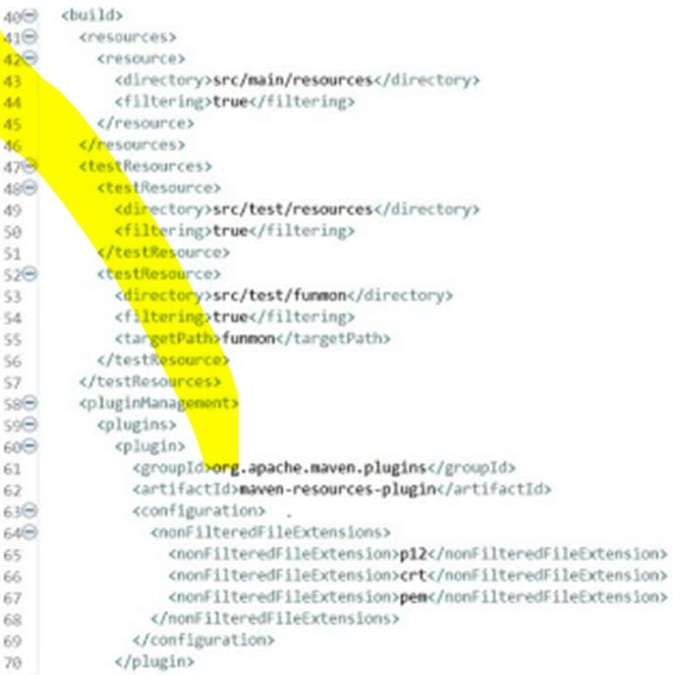
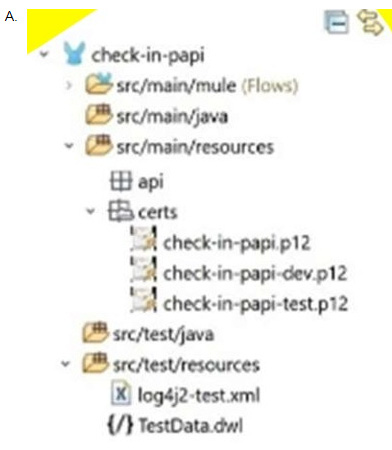
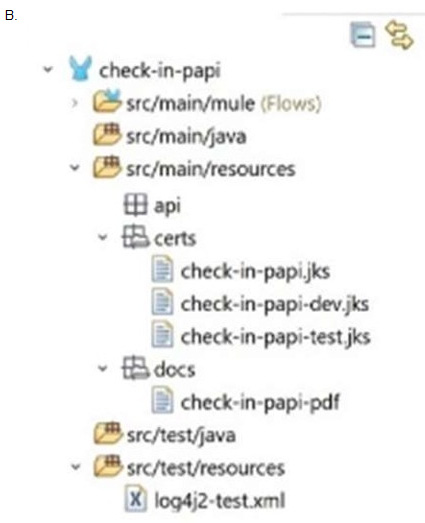
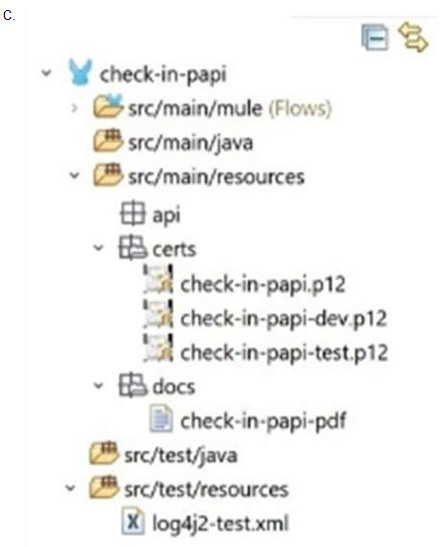
Correct answerC
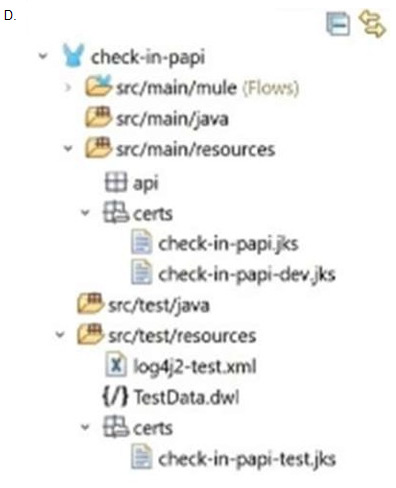
ExplanationTo configure the Maven Resources plugin to exclude parsing binary files in the project's src/main/ resources/certs directory, option C should be used. This option specifies that any files with .cer or .jks extensions under the certs directory should be excluded from filtering. Filtering is a process of replacing placeholders with actual values in resource files during the build process. Binary files should not be filtered because they may become corrupted or unusable.
References:
https://maven.apache.org/plugins/maven-resources-plugin/examples/filter.html
https://maven.apache.org/plugins/maven-resources-plugin/examples/include-exclude.html
|