Which Mule component provides a real-time, graphical representation of the APIs and mule applications that are running and discoverable?
-
A
-
B
-
C
-
D
Reveal answer details
Close answer details
Correct answerC
ExplanationCorrect answer is Anypoint Visualizer MuleSoft Doc Ref :
https://docs.mulesoft.com/visualizer/
Anypoint Visualizer provides a real-time, graphical representation of the APIs, and Mule applications that are running and discoverable. It also displays third-party systems that are invoked by a Mule API, proxy, or application within your application network. The data displayed in the graph is dynamically updated and does not require prior configuration. Additionally, the data displayed is secure, as only users with the proper permissions can view the application network graph. 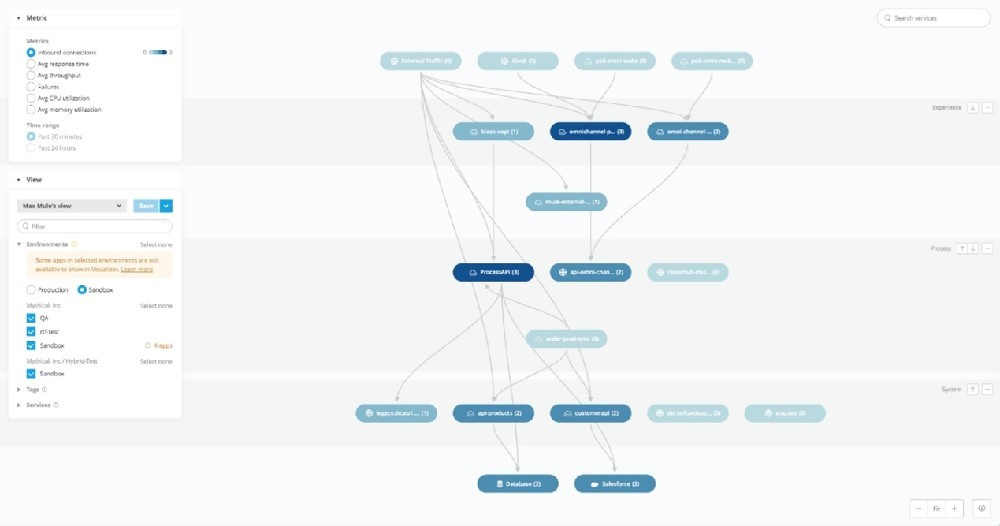
Which of the below activity doesn't support parallel execution?
-
A
-
B
-
C
-
D
Reveal answer details
Close answer details
Correct answerC
ExplanationThe First Successful router iterates through a list of configured processing routes until one of the routes executes successfully. This is sequential execution. In all other options mentioned in the question ,we can achieve parallel execution.
Refer to the exhibits. 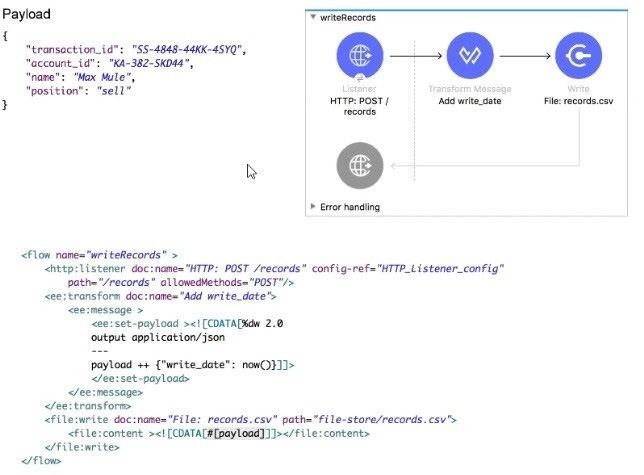 What is written to the records.csv file when the flow executes?
-
A
-
B
-
C
-
D
The payload convert to CVS
Reveal answer details
Close answer details
Correct answerA
ExplanationTransform Message Add write_date is coverting payload in JSON format and same JSON payload is avaialble to file write processor. However, if the payload is a different format (for example, not CSV) , you can place the transformation inside the Write operation to generate content that will be written without producing a side effect on the message in transit. This is not done in this case. By default, the connector writes whatever is in the message payload. Hence JSON payload will be written to file.
Does a root element required when creating a XML response using Dataweave?
-
A
-
B
-
C
-
D
Reveal answer details
Close answer details
Correct answerC
ExplanationRoot element is always required while creating XML response in DataWeave transformation
Refer to the exhibits. 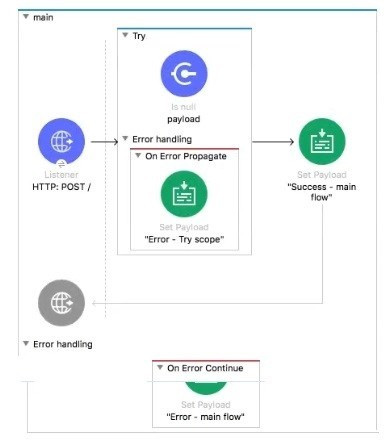 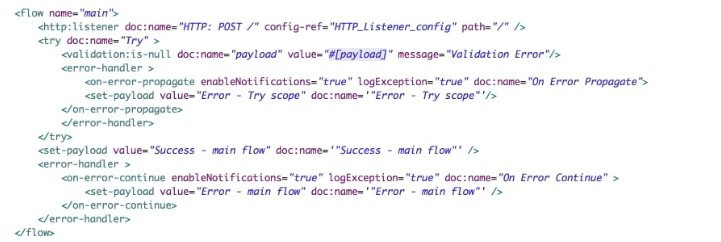 The Validation component in the Try scope throws an error. What response message is returned to a client request to the main flow's HTTP Listener? The Validation component in the Try scope throws an error. What response message is returned to a client request to the main flow's HTTP Listener?
-
A
-
B
-
C
-
D
Reveal answer details
Close answer details
Correct answerA
ExplanationNote that private flow has error scope defined as On Error Continue . So when error occurs in private flow , it is handled by this On Error Continue scope which sends success response back to main flow and does not throw back an error. So main continues normally and payload is set to Success - main flow.
Hence correct answer is Success - main flow
1) HTTP listener received request
2) The Flow Reference calls the child flow 3) The Is Number validator creates an Error Object because the payload isn't an integer.
Child Flow execution stops
#[error.description] = "payload is not a valid INTEGER value" #[error.errorType] = VALIDATION:INVALID_NUMBER 4) The On Error Continue handles the errorThe payload is set to "Error ?Sub Flow"
5) "Error ?Sub Flow" is returned to the main flow as if the child flow was a success. The Set Payload is executed. The payload is reset to "Success ?Finished Main Flow"
6) "Success ?Main Flow" is returned to the requestor in the body of the HTTP request.
HTTP Status Code: 200
As you can see, in the above example, because the error was caught by an On Error Continue scope in the child flow (RED in, GREEN out) when the Mule Message returns to the parent flow, the parent flow knows none-the-different that there was a failure because the on error continue returns a 200 success message. Note that because, to the mainFlow, the childFlow appeared to succeed, the processing of mainFlow resumed after the flow reference.
What is the difference between a subflow and a sync flow?
-
A
-
B
Subflow has no error handling of its own and sync flow does
-
C
Sync flow has no error handling of its own and subflow does
-
D
Subflow is synchronous and sync flow is asynchronous
Reveal answer details
Close answer details
Correct answerB
ExplanationCorrect answer is Subflow has no error handling implementation where as sync flow has.
Subflow
A subflow processes messages synchronously (relative to the flow that triggered its execution) and always inherits both the processing strategy and exception strategy employed by the triggering flow. While a subflow is running, processing on the triggering flow pauses, then resumes only after the subflow completes its processing and hands the message back to the triggering flow.
Synchronous Flow
A synchronous flow, like a subflow, processes messages synchronously (relative to the flow that triggered its execution). While a synchronous flow is running, processing on the triggering flow pauses, then resumes only after the synchronous flow completes its processing and hands the message back to the triggering flow. However, unlike a subflow, this type of flow does not inherit processing or exception strategies from the triggering flow. This type of flow processes messages along a single thread, which is ideally suited to transactional processing
Refer to the exhibit. APIkit is used to generate flow components for the RAML specification. 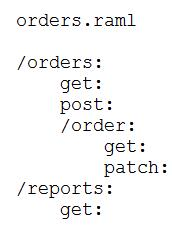 How many APIkit Router components are generated to handle requests to every endpoint defined in the RAML specification?
-
A
-
B
-
C
-
D
Reveal answer details
Close answer details
A Mule project contains a DataWeave module like WebStore.dwl that defines a function named loginUser.
The module file is located in the project's src/main/resources/libs/etl folder. What is correct DataWeave code to import all of the WebStore.dwl file's functions and then call the loginUser function for the login "[email protected]"?
-
A
1.
1. import libs.etl
2.
2. ---
3.
3. WebStore.loginUser("[email protected]")
-
B
1.
1. import * from libs::etl
2.
2. ---
3.
3. WebStore::loginUser("[email protected]")
-
C
1.
1. import libs.etl.WebStore
2.
2. ---
3.
3. loginUser("[email protected]")
-
D
1.
1. import * from libs::etl::WebStore
2.
2. ---
3.
3. loginUser("[email protected]")
Reveal answer details
Close answer details
Correct answerD
Explanation* To use custom modules, you need to import the module or functions you want to use by adding the import directive to the head of your DataWeave script, for example:
1) Does not identify any functions to import from the String module:
import dw::core::Strings
2) To identify a specific function to import from the String module:
import camelize, capitalize from dw::core::Strings 3) To import all functions from the String module:
import * from dw::core::Strings The way you import a module impacts the way you need to call its functions from a DataWeave script. If the directive does not list specific functions to import or use * from to import all functions from a function module, you need to specify the module when you call the function from your script.
* In given scenario, it's mentioned to import all of the WebStore.dwl So correct answer is:
References:
https://docs.mulesoft.com/mule-runtime/4.3/dw-functions
Refer to the exhibit. 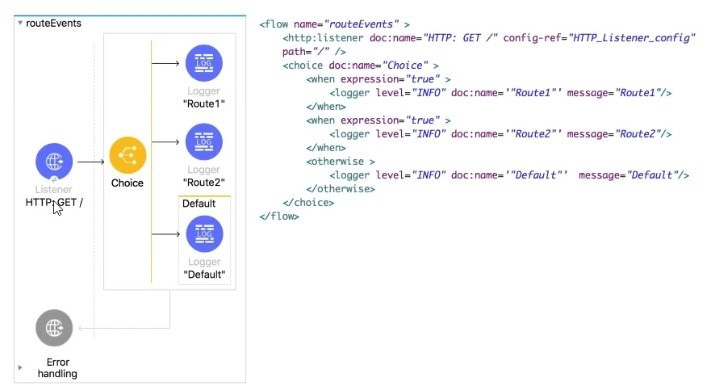 All three of the condition for the Choice router are true. What log messages are written?
-
A
-
B
-
C
-
D
Reveal answer details
Close answer details
Question 10
Single choice
How we can scale deployed Mule application vertically on cloudhub?
-
A
-
B
-
C
Mule applications can be scaled only horizontally
-
D
Option 1 and 2 both can be used
Reveal answer details
Close answer details
Correct answerA
ExplanationMule applications can be scaled vertically by changing worker size. Mule applications can be scaled horizontally by adding more workers.
Question 11
Single choice
Which out of below is not an asset?
-
A
-
B
-
C
-
D
Reveal answer details
Close answer details
Correct answerC
ExplanationExchange is the odd man out here. Rest all are type of asset 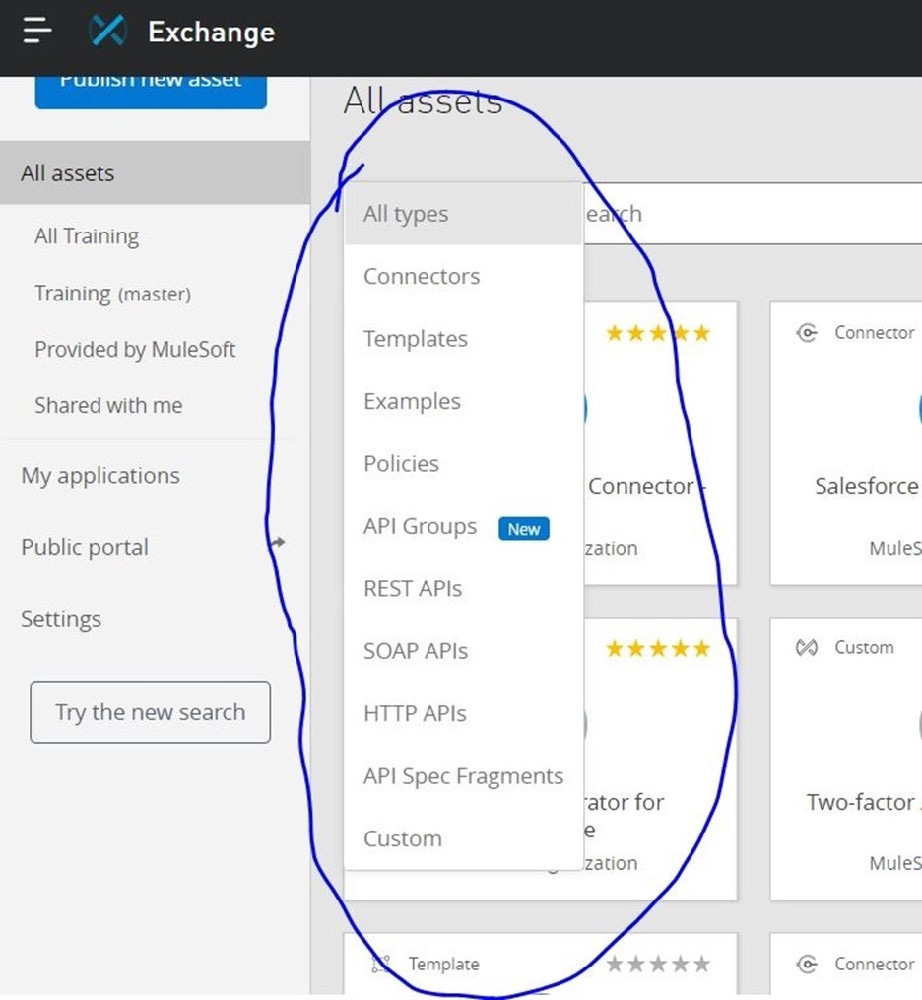
Question 12
Single choice
An On Table Row Database listener retrieves data from a table that contains record_id, an increasing numerical column. How should the listener be configured so it retrieves new rows at most one time?
-
A
Set the target to store the last retrieved record_id value
-
B
Set the ObjectStore to store the last retrieved record_id value
-
C
Set the target to the record_id column
-
D
Set the watermark column to the record id column
Reveal answer details
Close answer details
Question 13
Single choice
Refer to the exhibits. 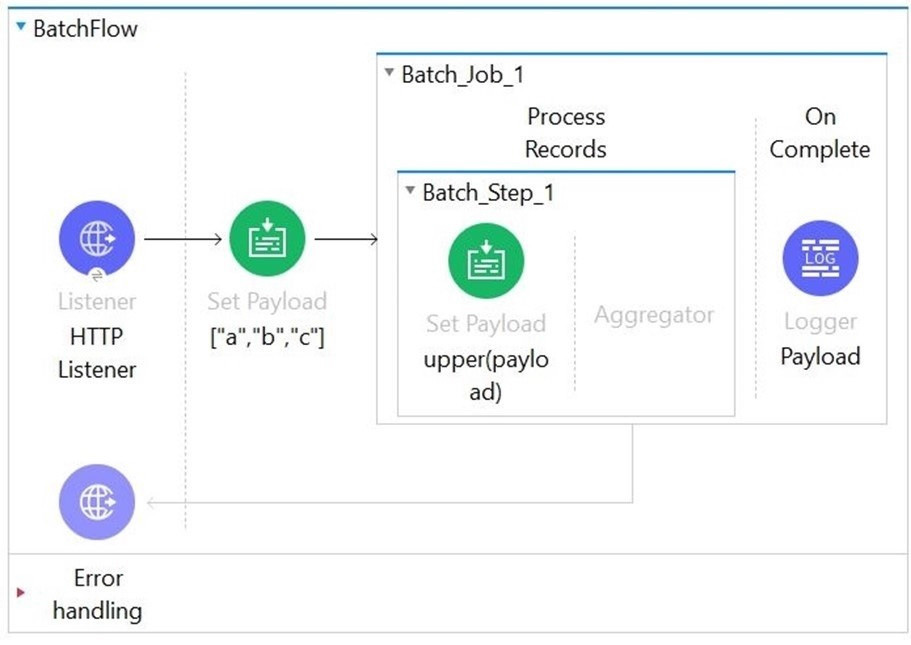 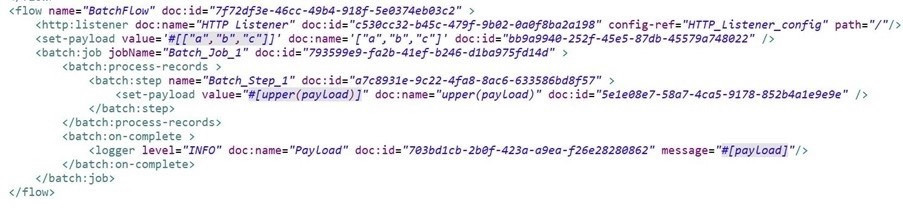 The Batch job processes an array of strings. What information is logged by the logger component after the batch job scope completes processing of the input payload?
-
A
Total Records Processed: 3
Successful Records: 3
Failed Records: 0
payload: ["A","B","C"]
-
B
-
C
Total Records Processed: 3
Successful Records: 3
Failed Records: 0
payload: ["a", "b", "c"]
-
D
Total Records Processed: 3
Successful Records: 3
Failed Records: 0
Reveal answer details
Close answer details
Correct answerD
ExplanationCorrect answer is as below. On complete phase only has access to batch job result statistics and payload is not available.
Total Records Processed: 3
Successful Records: 3
Failed Records: 0 Mule Ref Doc :
https://docs.mulesoft.com/mule-runtime/4.3/batch-processing-concept#on-complete
Question 14
Single choice
Refer to the exhibits. 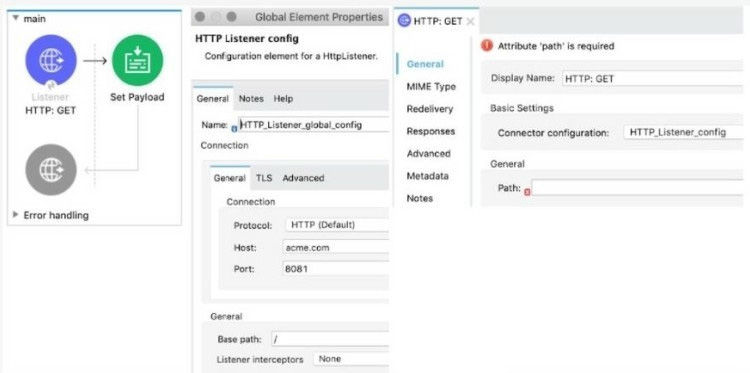 The Mule application implements a REST API that accepts GET requests from web clients on the URLs:
http://acmecom/order/status and http:Vacme.com/customer/status. What path value can be set in the HTTP GE~ event source to accept web client requests from both of these URLs?
-
A
-
B
-
C
-
D
Reveal answer details
Close answer details
Question 15
Single choice
An API specification is designed using RAML. What is the next step to create a REST Connector from this API specification?
-
A
Download the API specification and build the interface using APIkit
-
B
Publish the API specification to Any point Exchange
-
C
Implement the API specification using flow designer in Design Center
-
D
Add the specification to a Mule project's src/main/resources/api folder
Reveal answer details
Close answer details
Correct answerB
ExplanationAPI Exchange creates REST conenctor automtaically once API is published. Hence correct answer is Publish the API specification to Any point Exchange
Question 16
Single choice
Refer to the exhibit. 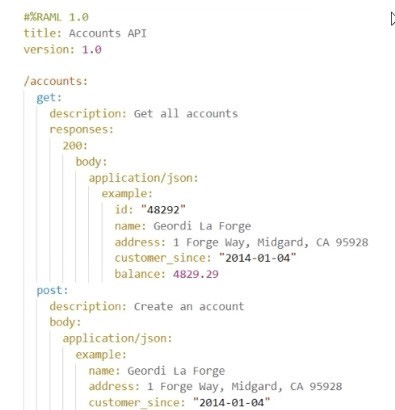 What data is expected by the POST /accounts endpoint? 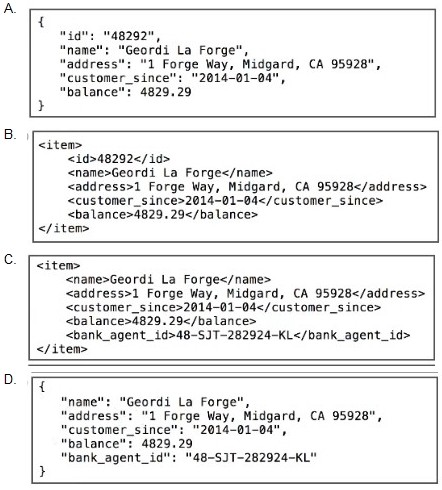
-
A
-
B
-
C
-
D
Reveal answer details
Close answer details
Question 17
Single choice
Refer to the exhibit. 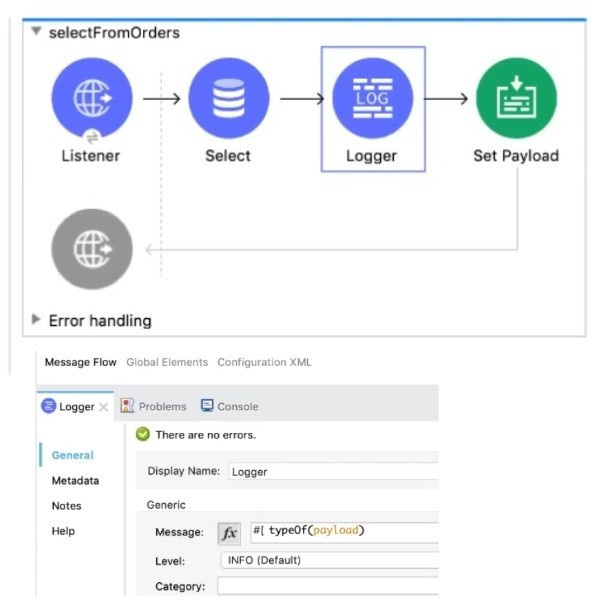 The Database Select operation returns five rows from a database. What is logged by the Logger component?
-
A
-
B
-
C
-
D
Reveal answer details
Close answer details
Question 18
Single choice
A Batch Job scope has five batch steps. An event processor throws an error in the second batch step because the input data is incomplete. What is the default behavior of the batch job after the error is thrown?
-
A
All processing of the batch job stops.
-
B
Event processing continues to the next batch step.
-
C
-
D
Reveal answer details
Close answer details
Correct answerA
ExplanationIn case of an error , batch job completes in flight steps and stops further processing. MuleSoft Doc Ref : Handling Errors During Batch Job | MuleSoft Documentation The default is all processing will stop but we can change it by Max Failed Record field. General -> Max Failed Records: Mule has three options for
handling a record-level error: Finish processing, Continue processing and Continue processing until the batch job accumulates a maximum number of failed records. This behavior can be controlled by Max Failed Records.
The default value is Zero which corresponds to Finish processing.
The value -1, corresponds to Continue processing.
The value +ve integer, corresponds to Continue processing until the batch job accumulates a maximum number of failed records
Question 19
Single choice
Refer to the exhibits. A company has defined this Book data type and Book example to be used in APIs. What is valid RAML for an API that uses this Book data type and Book example? 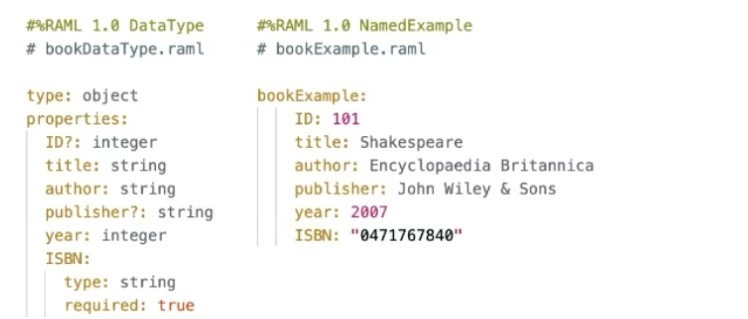 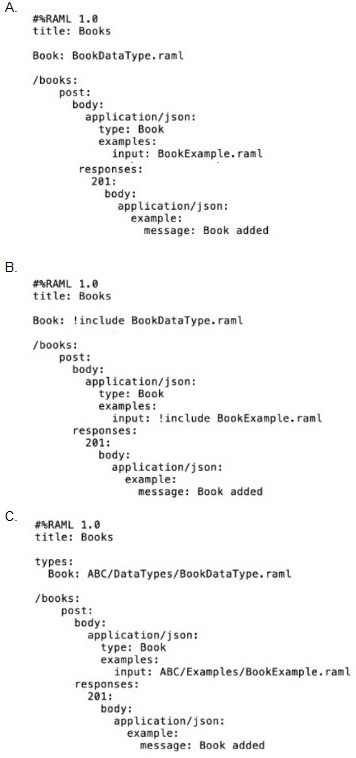 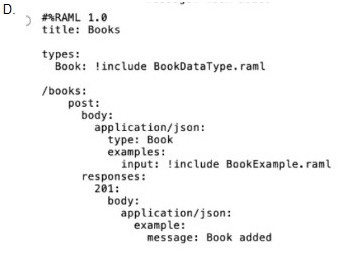
-
A
-
B
-
C
-
D
Reveal answer details
Close answer details
Question 20
Single choice
Which file is used to define the interface contract to invoke a web service implemented as a SOAP service
-
A
-
B
-
C
-
D
Reveal answer details
Close answer details
Correct answerB
ExplanationWSDL is used to define the contract in case of SOAP . RAML/OAS is used to REST services
Question 21
Single choice
What payload is returned by a Database SELECT operation that does not match any rows in the database?
-
A
-
B
-
C
-
D
Reveal answer details
Close answer details
Correct answerD
ExplanationEmpty array is returned when no rows are matched.
MuleSoft Doc Ref :
https://docs.mulesoft.com/db-connector/1.9/database-connector-select
Question 22
Single choice
Refer to the exhibits. The updateTemp and getTemp flows share the same default object store. 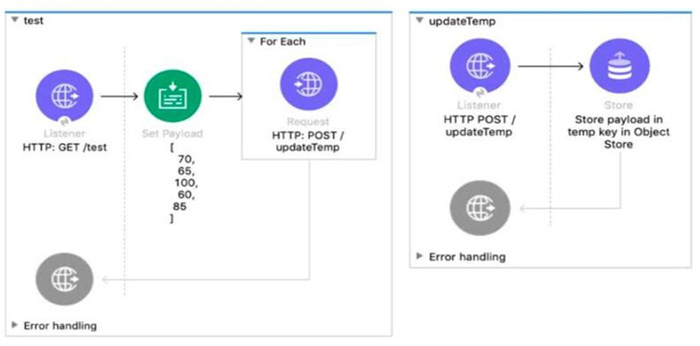 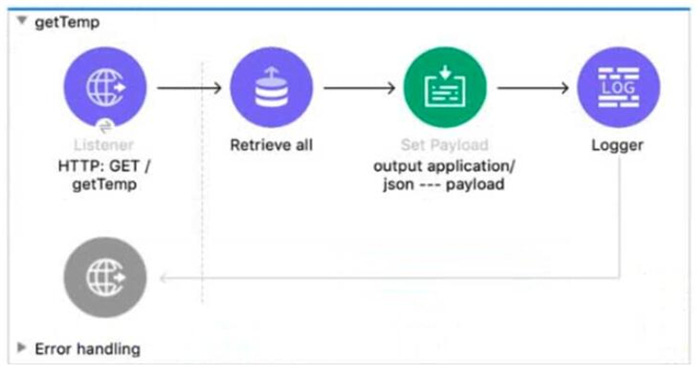 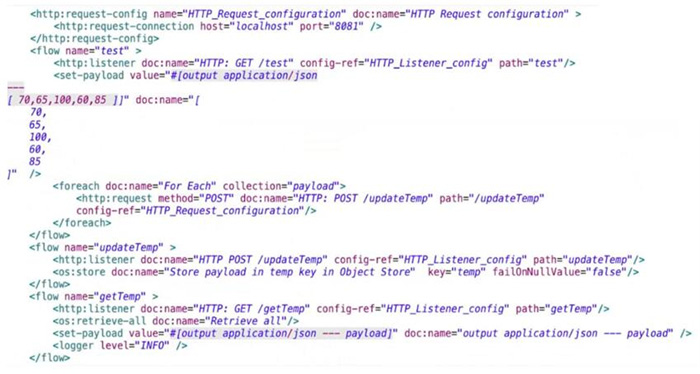 A web client sends one GET request to the test flow's HTTP Listener, which causes the test flow to call the updateTemp flow. After the test flow returns a response, the web client then sends a different GET request to the getTemp flow's HTTP Listener. The test flow is not called a second time. What response is returned from the request to the getTemp flow's HTTP Listener? 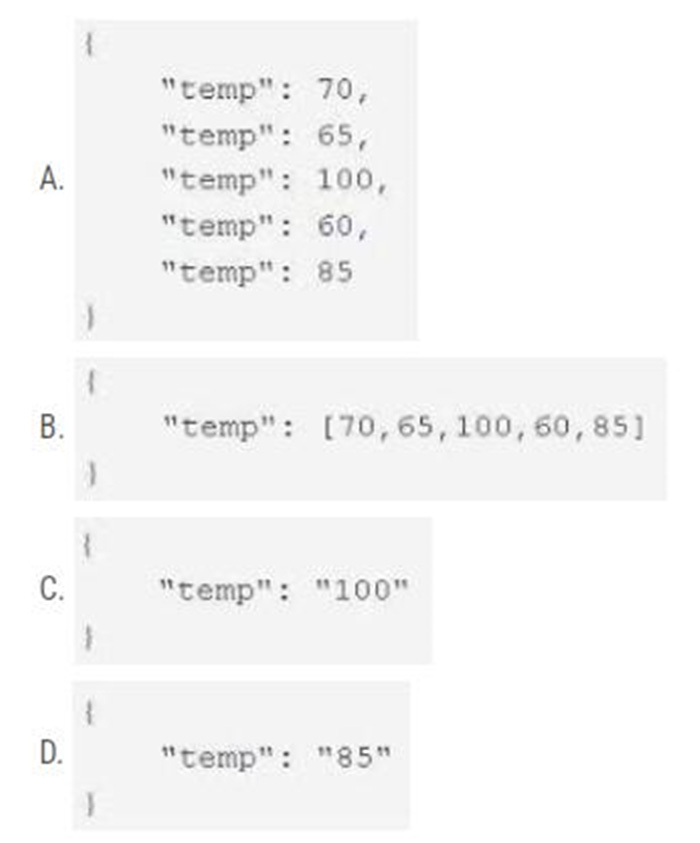
-
A
-
B
-
C
-
D
Reveal answer details
Close answer details
Question 23
Single choice
Refer to the exhibits. 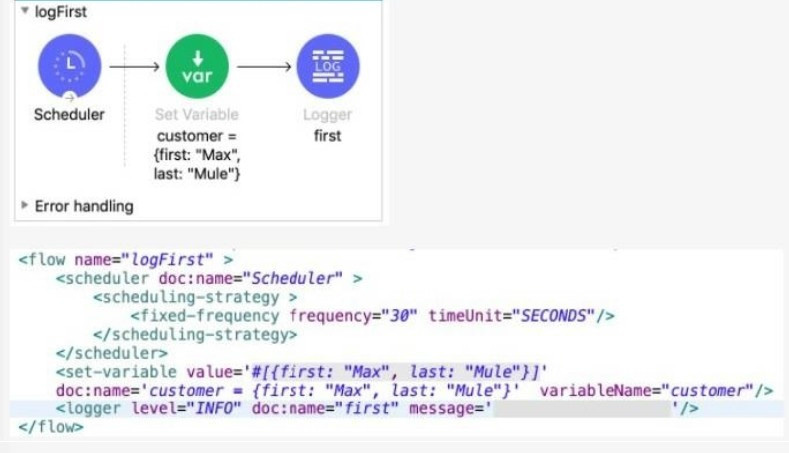 The Set Variable transformer is set with value #[ [ first "Max" last "Mule"} ]. What is a valid DataWeave expression to set as the message attribute of the Logger to access the value "Max" from the Mule event?
-
A
-
B
-
C
-
D
Reveal answer details
Close answer details
Question 24
Single choice
How would you debug Mule applications?
-
A
By Deploying apps on production
-
B
Checking RAML specifications
-
C
-
D
Use third party debugger application
Reveal answer details
Close answer details
Correct answerC
ExplanationDebugger can be used to debug applications to see event data movine from one flow to other
Question 25
Single choice
Refer to the exhibits. 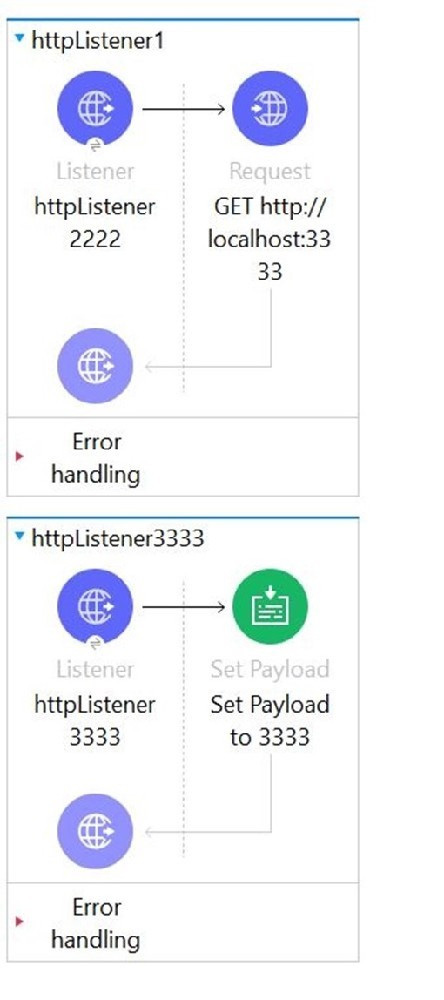 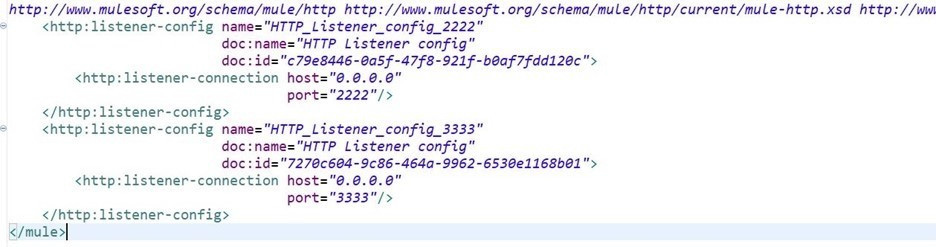 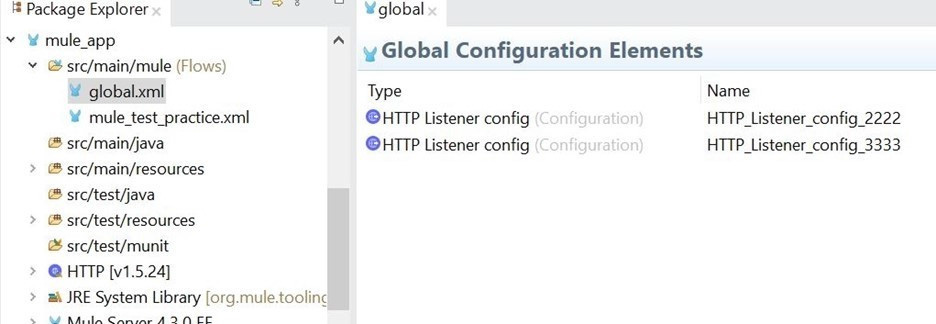 The Mule application configures and uses two HTTP Listener global configuration elements. Mule application is run in Anypoint Studio. If the mule application starts correctly, what URI and port numbers can receive web client requests?
If the mule applications fails to start , what is the reason for the failure?
-
A
The mule application fails to start There is URL path conflict because both HTTP Listeners are configured with same path
-
B
The mule application start successfully Web client requests can only be received at URI on port 2222 but not on port 3333
-
C
The mule application fails to start because of the port binding conflict as HTTP request also use same port i.e. 3333
-
D
The mule application start successfully Web client requests can be received at URI on port 2222 and on port 3333.
Reveal answer details
Close answer details
Correct answerD
ExplanationIn this case both the flows can start without any error and requests can be received on both ports. Flow names httpListener1 can call other flow using HTTP request without any issues.
Question 26
Single choice
Refer to the exhibit. What is the output of logger component? 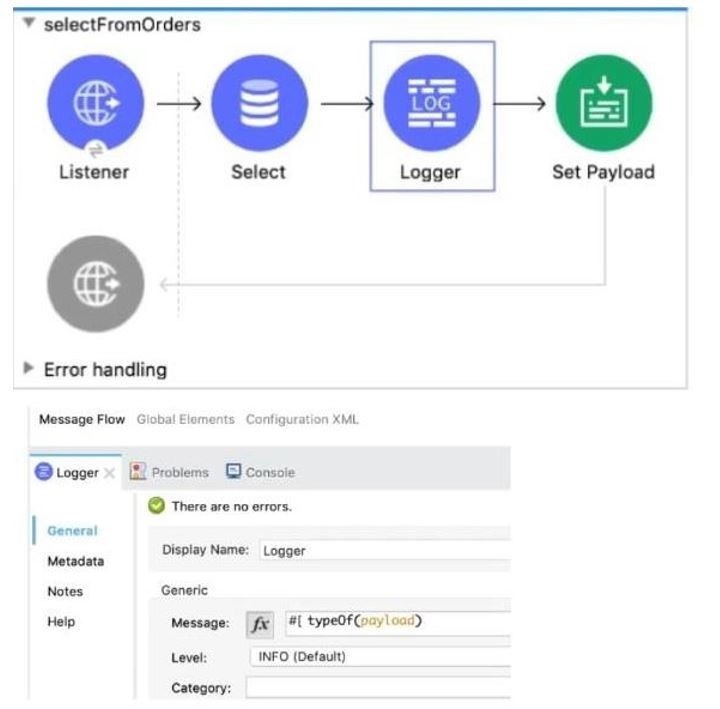
-
A
-
B
-
C
-
D
Reveal answer details
Close answer details
Correct answerC
ExplanationDatabase always return rows as an array.
Array is the correct answer
Question 27
Single choice
Refer to the exhibit. 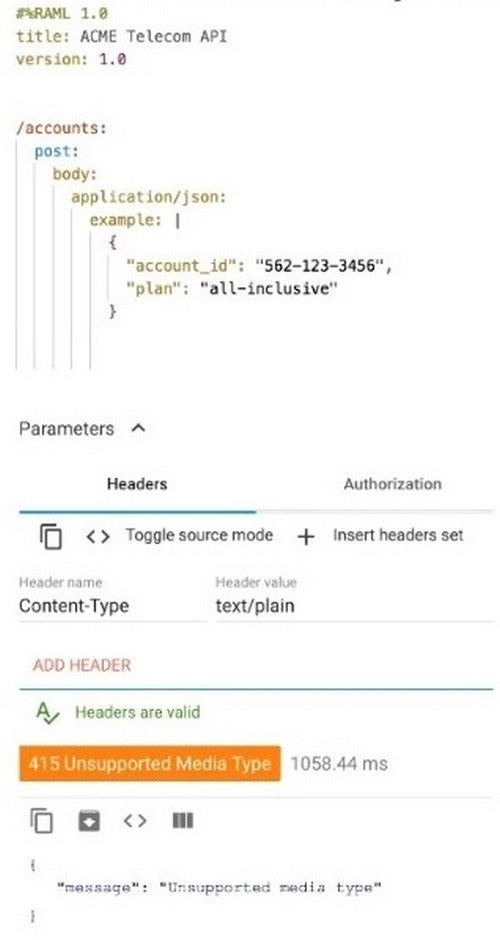 What should be changed to fix the 415 error?
-
A
set the response Content-Type header to text/plain
-
B
set the response Content-Type header to application/json
-
C
Set the request Content-Type header to application/] son
-
D
set the request Content-Type header to text/plain
Reveal answer details
Close answer details
Correct answerC
ExplanationThe HTTP 415 Unsupported Media Type client error response code indicates that the server refuses to accept the request because the payload format is in an unsupported format. The format problem might be due to the request's indicated Content-Type or Content-Encoding , or as a result of inspecting the data directly. In this case as per RAML specification data is expected in application/json and in request Content-
Type is set as "text/plain" which is incorrect. Hence solution is set the request Content-Type header to application/json
Question 28
Single choice
A Mule project contains a DataWeave module file WebStore dvA that defines a function named loginUser
The module file is located in the projects src/main/resources/libs/dw folder What is correct DataWeave code to import all of the WebStore.dwl file's functions and then call the loginUser function for the login "[email protected]"? 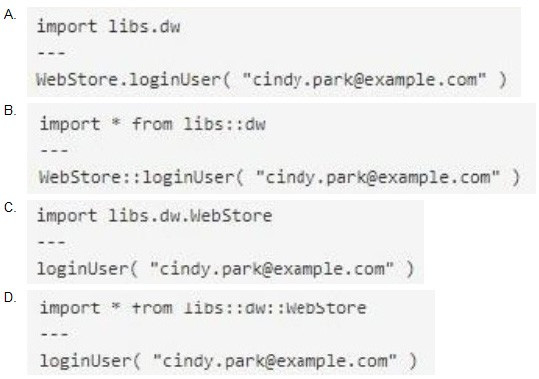
-
A
-
B
-
C
-
D
Reveal answer details
Close answer details
Question 29
Single choice
A web client sends a request to http;//localhost:8081?dept=sales. What is the correct DataWeave expression to access the value of dept?
-
A
attributes.queryParams.dept
-
B
-
C
-
D
Reveal answer details
Close answer details
Question 30
Single choice
Refer to the exhibits. 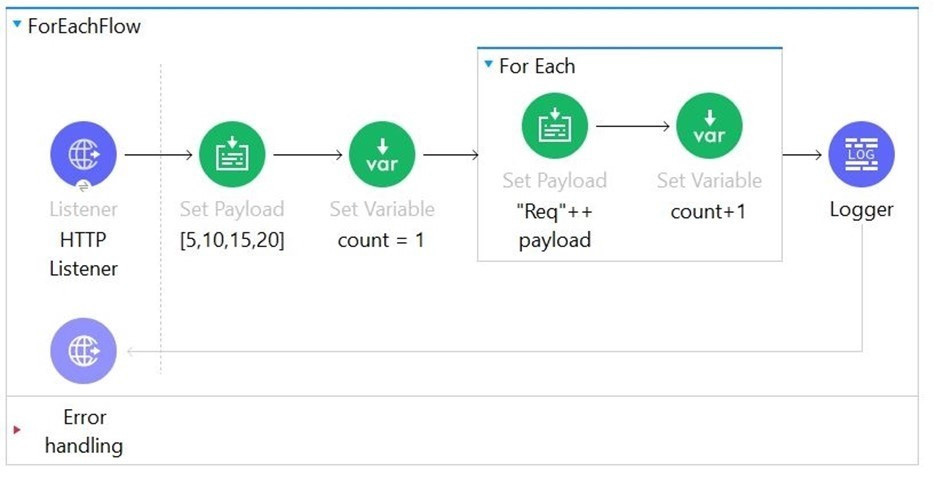 What payload and variable are logged at the end of the main flow? 
-
A
-
B
-
C
[[Req5, Req10, Req15, Req20], 5]
-
D
[Req5Req10,Req15Req20, 5]
Reveal answer details
Close answer details
Correct answerB
ExplanationCorrect answer is [[5, 10, 15, 20], 5]
Key thing to note here is that any changes made to payload in for each loop are not available outside for each scope where as variable value updated in for each loop is visible out side for each loop too.
Question 31
Single choice
What asset cannot be created using Design Center?
-
A
-
B
-
C
-
D
Reveal answer details
Close answer details
Correct answerD
ExplanationAPI portal are created by API Exchange and cannot be created by Design Center
Question 32
Single choice
What should this endpoint return considering the API is build using standard practices? http://dev.acme.com/api/patients?year=2021
-
A
-
B
-
C
-
D
Reveal answer details
Close answer details
Correct answerB
ExplanationCorrect answer is Patients from year 2021.
The thing to note here is that year is not a query parameter and not the uri parameter. Hence it will filter all the patients and return the ones for whom year is 2021
Question 33
Single choice
What is the object type returned by the File List operation?
-
A
Object of String file names
-
B
Array of String file names
-
C
Object of Mule event objects
-
D
Array of Mule event objects
Reveal answer details
Close answer details
Correct answerD
ExplanationThe List operation returns an array of messages in which: Each message holds the file's content in its payload. The file's attributes section carries the file's metadata (such as name, creation time, and size).
The payload is empty if the element is a folder.
Question 34
Single choice
A RAML example fragment named StudentExample.raml is placed in the examples folder in an API specification project. What is the correct syntax to reference the fragment?
-
A
examples: !include StudentExample.raml
-
B
examples: #import StudentExample.raml
-
C
examples: !include examples/StudentExample.raml
-
D
examples: #import examples/StudentExample.raml
Reveal answer details
Close answer details
Correct answerC
ExplanationTo include property. To keep the API definition concise, you can include external content, such as documentation, schemas, and frequently used patterns outside the definition itself. The parser interprets
!include as if the content of the externally-hosted file or a URL were declared in-line.
To use the fragments in RAML you have to include the exact path(copy the path) of that fragment you want to use as shown below Option 3 is the correct as correct syntax is examples: !include examples/StudentExample.raml
References:
https://docs.mulesoft.com/api-manager/1.x/tutorial-design-an-api
Question 35
Single choice
Refer to the exhibits. 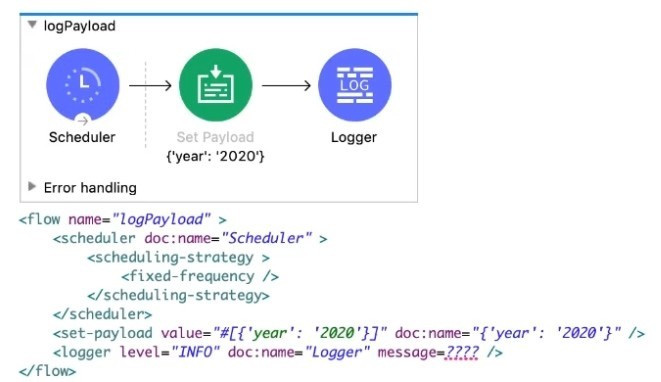 The Set Payload transformer's value is set to {'year': '2020'}. What message value should be added to the Logger component to output the message 'The year is 2020', without hardcoding 2020?
-
A
'#[The year is $(pay load .year)]*
-
B
The year is #[payload.year]'
-
C
'#[The year is " + paytoad.year]'
-
D
#["The year is "++ payload.year].
Reveal answer details
Close answer details
Question 36
Single choice
Which of the module is imported automatically in Dataweave scripts?
-
A
-
B
-
C
-
D
Reveal answer details
Close answer details
Correct answerA
ExplanationCore (dw::Core) This module contains core DataWeave functions for data transformations.
It is automatically imported into any DataWeave script.
|