In some countries, there is a free flow of information about infrastructure, agriculture, and industry, whereas in other countries, this information is controlled by a small elite. In the latter countries, the vast majority of the population is denied vital information about factors that determine their welfare. Thus, these countries are likely to experience more frequent economic crises than other countries do. The conclusion follows logically if which one of the following is assumed?
-
A
It is more likely that people without political power will suffer from economic crises than it is that people in power will.
-
B
Economic crises become more frequent as the amount of information available to the population about
factors determining its welfare decreases.
-
C
In nations in which the government controls access to information about infrastructure, agriculture, and industry, economic crises are common.
-
D
The higher the percentage of the population that participates in economic decisions, the better those decisions are.
-
E
A small elite that controls information about infrastructure, agriculture, and industry is likely to manipulate that information for its own benefit.
Reveal answer details
Close answer details
Correct answerB
ExplanationAnother Assumption question, so the familiar drill applies; let's analyze the components of the argument and see what's missing. And this one has "connect the dots" written all over it. Remember back in Q. 1 when the idea of student interests seemed to drop in out of nowhere? Did you notice its counterpart here?
In countries where the elite control the flow of information on certain topics, most people are denied important information on topics that are relevant to their welfare. From this, the author concludes (notice the Keyword "Thus") that these countries are likely to have economic crises more often than other countries. Where does that come from? From out of nowhere, really, which tells us there's a big chunk missing here. The argument works only if the idea of economic crises is connected with the notion of people being denied information vital to their welfare. Option [Economic crises become more frequent as...] connects the dots, so to speak, by forging the necessary link between these parts of the argument.
In 1892 the Sierra Club was formed. In 1908 an area of coastal redwood trees north of San Francisco was established as Muir Woods National Monument. In the Sierra Nevada mountains, a walking trail from Yosemite Valley to Mount Whitney was dedicated in 1938. It is called John Muir Trail.
John Muir was born in 1838 in Scotland. His family name means "moor," which is a meadow full of flowers and animals. John loved nature from the time he was small. He also liked to climb rocky cliffs and walls.
When John was eleven, his family moved to the United States and settled in Wisconsin. John was good with tools and soon became an inventor. He first invented a model of a sawmill. Later he invented an alarm clock that would cause the sleeping person to be tipped out of bed when the timer sounded. Muir left home at an early age. He took a thousand-mile walk south to the Gulf of Mexico in 1867and 1868. Then he sailed for San Francisco. The city was too noisy and crowded for Muir, so he headed inland for the Sierra Nevadas.
When Muir discovered the Yosemite Valley in the Sierra Nevadas, it was as if he had come home. He loved the mountains, the wildlife, and the trees. He climbed the mountains and even climbed trees during thunderstorms in order to get closer to the wind. He put forth the theory in the late 1860's that the Yosemite Valley had been formed through the action of glaciers. People ridiculed him. Not until 1930 was Muir's theory proven correct. Muir began to write articles about the Yosemite Valley to tell readers about its beauty. His writing also warned people that Yosemite was in danger from timber mining and sheep ranching interests. In 1901 Theodore Roosevelt became president of the United States. He was interested in conservation. Muir took the president through Yosemite, and Roosevelt helped get legislation passed to create Yosemite National Park in 1906. Although Muir won many conservation battles, he lost a major one.
He fought to save the Hetch Valley, which people wanted to dam in order to provide water for San Francisco. In the late 1913 a bill was signed to dam the valley. Muir died in 1914. Some people say losing the fight to protect the valley killed Muir. When did Muir invent a unique form of alarm clock?
-
A
while the family still lived in Scotland
-
B
after he sailed to San Francisco
-
C
after he traveled in Yosemite
-
D
while the Muir family lived in Wisconsin
-
E
after he took the long walk
Reveal answer details
Close answer details
What does the word patent mean to you? Does it strike you as being something rather remote from your interests? If it does, stop and think a moment about some of the commonplace things that you use every day, objects that you take for granted as part of the world around you. The telephone, radio, television, the automobile, and the thousand and one other things (even the humble safety pin) that enrich our lives today once existed only as ideas in the minds of men. If it had not been possible to patent their ideas and thus protect them against copying by others, these inventions might never have been fully developed to serve mankind. If there were no patent protection there would be little incentive to invent and innovate, for once the details of an invention became known, hordes of imitators who did not share the inventor's risks and expenses might well flood the market with their copies of his product and reap much of the benefit of his efforts. The technological progress that has made America great would wither rapidly under conditions such as these. The fundamental principles in the US. patent structure came from England. During the glorious reign of Queen Elizabeth I in England, the expanding technology was furthered by the granting of exclusive manufacturing and selling privileges to citizens who had invented new processes or tools- a step that did much to encourage creativity. Later, when critics argued that giving monopoly rights to one person infringed on the rights of others, an important principle was added to the patent structure: The Lord Chief Justice of England stated that society had everything to gain and nothing to lose by granting exclusive privileges to an inventor, because a patent for an invention was granted for something new that society never had before. Another basic principle was brought into law because certain influential people in England had managed to obtain monopoly control over such age-old products as salt, and had begun charging as much as the traffic would bear. The public outcry became so great that the government was forced to decree that monopoly rights could be awarded only to those who created or introduced something really unique. These principles are the mainstays of our modern patent system in the United States. In colonial times patent law was left up to the separate states. The inconsistency, confusion, and unfairness that resulted clearly indicated the need for a uniform patent law, and the men who drew up the Constitution incorporated one. George Washington signed the first patent law on April 10, 1790, and less than four months later the first patent was issued to a man named Samuel Hopkins for a chemical process, an improved method of making potash for use in soapmaking. In 1936 the Patent Office was established as a separate bureau. From the staff of eight that it maintained during its first year of operation it has grown into an organization of over 2500 people handling more than 1600 patent applications and granting over 1000 every week. The Patent Office in Washington, DC., is the world's largest library of scientific and technical data, and this treasure trove of information is open for public inspection. In addition to more than 3 million U. S. patents, it houses more than 7 million foreign patents and thousands of volumes of technical literature. Abraham Lincoln patented a device to lift steam vessels over river shoals, Mark Twain developed a self-pasting scrapbook, and millionaire Cornelius Vanderbilt invented a shoe-shine kit. A patent may be granted for any new and useful process, machine, article of manufacture, or composition of
matter (a chemical compound or combinations of chemical compounds), or any distinct and new variety; of
plant, including certain mutants and hybrids. The patent system has also helped to boost the wages of the American worker to an unprecedented level; he can produce more and earn more with the computer,
adding machines, drill press or lathe. Patented inventions also help keep prices down by increasing manufacturing efficiency and by stimulating the competition that is the foundation of our free enterprise system.
The decades of history have disclosed little need for modification of the patent structure.
Our patent laws, like the Constitution from which they grew, have stood the test of time well. They encouraged the creative processes, brought untold benefits to society as a whole and enabled American technology to outstrip that of the rest of the civilized world. What is the main idea of this passage?
-
A
The patent system encourages free enterprise.
-
B
The Constitution protects the patent system.
-
C
The patent system in England has been influential in American patent development.
-
D
Patents are important tools for inventors.
-
E
Patented inventions protect the inventor, free enterprise, and the creative process.
Reveal answer details
Close answer details
Is it necessary for defense lawyers to believe that the clients they defend are innocent of the charges against them? Some legal scholars hold that lawyers* sole obligation is to provide the best defense they are capable of, claiming that in democratic societies all people accused of crimes are entitled to the best possible legal representation. They argue that lawyers have no right to judge defendants because it is the job of the courts to determine guilt or innocence and the job of the lawyer to represent the defendant before the court. They believe that the lawyer's responsibility is to state those facts that will assist each client's case, construct sound arguments based on these facts, and identify flaws in the arguments of opposing counsel. According to these scholars, the lawyer's role is not to express or act on personal opinions but to act as an advocate, saying only what defendants would say if they possessed the proper training or resources with which to represent themselves. But such a position overlooks the fact that the defense lawyer's obligation is twofold: to the defendant, certainly, but no less so to the court and, by extension, to society. For this reason, lawyers, great as their obligation to defendants is, should not, as officers of the court, present to the court assertions that they know to be false. But by the same principle, lawyers who are convinced that their clients are guilty should not undertake to demonstrate their innocence. Guilty defendants should not be entitled to false or insincere representation. When lawyers know with certainty that a defendant is guilty, it is their duty not to deny this.
Rather, they should appraise the case as much as possible in their client's favor, after giving due consideration to the facts on the other side, and then present any extenuating circumstances and argue for whatever degree of leniency in sentencing they sincerely believe is warranted. In cases where it is uncertain whether the client is guilty but the lawyer sincerely believes the client may well be innocent, the lawyer should of course try to prove that the client is innocent. The lawyer's obligation to the court and to society also ultimately benefits the defendant, because the "best defense" can only truly be provided by an advocate who, after a careful analysis of the facts, is convinced of the merits of the case. The fact that every client is entitled to a defense does not mean that defense lawyers should take every case they are offered. Lawyers should not be mere mouthpieces for a defendant but instead advocates for the rights of the defendant given the facts of the case. According to the passage, the legal scholars mentioned at the end of 1st paragraph believe that it is a defense lawyer's role to be
-
A
a source of legal information that can help a jury to reach decisions that are fair and equitable
-
B
a thorough investigator of all relevant evidence
-
C
a diligent representative of the client's position
-
D
a facilitator and expediter of the cause of justice
-
E
an energetic advocate of the client's right to legal representation
Reveal answer details
Close answer details
Correct answerC
ExplanationThe categorical language of the stem, and the "According to the passage," signal a Detail question, and the line reference sends us to a particular spot. So let's read the Detail, in full.
Always read the meter dials from the right to the left. This procedure is much easier, especially if any of the dial hands are near the zero mark. If the meter has two dials, and one is smaller than the other, it is not imperative to read the smaller dial since it only registers a small amount. Read the dial at the right first. As the dial turns clockwise, always record the figure the pointer has just passed. Read the next dial to the left and record the figure it has just passed. Continue recording the figures on the dials from right to left. When finished, mark off the number of units recorded. Dials on water and gas meters usually indicate the amount each dial records. When you have finished reading the meter, mark off
-
A
the number of units recorded
-
B
the figures on the small dial
-
C
-
D
-
E
the last reading of the month
Reveal answer details
Close answer details
The Galapagos Islands are in the Pacific Ocean, off the western coast of South America.
They are a rocky, lonely spot, but they are also one of the most unusual places in the world. One reason is that they are the home of some of the last giant tortoises left on earth. Weighing hundreds of pounds, these tortoises, or land turtles, wander slowly around the rocks and sand of the islands. Strangely, each of these islands has its own particular kinds of tortoises. There are seven different kinds of tortoises on the eight islands, each kind being slightly different from the other. Hundreds of years ago, thousands of tortoises wandered around these islands. However, all that changed when people started landing there.
When people first arrived in 1535, their ships had no refrigerators. This meant that fresh food was always a problem for the sailors on board. The giant tortoises provided a solution to this problem. Ships would anchor off the islands, and crews would row ashore and seize as many tortoises as they could. Once the animals were aboard the ship, the sailors would roll the tortoises onto their backs. The tortoises were completely helpless once on their backs, so they could only lie there until used for soups and stews.
Almost 100,000 tortoises were carried off in this way. The tortoises faced other problems, too. Soon after the first ships, settlers arrived bringing pigs, goats, donkeys, dogs and cats. All of these animals ruined life for the tortoises. Donkey and goats ate all the plants that the tortoises usually fed on, while the pigs. Dogs and cats consumed thousands of baby tortoises each year. Within a few years, it was hard to find any tortoise eggs-or even any baby tortoises. By the early 1900s, people began to worry that the last of the tortoises would soon die out. No one, however, seemed to care enough to do anything about the problem. More and more tortoises disappeared, even though sailors no longer needed them for food. For another fifty years, this situation continued. Finally, in the 1950s, scientist decided that something must be done. The first part of their plan was to get rid of as many cats, dogs and other animals as they could. Next, they tried to make sure that more baby tortoises would be born. To do this, they started looking for wild tortoise eggs. They gathered the eggs and put them in safe containers. When the eggs hatched, the scientists raised the tortoises in special pens. Both the eggs and tortoises were numbered so that the scientists knew exactly which kinds of tortoises they had-and which island they came from. Once the tortoises were old enough and big enough to take care of themselves, the scientists took them back to their islands and set them loose. This slow, hard work continues today, and, thanks to it, the number of tortoises is now increasing every year. Perhaps these wonderful animals will not disappear after all. What happened soon after people brought animals to the islands?
-
A
Tortoise eggs were kept in safe containers.
-
B
Scientists took away as many animals as they could.
-
C
The animals ate the tortoises' food and eggs.
-
D
The tortoises fought with the other animals.
-
E
The tortoises continued to wander freely.
Reveal answer details
Close answer details
Two mannequins -- 1 and 2 -- will be dressed for display in outfits chosen from ten articles of clothing.
Each article is in exactly one of three colors: navy, red, or yellow. There are three hats -- one in each color;
three jackets -- one in each color; three skirts -- one in each color; and one red tie. Each mannequin wears
exactly one of the hats, one of the jackets, and one of the skirts. Furthermore, their outfits must meet the following restrictions: Neither mannequin wears all three colors.
Each mannequin wears a hat in a different color from the jacket it wears.
Mannequin 2 wears the navy skirt.
Mannequin 1 wears the tie. If all four of the red articles of clothing are included in the two mannequins' outfits, which one of the following must be true?
-
A
Mannequin 1 wears the red hat.
-
B
Mannequin 1 wears the yellow jacket.
-
C
Mannequin 2 wears the navy jacket.
-
D
Mannequin 1 wears no navy articles of clothing.
-
E
Mannequin 2 wears no yellow articles of clothing.
Reveal answer details
Close answer details
Correct answerE
ExplanationIf there are four red items worn, then someone gets the red hat, someone gets the red jacket, and someone gets the red skirt. Since mannequin 2 gets the navy skirt, mannequin 1 gets the red skirt, but that's not one of the choices. What else do we know? We know that mannequin 2's hat and jacket are different colors (Rule 2), and that one of those colors is navy. What's the other color? It can't be yellow, since that would force mannequin 1 to have a red hat and a red jacket in violation of Rule 2. So mannequin 2's colors are red and navy, which means that mannequin 2 wears no yellow clothing, and option
[Mannequin 2 wears no yellow articles of clothing.] is correct. The other choices are possible only.
Some types of organisms originated through endosymbiosis, the engulfing of one organism by another so that a part of the former becomes a functioning part of the latter. An unusual nucteomorph, a structure that contains DNA and resembles a cell nucleus, has been discovered within a plant known as a chlorarachniophyte. Two versions of a particular gene have been found in the DNA of this nucleomorph, and one would expect to find only a single version of this gene if the nucleomorph were not the remains of an engulfed organism's nucleus. Which one of the following is most strongly supported by the information above?
-
A
Only organisms of types that originated through endosymbiosis contain nucleomorphs.
-
B
A nucleomorph within the chlorarachniophyte holds all of the genetic material of some other organism.
-
C
Nucleomorphs originated when an organism endosymbiotically engulfed a chtorarachniophyte.
-
D
Two organisms will not undergo endosymbiosisunless at least one of them contains a nucleomorph.
-
E
Chlorarachniophytes emerged as the result of two organisms having undergone endosymbiosis.
Reveal answer details
Close answer details
Correct answerE
ExplanationThis next Inference question involves a scientifically challenging argument. But buried amidst the technical terms is some fairly straightforward formal logic, so hopefully you didn't let yourself get bogged down in the terminology. Endo (no reason not to shorten this) is a process by which one organism engulfs another and the engulfed organism becomes a functioning part of the whole. Something strange that looks like a cell nucleus (let's shorten its cumber somename to nuc) has been found inside a plant (chlor); can you see
where this is going? Perhaps endosymbiosis occurred here? What follows requires some interpretation (and that's, after all, what Inference questions are all about--interpretingand combining): If the nuc was NOT originally part of an organism that got engulfed, then we'd expect one version of a particular gene in its DNA. That's a simple formal logic statement, albeit one with complicated terms. Nonetheless, the contrapositive applies: If there's NOT one version of the gene, then the nuc WAS part of something that got engulfed. And we're told, in fact, that there are TWO versions of the gene, so we know for sure that engulfing took place.
A study of young and middle-aged men in the United States has found that the men whose diet was high in saturated fat also had a high amount of blood cholesterol. In another experiment, when the blood cholesterol level of laboratory rabbits was raised by feeding them exclusively on cholesterol, fat deposits formed in their blood vessels. Similar fat deposits are found in human patients of heart disease. Therefore, to reduce the occurrence of heart disease, people should reduce their dietary consumption of saturated fat. Each of the following, if true, weakens the above argument EXCEPT:
-
A
The bodily reactions of animal models to internal or external stimulants are often poor predictors of the reactions of the human body to the same stimulants.
-
B
The per capita consumption of saturated fat in the United States has decreased by 27 percent since 1970 while the occurrence of heart disease in the country has increased by 400 percent in the same period.
-
C
An analysis of studies done on more than 600,000 men and women has established that blood cholesterol is inversely associated with the risk of death from infectious respiratory and digestive diseases.
-
D
A study that covered more than 10,000 individuals has found no relationship between the amount of blood cholesterol and the occurrence of heart disease.
-
E
In a study where the dietary saturated fat consumption of young and middle-aged American women was three to seven times higher than normal, the blood cholesterol level remained unchanged.
Reveal answer details
Close answer details
Correct answerC
ExplanationArgument construction Premise 1: A study of young and middle-aged men in the United States has found that the men whose diet was high in saturated fat (SF) also had a high amount of blood cholesterol (BC). So, this premise can be simplified as: High SF is correlated with high BC in young and middle-aged American males. Premise 2: In another experiment, when the blood cholesterol level (BC) of laboratory rabbits was raised by feeding them on cholesterol, fat deposits (FD) were found in their blood vessels. This premise can be simplified as: In lab rabbits, when BC became high, FD formed. Premise 3: Similar fat deposits (FD) are found in human patients of heart disease (HD). So, per this premise, FD is correlated with HD in humans. By combining these three premises, the following conclusion is drawn: Conclusion: To reduce the occurrence of heart disease, people should reduce their dietary consumption of saturated fat. In simpler form: To reduce HD, people should reduce SF. The structure of this argument can be visually depicted as under: 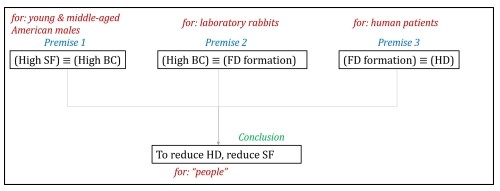 There are a few things to note about the way this argument is drawn: The argument's conclusion draws broad generalizations whereas the premises are not similarly general in their scope: 1. Premise 1 mentions a finding about one demographic - young and middle -aged American men ?while the conclusion drawn is a generalization that seems to apply to all";people"; irrespective of age, gender or nationality.
2. Premise 2 mentions a finding about laboratory rabbits while the conclusion drawn is about humans. The argument confounds correlation with causation. This is proved by the conclusion that reducing SF will cause reduced occurrence of heart disease.
However, the premises do not offer grounds for such causality: 1. Premise 1 only states that in one particular group, high SF is correlated with high BC. We cannot infer from this whether it is high SF that caused high BC, or whether high BC caused high SF (for example, by inducing cravings for food that is high SF), or whether some other third factor was the cause of both high SF and high BC (for example, if the individuals of this particular group have a genetic predisposition towards higher BC than other ethnic and/or age groups and also have a diet that is high in SC).
2. In Premise 2, since FD follows an increase in BC, the said increase in BC does seem to cause the FD;
however, this causal link is still an assumption and is not explicitly stated by the argument. Alternate explanations might be possible. For example, since these rabbits were fed exclusively on cholesterol, perhaps they developed deficiency of some vital nutrient X (which they usually got from their normal diet) and it was the lack of this nutrient X that caused the formation of FD. With such an explanation, one can see that if the rabbits had continued to consume as much cholesterol as they did in this study but along with the required amounts of X, they would not have formed FD.
3. In Premise 3, FD is found in human patients of HD. This is not enough to conclusively establish that FD causes HD in humans. For example, when the virus of common cold enters the human body, the body activates its immune system and produces antibodies to neutralize that virus. There is a brief period when, if a blood sample is taken from the body, both the virus and the antibodies will be found in it. From this coexistence, drawing a conclusion that the antibodies produced/caused the virus would be wrong.
Correlation does not always imply causality, and even when it does, the direction of that causality is not always clear (if A and B coexist, then does A cause B or does B cause A?). Not only does the argument make an unreasonable assumption that high SF causes high HD, but it also assumes that the converse of this statement would be true ?that is, low SF would cause low HD. 1. The evidence presented in premises 1 and 2 is about high SF and high blood cholesterol. Using this evidence to draw the conclusion that low SF would have the opposite effect to that of high SF is fallacious.
2. For example, the following statement is true: "high stress causes high blood pressure." However, the converse of this - "low stress causes low blood pressure" ?is not true. This is a 'Weaken EXCEPT' question. Therefore, four of the answer choices will weaken the argument. We will be looking for the single statement that does not weaken it. Let us analyze the options one by one. Answer choices explanation [The bodily reactions of animal models to internal or external stimulants...] This option is incorrect. This statement does weaken the argument by suggesting that the use of premise 2 (which describes the bodily reaction of an animal model to high BC) to draw a conclusion about the bodily reaction of the humans to high BC may not be correct. Without this premise, the conclusion cannot hold. [The per capita consumption of saturated fat in the United States has decreased...] This option is incorrect.
This statement does weaken the argument by providing empirical evidence that in the same period in which SF decreased, HD increased by a lot more. This suggests that some factor, other than SF, causes HD and therefore disproves the causal assumptions that went into the drawing of the conclusion. [An analysis of studies done on more than 600,000 men and women has...] This option is correct. This statement does not weaken the argument. From this statement, we learn some benefits of high blood cholesterol and risks of low blood cholesterol. However, the argument's main concern was not whether the overall impact of high blood cholesterol on human health is beneficial or not. The argument suggests only one specific effect of high blood cholesterol ?that it causes heart disease. Likewise, the conclusion is only concerned about reducing HD. If reducing HD by reducing SF has some other side-effects (like increased risk of infections, as this option statement seems to suggest), then so be it. These are "other" side-effects and are outside the scope of the argument. The author is only claiming that reducing SF will reduce HD.
He is not claiming that reducing SF will reduce the occurrence of all kinds of diseases. [A study that covered more than 10,000 individuals has found...] This option is incorrect. This statement weakens the argument. It states that in humans, high blood cholesterol does not lead to HD. This directly disproves the subsidiary conclusion that can be drawn by combining premises 2 and 3 while also assuming that correlation implies causation, this subsidiary conclusion being that high blood cholesterol leads to HD. [In a study where the dietary saturated fat consumption of young...] This option is incorrect. It weakens the argument. It shows that the extrapolation of premise 1 to all humans (as has been done in the argument) was incorrect. When females of a similar age-group and nationality as the men in the study that is cited in premise 1 ate a high SF diet, their blood cholesterol did not increase. This suggests that there is not a simple causal link between high SF and high BC. The chain of causations on which the conclusion rests therefore stands broken.
Question 10
Single choice
Conflict had existed between Spain and England since the 1570s. England wanted a share of the wealth that Spain had been taking from the lands it had claimed in the Americas. Elizabeth I, Queen of England, encouraged her staunch admiral of the navy, Sir Francis Drake, to raid Spanish ships and towns. Though these raids were on a small scale, Drake achieved dramatic success, adding gold and silver to England's treasury and diminishing Spain's omnipotence. Religious differences also caused conflict between the two countries. Whereas Spain was Roman Catholic, most of England had become Protestant. King Philip II of Spain wanted to claim the throne and make England a Catholic country again. To satisfy his ambition and also to retaliate against England's theft of his gold and silver, King Philip began to build his fleet of warships, the Armada, in January 1586. Philip intended his fleet to be indestructible. In addition to building new warships, he marshaled one hundred and thirty sailing vessels of all types and recruited more than nineteen thousand robust soldiers and eight thousand sailors. Although some of his ships lacked guns and others lacked ammunition, Philip was convinced that his Armada could withstand any battle with England. The martial Armada set sail from Lisbon, Portugal, on May 9,1588, but bad weather forced it back to port.
The voyage resumed on July 22 after the weather became more stable. The Spanish fleet met the smaller, faster, and more maneuverable English ships in battle off the coast of Plymouth, England, first on July 31 and again on August 2. The two battles left Spain vulnerable, having lost several ships and with its ammunition depleted. On August 7, while the Armada lay at anchor on the French side of the Strait of Dover, England sent eight burning ships into the midst of the Spanish fleet to set it on fire. Blocked on one side, the Spanish ships could only drift away, their crews in panic and disorder. Before the Armada could regroup, the English attacked again on August 8. Although the Spaniards made a valiant effort to fight back, the fleet suffered extensive damage. During the eight hours of battle, the Armada drifted perilously close to the rocky coastline. At the moment when it seemed that the Spanish ships would be driven onto the English shore, the wind shifted, and the Armada drifted out into the North Sea. The Spaniards recognized the superiority of the English fleet and returned home, defeated. The Armada was _________________ on one side.
-
A
-
B
-
C
-
D
-
E
answer not available in this article
Reveal answer details
Close answer details
Question 11
Single choice
One way kidney stones can form is when urine produced in the kidneys is overly concentrated with calcium or oxalate. Reducing dietary calcium has been thought, therefore, to decrease the likelihood that calcium will concentrate and form additional stones. Oddly enough, for many people the chances of recurrence are decreased by increasing calcium intake. Which one of the following, if true, most helps to resolve the apparent discrepancy described above?
-
A
Laboratory studies on animals with kidney stones reveal that they rarely get additional stones once calcium supplements are added to the diet.
-
B
Increasing dietary oxalate while reducing dietary calcium does not reduce the chances of kidney stone recurrence.
-
C
Kidney stone development is sometimes the result of an inherited disorder that can result in excessive production of calcium and oxalate.
-
D
Increasing calcium intake increases the amount of calcium eliminated through the intestines, which decreases the amount to be filtered by the kidneys.
-
E
Some kidney stones are composed of uric acid rather than a combination of calcium and oxalate.
Reveal answer details
Close answer details
Correct answerE
Explanation"Resolve the apparent discrepancy" in the stem signals a Paradox question, so we need to locate the mystery, paraphrase it in user-friendly terms, and think about possible solutions. Why, if excess calcium in the urine forms kidney stones, is the chance of recurrence decreased by adding more calcium to one's diet? It may seem that more calcium in the diet would mean more in the urine, but nowhere does it say that the amount of calcium in the urine is directly proportional to the amount of calcium one consumes.
Perhaps there's a mechanism that causes an increase in dietary calcium to lead to a decrease in urinary calcium. Perhaps increasing calcium intake has some other, unmentioned effect, which reduces the chances that calcium in the urine will form stones. Option [Increasing calcium intake increases the amount of...] provides such an alternative: If increasing calcium intake increases calcium elimination in the intestines, and causes less calcium to go to the kidneys, then it's much easier to understand how increasing calcium intake can actually decrease the chances that new stones will form.
Question 12
Single choice
Exactly six piano classes are given sequentially on Monday: two with more than one student and four with exactly one student. Exactly four females -- Gimena, Holly, Iyanna, and Kate -- and five males -- Leung, Nate, Oscar, Pedro, and Saul -- attend these classes. Each student attends exactly one class. The following must obtain: Iyanna and Leung together constitute one class.
Pedro and exactly two others together constitute one class.
Kate is the first female, but not the first student, to attend a class.
Gimena's class is at some time after Iyanna's but at some time before Pedro's.
Oscar's class is at some time after Gimena's. If Oscar and Pedro do not attend the same class as each other, then which one of the following could be true?
-
A
Gimena attends the fifth class.
-
B
Holly attends the third class.
-
C
Iyanna attends the fourth class.
-
D
Nate attends the fifth class.
-
E
Saul attends the second class.
Reveal answer details
Close answer details
Question 13
Single choice
Scientists have long known that the soft surface of the bill of the platypus is perforated with openings that contain sensitive nerve endings. Only recently, however, have biologists concluded on the basis of new evidence that the animal uses its bill to locate its prey while underwater, a conclusion suggested by the fact that the animal's eyes, ears, and nostrils are sealed when it is submerged. The new evidence comes from neurophysiological studies, which have recently revealed that within the pores on the bill there are two kinds of sensory receptors: mechanoreceptors, which are tiny pushrods that respond to tactile pressure, and electroreceptors, which respond to weak electrical fields. Having discovered that tactile stimulation of the pushrods sends nerve impulses to the brain, where they evoke an electric potential over an area of the neocortex much larger than the one stimulated by input from the limbs, eyes, and ears, Bohringer concluded that the bill must be the primary sensory organ for the platypus. Her finding was supported by studies showing that the bill is extraordinarily sensitive to tactile stimulation: stimulation with a fine glass stylus sent a signal by way of the fifth cranial nerve to the neocortex and from there to the motor cortex. Presumably nerve impulses from the motor cortex then induced a snapping movement of the bill. But Bohringer's investigations did not explain how the animal locates its prey at a distance. Scheich's neurophysiological studies contribute to solving this mystery. His initial work showed that when a platypus feeds, it swims along, steadily wagging its bill from side to side until prey is encountered. It thereupon switches to searching behavior, characterized by erratic movements of the bill over a small area at the bottom of a body of water, which is followed by homing in on the object and seizing it. In order to determine how the animal senses prey and then distinguishes it from other objects on the bottom, Scheich hypothesized that a sensory system based on electroreception similar to that found in sharks might exist in the platypus. In further experiments he found he could trigger the switch from patrolling to searching behavior in the platypus by creating a dipole electric field in the water with the aid of a small 1.5-volt battery. The platypus, sensitive to the weak electric current that was created, rapidly oriented toward the battery at a distance of 10 centimeters and sometimes as much as 30 centimeters. Once the battery was detected, the platypus would inevitably attack it as if it were food. Scheich then discovered that the tail flicks of freshwater shrimp, a common prey of the platypus, also produce weak electric fields and elicit an identical response. Scheich and his colleagues believe that it is reasonable to assume that all the invertebrates on which the platypus feed must produce electric fields. Which one of the following strategies is most similar to Scheich's experimental strategy as it is described in the passage?
-
A
To determine the mating habits of birds, a biologist places decoys near the birds' nests that resemble the birds and emit bird calls.
-
B
To determine whether certain animals find their way by listening for echoes to their cries, a biologist plays a tape of the animals' cries in their vicinity.
-
C
To determine whether an animal uses heat sensitivity to detect prey, a biologist places a heat-generating object near the animal's home.
-
D
A fisherman catches fish by dangling in the water rubber replicas of the fishes' prey that have been scented with fish oil.
-
E
A game warden captures an animal by baiting a cage with a piece of meat that the animal will want to eat.
Reveal answer details
Close answer details
Correct answerC
ExplanationThis question has a kind of Parallel Reasoning feel to it. We are looking for an experiment analogous with that of Scheich in 2, which means we need to re-read passage. Placing a small battery in the water triggered a switch in the platypus behavior from "patrolling" to "searching," which led Scheich to believe that those bill electroreceptors are sensitive to the electrical charges of prey. Well, if you use electricity to confirm whether an entity senses electricity, what's the best way to confirm whether an entity senses heat?
Question 14
Single choice
The folktale that claims that a rattlesnake's age can be determined from the number of sections in its rattle is false, but only because the rattles are brittle and sometimes partially or completely break off. So if they were not so brittle, one could reliably determine a rattlesnake's age simply from the number of sections in its rattle, because one new section is. formed each time a rattlesnake molts. Which one of the following is an assumption the argument requires in order for its conclusion to be properly drawn?
-
A
Rattlesnakes molt exactly once a year.
-
B
The rattles of rattlesnakes of different species are identical in appearance.
-
C
Rattlesnakes molt more frequently when young than when old.
-
D
The brittleness of a rattlesnake's rattle is not, correlated with the length of the rattlesnake's life.
-
E
Rattlesnakes molt as often when food is scarce as they do when food is plentiful.
Reveal answer details
Close answer details
Correct answerE
ExplanationMore debunking -- this time of an old rattlesnake folktale. We cannot, in fact, tell the age of a rattlesnake by the number of its rattle sections, but only because these sometimes break off. The author concludes (note the Conclusion Keyword "so") that if these sections didn't break off, we would be able to tell the age of a rattlesnake by counting its sections. This would certainly make sense if we knew the precise amount of time it takes a rattlesnake to form a new section, and this interval never changed. But notice that we're told only that a new section appears every time a snake molts. How often is that? If it's variable, then the author's claim is bogus -- we wouldn't be able to tell the age simply from the number of sections. In order for the claim in the last sentence to hold up, we need to know that the intervals at which rattlesnakes molt are consistent. Note that we don't need to know the exact time of the molting periods -- only that there is an exact timing for this and that it doesn't change. So choice [Rattlesnakes molt exactly once a year.] is a red herring whereas correct choice [Rattlesnakes molt as often when...] relates to the real issue at hand: If molting time is variable depending on food availability, then the whole theory goes out the window. The author must therefore assume that no such molting variations occur.
Question 15
Single choice
"Old woman," grumbled the burly white man who had just heard Sojourner Truth speak, "do you think your talk about slavery does any good? I don't care anymore for your talk than I do for the bite of a flea." The tall, imposing black woman turned her piercing eyes on him. "Perhaps not," she answered, "but I'll keep you scratching." The little incident of the 1840s sums up all that Sojourner Truth was: utterly dedicated to spreading her message, afraid of no one, forceful and witty in speech. Yet forty years earlier, who could have suspected that a spindly slave girl growing up in a damp cellar in upstate New York would become one of the most remarkable women in American history? Her name then was Isabella (many slaves had no last names), and by the time she was fourteen she had seen both parents die of cold and hunger. She herself had been sold several times. By 1827, when New York freed its slaves, she had married and borne five children. The first hint of Isabella's fighting spirit came soon after wards, when her youngest son was illegally seized and sold. She marched to the courthouse and badgered officials until her son was returned to her. In 1843, inspired by religion, she changed her name to Sojourner (meaning "one who stays briefly")
Truth, and, with only pennies in her purse, set out to preach against slavery. From New England to Minnesota she trekked, gaining a reputation for her plain but powerful and moving words. Incredibly, despite being black and female (only white males were expected to be public speakers), she drew thousands to town halls, tents, and churches to hear her powerful, deep-voiced pleas on equality for blacks-and for women. Often she had to face threatening hoodlums. Once she stood before armed bullies and sang a hymn to them. Awed by her courage and her commanding presence, they sheepishly retreated. During the Civil War she cared for homeless ex-slaves in Washington. President Lincoln invited her to the White House to bestow praise on her. Later, she petitioned Congress to help former slaves get land in the West. Even in her old age, she forced the city of Washington to integrate its trolley cars so that black and white could ride together. Shortly before her death at eighty-six, she was asked what kept her going. "I think of the great things," replied Sojourner. Sojourner Truth was raised in a damp cellar in
-
A
-
B
-
C
-
D
-
E
Reveal answer details
Close answer details
Question 16
Single choice
In the decade from the mid-1980s to the mid-1990s, large corporations were rocked by mergers, reengineering, and downsizing. These events significantly undermined employees' job security.
Surprisingly, however, employees' perception of their own job security hardly changed over that period.
Fifty-eight percent of employees surveyed in 1984 and 55 percent surveyed in 1994 stated that their own jobs were very secure. Each of the following contributes to an explanation of the surprising survey results described above EXCEPT:
-
A
A large number of the people in both surveys work in small companies that were not affected by mergers, reengineering, and downsizing.
-
B
Employees who feel secure in their jobs tend to think that the jobs of others are secure.
-
C
The corporate downsizing that took place during this period had been widely anticipated for several years before the mid-1980s.
-
D
Most of the major downsizing during this period was completed within a year after the first survey.
-
E
In the mid-1990s, people were generally more optimistic about their lives, even in the face of hardship, than they were a decade before.
Reveal answer details
Close answer details
Correct answerB
ExplanationThe question stem tells us that we're looking to explain surprising survey results. This just means that we have to resolve the paradox. So you should have first identified the paradox: even though massive downsizing occurred from the mid 1980s to the mid 1990s, which the author tells us undermined employees' job security, results from surveys taken in 1984 and 1994 asking employees about their job security were surprisingly similar. The reason this is surprising is that we would expect the workers in 1994 to feel much less secure, having experienced so many mergers, layoffs, etc. All of the incorrect answer choices will help to explain how the results could be similar. The one that doesn't is option [Employees who feel secure in their jobs...]. How the employees feel about the jobs of others is irrelevant. The argument concerns one's confidence in one's own job security.
Question 17
Single choice
Telephone companies are promoting "voice mail" as an alternative to the answering machine. By recording messages from callers when a subscriber does not have access to his or her telephone, voice mail provides a service similar to that of an answering machine. The companies promoting this service argue that it will soon make answering machines obsolete, since it is much more convenient, more flexible, and less expensive than an answering machine. Which one of the following, if true, most calls into question the argument made by the companies promoting voice mail?
-
A
Unlike calls made to owners of answering machines, all telephone calls made to voice-mail subscribers are completed, even if the line called is in use at the time of the call.
-
B
The surge in sales of answering machines occurred shortly after they were first introduced to the electronics market.
-
C
Once a telephone customer decides to subscribe to voice mail, that customer can cancel the service at any time,
-
D
Answering machines enable the customer to hear who is calling before the customer decides whether to answer the telephone, a service voice mail does not provide.
-
E
The number of messages a telephone answering machine can record is limited by the length of the magnetic tape on which calls are recorded.
Reveal answer details
Close answer details
Correct answerD
ExplanationCertainly the companies promoting voice mail have a vested interest in making it sound as good as possible. Their pitch includes greater convenience, more flexibility, and lower cost than the garden-variety answering machine. One need not jump through hoops to weaken an argument like this--pointing out a factor that the voice mail folks overlook (conveniently, no doubt) that favors the answering machine over voice mail would be enough. The factor in option [Answering machines enable the customer to...] serves perfectly well. A huge benefit of answering machines (as we suspect most of us have discovered by now) is the ability they afford us to "screen" our calls. They weren't invented for that purpose, but people certainly figured out pretty quickly how to use them that way. Option [Answering machines enable the customer to...] therefore cites a function of answering machines that voice mail can't match, and to the extent that that function is desirable (which isn't so hard to imagine), we'd be less likely to believe the prediction that voice mail will render the answering machine obsolete.
Question 18
Single choice
Donna Haraway's Primate Visions is the most ambitious book on the history of science yet written from a feminist perspective, embracing not only the scientific construction of gender but also the interplay of race, class, and colonial and postcolonial culture with the "Western" construction of the very concept of nature itself. Primatology is a particularly apt vehicle for such themes because primates seem so much like ourselves that they provide ready material for scientists' conscious and unconscious projections of their beliefs about nature and culture. Haraway's most radical departure is to challenge the traditional disjunction between the active knower (scientist/historian) and the passive object (nature/history). In Haraway's view, the desire to understand nature, whether in order to tame it or to preserve it as a place of wild innocence, is based on a troublingly masculinist and colonialist view of nature as an entity distinct from us and subject to our control. She argues that it is a view that is no longer politically, ecologically, or even scientifically viable. She proposes an approach that not only recognizes diverse human actors (scientists, government officials, laborers, science fiction writers) as contributing to our knowledge of nature, but that also recognizes the creatures usually subsumed under nature (such as primates) as active participants in creating that knowledge as well. Finally, she insists that the perspectives afforded by these different agents cannot be reduced to a single, coherent reality ?there are necessarily only multiple, interlinked, partial realities. This iconoclastic view is reflected in Haraway's unorthodox writing style. Haraway does not weave the
many different elements of her work into one unified, overarching Story of Primatology; they remain distinct
voices that will not succumb to a master narrative. This fragmented approach to historiography is familiar enough in historiographical theorizing but has rarely been put into practice by historians of science. It presents a complex alternative to traditional history, whether strictly narrative or narrative with emphasis on a causal argument. Haraway is equally innovative in the way she incorporates broad cultural issues into her analysis. Despite decades of rhetoric from historians of science about the need to unite issues deemed "internal" to science (scientific theory and practice) and those considered "external" to it (social issues, structures, and beliefs), that dichotomy has proven difficult to set aside. Haraway simply ignores it. The many readers in whom this separation is deeply ingrained may find her discussions of such popular sources as science fiction, movies, and television distracting, and her statements concerning such issues as nuclear war bewildering and digressive. To accept her approach one must shed a great many assumptions about what properly belongs to the study of science. Which one of the following best exemplifies the type of "traditional history" mentioned at the end of 3rd paragraph
-
A
a chronological recounting of the life and work of Marie Curie, with special attention paid to the circumstances that led to her discovery of radium
-
B
a television series that dramatizes one scientist's prediction about human life in the twenty-second century
-
C
the transcript of a series of conversations among several scientists of radically opposing philosophies, in which no resolution or conclusion is reached
-
D
a newspaper editorial written by a scientist trying to arouse public support for a certain project by detailing the practical benefits to be gained from it
-
E
detailed mathematical notes recording the precise data gathered from a laboratory experiment
Reveal answer details
Close answer details
Correct answerA
ExplanationThis particular Logic question hearkens back to the Parallel Reasoning question type in Logical Reasoning. That sentence asserts that "It" ?Haraway's fragmented approach ?is to be distinguished from two traditional forms: strict narrative, and the narrative that emphasizes causality. As it happens, correct choice gives us both: the "chronological recounting" is strict narrative, and "the circumstances...[leading] to radium" implies a causal argument. Certainly such a life of Marie Curie would be in sharp contrast to the kind of prose described in 3rd paragraph.
Question 19
Single choice
Most people who shop for groceries no more than three times a month buy prepared frozen dinners regularly. In Hallstown most people shop for groceries no more than three times a month. Therefore, in Hallstown most people buy prepared frozen dinners regularly. Which one of the following arguments has a flawed pattern of reasoning most like the flawed reasoning in the argument above?
-
A
It is clear that most drivers in West Island are safe drivers since there are very few driving accidents in West Island and most accidents there are not serious.
-
B
It is clear that John cannot drive, since he does not own a car and no one in his family who does not own a car can drive.
-
C
It is clear that Fernando's friends usually drive to school, since all of his friends can drive and all of his friends go to school.
-
D
It is clear that most people in Highland County drive sedans, since most people who commute to work drive sedans and most people in Highland County commute to work.
-
E
It is clear that most of Janine's friends are good drivers, since she accepts rides only from good drivers and she accepts rides from most of her friends
Reveal answer details
Close answer details
Correct answerD
ExplanationWe've already seen a standard Parallel Reasoning question, so not surprisingly we come upon the "mimic the logical flaw" variety, and the same drill applies: Compare conclusions to narrow the choices down, and then look further. The conclusion is fairly obviously signaled by the ubiquitous Keyword "Therefore," and let's restate it in general terms: In a certain place, most people do X (buy prepared frozen dinners regularly). Happily, all of the wrong choices fall on this count alone; that is, they all fail to mimic this simple
structure in their conclusions. Options [It is clear that most drivers in West Island are safe...], [It is clear that Fernando's friends usually drive to...] and [It is clear that most of Janine's friends are good drivers, since...] all conclude something about a certain type of person instead of the more general "most people" in a certain place: Option [It is clear that most drivers in West Island are safe...] concludes something about most drivers; Option [It is clear that Fernando's friends usually drive to...] about Fernando's friends; and
option [It is clear that most of Janine's friends are good drivers, since...] is about most of Janine's friends.
Option [It is clear that John cannot drive, since he...] concludes something about a specific person, John, which is even further away from "most people do X."
Question 20
Single choice
Charles A. Lindbergh is remembered as the first person to make a nonstop solo flight across the Atlantic, in 1927. This feat, when Lindbergh was only twenty-five years old, assured him a lifetime of fame and public attention. Charles Augustus Lindbergh was more interested in flying airplanes than he was in studying. He dropped out of the University of Wisconsin after two years to earn a living performing daredevil airplane stunts at country fairs. Two years later, he joined the United States Army so that he could go to the Army Air Service flight-training school. After completing his training, he was hired to fly mail between St. Louis and Chicago. Then came the historic flight across the Atlantic. In 1919, a New York City hotel owner offered a prize of $25,000 to the first pilot to fly nonstop from New York to Paris. Nine St. Louis business leaders helped pay for the plane Lindbergh designed especially for the flight. Lindbergh tested the plane by flying it from San Diego to New York, with an overnight stop in St. Louis. The flight took only 20 hours and 21 minutes, a transcontinental record. Nine days later, on May 20, 1927, Lindbergh took off from Long Island, New York, at 7:52 A. M. He landed at Paris on May 21 at 10:21 P. M. He had flown more than 3,600 miles in less than thirty-four hours. His flight made news around the world. He was given awards and parades everywhere he went. He was presented with the U. S. Congressional Medal of Honor and the first Distinguished Flying Cross. For a long time, Lindbergh toured the world as a U. S. goodwill ambassador. He met his future wife, Anne Morrow, in Mexico, where her father was the United States ambassador. During the 1930s, Charles and Anne Lindbergh worked for various airline companies, charting new commercial air routes. In 1931, for a major airline, they charted a new route from the east coast of the United States to the Orient. The shortest, most efficient route was a great curve across Canada, over Alaska, and down to China and Japan. Most pilots familiar with the Arctic did not believe that such a route was possible. The Lindberghs took on the task of proving that it was. They arranged for fuel and supplies to be set out along the route. On July 29, they took off from Long Island in a specially equipped small seaplane. They flew by day and each night landed on a lake or a river and camped. Near Nome, Alaska, they had their first serious emergency. Out of daylight and nearly out of fuel, they were forced down in a small ocean inlet. In the next morning's light, they discovered they had landed on barely three feet of water. On September 19, after two more emergency landings and numerous close calls, they landed in China with the maps for a safe airline passenger route. Even while actively engaged as a pioneering flier, Lindbergh was also working as an engineer. In 1935, he and Dr. Alexis Carrel were given a patent for an artificial heart. During World War I in the 1940s, Lindbergh served as a civilian technical advisor in aviation. Although he was a civilian, he flew over fifty combat missions in the Pacific. In the 1950s, Lindbergh helped design the famous 747 jet airliner. In the late 1960s, he spoke widely on conservation issues. He died August 1974, having lived through aviation history from the time of the first powered flight to the first steps on the moon and having influenced a big part of that history himself. What happened immediately after Lindbergh crossed the Atlantic?
-
A
He flew the mail between St. Louis and Chicago.
-
B
-
C
He attended the Army flight-training school.
-
D
He was given the Congressional Medal of Honor.
-
E
Reveal answer details
Close answer details
Question 21
Single choice
Donna Haraway's Primate Visions is the most ambitious book on the history of science yet written from a feminist perspective, embracing not only the scientific construction of gender but also the interplay of race, class, and colonial and postcolonial culture with the "Western" construction of the very concept of nature itself. Primatology is a particularly apt vehicle for such themes because primates seem so much like ourselves that they provide ready material for scientists' conscious and unconscious projections of their beliefs about nature and culture. Haraway's most radical departure is to challenge the traditional disjunction between the active knower (scientist/historian) and the passive object (nature/history). In Haraway's view, the desire to understand nature, whether in order to tame it or to preserve it as a place of wild innocence, is based on a troublingly masculinist and colonialist view of nature as an entity distinct from us and subject to our control. She argues that it is a view that is no longer politically, ecologically, or even scientifically viable. She proposes an approach that not only recognizes diverse human actors (scientists, government officials, laborers, science fiction writers) as contributing to our knowledge of nature, but that also recognizes the creatures usually subsumed under nature (such as primates) as active participants in creating that knowledge as well. Finally, she insists that the perspectives afforded by these different agents cannot be reduced to a single, coherent reality ?there are necessarily only multiple, interlinked, partial realities. This iconoclastic view is reflected in Haraway's unorthodox writing style. Haraway does not weave the
many different elements of her work into one unified, overarching Story of Primatology; they remain distinct
voices that will not succumb to a master narrative. This fragmented approach to historiography is familiar enough in historiographical theorizing but has rarely been put into practice by historians of science. It presents a complex alternative to traditional history, whether strictly narrative or narrative with emphasis on a causal argument. Haraway is equally innovative in the way she incorporates broad cultural issues into her analysis. Despite decades of rhetoric from historians of science about the need to unite issues deemed "internal" to science (scientific theory and practice) and those considered "external" to it (social issues, structures, and beliefs), that dichotomy has proven difficult to set aside. Haraway simply ignores it. The many readers in whom this separation is deeply ingrained may find her discussions of such popular sources as science fiction, movies, and television distracting, and her statements concerning such issues as nuclear war bewildering and digressive. To accept her approach one must shed a great many assumptions about what properly belongs to the study of science. According to the author of the passage, which one of the following statements is true of the historiographical method employed by Haraway in Primate Visions?
-
A
It is a particularly effective approach in discussions of social issues.
-
B
It is an approach commonly applied in historiography in many disciplines.
-
C
It is generally less effective than traditional approaches.
-
D
It has rarely been used by historians emphasizing causal arguments.
-
E
It has rarely been practiced by historians of science.
Reveal answer details
Close answer details
Correct answerE
ExplanationThose who were dismayed at the author's use (twice!) of the unfamiliar word "historiography" should probably have been elated before. After all, it certainly tells you where the answer is likely to be found. (For the record, it's just a fancy term for the way in which history is told.) Anyway, if we read the 3rd paragraph carefully, we see that Haraway's method ?the use of "fragmented voices," the refusal to roll everything up into some unified whole ?is wellknown in theory, but not much put into practice by those telling the history of science.
Question 22
Single choice
A running track with a hard surface makes for greater running speed than a soft one, at least under dry conditions, because even though step length is shorter on ' a hard surface, the time the runner's foot remains in contact with the running surface is less with a hard surface. Which one of the following, if true, is evidence that the explanation given above is only a partial one?
-
A
Dry running conditions can be guaranteed for indoor track races only.
-
B
In general, taller runners have greater average step length than shorter runners do.
-
C
Hard tracks enhance a runner's speed by making it easier for the runner to maintain a posture that minimizes wind resistance.
-
D
The tracks at which the world's fastest running times have been recorded are located well above sea level, where the air is relatively thin.
-
E
To remain in top condition, a soft track surface requires different maintenance procedures than does a hard one.
Reveal answer details
Close answer details
Correct answerC
ExplanationThis question stem requires some translation. We're looking for something that, if true, would show that the author's explanation is only a partial one. So we're looking for a weakener of the explanation: something that points to another factor. Another way of thinking about this question is to recognize that the stem is telling you that the author is arguing that X (and only X) causes Y. You need to look for the answer choice that says Z also causes Y. The author's conclusion is that hard tracks are faster; the author says this is
because the runner's foot is in contact with a hard surface for a shorter period of time. The correct answer choice will therefore give you another reason why hard tracks are faster. And that's what option [Hard tracks enhance a runner's speed by...] does. It tells you that hard tracks also make it possible for runners to minimize the effect of wind resistance, again making their times faster. If option [Hard tracks enhance a runner's speed by...].is true, then the author's explanation of why hard tracks are fast is only a partial explanation.
Question 23
Single choice
Jane works at a fashion design company, and is having problems getting dressed for work.
She refuses to wear any color combination that does not go well together as many of her clients may look
down upon this. She has two pairs of skirts, brown and blue; three blouses, white, sky blue, and gray; four
pairs of stockings, red, black, brown, and blue; and two pairs of shoes, black and brown. The blue skirt
cannot be worn with red or brown stockings. Gray does not go well with brown.
Black does not go well with brown. If Jane wears black shoes she will not wear:
-
A
-
B
-
C
-
D
-
E
Reveal answer details
Close answer details
Correct answerA
ExplanationIf Jane wears black shoes, she will not wear a brown skirt. Therefore, she must wear a blue skirt. If she wears a blue skirt, she cannot wear the red stockings.
Question 24
Single choice
In a school function ceremony, seven students, Amy, Bob, Chad, Dom, Elisa, Fischer, and Grant have to deliver their performances in seven consecutive slots, not necessarily in the order of their given names.
The following information is known about the order in which the students perform: Chad performs immediately before Dom Grant performs sometime after Chad There are exactly two performances made between the performances of Amy and Elisa What is the maximum number of performers between Fischer and Grant?
-
A
-
B
-
C
-
D
-
E
Reveal answer details
Close answer details
Correct answerE
ExplanationTo have the maximum number of performers between F and G, we would typically want them to be the 1st and 7th performers, in any order. However, we know that G follows C and D. thus, the best choice for G is the 7th slot. We now need to check the earliest possible slot for F. We can observe that F is a floating element as there is no conditions set on F. Thus, F can easily take the 1st slot. One of the possible orders is shown below:  Thus, there can be a maximum of five performers between F and G. General Explanation Let us denote the seven slots using the numbers 1 through 7 as shown below:  We need to fill in the names of the performers in each slot depending on the information provided. Let us name the performers Amy, Bob, Chad, Dom, Elisa, Fischer, and Grant as A, B, C, D, E, F and G. Let us look at the information given in the question stem and see what we have got: 1. Since Chad performs immediately before Dom, we can write "CD" as an element implying that there is no one else performing between them.
2. Since Grant performs sometime after Chad, and Chad and Dom are consecutive performers, Grant must perform after Dom as well. Thus, we can represent the information as shown below:  The "..." above implies that there could be none or at least 1 performer between D and G.
3. There are exactly two performers between Amy and Elisa. This information can be represented as shown below:  Thus, we see that the above information is NOT sufficient to assign even one of the performers to his/her corresponding slot number. This implies that there would possibly be multiple solutions to the arrangements of the performers. Thus, in order to solve the questions, we would need to use the information given in the questions.
Question 25
Single choice
Editorial: The structure of the present school calendar was established to satisfy the requirements of early-twentieth-century agricultural life. In those days, farmers needed their children to have long breaks during which they could remain at home and help with the harvest. The contemporary school year is thus made up of periods of study interspersed with long breaks. But agricultural life no longer occupies most of our citizens, so we can now make changes that serve the interests of children. Therefore, long breaks should be removed from the school calendar. Which one of the following is an assumption on which the editorial's argument depends?
-
A
During long breaks children have a tendency to forget what they have learned.
-
B
Children of farmers need to continue observing a school calendar made up of periods of study interspersed with long breaks.
-
C
Long breaks in the school calendar should be replaced with breaks that are no longer than workers' average vacations.
-
D
A change in the present school calendar that shortened breaks would serve the interests of agricultural life.
-
E
A school calendar made up of periods of study without long breaks would serve the interests of children more than a school calendar with long breaks.
Reveal answer details
Close answer details
Correct answerE
ExplanationWe lead off with an Assumption question, so we know to look for the usual suspects: scope shifts, gaps in the reasoning, and stray terms that need to be connected. Here, the latter applies. Did you notice the issue that appears to drop in out of nowhere? The argument hums along nicely until the notion of children's interests is introduced. How do we know what would "serve the interests of children" if the author doesn't tell us? If a factor (agricultural needs) that made long school breaks necessary is no longer relevant, one could certainly argue that long breaks are no longer necessary, but to say that long breaks should be eliminated in the name of student interests requires an additional step -- the author has to somehow show that shorter breaks would actually be better for children.
Question 26
Single choice
Exactly six piano classes are given sequentially on Monday: two with more than one student and four with exactly one student. Exactly four females -- Gimena, Holly, Iyanna, and Kate -- and five males -- Leung, Nate, Oscar, Pedro, and Saul -- attend these classes. Each student attends exactly one class. The following must obtain: Iyanna and Leung together constitute one class.
Pedro and exactly two others together constitute one class.
Kate is the first female, but not the first student, to attend a class.
Gimena's class is at some time after Iyanna's but at some time before Pedro's. Oscar's class is at some time after Gimena's. Suppose the condition that Oscar attends a class after Gimena is replaced with the condition that Oscar attends a class before Gimena and after Kate.
If all the other conditions remain the same, then which class must Holly attend?
-
A
-
B
-
C
-
D
-
E
Reveal answer details
Close answer details
Correct answerE
ExplanationNow o is between K and
G. So either n or s is first, K must be second, and the third and fourth positions are occupied by o and the I+l pair, in either order. The fifth position goes to G, and p is in the sixth position with the other of the n/s pair and. . . H! After all, Holly is the only entity left. So
E. is correct
Question 27
Single choice
Scientists have long known that the soft surface of the bill of the platypus is perforated with openings that contain sensitive nerve endings. Only recently, however, have biologists concluded on the basis of new evidence that the animal uses its bill to locate its prey while underwater, a conclusion suggested by the fact that the animal's eyes, ears, and nostrils are sealed when it is submerged. The new evidence comes from neurophysiological studies, which have recently revealed that within the pores on the bill there are two kinds of sensory receptors: mechanoreceptors, which are tiny pushrods that respond to tactile pressure, and electroreceptors, which respond to weak electrical fields. Having discovered that tactile stimulation of the pushrods sends nerve impulses to the brain, where they evoke an electric potential over an area of the neocortex much larger than the one stimulated by input from the limbs, eyes, and ears, Bohringer concluded that the bill must be the primary sensory organ for the platypus. Her finding was supported by studies showing that the bill is extraordinarily sensitive to tactile stimulation: stimulation with a fine glass stylus sent a signal by way of the fifth cranial nerve to the neocortex and from there to the motor cortex. Presumably nerve impulses from the motor cortex then induced a snapping movement of the bill. But Bohringer's investigations did not explain how the animal locates its prey at a distance. Scheich's neurophysiological studies contribute to solving this mystery. His initial work showed that when a platypus feeds, it swims along, steadily wagging its bill from side to side until prey is encountered. It thereupon switches to searching behavior, characterized by erratic movements of the bill over a small area at the bottom of a body of water, which is followed by homing in on the object and seizing it. In order to determine how the animal senses prey and then distinguishes it from other objects on the bottom, Scheich hypothesized that a sensory system based on electroreception similar to that found in sharks might exist in the platypus. In further experiments he found he could trigger the switch from patrolling to searching behavior in the platypus by creating a dipole electric field in the water with the aid of a small 1.5-volt battery. The platypus, sensitive to the weak electric current that was created, rapidly oriented toward the battery at a distance of 10 centimeters and sometimes as much as 30 centimeters. Once the battery was detected, the platypus would inevitably attack it as if it were food. Scheich then discovered that the tail flicks of freshwater shrimp, a common prey of the platypus, also produce weak electric fields and elicit an identical response. Scheich and his colleagues believe that it is reasonable to assume that all the invertebrates on which the platypus feed must produce electric fields. During the studies supporting Bohringer's finding, as they are described in the passage, which one of the following occurred before a nerve impulse reached the motor cortex of the platypus?
-
A
The electroreceptors sent the nerve impulse to the fifth crania.
-
B
The neocortex induced a snapping movement of the bill.
-
C
The mechanoreeeptors sent the nerve impulse via the fifth cranial nerve to the electroreceptors.
-
D
The platypus opened the pores on its bill.
-
E
The fifth cranial nerve carried the nerve impulse to the neocortex.
Reveal answer details
Close answer details
Correct answerE
Explanation"Which...occurred before" ?this question implies that we are to keep an eye on chronology, and on the chronology of 1 because that's the domain of Bohringer. The language of the question stem appears in 2nd paragraph, and one awesome Sequence Keyword is there to help us: "Nerve impulses from the motor cortex then" (emphasis Training's). That "then" means that whatever precedes those nerve impulses has to have been described immediately prior to 2nd paragraph. A signal is "sent by way of the fifth cranial nerve to the neocortex and from there to the motor cortex."
Question 28
Single choice
Every moral theory developed in the Western tradition purports to tell us what a good life is. However, most people would judge someone who perfectly embodied the ideals of any one of these theories not to be living a good life -- the kind of life they would want for themselves and their children. The statements above, if true, most strongly support which one of the following?
-
A
Most people desire a life for themselves and their children that is better than a merely good life.
-
B
A person who fits the ideals of one moral theory in the Western tradition would not necessarily fit the ideals of another.
-
C
Most people have a conception of a good life that does not match that of any moral theory in the Western tradition.
-
D
A good life as described by moral theories in the Western tradition cannot be realized.
-
E
It is impossible to develop a theory that accurately describes what a good life is.
Reveal answer details
Close answer details
Correct answerC
ExplanationInference is the name of the game here, so let's dive right in, looking to interpret and combine statements.
If most people would find someone living out the ideals of any moral theory in the Western tradition as lacking "a good life," then it stands to reason that most people's notion of a good life is not consistent with the ones embodied in the Western moral theories. That's C.
Question 29
Single choice
Experts anticipate that global atmospheric concentrations of carbon dioxide (CO2) will have-doubled by the end of the twenty-first century. It is known that CO2 can contribute to global warming by trapping solar energy that is being reradiated as heat from the Earth's surface. However, some research has suggested that elevated CO2 levels could enhance the photosynthetic rates of plants, resulting in a lush world of agricultural abundance, and that this CO2 fertilization effect might eventually decrease the rate of global warming. The increased vegetation in such an environment could be counted on to draw more CO, from the atmosphere. The level of CO2 would thus increase at a lower rate than many experts have predicted. However, while a number of recent studies confirm that plant growth would be generally enhanced in an atmosphere rich in CO2, they also suggest that increased CO2 would differentially increase the growth rate of different species of plants, which could eventually result in decreased agricultural yields. Certain important crops such as corn and sugarcane that currently have higher photosynthetic efficiencies than other plants may lose that edge in an atmosphere rich in CO2. Patterson and Flint have shown that these important crops may experience yield reductions because of the increased performance of certain weeds.
Such differences in growth rates between plant species could also alter ecosystem stability. Studies have shown that within rangeland regions, for example, a weedy grass grows much better with plentiful CO2 than do three other grasses. Because this weedy grass predisposes land to burning, its potential increase may lead to greater numbers of and more severe wildfires in future rangeland communities. It is clear that the CO2 fertilization effect does not guarantee the lush world of agricultural abundance that once seemed likely, but what about the potential for the increased uptake of CO2 to decrease the rate of global warming? Some studies suggest that the changes accompanying global warming will not improve the ability of terrestrial ecosystems to absorb CO2. Billings' simulation of global warming conditions in wet tundra grasslands showed that the level of CO2 actually increased. Plant growth did increase under these conditions because of warmer temperatures and increased CO2 levels. But as the permafrost melted,
more peat {accumulated dead plant material) began to decompose. This process in turn liberated more
CO2 to the atmosphere. Billings estimated that if summer temperatures rose four degrees Celsius, the tundra would liberate 50 percent more CO2 than it does currently. In a warmer world, increased plant growth, which could absorb CO2 from the atmosphere, would not compensate for this rapid increase in decomposition rates. This observation is particularly important because high-latitude habitats such as the tundra are expected to experience the greatest temperature increase. Which one of the following, if true, is LEAST consistent with the hypothesis mentioned in 2nd paragraph of the passage?
-
A
The roots of a certain tree species grow more rapidly when the amount of CO2 in the atmosphere increases, thus permitting the trees to expand into habitats formerly dominated by grasses with high photosynthetic efficiencies.
-
B
When grown in an atmosphere high in CO2, certain weeds with low photosynthetic efficiencies begin to thrive in cultivated farmlands formerly dominated by agricultural crops.
-
C
When trees of a species with a high photosynthetic efficiency and grasses of a species with a low photosynthetic efficiency were placed in an atmosphere high in CO2, the trees grew more quickly than the grasses.
-
D
When two different species of grass with equivalent photosynthetic efficiency were placed in an atmosphere high in CO2, one species grew much more rapidly and crowded the slower-growing species out of the growing area.
-
E
The number of leguminous plants decreased in an atmosphere rich in CO2, thus diminishing soil fertility and limiting the types of plant species that could thrive in certain habitats.
Reveal answer details
Close answer details
Correct answerC
ExplanationThe four lines in question speculate that key, high-photosynthetic-efficiency crops may "lose that edge" after a major increase in CO2. On that basis alone, options [The roots of a certain tree species...] and [When grown in an atmosphere high in...] can both be quickly dismissed because they are explicit examples of low-efficiency plants crushing higher-efficiency ones. Option [The number of leguminous plants...] doesn't mention efficiency explicitly, but its description of soil rendered less fertile and plants rendered fewer in number and weaker, all in the presence of high CO2, certainly is consistent, in a different way. "Consistent," remember, means "non-contradictory," and for one of two grass species of equal efficiency to crowd out the other in a high CO2 environment doesn't contradict anything the author says. In option [When trees of a species with a high...], high-efficiency trees in the presence of high CO2 are outstripping the low-efficiency grasses.
Question 30
Single choice
Many great inventions are greeted with ridicule and disbelief. The invention of the airplane was no exception. Although many people who heard about the first powered flight on December 17, 1903, were excited and impressed, others reacted with peals of laughter. The idea of flying an aircraft was repulsive to some people. Such people called Wilbur and Orville Wright, the inventors of the first flying machine, impulsive fools. Negative reactions, however, did not stop the Wrights. Impelled by their desire to succeed, they continued their experiments in aviation. Orville and Wilbur Wright had always had a compelling interest in aeronautics and mechanics. As young boys they earned money by making and selling kites and mechanical toys. Later, they designed a newspaper-folding machine, built a printing press, and operated a bicycle-repair shop. In 1896, when they read about the death of Otto Lilienthal, the brother's interest in flight grew into a compulsion. Lilienthal, a pioneer in hang-gliding, had controlled his gliders by shifting his body in the desired direction. This idea was repellent to the Wright brothers, however, and they searched for more efficient methods to control the balance of airborne vehicles. In 1900 and 1901, the Wrights tested numerous gliders and developed control techniques. The brothers' inability to obtain enough lift power for the gliders almost led them to abandon their efforts. After further study, the Wright brothers concluded that the published tables of air pressure on curved surfaces must be wrong. They set up a wind tunnel and began a series of experiments with model wings. Because of their efforts, the old tables were repealed in time and replaced by the first reliable figures for air pressure on curved surfaces. This work, in turn, made it possible for them to design a machine that would fly. In 1903 the Wrights built their first airplane, which cost less than one thousand dollars. They even designed and built their own source of propulsion- a lightweight gasoline engine. When they started the engine on December 17, the airplane puffed wildly before taking off. The plane managed to stay aloft for twelve seconds, however, and it flew one hundred twenty feet. By 1905 the Wrights had perfected the first airplane that could turn, circle, and remain airborne for half an hour at a time. Others had flown in balloons or in hang gliders, but the Wright brothers were the first to build a full-size machine that could fly under its own power. As the contributors of one of the most outstanding engineering achievements in history, the Wright brothers are accurately called the fathers of aviation. People thought that the Wright brothers had ____.
-
A
-
B
been negatively influenced
-
C
-
D
had not given enough thought
-
E
Reveal answer details
Close answer details
Question 31
Single choice
There are exactly ten stores and no other buildings on Oak Street. On the north side of the street, from
west to east, are stores 1, 3, 5, 7, and 9; on the south side of the street, also from west to east, are stores
2, 4, 6, 8, and 10. The stores on the north side are located directly across the street from those on the
south side, facing each other in pairs, as follows: 1 and 2; 3 and 4; 5 and 6; 7 and 8; 9 and 10. Each store
is decorated with lights in exactly one of the following colors: green, red, and yellow. The stores have been decorated with lights according to the following conditions: No store is decorated with lights of the same color as those of any store adjacent to it.
No store is decorated with lights of the same color as those of the store directly across the street from it.
Yellow lights decorate exactly one store on each side of the street.
Red lights decorate store 4.
Yellow lights decorate store 5. Suppose that yellow lights decorate exactly two stores, not just one, on the south side of the street and decorate exactly one store on the north side. If all of the other conditions remain the same, then which one of the following statements must be true?
-
A
Green lights decorate store 1.
-
B
Red lights decorate store 7.
-
C
Red lights decorate store 10.
-
D
Yellow lights decorate store 2.
-
E
Yellow lights decorate store 8.
Reveal answer details
Close answer details
Correct answerD
ExplanationThe new "suppose" doesn't affect the north side, but it means we have to rethink the south. We need two yellows there. With stores 4 and 6 red and green respectively, and since we're still unable to have adjacent yellows, the two yellows will be stores 2 and 8, or 2 and 10. You may have started to draw all of this out, but it is to be hoped that you quickly saw that we have just deduced that option [Yellow lights decorate store 2.] is true. Option [Green lights decorate store 1.] is false, the others possible only.
Question 32
Single choice
Political opinion and analysis outside the mainstream rarely are found on television talk shows, and it might be thought that this state of affairs is a product of the political agenda of the television stations themselves. In fact, television stations are driven by the same economic forces as sellers of more tangible goods. Because they must attempt to capture the largest possible share of the television audience for their shows, they air only those shows that will appeal to large numbers of people. As a result, political opinions and analyses aired on television talk shows are typically bland and innocuous. An assumption made in the explanation offered by the author of the passage is that
-
A
most television viewers cannot agree on which elements of a particular opinion or analysis are most disturbing
-
B
there are television viewers who might refuse to watch television talk shows that they knew would be controversial and disturbing
-
C
each television viewer holds some opinion that is outside the political mainstream, but those opinions are not the same for everyone
-
D
there are television shows on which economic forces have an even greater impact than they do on television talk shows
-
E
the television talk shows of different stations resemble one another in most respects
Reveal answer details
Close answer details
Correct answerB
ExplanationThe author concludes that political opinions on TV talk shows are bland and innocuous.
Why is that? Not, as some might think, because the TV stations have their own political agenda. According to the author, it's because stations air only those shows that will appeal to large numbers of people, and that's because the stations are driven by economic forces. If you look at this author's conclusion, that the talk shows are innocuous, and then look at the reason why, because the stations are trying to appeal to lots of people, then you can spot a missing link: that only bland opinions appeal to lots of people. That works as a central assumption in this argument. A prephrase similar to this will help you attack the answer choices. When you do, option [there are television viewers who might refuse...] should jump out. For the author's argument to work, he must assume that some viewers would not watch something they found controversial. If that were not the case, and everyone tunes in even when something is controversial, then stations could run these programs and still hope to gain as many viewers as possible.
Question 33
Single choice
Most scientists who study the physiological effects of alcoholic beverages have assumed that wine, like beer or distilled spirits, is a drink whose only active ingredient is alcohol. Because of this assumption, these scientists have rarely investigated the effects of wine as distinct from other forms of alcoholic beverages. Nevertheless, unlike other alcoholic beverages, wine has for centuries been thought to have healthful effects that these scientists ?who not only make no distinction among wine, beer, and distilled spirits but also study only the excessive or abusive intake of these beverages ?have obscured. Recently, a small group of researchers has questioned this assumption and investigated the effects of moderate wine consumption. While alcohol has been shown conclusively to have negative physiological effects ?for example, alcohol strongly affects the body's processing of lipids (fats and other substances including cholesterol), causing dangerous increases in the levels of these substances in the blood, increases that are a large contributing factor in the development of premature heart disease ?the researchers found that absorption of alcohol into the bloodstream occurs much more slowly when subjects drink wine than when they drink distilled spirits. More remarkably, it was discovered that deaths due to premature heart disease in the populations of several European countries decreased dramatically as the incidence of moderate wine consumption increased. One preliminary study linked this effect to red wine, but subsequent research has shown identical results whether the wine was white or red. What could
explain such apparently healthful effects? For one thing, the studies show increased activity of a natural clot-breaking compound used by doctors to restore blood flow through blocked vessels in victims of heart disease. In addition, the studies of wine drinkers indicate increased levels of certain compounds that may help to prevent damage from high lipid levels. And although the link between lipid processing and premature heart disease is one of the most important discoveries in modern medicine, in the past 20 years' researchers have found several additional important contributing factors. We now know that endothelial cell reactivity (which affects the thickness of the innermost walls of blood vessels) and platelet adhesiveness (which influences the degree to which platelets cause blood to clot) are each linked to the development of premature heart disease. Studies show that wine appears to have ameliorating effects on both of these factors: it decreases the thickness of the innermost walls of blood vessels, and it reduces platelet adhesiveness. One study demonstrated a decrease in platelet adhesiveness among individuals who drank large amounts of grape juice. This finding may be the first step in confirming speculation that the potentially healthful effects of moderate wine intake may derive from the concentration of certain natural compounds found in grapes and not present in other alcoholic beverages. The author suggests each of the following in the passage EXCEPT:
-
A
Greater platelet adhesiveness increases the risk of premature heart disease.
-
B
The body's ability to process lipids is compromised by the presence of alcohol in the bloodstream.
-
C
Doctors have access to a natural compound that breaks down blood clots.
-
D
High lipid levels are dangerous because they lead to increased endothelial cell reactivity and platelet adhesiveness.
-
E
Moderate wine consumption appears to decrease the thickness of the interior walls of blood vessels.
Reveal answer details
Close answer details
Correct answerD
ExplanationHere's a rarity: an "all of the following EXCEPT" Inference question. Four of the five choices are inferable;
therefore the right answer is either contradictory to, or outside the scope of, the text. Keep that 4/1 distinction in mind as you attack the choices. And be sure to look back to the text for support each time.
Question 34
Single choice
Exactly seven toy-truck models ?F, G, H, J, K, M, and S ?are assembled on seven assembly lines, exactly one model to a line. The seven lines are arranged side by side and numbered consecutively F through 7.
Assignment of models to lines must meet the following conditions: F is assembled on a lower-numbered line than J.
M is assembled on the line numbered one lower than the line on which G is assembled.
H is assembled on line 1 or else line 7.
S is assembled on line 4. If G is assembled on the line numbered one less than the line on which F is assembled, then which one of the following must be true?
-
A
F is assembled on line 3.
-
B
G is assembled on line 5.
-
C
H is assembled on line 1.
-
D
K is assembled on line 5.
-
E
Reveal answer details
Close answer details
Correct answerA
ExplanationHere's another question that highlights the importance of blocs of entities. If G is one before F, then (along with Rules 1and 2) we can form the bloc of "MGF . . . J." The only way for us to place that in the sequence is if M, G, and F go in 1, 2, and 3, respectively, to be followed at some point by J. With space 1 occupied, H must go in 7 (Rule 3).
Question 35
Single choice
Philosopher Denise Meyerson views the Critical Legal Studies (CLS) movement as seeking to debunk orthodox legal theory by exposing its contradictions. However, Meyerson argues that CLS proponents tend to see contradictions where none exist, and that CLS overrates the threat that conflict poses to orthodox legal theory. According to Meyerson, CLS proponents hold that the existence of conflicting values in the law implies the absence of any uniquely right solution to legal cases. CLS argues that these conflicting values generate equally plausible but opposing answers to any given legal question, and, consequently, that the choice between the conflicting answers must necessarily be arbitrary or irrational. Meyerson denies that the existence of conflicting values makes a case irresolvable, and asserts that at least some such cases can be resolved by ranking the conflicting values. For example, a lawyer's obligation to preserve a client's confidences may entail harming other parties, thus violating moral principle. This conflict can be resolved if it can be shown that in certain cases the professional obligation overrides ordinary moral obligations. In addition, says Meyerson, even when the two solutions are equally compelling, it does not follow that the choice between them must be irrational. On the contrary, a solution that is not rationally required need not be unreasonable. Meyerson concurs with another critic that instead of concentrating on the choice between two compelling alternatives, we should rather reflect on the difference between both of these answers on the one hand, and some utterly unreasonable answer on the other ?such as deciding a property dispute on the basis of which claimant is louder. The acknowledgment that conflicting values can
exist, then, does not have the far-reaching implications imputed by CLS; even if some answer to a problem
is not the only answer, opting for it can still be reasonable. Last, Meyerson takes issue with the CLS charge that legal formalism, the belief that there is a quasi-deductive method capable of giving solutions to problems of legal choice, requires objectivism, the belief that the legal process has moral authority. Meyerson claims that showing the law to be unambiguous does not demonstrate its legitimacy: consider a game in which participants compete to steal the item of highest
value from a shop; while a person may easily identify the winner in terms of the rules, it does not follow
that the person endorses the rules of the game. A CLS scholar might object that legal cases are unlike games, in that one cannot merely apply the rules without appealing to, and therefore endorsing, external considerations of purpose, policy, and value. But Meyerson replies that such considerations may be viewed as part of, not separate from, the rules of the game. The phrase "far-reaching implications" (line 36) refers to the idea that
-
A
any choice made between conflicting solutions to a legal question will be arbitrary
-
B
every legal question will involve the consideration of a set of values
-
C
two or more alternative solutions to a legal question may carry equal moral weight
-
D
no legal question will have a single correct answer
-
E
the most relevant criterion for judging solutions is the degree of rationality they possess
Reveal answer details
Close answer details
Correct answerA
Explanation3 presents Meyerson's counter to the CLS claim involving conflicting values. Meyerson says that even when values conflict, we can reason it out. For that reason, Meyerson thinks that the CLS critique doesn't have such "far-reaching implications. deciding between answers can be a reasoned process even if there isn't one undeniable answer.
The CLS scholars believe that conflicting values reduce legal theory to arbitrariness. Indeed, that would be a far-reaching implication. But Meyerson thinks that one can find a reasoned answer even given conflicting values.
Question 36
Single choice
Jane works at a fashion design company, and is having problems getting dressed for work.
She refuses to wear any color combination that does not go well together as many of her clients may look
down upon this. She has two pairs of skirts, brown and blue; three blouses, white, sky blue, and gray; four
pairs of stockings, red, black, brown, and blue; and two pairs of shoes, black and brown. The blue skirt
cannot be worn with red or brown stockings. Gray does not go well with brown. Black does not go well with brown. Jane buys a gray scarf. If she wears the new scarf, then she could:
-
A
-
B
not wear brown stockings.
-
C
-
D
-
E
Reveal answer details
Close answer details
Correct answerB
ExplanationSince gray does not go well with brown, Jane would not be allowed to wear brown stockings.
Question 37
Single choice
Many political economists believe that the soundest indicator of the economic health of a nation is the nation's gross-national product (GNP) per capita ?a figure reached by dividing the total value of the goods produced yearly in a nation by its population and taken to be a measure of the welfare of the nation's
residents. But there are many factors affecting residents' welfare that are not captured by per capita GNP;
human indicators, while sometimes more difficult to calculate or document, provide sounder measures of a nation's progress than does the indicator championed by these economists. These human indicators
include nutrition and life expectancy; birth weight and level of infant mortality; ratio of population level to
availability of resources; employment opportunities; and the ability of governments to provide services
such as education, clean water, medicine, public transportation, and mass communication for their residents. The economists defend their use of per capita GNP as the sole measure of a nation's economic health by claiming that improvements in per capita GNP eventually stimulate improvements in human indicators. But, in actuality, this often fails to occur. Even in nations where economic stimulation has brought about substantial improvements in per capita GNP, economic health as measured by human indicators does not always reach a level commensurate with the per capita GNP. Nations that have achieved a relatively high per capita GNP, for example, sometimes experience levels of infant survival, literacy, nutrition, and life expectancy no greater than levels in nations where per capita GNP is relatively low. In addition, because
per capita GNP is an averaged figure, it often presents a distorted picture of the wealth of a nation; for
example, in a relatively sparsely populated nation where a small percentage of residents receives most of the economic benefits of production while the majority receives very little benefit, per capita GNP may nevertheless be high. The welfare of a nation's residents is a matter not merely of total economic benefit, but also of the distribution of economic benefits across the entire society. Measuring a nation's economic health only by total wealth frequently obscures a lack of distribution of wealth across the society as a whole. In light of the potential for such imbalances in distribution of economic benefits, some nations have begun to realize that their domestic economic efforts are better directed away from attempting to raise per capita GNP and instead toward ensuring that the conditions measured by human indicators are salutary. They recognize that unless a shift in focus away from using material wealth as the sole indicator of economic success is effected, the well-being of the nation may be endangered, and that nations that do well according to human indicators may thrive even if their per capita GNP remains stable or lags behind that of other nations The passage provides specific information about each of the following EXCEPT:
-
A
how per capita GNP is calculated
-
B
what many political economists believe to be an accurate measure of a nation's economic health
-
C
how nations with a relatively low per capita GNP can sometimes be economically healthier than nations whose per capita GNP is higher
-
D
why human indicators may not provide the same picture of a nation's economic health that per capita
GNP does
-
E
how nations can adjust their domestic economic efforts to bring about substantial improvements in per capita GNP
Reveal answer details
Close answer details
Correct answerE
ExplanationPinpointing the information mentioned in the four wrong choices may be the fastest way to identify the choice that goes undescribed. Option [how nations can adjust their...] is never discussed, and no wonder: Why would the author include information as to how to improve the very measuring factor ?per capita GNP ?that he wants nations to eschew?
Question 38
Single choice
Some government economists view their home countries as immune to outside influence. But economies
are always open systems; international trade significantly affects prices and wages. Just as physicists
learned the shortcomings of a mechanics based on idealizations such as the postulation of perfectly frictionless bodies, government economists must look beyond national borders if their nations' economies are to prosper. The argument's conclusion follows logically if which one of the following is assumed?
-
A
A national economy cannot prosper unless every significant influence on it has been examined by that
nation's government economists.
-
B
Economics is weakly analogous to the physical sciences.
-
C
Economic theories relying on idealizations are generally less accurate than economic theories that do not rely on idealizations.
-
D
International trade is the primary significant variable influencing prices and wages.
-
E
Some government economists have been ignoring the effects of international trade on prices and wages.
Reveal answer details
Close answer details
Correct answerA
ExplanationWhy must government economists reach out and look to international trade for a country's prosperity?
Why is that a necessity? Because no economy is an island "immune to outside influence"; international trade has a significant impact. Maybe so, but the argument only works if the author assumes that anything that has a significant impact on prosperity has to be examined by the economists. If option [A national economy cannot prosper...] is false, if an economy can prosper without all of its major influences coming under the government economists' scrutiny, then the need expressed by the conclusion is in serious doubt.
Question 39
Single choice
In the sixteenth century, an age of great marine and terrestrial exploration, Ferdinand Magellan led the first expedition to sail around the world. As a young Portuguese noble, he served the king of Portugal, but he became involved in the quagmire of political intrigue at court and lost the king's favor. After he was dismissed from service to the king of Portugal, he offered to serve the future Emperor Charles V of Spain.
A papal decree of 1493 had assigned all land in the New World west of 50 degrees W longitude to Spain and all the land east of that line to Portugal. Magellan offered to prove that the East Indies fell under Spanish authority. On September 20, 1519, Magellan set sail from Spain with five ships. More than a year later, one of these ships was exploring the topography of South America in search of a water route across the continent. This ship sank, but the remaining four ships searched along the southern peninsula of South America. Finally, they found the passage they sought near a latitude of 50 degrees S. Magellan named this passage the Strait of All Saints, but today we know it as the Strait of Magellan. One ship deserted while in this passage and returned to Spain, so fewer sailors were privileged to gaze at that first panorama of the Pacific Ocean. Those who remained crossed the meridian we now call the International Date Line in the early spring of 1521 after ninety-eight days on the Pacific Ocean. During those long days at sea, many of Magellan's men died of starvation and disease. Later Magellan became involved in an insular conflict in the Philippines and was killed in a tribal battle. Only one ship and seventeen sailors under the command of the Basque navigator Elcano survived to complete the westward journey to Spain and thus prove once and for all that the world is round, with no precipice at the edge. The sixteenth century was an age of great ______________ exploration.
-
A
-
B
-
C
-
D
-
E
Reveal answer details
Close answer details
Question 40
Single choice
A test that examines people on their memory capacity for spatial layouts has placed Jason in the top 1 percentile of all test-takers. We can conclude from this that his memory capacity for things that do not involve spatial layouts will be below average.
The conclusion follows logically if which one of the following is assumed?
-
A
Jason tried hard to remember spatial layouts.
-
B
Jason has a greater proclivity to remember spatial layouts than most people.
-
C
It is possible for Jason to improve, through practice and effort, his memory capacity for things that do
not involve spatial layouts.
-
D
The total memory capacity of the human brain is fixed and equal for all people.
-
E
Some people have a greater memory capacity than others.
Reveal answer details
Close answer details
Correct answerD
ExplanationArgument construction
A test that examines people on their memory capacity for spatial layouts has placed Jason in the top 1 percentile of all test-takers. We can conclude from this that his memory capacity for things that do not involve spatial layouts will be below average. The structure of the argument is: Premise: Jason is in the top 1 percentile of all people in his memory capacity for spatial layouts. This means, his 'memory capacity for spatial layouts' (called Ms henceforth for easier reference) is better than 99% of all test-takers. In other words, it is outstanding! Conclusion: We can conclude from this that his memory capacity for things that do not involve spatial layouts (called MO ?'o' for other things - henceforth for easier reference) will be below average. Looking at this argument, we see a gap between the premise and conclusion ?being outstanding in MS does not necessarily guarantee that one's MO will be below average. This is the loophole that the correct answer choice will have to plug. The correct answer choice will be one which, when added to the argument's premise, would produce a conclusive argument, that is, an argument with no gaps in its support for the conclusion. Let us analyze the options one by one. Answer choices explanation
[Jason tried hard to remember spatial layouts.] This option is incorrect. When we take this option statement as a premise and combine it with the premise of the argument, does the conclusion logically follow? No. This option statement only provides a plausible reason for why Jason's MS is outstanding. It does not offer any support for the conclusion, which is about his MO. [Jason has a greater proclivity to remember spatial layouts than most people.] This option is incorrect. The reasons are similar to the ones discussed in the Option above. [It is possible for Jason to improve, through practice and effort, his memory capacity for things that do not involve spatial layouts.] This option is incorrect. The premise in the argument is that Jason's MS is outstanding. The premise offered by this option statement is that it is possible for Jason (through practice and effort) to improve his MO. When these two premises are combined, the conclusion that Jason's MO is below-average does not logically follow. In fact, one wonders how, when it is possible to improve one's MO, can such a definite declaration as the argument's conclusion be made. [The total memory capacity of the human brain is fixed and equal for all people.] This option is correct.
According to this option statement, the total memory capacity, M, is equal for all people. Also, M is a fixed number. It cannot be increased or decreased. Now, If Jason has higher MS than most people, then it does follow that his MO is lower than most people. Therefore, when this option statement is combined with the argument's premise, there is no gap left in the argument and the conclusion follows logically. [Some people have a greater memory capacity than others.] This option is incorrect. If some people have a greater (total) memory capacity than others, then it could be possible that Jason has both an outstanding MS and an outstanding MO, therefore, ending up with an outstanding total memory capacity M as compared to most people. Therefore, when this option statement is combined with the premise, the conclusion does not logically follow.
Question 41
Single choice
Marie Curie was one of the most accomplished scientists in history. Together with her husband, Pierre, she discovered radium, an element widely used for treating cancer, and studied uranium and other radioactive substances. Pierre and Marie's amicable collaboration later helped to unlock the secrets of the atom. Marie was born in 1867 in Warsaw, Poland, where her father was a professor of physics. At the early age, she displayed a brilliant mind and a blithe personality. Her great exuberance for learning prompted her to continue with her studies after high school. She became disgruntled, however, when she learned that the university in Warsaw was closed to women. Determined to receive a higher education, she defiantly left Poland and in 1891 entered the Sorbonne, a French university, where she earned her master's degree and doctorate in physics. Marie was fortunate to have studied at the Sorbonne with some of the greatest scientists of her day, one of whom was Pierre Curie. Marie and Pierre were married in 1895 and spent many productive years working together in the physics laboratory. A short time after they discovered radium, Pierre was killed by a horse-drawn wagon in 1906. Marie was stunned by this horrible misfortune and endured heartbreaking anguish. Despondently she recalled their close relationship and the joy that they had shared in scientific research. The fact that she had two young daughters to raise by herself greatly increased her distress. Curie's feeling of desolation finally began to fade when she was asked to succeed her husband as a physics professor at the Sorbonne. She was the first woman to be given a professorship at the world-famous university. In 1911 she received the Nobel Prize in chemistry for isolating radium. Although Marie Curie eventually suffered a fatal illness from her long exposure to radium, she never became disillusioned about her work. Regardless of the consequences, she had dedicated herself to science and to revealing the mysteries of the physical world. The Curies' ______________ collaboration helped to unlock the secrets of the atom.
-
A
-
B
-
C
-
D
-
E
Reveal answer details
Close answer details
Question 42
Single choice
North American eastern white cedars grow both on cliff faces and in forests. Cedars growing on exposed cliff faces receive very few nutrients, and rarely grow bigger than one-tenth the height of cedars growing in forests, where they benefit from moisture and good soil. Yet few eastern white cedars found in forests are as old as four hundred years, while many on cliff faces are more than five hundred years old. Which one of the following, if true, most helps to explain the difference in the ages of the cedars on cliff faces and those in forests?
-
A
The conditions on cliff faces are similar to those in most other places where there are few tall trees.
-
B
In areas where eastern white cedars grow, forest fires are relatively frequent, but fires cannot reach cliff faces.
-
C
Trees that are older than a few hundred years start to lose the protective outer layer of their bark.
-
D
The roots of cedars on cliff faces lodge in cracks in the cliff, and once the roots are so large that they fill a crack, the tree is unable to grow any taller.
-
E
Eastern white cedar wood is too soft to be used for firewood or modern buildings, but it is occasionally used to make furniture.
Reveal answer details
Close answer details
Correct answerB
ExplanationThe essence of the paradox about the two sets of cedars goes like this: One set grows in a hospitable forest locale and another grows on hardscrabble cliff faces, yet the cliff cedars seem to be thriving better -- in general they're older than the forest cedars. Some outside factor must account for the difference in longevity, and you might not have predicted forest fires but certainly should not have been surprised to encounter [In areas where eastern white...]. That forests are far more susceptible to tree-killing blazes than are cliffs would readily account for the longer life of the cliff cedars.
Question 43
Single choice
During a single week, from Monday through Friday, tours will be conducted of a company's three divisions
-- Operations, Production, Sales. Exactly five tours will be conducted that week, one each day. The schedule of tours for the week must conform to the following restrictions: Each division is toured at least once.
The Operations division is not toured on Monday.
The Production division is not toured on Wednesday.
The Sales division is toured on two consecutive days, and on no other days.
If the Operations division is toured on Thursday, then the Production division is toured on Friday. If in the week's tour schedule the division that is toured on Monday is not the division that is toured on Tuesday, then which one of the following could be true of the week's schedule?
-
A
A tour of the Sales division is scheduled for someday earlier in the week than is any tour of the Production division.
-
B
A tour of the Operations division is scheduled for some day earlier in the week than is any tour of the Production division.
-
C
The Sales division is toured on Monday.
-
D
The Production division is toured on Tuesday.
-
E
The Operations division is toured on Wednesday.
Reveal answer details
Close answer details
Correct answerE
ExplanationAfter several questions about days that include the same entity, we have one about days with different entities. That's a little tougher but still manageable. Monday and Tuesday are different. Well, Monday is never an O day, so Monday will be either P or S. Yet our two S's are consecutive, so the latter option is out.
Question 44
Single choice
Two mannequins -- 1 and 2 -- will be dressed for display in outfits chosen from ten articles of clothing.
Each article is in exactly one of three colors: navy, red, or yellow. There are three hats -- one in each color;
three jackets -- one in each color; three skirts -- one in each color; and one red tie. Each mannequin wears
exactly one of the hats, one of the jackets, and one of the skirts. Furthermore, their outfits must meet the following restrictions: Neither mannequin wears all three colors.
Each mannequin wears a hat in a different color from the jacket it wears.
Mannequin 2 wears the navy skirt.
Mannequin 1 wears the tie. If mannequin 2 wears the red jacket, then mannequin 1 must wear the
-
A
-
B
-
C
-
D
-
E
Reveal answer details
Close answer details
Correct answerB
ExplanationIf mannequin 2 gets the red jacket, then mannequin 2's colors are red and navy, and so mannequin 2 must get the navy hat, which eliminates option [navy hat] and tells us that mannequin 1's hat is either red or yellow. Could it be yellow? If it were yellow, then we wouldn't be able to pick a color for mannequin 1's jacket: that jacket couldn't be yellow (Rule 2), navy (Rule 1) or red, since mannequin 2 has the red jacket.
So the only option for mannequin 1's hat is red.
Question 45
Single choice
The six messages on an answering machine were each left by one of Fleure, Greta, Hildy, Liam, Pasquale, or Theodore, consistent with the following: At most one person left more than one message.
No person left more than three messages.
If the first message is Hildy's, the last is Pasquale's.
If Greta left any message, Fleure and Pasquale did also.
If Fleure left any message, Pasquale and Theodore did also, all of Pasquale's preceding any of Theodore's.
If Pasquale left any message, Hildy and Liam did also, all of Hildy's preceding any of Liam's Each of the following must be true EXCEPT:
-
A
Liam left at least one message.
-
B
Theodore left at least one message.
-
C
Hildy left at least one message.
-
D
Exactly one person left at least two messages.
-
E
At least four people left messages.
Reveal answer details
Close answer details
Correct answerD
ExplanationIf you made the Key Deductions we described above (and few did), then you could have quickly eliminated options [Liam left..], [Theodore left...] and [Hildy left...], [At least four...] basically a combination of Rules 1 and 2, is another statement you could have deduced up front. So option [Exactly one person left at least two messages.] is the winner. We could hear once from each of the six people, in which case we'd have no repeat callers.
Question 46
Single choice
On each of exactly seven consecutive days (day 1 through day 7), a pet shop features exactly one of three breeds of kitten -- Himalayan, Manx, Siamese -- and exactly one of three breeds of puppy -- Greyhound, Newfoundland, Rottweiler.
The following conditions must apply: Greyhounds are featured on day 1.
No breed is featured on any two consecutive days.
Any breed featured on day 1 is not featured on day 7.
Himalayans are featured on exactly three days, but not on day 1.
Rottweilers are not featured on day 7, nor on any day that features Himalayans. If Himalayans are not featured on day 7, which one of the following could be true?
-
A
Greyhounds are featured on days 3 and 5.
-
B
Newfoundlands are featured on day 3.
-
C
Rottweilers are featured on day 6.
-
D
Rottweilers are featured only on day 3.
-
E
Rottweilers are featured on exactly three days.
Reveal answer details
Close answer details
Correct answerD
ExplanationWe got the same if-clause and deduced that the Himalayans must occupy days 2, 4, and 6. Having drawn that out, let's try our choices. The right answer is possible, remember.
A.?1234567
m/sh___h___h___
GN/RG___GG/RN
Question 47
Single choice
It is inaccurate to say that a diet high in refined sugar cannot cause adult-onset diabetes, since a diet high in refined sugar can make a person overweight, and being overweight can predispose a person to adult-onset diabetes. The argument is most parallel, in its logical structure, to which one of the following?
-
A
It is inaccurate to say that being in cold air can cause a person to catch a cold, since colds are caused by viruses, and viruses flourish in warm, crowded places.
-
B
It is accurate to say that no airline flies from Halifax to Washington. No airline offers a direct flight, although some airlines have flights from Halifax to Boston and others have flights from Boston to Washington.
-
C
It is correct to say that over fertilization is the primary cause of lawn disease, since fertilizer causes lawn grass to grow rapidly and rapidly growing grass has little resistance to disease.
-
D
It is incorrect to say that inferior motor oil cannot cause a car to get poorer gasoline mileage, since inferior motor oil can cause engine valve deterioration, and engine valve deterioration can lead to poorer gasoline mileage,
-
E
It is inaccurate to say that Alexander the Great was a student of Plato; Alexander was a student of
Aristotle and Aristotle was a student of Plato.
Reveal answer details
Close answer details
Correct answerD
ExplanationThe author of the stimulus is evidently responding to someone claiming that a diet high in refined sugar can't cause diabetes. "That's inaccurate," says he. How come? Because such a diet can make one overweight, which in turn can lead to diabetes. This can be broken down algebraically: It's wrong to say that X can't cause Y, because X can lead to Z, which in turn can lead to Y.
Question 48
Single choice
A new bank has decided to stay open only on weekends - all day Saturday and Sunday - and no other days. The bank has hired two managers (U and V), Four tellers (W,X,Y, and Z), and two operation officers (S and T), for a total of exactly eight full-time employees. No part-time employees are hired.
Each employee works a complete day when working.
A manager must be on duty each day.
The managers cannot work on the same day.
At least two tellers must be working on the same day.
W and X will not work on the same day.
S and Z will only work on Saturday.
No employee can work on consecutive days, but each employee must work on Saturday or Sunday. Which of the following could be false?
-
A
If U works on Saturday, then V works on Sunday.
-
B
If X works on Saturday, then W works on Sunday.
-
C
-
D
If W works on Saturday and Y works on Sunday, then X works on Sunday.
-
E
If U works on Sunday, then X works on Saturday.
Reveal answer details
Close answer details
Correct answerE
ExplanationFrom the original information, a manager must be on duty each day and the managers cannot work on the same day. Therefore, option [If U works on Saturday, then V works on Sunday.] must be true. Option [If U works on Sunday, then X works on Saturday.] does not have to be true, since U's schedule has no bearing on X's schedule. Since W and X will not work on the same day, Option [If X works on Saturday, then W works on Sunday.] must also be true. There is no restriction placed on T.
Question 49
Single choice
Larry has purchased a device that the manufacturer claims will reduce the fuel consumption in his car.
After a month has passed, Larry determines that his mileage currently rests at 17 miles per gallon. Larry's best friend, Steve, owns the exact same make and model car, and has calculated his mileage at 23 miles per gallon. Steve's car does not have the device that Larry purchased one month ago. Larry then makes the conclusion that the manufacturer of the device's claim is not true. Which of the following statements would cause Larry's conclusion to be the weakest?
-
A
Though Larry has the same make and model of car as Steve, Larry's car is 15 years older.
-
B
Larry was driving in the city, whereas Steve drives the highway
-
C
Larry purchases a lower grade of gasoline than Steve
-
D
Steve lied, he actually only gets 15 miles per gallon
-
E
Before buying the device, Larry had never before calculated the mileage of his car.
Reveal answer details
Close answer details
Question 50
Single choice
At the local butcher's shop, there were five customers in the lineup. Each of the customers bought something different. The first names of the customers were Annie, Jessica, Lily, Maggie and Naomi. Their last names were Bore, Hazlitt, Piggott, Sowter and Trotter. The available products were: Cumberland sausage, pork chops, pork pie, scotch eggs, and sliced ham.
Lily Piggott was served later than the customer who requested the sliced ham, but before Mrs. Sowter. The second customer was Maggie.
The pork pie was purchased by the customer directly after Jessica.
Naomi was the woman who bought the scotch eggs; she was served after Annie.
The Cumberland sausage was requested by Mrs. Trotter.
Mrs. Hazlitt was the third in line.
The fourth customer in the line bought the pork chops What was purchased by the third person in line?
-
A
-
B
-
C
-
D
-
E
Reveal answer details
Close answer details
Question 51
Single choice
Donna Haraway's Primate Visions is the most ambitious book on the history of science yet written from a feminist perspective, embracing not only the scientific construction of gender but also the interplay of race, class, and colonial and postcolonial culture with the "Western" construction of the very concept of nature itself. Primatology is a particularly apt vehicle for such themes because primates seem so much like ourselves that they provide ready material for scientists' conscious and unconscious projections of their beliefs about nature and culture. Haraway's most radical departure is to challenge the traditional disjunction between the active knower (scientist/historian) and the passive object (nature/history). In Haraway's view, the desire to understand nature, whether in order to tame it or to preserve it as a place of wild innocence, is based on a troublingly masculinist and colonialist view of nature as an entity distinct from us and subject to our control. She argues that it is a view that is no longer politically, ecologically, or even scientifically viable. She proposes an approach that not only recognizes diverse human actors (scientists, government officials, laborers, science fiction writers) as contributing to our knowledge of nature, but that also recognizes the creatures usually subsumed under nature (such as primates) as active participants in creating that knowledge as well. Finally, she insists that the perspectives afforded by these different agents cannot be reduced to a single, coherent reality ?there are necessarily only multiple, interlinked, partial realities. This iconoclastic view is reflected in Haraway's unorthodox writing style. Haraway does not weave the
many different elements of her work into one unified, overarching Story of Primatology; they remain distinct
voices that will not succumb to a master narrative. This fragmented approach to historiography is familiar enough in historiographical theorizing but has rarely been put into practice by historians of science. It presents a complex alternative to traditional history, whether strictly narrative or narrative with emphasis on a causal argument.
Haraway is equally innovative in the way she incorporates broad cultural issues into her analysis. Despite decades of rhetoric from historians of science about the need to unite issues deemed "internal" to science (scientific theory and practice) and those considered "external" to it (social issues, structures, and beliefs), that dichotomy has proven difficult to set aside. Haraway simply ignores it. The many readers in whom this separation is deeply ingrained may find her discussions of such popular sources as science fiction, movies, and television distracting, and her statements concerning such issues as nuclear war bewildering and digressive. To accept her approach one must shed a great many assumptions about what properly belongs to the study of science. The passage suggests that Haraway would most probably agree with which one of the following statements about scientists observing animal behavior in the field?
-
A
Those scientists who have been properly trained in field techniques will all record similar observations about the animals they are studying.
-
B
Primatologists are more likely to record accurate and sensitive observations about the animals they are studying than are other animal behaviorists.
-
C
Scientists studying primate behavior will probably record more accurate and sensitive observations than will scientists studying animals that are less like ourselves.
-
D
Scientists who study primates will probably be more likely than will scientists studying other animals to interpret an animal's behavior in terms of the scientists' own beliefs.
-
E
Scientists who take a passive role in interactions with the animals they study will probably record observations similar to those recorded by scientists taking a more active role.
Reveal answer details
Close answer details
Correct answerD
ExplanationThe passage suggests" again ?it's another Inference question. A search reveals no explicit reference to field observations of animal behavior, but it's a concept that seems to relate to 1 and/or 2, where the relationship of science to nature is topic [Those scientists who have been properly...].
Question 52
Single choice
Marie Curie was one of the most accomplished scientists in history. Together with her husband, Pierre, she discovered radium, an element widely used for treating cancer, and studied uranium and other radioactive substances. Pierre and Marie's amicable collaboration later helped to unlock the secrets of the atom. Marie was born in 1867 in Warsaw, Poland, where her father was a professor of physics. At the early age, she displayed a brilliant mind and a blithe personality. Her great exuberance for learning prompted her to continue with her studies after high school. She became disgruntled, however, when she learned that the university in Warsaw was closed to women. Determined to receive a higher education, she defiantly left Poland and in 1891 entered the Sorbonne, a French university, where she earned her master's degree and doctorate in physics. Marie was fortunate to have studied at the Sorbonne with some of the greatest scientists of her day, one of whom was Pierre Curie. Marie and Pierre were married in 1895 and spent many productive years working together in the physics laboratory. A short time after they discovered radium, Pierre was killed by a horse-drawn wagon in 1906. Marie was stunned by this horrible misfortune and endured heartbreaking anguish. Despondently she recalled their close relationship and the joy that they had shared in scientific research. The fact that she had two young daughters to raise by herself greatly increased her distress. Curie's feeling of desolation finally began to fade when she was asked to succeed her husband as a physics professor at the Sorbonne. She was the first woman to be given a professorship at the world-famous university. In 1911 she received the Nobel Prize in chemistry for isolating radium. Although Marie Curie eventually suffered a fatal illness from her long exposure to radium, she never became disillusioned about her work. Regardless of the consequences, she had dedicated herself to science and to revealing the mysteries of the physical world. Marie had a bright mind and a__personality.
-
A
-
B
-
C
-
D
-
E
Reveal answer details
Close answer details
Question 53
Single choice
President of the Regional Chamber of Commerce: We are all aware of the painful fact that almost no new businesses have moved into our region or started up here over the last ten years. But the Planning Board is obviously guilty of a gross exaggeration in its recent estimate that businesses are leaving the region at the rate of about four a week. After all, there were never more than about one thousand businesses in the region, so if they were really leaving at such a rate, they would all have been gone long ago. The argument is most vulnerable to criticism on the ground that it
-
A
focuses on what is going out of a system while ignoring the issue of what is coming into the system
-
B
confuses a claim about a rate of change within a system with a claim about the absolute size of the system
-
C
argues against a position simply by showing that the position serves the interest of the Planning Board
-
D
treats a claim about what is currently the case as if it were a claim about what has been the case for an extended period
-
E
attacks what was offered as an estimate on the ground that it is not precise
Reveal answer details
Close answer details
Correct answerD
ExplanationIf this guy is the President of the Chamber of Commerce, then the region can expect a lot more businesses to leave. The question stem tells you that his argument is flawed. The President concludes that the Planning Board is guilty of exaggerating the rate of businesses leaving the region. His evidence is that there have never been more than a thousand businesses in the region, and if they were really leaving at the rate of four per week over the past 10 years, then there wouldn't be any businesses left in the region.
Did you spot the scope shift? The Planning Board, in its estimate of businesses leaving, said nothing about how long this had been occurring. So the President seems to assume that the Board is claiming that this rate has been accurate for a long time. Once you identified this flaw, it should have been easy to skim the choices for the correct answer. Businesses are currently leaving at four per week. The Planning Board did not say they've been leaving at four per week for 10 years. Option [treats a claim about what is currently the case...] points out the President's misrepresentation.
Question 54
Single choice
In 1892 the Sierra Club was formed. In 1908 an area of coastal redwood trees north of San Francisco was established as Muir Woods National Monument. In the Sierra Nevada mountains, a walking trail from Yosemite Valley to Mount Whitney was dedicated in 1938. It is called John Muir Trail.
John Muir was born in 1838 in Scotland. His family name means "moor," which is a meadow full of flowers and animals. John loved nature from the time he was small. He also liked to climb rocky cliffs and walls.
When John was eleven, his family moved to the United States and settled in Wisconsin. John was good with tools and soon became an inventor. He first invented a model of a sawmill. Later he invented an alarm clock that would cause the sleeping person to be tipped out of bed when the timer sounded. Muir left home at an early age. He took a thousand-mile walk south to the Gulf of Mexico in 1867and 1868. Then he sailed for San Francisco. The city was too noisy and crowded for Muir, so he headed inland for the Sierra Nevadas.
When Muir discovered the Yosemite Valley in the Sierra Nevadas, it was as if he had come home. He loved the mountains, the wildlife, and the trees. He climbed the mountains and even climbed trees during thunderstorms in order to get closer to the wind. He put forth the theory in the late 1860's that the Yosemite Valley had been formed through the action of glaciers. People ridiculed him. Not until 1930 was Muir's theory proven correct. Muir began to write articles about the Yosemite Valley to tell readers about its beauty. His writing also warned people that Yosemite was in danger from timber mining and sheep ranching interests. In 1901 Theodore Roosevelt became president of the United States. He was interested in conservation. Muir took the president through Yosemite, and Roosevelt helped get legislation passed to create Yosemite National Park in 1906. Although Muir won many conservation battles, he lost a major one.
He fought to save the Hetch Valley, which people wanted to dam in order to provide water for San Francisco. In the late 1913 a bill was signed to dam the valley. Muir died in 1914. Some people say losing the fight to protect the valley killed Muir. What happened first?
-
A
The Muir family moved to the United States.
-
B
-
C
John Muir learned to climb rocky cliffs.
-
D
John Muir walked to the Gulf of Mexico
-
E
Muir visited along the east coast.
Reveal answer details
Close answer details
Question 55
Single choice
Conflict had existed between Spain and England since the 1570s. England wanted a share of the wealth that Spain had been taking from the lands it had claimed in the Americas. Elizabeth I, Queen of England, encouraged her staunch admiral of the navy, Sir Francis Drake, to raid Spanish ships and towns. Though these raids were on a small scale, Drake achieved dramatic success, adding gold and silver to England's treasury and diminishing Spain's omnipotence. Religious differences also caused conflict between the two countries. Whereas Spain was Roman Catholic, most of England had become Protestant. King Philip II of Spain wanted to claim the throne and make England a Catholic country again. To satisfy his ambition and also to retaliate against England's theft of his gold and silver, King Philip began to build his fleet of warships, the Armada, in January 1586. Philip intended his fleet to be indestructible. In addition to building new warships, he marshaled one hundred and thirty sailing vessels of all types and recruited more than nineteen thousand robust soldiers and eight thousand sailors. Although some of his ships lacked guns and others lacked ammunition, Philip was convinced that his Armada could withstand any battle with England. The martial Armada set sail from Lisbon, Portugal, on May 9,1588, but bad weather forced it back to port.
The voyage resumed on July 22 after the weather became more stable. The Spanish fleet met the smaller, faster, and more maneuverable English ships in battle off the coast of Plymouth, England, first on July 31 and again on August 2. The two battles left Spain vulnerable, having lost several ships and with its ammunition depleted. On August 7, while the Armada lay at anchor on the French side of the Strait of Dover, England sent eight burning ships into the midst of the Spanish fleet to set it on fire. Blocked on one side, the Spanish ships could only drift away, their crews in panic and disorder. Before the Armada could regroup, the English attacked again on August 8. Although the Spaniards made a valiant effort to fight back, the fleet suffered extensive damage. During the eight hours of battle, the Armada drifted perilously close to the rocky coastline. At the moment when it seemed that the Spanish ships would be driven onto the English shore, the wind shifted, and the Armada drifted out into the North Sea. The Spaniards recognized the superiority of the English fleet and returned home, defeated. The two battles left the Spanish fleet ________________.
-
A
-
B
-
C
-
D
-
E
Reveal answer details
Close answer details
Question 56
Single choice
The past three consecutive women's U.S. tennis champions have all changed to Wilson's new line of tennis rackets. If this is the case, don't you think it's time to improve your tennis swing and trade your old racket in for a Wilson? Consider the following claims, which claim is not made and cannot be used in conclusion to the above advertisement?
-
A
Previous U.S. Tennis champions know a considerable amount about their equipment and the sport of tennis.
-
B
Rackets that are strengthened by oak wood are used exclusively in Wilson's new rackets.
-
C
Oak wood strengthened rackets help to make tennis rackets durable and stronger, allowing the player to make powerful swings.
-
D
With Wilson's rackets, you will improve your tennis playing.
-
E
The status achieved by the past three consecutive women's U.S. tennis championships, was due to the assistance of Wilson's rackets.
Reveal answer details
Close answer details
Question 57
Single choice
The village of Vestmannaeyjar, in the far northern country of Iceland, is as bright and clean and up-to-date as any American or Canadian suburb. It is located on the island of Heimaey, just off the mainland. One January night in 1973, however, householders were shocked from their sleep. In some backyards red-hot liquid was spurting from the ground. Flaming "skyrockets" shot up and over the houses. The island's volcano, Helgafell, silent for seven thousand years, was violently erupting! Luckily, the island's fishing fleet was in port, and within twenty-four hours almost everyone was ferried to the mainland. But then the agony of the island began in earnest. As in a nightmare, fountains of burning lava spurted three hundred feet high. Black, baseball-size cinders rained down. An evil-smelling, eye-burning, throat-searing cloud of smoke and gas erupted into the air, and a river of lava flowed down the mountain. The constant shriek of escaping steam was punctuated by ear-splitting explosions. As time went on, the once pleasant village of Vestmannaeyjar took on a weird aspect. Its street lamps still burning against the long Arctic night, the town lay under a thick blanket of cinders. All that could be seen above the ten-foot black drifts were the tips of
street signs. Some houses had collapsed under the weight of cinders; others had burst into flames as the
heat ignited their oil storage tanks. Lighting the whole lurid scene, fire continued to shoot from the mouth of the looming volcano. The eruption continued for six months. Scientists and reporters arrived from around the world to observe the awesome natural event. But the town did not die that easily. In July, when the eruption ceased, the people of Heimaey Island returned to assess the chances of rebuilding their homes and lives. They found tons of ash covering the ground. The Icelanders are a tough people, however, accustomed to the strange and violent nature of their Arctic land. They dug out their homes. They even used the cinders to build new roads and airport runways. Now the new homes of Heimaey are warmed from water pipes heated by molten lava. The color of the hot liquid was
-
A
-
B
-
C
-
D
-
E
Reveal answer details
Close answer details
Question 58
Single choice
Zoos have served both as educational resources and as entertainment. Unfortunately, removing animals from their natural habitats to stock the earliest zoos reduced certain species' populations, endangering their survival. Today most new zoo animals are obtained from captive breeding programs, and many zoos now maintain breeding stocks for continued propagation of various species. This makes possible efforts to reestablish endangered species in the wild. Which one of the following statements is most strongly supported by the information above?
-
A
Zoos have played an essential role in educating the public about endangered species.
-
B
Some specimens of endangered species are born and bred in zoos.
-
C
No zoos exploit wild animals or endanger the survival of species.
-
D
Nearly all of the animals in zoos today were born in captivity.
-
E
The main purpose of zoos has shifted from entertainment to education.
Reveal answer details
Close answer details
Correct answerB
ExplanationThis is an Inference question. Because the right answer must be supported by statements in the passage, you should avoid answer choices using extreme language. There usually won't be enough information in the passage to support choices that speak in terms of "all" or "every" or "never". Only option [Some specimens of endangered species are...] is supported by the passage, specifically the last two sentences of the paragraph. The stimulus tells us that zoos maintain breeding stocks for continued propagation of various species, and that this makes possible efforts to reestablish endangered species in the wild.
Therefore, you can infer that some (though not all, or even most) specimens of endangered species are born and bred in zoos.
Question 59
Single choice
Always read the meter dials from the right to the left. This procedure is much easier, especially if any of the dial hands are near the zero mark. If the meter has two dials, and one is smaller than the other, it is not imperative to read the smaller dial since it only registers a small amount. Read the dial at the right first. As the dial turns clockwise, always record the figure the pointer has just passed. Read the next dial to the left and record the figure it has just passed. Continue recording the figures on the dials from right to left. When finished, mark off the number of units recorded. Dials on water and gas meters usually indicate the amount each dial records. Always read the meter dials
-
A
-
B
-
C
-
D
from the small to the large dial
-
E
from the large dial to the small dial
Reveal answer details
Close answer details
Question 60
Single choice
The Galapagos Islands are in the Pacific Ocean, off the western coast of South America.
They are a rocky, lonely spot, but they are also one of the most unusual places in the world. One reason is that they are the home of some of the last giant tortoises left on earth. Weighing hundreds of pounds, these tortoises, or land turtles, wander slowly around the rocks and sand of the islands. Strangely, each of these islands has its own particular kinds of tortoises. There are seven different kinds of tortoises on the eight islands, each kind being slightly different from the other. Hundreds of years ago, thousands of tortoises wandered around these islands. However, all that changed when people started landing there.
When people first arrived in 1535, their ships had no refrigerators. This meant that fresh food was always a problem for the sailors on board. The giant tortoises provided a solution to this problem. Ships would anchor off the islands, and crews would row ashore and seize as many tortoises as they could. Once the animals were aboard the ship, the sailors would roll the tortoises onto their backs. The tortoises were completely helpless once on their backs, so they could only lie there until used for soups and stews.
Almost 100,000 tortoises were carried off in this way. The tortoises faced other problems, too. Soon after the first ships, settlers arrived bringing pigs, goats, donkeys, dogs and cats. All of these animals ruined life for the tortoises. Donkey and goats ate all the plants that the tortoises usually fed on, while the pigs. Dogs and cats consumed thousands of baby tortoises each year. Within a few years, it was hard to find any tortoise eggs-or even any baby tortoises. By the early 1900s, people began to worry that the last of the tortoises would soon die out. No one, however, seemed to care enough to do anything about the problem. More and more tortoises disappeared, even though sailors no longer needed them for food. For another fifty years, this situation continued. Finally, in the 1950s, scientist decided that something must be done. The first part of their plan was to get rid of as many cats, dogs and other animals as they could. Next, they tried to make sure that more baby tortoises would be born. To do this, they started looking for wild tortoise eggs. They gathered the eggs and put them in safe containers. When the eggs hatched, the scientists raised the tortoises in special pens. Both the eggs and tortoises were numbered so that the scientists knew exactly which kinds of tortoises they had-and which island they came from. Once the tortoises were old enough and big enough to take care of themselves, the scientists took them back to their islands and set them loose. This slow, hard work continues today, and, thanks to it, the number of tortoises is now increasing every year. Perhaps these wonderful animals will not disappear after all. What happens right after the tortoise eggs hatch?
-
A
The scientists take the tortoises back to their islands.
-
B
The scientists get rid of cats, dogs, and other animals.
-
C
The sailors use the tortoises for food.
-
D
The scientist raised the tortoises in special pens.
-
E
The scientist encouraged the villagers to help.
Reveal answer details
Close answer details
Question 61
Single choice
The print circulation of The World Tribune has shown a 40 percent decline in the past two years. However, the traffic on the newspaper's website has increased by 30 percent during the same period. The website contains many news sections and blogs that are not featured in the print newspaper but are the most read pages of the website. Therefore, to maintain its profits, the newspaper has decided to discontinue its still-profitable print edition and to introduce more content on the website that is similar to the exclusive content on the most read pages of the website. Which one of the following is an assumption on which the decision of The World Tribune depends?
-
A
The print circulation of the newspaper would not have declined further in the near future.
-
B
To access the content on the newspaper's website, the readers of the website will be willing to pay a monthly subscription fees that is equal to the revenue that the print edition of the newspaper earned
per reader each month.
-
C
The print circulation of the newspaper declined in the past two years because the newspaper's website
offered more interesting content.
-
D
The revenue earned from increased website traffic will not be less than the revenue lost by discontinuing the print edition.
-
E
Introducing more content similar to the exclusive content on the most read pages of the website will increase the newspaper's website traffic further.
Reveal answer details
Close answer details
Correct answerE
ExplanationArgument construction
This argument features two versions/modes in which The World Tribune newspaper is available: the Print Mode and the newspaper's website (called the Web Mode henceforth). Over the past 2 years: The Print Mode's circulation has decreased by 40% - Premise 1
The Web Mode's traffic has increased by 30% - Premise 2
The website contains many news sections and blogs that are not featured in the print newspaper but are the most read pages of the website. This is Premise 3. The Conclusion drawn (= the decision made) by the newspaper from these three premises is that: to maintain profits, the newspaper should: discontinue the still-profitable Print Mode. introduce more exclusive content on the website that is similar to the most read pages of the website. When we analyze the premises of this argument, we realize that from Premises 2 and 3, the decision-makers at the newspaper have assumed that the increase in the Web Mode's traffic is due to the exclusive content that makes for the website's most read pages. It is due to this assumption that they have decided to introduce more such content on the Web Mode. It can also be said that these decision-makers believe (assume) that because such content led to an increase in the website traffic in the past two years, introducing more such content will inevitably increase the website traffic in the future too. That is, they are assuming that a past relationship between two metrics (amount of exclusive content that forms the most-read pages of the Web Mode, website traffic) that held in the past will hold in the future too. Further, the explicit goal of the newspaper is "to maintain its profits." However, the decision that it has taken concerns its reach ?because the reach ";circulatio";) of the Print Mode was decreasing while the
reach ";traffi";) of the Web Mode was increasing, the newspaper decided to kill the still-profitable Print
Mode and focus solely on the Web Mode and take measures to increase the traffic of the Web Mode further. So, one necessary assumption that the decision-makers have made is that the increase in profits from increasing the traffic of the Web Mode will at least offset (if not exceed) the loss of profits due to closing down the Print Mode. 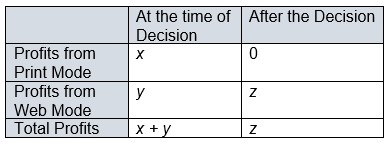 The decision-makers assume that this decision will enable them to "maintain profits," that is: z x + y
=> z - y x
=> (Post-decision Increase in profit from Web-Mode) (Post-decision Loss of profit from Print-Mode) Therefore, to sum up, the assumptions that have gone into the newspaper's decision are: over the past two years, the increase in the Web Mode's traffic was due to the exclusive content that makes for the website's most read pages in the future too, introducing more such content will continue to drive an increase in the Web Mode's traffic (Post-decision Increase in profit from Web-Mode) (Post-decision Loss of profit from Print-Mode) In analyzing the options in an assumption question, the Negation Test often comes in handy. Since a necessary assumption is, by definition, vital for the conclusion to be logically valid, we can test an answer choice by deeming it to be false. If, upon doing so, the conclusion no longer holds, this means that the answer choice in question is indeed a necessary assumption. Let's analyze each option one by one. Answer choices explanation
[The print circulation of the newspaper would not have declined further in the near future.] This option is incorrect. Suppose the print circulation of the newspaper would have declined further in the near future.
Then, the perception that the Print Mode is a sinking business would be further strengthened and the newspaper's decision to kill the Print Mode would be validated. So, if we Negate this answer choice, the conclusion (= decision made by the newspaper) stands strengthened, instead of being demolished.
Therefore, this answer choice fails the Negation Test. [To access the content on the newspaper's website, the readers of the website will be willing ...] This option is incorrect. Let the revenue that the print edition of the newspaper earned per reader each month (at the time of the decision) be dollars. Suppose the readers of the newspaper's website are not willing to pay a subscription fees of dollars per month for access to the website content. Does this necessarily mean that the newspaper will not be able to maintain its profits? No. For example, suppose the readers of the website are only willing to pay a monthly subscription fees of dollars. If the number of website readers is more than ten times the number of print-edition readers (which it very well might be, because, from the argument, we only know the percentage changes in readership of the print-edition and the website traffic, and not the actual numbers), then the revenue from the website subscription fees will be greater than the revenue from the print-edition. If the costs of the website are not greater than the costs of the print-edition, then the profits from the website will be greater than the profits that the print-edition earned at the time of the decision. Therefore, negating this answer choice does not necessarily impact the conclusion. [The print circulation of the newspaper declined in the past two years...] This option is incorrect. Suppose the print circulation did not decline in the past two years because of the content offered in the Web Mode but due to some other reason. The facts of the case still remain the same ?the print circulation was declining, the Web Mode traffic was increasing, and the newspaper wanted to maintain its profits. So, negating this answer choice has no impact whatsoever on the conclusion drawn. [The revenue earned from increased website traffic will not be less than...] This option is incorrect.
Suppose the revenue earned from increased website traffic is indeed less than the revenue lost by discontinuing the print edition. However, if the costs incurred by the newspaper for the Web Mode are far lesser than those for the Print Mode, then profits earned by the newspaper for the Web Mode can still be greater than or equal to the profits earned for the Print Mode. Therefore, the conclusion ("to maintain profits," kill the Print Mode and put more of XYZ type of traffic-increasing content on the Web Mode) can still stand. Therefore, this answer choice fails the Negation Test. [Introducing more content similar to the exclusive content on the most ...] This option is correct. Suppose that introducing more content similar to the exclusive content on the most read pages of the website will not increase the newspaper's website traffic further. The newspaper had assumed: (More such content -->
More Web Traffic --> More Profit from Web-Mode that would at least offset the loss of profit from Print- mode). The negation of this answer choice breaks this chain of assumptions and therefore suggests that the newspaper's decision may not result in greater profit from Web-Mode that would at least offset the loss of profit from Print-Mode. Therefore, the profits of the newspaper may not be maintained. The negation of this answer choice substantially weakens the decision made by the newspaper. Therefore, this answer choice represents a necessary assumption on which this decision depends.
Question 62
Single choice
For all species of higher animals, reproduction requires the production of eggs but not necessarily the
production of sperm. There are some species whose members are all female; the eggs produced by a rare
female-only species of salamander hatch without fertilization. This has the drawback that all offspring have genetic codes nearly identical to that of the single parent, making the species less adaptive than species containing both male and female members. If the statements above are true, each of the following could be true EXCEPT:
-
A
There are some species of salamanders that have both male and female members.
-
B
There are some species of higher animals none of whose members produce eggs.
-
C
There is a significant number of female-only species of higher animals.
-
D
Some species of higher animals containing both female and male members are not very adaptive.
-
E
Some offspring of species of higher animals containing both female and male members have genetic codes more similar to one parent than to the other parent.
Reveal answer details
Close answer details
Correct answerB
Explanation"Could be true "EXCEPT" means that the right answer must be false, while the wrong choices need only be consistent(that is, not in conflict) with the statements in the passage. Your best bet in this kind of question is to focus on the most concrete information in the stimulus, because that provides the best possibilities for violations. To wit: The first sentence in the argument says that all species of higher animals produce eggs for reproduction. That's a pretty definite fact, no? It's a fact that's clearly trampled on by choice B, which says that some species of higher animals don't produce eggs.
Question 63
Single choice
There are exactly ten stores and no other buildings on Oak Street. On the north side of the street, from
west to east, are stores 1, 3, 5, 7, and 9; on the south side of the street, also from west to east, are stores
2, 4, 6, 8, and 10. The stores on the north side are located directly across the street from those on the
south side, facing each other in pairs, as follows: 1 and 2; 3 and 4; 5 and 6; 7 and 8; 9 and 10. Each store
is decorated with lights in exactly one of the following colors: green, red, and yellow. The stores have been decorated with lights according to the following conditions: No store is decorated with lights of the same color as those of any store adjacent to it.
No store is decorated with lights of the same color as those of the store directly across the street from it.
Yellow lights decorate exactly one store on each side of the street.
Red lights decorate store 4.
Yellow lights decorate store 5. If green lights decorate five stores on the street, then which one of the following statements must be true?
-
A
Green lights decorate store 9.
-
B
Red lights decorate store 2.
-
C
Red lights decorate store 7.
-
D
Red lights decorate store 10.
-
E
Yellow lights decorate store 8.
Reveal answer details
Close answer details
Correct answerE
ExplanationThe trick here is to figure out which of the ten stores are the five that will have green lights. On the north side, with store 3 always green, we will have to have a green light in store 7 or 9. (Remember, adjacent greens are prohibited.) It may be smart to draw out both possibilities. And happily the south side is determinable. On the south side, we need three more greens, and clearly they'll have to be stores 2, 6, and 10. And with store 4 always red, the requisite (Rule 3) yellow will go to store 8. So here are the two options:  NEW QUESTIONS
Question 64
Single choice
A nationwide poll of students, parents, and teachers showed that over 90 percent believe that an appropriate percentage of their school's budget is being spent on student counseling programs. It seems, then, that any significant increase in a school's budget should be spent on something other than student counseling programs. Which one of the following describes a flaw in the reasoning of the argument above?
-
A
The argument confuses a mere coincidence with a causal relationship.
-
B
The argument confuses the percentage of the budget spent on a program with the overall amount spent on that program.
-
C
The argument fails to justify its presumption that what is true of a part of the budget is also true of the total budget.
-
D
The argument fails to consider the possibility that money could be saved by training students as peer counselors.
-
E
The argument fails to consider that if more money is spent on a program, then more money cannot also be used for other purposes.
Reveal answer details
Close answer details
Correct answerB
ExplanationWhy should any additional cash be applied to some area other than student counseling? Because almost everyone concerned believes that the right percentage of the budget is already going there. But percentage and amount are two different things, as option [The argument confuses the percentage of...] points out. If budget dollars were to go up but the percentage allotted to counseling were to remain the same, then fewer dollars would be spent on counseling, a state of affairs that might not please anybody.
No causality, confused or otherwise, is described in the argument of [The argument confuses a mere...].
The author makes no such claim such as [The argument fails to justify its presumption that...] describes; to argue that a part of a whole is adequate is not necessarily to commit a part to whole fallacy. Option [The argument fails to consider the possibility...] raises a couple of issues irrelevant to the argument, namely saving money and the content of counseling programs. As for option [The argument fails to consider that if more money...], the argument pretty much does consider that money spent in one area takes money away from another, and anyway, that point isn't central to the logical error.
Question 65
Single choice
Because addictive drugs are physically harmful, their use by athletes is never justified. Purists, however, claim that taking massive doses of even such nonaddictive drugs as aspirin and vitamins before competing
should also be prohibited because they are unnatural. This is ridiculous; almost everything in sports is
unnatural, from high-tech running shoes to padded boxing gloves to highly-specialized bodybuilding machines. Yet, none of these is prohibited on the basis of its being unnatural. Furthermore, we should be attending to far more serious problems that plague modern sports and result in unnecessary deaths and injuries. Therefore, the use of nonaddictive drugs by athletes should not be prohibited. Which one of the following can be inferred from the passage above?
-
A
The fact that something is unnatural is not a sufficient reason for banning it.
-
B
There is nothing unnatural about the use of nonaddictive drugs by athletes.
-
C
The use of addictive drugs by athletes should be prohibited because addictive drugs are unnatural.
-
D
Some of the unnecessary deaths and injuries in modern sports are caused by the use of addictive drugs by athletes.
-
E
The use of addictive drugs by athletes is a less serious problem than are unnecessary injuries.
Reveal answer details
Close answer details
Correct answerA
ExplanationThe second half of this two-parter is a straightforward Inference question. The author counters the objection that nonaddictive drugs are unnatural with "This is ridiculous..." He implicitly agrees that nonaddictive drugs are unnatural, but not only supports them but cites other "unnatural" things such as equipment that no one would dream of prohibiting. Clearly, in the author's book, something being unnatural is in no way sufficient grounds for banning it.
Question 66
Single choice
One of the most intriguing stories of the Russian Revolution concerns the identity of Anastasia, the youngest daughter of Czar Nicholas II. During his reign over Russia, the Czar had planned to revoke many of the harsh laws established by previous czars. Some workers and peasants, however, clamored for more rapid social reform. In 1918 a group of these people, known as Bolsheviks, overthrew the government. On July 17 or 18, they murdered the Czar and what was thought to be his entire family. Although witnesses vouched that all the members of the Czar's family had been executed, there were rumors suggesting that Anastasia had survived. Over the years, a number of women claimed to be Grand Duchess Anastasia.
Perhaps the best nown claimant was Anastasia Tschaikovsky, who was also known as Anna Anderson.
In 1920, eighteen months after the Czar's execution, this terrified young woman was rescued from drowning in a Berlin river. She spent two years in a hospital, where she attempted to eclaim her health and shattered mind. The doctors and nurses thought that she resembled Anastasia and questioned her about her background. She disclaimed any connection with the Czar's family. Eight years later, though, she claimed that she was Anastasia. She said that she had been rescued by two Russian soldiers after the Czar and the rest of her family had been killed.
Two brothers named Tschaikovsky had carried her into Romania. She had married one of the brothers, who had taken her to Berlin and left her there, penniless and without a vocation. Unable to invoke the aid of her mother's family in Germany, she had tried to drown herself. During the next few years, scores of the Czar's relatives, ex-servants, and acquaintances interviewed her. Many of these people said that her looks and mannerisms were evocative of the Anastasia that they had known. Her grandmother and other relatives denied that she was the real Anastasia, however. Tried of being accused of fraud, Anastasia immigrated to the United States in 1928 and took the name Anna Anderson. She still wished to prove that she was Anastasia, though, and returned to Germany in 1933 to bring suit against her mother's family.
There she declaimed to the court, asserting that she was indeed Anastasia and deserved her inheritance.
In 1957, the court decided that it could neither confirm nor deny Anastasia's identity. Although we will probably never know whether this woman was the Grand Duchess Anastasia, her search to establish her identity has been the subject of numerous books, plays, and movies. Witnesses _____________ that all members of the Czar's family had been executed.
-
A
-
B
-
C
-
D
-
E
Reveal answer details
Close answer details
Question 67
Single choice
Seven friends, Abe, Bob, Chad, Dolly, Elisa, Frank, and Gregory sit in a VIP enclosure of a stadium to watch a football match. The seats in the enclosure form a 3 x 3 matrix, i.e. 3 rows (front, middle and last) with 3 seats in each row. The following information is known: Chad sits immediately beside Dolly Dolly sits in a row immediately behind the row in which Abe is sitting There is no one sitting on one side of Chad None of Elisa or Gregory sits immediately beside Abe
Bob sits in the last row Who sits in the middle seat of the middle row?
-
A
-
B
-
C
-
D
Any among Chad, Dolly or Elisa
-
E
Reveal answer details
Close answer details
Correct answerA
ExplanationFrom the figure below, it is definite that the person must be C. 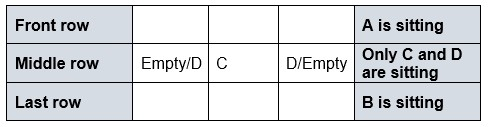 General Explanation
Let us name the people Abe, Bob, Chad, Dolly, Elisa, Frank, and Gregory as A, B, C, D, E, F, and G, respectively. We can see that there are 3 ?3 = 9 seats, but there are only 7 people. Thus, the only possible way of distributing the 7 people across the 3 rows is that 2 rows would have 2 members each and one row would have 3 members. However, the exact number of people in a particular row is not yet known and further analysis of the statements needs to be done. 1st statement: C and D sit beside each other ... (i) 3rd statement: The row in which C and D are sitting, has exactly 2 people sitting in it (since there is no one sitting on the other side of C) ... (ii) 2nd statement: Since D sits in the row just behind A's row, the row where D (and C) sits must be either the middle or the last row 5th statement: Since B sits in the last row and the row where C and D sits has only 2 people, C and D must be in the middle row ... (iii) Thus, it also follows that A must be in the front row ... (iv) 4th statement: We know that neither E nor G sits beside A. Thus, there are 2 possible scenarios:
If A is in the middle of the front row, none of E or G can sit in the front row; thus, they would sit in the last
row ... (v)
If A is at either end of the front row, only in that scenario can one of E or G also sits in the front row ... (vi) Thus, we have: 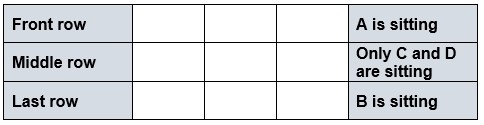 Also, in the middle row, since C has D on one side and a vacant seat on the other, C must be in the middle position. Thus, we finally have: This is all that can be deduced from the main stem. To answer the questions, we need to use the additional information contained in each question.
Question 68
Single choice
Passage (1)
[1] Positive thinking sounds useful on the surface. [2] But "positive thinking" is also a soft and fluffy term that is easy to dismiss. [3] But those views may be changing. [4] Research is beginning to reveal that positive thinking is about much more than just being happy or displaying an upbeat attitude. [5] Positive thoughts can actually create real value in your life and help you build skills that last much longer than a smile. [6] The impact of positive thinking on your work, your health, and your life is being studied by researchers, one of whom is Barbara Fredrickson. [7] Fredrickson is a positive psychology researcher at the University of North Carolina, and she published a landmark paper that provides surprising insights about positive thinking and its impact on your skills. [8] Her work is among the most referenced and cited in her field, and it is surprisingly useful in everyday life.
(2)
[9] What do negative thoughts do to your brain? [10] Let's say that you're walking through the forest and suddenly a tiger steps onto the path ahead of you. [11] When this happens, your brain registers a negative emotion ?in this case, fear. [12] Researchers have long known that negative emotions program your brain to do a specific action. [13] When that tiger crosses your path, for example, you run. [14] The rest of the world doesn't matter. [15] You are focused entirely on the tiger, the fear it creates, and how you can get away from it. [16] In other words, negative emotions narrow your mind and focus your thoughts. [17] At that same moment, you might have the option to climb a tree, pick up a leaf, or grab a stick ?but your brain ignores all of those options because they seem irrelevant when a tiger is standing in front of you.
(3)
[18] This is a useful instinct if you're trying to save life and limb, but in our modern society, we don't have to worry about stumbling across tigers in the wilderness. [19] The problem is that your brain is still programmed to respond to negative emotions in the same way ?by shutting off the outside world and limiting the options, you see around you. [20] For example, when you're in a fight with someone, your anger and emotion might consume you to the point where you can't think about anything else. [21] Or, when you are stressed out about everything you have to get done today, you may find it hard to actually start anything because you're paralyzed by how long your to-do list has become. [22] In each case, your brain closes off from the outside world and focuses on the negative emotions of fear, anger, and stress ? just like it did with the tiger. [23] Negative emotions prevent your brain from seeing the other options and choices that surround you. [24] It's your survival instinct.
(4)
[25] Now, let's compare this to what positive emotions do to your brain. [26] This is where Barbara Fredrickson returns to the story. [27] Fredrickson tested the impact of positive emotions on the brain by setting up a little experiment. [28] During this experiment, she divided her research subjects into five groups and showed each group different film clips. [29] The first two groups were shown clips that created positive emotions. [30] Group 1 saw images that created feelings of joy. [31] Group 2 saw images that created feelings of contentment. [32] Group 3 was the control group. [33] They saw images that were neutral and produced no significant emotion. [34] The last two groups were shown clips that created negative emotions. [35] Group 4 saw images that created feelings of fear. [36] Group 5 saw images that created feelings of anger. [37] Afterward, each participant was asked to imagine themselves in a situation where similar feelings would arise and to write down what they would do. [38] Each participant was handed a piece of paper with 20 blank lines that started with the phrase, "I would like to..." Participants who saw images of fear and anger wrote down the fewest responses. [39] Meanwhile, the participants who saw images of joy and contentment, wrote down a significantly higher number of actions that they would take, even when compared to the neutral group.
(5)
[40] In other words, when you are experiencing positive emotions like joy, contentment, and love, you will see more possibilities in your life. [41] These findings were among the first that suggested positive emotions broaden your sense of possibility and open your mind up to more options. [42] But that was just the beginning. [43] The benefits of positive emotions don't stop after a few minutes of good feelings subside. [44] In fact, the biggest benefit that positive emotions provide is an enhanced ability to build skills and develop resources for use later in life. [45] Let's consider a real-world example. [46] A child who runs around outside, swinging on branches and playing with friends, develops the ability to move athletically (physical skills), the ability to play with others and communicate with a team (social skills), and the ability to explore and examine the world around them (creative skills). [47] In this way, the positive emotions of play and joy prompt the child to build skills that are useful and valuable in everyday life. [48] These skills last much longer than the emotions that initiated them. [49] Years later, that foundation of athletic movement might develop into a scholarship as a college athlete or the communication skills may blossom into a job offer as a business manager. [50] The happiness that promoted the exploration and creation of new skills has long since ended, but the skills themselves live on. [51] Fredrickson refers to this as the "broaden and build" theory because positive emotions broaden your sense of possibilities and open your mind, which in turn allows you to build new skills and resources that can provide value in other areas of your life.
(6)
[52] All of this research begs the most important question of all: If positive thinking is so useful for developing valuable skills and appreciating the big picture of life, how do you actually get yourself to be positive? [53] Recent research by Fredrickson and her colleagues has revealed that people who meditate daily display more positive emotions that those who do not. [54] As expected, people who meditated also built valuable long-term skills. [55] For example, three months after the experiment was over, the people who meditated daily continued to display increased mindfulness, purpose in life, social support, and decreased illness symptoms.
(7)
[56] Secondly, a study published in the Journal of Research in Personality examined a group of 90 undergraduate students who were split into two groups. [57] The first group wrote about an intensely positive experience each day for three consecutive days. [58] The second group wrote about a control topic. [59] Three months later, the students who wrote about positive experiences had better mood levels, fewer visits to the health center, and experienced fewer illnesses.
(8)
[60] Positive thinking isn't just a soft and fluffy feel-good term. [61] Yes, it's great to simply "be happy," but those moments of happiness are also critical for opening your mind to explore and build the skills that become so valuable in other areas of your life. [62] Periods of positive emotion and unhindered exploration are when you see the possibilities for how your past experiences fit into your future life, when you begin to develop skills that blossom into useful talents later on, and when you spark the urge for further exploration and adventure. Which one of the following would be an appropriate title to the passage?
-
A
The Science of Positive Thinking
-
B
Positive Thinking ?The Skills You Need
-
C
Is Positive Thinking Difficult?
-
D
How Positive Thinking Will Get You Hired
-
E
Positive Thinking For Success
Reveal answer details
Close answer details
Correct answerA
ExplanationAn appropriate title to the passage must encapsulate the essence of the passage. The passage gives credible research to prove that positive thinking is beneficial to humans. It also uses research findings to show how a person can develop positive thinking. [The Science of Positive Thinking] This option is correct because the science behind positive emotions is discussed by means of the research. Also, the science of how one can develop positive emotions is given. [Positive Thinking ?The Skills You Need] This option is incorrect. The skills that one needs to be able to think positively is only a small portion of the passage. The majority of the passage discusses the different studies conducted by Barbara Frederickson. [Is Positive Thinking Difficult?] This option is incorrect because the difficulty of positive thinking has not been discussed. [How Positive Thinking Will Get You Hired] This option is incorrect because employability is not the focus of this passage. [Positive Thinking For Success] This option is incorrect because success as a term is not the focus of the passage. Rather, research conducted towards the possibility of newer avenues and opportunities opening up as a result of positive thinking is the primary purpose of the passage. Understanding the passage
In paragraph (1), the author introduces the topic of the essay. He states that positive thinking, though sounds like a fluffy term, is much beyond that. Researcher Barbara Fredrickson has done research on this topic and her studies find several insights about positive thinking.
In paragraph (2), the author discusses the impact of negative thoughts on the human brain ?that they narrow one's mind and reduce the options that the brain can see. He gives the example of a tiger to reinforce the same. In paragraph (3), the author gives further examples to strengthen the fact that negative emotions make one shut off from the outside world and limit one's options. In paragraph (4), the author discusses the impact that positive emotions can have on a person. He elaborates on an experiment conducted by Barbara Fredrickson to reinforce the same. Fredrickson divided her subjects into five groups. Group 1 and 2 were shown pictures that evoked positive emotions ?joy and contentment respectively. Group 3 was the control group and was shown pictures that produced no significant emotion. Group 4 and 5 were shows pictures that evoked negative emotions ?fear and anger.
After the experiment, it was found that participants of Group 1 and 2 saw more possibilities in their lives whereas participants of Group 4 and 5 saw fewer possibilities. In paragraph (5), the author explains that the benefits of positive emotions last for a lifetime. Positive thinking helps to build skills and develop resources for use later in life. He explains the same using the example of a child playing; the skills that a child learns while playing could help him develop valuable
social, physical, and creative skills later in life. In paragraphs (6) & (7), the author discusses two skills that could help people develop a positive outlook ? meditating and writing positive thoughts in a journal. Main point: Research and science supports that positive thinking has numerous benefits.
Question 69
Single choice
Bird-watchers explore a forest to see which of the following six kinds of birds -- grosbeak, harrier, jay, martin, shrike, wren -- it contains. The findings are consistent with the following conditions: If harriers are in the forest, then grosbeaks are not.
If jays, martins, or both are in the forest, then so are harriers
If wrens are in the forest, then so are grosbeaks
If jays are not in the forest, then shrikes are Which one of the following could be a complete and accurate list of the birds NOT in the forest?
-
A
-
B
-
C
-
D
grosbeaks, martins, shrikes, wrens
-
E
Reveal answer details
Close answer details
Correct answerD
ExplanationPartial Acceptability questions -- those in which the choices give you only part of the story -- are rendered easier if you lay out, carefully and without rushing, the rest of the story. Here, it means that your test booklet might look like so: Not In Therefore In: 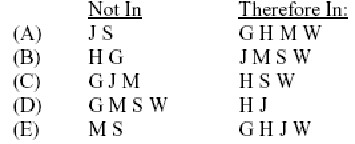
Question 70
Single choice
Jane works at a fashion design company, and is having problems getting dressed for work. She refuses to wear any color combination that does not go well together as many of her clients may look
down upon this. She has two pairs of skirts, brown and blue; three blouses, white, sky blue, and gray; four
pairs of stockings, red, black, brown, and blue; and two pairs of shoes, black and brown. The blue skirt
cannot be worn with red or brown stockings. Gray does not go well with brown. Black does not go well with brown. If Jane wears a brown skirt and a white blouse, she could:
-
A
-
B
-
C
-
D
-
E
Reveal answer details
Close answer details
Correct answerC
ExplanationSince black does not go well with brown, Jane would not be allowed to wear black shoes.
Question 71
Single choice
While historians once propagated the myth that Africans who were brought to the New World as slaves contributed little of value but their labor, a recent study by Amelia Wallace Vernon helps to dispel this notion by showing that Africans introduced rice and the methods of cultivating it into what is now the United States in the early eighteenth century. She uncovered, for example, an 1876 document that details that in 1718 starving French settlers instructed the captain of a slave ship bound for Africa to trade for 400
Africans including some "who know how to cultivate rice." This discovery is especially compelling because the introduction of rice into what is now the United States had previously been attributed to French Acadians, who did not arrive until the 1760s. Vernon interviewed elderly African Americans who helped her discover the locations where until about 1920 their forebears had cultivated rice. At the heart of Vernon's research is the question of why, in an economy dedicated to maximizing cotton production, African Americans grew rice. She proposes two intriguing answers, depending on whether the time is before or after the end of slavery. During the period of slavery, plantation owners also ate rice and therefore tolerated or demanded its "after-hours" cultivation on patches of land not suited to cotton. In addition, growing the rice gave the slaves some relief from a system of regimented labor under a field supervisor, in that they were left alone to work independently. After the abolition of slavery, however, rice cultivation is more difficult to explain: African Americans had acquired a preference for eating corn, there was no market for the small amounts of rice they produced, and under the tenant system ?in which farmers surrendered a portion of their crops to the owners of the land they farmed ?owners wanted only cotton as payment. The labor required to transform unused land to productive ground would thus seem completely out of proportion to the reward ?except that, according to Vernon, the transforming of the land itself was the point. Vernon suggests that these African Americans did not transform the land as a means to an end, but rather as an end in itself. In other words, they did not transform the land in order to grow rice ?for the resulting rice was scarcely worth the effort required to clear the land ?but instead transformed the land because they viewed land as an extension of self and home and so wished to nurture it and make it their own. In addition to this cultural explanation, Vernon speculates that rice cultivation might also have been a political act, a next step after the emancipation of the slaves: the symbolic claiming of plantation land that the U.S. government had promised but failed to parcel off and deed to newly freed African Americans. As described in the last paragraph of the passage, rice cultivation after slavery is most analogous to which one of the following?
-
A
A group of neighbors plants flower gardens on common land adjoining their properties in order to beautify their neighborhood and to create more of a natural boundary between properties.
-
B
A group of neighbors plants a vegetable garden for their common use and to compete with the local market's high-priced produce by selling vegetables to other citizens who live outside the neighborhood.
-
C
A group of neighbors initiates an effort to neuter all the domestic animals in their neighborhood out of a sense of civic duty and to forestall the city taking action of its own to remedy the overpopulation.
-
D
A group of neighbors regularly cleans up the litter on a vacant lot in their neighborhood out of a sense of ownership over the lot and to protest the city's neglect of their neighborhood.
-
E
A group of neighbors renovates an abandoned building so they can start a program to watch each other's children out of a sense of communal responsibility and to offset the closing of a day care center in their neighborhood,
Reveal answer details
Close answer details
Correct answerD
ExplanationThis Application question narrows our focus to the final and the post-slavery explanation. Refresh your memory if you need to: Although not economically practical, these African Americans engaged in growing rice for cultural and political reasons. We're therefore looking for another situation in which people engage in an activity as an "end in itself" with more than just economic considerations in mind. The situation in option [A group of neighbors regularly cleans up...] relates perfectly to the African Americans' motivation cited; they viewed the land as "an extension of self and home" and desired to "make it their own." The
neighborhood folks tend to the vacant lot out of a similar sense of ownership, and their protest of the city's neglect of the lot corresponds nicely to the political explanation given in the passage.
Question 72
Single choice
Selena: Asteroid impact on the Earth caused the extinction of the dinosaurs by raising vast clouds of dust, thus blocking the Sun's rays and cooling the planet beyond the capacity of the dinosaurs, or perhaps the vegetation that supported them, to adapt. A worldwide dust layer provides evidence of asteroid impact at approximately the correct time, and a huge crater exists on the edge of the Yucatan peninsula in Mexico.
Trent: That asteroid crater is not large enough for the requisite amount of dust to have been produced.
Besides, the extinction of dinosaur species took many years, not just one or two.
So the extinctions must have been due not to asteroid impact on the Earth but to some other kind of cause. Trent's argument assumes that
-
A
any collision of an asteroid with the Earth would have occurred on a land area rather than an ocean
-
B
dinosaurs in the neighborhood of an asteroid impact but not within the zone of direct impact would have survived such an impact
-
C
any event that takes place over a long period of time has many different kinds of causes
-
D
dust from the impact of an asteroid on the Earth would not have had any cooling effect on the climate
-
E
no more than one large asteroid struck the Earth during the period when the dinosaurs were becoming extinct
Reveal answer details
Close answer details
Correct answerE
ExplanationThe stem tells us that Trent is the featured player in this one, but first Selena's argument. In a nutshell, Selena thinks asteroid impact unleashed a chain of events that caused the dinosaurs to die out. Trent responds that the extinction of the dinosaurs must have been due to some cause other than asteroid impact, based on the facts that the crater Selena mentions is too small to create the amount of dust required in her scenario, and that the extinction took many years. Both of Trent's facts seem to argue against the likelihood that the Mexican asteroid, by itself, did the dinosaurs in, but what if many asteroid impacts over time raised enough dust to set the process described in motion? (Notice that Selena never says that a single asteroid wiped out the dinosaurs.) If Trent accepted the possibility of multiple impacts, he'd have to rework his argument. For his argument as stated to stand, he'd have to assume that this didn't happen.
Question 73
Single choice
David: Forbidding companies from hiring permanent replacements for striking employees would be profoundly unfair. Such companies would have little leverage in their negotiations with strikers. Lin: No, the companies would still have sufficient leverage in negotiations if they hired temporary replacements. Which one of the following statements is most strongly supported by the exchange between David and Lin?
-
A
David does not believe that the freedom to hire temporary replacements gives companies any leverage in their negotiations with strikers.
-
B
David and Lin believe that companies should be allowed as much leverage in negotiations as the striking employees.
-
C
David and Lin disagree over the amount of leverage companies lose in their negotiations with strikers by not being able to hire permanent replacements.
-
D
David and Lin disagree over how much leverage should be accorded companies in their negotiations with strikers.
-
E
Lin believes it is unfair to forbid companies from hiring permanent replacements for their striking employees.
Reveal answer details
Close answer details
Correct answerC
ExplanationNext up we're looking for something that can be inferred from a conversation. David thinks that not allowing companies to hire permanent replacements for striking employees is unfair, since that would place them in a weak bargaining position with the strikers. Lin claims that companies would maintain leverage if they hire temporary replacements. It's not easy to prephrase the correct inference, so let's evaluate the choices, keeping a close eye on the scope of each statement.
Question 74
Single choice
"Old woman," grumbled the burly white man who had just heard Sojourner Truth speak, "do you think your talk about slavery does any good? I don't care anymore for your talk than I do for the bite of a flea." The tall, imposing black woman turned her piercing eyes on him. "Perhaps not," she answered, "but I'll keep you scratching." The little incident of the 1840s sums up all that Sojourner Truth was: utterly dedicated to spreading her message, afraid of no one, forceful and witty in speech. Yet forty years earlier, who could have suspected that a spindly slave girl growing up in a damp cellar in upstate New York would become one of the most remarkable women in American history? Her name then was Isabella (many slaves had no last names), and by the time she was fourteen she had seen both parents die of cold and hunger. She herself had been sold several times. By 1827, when New York freed its slaves, she had married and borne five children. The first hint of Isabella's fighting spirit came soon after wards, when her youngest son was illegally seized and sold. She marched to the courthouse and badgered officials until her son was returned to her. In 1843, inspired by religion, she changed her name to Sojourner (meaning "one who stays briefly")
Truth, and, with only pennies in her purse, set out to preach against slavery. From New England to Minnesota she trekked, gaining a reputation for her plain but powerful and moving words. Incredibly, despite being black and female (only white males were expected to be public speakers), she drew thousands to town halls, tents, and churches to hear her powerful, deep-voiced pleas on equality for blacks-and for women. Often she had to face threatening hoodlums. Once she stood before armed bullies and sang a hymn to them. Awed by her courage and her commanding presence, they sheepishly retreated. During the Civil War she cared for homeless ex-slaves in Washington. President Lincoln invited her to the White House to bestow praise on her. Later, she petitioned Congress to help former slaves get land in the West. Even in her old age, she forced the city of Washington to integrate its trolley cars so that black and white could ride together. Shortly before her death at eighty-six, she was asked what kept her going. "I think of the great things," replied Sojourner. She preached against
-
A
-
B
-
C
-
D
-
E
Reveal answer details
Close answer details
Question 75
Single choice
Studies of the reliability of eyewitness identifications show little correlation between the accuracy of a witness's account and the confidence the witness has in the account. Certain factors can increase or undermine a witness's confidence without altering the accuracy of the identification. Therefore, police officers are advised to disallow suspect lineups in which witnesses can hear one another identifying suspects. Which one of the following is a principle underlying the advice given to police officers?
-
A
The confidence people have in what they remember having seen is affected by their awareness of what other people claim to have seen.
-
B
Unless an eyewitness is confronted with more than one suspect at a time, the accuracy of his or her statements cannot be trusted.
-
C
If several eyewitnesses all identify the same suspect in a lineup, it is more likely that the suspect committed the crime than if only one eyewitness identifies the suspect.
-
D
Police officers are more interested in the confidence witnesses have when testifying than in the accuracy of that testimony.
-
E
The accuracy of an eyewitness account is doubtful if the eyewitness contradicts what other eyewitnesses claim to have seen.
Reveal answer details
Close answer details
Correct answerA
ExplanationThe question stem tells us to identify the principle behind the advice given to police officers. So what's the advice? It's signaled by the Keyword "therefore": cops are told not to trust identifications made when witnesses can hear one another. The rest of the stimulus explains why not. There's no connection between confidence and accuracy when it comes to identification, and some factors increase confidence without increasing accuracy. So we can understand why police officers would want to avoid these factors. Based on this information, police officers are advised to disallow identifications in which witnesses can hear one another, and so witnesses being able to hear each other must be one of those factors that increase confidence without increasing accuracy. So option [The confidence people have in what they remember...] is the principle lying behind the advice police officers receive.
Question 76
Single choice
Passage (1)
[1] Positive thinking sounds useful on the surface. [2] But "positive thinking" is also a soft and fluffy term that is easy to dismiss. [3] But those views may be changing. [4] Research is beginning to reveal that positive thinking is about much more than just being happy or displaying an upbeat attitude. [5] Positive thoughts can actually create real value in your life and help you build skills that last much longer than a smile. [6] The impact of positive thinking on your work, your health, and your life is being studied by researchers, one of whom is Barbara Fredrickson. [7] Fredrickson is a positive psychology researcher at the University of North Carolina, and she published a landmark paper that provides surprising insights about positive thinking and its impact on your skills. [8] Her work is among the most referenced and cited in her field, and it is surprisingly useful in everyday life.
(2)
[9] What do negative thoughts do to your brain? [10] Let's say that you're walking through the forest and suddenly a tiger steps onto the path ahead of you. [11] When this happens, your brain registers a negative emotion ?in this case, fear. [12] Researchers have long known that negative emotions program your brain to do a specific action. [13] When that tiger crosses your path, for example, you run. [14] The rest of the world doesn't matter. [15] You are focused entirely on the tiger, the fear it creates, and how you can get away from it. [16] In other words, negative emotions narrow your mind and focus your thoughts. [17] At that same moment, you might have the option to climb a tree, pick up a leaf, or grab a stick ?but your brain ignores all of those options because they seem irrelevant when a tiger is standing in front of you.
(3)
[18] This is a useful instinct if you're trying to save life and limb, but in our modern society, we don't have to worry about stumbling across tigers in the wilderness. [19] The problem is that your brain is still programmed to respond to negative emotions in the same way ?by shutting off the outside world and limiting the options, you see around you. [20] For example, when you're in a fight with someone, your anger and emotion might consume you to the point where you can't think about anything else. [21] Or, when you are stressed out about everything you have to get done today, you may find it hard to actually start anything because you're paralyzed by how long your to-do list has become. [22] In each case, your brain closes off from the outside world and focuses on the negative emotions of fear, anger, and stress ? just like it did with the tiger. [23] Negative emotions prevent your brain from seeing the other options and choices that surround you. [24] It's your survival instinct.
(4)
[25] Now, let's compare this to what positive emotions do to your brain. [26] This is where Barbara Fredrickson returns to the story. [27] Fredrickson tested the impact of positive emotions on the brain by setting up a little experiment. [28] During this experiment, she divided her research subjects into five groups and showed each group different film clips. [29] The first two groups were shown clips that created positive emotions. [30] Group 1 saw images that created feelings of joy. [31] Group 2 saw images that created feelings of contentment. [32] Group 3 was the control group. [33] They saw images that were neutral and produced no significant emotion. [34] The last two groups were shown clips that created negative emotions. [35] Group 4 saw images that created feelings of fear. [36] Group 5 saw images that created feelings of anger. [37] Afterward, each participant was asked to imagine themselves in a situation where similar feelings would arise and to write down what they would do. [38] Each participant was handed a piece of paper with 20 blank lines that started with the phrase, "I would like to..." Participants who saw images of fear and anger wrote down the fewest responses. [39] Meanwhile, the participants who saw images of joy and contentment, wrote down a significantly higher number of actions that they would take, even when compared to the neutral group.
(5)
[40] In other words, when you are experiencing positive emotions like joy, contentment, and love, you will see more possibilities in your life. [41] These findings were among the first that suggested positive emotions broaden your sense of possibility and open your mind up to more options. [42] But that was just the beginning. [43] The benefits of positive emotions don't stop after a few minutes of good feelings subside. [44] In fact, the biggest benefit that positive emotions provide is an enhanced ability to build skills and develop resources for use later in life. [45] Let's consider a real-world example. [46] A child who runs around outside, swinging on branches and playing with friends, develops the ability to move athletically (physical skills), the ability to play with others and communicate with a team (social skills), and the ability to explore and examine the world around them (creative skills). [47] In this way, the positive emotions of play and joy prompt the child to build skills that are useful and valuable in everyday life. [48] These skills last much longer than the emotions that initiated them. [49] Years later, that foundation of athletic movement might develop into a scholarship as a college athlete or the communication skills may blossom into a job offer as a business manager. [50] The happiness that promoted the exploration and creation of new skills has long since ended, but the skills themselves live on. [51] Fredrickson refers to this as the "broaden and build" theory because positive emotions broaden your sense of possibilities and open your mind, which in turn allows you to build new skills and resources that can provide value in other areas of your life.
(6)
[52] All of this research begs the most important question of all: If positive thinking is so useful for developing valuable skills and appreciating the big picture of life, how do you actually get yourself to be positive? [53] Recent research by Fredrickson and her colleagues has revealed that people who meditate daily display more positive emotions that those who do not. [54] As expected, people who meditated also built valuable long-term skills. [55] For example, three months after the experiment was over, the people who meditated daily continued to display increased mindfulness, purpose in life, social support, and decreased illness symptoms.
(7)
[56] Secondly, a study published in the Journal of Research in Personality examined a group of 90 undergraduate students who were split into two groups. [57] The first group wrote about an intensely positive experience each day for three consecutive days. [58] The second group wrote about a control topic. [59] Three months later, the students who wrote about positive experiences had better mood levels, fewer visits to the health center, and experienced fewer illnesses.
(8)
[60] Positive thinking isn't just a soft and fluffy feel-good term. [61] Yes, it's great to simply "be happy," but those moments of happiness are also critical for opening your mind to explore and build the skills that become so valuable in other areas of your life. [62] Periods of positive emotion and unhindered exploration are when you see the possibilities for how your past experiences fit into your future life, when you begin to develop skills that blossom into useful talents later on, and when you spark the urge for further exploration and adventure. According to the passage, which one of the following is a tool that the author recommends to build positive thinking?
-
A
-
B
-
C
Maintaining strong and meaningful relationships
-
D
Penning optimistic thoughts
-
E
Spending time with family regularly
Reveal answer details
Close answer details
Correct answerD
ExplanationFrom sentences 52-59, the author discusses two tools to help people develop positive thinking ?meditating and writing about positive thoughts. Understanding the passage
In paragraph (1), the author introduces the topic of the essay. He states that positive thinking, though sounds like a fluffy term, is much beyond that. Researcher Barbara Fredrickson has done research on this topic and her studies find several insights about positive thinking. In paragraph (2), the author discusses the impact of negative thoughts on the human brain ?that they narrow one's mind and reduce the options that the brain can see. He gives the example of a tiger to reinforce the same. In paragraph (3), the author gives further examples to strengthen the fact that negative emotions make one shut off from the outside world and limit one's options. In paragraph (4), the author discusses the impact that positive emotions can have on a person. He elaborates on an experiment conducted by Barbara Fredrickson to reinforce the same. Fredrickson divided her subjects into five groups. Group 1 and 2 were shown pictures that evoked positive emotions ?joy and contentment respectively. Group 3 was the control group and was shown pictures that produced no significant emotion. Group 4 and 5 were shows pictures that evoked negative emotions ?fear and anger.
After the experiment, it was found that participants of Group 1 and 2 saw more possibilities in their lives whereas participants of Group 4 and 5 saw fewer possibilities. In paragraph (5), the author explains that the benefits of positive emotions last for a lifetime. Positive thinking helps to build skills and develop resources for use later in life. He explains the same using the example of a child playing; the skills that a child learns while playing could help him develop valuable
social, physical, and creative skills later in life. In paragraphs (6) & (7), the author discusses two skills that could help people develop a positive outlook ? meditating and writing positive thoughts in a journal. Main point: Research and science supports that positive thinking has numerous benefits.
Question 77
Single choice
On each of exactly seven consecutive days (day 1 through day 7), a pet shop features exactly one of three breeds of kitten -- Himalayan, Manx, Siamese -- and exactly one of three breeds of puppy -- Greyhound, Newfoundland, Rottweiler.
The following conditions must apply: Greyhounds are featured on day 1.
No breed is featured on any two consecutive days.
Any breed featured on day 1 is not featured on day 7.
Himalayans are featured on exactly three days, but not on day 1.
Rottweilers are not featured on day 7, nor on any day that features Himalayans. If Himalayans are not featured on day 2, which one of the following could be true?
-
A
Manx are featured on day 3.
-
B
Siamese are featured on day 4.
-
C
Rottweilers are featured on day 5.
-
D
Himalayans are featured on day 6.
-
E
Greyhounds are featured on day 7
Reveal answer details
Close answer details
Correct answerB
ExplanationSo there are no Himalayans on day 2, eh? Well, that should be helpful: We have three non-consecutive h's to place, and day 1 was already forbidden to them, so you might suspect that their placement is now pretty much of a done deal, and so it is. There's only one way to insert them:
1234567 m/s___h___h___h
So let's check our choices.
Question 78
Single choice
Consultant: Most workers do not have every item they produce judged for quality, but each piece a freelance writer authors is evaluated. That is why freelance writers produce such high-quality work. The consultant's statements, if true, most strongly support which one of the following?
-
A
A piece authored by a freelance writer is generally evaluated more strictly than the majority of items most workers produce.
-
B
By having every piece of their work evaluated, some workers are caused to produce high-quality work.
-
C
No other workers produce higher quality work than do freelance writers.
-
D
Only freelance writers have every item they produce evaluated for quality.
-
E
Some workers produce high-quality work in spite of the fact that not every item they produce is judged for quality.
Reveal answer details
Close answer details
Correct answerB
ExplanationRather than predict anything, we can simply check each choice against the stimulus and look for that which must be true. Option [A piece authored by...] need not, since the strictness of evaluation is never mentioned and hence need not be the reason for freelancers' high-quality work. But option [By having every piece of...] echoes the author's overall point. The workers in this option is talking about are the freelance writers. They, at least, are always evaluated and "that is why" they produce (they "are caused to
produce") high-quality work.
The wise student gives at least a cursory glance at those that remain. Option [No other workers produce higher...] makes an irrelevant and unwarranted distinction between freelancers and others; for all we know,
other types of workers may produce even better work than do freelance writers. And option [Only freelance writers have...] is a flagrant misreading of sentence 1's second clause. The statement "All freelance writers are evaluated" cannot be read to mean "Only freelance writers are evaluated," as option [Only freelance writers have...] would have it. Finally, the author takes no position on the quality of workers other than freelance writers; notwithstanding that most workers don't enjoy quality control, they still might produce
plenty of high-quality work.
Question 79
Single choice
Bird-watchers explore a forest to see which of the following six kinds of birds -- grosbeak, harrier, jay, martin, shrike, wren -- it contains. The findings are consistent with the following conditions: If harriers are in the forest, then grosbeaks are not.
If jays, martins, or both are in the forest, then so are harriers
If wrens are in the forest, then so are grosbeaks
If jays are not in the forest, then shrikes are If grosbeaks are in the forest, then which one of the following must be true?
-
A
Shrikes are in the forest.
-
B
-
C
The forest contains both wrens and shrikes.
-
D
At most two kinds of birds are in the forest.
-
E
At least three kinds of birds are in the forest.
Reveal answer details
Close answer details
Correct answerA
ExplanationA straightforward chain. Choosing G mandates rejecting H (Rule 1). That in turn mandates rejecting J and M (Rule 2's contrapositive). And once J is gone, S must be chosen (Rule 4). W, the remaining entity, can be chosen but need not be, so neither choice [Wrens are in the forest.] nor [The forest contains both...] must be true. And since the total number of birds here is 2 or 3, options [At most two kinds of...] and [At least three kinds of...] are possible only.
Question 80
Single choice
A chess tournament is occurring in the local community school, and the players at all four of the tables are engaged in their fourth game against their prospective opponents. The players with white pieces are: David, Gerry, Lenny and Terry
The players with black pieces are: Don, Mike, Richie and Stephen
The scores are 3:0, 2.5:0.5, 2:1, 1.5:1.5
[note: tied games result in a score of 0.5 points for each player]
Lenny is playing at the table to the right of Stephen, who has lost all of his games until now.
Gerry is playing against Mike.
At least one game at table 1 has resulted in a tie.
Richie, who is not in the lead over his opponent, has not been in a tied game.
The player who is using the white pieces at table 4 is Terry, however, the current score at table 4 is not 2:1.
Don is leading his match after his last three games. What table is Stephen playing at, and what is the score at that table?
-
A
-
B
-
C
-
D
-
E
Reveal answer details
Close answer details
Question 81
Single choice
While historians once propagated the myth that Africans who were brought to the New World as slaves contributed little of value but their labor, a recent study by Amelia Wallace Vernon helps to dispel this notion by showing that Africans introduced rice and the methods of cultivating it into what is now the United States in the early eighteenth century. She uncovered, for example, an 1876 document that details that in 1718 starving French settlers instructed the captain of a slave ship bound for Africa to trade for 400
Africans including some "who know how to cultivate rice." This discovery is especially compelling because the introduction of rice into what is now the United States had previously been attributed to French Acadians, who did not arrive until the 1760s. Vernon interviewed elderly African Americans who helped her discover the locations where until about 1920 their forebears had cultivated rice. At the heart of Vernon's research is the question of why, in an economy dedicated to maximizing cotton production, African Americans grew rice. She proposes two intriguing answers, depending on whether the time is before or after the end of slavery. During the period of slavery, plantation owners also ate rice and therefore tolerated or demanded its "after-hours" cultivation on patches of land not suited to cotton. In addition, growing the rice gave the slaves some relief from a system of regimented labor under a field supervisor, in that they were left alone to work independently.
After the abolition of slavery, however, rice cultivation is more difficult to explain: African Americans had acquired a preference for eating corn, there was no market for the small amounts of rice they produced, and under the tenant system ?in which farmers surrendered a portion of their crops to the owners of the land they farmed ?owners wanted only cotton as payment. The labor required to transform unused land to productive ground would thus seem completely out of proportion to the reward ?except that, according to Vernon, the transforming of the land itself was the point. Vernon suggests that these African Americans did not transform the land as a means to an end, but rather as an end in itself. In other words, they did not transform the land in order to grow rice ?for the resulting rice was scarcely worth the effort required to clear the land ?but instead transformed the land because they viewed land as an extension of self and home and so wished to nurture it and make it their own. In addition to this cultural explanation, Vernon speculates that rice cultivation might also have been a political act, a next step after the emancipation of the slaves: the symbolic claiming of plantation land that the U.S. government had promised but failed to parcel off and deed to newly freed African Americans. Which one of the following most completely and accurately describes the organization of the passage?
-
A
A historical phenomenon is presented, several competing theories about the phenomenon are described, and one theory having the most support is settled upon.
-
B
A historical discovery is presented, the method leading to the discovery is provided, and two questions left unanswered by the discovery are identified.
-
C
A historical fact is presented, a question raised by the fact is described, and two answers to the question are given.
-
D
A historical question is raised, possible answers to the question are speculated upon, and two reasons for difficulty in answering the question are given.
-
E
A historical question is raised, a study is described that answers the question, and a number of issues surrounding the study are discussed.
Reveal answer details
Close answer details
Correct answerC
ExplanationIt's not impossible, but probably difficult to precisely prephrase the correct answer for this Global
"organization of the passage" question, but we should at least review in our minds the major elements of the passage before hitting the choices. There's a discovery, a major question posed, and two possible theories to answer the question. Let's take that with us into the choices.
Question 82
Single choice
If a petrochemical plant manufactures a range of hazardous chemical products and must therefore follow strict guidelines concerning each of the chemicals may interact with one another on a daily basis. The plant processes five different chemicals every week. Three of these chemicals can be processed on any given day. Xenon may be processed any day except for every other Monday and every other Thursday. Oxygen, however, can be processed only on Tuesdays and Wednesdays.
Liquid Hydrogen may be processed on Mondays, Wednesdays and Fridays.
Sulfur Dioxide can't be processed on Fridays.
Methane can't be processed on Wednesday. There are 3 chemicals that can be processed on a Friday. What are they?
-
A
Oxygen, Methane, and Liquid Hydrogen
-
B
Liquid Hydrogen, Methane, and Sulfur Dioxide
-
C
Liquid Hydrogen, Methane, and Xenon
-
D
Methane, Oxygen, and Xenon
-
E
Liquid Hydrogen, Oxygen, and Sulfur Dioxide
Reveal answer details
Close answer details
Question 83
Single choice
A crew of up to five workers is to install a partition in at most three days. The crew completes five tasks in this order: framing, wallboarding, taping, sanding, priming. The crew is selected from the following list, which specifies exactly the tasks each person can do: George: taping
Helena: sanding, priming
Inga: framing, priming
Kelly: framing, sanding
Leanda: wallboarding, taping
Maricita: sanding
Olaf: wallboarding, priming The following conditions must apply: At least one task is done each day.
Taping and priming are done on different days.
Each crew member does at least one task during the installation, but no more than one task a day.
Each task is done by exactly one worker, completed the day it is started and before the next task begins. Which one of the following could be a complete and accurate list of the members of the crew?
-
A
George, Helena, Inga, Kelly
-
B
George, Helena, Kelly, Leanda
-
C
Helena, Inga, Kelly, Olaf
-
D
Helena, Inga, Maricita, Olaf
-
E
George, Helena, Leanda, Maricita, Olaf
Reveal answer details
Close answer details
Correct answerB
ExplanationOur list of the tasks in order, plus the eligible workers, is the key here. Start with fundamentals. Someone's got to do framing, right? And the only possible framers are Inga and Kelly, right? So at rock bottom, any
"complete and accurate" crew list must include either Inga or Kelly to do the framing. Which means that
E. can be rejected. If
E. is the crew, framing doesn't happen. Next, wallboarding. Any crew must include either Leanda or Olaf to do that task. No one will wallboard if option [George, Helena, Inga, Kelly] is the crew, which makes that option impossible. And task #3, taping, needs George or Leanda, which means we need to throw out both options [Helena, Inga, Kelly, Olaf] and [Helena, Inga, Maricita, Olaf], each of which mentions neither of those workers. We're left with one choice, [George, Helena, Kelly, Leanda], which must work. And maybe we can use B. to check our overall understanding of the game, what do you say?
Given option [George, Helena, Kelly, Leanda]'s crew, we can see that at least one member is present for each of the tasks, and there are several possibilities, as for instance this two-day job: Day 1, Kelly framing, Leanda wallboarding, and George taping; day 2, Kelly sanding and Helena priming.
Question 84
Single choice
In a lab, the scientists have been performing tests on pregnant lab rats with caffeine. These rats were given the equivalent amount of caffeine that a person would consume with 6 cups of coffee every day. The caffeine increase also increased the occurrence of birth defects.
A media relations person told reporters that the government would not require warning labels on products that contain caffeine, as the testing was continuing, and it may have different results in the future, and the government did not want to lose credibility. Of the following statements, which is the most in line with the statement that was made by the media relations person?
-
A
If a warning applies only to a small minority of people is inappropriate
-
B
Six cups of coffee per day is much higher than what a person typically drinks
-
C
The conclusive nature of studies that have been performed on animals are doubted
-
D
Studies on rats don't provide us with much data regarding birth defects in humans
-
E
The significance of birth defects due to the use of caffeine is unclear
Reveal answer details
Close answer details
Question 85
Single choice
In a school, 9 students, Andrew, Bach, Caesar, Drew, Elena, Fischer, Grant, Hughes, and Ileana are selected to form 3 debate teams - Team A, Team B and Team C - to participate in interschool competitions. The following information is known: Each team will have exactly 3 students and no student can be a part of more than one team Caesar cannot be selected in Team A if Ileana is not selected in Team A as well Andrew and Bach are in the same team and so are Elena and Grant Andrew and Caesar are not in the same team Bach and Ileana are not in the same team Drew and Elena are not in the same team Which following pair of students cannot be in the same team?
-
A
-
B
-
C
-
D
-
E
Reveal answer details
Close answer details
Question 86
Single choice
A new bank has decided to stay open only on weekends - all day Saturday and Sunday - and no other days. The bank has hired two managers (U and V), Four tellers (W,X,Y, and Z), and two operation officers (S and T), for a total of exactly eight full-time employees. No part-time employees are hired.
Each employee works a complete day when working.
A manager must be on duty each day.
The managers cannot work on the same day.
At least two tellers must be working on the same day.
W and X will not work on the same day.
S and Z will only work on Saturday.
No employee can work on consecutive days, but each employee must work on Saturday or Sunday. Which one of the following must be true?
-
A
T always works on the same day as Y.
-
B
S never works on the same day as U.
-
C
Z never works on the same day as X.
-
D
If W works on Sunday, then Y always works on Saturday.
-
E
Only two tellers work on Saturday.
Reveal answer details
Close answer details
Correct answerE
ExplanationSince no employee can work on consecutive days, and there are four tellers, then two must work on Saturday.
Question 87
Single choice
A government ought to protect and encourage free speech, because free speech is an activity that is conducive to a healthy nation and thus is in the best interest of its people. The main conclusion above follows logically if which one of the following is assumed?
-
A
An activity that is in the best interest of the people ought to be protected and encouraged by a nation's government.
-
B
Basic, inalienable rights of the people ought to be protected and encouraged by government.
-
C
An activity that helps a government to govern ought to be protected and encouraged by it.
-
D
A government ought to protect and encourage an activity that is conducive to the interests of that government.
-
E
Universal human rights that are in the best interest of the people ought to be protected and encouraged by a nation's government.
Reveal answer details
Close answer details
Correct answerA
ExplanationThis question stem may seem a bit unfamiliar, but hopefully you recognized it as a variation of a standard Assumption question. We're looking for the assumption that would complete the argument, so again, we need to identify the argument's evidence and conclusion. The author's conclusion is stated up front: A government ought to protect and encourage free speech. The Keyword "because" signals the author's evidence, that "free speech . . . is conducive to a healthy nation and thus is in the best interest of its people." This sounds like a pretty good argument so far, but it's missing a subtle step: We know that free speech is in the best interests of the people, but who's to say that the government ought to act in that interest? It seems obvious, but this notion isn't stated in the argument, and it's necessary for the argument to work.
Question 88
Single choice
Many great inventions are greeted with ridicule and disbelief. The invention of the airplane was no exception. Although many people who heard about the first powered flight on December 17, 1903, were excited and impressed, others reacted with peals of laughter. The idea of flying an aircraft was repulsive to some people. Such people called Wilbur and Orville Wright, the inventors of the first flying machine, impulsive fools. Negative reactions, however, did not stop the Wrights. Impelled by their desire to succeed, they continued their experiments in aviation. Orville and Wilbur Wright had always had a compelling interest in aeronautics and mechanics. As young boys they earned money by making and selling kites and mechanical toys. Later, they designed a newspaper-folding machine, built a printing press, and operated a bicycle-repair shop. In 1896, when they read about the death of Otto Lilienthal, the brother's interest in flight grew into a compulsion. Lilienthal, a pioneer in hang-gliding, had controlled his gliders by shifting his body in the desired direction. This idea was repellent to the Wright brothers, however, and they searched for more efficient methods to control the balance of airborne vehicles. In 1900 and 1901, the Wrights tested numerous gliders and developed control techniques. The brothers' inability to obtain enough lift power for the gliders almost led them to abandon their efforts. After further study, the Wright brothers concluded that the published tables of air pressure on curved surfaces must be wrong. They set up a wind tunnel and began a series of experiments with model wings. Because of their efforts, the old tables were repealed in time and replaced by the first reliable figures for air pressure on curved surfaces. This work, in turn, made it possible for them to design a machine that would fly. In 1903 the Wrights built their first airplane, which cost less than one thousand dollars. They even designed and built their own source of propulsion- a lightweight gasoline engine. When they started the engine on December 17, the airplane puffed wildly before taking off. The plane managed to stay aloft for twelve seconds, however, and it flew one hundred twenty feet. By 1905 the Wrights had perfected the first airplane that could turn, circle, and remain airborne for half an hour at a time. Others had flown in balloons or in hang gliders, but the Wright brothers were the first to build a full-size machine that could fly under its own power. As the contributors of one of the most outstanding engineering achievements in history, the Wright brothers are accurately called the fathers of aviation. The old tables were __________ and replaced by the first reliable figures for air pressure on curved surfaces.
-
A
-
B
-
C
-
D
-
E
Reveal answer details
Close answer details
Question 89
Single choice
Historian: The spread of literacy informs more people of injustices and, in the right circumstances, leads to increased capacity to distinguish true reformers from mere opportunists. However, widespread literacy
invariably emerges before any comprehensive system of general education; thus, in the interim, the
populace is vulnerable to clever demagogues calling for change. Consequently, some relatively benign regimes may ironically be toppled by their own "enlightened" move to increase literacy. Which one of the following is an assumption on which the historian's argument depends?
-
A
A demagogue can never enlist the public support necessary to topple an existing regime unless a comprehensive system of general education is in place.
-
B
Without literacy there can be no general awareness of the injustice in a society.
-
C
Any comprehensive system of general education will tend to preserve the authority of benign regimes.
-
D
A lack of general education affects the ability to differentiate between legitimate and illegitimate calls for reform.
-
E
Any benign regime that fails to provide comprehensive general education will be toppled by a clever demagogue.
Reveal answer details
Close answer details
Correct answerD
ExplanationThe historian believes that a country's move towards literacy, a condition that makes the public more informed and skeptical of opportunists, can ironically make the country more vulnerable to opportunists.
His reasoning is that widespread literacy tends to predate the establishment of general education, and during that middle period, the public is ripe to be hoodwinked. This assessment hinges on the premise that there is something about general education that, when combined with literacy, renders protection against scoundrels, and option [A lack of general education affects...] points out that very premise.
Question 90
Single choice
The autobiographical narrative Incidents in the Life of a Slave Girl, Written by Herself (1861), by Harriet A.
Jacobs, a stave of African descent, not only recounts an individual life but also provides, implicitly and explicitly, a perspective on the larger United States culture from the viewpoint of one denied access to it.
Jacobs, as a woman and a slave, faced the stigmas to which those statuses were subject. Jacobs crafted her narrative, in accordance with the mainstream literary genre of the sentimental domestic novel, as an embodiment of cherished cultural values such as the desirability of marriage and the sanctity of personal identity, home, and family. She did so because she was writing to the free women of her day ?the principal readers of domestic novels ?in the hopes that they would sympathize with and come to understand her unique predicament as a female slave. By applying these conventions of the genre to her situation, Jacobs demonstrates to her readers that family and domesticity are no less prized by those forced into slavery, thus leading her free readers to perceive those values within a broader social context. Some critics have argued that, by conforming to convention, Jacobs shortchanged her own experiences;
one critic, for example, claims that in Jacobs's work the purposes of the domestic novel overshadow those of the typical slave narrative. But the relationship between the two genres is more complex: Jacobs's attempt to frame her story as a domestic novel creates a tension between the usual portrayal of women in this genre and her actual experience, often calling into question the applicability of the hierarchy of values espoused by the domestic novel to those who are in her situation. Unlike the traditional romantic episodes in domestic novels in which a man and woman meet, fall in love, encounter various obstacles but eventually marry, Jacobs's protagonist must send her lover, a slave, away in order to protect him from the wrath of her jealous master. In addition, by the end of the narrative, Jacobs's protagonist achieves her freedom by escaping to the north, but she does not achieve the domestic novel's ideal of a stable home complete with family, as the price she has had to pay for her freedom is separation from most of her family, including one of her own children. Jacobs points out that, slave women view certain events and actions from a perspective different from that of free women, and that they must make difficult choices that free women need not. Her narrative thus becomes an antidomestic novel, for Jacobs accepts readily the goals of the genre, but demonstrates that its hierarchy of values does not apply when examined from the perspective of a female slave, suggesting thereby that her experience, and that of any female slave, cannot be fully understood without shedding conventional perspectives. With which one of the following statements would the author of the passage be most likely to agree?
-
A
Some authors of slave narratives allowed the purposes of the genre to overshadow their own experiences.
-
B
The slave narrative, no less than the domestic novel, constitutes a literary genre.
-
C
Authors who write in a particular genre must obey the conventions of that genre.
-
D
An autobiography, no less than a novel, should tell a powerful story.
-
E
Autobiographies should be evaluated not on their literary merit but on their historical accuracy.
Reveal answer details
Close answer details
Correct answerB
ExplanationNo way to predict an answer here. The author may or may not agree with option [Some authors of slave narratives allowed the...], but certainly Jacobs's book is emphatically not an example of the phenomenon.
Option [The slave narrative, no less than...] on the other hand, is justified, where the author explicitly refers to "the domestic novel" and "the typical slave narrative" as "the two genres." Since Jacobs does just the opposite of option [Authors who write in a particular genre...]. when she has her protagonist fail to achieve the ideals of the domestic novel, and does so to the author's approbation, this option is the opposite of what we want. Option [An autobiography, no less than a novel...] is a plausible sentiment ?who goes out of his or her way to cherish a limp story? ?but the author never gets into a detailed comparison of autobiographies and novels, so there's no support for that option. As for option [Autobiographies should be evaluated not...], the author is throughout far more concerned with the book's literary (and social) merit than any historical accuracy.
Question 91
Single choice
Four boys -- Fred, Juan, Marc, and Paul -- and three girls -- Nita, Rachel, and Trisha -- will be assigned to a row of five adjacent lockers, numbered consecutively 1 through 5, arranged along a straight wall. The following conditions govern the assignment of lockers to the seven children: Each locker must be assigned to either one or two children, and each child must be assigned to exactly one locker.
Each shared locker must be assigned to one girl and one boy.
Juan must share a locker, but Rachel cannot share a locker.
Nita's locker cannot be adjacent to Trisha's locker. Fred must be assigned to locker 3 If lockers 1 and 2 are each assigned to one boy and are not shared lockers, then locker 4 must be assigned to
-
A
-
B
-
C
-
D
-
E
Reveal answer details
Close answer details
Correct answerC
ExplanationSo lockers 1 and 2 go to boys, yes? And they're not shared? So where--you as a good Logic Games detective must ask are the shared lockers? The only way to insert two non-adjacent (Rule 4) shared lockers is to use lockers 3 and 5. The former is always Fred's, so the latter will be Juan's.
Question 92
Single choice
"Old woman," grumbled the burly white man who had just heard Sojourner Truth speak, "do you think your talk about slavery does any good? I don't care anymore for your talk than I do for the bite of a flea." The tall, imposing black woman turned her piercing eyes on him. "Perhaps not," she answered, "but I'll keep you scratching." The little incident of the 1840s sums up all that Sojourner Truth was: utterly dedicated to spreading her message, afraid of no one, forceful and witty in speech. Yet forty years earlier, who could have suspected that a spindly slave girl growing up in a damp cellar in upstate New York would become one of the most remarkable women in American history? Her name then was Isabella (many slaves had no last names), and by the time she was fourteen she had seen both parents die of cold and hunger. She herself had been sold several times. By 1827, when New York freed its slaves, she had married and borne five children. The first hint of Isabella's fighting spirit came soon after wards, when her youngest son was illegally seized and sold. She marched to the courthouse and badgered officials until her son was returned to her. In 1843, inspired by religion, she changed her name to Sojourner (meaning "one who stays briefly")
Truth, and, with only pennies in her purse, set out to preach against slavery. From New England to Minnesota she trekked, gaining a reputation for her plain but powerful and moving words. Incredibly, despite being black and female (only white males were expected to be public speakers), she drew thousands to town halls, tents, and churches to hear her powerful, deep-voiced pleas on equality for blacks-and for women. Often she had to face threatening hoodlums. Once she stood before armed bullies and sang a hymn to them. Awed by her courage and her commanding presence, they sheepishly retreated. During the Civil War she cared for homeless ex-slaves in Washington. President Lincoln invited her to the White House to bestow praise on her. Later, she petitioned Congress to help former slaves get land in the West. Even in her old age, she forced the city of Washington to integrate its trolley cars so that black and white could ride together. Shortly before her death at eighty-six, she was asked what kept her going. "I think of the great things," replied Sojourner. The imposing black woman promised to keep the white man
-
A
-
B
-
C
-
D
-
E
Reveal answer details
Close answer details
Question 93
Single choice
A favorable biography of a politician omits certain incriminating facts about the politician that were available to anyone when the book was written. The book's author claims that, because he was unaware of these facts when he wrote the book, he is not accountable for the fact that readers were misled by this omission. In a biographer, however, ignorance of this kind cannot be used to evade blame for misleading readers. Which one of the following principles, if established, does most to justify the position advanced by the passage?
-
A
An author of a biography should not be blamed for whether the book is perceived to be favorable or unfavorable by readers of the biography.
-
B
An author of a biography should be blamed for readers' misperceptions only when facts are omitted deliberately in order to mislead the readers.
-
C
An author of a biography should not be blamed for omitting facts if those facts would have supported the author's view,
-
D
An author of a biography should be blamed for misleading readers only if facts are omitted to which the author alone had access when the biography was written.
-
E
An author of a biography should be blamed for readers' misperceptions caused by omitting facts that were widely available when the biography was written.
Reveal answer details
Close answer details
Correct answerE
ExplanationHere we need to locate a principle that would help justify the conclusion of the argument, so we're essentially looking fora strengthener stated in general terms. The final sentence provides the conclusion: A biographer's ignorance of well-known facts can't be used to escape blame for misleading readers. The second sentence is the key: "The book's author claims that, because he was unaware of these facts when he wrote the book, he is not accountable for the fact that readers were misled by this omission." The author feels that exactly the opposite is true; something like "A biographer is accountable for misleading
readers if he is unaware of well-known facts." This is what choice E expresses.
Question 94
Single choice
Scientists have long known that the soft surface of the bill of the platypus is perforated with openings that contain sensitive nerve endings. Only recently, however, have biologists concluded on the basis of new evidence that the animal uses its bill to locate its prey while underwater, a conclusion suggested by the fact that the animal's eyes, ears, and nostrils are sealed when it is submerged. The new evidence comes from neurophysiological studies, which have recently revealed that within the pores on the bill there are two kinds of sensory receptors: mechanoreceptors, which are tiny pushrods that respond to tactile pressure, and electroreceptors, which respond to weak electrical fields. Having discovered that tactile stimulation of the pushrods sends nerve impulses to the brain, where they evoke an electric potential over an area of the neocortex much larger than the one stimulated by input from the limbs, eyes, and ears, Bohringer concluded that the bill must be the primary sensory organ for the platypus. Her finding was supported by studies showing that the bill is extraordinarily sensitive to tactile stimulation: stimulation with a fine glass stylus sent a signal by way of the fifth cranial nerve to the neocortex and from there to the motor cortex. Presumably nerve impulses from the motor cortex then induced a snapping movement of the bill. But Bohringer's investigations did not explain how the animal locates its prey at a distance. Scheich's neurophysiological studies contribute to solving this mystery. His initial work showed that when a platypus feeds, it swims along, steadily wagging its bill from side to side until prey is encountered. It thereupon switches to searching behavior, characterized by erratic movements of the bill over a small area at the bottom of a body of water, which is followed by homing in on the object and seizing it. In order to determine how the animal senses prey and then distinguishes it from other objects on the bottom, Scheich hypothesized that a sensory system based on electroreception similar to that found in sharks might exist in the platypus. In further experiments he found he could trigger the switch from patrolling to searching behavior in the platypus by creating a dipole electric field in the water with the aid of a small 1.5-volt battery. The platypus, sensitive to the weak electric current that was created, rapidly oriented toward the battery at a distance of 10 centimeters and sometimes as much as 30 centimeters. Once the battery was detected, the platypus would inevitably attack it as if it were food. Scheich then discovered that the tail flicks of freshwater shrimp, a common prey of the platypus, also produce weak electric fields and elicit an identical response. Scheich and his colleagues believe that it is reasonable to assume that all the invertebrates on which the platypus feed must produce electric fields. It can be inferred from the passage that during patrolling behavior, the platypus is attempting to
-
A
capture prey that it has detected
-
B
distinguish one kind of prey from another
-
C
detect electric fields produced by potential prey
-
D
stimulate its mechanoreceptors
-
E
pick up the scent of its prey
Reveal answer details
Close answer details
Correct answerC
Explanation"Patrolling behavior" is mentioned but once, at line 43; but "searching behavior" is mentioned twice, and it's that phrase that proves to be the key to the question, as the former behavior is shown to precede the latter.
This parallels the earlier assertion that the platypus "swims along...until prey is discovered. It thereupon switches to searching behavior" (emphasis Training's). Inferably, then, when it patrols the platypus swims until potential prey is detected, which means when the prey sets off its electrical charge.
Question 95
Single choice
Five racing drivers, Alan, Bob, Chris, Don, and Eugene, enter into a contest that consists of 6 races. The results of all six races are listed below: Bob always finishes ahead of Chris. Alan finishes either first or last.
Eugene finishes either first or last. There are no ties in any race.
Every driver finishes each race. In each race, two points are awarded for a fifth place finish, four points for fourth, six points for third, eight points for second, and ten points for first. If Eugene finishes two places ahead of Chris in the first race, all of the following will be true EXCEPT:
-
A
Bob finishes ahead of Don.
-
B
Chris finishes two places ahead of Alan.
-
C
-
D
Bob finishes immediately behind Eugene.
-
E
Chris finishes ahead of Bob.
Reveal answer details
Close answer details
Correct answerE
ExplanationThe order for this race will be: Eugene, Bob, Chris, Don, Alan.
Chris will actually finish behind Bob.
Question 96
Single choice
Most people invest in the stock market without doing any research of their own. Some of these people rely solely on their broker's advice, whereas some others make decisions based merely on hunches. Other people do some research of their own, but just as often rely only on their broker or on hunches. Only a few always do their own research before investing. Nonetheless, a majority of investors in the stock market make a profit. If the statements in the passage are true, which one of the following must also be true?
-
A
Some people who make a profit on their investments in the stock market do so without doing any research of their own.
-
B
Most people who invest in the stock market either rely solely on their broker or make decisions based merely on hunches.
-
C
Some people who do investment research on their own, while just as often relying on their broker or on hunches, make a profit in the stock market.
-
D
Most people who invest in the stock market without doing any research of their own make a profit.
-
E
Most people who rely solely on their broker rather than on hunches make a profit in the stock market.
Reveal answer details
Close answer details
Correct answerA
ExplanationAs usual in an inference question, the stimulus is not an argument but a mere set of statements, these dealing with the different ways in which people make their investment decisions. Also as usual, not every statement is needed to lead to the correct answer, and here correct choice [Some people who make a profit on...] comes out of the first and last sentences only. Most investors don't do their own research (that's sentence 1) but most investors make a profit (that's sentence 5). Put them together, and it must be true that at least one investor who doesn't do his own research must make a profit; there's got to be some overlap between the two groups.
Question 97
Single choice
Forty years ago, hardly anybody thought about going to court to sue somebody. A person could bump a pedestrian with his Chrysler Airflow and the victim would say something like, "No harm done," and walk away. Ipso facto. No filing of codicils, taking of depositions or polling the jury. Attorneys need not apply. Which one of the following sentences most logically continues the above passage?
-
A
The Chrysler Airflow is no longer the harmless machine it used to be.
-
B
Fortunately, this is still the case.
-
C
Unfortunately, times have changed.
-
D
New legislation affecting the necessity for codicils is a sign of the times.
-
E
But now, as we know, law schools are full of eager young people.
Reveal answer details
Close answer details
Correct answerC
ExplanationThe passage consistently implies a difference between the past and the present, and option
[Unfortunately, times have changed.] makes this contrast explicit. Option [Fortunately, this is still the case...] contradicts the implication of the passage, while options [The Chrysler Airflow is no longer the...] and [New legislation affecting the necessity...] narrow the focus unnecessarily, and [But now, as we know, law schools are full of...] is irrelevant.
Question 98
Single choice
The tendency toward overspecialization in the study of artifacts is unfortunate. Scholars can enhance their understanding of a certain artistic period by studying art from earlier periods that had a significant influence on it. For instance, because of its influence on Spanish artisans, a proper understanding of Arabic porcelain is indispensable for a proper understanding of Spanish porcelain. Of the following, which one most closely conforms to the principle that the passage as a whole illustrates?
-
A
To understand completely the major trends in research on aging, one must understand the influences these trends exert on society's view of aging.
-
B
To understand fully the historical events of this century, a historian must have an understanding of similar events in earlier centuries.
-
C
To appreciate fully the French language, one must understand the other languages that share its linguistic ancestry.
-
D
To understand properly any academic discipline, one must have at least a superficial acquaintance with the practices of the wider academic community.
-
E
To understand completely Aristotle's philosophy, one must be well acquainted with the philosophy of
his intellectual mentor, Plato.
Reveal answer details
Close answer details
Correct answerE
ExplanationThe stem tells us that the entire stimulus represents a principle, and that we're to find the choice that involves a situation that behaves according to that principle. So the first step, naturally, is to extract the principle from the passage. The author is against the overspecialization in the study of artifacts, but that doesn't mean all that much to us until it's fleshed out with an alternative and an example. To understand a specific artistic period, the author claims that it helps to study previous art that influenced the period in question. The example further clarifies her position: Since Arabic porcelain influenced Spanish artisans, studying the previous Arabic stuff is crucial to understanding Spanish porcelain. So to paraphrase this in general terms, let's simply say that understanding a certain thing is important to understanding a later thing derived from it.
Question 99
Single choice
The rural community of Pottsville has a low crime rate. Urban Los Angeles has a high crime rate. Shady Junction, a small agricultural community, has a high rate of criminal activity. The city of Washington, D.C. has a low rate of criminal activity. Which one of the following most clearly expresses the main point in the passage above?
-
A
Urban communities generally have higher crime rates.
-
B
Crime is rampant in all communities.
-
C
Rural communities generally have higher crime rates.
-
D
Crime is not solely an urban or rural phenomenon.
-
E
Urban crime is more violent than rural crime.
Reveal answer details
Close answer details
Correct answerD
ExplanationThe passage points out that crime rates can be high or low in rural or urban communities.
Question 100
Single choice
Which one of the following most accurately describes the organization of the final paragraph in the passage?
-
A
A criticism is identified and its plausibility is investigated.
-
B
The different arguments made by two opponents of a certain viewpoint are advanced.
-
C
The arguments for and against a certain position are outlined, then a new position is offered to reconcile them.
-
D
A belief is presented and its worth is debated on the basis of its practical consequences.
-
E
Two different solutions are imagined in order to summarize a controversy.
Reveal answer details
Close answer details
Correct answerA
ExplanationThe author first identifies Meyerson's critique of the CLS claim that formalism requires objectivism. The rest of the paragraph investigates Meyerson's position, using the shoplifting game as an example. The author raises a possible CLS objection, but counters with Meyerson's likely reply to it. In doing so, the author is investigating the plausibility of Meyerson's critique.
|