You want to ensure thatVXLAN traffic from the xe-0/0/12 interlace is being encapsulatedby logical vlep.
32770 and sent to a remote leaf device in this scenario, which command would you use to verify that traffic is flowing?
-
A
monitor traffic interface xe-0/0/12
-
B
show interface terse vtep.32770
-
C
show interfaces terse vtep.32770 statistics
-
D
show interfaces vtep.32770 detail
Reveal answer details
Close answer details
Correct answerC
ExplanationVXLAN Traffic Verification:
To ensure VXLAN traffic from the xe-0/0/12 interface is correctly encapsulated by the logical vtep.32770 and sent to a remote leaf device, it is essential to monitor the relevant interface statistics.
The command show interfaces terse vtep.32770 statistics provides a concise overview of the traffic statistics for the specific VTEP interface, which can help verify whether traffic is being correctly encapsulated and transmitted.
This command is particularly useful for quickly checking the traffic counters and identifying any potential issues with VXLAN encapsulation or transmission.
It allows you to confirm that traffic is flowing as expected, by checking the transmitted and received packet counters.
References:
Monitoring interface statistics is a crucial step in troubleshooting and validating network traffic, particularly in complex overlay environments like EVPN-VXLAN.
Question 2
Multiple choice
Exhibit. 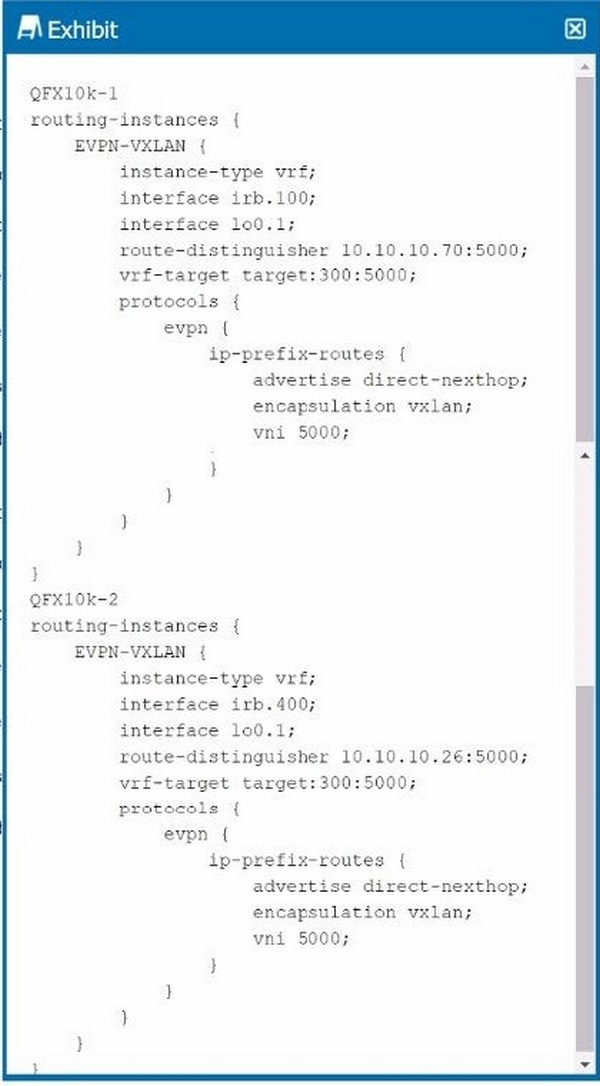 You have a sample configuration for connecting two sites through EVPN-VXLAN by exchanging IP prefix routes. Referring to the exhibit, which two statements regarding the configuration are true? {Choose two.)
-
A
The advertise direct-nexthop option enables the receiver to resolve the next-hop route using only information carried in the Type 5 route.
-
B
The advertise direct-nexthop option enables the receiver to resolve the next-hop route using only information carried in the Type 2 route.
-
C
The VNI must match on all devices for the same customer.
-
D
The VNI should be unique on all devices for each customer site.
Reveal answer details
Close answer details
Correct answersA, C
ExplanationEVPN-VXLAN Configuration:
The configuration provided in the exhibit shows an EVPN-VXLAN setup where IP prefix routes are exchanged between two sites. The advertise direct-nexthop option and the VNI (Virtual Network Identifier) settings are crucial in this context.
Advertise Direct-Nexthop:
Option A:The advertise direct-nexthop option ensures that the next-hop route is resolved using only the information carried in the EVPN Type 5 route. Type 5 routes are used for IP prefix advertisement in EVPN, which is key to enabling Layer 3 interconnectivity between different VXLAN segments.
VNI Consistency:
Option C:For the same customer across different devices, the VNI must be consistent. This consistency ensures that all devices can correctly map traffic to the appropriate VXLAN segment, maintaining seamless Layer 2 and Layer 3 connectivity.
Exhibit. 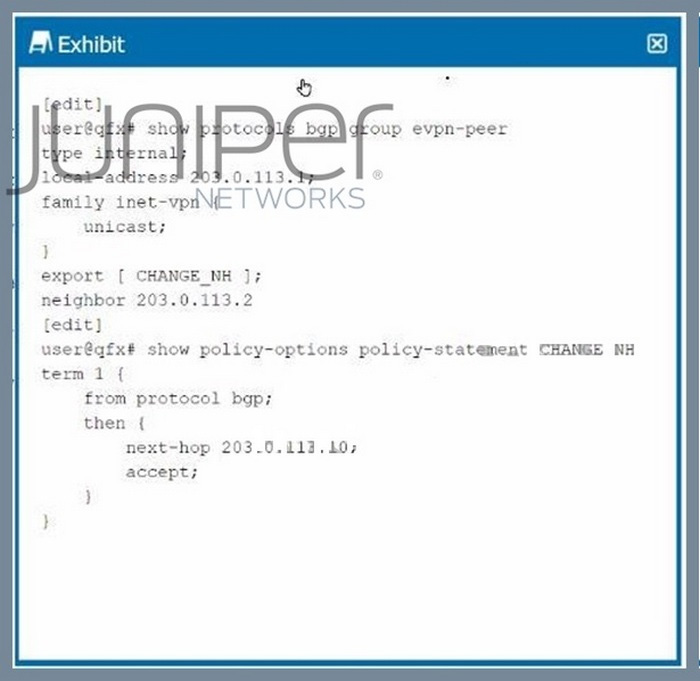 Given the configuration shown in the exhibit, why has the next hop remained the same for the EVPN
routes advertised to the peer 203.0.113.2?
-
A
EVPN routes cannot have the next hop changed.
-
B
The export policy is incorrectly configured.
-
C
The vrf-export parameter must be applied.
-
D
The vpn-apply-export parameter must be applied to this peer.
Reveal answer details
Close answer details
Correct answerD
ExplanationUnderstanding the Configuration:
The configuration shown in the exhibit involves an EVPN (Ethernet VPN) setup using BGP as the routing protocol. The export policy named CHANGE_NH is applied to the BGP group evpn-peer, which includes a rule to change the next hop for routes that match the policy. Issue with Next Hop Not Changing: The policy CHANGE_NH is correctly configured to change the next hop to 203.0.113.10 for the matching routes. However, the next hop remains unchanged when advertising EVPN routes to the peer 203.0.113.2.
Reason for the Issue: In Junos OS, when exporting routes for VPNs (including EVPN), the next-hop change defined in a policy will not take effect unless the vpn-apply-export parameter is used inthe BGP configuration. This parameter ensures that the export policy is applied specifically to VPN routes.
The vpn-apply-export parameter must be included to apply the next-hop change to EVPN routes.
Correct Answer Explanation:
D. The vpn-apply-export parameter must be applied to this peer:This is the correct solution because the
next hop in EVPN routes won't be altered without this parameter in the BGP configuration. It instructs the BGP process to apply the export policy to the EVPN routes.
References:
This behavior is standard in EVPN deployments with Juniper Networks devices, where the export policies applied to VPN routes require explicit invocation using vpn-apply-export to take effect.
Question 4
Multiple choice
You are deploying a Clos IP fabric with an oversubscription ratio of 3:1. In this scenario, which two statements are correct? (Choose two.)
-
A
The oversubscription ratio remains the same when you remove spine devices.
-
B
The oversubscription ratio decreases when you add spine devices.
-
C
The oversubscription ratio increases when you remove spine devices.
-
D
The oversubscription ratio remains the same when you add spine devices.
Reveal answer details
Close answer details
Correct answersB, C
ExplanationUnderstanding Oversubscription in a Clos Fabric: The oversubscription ratio in a Clos IP fabric measures the ratio of the amount of edge (leaf) bandwidth to the core (spine) bandwidth. An oversubscription ratio of 3:1 means that there is three times more edge bandwidth compared to core bandwidth.
Impact of Adding/Removing Spine Devices: Option C:If you remove spine devices , the total available core bandwidth decreases, while the edge bandwidth remains the same. This results in anincrease in the oversubscription ratio because there is now less core bandwidth to handle the same amount of edge traffic.
Option B:Conversely, if you add spine devices , the total core bandwidth increases. This decreases the oversubscription ratio because more core bandwidth is available to handle the edge traffic.
Conclusion:
Option C:Correct--Removing spine devices increases the oversubscription ratio.
Option B:Correct--Adding spine devices decreases the oversubscription ratio.
Question 5
Multiple choice
You are selling up an EVPN-VXLAN architecture (or your new data center. thisinitial deployment will be less than 50 switches: however, it could scale up to 250 switches over time supporting 1024 VLANs. You are still deciding whether to use symmetric or asymmetric routing. In this scenario, which two statements are correct? (Choose two.)
-
A
Symmetric routing needs an extra VLAN with an IRB interface for each L3 VRF instance.
-
B
Asymmetric routing is easier lo monitor because of the transit VNI.
-
C
Symmetric routing supports higher scaling numbers.
-
D
Asymmetric routing routes traffic on the egress switch.
Reveal answer details
Close answer details
Correct answersC, D
ExplanationSymmetric vs. Asymmetric Routing in EVPN-VXLAN: Symmetric Routing:Traffic enters and exits the VXLAN network through the same VTEP, regardless of the source or destination. This approach simplifies routing decisions, especially in large networks, and is generally more scalable.
Asymmetric Routing:The routing occurs on the egress VTEP. This method can be simpler to deploy in smaller environments but becomes complex as the network scales, particularly with larger numbers of VNIs and VLANs.
Correct Statements:
C. Symmetric routing supports higher scaling numbers:Symmetric routing is preferred in larger EVPN-
VXLAN deployments because it centralizes routing decisions, which can be more easily managed and scaled.
D. Asymmetric routing routes traffic on the egress switch:This is accurate, as asymmetric routing means
the routing decision is made at the final hop, i.e., the egress VTEP before the traffic reaches its destination.
Incorrect Statements:
A. Symmetric routing needs an extra VLAN with an IRB interface for each L3 VRF instance:This is not accurate. Symmetric routing does not require an extra VLAN per VRF; rather, it uses the same VLAN/VNI across the network, simplifying routing and VLAN management.
B. Asymmetric routing is easier to monitor because of the transit VNI:Asymmetric routing is not necessarily
easier to monitor; in fact, it can add complexity due to the split routing logic between ingress and egress
points.
References:
The choice between symmetric and asymmetric routing in an EVPN-VXLAN environment depends on network size, complexity, and specific operational requirements. Symmetric routing is generally more scalable and easier to manage in large-scale deployments.
Which statement is correct about a collapsed fabric EVPN-VXLAN architecture?
-
A
Fully meshed back-to-back links are needed between the spine devices.
-
B
It supports multiple vendors in the fabric as long as all the spine devices are Juniper devices deployed with L2 VTEPs
-
C
Using Virtual Chassis at the leaf layer increases resiliency.
-
D
Border gateway functions occur on border leaf devices.
Reveal answer details
Close answer details
Correct answerD
ExplanationCollapsed Fabric Architecture:
A collapsed fabric refers to a simplified architecture where the spine and leaf roles are combined, often reducing the number of devices and links required.
In this architecture, the spine typically handles core switching, while leaf switches handle both access and distribution roles.
Understanding Border Gateway Functionality:
Border gateway functions include connecting the data center to external networks or other data centers.
In a collapsed fabric, these functions are usually handled at the leaf level, particularly on border leaf devices that manage the ingress and egress of traffic to and from the data center fabric.
Correct Statement:
D. Border gateway functions occur on border leaf devices:This is accurate in collapsed fabric architectures,
where the border leaf devices take on the role of managing external connections and handling routes to other data centers or the internet.
References:
The collapsed fabric model is advantageous in smaller deployments or scenarios where simplicity and cost-effectiveness are prioritized. It reduces complexity by consolidating functions into fewer devices, and the border leaf handles the critical task of interfacing with external networks.
In conclusion, border gateway functions are effectively managed at the leaf layer in collapsed fabric architectures, ensuring that the data center can communicate with external networks seamlessly.
Exhibit. 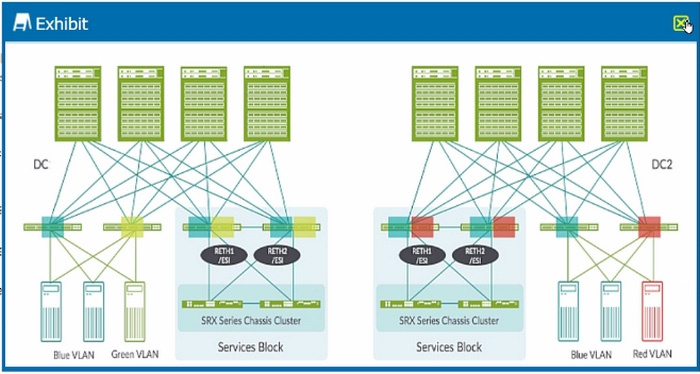 Both DC and DC2 ate using EVPN-VXLAN technology deployed using an ERB architecture. A server on the Red VLAN must communicate with a server on the Green VLAN. The Blue VLAN in DC and DC2 needs to be the same VLAN. Which statement is correct in this scenario?
-
A
The eight spine devices must be configured as border spine devices; a full mush interconnect must
exist between all eight spine devices and the Blue VLAN must be stitched together
-
B
An interconnect is required between the four SRX Series devices; the Blue VLAN must be stretched
and a transit VNI must be added for the Red and Green VLANs.
-
C
An interconnect is required between four leaf devices in the services blocks; the Red VLAN and the
Green VLAN must be stitched and the Blue VLAN must be stretched.
-
D
A lean super spine device must be added to DC and DC2; all VLANs must be stretched to the lean
super spine device and the lean super spine devices must stitch all the VLANs together.
Reveal answer details
Close answer details
Correct answerB
ExplanationERB Architecture in EVPN-VXLAN:
ERB (Edge Routed Bridging) architecture is commonly used in data center networks where routing decisions are made at the network edge (leaf or border devices), while bridging (Layer 2 forwarding) is extended across the fabric. This architecture allows for efficient L3 routing while still enabling L2 services like VLANs to span across multiple locations.
VLAN and VNI Configuration:
The scenario specifies that a server on the Red VLAN needs to communicate with a server on the Green VLAN. Since these VLANs are in different data centers (DC and DC2), and given the use of EVPN-VXLAN, the communication between these VLANs will require a transit VNI (Virtual Network Identifier). This transit VNI will allow traffic to traverse the VXLAN tunnel across the DCI (Data Center Interconnect).
Interconnect between SRX Series Devices:
The exhibit shows SRX Series Chassis Clusters used as service devices (likely for firewalling or other security services). These devices need to be interconnected between the two data centers to ensure that VLANs can communicate effectively. The Blue VLAN needs to be stretched between DC and DC2 to maintain the same Layer 2 domain across both data centers.
Conclusion:
Option B:Correct--Interconnecting the SRX Series devices will ensure the necessary service chaining, while stretching the Blue VLAN and adding a transit VNI for the Red and Green VLANs will enable the required communication across the data centers.
Exhibit. 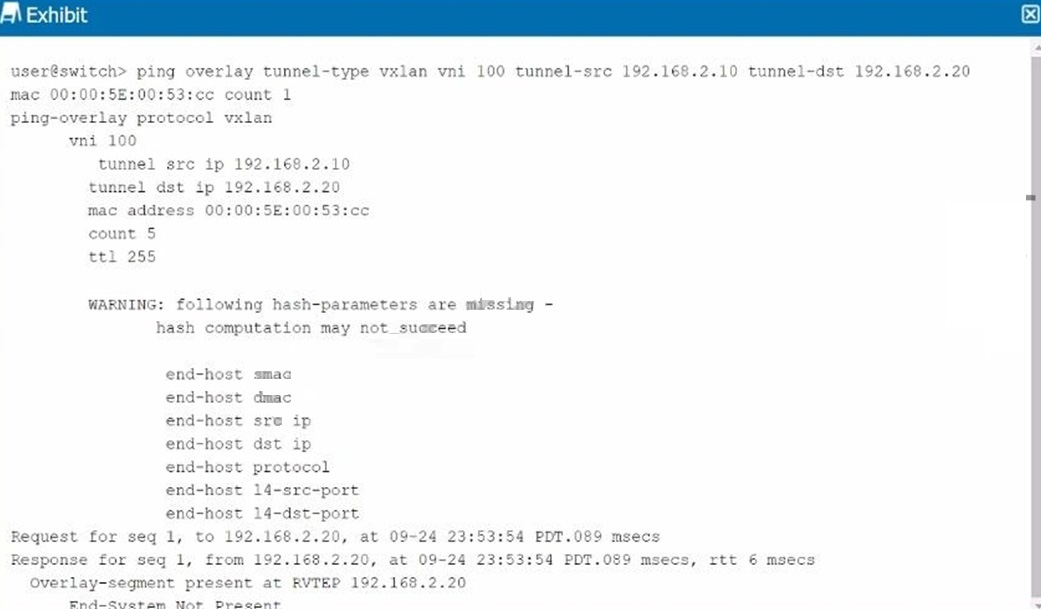 Referring tothe exhibit, which statement is correct?
-
A
VNI 100 is not configured on the remote VTEP.
-
B
The MAC address is unknown and not in the forwarding table of the remote VTEP.
-
C
The remote VTEP is not responding.
-
D
The MAC address is known but not reachable by the remote VTEP
Reveal answer details
Close answer details
Correct answerB
ExplanationAnalyzing the Exhibit Output: The command ping overlay tunnel-type vxlan is used to test the VXLAN tunnel between two VTEPs (VXLAN Tunnel Endpoints). The output shows a warning about missing hash parameters, but more importantly, it displays the result: End-System Not Present.
Understanding the Response:
The message End-System Not Present indicates that the remote VTEP (192.168.2.20) did not find the MAC address 00:00:5E:00:53:CC in its forwarding table. This typically means that the MAC address is unknown to the remote VTEP, and as a result, it could not forward the packet to the intended destination.
Conclusion:
Option B:Correct--The MAC address is unknown and is not in the forwarding table of the remote VTEP, which is why the system reports that the "End-System" is not present.
Exhibit. 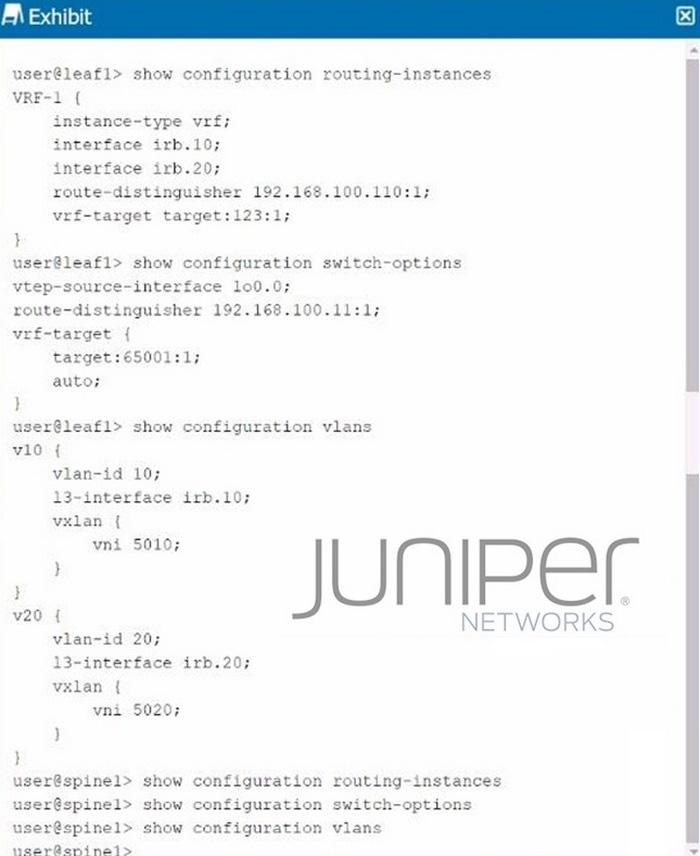 Referring to the exhibit, which statement Is true?
-
A
A PBB-EVPN architecture is being used.
-
B
An ERB architecture is being used.
-
C
An OTT architecture is being used.
-
D
A CRB architecture is being used.
Reveal answer details
Close answer details
Correct answerB
ExplanationUnderstanding Network Architectures:
ERB (Edge Routed Bridging) architecture involves routing at the network's edge (leaf nodes), while traffic between leaf nodes is switched. This is commonly used in VXLAN-EVPN setups.
Analysis of the Exhibit: The exhibit shows configurations related to routing instances, VXLAN, and VLANs, with VNIs being used for each VLAN. This setup is characteristic of an ERB architecture where each leaf device handles Layer 3 routing for its connected devices.
Conclusion:
Option B:Correct--The configuration shown corresponds to an ERB architecture where routing occurs at the network's edge (leaf devices).
Question 10
Multiple choice
Exhibit. 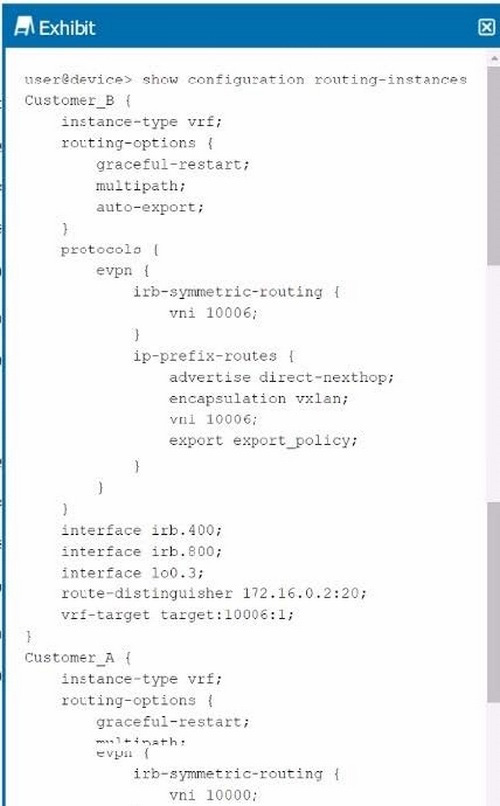 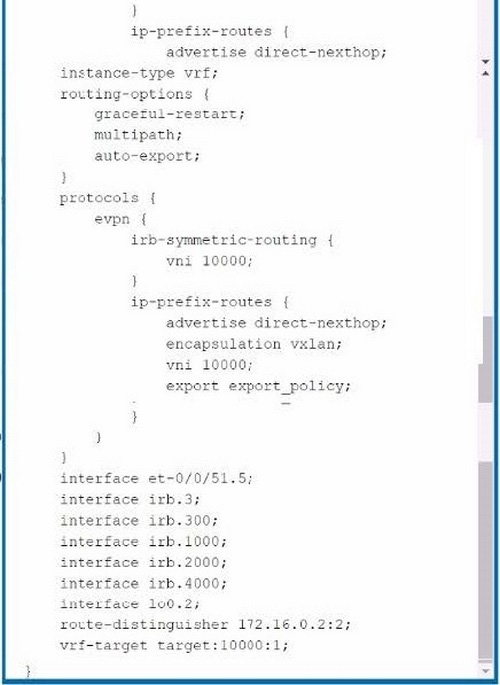 Referring to the configuration shown in the exhibit, assume that there is no external router present, and that the configuration is fabric-only. Which two statements are true about the example configuration? (Choose two.)
-
A
VNI 10006is assigned to vlan 800 (irb.800).
-
B
Devices in irb.400 (vlan 400) are not able to communicate directly with devices in routing instance Customer A.
-
C
Devices in routing instance Customer A are able to communicate with devices in routing instance Customer B
-
D
Devices in irb.400 (vlan 400) and irb.800 (vlan 800) are able to communicate over the fabric.
Reveal answer details
Close answer details
Correct answersB, D
ExplanationUnderstanding the Configuration:
The exhibit shows configurations for two VRFs (Customer_A and Customer_B) with specific VLANs and VNIs assigned. Each VRF has interfaces (IRBs) associated with particular VLANs.
Communication Between VLANs and Routing Instances: Option B:VLAN 400 (irb.400) is part of Customer_B, and there is no direct connection or routing between Customer_A and Customer_B in the configuration provided. Therefore, devices in irb.400 cannot communicate directly with devices in the Customer_A routing instance.
Option D:Since irb.400 (VLAN 400) and irb.800 (VLAN 800) are part of the same routing instance (Customer_B), they can communicate over the fabric using VXLAN encapsulation.
Conclusion:
Option B:Correct--There is no direct communication between devices in irb.400 (Customer_B) and routing instance Customer_A.
Option D:Correct--Devices in VLAN 400 and VLAN 800 can communicate within the Customer_B routing instance over the fabric.
|