Question 1
Multiple choice
Referring to the exhibit.  You have MAC addresses moving in your EVPN environment Referring to the exhibit, which two statements are correct about the sequence number? (Choose two)
-
A
It identifies MAC addresses that should be discarded.
-
B
It resolves conflicting MAC address ownership claims.
-
C
It helps the local PE to identify the latest advertisement.
-
D
It is advertised using a Type 2 message
Reveal answer details
Close answer details
Correct answersB, D
ExplanationThe MAC mobility sequence distinguishes competing advertisements for the same MAC address, so the higher sequence resolves conflicting ownership claims after a move. This mobility information is carried with the EVPN MAC/IP Advertisement, which is a Type 2 route. It identifies the newer ownership claim rather than marking a MAC address for unconditional discard.
Question 2
Multiple choice
Which two statements describe PIM-SM? (Choose two)
-
A
Routers with receivers send join messages to their upstream neighbors.
-
B
Routers without receivers must periodically prune themselves from the SPT.
-
C
Traffic is initially flooded to all routers and an S,G is maintained for each group
-
D
Traffic is only forwarded to routers that request to join the distribution tree.
Reveal answer details
Close answer details
Correct answersA, D
ExplanationPIM-SM builds multicast forwarding state only where receivers express interest. A router attached to receivers sends join messages toward its upstream neighbor, extending the distribution tree toward the source or RP. Consequently, multicast traffic is forwarded only along branches requested by downstream routers rather than initially being flooded throughout the network.
Question 3
Multiple choice
Referring to the exhibit.  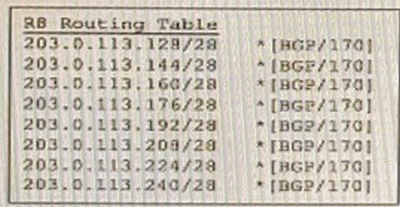 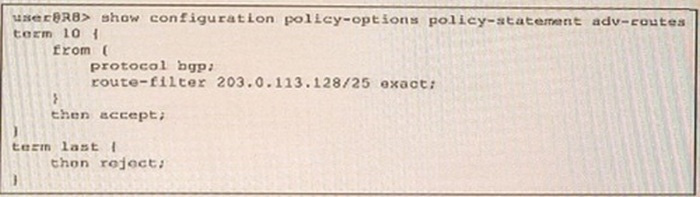 You are attempting to summarize routes from the 203.0.113.128/25 IP block on R8 to AS 64500. You implement the export policy shown in the exhibit, and all routes from the routing table stop being advertised. In this scenario, which two steps would you take to summarize the route in BGP? (Choose two.)
-
A
Remove the from protocol bgp command from the export policy.
-
B
Add the set protocols bgp family inet unicast add-path command to allow additional routes to the RIB tables.
-
C
Add the set routing-options static route 203.0.113.128/25 discard command.
-
D
Replace exact in the export policy with orlonger.
Reveal answer details
Close answer details
Correct answersA, C
ExplanationTo advertise a summarized prefix, the aggregate route must first exist in the routing table. Creating a discard static route for 203.0.113.128/25 installs that summary prefix while preventing traffic loops for destinations without a more-specific route. Because this new summary is a static route rather than a BGP-learned route, the export policy must not restrict matching to protocol bgp; otherwise, the summary route will not be exported to the BGP peer.
On a broadcast segment, R1 and R2 are the established OSPF DR and BDR. Eligible router R3, whose interface priority is higher than both, now joins the segment. What is the expected result while the existing election remains valid?
-
A
R3 replaces the DR and forms full adjacencies with every DROther router
-
B
R3 replaces the BDR while the current DR remains in its role
-
C
R3 remains DROther and forms a full adjacency only with the current DR
-
D
R3 remains DROther and forms full adjacencies with both designated routers
Reveal answer details
Close answer details
Correct answerD
ExplanationOSPF DR and BDR elections are nonpreemptive while the elected routers remain valid. R3's higher priority therefore does not displace either designated router when it joins. It remains a DROther and, on a broadcast network, forms full adjacencies with both the current DR and BDR; adjacencies with other DROther routers remain at the two-way state.
Your network is receiving the 203.0.113.0/24 network using EBGP from AS 64500 and AS 64501. Both of these advertisements have identical local-preference values, AS-path lengths, and BGP origin codes. You want to infiuence the way your AS sends trac to the 203.0.113.0/24 network. In this scenario, which attribute would you consider next when selecting the best path?
-
A
-
B
-
C
-
D
Reveal answer details
Close answer details
Correct answerD
ExplanationMED is normally compared between routes received from the same neighboring AS. These otherwise equal advertisements come from different ASes, so MED does not provide the next comparison under normal selection. The path-selection process therefore considers the IGP metric to each BGP next hop, preferring the route whose next hop has the lower internal cost. Router ID and peer IP address are later tie-breakers.
Referring to the exhibit. 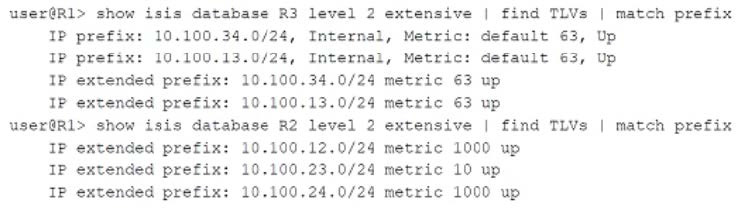 You enabled a new router (R3) in your network but all destinations using IS-IS routes are not properly load balancing over this new router. What is the problem?
-
A
R2 is missing internal routes for R1.
-
B
R1 is missing internal routes for R2.
-
C
R3 does not have wide-metrics enabled.
-
D
R1 does not have wide-metrics enabled.
Reveal answer details
Close answer details
Correct answerC
ExplanationR3 advertises the affected prefixes using both legacy IP prefix TLVs with the default metric 63 and extended prefix TLVs, while the established wide-metric environment relies on extended metrics such as 10 and 1000. This mixed behavior indicates that R3 does not have wide metrics enabled consistently. Its metric advertisements therefore do not align with the other routers for equal-cost load balancing.
You must alter class-of-service values in packets on the outbound interface of an edge router. In this scenario, which CoS component allows you to accomplish this task?
-
A
-
B
-
C
-
D
Reveal answer details
Close answer details
Correct answerC
ExplanationRewrite rules operate during egress processing and change the packet's class-of-service marking, such as the DSCP, IP precedence, or MPLS traffic-class value, according to its forwarding class and loss priority. A scheduler controls transmission service, while a policer limits traffic and a forwarding class categorizes it; those components do not perform the required outbound field rewrite.
Question 8
Multiple choice
Referring to the exhibit 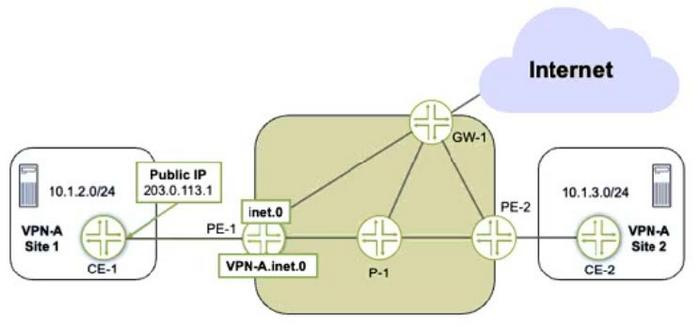 CE-1 is providing NAT services for the hosts at Site 1 and you must provide Internet access for those hosts. Which two statements are correct in this scenario? (Choose two.)
-
A
You must configure a static route in the main routing instance for the 10 1 2.0/24 prefix that uses the VPN-A.inet.0 table as the next hop
-
B
You must configure a static route in the main routing instance for the 203.0.113.1/32 prefix that uses the VPN-A.inet.0 table as the next hop.
-
C
You must configure a RIB group on PE-1 to leak a default route from the inet.0 table to the VPN-
A.inet.0 table.
-
D
You must configure a RIB group on PE-1 to leak the 10 1 2.0/24 prefix from the VPN-inet.0 table to the inet.0 table.
Reveal answer details
Close answer details
Correct answersB, C
ExplanationReturn traffic from the Internet is addressed to CE-1's translated public IP, 203.0.113.1, so inet.0 needs a /32 static route whose next-table lookup enters VPN-A.inet.0. In the opposite direction, VPN hosts need Internet reachability; leaking the default route from inet.0 into VPN-A.inet.0 supplies that path without importing all Internet routes.
External reachability is redistributed by an ASBR inside an OSPF NSSA and must also reach normal areas. What behavior supports this design?
-
A
The NSSA accepts locally originated external information, and an ABR translates it for the rest of the domain
-
B
The NSSA rejects the redistribution because a nonnormal area cannot contain an ASBR
-
C
The original NSSA external advertisement is flooded unchanged through every OSPF area
-
D
The route is represented only by a default route and cannot be advertised outside the NSSA
Reveal answer details
Close answer details
Correct answerA
ExplanationAn NSSA permits its internal ASBR to originate external reachability as an NSSA external advertisement. At the boundary, an ABR translates that information into the normal external form that can be flooded into eligible non-NSSA areas. This mechanism lets locally originated external information leave the NSSA without flooding the original NSSA-specific advertisement unchanged everywhere.
Question 10
Multiple choice
Which two statements about IS-IS are correct? (Choose two.)
-
A
CSNPs are used to request a missing LSP.
-
B
PSNPs are used to acknowledge a received LSP.
-
C
PSNPs are used to request a missing LSP.
-
D
CSNPs are used to acknowledge a received LSP.
Reveal answer details
Close answer details
Correct answersB, C
ExplanationA Partial Sequence Number PDU, or PSNP, lists selected LSP entries rather than the complete link-state database. On a point-to-point exchange it can acknowledge a received LSP, confirming successful delivery. A router can also include an absent or outdated LSP entry in a PSNP to request the missing LSP from its neighbor. CSNPs instead provide broader database summaries for comparison.
Question 11
Single choice
Your organization manages a Layer 3 VPN for multiple customers To support advanced route than one BGP community on advertised VPN routes to remote PE routers. Which routing-instance configuration parameter would support this requirement?
-
A
-
B
-
C
-
D
Reveal answer details
Close answer details
Correct answerA
ExplanationThe requirement concerns policy applied to VPN routes as they leave the routing instance for remote PE routers. The vrf-export parameter references an export policy, and that policy can attach more than one BGP community or apply other advanced route transformations. A vrf-import policy governs received VPN routes, while a simple vrf-target export value does not provide the same policy flexibility.
Question 12
Single choice
You are configuring schedulers to define the class-of-service properties of output queues. You want to control packet drops during periods of congestion. In this scenario, which CoS configuration parameter would be used to accomplish this task?
-
A
-
B
-
C
-
D
Reveal answer details
Close answer details
Correct answerD
ExplanationA drop profile defines how packet-drop probability changes as a queue fills, providing congestion avoidance before the queue is exhausted. A scheduler references the profile to control drops for its forwarding class. Buffer size changes available storage, priority affects service order, and shaping rate limits transmission, but none of those parameters directly defines the queue-fill-to-drop-probability relationship.
Question 13
Single choice
When building an interprovider VPN, you notice on the PE router that you have hidden routes which are received from your BGP peer with family inet labeled-unica3t configured. Which parameter must you configure to solve this problem?
-
A
Under the family inet labeled-unicast hierarchy, add the explicit null parameter.
-
B
Under the protocols ospf hierarchy, add the traffic-engineering parameter.
-
C
Under the family inet labeled-unicast hierarchy, add the resolve-vpn parameter.
-
D
Under the protocols mpls hierarchy, add the traffic-engineering parameter
Reveal answer details
Close answer details
Correct answerC
ExplanationA labeled-unicast route can remain hidden when its next hop must be resolved through VPN routing information. The resolve-vpn parameter permits that resolution under family inet labeled-unicast, allowing the labeled route to become usable. MPLS or OSPF traffic-engineering settings do not address this next-hop resolution condition.
Question 14
Single choice
Click the Exhibit button. 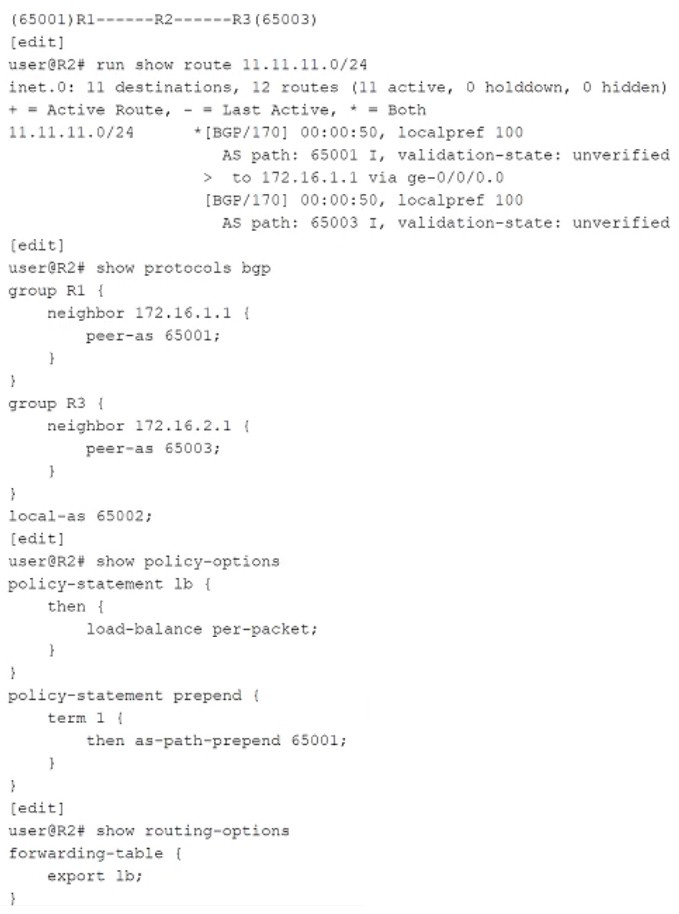 R2 is receiving the same route from R1 and R3. You must ensure that you can load balance traffic for that route. Referring to the exhibit, which configuration change will allow load balancing?
-
A
Configure the multipath parameter under the global BGP configuration.
-
B
Apply the prepend policy as an import policy under group R1.
-
C
Configure the multipath multiple-as parameter under the global BGP configuration.
-
D
Apply the prepend policy as an import policy under group R3.
Reveal answer details
Close answer details
Correct answerC
ExplanationR2 has two otherwise usable paths, but they were learned from different neighboring AS numbers, 65001 and 65003. Ordinary multipath does not make unlike AS paths eligible in this case. Enabling the global BGP multipath multiple-as parameter permits equal paths from different AS peers to participate, after which the existing forwarding-table load-balancing policy can install both next hops.
Question 15
Multiple choice
You are configuring a Layer 3 VPN between two sites. You are configuring the vrf-target target: 65100:100 statement in your routing instance. In this scenario, which two statements describe the vrf-target configuration? (Choose two.)
-
A
This value is used to identify BGP routes learned from the remote PE device.
-
B
This value is used to add a target community to BGP routes advertised to the local CE device.
-
C
This value is used to add a target community to BGP routes advertised to the remote PE device.
-
D
This value is used to identify BGP routes learned from the local CE device.
Reveal answer details
Close answer details
Correct answersA, C
ExplanationThe vrf-target value provides the target community used in both directions by the routing instance. On import, it identifies BGP VPN routes learned from a remote PE whose target community matches 65100:100. On export, it adds that target community to BGP routes advertised toward remote PE devices, allowing their matching VPN instances to select and import those routes.
Question 16
Single choice
Two BGP paths pass the configured multipath-equivalence checks and both next hops are installed. Traffic counters are consistently unequal across those next hops. Which conclusion is valid?
-
A
Control-plane multipath succeeded, while forwarding hashing can produce unequal traffic distribution
-
B
One path failed multipath eligibility because installed next hops must have equal counters
-
C
Forwarding load balancing installed a path that the BGP process had rejected
-
D
Unequal counters prove that the routing table contains only one usable next hop
Reveal answer details
Close answer details
Correct answerA
ExplanationInstalling both next hops establishes that the BGP control-plane multipath checks succeeded. Forwarding then assigns flows to those next hops using a hash over packet fields; it does not continually equalize byte or packet counters. Different flow sizes, rates, and hash outcomes can therefore produce unequal traffic distribution without invalidating multipath eligibility.
|