Question 1
Multiple choice
Which two statements are true about the default VLAN on Juniper switches? (Choose two.)
-
A
The default VLAN is set to a VLAN ID of 1 by default
-
B
The default VLAN ID is not assigned to any interface.
-
C
The default VLAN ID is not visible.
-
D
The default VLAN ID can be changed.
Reveal answer details
Close answer details
Correct answersA, D
ExplanationExplanation: On Juniper switches, the default VLAN is set to a VLAN ID of 1 by default 12. This means that all interfaces on the switch are members of VLAN 1 until they are specifically assigned to another VLAN12.
Therefore, option A is correct. The default VLAN ID can be changed 12. This allows network administrators to configure the switch to use a different VLAN as the default, if necessary 12. Therefore,
option D is correct.
Question 2
Multiple choice
Exhibit. 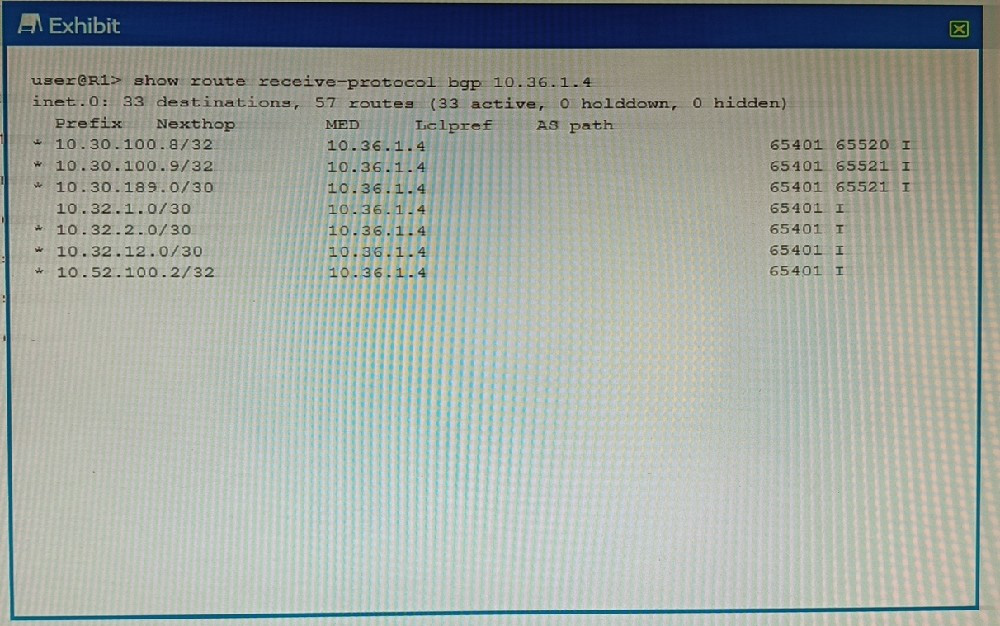 You want to verify prefix information being sent from 10.36.1.4. Which two statements are correct about the output shown in the exhibit? (Choose two.)
-
A
The routes displayed have traversed one or more autonomous systems.
-
B
The output shows routes that were received prior to the application of any BGP import policies.
-
C
The output shows routes that are active and rejected by an import policy.
-
D
The routes displayed are being learned from an I BGP peer.
Reveal answer details
Close answer details
Correct answersA, B
ExplanationExplanation: The output shown in the exhibit is the result of the command "show ip bgp neighbor 10.36.1.4 received-routes", which displays all received routes (both accepted and rejected) from the specified neighbor.
Option A is correct, because the routes displayed have traversed one or more autonomous systems. This can be seen from the AS_PATH attribute, which shows the sequence of AS numbers that the route has passed through. For example, the route 10.0.0.0/8 has an AS_PATH of 65001 65002, which means that it has traversed AS 65001 and AS 65002 before reaching the local router.
Option B is correct, because the output shows routes that were received prior to the application of any BGP import policies. This can be seen from the fact that some routes have a status code of "r", which means that they are rejected by an import policy. The"received-routes" keyword shows the routes coming from a given neighbor before the inbound policy has been applied. To see the routes after the inbound policy has been applied, the "routes" keyword should be used instead.
Option C is incorrect, because the output does not show routes that are active and rejected by an import policy. The status code of "r" means that the route is rejected by an import policy, but it does not mean that it is active. The status code of ">"
means that the route is active and selected as the best path. None of the routes in the output have both ">" and "r" status codes.
Option D is incorrect, because the routes displayed are not being learned from an IBGP peer. An IBGP peer is a BGP neighbor that belongs to the same AS as the local router. The output shows that the neighbor 10.36.1.4 has a remote AS of 65001, which is different from the local AS of 65002. Therefore, the neighbor is an EBGP peer, not an IBGP peer.
Question 3
Multiple choice
You have DHCP snooping enabled but no entries are automatically created in the snooping database for an interface on your EX Series switch. What are two reasons for the problem? (Choose two.)
-
A
The device that is connected to the interface has performed a DHCPRELEASE.
-
B
MAC limiting is enabled on the interface.
-
C
The device that is connected to the interface has a static IP address.
-
D
Dynamic ARP inspection is enabled on the interface.
Reveal answer details
Close answer details
Correct answersB, C
ExplanationExplanation: The DHCP snooping feature in Juniper Networks' EX Series switches works by building a binding database that maps the IP address, MAC address, lease time, binding type, VLAN number, and interface information 1. This database is used to filter and validate DHCP messages from untrusted sources 1.
However, there are certain conditions that could prevent entries from being automatically created in the snooping database for an interface: MAC limiting: If MAC limiting is enabled on the interface, it could potentially interfere with the operation of DHCP snooping. MAC limiting restricts the number of MAC addresses that can be learned on a physical interface to prevent MAC flooding attacks 1. This could inadvertently limit the number of DHCP clients that can be learned on an interface, thus preventing new entries from being added to the DHCP snooping database.
Static IP address: If the device connected to the interface is configured with a static IP address, it will not go through the DHCP process and therefore will not have an entry in the DHCP snooping database 1. The DHCP snooping feature relies on monitoring DHCP messages to build its database1, so devices with static IP addresses that do not send DHCP messages will not have their information added.
Therefore, options B and C are correct. Options A and D are not correct because performing a DHCPRELEASE would simply remove an existing entry from the database1, and Dynamic ARP inspection (DAI) uses the information stored in the DHCP snooping binding database but does not prevent entries from being created 1.
Click the Exhibit button.  Which type of route is shown in the exhibit?
-
A
-
B
-
C
-
D
Reveal answer details
Close answer details
You are receiving multiple BGP routes from an upstream neighbor and only want to advertise a single summarized prefix to your internal OSPF neighbors. This route should only be advertised when you are receiving these BGP routes from this neighbor. In this scenario, which type of route should you create?
-
A
-
B
static route using the resolve feature
-
C
-
D
static route using qualified next hops
Reveal answer details
Close answer details
Correct answerA
ExplanationExplanation: In this scenario, you should create an aggregate route 1. Aggregate routes are used for advertising summarized network prefixes 1. They help minimize the number of routing tables in an IP network by consolidating selected multiple routes into a single route advertisement 1. This approach is in contrast to non-aggregation routing, in which every routing table contains a unique entry for each route 1.
Therefore, option A is correct. Options B, C, and D are not correct because: Static route using the resolve feature: This type of route uses the resolve feature to install a static route in the routing table only if a specific condition is met 1. However, it does not provide the capability to summarize multiple routes into a single prefix.
Generate route: This type of route generates a route that is always present in the routing table and can be used to summarize routes. However, it does not have the capability to only advertise the route when specific BGP routes are being received from a neighbor 1.
Static route using qualified next hops: This type of route allows for the specification of multiple next-hop addresses for a static route 1. However, it does not provide the capability to summarize multiple routes into a single prefix.
Question 6
Multiple choice
Which two statements are true about high availability on Junos devices? (Choose two.)
-
A
BFD is faster at detecting failures than default GRE or OSPF timers.
-
B
NSR is independent of helper routers to assist the routing platform in restoring routing protocol information.
-
C
NSR is dependent on helper routers to assist the routing platform in restoring routing protocol information.
-
D
BFD is slower at detecting failures than default GRE or OSPF timers.
Reveal answer details
Close answer details
Correct answersA, B
ExplanationExplanation:
https://www.juniper.net/documentation/en_US/junos/topics/concept/nsr-overview.html
Click the Exhibit button. 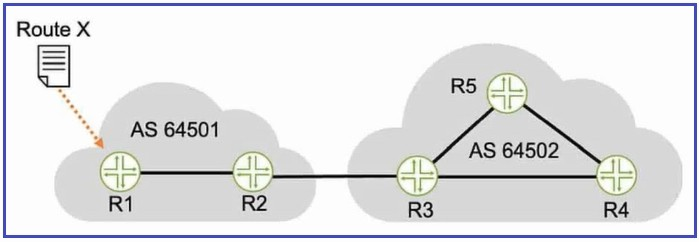 Referring to the exhibit, Router 1 learns about Route X. Which statement is correct about Route X when using the default BGP advertisement rules?
-
A
R1 will not advertise this route to any peers.
-
B
R3 will not advertise this route to R4 or R5 without an explicit policy.
-
C
R4 and R5 will not advertise this route to each other.
-
D
R2 will not advertise this route to R3 without an explicit policy.
Reveal answer details
Close answer details
Question 8
Multiple choice
Referring to the exhibit, which two statements are correct? (Choose two.) 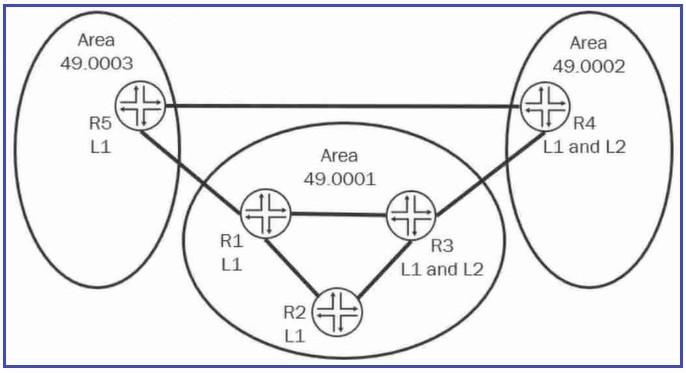
-
A
R2 and R3 can form a Level 1 IS-IS adjacency.
-
B
R4 and R5 can form a Level 1 IS-IS adjacency.
-
C
R1 and R5 can form a Level 1 IS-IS adjacency.
-
D
R3 and R4 can form a Level 2 IS-IS adjacency.
Reveal answer details
Close answer details
Question 9
Multiple choice
What are three types of port designation specific to Private VLANs? (Choose three.)
-
A
-
B
-
C
-
D
-
E
Reveal answer details
Close answer details
Question 10
Single choice
By default, how long will a learned MAC address be retained in the bridge table on an EX Series switch?
-
A
-
B
-
C
-
D
Reveal answer details
Close answer details
Question 11
Multiple choice
Which two statements about Layer 2 loop prevention protocols are correct? (Choose two.)
-
A
With STP, a designated port can transition to the forwarding state without waiting for the protocol times to expire.
-
B
STP uses point-to-point and edge port designations.
-
C
With RSTP, a designated port can transition to the forwarding state without waiting for the protocol times to expire.
-
D
RSTP uses point-to-point and edge port designations.
Reveal answer details
Close answer details
Question 12
Multiple choice
Which three statements describe what happens when processing a frame for a switched packet? (Choose three.)
-
A
The ingress PFE performs the MAC address lookup.
-
B
The frame enters the ingress port and is forwarded out all ports.
-
C
The frame enters the ingress port and is processed by the ingress PFE.
-
D
The ingress PFE sends the header information to the Routing Engine.
-
E
The egress PFE forwards the packet out the egress port towards the destination.
Reveal answer details
Close answer details
Question 13
Multiple choice
An update to your organization's network security requirements document requires management traffic to be isolated in a non-default routing-instance. You want to implement this requirement on your Junos-based devices. Which two commands enable this behavior? (Choose two.)
-
A
set routing--instances mgmtjunoa interface ge-0/0/0.0
-
B
set routing--instances mgmt_junos interface em1
-
C
set system management--instance
-
D
set routing--instances mgmt_junos
Reveal answer details
Close answer details
Correct answersC, D
ExplanationExplanation: To isolate management traffic in a non-default routing-instance on Junos-based devices, you can use the set system management-instance and set routing-instances mgmt_junos commands 12. set system management-instance: This command associates the management interface (usually named fxp0 or em0 for Junos OS, or re0:mgmt-* or re1:mgmt-* for Junos OS Evolved) with the non-default virtual routing and forwarding (VRF) instance 1. After you configure the non-default management VRF instance, management traffic no longer has to share a routing table with other control traffic or protocol traffic 1. set routing-instances mgmt_junos: This command creates a new routing instance named mgmt_junos. The
name of the dedicated management VRF instance is reserved and hardcoded as mgmt_junos; you cannot configure any other routing instance by the name mgmt_junos1.
Therefore, options C and D are correct. Options A and B are not correct because they attempt to assign an interface to the mgmt_junos routing instance, which is not necessary for isolating management traffic 1.
Question 14
Multiple choice
In RSTP, which three port roles are associated with the discarding state? (Choose three.)
-
A
-
B
-
C
-
D
-
E
Reveal answer details
Close answer details
Correct answersB, C, D
ExplanationExplanation: In Rapid Spanning Tree Protocol (RSTP), there are several port roles that determine the behavior of the port in the spanning tree 123. The roles include root, designated, alternate, backup, and disabled 123.
The discarding state is associated with the backup, alternate, and disabled roles 123. In a stable topology with consistent port roles throughout the network, RSTP ensures that every root port and designated port immediately transition to the forwarding state while all alternate and backup ports are always in the discarding state 2. Disabled ports are also in the discarding state 3.
Therefore, options B, C, and D are correct.
Question 15
Multiple choice
You are concerned about spoofed MAC addresses on your LAN. Which two Layer 2 security features should you enable to minimize this concern? (Choose two.)
-
A
-
B
-
C
-
D
Reveal answer details
Close answer details
Correct answersA, C
ExplanationA is correct because dynamic ARP inspection (DAI) is a Layer 2 security feature that prevents ARP spoofing attacks. ARP spoofing is a technique that allows an attacker to send fake ARP messages to associate a spoofed MAC address with a legitimate IP address. This can result in traffic redirection, man-in-the-middle attacks, or denial-of-service attacks. DAI validates ARP packets by checking the source MAC address and IP address against a trusted database, which is usually built by DHCP snooping 1. DAI discards any ARP packets that do not match the database or have invalid formats 1.
C is correct because DHCP snooping is a Layer 2 security feature that prevents DHCP spoofing attacks.
DHCP spoofing is a technique that allows an attacker to act as a rogue DHCP server and offer fake IP addresses and other network parameters to unsuspecting clients. This can result in traffic redirection, man-in- the-middle attacks, or denial-of-service attacks. DHCP snooping filters DHCP messages by classifying switch ports as trusted or untrusted. Trusted ports are allowed to send and receive any DHCP messages, while untrusted ports are allowed to send only DHCP requests and receive only valid DHCP replies from trusted ports 2. DHCP snooping also builds a database of MAC addresses, IP addresses, lease times, and binding types for each client 2.
Question 16
Multiple choice
What are two interarea OSPF LSA types? (Choose two.)
-
A
-
B
-
C
-
D
Reveal answer details
Close answer details
Question 17
Single choice
You have an IBGP neighbor sending you routes. You need to apply a policy so it only evaluates routes being learned from this specific neighbor. In this scenario, which statement is correct about applying the policy?
-
A
The policy should be applied as an export policy to the BGP group level.
-
B
The policy should be applied as an import policy to the BGP group level.
-
C
The policy should be applied as an export policy to the BGP neighbor level.
-
D
The policy should be applied as an import policy to the BGP neighbor level.
Reveal answer details
Close answer details
Question 18
Single choice
Which statement is correct about access ports?
-
A
Access ports must have an IRB assigned to accept untagged traffic.
-
B
By default, access ports accept only VLAN tagged traffic.
-
C
Access ports must have an IRB assigned to accept VLAN tagged traffic.
-
D
By default, an access port can have only a single VLAN assigned.
Reveal answer details
Close answer details
Question 19
Single choice
Click the Exhibit button. 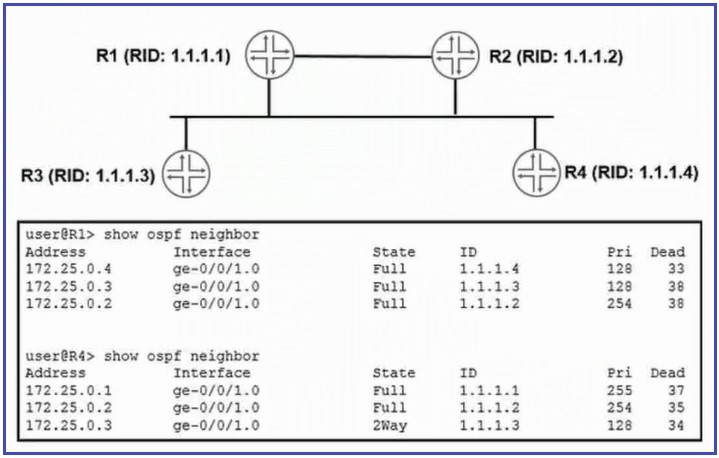 Referring to the exhibit, which statement is correct?
-
A
R1 and R2 are elected as DROthers.
-
B
R3 has the complete OSPF database.
-
C
R3 and R4 have an adjacency state of Full.
-
D
Reveal answer details
Close answer details
Question 20
Single choice
Exhibit: 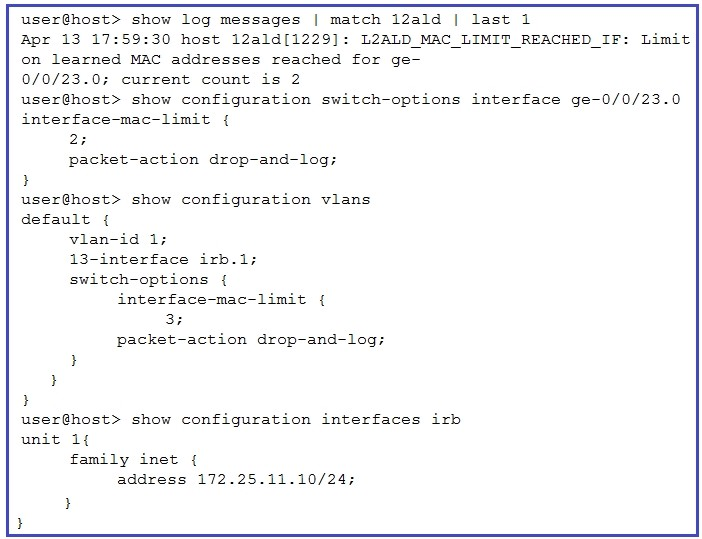 You have an ESXi host that is connected to ge-0/0/23 on a Juniper EX Series switch. You added a new VM that will also use the same ge-0/0/23 interface. Unfortunately, the new VM is not able to reach external devices. Referring to the exhibit, which command would solve this problem?
-
A
set vlans default switch-options interface-mac-limit 4
-
B
set vlans default switch-options interface-mac-limit 5
-
C
set switch-options interface ge-0/0/23.0 interface-mac-limit 3
-
D
clear ethernet-switching recovery-timeout interface ge-0/0/23.0
Reveal answer details
Close answer details
Question 21
Single choice
Exhibit 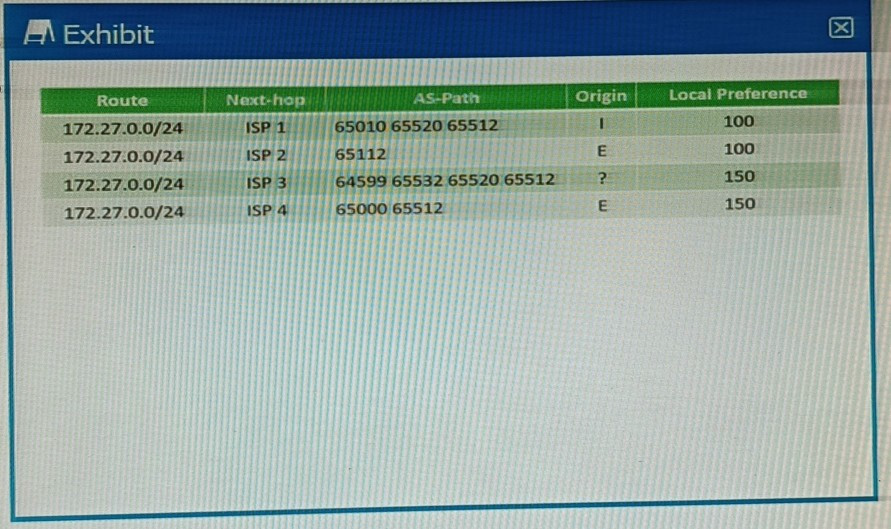 You are receiving the BGP route shown in the exhibit from four different upstream ISPs. Referring to the exhibit, which ISP will be selected as the active path?
-
A
-
B
-
C
-
D
Reveal answer details
Close answer details
Correct answerC
ExplanationExplanation: In BGP, the path selection process is based on a set of attributes 1. The process starts by preferring the path with the highest weight, then the highest local preference, then the locally originated routes, and so on1. If all these attributes are the same, then it prefers the path with the shortest AS path 1.
Referring to the exhibit, all four ISPs have the same weight, local preference, and origin 1. However, ISP 4 has the shortest AS path 1. Therefore, ISP 4 will be selected as the active path. So, option C is correct.
Question 22
Single choice
You have configured storm control on your network devices. Your network has grown and you no longer have time to investigate each occurrence of a storm control violation. You want to enable a port to automatically be re-enabled after a storm violation.
In this scenario, which Junos OS configuration timeout would accomplish this task?
-
A
Configure the secure access port timeout.
-
B
Configure the port error disable timeout.
-
C
Configure the BPDU blocking timeout.
-
D
Configure the MAG aging table timeout.
Reveal answer details
Close answer details
Question 23
Multiple choice
Which two statements are true regarding RIB groups? (Choose two.)
-
A
The first table listed is the primary route table and determines the address family of the RIB group.
-
B
The last table listed is the primary route table and determines the address family of the RIB group.
-
C
A RIB group must contain one or more export-rib statements.
-
D
A RIB group must contain one or more import-rib statements.
Reveal answer details
Close answer details
Question 24
Single choice
You are asked to configure filter-based forwarding (FBF) to forward traffic sourced from a specific subnet to a webserver. In this scenario, which mechanism is used to add interface routes to the forwarding routing instance used in FBF?
-
A
-
B
-
C
-
D
Reveal answer details
Close answer details
Question 25
Multiple choice
What are three requirements to ensure proper GRE or IP-IP tunnel routing? (Choose three.)
-
A
Keepalives must be used on stateless tunneling protocols.
-
B
Tunnel endpoints must have a route that directs traffic into the tunnel.
-
C
BGP must be used on intermediate devices.
-
D
Tunnel endpoints must have a valid route to the remote endpoint.
-
E
All intermediary devices must have a route to the tunnel endpoints.
Reveal answer details
Close answer details
Question 26
Single choice
Exhibit. 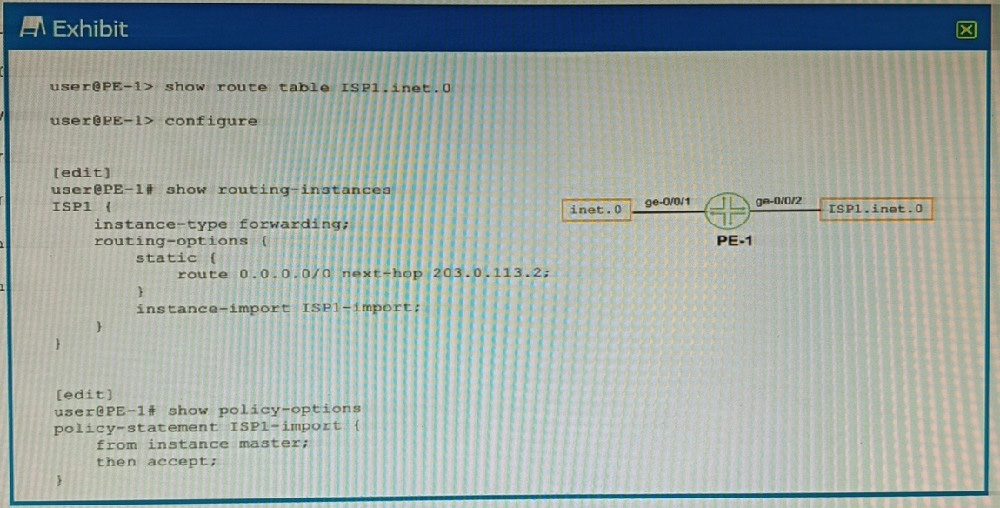 The ispi_inet. 0 route table has currently no routes in it. What will happen when you commit the configuration shown on the exhibit?
-
A
The inet. 0 route table will be completely overwritten by the ispi . inet. 0 route table.
-
B
The inet. 0 route table will be imported into the ispi . inet. 0 route table.
-
C
The ISPI . inet. 0 route table will be completely overwritten by the inet. o route table.
-
D
The ISPI . inet. 0 route table will be imported into the inet. 0 route table.
Reveal answer details
Close answer details
Correct answerB
ExplanationExplanation: The configuration shown in the exhibit is an example of a routing instance of type virtual- router. A routing instance is a collection of routing tables, interfaces, and routing protocol parameters that create a separate routing domain on a Juniper device 1. A virtual-router routing instance allows administrators to divide a device into multiple independent virtual routers, each with its own routing table 2.
The configuration also includes a rib-group statement, which is used to import routes from one routing table to another. A rib-group consists of an import-rib statement, which specifies the source routing table, and an export-rib statement, which specifies the destination routing table.
In this case, the rib-group name is inet-to-ispi, and the import-rib statement specifies inet.0 as the source routing table. The export-rib statement specifies ispi.inet.0 as the destination routing table. This means that the routes from inet.0 will be imported into ispi.inet.0. Therefore, the correct answer is B. The inet.0 route table will be imported into the ispi.inet.0 route table.
References:
1: Routing Instances Overview
2: Virtual Routing Instances : [rib-group (Routing Options)]
Question 27
Multiple choice
Which two BGP attributes must be supported by all BGP implementations and must be included in every update? (Choose two.)
-
A
-
B
-
C
-
D
Reveal answer details
Close answer details
Correct answersA, C
ExplanationExplanation: BGP attributes are properties that BGP uses for route advertisement, path selection, and loop prevention 1. There are four categories of BGP attributes123: Well-known mandatory: Must be recognized by all BGP routers, present in all BGP updates, and passed on to other BGP routers 123.
Well-known discretionary: Supported by all BGP implementations, and are optionally included in BGP updates 1.
Optional transitive: May not be supported by all implementations of BGP1. Optional non-transitive: May not be supported by all implementations of BGP1. The well-known mandatory attributes must be supported by all BGP implementations and must be included in every update 123. These include the AS path and next hop attributes 23. Therefore, options A and C are correct.
|