You are asked to create an IPS-exempt rule base to eliminate false positives from happening. Which two configuration parameters are available to exclude traffic from being examined? (Choose two.)
-
A
-
B
-
C
-
D
Reveal answer details
Close answer details
Correct answerB
ExplanationTo exclude traffic from being examined by IPS, you can use the source IP address and/or destination port as criteria for the exemption. This is achieved by configuring an IPS-exempt rule base that includes specific exemption rules based on these criteria.
References:
Juniper Networks. JNCIS-SEC Study Guide: Chapter 8, Intrusion Prevention System (IPS).
Question 2
Multiple choice
Which two devices would you use for DDoS protection with Policy Enforcer? (Choose two.)
-
A
-
B
-
C
-
D
Reveal answer details
Close answer details
Correct answersB, C
ExplanationThe MX and vMX devices can be used for DDoS protection with Policy Enforcer. Policy Enforcer is a Juniper Networks solution that provides real-time protection from DDoS attacks. It can be used to detect and block malicious traffic, and also provides granular control over user access and policy enforcement.
The MX and vMX devices are well-suited for use with Policy Enforcer due to their high-performance hardware and advanced security features.
Question 3
Multiple choice
What are three capabilities of AppQoS? (Choose three.)
-
A
-
B
assign a forwarding class
-
C
-
D
-
E
Reveal answer details
Close answer details
Correct answersA, B, E
ExplanationAppQoS (Application Quality of Service) is a Junos OS feature that provides advanced control and prioritization of application traffic. With AppQoS, you can classify application traffic, assign a forwarding class to the traffic, and apply quality of service (QoS) policies to the traffic. You can also re-write DSCP values and reserve bandwidth for important applications. However, AppQoS does not re-write the TTL or rate-limit traffic. Source: Juniper Networks, Security, Specialist (JNCIS-SEC) Study Guide. Chapter 3:
AppSecure. Page 66-67.
Click the Exhibit button. 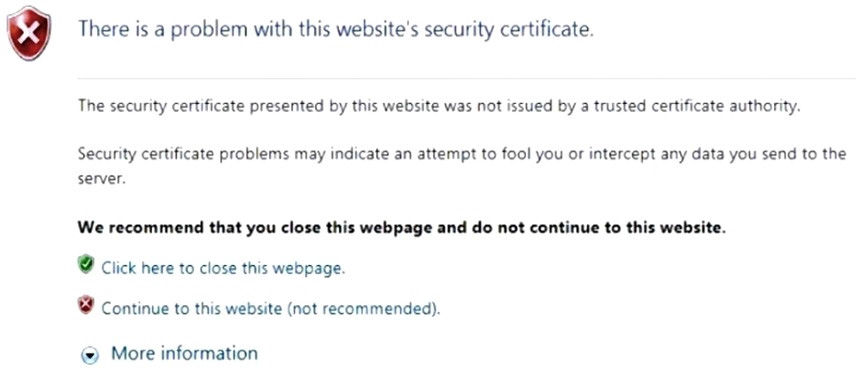 You have implemented SSL client protection proxy. Employees are receiving the error shown in the exhibit. How do you solve this problem?
-
A
Load a known good, but expired. CA certificate onto the SRX Series device.
-
B
Install a new SRX Series device to act as the client proxy
-
C
Reboot the SRX Series device.
-
D
Import the existing certificate to each client device.
Reveal answer details
Close answer details
Correct answerD
ExplanationSSL client protection proxy is a feature that allows you to decrypt and inspect the SSL traffic from clients to servers. To do this, you need to install a certificate authority (CA) certificate on the SRX Series device and import the same certificate to each client device. This way, the SRX Series device can act as a proxy between the client and the server and perform security checks on the decrypted traffic. If the client device does not have the certificate installed, it will receive an error message like the one shown in the exhibit.
References:
JNCIS-SEC Certification, Open Learning - Security, Specialist (JNCIS-SEC), SSL Proxy
Configuration
Exhibit 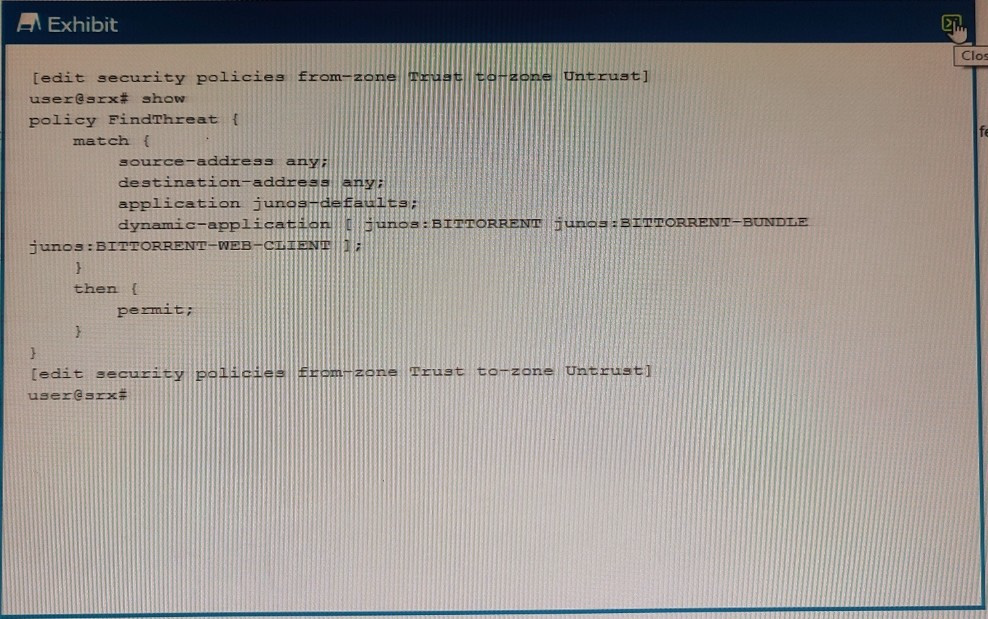 You are asked to track BitTorrent traffic on your network. You need to automatically add the workstations to the High_Risk_Workstations feed and the servers to the BitTorrent_Servers feed automatically to help mitigate future threats. Which two commands would add this functionality to the FindThreat policy? (Choose two.) A.  B.  C.  D. 
-
A
-
B
-
C
-
D
Reveal answer details
Close answer details
Question 6
Multiple choice
Which two statements are correct about SSL proxy server protection? (Choose two.)
-
A
You do not need to configure the servers to use the SSL proxy the function on the SRX Series device.
-
B
You must load the server certificates on the SRX Series device.
-
C
The servers must be configured to use the SSL proxy function on the SRX Series device.
-
D
You must import the root CA on the servers.
Reveal answer details
Close answer details
Correct answersB, C
ExplanationYou must load the server certificates on the SRX Series device and configure the servers to use the SSL proxy function on the SRX Series device. This is done to ensure that the SSL proxy is able to decrypt the traffic between the client and server. Additionally, you must import the root CA on the servers in order for the SSL proxy to properly validate the server certificate.
You are preparing a proposal for a new customer who has submitted the following requirements for a vSRX deployment: -- globally distributed, -- rapid provisioning, -- scale based on demand, -- and low CapEx. Which solution satisfies these requirements?
-
A
-
B
-
C
-
D
Reveal answer details
Close answer details
Correct answerA
ExplanationThe solution that satisfies the requirements for a vSRX deployment is AWS. AWS (Amazon Web Services) is a cloud computing platform that provides on-demand services such as infrastructure, platform, software, and database as a service. AWS is globally distributed, meaning that it has data centers in multiple regions around the world. AWS also allows rapid provisioning, meaning that you can launch vSRX instances in minutes using preconfigured Amazon Machine Images (AMIs) or custom templates. AWS also enables scaling based on demand, meaning that you can adjust the number and size of vSRX instances according to your network traffic and performance needs. AWS also has low CapEx (capital expenditure), meaning that you only pay for what you use and do not need to invest in hardware or maintenance costs.
References:
vSRX Deployment Guide for AWS, Understand vSRX Virtual Firewall with AWS, What Is
Amazon Web Services?
Question 8
Multiple choice
Which two statements are correct about the fab interface in a chassis cluster? (Choose two.)
-
A
Real-time objects (RTOs) are exchanged on the fab interface to maintain session synchronization.
-
B
In an active/active configuration, inter-chassis transit traffic is sent over the fab interface.
-
C
The fab interface enables configuration synchronization.
-
D
Heartbeat signals sent on the fab interface monitor the health of the control plane link.
Reveal answer details
Close answer details
Correct answersA, B
ExplanationThe fab interface is a fabric link that connects the two nodes in a chassis cluster. A chassis cluster is a high-availability feature that groups two identical SRX Series devices into a cluster that acts as a single device. The fab interface has two functions: Real-time objects (RTOs) are exchanged on the fab interface to maintain session synchronization: RTOs are data structures that store information about active sessions, such as source and destination IP addresses, ports, protocols, and security policies. RTOs are exchanged between the nodes on the fab interface to ensure that both nodes have the same session information and can take over the traffic in case of a failover.
In an active/active configuration, inter-chassis transit traffic is sent over the fab interface: In an active/active configuration, both nodes in a cluster can process traffic for different redundancy groups (RGs). RGs are collections of interfaces or services that fail over together from one node to another. If traffic needs to transit from one RG to another RG that is active on a different node, it is sent over the fab interface.
References:
Configuring Chassis Clustering on SRX Series Devices, Chassis Cluster Redundancy
Groups, Chassis Cluster Data Plane
How does the SSL proxy detect if encryption is being used?
-
A
It uses application identity services.
-
B
It verifies the length of the packet
-
C
It queries the client device.
-
D
It looks at the destination port number.
Reveal answer details
Close answer details
Correct answerD
ExplanationThe SSL proxy can detect if encryption is being used by looking at the destination port number of the packet. If the port number is 443, then the proxy can assume that the packet is being sent over an encrypted connection. If the port number is different, then the proxy can assume that the packet is not encrypted. For more information, please refer to the Juniper Networks JNCIS-SEC Study Guide.
References:
Juniper Networks Security, Specialist (JNCIS-SEC) Study Guide, Chapter 6:
SSL Proxy, page 6-9.
The SSL proxy is a security feature that provides visibility and control over SSL/TLS encrypted traffic.
When SSL proxy is enabled, it intercepts SSL/TLS traffic and decrypts it to allow visibility into the content of the encrypted traffic. However, before decrypting the traffic, the SSL proxy must first determine if the traffic is encrypted.
To detect if encryption is being used, the SSL proxy looks at the destination port number. If the destination port number is a known SSL/TLS port (e.g., TCP port 443), the SSL proxy assumes that encryption is being used and intercepts the traffic. If the destination port is not a known SSL/TLS port, the SSL proxy does not intercept the traffic and allows it to pass through the device unmodified.
Question 10
Multiple choice
Which two statements about unified security policies are correct? (Choose two.)
-
A
Unified security policies require an advanced feature license.
-
B
Unified security policies are evaluated after global security policies.
-
C
Traffic can initially match multiple unified security policies.
-
D
APPID results are used to determine the final security policy
Reveal answer details
Close answer details
Correct answersC, D
Explanationunified security policies are security policies that enable you to use dynamic applications as match conditions along with existing 5-tuple or 6-tuple matching conditions 12. They simplify application-based security policy management at Layer 7 and provide greater control and extensibility to manage dynamic applications traffic3
Question 11
Single choice
You want to be alerted if the wrong password is used more than three times on a single device within five minutes. Which Juniper Networks solution will accomplish this task?
-
A
Adaptive Threat Profiling
-
B
-
C
Juniper Identity Management Service
-
D
Intrusion Prevention System
Reveal answer details
Close answer details
Correct answerB
ExplanationThe Juniper Networks solution that will accomplish the task of alerting if the wrong password is used more than three times on a single device within five minutes is Juniper Secure Analytics (JSA). JSA is a security intelligence platform that collects, analyzes, and correlates network data from various sources, such as firewalls, routers, switches, servers, and applications. JSA can detect and respond to threats, anomalies, and vulnerabilities in real time using rules, offenses, reports, and dashboards. JSA can also integrate with JIMS (Juniper Identity Management Service) to obtain user identity information from Active Directory domains or syslog sources. JSA can use this information to create custom rules that trigger offenses or alerts based on user behavior or activity, such as failed login attempts or password changes.
References:
Juniper Secure Analytics Troubleshooting Guide, Juniper Identity Management Service User Guide
Question 12
Multiple choice
You are configuring logging for a security policy. In this scenario, in which two situations would log entries be generated? (Choose two.)
-
A
-
B
at session initialization
-
C
-
D
Reveal answer details
Close answer details
Correct answersB, D
ExplanationLog entries would be generated in two situations: at session initialization and at session close. At session initialization, the log entry would include details about the connection, such as the source and destination IP addresses, the service being used, and the action taken by the security policy. At session close, the log entry would include details about the connection, such as the duration of the session, the bytes sent/ received, and the action taken by the security policy. For more information, you can refer to the Juniper Security documentation at
https://www.juniper.net/documentation/en_US/junos/topics/reference/configuration-statement/security-log-configuration.html.
Question 13
Single choice
You are asked to find systems running applications that increase the risks on your network. You must ensure these systems are processed through IPS and Juniper ATP Cloud for malware and virus protection. Which Juniper Networks solution will accomplish this task?
-
A
-
B
Encrypted Traffic Insights
-
C
-
D
Adaptive Threat Profiling
Reveal answer details
Close answer details
Correct answerD
ExplanationAdaptive Threat Profiling (ATP) is a Juniper Networks solution that enables organizations to detect malicious activity on their networks and process it through IPS and Juniper ATP Cloud for malware and virus protection. ATP is powered by Juniper's advanced Machine Learning and Artificial Intelligence (AI) capabilities, allowing it to detect and block malicious activity in real-time. ATP is integrated with Juniper's
Unified Threat Management (UTM) and Encrypted Traffic Insights (ETI) solutions, providing an end-to-end network protection solution.
Question 14
Single choice
Exhibit 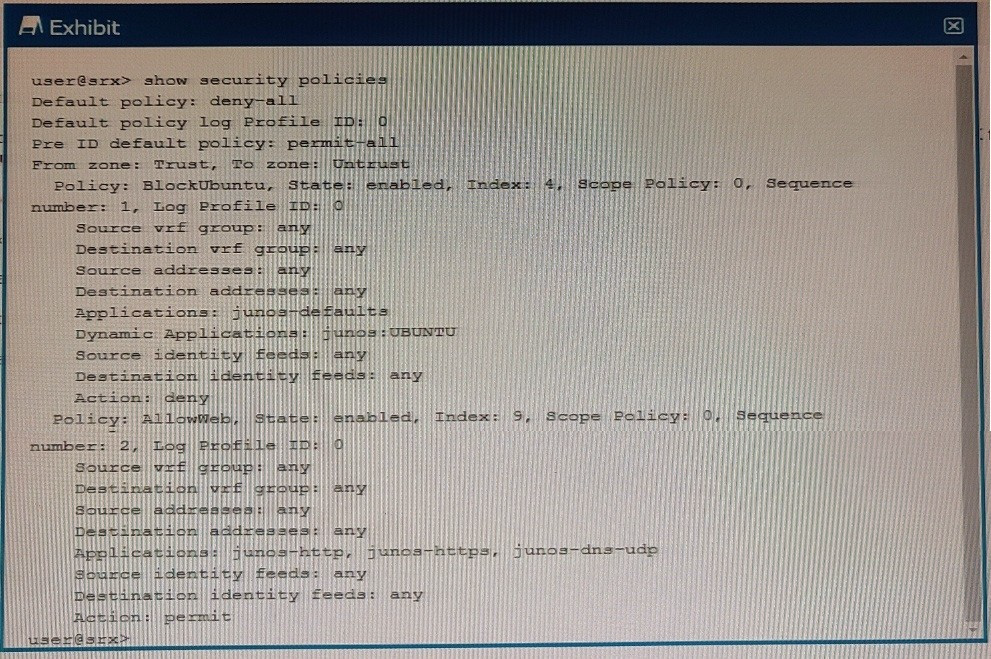 You are asked to ensure that servers running the Ubuntu OS will not be able to update automatically by blocking their access at the SRX firewall. You have configured a unified security policy named Blockuburrtu, but it is not blocking the updates to the OS. Referring to the exhibit which statement will block the Ubuntu OS updates?
-
A
Move the Blockubuntu policy after the Allowweb policy.
-
B
Configure the Blockubuntu policy with the junos-https application parameter.
-
C
Change the default policy to permit-all.
-
D
Configure the Allowweb policy to have a dynamic application of any.
Reveal answer details
Close answer details
Question 15
Multiple choice
Which two sources are used by Juniper Identity Management Service (JIMS) for collecting username and device IP addresses? (Choose two.)
-
A
Microsoft Exchange Server event logs
-
B
-
C
Active Directory domain controller event logs
-
D
Reveal answer details
Close answer details
Correct answersB, C
ExplanationJuniper Identity Management Service (JIMS) collects username and device IP addresses from both DNS and Active Directory domain controller event logs. DNS is used to resolve hostnames to IP addresses, while Active Directory domain controller event logs are used to get information about user accounts, such as when they last logged in.
|