Question 1
Multiple choice
What are two reasons why you would deploy an IP fabric instead of a traditional Layer 2 network in a data center? (Choose two.)
-
A
Layer 2 networks only support a single broadcast domain.
-
B
IP fabrics are better suited to smaller networks where scale is less important.
-
C
Layer 3 networks support load balancing.
-
D
Layer 2 networks are susceptible to loops.
Reveal answer details
Close answer details
Correct answersC, D
ExplanationIP fabricsare Layer 3-centric network designs often used in data centers due to their scalability, efficient routing, and loop-free architecture. Step-by-Step Breakdown: Layer 3 Load Balancing:IP fabrics use Equal-Cost Multipath (ECMP) to distribute traffic across multiple paths, providing effective load balancing and improving bandwidth utilization. This capability is absent in traditional Layer 2 networks, which do not support ECMP for routing decisions.
Layer 2 Loops: Layer 2 networks are prone to loops because of the lack of TTL (Time-to-Live) mechanisms. Spanning Tree Protocol (STP) is required to prevent loops, but it can introduce inefficiencies by blocking links. In contrast, IP fabrics based on Layer 3 protocols are loop-free and do not need STP. References:
IP Fabric: Juniper's IP fabric solutions offer efficient Layer 3 routing with built-in load balancing and loop prevention, making them ideal for modern data center architectures.
EVPN/VXLAN is primarily used in modern data centers to:
-
A
Increase the physical distance between data centers.
-
B
Provide Layer 2 connectivity over a Layer 3 network.
-
C
Replace traditional routing protocols.
-
D
Enhance the physical security of the data center.
Reveal answer details
Close answer details
Which state in the adjacency process do OSPF routers check the MTU size?
-
A
-
B
-
C
-
D
Reveal answer details
Close answer details
Correct answerB
ExplanationIn OSPF, routers exchange link-state information in different stages to establish full adjacency. TheMTU size is checked during the Exchange state. Step-by-Step Breakdown: OSPF Adjacency Process:
OSPF routers go through multiple stages when forming an adjacency: Down Init 2-Way ExStart , , , , Exchange Loading , , and Full . Exchange State:
During the Exchange state, OSPF routers exchange Database Description (DBD) packets to describe their link-state databases. The MTU size is checked at this stage to ensure both routers can successfully exchange these packets without fragmentation. If there is an MTU mismatch , the routers may fail to proceed past the Exchange state. References:
MTU Checking in OSPF: Junos uses the Exchange state to check for MTU mismatches, ensuring that routers can properly exchange database information without packet fragmentation issues.
A generated route is configured under which hierarchy?
-
A
-
B
-
C
-
D
Reveal answer details
Close answer details
Correct answerC
ExplanationA generated route in Junos OS is configured under the [edit routing-options] hierarchy. Step-by-Step Breakdown: Generated Routes:A generated route is created based on the presence of more specific routes in the routing table. It acts as a summary route and is generated when any of its contributing routes are active.
This is commonly used to create aggregate routes in OSPF, BGP, or other protocols.
Configuration Hierarchy:The configuration for generated routes is placed under[edit routing-options] , where other static and routing policies are also defined. Command Example:
set routing-options generate route 10.10.0.0/16 References:
Routing Options: Juniper routers use the routing-options hierarchy to configure generated routes and other static routing behaviors.
Question 5
Multiple choice
Which three actions are required to implement filter-based forwarding? (Choose three.)
-
A
You must create an instance-type forwarding routing instance.
-
B
You must create an instance-type vrf routing instance.
-
C
You must create a match filter.
-
D
You must create a security policy.
-
E
You must create a RIB group.
Reveal answer details
Close answer details
Correct answersA, C, E
ExplanationFilter-Based Forwarding (FBF) in Junos OS allows traffic to be routed based on specific criteria such as source address, rather than just the destination address. This is useful in scenarios like policy routing or providing multiple paths for different types of traffic. Step-by-Step Breakdown: Instance-Type Forwarding:You must create an instance-type forwarding routing instance. This routing instance allows for different routing tables based on the incoming packet filter. Command:
set routing-instances FBF-instance instance-type forwarding
Match Filter:You need to create a filter to match the traffic that will be forwarded according to your custom routing policy. This filter is applied to an interface to determine which traffic will use the custom forwarding instance. Command Example:
set firewall family inet filter FBF-filter term 1 from source-address <address> set firewall family inet filter FBF-filter term 1 then routing-instance FBF-instance RIB Group:A RIB (Routing Information Base) group is necessary to share routes between the primary routing table and the custom routing instance. This allows FBF traffic to use the routing information from other routing tables. Command Example:
set routing-options rib-groups FBF-group import-rib inet.0 set routing-instances FBF-instance routing-options rib-group FBF-group References:
FBF Configuration: Filter-based forwarding requires these specific steps to redirect traffic to a custom routing table based on filter criteria.
Question 6
Multiple choice
Which LSA types are associated with OSPF? (Choose three)
-
A
-
B
-
C
-
D
Reveal answer details
Close answer details
Question 7
Multiple choice
What are two consequences of having all network devices in a single collision domain? (Choose two.)
-
A
The amount of network resource consumption does not change.
-
B
The chance of packet collision is decreased.
-
C
The chance of packet collision is increased.
-
D
The amount of network resource consumption is increased.
Reveal answer details
Close answer details
Correct answersC, D
ExplanationA collision domain is a network segment where data packets can "collide" with one another when being sent on the same network medium. Step-by-Step Breakdown: Increased Collision Probability:If all devices are in a single collision domain , the likelihood of packet collisions increases as more devices attempt to send packets simultaneously, leading to network inefficiencies. Increased Resource Consumption:More collisions result inincreased network resource
consumption as devices need to retransmit packets, causing higher utilization of bandwidth and slowing down network performance. References:
Collision Domains: Proper network segmentation using switches reduces collision domains, thereby
improving network performance and reducing packet collisions.
Under which Junos hierarchy is a static route configured?
-
A
-
B
-
C
-
D
Reveal answer details
Close answer details
What is the primary purpose of using aggregate routes in a network?
-
A
To dynamically adjust to network changes
-
B
To summarize and reduce the number of routes in the routing table
-
C
To filter unwanted traffic
-
D
To statically define a route to a specific destination
Reveal answer details
Close answer details
Question 10
Single choice
Which statement is correct about the BGP AS path when advertising routes?
-
A
The order of the AS path is not significant.
-
B
The local AS number is added to the end of the AS path.
-
C
The order of the AS path is only significant in IBGP.
-
D
The local AS number is added to the beginning of the AS path.
Reveal answer details
Close answer details
Correct answerD
ExplanationThe BGP AS (Autonomous System) path attribute is crucial in path selection and loop prevention. Each BGP router appends its local AS number to the beginning of the AS path when it advertises a route to an
external BGP (eBGP) peer. Step-by-Step Breakdown: AS Path Attribute:The AS path is a sequence of AS numbers that a route has traversed to reach a destination. Each AS adds its number to the front of the path, allowing BGP to track the route's history.
Why the Local AS is Added at the Beginning:When advertising a route to an eBGP neighbor, a BGP router adds its own AS number to the beginning of the AS path. This ensures that the AS path reflects the route's journey accurately from the origin to the destination, and prevents loops in BGP. If the route returns to the same AS, the router will detect its AS number in the path and reject the route, preventing routing loops.
Order of the AS Path:The order is significant because BGP uses it to select the best path. A shorter AS path is preferred, as it indicates fewer hops between the source and destination. References:
AS Path Attribute: Junos devices append the local AS at the start of the AS path before advertising the route to an external peer.
Question 11
Single choice
Which statement is correct about member interfaces when creating a LAG?
-
A
The interface's MTU settings must match on all member interfaces.
-
B
The interface's duplex settings and link speed must be the same on all member interfaces.
-
C
Member interfaces must all be allocated on the same chassis when using a Virtual Chassis.
-
D
Member interfaces must all be allocated on the same PFE.
Reveal answer details
Close answer details
Correct answerB
ExplanationWhen creating a LAG (Link Aggregation Group) in Junos, the duplex settings and link speed must be the same across all member interfaces. Step-by-Step Breakdown: LAG Overview:A LAG combines multiple physical interfaces into a single logical interface to increase bandwidth and provide redundancy. All member links must act as a single cohesive unit. Interface Requirements:
Duplex: All member interfaces must operate in the same duplex mode (either full-duplex or half-duplex).
Mismatched duplex settings can cause performance issues, packet drops, or interface errors. Link Speed: All interfaces in the LAG must have the same link speed (e.g., all interfaces must be 1 Gbps or 10 Gbps).
Mismatched speeds would prevent the interfaces from functioning correctly within the LAG. Configuration and Validation: Ensure that all member interfaces have identical settings before adding them to the LAG. These settings can be checked using the show interfaces command, and the LAG can be configured using:
set interfaces ae0 aggregated-ether-options link-speed 10g set interfaces ge-0/0/1 ether-options 802.3ad ae0 References:
LAG Configuration: Duplex and link speed must be consistent across member interfaces to ensure proper LAG operation in Juniper devices.
Question 12
Single choice
In the Junos OS, which feature is used to create an alternate next hop with a unique preference for a static route?
-
A
-
B
-
C
-
D
Reveal answer details
Close answer details
Correct answerD
ExplanationIn Junos OS, the qualified-next-hop feature is used to specify an alternate next hop for a static route, along with a unique preference value. Step-by-Step Breakdown: Qualified-Next-Hop:A qualified-next-hop allows you to define multiple next hops for a static route, each with its own preference. This provides flexibility by allowing the router to choose the best available next hop based on reachability and preference.
Use Case:If the primary next hop becomes unreachable, the router can automatically switch to the alternate next hop defined by the qualified-next-hop with a higher preference value. Command Example:
set routing-options static route 10.10.10.0/24 qualified-next-hop 192.168.1.1 preference 5 set routing-options static route 10.10.10.0/24 qualified-next-hop 192.168.1.2 preference 10
Preference:The next hop with the lowest preference is chosen first. If it becomes unavailable, the router will use the higher preference next hop. References:
Qualified-Next-Hop: This feature is used to configure backup or alternate next hops for static routes in Juniper devices.
Question 13
Single choice
Referring to the exhibit, 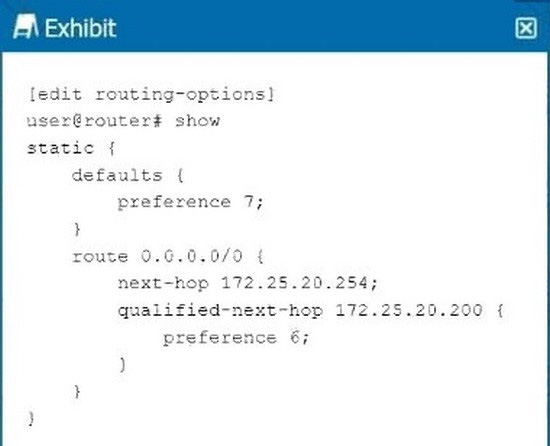 which next hop will be preferred in the routing table?
-
A
Next hop IP address 172.25.20.254 will be preferred.
-
B
Neither next hop will be preferred.
-
C
Next hop IP address 172.25.20.200 will be preferred.
-
D
Both next hops will be preferred.
Reveal answer details
Close answer details
Correct answerC
ExplanationIn the exhibit, we see a static route configuration with two possible next hops for the default route
(0.0.0.0/0):
next-hop 172.25.20.254with the default preference of 7. qualified-next-hop 172.25.20.200with a preference of 6. Step-by-Step Breakdown: Preference Value:In Junos OS, the preference value is used to determine which route should be preferred in the routing table. The lower the preference value, the higher the priority for the route. Comparison:In this case: The next hop 172.25.20.254 has a preference of . 7
The qualified-next-hop 172.25.20.200 has a preference of . 6
Preferred Next Hop:Since 172.25.20.200 has a lower preference (6) compared to 172.25.20.254 (7), it will be the preferred next hop in the routing table, assuming both next hops are reachable. References:
Qualified Next Hop: In Junos, static routes with multiple next-hop options are selected based on the preference value , with the lower value being preferred.
Question 14
Single choice
What happens if a frame with a known destination MAC address enters a switch?
-
A
The egress PFE performs a MAC address lookup and determines the ingress PFE and port.
-
B
The ingress PFE sends the header information to the R
-
C
The ingress PFE performs a MAC address lookup and determines the egress PFE and port.
-
D
The MAC address is added to the bridge table.
Reveal answer details
Close answer details
Question 15
Single choice
In the context of protocol-independent routing, what is the main difference between static and generated routes?
-
A
Static routes require manual configuration, while generated routes are created dynamically.
-
B
Static routes are used for load balancing, while generated routes are not.
-
C
Generated routes support summarization, while static routes do not.
-
D
Generated routes are manually configured, while static routes are automatically created.
Reveal answer details
Close answer details
Question 16
Single choice
You are troubleshooting a downed BGP session. 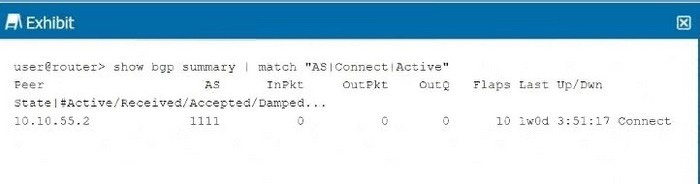 Referring to the exhibit, what is the cause of the problem?
-
A
The UDP session between the peers has not been established.
-
B
The local peer has sent an Open message but not received one from the remote peer.
-
C
The TCP session between the peers has not been established.
-
D
The local peer has sent an Update message but not received one from the remote peer.
Reveal answer details
Close answer details
Correct answerC
ExplanationThe BGP session in the exhibit shows the state as Connect , which indicates that the TCP session between the BGP peers has not been fully established. Step-by-Step Breakdown: BGP State "Connect": The Connect state is the second stage in the BGP finite state machine (FSM). At this stage, BGP is trying to establish a TCP session with the peer, but the session has not yet been successfully established. A successful TCP three-way handshake (SYN, SYN-ACK, ACK) is required before BGP can progress to the OpenSent state, where the peers exchange BGP Open messages. Possible Causes:
A firewall blocking TCP port 179 .
Incorrect IP addresses or network connectivity issues between the BGP peers. References:
BGP Troubleshooting: In Junos, if a BGP session is stuck in the Connect state, the issue is likely due to a failure in establishing the underlying TCP connection.
Question 17
Multiple choice
Which two statements are true about how switches handle Layer 2 traffic? (Choose two.)
-
A
The MAC address is learned based on the destination MAC address.
-
B
The MAC address is learned based on the source MAC address.
-
C
Traffic is forwarded based on the source MAC address.
-
D
Traffic is forwarded based on the destination MAC address.
Reveal answer details
Close answer details
Correct answersB, D
ExplanationIn Layer 2 switching, switches learn MAC addresses based on the source MAC address of incoming frames and forward frames based on the destination MAC address . Step-by-Step Breakdown: MAC Learning:When a switch receives a frame, it records the source MAC address and the port on which it arrived. This allows the switch to know where to send traffic destined for that MAC address. Forwarding Based on Destination:The switch then looks at the destination MAC address and forwards the frame out of the port associated with that MAC address. If the MAC is unknown, the switch floods the frame to all ports. References:
Layer 2 Switching: Juniper switches use source MAC addresses to build MAC tables and forward traffic based on the destination MAC address.
Question 18
Single choice
Referring to the exhibit, how many broadcast domains are present in the topology? 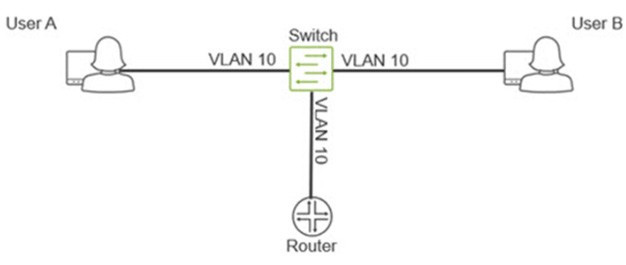
-
A
-
B
-
C
-
D
Reveal answer details
Close answer details
Question 19
Single choice
Which operation mode command will display the mapping between the VLAN ID and ports on a switch?
-
A
-
B
show ethernet-switching table
-
C
-
D
Reveal answer details
Close answer details
Correct answerD
ExplanationTo display the mapping between VLAN IDs and ports on a Juniper switch, the show vlans command is used. Step-by-Step Breakdown: VLAN Information:The show vlans command displays detailed information about VLAN configurations, including the VLAN ID, associated interfaces (ports), and VLAN membership. Command Example: show vlans
This command will provide an output listing each VLAN, its ID, and the interfacesassociated with the VLAN, enabling network engineers to quickly verify VLAN to port mappings. References:
VLAN Verification: Use the show vlans command to verify which VLANs are configured on the switch and the ports that are members of those VLANs.
Question 20
Single choice
In Ethernet switching, what is the primary function of a storm control policy?
-
A
To prevent loops in the network.
-
B
To restrict the rate of certain types of traffic.
-
C
-
D
To segregate broadcast domains.
Reveal answer details
Close answer details
Question 21
Single choice
In OSPF, which command is commonly used to monitor neighbor relationships?
-
A
-
B
-
C
-
D
Reveal answer details
Close answer details
|