Question 1
Multiple choice
When traffic enters an interface, which two results does a route lookup determine? (Choose two.)
-
A
-
B
-
C
-
D
Reveal answer details
Close answer details
Correct answersB, D
ExplanationA route lookup determines where the packet must leave the device, identifying the egress interface associated with the selected route. Because that interface belongs to a security zone, the lookup result also establishes the egress security zone used for subsequent policy processing.
You want to verify the peer before IPsec tunnel establishment. What is used as a final check?
-
A
-
B
-
C
-
D
Reveal answer details
Close answer details
Correct answerD
ExplanationDuring IPsec negotiation, proxy ID values are compared as the final compatibility check for the traffic endpoints to be protected. Matching proxy IDs confirms that the peer is proposing the expected local and remote traffic relationship, allowing tunnel establishment to proceed.
What is the purpose of assigning logical interfaces to separate security zones in Junos OS?
-
A
to simplify the configuration of network interfaces
-
B
to manage routing protocols and updates
-
C
to control traffic that traverses different VLANs using security policies
-
D
to enable network monitoring through SNMP
Reveal answer details
Close answer details
Correct answerC
ExplanationAssigning logical interfaces to security zones creates policy boundaries for traffic moving between those zones. When the interfaces represent different VLANs, security policies can control whether that traffic is permitted or denied according to the source zone, destination zone, and application.
Which Juniper ATP feed provides a dynamic list of known botnet servers and malware download sources?
-
A
-
B
-
C
-
D
Reveal answer details
Close answer details
Correct answerC
ExplanationThe C&C cloud feed supplies a dynamic cloud-maintained list associated with command-and-control infrastructure. Known botnet servers and malware download sources fit that role because compromised hosts may contact them for instructions or payloads. The feed therefore provides the changing threat endpoints described in the question.
Question 5
Multiple choice
You just made a configuration change to a security policy on your SRX Series Firewall. Your users alert you that an application that uses FTP is no longer working. 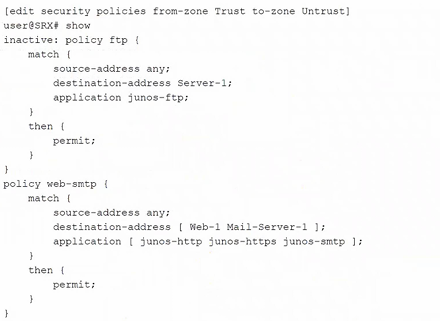 Referring to the exhibit, what are two ways to solve this problem? (Choose two.)
-
A
Enter the rollback 1 command followed by a commit command.
-
B
Activate the FTP security policy and commit the configuration.
-
C
Insert the FTP security policy before the web-smtp security policy.
-
D
Change the destination address in the FTP security policy to any and commit the configuration.
Reveal answer details
Close answer details
Correct answersA, B
ExplanationThe FTP policy is marked inactive, so it cannot permit FTP traffic in the committed configuration. Activating that policy and committing restores its direct effect. Alternatively, rollback 1 followed by commit restores the preceding configuration, undoing the policy change that caused the application failure.
What must also be enabled when using source NAT if the address pool is in the same subnet as the interface?
-
A
-
B
-
C
-
D
Reveal answer details
Close answer details
Correct answerD
ExplanationWhen a source NAT pool uses addresses from the interface's own subnet, neighboring devices treat those translated addresses as directly reachable and issue ARP requests for them. Proxy ARP enables the SRX to answer those requests on behalf of the pool addresses, allowing return traffic to reach the firewall.
Question 7
Multiple choice
A security zone is configured with source 192.168.0.12/255.255.0.255 wildcard match. Which two IP packets match? (Choose two.)
-
A
-
B
-
C
-
D
Reveal answer details
Close answer details
Correct answersC, D
ExplanationIn a wildcard match, a 0 bit requires the corresponding source-address bit to match, while a 1 bit permits variation. With 192.168.0.12/255.255.0.255, the last octet must remain 12 and the third octet may vary. Therefore, both 192.168.1.12 and 192.168.22.12 match.
You must ensure that sessions can only be established from the external device. 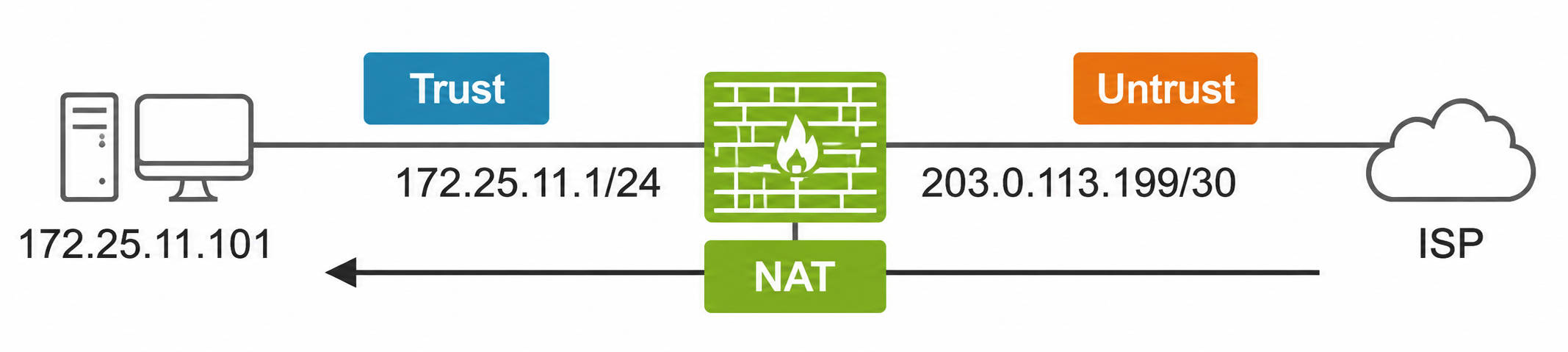 Referring to the exhibit, which type of NAT is being performed?
-
A
static NAT and source NAT
-
B
-
C
-
D
Reveal answer details
Close answer details
Correct answerD
ExplanationDestination NAT changes the destination of traffic initiated from Untrust toward the internal host in Trust. The public-facing destination is translated to the internal destination, while no source translation is part of the stated operation. That one-way mapping is destination NAT only.
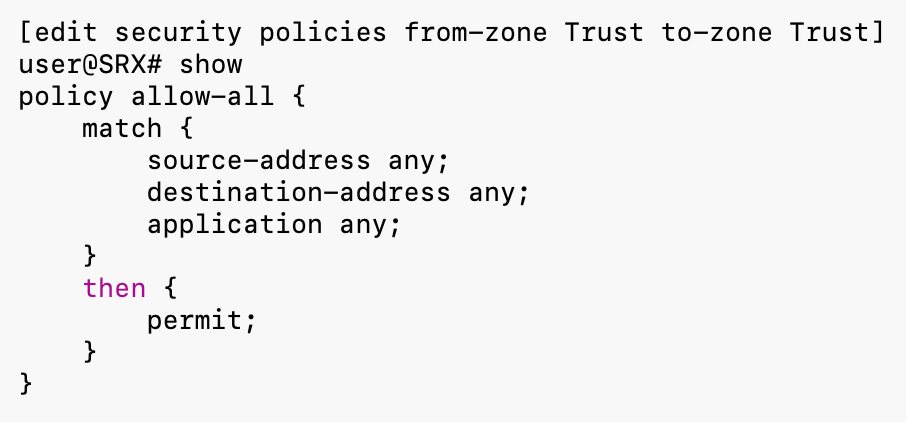
Which type of policy is shown in the exhibit?
-
A
-
B
-
C
-
D
Reveal answer details
Close answer details
Correct answerB
ExplanationBoth policy endpoints are the same security zone: the hierarchy is from-zone Trust to-zone Trust. A policy governing traffic whose source and destination interfaces belong to one zone is an intra-zone policy. Inter-zone processing would name different source and destination zones, while a global policy would not be defined by this same-zone pair.
Question 10
Single choice
What is the purpose of rate-limiting exception traffic in the Junos OS?
-
A
to enhance the performance of the forwarding plane
-
B
to simplify the configuration of network interfaces
-
C
to prevent denial-of-service attacks on the Routing Engine
-
D
to manage routing protocols and updates
Reveal answer details
Close answer details
Correct answerC
ExplanationException traffic can be directed from the forwarding path toward the Routing Engine for additional processing. Rate-limiting bounds that arrival rate, preventing a flood from exhausting Routing Engine capacity. This protects the control plane from denial-of-service attacks rather than managing routing updates or interface configuration.
Question 11
Single choice
What information does the show chassis routing-engine command provide?
-
A
-
B
-
C
-
D
Reveal answer details
Close answer details
Correct answerB
Explanationshow chassis routing-engine reports operational information about the Routing Engine, including its resource utilization. This lets an operator assess consumption of Routing Engine resources. Chassis identity, software-version reporting, and routing-table contents belong to other operational information areas.
Question 12
Multiple choice
What are two Juniper ATP Cloud feed analysis components? (Choose two.)
-
A
-
B
-
C
-
D
Reveal answer details
Close answer details
Correct answersB, C
ExplanationThe C&C cloud feed supplies information associated with command-and-control destinations, supporting detection of related communications. The infected host cloud feed identifies hosts associated with compromise. Both are cloud-provided feed analysis components in Juniper ATP Cloud.
Question 13
Single choice
You are asked to enable trace options to debug the packet flow.
In this scenario, which flag would you configure at the [edit security flow traceoptions] hierarchy?
-
A
-
B
-
C
-
D
Reveal answer details
Close answer details
Correct answerA
ExplanationThe packet-dump flag records packet-level information for security flow tracing. That data exposes how packets are handled while they traverse the flow path, making this the relevant flag when the goal is to debug packet flow rather than collect only general, state, or basic datapath events.
Question 14
Single choice
You are asked to reduce security configuration complexity on your external facing firewalls. You notice that a previous administrator included hundreds of private subnet NAT rules covering various RFC1918 addresses. You want to replace all these rules with a single rule covering all RFC1918 addresses. Which rule would you use in this scenario?
-
A
set security nat source rule-set private-to-pub rule RFC1918 match source-address [10.0.0.0/8
192.168.0.0/16 172.16.0.0/12]
-
B
set security nat source rule-set private-to-pub rule RFC1918 match source-address [10.0.0.0/8
192.16.0.0/12 172.168.0.0/16]
-
C
set security nat source rule-set private-to-pub rule RFC1918 match source-address [10.0.0.0/8
172.168.0.0/16 192.0.2.0/24 203.1.113.0/24]
-
D
set security nat source rule-set private-to-pub rule RFC1918 match source-address [10.0.0.0/8
192.168.0.0/16 172.16.0.0/12 192.0.2.0/24]
Reveal answer details
Close answer details
Correct answerA
ExplanationThe three RFC1918 private IPv4 blocks are 10.0.0.0/8, 172.16.0.0/12, and 192.168.0.0/16. The command set security nat source rule-set private-to-pub rule RFC1918 match source-address [10.0.0.0/8 192.168.0.0/16 172.16.0.0/12] places all three in one source NAT rule match, replacing the many subnet-specific rules.
Question 15
Single choice
On an SRX Series firewall, which log type records events generated by UTM and security services such as Web filtering or antivirus scanning?
-
A
-
B
-
C
-
D
Reveal answer details
Close answer details
Correct answerD
ExplanationUTM services generate security-service records rather than ordinary session or administrator activity records. The utm log type is designed to hold events from antivirus scanning, Web filtering, and related UTM processing, so those service results are recorded there.
Question 16
Multiple choice
Which two statements are correct about security policies in SRX Series Firewalls? (Choose two.)
-
A
A security policy can only control inter-zone traffic.
-
B
A security policy can control both transit traffic and self-traffic.
-
C
A security policy can control both intra-zone traffic and inter-zone traffic.
-
D
A security policy can only control transit traffic.
Reveal answer details
Close answer details
Correct answersC, D
ExplanationAn SRX security policy can control transit traffic crossing between different zones and transit traffic moving within the same zone, covering both inter-zone and intra-zone flows. Its scope is limited to transit traffic; self-traffic directed to or generated by the firewall is outside that security-policy control boundary.
Question 17
Single choice
In Junos OS, which statement is correct about packet-based forwarding mode on an SRX device?
-
A
It enables AppID for all flows by default.
-
B
It bypasses session-based processing.
-
C
It supports UTM on all platforms.
-
D
It requires NPUs to be disabled.
Reveal answer details
Close answer details
Correct answerB
ExplanationPacket-based forwarding handles packets without creating and tracking the stateful flow sessions used by session-based mode. Therefore, enabling packet-based forwarding bypasses session-based processing; features that depend on session awareness are not the defining behavior of this mode.
Question 18
Multiple choice
What are two purposes of configuring application sets? (Choose two.)
-
A
to organize multiple applications into a single group
-
B
to open dynamic ports used by particular applications for the duration of a session
-
C
to organize multiple addresses into a single group
-
D
to change the applications referenced in a security policy without editing the security policy
Reveal answer details
Close answer details
Correct answersA, D
ExplanationAn application set organizes multiple applications into a single reusable group. A security policy can reference that group instead of listing each application individually. Changing the applications referenced by the set then changes what the policy covers without editing the security policy itself.
Question 19
Multiple choice
Which two statements are correct about unified security policies? (Choose two.)
-
A
Traffic that matches a unified policy will not be evaluated by traditional security policy.
-
B
Dynamic applications in unified security policies analyze traffic based on Layer 4 information.
-
C
Traffic that matches a traditional policy will not be evaluated by unified security policy.
-
D
Dynamic applications in unified security policies analyze traffic based on Layer 7 information.
Reveal answer details
Close answer details
Correct answersA, D
ExplanationWhen traffic matches a unified security policy, that match determines its policy path, so the traffic is not subsequently evaluated by a traditional security policy. Dynamic applications add application-aware inspection at Layer 7, where the application behavior and content can be identified rather than relying only on Layer 4 data.
Question 20
Single choice
Which security policy type will be evaluated first?
-
A
A zone policy with no dynamic application set
-
B
A global with no dynamic application set
-
C
A zone policy with a dynamic application set
-
D
A global policy with a dynamic application set
Reveal answer details
Close answer details
Correct answerD
ExplanationPolicy evaluation gives precedence to the combination of global scope and a dynamic application set. Therefore, a global policy using a dynamic application set is considered before zone policies and before global rules that lack that dynamic application criterion.
Question 21
Single choice
You need to capture control plane traffic on a high-end SRX Series device. How would you accomplish this task?
-
A
Configure a packet capture under the edit security datapath-debug capture hierarchy.
-
B
Apply a firewall filter matching the desired traffic using the sample action.
-
C
Start a shell then use the tcpdump tool.
-
D
Apply a port mirroring configuration under the edit forwarding options hierarchy.
Reveal answer details
Close answer details
Correct answerB
ExplanationA firewall filter can identify the desired control plane traffic with its match conditions. The sample action then selects copies of those matching packets for capture and analysis, providing visibility into the targeted traffic without relying on a forwarding-table view.
Question 22
Single choice
You are modifying the NAT rule order and you notice that a new NAT rule has been added to the bottom of the list.
In this situation, which command would you use to reorder NAT rules?
-
A
-
B
-
C
-
D
Reveal answer details
Close answer details
Correct answerA
ExplanationThe top command moves the newly added NAT rule from the bottom to the beginning of the ordered rule list. NAT rules are evaluated in sequence, so placing the intended rule at the top gives it precedence over rules that would otherwise be examined first.
Question 23
Multiple choice
Which two statements are correct about global policies? (Choose two.)
-
A
Global policies are evaluated after default policies.
-
B
Global policies do not have to reference zone context.
-
C
Global policies are evaluated before default policies.
-
D
Global policies must reference zone contexts.
Reveal answer details
Close answer details
Correct answersB, C
ExplanationGlobal policies do not require source-zone and destination-zone context, so they can express controls across zone boundaries without those references. They are evaluated before default policies, allowing an applicable global rule to determine handling before processing reaches the default policy stage.
Question 24
Single choice
Which scenario would require the use of a policy-based VPN instead of a route-based VPN?
-
A
You want to enforce encryption only for specific applications.
-
B
You want to use st0.* interfaces for forwarding decisions.
-
C
You need multi-proxy-ID support for interoperability.
-
D
You need dynamic VPN support for remote users.
Reveal answer details
Close answer details
Correct answerA
ExplanationPolicy-based VPN selection can tie the encryption decision to policy match criteria. When only specific applications should be encrypted, that policy-level selectivity provides the required control. A route-based VPN bases forwarding on a routed tunnel interface, which does not itself express the per-application encryption condition.
Question 25
Single choice
Click the Exhibit button. 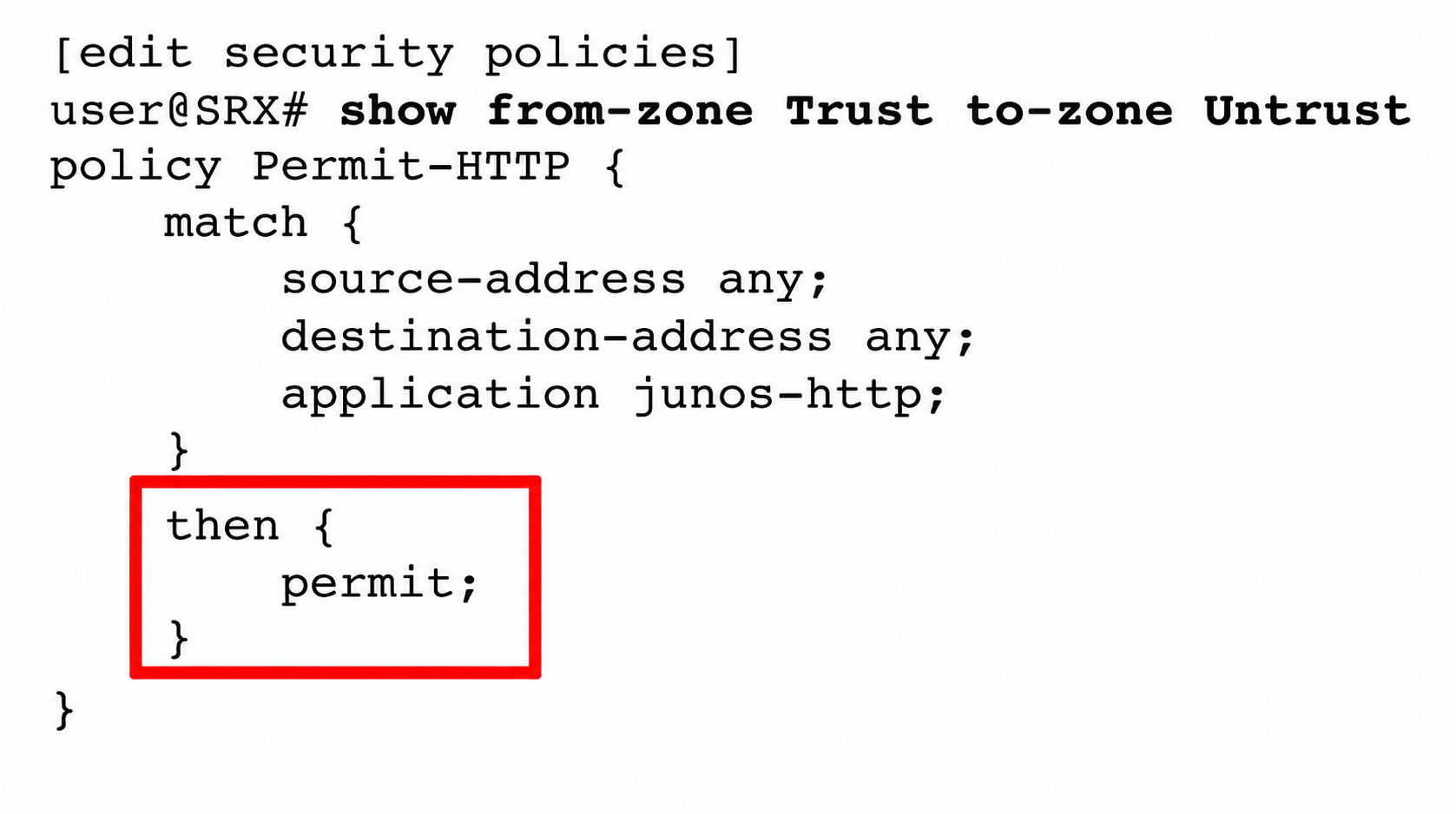 Which security policy component is highlighted in the exhibit?
-
A
-
B
-
C
-
D
Reveal answer details
Close answer details
Correct answerD
ExplanationThe highlighted then { permit; } block is the policy action. The preceding match block defines which traffic qualifies, and the then block states what the policy does with that traffic. Here, permit is the resulting action after the match criteria are satisfied.
Question 26
Multiple choice
Which two statements are correct about functional zones? (Choose two.)
-
A
Functional zones must have a user-defined name.
-
B
Functional zone cannot be referenced in security policies or pass transit traffic.
-
C
Multiple types of functional zones can be defined by the user.
-
D
Functional zones are used for out-of-band device management.
Reveal answer details
Close answer details
Correct answersB, D
ExplanationA functional zone is reserved for device-management connectivity rather than ordinary transit forwarding. It therefore cannot be referenced by security policies or used to pass transit traffic. Its intended role is out-of-band device management, keeping management access separate from the traffic paths handled by standard security zones.
Question 27
Multiple choice
Which two traffic types are considered exception traffic and require some form of special handling by the PFE? (Choose two.)
-
A
-
B
-
C
-
D
Reveal answer details
Close answer details
Correct answersB, D
ExplanationICMP reply messages carry protocol control information, and traceroute packets intentionally trigger hop-by-hop diagnostic processing. These traffic types therefore require special handling by the PFE and are treated as exception traffic rather than as ordinary SSH or HTTP session data.
Question 28
Single choice
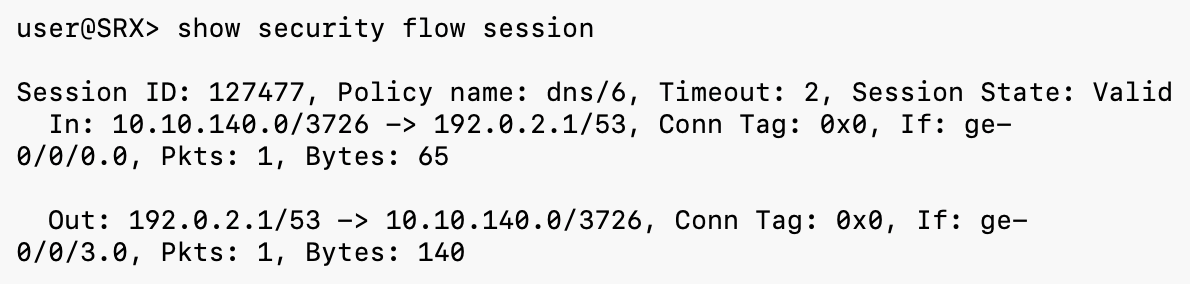
Referring to the exhibit, which type of NAT is the SRX Series Firewall performing?
-
A
-
B
-
C
-
D
destination NAT without PAT
Reveal answer details
Close answer details
Correct answerC
ExplanationSource NAT changes the initiating host's source identity while leaving the destination role intact. PAT adds transport-port translation so multiple connections can share a translated address while remaining distinct. The session therefore uses source-side address translation together with port translation, which is source NAT with PAT.
|