What is the protocol data unit (PDU) of the Data Link Layer?
-
A
-
B
-
C
-
D
Reveal answer details
Close answer details
Correct answerD
ExplanationIn the OSI model, the Data Link Layer is responsible for node-to-node delivery of data. It frames the packets received from the Network Layer and prepares them for physical transmission. The Protocol Data Unit (PDU) for the Data Link Layer is called a "frame." Frames encapsulate the network layer packets, adding a header and a trailer that include the hardware addresses of the source and destination, among other things, facilitating the data link layer services like frame synchronization, flow control, and error checking.
Question 2
Multiple choice
Which two operating systems are used as the foundation of the Junos OS? (Choose two.)
-
A
-
B
-
C
-
D
Reveal answer details
Close answer details
Refer to the exhibit. 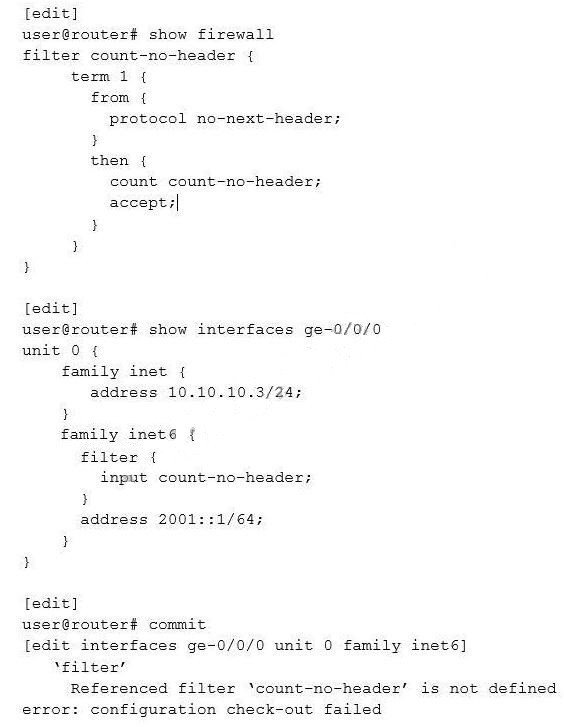 You asked to create a firewall filter to count IPv6 packets that arrive with a no next header value. As shown in the exhibit, you have created and applied the count-no-header firewall filter to the ge-0/0/0 interface. The commit operation fails. What is causing this problem?
-
A
IPv6 interfaces do not support firewall filters.
-
B
The filter name must be different than the counter name.
-
C
The firewall term does not include inet6 in the from statement.
-
D
The firewall family is not correct.
Reveal answer details
Close answer details
You are asked to convert the number 7 from decimal to binary. Which number is correct in this scenario?
-
A
-
B
-
C
-
D
Reveal answer details
Close answer details
Correct answerC
ExplanationTo convert the decimal number 7 to binary, the correct representation is 00000111. In binary, 7 is represented as 1+2+4 (2^0 + 2^1 + 2^2), which corresponds to the last three digits being 1 in the binary format, with leading zeros added for clarity.
Click the Exhibit button. 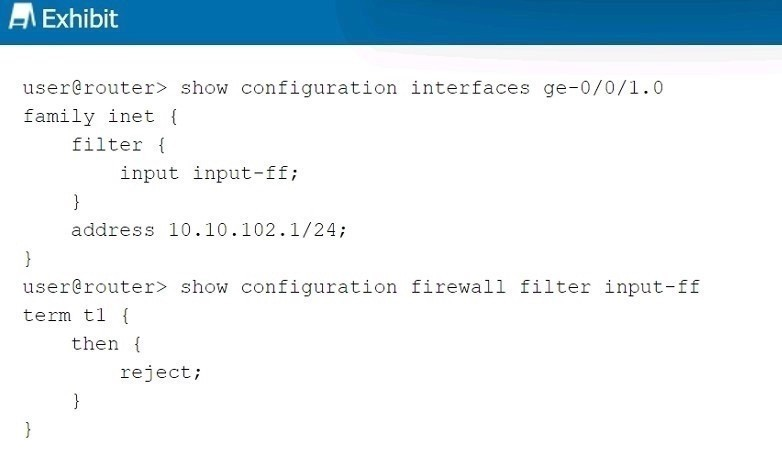 Referring to the exhibit, which statement is correct about traffic received on the ge-0/0/1.0 interface?
-
A
All traffic will be silently dropped.
-
B
All traffic will be accepted.
-
C
All traffic will be dropped and a UDP message sent back to the source.
-
D
All traffic will be dropped and an ICMP notification sent back to the source.
Reveal answer details
Close answer details
Click the Exhibit button. 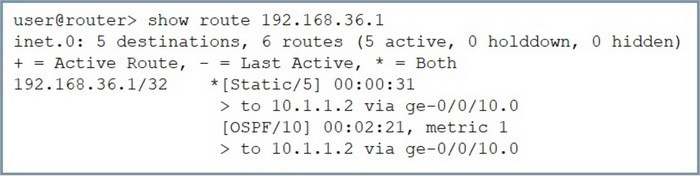 Referring to the exhibit, which route(s) will be selected by Junos for packet forwarding?
-
A
The static route will be selected.
-
B
The OSPF route will be selected.
-
C
The Junos OS randomly selects one route.
-
D
The Junos OS selects both routes.
Reveal answer details
Close answer details
Correct answerA
ExplanationJunos OS selects routes based on the route preference (also known as administrative distance). Static routes typically have a lower route preference than OSPF routes, meaning they are more preferred. Since the static route to 192.168.36.1/32 is shown with a preference of 5, it will be selected over the OSPF route for packet forwarding, assuming no other factors such as route filters or policies affect the routing decision.
Click the Exhibit button. 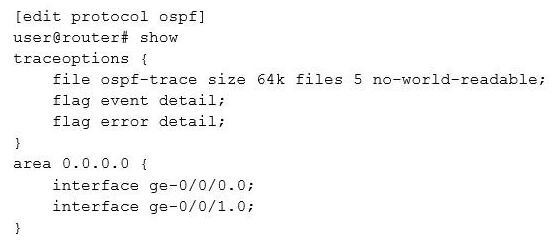 Which statement is correct regarding the configurration shown in the exhibit?
-
A
When the ospf-trace file has created five files, it will stop logging additional information.
-
B
When the ospf-trace file reaches the 64 KB file size, it is renamed and begins a new file.
-
C
The ospf-trace file will automatically replace any existing trace file with the same name.
-
D
Timestamp information will not be included for each line of ospf-trace
Reveal answer details
Close answer details
You issue a "request system zeroize" command. Which statement is correct in this scenario?
-
A
All data files remain unchanged but all configuration settings returned to factory defaults.
-
B
All data files are deleted and all configuration settings are returned to factory defaults.
-
C
All data files are deleted and all configuration settings remain unchanged
-
D
Disk space is freed by rotating log files and a proposed list of files to be deleted is presented.
Reveal answer details
Close answer details
Question 9
Multiple choice
Which two statements describe IPv4 default behavior for BGP? Choose Two
-
A
All Active BGP routes are exported to configured EBGP neighbors
-
B
All BGP routes are exported to configured EBGP neighbors
-
C
All BGP routes are imported into the inet.0 routing table
-
D
All BGP routes are imported into the inet4.0 routing table
Reveal answer details
Close answer details
Question 10
Single choice
A Junos device is configured with multiple routing protocols to the same destination prefix. By Default, which route will be active in the forwarding table?
-
A
-
B
-
C
-
D
Reveal answer details
Close answer details
Question 11
Multiple choice
Click the Exhibit button 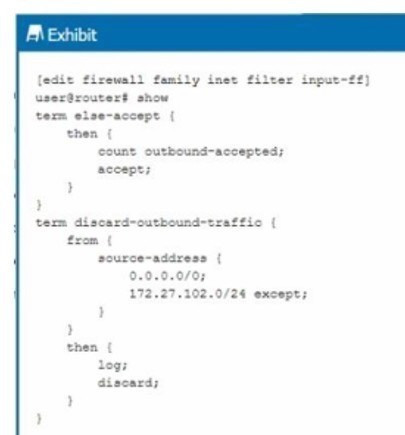 A packet destined to the 172.27. 102.65 IP address is received by the ge-0/0/1.0 interface on your Junos device. The input firewall filter shown in the exhibit is applied to the ge- 0/0/1.0 interface. Which two actions are performed in this scenario? (Choose two.)
-
A
-
B
-
C
-
D
Reveal answer details
Close answer details
Question 12
Multiple choice
When considering routing tables and forwarding tables, which two statements are correct? (Choose two.)
-
A
The routing table is used by the RE to select the best route.
-
B
The forwarding table stores all routes and prefixes from all protocols.
-
C
The forwarding table is used by the RE to select the best route.
-
D
The routing table stores all routes and prefixes from all protocols.
Reveal answer details
Close answer details
Correct answersA, D
ExplanationThe routing table and forwarding table play distinct roles in a Junos OS device. The correct answers are A and D. The routing table (A) is used by the Routing Engine (RE) to select the best route among all the learned routes, while the routing table (D) stores all routes and prefixes learned from all routing protocols.
The forwarding table, in contrast, contains only the active routes chosen by the RE and is used by the Packet Forwarding Engine for actual packet forwarding.
Question 13
Single choice
Referring to the exhibit, what is the expected behavior for login attempts from users that receive a reject form from both the RADIUS and TACACS+ servers? 
-
A
Users are prompted for a local authentication password.
-
B
Users are not prompted for a local authentication password.
-
C
Users are prompted for the root authentication password.
-
D
Users are granted limited access to the device using a guest account.
Reveal answer details
Close answer details
Correct answerB
ExplanationLocal Auth is not included in the authentication-order. It will only consult the local auth if it doesn't recieved any reply from the RADIUS and TACAS from a certain time. In this case the RADIUS and TACAS rejects the Authentication therefore no need to consult the local auth.
Question 14
Multiple choice
What are two methods for navigating to configuration mode from an operational mode prompt? (Choose two.)
-
A
-
B
Use the configure command.
-
C
-
D
Reveal answer details
Close answer details
Correct answersB, D
ExplanationIn Junos OS, to navigate from operational mode to configuration mode, you can use either the edit or configure command. Both commands move the CLI from operational mode, where you can view the state of the device, to configuration mode, where you can make changes to the device's configuration.
Question 15
Single choice
You want to redeploy a Junos device by clearing the existing configuration and resetting it to factory defaults. In this scenario, which command would help to accomplish this task?
-
A
-
B
request systemstorage cleanup
-
C
request systemstorage cleanup dry-run
-
D
request systemzeroize media
Reveal answer details
Close answer details
Correct answerD
ExplanationThe request system zeroize media command on a Junos device securely erases all data, including configuration and log files, and resets the device to its factory default settings. This command is used when redeploying a device to ensure no residual data remains from its previous deployment. It's a comprehensive and secure way to clear all configurations and data, making the device as if it were new.
The other commands listed do not perform a full reset to factory defaults; for example, show system storage displays storage information, and request system storage cleanup offers to delete unnecessary files without resetting the device to factory settings.
Question 16
Multiple choice
Which three benefits occur when operating an interior gateway protocol (IGP) in an autonomous system (AS)? (Choose three.)
-
A
IGPs learn prefixes in the global Internet's routing table.
-
B
IGPs react very fast to network change.
-
C
IGPs automatically distribute static routing information.
-
D
IGPs determine the optimal paths for data transmission.
-
E
IGPs learn everything about the subnets and best paths within your network.
Reveal answer details
Close answer details
Correct answersB, D, E
ExplanationOperating an Interior Gateway Protocol (IGP) within an Autonomous System (AS) provides several benefits, including determining the optimal paths for data transmission, reacting quickly to network changes, and learning all about the subnets and best paths within the network. IGPs are designed to manage routing within a single AS efficiently, adapting to changes and ensuring data is routed through the best available paths.
Question 17
Single choice
Which criteria does the Junos OS use to select an active route when two entries exist in the routing table?
-
A
the route with the lowest preference number
-
B
the most recently learned dynamic route
-
C
the route with the highest preference number
-
D
the route with the highest metric
Reveal answer details
Close answer details
Correct answerA
ExplanationIn Junos OS, when two entries for the same destination exist in the routing table, the route with the lowest preference number is selected as the active route. This preference number, also known as the route preference or administrative distance, is used to prioritize routes received from different routing protocols.
Question 18
Single choice
How many rescue configuration files are supported on a Junos device?
-
A
-
B
-
C
-
D
Reveal answer details
Close answer details
Correct answerB
ExplanationJunos OS supports only 1 rescue configuration file on a device. This rescue configuration is a safeguard feature that allows network administrators to revert to a known good configuration in case of a configuration error or issue, ensuring network stability. In Junos OS, each device supports only one rescue configuration file. The rescue configuration is a specific configuration that can be saved and later retrieved if needed. This is used as a fallback configuration that you know works and can be applied in case of an emergency or if the current configuration has issues.
References:
Juniper Networks Documentation on Rescue Configuration
"You can create a rescue configuration file by using the request system configuration rescue save operational mode command. Each Junos OS device can have only one rescue configuration file."
Question 19
Single choice
You configured your system authentication order using the set authentication-order tacplus radius password command. Which statement is correct in this scenario?
-
A
A rejection by TACACS+ will prevent a login and bypass the other two authentication methods.
-
B
The password authentication will only be used if the TACACS+ and RADIUS servers fail to respond.
-
C
All authentication methods are used with the most restrictive permission set used.
-
D
The password authentication method is evaluated if the TACACS+ and RADIUS servers respond with a reject message.
Reveal answer details
Close answer details
Correct answerB
ExplanationIn the scenario where the system authentication order is set to "tacplus radius password," the correct statement is (B). If the TACACS+ and RADIUS servers are unreachable or fail to respond, the system will fall back to using password authentication. This ensures that users can still authenticate using locally stored passwords if external authentication servers are unavailable.
Question 20
Single choice
Your router has a route to the 10.1.1.0/24 network with a next hop of r jet. In this scenario, which action will your router perform when traffic destined to the 10.1.1.0/24 network is received?
-
A
The traffic will be discarded and an ICMP unreachable message will be sent to the destination of the traffic.
-
B
The traffic will be silently discarded.
-
C
The traffic will be redirected using a default route.
-
D
The traffic will be discarded and an ICMP unreachable message will be sent to the source of the traffic.
Reveal answer details
Close answer details
Correct answerB
ExplanationIn a scenario where a router has a route to a specific network (in this case, 10.1.1.0/24) with a next hop that is unreachable or incorrectly specified (e.g., "r jet" seems to be a typo or an undefined entity), the router will typically discard the traffic destined for that network. This action is taken because the router cannot determine a valid path to forward the traffic. Unlike some scenarios where the router might generate an ICMP (Internet Control Message Protocol) unreachable message, in many configurations, especially in production networks, the traffic might be silently discarded without providing feedback to the sender, as generating ICMP messages for all undeliverable packets could lead to additional network congestion and potential security concerns.
Question 21
Single choice
Which command displays all IPv6 routes in the default routing instance?
-
A
-
B
-
C
-
D
Reveal answer details
Close answer details
Correct answerA
ExplanationThe show route table inet6.0 command displays all IPv6 routes in the default routing instance. In Junos OS, the routing table for IPv6 addresses is referred to as inet6.0, whereas inet.0 is used for IPv4 unicast routes. The other options do not correspond to the correct IPv6 routing table.
References:
Juniper official documentation: Junos OS Routing Tables Overview.
Question 22
Multiple choice
Which two fields are you required to enter when you create a new user account? (Choose two.)
-
A
-
B
-
C
-
D
Reveal answer details
Close answer details
Correct answersA, B
ExplanationIn Junos OS, when creating a new user account, the minimum required fields are the username and the login class. The username is the identifier for the account, while the login class specifies the level of access or permissions the user has on the device. Login classes allow for the differentiation between various roles, such as read-only access or full administrative rights. Other information, such as full name or user ID, is optional and not strictly necessary for the creation of a functional user account.
|