You are the Test Manager of a four-person test team working for a small distribution company with a single warehouse. Your team has been working with a third party development team on a new inventory management system. The company expects this system to generate approximately one million dollars per annum in profits for the company. Early in the project, various risks were identified, and steps taken to mitigate those risks.
For example, you sent your test team for training on the new system, and upgraded the test environment.
There are still some lingering risks that have not been addressed, but they have been determined to have a low chance of occurring, with minimal impact if they do occur. What would be the best option to mitigate these remaining risks? [3]
-
A
Note the risks, and ignore them for now.
-
B
Redo the project test plan to add additional testing for these risk items.
-
C
Contract with the Risk Protection Insurance company to assume these risks at a cost of $500,000 per annum.
-
D
Create a cross-functional team to work to reduce the impact and likelihood of these risks coming to fruition.
Reveal answer details
Close answer details
Correct answerD
ExplanationCreating a cross-functional team to address the remaining risks is the best option, as it actively involves various stakeholders in the mitigation process. This approach allows for diverse perspectives and expertise to be applied to reduce both the likelihood of the risks occurring and their potential impact, without incurring excessive costs or ignoring the risks altogether.
References:
The ISTQB Advanced Level Test Manager syllabus and related documents emphasize the
importance of risk management throughout the testing process. It suggests that forming teams to address risks can be an effective strategy, as it leverages collective knowledge and resources to mitigate risks in a cost-effective manner
Your customer is closely involved in the development project. Requirements are communicated verbally and rarely written down. An iterative development model is being followed and time boxing is used to stay on schedule. Which of the following statements is true? [3]
-
A
A requirements traceability matrix will be created at the start of each iteration.
-
B
Your developers are using a waterfall methodology.
-
C
There is a risk that the system architecture may have to be changed during the development process.
-
D
Testing will start when all coding is completed.
Reveal answer details
Close answer details
Correct answerC
ExplanationIn an iterative development model with close customer involvement and verbal communication of requirements, there is an inherent risk of changes in the system architecture. This is due to the evolving understanding of requirements and the potential for new requirements to emerge as the project progresses.
References:
The ISTQB Advanced Level Test Manager syllabus emphasizes the importance of managing
risks in iterative development models 1. It suggests that test managers should be prepared for changes, including possible alterations to the system architecture, as part of the risk management process 23. This approach ensures that the testing strategy remains flexible and responsive to changes throughout the development lifecycle.
Which two of the following are test strategies that would need to be implemented to meet the objectives defined in the Safe as Houses' test policy? a- Analytical strategy
b- Reactive strategy
c- Methodical strategy
d- Regression averse strategy
e- Process compliant strategy
-
A
-
B
-
C
-
D
Reveal answer details
Close answer details
What occurs In the retrospective closing?
-
A
-
B
The data collection methods are reviewed
-
C
The strengths and opportunities for improvement in the retrospectives are discussed
-
D
A brainstorming session is held to discuss the solutions to the root causes of the most significant issues
Reveal answer details
Close answer details
Correct answerC
ExplanationPurpose of Retrospectives:
Retrospectives are team meetings aimed at reflecting on the work process to identify what went well (strengths) and areas that can be improved (opportunities).
This aligns with continuous process improvement practices. Evaluation of Options:
A(Everyone shakes hands) is trivial and not a core activity.
B(Reviewing data collection methods) may be part of broader discussions but is not the primary focus. Cis correct because it directly reflects retrospective goals. D(Brainstorming solutions) typically occurs in follow-up sessions, not during the retrospective itself.
References and Syllabus Alignment: Retrospective practices are emphasized in "Improving the Test Process" (TM-1.5.4) in the syllabus.
Which of the following defect statistics will provide input to be used for improvement in the defect reporting process?
-
A
Number of defect reports re-opened
-
B
Number of defects in a particular area of the code
-
C
Number of defect reports rejected by the developers
-
D
Number of defects found in a phase later than they were introduced
Reveal answer details
Close answer details
Correct answerC
ExplanationPurpose of the Question: Identifying metrics to improve the defect reporting process by reducing ambiguities or improving accuracy.
Evaluation of Options:
A. Number of defect reports re-opened:
Incorrect. This reflects issues with defect resolution rather than reporting.
B. Number of defects in a particular area of the code:
Incorrect. This metric pertains to defect clustering, not the reporting process.
C. Number of defect reports rejected by the developers:
Correct. Rejected reports often indicate poor reporting quality (e.g., insufficient details, incorrect categorization), directly highlighting areas for improvement.
D. Number of defects found in a phase later than they were introduced:
Incorrect. This is a measure of defect detection efficiency, not reporting quality.
Syllabus Alignment:
The syllabus stresses the importance of using defect metrics to refine processes, including reporting accuracy (TM-2.3.5).
References:
ISTQB Advanced Level Test Management Syllabus (TM-2.3.5)
System testing on your current project is coming to an end and it is time to write the test completion report.
The product is an in-house development to support the Sales & Marketing department. Test design was based on requirements analysis. Which of the following metrics is MOST likely to be useful to help the business stakeholders decide if testing has met its objectives?
-
A
Breakdown by risk level of coverage of product risks
-
B
Breakdown by coverage type of the code coverage achieved
-
C
Percentage of test cases that have been automated
-
D
Breakdown by priority of coverage of requirements
Reveal answer details
Close answer details
Correct answerD
ExplanationIn business-focused testing (requirements-based), stakeholders are most interested in requirement coverage, especially bypriority.
"Metrics... can be used to assess test progress... test coverage of requirements, user stories, acceptance criteria, risks or code."
- ISTQB-CTFL_Syllabus_2018_V3.1, section 5.3.1
Options A and B are more aligned with technical or risk-based strategies. Option C doesn't reflect testing effectiveness.
You are working on a project where the business part of the organization works traditionally with defined requirements, but the development team follows an Agile model Neither team plans to change their approach. What is the proper name for this type of project approach?
-
A
-
B
Hybrid as a transition to Agile
-
C
-
D
Hybrid as fit for purpose
Reveal answer details
Close answer details
Correct answerD
ExplanationContext Analysis:
The project described has teams using different methodologies (traditional vs. Agile) tailored to their needs.
The "fit for purpose" hybrid approach is explicitly designed to combine methodologies based on team and project requirements.
Evaluation of Options:
A. Sequential:
Incorrect. A sequential approach suggests a traditional waterfall-like model, not a hybrid.
B. Hybrid as a transition to Agile:
Incorrect. This term implies the entire project is transitioning to Agile, which is not the case here.
C. Agile:
Incorrect. Only the development team is Agile; the business team uses a traditional approach.
D. Hybrid as fit for purpose:
Correct. Combines the most effective aspects of both traditional and Agile methodologies to suit the project context.
Syllabus Alignment:
ISTQB defines hybrid models as combinations of methodologies tailored to specific project needs (TM- 1.2.4).
References:
ISTQB Advanced Level Test Management Syllabus (TM-1.2.4)
What is a "depth-first" risk-based testing technique? [1]
-
A
Highest risk test cases are executed first
-
B
All risk items are tested at least once
-
C
Lowest risk test cases are executed first
-
D
Non-functional test cases are executed first
Reveal answer details
Close answer details
Correct answerA
ExplanationA depth-first risk-based testing technique is a method of prioritizing and executing test cases based on the risk level of the features or functions to be tested. In this technique, the test cases with the highest risk are executed first, followed by the test cases with lower risks. This ensures that the most critical and likely areas of failure are tested thoroughly and early in the testing process. Risk Based Testing: Approach, Matrix, Process & Examples - Guru99 References: Certified Tester Advanced Level Test Manager (CTAL-TM) - ISTQB not-for-profit association, ISTQB Test Manager Certification - ISTQB Exams Worldwide - ISTQB Official Registration, [Analytical Test Strategy: A Comprehensive Guide - LambdaTest]
Which of the following are primary activities in conducting product risk analysis? [1]
-
A
Risk testing, risk management
-
B
Risk identification, risk assessment
-
C
Risk identification, risk testing
-
D
Risk management, risk assessment
Reveal answer details
Close answer details
Correct answerB
ExplanationProduct risk analysis is the process of identifying and assessing the product risks that may affect the quality or functionality of the software under test 1. Product risk analysis involves two primary activities: risk identification and risk assessment. Risk identificationis the activity of finding, naming, and describing the risks that might affect the software under test 2. Risk assessment is the activity of estimating the impact and probability of occurrence (likelihood) of the identified risks, and prioritizing them based on these factors 3. Therefore, option B is the correct answer.
Option A is incorrect because risk testing and risk management are not primary activities of product risk analysis, but rather activities that follow or use the results of product risk analysis. Risk testing is the activity of designing, implementing, and executing tests based on the product risk levels to reduce the level of product risks and inform stakeholders of their status 4. Risk management is the activity of planning, monitoring, and controlling the risks and the risk mitigation actions in the software project 5.
Option C is incorrect because risk identification and risk testing are not primary activities of product risk analysis, but rather activities that are part of product risk analysis and risk-based testing respectively.
Option D is incorrect because risk management and risk assessment are not primary activities of product risk analysis, but rather activities that are part of risk management and
product risk analysis respectively. References:
1: ISTQB Glossary, Product Risk Analysis
2: ISTQB Glossary, Risk Identification
3: ISTQB
4: ISTQB Glossary, Risk-Based Testing
5: ISTQB Glossary, Risk Management
: Product Risk Analysis (PRA) | TMap : Risk-Based Testing | ISTQB Glossary : Risk Analysis | ISTQB
Glossary
Question 10
Single choice
Your team has been assigned to lest a new product that is tightly integrated with existing systems The integrations include data transfers and transformations You have access to the architectural design documents and the integration specifications and some of your testers are former developers. Given this information, what is the most appropriate test approach?
-
A
Model-based and white-box
-
B
Experience-based and black-box
-
C
Risk-based and non-functional
-
D
Requirements-based and functional
Reveal answer details
Close answer details
Correct answerA
ExplanationContext Analysis:
The scenario involves tight integration, architectural design, and data transformations, requiring detailed and structured approaches.
Access to architectural documents and experienced testers (former developers) aligns with model-based and white-box techniques.
Evaluation of Options:
A. Model-based and white-box: Correct. Model-based testing leverages design documents, while white-box testing uses internal knowledge for detailed integration testing.
B. Experience-based and black-box:
Incorrect. This is less structured and doesn't utilize available design documentation or tester expertise.
C. Risk-based and non-functional:
Incorrect. Risk-based testing focuses on high-priority areas but doesn't leverage the design documents for integration specifics.
D. Requirements-based and functional:
Incorrect. While functional testing is relevant, requirements-based testing does not utilize internal system knowledge effectively.
Syllabus Alignment:
ISTQB emphasizes model-based and white-box testing as appropriate for systems with complex integrations (TM-1.2.6).
References:
ISTQB Advanced Level Test Management Syllabus (TM-1.2.6)
Question 11
Single choice
When scheduling performance testing, which of the following approaches would be most advisable? [1]
-
A
Starting the performance testing during unit and integration testing
-
B
Deferring the start of performance testing until all functional defects have been resolved
-
C
Leveraging end users to do unit-level performance testing and automated tools for system-level performance testing
-
D
Requiring all performance tests to pass before starting functional testing
Reveal answer details
Close answer details
Correct answerA
ExplanationPerformance testing is the process of determining the speed, responsiveness, and stabilityof a system under a given workload 1. Performance testing should be started as early as possible in the software development lifecycle, preferably during unit and integration testing, to identify and resolve performance issues before they become costly or risky 2. Starting performance testing early can also help to validate the performance requirements, design, and architecture of the system, as well as to optimize the performance testing strategy and scope 3. Therefore,
option A is the correct answer.
Option B is incorrect because deferring the start of performance testing until all functional defects have been resolved can delay the detection and resolution of performance issues, increase the cost and effort of performance testing, and reduce the confidence and quality of the system 4.
Option C is incorrect because leveraging end users to do unit-level performance testing and automated tools for system-level performance testing can introduce inconsistency, bias, and inefficiency in the performance testing process, as well as compromise the reliability and validity of the performance test results.
Option D is incorrect because requiring all performance tests to pass before starting functional testing can create unrealistic or unnecessary expectations, as well as hinder the progress and feedback of the functional testing activities.
References:
1: ISTQB Glossary, Performance Testing
2: ISTQB. Certified Tester - Performance Testing (CT-PT)3 3:
ISTQB. Performance Testing - TesterYou4 4: Performance Testing - ISTQB not-for-profit association : ISTQB - PERFORMANCE TESTING : Performance Testing - ISTQB not-for-profit association
Question 12
Single choice
Which of the following BEST explains how test process improvement can benefit an organisation?
SELECT ONE OPTION
-
A
It can result in defect free releases into production
-
B
It can reduce the demand for test resources to support maintenance releases.
-
C
It can prevent developers making errors when writing code.
-
D
It can increase the number of applicants for job vacancies.
Reveal answer details
Close answer details
Question 13
Single choice
In relation to cost of quality, which of the following would be classified as a cost of detection? SELECT
ONE OPTION
-
A
Correcting errors found in a requirements review.
-
B
Fixing defects found in unit testing.
-
C
Training developers to write more secure code.
-
D
Designing test cases and writing test scripts.
Reveal answer details
Close answer details
Question 14
Single choice
What is the purpose of tracking efficiency metrics for a formal review? [1]
-
A
These metrics can be used to determine who participated in the review.
-
B
These metrics can be used to determine if the review was a good use of resources.
-
C
These metrics can be used to determine the quality of the reviewed object.
-
D
These metrics can be used to determine the speed with which defects were fixed.
Reveal answer details
Close answer details
Correct answerB
ExplanationEfficiency metrics for a formal review are used to measure the cost-effectiveness of the review process, such as the time spent on the review, the number of defects found, and the return on investment 1. These metrics can help to evaluate if the review was a good use of resources, such as human effort, money, and tools. Therefore, option B is the correct answer.
Option A is incorrect because efficiency metrics do not track who participated in the review, but rather how they performed.
Option C is incorrect because efficiency metrics do not measure the quality of the reviewed object, but rather the quality of the review process.
Option D is incorrect because efficiency metrics do not measure the speed with which defects were fixed, but rather the speed with which defects were detected.
References:
1: How to manage formal reviews & management audits? Skills,metrics ...
Question 15
Single choice
Which ONE of the following is considered to be the LEAST independent form of testing for anorganisation?
SELECT ONE OPTION
-
A
Testing is performed by a tester who is part of an independent test team.
-
B
Testing is performed by an organisation external to the company that has developed the code.
-
C
Testing is performed by a tester who is part of the development team.
-
D
Testing is performed by specialists from the business organisation.
Reveal answer details
Close answer details
Question 16
Single choice
You are working on a project that is having problems with regressions. With each release of software given to the test team. 50% of the defects found are actually regressions. To combat this you have decided to implement test automation. You have given your automation team the following goal 'Implement lest automation to automate 90% of the manual regression tests before the product release date.' ' Which of the following is likely an issue with this goal being defined as "SMART?
-
A
it is not clear if this is achievable in the time allowed
-
B
It is not specific on what needs to be done
-
C
It is not relevant to the project objectives
-
D
It is not measurable against the goals of the project
Reveal answer details
Close answer details
Correct answerA
ExplanationUnderstanding SMART Goals:
SMART goals must be Specific, Measurable, Achievable, Relevant, and Time-bound.
The goal "automate 90% of the manual regression tests before the product release date" may not bedepending on the time constraints and resources available.achievable Evaluation of Options: Ais correct because the issue lies in whether automating 90% is feasible within the timeline.
Bis incorrect as the goal is specific.
Cis incorrect because automating regression tests is relevant to reducing regressions.
Dis incorrect since the goal is measurable by the percentage of automation achieved.
References and Syllabus Alignment: Aligned with ISTQB Advanced Test Management guidelines on goal setting and test automation strategies (TM-1.6.2).
Question 17
Single choice
Assuming that 'In progress' means that somebody is working on a fix and that 'Resolved' means that the fix
passed the confirmation test; which option provides a defect workflow that flows in a sensible way from an initial state to a terminal state?
-
A
New, Under Investigation, Rejected, Re-test, Resolved, Closed
-
B
New, Under Investigation, In progress, Re-test, Resolved, Closed, Deferred
-
C
In progress, Under Investigation, Deferred, Retest, Resolved, Closed
-
D
New, under investigation, Deferred, In progress, Re-test, Resolved, Closed
Reveal answer details
Close answer details
Correct answerD
ExplanationA typical defect workflow should begin with a newly reported issue ("New"), proceed to investigation, allow for deferral if necessary, move to fixing ("In Progress"), re-testing, and finally confirmation of resolution and closure. According to the ISTQB CTFL Syllabus, valid states of a defect report include:New, Under Investigation, Deferred, In Progress, Re-Test, Resolved, Closed.
Question 18
Single choice
Which of the following is a key characteristic of a management review? [1]
-
A
Used to assess project risks
-
B
Used to check consistency of and deviation from the system requirements
-
C
-
D
Conducted by an external group to assess process compliance
Reveal answer details
Close answer details
Correct answerD
ExplanationA management review, particularly in the context of software testing and quality assurance, often involves an external group or higher-level management team that reviews the processes and procedures to ensure compliance with specified standards or objectives. This can include assessing the effectiveness of current practices, identifying areas for improvement, and ensuring that the project aligns with organizational or industry standards. This type of review is distinct from other forms of reviews like technical reviews or walkthroughs, which might focus more on the technical aspects or consistency of system requirements.
Question 19
Single choice
You have been tasked with recruiting testers for Project 3 to help design and run regression tests, you have been provided with a skills matrix for four prospective candidates. The matrix shows the skill level (High or Low) for each candidate: 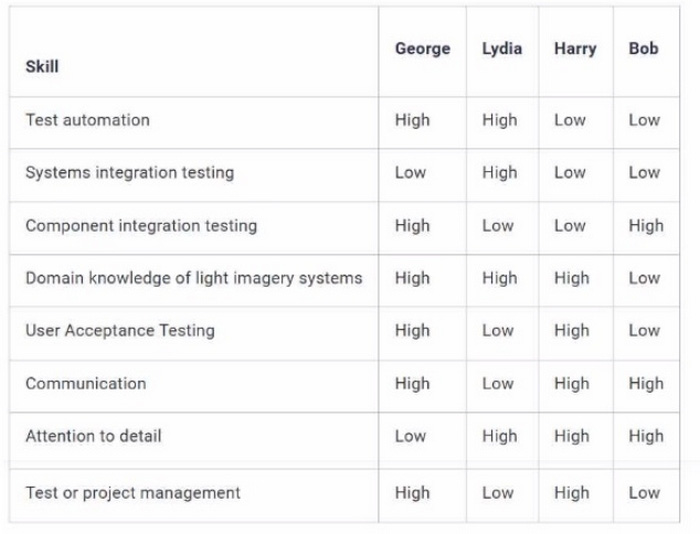 Which candidate would be the MOST suitable for a test analyst role on Project 3? SELECT ONE OPTION
-
A
-
B
-
C
-
D
Reveal answer details
Close answer details
Question 20
Single choice
You have been assigned t o a project that has a very tight schedule. In fact, given your first analysis you do not think the planned test execution can be completed within the schedule There is no time allowed for defect fixing or for repeating tests. Regression testing has been left out of the planning entirely There is no time to develop test automation. The team has agreed that this Is not the way to run a project, yet they are stuck with the current schedule. Given this information what is the best way to proceed with the testing to try to meet the deadline with the best outcome1?
-
A
Review the personnel plan and get more resources onto the test team
-
B
Continue with the current plan but highlight to the project manager that either the deadline will be missed or the testing will not be done
-
C
Develop a test automation plan so that automation can be started now
-
D
Conduct a quality risk analysis and prioritize the testing based on risk so the highest risk items are tested first
Reveal answer details
Close answer details
Correct answerD
ExplanationDealing with Tight Schedules: Prioritization based on quality risk ensures critical areas are tested, minimizing risks to the project.
In tight schedules, testing everything is impractical; focus must shift to high-risk areas. Evaluation of Options:
Ais unlikely feasible given the tight schedule.
Bhighlights the issue but does not propose a solution.
C(developing automation) is not possible given time constraints.
Dis correct because risk-based testing ensures the best possible outcome within the constraints. References and Syllabus Alignment: Risk-based testing is a core concept under "Test Process and Risk Management" in ISTQB syllabus (TM-
1.3.1, TM-1.3.4).
Question 21
Single choice
You are working with a development team who have a CI/CD pipeline implemented. They want to integrate your team's existing test automation into the pipeline to augment their unit tests so they will have continuous testing. They have already determined that this is technically possible with the tool you are using but with require some changes to the test automation framework to integrate the results reporting. What will your team need to make this happen?
-
A
Investigation that the tool will be fit for purpose
-
B
Training regarding how to make the framework modifications so the integration is possible
-
C
A review to determine if this is the best tool to use for the integration with the CI/CD pipeline
-
D
investigation of the licensing models of the tool and an understanding of any potential costs
Reveal answer details
Close answer details
Correct answerA
ExplanationContext Analysis:The question involves integrating an existing test automation framework into a CI /CD pipeline. The integration requires modifications to the framework and results reporting. This aligns with ISTQB Advanced Test Management concepts focusing on evaluating and adapting test tools for specific project needs (Syllabus reference: TM-1.6.1 and TM-1.6.4).
Evaluation of Options:
A. Investigation that the tool will be fit for purpose:
Correct. Before integrating the framework, a thorough investigation is necessary to confirm whether the tool can support the required modificationsand functionality. This aligns with the emphasis on ensuring tools meet both current and future needs as per the ISTQB syllabus section TM-1.6.1.
B. Training regarding how to make the framework modifications so the integration is possible:
Incorrect. While training might be useful later, it is not the first step or the primary requirement to ensure the integration is feasible.
C. A review to determine if this is the best tool to use for the integration with the CI/CD pipeline:
Incorrect. This step might be relevant in an earlier phase of tool selection, but the question assumes the tool has already been chosen.
D. Investigation of the licensing models of the tool and an understanding of any potential costs:
Incorrect. Licensing investigation is part of tool selection and budgeting, not directly related to technical integration feasibility. Syllabus Alignment:The ISTQB Advanced Level Test Management syllabus emphasizes the importance of ensuring the selected tools and technologies align with organizational requirements and technical feasibility. This is outlined in the "Test Tools" section of the syllabus (TM-1.6.1, TM-1.6.4).
Conclusion:The correct answer isA. Investigation that the tool will be fit for purpose, as this step ensures the technical requirements for integration are met before proceeding with modifications or training.
References:
ISTQB Advanced Level Test Management Syllabus (TM-1.6.1 and TM-1.6.4) ISTQB CTAL-TM Sample Exam Questions ISTQB CTAL-TM Sample Exam Answers
Question 22
Single choice
Referring to SCENARIO 2 It has been agreed that Project 1 will be delivered using an Agile approach, with user stories delivered across three sprints, each lasting 4 weeks. The programme manager is concerned about RISK 3 and wants the Master Test Plan to specify an
effective test process improvement approach. Which of the following is the best test process improvement approach for Project 1 ? SELECT ONE OPTION
-
A
Test process improvement is not possible for this project as the Agile approach does not allow time to make improvements.
-
B
A TMMi assessment should be run at the end of each sprint to identify improvements for the next sprint.
-
C
Short post-sprint review sessions should be conducted to identify areas of improvement for the next sprint.
-
D
A CTP assessment should be run after each sprint to identify critical test processes that need improving.
Reveal answer details
Close answer details
Question 23
Single choice
Which of the following is NOT true when following the V-Model lifecycle to organise and plan testing activities? SELECT ONE OPTION
-
A
Test execution activities run until exit criteria have been met.
-
B
Reporting of all test results occurs when testing is complete for the whole project.
-
C
System test planning starts when project planning activities commence.
-
D
Test analysis activities run concurrently with specification of requirements and design.
Reveal answer details
Close answer details
Question 24
Single choice
A test team is working long hours to achieve a deadline for release of a new product which has had problems throughout development and is well behind schedule. Which of the following is most likely to have a MOTIVATING effect on the testers in the team? SELECT ONE OPTION
-
A
A decrease in the scope of testing that the team is responsible for
-
B
Testers contributing to ideas for faster defect resolution during regular meetings with the developers.
-
C
A planned bonus payment that will be based on customer satisfaction with the product once released.
-
D
Routine measurement of outstanding defects during testing.
Reveal answer details
Close answer details
Question 25
Single choice
You are working In an environment that is continually pushing process improvements down to the lest team You are skeptical that any of these have actually accomplished any improvement In fact you know that some of the changes have actually impaired progress Given this information what step of the IDEAL model is missing?
-
A
-
B
-
C
-
D
Reveal answer details
Close answer details
Correct answerD
ExplanationUnderstanding the IDEAL Model: The IDEAL model (Initiating, Diagnosing, Establishing, Acting, Learning) is a framework for process improvement.
In this case, theLearningphase is missing, which involves evaluating the outcomes of implemented changes to identify what worked and what did not.
Evaluation of Options:
A(Diagnosing) and (Establishing) refer to earlier stages of the model. B C(Acting) relates to implementing changes but does not address the lack of retrospective evaluation. Dis correct as the problem lies in not assessing the success of past improvements.
References and Syllabus Alignment: The IDEAL model is covered under "Improving the Testing Process" (TM-1.5.4) in the ISTQB syllabus
Question 26
Single choice
As the Test Manager for an agile project how would you BEST plan and guide the testing activities during development? SELECT ONE OPTION
-
A
Ensure testers provide training to developers to help them write a set of auto-mated unit tests
-
B
Ensure testers are integrated into the development process, helping to review and develop automated unit tests
-
C
Ensure testers are separated from the developers to provide an independent set of functional tests
-
D
Ensure all tests are written and reviewed by the developers to ensure they reflect the code being developed
Reveal answer details
Close answer details
Question 27
Single choice
A project to replace an old sales and merchandising system with a new version based on modern platforms, will use an Agile lifecycle with iterations of fixed length.
The project objectives include: Delivery within 6 months of the start of the first iteration, in 3 releases, to be accomplished by a team that will contain all resources deemed necessary to achieve this Quality of delivered product to meet customer acceptance criteria
A test objective, derived from discussion with the customers, has been set as follows: "Each release shall deliver usability that is better than that of the previous system for the equivalent functionality" Which S.M.A.R.T. criteria are met by this objective? 1. Specific
2. Measurable
3. Achievable
4. Relevant
5. Timely
-
A
1, 2, 3 and 4 are met but 5 is not met
-
B
1, 2, 3 and 5 are met but 4 is not met
-
C
1, 2, 4 and 5 are met but 3 is not met
-
D
1, 3, 4 and 5 are met but 2 is not met
Reveal answer details
Close answer details
Correct answerA
ExplanationThe objective isSpecific(usability),Measurable(compared with previous system),Achievable(if proper design and test resources are used), andRelevant(to user satisfaction). However, it lacks aclear time constraint per release, henceTimelyis not met in the S.M.A.R.T. sense.
This structure for goal-setting aligns with strategic planning principles in ISTQB where test objectives should be SMART to allow proper planning, estimation, and monitoring.
Question 28
Multiple choice
Which TWO of the following statements are TRUE about a model-based improvement approach?
-
A
GQM (Goal Question-Metric) is one possible choice of model-based improvement approach
-
B
TPI NEXT. defines maturity levels which intersect with key process areas at predefined checkpoints
-
C
Model-based improvement can be done only at organisational level
-
D
Model-based test improvement models organise the improvement(s) in a series of steps
-
E
Test Maturity Model integration (TMMi.) defines four levels of process maturity
Reveal answer details
Close answer details
Correct answersA, D
ExplanationA model-based improvement approach is characterized by the use of structured models such as GQM or TMMi. to guide improvement through levels and steps. The GQM model (Goal-Question-Metric) is a known example of a model-based approach. Such models typically break improvements into levels or steps, promoting maturity through defined phases.
# TMMi. definesfivematurity levels, not four, making statement E incorrect.
# Statement C is incorrect since model-based improvement can be applied both at project and organizational levels.
# Statement B istruefor TPI NEXT., not false, but it isnot selecteddue to the expected best fit being A and D, aligning with the general model characteristics used in test management.
References:
ISTQB. Advanced Level - Test Manager Syllabus, section "Improving the Test Process" and
Glossaire-des-tests-logiciels-v3_2F-ISTQB-CFTL.pdf for GQM reference.
Question 29
Single choice
Which technique will assist you in determining targeted improvement areas to reduce the number of defects? [1]
-
A
-
B
-
C
-
D
Reveal answer details
Close answer details
Correct answerC
ExplanationThe technique that will assist you in determining targeted improvement areas to reduce the number of defects is Pareto analysis. This is because Pareto analysis is a method of identifying and prioritizing the most significant causes of defects, based on the principle that 80% of the problems are caused by 20% of the causes. By applying Pareto analysis, you can focus on the improvement areas that will have the most impact on reducing the number of defects. Pareto Analysis - ISTQB not-for-profit association References: Certified Tester Advanced Level Test Manager (CTAL-TM) - ISTQB not-for-profit association, ISTQB Test Manager Certification - ISTQB Exams Worldwide - ISTQB Official Registration, Pareto Analysis - ISTQB not-for-profit association
Question 30
Single choice
You are Test Manager for a project which is in the Test Implementation stage for the first planned iteration, creation of the initial Test Cases and required test data is progressing well.
The Test Strategy documents the Stakeholders view that small teams should collaborate together to create and test functionality which is to be released in iterations, with each release building on the success of the last.
Stakeholders are willing to accept the risks of a partly working system in the early stages. Delivery of working functionality (particularly around interfaces to third party systems and performance of back end databases) is the priority for the early releases.
Which of the following test types would you select for this first planned iteration, in order to meet Stakeholders expectations? a) Usability testing
b) Structural testing
c) Functional testing of process flows d) Performance testing
e) Business process testing
f) Component integration testing
-
A
-
B
-
C
-
D
Reveal answer details
Close answer details
Question 31
Single choice
Which of the Mowing should be used to understand the context of testing within an organization?
-
A
The organizational test strategy
-
B
Stakeholder organization chart
-
C
-
D
Reveal answer details
Close answer details
Correct answerA
ExplanationContext Analysis:
The test strategy defines thContext Analysis: Monitoring code coverage is inherently tied to knowledge of the internal structure of the software, a characteristic of white-box testing.
Evaluation of Options:
A. Black-box:
Incorrect. Black-box testing focuses on functionality without knowledge of internal structures.
B. White-box:
Correct. White-box testing uses internal code knowledge to determine areas that need more coverage.
C. Functional:
Incorrect. Functional testing assesses functionality without inspecting internal code.
D. Non-functional:
Incorrect. Non-functional testing focuses on performance, usability, etc., not code coverage.
Syllabus Alignment:
ISTQB associates code coverage monitoring with white-box testing techniques (TM-1.2.6).
References:
ISTQB Advanced Level Test Management Syllabus (TM-1.2.6) approach, resources, and processes for testing within an organization.It provides insight into the testing context.
Evaluation of Options:
A. The organizational test strategy:
Correct. It offers a comprehensive understanding of the organization's testing framework.
B. Stakeholder organization chart:
Incorrect. Useful for identifying roles but does not provide a testing context.
C. The schedule:
Incorrect. Reflects timelines but not testing approaches or resources.
D. The budget:
Incorrect. Indicates financial constraints but not the testing context.
Syllabus Alignment:
ISTQB emphasizes using the organizational test strategy to understand the testing context (TM-1.4.1).
References:
ISTQB Advanced Level Test Management Syllabus (TM-1.4.1)
Question 32
Single choice
Which of the following is required to apply an experience-based testing approach?
-
A
-
B
-
C
Tester knowledge of the system and its usage
-
D
A full risk-assessment to support risk prioritization
Reveal answer details
Close answer details
Correct answerC
ExplanationExperience-Based Testing:
This testing approach relies on the testers' knowledge, experience, and intuition about the system and its usage rather than formal requirements or models. It is often used when documentation is incomplete or time constraints limit more structured approaches.
Evaluation of Options:
A(Detailed requirements) and (Usage models) are associated with structured testing techniques.
B Cis correct as experience-based testing depends on the testers' understanding of the system.
D(Full risk assessment) supports risk-based testing, not experience-based testing.
References and Syllabus Alignment: Experience-based testing is detailed under "Test Techniques" (TM-1.4.1) in the ISTQB syllabus.
Question 33
Single choice
It the lest manager must repeatedly step in to resolve conflicts within the team what phase is the team in and what competencies are required from the test manager?
-
A
-
B
-
C
-
D
Performing Methodological
Reveal answer details
Close answer details
Correct answerB
ExplanationUnderstanding Team Development Phases:
TheStormingphase is where team members often experience conflicts as they establish their roles and relationships.
Resolving conflicts in this phase is essential for team cohesion and productivity. Competencies Required:
Social competenciesare needed to mediate, facilitate communication, and encourage collaboration.
Evaluation of Options:
A. Forming Professional:
Incorrect. The Forming phase involves team orientation, not conflict resolution.
B. Storming Social:
Correct. This phase requires social skills to address conflicts and foster a productive environment.
C. Norming Personal:
Incorrect. The Norming phase focuses on team cohesion and process standardization.
D. Performing Methodological:
Incorrect. The Performing phase assumes the team is high-functioning and requires minimal intervention.
Syllabus Alignment:
ISTQB emphasizes understanding team dynamics and applying social skills for effective team management during challenging phases (TM-3.1.5).
References:
ISTQB Advanced Level Test Management Syllabus (TM-3.1.5)
Question 34
Single choice
You are a test team lead working on a large project and have been subject to considerable stress due to exceptional workload. Your manager has suggested that you need to delegate more work to your team members to both reduce the pressure on yourself and allow team members to take on more responsibility which would, in turn, benefit their growth. Which phase of the Tuckman model would this situational skill represent?
-
A
-
B
-
C
-
D
Reveal answer details
Close answer details
Correct answerC
ExplanationThe "Performing" stage in the Tuckman model is characterized by high-performing teams that are well-organized, motivated, and able to manage and delegate responsibilities effectively. Delegation and enabling team member growth are signs of a mature and performing team. This corresponds to fostering autonomy and productivity, a key trait of the Performing stage.
References:
Though not named explicitly in the syllabus, the Tuckman model is generally accepted in team
dynamics and is a valid topic under leadership responsibilities of a test manager in ISTQB Advanced Test Manager context.
Question 35
Single choice
Your company is installing a third-party enterprise-wide business software package. This is the first time the company has done anything like this. Which technique would be the best one to use to estimate the testing effort? [3]
-
A
Estimated developer effort and lines of code
-
B
-
C
Review of the installation guide
-
D
Past experience with in-house projects
Reveal answer details
Close answer details
|