Single choice
Which of the following is one of the reasons for data mislabelling?
Reveal answer details Close answer details
Correct answerA
ISTQB · ISTQB-CT-AI
Preview real exam questions, verified answers and available explanations before choosing a study plan.
|
Single choice
Which of the following is one of the reasons for data mislabelling? Reveal answer details Close answer detailsCorrect answerA
Single choice
Which of the following is correct regarding the layers of a deep neural network? Reveal answer details Close answer detailsCorrect answerB Explanation The ISTQB CT-AI syllabus clearly explains the structure of a deep neural network (DNN). A deep neural network consists of three types of layers: an input layer that receives the input data, one or more hidden layers composed of artificial neurons (also referred to as nodes), and an output layer that produces the final result. The defining characteristic of a deep neural network is the presence of at least one hidden layer between the input and output layers. This directly supports Option B, which correctly states that a deep neural network has at least one internal hidden layer. The other options are incorrect. A network with only input and output layers would not be considered deep. Thus, Option B is the correct statement.
Single choice
Which ONE of the following options BEST DESCRIBES clustering? Reveal answer details Close answer detailsCorrect answerC Explanation The ISTQB CT-AI syllabus defines clustering as an unsupervised learning technique in which data points are grouped based on similarity, without using labeled output classes. The goal of clustering is to discover inherent structures or patterns in the data. Option C correctly reflects this definition, stating that clustering is performed without prior knowledge of output classes. The other options are incorrect. Classification of continuous quantities refers to regression, not clustering. Therefore, Option C is the correct answer.
Single choice
Upon testing a model used to detect rotten tomatoes, the following data was observed by the test engineer, based on certain number of tomato images. 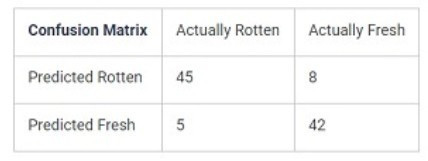 For this confusion matrix which combinations of values of accuracy, recall, and specificity respectively is CORRECT? Reveal answer details Close answer detailsCorrect answerA Explanation To calculate accuracy, recall, and specificity from the confusion matrix, the following values are used: Confusion Matrix Actually Rotten: True Positive (TP) = 45 False Positive (FP) = 8 Actually Fresh: False Negative (FN) = 5 True Negative (TN) = 42 Accuracy Accuracy is the proportion of all correct predictions. Formula: Calculation: Recall (Sensitivity) Recall is the proportion of actual positives correctly identified. Calculation: Specificity Specificity is the proportion of actual negatives correctly identified. Formula: Calculation: Therefore, the correct combination of accuracy, recall, and specificity is: 0.87, 0.9, 0.84 Reference ISTQB CT-AI Syllabus v1.0, Section 5.1 - Confusion Matrix and ML Functional Performance Metrics.
Single choice
Which ONE of the following options is an example that BEST describes a system with AI-based autonomous functions? Reveal answer details Close answer detailsCorrect answerD Explanation The ISTQB CT-AI syllabus defines AI-based autonomous systems as systems that can perceive and respond to their environment and make decisions or take actions without direct human intervention. Option D correctly describes such a system, as the ability to respond to the environment independently is a core characteristic of AI-based autonomous functionality. Option A is incorrect because decision-making is entirely performed by humans. Therefore, Option D is the correct answer.
Single choice
Which ONE of the following situations MOST clearly indicates concept drift? Reveal answer details Close answer detailsCorrect answerB
Single choice
Which ONE of the following BEST describes reinforcement learning? Reveal answer details Close answer detailsCorrect answerC
Single choice
Which ONE of the following BEST describes the AI Effect? Reveal answer details Close answer detailsCorrect answerB
Single choice
Which ONE of the following combinations of training, validation, and testing data is used during the process of learning/creating the model? Reveal answer details Close answer detailsCorrect answerA Explanation The process of developing a machine learning model typically involves the use of three types of datasets: Training data Validation data Test data Evaluation of the options: A. Training data - validation data - test data B. Training data - validation data C. Training data - test data D. Validation data - test data Therefore, the correct answer is Option A, as it includes all datasets used during the process of learning and creating the model. Reference ISTQB CT-AI Syllabus v1.0, Sections 3.2 and 4.1
Single choice
You are using a neural network to train a robot vacuum to navigate without bumping into objects. You set up a reward scheme that encourages speed but discourages triggering the bumper sensors. Instead of the expected behavior, the vacuum has learned to drive backwards because there are no bumpers on the back. This is an example of what type of behavior? Reveal answer details Close answer detailsCorrect answerB Explanation The ISTQB CT-AI syllabus defines reward hacking as a situation in which an AI-based system achieves a specified objective by exploiting weaknesses or loopholes in the reward function, thereby fulfilling the reward criteria while violating the designer's original intent. In this scenario, the robot vacuum exploits the reward structure by driving backwards. This allows it to maximize speed while avoiding bumper activation, even though this behavior is not aligned with the intended goal of safe forward navigation. The system technically optimizes the reward but does so in an unintended and undesirable way. The other options do not apply. Error short-circuiting refers to bypassing error detection logic, while transparency and interpretability relate to understanding model behavior, not exploiting reward definitions. Therefore, Reward hacking is the correct answer.
Single choice
Which ONE of the following approaches to labeling requires the least time and effort? Reveal answer details Close answer detailsCorrect answerB Explanation The ISTQB CT-AI syllabus describes multiple approaches to data labeling for supervised learning. Among these approaches, using a pre-labeled dataset requires the least time and effort because the labeling activity has already been completed. This eliminates the need for additional manual labeling, coordination with external resources, or human review of automatically generated labels. Other approaches---internal labeling, outsourced labeling, and AI-assisted labeling---still require time and effort for labeling, verification, or quality control. Therefore, they are more resource-intensive than using data that is already labeled. Thus, Pre-labeled dataset (Option B) is the correct answer.
Single choice
A company is using a spam filter to identify which emails should be marked as spam. Detection rules are created by the filter that cause a message to be classified as spam. An attacker wants all messages internal to the company to be classified as spam. To achieve this, the attacker sends messages with obvious red flags in the body of the email and modifies the "from" field to make it appear that the emails were sent by company members. The testers plan to use exploratory data analysis (EDA) to detect the attack and use this information to How could EDA be used to detect this attack? Reveal answer details Close answer detailsCorrect answerA Explanation The ISTQB CT-AI syllabus explains that exploratory data analysis (EDA) can be used to examine datasets in order to identify outliers, anomalies, and unusual patterns. In the context of adversarial attacks such as data poisoning, maliciously crafted inputs often differ statistically from legitimate data and may therefore appear as outliers. By analyzing distributions, frequencies, and patterns in email metadata and content, EDA can help identify emails that deviate significantly from normal internal communication, indicating a potential attack. Therefore, using EDA to detect outlier emails is an appropriate method for identifying this type of adversarial behavior, making Option A the correct answer.
Single choice
Which of the following statements about reinforcement learning is correct? Reveal answer details Close answer detailsCorrect answerC Explanation Section 1.6.3 - Reinforcement Learning of the ISTQB CT-AI syllabus states that reinforcement learning (RL) is based on an agent interacting with an environment, performing actions, and receiving rewards or penalties. The core concept is the reward function, which guides the agent's learning process. The syllabus emphasizes that training in RL is driven by rewards, and the agent aims to maximize cumulative reward over time. Therefore, Option C correctly describes reinforcement learning: the agent's training is based on a reward function that rewards successful actions. Option A is incorrect because reinforcement learning does not rely on labeled data; that is characteristic of Thus, Option C is the only statement consistent with reinforcement learning as defined in the syllabus.
Single choice
Arihant Meditation is a start-up using AI to aid people in achieving deeper and more effective meditation based on the analysis of various factors, such as the time and duration of meditation, pulse, blood pressure, EEG patterns, and others. Which ONE of the following factors is NOT a factor affecting the ML functional performance? Reveal answer details Close answer detailsCorrect answerD Explanation The ISTQB CT-AI syllabus explains that several factors directly influence machine learning functional performance, including the data pipeline, the quality of data labeling, and the presence of biased data. The number of classes, however, is primarily a characteristic of the problem formulation and model design. Therefore, Option D is the correct answer.
Single choice
Which ONE of the following options describes the LEAST LIKELY usage of AI for detection of GUI changes due to changes in test objects? Reveal answer details Close answer detailsCorrect answerA Explanation Using a pixel-by-pixel comparison of the GUI before and after a change is a traditional image comparison technique and does not involve AI. It performs a direct comparison of pixel values without applying learning, inference, or intelligent interpretation. Therefore, it is the least likely usage of AI for detecting GUI changes. Using computer vision techniques to compare GUIs involves AI-based image understanding and is commonly applied to detect visual changes beyond simple pixel differences. Using vision-based detection of GUI layout changes leverages AI to analyze structural and spatial relationships within the interface, which is a typical AI-based approach. Using an ML-based classifier to determine whether detected GUI changes should be flagged for human review is also a valid AI usage, as it applies learned patterns to support decision-making. Therefore, Option A correctly describes the least likely usage of AI for detecting GUI changes.
Multiple choice
Which of the following characteristics make ensuring safety more difficult in AI-based systems? (Choose two) Reveal answer details Close answer detailsCorrect answersB, C
Single choice
Which of the following is a dataset issue that can be resolved using pre-processing? Reveal answer details Close answer detailsCorrect answerD Explanation The ISTQB CT-AI syllabus explains that data pre-processing includes activities such as data cleaning and data transformation. Data transformation covers changes to the format or representation of data, for example converting data types or encodings so that they can be correctly processed by machine learning algorithms. Specifically, the syllabus states that transformation may include converting categorical values to numerical values or changing data representations, such as numbers stored as strings. This directly corresponds to Option D, which describes a dataset issue that can be resolved through pre-processing. Option A is incorrect because insufficient data is a data availability problem that cannot be solved by pre-processing. Thus, Option D is the correct answer.
Single choice
Which of the following technologies for implementing AI is considered to be a reasoning technique? Reveal answer details Close answer detailsCorrect answerA Explanation The ISTQB Certified Tester AI Testing Syllabus v1.0 explicitly categorizes different AI implementation technologies in Section 1.4 - AI Technologies. Within this section, AI methods are grouped into categories, one of which is "Reasoning techniques." These reasoning techniques include rule engines, deductive classifiers, case-based reasoning, and procedural reasoning. Because deductive classifiers are explicitly listed under this category, they are recognized as reasoning-based AI technologies. Reasoning techniques differ from machine learning approaches because they rely on structured, predefined rules or logic to reach conclusions. Deductive classifiers use logical inference and symbolic reasoning to classify inputs by applying encoded knowledge, rather than learning patterns statistically from data. The other options---linear regression, Random Forest, and genetic algorithms---are categorized in the syllabus as machine learning or optimization techniques, not reasoning techniques. Linear regression is a statistical prediction method, Random Forest is an ensemble-based machine learning model, and genetic algorithms are optimization approaches inspired by evolutionary processes. Thus, based on the syllabus definitions, Deductive classifiers (Option A) are the only technology considered to be a reasoning technique.
Single choice
Which ONE of the following BEST describes back-to-back testing in the context of AI systems? Reveal answer details Close answer detailsCorrect answerB
Single choice
Which of the following is an example of a clustering problem that can be resolved by unsupervised learning? Reveal answer details Close answer detailsCorrect answerA Explanation The ISTQB CT-AI syllabus defines clustering as an unsupervised learning approach in which similarities among input data points are identified in order to group them based on common characteristics or attributes. The syllabus explicitly notes that clustering is often used in marketing scenarios, such as grouping customers according to behavior or tendencies. Option A directly matches this definition, as associating shoppers with their shopping tendencies involves identifying natural groupings in customer behavior without predefined labels. Option B is incorrect because grouping fish by fin types implies predefined categories, which aligns more with classification than clustering. Therefore, Option A is the correct example of a clustering problem solvable using unsupervised learning. |