Preview real exam questions, verified answers and available explanations before choosing a study plan.
Question 1
Single choice
You received an email requiring you to send information such as name, email, and password in order to continue using your email account. If you do not send such information, your email account will be disabled.
What does this scenario present?
A
A personnel type of vulnerability
B
An unauthorized action type of threat
C
A compromise of information type of threat
Reveal answer detailsClose answer details
Correct answerB
Explanation
The scenario described is a classic example of a phishing attack, which is a type of social engineering threat where attackers masquerade as a trustworthy entity in an electronic communication. The goal is to trick individuals into providing sensitive information. This represents an unauthorized action type of threat because it involves an attacker attempting to gain unauthorized access to personal information. References: = This understanding of phishing as a threat is consistent with the principles of information security management systems and is supported by resources that describe phishing attacks and their prevention
Question 2
Single choice
-------------------------is an asset like other important business assets has value to an organization and consequently needs to be protected.
A
Infrastructure
B
Data
C
Information
D
Security
Reveal answer detailsClose answer details
Correct answerC
Explanation
Information is an asset like other important business assets, as it has value to an organization and consequently needs to be protected. Information can be in any form, such as electronic, paper, or verbal. Information security is the protection of information from unauthorized access, use, disclosure, modification, or destruction 2. References: ISO/IEC 27001:2022 Lead Auditor (Information Security Management Systems) | CQI | IRCA
Question 3
Multiple choice
During discussions with the individual(s) managing the audit programme of a certification body, the Management System Representative of the client organisation asks for a specific auditor for the certification audit. Select two of the following options for how the individual(s) managing the audit programme should respond.
A
Advise the Management System Representative that his request can be accepted
B
Suggest that the Management System Representative chooses another certification body
C
State that his request will be considered but may not be taken up
D
Suggest asking the certification body management to permit the request
E
Advise the Management System Representative that the audit team selection is a decision that the audit programme manager needs to make based on the resources available
Reveal answer detailsClose answer details
Correct answersC, E
Explanation
According to ISO/IEC 17021-1, which specifies the requirements for bodies providing audit and certification of management systems, a certification body should ensure that its auditors are competent, impartial, and independent from the auditee organization 2. Therefore, if a Management System Representative of a client organization asks for a specific auditor for the certification audit, the individual(s) managing the audit programme should respond in a way that does not compromise these principles or create any conflict of interest or undue influence. Two possible ways to respond are to state that his request will be considered but may not be taken up, as there may be other factors that affect the auditor selection process; or to advise him that the audit team selection is a decision that the audit programme manager needs to make based on the resources available, such as auditor availability, competence, location, etc. The other options are not suitable ways to respond in this situation. For example, advising him that his request can be accepted may raise doubts about the objectivity and credibility of the auditor and the certification body; suggesting that he chooses another certification body may imply that his request is unreasonable or unethical; and suggesting asking the certification body management to permit his request may suggest that there is room for negotiation or manipulation in auditor selection
References: ISO/IEC 17021-1:2015 - Conformity assessment ?Requirements for bodies providing audit and certification of management systems ?Part 1: Requirements
Question 4
Single choice
What is the standard definition of ISMS?
A
Is an information security systematic approach to achieve business objectives for implementation, establishing, reviewing,operating and maintaining organization's reputation.
B
A company wide business objectives to achieve information security awareness for establishing, implementing, operating, monitoring, reviewing, maintaining and improving
C
A project-based approach to achieve business objectives for establishing, implementing, operating, monitoring, reviewing, maintaining and improving an organization's information security
D
A systematic approach for establishing, implementing, operating,monitoring, reviewing, maintaining and improving an organization's information security to achieve business objectives.
Reveal answer detailsClose answer details
Correct answerD
Explanation
The standard definition of ISMS is a systematic approach for establishing, implementing, operating, monitoring, reviewing, maintaining and improving an organization's information security to achieve business objectives. This definition is given in clause 3.17 of ISO/IEC 27001:2022, and it describes the main components and purpose of an ISMS. An ISMS is not a project-based approach, as it is an ongoing process that requires continual improvement. An ISMS is not a company wide business objective, as it is a management system that supports the organization's objectives. An ISMS is not an information security systematic approach, as it is a broader concept that encompasses the organization's context, risks, controls, and performance. References: CQI & IRCA ISO 27001:2022 Lead Auditor Course Handbook, page 15. : ISO /IEC 27001:2022, clause 3.17.
Question 5
Single choice
After analyzing the audit conclusions, Company X decided to accept the risk related to one of the detected nonconformities. They claimed that no corrective action was necessary; however, their decision was not documented. Is this acceptable?
A
Yes, the auditee's management can decide to accept the risk instead of implementing corrective actions and documenting such decision is not necessary
B
No, the decision of the auditee to accept the risk instead of implementing corrective actions should be
justified and documented
C
No, the auditee must implement corrective actions for all the observations documented during the audit
Reveal answer detailsClose answer details
Correct answerB
Explanation
According to ISO/IEC 27001 standards, if the auditee decides to accept the risk instead of implementing corrective actions for a nonconformity, this decision should be justified and documented. Documenting such decisions is essential for maintaining the integrity of the ISMS and for demonstrating that the decision was made based on informed judgment.
References: ISO/IEC 27001:2013, Clause 6.1 (Actions to address risks and opportunities)
Question 6
Drag & drop
DRAG DROP
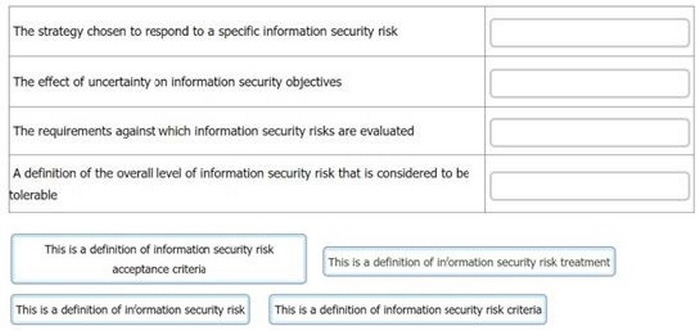
You have just completed a scheduled information security audit of your organisation when the IT Manager approaches you and asks for your assistance in the revision of the company's risk management process.
He is attempting to update the current documentation to make it easier for other managers to understand, however, it is clear from your discussion he is confusing several key terms.
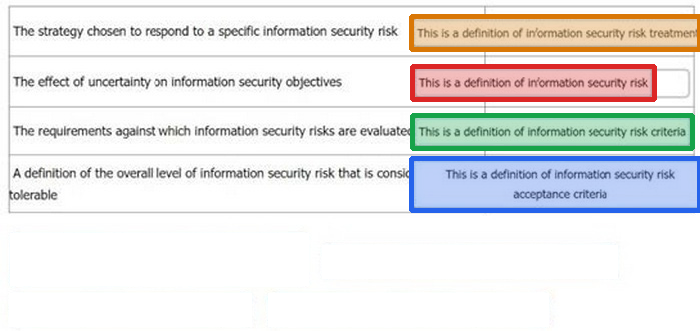
You ask him to match each of the descriptions with the appropriate risk term.
What should the correct answers be?
Reveal answer detailsClose answer details
Explanation
The strategy chosen to respond to a specific information security risk: This is a definition of information security risk treatment. According to ISO/IEC 27000:2022, information security risk treatment is "the process of selecting and implementing measures to modify the information security risk" Section 3.33. The effect of uncertainty on information security objectives: This is a definition of information security risk. According to ISO/IEC 27000:2022, information security risk is "the effect of uncertainty on information security objectives" Section 3.32. The requirements against which information security risks are evaluated: This is a definition of information security risk criteria. According to ISO/IEC 27000:2022, information security risk criteria are "the terms of reference by which the significance of information security risks is assessed" Section 3.31. A definition of the overall level of information security risk that is considered to be tolerable: This is a definition of information security risk acceptance criteria. According to ISO/IEC 27000:2022, information security risk acceptance criteria are "the level of information security risk that is acceptable" Section 3.30.
Question 7
Multiple choice
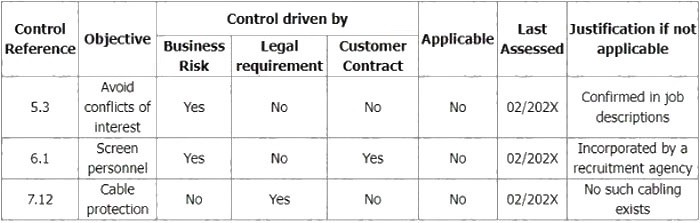
You are the audit team leader conducting a third-party audit of an online insurance company. During Stage 1, you found that the organization took a very cautious risk approach and included all the information security controls in ISO/IEC 27001:2022 Appendix A in their Statement of Applicability.
During the Stage 2 audit, your audit team found that there was no evidence of a risk treatment plan for the implementation of the three controls (5.3 Segregation of duties, 6.1 Screening, 7.12 Cabling security). You raise a nonconformity against clause 6.1.3.e of ISO 27001:2022.
At the closing meeting, the Technical Director issues an extract from an amended Statement of Applicability (as shown) and asks for the nonconformity to be withdrawn.
Select three options of the correct responses of an audit team leader to the request of the Technical Director.
A
Advise management that the information provided will be reviewed when the auditors have more time.
B
Advise the Technical Director that his request will be included in the audit report.
C
Advise the Technical Director that once a nonconformity is raised it cannot be withdrawn.
D
Advise the Technical Director that the nonconformity must stand since the evidence obtained for it was clear.
E
Ask the auditor who raised the issue for their opinion on how you should respond to the request.
F
Inform the Technical Director that the nonconformity will be changed to an Opportunity for Improvement.
G
Review the documentation produced and withdraw the nonconformity.
H
State that a follow up audit will be necessary to review the evidence for the updated Statement of
Applicability.
Reveal answer detailsClose answer details
Correct answersB, D, H
Explanation
The three options of the correct responses of an audit team leader to the request of the Technical Director are:
Advise the Technical Director that his request will be included in the audit report. Advise the Technical Director that the nonconformity must stand since the evidence obtained for it was clear. State that a follow up audit will be necessary to review the evidence for the updated Statement of Applicability.
This response is correct because the audit team leader should document the request of the Technical Director and include it in the audit report, along with the audit findings and conclusions 12. This will ensure transparency and traceability of the audit process and the audit results. This response is correct because the audit team leader should not withdraw the nonconformity based on the amended Statement of Applicability alone. The nonconformity was raised against clause 6.1.3.e of ISO 27001:2022, which requires the organisation to produce and maintain a risk treatment plan that defines how the information security risks are treated, including the controls selected and their implementation status 34. The Statement of Applicability is only one part of the risk treatment plan, and it does not provide sufficient evidence that the controls have been implemented effectively. The audit team leader should base the nonconformity on the objective evidence obtained during the audit, not on the subjective claims of the auditee 12. This response is correct because the audit team leader should state that a follow up audit will be necessary to review the evidence for the updated Statement of Applicability. A follow up audit is an audit that is conducted after a previous audit to verify the implementation and effectiveness of the corrective actions and/or opportunities for improvement that were agreed upon as a result of the previous audit 56. The follow up audit should seek to ensure that the nonconformity has been effectively addressed and that the ISMS is compliant and effective. The follow up audit should also consider any new or changed risks or requirements that may affect the ISMS.
References: 1: PECB Candidate Handbook - ISO 27001 Lead Auditor, page 25 2: ISO 19011:2018 - Guidelines for auditing management systems, clause 6.7 3: ISO/IEC 27001:2022 - Information technology -- Security techniques -- Information security management systems -- Requirements, clause 6.1.3.e 4: ISO/IEC 27005:2022 - Information technology -- Security techniques -- Information security risk management, clause 8.3.2 5: PECB Candidate Handbook - ISO 27001 Lead Auditor, page 25 6: ISO 19011:2018 - Guidelines for auditing management systems, clause 6.7
Question 8
Multiple choice
You are an experienced ISMS audit team leader guiding an auditor in training. You decide to test her knowledge of follow-up audits by asking her a series of questions. Here are your questions and her answers.
Which four of your questions has she answered correctly?
A
Q: Should a follow-up audit seek to identify new nonconformities? A:YES
B
Q: Should follow-up audits seek to ensure nonconformities have been effectively addressed? A:YES
C
Q: Should follow-up audits consider agreed opportunities for improvement as well as corrective action? A:No
D
Q: Is the purpose of a follow-up audit to verify the completion of corrections, corrective actions, and opportunities for improvement? A:YES
E
Q: Are follow-up audits required for all audits? A:No
F
Q: Should the outcome from a follow-up audit be reported to the audit team leader who carried out the audit at which the NCs were originally identified? A:YES
G
Q: Should the outcome from a follow-up audit be reported to the audit client? A:No
H
Q: Could an outcome from a follow-up audit be another follow-up audit if required? A:YES
Reveal answer detailsClose answer details
Correct answersB, D, E, H
Explanation
Based on the understanding of follow-up audits, especially in the context of Information Security Management Systems (ISMS) and the guidelines provided by ISO 19011:2018, here are the four questions from your list that the auditor in training has answered correctly:
B. Q: Should follow-up audits seek to ensure nonconformities have been effectively addressed? A: YES This is correct. The primary purpose of follow-up audits is to verify that nonconformities identified in previous audits have been effectively addressed and the corrective actions taken are suitable and effective. D. Q: Is the purpose of a follow-up audit to verify the completion of corrections, corrective actions, and opportunities for improvement? A: YES Yes, the follow-up audit aims to verify the completion and effectiveness of corrections and corrective actions. It may also consider the implementation of opportunities for improvement identified during the initial audit. E. Q: Are follow-up audits required for all audits? A: NO This is correct. Follow-up audits are not automatically required for all audits. They are typically conducted when nonconformities or other significant issues were identified in an earlier audit and there's a need to verify the implementation and effectiveness of the corrective actions. H. Q: Could an outcome from a follow-up audit be another follow-up audit if required? A: YES Yes, this is a possible outcome. If the follow-up audit finds that the corrective actions have not been fully effective, or if new issues are identified, it may be necessary to conduct another follow-up audit.
The other responses provided by the auditor in training require some clarification or correction. For instance, while a follow-up audit primarily focuses on previously identified nonconformities and corrective actions, it can still identify new nonconformities if observed (A). Opportunities for improvement are generally considered in the scope of regular audits more so than in follow-up audits, which are more narrowly focused on corrective actions (C). Also, the outcomes of follow-up audits should typically be reported to both the audit team leader and the audit client (F and G), ensuring transparency and accountability.
The four questions that the auditor in training has answered correctly are B, D, E, and H. These questions and answers are consistent with the definition and purpose of a follow-up audit as specified in ISO 19011:2018, Clause 6.712. A follow-up audit is conducted to verify the completion and effectiveness of corrective actions taken as a result of a previous audit (B, D). Follow-up audits are not mandatory for all audits, but they may be required by the audit program, the audit client, or other interested parties (E). The outcome of a follow-up audit may be another follow-up audit if the corrective actions are not satisfactory or not completed within the agreed time frame (H). The other questions and answers are either incorrect or irrelevant. A follow-up audit should not seek to identify new nonconformities, as this is not its objective (A). Follow-up audits should consider agreed opportunities for improvement as well as corrective actions, as they are both outputs of a previous audit ? The outcome of a follow-up audit should be reported to the audit client, as well as to other relevant parties, such as the audit team leader who carried out the previous audit (F, G).
References: 1: ISO 19011:2018, Guidelines for auditing management systems, Clause 6.7 \n2: PECB Certified ISO/IEC 27001 Lead Auditor Exam Preparation Guide, Domain 6: Closing an ISO/IEC 27001 audit
Question 9
Multiple choice
You are an experienced audit team leader conducting a third-party surveillance audit of an organisation that designs websites for its clients. You are currently reviewing the organisation's Statement of Applicability.
Based on the requirements of ISO/IEC 27001, which two of the following observations about the Statement of Applicability are true?
A
Justification for both the inclusion and exclusion of Annex A controls in the Statement of Applicability is required
B
The Statement of Applicability is owned and amended by the organisation's top management
C
The Statement of Applicability must be reviewed at least annually
D
A Statement of Applicability must be produced by organisations seeking ISO/IEC 27001 conformity
E
Justification is only required for any controls that the organisations choses to exclude
F
The Statement of Applicability must be reviewed at Management Review
Reveal answer detailsClose answer details
Correct answersA, D
Question 10
Multiple choice
Auditors should have certain knowledge and skills; while audit team leaders should have some additional knowledge and skills. From the following list, select two that only apply to audit team leaders.
A
Plan the audit
B
Understand and apply the risk-based approach to auditing
C
Apply appropriate sampling techniques
D
Make effective use of resources provided to the audit
E
Be aware of cultural and social aspects of the auditee
F
Verify the relevance and accuracy of collected information
Reveal answer detailsClose answer details
Correct answersA, D
Explanation
According to the PECB Candidate Handbook1, audit team leaders should have the following additional knowledge and skills compared to auditors:
Plan the audit, including preparing the audit plan, assigning work to the audit team members and coordinating their activities
Make effective use of resources provided to the audit, such as personnel, time, budget and equipment
Manage the audit process, including leading the opening and closing meetings, directing the audit team, resolving conflicts and ensuring the audit objectives are achieved
Review and approve the audit report and audit findings
Communicate with the client and other interested parties throughout the audit
References: 1: PECB Candidate Handbook - ISO 27001 Lead Auditor, pages 9-10.
Question 11
Multiple choice
You are conducting an ISMS audit in the despatch department of an international logistics organisation that provides shipping services to large organisations including local hospitals and government offices. Parcels typically contain pharmaceutical products, biological samples, and documents such as passports and driving licences. You note that the company records show a very large number of returned items with causes including misaddressed labels and, in 15% of cases, two or more labels for different addresses for the one package. You are interviewing the Shipping Manager (SM).
You: Are items checked before being dispatched?
SM: Any obviously damaged items are removed by the duty staff before being dispatched, but the small profit margin makes it uneconomic to implement a formal checking process.
You: What action is taken when items are returned?
SM: Most of these contracts are relatively low value, therefore it has been decided that it is easier and more convenient to simply reprint the label and re-send individual parcels than it is to implement an investigation.
You raise a nonconformity against ISO 27001:2022 based on the lack of control of the labelling process. At the closing meeting, the Shipping Manager issues an apology to you that his comments may have been misunderstood.
He says that he did not realise that there is a background IT process that automatically checks that the right label goes onto the right parcel otherwise the parcel is ejected at labelling. He asks that you withdraw your nonconformity.
Select three options of the correct responses that you as the audit team leader would make to the request of the Shipping Manager.
A
Advise the Shipping Manager that his request will be included in the audit report
B
Advise management that the new information provided will be discussed when the auditors have more time
C
Inform the Shipping Manager that the nonconformity is minor and should be quickly corrected
D
Ask the audit team members to state what they think should happen
E
Inform him of your understanding and withdraw the nonconformity
F
Thank the Shipping Manager for his honesty but advise that withdrawing the nonconformity is not the right way to proceed
G
Advise the Shipping Manager that the nonconformity must stand since the evidence obtained for it was dear
H
Indicate that the nonconformity is evidence of a deeper system failure that needs to be rectified
Reveal answer detailsClose answer details
Correct answersA, B, F
Explanation
A. Advise the Shipping Manager that his request will be included in the audit report. This is true because the audit report should document all the relevant information and evidence related to the audit, including any requests or objections raised by the auditee. The audit report should also provide the rationale for the audit conclusions and recommendations. B. Advise management that the new information provided will be discussed when the auditors have more
time. This is true because the auditors should not make hasty decisions based on incomplete or unverified information. The auditors should review and evaluate the new information in a systematic and objective manner, and determine whether it affects the audit findings, nonconformities, or conclusions F. Thank the Shipping Manager for his honesty but advise that withdrawing the nonconformity is not the right way to proceed. This is true because the auditors should acknowledge and appreciate the cooperation and transparency of the auditee, but also maintain their professional integrity and independence. The auditors should not withdraw a nonconformity unless they are satisfied that it was raised in error or that it has been effectively corrected and verified.
References: ISO 19011:2022 Guidelines for auditing management systems ISO/IEC 17021-1:2022 Conformity assessment -- Requirements for bodies providing audit and certification of management systems -- Part 1: Requirements
Question 12
Drag & drop
DRAG DROP
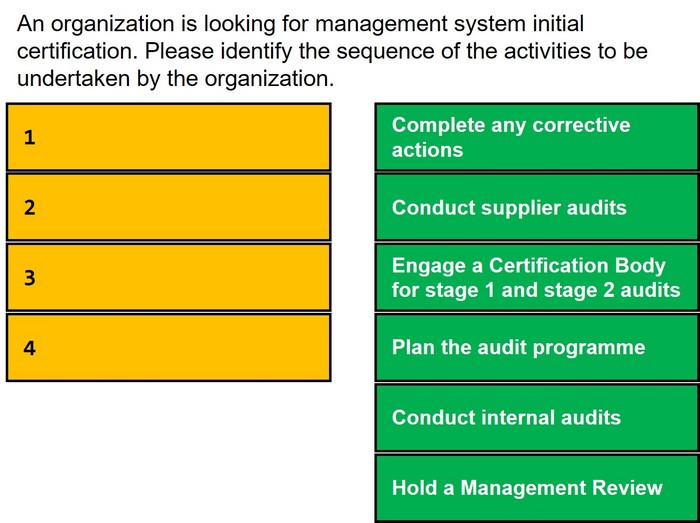
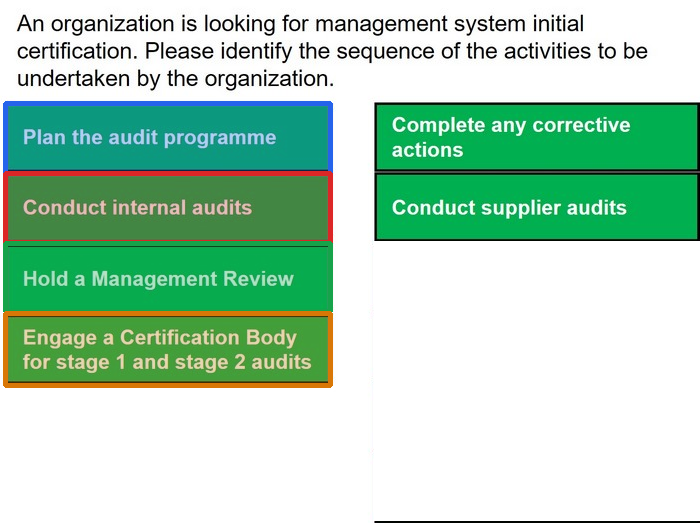
An organisation is looking for management system initial certification. Please identify the sequence of the activities to be undertaken by the organisation.
To complete the sequence click on the blank section you want to complete so that it is highlighted in red, and then click on the applicable text from the options below. Alternatively, you may drag and drop the options to the appropriate blank section.
Reveal answer detailsClose answer details
Explanation
The correct sequence of activities is:
Establish the management system
Plan the audit programme
Conduct internal audits
Hold a Management Review
Engage a Certification Body for stage 1 and stage 2 audits
Complete any corrective actions
Comprehensive but Short = According to the PECB Candidate Handbook - ISO/IEC 27001 Lead Auditor, the steps for achieving certification are as follows1:
Establish the management system: This involves defining the scope, objectives, policies, procedures, and controls of the ISMS, as well as ensuring the availability of resources and top management commitment.
Plan the audit programme: This involves defining the audit objectives, criteria, scope, frequency, methods, and responsibilities for conducting internal audits of the ISMS.
Conduct internal audits: This involves verifying the conformity and effectiveness of the ISMS, as well as identifying any nonconformities or opportunities for improvement.
Hold a Management Review: This involves reviewing the performance and suitability of the ISMS, as well as deciding on any changes or actions needed to improve it.
Engage a Certification Body for stage 1 and stage 2 audits: This involves selecting a reputable and accredited certification body to conduct an external audit of the ISMS, consisting of two stages: a documentation review and an on-site assessment.
Complete any corrective actions: This involves addressing any nonconformities or findings identified by the certification body, and providing evidence of their implementation and effectiveness.
Which two of the following phrases would apply to 'check' in the Plan-Do-Check-Act cycle for a business process?
A
Making improvements
B
Managing changes
C
Verifying training
D
Resetting objectives
E
Updating the Information Security Policy
F
Auditing processes
Reveal answer detailsClose answer details
Correct answersC, F
Explanation
The two phrases that would apply to `check' in the Plan-Do-Check-Act cycle for a business process are:
Verifying training Auditing processes This phrase applies to `check' in the PDCA cycle because it involves measuring and evaluating the effectiveness of the training activities that were implemented in the `do' phase. Training is an important aspect of information security awareness, education, and competence, which are required by clause 7.2 of ISO 27001:20221. Verifying training can help the organisation to assess whether the staff have acquired the necessary knowledge, skills, and behaviour to perform their roles and responsibilities in relation to information security. Verifying training can also help the organisation to identify any gaps or weaknesses in the training program and to plan for improvement actions. This phrase applies to `check' in the PDCA cycle because it involves examining and reviewing the performance and conformity of the processes that were implemented in the `do' phase. Auditing is a systematic, independent, and documented process for obtaining objective evidence and evaluating it to determine the extent to which the audit criteria are fulfilled. Auditing processes can help the organisation to verify whether the information security objectives and requirements are met, whether the information security controls are effective and efficient, and whether the information security risks are adequately managed. Auditing processes can also help the organisation to identify any nonconformities or opportunities for improvement and to plan for corrective or preventive actions.
References: ISO/IEC 27001:2022 - Information technology -- Security techniques -- Information security management systems -- Requirements, clause 7.2 ISO 19011:2018 - Guidelines for auditing management systems, clause 3.2
Question 14
Single choice
Which is an example of a qualitative evidence?
A
The documented results of an intrusion-detection test from an information security expert from an external organization
B
A defined sample analysis of nonconformity reports drafted by the audited organization from the time their ISMS was implemented
C
An interview with the information security personnel to validate if the information security process complies with the standard requirements
Reveal answer detailsClose answer details
Correct answerC
Explanation
Qualitative evidence in an audit typically involves observations, interviews, and reviews that provide insights into the processes and compliance through subjective but informed assessments. An interview with information security personnel to validate compliance with the standard requirements is an example of qualitative evidence, where the quality and effectiveness of processes are assessed based on expert judgments rather than measurable metrics. References: PECB ISO/IEC 27001 Lead Auditor Course Material
Question 15
Single choice
Scenario 2: Knight is an electronics company from Northern California, US that develops video game consoles. Knight has more than 300 employees worldwide. On the fifth anniversary of their establishment, they have decided to deliver the G-Console, a new generation video game console aimed for worldwide markets. G-Console is considered to be the ultimate media machine of 2021 which will give the best gaming experience to players.
The console pack will include a pair of VR headset, two games, and other gifts.
Over the years, the company has developed a good reputation by showing integrity, honesty, and respect toward their customers. This good reputation is one of the reasons why most passionate gamers aim to have Knight's G-console as soon as it is released in the market.
Besides being a very customer-oriented company, Knight also gained wide recognition within the gaming industry because of the developing quality. Their prices are a bit higher than the reasonable standards allow.
Nonetheless, that is not considered an issue for most loyal customers of Knight, as their quality is top-notch.
Being one of the top video game console developers in the world, Knight is also often the center of attention for malicious activities. The company has had an operational ISMS for over a year. The ISMS scope includes all departments of Knight, except Finance and HR departments. Recently, a number of Knight's files containing proprietary information were leaked by hackers. Knight's incident response team (IRT) immediately started to analyze every part of the system and the details of the incident.
The IRT's first suspicion was that Knight's employees used weak passwords and consequently were easily cracked by hackers who gained unauthorized access to their accounts. However, after carefully investigating the incident, the IRT determined that hackers accessed accounts by capturing the file transfer protocol (FTP) traffic.
FTP is a network protocol for transferring files between accounts. It uses clear text passwords for authentication.
Following the impact of this information security incident and with IRT's suggestion, Knight decided to replace the FTP with Secure Shell (SSH) protocol, so anyone capturing the traffic can only see encrypted data.
Following these changes, Knight conducted a risk assessment to verify that the implementation of controls had minimized the risk of similar incidents. The results of the process were approved by the ISMS project manager who claimed that the level of risk after the implementation of new controls was in accordance with the company's risk acceptance levels.
Based on this scenario, answer the following question:
Based on scenario 2, Knight decided to replace the FTP with Secure Shell (SSH) protocol. Should the Statement of Applicability (SoA) be updated in this case?
A
No, the usage of SSH protocol is not an ISO/IEC 27001 requirement and; therefore, does not need to be included in the SoA
B
No, because the SoA should be updated only when new controls are added, not when old ones are canceled
C
Yes, the implementation of the new control should be justified and included in the SoA
Reveal answer detailsClose answer details
Correct answerC
Explanation
The Statement of Applicability (SoA) is a core document within an ISMS that outlines the security controls an organization implements. When a new control, such as the SSH protocol, is implemented, it should be included in the SoA to reflect the current state of the ISMS. The SoA should be updated to justify the inclusion of the new control and to document how it is implemented within the organization.
References: This guidance is based on the best practices for maintaining the SoA as per ISO/IEC 27001, which requires the SoA to be a living document that accurately reflects the security controls in use by the organization
Question 16
Single choice
What is the difference between a restricted and confidential document?
A
Restricted - to be shared among an authorized group Confidential - to be shared among named individuals
B
Restricted - to be shared among named individuals Confidential - to be shared among an authorized group
C
Restricted - to be shared among named individuals Confidential - to be shared across the organization only
D
Restricted - to be shared among named individuals Confidential - to be shared with friends and family
Reveal answer detailsClose answer details
Correct answerB
Explanation
The difference between a restricted and confidential document is that a restricted document is to be shared among named individuals, while a confidential document is to be shared among an authorized group. Restricted and confidential are examples of information classification levels that indicate the sensitivity and value of information and the degree of protection required for it. Restricted documents contain information that could cause serious damage or harm to the organization or its stakeholders if disclosed to unauthorized persons. Therefore, they should only be accessed by specific individuals who have a legitimate need to know and are authorized by the information owner. Confidential documents contain information that could cause damage or harm to the organization or its stakeholders if disclosed to unauthorized persons. Therefore, they should only be accessed by a defined group of people who have a legitimate need to know and are authorized by the information owner. ISO/IEC 27001:2022 requires the organization to classify information in terms of legal requirements, value, criticality and sensitivity to unauthorized disclosure or modification (see clause A. 8.2.1). References: CQI & IRCA Certified ISO/IEC 27001:2022 Lead Auditor Training Course, ISO/IEC 27001:2022 Information technology -- Security techniques -- Information security management systems -- Requirements, What is Information Classification?
Question 17
Single choice
Scenario 4: SendPay is a financial company that provides its services through a network of agents and financial institutions. One of their main services is transferring money worldwide. SendPay, as a new company, seeks to offer top quality services to its clients. Since the company offers international transactions, it requires from their clients to provide personal information, such as their identity, the reason for the transactions, and other details that might be needed to complete the transaction. Therefore, SendPay has implemented security measures to protect their clients' information, including detecting, investigating, and responding to any information security threats that may emerge. Their commitment to offering secure services was also reflected during the ISMS implementation where the company invested a lot of time and resources.
Last year, SendPay unveiled their digital platform that allows money transactions through electronic devices, such as smartphones or laptops, without requiring an additional fee. Through this platform, SendPay's clients can send and receive money from anywhere and at any time. The digital platform helped SendPay to simplify the company's operations and further expand its business. At the time, SendPay was outsourcing its software operations, hence the project was completed by the software development team of the outsourced company. The same team was also responsible for maintaining the technology infrastructure of SendPay.
Recently, the company applied for ISO/IEC 27001 certification after having an ISMS in place for almost a year. They contracted a certification body that fit their criteria. Soon after, the certification body appointed a team of four auditors to audit SendPay's ISMS.
During the audit, among others, the following situations were observed:
1. The outsourced software company had terminated the contract with SendPay without prior notice. As a result, SendPay was unable to immediately bring the services back in-house and its operations were disrupted for five days. The auditors requested from SendPay's representatives to provide evidence that they have a plan to follow in cases of contract terminations. The representatives did not provide any documentary evidence but during an interview, they told the auditors that the top management of SendPay had identified two other software development companies that could provide services immediately if similar situations happen again.
2. There was no evidence available regarding the monitoring of the activities that were outsourced to the software development company. Once again, the representatives of SendPay told the auditors that they regularly communicate with the software development company and that they are appropriately informed for any possible change that might occur.
3. There was no nonconformity found during the firewall testing. The auditors tested the firewall configuration in order to determine the level of security provided by these services. They used a packet analyzer to test the firewall policies which enabled them to check the packets sent or received in real-time. Based on this scenario, answer the following question:
Why could SendPay not restore their services back in-house after the contract termination? Refer to
scenario 4.
A
Because SendPay did not monitor the technology infrastructure of the outsourced software operations
B
Because SendPay lacked a comprehensive business continuity plan with potential impact of contract terminations
C
Because the outsourced software company terminated the contract with SendPay without prior notice
Reveal answer detailsClose answer details
Correct answerB
Explanation
SendPay's inability to restore their services immediately after the contract termination indicates a lack of a comprehensive business continuity plan that addresses the potential impacts of such terminations. This oversight can result in significant operational disruptions, as observed.
References: ISO/IEC 27001:2013 Standard, Clause A.17 (Information security aspects of business continuity management)
Question 18
Multiple choice
You are a certification body auditor, conducting a surveillance audit to ISO/IEC 27001:2022 of a data centre operated by a client who provides hosting services for ICT facilities.
You and your guide are currently in one of the private suites that the client rents out to customers. Access to each suite is controlled using a combination lock. CCTV is also installed in every suite.
Within each suite are three data cabinets in which the client can locate mission-critical servers and other items of networking equipment such as switches and routers.
You notice that whilst two of the cabinets in your suite are locked, the third is unlocked. You ask the guide why. They reply "This is because the client is currently swapping out a hard drive unit. Their technician is currently on a lunch break".
What three actions should you undertake next?
A
Do nothing, the room appears adequately protected so it is unlikely that a security incident has taken place.
B
Raise a nonconformity against control 5.16 'identity management' as it may not be possible to identify who left the cabinet unlocked.
C
Raise a nonconformity against control 7.2 'physical entry' as the area where the client's equipment is located is not protected.
D
Raise a nonconformity against control 7.4 'physical security monitoring' as the private suite is not being continuously monitored for unauthorised physical access.
E
Raise an opportunity for improvement suggesting cabinet doors are locked whenever clients leave their suites, even if they intend to return within a short time.
F
Review the CCTV records to ensure that only the client has accessed the cabinet since it was last confirmed as locked.
G
When the technician returns from lunch, reprimand them for leaving the cabinet open.
H
With the permission of the guide, speak to the customer to confirm that they are in the process of swapping out a drive.
Reveal answer detailsClose answer details
Correct answersE, F, H
Explanation
Leaving the cabinet unlocked while the technician is on a lunch break exposes the client's equipment and data to potential physical security risks, such as theft, damage, or tampering. This is a violation of the ISO/ IEC 27001:2022 requirements for physical entry (control 7.2) and physical security monitoring (control 7.4), which aim to prevent unauthorized access to information processing facilities and assets. Therefore, the appropriate actions for the auditor are:
Raise an opportunity for improvement (OFI) suggesting that the cabinet doors are locked whenever clients leave their suites, even if they intend to return within a short time. This would enhance the security of the client's equipment and data, and reduce the likelihood of security incidents. Review the CCTV records to ensure that only the client has accessed the cabinet since it was last confirmed as locked. This would verify the integrity and availability of the client's equipment and data, and identify any possible unauthorized access or interference. With the permission of the guide, speak to the customer to confirm that they are in the process of swapping out a drive. This would validate the reason for leaving the cabinet unlocked, and assess the impact and risk of the activity on the client's information security.
References: ISO/IEC 27001:2022, clause 7.2, Physical entry ISO/IEC 27001:2022, clause 7.4, Physical security monitoring PECB Candidate Handbook ISO 27001 Lead Auditor, page 19, Audit Process PECB Candidate Handbook ISO 27001 Lead Auditor, page 21, Audit Findings
Question 19
Single choice
Below is Purpose of "Integrity", which is one of the Basic Components of Information Security
A
the property that information is not made available or disclosed to unauthorized individuals
B
the property of safeguarding the accuracy and completeness of assets.
C
the property that information is not made available or disclosed to unauthorized individuals
D
the property of being accessible and usable upon demand by an authorized entity.
Reveal answer detailsClose answer details
Correct answerB
Explanation
Integrity is one of the basic components of information security, along with confidentiality and availability. Integrity means that information is safeguarded from unauthorized or accidental changes that could affect its accuracy and completeness. Integrity ensures that information is reliable and trustworthy 3. References: ISO /IEC 27001:2022 Lead Auditor Training Course - BSI
Question 20
Single choice
Which one of the following options describes the main purpose of a Stage 1 audit?
A
To determine readiness for Stage 2
B
To check for legal compliance by the organisation
C
To get to know the organisation
D
To compile the audit plan
Reveal answer detailsClose answer details
Correct answerA
Explanation
The main purpose of a Stage 1 audit is to evaluate the adequacy and effectiveness of the organisation's ISMS documentation, and to assess whether the organisation is prepared for the Stage 2 audit, where the implementation and operation of the ISMS will be verified. The Stage 1 audit also involves verifying the scope, objectives, and context of the ISMS, as well as identifying any areas of concern or nonconformities that need to be addressed before the Stage 2 audit.
References: ISO/IEC 27001:2022 Lead Auditor (Information Security Management Systems) objectives and content from Quality.org and PECB ISO/IEC 27006:2015 Information technology -- Security techniques -- Requirements for bodies providing audit and certification of information security management systems Section 7.3.1
Question 21
Drag & drop
DRAG DROP
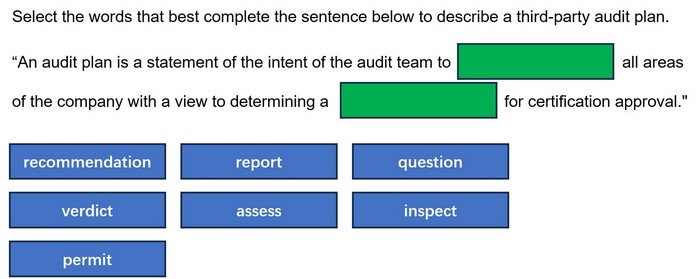
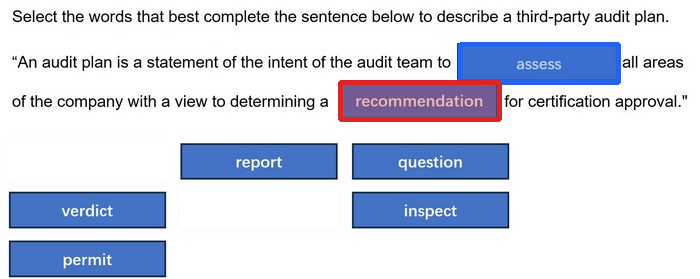
Select the words that best complete the sentence below to describe a third-party audit plan.
To complete the sentence with the best word(s), click on the blank section you want to complete so that it is highlighted in red, and then click on the applicable text from the options below. Alternatively, you may drag and drop the option to the appropriate blank section.
Reveal answer detailsClose answer details
Explanation
The words that best complete the sentence are assess and recommendation. The sentence would read as follows:
"An audit plan is a statement of the intent of the audit team to assess all areas of the company with a view to determining a recommendation for certification approval."
According to the web search results from my predefined tool, a third-party audit plan is a document that describes the scope, objectives, criteria, and methodology of an external audit conducted by an independent certification body to verify the conformity of an organization's ISMS with the ISO 27001 standard. The audit plan also includes the audit schedule, the audit team, the audit locations, and the audit deliverables. One of the main deliverables of a third-party audit is the audit report, which summarizes the audit findings, the audit conclusions, and the audit recommendation. The audit recommendation is the opinion of the audit team on whether the organization's ISMS meets the certification requirements and whether the certification should be granted, maintained, suspended, or withdrawn.
Therefore, the purpose of the audit plan is to state the intention of the audit team to assess all areas of the company, meaning to evaluate the performance and effectiveness of the ISMS, and to determine a recommendation for certification approval, meaning to provide a judgment on the certification status of the ISMS. The other words in the options, such as verdict, permit, report, inspect, and question, do not accurately reflect the meaning of the audit plan. A verdict is a formal decision made by a judge or a jury, not by an audit team. A permit is a legal authorization to do something, not a certification of conformity. A report is a document that presents the audit results, not the audit intention. An inspection is a visual examination of something, not a comprehensive assessment of an ISMS. A question is a request for information, not a determination of a recommendation.
Question 22
Multiple choice
You are an experienced audit team leader guiding an auditor in training.
Your team is currently conducting a third-party surveillance audit of an organisation that stores data on behalf of external clients. The auditor in training has been tasked with reviewing the TECHNOLOGICAL controls listed in the Statement of Applicability (SoA) and implemented at the site.
Select four controls from the following that would you expect the auditor in training to review.
A
Confidentiality and nondisclosure agreements
B
How access to source code and development tools are managed
C
How power and data cables enter the building
D
How protection against malware is implemented
E
How the organisation evaluates its exposure to technical vulnerabilities
F
Information security awareness, education and training
G
The organisation's arrangements for information deletion
H
The organisation's business continuity arrangements
Reveal answer detailsClose answer details
Correct answersB, D, E, G
Explanation
The four controls from the list that the auditor in training should review are:
How access to source code and development tools are managed: This control requires the organisation to restrict and monitor the access to the source code and development tools that are used to create, modify, or maintain the software applications and systems that process or store the data of external clients. This is important for ensuring the integrity, confidentiality, and availability of the software and the data, as well as for preventing unauthorized changes, errors, or malicious code injection.
How protection against malware is implemented: This control requires the organisation to implement appropriate measures to detect, prevent, and remove malware from the IT systems and devices that process or store the data of external clients. This includes using antivirus software, firewalls, email filtering, web filtering, and other tools to protect against viruses, worms, ransomware, spyware, and other malicious software. This is essential for safeguarding the data and the systems from corruption, theft, or damage caused by malware. How the organisation evaluates its exposure to technical vulnerabilities: This control requires the organisation to identify and assess the technical vulnerabilities that may affect the IT systems and devices that process or store the data of external clients. This includes using vulnerability scanning tools, penetration testing tools, threat intelligence sources, and other methods to discover and evaluate the weaknesses and gaps in the security of the systems and the devices. This is necessary for prioritizing and implementing the appropriate corrective actions and controls to mitigate the risks posed by the vulnerabilities. The organisation's arrangements for information deletion: This control requires the organisation to establish and implement policies and procedures for deleting the data of external clients from the IT systems and devices when it is no longer needed or required. This includes defining the criteria and methods for data deletion, such as secure erasure, encryption, or physical destruction. This is important for complying with the contractual obligations and the legal and regulatory requirements regarding the retention and disposal of the data, as well as for protecting the confidentiality and integrity of the data.
References: ISO/IEC 27001:2022, Annex A, clauses A.8.9, A.8.10, A.8.11, and A.8.28 Understanding ISO 27001:2022: People, process, and technology, pages 6-7 What are the 11 new security controls in ISO 27001:2022 - Advisera.
Question 23
Single choice
As the Information Security Management System audit team leader, you are conducting a second-party audit of an international logistics company on behalf of an online retailer. During the audit, one of your team members reports a nonconformity relating to control 5.18 (Access rights) of Appendix A of ISO/IEC 27001: 2022. She found evidence that removing the server access protocols of 20 people who left in the last 3 months took up to 1 week whereas the policy required removing access within 24 hours of their departure.
When the auditee was asked why there was a delay in removing access they replied, 'no one was available in the IT department during that period as a result of COVID-19. As soon as an IT officer became available the rights were removed.
You note that she intends to raise a minor non-conformity against Access rights control (5.18).
How should you respond to this?
A
Agree with the raising of a minor non-conformity but against control 5.15, not 5.18.
B
Agree with the raising of the minor non-conformity against 5.18.
C
Disagree with the raising of a minor conformity as appropriate action was taken at the earliest opportunity Take no further action.
D
Disagree with the raising of the minor nonconformity as appropriate action was taken at the earliest opportunity. Instead raise an opportunity for improvement.
E
Disagree with the raising of the minor nonconformity, there is sufficient evidence to justify an escalation to a major non-conformity.
F
Require additional audit evidence to be obtained before determining whether a non-conformity is appropriate.
Reveal answer detailsClose answer details
Correct answerA
Question 24
Single choice
A marketing agency has developed its own risk assessment approach as part of the ISMS implementation. Is this acceptable?
A
Yes, any risk assessment methodology that complies with the ISO/IEC 27001 requirements can be used
B
Yes, only if the risk assessment methodology is aligned with recognized risk assessment methodologies
C
No, when implementing an ISMS, the risk assessment methodology provided by ISO/IEC 27001 should be used
Reveal answer detailsClose answer details
Correct answerA
Explanation
ISO/IEC 27001 does not mandate the use of a specific risk assessment methodology. Organizations are free to choose their own approach as long as it is systematic, consistent, and capable of producing valid and comparable results. This allows organizations, such as the marketing agency in the question, to adapt the methodology to suit their specific needs and business context, provided it complies with the requirements set out in the standard.
(1) Continual improvement, (2) the effectiveness of corrective actions
B
(1) Management review, (2) opportunities for continual improvement
C
(1) Internal audit, (2) the ISMS scope
Reveal answer detailsClose answer details
Correct answerB
Explanation
Management review is a crucial component of an ISMS that helps determine opportunities for continual improvement. Through management review, an organization assesses the performance and effectiveness of its ISMS, including reviewing opportunities for improvements and the need for changes to the ISMS, including the security policy and security objectives.
You are an experienced ISMS audit team leader who is currently conducting a third party initial certification audit of a new client, using ISO/IEC 27001:2022 as your criteria.
It is the afternoon of the second day of a 2-day audit, and you are just about to start writing your audit report. So far no nonconformities have been identified and you and your team have been impressed with both the site and the organisation's ISMS.
At this point, a member of your team approaches you and tells you that she has been unable to complete her assessment of leadership and commitment as she has spent too long reviewing the planning of changes.
Which one of the following actions will you take in response to this information?
A
Apologise to the client and tell them you will return at a later date to review leadership and commitment.
B
Suggest to the client that if they are prepared to upgrade your return flight to first class you will audit leadership and commitment in your own time tomorrow.
C
Advise the auditee and audit client that it is not possible to make a positive recommendation at this point.
D
Advise the auditee that the certification audit will need to be terminated and rescheduled.
E
Contact the individual managing the audit programme and seek their permission to record a positive recommendation in the audit report.
F
Contact your head office and await their further instructions of how to proceed.
G
Given there have been no nonconformities identified and the overall impression of the organisation has been a good one, record a positive recommendation for certification in the audit report.
H
Review the audit plan and client availabilities to determine whether there is any opportunity for another member of your team to pick up this task before the closing meeting.
Reveal answer detailsClose answer details
Correct answerC
Explanation
Leadership and commitment is a key requirement of ISO/IEC 27001:2022, as it establishes the top management's role and responsibility in establishing, implementing, maintaining, and continually improving the ISMS. Without assessing this aspect, the audit team cannot conclude that the ISMS is effective and conforms to the standard. Therefore, the audit team leader should advise the auditee and audit client that it is not possible to make a positive recommendation at this point, and explain the reason and the implications. The audit team leader should also consult with the certification body and the audit programme manager on the next steps, such as extending the audit duration, conducting a follow-up audit, or issuing a conditional certification, depending on the certification body's policy and the audit client's agreement.
References: ISO/IEC 27001:2022, clause 5, Leadership PECB Candidate Handbook ISO 27001 Lead Auditor, page 19, Audit Process PECB Candidate Handbook ISO 27001 Lead Auditor, page 22, Audit Report PECB Candidate Handbook ISO 27001 Lead Auditor, page 23, Audit Conclusion and Recommendation
Question 27
Single choice
Information Security is a matter of building and maintaining ________ .
A
Confidentiality
B
Trust
C
Protection
D
Firewalls
Reveal answer detailsClose answer details
Correct answerB
Explanation
Information security is a matter of building and maintaining trust. Trust is the confidence that information and information processing facilities are protected from unauthorized or malicious actions that could compromise their confidentiality, integrity or availability. Trust is essential for establishing and maintaining relationships with customers, partners, suppliers, employees and other stakeholders who rely on the organization's information and services. Trust is also a key factor for achieving compliance with legal, regulatory and contractual obligations, as well as meeting the organization's own information security objectives and policies. ISO/IEC 27001:2022 defines information security as "preservation of confidentiality, integrity and availability of information" (see clause 3.28) and states that "the purpose of an information security management system is to provide a framework for managing activities that influence the trustworthiness of information" (see Introduction). References: CQI & IRCA Certified ISO/IEC 27001:2022 Lead Auditor Training Course, ISO/IEC 27001:2022 Information technology -- Security techniques -- Information security management systems -- Requirements, What is Trust?
Question 28
Single choice
You are an experienced ISMS Audit Team Leader, talking to an Auditor in training who has been assigned to your audit team. You want to ensure that they understand the importance of the Check stage of the Plan-
Do-Check-Act cycle in respect of the operation of the information security management system.
You do this by asking him to select the answer which best describes the purpose of the check activity 'management review.
The purpose of the management review is to: Select 1
A
Assess the information security management system at random intervals to ensure its continuing efficiency, adequacy and effectiveness.
B
Consider the information security management system at regular intervals to ensure its continuing compliance, adequacy and effectiveness.
C
Review the information security management system at planned intervals to ensure its continuing suitability, adequacy and effectiveness.
D
Update the information security management system at documented intervals to ensure its continuing conformity, adequacy and effectiveness.
Reveal answer detailsClose answer details
Correct answerC
Explanation
The management review is a key component of the "Check" stage in the Plan-Do-Check-Act (PDCA) cycle. Its primary purpose is to evaluate the overall ISMS and make strategic decisions for improvement. Here's why the other options are less accurate:
Random intervals: Reviews should be conducted at planned intervals for consistency and tracking progress. Compliance: While compliance is a consideration, the main focus is on the system's suitability for the organization's needs, its adequacy in managing risks, and its overall effectiveness in achieving information security objectives. Update: The management review might lead to updates, but its primary goal is evaluation, not immediate modification.
References: ISO/IEC 27001:2022, Section 9.3 (Management Review): Outlines the purpose and requirement for conducting management reviews. PECB Candidate Handbook, ISO/IEC 27001 Lead Auditor: Emphasizes the management review's role in evaluating the ISMS's suitability, adequacy, and effectiveness, driving continuous improvement.
Question 29
Single choice
Scenario 3: NightCore is a multinational technology company based in the United States that focuses on e- commerce, cloud computing, digital streaming, and artificial intelligence. After having an information security management system (ISMS) implemented for over 8 months, they contracted a certification body to conduct a third party audit in order to get certified against ISO/IEC 27001. The certification body set up a team of seven auditors. Jack, the most experienced auditor, was assigned as the audit team leader. Over the years, he received many well known certifications, such as the ISO/IEC 27001 Lead Auditor, CISA, CISSP, and CISM.
Jack conducted thorough analyses on each phase of the ISMS audit, by studying and evaluating every information security requirement and control that was implemented by NightCore. During stage 2 audit. Jack detected several nonconformities. After comparing the number of purchased invoices for software licenses with the software inventory, Jack found out that the company has been using the illegal versions of a software for many computers. He decided to ask for an explanation from the top management about this nonconformity and see whether they were aware about this. His next step was to audit NightCore's IT Department. The top management assigned Tom, NightCore's system administrator, to act as a guide and accompany Jack and the audit team toward the inner workings of their system and their digital assets infrastructure.
While interviewing a member of the Department of Finance, the auditors discovered that the company had recently made some unusual large transactions to one of their consultants. After gathering all the necessary details regarding the transactions. Jack decided to directly interview the top management.
When discussing about the first nonconformity, the top management told Jack that they willingly decided to use a copied software over the original one since it was cheaper. Jack explained to the top management of NightCore that using illegal versions of software is against the requirements of ISO/IEC 27001 and the national laws and regulations. However, they seemed to be fine with it.
Several months after the audit, Jack sold some of NightCore's information that he collected during the audit for a huge amount of money to competitors of NightCore.
Based on this scenario, answer the following question:
Based on audit principles, should Jack contact the certification body regarding the second nonconformity? Refer to scenario 3.
A
Yes, auditors should contact the ethics committee members of the certification body to obtain advice on such situation
B
Yes, auditors should communicate such situations to the certification body; however, the top management should not be informed
C
No, situations that may indicate financial crime are not the focus of an ISMS audit
Reveal answer detailsClose answer details
Correct answerB
Explanation
Yes, Jack should communicate such situations to the certification body. is essential for auditors to report potential nonconformities and ethical breaches to the certification body to maintain the integrity and credibility of the audit process, without necessarily informing top management of these steps.
References: ISO 19011:2018, Guidelines for auditing management systems
Question 30
Single choice
The following are definitions of Information, except:
A
accurate and timely data
B
specific and organized data for a purpose
C
mature and measurable data
D
can lead to understanding and decrease in uncertainty
Reveal answer detailsClose answer details
Correct answerC
Explanation
The definition of information that is not correct is C: mature and measurable data. This is not a valid definition of information, as information does not have to be mature or measurable to be considered as such. Information can be any data that has meaning or value for someone or something in a certain context. Information can be subjective, qualitative, incomplete or uncertain, depending on how it is interpreted or used. Mature and measurable data are characteristics that may apply to some types of information, but not all. The other definitions of information are correct, as they describe different aspects of information, such as accuracy and timeliness (A), specificity and organization (B), and understanding and uncertainty reduction (D). ISO/IEC 27001:2022 defines information as "any data that has meaning" (see clause 3.25).
References: CQI & IRCA Certified ISO/IEC 27001:2022 Lead Auditor Training Course, ISO/IEC 27001:2022 Information technology -- Security techniques -- Information security management systems -- Requirements, What is Information?
Question 31
Single choice
CMM stands for?
A
Capability Maturity Matrix
B
Capacity Maturity Matrix
C
Capability Maturity Model
D
Capable Mature Model
Reveal answer detailsClose answer details
Correct answerC
Explanation
Capability Maturity Model (CMM) is a framework that describes the key elements of an effective software process. It defines five levels of maturity for software development organizations, from initial to optimized. The CMM helps organizations to assess their current level of process capability and identify the areas for improvement. References: ISO/IEC 27001:2022 Lead Auditor - IECB
Question 32
Drag & drop
DRAG DROP
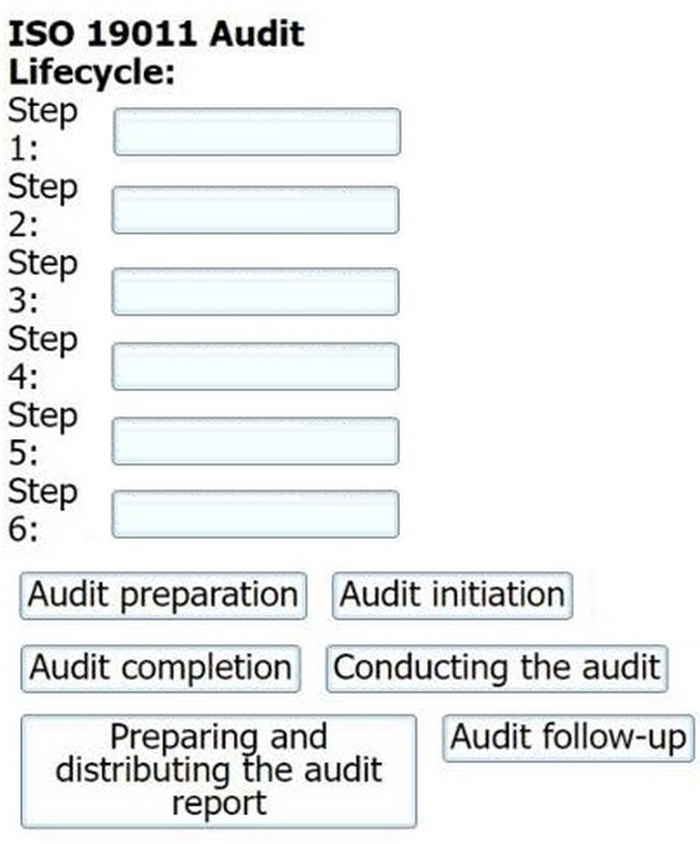
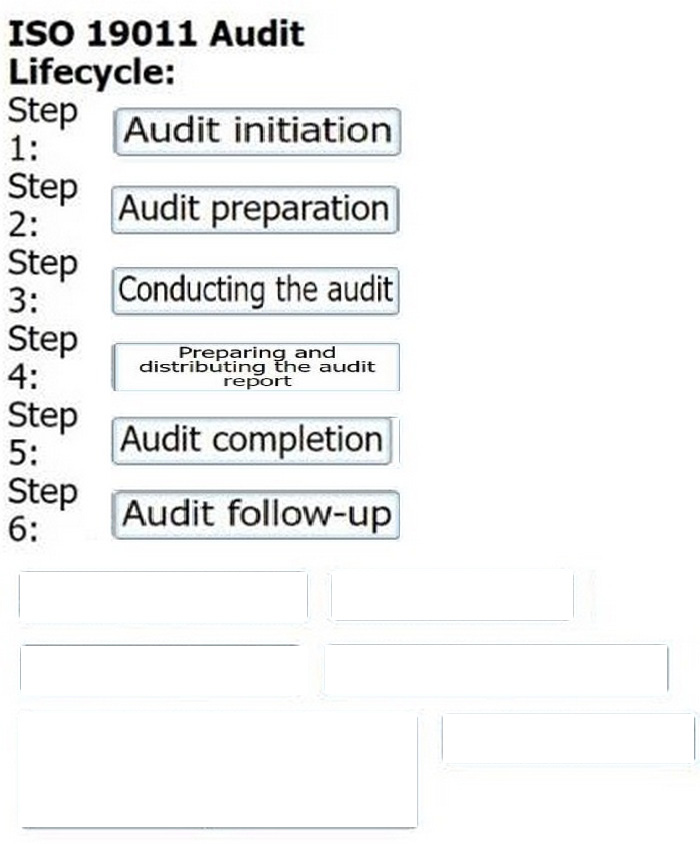
The audit lifecycle describes the ISO 19011 process for conducting an individual audit. Drag and drop the steps of the audit lifecycle into the correct sequence.
Reveal answer detailsClose answer details
Explanation
Step 1: Audit initiation
Step 2: Audit preparation Step 3: Conducting the audit Step 4: Preparing and distributing the audit report Step 5: Audit completion Step 6: Audit follow-up This sequence reflects the logical order of the audit activities, from establishing the audit objectives, scope and criteria, to verifying the implementation and effectiveness of the corrective actions. However, ISO 19011:2018 also recognizes that some audit activities can be iterative or concurrent, depending on the nature and complexity of the audit. For example, audit preparation and conducting the audit can overlap when new information or changes occur during the audit. Similarly, audit follow-up can be integrated with audit completion when the corrective actions are verified shortly after the audit. Therefore, the audit lifecycle should be adapted to the specific context and needs of each audit.
Question 33
Single choice
Scenario 9: UpNet, a networking company, has been certified against ISO/IEC 27001. It provides network security, virtualization, cloud computing, network hardware, network management software, and networking technologies.
The company's recognition has increased drastically since gaining ISO/IEC 27001 certification. The certification confirmed the maturity of UpNefs operations and its compliance with a widely recognized and accepted standard.
But not everything ended after the certification. UpNet continually reviewed and enhanced its security controls and the overall effectiveness and efficiency of the ISMS by conducting internal audits. The top management was not willing to employ a full-time team of internal auditors, so they decided to outsource the internal audit function. This form of internal audits ensured independence, objectivity, and that they had an advisory role about the continual improvement of the ISMS.
Not long after the initial certification audit, the company created a new department specialized in data and storage products. They offered routers and switches optimized for data centers and software-based networking devices, such as network virtualization and network security appliances. This caused changes to the operations of the other departments already covered in the ISMS certification scope.
Therefore. UpNet initiated a risk assessment process and an internal audit. Following the internal audit result, the company confirmed the effectiveness and efficiency of the existing and new processes and controls.
The top management decided to include the new department in the certification scope since it complies with ISO/IEC 27001 requirements. UpNet announced that it is ISO/IEC 27001 certified and the certification scope encompasses the whole company.
One year after the initial certification audit, the certification body conducted another audit of UpNefs ISMS. This audit aimed to determine the UpNefs ISMS fulfillment of specified ISO/IEC 27001 requirements and ensure that the ISMS is being continually improved. The audit team confirmed that the certified ISMS continues to fulfill the requirements of the standard. Nonetheless, the new department caused a significant impact on governing the management system. Moreover, the certification body was not informed about any changes. Thus, the UpNefs certification was suspended.
Based on the scenario above, answer the following question:
UpNet outsourced the internal audit function, as provided in scenario 9. Does it impact the internal audit process?
A
No, internal audits do not necessarily have to be independent and objective because they have an
advisory role
B
No, because the internal audit process can comprise more than an audit program
C
Yes, it increases the independence and impartiality of the internal audit because auditors do not have operational roles related to the ISMS
Reveal answer detailsClose answer details
Correct answerC
Explanation
Yes, outsourcing the internal audit function can positively impact the internal audit process by increasing its independence and impartiality. This helps ensure that the internal audits are conducted without any bias or influence from the company's internal management.
Question 34
Single choice
You are an experienced ISMS auditor conducting a third-party surveillance audit at an organisation which offers ICT reclamation services. ICT equipment which companies no longer require is processed by the organisation. It Is either recommissioned and reused or is securely destroyed. You notice two servers on a bench in the corner of the room. Both have stickers on item with the server's name, IP address and admin password. You ask the ICT Manager about them, and he tells you they were part of a shipment received yesterday from a regular customer.
Which one action should you take?
A
Ask the ICT Manager to record an information security incident and initiate the information security incident management process
B
Note the audit finding and check the process for dealing with incoming shipments relating to customer IT security
C
Record what you have seen in your audit findings, but take no further action
D
Raise a nonconformity against control 5.31 Legal, staturary, regulatory and contractual requirements'
E
Raise a nonconformity against control 8.20 'network security' (networks and network devices shall be secured, managed and controlled to protect information in systems and applications)
F
Ask the auditee to remove the labels, then carry on with the audit
Reveal answer detailsClose answer details
Correct answerB
Explanation
According to ISO 27001:2022 clause 8.1.4, the organisation shall ensure that externally provided processes, products or services that are relevant to the information security management system are controlled. This includes implementing appropriate contractual requirements related to information security with external providers, such as customers who send ICT equipment for reclamation
In this case, the organisation offers ICT reclamation services, which involves processing customer ICT equipment that may contain sensitive or confidential information. The organisation should have a process in place to ensure that the customer ICT equipment is handled securely and in accordance with the customer's information security requirements. The process should include steps such as verifying the customer's identity and authorisation, checking the inventory and condition of the equipment, removing or destroying any labels or stickers that contain information about the equipment or the customer, wiping or erasing any data stored on the equipment, and documenting the actions taken and the results achieved
The fact that the auditor noticed two servers on a bench with stickers that reveal the server's name, IP address and admin password indicates that the process for dealing with incoming shipments relating to customer IT security is not effective or not followed. This could pose a risk of unauthorised access, disclosure, or modification of the customer's information or systems. Therefore, the auditor should note the audit finding and check the process for dealing with incoming shipments relating to customer IT security, and determine whether there is a nonconformity with clause 8.1.4 of ISO 27001:2022
The other actions are not appropriate for the following reasons:
A. Asking the ICT Manager to record an information security incident and initiate the information security incident management process is not appropriate because this is not an information security incident that affects the organisation's own information or systems. An information security incident is defined as a single or a series of unwanted or unexpected information security events that have a significant probability of compromising business operations and threatening information security12 In this case, the information security event affects the customer's information or systems, not the organisation's. Therefore, the organisation should follow the process for dealing with incoming shipments relating to customer IT security, not the process for information security incident management. C. Recording what the auditor has seen in the audit findings, but taking no further action is not appropriate because this would not address the root cause or the impact of the issue. The auditor has a responsibility to verify the effectiveness and compliance of the organisation's information security management system, and to report any nonconformities or opportunities for improvement. Therefore, the auditor should check the process for dealing with incoming shipments relating to customer IT security, and determine whether there is a nonconformity with clause 8.1.4 of ISO 27001:2022. D. Raising a nonconformity against control 5.31 Legal, statutory, regulatory and contractual requirements is not appropriate because this control is not relevant to the issue. Control 5.31 requires the organisation to identify and comply with the legal, statutory, regulatory and contractual requirements that are applicable to the information security management system In this case, the issue is not about the organisation's compliance with the legal, statutory, regulatory and contractual requirements, but about the organisation's control of the externally provided processes, products or services that are relevant to the information security management system. Therefore, the auditor should check the process for dealing with incoming shipments relating to customer IT security, and determine whether there is a nonconformity with clause 8.1.4 of ISO 27001:2022. E. Raising a nonconformity against control 8.20 'network security' (networks and network devices shall be secured, managed and controlled to protect information in systems and applications) is not appropriate because this control is not relevant to the issue. Control 8.20 requires the organisation to secure, manage and control its own networks and network devices to protect the information in its systems and applications In this case, the issue is not about the organisation's network security, but about the organisation's control of the externally provided processes, products or services that are relevant to the information security management system. Therefore, the auditor should check the process for dealing with incoming shipments relating to customer IT security, and determine whether there is a nonconformity with clause 8.1.4 of ISO 27001:2022. F. Asking the auditee to remove the labels, then carry on with the audit is not appropriate because this would not address the root cause or the impact of the issue. The auditor should not interfere with the auditee's operations or suggest corrective actions during the audit, as this would compromise the auditor's objectivity and impartiality. The auditor should check the process for dealing with incoming shipments relating to customer IT security, and determine whether there is a nonconformity with clause 8.1.4 of ISO 27001:2022.
References: 1: ISO/IEC 27001:2022 Lead Auditor (Information Security Management Systems) Course by CQI and IRCA Certified Training 1 2: ISO/IEC 27001 Lead Auditor Training Course by PECB 2
Question 35
Single choice
Scenario 6: Sinvestment is an insurance company that offers home, commercial, and life insurance. The company was founded in North Carolina, but have recently expanded in other locations, including Europe and Africa.
Sinvestment is committed to complying with laws and regulations applicable to their industry and preventing any information security incident. They have implemented an ISMS based on ISO/IEC 27001 and have applied for ISO/IEC 27001 certification.
Two auditors were assigned by the certification body to conduct the audit. After signing a confidentiality agreement with Sinvestment. they started the audit activities. First, they reviewed the documentation required by the standard, including the declaration of the ISMS scope, information security policies, and internal audits reports. The review process was not easy because, although Sinvestment stated that they had a documentation procedure in place, not all documents had the same format.
Then, the audit team conducted several interviews with Sinvestment's top management to understand their role in the ISMS implementation. All activities of the stage 1 audit were performed remotely, except the review of documented information, which took place on-site, as requested by Sinvestment.
During this stage, the auditors found out that there was no documentation related to information security training and awareness program. When asked, Sinvestment's representatives stated that the company has provided information security training sessions to all employees. Stage 1 audit gave the audit team a general understanding of Sinvestment's operations and ISMS.
The stage 2 audit was conducted three weeks after stage 1 audit. The audit team observed that the marketing department (which was not included in the audit scope) had no procedures in place to control employees' access rights. Since controlling employees' access rights is one of the ISO/IEC 27001 requirements and was included in the information security policy of the company, the issue was included in the audit report. In addition, during stage 2 audit, the audit team observed that Sinvestment did not record logs of user activities. The procedures of the company stated that "Logs recording user activities should be retained and regularly reviewed," yet the company did not present any evidence of the implementation of such procedure.
During all audit activities, the auditors used observation, interviews, documented information review, analysis, and technical verification to collect information and evidence. All the audit findings during stages 1 and 2 were analyzed and the audit team decided to issue a positive recommendation for certification.
During stage 1 audit, the audit team found out that Sinvestment did not have records on information security training and awareness. What Sinvestment do in this case? Refer to scenario 6.
A
Correct the identified issue before the stage 2 audit
B
Document the identified issue and correct it after the certification audit is completed
C
Perform a new risk assessment process to understand whether the issue needs modification or not
Reveal answer detailsClose answer details
Correct answerA
Explanation
Sinvestment should correct the identified issue related to the lack of documentation on information security training and awareness before the stage 2 audit. Addressing this gap promptly ensures that the ISMS is fully compliant and effective when assessed in the subsequent audit stage.
Scenario 5: Data Grid Inc. is a well-known company that delivers security services across the entire information technology infrastructure. It provides cybersecurity software, including endpoint security, firewalls, and antivirus software. For two decades, Data Grid Inc. has helped various companies secure their networks through advanced products and services. Having achieved reputation in the information and network security field, Data Grid Inc. decided to obtain the ISO/IEC 27001 certification to better secure its internal and customer assets and gain competitive advantage.
Data Grid Inc. appointed the audit team, who agreed on the terms of the audit mandate. In addition, Data Grid Inc. defined the audit scope, specified the audit criteria, and proposed to close the audit within five days. The audit team rejected Data Grid Inc.'s proposal to conduct the audit within five days, since the company has a large number of employees and complex processes. Data Grid Inc. insisted that they have planned to complete the audit within five days, so both parties agreed upon conducting the audit within the defined duration. The audit team followed a risk-based auditing approach.
To gain an overview of the main business processes and controls, the audit team accessed process descriptions and organizational charts. They were unable to perform a deeper analysis of the IT risks and controls because their access to the IT infrastructure and applications was restricted. However, the audit team stated that the risk that a significant defect could occur to Data Grid Inc.'s ISMS was low since most of the company's processes were automated. They therefore evaluated that the ISMS, as a whole, conforms to the standard requirements by asking the representatives of Data Grid Inc. the following questions:
How are responsibilities for IT and IT controls defined and assigned? How does Data Grid Inc. assess whether the controls have achieved the desired results? What controls does Data Grid Inc. have in place to protect the operating environment and data from malicious software? Are firewall-related controls implemented?
Data Grid Inc.'s representatives provided sufficient and appropriate evidence to address all these questions.
The audit team leader drafted the audit conclusions and reported them to Data Grid Inc.'s top management. Though Data Grid Inc. was recommended for certification by the auditors, misunderstandings were raised between Data Grid Inc. and the certification body in regards to audit objectives. Data Grid Inc. stated that even though the audit objectives included the identification of areas for potential improvement, the audit team did not provide such information.
Based on this scenario, answer the following question:
What would prevent the misunderstanding between the certification body and the Data Grid Inc?
Refer to scenario 5.
A
Validating the audit offer
B
Signing the certification agreement
C
Defining the audit schedule
Reveal answer detailsClose answer details
Correct answerB
Explanation
Signing the certification agreement, which should clearly outline the audit objectives, scope, and responsibilities, would help prevent misunderstandings between the certification body and Data Grid Inc. A well-defined agreement ensures both parties have a clear understanding of what the audit will entail and what outputs are expected.
References: ISO/IEC 27006:2015, Information technology -- Security techniques -- Requirements for bodies providing audit and certification of information security management systems
Question 37
Multiple choice
Select two options that describe an advantage of using a checklist.
A
Using the same checklist for every audit without review
B
Restricting interviews to nominated parties
C
Ensuring relevant audit trails are followed
D
Ensuring the audit plan is implemented
E
Reducing audit duration
F
Not varying from the checklist when necessary
Reveal answer detailsClose answer details
Correct answersC, D
Explanation
A checklist is a tool that helps auditors to collect and verify information relevant to the audit objectives and scope. It can provide the following advantages: Ensuring relevant audit trails are followed: A checklist can help auditors to identify and trace the sources of evidence that support the conformity or nonconformity of the audited criteria. It can also help auditors to avoid missing or overlooking any important aspects of the audit. Ensuring the audit plan is implemented: A checklist can help auditors to follow and fulfil the audit plan, which describes the arrangements and details of the audit, such as the objectives, scope, criteria, schedule, roles, and responsibilities. It can also help auditors to manage their time and resources effectively and efficiently.
The other options are not advantages of using a checklist, but rather: Using the same checklist for every audit without review: This is a disadvantage of using a checklist, as it can lead to a rigid and ineffective audit approach. A checklist should be tailored and adapted to each specific audit, taking into account the context, risks, and changes of the auditee and the audit criteria. A checklist should also be reviewed and updated periodically to ensure its validity and relevance. Restricting interviews to nominated parties: This is a disadvantage of using a checklist, as it can limit the scope and depth of the audit. A checklist should not prevent auditors from interviewing other relevant parties or sources of information that may provide valuable evidence or insights for the audit. A checklist should be used as a guide, not as a constraint. Reducing audit duration: This is not necessarily an advantage of using a checklist, as it depends on various factors, such as the complexity, size, and maturity of the auditee's ISMS, the availability and quality of evidence, the competence and experience of the auditors, and the level of cooperation and communication between the auditors and the auditee. A checklist may help reduce audit duration by improving efficiency and organization, but it may also increase audit duration by requiring more evidence or verification. Not varying from the checklist when necessary: This is a disadvantage of using a checklist, as it can result in a superficial or incomplete audit. A checklist should not prevent auditors from exploring or investigating any issues or concerns that arise during the audit, even if they are not included in the checklist. A checklist should be used as a support, not as a substitute.
References: ISO/IEC 27001:2022 Lead Auditor (Information Security Management Systems) objectives and content from Quality.org and PECB ISO 19011:2018 Guidelines for auditing management systems [Section 6.2.2]
Question 38
Single choice
Which statement below best describes the relationship between information security aspects?
A
Threats exploit vulnerabilities to damage or destroy assets
B
Controls protect assets by reducing threats
C
Risk is a function of vulnerabilities that harm assets
Reveal answer detailsClose answer details
Correct answerA
Explanation
This statement encapsulates the relationship between threats, vulnerabilities, and assets within the context of information security. Threats are potential causes of an unwanted incident, which may result in harm to a system or organization. Vulnerabilities are weaknesses that can be exploited by threats to cause harm. Assets are valuable resources to an organization that need protection. Therefore, when threats exploit vulnerabilities, they can damage or destroy assets. References: = The explanation is based on the foundational concepts of information security as outlined in ISO/IEC 27001, which includes understanding the interplay between threats, vulnerabilities, and assets as part of an information security management system (ISMS)
Question 39
Multiple choice
You are performing an ISO 27001 ISMS surveillance audit at a residential nursing home, ABC Healthcare Services. ABC uses a healthcare mobile app designed and maintained by a supplier, WeCare, to monitor residents' well-being. During the audit, you learn that 90% erf the residents' family members regularly receive medical device advertisements from WeCare, by email and SMS once a week. The service agreement between ABC and WeCare prohibits the supplier from using residents' personal data. ABC has received many complaints from residents and their family members.
The Service Manager says that the complaints were investigated as an information security incident which found that they were justified. Corrective actions have been planned and implemented according to the nonconformity and corrective action management procedure. You write a nonconformity "ABC failed to comply with information security control A.5.34 (Privacy and protection of PII) relating to the personal data of residents' and their family members. A supplier, WeCare, used residents' personal information to send advertisements to family members"
Select three options of the corrections and corrective actions listed that you would expect ABC to make in response to the nonconformity
A
ABC confirms that information security control A.5.34 is contained in the Statement of Applicability (SoA)
B
The Service Manager provides evidence of analysis of the cause of nonconformity and how the ABC evaluates the effectiveness of implemented corrective actions
C
ABC instructs all staff to follow the signed healthcare service agreement with residents' family members
D
ABC conducts a management review to take the feedback from residents' family members into consideration
E
ABC needs to collect more evidence on how the organisation defines the management system scope and find out if they covered WeCare the medical device manufacturer
F
ABC identifies and checks compliance with all applicable legislation and contractual requirements involving third parties
G
The Service Manager implements the corrective actions and Customer Service Representatives evaluate the effectiveness of implemented corrective actions
H
ABC needs to collect more evidence on how information security risk assessment relates to the identified nonconformities before concluding actions on the nonconformity
Reveal answer detailsClose answer details
Correct answersB, F, G
Explanation
According to the ISO/IEC 27001:2022 Lead Auditor (Information Security Management Systems) course, the following corrections and corrective actions are expected from ABC in response to the nonconformity:
B. The Service Manager provides evidence of analysis of the cause of nonconformity and how the ABC
evaluates the effectiveness of implemented corrective actions. This is part of the requirement of clause 10.1 of ISO/IEC 27001:2022, which states that the organization shall determine the causes of nonconformities and evaluate the need for action to ensure that they do not recur or occur elsewhere. The organization shall also evaluate the effectiveness of any corrective actions taken.
F. ABC identifies and checks compliance with all applicable legislation and contractual requirements involving third parties. This is part of the requirement of clause 4.2 of ISO/IEC 27001:2022, which states that the organization shall determine the external and internal issues that are relevant to its purpose and that affect its ability to achieve the intended outcome(s) of its information security management system. This includes the legal and contractual requirements related to the information security aspects of the organization's activities, products and services.
G. The Service Manager implements the corrective actions and Customer Service Representatives evaluate the effectiveness of implemented corrective actions. This is part of the requirement of clause 10.1 of ISO/IEC 27001:2022, which states that the organization shall implement any action needed and retain documented information as evidence of the results of any action taken. The organization shall also monitor, measure, analyze and evaluate the information security performance and the effectiveness of the information security management system.
References: 1: ISO/IEC 27001:2022 Lead Auditor (Information Security Management Systems) course, CQI and IRCA Certified Training, 1 2: ISO/IEC 27001 Lead Auditor Training Course, PECB, 2
Question 40
Single choice
Which of the options below is a control related to the management of personnel that aims to avoid the occurrence of incidents?
A
The organization regularly provides security awareness and training sessions for its employees
B
The organization always reviews the security policy after the integration of a new division to the organization
C
The organization conducts regular user access reviews to verify that only authorized employees have access to confidential information
Reveal answer detailsClose answer details
Correct answerA
Explanation
Regular security awareness and training sessions for employees are a control measure aimed at preventing security incidents by ensuring that personnel are aware of information security threats and concerns, and understand their roles and responsibilities in safeguarding organizational assets. This proactive approach is designed to educate employees on the importance of security practices and to avoid the occurrence of security incidents. References: = This answer is based on the principles of personnel security management as outlined in ISO/IEC 27001, particularly in Annex A.7 which deals with human resource security before, during, and after employment, and Annex A.9 which focuses on access control and ensuring that employees have access only to the information that is necessary for their job role
Question 41
Single choice
Scenario 6: Sinvestment is an insurance company that offers home, commercial, and life insurance. The company was founded in North Carolina, but have recently expanded in other locations, including Europe and Africa.
Sinvestment is committed to complying with laws and regulations applicable to their industry and preventing any information security incident. They have implemented an ISMS based on ISO/IEC 27001 and have applied for ISO/IEC 27001 certification.
Two auditors were assigned by the certification body to conduct the audit. After signing a confidentiality agreement with Sinvestment. they started the audit activities. First, they reviewed the documentation required by the standard, including the declaration of the ISMS scope, information security policies, and internal audits reports. The review process was not easy because, although Sinvestment stated that they had a documentation procedure in place, not all documents had the same format.
Then, the audit team conducted several interviews with Sinvestment's top management to understand their role in the ISMS implementation. All activities of the stage 1 audit were performed remotely, except the review of documented information, which took place on-site, as requested by Sinvestment.
During this stage, the auditors found out that there was no documentation related to information security training and awareness program. When asked, Sinvestment's representatives stated that the company has provided information security training sessions to all employees. Stage 1 audit gave the audit team a general understanding of Sinvestment's operations and ISMS.
The stage 2 audit was conducted three weeks after stage 1 audit. The audit team observed that the marketing department (which was not included in the audit scope) had no procedures in place to control employees' access rights. Since controlling employees' access rights is one of the ISO/IEC 27001 requirements and was included in the information security policy of the company, the issue was included in the audit report. In addition, during stage 2 audit, the audit team observed that Sinvestment did not record logs of user activities. The procedures of the company stated that "Logs recording user activities should be retained and regularly reviewed," yet the company did not present any evidence of the implementation of such procedure.
During all audit activities, the auditors used observation, interviews, documented information review, analysis, and technical verification to collect information and evidence. All the audit findings during stages 1 and 2 were analyzed and the audit team decided to issue a positive recommendation for certification.
According to scenario 6, the marketing department employees were not following the access control policy.
Which option is correct in this case?
A
The marketing department is not included in the audit scope, so the issue should only be communicated to Sinvestment's representatives
B
The employees' access right control is included in Sinvestment's information security policy, so the
issue must be communicated to Sinvestment's representatives and included in the audit report
C
Sinvestment is not controlling the employees' access rights, which represents a potential information security risk and should be reported as a major nonconformity
Reveal answer detailsClose answer details
Correct answerB
Explanation
Even though the marketing department was not included in the audit scope, the issue of employees' access rights control must be communicated to Sinvestment's representatives and included in the audit report because it is part of Sinvestment's information security policy. It reflects on the overall adherence to the ISMS requirements.
When preparing for an audit, which of the following statements is false?
A
Each auditor creates their own audit checklist for use during the audit
B
The audit checklists are shared and agreed with the auditee in advance of the audit
C
The audit plan is shared with the auditee in advance of the audit
D
The audit plan may be changed during the audit
Reveal answer detailsClose answer details
Correct answerB
Question 43
Single choice
After completing Stage 1 and in preparation for a Stage 2 initial certification audit, the auditee informs the audit team leader that they wish to extend the audit scope to include two additional sites that have recently been acquired by the organisation.
Considering this information, what action would you expect the audit team leader to take?
A
Arrange to complete a remote Stage 1 audit of the two sites using a video conferencing platform
B
Increase the length of the Stage 2 audit to include the extra sites
C
Inform the auditee that the audit team leader accepts the request
D
Obtain information about the additional sites to inform the individual(s) managing the audit programme
Reveal answer detailsClose answer details
Correct answerD
Explanation
According to the PECB Candidate Handbook for ISO/IEC 27001 Lead Auditor, the audit team leader should obtain information about the additional sites to inform the individual(s) managing the audit programme, as this may affect the audit objectives, scope, criteria, duration, resources, and risks. The audit team leader should also review the audit plan and make any necessary adjustments in consultation with the auditee and the audit client 1. References: 1: PECB Candidate Handbook for ISO/IEC 27001 Lead Auditor, page 27, section 4.3.2.2.
Question 44
Multiple choice
Review the following statements and determine which two are false:
A
Auditors approved for conducting onsite audits do not require additional training for virtual audits, as there are no significant differences in the skillset required
B
Conducting a technology check in advance of a virtual audit can improve the effectiveness and efficiency of the audit
C
Due to confidentiality and security concerns, screen sharing during a virtual audit is one method by which the audit team can review the auditee's documentation
D
During a virtual audit, auditees participating in interviews are strongly recommended to keep their webcam enabled
E
The number of days assigned to a third-party audit is determined by the auditee's availability
F
The selection of onsite, virtual or combination audits should take into consideration historical performance and previous audit results
Reveal answer detailsClose answer details
Correct answersA, E
Explanation
Auditors approved for conducting onsite audits do require additional training for virtual audits to ensure they are competent in using the technology and tools required for conducting audits remotely 12. The number of days assigned to a third-party audit is not determined by the auditee's availability, but rather by factors such as the size and complexity of the organization, the scope of the audit, and the requirements of the certification body 34.
References: The answers are verified based on the content and objectives of the ISMS ISO/IEC 27001 Lead Auditor course, as well as the guidelines provided in the reference materials and documents related to the course.
PECB
PECB Certified ISO/IEC 27001 Lead Auditor exam
ISO-IEC-27001-LEAD-AUDITOR · 44 sample Q&As · Public preview
You received an email requiring you to send information such as name, email, and password in order to continue using your email account. If you do not send such information, your email account will be disabled.
What does this scenario present?
A.
A personnel type of vulnerability
B.
An unauthorized action type of threat
C.
A compromise of information type of threat
Correct Answer: B
Explanation
Explanation/Reference:
The scenario described is a classic example of a phishing attack, which is a type of social engineering threat where attackers masquerade as a trustworthy entity in an electronic communication. The goal is to trick individuals into providing sensitive information. This represents an unauthorized action type of threat because it involves an attacker attempting to gain unauthorized access to personal information. References: = This understanding of phishing as a threat is consistent with the principles of information security management systems and is supported by resources that describe phishing attacks and their prevention
QUESTION 2
-------------------------is an asset like other important business assets has value to an organization and consequently needs to be protected.
A.
Infrastructure
B.
Data
C.
Information
D.
Security
Correct Answer: C
Explanation
Explanation/Reference:
Information is an asset like other important business assets, as it has value to an organization and consequently needs to be protected. Information can be in any form, such as electronic, paper, or verbal. Information security is the protection of information from unauthorized access, use, disclosure, modification, or destruction 2. References: ISO/IEC 27001:2022 Lead Auditor (Information Security Management Systems) | CQI | IRCA
QUESTION 3
During discussions with the individual(s) managing the audit programme of a certification body, the Management System Representative of the client organisation asks for a specific auditor for the certification audit. Select two of the following options for how the individual(s) managing the audit programme should respond.
A.
Advise the Management System Representative that his request can be accepted
B.
Suggest that the Management System Representative chooses another certification body
C.
State that his request will be considered but may not be taken up
D.
Suggest asking the certification body management to permit the request
E.
Advise the Management System Representative that the audit team selection is a decision that the audit programme manager needs to make based on the resources available
Correct Answer: CE
Explanation
Explanation/Reference:
According to ISO/IEC 17021-1, which specifies the requirements for bodies providing audit and certification of management systems, a certification body should ensure that its auditors are competent, impartial, and independent from the auditee organization 2. Therefore, if a Management System Representative of a client organization asks for a specific auditor for the certification audit, the individual(s) managing the audit programme should respond in a way that does not compromise these principles or create any conflict of interest or undue influence. Two possible ways to respond are to state that his request will be considered but may not be taken up, as there may be other factors that affect the auditor selection process; or to advise him that the audit team selection is a decision that the audit programme manager needs to make based on the resources available, such as auditor availability, competence, location, etc. The other options are not suitable ways to respond in this situation. For example, advising him that his request can be accepted may raise doubts about the objectivity and credibility of the auditor and the certification body; suggesting that he chooses another certification body may imply that his request is unreasonable or unethical; and suggesting asking the certification body management to permit his request may suggest that there is room for negotiation or manipulation in auditor selection
References: ISO/IEC 17021-1:2015 - Conformity assessment ?Requirements for bodies providing audit and certification of management systems ?Part 1: Requirements
QUESTION 4
What is the standard definition of ISMS?
A.
Is an information security systematic approach to achieve business objectives for implementation, establishing, reviewing,operating and maintaining organization's reputation.
B.
A company wide business objectives to achieve information security awareness for establishing, implementing, operating, monitoring, reviewing, maintaining and improving
C.
A project-based approach to achieve business objectives for establishing, implementing, operating, monitoring, reviewing, maintaining and improving an organization's information security
D.
A systematic approach for establishing, implementing, operating,monitoring, reviewing, maintaining and improving an organization's information security to achieve business objectives.
Correct Answer: D
Explanation
Explanation/Reference:
The standard definition of ISMS is a systematic approach for establishing, implementing, operating, monitoring, reviewing, maintaining and improving an organization's information security to achieve business objectives. This definition is given in clause 3.17 of ISO/IEC 27001:2022, and it describes the main components and purpose of an ISMS. An ISMS is not a project-based approach, as it is an ongoing process that requires continual improvement. An ISMS is not a company wide business objective, as it is a management system that supports the organization's objectives. An ISMS is not an information security systematic approach, as it is a broader concept that encompasses the organization's context, risks, controls, and performance. References: CQI & IRCA ISO 27001:2022 Lead Auditor Course Handbook, page 15. : ISO /IEC 27001:2022, clause 3.17.
QUESTION 5
After analyzing the audit conclusions, Company X decided to accept the risk related to one of the detected nonconformities. They claimed that no corrective action was necessary; however, their decision was not documented. Is this acceptable?
A.
Yes, the auditee's management can decide to accept the risk instead of implementing corrective actions and documenting such decision is not necessary
B.
No, the decision of the auditee to accept the risk instead of implementing corrective actions should be
justified and documented
C.
No, the auditee must implement corrective actions for all the observations documented during the audit
Correct Answer: B
Explanation
Explanation/Reference:
According to ISO/IEC 27001 standards, if the auditee decides to accept the risk instead of implementing corrective actions for a nonconformity, this decision should be justified and documented. Documenting such decisions is essential for maintaining the integrity of the ISMS and for demonstrating that the decision was made based on informed judgment.
References: ISO/IEC 27001:2013, Clause 6.1 (Actions to address risks and opportunities)
QUESTION 6
DRAG DROP
You have just completed a scheduled information security audit of your organisation when the IT Manager approaches you and asks for your assistance in the revision of the company's risk management process.
He is attempting to update the current documentation to make it easier for other managers to understand, however, it is clear from your discussion he is confusing several key terms.
You ask him to match each of the descriptions with the appropriate risk term.
What should the correct answers be?
Correct Answer:
Explanation
Explanation/Reference:
The strategy chosen to respond to a specific information security risk: This is a definition of information security risk treatment. According to ISO/IEC 27000:2022, information security risk treatment is "the process of selecting and implementing measures to modify the information security risk" Section 3.33. The effect of uncertainty on information security objectives: This is a definition of information security risk. According to ISO/IEC 27000:2022, information security risk is "the effect of uncertainty on information security objectives" Section 3.32. The requirements against which information security risks are evaluated: This is a definition of information security risk criteria. According to ISO/IEC 27000:2022, information security risk criteria are "the terms of reference by which the significance of information security risks is assessed" Section 3.31. A definition of the overall level of information security risk that is considered to be tolerable: This is a definition of information security risk acceptance criteria. According to ISO/IEC 27000:2022, information security risk acceptance criteria are "the level of information security risk that is acceptable" Section 3.30.
QUESTION 7
You are the audit team leader conducting a third-party audit of an online insurance company. During Stage 1, you found that the organization took a very cautious risk approach and included all the information security controls in ISO/IEC 27001:2022 Appendix A in their Statement of Applicability.
During the Stage 2 audit, your audit team found that there was no evidence of a risk treatment plan for the implementation of the three controls (5.3 Segregation of duties, 6.1 Screening, 7.12 Cabling security). You raise a nonconformity against clause 6.1.3.e of ISO 27001:2022.
At the closing meeting, the Technical Director issues an extract from an amended Statement of Applicability (as shown) and asks for the nonconformity to be withdrawn.
Select three options of the correct responses of an audit team leader to the request of the Technical Director.
A.
Advise management that the information provided will be reviewed when the auditors have more time.
B.
Advise the Technical Director that his request will be included in the audit report.
C.
Advise the Technical Director that once a nonconformity is raised it cannot be withdrawn.
D.
Advise the Technical Director that the nonconformity must stand since the evidence obtained for it was clear.
E.
Ask the auditor who raised the issue for their opinion on how you should respond to the request.
F.
Inform the Technical Director that the nonconformity will be changed to an Opportunity for Improvement.
G.
Review the documentation produced and withdraw the nonconformity.
H.
State that a follow up audit will be necessary to review the evidence for the updated Statement of
Applicability.
Correct Answer: BDH
Explanation
Explanation/Reference:
The three options of the correct responses of an audit team leader to the request of the Technical Director are:
Advise the Technical Director that his request will be included in the audit report. Advise the Technical Director that the nonconformity must stand since the evidence obtained for it was clear. State that a follow up audit will be necessary to review the evidence for the updated Statement of Applicability.
This response is correct because the audit team leader should document the request of the Technical Director and include it in the audit report, along with the audit findings and conclusions 12. This will ensure transparency and traceability of the audit process and the audit results. This response is correct because the audit team leader should not withdraw the nonconformity based on the amended Statement of Applicability alone. The nonconformity was raised against clause 6.1.3.e of ISO 27001:2022, which requires the organisation to produce and maintain a risk treatment plan that defines how the information security risks are treated, including the controls selected and their implementation status 34. The Statement of Applicability is only one part of the risk treatment plan, and it does not provide sufficient evidence that the controls have been implemented effectively. The audit team leader should base the nonconformity on the objective evidence obtained during the audit, not on the subjective claims of the auditee 12. This response is correct because the audit team leader should state that a follow up audit will be necessary to review the evidence for the updated Statement of Applicability. A follow up audit is an audit that is conducted after a previous audit to verify the implementation and effectiveness of the corrective actions and/or opportunities for improvement that were agreed upon as a result of the previous audit 56. The follow up audit should seek to ensure that the nonconformity has been effectively addressed and that the ISMS is compliant and effective. The follow up audit should also consider any new or changed risks or requirements that may affect the ISMS.
References: 1: PECB Candidate Handbook - ISO 27001 Lead Auditor, page 25 2: ISO 19011:2018 - Guidelines for auditing management systems, clause 6.7 3: ISO/IEC 27001:2022 - Information technology -- Security techniques -- Information security management systems -- Requirements, clause 6.1.3.e 4: ISO/IEC 27005:2022 - Information technology -- Security techniques -- Information security risk management, clause 8.3.2 5: PECB Candidate Handbook - ISO 27001 Lead Auditor, page 25 6: ISO 19011:2018 - Guidelines for auditing management systems, clause 6.7
QUESTION 8
You are an experienced ISMS audit team leader guiding an auditor in training. You decide to test her knowledge of follow-up audits by asking her a series of questions. Here are your questions and her answers.
Which four of your questions has she answered correctly?
A.
Q: Should a follow-up audit seek to identify new nonconformities? A:YES
B.
Q: Should follow-up audits seek to ensure nonconformities have been effectively addressed? A:YES
C.
Q: Should follow-up audits consider agreed opportunities for improvement as well as corrective action? A:No
D.
Q: Is the purpose of a follow-up audit to verify the completion of corrections, corrective actions, and opportunities for improvement? A:YES
E.
Q: Are follow-up audits required for all audits? A:No
F.
Q: Should the outcome from a follow-up audit be reported to the audit team leader who carried out the audit at which the NCs were originally identified? A:YES
G.
Q: Should the outcome from a follow-up audit be reported to the audit client? A:No
H.
Q: Could an outcome from a follow-up audit be another follow-up audit if required? A:YES
Correct Answer: BDEH
Explanation
Explanation/Reference:
Based on the understanding of follow-up audits, especially in the context of Information Security Management Systems (ISMS) and the guidelines provided by ISO 19011:2018, here are the four questions from your list that the auditor in training has answered correctly:
B. Q: Should follow-up audits seek to ensure nonconformities have been effectively addressed? A: YES This is correct. The primary purpose of follow-up audits is to verify that nonconformities identified in previous audits have been effectively addressed and the corrective actions taken are suitable and effective. D. Q: Is the purpose of a follow-up audit to verify the completion of corrections, corrective actions, and opportunities for improvement? A: YES Yes, the follow-up audit aims to verify the completion and effectiveness of corrections and corrective actions. It may also consider the implementation of opportunities for improvement identified during the initial audit. E. Q: Are follow-up audits required for all audits? A: NO This is correct. Follow-up audits are not automatically required for all audits. They are typically conducted when nonconformities or other significant issues were identified in an earlier audit and there's a need to verify the implementation and effectiveness of the corrective actions. H. Q: Could an outcome from a follow-up audit be another follow-up audit if required? A: YES Yes, this is a possible outcome. If the follow-up audit finds that the corrective actions have not been fully effective, or if new issues are identified, it may be necessary to conduct another follow-up audit.
The other responses provided by the auditor in training require some clarification or correction. For instance, while a follow-up audit primarily focuses on previously identified nonconformities and corrective actions, it can still identify new nonconformities if observed (A). Opportunities for improvement are generally considered in the scope of regular audits more so than in follow-up audits, which are more narrowly focused on corrective actions (C). Also, the outcomes of follow-up audits should typically be reported to both the audit team leader and the audit client (F and G), ensuring transparency and accountability.
The four questions that the auditor in training has answered correctly are B, D, E, and H. These questions and answers are consistent with the definition and purpose of a follow-up audit as specified in ISO 19011:2018, Clause 6.712. A follow-up audit is conducted to verify the completion and effectiveness of corrective actions taken as a result of a previous audit (B, D). Follow-up audits are not mandatory for all audits, but they may be required by the audit program, the audit client, or other interested parties (E). The outcome of a follow-up audit may be another follow-up audit if the corrective actions are not satisfactory or not completed within the agreed time frame (H). The other questions and answers are either incorrect or irrelevant. A follow-up audit should not seek to identify new nonconformities, as this is not its objective (A). Follow-up audits should consider agreed opportunities for improvement as well as corrective actions, as they are both outputs of a previous audit ? The outcome of a follow-up audit should be reported to the audit client, as well as to other relevant parties, such as the audit team leader who carried out the previous audit (F, G).
References: 1: ISO 19011:2018, Guidelines for auditing management systems, Clause 6.7 \n2: PECB Certified ISO/IEC 27001 Lead Auditor Exam Preparation Guide, Domain 6: Closing an ISO/IEC 27001 audit
QUESTION 9
You are an experienced audit team leader conducting a third-party surveillance audit of an organisation that designs websites for its clients. You are currently reviewing the organisation's Statement of Applicability.
Based on the requirements of ISO/IEC 27001, which two of the following observations about the Statement of Applicability are true?
A.
Justification for both the inclusion and exclusion of Annex A controls in the Statement of Applicability is required
B.
The Statement of Applicability is owned and amended by the organisation's top management
C.
The Statement of Applicability must be reviewed at least annually
D.
A Statement of Applicability must be produced by organisations seeking ISO/IEC 27001 conformity
E.
Justification is only required for any controls that the organisations choses to exclude
F.
The Statement of Applicability must be reviewed at Management Review
Correct Answer: AD
QUESTION 10
Auditors should have certain knowledge and skills; while audit team leaders should have some additional knowledge and skills. From the following list, select two that only apply to audit team leaders.
A.
Plan the audit
B.
Understand and apply the risk-based approach to auditing
C.
Apply appropriate sampling techniques
D.
Make effective use of resources provided to the audit
E.
Be aware of cultural and social aspects of the auditee
F.
Verify the relevance and accuracy of collected information
Correct Answer: AD
Explanation
Explanation/Reference:
According to the PECB Candidate Handbook1, audit team leaders should have the following additional knowledge and skills compared to auditors:
Plan the audit, including preparing the audit plan, assigning work to the audit team members and coordinating their activities
Make effective use of resources provided to the audit, such as personnel, time, budget and equipment
Manage the audit process, including leading the opening and closing meetings, directing the audit team, resolving conflicts and ensuring the audit objectives are achieved
Review and approve the audit report and audit findings
Communicate with the client and other interested parties throughout the audit
References: 1: PECB Candidate Handbook - ISO 27001 Lead Auditor, pages 9-10.
QUESTION 11
You are conducting an ISMS audit in the despatch department of an international logistics organisation that provides shipping services to large organisations including local hospitals and government offices. Parcels typically contain pharmaceutical products, biological samples, and documents such as passports and driving licences. You note that the company records show a very large number of returned items with causes including misaddressed labels and, in 15% of cases, two or more labels for different addresses for the one package. You are interviewing the Shipping Manager (SM).
You: Are items checked before being dispatched?
SM: Any obviously damaged items are removed by the duty staff before being dispatched, but the small profit margin makes it uneconomic to implement a formal checking process.
You: What action is taken when items are returned?
SM: Most of these contracts are relatively low value, therefore it has been decided that it is easier and more convenient to simply reprint the label and re-send individual parcels than it is to implement an investigation.
You raise a nonconformity against ISO 27001:2022 based on the lack of control of the labelling process. At the closing meeting, the Shipping Manager issues an apology to you that his comments may have been misunderstood.
He says that he did not realise that there is a background IT process that automatically checks that the right label goes onto the right parcel otherwise the parcel is ejected at labelling. He asks that you withdraw your nonconformity.
Select three options of the correct responses that you as the audit team leader would make to the request of the Shipping Manager.
A.
Advise the Shipping Manager that his request will be included in the audit report
B.
Advise management that the new information provided will be discussed when the auditors have more time
C.
Inform the Shipping Manager that the nonconformity is minor and should be quickly corrected
D.
Ask the audit team members to state what they think should happen
E.
Inform him of your understanding and withdraw the nonconformity
F.
Thank the Shipping Manager for his honesty but advise that withdrawing the nonconformity is not the right way to proceed
G.
Advise the Shipping Manager that the nonconformity must stand since the evidence obtained for it was dear
H.
Indicate that the nonconformity is evidence of a deeper system failure that needs to be rectified
Correct Answer: ABF
Explanation
Explanation/Reference:
A. Advise the Shipping Manager that his request will be included in the audit report. This is true because the audit report should document all the relevant information and evidence related to the audit, including any requests or objections raised by the auditee. The audit report should also provide the rationale for the audit conclusions and recommendations. B. Advise management that the new information provided will be discussed when the auditors have more
time. This is true because the auditors should not make hasty decisions based on incomplete or unverified information. The auditors should review and evaluate the new information in a systematic and objective manner, and determine whether it affects the audit findings, nonconformities, or conclusions F. Thank the Shipping Manager for his honesty but advise that withdrawing the nonconformity is not the right way to proceed. This is true because the auditors should acknowledge and appreciate the cooperation and transparency of the auditee, but also maintain their professional integrity and independence. The auditors should not withdraw a nonconformity unless they are satisfied that it was raised in error or that it has been effectively corrected and verified.
References: ISO 19011:2022 Guidelines for auditing management systems ISO/IEC 17021-1:2022 Conformity assessment -- Requirements for bodies providing audit and certification of management systems -- Part 1: Requirements
QUESTION 12
DRAG DROP
An organisation is looking for management system initial certification. Please identify the sequence of the activities to be undertaken by the organisation.
To complete the sequence click on the blank section you want to complete so that it is highlighted in red, and then click on the applicable text from the options below. Alternatively, you may drag and drop the options to the appropriate blank section.
Correct Answer:
Explanation
Explanation/Reference:
The correct sequence of activities is:
Establish the management system
Plan the audit programme
Conduct internal audits
Hold a Management Review
Engage a Certification Body for stage 1 and stage 2 audits
Complete any corrective actions
Comprehensive but Short = According to the PECB Candidate Handbook - ISO/IEC 27001 Lead Auditor, the steps for achieving certification are as follows1:
Establish the management system: This involves defining the scope, objectives, policies, procedures, and controls of the ISMS, as well as ensuring the availability of resources and top management commitment.
Plan the audit programme: This involves defining the audit objectives, criteria, scope, frequency, methods, and responsibilities for conducting internal audits of the ISMS.
Conduct internal audits: This involves verifying the conformity and effectiveness of the ISMS, as well as identifying any nonconformities or opportunities for improvement.
Hold a Management Review: This involves reviewing the performance and suitability of the ISMS, as well as deciding on any changes or actions needed to improve it.
Engage a Certification Body for stage 1 and stage 2 audits: This involves selecting a reputable and accredited certification body to conduct an external audit of the ISMS, consisting of two stages: a documentation review and an on-site assessment.
Complete any corrective actions: This involves addressing any nonconformities or findings identified by the certification body, and providing evidence of their implementation and effectiveness.
Which two of the following phrases would apply to 'check' in the Plan-Do-Check-Act cycle for a business process?
A.
Making improvements
B.
Managing changes
C.
Verifying training
D.
Resetting objectives
E.
Updating the Information Security Policy
F.
Auditing processes
Correct Answer: CF
Explanation
Explanation/Reference:
The two phrases that would apply to `check' in the Plan-Do-Check-Act cycle for a business process are:
Verifying training Auditing processes This phrase applies to `check' in the PDCA cycle because it involves measuring and evaluating the effectiveness of the training activities that were implemented in the `do' phase. Training is an important aspect of information security awareness, education, and competence, which are required by clause 7.2 of ISO 27001:20221. Verifying training can help the organisation to assess whether the staff have acquired the necessary knowledge, skills, and behaviour to perform their roles and responsibilities in relation to information security. Verifying training can also help the organisation to identify any gaps or weaknesses in the training program and to plan for improvement actions. This phrase applies to `check' in the PDCA cycle because it involves examining and reviewing the performance and conformity of the processes that were implemented in the `do' phase. Auditing is a systematic, independent, and documented process for obtaining objective evidence and evaluating it to determine the extent to which the audit criteria are fulfilled. Auditing processes can help the organisation to verify whether the information security objectives and requirements are met, whether the information security controls are effective and efficient, and whether the information security risks are adequately managed. Auditing processes can also help the organisation to identify any nonconformities or opportunities for improvement and to plan for corrective or preventive actions.
References: ISO/IEC 27001:2022 - Information technology -- Security techniques -- Information security management systems -- Requirements, clause 7.2 ISO 19011:2018 - Guidelines for auditing management systems, clause 3.2
QUESTION 14
Which is an example of a qualitative evidence?
A.
The documented results of an intrusion-detection test from an information security expert from an external organization
B.
A defined sample analysis of nonconformity reports drafted by the audited organization from the time their ISMS was implemented
C.
An interview with the information security personnel to validate if the information security process complies with the standard requirements
Correct Answer: C
Explanation
Explanation/Reference:
Qualitative evidence in an audit typically involves observations, interviews, and reviews that provide insights into the processes and compliance through subjective but informed assessments. An interview with information security personnel to validate compliance with the standard requirements is an example of qualitative evidence, where the quality and effectiveness of processes are assessed based on expert judgments rather than measurable metrics. References: PECB ISO/IEC 27001 Lead Auditor Course Material
QUESTION 15
Scenario 2: Knight is an electronics company from Northern California, US that develops video game consoles. Knight has more than 300 employees worldwide. On the fifth anniversary of their establishment, they have decided to deliver the G-Console, a new generation video game console aimed for worldwide markets. G-Console is considered to be the ultimate media machine of 2021 which will give the best gaming experience to players.
The console pack will include a pair of VR headset, two games, and other gifts.
Over the years, the company has developed a good reputation by showing integrity, honesty, and respect toward their customers. This good reputation is one of the reasons why most passionate gamers aim to have Knight's G-console as soon as it is released in the market.
Besides being a very customer-oriented company, Knight also gained wide recognition within the gaming industry because of the developing quality. Their prices are a bit higher than the reasonable standards allow.
Nonetheless, that is not considered an issue for most loyal customers of Knight, as their quality is top-notch.
Being one of the top video game console developers in the world, Knight is also often the center of attention for malicious activities. The company has had an operational ISMS for over a year. The ISMS scope includes all departments of Knight, except Finance and HR departments. Recently, a number of Knight's files containing proprietary information were leaked by hackers. Knight's incident response team (IRT) immediately started to analyze every part of the system and the details of the incident.
The IRT's first suspicion was that Knight's employees used weak passwords and consequently were easily cracked by hackers who gained unauthorized access to their accounts. However, after carefully investigating the incident, the IRT determined that hackers accessed accounts by capturing the file transfer protocol (FTP) traffic.
FTP is a network protocol for transferring files between accounts. It uses clear text passwords for authentication.
Following the impact of this information security incident and with IRT's suggestion, Knight decided to replace the FTP with Secure Shell (SSH) protocol, so anyone capturing the traffic can only see encrypted data.
Following these changes, Knight conducted a risk assessment to verify that the implementation of controls had minimized the risk of similar incidents. The results of the process were approved by the ISMS project manager who claimed that the level of risk after the implementation of new controls was in accordance with the company's risk acceptance levels.
Based on this scenario, answer the following question:
Based on scenario 2, Knight decided to replace the FTP with Secure Shell (SSH) protocol. Should the Statement of Applicability (SoA) be updated in this case?
A.
No, the usage of SSH protocol is not an ISO/IEC 27001 requirement and; therefore, does not need to be included in the SoA
B.
No, because the SoA should be updated only when new controls are added, not when old ones are canceled
C.
Yes, the implementation of the new control should be justified and included in the SoA
Correct Answer: C
Explanation
Explanation/Reference:
The Statement of Applicability (SoA) is a core document within an ISMS that outlines the security controls an organization implements. When a new control, such as the SSH protocol, is implemented, it should be included in the SoA to reflect the current state of the ISMS. The SoA should be updated to justify the inclusion of the new control and to document how it is implemented within the organization.
References: This guidance is based on the best practices for maintaining the SoA as per ISO/IEC 27001, which requires the SoA to be a living document that accurately reflects the security controls in use by the organization
QUESTION 16
What is the difference between a restricted and confidential document?
A.
Restricted - to be shared among an authorized group Confidential - to be shared among named individuals
B.
Restricted - to be shared among named individuals Confidential - to be shared among an authorized group
C.
Restricted - to be shared among named individuals Confidential - to be shared across the organization only
D.
Restricted - to be shared among named individuals Confidential - to be shared with friends and family
Correct Answer: B
Explanation
Explanation/Reference:
The difference between a restricted and confidential document is that a restricted document is to be shared among named individuals, while a confidential document is to be shared among an authorized group. Restricted and confidential are examples of information classification levels that indicate the sensitivity and value of information and the degree of protection required for it. Restricted documents contain information that could cause serious damage or harm to the organization or its stakeholders if disclosed to unauthorized persons. Therefore, they should only be accessed by specific individuals who have a legitimate need to know and are authorized by the information owner. Confidential documents contain information that could cause damage or harm to the organization or its stakeholders if disclosed to unauthorized persons. Therefore, they should only be accessed by a defined group of people who have a legitimate need to know and are authorized by the information owner. ISO/IEC 27001:2022 requires the organization to classify information in terms of legal requirements, value, criticality and sensitivity to unauthorized disclosure or modification (see clause A. 8.2.1). References: CQI & IRCA Certified ISO/IEC 27001:2022 Lead Auditor Training Course, ISO/IEC 27001:2022 Information technology -- Security techniques -- Information security management systems -- Requirements, What is Information Classification?
QUESTION 17
Scenario 4: SendPay is a financial company that provides its services through a network of agents and financial institutions. One of their main services is transferring money worldwide. SendPay, as a new company, seeks to offer top quality services to its clients. Since the company offers international transactions, it requires from their clients to provide personal information, such as their identity, the reason for the transactions, and other details that might be needed to complete the transaction. Therefore, SendPay has implemented security measures to protect their clients' information, including detecting, investigating, and responding to any information security threats that may emerge. Their commitment to offering secure services was also reflected during the ISMS implementation where the company invested a lot of time and resources.
Last year, SendPay unveiled their digital platform that allows money transactions through electronic devices, such as smartphones or laptops, without requiring an additional fee. Through this platform, SendPay's clients can send and receive money from anywhere and at any time. The digital platform helped SendPay to simplify the company's operations and further expand its business. At the time, SendPay was outsourcing its software operations, hence the project was completed by the software development team of the outsourced company. The same team was also responsible for maintaining the technology infrastructure of SendPay.
Recently, the company applied for ISO/IEC 27001 certification after having an ISMS in place for almost a year. They contracted a certification body that fit their criteria. Soon after, the certification body appointed a team of four auditors to audit SendPay's ISMS.
During the audit, among others, the following situations were observed:
1. The outsourced software company had terminated the contract with SendPay without prior notice. As a result, SendPay was unable to immediately bring the services back in-house and its operations were disrupted for five days. The auditors requested from SendPay's representatives to provide evidence that they have a plan to follow in cases of contract terminations. The representatives did not provide any documentary evidence but during an interview, they told the auditors that the top management of SendPay had identified two other software development companies that could provide services immediately if similar situations happen again.
2. There was no evidence available regarding the monitoring of the activities that were outsourced to the software development company. Once again, the representatives of SendPay told the auditors that they regularly communicate with the software development company and that they are appropriately informed for any possible change that might occur.
3. There was no nonconformity found during the firewall testing. The auditors tested the firewall configuration in order to determine the level of security provided by these services. They used a packet analyzer to test the firewall policies which enabled them to check the packets sent or received in real-time. Based on this scenario, answer the following question:
Why could SendPay not restore their services back in-house after the contract termination? Refer to
scenario 4.
A.
Because SendPay did not monitor the technology infrastructure of the outsourced software operations
B.
Because SendPay lacked a comprehensive business continuity plan with potential impact of contract terminations
C.
Because the outsourced software company terminated the contract with SendPay without prior notice
Correct Answer: B
Explanation
Explanation/Reference:
SendPay's inability to restore their services immediately after the contract termination indicates a lack of a comprehensive business continuity plan that addresses the potential impacts of such terminations. This oversight can result in significant operational disruptions, as observed.
References: ISO/IEC 27001:2013 Standard, Clause A.17 (Information security aspects of business continuity management)
QUESTION 18
You are a certification body auditor, conducting a surveillance audit to ISO/IEC 27001:2022 of a data centre operated by a client who provides hosting services for ICT facilities.
You and your guide are currently in one of the private suites that the client rents out to customers. Access to each suite is controlled using a combination lock. CCTV is also installed in every suite.
Within each suite are three data cabinets in which the client can locate mission-critical servers and other items of networking equipment such as switches and routers.
You notice that whilst two of the cabinets in your suite are locked, the third is unlocked. You ask the guide why. They reply "This is because the client is currently swapping out a hard drive unit. Their technician is currently on a lunch break".
What three actions should you undertake next?
A.
Do nothing, the room appears adequately protected so it is unlikely that a security incident has taken place.
B.
Raise a nonconformity against control 5.16 'identity management' as it may not be possible to identify who left the cabinet unlocked.
C.
Raise a nonconformity against control 7.2 'physical entry' as the area where the client's equipment is located is not protected.
D.
Raise a nonconformity against control 7.4 'physical security monitoring' as the private suite is not being continuously monitored for unauthorised physical access.
E.
Raise an opportunity for improvement suggesting cabinet doors are locked whenever clients leave their suites, even if they intend to return within a short time.
F.
Review the CCTV records to ensure that only the client has accessed the cabinet since it was last confirmed as locked.
G.
When the technician returns from lunch, reprimand them for leaving the cabinet open.
H.
With the permission of the guide, speak to the customer to confirm that they are in the process of swapping out a drive.
Correct Answer: EFH
Explanation
Explanation/Reference:
Leaving the cabinet unlocked while the technician is on a lunch break exposes the client's equipment and data to potential physical security risks, such as theft, damage, or tampering. This is a violation of the ISO/ IEC 27001:2022 requirements for physical entry (control 7.2) and physical security monitoring (control 7.4), which aim to prevent unauthorized access to information processing facilities and assets. Therefore, the appropriate actions for the auditor are:
Raise an opportunity for improvement (OFI) suggesting that the cabinet doors are locked whenever clients leave their suites, even if they intend to return within a short time. This would enhance the security of the client's equipment and data, and reduce the likelihood of security incidents. Review the CCTV records to ensure that only the client has accessed the cabinet since it was last confirmed as locked. This would verify the integrity and availability of the client's equipment and data, and identify any possible unauthorized access or interference. With the permission of the guide, speak to the customer to confirm that they are in the process of swapping out a drive. This would validate the reason for leaving the cabinet unlocked, and assess the impact and risk of the activity on the client's information security.
References: ISO/IEC 27001:2022, clause 7.2, Physical entry ISO/IEC 27001:2022, clause 7.4, Physical security monitoring PECB Candidate Handbook ISO 27001 Lead Auditor, page 19, Audit Process PECB Candidate Handbook ISO 27001 Lead Auditor, page 21, Audit Findings
QUESTION 19
Below is Purpose of "Integrity", which is one of the Basic Components of Information Security
A.
the property that information is not made available or disclosed to unauthorized individuals
B.
the property of safeguarding the accuracy and completeness of assets.
C.
the property that information is not made available or disclosed to unauthorized individuals
D.
the property of being accessible and usable upon demand by an authorized entity.
Correct Answer: B
Explanation
Explanation/Reference:
Integrity is one of the basic components of information security, along with confidentiality and availability. Integrity means that information is safeguarded from unauthorized or accidental changes that could affect its accuracy and completeness. Integrity ensures that information is reliable and trustworthy 3. References: ISO /IEC 27001:2022 Lead Auditor Training Course - BSI
QUESTION 20
Which one of the following options describes the main purpose of a Stage 1 audit?
A.
To determine readiness for Stage 2
B.
To check for legal compliance by the organisation
C.
To get to know the organisation
D.
To compile the audit plan
Correct Answer: A
Explanation
Explanation/Reference:
The main purpose of a Stage 1 audit is to evaluate the adequacy and effectiveness of the organisation's ISMS documentation, and to assess whether the organisation is prepared for the Stage 2 audit, where the implementation and operation of the ISMS will be verified. The Stage 1 audit also involves verifying the scope, objectives, and context of the ISMS, as well as identifying any areas of concern or nonconformities that need to be addressed before the Stage 2 audit.
References: ISO/IEC 27001:2022 Lead Auditor (Information Security Management Systems) objectives and content from Quality.org and PECB ISO/IEC 27006:2015 Information technology -- Security techniques -- Requirements for bodies providing audit and certification of information security management systems Section 7.3.1
QUESTION 21
DRAG DROP
Select the words that best complete the sentence below to describe a third-party audit plan.
To complete the sentence with the best word(s), click on the blank section you want to complete so that it is highlighted in red, and then click on the applicable text from the options below. Alternatively, you may drag and drop the option to the appropriate blank section.
Correct Answer:
Explanation
Explanation/Reference:
The words that best complete the sentence are assess and recommendation. The sentence would read as follows:
"An audit plan is a statement of the intent of the audit team to assess all areas of the company with a view to determining a recommendation for certification approval."
According to the web search results from my predefined tool, a third-party audit plan is a document that describes the scope, objectives, criteria, and methodology of an external audit conducted by an independent certification body to verify the conformity of an organization's ISMS with the ISO 27001 standard. The audit plan also includes the audit schedule, the audit team, the audit locations, and the audit deliverables. One of the main deliverables of a third-party audit is the audit report, which summarizes the audit findings, the audit conclusions, and the audit recommendation. The audit recommendation is the opinion of the audit team on whether the organization's ISMS meets the certification requirements and whether the certification should be granted, maintained, suspended, or withdrawn.
Therefore, the purpose of the audit plan is to state the intention of the audit team to assess all areas of the company, meaning to evaluate the performance and effectiveness of the ISMS, and to determine a recommendation for certification approval, meaning to provide a judgment on the certification status of the ISMS. The other words in the options, such as verdict, permit, report, inspect, and question, do not accurately reflect the meaning of the audit plan. A verdict is a formal decision made by a judge or a jury, not by an audit team. A permit is a legal authorization to do something, not a certification of conformity. A report is a document that presents the audit results, not the audit intention. An inspection is a visual examination of something, not a comprehensive assessment of an ISMS. A question is a request for information, not a determination of a recommendation.
QUESTION 22
You are an experienced audit team leader guiding an auditor in training.
Your team is currently conducting a third-party surveillance audit of an organisation that stores data on behalf of external clients. The auditor in training has been tasked with reviewing the TECHNOLOGICAL controls listed in the Statement of Applicability (SoA) and implemented at the site.
Select four controls from the following that would you expect the auditor in training to review.
A.
Confidentiality and nondisclosure agreements
B.
How access to source code and development tools are managed
C.
How power and data cables enter the building
D.
How protection against malware is implemented
E.
How the organisation evaluates its exposure to technical vulnerabilities
F.
Information security awareness, education and training
G.
The organisation's arrangements for information deletion
H.
The organisation's business continuity arrangements
Correct Answer: BDEG
Explanation
Explanation/Reference:
The four controls from the list that the auditor in training should review are:
How access to source code and development tools are managed: This control requires the organisation to restrict and monitor the access to the source code and development tools that are used to create, modify, or maintain the software applications and systems that process or store the data of external clients. This is important for ensuring the integrity, confidentiality, and availability of the software and the data, as well as for preventing unauthorized changes, errors, or malicious code injection.
How protection against malware is implemented: This control requires the organisation to implement appropriate measures to detect, prevent, and remove malware from the IT systems and devices that process or store the data of external clients. This includes using antivirus software, firewalls, email filtering, web filtering, and other tools to protect against viruses, worms, ransomware, spyware, and other malicious software. This is essential for safeguarding the data and the systems from corruption, theft, or damage caused by malware. How the organisation evaluates its exposure to technical vulnerabilities: This control requires the organisation to identify and assess the technical vulnerabilities that may affect the IT systems and devices that process or store the data of external clients. This includes using vulnerability scanning tools, penetration testing tools, threat intelligence sources, and other methods to discover and evaluate the weaknesses and gaps in the security of the systems and the devices. This is necessary for prioritizing and implementing the appropriate corrective actions and controls to mitigate the risks posed by the vulnerabilities. The organisation's arrangements for information deletion: This control requires the organisation to establish and implement policies and procedures for deleting the data of external clients from the IT systems and devices when it is no longer needed or required. This includes defining the criteria and methods for data deletion, such as secure erasure, encryption, or physical destruction. This is important for complying with the contractual obligations and the legal and regulatory requirements regarding the retention and disposal of the data, as well as for protecting the confidentiality and integrity of the data.
References: ISO/IEC 27001:2022, Annex A, clauses A.8.9, A.8.10, A.8.11, and A.8.28 Understanding ISO 27001:2022: People, process, and technology, pages 6-7 What are the 11 new security controls in ISO 27001:2022 - Advisera.
QUESTION 23
As the Information Security Management System audit team leader, you are conducting a second-party audit of an international logistics company on behalf of an online retailer. During the audit, one of your team members reports a nonconformity relating to control 5.18 (Access rights) of Appendix A of ISO/IEC 27001: 2022. She found evidence that removing the server access protocols of 20 people who left in the last 3 months took up to 1 week whereas the policy required removing access within 24 hours of their departure.
When the auditee was asked why there was a delay in removing access they replied, 'no one was available in the IT department during that period as a result of COVID-19. As soon as an IT officer became available the rights were removed.
You note that she intends to raise a minor non-conformity against Access rights control (5.18).
How should you respond to this?
A.
Agree with the raising of a minor non-conformity but against control 5.15, not 5.18.
B.
Agree with the raising of the minor non-conformity against 5.18.
C.
Disagree with the raising of a minor conformity as appropriate action was taken at the earliest opportunity Take no further action.
D.
Disagree with the raising of the minor nonconformity as appropriate action was taken at the earliest opportunity. Instead raise an opportunity for improvement.
E.
Disagree with the raising of the minor nonconformity, there is sufficient evidence to justify an escalation to a major non-conformity.
F.
Require additional audit evidence to be obtained before determining whether a non-conformity is appropriate.
Correct Answer: A
QUESTION 24
A marketing agency has developed its own risk assessment approach as part of the ISMS implementation. Is this acceptable?
A.
Yes, any risk assessment methodology that complies with the ISO/IEC 27001 requirements can be used
B.
Yes, only if the risk assessment methodology is aligned with recognized risk assessment methodologies
C.
No, when implementing an ISMS, the risk assessment methodology provided by ISO/IEC 27001 should be used
Correct Answer: A
Explanation
Explanation/Reference:
ISO/IEC 27001 does not mandate the use of a specific risk assessment methodology. Organizations are free to choose their own approach as long as it is systematic, consistent, and capable of producing valid and comparable results. This allows organizations, such as the marketing agency in the question, to adapt the methodology to suit their specific needs and business context, provided it complies with the requirements set out in the standard.
(1) Continual improvement, (2) the effectiveness of corrective actions
B.
(1) Management review, (2) opportunities for continual improvement
C.
(1) Internal audit, (2) the ISMS scope
Correct Answer: B
Explanation
Explanation/Reference:
Management review is a crucial component of an ISMS that helps determine opportunities for continual improvement. Through management review, an organization assesses the performance and effectiveness of its ISMS, including reviewing opportunities for improvements and the need for changes to the ISMS, including the security policy and security objectives.
You are an experienced ISMS audit team leader who is currently conducting a third party initial certification audit of a new client, using ISO/IEC 27001:2022 as your criteria.
It is the afternoon of the second day of a 2-day audit, and you are just about to start writing your audit report. So far no nonconformities have been identified and you and your team have been impressed with both the site and the organisation's ISMS.
At this point, a member of your team approaches you and tells you that she has been unable to complete her assessment of leadership and commitment as she has spent too long reviewing the planning of changes.
Which one of the following actions will you take in response to this information?
A.
Apologise to the client and tell them you will return at a later date to review leadership and commitment.
B.
Suggest to the client that if they are prepared to upgrade your return flight to first class you will audit leadership and commitment in your own time tomorrow.
C.
Advise the auditee and audit client that it is not possible to make a positive recommendation at this point.
D.
Advise the auditee that the certification audit will need to be terminated and rescheduled.
E.
Contact the individual managing the audit programme and seek their permission to record a positive recommendation in the audit report.
F.
Contact your head office and await their further instructions of how to proceed.
G.
Given there have been no nonconformities identified and the overall impression of the organisation has been a good one, record a positive recommendation for certification in the audit report.
H.
Review the audit plan and client availabilities to determine whether there is any opportunity for another member of your team to pick up this task before the closing meeting.
Correct Answer: C
Explanation
Explanation/Reference:
Leadership and commitment is a key requirement of ISO/IEC 27001:2022, as it establishes the top management's role and responsibility in establishing, implementing, maintaining, and continually improving the ISMS. Without assessing this aspect, the audit team cannot conclude that the ISMS is effective and conforms to the standard. Therefore, the audit team leader should advise the auditee and audit client that it is not possible to make a positive recommendation at this point, and explain the reason and the implications. The audit team leader should also consult with the certification body and the audit programme manager on the next steps, such as extending the audit duration, conducting a follow-up audit, or issuing a conditional certification, depending on the certification body's policy and the audit client's agreement.
References: ISO/IEC 27001:2022, clause 5, Leadership PECB Candidate Handbook ISO 27001 Lead Auditor, page 19, Audit Process PECB Candidate Handbook ISO 27001 Lead Auditor, page 22, Audit Report PECB Candidate Handbook ISO 27001 Lead Auditor, page 23, Audit Conclusion and Recommendation
QUESTION 27
Information Security is a matter of building and maintaining ________ .
A.
Confidentiality
B.
Trust
C.
Protection
D.
Firewalls
Correct Answer: B
Explanation
Explanation/Reference:
Information security is a matter of building and maintaining trust. Trust is the confidence that information and information processing facilities are protected from unauthorized or malicious actions that could compromise their confidentiality, integrity or availability. Trust is essential for establishing and maintaining relationships with customers, partners, suppliers, employees and other stakeholders who rely on the organization's information and services. Trust is also a key factor for achieving compliance with legal, regulatory and contractual obligations, as well as meeting the organization's own information security objectives and policies. ISO/IEC 27001:2022 defines information security as "preservation of confidentiality, integrity and availability of information" (see clause 3.28) and states that "the purpose of an information security management system is to provide a framework for managing activities that influence the trustworthiness of information" (see Introduction). References: CQI & IRCA Certified ISO/IEC 27001:2022 Lead Auditor Training Course, ISO/IEC 27001:2022 Information technology -- Security techniques -- Information security management systems -- Requirements, What is Trust?
QUESTION 28
You are an experienced ISMS Audit Team Leader, talking to an Auditor in training who has been assigned to your audit team. You want to ensure that they understand the importance of the Check stage of the Plan-
Do-Check-Act cycle in respect of the operation of the information security management system.
You do this by asking him to select the answer which best describes the purpose of the check activity 'management review.
The purpose of the management review is to: Select 1
A.
Assess the information security management system at random intervals to ensure its continuing efficiency, adequacy and effectiveness.
B.
Consider the information security management system at regular intervals to ensure its continuing compliance, adequacy and effectiveness.
C.
Review the information security management system at planned intervals to ensure its continuing suitability, adequacy and effectiveness.
D.
Update the information security management system at documented intervals to ensure its continuing conformity, adequacy and effectiveness.
Correct Answer: C
Explanation
Explanation/Reference:
The management review is a key component of the "Check" stage in the Plan-Do-Check-Act (PDCA) cycle. Its primary purpose is to evaluate the overall ISMS and make strategic decisions for improvement. Here's why the other options are less accurate:
Random intervals: Reviews should be conducted at planned intervals for consistency and tracking progress. Compliance: While compliance is a consideration, the main focus is on the system's suitability for the organization's needs, its adequacy in managing risks, and its overall effectiveness in achieving information security objectives. Update: The management review might lead to updates, but its primary goal is evaluation, not immediate modification.
References: ISO/IEC 27001:2022, Section 9.3 (Management Review): Outlines the purpose and requirement for conducting management reviews. PECB Candidate Handbook, ISO/IEC 27001 Lead Auditor: Emphasizes the management review's role in evaluating the ISMS's suitability, adequacy, and effectiveness, driving continuous improvement.
QUESTION 29
Scenario 3: NightCore is a multinational technology company based in the United States that focuses on e- commerce, cloud computing, digital streaming, and artificial intelligence. After having an information security management system (ISMS) implemented for over 8 months, they contracted a certification body to conduct a third party audit in order to get certified against ISO/IEC 27001. The certification body set up a team of seven auditors. Jack, the most experienced auditor, was assigned as the audit team leader. Over the years, he received many well known certifications, such as the ISO/IEC 27001 Lead Auditor, CISA, CISSP, and CISM.
Jack conducted thorough analyses on each phase of the ISMS audit, by studying and evaluating every information security requirement and control that was implemented by NightCore. During stage 2 audit. Jack detected several nonconformities. After comparing the number of purchased invoices for software licenses with the software inventory, Jack found out that the company has been using the illegal versions of a software for many computers. He decided to ask for an explanation from the top management about this nonconformity and see whether they were aware about this. His next step was to audit NightCore's IT Department. The top management assigned Tom, NightCore's system administrator, to act as a guide and accompany Jack and the audit team toward the inner workings of their system and their digital assets infrastructure.
While interviewing a member of the Department of Finance, the auditors discovered that the company had recently made some unusual large transactions to one of their consultants. After gathering all the necessary details regarding the transactions. Jack decided to directly interview the top management.
When discussing about the first nonconformity, the top management told Jack that they willingly decided to use a copied software over the original one since it was cheaper. Jack explained to the top management of NightCore that using illegal versions of software is against the requirements of ISO/IEC 27001 and the national laws and regulations. However, they seemed to be fine with it.
Several months after the audit, Jack sold some of NightCore's information that he collected during the audit for a huge amount of money to competitors of NightCore.
Based on this scenario, answer the following question:
Based on audit principles, should Jack contact the certification body regarding the second nonconformity? Refer to scenario 3.
A.
Yes, auditors should contact the ethics committee members of the certification body to obtain advice on such situation
B.
Yes, auditors should communicate such situations to the certification body; however, the top management should not be informed
C.
No, situations that may indicate financial crime are not the focus of an ISMS audit
Correct Answer: B
Explanation
Explanation/Reference:
Yes, Jack should communicate such situations to the certification body. is essential for auditors to report potential nonconformities and ethical breaches to the certification body to maintain the integrity and credibility of the audit process, without necessarily informing top management of these steps.
References: ISO 19011:2018, Guidelines for auditing management systems
QUESTION 30
The following are definitions of Information, except:
A.
accurate and timely data
B.
specific and organized data for a purpose
C.
mature and measurable data
D.
can lead to understanding and decrease in uncertainty
Correct Answer: C
Explanation
Explanation/Reference:
The definition of information that is not correct is C: mature and measurable data. This is not a valid definition of information, as information does not have to be mature or measurable to be considered as such. Information can be any data that has meaning or value for someone or something in a certain context. Information can be subjective, qualitative, incomplete or uncertain, depending on how it is interpreted or used. Mature and measurable data are characteristics that may apply to some types of information, but not all. The other definitions of information are correct, as they describe different aspects of information, such as accuracy and timeliness (A), specificity and organization (B), and understanding and uncertainty reduction (D). ISO/IEC 27001:2022 defines information as "any data that has meaning" (see clause 3.25).
References: CQI & IRCA Certified ISO/IEC 27001:2022 Lead Auditor Training Course, ISO/IEC 27001:2022 Information technology -- Security techniques -- Information security management systems -- Requirements, What is Information?
QUESTION 31
CMM stands for?
A.
Capability Maturity Matrix
B.
Capacity Maturity Matrix
C.
Capability Maturity Model
D.
Capable Mature Model
Correct Answer: C
Explanation
Explanation/Reference:
Capability Maturity Model (CMM) is a framework that describes the key elements of an effective software process. It defines five levels of maturity for software development organizations, from initial to optimized. The CMM helps organizations to assess their current level of process capability and identify the areas for improvement. References: ISO/IEC 27001:2022 Lead Auditor - IECB
QUESTION 32
DRAG DROP
The audit lifecycle describes the ISO 19011 process for conducting an individual audit. Drag and drop the steps of the audit lifecycle into the correct sequence.
Correct Answer:
Explanation
Explanation/Reference:
Step 1: Audit initiation
Step 2: Audit preparation Step 3: Conducting the audit Step 4: Preparing and distributing the audit report Step 5: Audit completion Step 6: Audit follow-up This sequence reflects the logical order of the audit activities, from establishing the audit objectives, scope and criteria, to verifying the implementation and effectiveness of the corrective actions. However, ISO 19011:2018 also recognizes that some audit activities can be iterative or concurrent, depending on the nature and complexity of the audit. For example, audit preparation and conducting the audit can overlap when new information or changes occur during the audit. Similarly, audit follow-up can be integrated with audit completion when the corrective actions are verified shortly after the audit. Therefore, the audit lifecycle should be adapted to the specific context and needs of each audit.
QUESTION 33
Scenario 9: UpNet, a networking company, has been certified against ISO/IEC 27001. It provides network security, virtualization, cloud computing, network hardware, network management software, and networking technologies.
The company's recognition has increased drastically since gaining ISO/IEC 27001 certification. The certification confirmed the maturity of UpNefs operations and its compliance with a widely recognized and accepted standard.
But not everything ended after the certification. UpNet continually reviewed and enhanced its security controls and the overall effectiveness and efficiency of the ISMS by conducting internal audits. The top management was not willing to employ a full-time team of internal auditors, so they decided to outsource the internal audit function. This form of internal audits ensured independence, objectivity, and that they had an advisory role about the continual improvement of the ISMS.
Not long after the initial certification audit, the company created a new department specialized in data and storage products. They offered routers and switches optimized for data centers and software-based networking devices, such as network virtualization and network security appliances. This caused changes to the operations of the other departments already covered in the ISMS certification scope.
Therefore. UpNet initiated a risk assessment process and an internal audit. Following the internal audit result, the company confirmed the effectiveness and efficiency of the existing and new processes and controls.
The top management decided to include the new department in the certification scope since it complies with ISO/IEC 27001 requirements. UpNet announced that it is ISO/IEC 27001 certified and the certification scope encompasses the whole company.
One year after the initial certification audit, the certification body conducted another audit of UpNefs ISMS. This audit aimed to determine the UpNefs ISMS fulfillment of specified ISO/IEC 27001 requirements and ensure that the ISMS is being continually improved. The audit team confirmed that the certified ISMS continues to fulfill the requirements of the standard. Nonetheless, the new department caused a significant impact on governing the management system. Moreover, the certification body was not informed about any changes. Thus, the UpNefs certification was suspended.
Based on the scenario above, answer the following question:
UpNet outsourced the internal audit function, as provided in scenario 9. Does it impact the internal audit process?
A.
No, internal audits do not necessarily have to be independent and objective because they have an
advisory role
B.
No, because the internal audit process can comprise more than an audit program
C.
Yes, it increases the independence and impartiality of the internal audit because auditors do not have operational roles related to the ISMS
Correct Answer: C
Explanation
Explanation/Reference:
Yes, outsourcing the internal audit function can positively impact the internal audit process by increasing its independence and impartiality. This helps ensure that the internal audits are conducted without any bias or influence from the company's internal management.
QUESTION 34
You are an experienced ISMS auditor conducting a third-party surveillance audit at an organisation which offers ICT reclamation services. ICT equipment which companies no longer require is processed by the organisation. It Is either recommissioned and reused or is securely destroyed. You notice two servers on a bench in the corner of the room. Both have stickers on item with the server's name, IP address and admin password. You ask the ICT Manager about them, and he tells you they were part of a shipment received yesterday from a regular customer.
Which one action should you take?
A.
Ask the ICT Manager to record an information security incident and initiate the information security incident management process
B.
Note the audit finding and check the process for dealing with incoming shipments relating to customer IT security
C.
Record what you have seen in your audit findings, but take no further action
D.
Raise a nonconformity against control 5.31 Legal, staturary, regulatory and contractual requirements'
E.
Raise a nonconformity against control 8.20 'network security' (networks and network devices shall be secured, managed and controlled to protect information in systems and applications)
F.
Ask the auditee to remove the labels, then carry on with the audit
Correct Answer: B
Explanation
Explanation/Reference:
According to ISO 27001:2022 clause 8.1.4, the organisation shall ensure that externally provided processes, products or services that are relevant to the information security management system are controlled. This includes implementing appropriate contractual requirements related to information security with external providers, such as customers who send ICT equipment for reclamation
In this case, the organisation offers ICT reclamation services, which involves processing customer ICT equipment that may contain sensitive or confidential information. The organisation should have a process in place to ensure that the customer ICT equipment is handled securely and in accordance with the customer's information security requirements. The process should include steps such as verifying the customer's identity and authorisation, checking the inventory and condition of the equipment, removing or destroying any labels or stickers that contain information about the equipment or the customer, wiping or erasing any data stored on the equipment, and documenting the actions taken and the results achieved
The fact that the auditor noticed two servers on a bench with stickers that reveal the server's name, IP address and admin password indicates that the process for dealing with incoming shipments relating to customer IT security is not effective or not followed. This could pose a risk of unauthorised access, disclosure, or modification of the customer's information or systems. Therefore, the auditor should note the audit finding and check the process for dealing with incoming shipments relating to customer IT security, and determine whether there is a nonconformity with clause 8.1.4 of ISO 27001:2022
The other actions are not appropriate for the following reasons:
A. Asking the ICT Manager to record an information security incident and initiate the information security incident management process is not appropriate because this is not an information security incident that affects the organisation's own information or systems. An information security incident is defined as a single or a series of unwanted or unexpected information security events that have a significant probability of compromising business operations and threatening information security12 In this case, the information security event affects the customer's information or systems, not the organisation's. Therefore, the organisation should follow the process for dealing with incoming shipments relating to customer IT security, not the process for information security incident management. C. Recording what the auditor has seen in the audit findings, but taking no further action is not appropriate because this would not address the root cause or the impact of the issue. The auditor has a responsibility to verify the effectiveness and compliance of the organisation's information security management system, and to report any nonconformities or opportunities for improvement. Therefore, the auditor should check the process for dealing with incoming shipments relating to customer IT security, and determine whether there is a nonconformity with clause 8.1.4 of ISO 27001:2022. D. Raising a nonconformity against control 5.31 Legal, statutory, regulatory and contractual requirements is not appropriate because this control is not relevant to the issue. Control 5.31 requires the organisation to identify and comply with the legal, statutory, regulatory and contractual requirements that are applicable to the information security management system In this case, the issue is not about the organisation's compliance with the legal, statutory, regulatory and contractual requirements, but about the organisation's control of the externally provided processes, products or services that are relevant to the information security management system. Therefore, the auditor should check the process for dealing with incoming shipments relating to customer IT security, and determine whether there is a nonconformity with clause 8.1.4 of ISO 27001:2022. E. Raising a nonconformity against control 8.20 'network security' (networks and network devices shall be secured, managed and controlled to protect information in systems and applications) is not appropriate because this control is not relevant to the issue. Control 8.20 requires the organisation to secure, manage and control its own networks and network devices to protect the information in its systems and applications In this case, the issue is not about the organisation's network security, but about the organisation's control of the externally provided processes, products or services that are relevant to the information security management system. Therefore, the auditor should check the process for dealing with incoming shipments relating to customer IT security, and determine whether there is a nonconformity with clause 8.1.4 of ISO 27001:2022. F. Asking the auditee to remove the labels, then carry on with the audit is not appropriate because this would not address the root cause or the impact of the issue. The auditor should not interfere with the auditee's operations or suggest corrective actions during the audit, as this would compromise the auditor's objectivity and impartiality. The auditor should check the process for dealing with incoming shipments relating to customer IT security, and determine whether there is a nonconformity with clause 8.1.4 of ISO 27001:2022.
References: 1: ISO/IEC 27001:2022 Lead Auditor (Information Security Management Systems) Course by CQI and IRCA Certified Training 1 2: ISO/IEC 27001 Lead Auditor Training Course by PECB 2
QUESTION 35
Scenario 6: Sinvestment is an insurance company that offers home, commercial, and life insurance. The company was founded in North Carolina, but have recently expanded in other locations, including Europe and Africa.
Sinvestment is committed to complying with laws and regulations applicable to their industry and preventing any information security incident. They have implemented an ISMS based on ISO/IEC 27001 and have applied for ISO/IEC 27001 certification.
Two auditors were assigned by the certification body to conduct the audit. After signing a confidentiality agreement with Sinvestment. they started the audit activities. First, they reviewed the documentation required by the standard, including the declaration of the ISMS scope, information security policies, and internal audits reports. The review process was not easy because, although Sinvestment stated that they had a documentation procedure in place, not all documents had the same format.
Then, the audit team conducted several interviews with Sinvestment's top management to understand their role in the ISMS implementation. All activities of the stage 1 audit were performed remotely, except the review of documented information, which took place on-site, as requested by Sinvestment.
During this stage, the auditors found out that there was no documentation related to information security training and awareness program. When asked, Sinvestment's representatives stated that the company has provided information security training sessions to all employees. Stage 1 audit gave the audit team a general understanding of Sinvestment's operations and ISMS.
The stage 2 audit was conducted three weeks after stage 1 audit. The audit team observed that the marketing department (which was not included in the audit scope) had no procedures in place to control employees' access rights. Since controlling employees' access rights is one of the ISO/IEC 27001 requirements and was included in the information security policy of the company, the issue was included in the audit report. In addition, during stage 2 audit, the audit team observed that Sinvestment did not record logs of user activities. The procedures of the company stated that "Logs recording user activities should be retained and regularly reviewed," yet the company did not present any evidence of the implementation of such procedure.
During all audit activities, the auditors used observation, interviews, documented information review, analysis, and technical verification to collect information and evidence. All the audit findings during stages 1 and 2 were analyzed and the audit team decided to issue a positive recommendation for certification.
During stage 1 audit, the audit team found out that Sinvestment did not have records on information security training and awareness. What Sinvestment do in this case? Refer to scenario 6.
A.
Correct the identified issue before the stage 2 audit
B.
Document the identified issue and correct it after the certification audit is completed
C.
Perform a new risk assessment process to understand whether the issue needs modification or not
Correct Answer: A
Explanation
Explanation/Reference:
Sinvestment should correct the identified issue related to the lack of documentation on information security training and awareness before the stage 2 audit. Addressing this gap promptly ensures that the ISMS is fully compliant and effective when assessed in the subsequent audit stage.
Scenario 5: Data Grid Inc. is a well-known company that delivers security services across the entire information technology infrastructure. It provides cybersecurity software, including endpoint security, firewalls, and antivirus software. For two decades, Data Grid Inc. has helped various companies secure their networks through advanced products and services. Having achieved reputation in the information and network security field, Data Grid Inc. decided to obtain the ISO/IEC 27001 certification to better secure its internal and customer assets and gain competitive advantage.
Data Grid Inc. appointed the audit team, who agreed on the terms of the audit mandate. In addition, Data Grid Inc. defined the audit scope, specified the audit criteria, and proposed to close the audit within five days. The audit team rejected Data Grid Inc.'s proposal to conduct the audit within five days, since the company has a large number of employees and complex processes. Data Grid Inc. insisted that they have planned to complete the audit within five days, so both parties agreed upon conducting the audit within the defined duration. The audit team followed a risk-based auditing approach.
To gain an overview of the main business processes and controls, the audit team accessed process descriptions and organizational charts. They were unable to perform a deeper analysis of the IT risks and controls because their access to the IT infrastructure and applications was restricted. However, the audit team stated that the risk that a significant defect could occur to Data Grid Inc.'s ISMS was low since most of the company's processes were automated. They therefore evaluated that the ISMS, as a whole, conforms to the standard requirements by asking the representatives of Data Grid Inc. the following questions:
How are responsibilities for IT and IT controls defined and assigned? How does Data Grid Inc. assess whether the controls have achieved the desired results? What controls does Data Grid Inc. have in place to protect the operating environment and data from malicious software? Are firewall-related controls implemented?
Data Grid Inc.'s representatives provided sufficient and appropriate evidence to address all these questions.
The audit team leader drafted the audit conclusions and reported them to Data Grid Inc.'s top management. Though Data Grid Inc. was recommended for certification by the auditors, misunderstandings were raised between Data Grid Inc. and the certification body in regards to audit objectives. Data Grid Inc. stated that even though the audit objectives included the identification of areas for potential improvement, the audit team did not provide such information.
Based on this scenario, answer the following question:
What would prevent the misunderstanding between the certification body and the Data Grid Inc?
Refer to scenario 5.
A.
Validating the audit offer
B.
Signing the certification agreement
C.
Defining the audit schedule
Correct Answer: B
Explanation
Explanation/Reference:
Signing the certification agreement, which should clearly outline the audit objectives, scope, and responsibilities, would help prevent misunderstandings between the certification body and Data Grid Inc. A well-defined agreement ensures both parties have a clear understanding of what the audit will entail and what outputs are expected.
References: ISO/IEC 27006:2015, Information technology -- Security techniques -- Requirements for bodies providing audit and certification of information security management systems
QUESTION 37
Select two options that describe an advantage of using a checklist.
A.
Using the same checklist for every audit without review
B.
Restricting interviews to nominated parties
C.
Ensuring relevant audit trails are followed
D.
Ensuring the audit plan is implemented
E.
Reducing audit duration
F.
Not varying from the checklist when necessary
Correct Answer: CD
Explanation
Explanation/Reference:
A checklist is a tool that helps auditors to collect and verify information relevant to the audit objectives and scope. It can provide the following advantages: Ensuring relevant audit trails are followed: A checklist can help auditors to identify and trace the sources of evidence that support the conformity or nonconformity of the audited criteria. It can also help auditors to avoid missing or overlooking any important aspects of the audit. Ensuring the audit plan is implemented: A checklist can help auditors to follow and fulfil the audit plan, which describes the arrangements and details of the audit, such as the objectives, scope, criteria, schedule, roles, and responsibilities. It can also help auditors to manage their time and resources effectively and efficiently.
The other options are not advantages of using a checklist, but rather: Using the same checklist for every audit without review: This is a disadvantage of using a checklist, as it can lead to a rigid and ineffective audit approach. A checklist should be tailored and adapted to each specific audit, taking into account the context, risks, and changes of the auditee and the audit criteria. A checklist should also be reviewed and updated periodically to ensure its validity and relevance. Restricting interviews to nominated parties: This is a disadvantage of using a checklist, as it can limit the scope and depth of the audit. A checklist should not prevent auditors from interviewing other relevant parties or sources of information that may provide valuable evidence or insights for the audit. A checklist should be used as a guide, not as a constraint. Reducing audit duration: This is not necessarily an advantage of using a checklist, as it depends on various factors, such as the complexity, size, and maturity of the auditee's ISMS, the availability and quality of evidence, the competence and experience of the auditors, and the level of cooperation and communication between the auditors and the auditee. A checklist may help reduce audit duration by improving efficiency and organization, but it may also increase audit duration by requiring more evidence or verification. Not varying from the checklist when necessary: This is a disadvantage of using a checklist, as it can result in a superficial or incomplete audit. A checklist should not prevent auditors from exploring or investigating any issues or concerns that arise during the audit, even if they are not included in the checklist. A checklist should be used as a support, not as a substitute.
References: ISO/IEC 27001:2022 Lead Auditor (Information Security Management Systems) objectives and content from Quality.org and PECB ISO 19011:2018 Guidelines for auditing management systems [Section 6.2.2]
QUESTION 38
Which statement below best describes the relationship between information security aspects?
A.
Threats exploit vulnerabilities to damage or destroy assets
B.
Controls protect assets by reducing threats
C.
Risk is a function of vulnerabilities that harm assets
Correct Answer: A
Explanation
Explanation/Reference:
This statement encapsulates the relationship between threats, vulnerabilities, and assets within the context of information security. Threats are potential causes of an unwanted incident, which may result in harm to a system or organization. Vulnerabilities are weaknesses that can be exploited by threats to cause harm. Assets are valuable resources to an organization that need protection. Therefore, when threats exploit vulnerabilities, they can damage or destroy assets. References: = The explanation is based on the foundational concepts of information security as outlined in ISO/IEC 27001, which includes understanding the interplay between threats, vulnerabilities, and assets as part of an information security management system (ISMS)
QUESTION 39
You are performing an ISO 27001 ISMS surveillance audit at a residential nursing home, ABC Healthcare Services. ABC uses a healthcare mobile app designed and maintained by a supplier, WeCare, to monitor residents' well-being. During the audit, you learn that 90% erf the residents' family members regularly receive medical device advertisements from WeCare, by email and SMS once a week. The service agreement between ABC and WeCare prohibits the supplier from using residents' personal data. ABC has received many complaints from residents and their family members.
The Service Manager says that the complaints were investigated as an information security incident which found that they were justified. Corrective actions have been planned and implemented according to the nonconformity and corrective action management procedure. You write a nonconformity "ABC failed to comply with information security control A.5.34 (Privacy and protection of PII) relating to the personal data of residents' and their family members. A supplier, WeCare, used residents' personal information to send advertisements to family members"
Select three options of the corrections and corrective actions listed that you would expect ABC to make in response to the nonconformity
A.
ABC confirms that information security control A.5.34 is contained in the Statement of Applicability (SoA)
B.
The Service Manager provides evidence of analysis of the cause of nonconformity and how the ABC evaluates the effectiveness of implemented corrective actions
C.
ABC instructs all staff to follow the signed healthcare service agreement with residents' family members
D.
ABC conducts a management review to take the feedback from residents' family members into consideration
E.
ABC needs to collect more evidence on how the organisation defines the management system scope and find out if they covered WeCare the medical device manufacturer
F.
ABC identifies and checks compliance with all applicable legislation and contractual requirements involving third parties
G.
The Service Manager implements the corrective actions and Customer Service Representatives evaluate the effectiveness of implemented corrective actions
H.
ABC needs to collect more evidence on how information security risk assessment relates to the identified nonconformities before concluding actions on the nonconformity
Correct Answer: BFG
Explanation
Explanation/Reference:
According to the ISO/IEC 27001:2022 Lead Auditor (Information Security Management Systems) course, the following corrections and corrective actions are expected from ABC in response to the nonconformity:
B. The Service Manager provides evidence of analysis of the cause of nonconformity and how the ABC
evaluates the effectiveness of implemented corrective actions. This is part of the requirement of clause 10.1 of ISO/IEC 27001:2022, which states that the organization shall determine the causes of nonconformities and evaluate the need for action to ensure that they do not recur or occur elsewhere. The organization shall also evaluate the effectiveness of any corrective actions taken.
F. ABC identifies and checks compliance with all applicable legislation and contractual requirements involving third parties. This is part of the requirement of clause 4.2 of ISO/IEC 27001:2022, which states that the organization shall determine the external and internal issues that are relevant to its purpose and that affect its ability to achieve the intended outcome(s) of its information security management system. This includes the legal and contractual requirements related to the information security aspects of the organization's activities, products and services.
G. The Service Manager implements the corrective actions and Customer Service Representatives evaluate the effectiveness of implemented corrective actions. This is part of the requirement of clause 10.1 of ISO/IEC 27001:2022, which states that the organization shall implement any action needed and retain documented information as evidence of the results of any action taken. The organization shall also monitor, measure, analyze and evaluate the information security performance and the effectiveness of the information security management system.
References: 1: ISO/IEC 27001:2022 Lead Auditor (Information Security Management Systems) course, CQI and IRCA Certified Training, 1 2: ISO/IEC 27001 Lead Auditor Training Course, PECB, 2
QUESTION 40
Which of the options below is a control related to the management of personnel that aims to avoid the occurrence of incidents?
A.
The organization regularly provides security awareness and training sessions for its employees
B.
The organization always reviews the security policy after the integration of a new division to the organization
C.
The organization conducts regular user access reviews to verify that only authorized employees have access to confidential information
Correct Answer: A
Explanation
Explanation/Reference:
Regular security awareness and training sessions for employees are a control measure aimed at preventing security incidents by ensuring that personnel are aware of information security threats and concerns, and understand their roles and responsibilities in safeguarding organizational assets. This proactive approach is designed to educate employees on the importance of security practices and to avoid the occurrence of security incidents. References: = This answer is based on the principles of personnel security management as outlined in ISO/IEC 27001, particularly in Annex A.7 which deals with human resource security before, during, and after employment, and Annex A.9 which focuses on access control and ensuring that employees have access only to the information that is necessary for their job role
QUESTION 41
Scenario 6: Sinvestment is an insurance company that offers home, commercial, and life insurance. The company was founded in North Carolina, but have recently expanded in other locations, including Europe and Africa.
Sinvestment is committed to complying with laws and regulations applicable to their industry and preventing any information security incident. They have implemented an ISMS based on ISO/IEC 27001 and have applied for ISO/IEC 27001 certification.
Two auditors were assigned by the certification body to conduct the audit. After signing a confidentiality agreement with Sinvestment. they started the audit activities. First, they reviewed the documentation required by the standard, including the declaration of the ISMS scope, information security policies, and internal audits reports. The review process was not easy because, although Sinvestment stated that they had a documentation procedure in place, not all documents had the same format.
Then, the audit team conducted several interviews with Sinvestment's top management to understand their role in the ISMS implementation. All activities of the stage 1 audit were performed remotely, except the review of documented information, which took place on-site, as requested by Sinvestment.
During this stage, the auditors found out that there was no documentation related to information security training and awareness program. When asked, Sinvestment's representatives stated that the company has provided information security training sessions to all employees. Stage 1 audit gave the audit team a general understanding of Sinvestment's operations and ISMS.
The stage 2 audit was conducted three weeks after stage 1 audit. The audit team observed that the marketing department (which was not included in the audit scope) had no procedures in place to control employees' access rights. Since controlling employees' access rights is one of the ISO/IEC 27001 requirements and was included in the information security policy of the company, the issue was included in the audit report. In addition, during stage 2 audit, the audit team observed that Sinvestment did not record logs of user activities. The procedures of the company stated that "Logs recording user activities should be retained and regularly reviewed," yet the company did not present any evidence of the implementation of such procedure.
During all audit activities, the auditors used observation, interviews, documented information review, analysis, and technical verification to collect information and evidence. All the audit findings during stages 1 and 2 were analyzed and the audit team decided to issue a positive recommendation for certification.
According to scenario 6, the marketing department employees were not following the access control policy.
Which option is correct in this case?
A.
The marketing department is not included in the audit scope, so the issue should only be communicated to Sinvestment's representatives
B.
The employees' access right control is included in Sinvestment's information security policy, so the
issue must be communicated to Sinvestment's representatives and included in the audit report
C.
Sinvestment is not controlling the employees' access rights, which represents a potential information security risk and should be reported as a major nonconformity
Correct Answer: B
Explanation
Explanation/Reference:
Even though the marketing department was not included in the audit scope, the issue of employees' access rights control must be communicated to Sinvestment's representatives and included in the audit report because it is part of Sinvestment's information security policy. It reflects on the overall adherence to the ISMS requirements.
When preparing for an audit, which of the following statements is false?
A.
Each auditor creates their own audit checklist for use during the audit
B.
The audit checklists are shared and agreed with the auditee in advance of the audit
C.
The audit plan is shared with the auditee in advance of the audit
D.
The audit plan may be changed during the audit
Correct Answer: B
QUESTION 43
After completing Stage 1 and in preparation for a Stage 2 initial certification audit, the auditee informs the audit team leader that they wish to extend the audit scope to include two additional sites that have recently been acquired by the organisation.
Considering this information, what action would you expect the audit team leader to take?
A.
Arrange to complete a remote Stage 1 audit of the two sites using a video conferencing platform
B.
Increase the length of the Stage 2 audit to include the extra sites
C.
Inform the auditee that the audit team leader accepts the request
D.
Obtain information about the additional sites to inform the individual(s) managing the audit programme
Correct Answer: D
Explanation
Explanation/Reference:
According to the PECB Candidate Handbook for ISO/IEC 27001 Lead Auditor, the audit team leader should obtain information about the additional sites to inform the individual(s) managing the audit programme, as this may affect the audit objectives, scope, criteria, duration, resources, and risks. The audit team leader should also review the audit plan and make any necessary adjustments in consultation with the auditee and the audit client 1. References: 1: PECB Candidate Handbook for ISO/IEC 27001 Lead Auditor, page 27, section 4.3.2.2.
QUESTION 44
Review the following statements and determine which two are false:
A.
Auditors approved for conducting onsite audits do not require additional training for virtual audits, as there are no significant differences in the skillset required
B.
Conducting a technology check in advance of a virtual audit can improve the effectiveness and efficiency of the audit
C.
Due to confidentiality and security concerns, screen sharing during a virtual audit is one method by which the audit team can review the auditee's documentation
D.
During a virtual audit, auditees participating in interviews are strongly recommended to keep their webcam enabled
E.
The number of days assigned to a third-party audit is determined by the auditee's availability
F.
The selection of onsite, virtual or combination audits should take into consideration historical performance and previous audit results
Correct Answer: AE
Explanation
Explanation/Reference:
Auditors approved for conducting onsite audits do require additional training for virtual audits to ensure they are competent in using the technology and tools required for conducting audits remotely 12. The number of days assigned to a third-party audit is not determined by the auditee's availability, but rather by factors such as the size and complexity of the organization, the scope of the audit, and the requirements of the certification body 34.
References: The answers are verified based on the content and objectives of the ISMS ISO/IEC 27001 Lead Auditor course, as well as the guidelines provided in the reference materials and documents related to the course.