Scenario 7: Adstry is a business growth agency that specializes in digital marketing strategies. Adstry helps organizations redefine the relationships with their customers through innovative solutions. Adstry is headquartered in San Francisco and recently opened two new offices in New York. The structure of the company is organized into teams which are led by project managers. The project manager has the full power in any decision related to projects. The team members, on the other hand, report the project's progress to project managers. Considering that data breaches and ad fraud are common threats in the current business environment, managing risks is essential for Adstry. When planning new projects, each project manager is responsible for ensuring that risks related to a particular project have been identified, assessed, and mitigated. This means that project managers have also the role of the risk manager in Adstry. Taking into account that Adstry heavily relies on technology to complete their projects, their risk assessment certainly involves identification of risks associated with the use of information technology. At the earliest stages of each project, the project manager communicates the risk assessment results to its team members. Adstry uses a risk management software which helps the project team to detect new potential risks during each phase of the project. This way, team members are informed in a timely manner for the new potential risks and are able to respond to them accordingly. The project managers are responsible for ensuring that the information provided to the team members is communicated using an appropriate language so it can be understood by all of them. In addition, the project manager may include external interested parties affected by the project in the risk communication. If the project manager decides to include interested parties, the risk communication is thoroughly prepared. The project manager firstly identifies the interested parties that should be informed and takes into account their concerns and possible conflicts that may arise due to risk communication. The risks are communicated to the identified interested parties while taking into consideration the confidentiality of Adstry's information and determining the level of detail that should be included in the risk communication. The project managers use the same risk management software for risk communication with external interested parties since it provides a consistent view of risks. For each project, the project manager arranges regular meetings with relevant interested parties of the project, they discuss the detected risks, their prioritization, and determine appropriate treatment solutions. The information taken from the risk management software and the results of these meetings are documented and are used for decision-making processes. In addition, the company uses a computerized documented information management system for the acquisition, classification, storage, and archiving of its documents. Based on scenario 7, Adstry's project managers hold regular meetings with interested parties to discuss risks and risk treatment solutions.
According to the guidelines of ISO/IEC 27005, is this in compliance with best practices?
-
A
Yes, the coordination between project managers and relevant interested parties can be achieved by discussions upon risks and appropriate treatment solutions
-
B
Yes, risks can be communicated to and discussed with relevant interested parties only if the project manager decides that it is appropriate to do so
-
C
No, risk owners should not communicate or discuss risk treatment options with external interested parties
Reveal answer details
Close answer details
Correct answerA
ExplanationRisk communication and consultation coordinate the people who make or are affected by risk decisions. Regular discussions allow project managers and relevant interested parties to share concerns, prioritize risks, and agree on appropriate treatment solutions, which supports informed and coordinated action.
Scenario 8: Biotide is a pharmaceutical company that produces medication for treating different kinds of diseases. The company was founded in 1997, and since then it has contributed in solving some of the most challenging healthcare issues. As a pharmaceutical company, Biotide operates in an environment associated with complex risks. As such, the company focuses on risk management strategies that ensure the effective management of risks to develop high-quality medication. With the large amount of sensitive information generated from the company, managing information security risks is certainly an important part of the overall risk management process. Biotide utilizes a publicly available methodology for conducting risk assessment related to information assets. This methodology helps Biotide to perform risk assessment by taking into account its objectives and mission. Following this method, the risk management process is organized into four activity areas, each of them involving a set of activities, as provided below. 1. Activity area 1: The organization determines the criteria against which the effects of a risk occurring can be evaluated. In addition, the impacts of risks are also defined. 2. Activity area 2: The purpose of the second activity area is to create information asset profiles. The organization identifies critical information assets, their owners, as well as the security requirements for those assets. After determining the security requirements, the organization prioritizes them. In addition, the organization identifies the systems that store, transmit, or process information. 3. Activity area 3: The organization identifies the areas of concern which initiates the risk identification process. In addition, the organization analyzes and determines the probability of the occurrence of possible threat scenarios. 4. Activity area 4: The organization identifies and evaluates the risks. In addition, the criteria specified in activity area 1 is reviewed and the consequences of the areas of concerns are evaluated. Lastly, the level of identified risks is determined. The table below provides an example of how Biotide assesses the risks related to its information assets following this methodology: 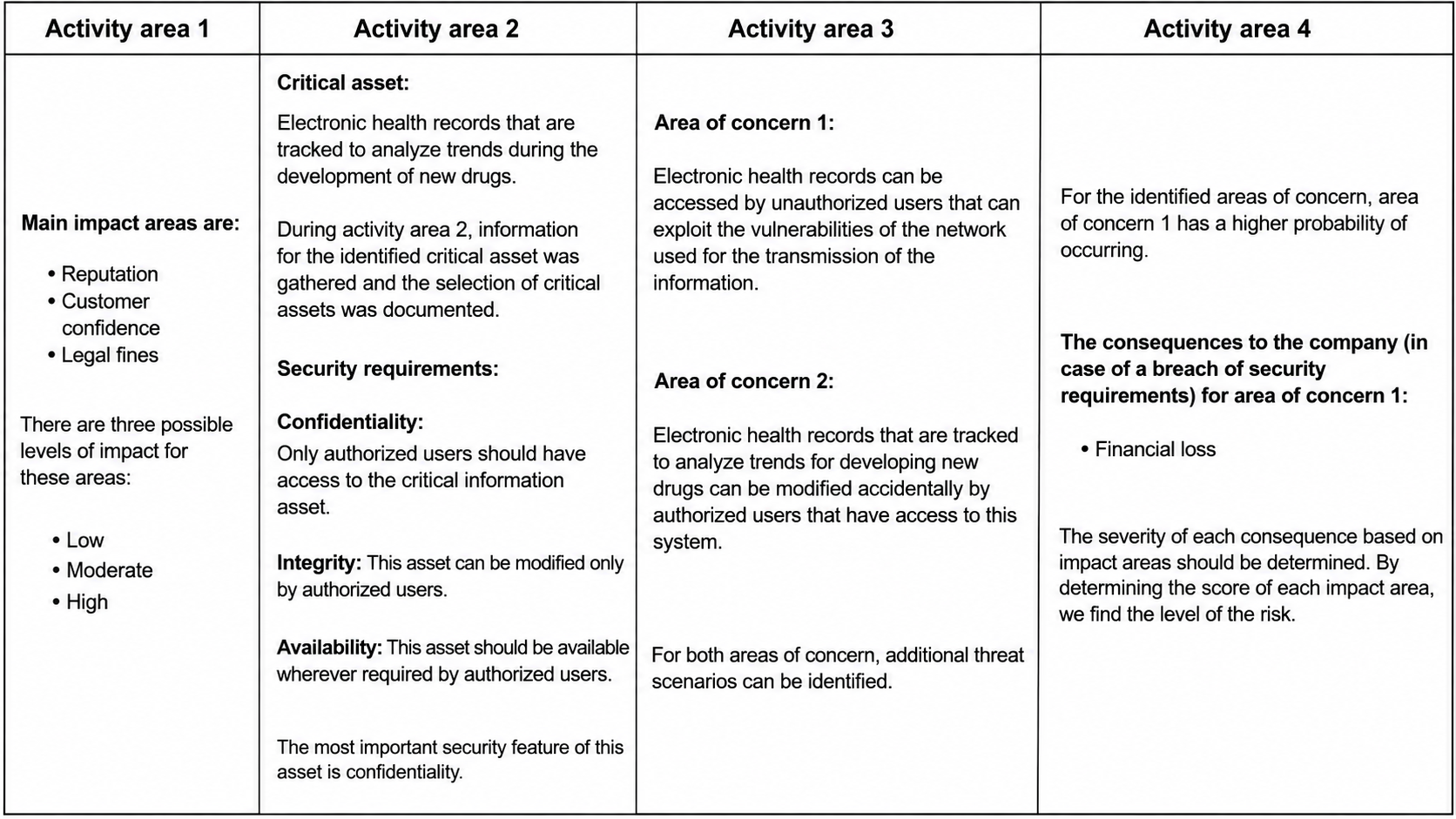
Based on scenario 8, how should Biotide use the criteria defined in the activity area 1?
-
A
To evaluate the potential impact of the risk on Biotide's objectives
-
B
To identify the assets on which information is stored
-
C
To determine the probability of threat scenarios
Reveal answer details
Close answer details
Correct answerA
ExplanationActivity area 1 establishes impact areas and criteria for judging the effects of risk. Biotide uses those criteria later to evaluate how a potential consequence would affect its objectives and to determine severity; identifying storage systems and estimating threat probability belong to other activity areas.
After creating a plan for outsourcing to a cloud service provider to store their confidential information in cloud, OrgX decided to not pursue this business strategy since the risk of doing so was high. Which risk treatment option did OrgX use?
-
A
-
B
-
C
Reveal answer details
Close answer details
Correct answerA
ExplanationRisk avoidance removes the activity or decision that creates the exposure. OrgX decided not to pursue cloud outsourcing because the associated risk was high, so it eliminated that planned source of risk instead of changing its likelihood, sharing responsibility, or retaining it.
Scenario 8: Biotide is a pharmaceutical company that produces medication for treating different kinds of diseases. The company was founded in 1997, and since then it has contributed in solving some of the most challenging healthcare issues. As a pharmaceutical company, Biotide operates in an environment associated with complex risks. As such, the company focuses on risk management strategies that ensure the effective management of risks to develop high-quality medication. With the large amount of sensitive information generated from the company, managing information security risks is certainly an important part of the overall risk management process. Biotide utilizes a publicly available methodology for conducting risk assessment related to information assets. This methodology helps Biotide to perform risk assessment by taking into account its objectives and mission. Following this method, the risk management process is organized into four activity areas, each of them involving a set of activities, as provided below. 1. Activity area 1: The organization determines the criteria against which the effects of a risk occurring can be evaluated. In addition, the impacts of risks are also defined. 2. Activity area 2: The purpose of the second activity area is to create information asset profiles. The organization identifies critical information assets, their owners, as well as the security requirements for those assets. After determining the security requirements, the organization prioritizes them. In addition, the organization identifies the systems that store, transmit, or process information. 3. Activity area 3: The organization identifies the areas of concern which initiates the risk identification process. In addition, the organization analyzes and determines the probability of the occurrence of possible threat scenarios. 4. Activity area 4: The organization identifies and evaluates the risks. In addition, the criteria specified in activity area 1 is reviewed and the consequences of the areas of concerns are evaluated. Lastly, the level of identified risks is determined. The table below provides an example of how Biotide assesses the risks related to its information assets following this methodology: 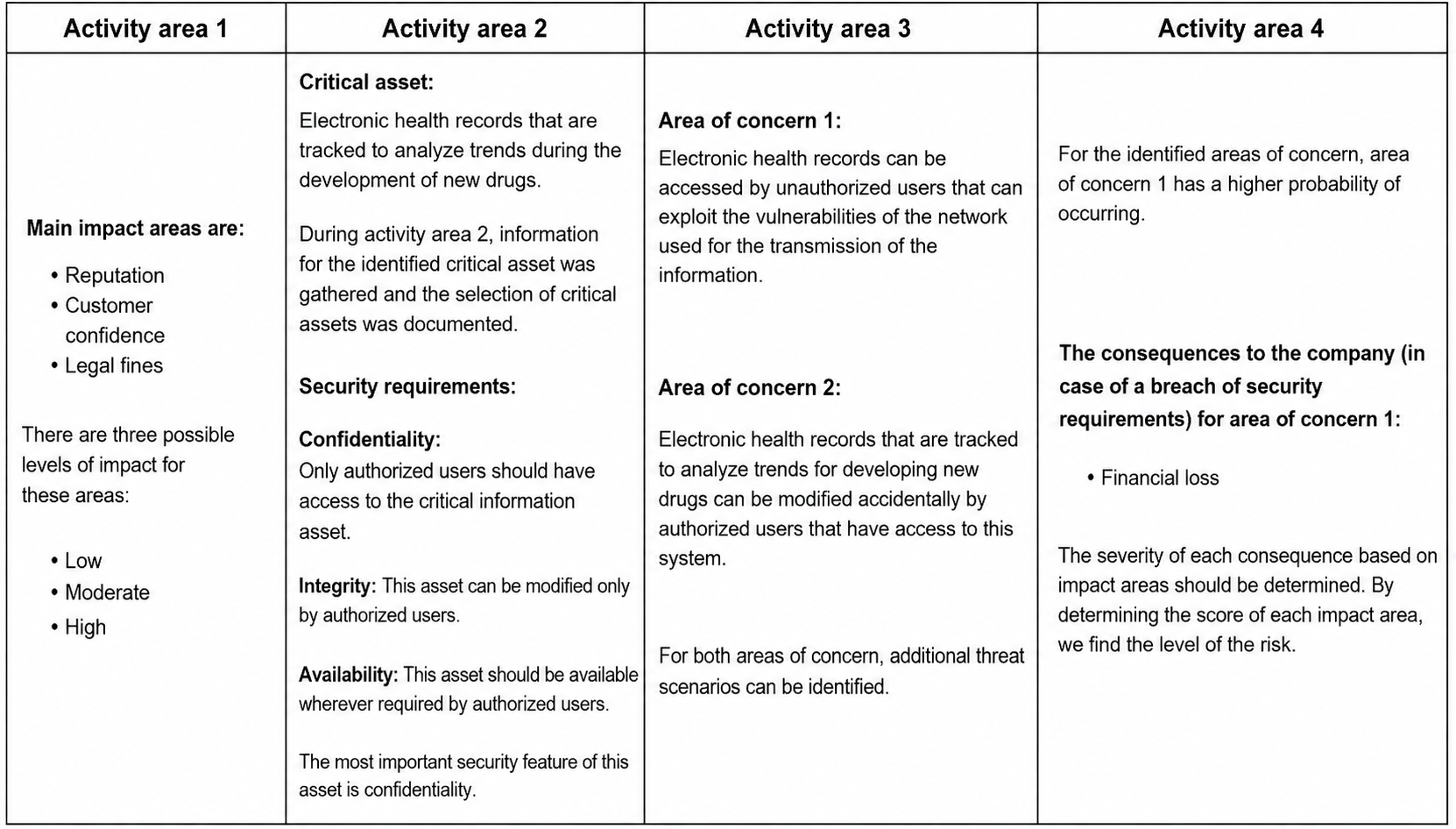
Based on the table provided in scenario 8, did Biotide prioritize the security requirements for electronic health records?
-
A
Yes, Biotide determined confidentiality as the most important security requirement for electronic health records
-
B
Yes, Biotide prioritized the security requirements for electronic health records when prioritizing the areas of concern
-
C
No, Biotide did not prioritize security requirements for electronic health records
Reveal answer details
Close answer details
Correct answerA
ExplanationBiotide identified confidentiality, integrity, and availability requirements for the electronic health records, then explicitly ranked confidentiality as the most important security feature. Naming one requirement as most important demonstrates that the requirements were prioritized rather than merely listed.
Scenario 4: In 2017, seeing that millions of people turned to online shopping, Ed and James Cordon founded the online marketplace for footwear called Poshoe. In the past, purchasing pre-owned designer shoes online was not a pleasant experience because of unattractive pictures and an inability to ascertain the products' authenticity. However, after Poshoe's establishment, each product was well advertised and certified as authentic before being offered to clients. This increased the customers' confidence and trust in Poshoe's products and services. Poshoe has approximately four million users and its mission is to dominate the second-hand sneaker market and become a multi-billion dollar company. Due to the significant increase of daily online buyers, Poshoe's top management decided to adopt a big data analytics tool that could help the company effectively handle, store, and analyze data. Before initiating the implementation process, they decided to conduct a risk assessment. Initially, the company identified its assets, threats, and vulnerabilities associated with its information systems. In terms of assets, the company identified the information that was vital to the achievement of the organization's mission and objectives. During this phase, the company also detected a rootkit in their software, through which an attacker could remotely access Poshoe's systems and acquire sensitive data. The company discovered that the rootkit had been installed by an attacker who had gained administrator access. As a result, the attacker was able to obtain the customers' personal data after they purchased a product from Poshoe. Luckily, the company was able to execute some scans from the target device and gain greater visibility into their software's settings in order to identify the vulnerability of the system. The company initially used the qualitative risk analysis technique to assess the consequences and the likelihood and to determine the level of risk. The company defined the likelihood of risk as "a few times in two years with the probability of 1 to 3 times per year." Later, it was decided that they would use a quantitative risk analysis methodology since it would provide additional information on this major risk. Lastly, the top management decided to treat the risk immediately as it could expose the company to other issues. In addition, it was communicated to their employees that they should update, secure, and back up Poshoe's software in order to protect customers' personal information and prevent unauthorized access from attackers. Based on scenario 4, which scanning tool did Poshoe use to detect the vulnerability in their software?
-
A
Network-based scanning tool
-
B
-
C
Reveal answer details
Close answer details
Correct answerB
ExplanationThe scans were executed from the target device and provided visibility into that device's software settings. That is a host-level examination of the system where the rootkit and vulnerability existed, so it is a host-based scanning activity rather than a scan of network-connected devices.
Scenario 4: In 2017, seeing that millions of people turned to online shopping, Ed and James Cordon founded the online marketplace for footwear called Poshoe. In the past, purchasing pre-owned designer shoes online was not a pleasant experience because of unattractive pictures and an inability to ascertain the products' authenticity. However, after Poshoe's establishment, each product was well advertised and certified as authentic before being offered to clients. This increased the customers' confidence and trust in Poshoe's products and services. Poshoe has approximately four million users and its mission is to dominate the second-hand sneaker market and become a multi-billion dollar company. Due to the significant increase of daily online buyers, Poshoe's top management decided to adopt a big data analytics tool that could help the company effectively handle, store, and analyze data. Before initiating the implementation process, they decided to conduct a risk assessment. Initially, the company identified its assets, threats, and vulnerabilities associated with its information systems. In terms of assets, the company identified the information that was vital to the achievement of the organization's mission and objectives. During this phase, the company also detected a rootkit in their software, through which an attacker could remotely access Poshoe's systems and acquire sensitive data. The company discovered that the rootkit had been installed by an attacker who had gained administrator access. As a result, the attacker was able to obtain the customers' personal data after they purchased a product from Poshoe. Luckily, the company was able to execute some scans from the target device and gain greater visibility into their software's settings in order to identify the vulnerability of the system. The company initially used the qualitative risk analysis technique to assess the consequences and the likelihood and to determine the level of risk. The company defined the likelihood of risk as "a few times in two years with the probability of 1 to 3 times per year." Later, it was decided that they would use a quantitative risk analysis methodology since it would provide additional information on this major risk. Lastly, the top management decided to treat the risk immediately as it could expose the company to other issues. In addition, it was communicated to their employees that they should update, secure, and back up Poshoe's software in order to protect customers' personal information and prevent unauthorized access from attackers. Based on the scenario above, answer the following question: Poshoe detected a rootkit installed in their software. In which category of threats does this threat belong?
-
A
-
B
-
C
Reveal answer details
Close answer details
Correct answerB
ExplanationThe rootkit did not arise from an equipment malfunction or an organizational condition: an attacker deliberately installed it after obtaining administrator access. Because the threat resulted from intentional conduct by a person, it belongs to the human actions category.
Scenario 2: Travivve is a travel agency that operates in more than 100 countries. Headquartered in San Francisco, the US, the agency is known for its personalized vacation packages and travel services. Travivve aims to deliver reliable services that meet its clients' needs. Considering the impact of information security in its reputation, Travivve decided to implement an information security management system (ISMS) based on ISO/IEC 27001. In addition, they decided to establish and implement an information security risk management program. Based on the priority of specific departments in Travivve, the top management decided to initially apply the risk management process only in the Sales Management Department. The process would be applicable for other departments only when introducing new technology. Travivve's top management wanted to make sure that the risk management program is established based on the industry best practices. Therefore, they created a team of three members that would be responsible for establishing and implementing it. One of the team members was Travivve's risk manager who was responsible for supervising the team and planning all risk management activities. In addition, the risk manager was responsible for monitoring the program and reporting the monitoring results to the top management. Initially, the team decided to analyze the internal and external context of Travivve. As part of the process of understanding the organization and its context, the team identified key processes and activities. Then, the team identified the interested parties and their basic requirements and determinedthe status of compliance with these requirements. In addition, the team identified all the reference documents that applied to the defined scope of the risk management process, which mainly included the Annex A of ISO/IEC 27001 and the internal security rules established by Travivve. Lastly, the team analyzed both reference documents and justified a few noncompliances with those requirements. The risk manager selected the information security risk management method which was aligned with other approaches used by the company to manage other risks. The team also communicated the risk management process to all interested parties through previously established communication mechanisms. In addition, they made sure to inform all interested parties about their roles and responsibilities regarding risk management. Travivve also decided to involve interested parties in its risk management activities since, according to the top management, this process required their active participation. Lastly, Travivve's risk management team decided to conduct the initial information security risk assessment process. As such, the team established the criteria for performing the information security risk assessment which included the consequence criteria and likelihood criteria. Did Travivve's risk management team identify the basic requirements of interested parties in accordance with the guidelines of ISO/IEC 27005? Refer to scenario 2.
-
A
No, the team should define the basic requirements of interested parties, but it should determine status of compliance with the requirements after implementing the risk treatment options
-
B
No, the team should use only the organization's internal security rules to determine the status of compliance with the basic requirements of interested parties
-
C
Yes, the team identified the basic requirements of interested parties and determined the status of compliance with those requirements as recommended by ISO/IEC 27005
Reveal answer details
Close answer details
Correct answerC
ExplanationUnderstanding the organizational context includes identifying interested parties, establishing their relevant requirements, and determining the organization's compliance status. Travivve performed both requirement identification and the compliance check, providing the context needed for its risk management program.
Scenario 1 The risk assessment process was led by Henry, Bontton's risk manager. The first step that Henry took was identifying the company's assets. Afterward, Henry created various potential incident scenarios. One of the main concerns regarding the use of the application was the possibility of being targeted by cyber attackers, as a great number of organizations were experiencing cyberattacks during that time. After analyzing the identified risks, Henry evaluated them and concluded that new controls must be implemented if the company wants to use the application. Among others, he stated that training should be provided to personnel regarding the use of the application and that awareness sessions should be conducted regarding the importance of protecting customers' personal data. Lastly, Henry communicated the risk assessment results to the top management. They decided that the application will be used only after treating the identified risks. According to scenario 1, what type of controls did Henry suggest?
-
A
-
B
-
C
Reveal answer details
Close answer details
Correct answerC
ExplanationTraining personnel and conducting awareness sessions influence how people understand and follow security expectations. These are administrative controls because they manage behavior through instruction and organizational practices, rather than implementing a protective function directly in hardware or software.
Email filtering is operating, but users can still reach a fake sign-in page and remote access lacks multifactor authentication. Which statement correctly describes the risk factors?
-
A
The missing authentication control is the threat, and phishing is the vulnerability.
-
B
Email filtering removes the vulnerability, so no residual risk needs analysis.
-
C
The vulnerability alone produces harm without any threat event or consequence.
-
D
Phishing may exploit the weakness, while filtering may reduce but not eliminate likelihood.
Reveal answer details
Close answer details
Correct answerD
ExplanationPhishing is a threat event that may exploit reachable fake sign-in pages and weak remote-access authentication. Email filtering is an existing control that can reduce the likelihood of that event, but users can still reach the page, so the pathway has not been eliminated. The remaining exposure must therefore be analyzed as residual risk.
Question 10
Single choice
Scenario 7: Adstry is a business growth agency that specializes in digital marketing strategies. Adstry helps organizations redefine the relationships with their customers through innovative solutions. Adstry is headquartered in San Francisco and recently opened two new offices in New York. The structure of the company is organized into teams which are led by project managers. The project manager has the full power in any decision related to projects. The team members, on the other hand, report the project's progress to project managers. Considering that data breaches and ad fraud are common threats in the current business environment, managing risks is essential for Adstry. When planning new projects, each project manager is responsible for ensuring that risks related to a particular project have been identified, assessed, and mitigated. This means that project managers have also the role of the risk manager in Adstry. Taking into account that Adstry heavily relies on technology to complete their projects, their risk assessment certainly involves identification of risks associated with the use of information technology. At the earliest stages of each project, the project manager communicates the risk assessment results to its team members. Adstry uses a risk management software which helps the project team to detect new potential risks during each phase of the project. This way, team members are informed in a timely manner for the new potential risks and are able to respond to them accordingly. The project managers are responsible for ensuring that the information provided to the team members is communicated using an appropriate language so it can be understood by all of them. In addition, the project manager may include external interested parties affected by the project in the risk communication. If the project manager decides to include interested parties, the risk communication is thoroughly prepared. The project manager firstly identifies the interested parties that should be informed and takes into account their concerns and possible conflicts that may arise due to risk communication. The risks are communicated to the identified interested parties while taking into consideration the confidentiality of Adstry's information and determining the level of detail that should be included in the risk communication. The project managers use the same risk management software for risk communication with external interested parties since it provides a consistent view of risks. For each project, the project manager arranges regular meetings with relevant interested parties of the project, they discuss the detected risks, their prioritization, and determine appropriate treatment solutions. The information taken from the risk management software and the results of these meetings are documented and are used for decision-making processes. In addition, the company uses a computerized documented information management system for the acquisition, classification, storage, and archiving of its documents. Based on scenario 7, the risk management software is used to help Adstry's teams to detect new risks throughout all phases of the project.
Is this necessary?
-
A
Yes, Adstry; should establish adequate procedures to monitor and review risks on a regular basis in order to identity the changes at an early stage
-
B
Yes, according to ISO/IEC 27005, Adstry; must use an automated solution for identifying and analyzing risks related to information technology throughout all phases of a project
-
C
No. monitoring risks after a project is initiated will not provide important information that could impact Adstry'.s business objectives
Reveal answer details
Close answer details
Correct answerA
ExplanationRisks and their conditions can change throughout a project, so monitoring cannot end when the project begins. Adequate procedures for regular monitoring and review allow Adstry to identify new risks or changes early enough for the project team to respond and adjust treatment decisions.
Question 11
Single choice
Scenario 4: In 2017, seeing that millions of people turned to online shopping, Ed and James Cordon founded the online marketplace for footwear called Poshoe. In the past, purchasing pre-owned designer shoes online was not a pleasant experience because of unattractive pictures and an inability to ascertain the products' authenticity. However, after Poshoe's establishment, each product was well advertised and certified as authentic before being offered to clients. This increased the customers' confidence and trust in Poshoe's products and services. Poshoe has approximately four million users and its mission is to dominate the second-hand sneaker market and become a multi-billion dollar company. Due to the significant increase of daily online buyers, Poshoe's top management decided to adopt a big data analytics tool that could help the company effectively handle, store, and analyze data. Before initiating the implementation process, they decided to conduct a risk assessment. Initially, the company identified its assets, threats, and vulnerabilities associated with its information systems. In terms of assets, the company identified the information that was vital to the achievement of the organization's mission and objectives. During this phase, the company also detected a rootkit in their software, through which an attacker could remotely access Poshoe's systems and acquire sensitive data. The company discovered that the rootkit had been installed by an attacker who had gained administrator access. As a result, the attacker was able to obtain the customers' personal data after they purchased a product from Poshoe. Luckily, the company was able to execute some scans from the target device and gain greater visibility into their software's settings in order to identify the vulnerability of the system. The company initially used the qualitative risk analysis technique to assess the consequences and the likelihood and to determine the level of risk. The company defined the likelihood of risk as "a few times in two years with the probability of 1 to 3 times per year." Later, it was decided that they would use a quantitative risk analysis methodology since it would provide additional information on this major risk. Lastly, the top management decided to treat the risk immediately as it could expose the company to other issues. In addition, it was communicated to their employees that they should update, secure, and back up Poshoe's software in order to protect customers' personal information and prevent unauthorized access from attackers. According to scenario 4, which type of assets was identified during the risk identification process?
-
A
-
B
-
C
Reveal answer details
Close answer details
Correct answerB
ExplanationPrimary assets are information and business processes whose value is directly tied to the organization's mission and objectives. Poshoe identified vital information on that basis, so it identified primary assets rather than the supporting hardware, software, networks, or facilities that enable them.
Question 12
Single choice
Scenario 7: Adstry is a business growth agency that specializes in digital marketing strategies. Adstry helps organizations redefine the relationships with their customers through innovative solutions. Adstry is headquartered in San Francisco and recently opened two new offices in New York. The structure of the company is organized into teams which are led by project managers. The project manager has the full power in any decision related to projects. The team members, on the other hand, report the project's progress to project managers. Considering that data breaches and ad fraud are common threats in the current business environment, managing risks is essential for Adstry. When planning new projects, each project manager is responsible for ensuring that risks related to a particular project have been identified, assessed, and mitigated. This means that project managers have also the role of the risk manager in Adstry. Taking into account that Adstry heavily relies on technology to complete their projects, their risk assessment certainly involves identification of risks associated with the use of information technology. At the earliest stages of each project, the project manager communicates the risk assessment results to its team members. Adstry uses a risk management software which helps the project team to detect new potential risks during each phase of the project. This way, team members are informed in a timely manner for the new potential risks and are able to respond to them accordingly. The project managers are responsible for ensuring that the information provided to the team members is communicated using an appropriate language so it can be understood by all of them. In addition, the project manager may include external interested parties affected by the project in the risk communication. If the project manager decides to include interested parties, the risk communication is thoroughly prepared. The project manager firstly identifies the interested parties that should be informed and takes into account their concerns and possible conflicts that may arise due to risk communication. The risks are communicated to the identified interested parties while taking into consideration the confidentiality of Adstry's information and determining the level of detail that should be included in the risk communication. The project managers use the same risk management software for risk communication with external interested parties since it provides a consistent view of risks. For each project, the project manager arranges regular meetings with relevant interested parties of the project, they discuss the detected risks, their prioritization, and determine appropriate treatment solutions. The information taken from the risk management software and the results of these meetings are documented and are used for decision-making processes. In addition, the company uses a computerized documented information management system for the acquisition, classification, storage, and archiving of its documents. Based on scenario 7, project managers communicate risks to external interested parties, taking into account the information confidentiality. Which principle of efficient communication strategy do project managers follow?
-
A
-
B
-
C
Reveal answer details
Close answer details
Correct answerC
ExplanationTransparency supports open and appropriate communication with relevant interested parties while respecting legitimate confidentiality limits. Adstry determines the suitable level of detail before communicating risks, allowing useful disclosure without exposing information that must remain protected.
Question 13
Single choice
An accepted cloud risk was last reviewed six months ago. The provider has now changed its platform architecture, and a new law applies, although the annual control test passed. What should happen?
-
A
Wait for the annual review because successful control testing covers all changing risk factors.
-
B
Trigger a review of assumptions, criteria, risk, controls, and treatment, then adjust as needed.
-
C
Preserve the acceptance decision because accepted risks do not require event-driven review.
-
D
Review only the provider's control because business and legal changes are outside risk monitoring.
Reveal answer details
Close answer details
Correct answerB
ExplanationThe architecture change and new law alter conditions on which the earlier acceptance may have depended. They should trigger a review of assumptions, evaluation criteria, the risk itself, relevant controls, and the current treatment, followed by adjustment where needed. A passed annual control test addresses that control at its test point; it does not preserve an acceptance decision after material technical and legal changes.
|