Preview real exam questions, verified answers and available explanations before choosing a study plan.
Question 1
Multiple choice
You are conducting a third-party surveillance audit when another member of the audit team approaches you seeking clarification. They have been asked to assess the organisation's application of control 5.7 - Threat Intelligence. They are aware that this is one of the new controls introduced in the 2022 edition of ISO/IEC 27001, and they want to make sure they audit the control correctly.
They have prepared a checklist to assist them with their audit and want you to confirm that their planned activities are aligned with the control's requirements.
Which three of the following options represent valid audit trails?
A
I will determine whether internal and external sources of information are used in the production of threat intelligence
B
I will ensure that the task of producing threat intelligence is assigned to the organisation's internal audit team
C
I will ensure that the organisation's risk assessment process begins with effective threat intelligence
D
I will check that the organisation has a fully documented threat intelligence process
E
I will check that threat intelligence is actively used to protect the confidentiality, integrity and availability of the organisation's information assets
F
I will speak to top management to make sure all staff are aware of the importance of reporting threats
G
I will ensure that appropriate measures have been introduced to inform top management as to the effectiveness of current threat intelligence arrangements
H
I will review how information relating to information security threats is collected and evaluated to produce threat intelligence
Reveal answer detailsClose answer details
Correct answersA, D, E
Explanation
The options that represent valid audit trails for assessing the organisation's application of control 5.7 - Threat Intelligence, according to ISO/IEC 27001:2022, are:
Option A: I will determine whether internal and external sources of information are used in the production of threat intelligence. This is relevant because effective threat intelligence typically requires gathering information from multiple sources to be comprehensive.
Option D: I will check that the organisation has a fully documented threat intelligence process. Proper documentation is a core requirement in ISO standards to ensure processes are defined, implemented, and maintained consistently.
Option E: I will check that threat intelligence is actively used to protect the confidentiality, integrity, and availability of the organisation's information assets. This verifies that the output of threat intelligence is being used effectively within the organisation's information security practices.
Question 2
Single choice
Scenario 4: SendPay is a financial company that provides its services through a network of agents and financial institutions. One of their main services is transferring money worldwide. SendPay, as a new company, seeks to offer top quality services to its clients. Since the company offers international transactions, it requires from their clients to provide personal information, such as their identity, the reason for the transactions, and other details that might be needed to complete the transaction. Therefore, SendPay has implemented security measures to protect their clients' information, including detecting, investigating, and responding to any information security threats that may emerge. Their commitment to offering secure services was also reflected during the ISMS implementation where the company invested a lot of time and resources.
Last year, SendPay unveiled their digital platform that allows money transactions through electronic devices, such as smartphones or laptops, without requiring an additional fee. Through this platform, SendPay's clients can send and receive money from anywhere and at any time. The digital platform helped SendPay to simplify the company's operations and further expand its business. At the time, SendPay was outsourcing its software operations, hence the project was completed by the software development team of the outsourced company. The same team was also responsible for maintaining the technology infrastructure of SendPay.
Recently, the company applied for ISO/IEC 27001 certification after having an ISMS in place for almost a year. They contracted a certification body that fit their criteria. Soon after, the certification body appointed a team of four auditors to audit SendPay's ISMS.
During the audit, among others, the following situations were observed:
1. The outsourced software company had terminated the contract with SendPay without prior notice. As a result, SendPay was unable to immediately bring the services back in-house and its operations were disrupted for five days. The auditors requested from SendPay's representatives to provide evidence that they have a plan to follow in cases of contract terminations. The representatives did not provide any documentary evidence but during an interview, they told the auditors that the top management of SendPay had identified two other software development companies that could provide services immediately if similar situations happen again.
2. There was no evidence available regarding the monitoring of the activities that were outsourced to the software development company. Once again, the representatives of SendPay told the auditors that they regularly communicate with the software development company and that they are appropriately informed for any possible change that might occur.
3. There was no nonconformity found during the firewall testing. The auditors tested the firewall configuration in order to determine the level of security provided by these services. They used a packet analyzer to test the firewall policies which enabled them to check the packets sent or received in real-time. Based on this scenario, answer the following question:
Why could SendPay not restore their services back in-house after the contract termination? Refer to
scenario 4.
A
Because SendPay did not monitor the technology infrastructure of the outsourced software operations
B
Because SendPay lacked a comprehensive business continuity plan with potential impact of contract terminations
C
Because the outsourced software company terminated the contract with SendPay without prior notice
Reveal answer detailsClose answer details
Correct answerB
Explanation
SendPay's inability to restore their services immediately after the contract termination indicates a lack of a comprehensive business continuity plan that addresses the potential impacts of such terminations. This oversight can result in significant operational disruptions, as observed.
References: ISO/IEC 27001:2013 Standard, Clause A.17 (Information security aspects of business continuity management)
Question 3
Single choice
Scenario:
Rebuildy is a construction company located in Bangkok.. Thailand, that specializes in designing, building, and maintaining residential buildings. To ensure the security of sensitive project data and client information, Rebuildy decided to implement an ISMS based on ISO/IEC 27001. This included a comprehensive understanding of information security risks, a defined continual improvement approach, and robust business solutions.
The ISMS implementation outcomes are presented below
- Information security is achieved by applying a set of security controls and establishing policies, processes, and procedures.
- Security controls are implemented based on risk assessment and aim to eliminate or reduce risks to an acceptable level.
- All processes ensure the continual improvement of the ISMS based on the plan-do-check-act (PDCA) model.
- The information security policy is part of a security manual drafted based on best security practices Therefore, it is not a stand-alone document.
- Information security roles and responsibilities have been clearly stated in every employees job description
- Management reviews of the ISMS are conducted at planned intervals.
Rebuildy applied for certification after two midterm management reviews and one annual internal audit Before the certification audit one of Rebuildy's former employees approached one of the audit team members to tell them that Rebuildy has several security problems that the company is trying to conceal. The former employee presented the documented evidence to the audit team member Electra, a key client of Rebuildy, also submitted evidence on the same issues, and the auditor determined to retain this evidence instead of the former employee's. The audit team member remained in contact with Electra until the audit was completed, discussing the nonconformities found during the audit. Electra provided additional evidence to support these findings.
At the beginning of the audit, the audit team interviewed the company's top management. They discussed, among other things, the top management's commitment to the ISMS implementation. The evidence obtained from these discussions was documented in written confirmation, which was used to determine Rebuildy's conformity to several clauses of ISO/IEC 27001
The documented evidence obtained from Electra was attached to the audit report, along with the nonconformities report. Among others, the following nonconformities were detected:
- An instance of improper user access control settings was detected within the company's financial reporting system.
- A stand-alone information security policy has not been established. Instead, the company uses a security manual drafted based on best security practices.
After receiving these documents from the audit team, the team leader met Rebuildy's top management to
present the audit findings. The audit team reported the findings related to the financial reporting system and the lack of a stand-alone information security policy. The top management expressed dissatisfaction with the findings and suggested that the audit team leader's conduct was unprofessional, implying they might request a replacement. Under pressure, the audit team leader decided to cooperate with top management to downplay the significance of the detected nonconformities. Consequently, the audit team leader adjusted the report to present a more favorable view, thus misrepresenting the true extent of Rebuildy's compliance issues.
Based on the scenario above, answer the following question:
Question:
Based on the last paragraph of Scenario, what did the audit team leader commit?
A
Ordinary negligence
B
Gross negligence
C
Fraud
Reveal answer detailsClose answer details
Correct answerC
Explanation
C. Fraud (Correct Answer):
The audit team leader knowingly falsified the audit report to downplay nonconformities.
Fraud involves intentional deception or misrepresentation of information, making this a fraudulent act.
A. Ordinary negligence (Incorrect):
Ordinary negligence is a failure to exercise reasonable care , but this case involved intentional misconduct .
B. Gross negligence (Incorrect):
Gross negligence is extreme carelessness but does not involve deliberate misrepresentation .
References: ISO 19011:2018 Clause 4 (Principles of Auditing: Integrity and Objectivity)
Question 4
Single choice
Which one of the following options describes the main purpose of a Stage 1 audit?
A
To determine readiness for Stage 2
B
To check for legal compliance by the organisation
C
To get to know the organisation
D
To compile the audit plan
Reveal answer detailsClose answer details
Correct answerA
Explanation
The main purpose of a Stage 1 audit is to evaluate the adequacy and effectiveness of the organisation's ISMS documentation, and to assess whether the organisation is prepared for the Stage 2 audit, where the implementation and operation of the ISMS will be verified. The Stage 1 audit also involves verifying the scope, objectives, and context of the ISMS, as well as identifying any areas of concern or nonconformities that need to be addressed before the Stage 2 audit.
References: ISO/IEC 27001:2022 Lead Auditor (Information Security Management Systems) objectives and content from Quality.org and PECB ISO/IEC 27006:2015 Information technology -- Security techniques -- Requirements for bodies providing audit and certification of information security management systems Section 7.3.1
Question 5
Single choice
Scenario 8: EsBank provides banking and financial solutions to the Estonian banking sector since September 2010. The company has a network of 30 branches with over 100 ATMs across the country.
Operating in a highly regulated industry, EsBank must comply with many laws and regulations regarding the security and privacy of data. They need to manage information security across their operations by implementing technical and nontechnical controls. EsBank decided to implement an ISMS based on ISO/ IEC 27001 because it provided better security, more risk control, and compliance with key requirements of laws and regulations.
Nine months after the successful implementation of the ISMS, EsBank decided to pursue certification of their ISMS by an independent certification body against ISO/IEC 27001 .The certification audit included all of EsBank's systems, processes, and technologies.
The stage 1 and stage 2 audits were conducted jointly and several nonconformities were detected. The first nonconformity was related to EsBank's labeling of information. The company had an information classification scheme but there was no information labeling procedure. As a result, documents requiring the same level of protection would be labeled differently (sometimes as confidential, other times sensitive).
Considering that all the documents were also stored electronically, the nonconformity also impacted media handling. The audit team used sampling and concluded that 50 of 200 removable media stored sensitive information mistakenly classified as confidential. According to the information classification scheme, confidential information is allowed to be stored in removable media, whereas storing sensitive information is strictly prohibited. This marked the other nonconformity.
They drafted the nonconformity report and discussed the audit conclusions with EsBank's representatives, who agreed to submit an action plan for the detected nonconformities within two months. EsBank accepted the audit team leader's proposed solution. They resolved the nonconformities by drafting a procedure for information labeling based on the classification scheme for both physical and electronic formats. The removable media procedure was also updated based on this procedure.
Two weeks after the audit completion, EsBank submitted a general action plan. There, they addressed the detected nonconformities and the corrective actions taken, but did not include any details on systems, controls, or operations impacted. The audit team evaluated the action plan and concluded that it would resolve the nonconformities. Yet, EsBank received an unfavorable recommendation for certification.
Based on the scenario above, answer the following question:
By drafting a procedure for information labeling, EsBank has:
A
Submitted an action plan to resolve the nonconformity
B
Created an information classification scheme
C
Eliminated the root cause of the nonconformity
Reveal answer detailsClose answer details
Correct answerA
Explanation
By drafting a procedure for information labeling, EsBank has submitted an action plan to resolve the nonconformity. This step addresses the immediate issue identified during the audit by establishing a consistent approach to labeling information according to its classification.
Question 6
Single choice
How does predictive analytics help auditors in identifying potential risks?
A
By providing real-time analysis of financial data
B
By predicting future outcomes based on trends
C
By organizing data from various sources
Reveal answer detailsClose answer details
Correct answerB
Explanation
B. Correct Answer:
Predictive analytics uses historical data, machine learning, and statistical models to predict future risk events .
It identifies patterns in security incidents, financial trends, and operational failures to anticipate risks before they occur .
A. Incorrect:
Real-time analysis is part of monitoring, but predictive analytics focuses on forecasting risks , not just real-time reporting.
C. Incorrect:
Data organization is essential but does not involve forecasting risks .
References: ISO 31000:2018 (Risk Management?Guidelines on Using Data Analytics in Risk Assessment)
Question 7
Single choice
Which one of the following options is the definition of an interested party?
A
A third party can appeal to an organisation when it perceives itself to be affected by a decision or activity
B
A person or organisation that can affect, be affected by or perceive itself to be affected by a decision or activity
C
A group or organisation that can interfere in or perceive itself to be interfered with by a management decision
D
An individual or organisation that can control, be controlled by, or perceive itself to be controlled by a decision or activity
Reveal answer detailsClose answer details
Correct answerB
Explanation
This is the definition of an interested party according to ISO 27001:2013, clause 3.16. An interested party is essentially a stakeholder, i.e., a person or organization that can influence or be influenced by the information security management system (ISMS) or its activities. Interested parties can have different needs and expectations regarding the ISMS, and these should be identified and addressed by the organization. References: ISO/IEC 27001:2013, Information technology -- Security techniques -- Information security management systems -- Requirements, clause 3.16 PECB Candidate Handbook ISO 27001 Lead Auditor, page 10 Identifying interested parties and their expectations for an ISO 27001 ISMS Examples of ISO 27001 interested parties
Question 8
Multiple choice
During a third-party certification audit you are presented with a list of issues by an auditee.
Which four of the following constitute 'external' issues in the context of a management system to ISO/IEC 27001:2022?
A
A rise in interest rates in response to high inflation
B
A reduction in grants as a result of a change in government policy
C
Poor levels of staff competence as a result of cuts in training expenditure
D
Increased absenteeism as a result of poor management
E
Higher labour costs as a result of an aging population
F
Inability to source raw materials due to government sanctions
G
Poor morale as a result of staff holidays being reduced
H
A fall in productivity linked to outdated production equipment
Reveal answer detailsClose answer details
Correct answersA, B, E, F
Explanation
According to ISO/IEC 27001:2022, which specifies the requirements for establishing, implementing, maintaining and continually improving an information security management system (ISMS), clause 4.1 requires an organization to determine external and internal issues that are relevant to its purpose and that affect its ability to achieve the intended outcomes of its ISMS2. External issues are those that originate from outside the organization, such as legal, regulatory, cultural, social, political, economic, natural and competitive factors. Internal issues are those that originate from within the organization, such as governance, structure, roles and responsibilities, policies, objectives, culture, capabilities, resources and information systems. Therefore, based on this definition, four examples of external issues in the context of a management system to ISO/IEC 27001:2022 are a rise in interest rates in response to high inflation (which affects the economic environment of the organization), a reduction in grants as a result of a change in government policy (which affects the political and legal environment of the organization), higher labour costs as a result of an aging population (which affects the social and demographic environment of the organization), and inability to source raw materials due to government sanctions (which affects the trade and supply environment of the organization). The other options are examples of internal issues, as they originate from within the organization or its activities. For example, poor levels of staff competence as a result of cuts in training expenditure (which affects the capabilities and resources of the organization), increased absenteeism as a result of poor management (which affects the culture and performance of the organization), poor morale as a result of staff holidays being reduced (which affects the motivation and satisfaction of the organization's personnel), and a fall in productivity linked to outdated production equipment (which affects the efficiency and quality of the organization's processes) 2. References: ISO/IEC 27001:2022 - Information technology Security techniques ? Information security management systems ?Requirements
Question 9
Single choice
Which option below is NOT a role of the audit team leader?
A
Preventing and solving conflict during the audit
B
Setting up an ethics committee
C
Preparing and explaining the audit conclusions
Reveal answer detailsClose answer details
Correct answerB
Explanation
The role of the audit team leader does not include setting up an ethics committee. The primary responsibilities of the audit team leader include planning the audit, directing the activities of the audit team, ensuring compliance with the auditing standards, managing conflicts that arise during the audit, and presenting audit conclusions.
References: ISO 19011:2018 Guidelines for auditing management systems
Question 10
Single choice
Scenario:
Webvue. headquartered in Japan, is a technology company specializing in the development, support, and maintenance of computer software. Webvue provides solutions across various technology fields and business sectors. Its flagship service is CloudWebvue, a comprehensive cloud computing platform offering storage, networking, and virtual computing services. Designed for both businesses and individual users. CloudWebvue is known for its flexibility, scalability, and reliability.
Webvue has decided to only include CloudWebvue in its ISO/IEC 27001 certification scope. Thus, the stage 1 and 2 audits were performed simultaneously Webvue takes pride in its strictness regarding asset confidentiality. They protect the information stored in CloudWebvue by using appropriate cryptographic controls. Every piece of information of any classification level, whether for internal use. restricted, or
confidential, is first encrypted with a unique corresponding hash and then stored in the cloud
The audit team comprised five persons Keith. Sean. Layla, Sam. and Tina. Keith, the most experienced auditor on the IT and information security auditing team, was the audit team leader. His responsibilities included planning the audit and managing the audit team. Sean and Layla were experienced in project planning, business analysis, and IT systems (hardware and application) Their tasks included audit planning according to Webvue's internal systems and processes Sam and Tina, on the other hand, who had recently completed their education, were responsible for completing the day-to-day tasks while developing their audit skills
While verifying conformity to control 8.24 Use of cryptography of ISO/IEC 27001 Annex A through interviews with the relevant staff, the audit team found out that the cryptographic keys have been initially generated based on random bit generator (RBG) and other best practices for the generation of the cryptographic keys. After checking Webvue's cryptography policy, they concluded that the information obtained by the interviews was true. However, the cryptographic keys are still in use because the policy does not address the use and lifetime of cryptographic keys.
As later agreed upon between Webvue and the certification body, the audit team opted to conduct a virtual audit specifically focused on verifying conformity to control 8.11 Data Masking of ISO/IEC 27001 within Webvue, aligning with the certification scope and audit objectives. They examined the processes involved in protecting data within CloudWebvue. focusing on how the company adhered to its policies and regulatory standards. As part of this process. Keith, the audit team leader, took screenshot copies of relevant documents and cryptographic key management procedures to document and analyze the effectiveness of Webvue's practices.
Webvue uses generated test data for testing purposes. However, as determined by both the interview with the manager of the QA Department and the procedures used by this department, sometimes live system data are used. In such scenarios, large amounts of data are generated while producing more accurate results. The test data is protected and controlled, as verified by the simulation of the encryption process performed by Webvue's personnel during the audit
While interviewing the manager of the QA Department, Keith observed that employees in the Security Training Department were not following proper procedures, even though this department fell outside the audit scope. Despite the exclusion in the audit scope, the non conformity in the Security Training Department has potential implications for the processes within the audit scope, specifically impacting data security and cryptographic practices in CloudWebvue. Therefore, Keith incorporated this finding into the audit report and accordingly informed the auditee.
Based on the scenario above, answer the following question:
Question:
Based on Scenario, which audit procedure was used to verify conformity to the use of test data?
A
Documented information review
B
Corroboration
C
Technical verification
Reveal answer detailsClose answer details
Correct answerC
Explanation
C. Correct Answer:
Technical verification involves directly testing or simulating controls.
Webvue's personnel simulated the encryption process, confirming test data security measures .
A. Incorrect:
Document review is passive, while technical verification is active and includes real-time assessments .
B. Incorrect:
Corroboration is about cross-checking information, whereas technical verification tests controls in practice .
References: ISO 19011:2018 Clause 6.4.9 (Technical Verification in Audits)
Question 11
Single choice
Which of the following is not a type of Information Security attack?
A
Legal Incidents
B
Vehicular Incidents
C
Technical Vulnerabilities
D
Privacy Incidents
Reveal answer detailsClose answer details
Correct answerB
Explanation
Vehicular incidents are not a type of information security attack. A vehicular incident is an event that involves a vehicle or its driver causing damage or injury to people or property. A vehicular incident may have an impact on information security if it affects the availability or integrity of information or systems that are transported or accessed by vehicles, but it is not an intentional or malicious attack on information security. Legal incidents are a type of information security attack that involve legal actions or disputes that may compromise the confidentiality or integrity of information or systems. Technical vulnerabilities are a type of information security attack that exploit weaknesses or flaws in software or hardware that may compromise the confidentiality, integrity, or availability of information or systems. Privacy incidents are a type of information security attack that involve unauthorized access or disclosure of personal or sensitive information that may compromise the confidentiality or integrity of information or systems.
References: CQI & IRCA ISO 27001:2022 Lead Auditor Course Handbook, page 25. : [ISO/IEC 27001 LEAD AUDITOR - PECB], page 13.
Question 12
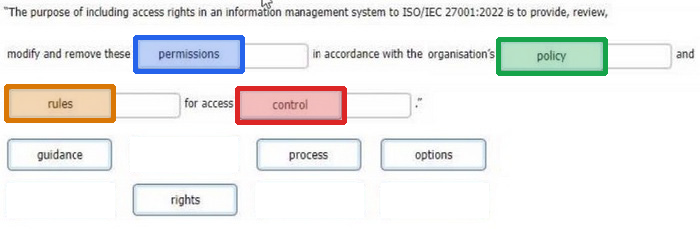
Drag & drop
DRAG DROP
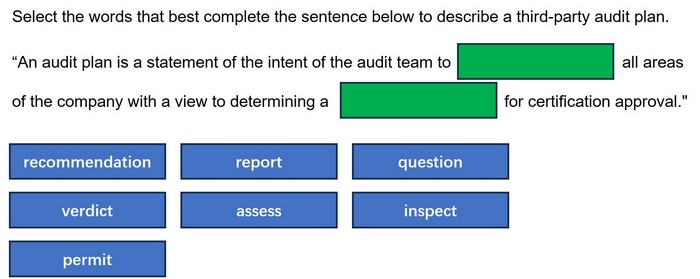
Select the words that best complete the sentence below to describe a third-party audit plan.
To complete the sentence with the best word(s), click on the blank section you want to complete so that it is highlighted in red, and then click on the applicable text from the options below. Alternatively, you may drag and drop the option to the appropriate blank section.
Reveal answer detailsClose answer details
Explanation
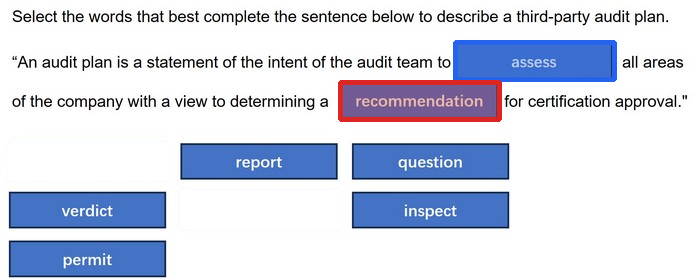
The words that best complete the sentence are assess and recommendation. The sentence would read as follows:
"An audit plan is a statement of the intent of the audit team to assess all areas of the company with a view to determining a recommendation for certification approval."
According to the web search results from my predefined tool, a third-party audit plan is a document that describes the scope, objectives, criteria, and methodology of an external audit conducted by an independent certification body to verify the conformity of an organization's ISMS with the ISO 27001 standard. The audit plan also includes the audit schedule, the audit team, the audit locations, and the audit deliverables. One of the main deliverables of a third-party audit is the audit report, which summarizes the audit findings, the audit conclusions, and the audit recommendation. The audit recommendation is the opinion of the audit team on whether the organization's ISMS meets the certification requirements and whether the certification should be granted, maintained, suspended, or withdrawn.
Therefore, the purpose of the audit plan is to state the intention of the audit team to assess all areas of the company, meaning to evaluate the performance and effectiveness of the ISMS, and to determine a recommendation for certification approval, meaning to provide a judgment on the certification status of the ISMS. The other words in the options, such as verdict, permit, report, inspect, and question, do not accurately reflect the meaning of the audit plan. A verdict is a formal decision made by a judge or a jury, not by an audit team. A permit is a legal authorization to do something, not a certification of conformity. A report is a document that presents the audit results, not the audit intention. An inspection is a visual examination of something, not a comprehensive assessment of an ISMS. A question is a request for information, not a determination of a recommendation.
Question 13
Single choice
When multiple offices of a certification body are involved, what must be ensured?
A
Each office has a separate legally enforceable agreement with the client
B
A legally enforceable agreement that covers all sites within the certification scope
C
Only the main office has a legally enforceable agreement with the client
Reveal answer detailsClose answer details
Correct answerB
Explanation
B. Correct Answer:
A single legally enforceable agreement must cover all sites included in the certification scope to ensure:
Consistency in audit approach
Legal clarity between all parties
Global applicability for multinational companies
A. Incorrect:
Separate agreements for each office would create inconsistencies and legal complexities.
C. Incorrect:
All sites involved in certification must be covered by the agreement, not just the main office.
References: ISO/IEC 17021-1:2015 Clause 8.2.1 (Legally Enforceable Agreements for Certification)
Question 14
Multiple choice
Which two of the following statements are true?
A
The benefits of implementing an ISMS primarily result from a reduction in information security risks
B
The benefit of certifying an ISMS is to obtain contracts from governmental institutions
C
The purpose of an ISMS is to apply a risk management process for preserving information security
D
The purpose of an ISMS is to demonstrate compliance with regulatory requirements
Reveal answer detailsClose answer details
Correct answersA, C
Explanation
The benefits of implementing an ISMS are not limited to a reduction in information security risks, but also include improved business performance, customer satisfaction, legal compliance, and stakeholder confidence. The benefit of certifying an ISMS is not only to obtain contracts from governmental institutions, but also to demonstrate the organisation's commitment to information security to other potential customers, partners, and regulators. The purpose of an ISMS is to apply a risk management process for preserving information security, which means identifying, analysing, evaluating, treating, monitoring, and reviewing the information security risks that the organisation faces. The purpose of an ISMS is not to demonstrate compliance with regulatory requirements, but rather to ensure that the organisation meets its own information security objectives and obligations.
References: ISO/IEC 27001:2022 Lead Auditor (Information Security Management Systems) objectives and content from Quality.org and PECB ISO/IEC 27001:2013 Information technology -- Security techniques -- Information security management systems -- Requirements [Section 0.1] and [Section 1]
Question 15
Drag & drop
DRAG DROP
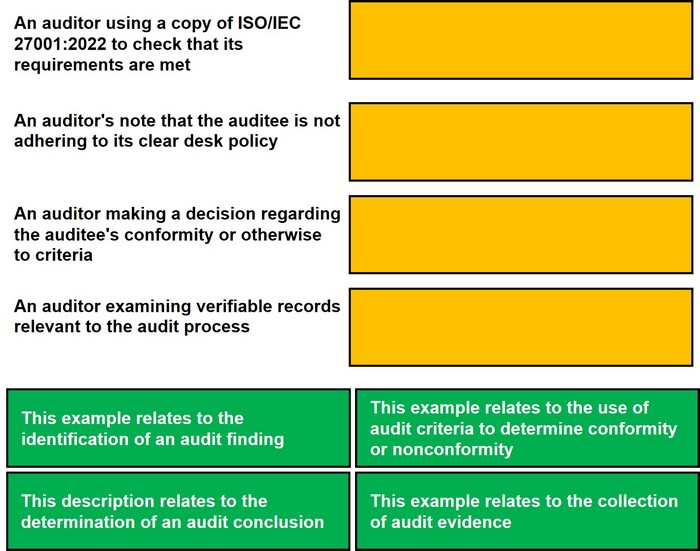
You are an experienced ISMS audit team leader, assisting an auditor in training to write their first audit report.
You want to check the auditor in training's understanding of terminology relating to the contents of an audit report and chose to do this by presenting the following examples.
For each example, you ask the auditor in training what the correct term is that describes the activity
Match the activity to the description.
Reveal answer detailsClose answer details
Explanation
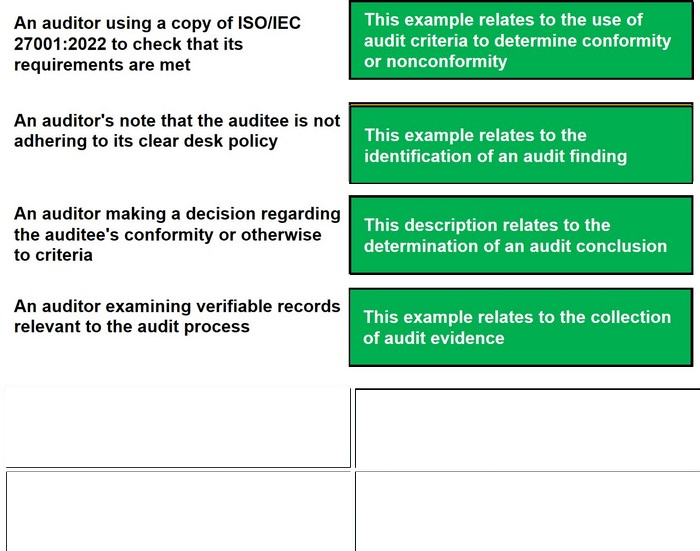
1. An auditor using a copy of ISO/IEC 27001:2022 to check that its requirements are met:
Termed: Reviewing audit criteria.
Justification: The auditor is comparing the auditee's information security management system (ISMS) against the established criteria outlined in the ISO/IEC 27001:2022 standard. This activity falls under the use of audit criteria to determine conformity or nonconformity.
2. An auditor's note that the auditee is not adhering to its clear desk policy:
Termed: Identifying an audit finding.
Justification: The auditor has observed a deviation from the auditee's established policy on clear desks. This observation is documented as a potential nonconformity, which requires further investigation and evaluation.
3. An auditor making a decision regarding the auditee's conformity or otherwise to criteria:
Termed: Determining an audit conclusion.
Justification: Based on the collected audit evidence and evaluation against the established criteria, the auditor forms an opinion about the overall compliance of the auditee's ISMS. This opinion is the audit conclusion and is a key element of the audit report.
4. An auditor examining verifiable records relevant to the audit process:
Termed: Collecting audit evidence.
Justification: The auditor is gathering objective and verifiable information to support their findings and conclusions. This information comes from various sources, including documents, records, interviews, and observations.
Question 16
Multiple choice
Select two of the following options that are the responsibility of a legal technical expert on the audit team during a certification audit.
A
Evaluating the auditee's legal knowledge
B
Criticising the organisation's legal compliance issues
C
Debating complex legal points with the auditee
D
Advising on legal checkpoints for the audit team
E
Verifying the legal status of the organisation
F
Meeting the organisation's legal representative
Reveal answer detailsClose answer details
Correct answersD, E
Explanation
A legal technical expert (LTE) is a person who provides specific knowledge or expertise related to the legal aspects of the information security management system (ISMS) during a certification audit. The LTE is not an auditor, but a member of the audit team who supports the auditors in collecting and evaluating the audit evidence. The LTE is not responsible for evaluating the auditee's legal knowledge, criticising the organisation' s legal compliance issues, or debating complex legal points with the auditee, as these tasks may be beyond the scope of the audit, or may compromise the objectivity and impartiality of the audit. The LTE is responsible for advising on legal checkpoints for the audit team, such as the applicable legal, regulatory, and contractual requirements, the relevant sources of information, the methods of verification, and the criteria of evaluation. The LTE is also responsible for verifying the legal status of the organisation, such as the registration, licensing, authorisation, or accreditation of the organisation, and the compliance with the relevant laws and regulations.
References: What is the role of a technical expert in ISO audit? Roles, Responsibilities & Authorities for ISO 27001 5.3 Guide to Become an ISO 27001 Lead Auditor
Question 17
Multiple choice
You are an ISMS audit team leader tasked with conducting a follow-up audit at a client's data centre. Following two days on-site you conclude that of the original 12 minor and 1 major nonconformities that prompted the follow-up audit, only 1 minor nonconformity still remains outstanding.
Select four options for the actions you could take.
A
Book another follow-up audit on-site to review the one outstanding minor nonconformity once it has been cleared
B
Recommend that the outstanding minor nonconformity is dealt with at the next surveillance audit
C
Advise the auditee that you will arrange an online audit to deal with the outstanding nonconformity
D
Note the progress made but hold the audit open until all corrective action has been cleared
E
Agree with the auditee/audit client how the remaining nonconformity will be cleared, by when, and how its clearance will be verified
F
Advise the individual managing the audit programme of any decision taken regarding the outstanding nonconformity
G
Recommend suspension of the organisation's certification as they have failed to implement the agreed corrections and corrective actions within the agreed timescale
H
Close the follow-up audit as the organisation has demonstrated it is committed to clearing the nonconformities raised
Reveal answer detailsClose answer details
Correct answersB, E, F, H
Explanation
According to ISO 19011:2018, which provides guidelines for auditing management systems, clause 6.7 requires the audit team leader to conduct a follow-up audit to verify the implementation and effectiveness of the corrective actions taken by the auditee in response to the nonconformities identified during a previous audit 1. The follow-up audit should be conducted in accordance with the same principles and processes as the initial audit, and should result in a conclusion on the status of the nonconformities and any remaining issues 1. Therefore, when conducting a follow-up audit, an ISMS auditor should consider the following actions:
Recommend that the outstanding minor nonconformity is dealt with at the next surveillance audit: This action is appropriate because it reflects the fact that the auditee has cleared most of the nonconformities, including the major one, and only one minor nonconformity remains outstanding. A minor nonconformity is defined as a failure to achieve one or more requirements of ISO/IEC 27001:2022 or a situation which raises significant doubt about the ability of an ISMS process to achieve its intended output, but does not affect its overall effectiveness or conformity 2. Therefore, this finding does not prevent or preclude the continuation of certification, as long as it is addressed by appropriate corrective actions within a reasonable time frame. The auditor should recommend that the outstanding minor nonconformity is dealt with at the next surveillance audit, which is a regular audit conducted by the certification body to confirm the ongoing conformity and effectiveness of an ISMS.
Agree with the auditee/audit client how the remaining nonconformity will be cleared, by when, and how its clearance will be verified: This action is appropriate because it reflects the fact that the auditee has demonstrated commitment and capability to implement corrective actions for the nonconformities identified during the previous audit. The auditor should agree with the auditee/audit client on a realistic, achievable, and effective corrective action plan for the remaining nonconformity, including a clear deadline and verification method. The auditor should also document this agreement in the follow-up audit report.
Advise the individual managing the audit programme of any decision taken regarding the outstanding nonconformity: This action is appropriate because it reflects the fact that the auditor has followed a systematic and consistent approach to conducting and reporting the follow-up audit. The auditor should advise the individual managing the audit programme of any decision taken regarding the outstanding nonconformity, such as recommending its closure at the next surveillance audit or agreeing on a corrective action plan with the auditee/audit client. The auditor should also provide sufficient information and evidence to support their decision.
Close the follow-up audit as the organisation has demonstrated it is committed to clearing the nonconformities raised: This action is appropriate because it reflects the fact that the organisation has achieved satisfactory results in the follow-up audit. The auditor should close the follow-up audit as the organisation has demonstrated it is committed to clearing the nonconformities raised by implementing effective corrective actions for most of them and agreeing on a plan for the remaining one. The auditor should also communicate the follow-up audit conclusion to the auditee/audit client and other relevant parties.
Question 18
Single choice
Scenario:
Clinic, founded in the 1990s, is a medical device company that specializes in treatments for heart-related conditions and complex surgical interventions. Based in Europe, it serves both patients and healthcare professionals. Clinic collects patient data to tailor treatments, monitor outcomes, and improve device functionality. To enhance data security and build trust, Clinic is implementing an information security management system (ISMS) based on ISO/IEC 27001 . This initiative demonstrates Clinic's commitment to securely managing sensitive patient information and proprietary technologies .
Clinic established the scope of its ISMS by solely considering internal issues, interfaces, dependencies between internal and outsourced activities, and the expectations of interested parties . This scope was carefully documented and made accessible. In defining its ISMS, Clinic chose to focus specifically on key processes within critical departments such as Research and Development, Patient Data Management, and Customer Support .
Despite initial challenges, Clinic remained committed to its ISMS implementation, tailoring security controls to its unique needs. The project team excluded certain Annex A controls from ISO/IEC 27001 while incorporating additional sector-specific controls to enhance security. The team evaluated the applicability of these controls against internal and external factors, culminating in the development of a comprehensive Statement of Applicability (SoA) detailing the rationale behind control selection and implementation. As preparations for certification progressed, Brian, appointed as the team leader , adopted a self-directed risk assessment methodology to identify and evaluate the company's strategic issues and security practices . This proactive approach ensured that Clinic's risk assessment aligned with its objectives and mission.
Question:
Based on Scenario 2, the Clinic decided that the ISMS would cover only key processes and departments. Is this acceptable?
A
Yes, but the decision to exclude other processes and departments must be justified
B
Yes, organizations may limit the scope of the ISMS, but they cannot request a certification audit if the ISMS scope does not include all processes and departments
C
No, Clinic must include all processes and departments in the scope, regardless of their importance or relevance to the ISMS
Reveal answer detailsClose answer details
Correct answerA
Explanation
A. Correct Answer: ISO/IEC 27001 Clause 4.3 (Determining the Scope of the ISMS) allows organizations to limit the scope , provided that exclusions do not undermine security effectiveness and are justified . B. Incorrect: Organizations can request certification even if the ISMS scope is limited , as long as it is justified. C. Incorrect: ISO/IEC 27001 does not mandate full inclusion of all departments in the ISMS.
Clinic's decision is acceptable only if the exclusions are justified .
Question 19
Single choice
What is the purpose of audit test plans in the audit process?
A
To develop detailed audit reports
B
To conduct audit procedures such as observation and interviews
C
To select all elements of the management system for validation
Reveal answer detailsClose answer details
Correct answerB
Explanation
B. Correct Answer:
Audit test plans define the structured approach for conducting interviews, observations, and control testing.
ISO 19011:2018 describes audit test planning as essential for consistent evidence collection.
A. Incorrect:
Test plans do not generate reports--they outline procedures for evidence collection.
C. Incorrect:
Audit test plans focus on specific risks rather than evaluating all elements.
References: ISO 19011:2018 Clause 6.4.5 (Audit Test Planning Procedures)
Question 20
Single choice
How does the use of new technologies such as big data impact auditing?
A
It presents new challenges, for example, combining structured and unstructured data
B
It enhances the audit quality by enabling auditors to collect higher quality audit evidence
C
It causes significant disruptions, for example, introducing data that is too large or complex for processing by traditional database management tools
Reveal answer detailsClose answer details
Correct answerA
Explanation
The use of new technologies such as big data presents new challenges in auditing, particularly the issue of combining structured and unstructured data. Big data environments often include diverse data sets that auditors need to understand and interpret, which requires new skills and approaches to ensure effective and comprehensive audit coverage.
References: ISO/IEC 27001:2013 Standards and supplementary literature on the impact of technology on auditing practices
Question 21
Multiple choice
You are an experienced ISMS audit team leader guiding an auditor in training. You are testing her understanding of follow-up audits by asking her a series of questions to which the answer is either "true* or 'false'. Which four of the following questions should the answer be true"'
A
A follow-up audit may be carried out where nonconformities are major
B
A follow-up audit may be carried out where nonconformities are minor
C
The outcomes of a follow-up audit should be reported to top management and the audit team leader who carried out the audit where the nonconformities were initially identified
D
The outcome of a follow-up audit could lower a major nonconformity to minor status
E
The outcome of a follow-up audit could be a recommendabon to suspend the client's certification
F
The outcomes of a follow-up audit should be reported to the individual managing the audit programme and the audit client
G
A follow-up audit is required in all instances where nonconformities have been identified
H
A follow-up audit is required only in instances where a major nonconformity has been identified
Reveal answer detailsClose answer details
Correct answersA, B, C, F
Explanation
A follow-up audit may be carried out where nonconformities are major. This is true because a major nonconformity is a situation that raises significant doubt about the ability of the organization's management system to achieve its intended results, and therefore requires immediate corrective action. A follow-up audit is necessary to verify the effectiveness of the corrective action and the conformity of the management system.
A follow-up audit may be carried out where nonconformities are minor. This is true because a minor nonconformity is a situation that does not affect the capability of the management system to achieve its intended results, but represents a deviation from the specified requirements. A follow-up audit may be conducted to check the implementation of the corrective action and the improvement of the management system.
The outcomes of a follow-up audit should be reported to top management and the audit team leader who carried out the audit where the nonconformities were initially identified. This is true because the top management is responsible for ensuring the effectiveness and continual improvement of the management system, and the audit team leader is accountable for the audit process and the audit conclusions. The follow-up audit report should provide them with objective evidence of the status of the nonconformities and the corrective actions taken by the auditee 13.
The outcomes of a follow-up audit should be reported to the individual managing the audit programme and the audit client. This is true because the individual managing the audit programme is responsible for planning, implementing, monitoring and reviewing the audit activities, and the audit client is the organization or person requesting an audit. The follow-up audit report should inform them of the results of the follow-up audit and any changes in the certification status of the auditee.
References: ISO 19011:2022 Guidelines for auditing management systems ISO/IEC 27001:2022 Information technology -- Security techniques -- Information security management systems -- Requirements ISO/IEC 17021-1:2022 Conformity assessment -- Requirements for bodies providing audit and certification of management systems -- Part 1: Requirements
Question 22
Single choice
Scenario:
Cyber ACrypt is a cybersecurity company that provides endpoint protection by offering anti-malware and device security, asset life cycle management, and device encryption. To validate its ISMS against ISO/IEC
27001 and demonstrate its commitment to cybersecurity excellence, the company underwent a meticulous audit process led by John, the appointed audit team leader.
Upon accepting the audit mandate, John promptly organized a meeting to outline the audit plan and team roles This phase was crucial for aligning the team with the audit's objectives and scope However, the initial presentation to Cyber ACrypt's staff revealed a significant gap in understanding the audit's scope and objectives, indicating potential readiness challenges within the company
As the stage 1 audit commenced, the team prepared for on-site activities. They reviewed Cyber ACrypt' s documented information, including the information security policy and operational procedures ensuring each piece conformed to and was standardized in format with author identification, production date, version number, and approval date Additionally, the audit team ensured that each document contained the information required by the respective clause of the standard. This phase revealed that a detailed audit of the documentation describing task execution was unnecessary, streamlining the process and focusing the team's efforts on critical areas During the phase of conducting on-site activities, the team evaluated management responsibility for the Cyber Acrypt's policies. This thorough examination aimed to ascertain continual improvement and adherence to ISMS requirements Subsequently, in the document, the stage 1 audit outputs phase, the audit team meticulously documented their findings, underscoring their conclusions regarding the fulfillment of the stage 1 objectives. This documentation was vital for the audit team and Cyber ACrypt to understand the preliminary audit outcomes and areas requiring attention.
The audit team also decided to conduct interviews with key interested parties. This decision was motivated by the objective of collecting robust audit evidence to validate the management system's compliance with ISO/IEC 27001 requirements. Engaging with interested parties across various levels of Cyber ACrypt provided the audit team with invaluable perspectives and an understanding of the ISMS' s implementation and effectiveness.
The stage 1 audit report unveiled critical areas of concern. The Statement of Applicability (SoA) and the ISMS policy were found to be lacking in several respects, including insufficient risk assessment, inadequate access controls, and lack of regular policy reviews. This prompted Cyber ACrypt to take immediate action to address these shortcomings. Their prompt response and modifications to the strategic documents reflected a strong commitment to achieving compliance.
The technical expertise introduced to bridge the audit team's cybersecurity knowledge gap played a pivotal role in identifying shortcomings in the risk assessment methodology and reviewing network architecture. This included evaluating firewalls, intrusion detection and prevention systems, and other network security measures, as well as assessing how Cyber ACrypt detects, responds to, and recovers from external and internal threats. Under John's supervision, the technical expert communicated the audit findings to the representatives of Cyber ACrypt. However, the audit team observed that the expert s objectivity might have been compromised due to receiving consultancy fees from the auditee. Considering the behavior of the technical expert during the audit, the audit team leader decided to discuss this concern with the certification body. Based on the scenario above, answer the following question:
Question:
Which criteria for evaluating documented information was NOT validated by the audit team?
A
Content of the documented information
B
Format of the documented information
C
Procedure for managing the documented information
Reveal answer detailsClose answer details
Correct answerC
Explanation
C. Correct Answer:
Scenario states that the audit team reviewed the content and format of the documents but does not mention an evaluation of the document management procedure.
ISO/IEC 27001 requires that procedures for managing documented information be reviewed.
A. Incorrect:
The content of documents was reviewed for compliance with ISO/IEC 27001 clauses .
B. Incorrect:
The audit team confirmed that all documents were in a standardized format .
References: ISO/IEC 27001:2022 Clause 7.5 (Documented Information Requirements)
Question 23
Single choice
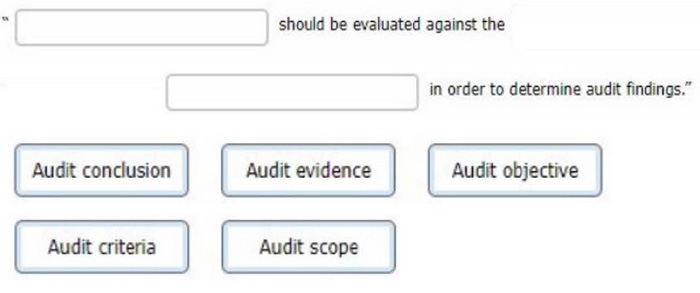
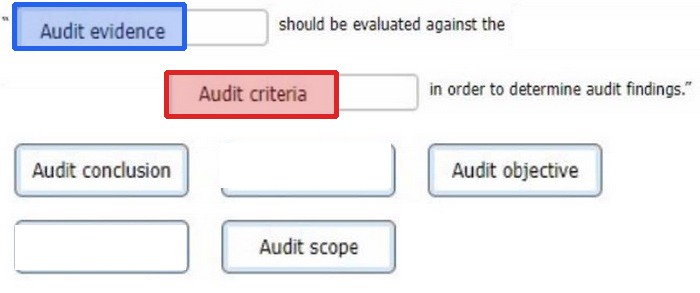
Which one of the following should be reviewed against the audit criteria to determine audit findings?
A
The audit conclusions
B
The audit evidence
C
The audit objectives
D
The audit scope
Reveal answer detailsClose answer details
Correct answerB
Explanation
Audit Findings: These are the results of evaluating collected audit evidence against the predetermined audit criteria. Audit Evidence: Objective, verifiable information gathered through interviews, observations, document reviews, etc., that supports the audit findings. Audit Criteria: The standards, policies, procedures, or requirements of the ISMS that are used as benchmarks for the audit.
The Process: Auditors compare collected audit evidence against the audit criteria to determine whether there is conformity or nonconformity, leading them to generate audit findings.
References: ISO/IEC 27001:2022, Section 9.2 (Internal Audit): Discusses the process of gathering audit evidence and documenting nonconformities (which form a basis for audit findings). ISO 19011:2018 Guidelines for auditing management systems: Provides a broader framework for audit processes, emphasizing the role of audit evidence in generating findings.
Question 24
Single choice
Scenario 8: EsBank provides banking and financial solutions to the Estonian banking sector since September 2010. The company has a network of 30 branches with over 100 ATMs across the country.
Operating in a highly regulated industry, EsBank must comply with many laws and regulations regarding the security and privacy of data. They need to manage information security across their operations by implementing technical and nontechnical controls. EsBank decided to implement an ISMS based on ISO/ IEC 27001 because it provided better security, more risk control, and compliance with key requirements of laws and regulations.
Nine months after the successful implementation of the ISMS, EsBank decided to pursue certification of their ISMS by an independent certification body against ISO/IEC 27001 .The certification audit included all of EsBank's systems, processes, and technologies.
The stage 1 and stage 2 audits were conducted jointly and several nonconformities were detected. The first nonconformity was related to EsBank's labeling of information. The company had an information classification scheme but there was no information labeling procedure. As a result, documents requiring the same level of protection would be labeled differently (sometimes as confidential, other times sensitive).
Considering that all the documents were also stored electronically, the nonconformity also impacted media handling. The audit team used sampling and concluded that 50 of 200 removable media stored sensitive information mistakenly classified as confidential. According to the information classification scheme, confidential information is allowed to be stored in removable media, whereas storing sensitive information is strictly prohibited. This marked the other nonconformity.
They drafted the nonconformity report and discussed the audit conclusions with EsBank's representatives, who agreed to submit an action plan for the detected nonconformities within two months.
EsBank accepted the audit team leader's proposed solution. They resolved the nonconformities by drafting a procedure for information labeling based on the classification scheme for both physical and electronic formats. The removable media procedure was also updated based on this procedure.
Two weeks after the audit completion, EsBank submitted a general action plan. There, they addressed the detected nonconformities and the corrective actions taken, but did not include any details on systems, controls, or operations impacted. The audit team evaluated the action plan and concluded that it would resolve the nonconformities. Yet, EsBank received an unfavorable recommendation for certification.
Based on the scenario above, answer the following question:
According to scenario 8, the audit team evaluated the action plan and concluded that it would resolve the detected nonconformities. Is this acceptable?
A
Yes. the audit team must evaluate the action plan and verify if it is appropriate for correcting the detected nonconformities
B
Yes, only if EsBank has previously verified the effectiveness of the action plan and informed the audit team that the action plan allows the correction of nonconformities
C
No, the auditee should verify if the action plan allows the correction of nonconformities and elimination of the root causes
Reveal answer detailsClose answer details
Correct answerA
Explanation
Yes, the audit team must evaluate the action plan and verify if it is appropriate for correcting the detected nonconformities. This is part of the auditor's responsibilities to ensure that the proposed actions adequately address the issues identified during the audit.
Question 25
Multiple choice
Which three of the following phrases are objectives' in relation to an audit?
A
International Standard
B
Identify opportunities for improvement
C
Confirm the scope of the management system
D
Management policy
E
Complete audit on time
F
Regulatory requirements
Reveal answer detailsClose answer details
Correct answersB, C, F
Explanation
According to ISO 19011:2018, which provides guidelines for auditing management systems, the audit objectives are defined by the audit client and may include determining the extent of conformity or nonconformity of the audited management system against the audit criteria, evaluating the ability of the audited management system to ensure that the organization meets applicable statutory, regulatory and contractual requirements, identifying potential improvement opportunities for the audited management system, and facilitating continual improvement of the audited management system. Therefore, these three phrases are examples of objectives in relation to an audit. The other options are not objectives, but rather elements or factors that may influence or affect an audit. For example, an international standard is a source of audit criteria, a management policy is a part of the audited management system, and completing an audit on time is a requirement for an effective audit. References: ISO 19011:2018 - Guidelines for auditing management systems
Question 26
Multiple choice
In the context of a third-party certification audit, confidentiality is an issue in an audit programme. Select two options which correctly state the function of confidentiality in an audit
A
Auditors are forced by regulatory requirements to maintain confidentiality in an audit
B
Observers in an audit team cannot access any confidential information
C
Confidentiality is one of the principles of audit conduct
D
Auditors should obtain the auditee's permission before using a camera or recording equipment
E
Audit information can be used for improving personal competence by the auditor
F
As an auditor is always accompanied by a guide, there is no risk to the auditee's sensitive information
Reveal answer detailsClose answer details
Correct answersC, D
Explanation
Confidentiality is one of the principles of audit conduct that auditors should adhere to when performing audits. Confidentiality means that auditors should exercise discretion in the use and protection of information acquired in the course of their duties 3. Auditors should respect the intellectual property rights of the auditee and other parties involved in the audit, and should not disclose any information that is sensitive, proprietary, or confidential without prior approval from the auditee or other authorized parties 3. Auditors should also obtain the auditee's permission before using a camera or recording equipment during an audit, as these devices may capture confidential information or infringe on the privacy of individuals 3. Therefore, these two options correctly state the function of confidentiality in an audit. The other options are either incorrect or irrelevant to confidentiality. For example, auditors are not forced by regulatory requirements to maintain confidentiality in an audit, but rather by ethical obligations and contractual agreements 3. Observers in an audit team can access confidential information if they have signed a confidentiality agreement and have been authorized by the auditee 3. Audit information can be used for improving personal competence by the auditor only if it does not compromise confidentiality or conflict with other interests 3. As an auditor is always accompanied by a guide, there is still a risk to the auditee's sensitive information if the guide is not trustworthy or authorized to access such information 3. References: ISO 19011:2018 - Guidelines for auditing management systems
Question 27
Single choice
You are an experienced ISMS auditor conducting a third-party surveillance audit at an organisation which offers ICT reclamation services. ICT equipment which companies no longer require is processed by the organisation. It is either recommissioned and reused or is securely destroyed.
You notice two servers on a bench in the corner of the room. Both have stickers on them with the server's name, IP address and admin password. You ask the ICT Manager about them, and he tells you they were part of a shipment received yesterday from a regular customer.
Which one action should you take?
A
Ask the auditee to remove the labels, then carry on with the audit
B
Ask the ICT Manager to record an information security incident and initiate the information security incident management process
C
Note the audit finding and check the process for dealing with incoming shipments relating to customer IT security
D
Raise a nonconformity against control 5.31 'Legal, staturary, regulatory and contractual requirements'
E
Raise a nonconformity against control 8.20 'network security' (networks and network devices shall be secured, managed and controlled to protect information in systems and applications)
F
Record what you have seen in your audit findings, but take no further action
Reveal answer detailsClose answer details
Correct answerC
Question 28
Multiple choice
You have to carry out a third-party virtual audit.
Which two of the following issues would you need to inform the auditee about before you start conducting the audit ?
A
You will ask to see the ID card of the person that is on the screen.
B
You will take photos of every person you interview.
C
You will ask those being interviewed to state their name and position beforehand.
D
You will ask for a 360-degree view of the room where the audit is being carried out.
E
You will not record any part of the audit, unless permitted.
F
You expect the auditee to have assessed all risks associated with online activities.
Reveal answer detailsClose answer details
Correct answersC, D
Explanation
A third-party virtual audit is an external audit conducted by an independent certification body using remote technology such as video conferencing, screen sharing, and electronic document exchange. The purpose of a third-party virtual audit is to verify the conformity and effectiveness of the information security management system (ISMS) and to issue a certificate of compliance
Before you start conducting the audit, you would need to inform the auditee about the following issues:
You will ask those being interviewed to state their name and position beforehand, i.e., to confirm their identity and role in the ISMS. This is to ensure that you are interviewing the relevant personnel and that they are authorized to provide information and evidence for the audit. You will ask for a 360-degree view of the room where the audit is being carried out, i.e., to verify the physical and environmental security of the audit location. This is to ensure that there are no unauthorized persons or devices in the vicinity that could compromise the confidentiality, integrity, or availability of the information being audited.
The other issues are not relevant or appropriate for a third-party virtual audit, because:
You will ask to see the ID card of the person that is on the screen, i.e., to verify their identity. This is not necessary if you have already asked them to state their name and position beforehand, and if you have access to the auditee's organizational chart or staff directory. Asking to see the ID card could also be seen as intrusive or disrespectful by the auditee.
You will take photos of every person you interview, i.e., to document the audit process. This is not advisable as it could violate the privacy or consent of the auditee and the interviewees. Taking photos could also be seen as unprofessional or suspicious by the auditee. You should rely on the audit records and evidence provided by the auditee and the audit tool instead.
You will not record any part of the audit, unless permitted, i.e., to respect the auditee's preferences and rights. This is not a valid issue to inform the auditee about, as you should always record the audit for quality assurance and verification purposes. Recording the audit is also a requirement of the ISO/IEC 27001 standard and the certification body. You should inform the auditee that you will record the audit and obtain their consent before the audit begins.
You expect the auditee to have assessed all risks associated with online activities, i.e., to ensure the security of the audit process. This is not an issue to inform the auditee about, as it is part of the auditee' s responsibility and obligation to have a risk assessment and treatment process for their ISMS. You should assess the auditee's risk management practices and controls during the audit, not before it.
References: 1: ISO/IEC 27001:2022 Lead Auditor (Information Security Management Systems) Course by CQI and IRCA Certified Training 2: ISO/IEC 27001 Lead Auditor Training Course by PECB 2
Question 29
Single choice
Why should materiality be considered during the initial contact?
A
To determine the audit duration
B
To obtain reasonable assurance that the audit can be successfully completed
C
To define processes for minimizing detection risks
Reveal answer detailsClose answer details
Correct answerB
Explanation
Materiality should be considered during the initial contact to obtain reasonable assurance that the audit can be successfully completed. Determining materiality helps establish the threshold for the significance of audit findings, ensuring that the audit focuses on substantial issues that could impact the audit conclusions.
References: ISO 19011:2018, Guidelines for auditing management systems
Question 30
Multiple choice
You are carrying out your first third-party ISMS surveillance audit as an audit team leader. You are presently in the auditee's data centre with another member of your audit team and the organisation's guide.
You request access to a locked room protected by a combination lock and iris scanner. In the corner of the room is a collection of hard drives piled on a desk.
You ask the guide what the status of the drives is. He tells you the drives are redundant and awaiting disposal.
They should have been picked up last week, but the organisation's external provider of secure destruction services was unable to source a driver due to staff sickness.
He says this has recently become more common though he does not know why. He then presents you with a job ticket that confirms the pickup has been rescheduled for tomorrow.
Based on the scenario above which three of the following actions would you now take?
A
Record a nonconformity against control A.5.13 'labelling of information' as the disk drives' status was unclear
B
Raise a nonconformity against control A.7.7, 'clear desk and clear screen' because the drives have been left unprotected on the desktop.
C
Record an opportunity for improvement in respect of the external provider's inventory management arrangements.
D
Ensure that the organisation's arrangements for the secure disposal and reuse of equipment have been adhered to.
E
Record the finding but note no further action is required as the pickup has now been rescheduled.
F
Raise a nonconformity against control A.7.5, 'protecting against physical and environmental threats' because the drives have been left exposed on the desktop.
G
Ensure that the organisation's arrangements for the life cycle management of storage media have been adhered to.
H
Follow an audit trail to determine whether the organisation is complying with its obligations in respect of control A.5.22 'monitoring, review and change management of supplier services'.
Reveal answer detailsClose answer details
Correct answersD, G, H
Question 31
Multiple choice
You are performing an ISMS audit at a residential nursing home that provides healthcare services. The next step in your audit plan is to verify the information security incident management process. The IT Security Manager presents the information security incident management procedure (Document reference ID: ISMS_L2_16, version 4).
You review the document and notice a statement "Any information security weakness, event, and incident should be reported to the Point of Contact (PoC) within 1 hour after identification". When interviewing staff, you found that there were differences in the understanding of the meaning of the phrase "weakness, event, and incident". The IT Security Manager explained that an online "information security handling" training seminar was conducted 6 months ago. All the people interviewed participated in and passed the reporting exercise and course assessment.
You would like to investigate other areas further to collect more audit evidence. Select three options that would not be valid audit trails.
A
Collect more evidence on how areas subject to information security incidents are quarantined to maintain information security during disruption (relevant to control A.5.29)
B
Collect more evidence on how information security incidents are reported via appropriate channels (relevant to control A.6.8)
C
Collect more evidence on how the organisation conducts information security incident training and evaluates its effectiveness. (Relevant to clause 7.2)
D
Collect more evidence on how the organisation learns from information security incidents and makes improvements. (Relevant to control A.5.27)
E
Collect more evidence on how the organisation manages the Point of Contact (PoC) which monitors vulnerabilities. (Relevant to clause 8.1)
F
Collect more evidence on how the organisation tests the business continuity plan. (Relevant to control 5.30)
G
Collect more evidence on whether terms and definitions are contained in the information security policy. (Relevant to control 5.32)
H
Collect more evidence to determine if ISO 27035 (Information security incident management) is used as internal audit criteria. (Relevant to clause 8.13)
Reveal answer detailsClose answer details
Correct answersE, G, H
Explanation
The three options that would not be valid audit trails are:
Collect more evidence on how the organisation manages the Point of Contact (PoC) which monitors vulnerabilities. (Relevant to clause 8.1) Collect more evidence on whether terms and definitions are contained in the information security policy. (Relevant to control 5.32) Collect more evidence to determine if ISO 27035 (Information security incident management) is used as internal audit criteria. (Relevant to clause 8.13)
These options are not valid audit trails because they are not directly related to the information security incident management process, which is the focus of the audit. The audit trails should be relevant to the objectives, scope, and criteria of the audit, and should provide sufficient and reliable evidence to support the audit findings and conclusions.
Option E is not valid because the PoC is not a part of the information security incident management process, but rather a role that is responsible for reporting and escalating information security incidents to the appropriate authorities. The audit trail should focus on how the PoC performs this function, not how the organisation manages the PoC. Option G is not valid because the terms and definitions are not a part of the information security incident management process, but rather a part of the information security policy, which is a high-level document that defines the organisation's information security objectives, principles, and responsibilities. The audit trail should focus on how the information security policy is communicated, implemented, and reviewed, not whether it contains terms and definitions. Option H is not valid because ISO 27035 is not a part of the information security incident management process, but rather a guidance document that provides best practices for managing information security incidents. The audit trail should focus on how the organisation follows the requirements of ISO/IEC 27001:2022 for information security incident management, not whether it uses ISO 27035 as an internal audit criteria.
The other options are valid audit trails because they are related to the information security incident management process, and they can provide useful evidence to evaluate the conformity and effectiveness of the process. For example:
Option A is valid because it relates to control A.5.29, which requires the organisation to establish procedures to isolate and quarantine areas subject to information security incidents, in order to prevent further damage and preserve evidence. The audit trail should collect evidence on how the organisation implements and tests these procedures, and how they ensure the continuity of information security during disruption. Option B is valid because it relates to control A.6.8, which requires the organisation to establish mechanisms for reporting information security events and weaknesses, and to ensure that they are communicated in a timely manner to the appropriate levels within the organisation 6. The audit trail should collect evidence on how the organisation defines and uses these mechanisms, and how they monitor and review the reporting process. Option C is valid because it relates to clause 7.2, which requires the organisation to provide information security awareness, education, and training to all persons under its control, and to evaluate the effectiveness of these activities. The audit trail should collect evidence on how the organisation identifies the information security training needs, how they deliver and record the training, and how they measure the learning outcomes and feedback. Option D is valid because it relates to control A.5.27, which requires the organisation to learn from information security incidents and to implement corrective actions to prevent recurrence or reduce impact. The audit trail should collect evidence on how the organisation analyses and documents the root causes and consequences of information security incidents, how they identify and implement corrective actions, and how they verify the effectiveness of these actions. Option F is valid because it relates to control A.5.30, which requires the organisation to establish and maintain a business continuity plan to ensure the availability of information and information processing facilities in the event of a severe information security incident. The audit trail should collect evidence on how the organisation develops and updates the business continuity plan, how they test and review the plan, and how they communicate and train the relevant personnel on the plan.
In a joint audit involving multiple audit teams, how many audit team leaders are typically designated per audit?
A
One audit team leader per audit, regardless of the number of audit teams involved
B
Each audit team appoints its own audit team leader
C
There are no designated audit team leaders in joint audits
Reveal answer detailsClose answer details
Correct answerA
Explanation
A. Correct Answer:
Joint audits involve multiple teams but require only one designated audit team leader to ensure:
Consistent audit methodology
Coordination among teams
Unified reporting structure
B. Incorrect:
While each team may have a coordinator , there is only one main leader responsible for the audit .
C. Incorrect:
ISO 19011 mandates the presence of a designated audit team leader in all audits .
References: ISO 19011:2018 Clause 5.5.5 (Assigning Responsibility to the Audit Team Leader)
Question 33
Single choice
Scenario 9: UpNet, a networking company, has been certified against ISO/IEC 27001. It provides network security, virtualization, cloud computing, network hardware, network management software, and networking technologies.
The company's recognition has increased drastically since gaining ISO/IEC 27001 certification. The certification confirmed the maturity of UpNefs operations and its compliance with a widely recognized and accepted standard.
But not everything ended after the certification. UpNet continually reviewed and enhanced its security controls and the overall effectiveness and efficiency of the ISMS by conducting internal audits. The top management was not willing to employ a full-time team of internal auditors, so they decided to outsource the internal audit function. This form of internal audits ensured independence, objectivity, and that they had an advisory role about the continual improvement of the ISMS.
Not long after the initial certification audit, the company created a new department specialized in data and storage products. They offered routers and switches optimized for data centers and software-based
networking devices, such as network virtualization and network security appliances. This caused changes to the operations of the other departments already covered in the ISMS certification scope.
Therefore. UpNet initiated a risk assessment process and an internal audit. Following the internal audit result, the company confirmed the effectiveness and efficiency of the existing and new processes and controls.
The top management decided to include the new department in the certification scope since it complies with ISO/IEC 27001 requirements. UpNet announced that it is ISO/IEC 27001 certified and the certification scope encompasses the whole company.
One year after the initial certification audit, the certification body conducted another audit of UpNefs ISMS. This audit aimed to determine the UpNefs ISMS fulfillment of specified ISO/IEC 27001 requirements and ensure that the ISMS is being continually improved. The audit team confirmed that the certified ISMS continues to fulfill the requirements of the standard.
Nonetheless, the new department caused a significant impact on governing the management system. Moreover, the certification body was not informed about any changes. Thus, the UpNefs certification was suspended.
Based on the scenario above, answer the following question:
What type of audit is illustrated in the last paragraph of scenario 9?
A
Surveillance audit
B
Internal audit
C
Recertification audit
Reveal answer detailsClose answer details
Correct answerA
Explanation
The audit described in the last paragraph of scenario 9 is a surveillance audit. This type of audit is conducted periodically to ensure that the certified ISMS continues to fulfill the requirements of the standard after the initial certification.
Question 34
Single choice
Scenario:
Webvue. headquartered in Japan, is a technology company specializing in the development, support, and maintenance of computer software. Webvue provides solutions across various technology fields and business sectors. Its flagship service is CloudWebvue, a comprehensive cloud computing platform offering storage, networking, and virtual computing services. Designed for both businesses and individual users. CloudWebvue is known for its flexibility, scalability, and reliability.
Webvue has decided to only include CloudWebvue in its ISO/IEC 27001 certification scope. Thus, the stage 1 and 2 audits were performed simultaneously Webvue takes pride in its strictness regarding asset
confidentiality They protect the information stored in CloudWebvue by using appropriate cryptographic controls. Every piece of information of any classification level, whether for internal use. restricted, or confidential, is first encrypted with a unique corresponding hash and then stored in the cloud.
The audit team comprised five persons Keith. Sean. Layla, Sam. and Tina. Keith, the most experienced auditor on the IT and information security auditing team, was the audit team leader. His responsibilities included planning the audit and managing the audit team. Sean and Layla were experienced in project planning, business analysis, and IT systems (hardware and application) Their tasks included audit planning according to Webvue's internal systems and processes Sam and Tina, on the other hand, who had recently completed their education, were responsible for completing the day-to-day tasks while developing their audit skills
While verifying conformity to control 8.24 Use of cryptography of ISO/IEC 27001 Annex A through interviews with the relevant staff, the audit team found out that the cryptographic keys have been initially generated based on random bit generator (RBG) and other best practices for the generation of the cryptographic keys. After checking Webvue's cryptography policy, they concluded that the information obtained by the interviews was true. However, the cryptographic keys are still in use because the policy does not address the use and lifetime of cryptographic keys.
As later agreed upon between Webvue and the certification body, the audit team opted to conduct a virtual audit specifically focused on verifying conformity to control 8.11 Data Masking of ISO/IEC 27001 within Webvue, aligning with the certification scope and audit objectives. They examined the processes involved in protecting data within CloudWebvue. focusing on how the company adhered to its policies and regulatory standards. As part of this process. Keith, the audit team leader, took screenshot copies of relevant documents and cryptographic key management procedures to document and analyze the effectiveness of Webvue's practices.
Webvue uses generated test data for testing purposes. However, as determined by both the interview with the manager of the QA Department and the procedures used by this department, sometimes live system data are used. In such scenarios, large amounts of data are generated while producing more accurate results. The test data is protected and controlled, as verified by the simulation of the encryption process performed by Webvue's personnel during the audit
While interviewing the manager of the QA Department, Keith observed that employees in the Security Training Department were not following proper procedures, even though this department fell outside the audit scope. Despite the exclusion in the audit scope, the non conformity in the Security Training Department has potential implications for the processes within the audit scope, specifically impacting data security and cryptographic practices in CloudWebvue. Therefore, Keith incorporated this finding into the audit report and accordingly informed the auditee.
Based on the scenario above, answer the following question:
Question:
Based on Scenario, the audit team checked Webvue's cryptography policy to obtain reasonable assurance of the information obtained during interviews .
Which type of audit procedure has been used?
A
Observation
B
Corroboration
C
Evaluation
Reveal answer detailsClose answer details
Correct answerB
Explanation
B. Correct Answer:
Corroboration is the process of validating verbal statements with documented evidence .
ISO 19011:2018 emphasizes cross-verification of audit evidence to ensure accuracy.
A. Incorrect:
Observation involves witnessing real-time processes, but here, the audit team compared interview data with documentation .
C. Incorrect:
Evaluation assesses compliance with criteria, but corroboration focuses on evidence validation .
References: ISO 19011:2018 Clause 6.4.7 (Corroboration of Audit Evidence)
Question 35
Drag & drop
DRAG DROP
In regard to generating an audit finding, select the words that best complete the following sentence.
To complete the sentence with the best word(s), click on the blank section you want to complete so that it Is highlighted in red, and then click on the applicable text from the options below. Alternatively, you may drag and drop the option to the appropriate blank section.
Reveal answer detailsClose answer details
Explanation
Audit evidence is the information obtained by the auditors during the audit process that is used as a basis for forming an audit opinion or conclusion 12. Audit evidence could include records, documents, statements, observations, interviews, or test results. Audit criteria are the set of policies, procedures, standards, regulations, or requirements that are used as a reference against which audit evidence is compared 12. Audit criteria could be derived from internal or external sources, such as ISO standards, industry best practices, or legal obligations. Audit findings are the results of a process that evaluates audit evidence and compares it against audit criteria. Audit findings can show that audit criteria are being met (conformity) or that they are not being met (nonconformity). They can also identify best practices or improvement opportunities. References: ISO 19011:2022 Guidelines for auditing management systems ISO/IEC 27001:2022 Information technology -- Security techniques -- Information security management systems -- Requirements Components of Audit Findings - The Institute of Internal Auditors
Question 36
Multiple choice
You are the audit team leader conducting a third-party audit of an online insurance organisation. During Stage 1, you found that the organisation took a very cautious risk approach and included all the information security controls in ISO/IEC 27001:2022 Appendix A in their Statement of Applicability.
During the Stage 2 audit, your audit team found that there was no evidence of the implementation of the three controls (5.3 Segregation of duties, 6.1 Screening, 7.12 Cabling security) shown in the extract from the Statement of Applicability. No risk treatment plan was found.
Select three options for the actions you would expect the auditee to take in response to a nonconformity against clause 6.1.3.e of ISO/IEC 27001:2022.
A
Allocate responsibility for producing evidence to prove to auditors that the controls are implemented.
B
Compile plans for the periodic assessment of the risks associated with the controls.
C
Implement the appropriate risk treatment for each of the applicable controls.
D
Incorporate written procedures for the controls into the organisation's Security Manual.
E
Remove the three controls from the Statement of Applicability.
F
Revise the relevant content in the Statement of Applicability to justify their exclusion.
G
Revisit the risk assessment process relating to the three controls.
H
Undertake a survey of customers to find out if the controls are needed by them.
Reveal answer detailsClose answer details
Correct answersC, F, G
Explanation
According to the PECB Candidate Handbook for ISO/IEC 27001 Lead Auditor, the auditee should take the following actions in response to a nonconformity against clause 6.1.3.e of ISO/IEC 27001:20221:
Implement the appropriate risk treatment for each of the applicable controls, as this is the main requirement of clause 6.1.3.e and the objective of the risk treatment process.
Revise the relevant content in the Statement of Applicability to justify their exclusion, as this is the expected output of the risk treatment process and the evidence of the risk-based decisions.
Revisit the risk assessment process relating to the three controls, as this is the input for the risk treatment process and the source of identifying the risks and the controls.
The other options are not correct because:
Allocating responsibility for producing evidence to prove to auditors that the controls are implemented is not a valid action, as the audit team already found that there was no evidence of the implementation of the three controls.
Compiling plans for the periodic assessment of the risks associated with the controls is not a valid action, as this is part of the risk monitoring and review process, not the risk treatment process.
Incorporating written procedures for the controls into the organisation's Security Manual is not a valid action, as this is part of the documentation and operation of the ISMS, not the risk treatment process.
Removing the three controls from the Statement of Applicability is not a valid action, as this is not a sufficient justification for their exclusion and does not reflect the risk treatment process.
Undertaking a survey of customers to find out if the controls are needed by them is not a valid action, as this is not a relevant criterion for the risk assessment and treatment process, which should be based on the organisation's own context and objectives.
Question 37
Single choice
Scenario 3: NightCore is a multinational technology company based in the United States that focuses on e- commerce, cloud computing, digital streaming, and artificial intelligence. After having an information security management system (ISMS) implemented for over 8 months, they contracted a certification body to conduct a third party audit in order to get certified against ISO/IEC 27001.
The certification body set up a team of seven auditors. Jack, the most experienced auditor, was assigned as the audit team leader. Over the years, he received many well known certifications, such as the ISO/IEC 27001 Lead Auditor, CISA, CISSP, and CISM.
Jack conducted thorough analyses on each phase of the ISMS audit, by studying and evaluating every information security requirement and control that was implemented by NightCore. During stage 2 audit. Jack detected several nonconformities. After comparing the number of purchased invoices for software licenses with the software inventory, Jack found out that the company has been using the illegal versions of a software for many computers. He decided to ask for an explanation from the top management about this nonconformity and see whether they were aware about this. His next step was to audit NightCore's IT Department. The top management assigned Tom, NightCore's system administrator, to act as a guide and accompany Jack and the audit team toward the inner workings of their system and their digital assets infrastructure.
While interviewing a member of the Department of Finance, the auditors discovered that the company had recently made some unusual large transactions to one of their consultants. After gathering all the necessary details regarding the transactions. Jack decided to directly interview the top management. When discussing about the first nonconformity, the top management told Jack that they willingly decided to use a copied software over the original one since it was cheaper. Jack explained to the top management of NightCore that using illegal versions of software is against the requirements of ISO/IEC 27001 and the national laws and regulations. However, they seemed to be fine with it.
Several months after the audit, Jack sold some of NightCore's information that he collected during the audit for a huge amount of money to competitors of NightCore.
Based on this scenario, answer the following question:
Based on scenario 3. which ISO/IEC 27001 control has NightCore ignored when they used an illegal version of software?
A
Annex A 5.1 Policies for information security
B
Annex A 5.10 Acceptable use of information and other associated assets
C
Annex A 5.32 Intellectual property rights
Reveal answer detailsClose answer details
Correct answerC
Explanation
By using illegal versions of software, NightCore ignored the control about intellectual property rights under Annex A.8.1.1 of ISO/IEC 27001, which requires the protection of organizational records to include intellectual property and personal information held in the form of data or software.
References: ISO/IEC 27001:2013 Standard, Annex A.8.1.1 (Responsibility for assets)
Question 38
Drag & drop
DRAG DROP
As the ISMS audit team leader, you are conducting a second-party audit of an international logistics company on behalf of an online retailer. During the audit, one of your team members reports a nonconformity relating to control 5.18 (Access rights) of Appendix A of ISO/IEC 27001:2022. She found evidence that removing the server access protocols of 20 people who left in the last 3 months took up to 1 week whereas the policy required removing access within 24 hours of their departure.
Complete the sentence with the best word(s), dick on the blank section you want to complete so that it is highlighted in red, and then click on the applicable text from the options below. Alternatively, you may drag and drop the option to the appropriate blank section.
Reveal answer detailsClose answer details
Explanation
The purpose of including access rights in an information management system to ISO/IEC 27001:2022 is to provide, review, modify and remove these permissions in accordance with the organisation's policy and rules for access control.
Access rights are the permissions granted to users or groups of users to access, use, modify, or delete information assets. Access rights should be aligned with the organisation's access control policy, which defines the objectives, principles, roles, and responsibilities for managing access to information systems. Access rights should also follow the organisation's rules for access control, which specify the criteria, procedures, and controls for granting, reviewing, modifying, and revoking access rights. The purpose of including access rights in an information management system is to ensure that only authorised users can access information assets according to their business needs and roles, and to prevent unauthorised or inappropriate access that could compromise the confidentiality, integrity, or availability of information assets. References: ISO/IEC 27001:2022 Annex A Control 5.181 ISO/IEC 27002:2022 Control 5.182 CQI & IRCA Certified ISO/IEC 27001:2022 Lead Auditor (Information Security Management Systems) Training Course3
Question 39
Single choice
Scenario 1: Fintive is a distinguished security provider for online payments and protection solutions. Founded in 1999 by Thomas Fin in San Jose, California, Fintive offers services to companies that operate online and want to improve their information security, prevent fraud, and protect user information such as PII. Fintive centers its decision-making and operating process based on previous cases. They gather customer data, classify them depending on the case, and analyze them. The company needed a large number of employees to be able to conduct such complex analyses. After some years, however, the technology that assists in conducting such analyses advanced as well. Now, Fintive is planning on using a modern tool, a chatbot, to achieve pattern analyses toward preventing fraud in real-time. This tool would also be used to assist in improving customer service.
This initial idea was communicated to the software development team, who supported it and were assigned to work on this project. They began integrating the chatbot on their existing system. In addition, the team set an objective regarding the chatbot which was to answer 85% of all chat queries.
After the successful integration of the chatbot, the company immediately released it to their customers for use.
The chatbot, however, appeared to have some issues.
Due to insufficient testing and lack of samples provided to the chatbot during the training phase, in which it was supposed "to learn" the queries pattern, the chatbot failed to address user queries and provide the right answers. Furthermore, the chatbot sent random files to users when it received invalid inputs such as odd patterns of dots and special characters. Therefore, the chatbot was unable to properly answer customer queries and the traditional customer support was overwhelmed with chat queries and thus was unable to help customers with their requests.
Consequently, Fintive established a software development policy. This policy specified that whether the software is developed in-house or outsourced, it will undergo a black box testing prior to its implementation on operational systems.
Based on this scenario, answer the following question:
Based on scenario 1, the chatbot was unable to properly answer customer queries.
Which principle of information security has been affected in this case?
A
Availability
B
Integrity
C
Confidentiality
Reveal answer detailsClose answer details
Correct answerB
Explanation
The integrity principle of information security has been affected in this case. The chatbot's inability to provide accurate answers and its unintended behavior (sending random files) due to insufficient testing and lack of proper training samples compromised the integrity of the system.
Question 40
Single choice
Scenario 5: Data Grid Inc. is a well-known company that delivers security services across the entire information technology infrastructure. It provides cybersecurity software, including endpoint security, firewalls, and antivirus software. For two decades, Data Grid Inc. has helped various companies secure their networks through advanced products and services. Having achieved reputation in the information and network security field, Data Grid Inc. decided to obtain the ISO/IEC 27001 certification to better secure its internal and customer assets and gain competitive advantage.
Data Grid Inc. appointed the audit team, who agreed on the terms of the audit mandate. In addition, Data Grid Inc. defined the audit scope, specified the audit criteria, and proposed to close the audit within five days. The audit team rejected Data Grid Inc.'s proposal to conduct the audit within five days, since the company has a large number of employees and complex processes. Data Grid Inc. insisted that they have planned to complete the audit within five days, so both parties agreed upon conducting the audit within the defined duration. The audit team followed a risk-based auditing approach.
To gain an overview of the main business processes and controls, the audit team accessed process descriptions and organizational charts. They were unable to perform a deeper analysis of the IT risks and controls because their access to the IT infrastructure and applications was restricted. However, the audit team stated that the risk that a significant defect could occur to Data Grid Inc.'s ISMS was low since most of the company's processes were automated. They therefore evaluated that the ISMS, as a whole, conforms to the standard requirements by asking the representatives of Data Grid Inc. the following questions:
How are responsibilities for IT and IT controls defined and assigned?
How does Data Grid Inc. assess whether the controls have achieved the desired results?
What controls does Data Grid Inc. have in place to protect the operating environment and data from malicious software?
Are firewall-related controls implemented?
Data Grid Inc.'s representatives provided sufficient and appropriate evidence to address all these questions.
The audit team leader drafted the audit conclusions and reported them to Data Grid Inc.'s top management. Though Data Grid Inc. was recommended for certification by the auditors, misunderstandings were raised between Data Grid Inc. and the certification body in regards to audit objectives. Data Grid Inc. stated that even though the audit objectives included the identification of areas for potential improvement, the audit team did not provide such information.
Based on this scenario, answer the following question:
Data Grid Inc. is responsible for all the actions below, EXCEPT:
A
Specifying the audit criteria
B
Appointing the audit team
C
Defining the audit scope
Reveal answer detailsClose answer details
Correct answerB
Explanation
In the context of ISO/IEC 27001 audits, the audit team is appointed by the certification body, not by the organization being audited. Data Grid Inc. is responsible for specifying the audit criteria and defining the audit scope, but not for appointing the audit team.
References: ISO 19011:2018, Guidelines for auditing management systems
Question 41
Single choice
Scenario 9: UpNet, a networking company, has been certified against ISO/IEC 27001. It provides network security, virtualization, cloud computing, network hardware, network management software, and networking technologies.
The company's recognition has increased drastically since gaining ISO/IEC 27001 certification. The certification confirmed the maturity of UpNefs operations and its compliance with a widely recognized and accepted standard.
But not everything ended after the certification. UpNet continually reviewed and enhanced its security controls and the overall effectiveness and efficiency of the ISMS by conducting internal audits. The top management was not willing to employ a full-time team of internal auditors, so they decided to outsource the internal audit function. This form of internal audits ensured independence, objectivity, and that they had an advisory role about the continual improvement of the ISMS.
Not long after the initial certification audit, the company created a new department specialized in data and storage products. They offered routers and switches optimized for data centers and software-based networking devices, such as network virtualization and network security appliances. This caused changes to the operations of the other departments already covered in the ISMS certification scope.
Therefore. UpNet initiated a risk assessment process and an internal audit. Following the internal audit result, the company confirmed the effectiveness and efficiency of the existing and new processes and controls.
The top management decided to include the new department in the certification scope since it complies with ISO/IEC 27001 requirements. UpNet announced that it is ISO/IEC 27001 certified and the certification scope encompasses the whole company.
One year after the initial certification audit, the certification body conducted another audit of UpNefs ISMS. This audit aimed to determine the UpNefs ISMS fulfillment of specified ISO/IEC 27001 requirements and ensure that the ISMS is being continually improved. The audit team confirmed that the certified ISMS continues to fulfill the requirements of the standard. Nonetheless, the new department caused a significant impact on governing the management system. Moreover, the certification body was not informed about any changes. Thus, the UpNefs certification was suspended.
Based on the scenario above, answer the following question:
UpNet outsourced the internal audit function, as provided in scenario 9. Does it impact the internal audit process?
A
No, internal audits do not necessarily have to be independent and objective because they have an advisory role
B
No, because the internal audit process can comprise more than an audit program
C
Yes, it increases the independence and impartiality of the internal audit because auditors do not have operational roles related to the ISMS
Reveal answer detailsClose answer details
Correct answerC
Explanation
Yes, outsourcing the internal audit function can positively impact the internal audit process by increasing its independence and impartiality. This helps ensure that the internal audits are conducted without any bias or influence from the company's internal management.
Question 42
Single choice
Scenario:
Techmanic is a Belgian company founded in 1995 and currently operating in Brussels. It provides IT consultancy, software design, and hardware/software services, including deployment and maintenance. The company serves sectors like public services, finance, telecom, energy, healthcare, and education. As a customer-centered company, it prioritizes strong client relationships and leading security practices.
Techmanic has been ISO/IEC 27001 certified for a year and regards this certification with pride. During the certification audit, the auditor found some inconsistencies in its ISMS implementation. Since the observed situations did not affect the capability of its ISMS to achieve the intended results, Techmanic was certified after auditors followed up on the root cause analysis and corrective actions remotely During that year, the company added hosting to its list of services and requested to expand its certification scope to include that area The auditor in charge approved the request and notified Techmanic that the extension audit would be conducted during the surveillance audit
Techmanic underwent a surveillance audit to verify its iSMS's continued effectiveness and compliance with ISO/IEC 27001. The surveillance audit aimed to ensure that Techmanic's security practices, including the recent addition of hosting services, aligned seamlessly with the rigorous requirements of the certification
The auditor strategically utilized the findings from previous surveillance audit reports in the recertification activity with the purpose of replacing the need for additional recertification audits, specifically in the IT consultancy sector. Recognizing the value of continual improvement and learning from past assessments. Techmanic implemented a practice of reviewing previous surveillance audit reports. This proactive approach not only facilitated identifying and resolving potential nonconformities but also aimed to streamline the recertification process in the IT consultancy sector.
During the surveillance audit, several nonconformities were found. The ISMS continued to fulfill the ISO/ IEC 27001*s requirements, but Techmanic failed to resolve the nonconformities related to the hosting services, as reported by its internal auditor. In addition, the internal audit report had several inconsistencies, which questioned the independence of the internal auditor during the audit of hosting services. Based on this, the extension certification was not granted. As a result. Techmanic requested a transfer to another certification body. In the meantime, the company released a statement to its clients stating that the ISO/IEC 27001 certification covers the IT services, as well as the hosting services.
Based on the scenario above, answer the following question:
Question:
Is questioning the independence of the internal auditor important given the inconsistencies found in the internal audit report?
A
No, internal auditors should only be independent when a surveillance audit relies on their findings
B
No, internal auditors cannot be independent since they have an advisory role
C
Yes, internal auditors must be independent of the audited activities
Reveal answer detailsClose answer details
Correct answerC
Explanation
C. Correct Answer:
ISO/IEC 27001:2022 Clause 9.2.2 requires internal auditors to be independent of the activities they audit.
Inconsistencies in the internal audit report raise valid concerns about independence.
A. Incorrect:
Internal auditors must always be independent, not just for surveillance audits.
B. Incorrect:
Internal auditors have a compliance role, not just an advisory role.
Which one of the following is an example of quantitative audit evidence?
A
An interview with a system administrator about patching practices
B
A metric showing 98% of endpoints received patches within 14 days for the last quarter
C
Auditor observation that a server room door was often left open
D
A verbal statement from the CISO that training is effective
Reveal answer detailsClose answer details
Correct answerB
Explanation
B is correct because it is numerical, measurable, and can be analyzed objectively as a performance indicator.
A, C, and D are qualitative evidence (interviews, observations, statements) and require corroboration.
References: ISO 19011:2018 (audit evidence concepts)
Question 44
Single choice
Based on the identified nonconformities. Company A established action plans that included the detected nonconformities, the root causes, and a general statement regarding each action that would be taken. Is this acceptable?
A
No, the action plans should include information on the systems that will be installed and how these systems will eliminate the root causes
B
No, the auditee is required to submit action plans that include detailed information on how every corrective action will be implemented
C
Yes, the auditee is required to submit action plans that include a general statement regarding the actions that will be taken
Reveal answer detailsClose answer details
Correct answerB
Explanation
The auditee is required to submit action plans that include detailed information on how every corrective action will be implemented. General statements are not sufficient; the action plans must specify the corrective actions in detail to ensure that the root causes of the nonconformities are addressed effectively.
References: ISO/IEC 27001:2013, Clause 10.1 (General) and ISO 19011:2018, Guidelines for auditing management systems.
Question 45
Multiple choice
You are performing an ISMS audit at a residential nursing home that provides healthcare services. The next step in your audit plan is to verify the information security of the business continuity management process. During the audit, you learned that the organisation activated one of the business continuity plans (BCPs) to make sure the nursing service continued during the recent pandemic. You ask Service Manager to explain how the organisation manages information security during the business continuity management process.
The Service Manager presents the nursing service continuity plan for a pandemic and summarises the process as follows:
Stop the admission of any NEW residents.
70% of administration staff and 30% of medical staff will work from home.
Regular staff self-testing including submitting a negative test report 1 day BEFORE they come to the office. Install ABC's healthcare mobile app, tracking their footprint and presenting a GREEN Health Status QR- Code for checking on the spot.
You ask the Service Manager how to prevent non-relevant family members or interested parties from accessing residents' personal data when staff work from home. The Service Manager cannot answer and suggests the n" Security Manager should help with that.
You would like to further investigate other areas to collect more audit evidence Select three options that will be in your audit trail.
A
Collect more evidence on how the organisation manages information security on mobile devices and during teleworking (Relevant to control A.6.7)
B
Collect more evidence by interviewing more staff about their feeling about working from home. (Relevant to clause 4.2)
C
Collect more evidence on what resources the organisation provides to support the staff working from home. (Relevant to clause 7.1)
D
Collect more evidence on how the organisation performs a business risk assessment to evaluate how fast the existing residents can be discharged from the nursing home. (Relevant to clause 6)
E
Collect more evidence on how and when the Business Continuity Wan has been tested. (Relevant to control A.5.29)
F
Collect more evidence on how the organisation makes sure only staff with a negative test result can enter the organisation (Relevant to control A.7.2)
Reveal answer detailsClose answer details
Correct answersA, E, F
Explanation
According to ISO/IEC 27001:2022, which specifies the requirements for establishing, implementing, maintaining and continually improving an information security management system (ISMS), control A.5.29 requires an organization to establish and maintain a business continuity management process to ensure the continued availability of information and information systems at the required level following disruptive incidents 1. The organization should identify and prioritize critical information assets and processes, assess the risks and impacts of disruptive incidents, develop and implement business continuity plans (BCPs), test and review the BCPs, and ensure that relevant parties are aware of their roles and responsibilities 1. Therefore, when verifying the information security of the business continuity management process, an ISMS auditor should verify that these aspects are met in accordance with the audit criteria.
Three options that will be in the audit trail for verifying control A.5.29 are: Collect more evidence on how the organisation manages information security on mobile devices and during teleworking (Relevant to control A.6.7): This option is relevant because it can provide evidence of how the organization has implemented appropriate controls to protect the confidentiality, integrity and availability of information and information systems when staff work from home using mobile devices, such as laptops, tablets or smartphones. This is related to control A.6.7, which requires an organization to establish a policy and procedures for teleworking and use of mobile devices.
Collect more evidence on how and when the Business Continuity Plan has been tested (Relevant to control A.5.29): This option is relevant because it can provide evidence of how the organization has tested and reviewed the BCPs to ensure their effectiveness and suitability for different scenarios, such as a pandemic. This is related to control A.5.29, which requires an organization to test and review the BCPs at planned intervals or when significant changes occur.
Collect more evidence on how the organisation makes sure only staff with a negative test result can enter the organisation (Relevant to control A.7.2): This option is relevant because it can provide evidence of how the organization has implemented appropriate controls to prevent or reduce the risk of infection or transmission of diseases among staff or residents, such as requiring regular staff self-testing and using a health status app. This is related to control A.7.2, which requires an organization to ensure that all employees and contractors are aware of information security threats and concerns, their responsibilities and liabilities, and are equipped to support organizational policies and procedures in this respect.
The other options are not relevant to verifying control A.5.29, as they are not related to the control or its requirements. For example:
Collect more evidence by interviewing more staff about their feeling about working from home (Relevant to clause 4.2): This option is not relevant because it does not provide evidence of how the organization has established and maintained a business continuity management process or ensured the continued availability of information and information systems following disruptive incidents. It may be related to clause 4.2, which requires an organization to understand the needs and expectations of interested parties, but not specifically to control A.5.29.
Collect more evidence on what resources the organisation provides to support the staff working from home (Relevant to clause 7.1): This option is not relevant because it does not provide evidence of how the organization has established and maintained a business continuity management process or ensured the continued availability of information and information systems following disruptive incidents. It may be related to clause 7.1, which requires an organization to determine and provide the resources needed for its ISMS, but not specifically to control A.5.29.
Collect more evidence on how the organisation performs a business risk assessment to evaluate how fast the existing residents can be discharged from the nursing home (Relevant to clause 6): This option is not relevant because it does not provide evidence of how the organization has established and maintained a business continuity management process or ensured the continued availability of information and information systems following disruptive incidents. It may be related to clause 6, which requires an organization to plan actions to address risks and opportunities for its ISMS, but not specifically to control A.5.29.
References: ISO/IEC 27001:2022 - Information technology ?Security techniques ?Information security management systems ?Requirements
Question 46
Single choice
Scenario 2: Knight is an electronics company from Northern California, US that develops video game consoles. Knight has more than 300 employees worldwide. On the fifth anniversary of their establishment, they have decided to deliver the G-Console, a new generation video game console aimed for worldwide markets. G-Console is considered to be the ultimate media machine of 2021 which will give the best gaming experience to players.
The console pack will include a pair of VR headset, two games, and other gifts.
Over the years, the company has developed a good reputation by showing integrity, honesty, and respect toward their customers. This good reputation is one of the reasons why most passionate gamers aim to have Knight's G-console as soon as it is released in the market.
Besides being a very customer-oriented company, Knight also gained wide recognition within the gaming industry because of the developing quality. Their prices are a bit higher than the reasonable standards allow.
Nonetheless, that is not considered an issue for most loyal customers of Knight, as their quality is top-notch.
Being one of the top video game console developers in the world, Knight is also often the center of attention for malicious activities. The company has had an operational ISMS for over a year. The ISMS scope includes all departments of Knight, except Finance and HR departments. Recently, a number of Knight's files containing proprietary information were leaked by hackers. Knight's incident response team (IRT) immediately started to analyze every part of the system and the details of the incident.
The IRT's first suspicion was that Knight's employees used weak passwords and consequently were easily cracked by hackers who gained unauthorized access to their accounts. However, after carefully investigating the incident, the IRT determined that hackers accessed accounts by capturing the file transfer protocol (FTP) traffic.
FTP is a network protocol for transferring files between accounts. It uses clear text passwords for authentication.
Following the impact of this information security incident and with IRT's suggestion, Knight decided to replace the FTP with Secure Shell (SSH) protocol, so anyone capturing the traffic can only see encrypted data.
Following these changes, Knight conducted a risk assessment to verify that the implementation of controls had minimized the risk of similar incidents. The results of the process were approved by the ISMS project manager who claimed that the level of risk after the implementation of new controls was in accordance with the company's risk acceptance levels.
Based on this scenario, answer the following question:
Based on scenario 2, Knight decided to replace the FTP with Secure Shell (SSH) protocol. Should the Statement of Applicability (SoA) be updated in this case?
A
No, the usage of SSH protocol is not an ISO/IEC 27001 requirement and; therefore, does not need to be included in the SoA
B
No, because the SoA should be updated only when new controls are added, not when old ones are canceled
C
Yes, the implementation of the new control should be justified and included in the SoA
Reveal answer detailsClose answer details
Correct answerC
Explanation
The Statement of Applicability (SoA) is a core document within an ISMS that outlines the security controls an organization implements. When a new control, such as the SSH protocol, is implemented, it should be included in the SoA to reflect the current state of the ISMS. The SoA should be updated to justify the inclusion of the new control and to document how it is implemented within the organization.
References: This guidance is based on the best practices for maintaining the SoA as per ISO/IEC 27001, which requires the SoA to be a living document that accurately reflects the security controls in use by the organization
Question 47
Single choice
OrgXY is an ISO/IEC 27001-certified software development company. A year after being certified, OrgXY's top management informed the certification body that the company was not ready for conducting the surveillance audit.
What happens in this case?
A
The certification is suspended
B
The current certification is used until the next surveillance audit
C
OrgXY transfers its registration to another certification body
Reveal answer detailsClose answer details
Correct answerA
Explanation
If an organization like OrgXY informs the certification body that it is not ready to conduct the surveillance audit as scheduled, the certification may be suspended. This is because the surveillance audit is a critical part of the ongoing certification maintenance, required to ensure continued compliance with the standard.
References: PECB ISO/IEC 27001 Lead Auditor Course Material ISO/IEC 27001:2013, general guidelines on certification and surveillance requirements
Question 48
Multiple choice
Which two of the following options do not participate in a first-party audit?
A
A certification body auditor
B
An audit team from an accreditation body
C
An auditor certified by CQI and IRCA
D
An auditor from a consultancy organisation
E
An auditor trained in the CQI and IRCA scheme
F
An auditor trained in the organization
Reveal answer detailsClose answer details
Correct answersA, B
Explanation
A first-party audit is an internal audit in which the organization's own staff or contractors check the conformity and effectiveness of the ISMS. A certification body auditor and an audit team from an accreditation body are external auditors who conduct audits for the purpose of certification or accreditation. They do not participate in a first-party audit, but rather in a third-party audit. References: First & Second Party Audits - operational services, The ISO 27001 Audit Process | Blog | OneTrust, The ISO 27001 Audit Process | A Beginner's Guide - IAS USA
Question 49
Single choice
Scenario 9: UpNet, a networking company, has been certified against ISO/IEC 27001. It provides network security, virtualization, cloud computing, network hardware, network management software, and networking technologies.
The company's recognition has increased drastically since gaining ISO/IEC 27001 certification. The
certification confirmed the maturity of UpNefs operations and its compliance with a widely recognized and accepted standard. But not everything ended after the certification. UpNet continually reviewed and enhanced its security controls and the overall effectiveness and efficiency of the ISMS by conducting internal audits. The top management was not willing to employ a full-time team of internal auditors, so they decided to outsource the internal audit function. This form of internal audits ensured independence, objectivity, and that they had an advisory role about the continual improvement of the ISMS.
Not long after the initial certification audit, the company created a new department specialized in data and storage products. They offered routers and switches optimized for data centers and software-based networking devices, such as network virtualization and network security appliances. This caused changes to the operations of the other departments already covered in the ISMS certification scope.
Therefore. UpNet initiated a risk assessment process and an internal audit. Following the internal audit result, the company confirmed the effectiveness and efficiency of the existing and new processes and controls.
The top management decided to include the new department in the certification scope since it complies with ISO/IEC 27001 requirements. UpNet announced that it is ISO/IEC 27001 certified and the certification scope encompasses the whole company. One year after the initial certification audit, the certification body conducted another audit of UpNefs ISMS. This audit aimed to determine the UpNefs ISMS fulfillment of specified ISO/IEC 27001 requirements and ensure that the ISMS is being continually improved. The audit team confirmed that the certified ISMS continues to fulfill the requirements of the standard. Nonetheless, the new department caused a significant impact on governing the management system. Moreover, the certification body was not informed about any changes. Thus, the UpNefs certification was suspended.
Based on the scenario above, answer the following question:
UpNet announced that the ISMS certification scope encompasses the whole company once ensuring that the new department also complies with the ISO/IEC 27001 requirements.
How would you classify this situation illustrated in scenario 9?
A
Unacceptable, the internal auditor should have approved the extension audit, not the top management
B
Unacceptable, UpNet should have requested and granted an extension audit prior to making the announcement
C
Acceptable, the internal audit confirmed the effectiveness and efficiency of the existing and new processes and controls
Reveal answer detailsClose answer details
Correct answerB
Explanation
This situation is unacceptable because UpNet should have requested and been granted an extension audit prior to announcing that the ISMS certification scope encompasses the whole company, including the new department. Proper procedures need to be followed to extend the certification to additional departments or processes.
Question 50
Multiple choice
You are an experienced ISMS audit team leader conducting a third-party surveillance audit of an internet services provider. You are reviewing the organization's risk assessment processes for conformity with ISO /IEC 27001:2022.
Which three of the following audit findings would prompt you to raise a nonconformity report?
A
Both systems contain additional information security risks which are not associated with preserving the
confidentiality, integrity and accessibility of information
B
The organisation is treating information security risks in the order in which they are identified
C
The organisation's information security risk assessment process suggests each risk is allocated a risk owner
D
The organisation has not used RAG (Red, Amber, Green) to classify its' information security risks.Instead, it has used a smiling emoji, a neutral face emoji and a sad face emoji
E
The organisation's risk assessment criteria have not been reviewed and approved by top management
F
The organisation's information security risk assessment process is based solely on an assessment of the impact of each risk
G
The organisation has assessed the probability of all of its information security risks as either 0%, 25%, 50%, 75% or 100%
H
There is a different system in place for assessing operational information security risks and for assessing strategic information security risks
Reveal answer detailsClose answer details
Correct answersB, E, F
Explanation
The three audit findings that would prompt you to raise a nonconformity report are:
The organisation is treating information security risks in the order in which they are identified The organisation's risk assessment criteria have not been reviewed and approved by top management The organisation's information security risk assessment process is based solely on an assessment of the impact of each risk
According to ISO/IEC 27001:2022, clause 6.1.2, the organisation must establish and maintain an information security risk management process that is consistent with the organisation's context and aligned with its overall risk management approach.
This process must include the following steps: Establishing the risk assessment criteria, which must be approved by top management and reflect the organisation's risk appetite and objectives Identifying the information security risks, which must consider the assets, threats, vulnerabilities, impacts, and likelihoods Analysing the information security risks, which must determine the levels of risk and compare them with the risk criteria Evaluating the information security risks, which must prioritise the risks and decide whether they need treatment or not
Therefore, the audit findings B, E, and F indicate that the organisation is not following the required steps of the information security risk management process, and thus are nonconformities with the standard.
The other audit findings are not necessarily nonconformities, as they may be acceptable depending on the organisation's context and justification. For example: Audit finding A may be acceptable if the organisation has identified and treated the additional information security risks that are relevant to its scope and objectives, and has documented the rationale for doing so Audit finding C may be acceptable if the organisation has assigned clear roles and responsibilities for the information security risk management process, and has ensured that the risk owners have the authority and competence to manage the risks Audit finding D may be acceptable if the organisation has defined and communicated the meaning and implications of the emoji-based risk classification, and has ensured that it is consistent with the risk criteria and the risk treatment process Audit finding G may be acceptable if the organisation has justified the use of discrete values for the probability of the information security risks, and has ensured that they are realistic and consistent with the risk criteria and the risk analysis method Audit finding H may be acceptable if the organisation has established and maintained different systems for assessing operational and strategic information security risks, and has ensured that they are integrated and aligned with the overall risk management approach and the ISMS objectives
Objectives, criteria, and scope are critical features of a third-party ISMS audit.
Which two issues are audit objectives?
A
Evaluate customer processes and functions
B
Assess conformity with ISO/IEC 27001 requirements
C
Fulfil the audit plan
D
Confirm sites operating the ISMS
E
Determine the scope of the ISMS
F
Review organisation efficiency
Reveal answer detailsClose answer details
Correct answersB, D
Explanation
Audit objectives are the specific purposes or goals that the customer or the certification body wants to achieve through the audit. They define what the audit intends to accomplish and provide the basis for planning and conducting the audit. Audit objectives may vary depending on the type, scope, and criteria of the audit, but they should be clear, measurable, and achievable.
Some examples of audit objectives for a third-party ISMS audit are:
Assess conformity with ISO/IEC 27001 requirements: This objective means that the audit aims to verify that the organisation's ISMS meets the requirements of the ISO/IEC 27001 standard, which specifies the best practices for establishing, implementing, maintaining, and improving an information security management system. The audit will evaluate the organisation's ISMS documentation, processes, controls, and performance against the standard's clauses and annex A controls. Confirm sites operating the ISMS: This objective means that the audit aims to confirm that the organisation's ISMS covers all the relevant sites or locations where the organisation operates or provides its services. The audit will verify that the scope of the ISMS is accurate and consistent with the organisation's context, objectives, and risks.
The other phrases are not audit objectives, but rather: Evaluate customer processes and functions: This is not an audit objective, but rather a possible audit criterion or a requirement that the organisation's processes and functions should meet. The audit criterion is the reference against which the audit evidence is compared to determine conformity or nonconformity. The audit criterion may include ISO/IEC 27001 requirements, customer requirements, or other applicable standards or regulations. Fulfil the audit plan: This is not an audit objective, but rather a task or an activity that the auditor performs during the audit. The audit plan is a document that describes the arrangements and details of the audit, such as the objectives, scope, criteria, schedule, roles, and responsibilities. The auditor should follow and fulfil the audit plan to ensure that the audit is conducted effectively and efficiently. Determine the scope of the ISMS: This is not an audit objective, but rather a prerequisite or an input for conducting the audit. The scope of the ISMS is the extent and boundaries of the information security management system within the organisation. It defines what processes, activities, locations, assets, and stakeholders are included or excluded from the ISMS. The scope of the ISMS should be determined by the organisation before applying for certification or undergoing an audit. Review organisation efficiency: This is not an audit objective, but rather a possible outcome or a result of conducting an audit. The organisation efficiency is a measure of how well the organisation uses its resources to achieve its goals and objectives. The audit may help review and improve the organisation efficiency by identifying strengths, weaknesses, opportunities, and threats in its information security management system.
References: ISO/IEC 27001:2022 Lead Auditor (Information Security Management Systems) objectives and content from Quality.org and PECB ISO 19011:2018 Guidelines for auditing management systems [Section 5.3.1]
Question 52
Single choice
Scenario 3: NightCore is a multinational technology company based in the United States that focuses on e- commerce, cloud computing, digital streaming, and artificial intelligence. After having an information security management system (ISMS) implemented for over 8 months, they contracted a certification body to conduct a third party audit in order to get certified against ISO/IEC 27001. The certification body set up a team of seven auditors. Jack, the most experienced auditor, was assigned as the audit team leader. Over the years, he received many well known certifications, such as the ISO/IEC 27001 Lead Auditor, CISA, CISSP, and CISM.
Jack conducted thorough analyses on each phase of the ISMS audit, by studying and evaluating every information security requirement and control that was implemented by NightCore. During stage 2 audit. Jack detected several nonconformities. After comparing the number of purchased invoices for software licenses with the software inventory, Jack found out that the company has been using the illegal versions of a software for many computers. He decided to ask for an explanation from the top management about this nonconformity and see whether they were aware about this. His next step was to audit NightCore's IT Department. The top management assigned Tom, NightCore's system administrator, to act as a guide and accompany Jack and the audit team toward the inner workings of their system and their digital assets infrastructure.
While interviewing a member of the Department of Finance, the auditors discovered that the company had recently made some unusual large transactions to one of their consultants. After gathering all the necessary details regarding the transactions. Jack decided to directly interview the top management.
When discussing about the first nonconformity, the top management told Jack that they willingly decided to use a copied software over the original one since it was cheaper. Jack explained to the top management of NightCore that using illegal versions of software is against the requirements of ISO/IEC 27001 and the national laws and regulations. However, they seemed to be fine with it.
Several months after the audit, Jack sold some of NightCore's information that he collected during the audit for a huge amount of money to competitors of NightCore.
Based on this scenario, answer the following question:
Based on audit principles, should Jack contact the certification body regarding the second nonconformity? Refer to scenario 3.
A
Yes, auditors should contact the ethics committee members of the certification body to obtain advice on such situation
B
Yes, auditors should communicate such situations to the certification body; however, the top management should not be informed
C
No, situations that may indicate financial crime are not the focus of an ISMS audit
Reveal answer detailsClose answer details
Correct answerB
Explanation
Yes, Jack should communicate such situations to the certification body. is essential for auditors to report potential nonconformities and ethical breaches to the certification body to maintain the integrity and credibility of the audit process, without necessarily informing top management of these steps.
References: ISO 19011:2018, Guidelines for auditing management systems
Question 53
Single choice
An organization does not check the source code of the updated version of an application when it is updated automatically. Thus, the application may be open to unauthorized modifications. This represents a _________________ that may impact information ___________________
A
Threat, (2) confidentiality
B
Risk, (2) availability
C
Vulnerability, (2) integrity
Reveal answer detailsClose answer details
Correct answerC
Explanation
A vulnerability is a weakness in an information system, system security procedures, internal controls, or implementation that could be exploited by a threat source. In this case, not checking the source code of an updated application can lead to unauthorized modifications, thus representing a vulnerability that may impact the integrity of the information, as integrity refers to the accuracy and completeness of the information.
References: The explanation aligns with the general principles of information security management systems and the content typically covered in ISMS ISO/IEC 27001 Lead Auditor training and certification programs, which include understanding vulnerabilities and their impact on information security attributes like integrity.
Question 54
Single choice
Scenario:
Northstorm is an online retail shop offering unique vintage and modern accessories. It initially entered a small market but gradually grew thanks to the development of the overall e-commerce landscape. Northstorm works exclusively online and ensures efficient payment processing, inventory management, marketing tools, and shipment orders. It uses prioritized ordering to receive, restock, and ship its most popular products.
Northstorm has traditionally managed its IT operations by hosting its website and maintaining full control over its infrastructure, including hardware, software, and data administration. However, this approach hindered its growth due to the lack of responsive infrastructure. Seeking to enhance its e-commerce and payment systems, Northstorm opted to expand its in-house data centers, completing the expansion in two phases over three months. Initially, the company upgraded its core servers, point-of-sale, ordering, billing, database, and backup systems. The second phase involved improving mail, payment, and network functionalities. Additionally, during this phase, Northstorm adopted an international standard for personally identifiable information (PII) controllers and PII processors regarding PII processing to ensure its data handling practices were secure and compliant with global regulations.
Despite the expansion, Northstorm's upgraded data centers failed to meet its evolving business demands. This inadequacy led to several new challenges, including issues with order prioritization. Customers reported not receiving priority orders, and the company struggled with responsiveness. This was largely due to the main server's inability to process orders from YouDecide, an application designed to prioritize orders and simulate customer interactions. The application, reliant on advanced algorithms, was incompatible with the new operating system (OS) installed during the upgrade.
Faced with urgent compatibility issues, Northstorm quickly patched the application without proper validation, leading to the installation of a compromised version. This security lapse resulted in the main server being affected and the company's website going offline for a week. Recognizing the need for a more reliable solution, the company decided to outsource its website hosting to an e-commerce provider. The company signed a confidentiality agreement concerning product ownership and conducted a thorough review of user access rights to enhance security before transitioning.
Question:
Which of the following situations represents a vulnerability in Northstorm's systems?
A
The new version of the application directly affected the main server
B
The need for a replacement version of the application
C
The new version of the application was not legitimate
Reveal answer detailsClose answer details
Correct answerC
Explanation
A vulnerability in information security refers to a weakness in a system, process, or software that can be exploited, leading to security incidents. In this case, the most significant vulnerability in Northstorm's system was the installation of an illegitimate (compromised) version of the application, which directly impacted the main server and resulted in system downtime.
A. The new version of the application directly affecting the main server is an outcome rather than the vulnerability itself. The reason it affected the server was due to its compromised nature.
B. The need for a replacement version of the application is not a vulnerability but rather a necessity due to the incompatibility issue introduced by the OS upgrade.
C. The new version of the application being illegitimate is the true vulnerability because it represents an unauthorized or unverified change that introduced malicious code or other security risks. This could have been mitigated by proper validation, secure software development practices, and adherence to change management policies outlined in ISO/IEC 27001:2022 Annex A controls :
A.8.8 Management of Technical Vulnerabilities?Ensures that systems and applications are updated and maintained securely.
A.8.9 Configuration Management?Covers proper software deployment and validation procedures.
A.8.14 Redundancy of Information Processing Facilities?Ensures resilience to failures like server downtimes.
This incident underscores the importance of implementing rigorous change management processes and software validation measures to prevent the installation of unauthorized software, a key requirement under ISO/IEC 27001:2022 Clause 8 (Operational Planning and Control) .
Question 55
Single choice
Which controls are related to the Annex A controls of ISO/IEC 27001 and are often selected from other guides and standards or defined by the organization to meet its specific needs?
A
General controls
B
Strategic controls
C
Specific controls
Reveal answer detailsClose answer details
Correct answerC
Explanation
Specific controls are tailored security controls chosen based on risk assessments, industry best practices, and regulatory requirements . These align with ISO/IEC 27001:2022 Annex A controls , which organizations select based on their risk landscape .
General controls refer to broad security measures that apply to all organizations.
Strategic controls focus on high-level governance and long-term security goals , not detailed security implementations.
Question 56
Single choice
The purpose of a management system audit is to? Select 1
A
Evaluate the performance of an organisation's management system
B
Improve the performance of an organisation's management system
C
Manage the performance of an organisation's management system
D
Research the performance of an organisation's management system
Reveal answer detailsClose answer details
Correct answerA
Explanation
A management system audit is a systematic, independent and documented process for obtaining objective evidence and evaluating it objectively to determine the extent to which the audit criteria are fulfilled. The audit criteria are a set of requirements that may include policies, procedures, standards, regulations, etc. The purpose of a management system audit is to evaluate the performance of an organisation's management system in terms of its effectiveness, efficiency, compliance, and improvement. A management system audit can also identify strengths, weaknesses, opportunities, and risks of the management system and provide recommendations for improvement.
Question 57
Single choice
You receive the following mail from the IT support team: Dear User,Starting next week, we will be deleting all inactive email accounts in order to create spaceshare the below details in order to continue using your account. In case of no response,
Name:
Email ID:
Password: DOB:
Kindly contact the webmail team for any further support. Thanks for your attention.
Which of the following is the best response?
A
Ignore the email
B
Respond it by saying that one should not share the password with anyone
C
One should not respond to these mails and report such email to your supervisor
Reveal answer detailsClose answer details
Correct answerC
Explanation
The best response to the email from the IT support team asking for personal details is to not respond to the email and report it to your supervisor. The email is likely a phishing attempt, which is a form of social engineering that uses deceptive emails or other messages to trick recipients into revealing sensitive information, such as passwords, credit card numbers, bank account details, etc. Phishing emails often impersonate legitimate organizations or individuals and create a sense of urgency or curiosity to lure the victims into clicking on malicious links, opening malicious attachments or providing personal information. The IT support team should never ask for your password or other personal details via email, as this is a violation of information security policies and best practices. Ignoring the email or responding to it by saying that one should not share the password with anyone are not sufficient responses, as they do not alert the IT support team or your supervisor about the phishing attempt, which could affect other users as well. Reporting the email to your supervisor is a responsible action that could help prevent further damage or compromise of information. ISO/IEC 27001:2022 requires the organization to implement awareness and training programs to make users aware of the risks of social engineering attacks, such as phishing, and how to avoid them (see clause A.7.2.2).
References: CQI & IRCA Certified ISO/IEC 27001:2022 Lead Auditor Training Course, ISO /IEC 27001:2022 Information technology -- Security techniques -- Information security management systems -- Requirements, What is Phishing?
Question 58
Multiple choice
Which two of the following options are an advantage of using a sampling plan for the audit?
A
Overrules the auditor's instincts
B
Reduces the audit duration
C
Prevents conflict within the audit team
D
Gives confidence in the audit results
E
Implements the audit plan efficiently
F
Use of the plan for consecutive audits
Reveal answer detailsClose answer details
Correct answersB, D
Explanation
A sampling plan for the audit is a method of selecting a representative subset of the audit evidence to evaluate the conformity of the ISMS.
The advantages of using a sampling plan are:
It reduces the audit duration by focusing on the most relevant and significant aspects of the ISMS. It gives confidence in the audit results by ensuring that the sample is sufficient, reliable, and unbiased.
References: 1: ISMS Auditing Guideline - ISO27000, page 9; 2: Internal Audit Plan ?ISO Templates and Documents Download; 3: A Step-by-Step Guide to Conducting an ISO 27001 Internal Audit, Step 4 : ISMS Auditing Guideline - ISO27000 : Internal Audit Plan - ISO Templates and Documents Download : A Step-by-Step Guide to Conducting an ISO 27001 Internal Audit
Question 59
Single choice
You are performing an ISMS audit at a residential nursing home (ABC) that provides healthcare services. The next step in your audit plan is to verify the information security of ABC's healthcare mobile app development, support, and lifecycle process. During the audit, you learned the organization outsourced the mobile app development to a professional software development company with CMMI Level 5, ITSM (ISO/ IEC 20000-1), BCMS (ISO 22301) and ISMS (ISO/IEC 27001) certified.
The IT Manager presented the software security management procedure and summarised the process as following:
The mobile app development shall adopt "security-by-design" and "security-by-default" principles, as a minimum.
The following security functions for personal data protection shall be available:
Access control.
Personal data encryption, i.e., Advanced Encryption Standard (AES) algorithm, key lengths: 256 bits; and Personal data pseudonymization.
Vulnerability checked and no security backdoor
You sample the latest Mobile App Test report, details as follows:
The IT Manager explains the test results should be approved by him according to the software security management procedure. The reason why the encryption and pseudonymisation functions failed is that these functions heavily slowed down the system and service performance. An extra 150% of resources are needed to cover this. The Service Manager agreed that access control is good enough and acceptable. That's why the Service Manager signed the approval.
You are preparing the audit findings. Select the correct option.
A
There is a nonconformity (NC). The organisation and developer do not perform acceptance tests. (Relevant to clause 8.1, control A.8.29)
B
There is a nonconformity (NC). The organisation and developer perform security tests that fail. (Relevant to clause 8.1, control A.8.29)
C
There is a nonconformity (NC). The Service Manager does not comply with the software security management procedure. (Relevant to clause 8.1, control A.8.30)
D
There is NO nonconformity (NC). The Service Manager makes a good decision to continue the service. (Relevant to clause 8.1, control A.8.30)
Reveal answer detailsClose answer details
Correct answerC
Question 60
Single choice
Scenario 4: SendPay is a financial company that provides its services through a network of agents and financial institutions. One of their main services is transferring money worldwide. SendPay, as a new company, seeks to offer top quality services to its clients. Since the company offers international transactions, it requires from their clients to provide personal information, such as their identity, the reason for the transactions, and other details that might be needed to complete the transaction. Therefore, SendPay has implemented security measures to protect their clients' information, including detecting, investigating, and responding to any information security threats that may emerge. Their commitment to offering secure services was also reflected during the ISMS implementation where the company invested a lot of time and resources.
Last year, SendPay unveiled their digital platform that allows money transactions through electronic devices, such as smartphones or laptops, without requiring an additional fee. Through this platform, SendPay's clients can send and receive money from anywhere and at any time. The digital platform helped SendPay to simplify the company's operations and further expand its business. At the time, SendPay was outsourcing its software operations, hence the project was completed by the software development team of the outsourced company. The same team was also responsible for maintaining the technology infrastructure of SendPay.
Recently, the company applied for ISO/IEC 27001 certification after having an ISMS in place for almost a year. They contracted a certification body that fit their criteria. Soon after, the certification body appointed a team of four auditors to audit SendPay's ISMS.
During the audit, among others, the following situations were observed:
1. The outsourced software company had terminated the contract with SendPay without prior notice. As a result, SendPay was unable to immediately bring the services back in-house and its operations were disrupted for five days. The auditors requested from SendPay's representatives to provide evidence that they have a plan to follow in cases of contract terminations. The representatives did not provide any documentary evidence but during an interview, they told the auditors that the top management of SendPay had identified two other software development companies that could provide services immediately if similar situations happen again. 2.There was no evidence available regarding the monitoring of the activities that were outsourced to the software development company. Once again, the representatives of SendPay told the auditors that they regularly communicate with the software development company and that they are appropriately informed for any possible change that might occur. 3.There was no nonconformity found during the firewall testing. The auditors tested the firewall configuration in order to determine the level of security provided by these services. They used a packet analyzer to test the firewall policies which enabled them to check the packets sent or received in real-time.
Based on this scenario, answer the following question:
Based on scenario 4, the auditors requested documentary evidence regarding the monitoring process of outsourced operations.
What does this indicate?
A
The auditors demonstrated professional skepticism
B
The auditors compromised the confidentiality of outsourced operations
C
The auditors evaluated the evidence based on a risk-based approach
Reveal answer detailsClose answer details
Correct answerA
Explanation
Based on the provided scenario, the auditors' request for documentary evidence regarding the monitoring process of outsourced operations indicates that the auditors demonstrated professional skepticism. This is because professional skepticism involves a critical assessment of audit evidence and includes a questioning mind and a careful evaluation of the information provided by the auditee.
Professional skepticism is an essential part of the auditing process, especially in the context of ISO/IEC 27001, which requires auditors to systematically examine an organization's information security risks, including the management of outsourced processes. The auditors' request for evidence suggests that they were not satisfied with verbal assurances alone and sought to verify that SendPay had a formal, documented process for monitoring outsourced activities, which is a requirement for maintaining an effective Information Security Management System (ISMS).
You are conducting a third-party surveillance audit when another member of the audit team approaches you seeking clarification. They have been asked to assess the organisation's application of control 5.7 - Threat Intelligence. They are aware that this is one of the new controls introduced in the 2022 edition of ISO/IEC 27001, and they want to make sure they audit the control correctly.
They have prepared a checklist to assist them with their audit and want you to confirm that their planned activities are aligned with the control's requirements.
Which three of the following options represent valid audit trails?
A.
I will determine whether internal and external sources of information are used in the production of threat intelligence
B.
I will ensure that the task of producing threat intelligence is assigned to the organisation's internal audit team
C.
I will ensure that the organisation's risk assessment process begins with effective threat intelligence
D.
I will check that the organisation has a fully documented threat intelligence process
E.
I will check that threat intelligence is actively used to protect the confidentiality, integrity and availability of the organisation's information assets
F.
I will speak to top management to make sure all staff are aware of the importance of reporting threats
G.
I will ensure that appropriate measures have been introduced to inform top management as to the effectiveness of current threat intelligence arrangements
H.
I will review how information relating to information security threats is collected and evaluated to produce threat intelligence
Correct Answer: ADE
Explanation
Explanation/Reference:
The options that represent valid audit trails for assessing the organisation's application of control 5.7 - Threat Intelligence, according to ISO/IEC 27001:2022, are:
Option A: I will determine whether internal and external sources of information are used in the production of threat intelligence. This is relevant because effective threat intelligence typically requires gathering information from multiple sources to be comprehensive.
Option D: I will check that the organisation has a fully documented threat intelligence process. Proper documentation is a core requirement in ISO standards to ensure processes are defined, implemented, and maintained consistently.
Option E: I will check that threat intelligence is actively used to protect the confidentiality, integrity, and availability of the organisation's information assets. This verifies that the output of threat intelligence is being used effectively within the organisation's information security practices.
QUESTION 2
Scenario 4: SendPay is a financial company that provides its services through a network of agents and financial institutions. One of their main services is transferring money worldwide. SendPay, as a new company, seeks to offer top quality services to its clients. Since the company offers international transactions, it requires from their clients to provide personal information, such as their identity, the reason for the transactions, and other details that might be needed to complete the transaction. Therefore, SendPay has implemented security measures to protect their clients' information, including detecting, investigating, and responding to any information security threats that may emerge. Their commitment to offering secure services was also reflected during the ISMS implementation where the company invested a lot of time and resources.
Last year, SendPay unveiled their digital platform that allows money transactions through electronic devices, such as smartphones or laptops, without requiring an additional fee. Through this platform, SendPay's clients can send and receive money from anywhere and at any time. The digital platform helped SendPay to simplify the company's operations and further expand its business. At the time, SendPay was outsourcing its software operations, hence the project was completed by the software development team of the outsourced company. The same team was also responsible for maintaining the technology infrastructure of SendPay.
Recently, the company applied for ISO/IEC 27001 certification after having an ISMS in place for almost a year. They contracted a certification body that fit their criteria. Soon after, the certification body appointed a team of four auditors to audit SendPay's ISMS.
During the audit, among others, the following situations were observed:
1. The outsourced software company had terminated the contract with SendPay without prior notice. As a result, SendPay was unable to immediately bring the services back in-house and its operations were disrupted for five days. The auditors requested from SendPay's representatives to provide evidence that they have a plan to follow in cases of contract terminations. The representatives did not provide any documentary evidence but during an interview, they told the auditors that the top management of SendPay had identified two other software development companies that could provide services immediately if similar situations happen again.
2. There was no evidence available regarding the monitoring of the activities that were outsourced to the software development company. Once again, the representatives of SendPay told the auditors that they regularly communicate with the software development company and that they are appropriately informed for any possible change that might occur.
3. There was no nonconformity found during the firewall testing. The auditors tested the firewall configuration in order to determine the level of security provided by these services. They used a packet analyzer to test the firewall policies which enabled them to check the packets sent or received in real-time. Based on this scenario, answer the following question:
Why could SendPay not restore their services back in-house after the contract termination? Refer to
scenario 4.
A.
Because SendPay did not monitor the technology infrastructure of the outsourced software operations
B.
Because SendPay lacked a comprehensive business continuity plan with potential impact of contract terminations
C.
Because the outsourced software company terminated the contract with SendPay without prior notice
Correct Answer: B
Explanation
Explanation/Reference:
SendPay's inability to restore their services immediately after the contract termination indicates a lack of a comprehensive business continuity plan that addresses the potential impacts of such terminations. This oversight can result in significant operational disruptions, as observed.
References: ISO/IEC 27001:2013 Standard, Clause A.17 (Information security aspects of business continuity management)
QUESTION 3
Scenario:
Rebuildy is a construction company located in Bangkok.. Thailand, that specializes in designing, building, and maintaining residential buildings. To ensure the security of sensitive project data and client information, Rebuildy decided to implement an ISMS based on ISO/IEC 27001. This included a comprehensive understanding of information security risks, a defined continual improvement approach, and robust business solutions.
The ISMS implementation outcomes are presented below
- Information security is achieved by applying a set of security controls and establishing policies, processes, and procedures.
- Security controls are implemented based on risk assessment and aim to eliminate or reduce risks to an acceptable level.
- All processes ensure the continual improvement of the ISMS based on the plan-do-check-act (PDCA) model.
- The information security policy is part of a security manual drafted based on best security practices Therefore, it is not a stand-alone document.
- Information security roles and responsibilities have been clearly stated in every employees job description
- Management reviews of the ISMS are conducted at planned intervals.
Rebuildy applied for certification after two midterm management reviews and one annual internal audit Before the certification audit one of Rebuildy's former employees approached one of the audit team members to tell them that Rebuildy has several security problems that the company is trying to conceal. The former employee presented the documented evidence to the audit team member Electra, a key client of Rebuildy, also submitted evidence on the same issues, and the auditor determined to retain this evidence instead of the former employee's. The audit team member remained in contact with Electra until the audit was completed, discussing the nonconformities found during the audit. Electra provided additional evidence to support these findings.
At the beginning of the audit, the audit team interviewed the company's top management. They discussed, among other things, the top management's commitment to the ISMS implementation. The evidence obtained from these discussions was documented in written confirmation, which was used to determine Rebuildy's conformity to several clauses of ISO/IEC 27001
The documented evidence obtained from Electra was attached to the audit report, along with the nonconformities report. Among others, the following nonconformities were detected:
- An instance of improper user access control settings was detected within the company's financial reporting system.
- A stand-alone information security policy has not been established. Instead, the company uses a security manual drafted based on best security practices.
After receiving these documents from the audit team, the team leader met Rebuildy's top management to
present the audit findings. The audit team reported the findings related to the financial reporting system and the lack of a stand-alone information security policy. The top management expressed dissatisfaction with the findings and suggested that the audit team leader's conduct was unprofessional, implying they might request a replacement. Under pressure, the audit team leader decided to cooperate with top management to downplay the significance of the detected nonconformities. Consequently, the audit team leader adjusted the report to present a more favorable view, thus misrepresenting the true extent of Rebuildy's compliance issues.
Based on the scenario above, answer the following question:
Question:
Based on the last paragraph of Scenario, what did the audit team leader commit?
A.
Ordinary negligence
B.
Gross negligence
C.
Fraud
Correct Answer: C
Explanation
Explanation/Reference:
C. Fraud (Correct Answer):
The audit team leader knowingly falsified the audit report to downplay nonconformities.
Fraud involves intentional deception or misrepresentation of information, making this a fraudulent act.
A. Ordinary negligence (Incorrect):
Ordinary negligence is a failure to exercise reasonable care , but this case involved intentional misconduct .
B. Gross negligence (Incorrect):
Gross negligence is extreme carelessness but does not involve deliberate misrepresentation .
References: ISO 19011:2018 Clause 4 (Principles of Auditing: Integrity and Objectivity)
QUESTION 4
Which one of the following options describes the main purpose of a Stage 1 audit?
A.
To determine readiness for Stage 2
B.
To check for legal compliance by the organisation
C.
To get to know the organisation
D.
To compile the audit plan
Correct Answer: A
Explanation
Explanation/Reference:
The main purpose of a Stage 1 audit is to evaluate the adequacy and effectiveness of the organisation's ISMS documentation, and to assess whether the organisation is prepared for the Stage 2 audit, where the implementation and operation of the ISMS will be verified. The Stage 1 audit also involves verifying the scope, objectives, and context of the ISMS, as well as identifying any areas of concern or nonconformities that need to be addressed before the Stage 2 audit.
References: ISO/IEC 27001:2022 Lead Auditor (Information Security Management Systems) objectives and content from Quality.org and PECB ISO/IEC 27006:2015 Information technology -- Security techniques -- Requirements for bodies providing audit and certification of information security management systems Section 7.3.1
QUESTION 5
Scenario 8: EsBank provides banking and financial solutions to the Estonian banking sector since September 2010. The company has a network of 30 branches with over 100 ATMs across the country.
Operating in a highly regulated industry, EsBank must comply with many laws and regulations regarding the security and privacy of data. They need to manage information security across their operations by implementing technical and nontechnical controls. EsBank decided to implement an ISMS based on ISO/ IEC 27001 because it provided better security, more risk control, and compliance with key requirements of laws and regulations.
Nine months after the successful implementation of the ISMS, EsBank decided to pursue certification of their ISMS by an independent certification body against ISO/IEC 27001 .The certification audit included all of EsBank's systems, processes, and technologies.
The stage 1 and stage 2 audits were conducted jointly and several nonconformities were detected. The first nonconformity was related to EsBank's labeling of information. The company had an information classification scheme but there was no information labeling procedure. As a result, documents requiring the same level of protection would be labeled differently (sometimes as confidential, other times sensitive).
Considering that all the documents were also stored electronically, the nonconformity also impacted media handling. The audit team used sampling and concluded that 50 of 200 removable media stored sensitive information mistakenly classified as confidential. According to the information classification scheme, confidential information is allowed to be stored in removable media, whereas storing sensitive information is strictly prohibited. This marked the other nonconformity.
They drafted the nonconformity report and discussed the audit conclusions with EsBank's representatives, who agreed to submit an action plan for the detected nonconformities within two months. EsBank accepted the audit team leader's proposed solution. They resolved the nonconformities by drafting a procedure for information labeling based on the classification scheme for both physical and electronic formats. The removable media procedure was also updated based on this procedure.
Two weeks after the audit completion, EsBank submitted a general action plan. There, they addressed the detected nonconformities and the corrective actions taken, but did not include any details on systems, controls, or operations impacted. The audit team evaluated the action plan and concluded that it would resolve the nonconformities. Yet, EsBank received an unfavorable recommendation for certification.
Based on the scenario above, answer the following question:
By drafting a procedure for information labeling, EsBank has:
A.
Submitted an action plan to resolve the nonconformity
B.
Created an information classification scheme
C.
Eliminated the root cause of the nonconformity
Correct Answer: A
Explanation
Explanation/Reference:
By drafting a procedure for information labeling, EsBank has submitted an action plan to resolve the nonconformity. This step addresses the immediate issue identified during the audit by establishing a consistent approach to labeling information according to its classification.
QUESTION 6
How does predictive analytics help auditors in identifying potential risks?
A.
By providing real-time analysis of financial data
B.
By predicting future outcomes based on trends
C.
By organizing data from various sources
Correct Answer: B
Explanation
Explanation/Reference:
B. Correct Answer:
Predictive analytics uses historical data, machine learning, and statistical models to predict future risk events .
It identifies patterns in security incidents, financial trends, and operational failures to anticipate risks before they occur .
A. Incorrect:
Real-time analysis is part of monitoring, but predictive analytics focuses on forecasting risks , not just real-time reporting.
C. Incorrect:
Data organization is essential but does not involve forecasting risks .
References: ISO 31000:2018 (Risk Management?Guidelines on Using Data Analytics in Risk Assessment)
QUESTION 7
Which one of the following options is the definition of an interested party?
A.
A third party can appeal to an organisation when it perceives itself to be affected by a decision or activity
B.
A person or organisation that can affect, be affected by or perceive itself to be affected by a decision or activity
C.
A group or organisation that can interfere in or perceive itself to be interfered with by a management decision
D.
An individual or organisation that can control, be controlled by, or perceive itself to be controlled by a decision or activity
Correct Answer: B
Explanation
Explanation/Reference:
This is the definition of an interested party according to ISO 27001:2013, clause 3.16. An interested party is essentially a stakeholder, i.e., a person or organization that can influence or be influenced by the information security management system (ISMS) or its activities. Interested parties can have different needs and expectations regarding the ISMS, and these should be identified and addressed by the organization. References: ISO/IEC 27001:2013, Information technology -- Security techniques -- Information security management systems -- Requirements, clause 3.16 PECB Candidate Handbook ISO 27001 Lead Auditor, page 10 Identifying interested parties and their expectations for an ISO 27001 ISMS Examples of ISO 27001 interested parties
QUESTION 8
During a third-party certification audit you are presented with a list of issues by an auditee.
Which four of the following constitute 'external' issues in the context of a management system to ISO/IEC 27001:2022?
A.
A rise in interest rates in response to high inflation
B.
A reduction in grants as a result of a change in government policy
C.
Poor levels of staff competence as a result of cuts in training expenditure
D.
Increased absenteeism as a result of poor management
E.
Higher labour costs as a result of an aging population
F.
Inability to source raw materials due to government sanctions
G.
Poor morale as a result of staff holidays being reduced
H.
A fall in productivity linked to outdated production equipment
Correct Answer: ABEF
Explanation
Explanation/Reference:
According to ISO/IEC 27001:2022, which specifies the requirements for establishing, implementing, maintaining and continually improving an information security management system (ISMS), clause 4.1 requires an organization to determine external and internal issues that are relevant to its purpose and that affect its ability to achieve the intended outcomes of its ISMS2. External issues are those that originate from outside the organization, such as legal, regulatory, cultural, social, political, economic, natural and competitive factors. Internal issues are those that originate from within the organization, such as governance, structure, roles and responsibilities, policies, objectives, culture, capabilities, resources and information systems. Therefore, based on this definition, four examples of external issues in the context of a management system to ISO/IEC 27001:2022 are a rise in interest rates in response to high inflation (which affects the economic environment of the organization), a reduction in grants as a result of a change in government policy (which affects the political and legal environment of the organization), higher labour costs as a result of an aging population (which affects the social and demographic environment of the organization), and inability to source raw materials due to government sanctions (which affects the trade and supply environment of the organization). The other options are examples of internal issues, as they originate from within the organization or its activities. For example, poor levels of staff competence as a result of cuts in training expenditure (which affects the capabilities and resources of the organization), increased absenteeism as a result of poor management (which affects the culture and performance of the organization), poor morale as a result of staff holidays being reduced (which affects the motivation and satisfaction of the organization's personnel), and a fall in productivity linked to outdated production equipment (which affects the efficiency and quality of the organization's processes) 2. References: ISO/IEC 27001:2022 - Information technology Security techniques ? Information security management systems ?Requirements
QUESTION 9
Which option below is NOT a role of the audit team leader?
A.
Preventing and solving conflict during the audit
B.
Setting up an ethics committee
C.
Preparing and explaining the audit conclusions
Correct Answer: B
Explanation
Explanation/Reference:
The role of the audit team leader does not include setting up an ethics committee. The primary responsibilities of the audit team leader include planning the audit, directing the activities of the audit team, ensuring compliance with the auditing standards, managing conflicts that arise during the audit, and presenting audit conclusions.
References: ISO 19011:2018 Guidelines for auditing management systems
QUESTION 10
Scenario:
Webvue. headquartered in Japan, is a technology company specializing in the development, support, and maintenance of computer software. Webvue provides solutions across various technology fields and business sectors. Its flagship service is CloudWebvue, a comprehensive cloud computing platform offering storage, networking, and virtual computing services. Designed for both businesses and individual users. CloudWebvue is known for its flexibility, scalability, and reliability.
Webvue has decided to only include CloudWebvue in its ISO/IEC 27001 certification scope. Thus, the stage 1 and 2 audits were performed simultaneously Webvue takes pride in its strictness regarding asset confidentiality. They protect the information stored in CloudWebvue by using appropriate cryptographic controls. Every piece of information of any classification level, whether for internal use. restricted, or
confidential, is first encrypted with a unique corresponding hash and then stored in the cloud
The audit team comprised five persons Keith. Sean. Layla, Sam. and Tina. Keith, the most experienced auditor on the IT and information security auditing team, was the audit team leader. His responsibilities included planning the audit and managing the audit team. Sean and Layla were experienced in project planning, business analysis, and IT systems (hardware and application) Their tasks included audit planning according to Webvue's internal systems and processes Sam and Tina, on the other hand, who had recently completed their education, were responsible for completing the day-to-day tasks while developing their audit skills
While verifying conformity to control 8.24 Use of cryptography of ISO/IEC 27001 Annex A through interviews with the relevant staff, the audit team found out that the cryptographic keys have been initially generated based on random bit generator (RBG) and other best practices for the generation of the cryptographic keys. After checking Webvue's cryptography policy, they concluded that the information obtained by the interviews was true. However, the cryptographic keys are still in use because the policy does not address the use and lifetime of cryptographic keys.
As later agreed upon between Webvue and the certification body, the audit team opted to conduct a virtual audit specifically focused on verifying conformity to control 8.11 Data Masking of ISO/IEC 27001 within Webvue, aligning with the certification scope and audit objectives. They examined the processes involved in protecting data within CloudWebvue. focusing on how the company adhered to its policies and regulatory standards. As part of this process. Keith, the audit team leader, took screenshot copies of relevant documents and cryptographic key management procedures to document and analyze the effectiveness of Webvue's practices.
Webvue uses generated test data for testing purposes. However, as determined by both the interview with the manager of the QA Department and the procedures used by this department, sometimes live system data are used. In such scenarios, large amounts of data are generated while producing more accurate results. The test data is protected and controlled, as verified by the simulation of the encryption process performed by Webvue's personnel during the audit
While interviewing the manager of the QA Department, Keith observed that employees in the Security Training Department were not following proper procedures, even though this department fell outside the audit scope. Despite the exclusion in the audit scope, the non conformity in the Security Training Department has potential implications for the processes within the audit scope, specifically impacting data security and cryptographic practices in CloudWebvue. Therefore, Keith incorporated this finding into the audit report and accordingly informed the auditee.
Based on the scenario above, answer the following question:
Question:
Based on Scenario, which audit procedure was used to verify conformity to the use of test data?
A.
Documented information review
B.
Corroboration
C.
Technical verification
Correct Answer: C
Explanation
Explanation/Reference:
C. Correct Answer:
Technical verification involves directly testing or simulating controls.
Webvue's personnel simulated the encryption process, confirming test data security measures .
A. Incorrect:
Document review is passive, while technical verification is active and includes real-time assessments .
B. Incorrect:
Corroboration is about cross-checking information, whereas technical verification tests controls in practice .
References: ISO 19011:2018 Clause 6.4.9 (Technical Verification in Audits)
QUESTION 11
Which of the following is not a type of Information Security attack?
A.
Legal Incidents
B.
Vehicular Incidents
C.
Technical Vulnerabilities
D.
Privacy Incidents
Correct Answer: B
Explanation
Explanation/Reference:
Vehicular incidents are not a type of information security attack. A vehicular incident is an event that involves a vehicle or its driver causing damage or injury to people or property. A vehicular incident may have an impact on information security if it affects the availability or integrity of information or systems that are transported or accessed by vehicles, but it is not an intentional or malicious attack on information security. Legal incidents are a type of information security attack that involve legal actions or disputes that may compromise the confidentiality or integrity of information or systems. Technical vulnerabilities are a type of information security attack that exploit weaknesses or flaws in software or hardware that may compromise the confidentiality, integrity, or availability of information or systems. Privacy incidents are a type of information security attack that involve unauthorized access or disclosure of personal or sensitive information that may compromise the confidentiality or integrity of information or systems.
References: CQI & IRCA ISO 27001:2022 Lead Auditor Course Handbook, page 25. : [ISO/IEC 27001 LEAD AUDITOR - PECB], page 13.
QUESTION 12
DRAG DROP
Select the words that best complete the sentence below to describe a third-party audit plan.
To complete the sentence with the best word(s), click on the blank section you want to complete so that it is highlighted in red, and then click on the applicable text from the options below. Alternatively, you may drag and drop the option to the appropriate blank section.
Correct Answer:
Explanation
Explanation/Reference:
The words that best complete the sentence are assess and recommendation. The sentence would read as follows:
"An audit plan is a statement of the intent of the audit team to assess all areas of the company with a view to determining a recommendation for certification approval."
According to the web search results from my predefined tool, a third-party audit plan is a document that describes the scope, objectives, criteria, and methodology of an external audit conducted by an independent certification body to verify the conformity of an organization's ISMS with the ISO 27001 standard. The audit plan also includes the audit schedule, the audit team, the audit locations, and the audit deliverables. One of the main deliverables of a third-party audit is the audit report, which summarizes the audit findings, the audit conclusions, and the audit recommendation. The audit recommendation is the opinion of the audit team on whether the organization's ISMS meets the certification requirements and whether the certification should be granted, maintained, suspended, or withdrawn.
Therefore, the purpose of the audit plan is to state the intention of the audit team to assess all areas of the company, meaning to evaluate the performance and effectiveness of the ISMS, and to determine a recommendation for certification approval, meaning to provide a judgment on the certification status of the ISMS. The other words in the options, such as verdict, permit, report, inspect, and question, do not accurately reflect the meaning of the audit plan. A verdict is a formal decision made by a judge or a jury, not by an audit team. A permit is a legal authorization to do something, not a certification of conformity. A report is a document that presents the audit results, not the audit intention. An inspection is a visual examination of something, not a comprehensive assessment of an ISMS. A question is a request for information, not a determination of a recommendation.
QUESTION 13
When multiple offices of a certification body are involved, what must be ensured?
A.
Each office has a separate legally enforceable agreement with the client
B.
A legally enforceable agreement that covers all sites within the certification scope
C.
Only the main office has a legally enforceable agreement with the client
Correct Answer: B
Explanation
Explanation/Reference:
B. Correct Answer:
A single legally enforceable agreement must cover all sites included in the certification scope to ensure:
Consistency in audit approach
Legal clarity between all parties
Global applicability for multinational companies
A. Incorrect:
Separate agreements for each office would create inconsistencies and legal complexities.
C. Incorrect:
All sites involved in certification must be covered by the agreement, not just the main office.
References: ISO/IEC 17021-1:2015 Clause 8.2.1 (Legally Enforceable Agreements for Certification)
QUESTION 14
Which two of the following statements are true?
A.
The benefits of implementing an ISMS primarily result from a reduction in information security risks
B.
The benefit of certifying an ISMS is to obtain contracts from governmental institutions
C.
The purpose of an ISMS is to apply a risk management process for preserving information security
D.
The purpose of an ISMS is to demonstrate compliance with regulatory requirements
Correct Answer: AC
Explanation
Explanation/Reference:
The benefits of implementing an ISMS are not limited to a reduction in information security risks, but also include improved business performance, customer satisfaction, legal compliance, and stakeholder confidence. The benefit of certifying an ISMS is not only to obtain contracts from governmental institutions, but also to demonstrate the organisation's commitment to information security to other potential customers, partners, and regulators. The purpose of an ISMS is to apply a risk management process for preserving information security, which means identifying, analysing, evaluating, treating, monitoring, and reviewing the information security risks that the organisation faces. The purpose of an ISMS is not to demonstrate compliance with regulatory requirements, but rather to ensure that the organisation meets its own information security objectives and obligations.
References: ISO/IEC 27001:2022 Lead Auditor (Information Security Management Systems) objectives and content from Quality.org and PECB ISO/IEC 27001:2013 Information technology -- Security techniques -- Information security management systems -- Requirements [Section 0.1] and [Section 1]
QUESTION 15
DRAG DROP
You are an experienced ISMS audit team leader, assisting an auditor in training to write their first audit report.
You want to check the auditor in training's understanding of terminology relating to the contents of an audit report and chose to do this by presenting the following examples.
For each example, you ask the auditor in training what the correct term is that describes the activity
Match the activity to the description.
Correct Answer:
Explanation
Explanation/Reference:
1. An auditor using a copy of ISO/IEC 27001:2022 to check that its requirements are met:
Termed: Reviewing audit criteria.
Justification: The auditor is comparing the auditee's information security management system (ISMS) against the established criteria outlined in the ISO/IEC 27001:2022 standard. This activity falls under the use of audit criteria to determine conformity or nonconformity.
2. An auditor's note that the auditee is not adhering to its clear desk policy:
Termed: Identifying an audit finding.
Justification: The auditor has observed a deviation from the auditee's established policy on clear desks. This observation is documented as a potential nonconformity, which requires further investigation and evaluation.
3. An auditor making a decision regarding the auditee's conformity or otherwise to criteria:
Termed: Determining an audit conclusion.
Justification: Based on the collected audit evidence and evaluation against the established criteria, the auditor forms an opinion about the overall compliance of the auditee's ISMS. This opinion is the audit conclusion and is a key element of the audit report.
4. An auditor examining verifiable records relevant to the audit process:
Termed: Collecting audit evidence.
Justification: The auditor is gathering objective and verifiable information to support their findings and conclusions. This information comes from various sources, including documents, records, interviews, and observations.
QUESTION 16
Select two of the following options that are the responsibility of a legal technical expert on the audit team during a certification audit.
A.
Evaluating the auditee's legal knowledge
B.
Criticising the organisation's legal compliance issues
C.
Debating complex legal points with the auditee
D.
Advising on legal checkpoints for the audit team
E.
Verifying the legal status of the organisation
F.
Meeting the organisation's legal representative
Correct Answer: DE
Explanation
Explanation/Reference:
A legal technical expert (LTE) is a person who provides specific knowledge or expertise related to the legal aspects of the information security management system (ISMS) during a certification audit. The LTE is not an auditor, but a member of the audit team who supports the auditors in collecting and evaluating the audit evidence. The LTE is not responsible for evaluating the auditee's legal knowledge, criticising the organisation' s legal compliance issues, or debating complex legal points with the auditee, as these tasks may be beyond the scope of the audit, or may compromise the objectivity and impartiality of the audit. The LTE is responsible for advising on legal checkpoints for the audit team, such as the applicable legal, regulatory, and contractual requirements, the relevant sources of information, the methods of verification, and the criteria of evaluation. The LTE is also responsible for verifying the legal status of the organisation, such as the registration, licensing, authorisation, or accreditation of the organisation, and the compliance with the relevant laws and regulations.
References: What is the role of a technical expert in ISO audit? Roles, Responsibilities & Authorities for ISO 27001 5.3 Guide to Become an ISO 27001 Lead Auditor
QUESTION 17
You are an ISMS audit team leader tasked with conducting a follow-up audit at a client's data centre. Following two days on-site you conclude that of the original 12 minor and 1 major nonconformities that prompted the follow-up audit, only 1 minor nonconformity still remains outstanding.
Select four options for the actions you could take.
A.
Book another follow-up audit on-site to review the one outstanding minor nonconformity once it has been cleared
B.
Recommend that the outstanding minor nonconformity is dealt with at the next surveillance audit
C.
Advise the auditee that you will arrange an online audit to deal with the outstanding nonconformity
D.
Note the progress made but hold the audit open until all corrective action has been cleared
E.
Agree with the auditee/audit client how the remaining nonconformity will be cleared, by when, and how its clearance will be verified
F.
Advise the individual managing the audit programme of any decision taken regarding the outstanding nonconformity
G.
Recommend suspension of the organisation's certification as they have failed to implement the agreed corrections and corrective actions within the agreed timescale
H.
Close the follow-up audit as the organisation has demonstrated it is committed to clearing the nonconformities raised
Correct Answer: BEFH
Explanation
Explanation/Reference:
According to ISO 19011:2018, which provides guidelines for auditing management systems, clause 6.7 requires the audit team leader to conduct a follow-up audit to verify the implementation and effectiveness of the corrective actions taken by the auditee in response to the nonconformities identified during a previous audit 1. The follow-up audit should be conducted in accordance with the same principles and processes as the initial audit, and should result in a conclusion on the status of the nonconformities and any remaining issues 1. Therefore, when conducting a follow-up audit, an ISMS auditor should consider the following actions:
Recommend that the outstanding minor nonconformity is dealt with at the next surveillance audit: This action is appropriate because it reflects the fact that the auditee has cleared most of the nonconformities, including the major one, and only one minor nonconformity remains outstanding. A minor nonconformity is defined as a failure to achieve one or more requirements of ISO/IEC 27001:2022 or a situation which raises significant doubt about the ability of an ISMS process to achieve its intended output, but does not affect its overall effectiveness or conformity 2. Therefore, this finding does not prevent or preclude the continuation of certification, as long as it is addressed by appropriate corrective actions within a reasonable time frame. The auditor should recommend that the outstanding minor nonconformity is dealt with at the next surveillance audit, which is a regular audit conducted by the certification body to confirm the ongoing conformity and effectiveness of an ISMS.
Agree with the auditee/audit client how the remaining nonconformity will be cleared, by when, and how its clearance will be verified: This action is appropriate because it reflects the fact that the auditee has demonstrated commitment and capability to implement corrective actions for the nonconformities identified during the previous audit. The auditor should agree with the auditee/audit client on a realistic, achievable, and effective corrective action plan for the remaining nonconformity, including a clear deadline and verification method. The auditor should also document this agreement in the follow-up audit report.
Advise the individual managing the audit programme of any decision taken regarding the outstanding nonconformity: This action is appropriate because it reflects the fact that the auditor has followed a systematic and consistent approach to conducting and reporting the follow-up audit. The auditor should advise the individual managing the audit programme of any decision taken regarding the outstanding nonconformity, such as recommending its closure at the next surveillance audit or agreeing on a corrective action plan with the auditee/audit client. The auditor should also provide sufficient information and evidence to support their decision.
Close the follow-up audit as the organisation has demonstrated it is committed to clearing the nonconformities raised: This action is appropriate because it reflects the fact that the organisation has achieved satisfactory results in the follow-up audit. The auditor should close the follow-up audit as the organisation has demonstrated it is committed to clearing the nonconformities raised by implementing effective corrective actions for most of them and agreeing on a plan for the remaining one. The auditor should also communicate the follow-up audit conclusion to the auditee/audit client and other relevant parties.
QUESTION 18
Scenario:
Clinic, founded in the 1990s, is a medical device company that specializes in treatments for heart-related conditions and complex surgical interventions. Based in Europe, it serves both patients and healthcare professionals. Clinic collects patient data to tailor treatments, monitor outcomes, and improve device functionality. To enhance data security and build trust, Clinic is implementing an information security management system (ISMS) based on ISO/IEC 27001 . This initiative demonstrates Clinic's commitment to securely managing sensitive patient information and proprietary technologies .
Clinic established the scope of its ISMS by solely considering internal issues, interfaces, dependencies between internal and outsourced activities, and the expectations of interested parties . This scope was carefully documented and made accessible. In defining its ISMS, Clinic chose to focus specifically on key processes within critical departments such as Research and Development, Patient Data Management, and Customer Support .
Despite initial challenges, Clinic remained committed to its ISMS implementation, tailoring security controls to its unique needs. The project team excluded certain Annex A controls from ISO/IEC 27001 while incorporating additional sector-specific controls to enhance security. The team evaluated the applicability of these controls against internal and external factors, culminating in the development of a comprehensive Statement of Applicability (SoA) detailing the rationale behind control selection and implementation. As preparations for certification progressed, Brian, appointed as the team leader , adopted a self-directed risk assessment methodology to identify and evaluate the company's strategic issues and security practices . This proactive approach ensured that Clinic's risk assessment aligned with its objectives and mission.
Question:
Based on Scenario 2, the Clinic decided that the ISMS would cover only key processes and departments. Is this acceptable?
A.
Yes, but the decision to exclude other processes and departments must be justified
B.
Yes, organizations may limit the scope of the ISMS, but they cannot request a certification audit if the ISMS scope does not include all processes and departments
C.
No, Clinic must include all processes and departments in the scope, regardless of their importance or relevance to the ISMS
Correct Answer: A
Explanation
Explanation/Reference:
A. Correct Answer: ISO/IEC 27001 Clause 4.3 (Determining the Scope of the ISMS) allows organizations to limit the scope , provided that exclusions do not undermine security effectiveness and are justified . B. Incorrect: Organizations can request certification even if the ISMS scope is limited , as long as it is justified. C. Incorrect: ISO/IEC 27001 does not mandate full inclusion of all departments in the ISMS.
Clinic's decision is acceptable only if the exclusions are justified .
QUESTION 19
What is the purpose of audit test plans in the audit process?
A.
To develop detailed audit reports
B.
To conduct audit procedures such as observation and interviews
C.
To select all elements of the management system for validation
Correct Answer: B
Explanation
Explanation/Reference:
B. Correct Answer:
Audit test plans define the structured approach for conducting interviews, observations, and control testing.
ISO 19011:2018 describes audit test planning as essential for consistent evidence collection.
A. Incorrect:
Test plans do not generate reports--they outline procedures for evidence collection.
C. Incorrect:
Audit test plans focus on specific risks rather than evaluating all elements.
References: ISO 19011:2018 Clause 6.4.5 (Audit Test Planning Procedures)
QUESTION 20
How does the use of new technologies such as big data impact auditing?
A.
It presents new challenges, for example, combining structured and unstructured data
B.
It enhances the audit quality by enabling auditors to collect higher quality audit evidence
C.
It causes significant disruptions, for example, introducing data that is too large or complex for processing by traditional database management tools
Correct Answer: A
Explanation
Explanation/Reference:
The use of new technologies such as big data presents new challenges in auditing, particularly the issue of combining structured and unstructured data. Big data environments often include diverse data sets that auditors need to understand and interpret, which requires new skills and approaches to ensure effective and comprehensive audit coverage.
References: ISO/IEC 27001:2013 Standards and supplementary literature on the impact of technology on auditing practices
QUESTION 21
You are an experienced ISMS audit team leader guiding an auditor in training. You are testing her understanding of follow-up audits by asking her a series of questions to which the answer is either "true* or 'false'. Which four of the following questions should the answer be true"'
A.
A follow-up audit may be carried out where nonconformities are major
B.
A follow-up audit may be carried out where nonconformities are minor
C.
The outcomes of a follow-up audit should be reported to top management and the audit team leader who carried out the audit where the nonconformities were initially identified
D.
The outcome of a follow-up audit could lower a major nonconformity to minor status
E.
The outcome of a follow-up audit could be a recommendabon to suspend the client's certification
F.
The outcomes of a follow-up audit should be reported to the individual managing the audit programme and the audit client
G.
A follow-up audit is required in all instances where nonconformities have been identified
H.
A follow-up audit is required only in instances where a major nonconformity has been identified
Correct Answer: ABCF
Explanation
Explanation/Reference:
A follow-up audit may be carried out where nonconformities are major. This is true because a major nonconformity is a situation that raises significant doubt about the ability of the organization's management system to achieve its intended results, and therefore requires immediate corrective action. A follow-up audit is necessary to verify the effectiveness of the corrective action and the conformity of the management system.
A follow-up audit may be carried out where nonconformities are minor. This is true because a minor nonconformity is a situation that does not affect the capability of the management system to achieve its intended results, but represents a deviation from the specified requirements. A follow-up audit may be conducted to check the implementation of the corrective action and the improvement of the management system.
The outcomes of a follow-up audit should be reported to top management and the audit team leader who carried out the audit where the nonconformities were initially identified. This is true because the top management is responsible for ensuring the effectiveness and continual improvement of the management system, and the audit team leader is accountable for the audit process and the audit conclusions. The follow-up audit report should provide them with objective evidence of the status of the nonconformities and the corrective actions taken by the auditee 13.
The outcomes of a follow-up audit should be reported to the individual managing the audit programme and the audit client. This is true because the individual managing the audit programme is responsible for planning, implementing, monitoring and reviewing the audit activities, and the audit client is the organization or person requesting an audit. The follow-up audit report should inform them of the results of the follow-up audit and any changes in the certification status of the auditee.
References: ISO 19011:2022 Guidelines for auditing management systems ISO/IEC 27001:2022 Information technology -- Security techniques -- Information security management systems -- Requirements ISO/IEC 17021-1:2022 Conformity assessment -- Requirements for bodies providing audit and certification of management systems -- Part 1: Requirements
QUESTION 22
Scenario:
Cyber ACrypt is a cybersecurity company that provides endpoint protection by offering anti-malware and device security, asset life cycle management, and device encryption. To validate its ISMS against ISO/IEC
27001 and demonstrate its commitment to cybersecurity excellence, the company underwent a meticulous audit process led by John, the appointed audit team leader.
Upon accepting the audit mandate, John promptly organized a meeting to outline the audit plan and team roles This phase was crucial for aligning the team with the audit's objectives and scope However, the initial presentation to Cyber ACrypt's staff revealed a significant gap in understanding the audit's scope and objectives, indicating potential readiness challenges within the company
As the stage 1 audit commenced, the team prepared for on-site activities. They reviewed Cyber ACrypt' s documented information, including the information security policy and operational procedures ensuring each piece conformed to and was standardized in format with author identification, production date, version number, and approval date Additionally, the audit team ensured that each document contained the information required by the respective clause of the standard. This phase revealed that a detailed audit of the documentation describing task execution was unnecessary, streamlining the process and focusing the team's efforts on critical areas During the phase of conducting on-site activities, the team evaluated management responsibility for the Cyber Acrypt's policies. This thorough examination aimed to ascertain continual improvement and adherence to ISMS requirements Subsequently, in the document, the stage 1 audit outputs phase, the audit team meticulously documented their findings, underscoring their conclusions regarding the fulfillment of the stage 1 objectives. This documentation was vital for the audit team and Cyber ACrypt to understand the preliminary audit outcomes and areas requiring attention.
The audit team also decided to conduct interviews with key interested parties. This decision was motivated by the objective of collecting robust audit evidence to validate the management system's compliance with ISO/IEC 27001 requirements. Engaging with interested parties across various levels of Cyber ACrypt provided the audit team with invaluable perspectives and an understanding of the ISMS' s implementation and effectiveness.
The stage 1 audit report unveiled critical areas of concern. The Statement of Applicability (SoA) and the ISMS policy were found to be lacking in several respects, including insufficient risk assessment, inadequate access controls, and lack of regular policy reviews. This prompted Cyber ACrypt to take immediate action to address these shortcomings. Their prompt response and modifications to the strategic documents reflected a strong commitment to achieving compliance.
The technical expertise introduced to bridge the audit team's cybersecurity knowledge gap played a pivotal role in identifying shortcomings in the risk assessment methodology and reviewing network architecture. This included evaluating firewalls, intrusion detection and prevention systems, and other network security measures, as well as assessing how Cyber ACrypt detects, responds to, and recovers from external and internal threats. Under John's supervision, the technical expert communicated the audit findings to the representatives of Cyber ACrypt. However, the audit team observed that the expert s objectivity might have been compromised due to receiving consultancy fees from the auditee. Considering the behavior of the technical expert during the audit, the audit team leader decided to discuss this concern with the certification body. Based on the scenario above, answer the following question:
Question:
Which criteria for evaluating documented information was NOT validated by the audit team?
A.
Content of the documented information
B.
Format of the documented information
C.
Procedure for managing the documented information
Correct Answer: C
Explanation
Explanation/Reference:
C. Correct Answer:
Scenario states that the audit team reviewed the content and format of the documents but does not mention an evaluation of the document management procedure.
ISO/IEC 27001 requires that procedures for managing documented information be reviewed.
A. Incorrect:
The content of documents was reviewed for compliance with ISO/IEC 27001 clauses .
B. Incorrect:
The audit team confirmed that all documents were in a standardized format .
References: ISO/IEC 27001:2022 Clause 7.5 (Documented Information Requirements)
QUESTION 23
Which one of the following should be reviewed against the audit criteria to determine audit findings?
A.
The audit conclusions
B.
The audit evidence
C.
The audit objectives
D.
The audit scope
Correct Answer: B
Explanation
Explanation/Reference:
Audit Findings: These are the results of evaluating collected audit evidence against the predetermined audit criteria. Audit Evidence: Objective, verifiable information gathered through interviews, observations, document reviews, etc., that supports the audit findings. Audit Criteria: The standards, policies, procedures, or requirements of the ISMS that are used as benchmarks for the audit.
The Process: Auditors compare collected audit evidence against the audit criteria to determine whether there is conformity or nonconformity, leading them to generate audit findings.
References: ISO/IEC 27001:2022, Section 9.2 (Internal Audit): Discusses the process of gathering audit evidence and documenting nonconformities (which form a basis for audit findings). ISO 19011:2018 Guidelines for auditing management systems: Provides a broader framework for audit processes, emphasizing the role of audit evidence in generating findings.
QUESTION 24
Scenario 8: EsBank provides banking and financial solutions to the Estonian banking sector since September 2010. The company has a network of 30 branches with over 100 ATMs across the country.
Operating in a highly regulated industry, EsBank must comply with many laws and regulations regarding the security and privacy of data. They need to manage information security across their operations by implementing technical and nontechnical controls. EsBank decided to implement an ISMS based on ISO/ IEC 27001 because it provided better security, more risk control, and compliance with key requirements of laws and regulations.
Nine months after the successful implementation of the ISMS, EsBank decided to pursue certification of their ISMS by an independent certification body against ISO/IEC 27001 .The certification audit included all of EsBank's systems, processes, and technologies.
The stage 1 and stage 2 audits were conducted jointly and several nonconformities were detected. The first nonconformity was related to EsBank's labeling of information. The company had an information classification scheme but there was no information labeling procedure. As a result, documents requiring the same level of protection would be labeled differently (sometimes as confidential, other times sensitive).
Considering that all the documents were also stored electronically, the nonconformity also impacted media handling. The audit team used sampling and concluded that 50 of 200 removable media stored sensitive information mistakenly classified as confidential. According to the information classification scheme, confidential information is allowed to be stored in removable media, whereas storing sensitive information is strictly prohibited. This marked the other nonconformity.
They drafted the nonconformity report and discussed the audit conclusions with EsBank's representatives, who agreed to submit an action plan for the detected nonconformities within two months.
EsBank accepted the audit team leader's proposed solution. They resolved the nonconformities by drafting a procedure for information labeling based on the classification scheme for both physical and electronic formats. The removable media procedure was also updated based on this procedure.
Two weeks after the audit completion, EsBank submitted a general action plan. There, they addressed the detected nonconformities and the corrective actions taken, but did not include any details on systems, controls, or operations impacted. The audit team evaluated the action plan and concluded that it would resolve the nonconformities. Yet, EsBank received an unfavorable recommendation for certification.
Based on the scenario above, answer the following question:
According to scenario 8, the audit team evaluated the action plan and concluded that it would resolve the detected nonconformities. Is this acceptable?
A.
Yes. the audit team must evaluate the action plan and verify if it is appropriate for correcting the detected nonconformities
B.
Yes, only if EsBank has previously verified the effectiveness of the action plan and informed the audit team that the action plan allows the correction of nonconformities
C.
No, the auditee should verify if the action plan allows the correction of nonconformities and elimination of the root causes
Correct Answer: A
Explanation
Explanation/Reference:
Yes, the audit team must evaluate the action plan and verify if it is appropriate for correcting the detected nonconformities. This is part of the auditor's responsibilities to ensure that the proposed actions adequately address the issues identified during the audit.
QUESTION 25
Which three of the following phrases are objectives' in relation to an audit?
A.
International Standard
B.
Identify opportunities for improvement
C.
Confirm the scope of the management system
D.
Management policy
E.
Complete audit on time
F.
Regulatory requirements
Correct Answer: BCF
Explanation
Explanation/Reference:
According to ISO 19011:2018, which provides guidelines for auditing management systems, the audit objectives are defined by the audit client and may include determining the extent of conformity or nonconformity of the audited management system against the audit criteria, evaluating the ability of the audited management system to ensure that the organization meets applicable statutory, regulatory and contractual requirements, identifying potential improvement opportunities for the audited management system, and facilitating continual improvement of the audited management system. Therefore, these three phrases are examples of objectives in relation to an audit. The other options are not objectives, but rather elements or factors that may influence or affect an audit. For example, an international standard is a source of audit criteria, a management policy is a part of the audited management system, and completing an audit on time is a requirement for an effective audit. References: ISO 19011:2018 - Guidelines for auditing management systems
QUESTION 26
In the context of a third-party certification audit, confidentiality is an issue in an audit programme. Select two options which correctly state the function of confidentiality in an audit
A.
Auditors are forced by regulatory requirements to maintain confidentiality in an audit
B.
Observers in an audit team cannot access any confidential information
C.
Confidentiality is one of the principles of audit conduct
D.
Auditors should obtain the auditee's permission before using a camera or recording equipment
E.
Audit information can be used for improving personal competence by the auditor
F.
As an auditor is always accompanied by a guide, there is no risk to the auditee's sensitive information
Correct Answer: CD
Explanation
Explanation/Reference:
Confidentiality is one of the principles of audit conduct that auditors should adhere to when performing audits. Confidentiality means that auditors should exercise discretion in the use and protection of information acquired in the course of their duties 3. Auditors should respect the intellectual property rights of the auditee and other parties involved in the audit, and should not disclose any information that is sensitive, proprietary, or confidential without prior approval from the auditee or other authorized parties 3. Auditors should also obtain the auditee's permission before using a camera or recording equipment during an audit, as these devices may capture confidential information or infringe on the privacy of individuals 3. Therefore, these two options correctly state the function of confidentiality in an audit. The other options are either incorrect or irrelevant to confidentiality. For example, auditors are not forced by regulatory requirements to maintain confidentiality in an audit, but rather by ethical obligations and contractual agreements 3. Observers in an audit team can access confidential information if they have signed a confidentiality agreement and have been authorized by the auditee 3. Audit information can be used for improving personal competence by the auditor only if it does not compromise confidentiality or conflict with other interests 3. As an auditor is always accompanied by a guide, there is still a risk to the auditee's sensitive information if the guide is not trustworthy or authorized to access such information 3. References: ISO 19011:2018 - Guidelines for auditing management systems
QUESTION 27
You are an experienced ISMS auditor conducting a third-party surveillance audit at an organisation which offers ICT reclamation services. ICT equipment which companies no longer require is processed by the organisation. It is either recommissioned and reused or is securely destroyed.
You notice two servers on a bench in the corner of the room. Both have stickers on them with the server's name, IP address and admin password. You ask the ICT Manager about them, and he tells you they were part of a shipment received yesterday from a regular customer.
Which one action should you take?
A.
Ask the auditee to remove the labels, then carry on with the audit
B.
Ask the ICT Manager to record an information security incident and initiate the information security incident management process
C.
Note the audit finding and check the process for dealing with incoming shipments relating to customer IT security
D.
Raise a nonconformity against control 5.31 'Legal, staturary, regulatory and contractual requirements'
E.
Raise a nonconformity against control 8.20 'network security' (networks and network devices shall be secured, managed and controlled to protect information in systems and applications)
F.
Record what you have seen in your audit findings, but take no further action
Correct Answer: C
QUESTION 28
You have to carry out a third-party virtual audit.
Which two of the following issues would you need to inform the auditee about before you start conducting the audit ?
A.
You will ask to see the ID card of the person that is on the screen.
B.
You will take photos of every person you interview.
C.
You will ask those being interviewed to state their name and position beforehand.
D.
You will ask for a 360-degree view of the room where the audit is being carried out.
E.
You will not record any part of the audit, unless permitted.
F.
You expect the auditee to have assessed all risks associated with online activities.
Correct Answer: CD
Explanation
Explanation/Reference:
A third-party virtual audit is an external audit conducted by an independent certification body using remote technology such as video conferencing, screen sharing, and electronic document exchange. The purpose of a third-party virtual audit is to verify the conformity and effectiveness of the information security management system (ISMS) and to issue a certificate of compliance
Before you start conducting the audit, you would need to inform the auditee about the following issues:
You will ask those being interviewed to state their name and position beforehand, i.e., to confirm their identity and role in the ISMS. This is to ensure that you are interviewing the relevant personnel and that they are authorized to provide information and evidence for the audit. You will ask for a 360-degree view of the room where the audit is being carried out, i.e., to verify the physical and environmental security of the audit location. This is to ensure that there are no unauthorized persons or devices in the vicinity that could compromise the confidentiality, integrity, or availability of the information being audited.
The other issues are not relevant or appropriate for a third-party virtual audit, because:
You will ask to see the ID card of the person that is on the screen, i.e., to verify their identity. This is not necessary if you have already asked them to state their name and position beforehand, and if you have access to the auditee's organizational chart or staff directory. Asking to see the ID card could also be seen as intrusive or disrespectful by the auditee.
You will take photos of every person you interview, i.e., to document the audit process. This is not advisable as it could violate the privacy or consent of the auditee and the interviewees. Taking photos could also be seen as unprofessional or suspicious by the auditee. You should rely on the audit records and evidence provided by the auditee and the audit tool instead.
You will not record any part of the audit, unless permitted, i.e., to respect the auditee's preferences and rights. This is not a valid issue to inform the auditee about, as you should always record the audit for quality assurance and verification purposes. Recording the audit is also a requirement of the ISO/IEC 27001 standard and the certification body. You should inform the auditee that you will record the audit and obtain their consent before the audit begins.
You expect the auditee to have assessed all risks associated with online activities, i.e., to ensure the security of the audit process. This is not an issue to inform the auditee about, as it is part of the auditee' s responsibility and obligation to have a risk assessment and treatment process for their ISMS. You should assess the auditee's risk management practices and controls during the audit, not before it.
References: 1: ISO/IEC 27001:2022 Lead Auditor (Information Security Management Systems) Course by CQI and IRCA Certified Training 2: ISO/IEC 27001 Lead Auditor Training Course by PECB 2
QUESTION 29
Why should materiality be considered during the initial contact?
A.
To determine the audit duration
B.
To obtain reasonable assurance that the audit can be successfully completed
C.
To define processes for minimizing detection risks
Correct Answer: B
Explanation
Explanation/Reference:
Materiality should be considered during the initial contact to obtain reasonable assurance that the audit can be successfully completed. Determining materiality helps establish the threshold for the significance of audit findings, ensuring that the audit focuses on substantial issues that could impact the audit conclusions.
References: ISO 19011:2018, Guidelines for auditing management systems
QUESTION 30
You are carrying out your first third-party ISMS surveillance audit as an audit team leader. You are presently in the auditee's data centre with another member of your audit team and the organisation's guide.
You request access to a locked room protected by a combination lock and iris scanner. In the corner of the room is a collection of hard drives piled on a desk.
You ask the guide what the status of the drives is. He tells you the drives are redundant and awaiting disposal.
They should have been picked up last week, but the organisation's external provider of secure destruction services was unable to source a driver due to staff sickness.
He says this has recently become more common though he does not know why. He then presents you with a job ticket that confirms the pickup has been rescheduled for tomorrow.
Based on the scenario above which three of the following actions would you now take?
A.
Record a nonconformity against control A.5.13 'labelling of information' as the disk drives' status was unclear
B.
Raise a nonconformity against control A.7.7, 'clear desk and clear screen' because the drives have been left unprotected on the desktop.
C.
Record an opportunity for improvement in respect of the external provider's inventory management arrangements.
D.
Ensure that the organisation's arrangements for the secure disposal and reuse of equipment have been adhered to.
E.
Record the finding but note no further action is required as the pickup has now been rescheduled.
F.
Raise a nonconformity against control A.7.5, 'protecting against physical and environmental threats' because the drives have been left exposed on the desktop.
G.
Ensure that the organisation's arrangements for the life cycle management of storage media have been adhered to.
H.
Follow an audit trail to determine whether the organisation is complying with its obligations in respect of control A.5.22 'monitoring, review and change management of supplier services'.
Correct Answer: DGH
QUESTION 31
You are performing an ISMS audit at a residential nursing home that provides healthcare services. The next step in your audit plan is to verify the information security incident management process. The IT Security Manager presents the information security incident management procedure (Document reference ID: ISMS_L2_16, version 4).
You review the document and notice a statement "Any information security weakness, event, and incident should be reported to the Point of Contact (PoC) within 1 hour after identification". When interviewing staff, you found that there were differences in the understanding of the meaning of the phrase "weakness, event, and incident". The IT Security Manager explained that an online "information security handling" training seminar was conducted 6 months ago. All the people interviewed participated in and passed the reporting exercise and course assessment.
You would like to investigate other areas further to collect more audit evidence. Select three options that would not be valid audit trails.
A.
Collect more evidence on how areas subject to information security incidents are quarantined to maintain information security during disruption (relevant to control A.5.29)
B.
Collect more evidence on how information security incidents are reported via appropriate channels (relevant to control A.6.8)
C.
Collect more evidence on how the organisation conducts information security incident training and evaluates its effectiveness. (Relevant to clause 7.2)
D.
Collect more evidence on how the organisation learns from information security incidents and makes improvements. (Relevant to control A.5.27)
E.
Collect more evidence on how the organisation manages the Point of Contact (PoC) which monitors vulnerabilities. (Relevant to clause 8.1)
F.
Collect more evidence on how the organisation tests the business continuity plan. (Relevant to control 5.30)
G.
Collect more evidence on whether terms and definitions are contained in the information security policy. (Relevant to control 5.32)
H.
Collect more evidence to determine if ISO 27035 (Information security incident management) is used as internal audit criteria. (Relevant to clause 8.13)
Correct Answer: EGH
Explanation
Explanation/Reference:
The three options that would not be valid audit trails are:
Collect more evidence on how the organisation manages the Point of Contact (PoC) which monitors vulnerabilities. (Relevant to clause 8.1) Collect more evidence on whether terms and definitions are contained in the information security policy. (Relevant to control 5.32) Collect more evidence to determine if ISO 27035 (Information security incident management) is used as internal audit criteria. (Relevant to clause 8.13)
These options are not valid audit trails because they are not directly related to the information security incident management process, which is the focus of the audit. The audit trails should be relevant to the objectives, scope, and criteria of the audit, and should provide sufficient and reliable evidence to support the audit findings and conclusions.
Option E is not valid because the PoC is not a part of the information security incident management process, but rather a role that is responsible for reporting and escalating information security incidents to the appropriate authorities. The audit trail should focus on how the PoC performs this function, not how the organisation manages the PoC. Option G is not valid because the terms and definitions are not a part of the information security incident management process, but rather a part of the information security policy, which is a high-level document that defines the organisation's information security objectives, principles, and responsibilities. The audit trail should focus on how the information security policy is communicated, implemented, and reviewed, not whether it contains terms and definitions. Option H is not valid because ISO 27035 is not a part of the information security incident management process, but rather a guidance document that provides best practices for managing information security incidents. The audit trail should focus on how the organisation follows the requirements of ISO/IEC 27001:2022 for information security incident management, not whether it uses ISO 27035 as an internal audit criteria.
The other options are valid audit trails because they are related to the information security incident management process, and they can provide useful evidence to evaluate the conformity and effectiveness of the process. For example:
Option A is valid because it relates to control A.5.29, which requires the organisation to establish procedures to isolate and quarantine areas subject to information security incidents, in order to prevent further damage and preserve evidence. The audit trail should collect evidence on how the organisation implements and tests these procedures, and how they ensure the continuity of information security during disruption. Option B is valid because it relates to control A.6.8, which requires the organisation to establish mechanisms for reporting information security events and weaknesses, and to ensure that they are communicated in a timely manner to the appropriate levels within the organisation 6. The audit trail should collect evidence on how the organisation defines and uses these mechanisms, and how they monitor and review the reporting process. Option C is valid because it relates to clause 7.2, which requires the organisation to provide information security awareness, education, and training to all persons under its control, and to evaluate the effectiveness of these activities. The audit trail should collect evidence on how the organisation identifies the information security training needs, how they deliver and record the training, and how they measure the learning outcomes and feedback. Option D is valid because it relates to control A.5.27, which requires the organisation to learn from information security incidents and to implement corrective actions to prevent recurrence or reduce impact. The audit trail should collect evidence on how the organisation analyses and documents the root causes and consequences of information security incidents, how they identify and implement corrective actions, and how they verify the effectiveness of these actions. Option F is valid because it relates to control A.5.30, which requires the organisation to establish and maintain a business continuity plan to ensure the availability of information and information processing facilities in the event of a severe information security incident. The audit trail should collect evidence on how the organisation develops and updates the business continuity plan, how they test and review the plan, and how they communicate and train the relevant personnel on the plan.
In a joint audit involving multiple audit teams, how many audit team leaders are typically designated per audit?
A.
One audit team leader per audit, regardless of the number of audit teams involved
B.
Each audit team appoints its own audit team leader
C.
There are no designated audit team leaders in joint audits
Correct Answer: A
Explanation
Explanation/Reference:
A. Correct Answer:
Joint audits involve multiple teams but require only one designated audit team leader to ensure:
Consistent audit methodology
Coordination among teams
Unified reporting structure
B. Incorrect:
While each team may have a coordinator , there is only one main leader responsible for the audit .
C. Incorrect:
ISO 19011 mandates the presence of a designated audit team leader in all audits .
References: ISO 19011:2018 Clause 5.5.5 (Assigning Responsibility to the Audit Team Leader)
QUESTION 33
Scenario 9: UpNet, a networking company, has been certified against ISO/IEC 27001. It provides network security, virtualization, cloud computing, network hardware, network management software, and networking technologies.
The company's recognition has increased drastically since gaining ISO/IEC 27001 certification. The certification confirmed the maturity of UpNefs operations and its compliance with a widely recognized and accepted standard.
But not everything ended after the certification. UpNet continually reviewed and enhanced its security controls and the overall effectiveness and efficiency of the ISMS by conducting internal audits. The top management was not willing to employ a full-time team of internal auditors, so they decided to outsource the internal audit function. This form of internal audits ensured independence, objectivity, and that they had an advisory role about the continual improvement of the ISMS.
Not long after the initial certification audit, the company created a new department specialized in data and storage products. They offered routers and switches optimized for data centers and software-based
networking devices, such as network virtualization and network security appliances. This caused changes to the operations of the other departments already covered in the ISMS certification scope.
Therefore. UpNet initiated a risk assessment process and an internal audit. Following the internal audit result, the company confirmed the effectiveness and efficiency of the existing and new processes and controls.
The top management decided to include the new department in the certification scope since it complies with ISO/IEC 27001 requirements. UpNet announced that it is ISO/IEC 27001 certified and the certification scope encompasses the whole company.
One year after the initial certification audit, the certification body conducted another audit of UpNefs ISMS. This audit aimed to determine the UpNefs ISMS fulfillment of specified ISO/IEC 27001 requirements and ensure that the ISMS is being continually improved. The audit team confirmed that the certified ISMS continues to fulfill the requirements of the standard.
Nonetheless, the new department caused a significant impact on governing the management system. Moreover, the certification body was not informed about any changes. Thus, the UpNefs certification was suspended.
Based on the scenario above, answer the following question:
What type of audit is illustrated in the last paragraph of scenario 9?
A.
Surveillance audit
B.
Internal audit
C.
Recertification audit
Correct Answer: A
Explanation
Explanation/Reference:
The audit described in the last paragraph of scenario 9 is a surveillance audit. This type of audit is conducted periodically to ensure that the certified ISMS continues to fulfill the requirements of the standard after the initial certification.
QUESTION 34
Scenario:
Webvue. headquartered in Japan, is a technology company specializing in the development, support, and maintenance of computer software. Webvue provides solutions across various technology fields and business sectors. Its flagship service is CloudWebvue, a comprehensive cloud computing platform offering storage, networking, and virtual computing services. Designed for both businesses and individual users. CloudWebvue is known for its flexibility, scalability, and reliability.
Webvue has decided to only include CloudWebvue in its ISO/IEC 27001 certification scope. Thus, the stage 1 and 2 audits were performed simultaneously Webvue takes pride in its strictness regarding asset
confidentiality They protect the information stored in CloudWebvue by using appropriate cryptographic controls. Every piece of information of any classification level, whether for internal use. restricted, or confidential, is first encrypted with a unique corresponding hash and then stored in the cloud.
The audit team comprised five persons Keith. Sean. Layla, Sam. and Tina. Keith, the most experienced auditor on the IT and information security auditing team, was the audit team leader. His responsibilities included planning the audit and managing the audit team. Sean and Layla were experienced in project planning, business analysis, and IT systems (hardware and application) Their tasks included audit planning according to Webvue's internal systems and processes Sam and Tina, on the other hand, who had recently completed their education, were responsible for completing the day-to-day tasks while developing their audit skills
While verifying conformity to control 8.24 Use of cryptography of ISO/IEC 27001 Annex A through interviews with the relevant staff, the audit team found out that the cryptographic keys have been initially generated based on random bit generator (RBG) and other best practices for the generation of the cryptographic keys. After checking Webvue's cryptography policy, they concluded that the information obtained by the interviews was true. However, the cryptographic keys are still in use because the policy does not address the use and lifetime of cryptographic keys.
As later agreed upon between Webvue and the certification body, the audit team opted to conduct a virtual audit specifically focused on verifying conformity to control 8.11 Data Masking of ISO/IEC 27001 within Webvue, aligning with the certification scope and audit objectives. They examined the processes involved in protecting data within CloudWebvue. focusing on how the company adhered to its policies and regulatory standards. As part of this process. Keith, the audit team leader, took screenshot copies of relevant documents and cryptographic key management procedures to document and analyze the effectiveness of Webvue's practices.
Webvue uses generated test data for testing purposes. However, as determined by both the interview with the manager of the QA Department and the procedures used by this department, sometimes live system data are used. In such scenarios, large amounts of data are generated while producing more accurate results. The test data is protected and controlled, as verified by the simulation of the encryption process performed by Webvue's personnel during the audit
While interviewing the manager of the QA Department, Keith observed that employees in the Security Training Department were not following proper procedures, even though this department fell outside the audit scope. Despite the exclusion in the audit scope, the non conformity in the Security Training Department has potential implications for the processes within the audit scope, specifically impacting data security and cryptographic practices in CloudWebvue. Therefore, Keith incorporated this finding into the audit report and accordingly informed the auditee.
Based on the scenario above, answer the following question:
Question:
Based on Scenario, the audit team checked Webvue's cryptography policy to obtain reasonable assurance of the information obtained during interviews .
Which type of audit procedure has been used?
A.
Observation
B.
Corroboration
C.
Evaluation
Correct Answer: B
Explanation
Explanation/Reference:
B. Correct Answer:
Corroboration is the process of validating verbal statements with documented evidence .
ISO 19011:2018 emphasizes cross-verification of audit evidence to ensure accuracy.
A. Incorrect:
Observation involves witnessing real-time processes, but here, the audit team compared interview data with documentation .
C. Incorrect:
Evaluation assesses compliance with criteria, but corroboration focuses on evidence validation .
References: ISO 19011:2018 Clause 6.4.7 (Corroboration of Audit Evidence)
QUESTION 35
DRAG DROP
In regard to generating an audit finding, select the words that best complete the following sentence.
To complete the sentence with the best word(s), click on the blank section you want to complete so that it Is highlighted in red, and then click on the applicable text from the options below. Alternatively, you may drag and drop the option to the appropriate blank section.
Correct Answer:
Explanation
Explanation/Reference:
Audit evidence is the information obtained by the auditors during the audit process that is used as a basis for forming an audit opinion or conclusion 12. Audit evidence could include records, documents, statements, observations, interviews, or test results. Audit criteria are the set of policies, procedures, standards, regulations, or requirements that are used as a reference against which audit evidence is compared 12. Audit criteria could be derived from internal or external sources, such as ISO standards, industry best practices, or legal obligations. Audit findings are the results of a process that evaluates audit evidence and compares it against audit criteria. Audit findings can show that audit criteria are being met (conformity) or that they are not being met (nonconformity). They can also identify best practices or improvement opportunities. References: ISO 19011:2022 Guidelines for auditing management systems ISO/IEC 27001:2022 Information technology -- Security techniques -- Information security management systems -- Requirements Components of Audit Findings - The Institute of Internal Auditors
QUESTION 36
You are the audit team leader conducting a third-party audit of an online insurance organisation. During Stage 1, you found that the organisation took a very cautious risk approach and included all the information security controls in ISO/IEC 27001:2022 Appendix A in their Statement of Applicability.
During the Stage 2 audit, your audit team found that there was no evidence of the implementation of the three controls (5.3 Segregation of duties, 6.1 Screening, 7.12 Cabling security) shown in the extract from the Statement of Applicability. No risk treatment plan was found.
Select three options for the actions you would expect the auditee to take in response to a nonconformity against clause 6.1.3.e of ISO/IEC 27001:2022.
A.
Allocate responsibility for producing evidence to prove to auditors that the controls are implemented.
B.
Compile plans for the periodic assessment of the risks associated with the controls.
C.
Implement the appropriate risk treatment for each of the applicable controls.
D.
Incorporate written procedures for the controls into the organisation's Security Manual.
E.
Remove the three controls from the Statement of Applicability.
F.
Revise the relevant content in the Statement of Applicability to justify their exclusion.
G.
Revisit the risk assessment process relating to the three controls.
H.
Undertake a survey of customers to find out if the controls are needed by them.
Correct Answer: CFG
Explanation
Explanation/Reference:
According to the PECB Candidate Handbook for ISO/IEC 27001 Lead Auditor, the auditee should take the following actions in response to a nonconformity against clause 6.1.3.e of ISO/IEC 27001:20221:
Implement the appropriate risk treatment for each of the applicable controls, as this is the main requirement of clause 6.1.3.e and the objective of the risk treatment process.
Revise the relevant content in the Statement of Applicability to justify their exclusion, as this is the expected output of the risk treatment process and the evidence of the risk-based decisions.
Revisit the risk assessment process relating to the three controls, as this is the input for the risk treatment process and the source of identifying the risks and the controls.
The other options are not correct because:
Allocating responsibility for producing evidence to prove to auditors that the controls are implemented is not a valid action, as the audit team already found that there was no evidence of the implementation of the three controls.
Compiling plans for the periodic assessment of the risks associated with the controls is not a valid action, as this is part of the risk monitoring and review process, not the risk treatment process.
Incorporating written procedures for the controls into the organisation's Security Manual is not a valid action, as this is part of the documentation and operation of the ISMS, not the risk treatment process.
Removing the three controls from the Statement of Applicability is not a valid action, as this is not a sufficient justification for their exclusion and does not reflect the risk treatment process.
Undertaking a survey of customers to find out if the controls are needed by them is not a valid action, as this is not a relevant criterion for the risk assessment and treatment process, which should be based on the organisation's own context and objectives.
QUESTION 37
Scenario 3: NightCore is a multinational technology company based in the United States that focuses on e- commerce, cloud computing, digital streaming, and artificial intelligence. After having an information security management system (ISMS) implemented for over 8 months, they contracted a certification body to conduct a third party audit in order to get certified against ISO/IEC 27001.
The certification body set up a team of seven auditors. Jack, the most experienced auditor, was assigned as the audit team leader. Over the years, he received many well known certifications, such as the ISO/IEC 27001 Lead Auditor, CISA, CISSP, and CISM.
Jack conducted thorough analyses on each phase of the ISMS audit, by studying and evaluating every information security requirement and control that was implemented by NightCore. During stage 2 audit. Jack detected several nonconformities. After comparing the number of purchased invoices for software licenses with the software inventory, Jack found out that the company has been using the illegal versions of a software for many computers. He decided to ask for an explanation from the top management about this nonconformity and see whether they were aware about this. His next step was to audit NightCore's IT Department. The top management assigned Tom, NightCore's system administrator, to act as a guide and accompany Jack and the audit team toward the inner workings of their system and their digital assets infrastructure.
While interviewing a member of the Department of Finance, the auditors discovered that the company had recently made some unusual large transactions to one of their consultants. After gathering all the necessary details regarding the transactions. Jack decided to directly interview the top management. When discussing about the first nonconformity, the top management told Jack that they willingly decided to use a copied software over the original one since it was cheaper. Jack explained to the top management of NightCore that using illegal versions of software is against the requirements of ISO/IEC 27001 and the national laws and regulations. However, they seemed to be fine with it.
Several months after the audit, Jack sold some of NightCore's information that he collected during the audit for a huge amount of money to competitors of NightCore.
Based on this scenario, answer the following question:
Based on scenario 3. which ISO/IEC 27001 control has NightCore ignored when they used an illegal version of software?
A.
Annex A 5.1 Policies for information security
B.
Annex A 5.10 Acceptable use of information and other associated assets
C.
Annex A 5.32 Intellectual property rights
Correct Answer: C
Explanation
Explanation/Reference:
By using illegal versions of software, NightCore ignored the control about intellectual property rights under Annex A.8.1.1 of ISO/IEC 27001, which requires the protection of organizational records to include intellectual property and personal information held in the form of data or software.
References: ISO/IEC 27001:2013 Standard, Annex A.8.1.1 (Responsibility for assets)
QUESTION 38
DRAG DROP
As the ISMS audit team leader, you are conducting a second-party audit of an international logistics company on behalf of an online retailer. During the audit, one of your team members reports a nonconformity relating to control 5.18 (Access rights) of Appendix A of ISO/IEC 27001:2022. She found evidence that removing the server access protocols of 20 people who left in the last 3 months took up to 1 week whereas the policy required removing access within 24 hours of their departure.
Complete the sentence with the best word(s), dick on the blank section you want to complete so that it is highlighted in red, and then click on the applicable text from the options below. Alternatively, you may drag and drop the option to the appropriate blank section.
Correct Answer:
Explanation
Explanation/Reference:
The purpose of including access rights in an information management system to ISO/IEC 27001:2022 is to provide, review, modify and remove these permissions in accordance with the organisation's policy and rules for access control.
Access rights are the permissions granted to users or groups of users to access, use, modify, or delete information assets. Access rights should be aligned with the organisation's access control policy, which defines the objectives, principles, roles, and responsibilities for managing access to information systems. Access rights should also follow the organisation's rules for access control, which specify the criteria, procedures, and controls for granting, reviewing, modifying, and revoking access rights. The purpose of including access rights in an information management system is to ensure that only authorised users can access information assets according to their business needs and roles, and to prevent unauthorised or inappropriate access that could compromise the confidentiality, integrity, or availability of information assets. References: ISO/IEC 27001:2022 Annex A Control 5.181 ISO/IEC 27002:2022 Control 5.182 CQI & IRCA Certified ISO/IEC 27001:2022 Lead Auditor (Information Security Management Systems) Training Course3
QUESTION 39
Scenario 1: Fintive is a distinguished security provider for online payments and protection solutions. Founded in 1999 by Thomas Fin in San Jose, California, Fintive offers services to companies that operate online and want to improve their information security, prevent fraud, and protect user information such as PII. Fintive centers its decision-making and operating process based on previous cases. They gather customer data, classify them depending on the case, and analyze them. The company needed a large number of employees to be able to conduct such complex analyses. After some years, however, the technology that assists in conducting such analyses advanced as well. Now, Fintive is planning on using a modern tool, a chatbot, to achieve pattern analyses toward preventing fraud in real-time. This tool would also be used to assist in improving customer service.
This initial idea was communicated to the software development team, who supported it and were assigned to work on this project. They began integrating the chatbot on their existing system. In addition, the team set an objective regarding the chatbot which was to answer 85% of all chat queries.
After the successful integration of the chatbot, the company immediately released it to their customers for use.
The chatbot, however, appeared to have some issues.
Due to insufficient testing and lack of samples provided to the chatbot during the training phase, in which it was supposed "to learn" the queries pattern, the chatbot failed to address user queries and provide the right answers. Furthermore, the chatbot sent random files to users when it received invalid inputs such as odd patterns of dots and special characters. Therefore, the chatbot was unable to properly answer customer queries and the traditional customer support was overwhelmed with chat queries and thus was unable to help customers with their requests.
Consequently, Fintive established a software development policy. This policy specified that whether the software is developed in-house or outsourced, it will undergo a black box testing prior to its implementation on operational systems.
Based on this scenario, answer the following question:
Based on scenario 1, the chatbot was unable to properly answer customer queries.
Which principle of information security has been affected in this case?
A.
Availability
B.
Integrity
C.
Confidentiality
Correct Answer: B
Explanation
Explanation/Reference:
The integrity principle of information security has been affected in this case. The chatbot's inability to provide accurate answers and its unintended behavior (sending random files) due to insufficient testing and lack of proper training samples compromised the integrity of the system.
QUESTION 40
Scenario 5: Data Grid Inc. is a well-known company that delivers security services across the entire information technology infrastructure. It provides cybersecurity software, including endpoint security, firewalls, and antivirus software. For two decades, Data Grid Inc. has helped various companies secure their networks through advanced products and services. Having achieved reputation in the information and network security field, Data Grid Inc. decided to obtain the ISO/IEC 27001 certification to better secure its internal and customer assets and gain competitive advantage.
Data Grid Inc. appointed the audit team, who agreed on the terms of the audit mandate. In addition, Data Grid Inc. defined the audit scope, specified the audit criteria, and proposed to close the audit within five days. The audit team rejected Data Grid Inc.'s proposal to conduct the audit within five days, since the company has a large number of employees and complex processes. Data Grid Inc. insisted that they have planned to complete the audit within five days, so both parties agreed upon conducting the audit within the defined duration. The audit team followed a risk-based auditing approach.
To gain an overview of the main business processes and controls, the audit team accessed process descriptions and organizational charts. They were unable to perform a deeper analysis of the IT risks and controls because their access to the IT infrastructure and applications was restricted. However, the audit team stated that the risk that a significant defect could occur to Data Grid Inc.'s ISMS was low since most of the company's processes were automated. They therefore evaluated that the ISMS, as a whole, conforms to the standard requirements by asking the representatives of Data Grid Inc. the following questions:
How are responsibilities for IT and IT controls defined and assigned?
How does Data Grid Inc. assess whether the controls have achieved the desired results?
What controls does Data Grid Inc. have in place to protect the operating environment and data from malicious software?
Are firewall-related controls implemented?
Data Grid Inc.'s representatives provided sufficient and appropriate evidence to address all these questions.
The audit team leader drafted the audit conclusions and reported them to Data Grid Inc.'s top management. Though Data Grid Inc. was recommended for certification by the auditors, misunderstandings were raised between Data Grid Inc. and the certification body in regards to audit objectives. Data Grid Inc. stated that even though the audit objectives included the identification of areas for potential improvement, the audit team did not provide such information.
Based on this scenario, answer the following question:
Data Grid Inc. is responsible for all the actions below, EXCEPT:
A.
Specifying the audit criteria
B.
Appointing the audit team
C.
Defining the audit scope
Correct Answer: B
Explanation
Explanation/Reference:
In the context of ISO/IEC 27001 audits, the audit team is appointed by the certification body, not by the organization being audited. Data Grid Inc. is responsible for specifying the audit criteria and defining the audit scope, but not for appointing the audit team.
References: ISO 19011:2018, Guidelines for auditing management systems
QUESTION 41
Scenario 9: UpNet, a networking company, has been certified against ISO/IEC 27001. It provides network security, virtualization, cloud computing, network hardware, network management software, and networking technologies.
The company's recognition has increased drastically since gaining ISO/IEC 27001 certification. The certification confirmed the maturity of UpNefs operations and its compliance with a widely recognized and accepted standard.
But not everything ended after the certification. UpNet continually reviewed and enhanced its security controls and the overall effectiveness and efficiency of the ISMS by conducting internal audits. The top management was not willing to employ a full-time team of internal auditors, so they decided to outsource the internal audit function. This form of internal audits ensured independence, objectivity, and that they had an advisory role about the continual improvement of the ISMS.
Not long after the initial certification audit, the company created a new department specialized in data and storage products. They offered routers and switches optimized for data centers and software-based networking devices, such as network virtualization and network security appliances. This caused changes to the operations of the other departments already covered in the ISMS certification scope.
Therefore. UpNet initiated a risk assessment process and an internal audit. Following the internal audit result, the company confirmed the effectiveness and efficiency of the existing and new processes and controls.
The top management decided to include the new department in the certification scope since it complies with ISO/IEC 27001 requirements. UpNet announced that it is ISO/IEC 27001 certified and the certification scope encompasses the whole company.
One year after the initial certification audit, the certification body conducted another audit of UpNefs ISMS. This audit aimed to determine the UpNefs ISMS fulfillment of specified ISO/IEC 27001 requirements and ensure that the ISMS is being continually improved. The audit team confirmed that the certified ISMS continues to fulfill the requirements of the standard. Nonetheless, the new department caused a significant impact on governing the management system. Moreover, the certification body was not informed about any changes. Thus, the UpNefs certification was suspended.
Based on the scenario above, answer the following question:
UpNet outsourced the internal audit function, as provided in scenario 9. Does it impact the internal audit process?
A.
No, internal audits do not necessarily have to be independent and objective because they have an advisory role
B.
No, because the internal audit process can comprise more than an audit program
C.
Yes, it increases the independence and impartiality of the internal audit because auditors do not have operational roles related to the ISMS
Correct Answer: C
Explanation
Explanation/Reference:
Yes, outsourcing the internal audit function can positively impact the internal audit process by increasing its independence and impartiality. This helps ensure that the internal audits are conducted without any bias or influence from the company's internal management.
QUESTION 42
Scenario:
Techmanic is a Belgian company founded in 1995 and currently operating in Brussels. It provides IT consultancy, software design, and hardware/software services, including deployment and maintenance. The company serves sectors like public services, finance, telecom, energy, healthcare, and education. As a customer-centered company, it prioritizes strong client relationships and leading security practices.
Techmanic has been ISO/IEC 27001 certified for a year and regards this certification with pride. During the certification audit, the auditor found some inconsistencies in its ISMS implementation. Since the observed situations did not affect the capability of its ISMS to achieve the intended results, Techmanic was certified after auditors followed up on the root cause analysis and corrective actions remotely During that year, the company added hosting to its list of services and requested to expand its certification scope to include that area The auditor in charge approved the request and notified Techmanic that the extension audit would be conducted during the surveillance audit
Techmanic underwent a surveillance audit to verify its iSMS's continued effectiveness and compliance with ISO/IEC 27001. The surveillance audit aimed to ensure that Techmanic's security practices, including the recent addition of hosting services, aligned seamlessly with the rigorous requirements of the certification
The auditor strategically utilized the findings from previous surveillance audit reports in the recertification activity with the purpose of replacing the need for additional recertification audits, specifically in the IT consultancy sector. Recognizing the value of continual improvement and learning from past assessments. Techmanic implemented a practice of reviewing previous surveillance audit reports. This proactive approach not only facilitated identifying and resolving potential nonconformities but also aimed to streamline the recertification process in the IT consultancy sector.
During the surveillance audit, several nonconformities were found. The ISMS continued to fulfill the ISO/ IEC 27001*s requirements, but Techmanic failed to resolve the nonconformities related to the hosting services, as reported by its internal auditor. In addition, the internal audit report had several inconsistencies, which questioned the independence of the internal auditor during the audit of hosting services. Based on this, the extension certification was not granted. As a result. Techmanic requested a transfer to another certification body. In the meantime, the company released a statement to its clients stating that the ISO/IEC 27001 certification covers the IT services, as well as the hosting services.
Based on the scenario above, answer the following question:
Question:
Is questioning the independence of the internal auditor important given the inconsistencies found in the internal audit report?
A.
No, internal auditors should only be independent when a surveillance audit relies on their findings
B.
No, internal auditors cannot be independent since they have an advisory role
C.
Yes, internal auditors must be independent of the audited activities
Correct Answer: C
Explanation
Explanation/Reference:
C. Correct Answer:
ISO/IEC 27001:2022 Clause 9.2.2 requires internal auditors to be independent of the activities they audit.
Inconsistencies in the internal audit report raise valid concerns about independence.
A. Incorrect:
Internal auditors must always be independent, not just for surveillance audits.
B. Incorrect:
Internal auditors have a compliance role, not just an advisory role.
Which one of the following is an example of quantitative audit evidence?
A.
An interview with a system administrator about patching practices
B.
A metric showing 98% of endpoints received patches within 14 days for the last quarter
C.
Auditor observation that a server room door was often left open
D.
A verbal statement from the CISO that training is effective
Correct Answer: B
Explanation
Explanation/Reference:
B is correct because it is numerical, measurable, and can be analyzed objectively as a performance indicator.
A, C, and D are qualitative evidence (interviews, observations, statements) and require corroboration.
References: ISO 19011:2018 (audit evidence concepts)
QUESTION 44
Based on the identified nonconformities. Company A established action plans that included the detected nonconformities, the root causes, and a general statement regarding each action that would be taken. Is this acceptable?
A.
No, the action plans should include information on the systems that will be installed and how these systems will eliminate the root causes
B.
No, the auditee is required to submit action plans that include detailed information on how every corrective action will be implemented
C.
Yes, the auditee is required to submit action plans that include a general statement regarding the actions that will be taken
Correct Answer: B
Explanation
Explanation/Reference:
The auditee is required to submit action plans that include detailed information on how every corrective action will be implemented. General statements are not sufficient; the action plans must specify the corrective actions in detail to ensure that the root causes of the nonconformities are addressed effectively.
References: ISO/IEC 27001:2013, Clause 10.1 (General) and ISO 19011:2018, Guidelines for auditing management systems.
QUESTION 45
You are performing an ISMS audit at a residential nursing home that provides healthcare services. The next step in your audit plan is to verify the information security of the business continuity management process. During the audit, you learned that the organisation activated one of the business continuity plans (BCPs) to make sure the nursing service continued during the recent pandemic. You ask Service Manager to explain how the organisation manages information security during the business continuity management process.
The Service Manager presents the nursing service continuity plan for a pandemic and summarises the process as follows:
Stop the admission of any NEW residents.
70% of administration staff and 30% of medical staff will work from home.
Regular staff self-testing including submitting a negative test report 1 day BEFORE they come to the office. Install ABC's healthcare mobile app, tracking their footprint and presenting a GREEN Health Status QR- Code for checking on the spot.
You ask the Service Manager how to prevent non-relevant family members or interested parties from accessing residents' personal data when staff work from home. The Service Manager cannot answer and suggests the n" Security Manager should help with that.
You would like to further investigate other areas to collect more audit evidence Select three options that will be in your audit trail.
A.
Collect more evidence on how the organisation manages information security on mobile devices and during teleworking (Relevant to control A.6.7)
B.
Collect more evidence by interviewing more staff about their feeling about working from home. (Relevant to clause 4.2)
C.
Collect more evidence on what resources the organisation provides to support the staff working from home. (Relevant to clause 7.1)
D.
Collect more evidence on how the organisation performs a business risk assessment to evaluate how fast the existing residents can be discharged from the nursing home. (Relevant to clause 6)
E.
Collect more evidence on how and when the Business Continuity Wan has been tested. (Relevant to control A.5.29)
F.
Collect more evidence on how the organisation makes sure only staff with a negative test result can enter the organisation (Relevant to control A.7.2)
Correct Answer: AEF
Explanation
Explanation/Reference:
According to ISO/IEC 27001:2022, which specifies the requirements for establishing, implementing, maintaining and continually improving an information security management system (ISMS), control A.5.29 requires an organization to establish and maintain a business continuity management process to ensure the continued availability of information and information systems at the required level following disruptive incidents 1. The organization should identify and prioritize critical information assets and processes, assess the risks and impacts of disruptive incidents, develop and implement business continuity plans (BCPs), test and review the BCPs, and ensure that relevant parties are aware of their roles and responsibilities 1. Therefore, when verifying the information security of the business continuity management process, an ISMS auditor should verify that these aspects are met in accordance with the audit criteria.
Three options that will be in the audit trail for verifying control A.5.29 are: Collect more evidence on how the organisation manages information security on mobile devices and during teleworking (Relevant to control A.6.7): This option is relevant because it can provide evidence of how the organization has implemented appropriate controls to protect the confidentiality, integrity and availability of information and information systems when staff work from home using mobile devices, such as laptops, tablets or smartphones. This is related to control A.6.7, which requires an organization to establish a policy and procedures for teleworking and use of mobile devices.
Collect more evidence on how and when the Business Continuity Plan has been tested (Relevant to control A.5.29): This option is relevant because it can provide evidence of how the organization has tested and reviewed the BCPs to ensure their effectiveness and suitability for different scenarios, such as a pandemic. This is related to control A.5.29, which requires an organization to test and review the BCPs at planned intervals or when significant changes occur.
Collect more evidence on how the organisation makes sure only staff with a negative test result can enter the organisation (Relevant to control A.7.2): This option is relevant because it can provide evidence of how the organization has implemented appropriate controls to prevent or reduce the risk of infection or transmission of diseases among staff or residents, such as requiring regular staff self-testing and using a health status app. This is related to control A.7.2, which requires an organization to ensure that all employees and contractors are aware of information security threats and concerns, their responsibilities and liabilities, and are equipped to support organizational policies and procedures in this respect.
The other options are not relevant to verifying control A.5.29, as they are not related to the control or its requirements. For example:
Collect more evidence by interviewing more staff about their feeling about working from home (Relevant to clause 4.2): This option is not relevant because it does not provide evidence of how the organization has established and maintained a business continuity management process or ensured the continued availability of information and information systems following disruptive incidents. It may be related to clause 4.2, which requires an organization to understand the needs and expectations of interested parties, but not specifically to control A.5.29.
Collect more evidence on what resources the organisation provides to support the staff working from home (Relevant to clause 7.1): This option is not relevant because it does not provide evidence of how the organization has established and maintained a business continuity management process or ensured the continued availability of information and information systems following disruptive incidents. It may be related to clause 7.1, which requires an organization to determine and provide the resources needed for its ISMS, but not specifically to control A.5.29.
Collect more evidence on how the organisation performs a business risk assessment to evaluate how fast the existing residents can be discharged from the nursing home (Relevant to clause 6): This option is not relevant because it does not provide evidence of how the organization has established and maintained a business continuity management process or ensured the continued availability of information and information systems following disruptive incidents. It may be related to clause 6, which requires an organization to plan actions to address risks and opportunities for its ISMS, but not specifically to control A.5.29.
References: ISO/IEC 27001:2022 - Information technology ?Security techniques ?Information security management systems ?Requirements
QUESTION 46
Scenario 2: Knight is an electronics company from Northern California, US that develops video game consoles. Knight has more than 300 employees worldwide. On the fifth anniversary of their establishment, they have decided to deliver the G-Console, a new generation video game console aimed for worldwide markets. G-Console is considered to be the ultimate media machine of 2021 which will give the best gaming experience to players.
The console pack will include a pair of VR headset, two games, and other gifts.
Over the years, the company has developed a good reputation by showing integrity, honesty, and respect toward their customers. This good reputation is one of the reasons why most passionate gamers aim to have Knight's G-console as soon as it is released in the market.
Besides being a very customer-oriented company, Knight also gained wide recognition within the gaming industry because of the developing quality. Their prices are a bit higher than the reasonable standards allow.
Nonetheless, that is not considered an issue for most loyal customers of Knight, as their quality is top-notch.
Being one of the top video game console developers in the world, Knight is also often the center of attention for malicious activities. The company has had an operational ISMS for over a year. The ISMS scope includes all departments of Knight, except Finance and HR departments. Recently, a number of Knight's files containing proprietary information were leaked by hackers. Knight's incident response team (IRT) immediately started to analyze every part of the system and the details of the incident.
The IRT's first suspicion was that Knight's employees used weak passwords and consequently were easily cracked by hackers who gained unauthorized access to their accounts. However, after carefully investigating the incident, the IRT determined that hackers accessed accounts by capturing the file transfer protocol (FTP) traffic.
FTP is a network protocol for transferring files between accounts. It uses clear text passwords for authentication.
Following the impact of this information security incident and with IRT's suggestion, Knight decided to replace the FTP with Secure Shell (SSH) protocol, so anyone capturing the traffic can only see encrypted data.
Following these changes, Knight conducted a risk assessment to verify that the implementation of controls had minimized the risk of similar incidents. The results of the process were approved by the ISMS project manager who claimed that the level of risk after the implementation of new controls was in accordance with the company's risk acceptance levels.
Based on this scenario, answer the following question:
Based on scenario 2, Knight decided to replace the FTP with Secure Shell (SSH) protocol. Should the Statement of Applicability (SoA) be updated in this case?
A.
No, the usage of SSH protocol is not an ISO/IEC 27001 requirement and; therefore, does not need to be included in the SoA
B.
No, because the SoA should be updated only when new controls are added, not when old ones are canceled
C.
Yes, the implementation of the new control should be justified and included in the SoA
Correct Answer: C
Explanation
Explanation/Reference:
The Statement of Applicability (SoA) is a core document within an ISMS that outlines the security controls an organization implements. When a new control, such as the SSH protocol, is implemented, it should be included in the SoA to reflect the current state of the ISMS. The SoA should be updated to justify the inclusion of the new control and to document how it is implemented within the organization.
References: This guidance is based on the best practices for maintaining the SoA as per ISO/IEC 27001, which requires the SoA to be a living document that accurately reflects the security controls in use by the organization
QUESTION 47
OrgXY is an ISO/IEC 27001-certified software development company. A year after being certified, OrgXY's top management informed the certification body that the company was not ready for conducting the surveillance audit.
What happens in this case?
A.
The certification is suspended
B.
The current certification is used until the next surveillance audit
C.
OrgXY transfers its registration to another certification body
Correct Answer: A
Explanation
Explanation/Reference:
If an organization like OrgXY informs the certification body that it is not ready to conduct the surveillance audit as scheduled, the certification may be suspended. This is because the surveillance audit is a critical part of the ongoing certification maintenance, required to ensure continued compliance with the standard.
References: PECB ISO/IEC 27001 Lead Auditor Course Material ISO/IEC 27001:2013, general guidelines on certification and surveillance requirements
QUESTION 48
Which two of the following options do not participate in a first-party audit?
A.
A certification body auditor
B.
An audit team from an accreditation body
C.
An auditor certified by CQI and IRCA
D.
An auditor from a consultancy organisation
E.
An auditor trained in the CQI and IRCA scheme
F.
An auditor trained in the organization
Correct Answer: AB
Explanation
Explanation/Reference:
A first-party audit is an internal audit in which the organization's own staff or contractors check the conformity and effectiveness of the ISMS. A certification body auditor and an audit team from an accreditation body are external auditors who conduct audits for the purpose of certification or accreditation. They do not participate in a first-party audit, but rather in a third-party audit. References: First & Second Party Audits - operational services, The ISO 27001 Audit Process | Blog | OneTrust, The ISO 27001 Audit Process | A Beginner's Guide - IAS USA
QUESTION 49
Scenario 9: UpNet, a networking company, has been certified against ISO/IEC 27001. It provides network security, virtualization, cloud computing, network hardware, network management software, and networking technologies.
The company's recognition has increased drastically since gaining ISO/IEC 27001 certification. The
certification confirmed the maturity of UpNefs operations and its compliance with a widely recognized and accepted standard. But not everything ended after the certification. UpNet continually reviewed and enhanced its security controls and the overall effectiveness and efficiency of the ISMS by conducting internal audits. The top management was not willing to employ a full-time team of internal auditors, so they decided to outsource the internal audit function. This form of internal audits ensured independence, objectivity, and that they had an advisory role about the continual improvement of the ISMS.
Not long after the initial certification audit, the company created a new department specialized in data and storage products. They offered routers and switches optimized for data centers and software-based networking devices, such as network virtualization and network security appliances. This caused changes to the operations of the other departments already covered in the ISMS certification scope.
Therefore. UpNet initiated a risk assessment process and an internal audit. Following the internal audit result, the company confirmed the effectiveness and efficiency of the existing and new processes and controls.
The top management decided to include the new department in the certification scope since it complies with ISO/IEC 27001 requirements. UpNet announced that it is ISO/IEC 27001 certified and the certification scope encompasses the whole company. One year after the initial certification audit, the certification body conducted another audit of UpNefs ISMS. This audit aimed to determine the UpNefs ISMS fulfillment of specified ISO/IEC 27001 requirements and ensure that the ISMS is being continually improved. The audit team confirmed that the certified ISMS continues to fulfill the requirements of the standard. Nonetheless, the new department caused a significant impact on governing the management system. Moreover, the certification body was not informed about any changes. Thus, the UpNefs certification was suspended.
Based on the scenario above, answer the following question:
UpNet announced that the ISMS certification scope encompasses the whole company once ensuring that the new department also complies with the ISO/IEC 27001 requirements.
How would you classify this situation illustrated in scenario 9?
A.
Unacceptable, the internal auditor should have approved the extension audit, not the top management
B.
Unacceptable, UpNet should have requested and granted an extension audit prior to making the announcement
C.
Acceptable, the internal audit confirmed the effectiveness and efficiency of the existing and new processes and controls
Correct Answer: B
Explanation
Explanation/Reference:
This situation is unacceptable because UpNet should have requested and been granted an extension audit prior to announcing that the ISMS certification scope encompasses the whole company, including the new department. Proper procedures need to be followed to extend the certification to additional departments or processes.
QUESTION 50
You are an experienced ISMS audit team leader conducting a third-party surveillance audit of an internet services provider. You are reviewing the organization's risk assessment processes for conformity with ISO /IEC 27001:2022.
Which three of the following audit findings would prompt you to raise a nonconformity report?
A.
Both systems contain additional information security risks which are not associated with preserving the
confidentiality, integrity and accessibility of information
B.
The organisation is treating information security risks in the order in which they are identified
C.
The organisation's information security risk assessment process suggests each risk is allocated a risk owner
D.
The organisation has not used RAG (Red, Amber, Green) to classify its' information security risks.Instead, it has used a smiling emoji, a neutral face emoji and a sad face emoji
E.
The organisation's risk assessment criteria have not been reviewed and approved by top management
F.
The organisation's information security risk assessment process is based solely on an assessment of the impact of each risk
G.
The organisation has assessed the probability of all of its information security risks as either 0%, 25%, 50%, 75% or 100%
H.
There is a different system in place for assessing operational information security risks and for assessing strategic information security risks
Correct Answer: BEF
Explanation
Explanation/Reference:
The three audit findings that would prompt you to raise a nonconformity report are:
The organisation is treating information security risks in the order in which they are identified The organisation's risk assessment criteria have not been reviewed and approved by top management The organisation's information security risk assessment process is based solely on an assessment of the impact of each risk
According to ISO/IEC 27001:2022, clause 6.1.2, the organisation must establish and maintain an information security risk management process that is consistent with the organisation's context and aligned with its overall risk management approach.
This process must include the following steps: Establishing the risk assessment criteria, which must be approved by top management and reflect the organisation's risk appetite and objectives Identifying the information security risks, which must consider the assets, threats, vulnerabilities, impacts, and likelihoods Analysing the information security risks, which must determine the levels of risk and compare them with the risk criteria Evaluating the information security risks, which must prioritise the risks and decide whether they need treatment or not
Therefore, the audit findings B, E, and F indicate that the organisation is not following the required steps of the information security risk management process, and thus are nonconformities with the standard.
The other audit findings are not necessarily nonconformities, as they may be acceptable depending on the organisation's context and justification. For example: Audit finding A may be acceptable if the organisation has identified and treated the additional information security risks that are relevant to its scope and objectives, and has documented the rationale for doing so Audit finding C may be acceptable if the organisation has assigned clear roles and responsibilities for the information security risk management process, and has ensured that the risk owners have the authority and competence to manage the risks Audit finding D may be acceptable if the organisation has defined and communicated the meaning and implications of the emoji-based risk classification, and has ensured that it is consistent with the risk criteria and the risk treatment process Audit finding G may be acceptable if the organisation has justified the use of discrete values for the probability of the information security risks, and has ensured that they are realistic and consistent with the risk criteria and the risk analysis method Audit finding H may be acceptable if the organisation has established and maintained different systems for assessing operational and strategic information security risks, and has ensured that they are integrated and aligned with the overall risk management approach and the ISMS objectives
Objectives, criteria, and scope are critical features of a third-party ISMS audit.
Which two issues are audit objectives?
A.
Evaluate customer processes and functions
B.
Assess conformity with ISO/IEC 27001 requirements
C.
Fulfil the audit plan
D.
Confirm sites operating the ISMS
E.
Determine the scope of the ISMS
F.
Review organisation efficiency
Correct Answer: BD
Explanation
Explanation/Reference:
Audit objectives are the specific purposes or goals that the customer or the certification body wants to achieve through the audit. They define what the audit intends to accomplish and provide the basis for planning and conducting the audit. Audit objectives may vary depending on the type, scope, and criteria of the audit, but they should be clear, measurable, and achievable.
Some examples of audit objectives for a third-party ISMS audit are:
Assess conformity with ISO/IEC 27001 requirements: This objective means that the audit aims to verify that the organisation's ISMS meets the requirements of the ISO/IEC 27001 standard, which specifies the best practices for establishing, implementing, maintaining, and improving an information security management system. The audit will evaluate the organisation's ISMS documentation, processes, controls, and performance against the standard's clauses and annex A controls. Confirm sites operating the ISMS: This objective means that the audit aims to confirm that the organisation's ISMS covers all the relevant sites or locations where the organisation operates or provides its services. The audit will verify that the scope of the ISMS is accurate and consistent with the organisation's context, objectives, and risks.
The other phrases are not audit objectives, but rather: Evaluate customer processes and functions: This is not an audit objective, but rather a possible audit criterion or a requirement that the organisation's processes and functions should meet. The audit criterion is the reference against which the audit evidence is compared to determine conformity or nonconformity. The audit criterion may include ISO/IEC 27001 requirements, customer requirements, or other applicable standards or regulations. Fulfil the audit plan: This is not an audit objective, but rather a task or an activity that the auditor performs during the audit. The audit plan is a document that describes the arrangements and details of the audit, such as the objectives, scope, criteria, schedule, roles, and responsibilities. The auditor should follow and fulfil the audit plan to ensure that the audit is conducted effectively and efficiently. Determine the scope of the ISMS: This is not an audit objective, but rather a prerequisite or an input for conducting the audit. The scope of the ISMS is the extent and boundaries of the information security management system within the organisation. It defines what processes, activities, locations, assets, and stakeholders are included or excluded from the ISMS. The scope of the ISMS should be determined by the organisation before applying for certification or undergoing an audit. Review organisation efficiency: This is not an audit objective, but rather a possible outcome or a result of conducting an audit. The organisation efficiency is a measure of how well the organisation uses its resources to achieve its goals and objectives. The audit may help review and improve the organisation efficiency by identifying strengths, weaknesses, opportunities, and threats in its information security management system.
References: ISO/IEC 27001:2022 Lead Auditor (Information Security Management Systems) objectives and content from Quality.org and PECB ISO 19011:2018 Guidelines for auditing management systems [Section 5.3.1]
QUESTION 52
Scenario 3: NightCore is a multinational technology company based in the United States that focuses on e- commerce, cloud computing, digital streaming, and artificial intelligence. After having an information security management system (ISMS) implemented for over 8 months, they contracted a certification body to conduct a third party audit in order to get certified against ISO/IEC 27001. The certification body set up a team of seven auditors. Jack, the most experienced auditor, was assigned as the audit team leader. Over the years, he received many well known certifications, such as the ISO/IEC 27001 Lead Auditor, CISA, CISSP, and CISM.
Jack conducted thorough analyses on each phase of the ISMS audit, by studying and evaluating every information security requirement and control that was implemented by NightCore. During stage 2 audit. Jack detected several nonconformities. After comparing the number of purchased invoices for software licenses with the software inventory, Jack found out that the company has been using the illegal versions of a software for many computers. He decided to ask for an explanation from the top management about this nonconformity and see whether they were aware about this. His next step was to audit NightCore's IT Department. The top management assigned Tom, NightCore's system administrator, to act as a guide and accompany Jack and the audit team toward the inner workings of their system and their digital assets infrastructure.
While interviewing a member of the Department of Finance, the auditors discovered that the company had recently made some unusual large transactions to one of their consultants. After gathering all the necessary details regarding the transactions. Jack decided to directly interview the top management.
When discussing about the first nonconformity, the top management told Jack that they willingly decided to use a copied software over the original one since it was cheaper. Jack explained to the top management of NightCore that using illegal versions of software is against the requirements of ISO/IEC 27001 and the national laws and regulations. However, they seemed to be fine with it.
Several months after the audit, Jack sold some of NightCore's information that he collected during the audit for a huge amount of money to competitors of NightCore.
Based on this scenario, answer the following question:
Based on audit principles, should Jack contact the certification body regarding the second nonconformity? Refer to scenario 3.
A.
Yes, auditors should contact the ethics committee members of the certification body to obtain advice on such situation
B.
Yes, auditors should communicate such situations to the certification body; however, the top management should not be informed
C.
No, situations that may indicate financial crime are not the focus of an ISMS audit
Correct Answer: B
Explanation
Explanation/Reference:
Yes, Jack should communicate such situations to the certification body. is essential for auditors to report potential nonconformities and ethical breaches to the certification body to maintain the integrity and credibility of the audit process, without necessarily informing top management of these steps.
References: ISO 19011:2018, Guidelines for auditing management systems
QUESTION 53
An organization does not check the source code of the updated version of an application when it is updated automatically. Thus, the application may be open to unauthorized modifications. This represents a _________________ that may impact information ___________________
A.
Threat, (2) confidentiality
B.
Risk, (2) availability
C.
Vulnerability, (2) integrity
Correct Answer: C
Explanation
Explanation/Reference:
A vulnerability is a weakness in an information system, system security procedures, internal controls, or implementation that could be exploited by a threat source. In this case, not checking the source code of an updated application can lead to unauthorized modifications, thus representing a vulnerability that may impact the integrity of the information, as integrity refers to the accuracy and completeness of the information.
References: The explanation aligns with the general principles of information security management systems and the content typically covered in ISMS ISO/IEC 27001 Lead Auditor training and certification programs, which include understanding vulnerabilities and their impact on information security attributes like integrity.
QUESTION 54
Scenario:
Northstorm is an online retail shop offering unique vintage and modern accessories. It initially entered a small market but gradually grew thanks to the development of the overall e-commerce landscape. Northstorm works exclusively online and ensures efficient payment processing, inventory management, marketing tools, and shipment orders. It uses prioritized ordering to receive, restock, and ship its most popular products.
Northstorm has traditionally managed its IT operations by hosting its website and maintaining full control over its infrastructure, including hardware, software, and data administration. However, this approach hindered its growth due to the lack of responsive infrastructure. Seeking to enhance its e-commerce and payment systems, Northstorm opted to expand its in-house data centers, completing the expansion in two phases over three months. Initially, the company upgraded its core servers, point-of-sale, ordering, billing, database, and backup systems. The second phase involved improving mail, payment, and network functionalities. Additionally, during this phase, Northstorm adopted an international standard for personally identifiable information (PII) controllers and PII processors regarding PII processing to ensure its data handling practices were secure and compliant with global regulations.
Despite the expansion, Northstorm's upgraded data centers failed to meet its evolving business demands. This inadequacy led to several new challenges, including issues with order prioritization. Customers reported not receiving priority orders, and the company struggled with responsiveness. This was largely due to the main server's inability to process orders from YouDecide, an application designed to prioritize orders and simulate customer interactions. The application, reliant on advanced algorithms, was incompatible with the new operating system (OS) installed during the upgrade.
Faced with urgent compatibility issues, Northstorm quickly patched the application without proper validation, leading to the installation of a compromised version. This security lapse resulted in the main server being affected and the company's website going offline for a week. Recognizing the need for a more reliable solution, the company decided to outsource its website hosting to an e-commerce provider. The company signed a confidentiality agreement concerning product ownership and conducted a thorough review of user access rights to enhance security before transitioning.
Question:
Which of the following situations represents a vulnerability in Northstorm's systems?
A.
The new version of the application directly affected the main server
B.
The need for a replacement version of the application
C.
The new version of the application was not legitimate
Correct Answer: C
Explanation
Explanation/Reference:
A vulnerability in information security refers to a weakness in a system, process, or software that can be exploited, leading to security incidents. In this case, the most significant vulnerability in Northstorm's system was the installation of an illegitimate (compromised) version of the application, which directly impacted the main server and resulted in system downtime.
A. The new version of the application directly affecting the main server is an outcome rather than the vulnerability itself. The reason it affected the server was due to its compromised nature.
B. The need for a replacement version of the application is not a vulnerability but rather a necessity due to the incompatibility issue introduced by the OS upgrade.
C. The new version of the application being illegitimate is the true vulnerability because it represents an unauthorized or unverified change that introduced malicious code or other security risks. This could have been mitigated by proper validation, secure software development practices, and adherence to change management policies outlined in ISO/IEC 27001:2022 Annex A controls :
A.8.8 Management of Technical Vulnerabilities?Ensures that systems and applications are updated and maintained securely.
A.8.9 Configuration Management?Covers proper software deployment and validation procedures.
A.8.14 Redundancy of Information Processing Facilities?Ensures resilience to failures like server downtimes.
This incident underscores the importance of implementing rigorous change management processes and software validation measures to prevent the installation of unauthorized software, a key requirement under ISO/IEC 27001:2022 Clause 8 (Operational Planning and Control) .
QUESTION 55
Which controls are related to the Annex A controls of ISO/IEC 27001 and are often selected from other guides and standards or defined by the organization to meet its specific needs?
A.
General controls
B.
Strategic controls
C.
Specific controls
Correct Answer: C
Explanation
Explanation/Reference:
Specific controls are tailored security controls chosen based on risk assessments, industry best practices, and regulatory requirements . These align with ISO/IEC 27001:2022 Annex A controls , which organizations select based on their risk landscape .
General controls refer to broad security measures that apply to all organizations.
Strategic controls focus on high-level governance and long-term security goals , not detailed security implementations.
QUESTION 56
The purpose of a management system audit is to? Select 1
A.
Evaluate the performance of an organisation's management system
B.
Improve the performance of an organisation's management system
C.
Manage the performance of an organisation's management system
D.
Research the performance of an organisation's management system
Correct Answer: A
Explanation
Explanation/Reference:
A management system audit is a systematic, independent and documented process for obtaining objective evidence and evaluating it objectively to determine the extent to which the audit criteria are fulfilled. The audit criteria are a set of requirements that may include policies, procedures, standards, regulations, etc. The purpose of a management system audit is to evaluate the performance of an organisation's management system in terms of its effectiveness, efficiency, compliance, and improvement. A management system audit can also identify strengths, weaknesses, opportunities, and risks of the management system and provide recommendations for improvement.
QUESTION 57
You receive the following mail from the IT support team: Dear User,Starting next week, we will be deleting all inactive email accounts in order to create spaceshare the below details in order to continue using your account. In case of no response,
Name:
Email ID:
Password: DOB:
Kindly contact the webmail team for any further support. Thanks for your attention.
Which of the following is the best response?
A.
Ignore the email
B.
Respond it by saying that one should not share the password with anyone
C.
One should not respond to these mails and report such email to your supervisor
Correct Answer: C
Explanation
Explanation/Reference:
The best response to the email from the IT support team asking for personal details is to not respond to the email and report it to your supervisor. The email is likely a phishing attempt, which is a form of social engineering that uses deceptive emails or other messages to trick recipients into revealing sensitive information, such as passwords, credit card numbers, bank account details, etc. Phishing emails often impersonate legitimate organizations or individuals and create a sense of urgency or curiosity to lure the victims into clicking on malicious links, opening malicious attachments or providing personal information. The IT support team should never ask for your password or other personal details via email, as this is a violation of information security policies and best practices. Ignoring the email or responding to it by saying that one should not share the password with anyone are not sufficient responses, as they do not alert the IT support team or your supervisor about the phishing attempt, which could affect other users as well. Reporting the email to your supervisor is a responsible action that could help prevent further damage or compromise of information. ISO/IEC 27001:2022 requires the organization to implement awareness and training programs to make users aware of the risks of social engineering attacks, such as phishing, and how to avoid them (see clause A.7.2.2).
References: CQI & IRCA Certified ISO/IEC 27001:2022 Lead Auditor Training Course, ISO /IEC 27001:2022 Information technology -- Security techniques -- Information security management systems -- Requirements, What is Phishing?
QUESTION 58
Which two of the following options are an advantage of using a sampling plan for the audit?
A.
Overrules the auditor's instincts
B.
Reduces the audit duration
C.
Prevents conflict within the audit team
D.
Gives confidence in the audit results
E.
Implements the audit plan efficiently
F.
Use of the plan for consecutive audits
Correct Answer: BD
Explanation
Explanation/Reference:
A sampling plan for the audit is a method of selecting a representative subset of the audit evidence to evaluate the conformity of the ISMS.
The advantages of using a sampling plan are:
It reduces the audit duration by focusing on the most relevant and significant aspects of the ISMS. It gives confidence in the audit results by ensuring that the sample is sufficient, reliable, and unbiased.
References: 1: ISMS Auditing Guideline - ISO27000, page 9; 2: Internal Audit Plan ?ISO Templates and Documents Download; 3: A Step-by-Step Guide to Conducting an ISO 27001 Internal Audit, Step 4 : ISMS Auditing Guideline - ISO27000 : Internal Audit Plan - ISO Templates and Documents Download : A Step-by-Step Guide to Conducting an ISO 27001 Internal Audit
QUESTION 59
You are performing an ISMS audit at a residential nursing home (ABC) that provides healthcare services. The next step in your audit plan is to verify the information security of ABC's healthcare mobile app development, support, and lifecycle process. During the audit, you learned the organization outsourced the mobile app development to a professional software development company with CMMI Level 5, ITSM (ISO/ IEC 20000-1), BCMS (ISO 22301) and ISMS (ISO/IEC 27001) certified.
The IT Manager presented the software security management procedure and summarised the process as following:
The mobile app development shall adopt "security-by-design" and "security-by-default" principles, as a minimum.
The following security functions for personal data protection shall be available:
Access control.
Personal data encryption, i.e., Advanced Encryption Standard (AES) algorithm, key lengths: 256 bits; and Personal data pseudonymization.
Vulnerability checked and no security backdoor
You sample the latest Mobile App Test report, details as follows:
The IT Manager explains the test results should be approved by him according to the software security management procedure. The reason why the encryption and pseudonymisation functions failed is that these functions heavily slowed down the system and service performance. An extra 150% of resources are needed to cover this. The Service Manager agreed that access control is good enough and acceptable. That's why the Service Manager signed the approval.
You are preparing the audit findings. Select the correct option.
A.
There is a nonconformity (NC). The organisation and developer do not perform acceptance tests. (Relevant to clause 8.1, control A.8.29)
B.
There is a nonconformity (NC). The organisation and developer perform security tests that fail. (Relevant to clause 8.1, control A.8.29)
C.
There is a nonconformity (NC). The Service Manager does not comply with the software security management procedure. (Relevant to clause 8.1, control A.8.30)
D.
There is NO nonconformity (NC). The Service Manager makes a good decision to continue the service. (Relevant to clause 8.1, control A.8.30)
Correct Answer: C
QUESTION 60
Scenario 4: SendPay is a financial company that provides its services through a network of agents and financial institutions. One of their main services is transferring money worldwide. SendPay, as a new company, seeks to offer top quality services to its clients. Since the company offers international transactions, it requires from their clients to provide personal information, such as their identity, the reason for the transactions, and other details that might be needed to complete the transaction. Therefore, SendPay has implemented security measures to protect their clients' information, including detecting, investigating, and responding to any information security threats that may emerge. Their commitment to offering secure services was also reflected during the ISMS implementation where the company invested a lot of time and resources.
Last year, SendPay unveiled their digital platform that allows money transactions through electronic devices, such as smartphones or laptops, without requiring an additional fee. Through this platform, SendPay's clients can send and receive money from anywhere and at any time. The digital platform helped SendPay to simplify the company's operations and further expand its business. At the time, SendPay was outsourcing its software operations, hence the project was completed by the software development team of the outsourced company. The same team was also responsible for maintaining the technology infrastructure of SendPay.
Recently, the company applied for ISO/IEC 27001 certification after having an ISMS in place for almost a year. They contracted a certification body that fit their criteria. Soon after, the certification body appointed a team of four auditors to audit SendPay's ISMS.
During the audit, among others, the following situations were observed:
1. The outsourced software company had terminated the contract with SendPay without prior notice. As a result, SendPay was unable to immediately bring the services back in-house and its operations were disrupted for five days. The auditors requested from SendPay's representatives to provide evidence that they have a plan to follow in cases of contract terminations. The representatives did not provide any documentary evidence but during an interview, they told the auditors that the top management of SendPay had identified two other software development companies that could provide services immediately if similar situations happen again. 2.There was no evidence available regarding the monitoring of the activities that were outsourced to the software development company. Once again, the representatives of SendPay told the auditors that they regularly communicate with the software development company and that they are appropriately informed for any possible change that might occur. 3.There was no nonconformity found during the firewall testing. The auditors tested the firewall configuration in order to determine the level of security provided by these services. They used a packet analyzer to test the firewall policies which enabled them to check the packets sent or received in real-time.
Based on this scenario, answer the following question:
Based on scenario 4, the auditors requested documentary evidence regarding the monitoring process of outsourced operations.
What does this indicate?
A.
The auditors demonstrated professional skepticism
B.
The auditors compromised the confidentiality of outsourced operations
C.
The auditors evaluated the evidence based on a risk-based approach
Correct Answer: A
Explanation
Explanation/Reference:
Based on the provided scenario, the auditors' request for documentary evidence regarding the monitoring process of outsourced operations indicates that the auditors demonstrated professional skepticism. This is because professional skepticism involves a critical assessment of audit evidence and includes a questioning mind and a careful evaluation of the information provided by the auditee.
Professional skepticism is an essential part of the auditing process, especially in the context of ISO/IEC 27001, which requires auditors to systematically examine an organization's information security risks, including the management of outsourced processes. The auditors' request for evidence suggests that they were not satisfied with verbal assurances alone and sought to verify that SendPay had a formal, documented process for monitoring outsourced activities, which is a requirement for maintaining an effective Information Security Management System (ISMS).