UC has an API-led architecture with three tiers. Requirement: return data to systems of engagement (mobile, web, Salesforce) in different formats and enforce different security protocols. What should the architect recommend?
-
A
Implement an API Gateway that all systems of engagement must interface with first.
-
B
Enforce separate security protocols and return formats at the first tier of the API-led architecture.
Reveal answer details
Close answer details
Correct answerB
ExplanationIn a standard API-led connectivity model, the First Tier (Experience APIs) is responsible for tailoring data for specific systems of engagement. The Experience APIs take the core data from the lower tiers and transform it into the specific return formats (e.g., JSON for mobile, XML for legacy web) and security protocols (e.g., OAuth for Salesforce, API Keys for web) required by each consumer. Option B correctly identifies that these transformations and security enforcements should happen at this outer layer. While an API Gateway (Option A) can provide generic security and rate limiting, it is the Experience API layer that provides the functional transformation and specific protocol requirements defined by the business needs of the engagement systems.
A large business-to-consumer (B2C) customer is planning to implement Salesforce CRM to become a customer-centric enterprise. Below is the B2C customer's current system landscape diagram. 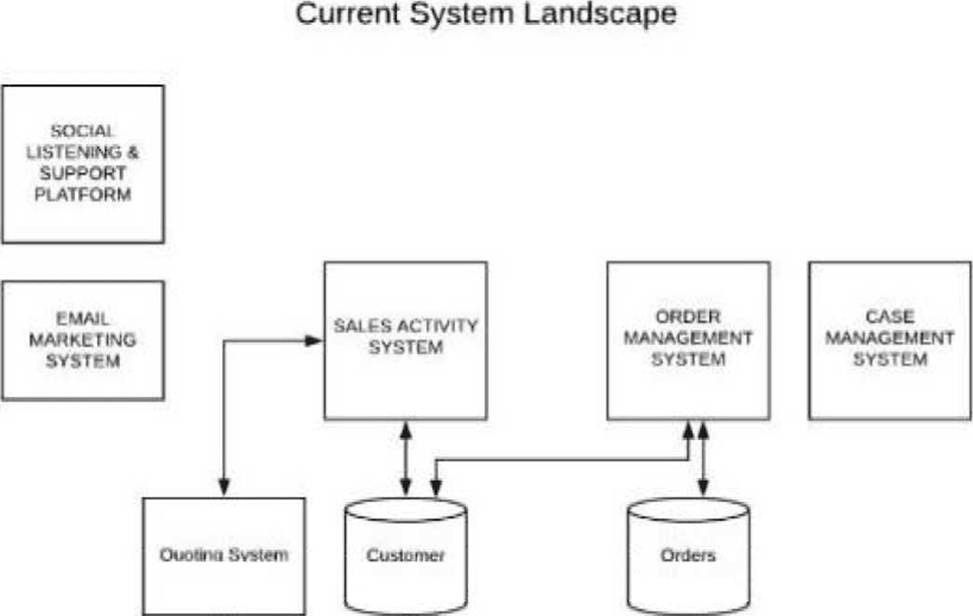 The goals for implementing Salesforce include:
1. Develop a 360-degree view of the customer.
2. Leverage Salesforce capabilities for marketing, sales, and service processes.
3. Reuse Enterprise capabilities built for quoting and order management processes. Which three systems from the current system landscape can be retired with the implementation of Salesforce?
-
A
Order Management, Case Management, and Email Marketing
-
B
Sales Activity, Order Management, and Case Management
-
C
Email Marketing, Sales Activity, and Case Management
Reveal answer details
Close answer details
Correct answerC
ExplanationComprehensive and Detailed 250 to 350 words of Explanation From Salesforce Platform Integration Architect documents: In the role of a Salesforce Platform Integration Architect, evaluating a legacy landscape requires a clinical mapping of current system functions against Salesforce's native capabilities, while strictly adhering to the "Constraints and Goals" provided by the business. The objective here is to maximize the ROI of the Salesforce implementation by consolidating redundant systems into the core platform. According to Goal 2, the business intends to utilize Salesforce for Marketing, Sales, and Service processes. Salesforce is architected to handle these three domains through its core clouds: Marketing Cloud (replacing the legacy Email Marketing System), Sales Cloud (replacing the Sales Activity System), and Service Cloud (replacing the Case Management System). By consolidating these three specific functions into Salesforce, the organization achieves Goal 1, which is the creation of a 360-degree view of the customer. When these activities occur on a single platform, the data is unified, eliminating the silos that existed in the previous landscape. However, the architect must also respect the technical constraints defined in Goal 3, which explicitly states the need to reuse enterprise capabilities built for quoting and order management . In architectural design, this designates the "Quoting System" and the "Order Management System" as systems of record that must remain in the future-state landscape. These systems likely contain complex, proprietary logic or are tightly coupled with back-end ERP systems like SAP Business Suite, making them "non-negotiable" for retirement at this stage. Therefore, because Email Marketing Sales Activity and Case Management map directly to Salesforce's primary strengths and are not excluded by the "reuse" requirement, they are the three systems that should be retired. This strategic retirement simplifies the integration architecture, allowing the architect to focus on building robust integration patterns (such as Request-Reply or Fire-and-Forget) between Salesforce and the remaining Quoting and Order Management systems.
Northern Trail Outfitters (NTO) uses a custom mobile app to interact with its customers. One of the features of the app is Salesforce Chatter Feeds. NTO wants to automatically post a Chatter item to Twitter whenever the post includes the #thanksNTO hashtag. Which API should an integration architect use to meet this requirement?
-
A
-
B
Streaming API to generate PushTopic
-
C
Reveal answer details
Close answer details
Correct answerC
ExplanationWhen designing integrations that specifically involve Chatter , social collaboration, or Experience Cloud sites, the Connect REST API (formerly known as the Chatter REST API) is the architecturally recommended choice. While the standard REST API is optimized for CRUD operations on data records, the Connect REST API is specifically designed to handle the complex, nested structures of social feeds, including posts, comments, hashtags, and mentions. The Connect REST API provides a specialized resource for feed elements that simplifies the process of identifying specific social markers like hashtags . In this use case, the mobile app or a middleware service can subscribe to or query the feed. The Connect REST API returns structured data where hashtags are identified as distinct message segments, making it trivial for an application logic to detect the #thanksNTO tag and trigger a subsequent call to the Twitter API. From an architectural standpoint, using the Connect REST API offers several advantages over the standard REST API or Streaming API for this requirement: Efficiency: Connect REST API responses are structured specifically for presentation in mobile applications, providing only the relevant social metadata and localized content needed for the feed. Feature Richness: It provides native support for social actions such as liking, sharing, and following, which are often required alongside feed monitoring. Scalability: It is designed to handle the high-volume, real-time nature of social interactions within Experience Cloud and mobile ecosystems. While the Streaming API (Option B) can notify an application of record changes, it does not provide the rich, formatted social context that the Connect REST API delivers. The standard REST API (Option A) could technically access FeedItem records, but it would require significant custom parsing logic to identify hashtags within the raw body text, whereas the Connect REST API handles this segmenting natively.
Therefore, for building custom mobile experiences that interact with Chatter data, the Connect REST API is the superior solution.
NTO is merging two orgs but needs the retiring org available for lead management (connected to web forms). New leads must be in the new instance within 30 minutes. Which approach requires the least amount of development effort?
-
A
Use the Tooling API with Process Builder to insert leads in real time.
-
B
Use the Composite REST API to aggregate multiple leads in a single call.
-
C
Configure named credentials in the source org.
Reveal answer details
Close answer details
When a user clicks "Check Preferences" as part of a Lightning flow, preferences from an externally hosted RESTful service are to be checked in real time. The service has OpenAPI 2.0 definitions. Which integration pattern and mechanism should be selected?
-
A
Data Virtualization: Salesforce Connect maps external REST data in external objects.
-
B
Request and Reply: Enhanced External Services invokes a REST API.
-
C
Remote Call-In: Salesforce REST API with REST Composite Resources.
Reveal answer details
Close answer details
Correct answerB
ExplanationThis scenario describes a classic Request and Reply pattern where a user action in the UI requires an immediate, synchronous response from an external system to determine the next step in a business process (the Flow). The requirement specifies that an OpenAPI 2.0 (Swagger) definition is available. For an Integration Architect, this is a prime use case for External Services . External Services allow you to import an OpenAPI schema and automatically generate "Invocable Actions" that can be used directly in Flow Builder without writing a single line of Apex code. Why this is the best fit: Low Code: It fulfills the requirement purely through declarative configuration, which reduces maintenance and development costs. Real-Time: It performs a synchronous HTTP callout and waits for the Boolean/String values to be returned to the Flow variables. Type Safety: Because it uses the OpenAPI definition, Salesforce understands the data types (Boolean /
String) natively. Option A (Data Virtualization) is more suitable for viewing and searching large external datasets as if they were records; it is over-engineered for a simple "check status" function. Option C (Remote Call-In) is the inverse of the requirement; it refers to an external system calling into Salesforce. By using Enhanced External Services , the architect provides a scalable, declarative solution that perfectly aligns with modern Salesforce development best practices for real-time external system interaction.
Northern Trail Outfitters has recently implemented middleware for orchestration of services across platforms.
The Enterprise Resource Planning (ERP) system being used requires transactions be captured near real-time at a REST endpoint initiated in Salesforce when creating an Order object. Additionally, the Salesforce team has limited development resources and requires a low-code solution. Which option should fulfill the use case requirements?
-
A
Use Remote Process Invocation Fire and Forget pattern on insert on the Order object using Flow Builder.
-
B
Implement a Workflow Rule wi5th Outbound Messaging to send SOAP messages to the designated endpoint.
-
C
Implement Change Data Capture on the Order object and leverage the replay ID in the middleware solution.
Reveal answer details
Close answer details
Correct answerA
ExplanationTo satisfy a requirement for near real-time updates to an ERP system while adher9ing to a low-code constraint, the architect must leverage Salesforce's modern declara10tive automation tools. The goal is to initiate an outbound signal that the existing middleware can then orchestrate and deliver to the ERP's REST endpoint. The Remote Process Invocation-Fire and Forget pattern is perfectly suited for this scenario. In this pattern, Salesforce sends a message to an external system and does not wait for a functional response. This is ideal for "capturing" transactions in an ERP where the primary goal is record synchronization rather than a real-time calculation return. By using Flow Builder , the team can implement a record-triggered flow on the Order object. This flow can be configured to execute "Actions" that send data to the middleware via External Services or standard HTTP Callouts (Beta/GA features in modern Flow), which requires zero Apex coding. Option B, Outbound Messaging , is a legacy declarative tool that is highly reliable but has a significant limitation: it natively sends messages in SOAP format. Since the requirement specifically specifies a REST endpoint , using Outbound Messaging would require additional transformation logic in the middleware, making it a less direct architectural fit than a modern Flow-based REST call. Option C, Change Data Capture (CDC) , is a highly scalable, event-driven mechanism, but it is typically considered more complex to implement and maintain. It requires the middleware to manage "Replay IDs" and subscribe to a streaming channel, which often requires more specialized development effort on the middleware side compared to a simple HTTP POST from a Flow. For a team with limited development resources, Flow Builder provides the most accessible and maintainable path to achieving near real-time integration.
Northern Trail Outfitters needs to use Shield Platform Encryption to encrypt social security numbers in order to meet a business requirement. Which action should an integration architect take prior to the implementation of Shield Platform Encryption?
-
A
Encrypt all the data so that it is secure.
-
B
Use Shield Platform Encryption as a user authentication or authorization tool.
-
C
Review Shield Platform Encryption configurations.
Reveal answer details
Close answer details
Correct answerC
ExplanationImplementing Shield Platform Encryption is a significant architectural change that requires careful planning before activation. The architect's first priority must be to Review Shield Platform Encryption configurations and understand the platform's functional limitations. Encryption at rest affects how data interacts with other platform features. For example, encrypting a field can impact the ability to use that field in SOQL WHERE clauses , report filters, list views, or as a unique/ external ID. Before encrypting Social Security Numbers, the architect must audit all existing integrations, Apex code, and reports that reference that field to ensure they will still function correctly. Option A is incorrect because unnecessarily encrypting all data can negatively impact system performance and break standard functionality. Encryption should be applied selectively to sensitive fields based on a clear data classification policy. Option B is factually wrong; Shield is a data protection tool, not an authentication or
authorization mechanism like OAuth or SSO. By reviewing the configurations first, the architect can identify potential "blockers"-such as a field being used in a formula or a criteria-based sharing rule-and address them before the encryption keys are generated and applied.
A customer is migrating from an old legacy system to Salesforce. As part of the modernization effort, the customer would like to integrate all existing systems that currently work with its legacy application with Salesforce. Which constraint/pain-point should an integration architect consider when choosing the integration pattern/mechanism?
-
A
System types APIs, File systems, Email
-
B
Reporting and usability requirements
-
C
Multi-language and multi-currency requirement
Reveal answer details
Close answer details
Correct answerA
ExplanationWhen migrating from a legacy landscape to a modern platform like Salesforce, the most immediate technical hurdle is the diversity of system types and communication protocols used by the existing systems. In a legacy environment, integrations are often not standardized. An architect may encounter systems that communicate via modern REST/SOAP APIs , but they will also likely find older systems that rely on Flat File exchanges (FTP/SFTP), Email-based triggers , or direct Database connections . These "System Types" are a fundamental constraint because they dictate the choice of integration middleware. For example, Salesforce cannot natively poll a file system or read an on-premise database; therefore, an
architect must identify these constraints to justify the need for an ETL or ESB tool that can bridge these legacy protocols with Salesforce's API-centric architecture. While reporting (Option B) and multi-currency (Option C) are important functional requirements for the Salesforce implementation, they do not dictate the integration pattern (e.g., Request-Reply vs. Batch) as much as the technical interface of the source/target systems does. By evaluating the APIs, file systems, and email capabilities of the legacy landscape first, the architect ensures that the chosen integration mechanism-whether it be the Streaming API, Bulk API, or middleware orchestration-is technically capable of actually communicating with the legacy debt.
Northern Trail Outfitters is planning to perform nightly batch loads into Salesforce from an external system with a custom Java application using the Bulk API. The CIO is curious about monitoring recommendations for the jobs from the technical architect. Which recommendation should help meet the requirements?
-
A
Use the getBatchInfo method in the Java application to monitor the status of the jobs from the Java application.
-
B
Write the error response from the Bulk API status to a custom error logging object in Salesforce using an Apex trigger, and create reports on the object.
-
C
Set the Salesforce debug logs level to "finest", and add the user ID running the job to monitor in the "Debug Logs" in the setup menu.
Reveal answer details
Close answer details
Correct answerA
ExplanationFor high-volume data loads using the Bulk API, monitoring should be performed programmatically by the orchestrating client-in this case, the custom Java application. The Bulk API is asynchronous, meaning that when you submit a job, Salesforce acknowledges the request and processes it in the background. The Java application must actively track the state of its own jobs. Using the `getBatchInfo` (or `getJobInfo` in Bulk API 2.0) method allows the application to retrieve the real-time status of each batch. The
application can check for statuses such as `Queued`, `InProgress`, `Completed`, or `Failed`. Once a batch is marked as `Completed`, the application can then call `getBatchResult` to retrieve a list of successes and
failures for individual records. Option B is architecturally unsound because Bulk API operations are designed to bypass most synchronous Apex logic to ensure performance; furthermore, creating custom records for every error in a
"nightly batch load" would likely hit other platform limits (like storage or CPU) and defeat the purpose of using the Bulk API. Option C is ineffective for Bulk API monitoring, as debug logs do not capture the background processing of bulk batches and would quickly hit the log size limits. By recommending Option A, the architect ensures that the Java application maintains full control over the integration lifecycle. The application can log errors locally, implement automated retries for transient failures, and provide the CIO with accurate, high-level reporting on the success rate of the nightly loads without placing unnecessary overhead on the Salesforce platform.
Question 10
Single choice
Universal Containers (UC) support agents would like to open bank accounts on the spot. During the process, agents execute credit checks through external agencies. At any given time, up to 30 concurrent reps will be using the service. Which error handling mechanisms should be built to display an error to the agent when the credit verification process has failed?
-
A
Handle Integration errors in the middleware in case the verification process is down, then the middleware should retry processing the request multiple times.
-
B
In case the verification process is down, use fire and forget mechanism instead of Request and Reply to allow the agent to get the response back when the service is back online.
-
C
Handle the error in the synchronous callout and display a message to the agent. (Note: While not
explicitly in the user's snippet, A and B are provided options; the standard architect answer for
"displaying an error to the agent" in a synchronous flow is handling the exception in the UI layer).
Reveal answer details
Close answer details
Correct answerA
ExplanationIn a synchronous Request-Reply scenario where a bank agent is waiting "on the spot" for a credit check, the error-handling strategy must balance immediate feedback with system resilience. Option A is the recommended architectural approach for enterprise resiliency. By placing a Middleware layer (like MuleSoft) between Salesforce and the credit agencies, the architect can implement sophisticated error-handling patterns that are invisible to the user but critical for success. If a credit agency's API is momentarily unreachable, the middleware can perform automated retries (e.g., three attempts with 500ms intervals). If the retries still fail, the middleware sends a clean, structured error response back to Salesforce. Option B (Fire and Forget) is fundamentally unsuitable for this use case because the agent needs the result immediately to open the account; they cannot wait for a callback that might arrive hours later. Option
C (Mock service) is only a testing tool and provides no value in a production environment where real financial data is required. By delegating the retry logic to the middleware, the architect protects Salesforce's concurrent request limits (since the agent only occupies a thread for the duration of the final response) and ensures that transient network issues do not result in a "failed" bank account application for the customer.
Question 11
Single choice
A customer is evaluating the Platform Events solution and would like help in comparing/contrasting it with Outbound Messaging for real-time/near-real time needs. They expect 3,000 customers to view messages in Salesforce. What should be evaluated and highlighted when deciding between the solutions?
-
A
In both Platform Events and Outbound Messaging, the event messages are retried by and delivered in sequence, and only once. Salesforce ensures there is no duplicate message delivery.
-
B
Message sequence is possible in Outbound Messaging, but not guaranteed with Platform Events. Both offer very high reliability. Fault handling and recovery are fully handled by Salesforce.
-
C
Both Platform Events and Outbound Messaging offer declarative means for asynchronous near-real time needs. They aren't best suited for real-time integrations.
Reveal answer details
Close answer details
Question 12
Single choice
A company needs to integrate a legacy on-premise application that can only support SOAP API. The integration architect determines that the Fire and Forget integration pattern is most appropriate for sending data from Salesforce to the external application and getting a response back in a strongly-typed format. Which integration capabilities should be used?
-
A
Platform Events for Salesforce to Legacy System direction and SOAP API using Enterprise WSDL for the communication back from legacy system to Salesforce
-
B
Outbound Messaging for Salesforce to Legacy System direction and SOAP API using Partner Web Services Description Language (WSDL) for the communication back from legacy system to Salesforce
-
C
Outbound Messaging for Salesforce to Legacy System direction and SOAP API using Enterprise WSDL for the communication back from legacy system to Salesforce
Reveal answer details
Close answer details
Correct answerC
ExplanationFor an outbound, declarative, Fire-and-Forget integration to a legacy SOAP-based system, Salesforce Outbound Messaging is the native tool of choice. Outbound Messaging sends an XML message to a designated endpoint when specific criteria are met. It is highly reliable as Salesforce will automatically retry the delivery for up to 24 hours if the target system is unavailable. For the communication back from the legacy system to Salesforce, a strongly-typed SOAP API approach is required. The Enterprise WSDL is the correct recommendation here because it is a strongly-typed WSDL that is specific to the organization's unique data model (including custom objects and fields). Using the Enterprise WSDL allows the legacy system to communicate with Salesforce using specific data types, providing compile-time safety and reducing errors during the mapping process. Option A is less efficient because Platform Events would likely require middleware to translate the event into the legacy system's SOAP format.
Option B suggests the Partner WSDL , which is loosely-typed and designed for developers building tools that must work across many different Salesforce orgs. Since this is an internal integration for a specific company, the Enterprise WSDL provides a much more streamlined development experience with better data integrity. By combining Outbound Messaging (for fire-and-forget delivery) and the Enterprise WSDL (for the strongly-typed callback), the architect fulfills the technical requirements while minimizing custom code.
Question 13
Single choice
Universal Containers (UC) is currently managing a custom monolithic web service that runs on an on-premise server. This monolithic web service is responsible for Point-to-Point (P2P) integrations between Salesforce and a legacy billing application, a cloud-based ERP, and a data lake. UC has found that the tight interdependencies are causing failures. What should an integration architect recommend to decouple the systems and improve performance?
-
A
Use the Salesforce Bulk API when integrating back into Salesforce.
-
B
Move the custom monolithic web service from on-premise to a cloud provider.
-
C
Leverage modular design by breaking up the web service into smaller pieces for a microservice architecture.
Reveal answer details
Close answer details
Correct answerC
ExplanationThe primary architectural flaw in UC's current landscape is the reliance on a monolithic P2P integration layer . In such designs, any failure in one integration thread or a surge in volume for one system can monopolize resources (CPU, memory, threads), causing the entire service-and thus all other integrations-to fail. This lack of isolation leads to the "tight interdependencies" described. To effectively decouple these systems, the architect should recommend a Microservices Architecture . By breaking the monolithic service into smaller, independent, and modular components, each integration (Billing, ERP, Data Lake) becomes its own isolated service. This approach provides several key architectural benefits: Isolation of Failure: If the connection to the legacy billing application fails or times out, it no longer impacts the ERP or Data Lake integrations. Independent Scalability: If the Data Lake integration requires high throughput, that specific microservice can be scaled horizontally without wasting resources on the others. Technology Agility: Each microservice can be updated or patched independently, allowing for faster maintenance cycles. Furthermore, moving a "monolithic" service to the cloud (Option B) is simply a "lift and shift" that preserves the underlying fragility. While the Bulk API (Option A) is excellent for high-volume data loading, it does not solve the fundamental problem of system interdependency and orchestration failure. Transitioning to a modular, service-oriented design allows UC to implement modern integration patterns, such as asynchronous queuing between the microservices, which significantly improves the overall resilience and performance of the Salesforce-to-back-office landscape.
Question 14
Single choice
Northern Trail Outfitters (NTO) wants to improve the quality of callouts from Salesforce to its REST APIs.
For this purpose, NTO will require all API Clients/consumers to adhere to REST API Markup Language (RAML) specifications that include the field-level definition of every API request and response Payload. The RAML specs serve as interface contracts that Apex REST API Clients can rely on. Which design specification should the integration architect include in the integration architecture to ensure that Apex REST API Clients' unit tests confirm Adherence to the RAML specs?
-
A
Require the Apex REST API Clients to implement the HttpCalloutMock
-
B
Call the HttpCalloutMock Implementation from the Apex REST API Clients.
-
C
Implement HttpCalloutMock to return responses per RAML specification.
Reveal answer details
Close answer details
Correct answerC
ExplanationIn a contract-first integration strategy using RAML (RESTful API Modeling Language), the specification defines the exact structure of requests and responses. Because Salesforce unit tests cannot perform actual network callouts, the platform requires d1evelopers to use the HttpCalloutMock interface to simulate responses. To ensure that the integration code strictly adheres to the established RAML contract, the integration architect must mandate that the HttpCalloutMock implementation returns responses that mirror the RAML specification . This means the mock must include all required fields, correct data types, and the expected HTTP status codes (e.g., 200 OK, 201 Created) as defined in the contract. By doing this, the unit tests verify that the Apex client code can successfully parse and process the specific JSON or XML payloads defined in the RAML spec. Option A and B are technically imprecise. The Apex client does not "implement" the mock; rather, the test class provides a separate mock implementation to the runtime via Test.setMock(). The value of the integration architecture lies in the content of that mock. If the mock is designed to return contract-compliant data, then any change to the RAML that breaks the Apex code's ability to process it will be caught immediately during the testing phase. This "Mock-as-a-Contract" approach provides a safety net, ensuring that Salesforce remains compatible with external services even as those services evolve, provided the RAML is kept up to date.
Question 15
Single choice
Northern Trail Outfitters uses a custom Java application to display code coverage and test results for all enterprise applications. Which Salesforce API should an integration architect use to include Salesforce in this application?
-
A
-
B
-
C
Reveal answer details
Close answer details
Correct answerC
ExplanationThe Tooling API is specifically designed for developer-centric tools that need fine-grained access to Salesforce metadata and runtime information. It exposes specialized objects like ApexCodeCoverage, ApexCodeCoverageAggregate, and ApexTestResult. These objects allow external applications to query the results of test runs and specific line-by-line coverage metrics. While the Metadata API (Option A) is used for deployments, it does not provide the same granular query access to test execution results.
The Tooling API is the industry standard for integrating Salesforce into enterprise CI/CD pipelines and quality dashboards.
Question 16
Single choice
An integration architect has designed a mobile application for Salesforce users to get data while on the road using a custom user interface (UI). The application is secured with OAuth and is currently functioning well. There is a new requirement where the mobile application needs to obtain the GPS coordinates and store them on a custom geolocation field. The geolocation field is secured with field-level security, so users can view the value without changing it. What should be don4e to meet the requirement?
-
A
The mobil10e device makes a REST Apex inbound call.
-
B
The 15mobile device makes a REST API inboun16d call.
-
C
The mobile device receives19 a REST Apex callout call.
Reveal answer details
Close answer details
Correct answerB
ExplanationWhen a custom mobile application already secured with OAuth needs to update a record in Salesforce, the standard architectural recommendation is to use the REST API . The REST API is optimized for mobile environments because it uses lightweight JSON payloads and follows standard HTTP methods (such as PATCH for updates), which are highly compatible with mobile development frameworks. In this specific scenario, the architect must address the Field-Level Security (FLS) constraint. Because the geolocation field is set to read-only for users, a standard UI-based update would typically fail. However, when using an inbound REST API call with a properly authorized integration user or via a "System Mode" context (if utilizing a custom Apex REST resource), the system can be configured to bypass UI-level restrictions while maintaining data integrity. The mobile device captures the coordinates via the device's native GPS capabilities and initiates an inbound call to the Salesforce REST endpoint.
Option A (Apex inbound call) is a subset of REST functionality but is only necessary if complex server-side logic is required that the standard REST API cannot handle.
Option C is technically incorrect as mobile devices do not typically "receive" callouts from Salesforce in this pattern; they initiate the requests. By leveraging the standard REST API, the architect ensures a scalable, secure, and standardized integration that adheres to Salesforce's mobile-first integration principles.
Question 17
Single choice
An integration architect has received a request to prevent employees that leave the company from accessing data in Salesforce after they are deactivated in the company's HR system. What should the integration architect determine before recommending a solution?
-
A
Inbound integration requirements, then identify frequency
-
B
Data access prevention requirements, integration requirements, and system constraints
-
C
Data access prevention requirements, then identify frequency
Reveal answer details
Close answer details
Question 18
Single choice
Northern Trail Outfitters (NTO) has recently changed its Corporate Security Guidelines. The guidelines require that all cloud applications pass through a secure firewall before accessing on-premise resources.
NTO is evaluating middleware solutions to integrate cloud applications with on-premise resources and services. Which consideration should an integration architect evaluate before choosing a middleware solution?
-
A
The middleware solution is capable of establishing a secure API Gateway between cloud applications and on-premise resources.
-
B
The middleware solution enforces the OAuth security protocol.
-
C
The middleware solution is able to interface directly with databases via an Open Database Connectivity (ODBC) connection string.
Reveal answer details
Close answer details
Correct answerA
ExplanationWhen corporate guidelines mandate that all cloud-to-on-premise traffic must pass through a secure firewall, the architecture must support a Demilitarized Zone (DMZ) or "Perimeter Network" strategy. The Integration Architect must evaluate whether the middleware solution includes a robust API Gateway component. A secure API Gateway acts as the single entry point for all external requests. It is typically deployed within the DMZ to terminate incoming TLS connections from the cloud (Salesforce) and perform deep packet inspection, IP whitelisting, and authentication before proxying the request to internal on-premise resources.
This provides a critical layer of insulation, ensuring that internal services-such as an ERP or legacy database-are never exposed directly to the public internet. While OAuth enforcement (Option B) is a common requirement for authorization, it does not fulfill the specific network-level firewall requirement described. Similarly, ODBC connectivity (Option C) is a low-level internal database protocol that should generally be avoided for cross-firewall communication due to its inherent security risks. By selecting a middleware solution with integrated API Gateway capabilities, Northern Trail Outfitters can provide the security team with centralized control over encryption, rate limiting, and threat protection, thereby strictly adhering to the new Corporate Security Guidelines while enabling
seamless hybrid cloud integration.
Question 19
Single choice
Universal Containers (UC) uses Salesforce Service Cloud. Support agents open bank accounts on the spot. UC's core banking system is the system of record, and all accounts opened in Salesforce must be synced in real time. Agents need to inform the customers of the newly created bank account ID, which is generated by the core banking system. Which integration pattern is recommended for this use case?
-
A
Salesforce platform event
-
B
-
C
Streaming API to generate PushTopic
Reveal answer details
Close answer details
Correct answerB
ExplanationThe requirement for an agent to receive a newly created bank account ID in real time to inform a customer signifies a synchronous dependency. The agent cannot complete the business process until the core banking system confirms the account creation and returns the generated identifier. The Request and Reply pattern is the appropriate recommendation for this use case. In this pattern: Request: Salesforce sends a synchronous callout (REST or SOAP) containing the customer's data to the core banking system. Wait: The Salesforce thread remains open, and the user interface typically displays a loading indicator while waiting for the external system to process the request. Reply: The core banking system returns the new account ID, which is then immediately displayed to the support agent in Salesforce. Options A ( Platform Events ) and C ( Streaming API ) are asynchronous, event-driven patterns. While highly scalable, they are unsuitable for this specific "on the spot" requirement because there is no native way to force the agent's screen to wait for an asynchronous callback with the new ID. Request and Reply ensures that the agent has the necessary information to complete the customer interaction in a single, continuous flow.
Question 20
Single choice
A global retailer needs to ensure that Salesforce can recover missed order status updates from an ERP system after a temporary outage lasting 24 hours. The integration uses an event-driven architecture. Which capability should be leveraged?
-
A
Replay ID with Streaming API subscription
-
B
SOAP getUpdated() polling
-
C
Reveal answer details
Close answer details
Correct answerA
ExplanationReplay IDs allow subscribers to retrieve missed Platform Events or Change Data Capture events within the 72-hour retention window. If Salesforce or the subscriber disconnects temporarily, the integration can resume from the last processed Replay ID. Polling using getUpdated() increases API consumption and introduces latency. Manual reconciliation is operationally inefficient and error-prone. Replay-based recovery ensures durability and reliability in event-driven architectures.
Question 21
Single choice
A solution requires monitoring of Apex test execution results and code coverage metrics from an external DevOps dashboard. Which Salesforce API should be used?
-
A
-
B
-
C
Reveal answer details
Close answer details
Correct answerA
ExplanationThe Tooling API exposes development-related objects such as ApexTestResult and ApexCodeCoverageAggregate. It enables programmatic retrieval of code coverage statistics and test execution outcomes. Bulk API handles high-volume data operations, not development metrics. Analytics REST API is designed for CRM Analytics datasets. Tooling API integrates Salesforce SDLC metrics into enterprise DevOps tools.
Question 22
Single choice
Northern Trail Outfitters is planning to perform nightly batch loads into Salesforce using the Bulk API. The CIO wants monitoring recommendations for these jobs. Which recommendation should help meet the requirements?
-
A
Visually monitor in the Salesforce UI using the "Bulk Data Load Jobs" in Salesforce in the setup menu.
-
B
Write the error response from the Bulk API status to a custom error logging object in Salesforce using an Apex trigger, and create reports on the object.
-
C
Set the Salesforce debug logs level to "finest", and add the user ID running the job to monitor in the "Debug Logs" in the setup menu.
Reveal answer details
Close answer details
Correct answerA
ExplanationFor monitoring high-volume Bulk API jobs, the standard and most efficient architectural recommendation is to use the native Bulk Data Load Jobs page in Salesforce Setup. This page provides a comprehensive, out-of-the-box view of all asynchronous API jobs, including their status (Queued, In Progress, Completed, Failed), the number of records processed, and any overall job errors. It allows administrators to download the result files for each batch to see record-level successes and failures without the overhead of custom code or data storage. Option B is generally discouraged for high-volume nightly loads. Since the Bulk API is designed to bypass standard synchronous logic for performance, writing errors to a custom object for millions of records would consume significant data storage and could trigger additional governor limit issues during the load itself. Option C is ineffective for Bulk API monitoring; debug logs capture Apex execution but do not monitor the background processing of asynchronous Bulk API batches, and they would quickly become overwhelmed by the volume of data. For enterprise-grade monitoring, the native UI provides the necessary visibility into job health with zero impact on platform performance or storage.
Question 23
Single choice
A new Salesforce program requires data updates between internal systems and Salesforce. Which relevant details should a Salesforce integration architect seek to solve for the integration architecture needs of the program?
-
A
Core functional and non-functional requirements for User Experience design, Encryption needs, Community, and license choices
-
B
Source and Target system, Directionality, and data volume & transformation complexity, along with any middleware that can be leveraged
-
C
Integration skills, SME availability, and Program Governance details
Reveal answer details
Close answer details
Correct answerB
ExplanationTo design a robust and scalable integration architecture, a Salesforce architect must first define the technical scope and "plumbing" of the data flow. The most critical details for solving integration architecture needs include: Source and Target Systems: Identifying which systems are involved determines the available APIs (REST, SOAP, etc.) and the necessary security protocols. Directionality: Knowing whether the integration is unidirectional (Salesforce to System X) or bidirectional is vital for managing record mastering and avoiding "infinite loops" in data synchronization. Data Volume & Transformation Complexity: High volumes may require asynchronous batch processing via the Bulk API, while complex transformations (e.g., mapping custom external IDs to Salesforce Account Numbers) may necessitate a middleware layer like MuleSoft to act as the "central nervous system". Option A focuses on UI/UX and licensing, which are general program concerns rather than architectural integration requirements.
Option C deals with project management and governance, which are important for execution but do not inform the choice between a Request-Reply or Fire-and-Forget pattern. By focusing on systems, data direction, and transformation complexity, the architect can select the correct pattern and tools that satisfy business requirements while staying within platform limits.
|