A company has HPE Aruba Networking Central-managed APs. The company wants to block all clients connected through the APs from using YouTube. Which steps should you take?
-
A
Deploy gateways and have the APs tunnel traffic to the gateways. Then, enable the gateway IDS/IPS engine.
-
B
Enable Client IPS at the "custom" level, and then specify the check for YouTube.
-
C
Enable WebCC on all client firewall roles. Then, create WebCC category rules that deny suspicious URLs.
-
D
Enable DPI. Then, create application rules to deny YouTube on the firewall roles.
Reveal answer details
Close answer details
Correct answerD
ExplanationTo block all clients connected through HPE Aruba Networking Central-managed APs from accessing YouTube, you should enable DPI (Deep Packet Inspection) and then create application rules to deny YouTube on the firewall roles. DPI allows the network to inspect and classify traffic based on application signatures, making it possible to enforce application-specific policies. By creating rules that specifically block YouTube traffic, you can effectively prevent clients from accessing the service.
A company is using HPE Aruba Networking Central SD-WAN Orchestrator to establish a hub-spoke VPN between branch gateways (BGWs) at 1164 site and VPNCs at multiple data centers. What is part of the configuration that admins need to complete?
-
A
In VPNCs' groups, establish VPN pools to control which branches connect to which VPNCs.
-
B
In BGWs' and VPNCs' groups, create default IKE policies for the SD-WAN Orchestrator to use.
-
C
In BGWs' groups, select the VPNCs to which to connect in a DC preference list.
-
D
At the global level, create default IPsec policies for the SD-WAN Orchestrator to use.
Reveal answer details
Close answer details
Correct answerC
ExplanationHub-Spoke VPN Configuration: HPE Aruba Central SD-WAN Orchestrator enables hub-spoke topology where branch gateways (BGWs) connect to VPN concentrators (VPNCs) located at data centers. A key step in configuring this is defining which VPNCs the BGWs will prefer for connectivity. The DC Preference List is configured in the BGW groups to prioritize the data centers to which BGWs connect. Option Analysis: Option A: Incorrect. VPN pools control IP allocation, not which branches connect to VPNCs. Option B: Incorrect. IKE policies define key exchange mechanisms but are not part of the connection preference process. Option C: Correct. Admins configure a DC preference list in BGW groups to determine connectivity priorities with VPNCs. Option D: Incorrect. IPsec policies define encryption parameters at a global level, but this is not specific to the hub-spoke connection configuration.
Which statement describes Zero Trust Security?
-
A
Companies should focus on protecting their resources rather than on protecting the boundaries of their internal network.
-
B
Companies must apply the same access controls to all users, regardless of identity.
-
C
Companies that support remote workers cannot achieve zero trust security and must determine if the benefits outweigh the cost.
-
D
Companies can achieve zero trust security by strengthening their perimeter security to detect a wider range of threats.
Reveal answer details
Close answer details
Correct answerA
ExplanationZero Trust Security is a security model that operates on the principle that no entity, whether inside or outside the network, should be trusted by default. Instead, every access request is thoroughly verified before granting access to resources. This model emphasizes protecting resources rather than merely securing the network perimeter, acknowledging that threats can originate both inside and outside the network. 1. Resource Protection: Zero Trust focuses on securing individual resources, assuming that threats can bypass traditional perimeter defenses. 2. Verification: Every access request is authenticated and authorized regardless of the source, ensuring that only legitimate users can access sensitive resources. 3. Modern Security Approach: This model aligns with the evolving threat landscape where insider threats and advanced persistent threats are common.
You have configured an AOS-CX switch to implement 802.1X on edge ports. Assume ports operate in the default auth-mode. VolP phones are assigned to the "voice" role and need to send traffic that is tagged for VLAN 12. Where should you configure VLAN 12?
-
A
As the trunk native VLAN on edge ports and the trunk native VLAN on the "voice" role
-
B
As a trunk allowed VLAN on edge ports and the trunk native VLAN in the "voice" role
-
C
As the trunk native VLAN in the "voice" role (and not in the edge port settings)
-
D
As the allowed trunk VLAN in the "voice" role (and not in the edge port settings)
Reveal answer details
Close answer details
Correct answerD
ExplanationWhen configuring 802.1X authentication on edge ports of an AOS-CX switch and assigning VoIP phones to a "voice" role, the correct approach is to configure VLAN 12 as the allowed trunk VLAN in the "voice" role. This setup ensures that traffic tagged for VLAN 12 is appropriately managed by the role applied to the VoIP phones. In AOS-CX switches, the role-based VLAN configuration allows for more granular control and ensures that the VoIP phones' traffic is handled correctly without altering the edge port settings, which typically operate with default settings for authentication.
You have downloaded a packet capture that you generated on HPE Aruba Networking Central. When you open the capture in Wireshark, you see the output shown in the exhibit. 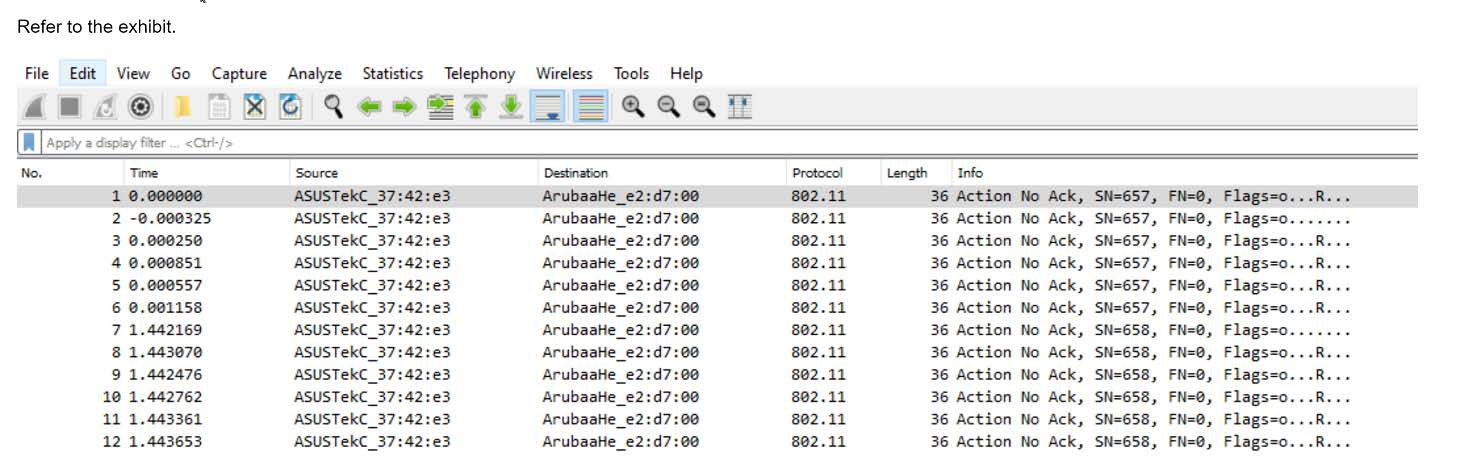 What should you do in Wireshark so that you can better interpret the packets?
-
A
Choose to decode UDP port 5555 packets as ARUBA_ERM and set the Aruba ERM Type to 0.
-
B
Edit pReferences: for IEEE 802.11 and chose to ignore the Protection bit with IV.
-
C
Apply the following display filter: wlan.fc.type == 1.
-
D
Edit the Enabled Protocols and make sure that 802.11, GRE, and Aruba_ERM are enabled.
Reveal answer details
Close answer details
Correct answerA
ExplanationTo better interpret the packets shown in the Wireshark capture, you should choose to decode UDP port 5555 packets as ARUBA_ERM and set the Aruba ERM Type to 0. This configuration will allow Wireshark to properly decode and display the Aruba-specific encapsulated remote mirroring (ERM) packets, providing a clearer understanding of the traffic. 1. Decoding Protocols: Selecting the correct protocol decoding in Wireshark ensures that the captured packets are interpreted correctly, displaying the relevant information. 2. Aruba ERM: The packets in the capture are likely encapsulated remote mirroring (ERM) packets specific to Aruba, which require proper decoding settings in Wireshark. 3. Clear Interpretation: By setting the Aruba ERM Type to 0 and decoding the packets as ARUBA_ERM, you can view the encapsulated data accurately.
You are setting up HPE Aruba Networking SSE. Which use case requires you to apply a non-default device posture in a rule?
-
A
Applying threat inspection to users when they access certain websites
-
B
Checking whether a client has antivirus software as a condition for receiving access to resources
-
C
Redirecting compromised clients to a remediation server
-
D
Integrating with HPE Aruba Networking ClearPass OnGuard
Reveal answer details
Close answer details
Correct answerB
ExplanationComprehensive Detailed
A non-default device posture is applied in scenarios where specific checks on a device's compliance or security state (posture) are required to grant or deny access. The correct answer is:
B. Checking whether a client has antivirus software as a condition for receiving access to resources.
This use case explicitly requires device posture assessment, which involves evaluating the device for attributes like antivirus software, patch levels, or other compliance criteria.
Non-default device posture rules are configured to assess these conditions and enforce the appropriate policy based on the device's state.
Other Options:
A. Applying threat inspection: Threat inspection rules operate independently of device posture and apply
based on traffic content, not device compliance.
C. Redirecting compromised clients: This action is typically triggered based on a security event or threat
detection, not directly related to device posture evaluation.
D. Integrating with ClearPass OnGuard: While OnGuard can contribute to posture assessment, it does not
require a non-default device posture in the SSE rule directly.
References:
HPE Aruba SSE Posture-Based Access Control documentation.
Aruba ClearPass and SSE Integration Deployment Guide.
A company wants HPE Aruba Networking ClearPass Policy Manager (CPPM) to respond to Syslog messages from its Check Point firewall. You have added the firewall as an event source and set up an
event service. However, test Syslog messages are not triggering the expected actions. What is one CPPM setting that you should check?
-
A
ClearPass Device Insight integration is disabled.
-
B
The Check Point Extension is installed through ClearPass Guest.
-
C
The CoA delay value is set to 0 on the server.
-
D
Ingress Event Dictionaries for Check Point messages are enabled.
Reveal answer details
Close answer details
Correct answerD
ExplanationTo ensure that HPE Aruba Networking ClearPass Policy Manager (CPPM) responds correctly to Syslog messages from a Check Point firewall, you need to check that the Ingress Event Dictionaries for Check Point messages are enabled. These dictionaries are necessary for CPPM to properly interpret and respond to the Syslog messages received from the firewall. 1. Event Dictionaries: Ingress Event Dictionaries allow CPPM to understand the specific format and content of Syslog messages from various sources, such as Check Point firewalls. 2. Message Interpretation: Without these dictionaries enabled, CPPM may not correctly interpret the Syslog messages, leading to a failure in triggering the expected actions. 3. Configuration Check: Ensuring that the dictionaries are enabled is crucial for the proper functioning of the event service and accurate response to security events.
HPE Aruba Networking ClearPass Policy Manager (CPPM) uses a service to authenticate clients. You are now adding the Endpoints Repository as an authorization source for the service, and you want to add rules to the service's policies that apply different access levels based, in part, on a client's device category. You need to ensure that CPPM can apply the new correct access level after discovering new clients' categories. What should you enable on the service?
-
A
The Posture Compliance option in the Service tab
-
B
The Profile Endpoints option in the Service tab
-
C
The Use cached Roles and Posture attributes from previous sessions option in the Enforcement tab
-
D
The Audit End-host option in the Service tab
Reveal answer details
Close answer details
Correct answerB
ExplanationTo ensure that HPE Aruba Networking ClearPass Policy Manager (CPPM) can apply the correct access levels based on a client's device category after discovering new clients, you need to enable the "Profile Endpoints" option in the Service tab. This option allows CPPM to profile and categorize endpoints dynamically, ensuring that the appropriate access levels are applied based on the device's characteristics.
Enabling this feature ensures that new devices are accurately profiled and that access policies can be enforced based on the updated device information.
A company needs you to integrate HPE Aruba Networking ClearPass Policy Manager (CPPM) with HPE Aruba Networking ClearPass Device Insight (CPDI). What is one task you should do to prepare?
-
A
Install the root CA for CPPM's HTTPS certificate as trusted in the CPDI application.
-
B
Enable Insight in the CPPM server configuration settings.
-
C
Configure WMI, SSH, and SNMP external accounts for device scanning on CPPM.
-
D
Collect a Data Collector token from HPE Aruba Networking Central.
Reveal answer details
Close answer details
Correct answerB
ExplanationClearPass Device Insight Integration:
To integrate ClearPass Device Insight (CPDI) with ClearPass Policy Manager (CPPM), you must enable the Insight feature in the CPPM server configuration settings.
This ensures CPPM can share and receive profiling data with CPDI for device identification.
Option Analysis:
Option A: Incorrect. Root CA certificates are not required for this integration.
Option B: Correct. Enabling Insight on CPPM is essential for the integration to function.
Option C: Incorrect. WMI, SSH, and SNMP are not part of the CPDI integration prerequisites.
Option D: Incorrect. The Data Collector token is relevant to Aruba Central, not CPDI integration.
Question 10
Single choice
A ClearPass Policy Manager (CPPM) service includes these settings: Role Mapping Policy: Evaluate: Select first Rule 1 conditions: Authorization:AD:Groups EQUALS Managers Authentication:TEAP-Method-1-Status EQUALS Success Rule 1 role: manager Rule 2 conditions: Authentication:TEAP-Method-1-Status EQUALS Success Rule 2 role: domain-comp Default role: [Other]
Enforcement Policy:
Evaluate: Select first
Rule 1 conditions:
Tips Role EQUALS manager AND Tips Role EQUALS domain-comp Rule 1 profile list: domain-manager Rule 2 conditions: Tips Role EQUALS manager Rule 2 profile list: manager-only Rule 3 conditions: Tips Role EQUALS domain-comp Rule 3 profile list: domain-only
Default profile: [Deny access]
A client is authenticated by the service. CPPM collects attributes indicating that the user is in the Contractors group, and the client passed both TEAP methods. Which enforcement policy will be applied?
-
A
-
B
-
C
-
D
Reveal answer details
Close answer details
Correct answerA
Explanation1. Understanding the Role Mapping Evaluation:
Role mapping is set to "Evaluate: Select first," meaning the first rule that matches the client attributes will determine the role(s) assigned.
Contractors group: Since the client is in the Contractors group (not Managers), in the Role Rule 1 Mapping Policy does not match.
TEAP-Method-1-Status EQUALS Success: This condition matches , so the client is assigned Rule 2 the domain-comp role.
No other rules match, so the default role [Other] is not applied. domain-comp role.
3. Enforcement Policy Evaluation:
Enforcement policy is also set to "Evaluate: Select first," so the first matching rule determines the enforcement profile.
Rule 1 (Tips Role = manager AND domain-comp): The client only has the domain-comp role, not manager, so this rule does not match.
Rule 2 (Tips Role = manager):
The client does not have the manager role, so this rule does not match.
Rule 3 (Tips Role = domain-comp):
This rule matches the client's role, but it is not evaluated because the enforcement policy already skipped to the default action after failing the first two rules.
4. Default Enforcement Profile:
Since no rule explicitly matches and the policy evaluation stops at the default, the default profile [Deny Access Profile] is applied.
Final Outcome:
The client is denied access because none of the matching rules satisfy the conditions. References:
Aruba ClearPass Policy Manager Role Mapping and Enforcement Policies Guide.
Role and Policy Evaluation Logic for ClearPass Authentication Services.
Question 11
Single choice
What is a typical use case for using HPE Aruba Networking ClearPass Onboard to provision devices?
-
A
Enabling unmanaged devices to succeed at certificate-based 802.1X
-
B
Enabling managed Windows domain computers to succeed at certificate-based 802.1X
-
C
Enhancing security for loT devices that need to authenticate with MAC-Auth
-
D
Enforcing posture-based assessment on managed Windows domain computers
Reveal answer details
Close answer details
Correct answerA
ExplanationA typical use case for using HPE Aruba Networking ClearPass Onboard is to provision unmanaged devices to succeed at certificate-based 802.1X authentication. ClearPass Onboard allows users to securely configure their personal devices with the necessary certificates and network settings to authenticate on the network using 802.1X, which enhances security and simplifies the onboarding process for unmanaged devices. 1. Certificate-Based Authentication: ClearPass Onboard simplifies the process of issuing and installing certificates on unmanaged devices, ensuring they can authenticate securely using 802.1X. 2. User-Friendly Onboarding: The Onboard process is user-friendly, guiding users through the steps needed to configure their devices for network access. 3. Enhanced Security: By using certificates for authentication, the solution provides a higher level of security compared to traditional username/password methods.
Question 12
Single choice
A company has Aruba APs that are controlled by Central and that implement WIDS. When you check WIDS events, you see a "detect valid SSID misuse" event. What can you interpret from this event, and what steps should you take?
-
A
Clients are failing to authenticate to corporate SSIDs. You should first check for misconfigured authentication settings and then investigate a possible threat.
-
B
Admins have likely misconfigured SSID security settings on some of the company's APs. You should have them check those settings.
-
C
Hackers are likely trying to pose as authorized APs. You should use the detecting radio information and immediately track down the device that triggered the event.
-
D
This event might be a threat but is almost always a false positive. You should wait to see the event over several days before following up on it.
Reveal answer details
Close answer details
Correct answerC
ExplanationThe "Detect Valid SSID Misuse" event in Aruba's Wireless Intrusion Detection System (WIDS) indicates that a valid SSID, associated with your network, is being broadcast from an unauthorized source. This scenario often signals a potential rogue access point attempting to deceive clients into connecting to it (e.g., for credential harvesting or man-in-the-middle attacks).
1. Explanation of Each Option
A. Clients are failing to authenticate to corporate SSIDs. You should first check for misconfigured
authentication settings and then investigate a possible threat: Incorrect: This event is not related to authentication failures by legitimate clients.
Misconfigured authentication settings would lead to events like "authentication failures" or "radius issues,"
not "valid SSID misuse."
B. Admins have likely misconfigured SSID security settings on some of the company's APs. You should
have them check those settings: Incorrect: This event refers to an external device broadcasting your SSID, not misconfiguration on the company's authorized APs.
WIDS differentiates between valid corporate APs and rogue APs.
C. Hackers are likely trying to pose as authorized APs. You should use the detecting radio information and
immediately track down the device that triggered the event: Correct: This is the most likely cause of the "detect valid SSID misuse" event. A rogue AP broadcasting a corporate SSID could lure clients into connecting to it, exposing sensitive credentials or traffic.
Immediate action includes:
Using the radio information from the event logs to identify the rogue AP's location.
Physically locating and removing the rogue device.
Strengthening WIPS/WIDS policies to prevent further misuse.
D. This event might be a threat but is almost always a false positive. You should wait to see the event over
several days before following up on it: Incorrect: While false positives are possible, "valid SSID misuse" is a critical security event that should not be ignored.
Delaying action increases the risk of successful attacks against your network.
2. Recommended Steps to Address the Event
Review Event Logs:
Gather details about the rogue AP, such as SSID, MAC address, channel, and signal strength. Locate the Rogue Device: Use the detecting AP's radio information and signal strength to triangulate the rogue AP's physical location.
Respond to the Threat: Remove or disable the rogue device.
Notify the security team for further investigation.
Prevent Future Misuse:
Strengthen security policies, such as enabling client whitelists or enhancing WIPS protection.
References:
Aruba WIDS/WIPS Configuration and Best Practices Guide.
Aruba Central Security Event Analysis Documentation.
Wireless Threat Management Using Aruba Networks.
Question 13
Single choice
A company is implementing HPE Aruba Networking Wireless IDS/IPS (WIDS/WIPS) on its AOS-10 APs, which are managed in HPE Aruba Networking Central. What is one requirement for enabling detection of rogue APs?
-
A
Each VLAN in the network assigned on at least one AP's or AM's port
-
B
A Foundation with Security license for each of the APs
-
C
One AM deployed for every one AP deployed
-
D
A manual radio profile that enables non-regulatory channels
Reveal answer details
Close answer details
Correct answerB
ExplanationTo enable the detection of rogue APs with HPE Aruba Networking Wireless IDS/IPS (WIDS/WIPS) on AOS- 10 APs managed in HPE Aruba Networking Central, each AP must have a Foundation with Security license. This license enables advanced security features, including rogue AP detection, which is crucial for maintaining a secure wireless environment and protecting against unauthorized access points.
Question 14
Single choice
Assume that an AOS-CX switch is already implementing DHCP snooping and ARP inspection successfully on several VLANs. What should you do to help minimize disruption time if the switch reboots?
-
A
Configure the switch to act as an ARP proxy.
-
B
Create static IP-to-MAC bindings for the DHCP and DNS servers.
-
C
Save the IP-to-MAC bindings to external storage.
-
D
Configure the IP helper address on this switch, rather than a core routing switch.
Reveal answer details
Close answer details
Correct answerC
ExplanationTo minimize disruption time if an AOS-CX switch reboots while implementing DHCP snooping and ARP inspection, you should save the IP-to-MAC bindings to external storage. This ensures that the DHCP snooping and ARP inspection tables, which are crucial for preventing spoofing attacks, are preserved across reboots. When the switch restarts, it can reload these bindings from the external storage, thereby maintaining network security and reducing the downtime associated with rebuilding these tables. 1. Preserving Bindings: Saving IP-to-MAC bindings to external storage ensures that these critical security tables are not lost during a reboot, maintaining network integrity. 2. Security Continuity: This practice helps to quickly restore security features like DHCP snooping and ARP inspection, minimizing the window of vulnerability. 3. Operational Efficiency: By preserving these bindings, the switch can resume normal operations faster, reducing disruption to network services.
Question 15
Single choice
You have run an Active Endpoint Security Report on HPE Aruba Networking ClearPass. The report indicates that hundreds of endpoints have MAC addresses but no known IP addresses. What is one step for addressing this issue?
-
A
Set up network devices to implement RADIUS accounting to CPPM.
-
B
Add CPPM's IP address to the IP helper list on routing switches.
-
C
Set up switches to implement ARP inspection on client VLANs.
-
D
Configure CPPM as a Syslog destination on network devices.
Reveal answer details
Close answer details
Correct answerB
ExplanationWhen the Active Endpoint Security Report on HPE Aruba Networking ClearPass indicates that endpoints have MAC addresses but no known IP addresses, one effective step to address this issue is to add CPPM's (ClearPass Policy Manager) IP address to the IP helper list on routing switches. This configuration ensures that DHCP requests are forwarded to the ClearPass server, allowing it to track and report the IP addresses assigned to the endpoints. This helps ClearPass maintain an accurate mapping of MAC addresses to IP addresses, improving endpoint visibility and security management.
Question 16
Single choice
A company has been running Gateway IDS/IPS on its gateways in IDS mode for several weeks. The company wants to transition to IPS mode. What is one step you should recommend?
-
A
Disable traffic inspection and reboot before re-enabling traffic inspection with the new mode.
-
B
Change the mode on one gateway at a time to establish a smoother transition period.
-
C
Consider applying a stricter IPS policy to minimize issues during the transition period.
-
D
Check for legitimate traffic that has been flagged as a threat and allow list the associated rules.
Reveal answer details
Close answer details
Correct answerD
ExplanationWhen transitioning from Intrusion Detection System (IDS) mode to Intrusion Prevention System (IPS) mode, it's critical to review and refine configurations to ensure legitimate traffic is not blocked. Here's the
reasoning behind each option:
A. Disable traffic inspection and reboot before re-enabling traffic inspection with the new mode.
Incorrect:
Transitioning to IPS mode does not require a full reboot or disabling traffic inspection.
This step is unnecessary and could lead to downtime that impacts network operations.
B. Change the mode on one gateway at a time to establish a smoother transition period.
Incorrect:
While a phased approach might help in some large deployments, it does not directly address the potential for legitimate traffic to be blocked by IPS mode.
IPS operates in real-time, so misconfigured rules or policies need to be addressed before enabling IPS on any gateway.
C. Consider applying a stricter IPS policy to minimize issues during the transition period.
Incorrect:
A stricter IPS policy increases the likelihood of false positives, which could disrupt legitimate business-critical traffic.
During the transition, the focus should be on minimizing disruptions by fine-tuning policies, not making them stricter.
D. Check for legitimate traffic that has been flagged as a threat and allow list the associated rules.
Correct:
In IDS mode, the system only detects and logs suspicious traffic but does not block it. Reviewing these logs for false positives allows the organization to fine-tune policies and allow list legitimate traffic before transitioning to IPS mode.
By doing this, the company ensures that IPS mode will block actual threats while permitting legitimate traffic.
This is a proactive step to prevent unnecessary disruptions to normal operations when IPS mode is enabled.
References:
HPE Aruba Gateway IDS/IPS Configuration Guide.
Best Practices for Transitioning from IDS to IPS Modes in Aruba Networks.
Aruba Network Threat Management Documentation.
Question 17
Single choice
What is a benefit of Online Certificate Status Protocol (OCSP)?
-
A
It lets a device determine whether to trust a certificate without needing any root certificates installed.
-
B
It lets a device query whether a single certificate is revoked or not.
-
C
It lets a device download all the serial numbers for certificates revoked by a CA at once.
-
D
It lets a device dynamically renew its certificate before the certificate expires.
Reveal answer details
Close answer details
Correct answerB
ExplanationOCSP (Online Certificate Status Protocol):
OCSP allows a device to check the revocation status of a specific certificate in real-time by querying the Certificate Authority (CA).
This is more efficient than downloading an entire Certificate Revocation List (CRL), as it only checks the status of one certificate.
Option Analysis:
Option A: Incorrect. Root certificates are still required to validate the CA issuing the certificate. Option B: Correct. OCSP checks the status of a single certificate for revocation. Option C: Incorrect. Downloading all serial numbers is a function of a CRL, not OCSP.
Option D: Incorrect. OCSP does not handle certificate renewal; it only checks for revocation.
Question 18
Single choice
A company is implementing a client-to-site VPN based on tunnel-mode IPsec. Which devices are responsible for the IPsec encapsulation?
-
A
Gateways at the remote clients' locations and devices accessed by the clients at the main site
-
B
The remote clients and devices accessed by the clients at the main site
-
C
The remote clients and a gateway at the main site
-
D
Gateways at the remote clients' locations and a gateway at the main site
Reveal answer details
Close answer details
Correct answerC
ExplanationIn a client-to-site VPN based on tunnel-mode IPsec, the remote clients and a gateway at the main site are responsible for the IPsec encapsulation. The remote clients initiate the VPN connection and encapsulate their traffic in IPsec, which is then decapsulated by the gateway at the main site. 1. IPsec Encapsulation: The remote clients encapsulate their traffic using IPsec protocols before sending it over the internet to the main site.
2. Gateway Role: The gateway at the main site receives the encapsulated traffic, decapsulates it, and forwards it to the internal network. Similarly, traffic from the main site to the remote clients is encapsulated by the gateway and decapsulated by the clients. 3. Security: This setup ensures that data is securely transmitted between the remote clients and the main site, protecting it from eavesdropping and tampering.
Question 19
Single choice
What is a use case for running periodic subnet scans on devices from HPE Aruba Networking ClearPass Policy Manager (CPPM)?
-
A
Using DHCP fingerprints to determine a client's device category and OS
-
B
Detecting devices that fail to comply with rules defined in CPPM posture policies
-
C
Identifying issues with authenticating and authorizing clients
-
D
Using WMI to collect additional information about Windows domain clients
Reveal answer details
Close answer details
Correct answerA
ExplanationRunning periodic subnet scans on devices from HPE Aruba Networking ClearPass Policy Manager (CPPM) can be used to gather DHCP fingerprints, which help determine a client's device category and operating system. DHCP fingerprints are unique patterns in DHCP request packets that provide valuable information about the device type and OS, assisting in device profiling and policy enforcement. 1. DHCP Fingerprinting: This technique captures specific details from DHCP packets to identify the type and operating system of a device.
2. Device Profiling: By running subnet scans, CPPM can continuously update its device database with accurate profiles, ensuring that policies are applied correctly based on the device type.
3. Network Visibility: Regular scanning helps maintain up-to-date visibility of all devices on the network, improving security and management.
Question 20
Single choice
A company lacks visibility into the many different types of user and loT devices deployed in its internal network, making it hard for the security team to address those devices. Which HPE Aruba Networking solution should you recommend to resolve this issue?
-
A
HPE Aruba Networking ClearPass Device Insight (CPDI)
-
B
HPE Aruba Networking Network Analytics Engine (NAE)
-
C
HPE Aruba Networking Mobility Conductor
-
D
HPE Aruba Networking ClearPass OnBoard
Reveal answer details
Close answer details
Correct answerA
ExplanationFor a company that lacks visibility into various types of user and IoT devices on its internal network, HPE Aruba Networking ClearPass Device Insight (CPDI) is the recommended solution. CPDI provides comprehensive visibility and profiling of all devices connected to the network. It uses machine learning and AI to identify and classify devices, offering detailed insights into their behavior and characteristics. This enhanced visibility enables the security team to effectively monitor and manage network devices, improving overall network security and compliance.
|