Is this a best practice when positioning ArubaOS-CX switches in data center networks? Solution: Deploy Aruba CX 6300 switches as data center spine switches.
-
A
-
B
Reveal answer details
Close answer details
Correct answerB
ExplanationDeploy Aruba CX 6300 switches as data center spine switches is not a best practice when positioning ArubaOS-CX switches in data center networks. The Aruba CX 6300 switches are designed for data center leaf roles, and they provide high density, low latency, and advanced features such as VSX and EVPN. The Aruba CX 83xx switches are more suitable for data center spine roles, and they provide high performance, scalability, and resiliency 1.
You enter this command on an ArubaOS-CX switch: Switch# show erps status ring 1 Is this what the specified status means? Solution: The status is Pending, which means that the ring is configured but not enabled administratively
-
A
-
B
Reveal answer details
Close answer details
Correct answerB
ExplanationThe status is Pending, which means that the ring is configured but not operational. The ring instance may be in one of the following states: Idle, Initializing, Pending, or Failed1. The Pending state indicates that the ring instance 1s waiting for a trigger event to become operational, such as a link failure or a manual command 1. The status does not depend on whether the ring is enabled administratively or not.
https://www.arubanetworks.com/techdocs/AOS-CX/10.08/HTML/high_availability/Content/Chp_ERPS/ERPS_cmds/sho-erp-sta4.htm
Is this a use case for disabling split-recovery mode on ArubaOS-CX switches in a Virtual Switching Extension (VSX) fabric? Solution: You want to prevent any possibility of a split brain situation from occurring if the keepalive link fails some time after the ISL.
-
A
-
B
Reveal answer details
Close answer details
Correct answerA
ExplanationSplit-recovery mode is a feature of ArubaOS-CX that prevents traffic loss when the ISL goes out-of-sync and keepalive subsequently fails 12. This can happen if the ISL is restored after a failure but the VSX nodes are not synchronized. Split-recovery mode enables the secondary switch to restore its VSX LAGs after 10 keepalive packets are missed, approximately 10 seconds after keepalive goes down 2. This avoids a split brain situation where both switches act as primary and forward traffic independently, causing loops and duplicate packets 1. Therefore, disabling split-recovery mode is not a use case for preventing split brain situations, and the correct answer is yes. For more information on split-recovery mode and VSX, refer to the Aruba Data Center Network Specialist (ADCNS) certification datasheet3 and the Virtual Switching Extension (VSX) Guide for your switch model 2.
Is this how you should position switches in the ArubaOS-CX portfolio for data center networks? Solution: Deploy Aruba 83xx switches as data center leaf switches.
-
A
-
B
Reveal answer details
Close answer details
Correct answerB
ExplanationDeploying Aruba 83xx switches as data center leaf switches is not how you should position switches in the ArubaOS-CX portfolio for data center networks. The Aruba 83xx switches are designed for data center spine or core roles, and they provide high performance, scalability, and resiliency. The Aruba 63xx switches are more suitable for data center leaf roles, and they provide high density, low latency, and advanced features such as VSX and EVPN2.
A data center has a three-tier topology with ArubaOS-CX switches at each layer, is this a use case for implementing Virtual Switching Extension (VSX) at the core? Solution: The aggregation layer operates at Layer 2 only, and the core provides Layer 2 and Layer 3 functions.
-
A
-
B
Reveal answer details
Close answer details
Correct answerB
ExplanationThe aggregation layer operates at Layer 2 only, and the core provides Layer 2 and Layer 3 functions is not a use case for implementing Virtual Switching Extension (VSX) at the core for a data center that has a three-tier topology with ArubaOS-CX switches at each layer. VSX is a feature that provides active-active forwarding and redundancy for ArubaOS-CX switches. VSX can be implemented at any layer of the data center network, but it is more common to implement it at the aggregation or leaf layer, where it can provide Layer 2 and Layer 3 functions. The core layer typically operates at Layer 3 only and does not require VSX2.
Is this a best practice when positioning ArubaOS-CX switches in data center networks? Solution: Deploy Aruba CX 83xx switches as data center spine switches.
-
A
-
B
Reveal answer details
Close answer details
Correct answerA
ExplanationDeploy Aruba CX 83xx switches as data center spine switches is a best practice when positioning ArubaOS-CX switches in data center networks. The Aruba CX 83xx switches are designed for data center spine or core roles, and they provide high performance, scalability, and resiliency. They can support various data center network architectures such as leaf-spine, three-tier, or collapsed core 1.
Is this a guideline for establishing a Virtual Switching Extension (VSX) Inter-Switch Link (ISL) between two ArubaOS-CX switches? Solution: Use the same speed on every link In the ISL.
-
A
-
B
Reveal answer details
Close answer details
Correct answerA
ExplanationThe solution is correct because using the same speed on every link in the ISL is a guideline for establishing a VSX ISL between two ArubaOS-CX switches. Using the same speed on every link in the ISL ensures consistent performance and avoids potential issues with link aggregation. Therefore, using the same speed on every link in the ISL is a good practice for establishing a VSX ISL.
AtubaOS-CX switches are acting as Virtual Extensible LAN (VXLAN) Tunnel Endpoints (VTEPs) WITHOUT Ethernet VPN (EVPN). Does this correctly describe how the VTEPs handle VXLAN traffic forwarding? Solution: VTEPs that use headend replication forward broadcast as multicast to each VTEP in the same
VNI.
-
A
-
B
Reveal answer details
Close answer details
Correct answerA
ExplanationVXLAN is a tunneling protocol that encapsulates layer 2 traffic over an IP network using VXLAN Network Identifiers (VNIs) to identify different layer 2 segments. VXLAN Tunnel Endpoints (VTEPs) are devices that perform the encapsulation and decapsulation of VXLAN packets. VTEPs can use different methods to handle broadcast, unknown unicast, and multicast (BUM) traffic within a VNI. One of these methods is headend replication, which means that the VTEP that receives a BUM packet replicates it and sends it as a unicast to each remote VTEP in the same VNI1. This method does not require multicast routing in the underlay network, but it can increase the load on the ingress VTEP. Therefore, this correctly describes how the VTEPs handle VXLAN traffic forwarding without EVPN.
Refer to the exhibit. 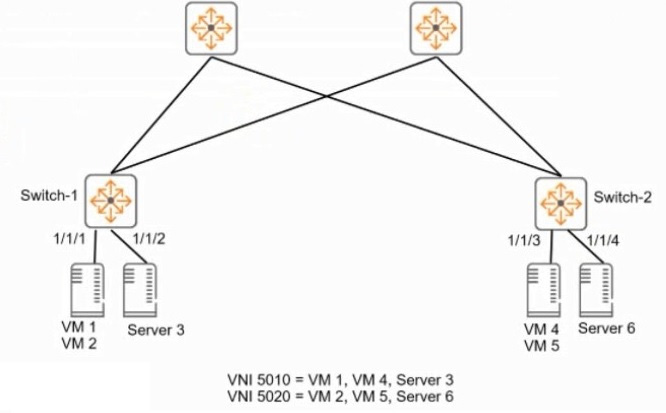 : The company wants AtubaOS-CX switches to provide VXLAN services for several VMs and servers, as shown in the exhibit. Hypervisors will not run VXLAN for this solution. Is this part of a valid configuration to meet the requirements? Solution: Attach VNIs 5010 and 5020 to interface 1/1/3 on Switch-2.
-
A
-
B
Reveal answer details
Close answer details
Correct answerB
ExplanationAttach VNIs 5010 and 5020 to interface 1/1/3 on Switch-2 is not part of a valid configuration to meet the requirements for providing VXLAN services for several VMs and servers using ArubaOS-CX switches.
VNIs are virtual network identifiers that are used to identify VXLAN segments. A VNI can only be attached to a VLAN interface, not a physical interface, on an ArubaOS-CX switch 1.
Question 10
Single choice
Is this a use case for disabling split-recovery mode on ArubaOS-CX switches in a Virtual Switching Extension (VSX) fabric? Solution: You are not concerned about split brain Issues in your environment, so you want the secondary member to keep its links up if the ISL falls.
-
A
-
B
Reveal answer details
Close answer details
Correct answerA
ExplanationYou are not concerned about split brain issues in your environment, so you want the secondary member to keep its links up if the ISL fails is a use case for disabling split-recovery mode on ArubaOS-CX switches in a Virtual Switching Extension (VSX) fabric. VSX is a feature that provides active-active forwarding and redundancy for ArubaOS-CX switches. The ISL is the inter-switch link that connects two VSX nodes and carries data traffic. The split-recovery mode is a feature that prevents split-brain scenarios when both VSX nodes lose connectivity with each other but remain up. When split-recovery mode is disabled, if the ISL fails but both VSX nodes remain up,
Question 11
Single choice
Refer to the exhibit. 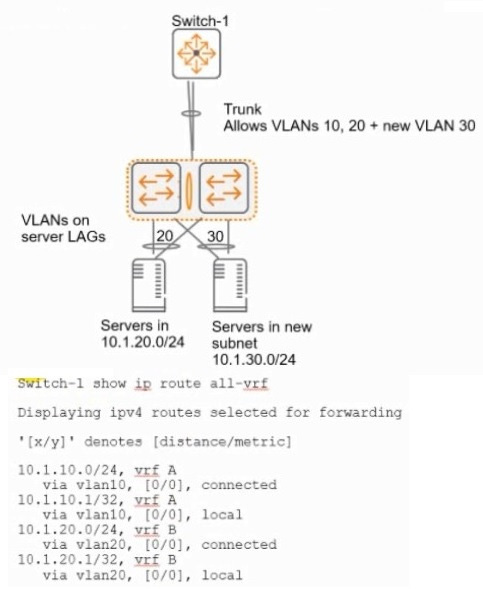 You are adding a VLAN 30, subnet 10.0.30.0/24 to the network shown in the exhibit. (This network is simplified to just the relevant switches for this item.) This subnet belongs in VRF A, and you have added a Layer 3 VLAN 30 interface attached to this VRF on Switch-1. You want to make the services in this VLAN available to devices in 10.1.20.0/24 in VRF B. Is this part of a valid setup for meeting these requirements? Solution: Add a route with this command: ip route 10.1.20.0/24 vlan20 vrf A
-
A
-
B
Reveal answer details
Close answer details
Correct answerB
ExplanationAdding a route with this command: ip route 10.1.20.0/24 vlan20 vrf A is not part of a valid setup for meeting these requirements. This command would add a static route for 10.1.20.0/24 in VRF A, but it would not be able to reach VLAN 20 on Switch-2 because Switch-2 does not have a VLAN interface for VLAN 20 in VRF
A. To make the services in VLAN 30 available to devices in 10.1.20.0/24 in VRF B, you need to use inter-
VRF routing or route leaking between VRF A and VRF B on Switch-11.
Question 12
Single choice
You need to integrate Aruba Fabric Composer (AFC) with customer datacenter software. Is this integration possible? Solution: Aruba Fabric Composer (AFC) with Nutanix Hypervisor (AHV)
-
A
-
B
Reveal answer details
Close answer details
Correct answerA
ExplanationAruba Fabric Composer (AFC) with Nutanix Hypervisor (AHV) integration is possible. AFC is a tool that provides automation and orchestration for managing data center networks composed of ArubaOS-CX switches. AFC can integrate with various data center software such as VMware vSphere, Nutanix AHV, Microsoft Hyper-V, etc. AFC can discover, monitor, and configure Nutanix AHV clusters and hosts using REST APIs1.
Question 13
Single choice
Refer to the exhibit. 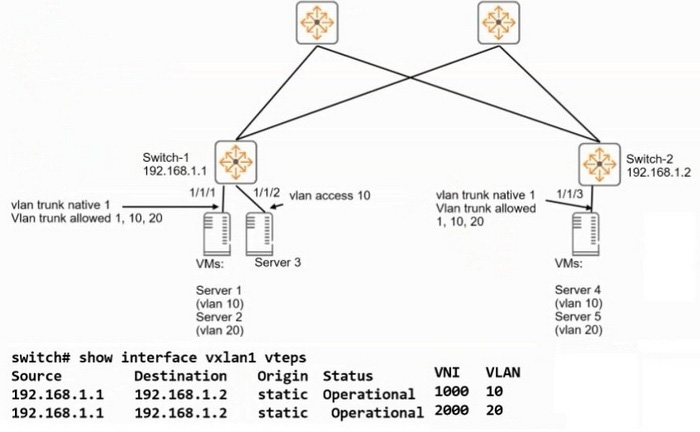 Switch-1 and Switch-2 ate ArubaOS-CX switches that implement VXLAN WITHOUT Ethernet VPN (EVPN). Switch-2 uses the same VNI-to-VLAN mappings as Switch-1. Is this how the specified servers communicate? Solution: The first time that Server I communicates with Server 3, It sends an ARP request to resolve Server 3's MAC address.
-
A
-
B
Reveal answer details
Close answer details
Correct answerB
ExplanationThe solution is incorrect because Switch-1 and Switch-2 implement VXLAN without EVPN, which means they do not have a control plane to exchange MAC addresses. Therefore, the first time that Server 1 communicates with Server 3, it sends an ARP request to resolve Server 3's IP address, not MAC address.
The ARP request is encapsulated in a VXLAN header and sent to the VTEP of Switch-2, which decapsulates it and forwards it to Server 3.
Question 14
Single choice
You enter this command on an ArubaOS-CX switch: Switch# show erps status ring 1 Is this what the specified status means? Solution: The status is Idle, which means that the ring is up and fully connected with the RPL port blocked.
-
A
-
B
Reveal answer details
Close answer details
Correct answerB
ExplanationThe status is Idle, which means that the ring is up and fully connected with the RPL port blocked is not what the specified status means for Ethernet Ring Protection Switching (ERPS) on an ArubaOS-CX switch.
Idle is one of the possible statuses for an ERPS ring instance, but it indicates that the ring is not operational and no port is blocked. This can happen when the ring is not configured properly or when there is a miscommunication between the nodes 1.
Question 15
Single choice
Is this part of a valid strategy for load sharing traffic across the links in an Ethernet Ring Protection Switching (ERPS) ring? Solution: Implement Virtual Switching Extension (VSX) on pairs of ERPS switches at the same site. Then combine multiple links between two data centers into VSX LAGs (M- LAGs).
-
A
-
B
Reveal answer details
Close answer details
Correct answerB
ExplanationImplement Virtual Switching Extension (VSX) on pairs of ERPS switches at the same site. Then combine multiple links between two data centers into VSX LAGs (MC-LAGs) is not part of a valid strategy for load sharing traffic across the links in an Ethernet Ring Protection Switching (ERPS) ring. ERPS is a feature that provides loop prevention and fast convergence for Layer 2 networks that use ring topologies. VSX is a feature that provides active-active forwarding and redundancy for ArubaOS-CX switches. VSX LAGs or MC-LAGs are LAGs that span across two VSX nodes and provide load balancing and resiliency. However, VSX LAGs or MC-LAGs are not supported by ERPS because they can create loops in the ring topology. A better way to load share traffic across the links in an ERPS ring would be to use link aggregation groups (LAGs) between two nodes in a ring as long as they are not multi-chassis LAGs (MC-LAGs)1.
Question 16
Single choice
You are using NetEdit to manage AruDaOS-CX switches. You want to deploy a standard config to the switches, but need the config to include a few device-specific settings such as hostname and IP address. Is this what you should do? Solution: Inside a configuration plan, right-click any device-specific parameters and modify the parameter per-device.
-
A
-
B
Reveal answer details
Close answer details
Correct answerA
ExplanationInside a configuration plan, right-click any device-specific parameters and modify the parameter per-device is what you should do if you want to use NetEdit to manage ArubaOS-CX switches and deploy a standard config to the switches, but need the config to include a few device-specific settings such as hostname and IP address. This approach allows you to edit any parameter value for individual devices within a configuration plan without affecting other devices or creating separate plans 1.
Question 17
Single choice
Refer to the exhibits. 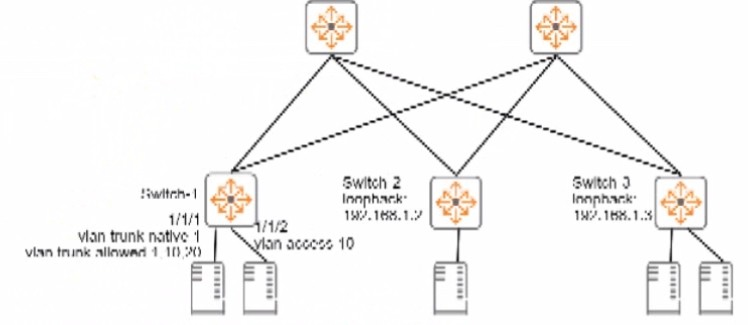 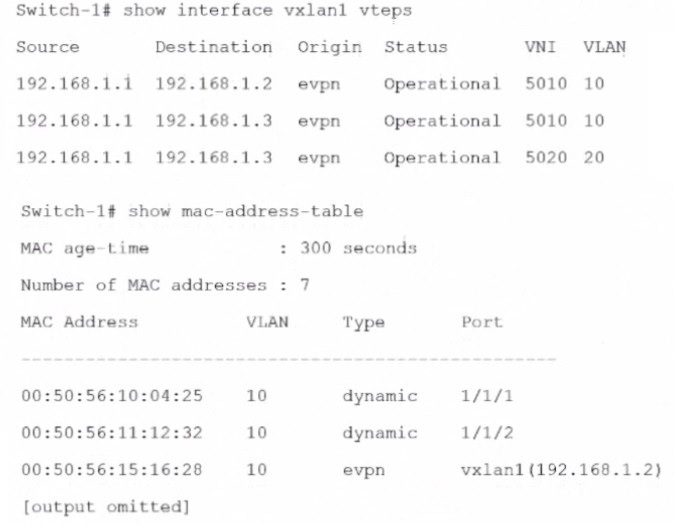 Is this how the switch-1 handles the traffic? Solution: A broadcast arrives in VLAN 10 on Switch-1. Switch 1 forwards the frame on all interfaces assigned to VLAN10. except the incoming interface. It replicates the broadcast, encapsulates each broadcast with VXLAN. and sends the VXLAN traffic to 192.168.1.2 and 192.168.1.3.
-
A
-
B
Reveal answer details
Close answer details
Correct answerA
ExplanationA broadcast arrives in VLAN 10 on Switch-1. Switch 1 forwards the frame on all interfaces assigned to VLAN10, except the incoming interface. It replicates the broadcast, encapsulates each broadcast with VXLAN, and sends the VXLAN traffic to 192.168.1.2 and 192.168.1.3 is a correct explanation of how the switch handles the traffic. Switch-1, Switch-2, and Switch-3 are ArubaOS-CX switches that use VXLAN and EVPN to provide Layer 2 extension over Layer 3 networks. VXLAN is a feature that uses UDP encapsulation to tunnel Layer 2 frames over Layer 3 networks using VNIs. EVPN is a feature that uses BGP to advertise multicast information for VXLAN networks using IMET routes. Switch-1 receives a broadcast in VLAN 10, which belongs to VNI 5010. Switch-1 forwards the frame on all interfaces assigned to VLAN 10, except the incoming interface, as per normal Layer 2 switching behavior. Switch-1 replicates the broadcast, encapsulates each broadcast with VXLAN, and sends the VXLAN traffic to both 192.168.1.2 and 192.168.1.3, which are Switch-3's and Switch-2's loopback interfaces respectively.
Question 18
Single choice
Refer to the exhibit. 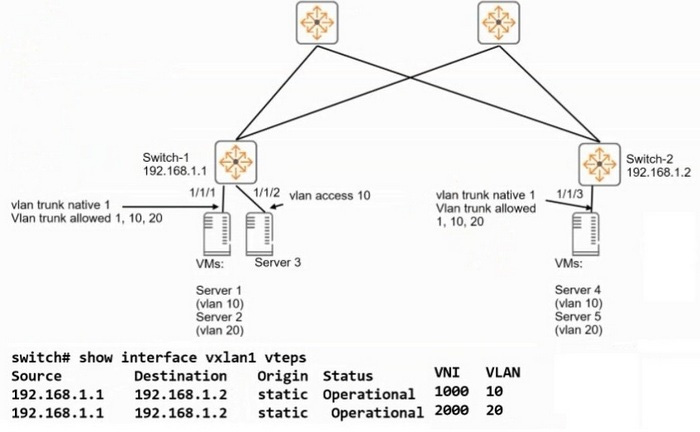 Switch-1 and Switch-2 ate ArubaOS-CX switches that implement VXLAN WITHOUT Ethernet VPN (EVPN). Switch-2 uses the same VNI-to-VLAN mappings as Switch-1. Is this how the specified servers communicate? Solution: Server 1 and Server 4 require routing services within the VXLANs to communicate with each other.
-
A
-
B
Reveal answer details
Close answer details
Correct answerB
ExplanationThe exhibit shows a network topology where Switch-1 and Switch-2 are ArubaOS-CX switches that implement VXLAN without Ethernet VPN (EVPN). Switch-2 uses the same VNI-to-VLAN mappings as Switch-1. The question asks how the specified servers communicate, which means Server 1 and Server 4.
Server 1 and Server 4 are in different VLANs and different VNIs, which means they are in different layer 2 segments. To communicate with each other, they require routing services between the VXLANs. However, using Virtual Routing and Forwarding (VRF) to tunnel iSCSI traffic through the network spine on the same links that data traffic uses is not the correct way to provide routing services. VRF is a technology that creates multiple isolated Layer 3 domains on a physical network, each with its own routing table. VRF does not provide any benefits for iSCSI traffic, as it does not guarantee bandwidth, priority, or quality of service.
VRF also adds overhead and complexity to the network configuration 1. To provide routing services between the VXLANs, the correct way is to use VXLAN routing with EVPN or distributed anycast gateway (DAG). VXLAN routing with EVPN allows the switches to exchange MAC and IP information using BGP EVPN control plane, and to perform routing between different VNIs using a centralized or distributed model 2. DAG allows the switches to act as anycast gateways for their local hosts, and to route traffic between different VNIs using a symmetric or asymmetric model 3. Therefore, this does not correctly describe how the specified servers communicate.
Question 19
Single choice
Your customer is using Nutanix AHV and they need a network orchestration tool to simplify network provisioning. Is this operation supported when Aruba Fabric Composer (AFC) is integrated with Nutanix? Solution: Automated configuration of Layer 3 MP-BGP protocol on leaf switches
-
A
-
B
Reveal answer details
Close answer details
Correct answerB
ExplanationAutomated configuration of Layer 3 MP-BGP protocol on leaf switches is not an operation supported when Aruba Fabric Composer (AFC) is integrated with Nutanix. AFC is a tool that provides automation and orchestration for managing data center networks composed of ArubaOS-CX switches. AFC can integrate with various data center software such as VMware vSphere, Nutanix AHV, Microsoft Hyper-V, etc. AFC can discover, monitor, and configure Nutanix AHV clusters and hosts using REST APIs. However, AFC does not support the configuration of Layer 3 MP-BGP protocol on leaf switches, which is required for EVPN VXLAN networks. AFC only supports the configuration of Layer 2 VXLAN networks without EVPN1.
Question 20
Single choice
Can you attach this type of ArubaOS-CX interface to a VRF? Solution: A Layer 3 VLAN interface
-
A
-
B
Reveal answer details
Close answer details
Correct answerA
ExplanationA Layer 3 VLAN interface is an interface that can be assigned an IP address and attached to a VRF. A VRF allows multiple instances of a routing table to co-exist within the same router. By attaching a Layer 3 VLAN interface to a VRF, you can isolate the traffic of that VLAN from other VLANs and routing domains 12. This can enhance security and performance of the network.
|