Which of the following qualifies as an operating segment?
-
A
Corporate headquarters, which oversees $1 billion in sales for the entire company.
-
B
North American segment, whose assets are 12% of the company's assets of all segments, and management reports to the chief operating officer.
-
C
South American segment, whose results of operations are reported directly to the chief operating officer, and has 5% of the company's assets, 9% of revenues, and 8% of the profits.
-
D
Eastern Europe segment, which reports its results directly to the manager of the European division, and has 20% of the company's assets, 12% of revenues, and 11% of profits.
Reveal answer details
Close answer details
Correct answerB
ExplanationChoice "b" is correct. Assets of the North American segment exceed 10% combined assets of all operating segments.
Choice "a" is incorrect. Corporate headquarters in not considered a segment.
Choice "c" is incorrect. The South American segment does not meet any of the 10% minimums (Revenue, P&L or Assets).
Choice "d" is incorrect. Eastern Europe segment does not report to the chief operating officer.
What is the underlying concept that supports the immediate recognition of a contingent loss?
-
A
-
B
-
C
-
D
Reveal answer details
Close answer details
Correct answerD
ExplanationChoice "d" is correct. Conservatism is a prudent reaction to uncertainty to try to ensure that uncertainty and risks inherent in business situations are adequately considereD. Recognition of a contingent loss is the recording of an amount representing uncertainty and risk in a business situation. SFAC 2, SFAS 5 para. 82
Choice "a" is incorrect. The substance over form concept presumes that the transaction form may not dictate the accounting treatment.
Choice "b" is incorrect. Consistency is conformity from period to period with unchanging policies and procedures. SFAC 2
Choice "c" is incorrect. The matching principle dictates that expenses be matched with the related revenues generated or the time period in which the expense is incurred and known. SFAS #5 cites matching as the one concept supporting the immediate recognition of a contingent loss, but it is not the primary underlying concept. SFAS 5 para. 76
An inventory loss from a permanent market decline of $360,000 occurred in May 1989. Cox Co. appropriately recorded this loss in May 1989 after its March 31, 1989 quarterly report was issued. What amount of inventory loss should be reported in Cox's quarterly income statement for the three months ended June 30, 1989?
-
A
-
B
-
C
-
D
Reveal answer details
Close answer details
Correct answerD
ExplanationChoice "d" is correct. $360,000 inventory loss reported for the quarter ended 6-30-89.
Rule: Inventory losses from "permanent market declines" are recognized in the interim period, incurred and later, if they "turn-around," are recognized as gains in a subsequent interim period only to the extent of previously reported losses. Rule: "Temporary" market declines need not be recognized at interim when a "turn-around" can reasonably be expected to occur before the end of the fiscal year. Facts: This $360,000 inventory decline is permanent and the entire loss would be recognized in the quarter interim period incurred (6-30-89).
On January 2, 1993, Quo, Inc. hired Reed to be its controller. During the year, Reed, working closely with Quo's president and outside accountants, made changes in accounting policies, corrected several errors dating from 1992 and before, and instituted new accounting policies.
Quo's 1993 financial statements will be presented in comparative form with its 1992 financial statements. This question represents one of Quo's transactions. List A represents possible clarifications of these transactions as: a change in accounting principle, a change in accounting estimate, a correction of an error in previously presented financial statements, or neither an accounting change nor an accounting error. Item to Be Answered
Quo changed from LIFO to FIFO to account for its finished goods inventory. List A (Select one)
-
A
Change in accounting principal.
-
B
Change in accounting estimate.
-
C
Correction of an error in previously presented financial statements.
-
D
Neither an accounting change nor an accounting error.
Reveal answer details
Close answer details
Correct answerA
ExplanationChoice "a" is correct. Change from LIFO to FIFO is a change in accounting principle.
Foy Corp. failed to accrue warranty costs of $50,000 in its December 31, 1992, financial statements. In addition, a $30,000 change from straight-line to accelerated depreciation was made at the beginning of
1993. Both the $50,000 and the $30,000 are net of related income taxes. What amount should Foy report as prior period adjustments in 1993?
-
A
-
B
-
C
-
D
Reveal answer details
Close answer details
Correct answerC
ExplanationChoice "c" is correct. $50,000.
The cumulative effect of a change in accounting principle is now shown on the retained earnings statement as an adjustment to the beginning balance of retained earnings, assuming that the cumulative effect can be calculated. An exception is made however, for a change in depreciation method, since a change in depreciation method is no longer considered to be a change in accounting principle. A change in depreciation method is now considered to be both a change in method and a change in estimate. These changes should now be accounted for as a change in estimate and handled prospectively. The new depreciation method should be used as of the beginning of the year of change and should start with the current book value of the underlying asset. No retroactive or retrospective calculations should be made, and no adjustment should be made to retained earnings. The correction of the failure to accrue warranty costs is treated as a correction of an error and thus as a prior period adjustment.
Choices "a", "b", and "d" are incorrect, per the above Explanation: .
In 1990, Teller Co. incurred losses arising from its guilty plea in its first antitrust action, and from a substantial increase in production costs caused when a major supplier's workers went on strike. Which of these losses should be reported as an extraordinary item? 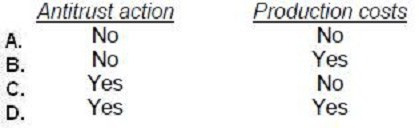
-
A
-
B
-
C
-
D
Reveal answer details
Close answer details
Correct answerC
ExplanationChoice "c" is correct. Yes - No.
Rule: Losses arising from a company's first (and probably "last") "anti-trust" action are unusual and extraordinary and should be reported as an extraordinary item. Losses resulting from additional costs caused by a strike at a major supplier or even at one's own company are not extraordinary and should be disclosed as a separate component of "income from continuing operations."
Which of the following factors determines whether an identified segment of an enterprise should be reported in the enterprise's financial statements under SFAS No.
131, Disclosures about Segments of an Enterprise and Related Information? I. The segment's assets constitute more than 10% of the combined assets of all operating segments.
II. The segment's liabilities constitute more than 10% of the combined liabilities of all operating segments.
-
A
-
B
-
C
-
D
Reveal answer details
Close answer details
Correct answerA
ExplanationChoice "a" is correct. For segment reporting, if an identified segment's assets constitute more than 10% of the combined assets of all operating segments, the segment should be reported. The same rule does not apply for the segment's liabilities. The candidate does have to remember the 10% and also the 10% of
"what."
Choice "b" is incorrect. For segment reporting, if an identified segment's assets constitute more than 10% of the combined assets of all operating segments, the segment should be reported. The same rule does not apply for the segment's liabilities.
Choice "c" is incorrect. For segment reporting, if an identified segment's assets constitute more than 10% of the combined assets of all operating segments, the segment should be reported. The same rule does not apply for the segment's liabilities, so the correct answer cannot be "Both."
Choice "d" is incorrect. For segment reporting, if an identified segment's assets constitute more than 10% of the combined assets of all operating segments, the segment should be reported. The correct answer cannot be "Neither."
Adam Corp. had the following infrequent transactions during 1989: - A $190,000 gain on reacquisition and retirement of bonds. This material event is also considered unusual
for Adam Corp.
- A $260,000 gain on the disposal of a component of a business. Adam continues similar operations at
another location.
- A $90,000 loss on the abandonment of equipment. In its 1989 income statement, what amount should Adam report as total infrequent net gains that are not considered extraordinary?
-
A
-
B
-
C
-
D
Reveal answer details
Close answer details
Correct answerB
ExplanationInfrequent net gains not considered extraordinary include:  Choice "b" is correct. $170,000.
An extraordinary item should be reported separately on the income statement as a component of income: 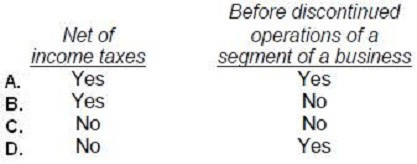
-
A
-
B
-
C
-
D
Reveal answer details
Close answer details
Correct answerB
ExplanationChoice "b" is correct, Yes - No. An extraordinary item should be reported separately on the income statement as a component of income: Yes - net of income taxes.
No - after (not before) "discontinued operations of a segment of a business."
Question 10
Single choice
On August 31, 1992, Harvey Co. decided to change from the FIFO periodic inventory system to the weighted average periodic inventory system. Harvey is on a calendar year basis. The cumulative effect of the change is determined:
-
A
-
B
-
C
During the eight months ending August 31, 1992, by a weighted average of the purchases.
-
D
During 1992 by a weighted average of the purchases.
Reveal answer details
Close answer details
Correct answerA
ExplanationRule: The cumulative effect of a change in accounting principle equals the difference between retained earnings at the beginning of period of the change and what retained earnings would have been if the change was applied to all affected prior periods.
Choice "a" is correct. As of January 1, 1992, the beginning of the year. This assumes that the company is not presenting comparative financial statements. If comparative financial statements are presented, then the adjustment is made to the beginning retained earnings of the earliest year presented.
Choice "b" is incorrect. The cumulative effect of the change is not determined as of the date the decision is made.
Choices "c" and "d" are incorrect. The cumulative effect of the change is not determined by a weighted average. (A far out distractor.)
Question 11
Single choice
According to the FASB's conceptual framework, the process of reporting an item in the financial statements of an entity is:
-
A
-
B
-
C
-
D
Reveal answer details
Close answer details
Correct answerA
ExplanationChoice "a" is correct. Recognition.
According to the FASB's conceptual framework, the process of reporting an item in the financial statements of an entity is recognition.
Question 12
Single choice
On November 1, 20X2, Smith Co. contracted to dispose of an industry segment. Throughout 20X2 the segment had operating losses. These losses were expected to continue until the segment's disposition.
If a loss is projected on final disposition, how much of the operating losses should be included in the loss from discontinued operations reported in Smith's 20X2 income statement? I. Operating losses for the period January 1 to October 31, 20X2.
II. Operating losses for the period November 1 to December 31, 20X2.
III. Estimated operating losses for the period January 1 to February 28, 20X3.
-
A
-
B
-
C
-
D
Reveal answer details
Close answer details
Correct answerD
ExplanationChoice "d" is correct. The operating losses to be included in Smith's 20X2 income statement would be the total 20X2 operating losses, regardless of whether those losses occurred before or after the date the decision to dispose of the component was made, and not any 20X3 operating losses. Projected operating losses are not anticipated and accrued.
Choice "a" is incorrect. The operating losses to be included in Smith's 20X2 income statement would be the total 20X2 operating losses, regardless of whether those losses occurred before or after the date the decision to dispose of the component was made, and not any 20X3 operating losses.
Choice "b" is incorrect. The operating losses to be included in Smith's 20X2 income statement would be the total 20X2 operating losses, regardless of whether those losses occurred before or after the date the decision to dispose of the component was made, and not any 20X3 operating losses.
Choice "c" is incorrect. The operating losses to be included in Smith's 20X2 income statement would be the total 20X2 operating losses, regardless of whether those losses occurred before or after the date the decision to dispose of the component was made, and not any 20X3 operating losses.
Question 13
Single choice
On January 2, 1993, Quo, Inc. hired Reed to be its controller. During the year, Reed, working closely with Quo's president and outside accountants, made changes in accounting policies, corrected several errors dating from 1992 and before, and instituted new accounting policies.
Quo's 1993 financial statements will be presented in comparative form with its 1992 financial statements.
This question represents one of Quo's transactions. List A represents possible clarifications of these transactions as: a change in accounting principle, a change in accounting estimate, a correction of an error in previously presented financial statements, or neither an accounting change nor an accounting error.
During 1993, Quo increased its investment in Worth, Inc. from a 10% interest, purchased in 1992, to 30%, and acquired a seat on Worth's board of directors. As a result of its increased investment, Quo changed its method of accounting for investment in Worth, Inc. from the cost method to the equity method. List A
-
A
Change in accounting principle.
-
B
Change in accounting estimate.
-
C
Correction of an error in previously presented financial statements.
-
D
Neither an accounting change nor an accounting error.
Reveal answer details
Close answer details
Correct answerD
ExplanationChoice "d" is correct. A change from the cost method (less than 20% ownership) to the equity method (20% or more ownership or a Board seat or other significant influence) of accounting for investment in an investee is neither an accounting change nor an accounting error. If it is not an accounting change, it cannot be a change in accounting principle or a change in accounting estimate since those two types of changes are both accounting changes. There is a considerable amount of controversy on this particular answer. Some people think that this change is a change in accounting principle (something certainly changed, but was it the accounting principle?), and others think it is a change in accounting entity (which is not one of the available answers;
anyway, did the accounting entity actually change or is it the same entity accounted for differently?). Under SFAS No. 154, a change in accounting principle is treated retrospectively and a change in accounting entity is treated retrospectively. This kind of change (cost to equity) has never been specifically identified in any accounting literature as either a change in accounting principle or a change in accounting entity. The words "cost method" were never mentioned in APB 20 (other than the full cost method for oil & gas companies, which is an entirely different subject), nor was it mentioned in SFAS No. 154. It was, however, discussed in APB 18 (the pronouncement for the equity method) in Paragraph 19m (bold added): "An investment in common stock of an investee that was previously accounted for on other than the equity method may become qualified for use of the equity method by an increase in the level of ownership described in paragraph 17 (i.e., acquisition of additional voting stock by the investor, acquisition or retirement of voting stock by the investee, or other transactions). When an investment qualifies for use of the equity method, the investor should adopt the equity method of accounting. The investment, results of operations (current and prior periods presented), and retained earnings of the investor should be adjusted retroactively in a manner consistent with the accounting for a step-by-step acquisition of a subsidiary." What does all this mean? It means that, when there is a change in the percentage of ownership that changes accounting from the cost method to the equity method, the change is treated retroactively (just like changes in accounting entity used to be treated, although they are now treated retrospectively). It does not say that the change is a change in accounting principle or anything else. Nothing in SFAS No.154 changed this treatment. So all this still makes Choice "d" correct. This whole issue might easily be considered to be splitting hairs, at the very least. Some questions on the CPA exam are just that way. Most are not.
Question 14
Single choice
During the second quarter of 1988, Buzz Company sold a piece of equipment at a $12,000 gain. What portion of the gain should Buzz report in its income statement for the second quarter of 1988?
-
A
-
B
-
C
-
D
Reveal answer details
Close answer details
Correct answerA
ExplanationChoice "a" is correct. $12,000.
Rule: The entire amount of an "extraordinary gain or loss" or an "unusual or infrequently occurring item," e.g., a gain or loss from sale of fixed assets, should be reported during the period (quarter) incurred.
Choices "b", "c", and "d" are incorrect. The full gain should be reported in the second quarter when it occurred.
Question 15
Single choice
Envoy Co. manufactures and sells household products. Envoy experienced losses associated with its small appliance group. Operations and cash flows for this group can be clearly distinguished from the rest of Envoy's operations. Envoy plans to sell the small appliance group with its operations. What is the earliest point at which Envoy should report the small appliance group as a discontinued operation?
-
A
When Envoy classifies it as held for sale.
-
B
When Envoy receives an offer for the segment.
-
C
When Envoy first sells any of the assets of the segment.
-
D
When Envoy sells the majority of the assets of the segment.
Reveal answer details
Close answer details
Correct answerA
ExplanationChoice "a" is correct. The earliest period that a component of an entity can be reported in discontinued operations is when the component meets the following "held for sale" criteria: 1. Management commits to a plan to sell the component.
2. The component is available for immediate sale in its present condition.
3. An active program to locate a buyer has been initiated.
4. The sale of the component is probable and the sale is expected to be completed within one year.
5. The sale of the component is being actively marketed.
6. It is unlikely that significant change to the plan to sell will be made or that the plan will be withdrawn.
Choices "b", "c", and "d" are incorrect, per the Explanation: above.
Question 16
Single choice
Under FASB Statement of Financial Accounting Concepts #5, which of the following items would cause earnings to differ from comprehensive income for an enterprise in an industry not having specialized accounting principles?
-
A
Unrealized loss on investments in noncurrent marketable equity securities available for sale.
-
B
Unrealized loss on investments in current marketable equity securities held for trading.
-
C
Loss on exchange of nonmonetary assets without commercial substance.
-
D
Loss on exchange of nonmonetary assets with commercial substance.
Reveal answer details
Close answer details
Correct answerA
ExplanationChoice "a" is correct. Unrealized loss on investments in marketable equity securities available for sale would cause earnings to differ from comprehensive income for an enterprise in an industry not having specialized accounting principles. Rule: FAC 5 defines "earnings" for a period to exclude certain cumulative accounting adjustments and other non-owner changes in equity (such as changes in market value of marketable securities available for sale) that are included in comprehensive income for a period.
Question 17
Single choice
Which of the following facts concerning fixed assets should be included in the summary of significant accounting policies? 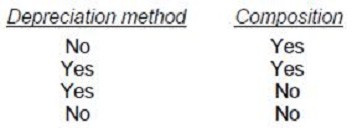
-
A
-
B
-
C
-
D
Reveal answer details
Close answer details
Correct answerC
ExplanationChoice "c" is correct. Yes - No.
Yes - "Depreciation methods" should be disclosed in the "summary of significant accounting policies."
No - Composition of fixed assets (or any other account) should not be disclosed in the "summary of significant accounting policies."
Question 18
Single choice
In general, an enterprise preparing interim financial statements should:
-
A
Defer recognition of seasonal revenue.
-
B
Disregard permanent decreases in the market value of its inventory.
-
C
Allocate revenues and expenses evenly over the quarters, regardless of when they actually occurred.
-
D
Use the same accounting principles followed in preparing its latest annual financial statements.
Reveal answer details
Close answer details
Correct answerD
ExplanationChoice "d" is correct. Generally accepted accounting principles that were used in the most recent annual report of an enterprise should be applied to interim financial statements of the current year, unless a change in accounting principle is adopted in the current year.
Choices "a", "b", and "c" are incorrect, per above.
Question 19
Single choice
Conn Co. reported a retained earnings balance of $400,000 at December 31, 1991. In August 1992, Conn determined that insurance premiums of $60,000 for the three-year period beginning January 1, 1991, had been paid and fully expensed in 1991. Conn has a 30% income tax rate. What amount should Conn report as adjusted beginning retained earnings in its 1992 statement of retained earnings?
-
A
-
B
-
C
-
D
Reveal answer details
Close answer details
Correct answerB
Explanation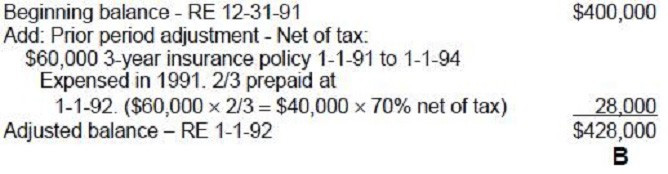 Choice "b" is correct. $428,000 net of tax.
Question 20
Single choice
On January 2, 1993, Quo, Inc. hired Reed to be its controller. During the year, Reed, working closely with Quo's president and outside accountants, made changes in accounting policies, corrected several errors dating from 1992 and before, and instituted new accounting policies.
Quo's 1993 financial statements will be presented in comparative form with its 1992 financial statements.
This question represents one of Quo's transactions. List B represents the general accounting treatment required for these transactions. These treatments are: - Cumulative effect approach - Include the cumulative effect of the adjustment resulting from the
accounting change or error correction in the 1993 financial statements, and do not restate the 1992 financial statements.
- Retroactive or retrospective restatement approach - Restate the 1992 financial statements and adjust
1992 beginning retained earnings if the error or change affects a period prior to 1992.
- Prospective approach - Report 1993 and future financial statements on the new basis but do not restate
1992 financial statements. During 1993, Quo increased its investment in Worth, Inc. from a 10% interest, purchased in 1992, to 30%, and acquired a seat on Worth's board of directors. As a result of its increased investment, Quo changed its method of accounting for investment in Worth, Inc. from the cost method to the equity method. List B
-
A
Cumulative effect approach.
-
B
Retroactive or retrospective restatement approach.
-
C
Reveal answer details
Close answer details
Correct answerB
ExplanationChoice "B" is correct. The equity method of accounting is applied retroactively when the investor has acquired 20% ownership. Prior to acquiring the ability to influence the investee, the cost method is proper.
The retroactive restatement approach does not mean that this change is the correction of an error (which is now treated retroactively), a change in accounting principle (which is now treated retrospectively), or a change in accounting entity (which is now treated retrospectively). It just means that retroactive restatement is the proper treatment.
Question 21
Single choice
According to the FASB conceptual framework, comprehensive income includes which of the following? 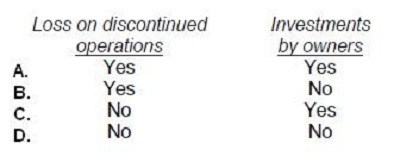
-
A
-
B
-
C
-
D
Reveal answer details
Close answer details
Correct answerB
ExplanationChoice "b" is correct. Comprehensive income is the change in equity of a business during a period from transactions and other events and circumstances from non-owner sources. It includes all changes in equity except those resulting from investments by owners and distributions to owners. SFAC 6 para 70.
Question 22
Single choice
Coffey Corp.'s trial balance of Income Statement Accounts for the year ended December 31, 1988 as follows: 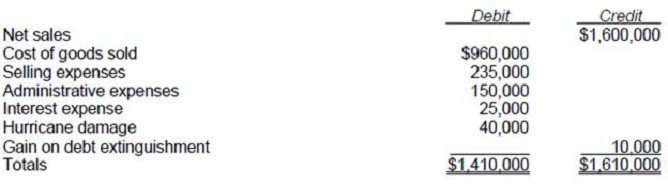 Coffey's income tax rate is 30%. The gain on debt extinguishment is considered a usual and recurring part of Coffey's operations. The hurricane is considered an unusual and infrequent event. Coffey prepares a multiple-step income statement for 1988. Net income is:
-
A
-
B
-
C
-
D
Reveal answer details
Close answer details
Correct answerA
ExplanationChoice "a" is correct. $140,000.
Net income is the "bottom line" amount after all has been considered on the income statement. Without showing all the line items as required for the income statement, the "bottom line" amount of $140,000 is derived as follows: 
Question 23
Single choice
Which of the following should be disclosed in a summary of significant accounting policies?
-
A
Basis of profit recognition on long-term construction contracts.
-
B
Future minimum lease payments in the aggregate and for each of the five succeeding fiscal years.
-
C
-
D
Composition of sales by segment.
Reveal answer details
Close answer details
Correct answerA
ExplanationChoice "a" is correct. The summary of significant accounting policies should disclose policies. The only policy in this question is the "basis" of profit recognition on long-term construction contracts. The other disclosures are accounting details and would be disclosed in other footnotes, but not in the summary of significant accounting policies.
Choice "b" is incorrect. The future minimum lease payments should be disclosed, but not in the summary of significant accounting policies. Choice "c" is incorrect. Depreciation expense should certainly be disclosed, but not in the summary of significant accounting policies. Choice "d" is incorrect. The composition of sales by segment should be disclosed, but not in the summary of significant accounting policies.
Question 24
Single choice
On January 2, 1993, Quo, Inc. hired Reed to be its controller. During the year, Reed, working closely with Quo's president and outside accountants, made changes in accounting policies, corrected several errors dating from 1992 and before, and instituted new accounting policies.
Quo's 1993 financial statements will be presented in comparative form with its 1992 financial statements.
This question represents one of Quo's transactions. List A represents possible clarifications of these transactions as: a change in accounting principle, a change in accounting estimate, a correction of an error in previously presented financial statements, or neither an accounting change nor an accounting error. Item to Be Answered During 1993, Quo determined that an insurance premium paid and entirely expensed in 1992 was for the period January 1, 1992, through January 1, 1994. List A (Select one)
-
A
Change in accounting principal.
-
B
Change in accounting estimate.
-
C
Correction of an error in previously presented financial statements.
-
D
Neither an accounting change nor an accounting error.
Reveal answer details
Close answer details
Correct answerC
ExplanationChoice "c" is correct. Expensing insurance premiums when paid (rather than allocating them to the periods benefited) is a correction of an error in previously presented financial statements.
Question 25
Single choice
The cumulative effect of a change in accounting estimate should be shown separately:
-
A
On the income statement above income from continuing operations.
-
B
On the income statement after income from continuing operations and before extraordinary items.
-
C
On the retained earnings statement as an adjustment to the beginning balance.
-
D
It should not be recorded separately on any financial statement.
Reveal answer details
Close answer details
Correct answerD
ExplanationChoice "d" is correct. A change in estimate is handled prospectively. No cumulative effect adjustment is made and no separate line item presentation is made on any financial statement. If a material change is being made, appropriate footnote disclosure is necessary.
Choices "a", "b", and "c" are incorrect, per the above Explanation: .
|