During a test, the client-side packet counter for a virtual server increases while its server-side packet counter remains at zero. What is the strongest conclusion supported by these counters?
-
A
The application transaction succeeded end to end.
-
B
The backend returned a response that the client rejected.
-
C
No client packet reached the BIG-IP system.
-
D
Activity reached the measured client side, but no server-side activity is shown.
Reveal answer details
Close answer details
Correct answerD
ExplanationThe increasing client-side counter establishes that activity reached the measured client side of the virtual server. A server-side counter that remains at zero provides no evidence that packets were sent on that side. These values therefore support only the client-side arrival and absent server-side activity, not successful end-to-end processing or a backend response.
A BIG-IP Administrator wants to add a new Self IP to the BIG-IP device. Which item should be assigned to the new Self IP being configured?
-
A
-
B
-
C
-
D
Reveal answer details
Close answer details
Correct answerB
ExplanationA Self IP represents the BIG-IP system's IP presence on a particular Layer 2 network, so its configuration must reference a VLAN. The VLAN then determines the network and interface path associated with that address. An interface or trunk may carry the VLAN, but it is not assigned directly as the Self IP's network object.
Refer to the exhibit. 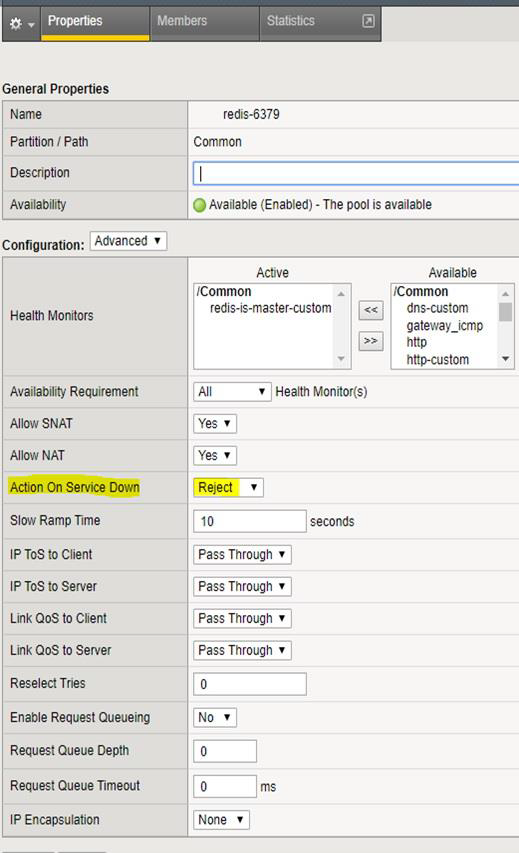
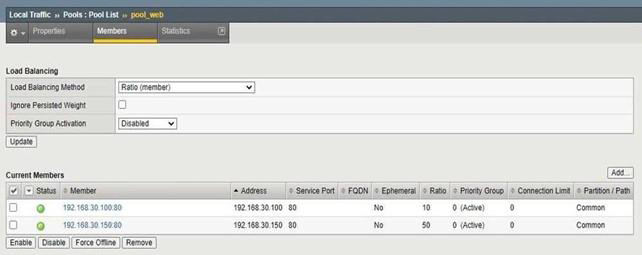 
The BIG-IP Administrator needs toavoid overloading any of the pool members with connections when they become active. What should the BIG-IP Administrator configure to meet this requirement? (Choose one answer)
-
A
Slow Ramp Time to the Pool
-
B
Different Ratio for each member
-
C
Action On Service Down to Reselect
-
D
Same Priority Group to each member
Reveal answer details
Close answer details
Correct answerA
ExplanationSlow Ramp Time limits how quickly a newly available pool member receives its full load-balancing share. Traffic is introduced progressively during the configured interval, preventing an immediate surge of connections when a member becomes active. Ratios affect steady-state distribution but do not provide this gradual return-to-service behavior.
A BIG-IP Administrator configures remote authentication and needs to make sure that users can still login even when the remote authentication server is unavailable. Which action should the BIG-IP Administrator take in the remote authentication configuration to meet this requirement?
-
A
Configure a remote role group
-
B
Set partition access to "All"
-
C
Configure a second remote user directory
-
D
Enable the Fallback to Local option
Reveal answer details
Close answer details
Correct answerD
ExplanationWhen the remote authentication server cannot respond, remote credentials cannot be validated through that service. Enabling Fallback to Local lets the system authenticate against its local user database during the outage, preserving login access. Role groups and partition access define authorization but do not provide an alternate authentication source.
To increase the available bandwidth of an existingtrunk, the BIG-IP Administrator plans to add additional interfaces. Which command should the BIG-IP Administrator run from within thebash shell? (Choose one answer)
-
A
tmsh modify /net trunk trunk_A interfaces add {1.3 1.4}
-
B
tmsh modify /sys trunk trunk_A interfaces add {1.3 1.4}
-
C
tmsh create /net trunk trunk_A interfaces add {1.3 1.4}
-
D
tmsh create /sys trunk trunk_A interfaces add {1.3 1.4}
Reveal answer details
Close answer details
Correct answerA
ExplanationBecause trunk_A already exists, the command must modify the object rather than create a duplicate. Network trunks reside under /net trunk, and interfaces add appends the additional links to its membership. The required bash command is tmsh modify /net trunk trunk_A interfaces add {1.3 1.4}.
An ecommerce company is experiencing latency issues with online shops during Black Friday's peak season. The BIG-IP Administrator detects an overall high CPU load on the BIG-IP device and wants to move thetop utilized Virtual Serversto a dedicated BIG-IP device. Where should the BIG-IP Administrator determine the problematic Virtual Servers? (Choose one answer)
-
A
Local Traffic > Virtual Servers > Virtual Server List
-
B
-
C
Statistics > Module Statistics > Local Traffic > Virtual Servers
-
D
Local Traffic > Network Map
Reveal answer details
Close answer details
Correct answerC
ExplanationThe administrator needs comparative utilization data for individual virtual servers, not merely their configuration or topology. Statistics -> Module Statistics -> Local Traffic -> Virtual Servers provides the per-virtual-server statistics needed to identify the busiest objects and decide which ones should be moved to the dedicated device.
A client flow arrives on an allowed VLAN and matches an enabled virtual server's destination and service. A healthy pool member receives the forward traffic. SNAT is disabled, and the member's route to the client uses a gateway that bypasses BIG-IP. Which issue is most likely to prevent the connection from succeeding?
-
A
The listener rejects the connection because SNAT is disabled.
-
B
The member becomes unavailable because its gateway is different.
-
C
The ingress packet bypasses the matching virtual server.
-
D
The member replies outside BIG-IP, breaking the return path.
Reveal answer details
Close answer details
Correct answerD
ExplanationThe forward direction already works: the ingress traffic matches the virtual server and reaches a healthy member. With SNAT disabled, the member sees the client's original source address. Its route to that address uses a gateway that bypasses BIG-IP, so the reply leaves outside the proxy path and breaks the required return direction of the connection.
Configuration is already synchronized, and connection mirroring is enabled for supported traffic. Which failover outcome is attributable to connection mirroring?
-
A
Unsynchronized configuration becomes current on the new owner.
-
B
Traffic-group ownership moves before a failover decision occurs.
-
C
Every connection is guaranteed to continue after any type of failure.
-
D
Supported established-flow state becomes available to the new owner.
Reveal answer details
Close answer details
Correct answerD
ExplanationConfiguration synchronization and connection mirroring serve different purposes. Synchronization gives the peer matching configuration, while mirroring copies supported established-flow state. After ownership moves, the new owner can use that available state for supported connections; this does not guarantee continuity for every connection or failure type.
A backend IP address offers HTTP on port 80 and HTTPS on port 443. Which BIG-IP object arrangement represents these services correctly?
-
A
Two nodes that each identify one service port
-
B
One node with one pool member for each service port
-
C
One pool member with one node for each service port
-
D
Two pools that each identify one backend address
Reveal answer details
Close answer details
Correct answerB
ExplanationA node represents the backend IP address independently of any particular service. A pool member combines that node address with a service port. Because HTTP and HTTPS share one backend address but use ports 80 and 443, one node represents the IP and a separate pool member represents each service port.
Question 10
Single choice
Traffic matches a Standard virtual server with the required profiles and an available pool. How does the virtual server handle the connection?
-
A
It forwards the original client transport connection unchanged toward the selected node.
-
B
It uses the pool's balancing method to choose which profile handles the client flow.
-
C
It runs a health monitor as the protocol proxy before matching the destination.
-
D
It maintains separate client-side and server-side flow segments.
Reveal answer details
Close answer details
Correct answerD
ExplanationA Standard virtual server acts as a full proxy. It terminates the client-side flow and establishes a distinct server-side flow toward the pool member chosen by the pool's balancing method. Because these are separate flow segments, profiles can process each side appropriately; the original client transport connection is not simply forwarded unchanged.
Question 11
Single choice
The outbound byte counter for one VLAN reads 3,000,000 at 10:00 and 3,120,000 at 10:01. No counter reset occurs. Which conclusion is supported?
-
A
Its current rate is 3,120,000 bytes per minute.
-
B
It counted 120,000 outbound bytes during that minute.
-
C
Every VLAN carried 120,000 bytes during that minute.
-
D
Its packet-drop cause is proven by the byte increase.
Reveal answer details
Close answer details
Correct answerB
ExplanationThe byte counter is cumulative because no reset occurred, so traffic during the interval is calculated from the difference between readings. Subtracting 3,000,000 from 3,120,000 gives 120,000 outbound bytes during the one-minute interval. The ending total is not itself the per-minute rate, and this increase does not identify any packet-drop cause.
Question 12
Single choice
A standard virtual server has been associated with a pool with multiple members.
Assuming all other settings are left at their defaults, which statement is always true concerning traffic processed by the virtual server?
-
A
The client IP address is unchanged between the client-side connection and the server-side connection.
-
B
The server IP address is unchanged between the client-side connection and the server-side connection.
-
C
The TCP ports used in the client-side connection are the same as the TCP ports server-side connection.
-
D
The IP addresses used in the client-side connection are the same as the IP addresses used in the server-side connection.
Reveal answer details
Close answer details
Correct answerA
ExplanationWith default settings, the standard virtual server creates a server-side connection to a selected pool member and translates the destination from the virtual address to that member. Source address translation is not enabled merely by associating the pool, so the client IP address remains unchanged between the client-side and server-side connections.
Question 13
Single choice
Port lockdown on a self IP permits no inbound services. An available virtual server on the same VLAN listens on TCP 443 at a different destination address. How does port lockdown affect client traffic to that virtual server?
-
A
It blocks TCP 443 traffic to both address types.
-
B
It makes the self IP unavailable for Layer 3 routing.
-
C
It restricts direct self-IP services, not virtual-server matching.
-
D
It limits pool members to the same permitted ports.
Reveal answer details
Close answer details
Correct answerC
ExplanationPort lockdown governs services addressed directly to the self IP, such as management or other locally hosted services. The client instead targets a different destination owned by the virtual server. That traffic can still match the virtual server on TCP 443 because restricting direct self-IP services does not disable virtual-server matching.
|