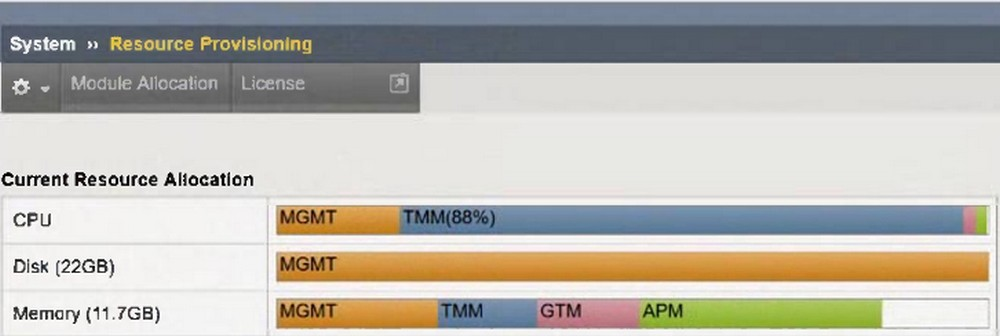
A BIG-IP device is licensed for LTM, ASM, APM, and AFM .
Currently, it will only be used for load balancing and web application firewalling .
To ensure optimal performance and efficient resource utilization, which of the following module provisioning combinations is the best choice?
Reveal answer details Close answer details
Correct answerC
BIG-IP provisioning determines how CPU, memory, and disk resources are allocated to each module. The goal is to provision only the modules required and at levels appropriate to their performance needs.
Requirements in the question
The device will be used for:
LTM(Local Traffic Manager) # load balancing
ASM(Application Security Manager) # WAF
No functions require:
APM (Access Policy Manager)
AFM (Advanced Firewall Manager)
Why Option C is correct
Provisioning both LTM and ASM Nominal at level provides:
Adequate performance for production load
Plentiful system resources while avoiding dedicating the entire system to a single module
Balanced allocation without starving memory or CPU
Setting APM: None and AFM: None ensures unused modules consume zero resources.
Why the other options are incorrect
A. Dedicated provisioning for both LTM and ASM
Two modules cannot both run in "Dedicated" mode.
Dedicated mode allocates all resources to a single module -- the second module cannot be dedicated simultaneously.
B. LTM and ASM both Dedicated
Same issue: only one module can be Dedicated at a time.
Also unnecessary for load balancing + WAF.
D. Setting APM and AFM to Minimal
Minimal still consumes memory and CPU.
Unused modules should be set to None .
Therefore, Option C is the best provisioning strategy.