SY0-601 Exam Details
-
Exam Code
:SY0-601 -
Exam Name
:CompTIA Security+ -
Certification
:CompTIA Certifications -
Vendor
:CompTIA -
Total Questions
:1334 Q&As -
Last Updated
:Jul 15, 2026
CompTIA SY0-601 Online Questions & Answers
-
Question 301:
Which of the following cryptographic concepts would a security engineer utilize while implementing non-repudiation? (Select TWO)
A. Block cipher
B. Hashing
C. Private key
D. Perfect forward secrecy
E. Salting
F. Symmetric keys -
Question 302:
Which of the following algorithms has the SMALLEST key size?
A. DES
B. Twofish
C. RSA
D. AES -
Question 303:
Which of the following is the final step of the incident response process?
A. Lessons learned
B. Eradication
C. Containment
D. Recovery -
Question 304:
A large bank with two geographically dispersed data centers is concerned about major power disruptions at both locations. Every day each location experiences very brief outages that last for a few seconds. However, during the summer a high risk of intentional under-voltage events that could last up to an hour exists, particularly at one of the locations near an industrial smelter. Which of the following is the best solution to reduce the risk of data loss?
A. Dual supply
B. Generator
C. PDU
D. Daily backups -
Question 305:
A company i working on mobile device security after a report revealed that users granted non-verified software access to corporate data. Which of the following ts the MOST effective security control to mitigate this risk?
A. Block access to application stores.
B. Implement OTA updates
C. Update the BYOD pot
D. Deploy a urttoem firmware -
Question 306:
Due to unexpected circumstances, an IT company must vacate its main office, forcing all operations to alternate, off-site locations. Which of the following will the company MOST likely reference for guidance during this change?
A. The business continuity plan
B. The retention policy
C. The disaster recovery plan
D. The incident response plan -
Question 307:
A global company is experiencing unauthorized logging due to credential theft and account lockouts caused by brute-force attacks. The company is considering implementing a third- party identity provider to help mitigate these attacks. Which of the following would be the BEST control for the company to require from prospective vendors?
A. IP restrictions
B. Multifactor authentication
C. A banned password list
D. A complex password policy -
Question 308:
During an incident response, a security analyst observes the following log entry on the web server.

Which of the following BEST describes the type of attack the analyst is experience?
A. SQL injection
B. Cross-site scripting
C. Pass-the-hash
D. Directory traversal -
Question 309:
An upcoming project focuses on secure communications and trust between external parties. Which of the following security components will need to be considered to ensure a chosen trust provider IS used and the selected option is highly scalable?
A. Self-signed certificate
B. Certificate attributes
C. Public key Infrastructure
D. Domain validation -
Question 310:
Given the following logs:
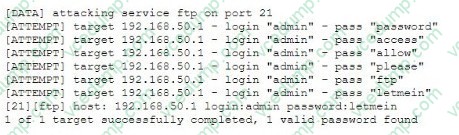
Which of the following BEST describes the type of attack that is occurring?
A. Rainbow table
B. Dictionary
C. Password spraying
D. Pass-the-hash
Related Exams:
-
220-1001
CompTIA A+ Certification: Core 1 -
220-1002
CompTIA A+ Certification: Core 2 -
220-1101
CompTIA A+ Certification: Core 1 -
220-1102
CompTIA A+ Certification: Core 2 -
220-1201
CompTIA A+ Certification: Core 1 -
220-1202
CompTIA A+ Core 2 (2026) -
220-902
CompTIA A+ Certification -
CAS-004
CompTIA Advanced Security Practitioner (CASP+) -
CAS-005
CompTIA SecurityX -
CLO-001
CompTIA Cloud Essentials+
Tips on How to Prepare for the Exams
Nowadays, the certification exams become more and more important and required by more and more enterprises when applying for a job. But how to prepare for the exam effectively? How to prepare for the exam in a short time with less efforts? How to get a ideal result and how to find the most reliable resources? Here on Vcedump.com, you will find all the answers. Vcedump.com provide not only CompTIA exam questions, answers and explanations but also complete assistance on your exam preparation and certification application. If you are confused on your SY0-601 exam preparations and CompTIA certification application, do not hesitate to visit our Vcedump.com to find your solutions here.