SAA-C03 Exam Details
-
Exam Code
:SAA-C03 -
Exam Name
:AWS Certified Solutions Architect - Associate (SAA-C03) -
Certification
:Amazon Certifications -
Vendor
:Amazon -
Total Questions
:1524 Q&As -
Last Updated
:Jul 19, 2026
Amazon SAA-C03 Online Questions & Answers
-
Question 661:
A solutions architect needs to design a system to process incoming work items immediately. Processing can take up to 30 minutes and involves calling external APIs, executing multiple states, and storing intermediate states.
The solution must scale with variable workloads and minimize operational overhead.
Which combination of steps meets these requirements? (Choose Two.)
A. Invoke an AWS Lambda function for each incoming work item. Configure each function to handle the work item completely. Store states in DynamoDB.
B. Invoke an AWS Step Functions workflow to process incoming work items. Use Lambda functions for business logic. Store work item states in DynamoDB.
C. Set up an API Gateway REST API to receive work items. Configure the API to invoke a Lambda function for each work item.
D. Deploy two EC2 Reserved Instances behind an ALB and send requests to an SQS queue.
E. Set up an API Gateway REST API to receive work items. Send the work items to an SQS queue. -
Question 662:
A solutions architect wants to use the following JSON text as an identity-based policy to grant specific permissions:
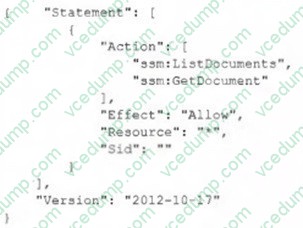
Which IAM principals can the solutions architect attach this policy to? (Choose two.)
A. Role
B. Group
C. Organization
D. Amazon Elastic Container Service (Amazon ECS) resource
E. Amazon EC2 resource -
Question 663:
A gaming company has a web application that displays scores. The application runs on Amazon EC2 instances behind an Application Load Balancer. The application stores data in an Amazon RDS for MySQL database. Users are starting to experience long delays and interruptions that are caused by database read performance. The company wants to improve the user experience while minimizing changes to the application's architecture.
What should a solutions architect do to meet these requirements?
A. Use Amazon ElastiCache in front of the database.
B. Use RDS Proxy between the application and the database.
C. Migrate the application from EC2 instances to AWS Lambda.
D. Migrate the database from Amazon RDS for MySQL to Amazon DynamoDB. -
Question 664:
A company is migrating its on-premises workload to the AWS Cloud. The company already uses several Amazon EC2 instances and Amazon RDS DB instances. The company wants a solution that automatically starts and stops the EC2 instances and DB instances outside of business hours. The solution must minimize cost and infrastructure maintenance.
Which solution will meet these requirements?
A. Scale the EC2 instances by using elastic resize. Scale the DB instances to zero outside of business hours.
B. Explore AWS Marketplace for partner solutions that will automatically start and stop the EC2 instances and DB instances on a schedule.
C. Launch another EC2 instance. Configure a crontab schedule to run shell scripts that will start and stop the existing EC2 instances and DB instances on a schedule.
D. Create an AWS Lambda function that will start and stop the EC2 instances and DB instances. Configure Amazon EventBridge to invoke the Lambda function on a schedule. -
Question 665:
A marketing team wants to build a campaign for an upcoming multi-sport event. The team has news reports from the past five years in PDF format. The team needs a solution to extract insights about the content and the sentiment of the news reports.
The solution must use Amazon Textract to process the news reports.
Which solution will meet these requirements with the LEAST operational overhead?
A. Provide the extracted insights to Amazon Athena for analysis. Store the extracted insights and analysis in an Amazon S3 bucket.
B. Store the extracted insights in an Amazon DynamoDB table. Use Amazon SageMaker to build a sentiment model.
C. Provide the extracted insights to Amazon Comprehend for analysis. Save the analysis to an Amazon S3 bucket.
D. Store the extracted insights in an Amazon S3 bucket. Use Amazon QuickSight to visualize and analyze the data. -
Question 666:
A company needs to move data from an Amazon EC2 instance to an Amazon S3 bucket. The company must ensure that no API calls and no data are routed through public internet routes. Only the EC2 instance can have access to upload data to the S3 bucket.
Which solution will meet these requirements?
A. Create an interface VPC endpoint for Amazon S3 in the subnet where the EC2 instance is located. Attach a resource policy to the S3 bucket to only allow the EC2 instance's IAM role for access.
B. Create a gateway VPC endpoint for Amazon S3 in the Availability Zone where the EC2 instance is located. Attach appropriate security groups to the endpoint. Attach a resource policy to the S3 bucket to only allow the EC2 instance's IAM role for access.
C. Run the nslookup tool from inside the EC2 instance to obtain the private IP address of the S3 bucket's service API endpoint. Create a route in the VPC route table to provide the EC2 instance with access to the S3 bucket. Attach a resource policy to the S3 bucket to only allow the EC2 instance's IAM role for access.
D. Use the AWS provided, publicly available ip-ranges.json file to obtain the private IP address of the S3 bucket's service API endpoint. Create a route in the VPC route table to provide the EC2 instance with access to the S3 bucket. Attach a resource policy to the S3 bucket to only allow the EC2 instance's IAM role for access. -
Question 667:
A company is migrating some workloads to AWS. However, many workloads will remain on premises. The on-premises workloads require secure and reliable connectivity to AWS with consistent, low-latency performance.
The company has deployed the AWS workloads across multiple AWS accounts and multiple VPCs. The company plans to scale to hundreds of VPCs within the next year. The company must establish connectivity between each of the VPCs and from the on-premises environment to each VPC.
Which solution will meet these requirements?
A. Use an AWS Direct Connect connection to connect the on-premises environment to AWS. Configure VPC peering to establish connectivity between VPCs.
B. Use multiple AWS Site-to-Site VPN connections to connect the on-premises environment to AWS. Create a transit gateway to establish connectivity between VPCs.
C. Use an AWS Direct Connect connection with a Direct Connect gateway to connect the on-premises environment to AWS. Create a transit gateway to establish connectivity between VPCs. Associate the transit gateway with the Direct Connect gateway.
D. Use an AWS Site-to-Site VPN connection to connect the on-premises environment to AWS. Configure VPC peering to establish connectivity between VPCs. -
Question 668:
A company needs to export its database once a day to Amazon S3 for other teams to access. The exported object size varies between 2 GB and 5 GB. The S3 access pattern for the data is variable and changes rapidly. The data must be immediately available and must remain accessible for up to 3 months.
The company needs the most cost-effective solution that will not increase retrieval time.
Which S3 storage class should the company use to meet these requirements?
A. S3 Intelligent-Tiering
B. S3 Glacier Instant Retrieval
C. S3 Standard
D. S3 Standard-Infrequent Access (S3 Standard-IA) -
Question 669:
A company uses AWS CloudFormation to deploy IAM resources within accounts that AWS Control Tower governs. The security team wants to prevent the deployment of IAM roles that include inline policies with the following statements:
" Effect ": " Allow ", " Action ": " * ", " Resource ": " * "
Which solution will meet this requirement?
A. Use AWS Control Tower proactive controls to block CloudFormation stacks that match these inline policy statements.
B. Use AWS Control Tower detective controls to detect and delete IAM inline policies that contain these statements upon deployment.
C. Use AWS Config to create a rule that detects these statements in any inline IAM policies. Configure the rule to automatically remove these statements by using the AWS-DeleteIAMInlinePolicy remediation.
D. Use AWS Config to create a rule that detects these statements in inline IAM policies and sends a notification to the security team. -
Question 670:
A company wants to migrate an Oracle database to AWS. The database consists of a single table that contains millions of geographic information systems (GIS) images that are high resolution and are identified by a geographic code. When a natural disaster occurs, tens of thousands of images get updated every few minutes. Each geographic code has a single image or row that is associated with it. The company wants a solution that is highly available and scalable during such events.
Which solution meets these requirements MOST cost-effectively?
A. Store the images and geographic codes in a database table. Use Oracle running on an Amazon RDS Multi-AZ DB instance.
B. Store the images in Amazon S3 buckets. Use Amazon DynamoDB with the geographic code as the key and the image S3 URL as the value.
C. Store the images and geographic codes in an Amazon DynamoDB table. Configure DynamoDB Accelerator (DAX) during times of high load.
D. Store the images in Amazon S3 buckets. Store geographic codes and image S3 URLs in a database table. Use Oracle running on an Amazon RDS Multi-AZ DB instance.
Related Exams:
-
AIF-C01
Amazon AWS Certified AI Practitioner (AIF-C01) -
AIP-C01
AWS Certified Generative AI Developer - Professional -
ANS-C00
AWS Certified Advanced Networking - Specialty (ANS-C00) -
ANS-C01
AWS Certified Advanced Networking - Specialty (ANS-C01) -
AXS-C01
AWS Certified Alexa Skill Builder - Specialty (AXS-C01) -
BDS-C00
AWS Certified Big Data - Speciality (BDS-C00) -
CLF-C02
AWS Certified Cloud Practitioner (CLF-C02) -
DAS-C01
AWS Certified Data Analytics - Specialty (DAS-C01) -
DATA-ENGINEER-ASSOCIATE
AWS Certified Data Engineer - Associate (DEA-C01) -
DBS-C01
AWS Certified Database - Specialty (DBS-C01)
Tips on How to Prepare for the Exams
Nowadays, the certification exams become more and more important and required by more and more enterprises when applying for a job. But how to prepare for the exam effectively? How to prepare for the exam in a short time with less efforts? How to get a ideal result and how to find the most reliable resources? Here on Vcedump.com, you will find all the answers. Vcedump.com provide not only Amazon exam questions, answers and explanations but also complete assistance on your exam preparation and certification application. If you are confused on your SAA-C03 exam preparations and Amazon certification application, do not hesitate to visit our Vcedump.com to find your solutions here.