SAA-C02 Exam Details
-
Exam Code
:SAA-C02 -
Exam Name
:AWS Certified Solutions Architect - Associate (SAA-C02) -
Certification
:Amazon Certifications -
Vendor
:Amazon -
Total Questions
:1080 Q&As -
Last Updated
:Jun 04, 2025
Amazon SAA-C02 Online Questions & Answers
-
Question 201:
A solutions architect is designing an application for a two-step order process The first step is synchronous and must return to the user with little latency The second step takes longer, so it will be implemented in a separate component Orders must be processed exactly once and in the order in which they are received
How should the solutions architect integrate these components?
A. Use an Amazon SQS FIFO queues
B. Use an AWS Lambda function along with Amazon SQS standard queues
C. Create an SNS topic and subscribe an Amazon SQS FIFO queue to that topic
D. Create an SNS topic and subscribe an Amazon SQS Standard queue to that topic. -
Question 202:
A hospital recently deployed a RESTful API with Amazon API Gateway and AWS Lambda The hospital uses API Gateway and Lambda to upload reports that are in PDF format and JPEG format The hospital needs to modify the Lambda code to identify protected health information (PHI) in the reports.
Which solution will meet these requirements with the LEAST operational overhead?
A. Use existing Python libraries to extract the text from the reports and to identify the PHI from the extracted text.
B. Use Amazon Textract to extract the text from the reports Use Amazon SageMaker to identify the PHI from the extracted text.
C. Use Amazon Textract to extract the text from the reports Use Amazon Comprehend Medical to identify the PHI from the extracted text
D. Use Amazon Rekognition to extract the text from the reports Use Amazon Comprehend Medical to identify the PHI from the extracted text -
Question 203:
An application running on AWS generates audit logs of operational activities Compliance requirements mandate that the application retain the logs for 5 years How can these requirements be met?
A. Save the togs in an Amazon S3 bucket and enable MFA Delete on the bucket
B. Save the togs In an Amazon Elastic File System (Amazon EFS) volume and use Network File System version 4 (NFSv4) locking with the volume
C. Save the togs in an Amazon S3 Glacier vault and define a vault lock policy
D. Save the logs in an Amazon Elastic Block Store (Amazon EBS) volume and take monthly snapshots -
Question 204:
A company must migrate 20 TB of data from a data center to the AWS Cloud within 30 days. The company's network bandwidth is limited to 15 Mbps and cannot exceed 70% utilization. What should a solutions architect do to meet these requirements?
A. Use AWS Snowball.
B. Use AWS DataSync.
C. Use a secure VPN connection.
D. Use Amazon S3 Transfer Acceleration. -
Question 205:
A company observes an increase in Amazon EC2 costs in its most recent bill. The billing team notices unwanted vertical scaling of instance types for a couple of EC2 instances. A solutions architect needs to create a graph comparing the last
2 months of EC2 costs and perform an in-depth analysis to identity the root cause of the vertical scaling.
How should the solutions architect generate the information with the LEAST operational overhead?
A. Use AWS Budgets to create a budget report and compare costs based on instance types.
B. Use Cost Explorer's granular filtering feature to perform an in-depth analysis of EC2 costs based on instance types.
C. Use graphs from the AWS Billing and Cost Management dashboard to compare EC2 costs based on instance types for the least 2 months.
D. Use AWS Cost and Usage Report to create a report and send it to an Amazon S3 bucket. Use Amazon QuickSight Amazon S3 as a source to generate an interactive graph based on instance types. -
Question 206:
A company seeks a storage solution for its application. The solution must be highly available and scalable The solution also must function as a file system, be mountable by multiple Linux instances in AWS and on premises through native
protocols, and have no minimum size requirements. The company has set up a Site-to-Site VPN for access from its on-premises network to its VPC.
Which storage solution meets these requirements?
A. Amazon FSx Multi-AZ deployments
B. Amazon Elastic Block Store (Amazon EBS) Multi-Attach volumes
C. Amazon Elastic File System (Amazon EFS) with multiple mount targets
D. Amazon Elastic File System (Amazon EFS) with a single mount target and multiple access points -
Question 207:
A company hosts a two-tier website that runs on Amazon EC2 instances. The website has a database that runs on Amazon RDS for MySQL. All users are required to log in I customized pages.
The website typically experiences low traffic. Occasionally, the website experiences sudden increases in traffic and becomes unresponsive. During these increases in traffic, write load. A solutions architect must improve the website's
availability without changing the application code.
What should the solutions architect do to meet these requirements?
A. Create an Amazon ElastiCache for Redis cluster. Configure the application to cache common database queries in the ElastiCache cluster.
B. Create an Auto Scaling group. Configure Amazon CloudWatch alarms to scale the number of EC2 instances based on the percentage of CPU in use during the traffic......
C. Create an Amazon CloudFront distribution that points to the EC2 instances as the origin.Enable caching of dynamic content, and configure a write throttle from ......database.
D. Migrate the database to an Amazon Aurora Serverless cluster. Set the maximum Aurora capacity units (ACUs) to a value high enough to respond to the traffic incre...........instances to connect to the Aurora database. -
Question 208:
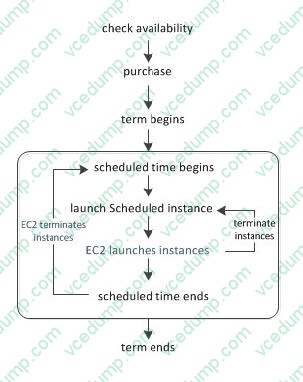
A company must generate sales reports at the beginning of every month. The reporting process launches 20 Amazon EC2 instances on the first of the month. The process runs for 7 days and cannot be interrupted. The company wants to minimize costs.
Which pricing model should the company choose?
A. Reserved Instances
B. Spot Block Instances
C. On-Demand Instances
D. Scheduled Reserved Instances -
Question 209:
A company built a food ordering application that captures user data and stores it for future analysis. The application's static front end is deployed on an Amazon EC? instance. The front-end application sends the requests to the backend
application running on separate EC2 instance. The backend application then stores the data in Amazon RDS.
What should a solutions architect do to decouple the architecture and make it scalable?
A. Use Amazon S3 to serve the front-end application, which sends requests to Amazon EC2 to execute the backend application. The backend application will process and store the data in Amazon RDS
B. Use Amazon S3 to serve the front-end application and write requests to an Amazon Simple Notification Service (Amazon SNS) topic. Subscribe Amazon EC2 instances to the HTTP/HTTPS endpoint o( the topic, and process and store the data in Amazon RDS
C. Use an EC2 instance lo serve the front end and write requests to an Amazon SQS queue Place the backend Instance in an Auto Scaling group, and scale based on the queue depth to process and store the data in Amazon RDS.
D. Use Amazon S3 to serve the static front-end application and send requests lo Amazon API Gateway which writes the requests to an Amazon SQS queue Place the backend instances in an Auto Scaling group, and scale based on the queue depth to process and store the data in Amazon RDS -
Question 210:
A company has hundreds of Amazon EC2 Linux-based instances in the AWS Cloud. Systems administrators have used shared SSH keys to manage the instances After a recent audit, the company's security team is mandating the removal of all shared keys. A solutions architect must design a solution that provides secure access to the EC2 instances.
Which solution will meet this requirement with the LEAST amount of administrative overhead?
A. Use AWS Systems Manager Session Manager to connect to the EC2 instances.
B. Use AWS Security Token Service (AWS STS) to generate one-time SSH keys on demand.
C. Allow shared SSH access to a set of bastion instances. Configure all other instances to allow only SSH access from the bastion instances
D. Use an Amazon Cognito custom authorizer to authenticate users. Invoke an AWS Lambda function to generate a temporary SSH key.
Related Exams:
-
AIF-C01
Amazon AWS Certified AI Practitioner (AIF-C01) -
AIP-C01
AWS Certified Generative AI Developer - Professional -
ANS-C00
AWS Certified Advanced Networking - Specialty (ANS-C00) -
ANS-C01
AWS Certified Advanced Networking - Specialty (ANS-C01) -
AXS-C01
AWS Certified Alexa Skill Builder - Specialty (AXS-C01) -
BDS-C00
AWS Certified Big Data - Speciality (BDS-C00) -
CLF-C02
AWS Certified Cloud Practitioner (CLF-C02) -
DAS-C01
AWS Certified Data Analytics - Specialty (DAS-C01) -
DATA-ENGINEER-ASSOCIATE
AWS Certified Data Engineer - Associate (DEA-C01) -
DBS-C01
AWS Certified Database - Specialty (DBS-C01)
Tips on How to Prepare for the Exams
Nowadays, the certification exams become more and more important and required by more and more enterprises when applying for a job. But how to prepare for the exam effectively? How to prepare for the exam in a short time with less efforts? How to get a ideal result and how to find the most reliable resources? Here on Vcedump.com, you will find all the answers. Vcedump.com provide not only Amazon exam questions, answers and explanations but also complete assistance on your exam preparation and certification application. If you are confused on your SAA-C02 exam preparations and Amazon certification application, do not hesitate to visit our Vcedump.com to find your solutions here.