RPFT Exam Details

  • Exam Code
    :RPFT
  • Exam Name
    :Registry Examination for Advanced Pulmonary Function Technologists
  • Certification
    :Test Prep Certifications
  • Vendor
    :Test Prep
  • Total Questions
    :111 Q&As
  • Last Updated
    :Jun 02, 2026

Test Prep RPFT Online Questions & Answers

  • Question 1:

    Which of the following is a suitable policy for following Standard Precautions in a pulmonary function laboratory?

    A. Eye protection is required when obtaining ABGs from patients with hepatitis.
    B. Reusable mouthpieces should be disposed when a patient has a history of tuberculosis.
    C. Gloves are optional when obtaining arterial blood samples using a kit
    D. Reusable mouthpieces should be disinfected between each patient.

  • Question 2:

    Successive peak flow measurements made with a peak flowmeter on a subject previously diagnosed as having asthma yield the following results:

    Which of the following is the best explanation for these?

    A. Condensation of moisture in the peak flowmeter
    B. Normal response
    C. Improper calibration of the peak flowmeter
    D. Increasing airways resistance in the subject

  • Question 3:

    In setting up a CO analyzer, a pulmonary function technologist notices that the analyzer reads -0.03 while sampling air. The technologist should

    A. Accept the reading because it is within ?3%.
    B. Adjust the reading to +0.03.
    C. Adjust the reading to 0.00.
    D. Reverse the sample flow.

  • Question 4:

    To facilitate measurement of arterial oxygen content during an exercise (stress) test, a pulmonary function technologist should recommend

    A. End-tidal monitoring
    B. Pulse oximetry
    C. An arterial puncture at anaerobic threshold
    D. Radial artery catheterization

  • Question 5:

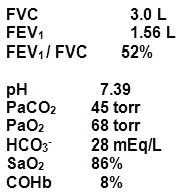
    An arterial blood gas performed prior to exercise on a 45-year-old patient shows the following results:

    A pulmonary function technologist should conclude that the patient's

    A. Hemoglobin level is below normal.
    B. Values are within normal limits.
    C. Alveolar ventilation is above normal.
    D. Dead space ventilation is above normal.

  • Question 6:

    The following arterial blood gas results are obtained during the final workload of a cardiopulmonary exercise test:

    Which of the following best explains these results?

    A. IV solution has contaminated the blood sample.
    B. Blood gas results are normal for someone at end-exercise.
    C. The test indicates a right-to-left shunt.
    D. There is air contamination since the PaCO2 is so low.

  • Question 7:

    During an exercise study, a pulmonary function technologist notices the systolic blood pressure increased to 270 mm Hg using an automated cuff. Which of the following should the technologist do?

    A. Terminate the test and administer oxygen by nasal cannula.
    B. Continue the test and recheck blood pressure using manual cuff method.
    C. Terminate the test at this time and recheck blood pressure.
    D. Continue the test if within 5 minutes of completion.

  • Question 8:

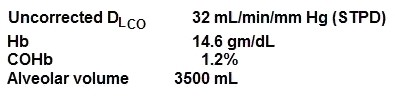
    A patient's vital capacity is slightly reduced, the FEWFVC is normal, and the uncorrected DLco is increased. Which of the following is the most likely diagnosis?

    A. diffuse pulmonary fibrosis
    B. diaphragmatic hemiparesis
    C. kyphoscoliosis
    D. polycythemia vera

  • Question 9:

    A pulmonary function laboratory routinely tests five subjects as biologic controls. Acceptable instrument performance over time is indicated when measurements

    A. For each individual are within 2 standard deviations of the mean of previous measurements for each individual.
    B. For an individual are within 2 standard deviations of the mean of those for the group.
    C. Of the group as a whole agree with those predicted by linear regression for changes in age.
    D. Are within the 95% confidence interval predicted for an individual being tested.

  • Question 10:

    During a bronchial provocation study, a patient has the following spirometric values after a 0.25 mg/mL dose of methacholine:

    Based on these results, a pulmonary function technologist should

    A. Instruct the patient to blow out longer and repeat the effort.
    B. Stop the test and immediately administer a bronchodilaior.
    C. Instruct the patient to blow out harder and repeat the effort.
    D. Reduce the concentration of methacholine on the next trial.

Tips on How to Prepare for the Exams

Nowadays, the certification exams become more and more important and required by more and more enterprises when applying for a job. But how to prepare for the exam effectively? How to prepare for the exam in a short time with less efforts? How to get a ideal result and how to find the most reliable resources? Here on Vcedump.com, you will find all the answers. Vcedump.com provide not only Test Prep exam questions, answers and explanations but also complete assistance on your exam preparation and certification application. If you are confused on your RPFT exam preparations and Test Prep certification application, do not hesitate to visit our Vcedump.com to find your solutions here.