N10-008 Exam Details
-
Exam Code
:N10-008 -
Exam Name
:CompTIA Network+ -
Certification
:CompTIA Certifications -
Vendor
:CompTIA -
Total Questions
:1219 Q&As -
Last Updated
:Feb 16, 2025
CompTIA N10-008 Online Questions & Answers
-
Question 411:
Several users with older devices are reporting intermittent connectivity while in an outdoor patio area. After some research, the network administrator determines that an outdoor WAP might help with the issue. However, the company does not want the signal to bleed into the building and cause interference. Which of the following should the network administrator perform to BEST resolve the issue?
A. Disable the SSID broadcast on the WAP in the patio area.
B. Install a WAP and enable 5GHz only within the patio area.
C. Install a directional WAP in the direction of the patio.
D. Install a repeater on the back wall of the patio area. -
Question 412:
A network administrator has discovered a low-end managed switch connected to the company's LAN. While reading about the device's specifications on the manufacturer's website, the administrator discovers the switch does not support a command-line interface for administration. Which of the following remote access methods should the administrator use to log in to the switch?
A. Install a VNC plugin on the web browser.
B. Connect to the HTTPS management interface.
C. Replace the managed switch with an unmanaged switch.
D. Establish an SSH session. -
Question 413:
Which of the following is used to provide disaster recovery capabilities to spin up an critical devices using internet resources?
A. Cloud site
B. Hot site
C. Cold site
D. Warm site -
Question 414:
A network technician is installing a wireless network in an office building. After performing a site survey, the technician determines the area is very saturated on the 2.4GHz and the 5GHz bands. Which of the following wireless standards should the network technician implement?
A. 802.11ac
B. 802.11ax
C. 802.11g
D. 802.11n -
Question 415:
A network technician installed a new host on the network. The host is not connecting to the company's cloud servers. The technician attemtps to ping a server using the AP address with no success. Checking the IP address using ipconfing displays:
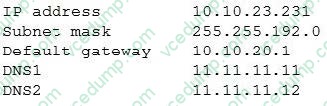
Which of the following should the technician perform NEXT to determine where the issue is located?
A. Modify the default gateway address and ping the server to test connectivity.
B. Change the DNS servers to be on the same subnet as the host.
C. Modify the router's ACL to allow port 80 to exit the network.
D. Perform a tracert command to locate where the packet is dropped. -
Question 416:
While waking from the parking lot lo an access-controlled door an employee sees an authorized user open the door. Then the employee notices that another person catches the door before It closes and goes inside.
Which of the following attacks Is taking place?
A. Tailgating
B. Pipgybacking
C. Shoulder surfing
D. Phisning -
Question 417:
A technician is assisting a user who cannot connect to a website. The technician attempts to ping the default gateway and DNS server of the workstation According to troubleshooting methodology this is an example of:
A. a divide-and-conquer approach
B. a bottom-up approach
C. a top-to-bottom approach
D. Implementing a solution -
Question 418:
A network technician is troubleshooting a port channel issue. When logging in to one of the switches, the technician sees the following information displayed:
Native VLAN mismatch detected on interface g0/1
Which of the following layers of the OSI model is most likely to be where the issue resides?
A. Layer 2
B. Layer 3
C. Layer 5
D. Layer 6 -
Question 419:
A technician is called to a customer site because the modem has failed and needs to be replaced. The technician connects the existing firewall to a modem taken from another customer site and ensures the users can reach the Internet. That night, a remote vendor tries to transfer a file to the customer's server using FTP but is unable to make the connection. There were no issues the previous night. Which of the following is the MOST likely cause of the problem?
A. The firewall rules in the router were not reconfigured for use with the newer ISP protocols.
B. The modern may have its own built-in firewall that is interfering with the communications.
C. The ISP cannot route traffic from the new modern because it came from another ISP.
D. The NAT that converts the public IP to the internal private IP of the server is using an incorrect port. -
Question 420:
Which of the following uses eight groups of characters for addressing?
A. MAC
B. IPv4
C. IPv6
D. DHCP
Related Exams:
-
220-1001
CompTIA A+ Certification: Core 1 -
220-1002
CompTIA A+ Certification: Core 2 -
220-1101
CompTIA A+ Certification: Core 1 -
220-1102
CompTIA A+ Certification: Core 2 -
220-1201
CompTIA A+ Certification: Core 1 -
220-1202
CompTIA A+ Core 2 (2026) -
220-902
CompTIA A+ Certification -
CAS-004
CompTIA Advanced Security Practitioner (CASP+) -
CAS-005
CompTIA SecurityX -
CLO-001
CompTIA Cloud Essentials+
Tips on How to Prepare for the Exams
Nowadays, the certification exams become more and more important and required by more and more enterprises when applying for a job. But how to prepare for the exam effectively? How to prepare for the exam in a short time with less efforts? How to get a ideal result and how to find the most reliable resources? Here on Vcedump.com, you will find all the answers. Vcedump.com provide not only CompTIA exam questions, answers and explanations but also complete assistance on your exam preparation and certification application. If you are confused on your N10-008 exam preparations and CompTIA certification application, do not hesitate to visit our Vcedump.com to find your solutions here.