IMANET-CMA Exam Details
-
Exam Code
:IMANET-CMA -
Exam Name
:Certified Management Accountant (CMA) -
Certification
:IMANET Certifications -
Vendor
:IMANET -
Total Questions
:1336 Q&As -
Last Updated
:Jun 01, 2026
IMANET IMANET-CMA Online Questions & Answers
-
Question 751:
Condensed monthly operating income data for Korbin, Inc. for May follows:
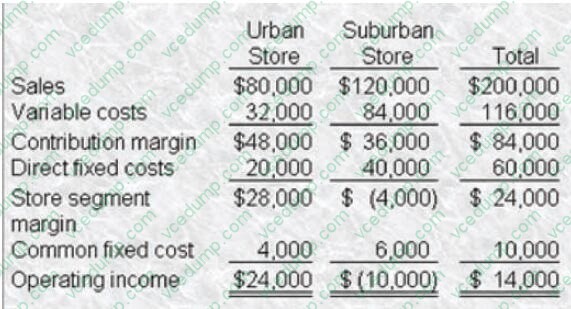
Additional information regarding Korbin's operations follows:
One-fourth of each store's direct fixed costs would continue if either store is closed.
Korbin allocates common fixed costs to each store on the basis of sales dollars.
Management estimates that closing the Suburban Store would result in a 10% decrease in the Urban Store's sales, while closing the Urban Store would not affect the Suburban Store's sales.
The operating results for May are representative of all months.
One-half of the Suburban Store's dollar sales are from items sold at variable cost to attract customers to the store. Korbin is considering the deletion of these items, a move that would reduce the Suburban Store's direct fixed expenses by
15% and result in a 20% loss of Suburban Store's remaining sales volume. This change would not affect the Urban Store. A decision by Korbin to eliminate the items sold at cost would result in a monthly increase (decrease) in Korbin's
operating income of
A. $(5,200)
B. $(1,200)
C. $(7,200)
D. $2,000 -
Question 752:
A large firm may be ,iewed as a portfolio of investments in the form of
A. MGRs.
B. SBUs.
C. RMSs.
D. BOGs. -
Question 753:
The percentage change in earnings before interest and taxes associated with the percentage change in sales volume is the degree of
A. Operating leverage.
B. Financial leverage.
C. Breakeven leverage.
D. Combined leverage. -
Question 754:
Madengrad Company manufactures a single electronic product called Precisionmix. This unit is a batch-density monitoring device attached to large industrial mixing machines used in flour, rubber, petroleum, and chemical manufacturing. Precisionmix sells for $900 per unit. The following variable costs are incurred to produce each Precisionmix device:
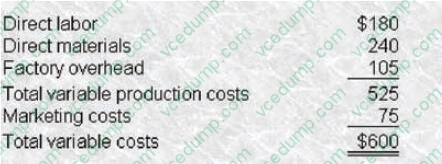
Madengrad's income tax rate is 40%, and annual fixed costs are $6,600,000. Except for an operating loss incurred in the year of incorporation, the firm has been profitable over the last 5 years.If Madengrad Company achieves a sales and production volume of 8.000 units, the annual before-tax income (loss) will be
A. $(4,200000)
B. $1,780,000
C. $(2,520,000)
D. $(420,000) -
Question 755:
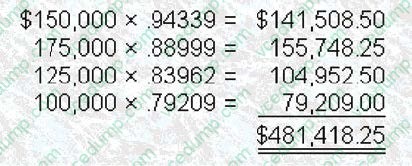
Henderson, Inc. has purchased a new fleet of trucks to deliver its merchandise. The trucks have a useful life of 8 years and cost a total of $500.000. Henderson expects its net increase in after-tax cash flow to be $150,000 in Year 1, $175,000 in Year 2, $125,000 in Year 3, and $100,000 in each of the remaining years. Based on a 6% annual interest rate, what is the discounted payback period for Henderson's fleet of trucks?
A. 3. Syears.
B. 3. 98 years.
C. 4. 25years.
D. 5. 0 years. -
Question 756:
A firm sells its product in a foreign market for a much higher price than in its home market. The reason is most likely
A. Price elasticity of demand.
B. Dumping.
C. Gray market activity,
D. Price escalation -
Question 757:
The customer value triad includes
A. Loyalty.
B. Cost.
C. Quantity.
D. Serco. -
Question 758:
The difference between variable costs and fixed costs is
A. Variable costs per unit fluctuate and fixed costs per unit remain constant.
B. Variable costs per unit are fixed over the relevant range and fixed costs per unit are variable.
C. Total variable costs are variable over the relevant range and fixed in the long term, while fixed costs never change.
D. Variable costs per unit change in varying increments, while fixed costs per unit change in equal increments. -
Question 759:
Which of the following price adjustment strategies is designed to stabilize production for the selling firm?
A. Cash discounts.
B. Quantity discounts.
C. Functional discounts.
D. Seasonal discounts. -
Question 760:
A printing company is considering replacing an old printing press. The old printing press has a book value of $24,000 and a trade-in value of $14,000. A new printing press would cost $85,000 after trade-in of the old press. It is estimated that the new printing press would reduce operating costs by $20,000 per year. If the company decides not to purchase the new press, the $85,000 could instead be used to retire debt that is currently costing $9,000 per year in interest. Which of the given is an example of a sunk cost?
A. The book value of the old printing press.
B. The trade-in value of the old printing press.
C. The estimated reduction in operating costs.
D. The interest on the existing debt.
Related Exams:
Tips on How to Prepare for the Exams
Nowadays, the certification exams become more and more important and required by more and more enterprises when applying for a job. But how to prepare for the exam effectively? How to prepare for the exam in a short time with less efforts? How to get a ideal result and how to find the most reliable resources? Here on Vcedump.com, you will find all the answers. Vcedump.com provide not only IMANET exam questions, answers and explanations but also complete assistance on your exam preparation and certification application. If you are confused on your IMANET-CMA exam preparations and IMANET certification application, do not hesitate to visit our Vcedump.com to find your solutions here.