IMANET-CMA Exam Details
-
Exam Code
:IMANET-CMA -
Exam Name
:Certified Management Accountant (CMA) -
Certification
:IMANET Certifications -
Vendor
:IMANET -
Total Questions
:1336 Q&As -
Last Updated
:Jun 01, 2026
IMANET IMANET-CMA Online Questions & Answers
-
Question 1031:
The technique used to evaluate all possible capital projects of different dollar amounts and then rank them according to their desirability is the
A. Profitability index method.
B. Net present value method.
C. Payback method.
D. Discounted cash flow method. -
Question 1032:
A company that sells its single product for $40 per unit uses cost-volume-profit analysis in its planning. The company's after4ax net income for the past year was $1,188,000 after applying an effective tax rate of 40%. The projected costs for manufacturing and selling its single product in the coming year are in the next column.
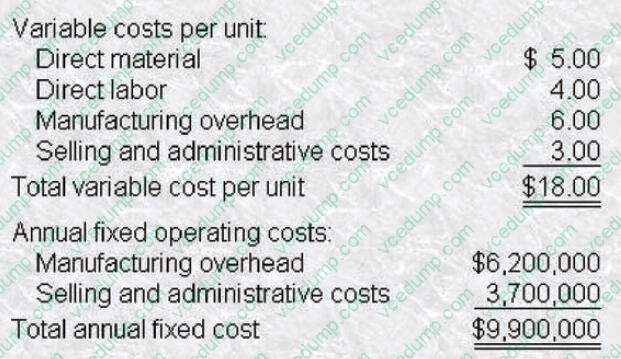
The company has learned that a new direct material is available that will increase the quality of its product. The new material will increase the direct material costs by $3 per unit. The company will increase the selling price of the product to $50 per unit and increase its marketing costs by $1 .575,000 to advertise the higher-quality product. The number of units the company has to sell in order to earn a 10% before-tax return on sales would be
A. 337,500 units.
B. 346875 units.
C. 425,000 units.
D. 478,125 units. -
Question 1033:
The costs described in situations Ill and V are
A. Prime costs.
B. Sunk costs.
C. Discretionary costs.
D. Imputed costs. -
Question 1034:
Quality control of services should be managed by
A. Separating the performance of services from their consumptions
B. Emphasizing customer attraction rather than satisfaction
C. Standardizing the firm's services
D. Adopting selective hiring practices and allowing those employees to use judgment in performing services -
Question 1035:
Networking capital is the difference between
A. Current assets and current liabilities.
B. Fixed assets and fixed liabilities.
C. Total assets and total liabilities.
D. Shareholders' investment and cash. -
Question 1036:
A firm produces two joint products (A and B) from one unit of raw material, which costs $1,000. Product A can be sold for $700 and product B can be sold for $500 at the split-off point. Alternatively, both A and/or B can be processed further and sold for $900 and $1 ,200, respectively. The additional processing costs are $100 for A and $750 for B. Should the firm process products A and B beyond the split-off point?
A. Both A and B should be processed further.
B. Only B should be processed further.
C. Only A should be processed further.
D. Neither product should be processed further. -
Question 1037:
Delphi Company has developed a new project hat will be marketed for the first time during the next fiscal year. Although the Marketing Department estimates that 35,000 units could be sold at $36 per unit, Delphi's management has allocated only enough manufacturing capacily to produce a maximum of 25,000 units of the new product annually. The fixed costs associated with the new product are budgeted at $450,000 for the year, which includes $60,000 for depreciation on new manufacturing equipment. Data associated with each unit of product are presented as follows. Delphi is subject to a40% income tax rate.
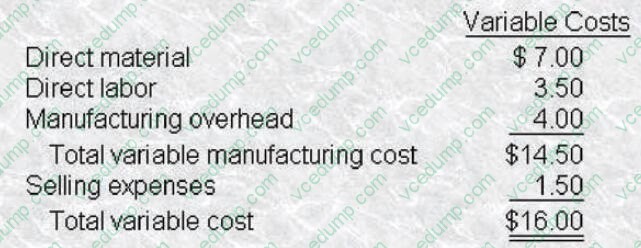
The maximum after-tax profit that can be earned by Delphi Company from sales of the new product during the next fiscal year is
A. $30,000
B. $50,000
C. $110,000
D. $66,000 -
Question 1038:
Which of the following is true regarding the calculation of a firms cost of capital?
A. The cost of capital of a firm is the weighted-average cost of its various financing components
B. All costs should be expressed as pre-tax costs
C. The time value of money should be excluded from the calculations.
D. The cost of capital is the cost of equity. -
Question 1039:
Gleason Co. has two products, a frozen dessert and ready-to-bake breakfast rolls, ready for introduction. However, plant capacity is limited, and only one product can be introduced at present. Therefore, Gleason has conducted a market study, at a cost of $26,000, to determine which product will be more profitable. The results of the study follow.
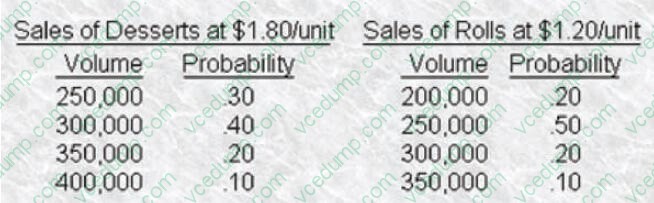
*Gleason treats production tooling as a current operating expense rather than capitalizing it as a fixed asset. The expected value of Gleason's operating profit directly traceable to the sale of frozen desserts is
A. $198,250
B. $150,250
C. $120,250
D. Some amount other than those given. -
Question 1040:
Controllable costs
A. Arise from periodic appropriation decisions and have no well-specified function relating inputs to outputs.
B. Are primarily subject to the influence of a given manager of a given responsibility center for a given time span.
C. Arise from having property, plant, and equipment, and a functioning organization.
D. Result specifically from a clear-cut measured relationship between inputs and outputs.
Related Exams:
Tips on How to Prepare for the Exams
Nowadays, the certification exams become more and more important and required by more and more enterprises when applying for a job. But how to prepare for the exam effectively? How to prepare for the exam in a short time with less efforts? How to get a ideal result and how to find the most reliable resources? Here on Vcedump.com, you will find all the answers. Vcedump.com provide not only IMANET exam questions, answers and explanations but also complete assistance on your exam preparation and certification application. If you are confused on your IMANET-CMA exam preparations and IMANET certification application, do not hesitate to visit our Vcedump.com to find your solutions here.