DP-300 Real Exam Questions

Administering Relational Databases on Microsoft Azure

376 questions available · Page 1 of 38

Updated Exam DumpsVerified AnswersPass Guarantee

Get Complete Exam Dumps
Case Study 5

Overview

ADatum Corporation is a financial services company that has a main office in New York City.

Existing Environment. Licensing Agreement

ADatum has a Microsoft Volume Licensing agreement that includes Software Assurance.

Existing Environment. Network Infrastructure

ADatum has an on-premises datacenter and an Azure subscription named Sub1.

Sub1 contains a virtual network named Network1 in the East US Azure region.

The datacenter is connected to Network1 by using a Site-to-Site (S2S) VPN.

Existing Environment. Identity Environment

The on-premises network contains an Active Directory Domain Services (AD DS) forest.

The forest contains a single domain named corp.adatum.com.

The corp.adatum.com domain syncs with a Microsoft Entra tenant named adatum.com.

Existing Environment. Database Environment

The datacenter contains the servers shown in the following table.
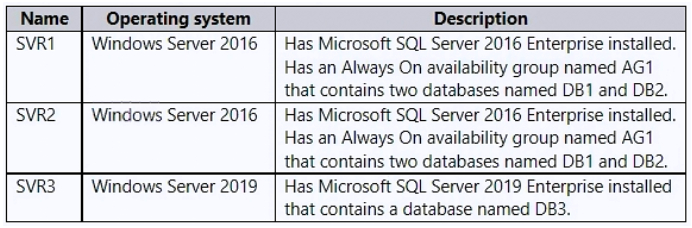
DB1 and DB2 are used for transactional and analytical workloads by an application named App1.

App1 runs on Microsoft Entra hybrid joined servers that run Windows Server 2022. App1 uses Kerberos authentication.

DB3 stores compliance data used by two applications named App2 and App3.

DB3 performance is monitored by using Extended Events sessions, with the event_file target set to a file share on a local disk of SVR3.

Resource allocation for DB3 is managed by using Resource Governor.

Requirements. Planned Changes

ADatum plans to implement the following changes:

1. Deploy an Azure SQL managed instance named Instance1 to Network1.
2. Migrate DB1 and DB2 to Instance1.
3. Migrate DB3 to Azure SQL Database.
4. Following the migration of DB1 and DB2, hand over database development to remote developers who use Microsoft Entra joined Windows 11 devices.
5. Following the migration of DB3, configure the database to be part of an auto-failover group.

Requirements. Availability Requirements

ADatum identifies the following post-migration availability requirements:

1. For DB1 and DB2, offload analytical workloads to a read-only database replica in the same Azure region.
2. Ensure that if a regional disaster occurs, DB1 and DB2 can be recovered from backups.
3. After the migration, App1 must maintain access to DB1 and DB2.
4. For DB3, manage potential performance issues caused by resource demand changes by App2 and App3.
5. Ensure that DB3 will still be accessible following a planned failover.
6. Ensure that DB3 can be restored if the logical server is deleted.
7. Minimize downtime during the migration of DB1 and DB2.

Requirements. Security Requirements

ADatum identifies the following security requirements for after the migration:

1. Ensure that only designated developers who use Microsoft Entra joined Windows 11 devices can access DB1 and DB2 remotely.
2. Ensure that all changes to DB3, including ones within individual transactions, are audited and recorded.

Requirements. Management Requirements

ADatum identifies the following post-migration management requirements:

1. Continue using Extended Events to monitor DB3.
2. In Azure SQL Database, automate the management of DB3 by using elastic jobs that have database-scoped credentials.

Requirements. Business Requirements

ADatum identifies the following business requirements:

1. Minimize costs whenever possible, without affecting other requirements.
2. Minimize administrative effort.

Question 1 Single choice

You need to recommend a solution that will enable remote developers to access DB1 and DB2. The solution must support the planned changes and meet the security requirements.

What should you include in the recommendation?

  1. A

    a public endpoint via a database-level firewall rule

  2. B

    a Point-to-Site (P2S) VPN

  3. C

    a public endpoint via a server-level firewall rule

  4. D

    a private endpoint

Show answer and explanation

Correct answer: D
Question 2 Hotspot

HOTSPOT

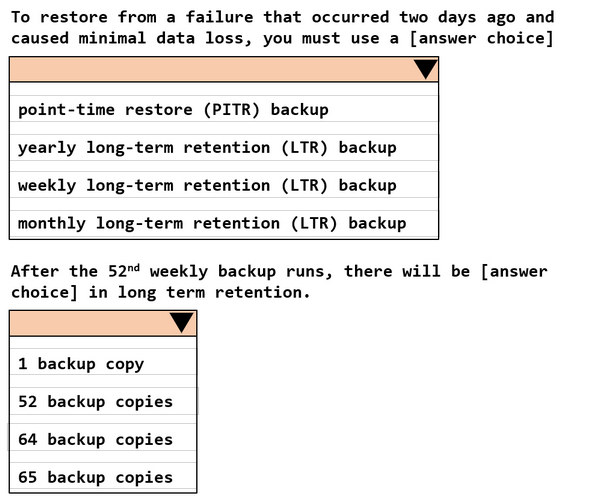
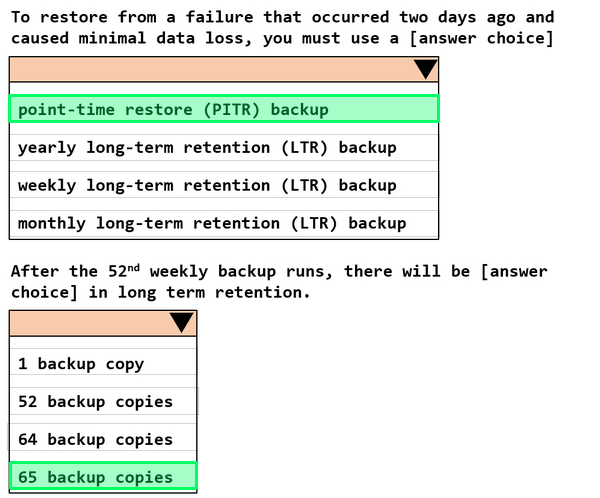
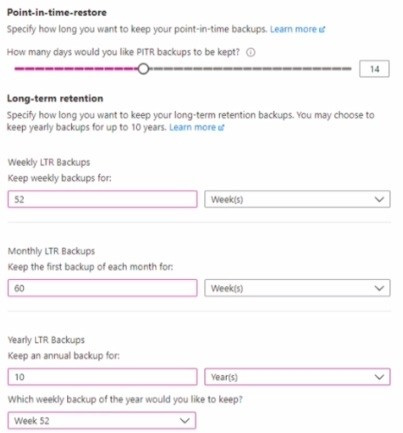
You configure backup for an Azure SQL database as shown in the following exhibit.

Use the drop-down menus to select the answer choice the completes each statement based on the information presented in the graphic.

NOTE: Each correct selection is worth one point.

Question diagram
Show answer and explanation
Correct answer diagram
Question 3 Single choice

You have an Azure subscription that contains an Azure SQL database named DB1.

You need to host elastic jobs by using DB1. DB1 will also be configured as a job target. The solution must support the use of location-based Conditional Access policies.

What should the elastic jobs use to access DB1?

  1. A

    a system-assigned managed identity

  2. B

    Azure SQL sign-in credentials

  3. C

    database-scoped credentials

  4. D

    a user-assigned managed identity

Show answer and explanation

Correct answer: A

Question 4 Lab simulation

Simulation

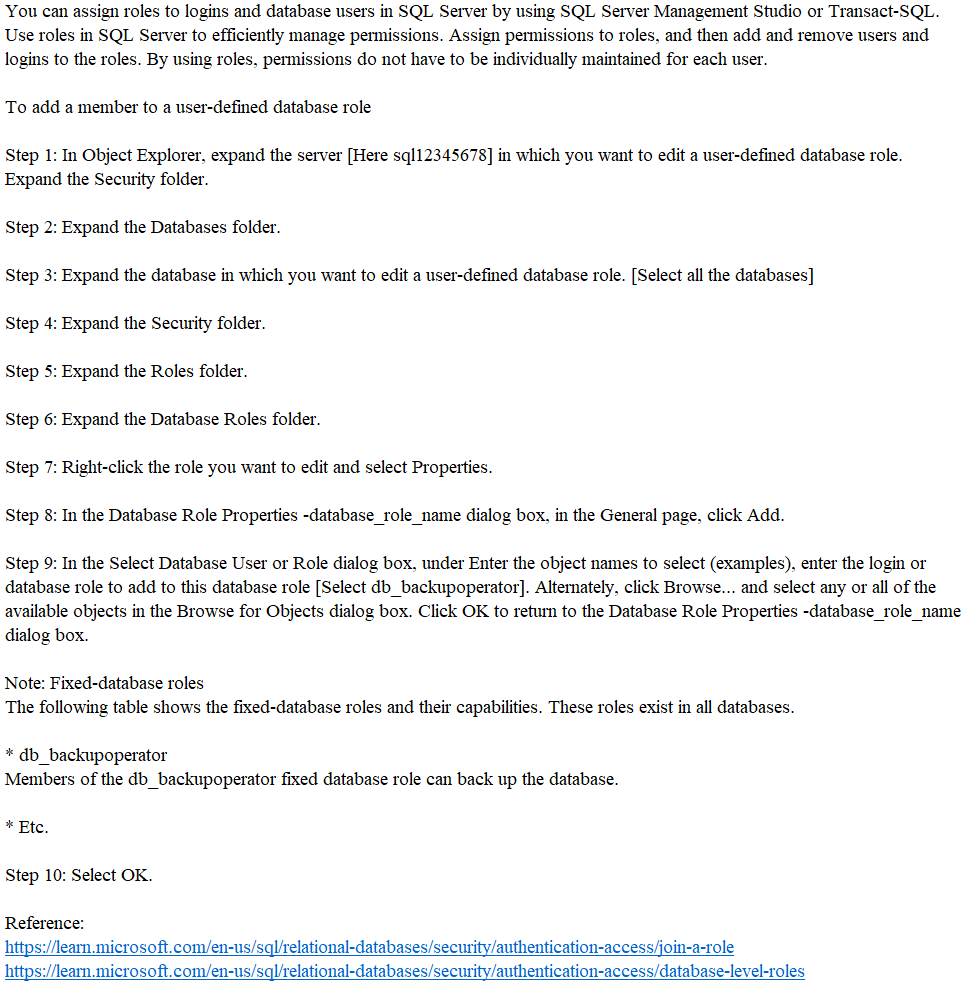
You need to provide a user named user2-12345678 with the ability to back up and restore databases and change the compute setting of the databases located on a server named sql12345678. User2-12345678 must be prevented from connecting to the databases and modifying database server settings. The solution must minimize administrative effort.

To complete this task, sign in to the virtual machine. You may need to use SQL Server Management Studio and the Azure portal.

Show answer and explanation
Question 5 Drag & drop

DRAG DROP

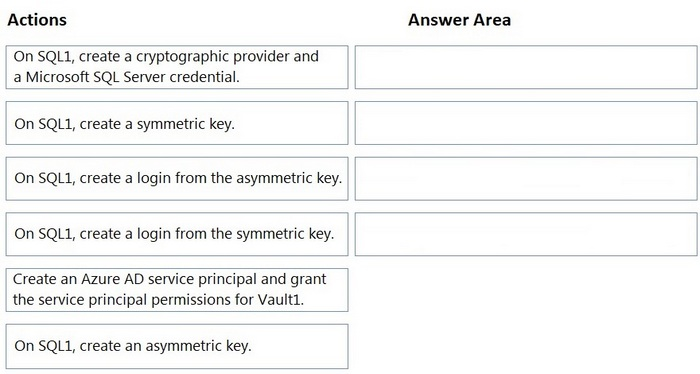
You have an Azure key vault named Vault1 and a SQL server on Azure Virtual Machines instance named SQL1. SQL1 hosts a database named DB1.

You need to configure Transparent Data Encryption (TDE) on DB1 to use a key in Vault1.

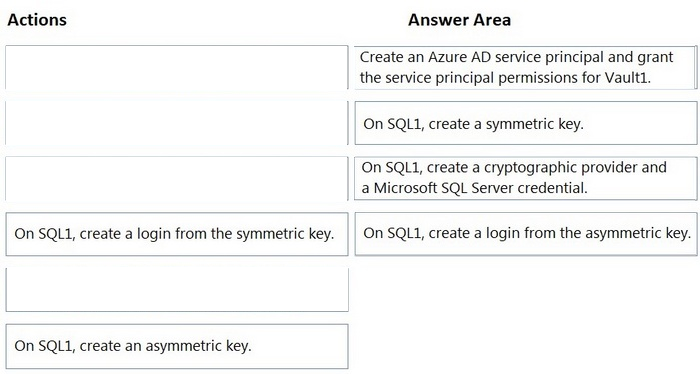
Which four actions should you perform in sequence? To answer, move the appropriate actions from the list of actions to the answer area and arrange them in the correct order.

Question diagram
Show answer and explanation
Correct answer diagram
Explanation

Step 1: Create an Azure AD service principal and grant the service principal permissions for Vault1.
Set up SQL Server TDE Extensible Key Management by using Azure Key Vault

Set up an Azure AD service principal
To grant your SQL Server instance access permissions to your Azure key vault, you need a service principal account in Azure AD.

Step 2: On SQL1, create an asymmetric key.
Be sure to use an asymmetric RSA 2048 or 3072 key so that it's supported by SQL Server.

Step 3: On SQL1, crate a cryptographic provider and Microsoft SQL Server credential.
Configure SQL Server
Create a cryptographic provider by using the SQL Server Connector, which is an EKM provider for the Azure key vault.
Set up a SQL Server credential for a SQL Server login to use the key vault.

Step 4: On SQL1, create a login from the asymmetric key.
Create a new login from the asymmetric key in SQL Server.

References:
https://learn.microsoft.com/en-us/sql/relational-databases/security/encryption/setup-steps-for-extensible-key-management-using-the-azure-key-vault

Question 6 Single choice

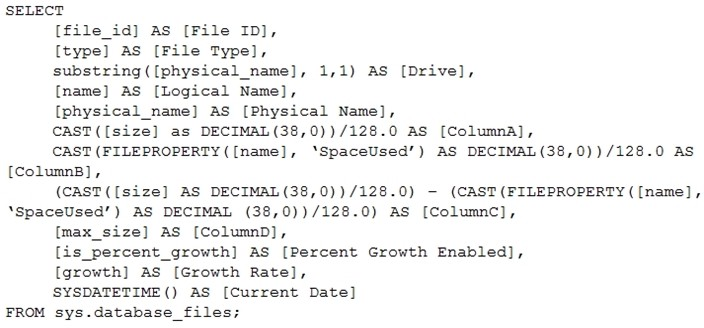
You have the following Transact-SQL query.

Which column returned by the query represents the free space in each file?

  1. A

    ColumnA

  2. B

    ColumnB

  3. C

    ColumnC

  4. D

    ColumnD

Show answer and explanation

Correct answer: C

Explanation

Example:
Free space for the file in the below query result set will be returned by the FreeSpaceMB column.

SELECT DB_NAME() AS DbName,
name AS FileName,
type_desc,
size/128.0 AS CurrentSizeMB, size/128.0 - CAST(FILEPROPERTY(name, 'SpaceUsed') AS INT)/128.0 AS FreeSpaceMB FROM
sys.database_files
WHERE type IN (0,1);

References:
https://www.sqlshack.com/how-to-determine-free-space-and-file-size-for-sql-server-databases/

Question 7 Hotspot

HOTSPOT

You have an Azure SQL database.

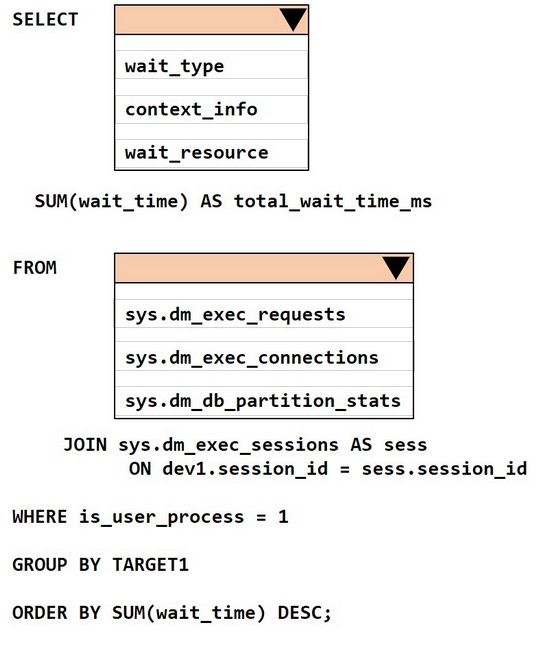
You need to identify whether a delayed query execution is associated to a RESOURCE wait.

How should you complete the Transact -SQL statement? To answer, select the appropriate option in the answer area.

NOTE: Each correct selection is worth one point.

Question diagram
Show answer and explanation
Correct answer diagram
Explanation

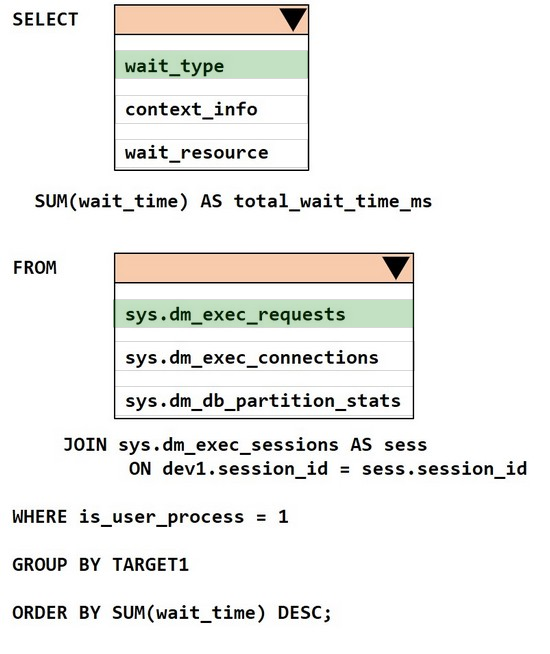
Box 1: wait_type
Determine if a RESOURCE_SEMAHPORE wait is a top wait
Use the following query to determine if a RESOURCE_SEMAHPORE wait is a top wait

SELECT wait_type, SUM(wait_time) AS total_wait_time_ms FROM sys.dm_exec_requests AS req JOIN sys.dm_exec_sessions AS sess ON req.session_id = sess.session_id WHERE is_user_process = 1 GROUP BY wait_type ORDER BY SUM(wait_time) DESC;

Box 2: sys.dm_exec_requests
Use the sys.dm_exec_requests or sys.dm_os_waiting_tasks to see the wait_type and wait_time.

Azure SQL RESOURCE_SEMAPHORE wait "wait_time" is_user_process

Question 8 Multiple choice

You have a new Azure SQL database. The database contains a column that stores confidential information.

You need to track each time values from the column are returned in a query. The tracking information must be stored for 365 days from the date the query was executed.

Which three actions should you perform? Each correct answer presents part of the solution.

NOTE: Each correct selection is worth one point.

  1. A

    Turn on auditing and write audit logs to an Azure Storage account.

  2. B

    Add extended properties to the column.

  3. C

    Turn on Advanced Data Security for the Azure SQL server.

  4. D

    Apply sensitivity labels named Highly Confidential to the column.

  5. E

    Turn on Azure Advanced Threat Protection (ATP).

Show answer and explanation

Correct answers: A, C, D

Explanation

C: Advanced Data Security (ADS) is a unified package for advanced SQL security capabilities. ADS is available for Azure SQL Database, Azure SQL Managed Instance, and Azure Synapse Analytics. It includes functionality for discovering and classifying sensitive data

D: You can apply sensitivity-classification labels persistently to columns by using new metadata attributes that have been added to the SQL Server database engine. This metadata can then be used for advanced, sensitivity-based auditing and protection scenarios.
A: An important aspect of the information-protection paradigm is the ability to monitor access to sensitive data. Azure SQL Auditing has been enhanced to include a new field in the audit log called data_sensitivity_information. This field logs the sensitivity classifications (labels) of the data that was returned by a query. Here's an example:

References:
https://docs.microsoft.com/en-us/azure/azure-sql/database/data-discovery-and-classification-overview

Question 9 Drag & drop

DRAG DROP

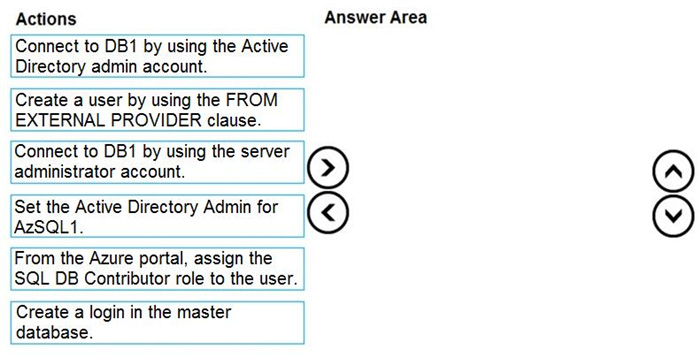
You have a new Azure SQL database named DB1 on an Azure SQL server named AzSQL1.

The only user who was created is the server administrator.

You need to create a contained database user in DB1 who will use Azure Active Directory (Azure AD) for authentication.

Which three actions should you perform in sequence? To answer, move the appropriate actions from the list of actions to the answer area and arrange them in the correct order.

Question diagram
Show answer and explanation
Correct answer diagram
Explanation

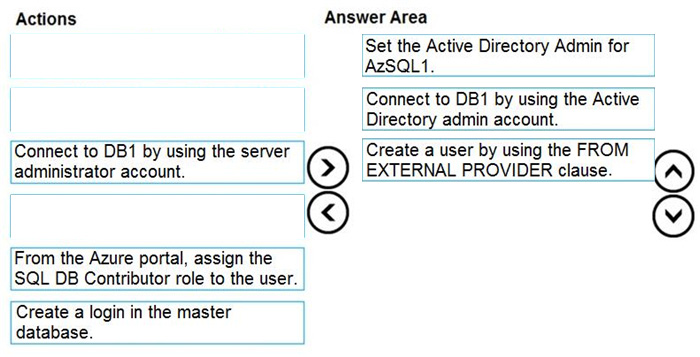
Step 1: Set up the Active Directory Admin for AzSQL1.

Step 2: Connect to DB1 by using the server administrator.
Sign into your managed instance with an Azure AD login granted with the sysadmin role.

Step 3: Create a user by using the FROM EXTERNAL PROVIDER clause.
FROM EXTERNAL PROVIDER is available for creating server-level Azure AD logins in SQL Database managed instance. Azure AD logins allow database-level Azure AD principals to be mapped to server-level Azure AD logins. To create an Azure AD user from an Azure AD login use the following syntax:

CREATE USER [AAD_principal] FROM LOGIN [Azure AD login]

References:
https://docs.microsoft.com/en-us/sql/t-sql/statements/create-user-transact-sql

Question 10 Single choice

You have an instance of SQL Server on Azure Virtual Machine named SQL1.

You need to monitor SQL1 and query the metrics by using Kusto query language. The solution must minimize administrative effort.

Where should you store the metrics?

  1. A

    a Log Analytics workspace

  2. B

    Azure Event Hubs

  3. C

    Azure SQL Database

  4. D

    an Azure Blob storage container

Show answer and explanation

Correct answer: A