DOP-C02 Exam Details
-
Exam Code
:DOP-C02 -
Exam Name
:AWS Certified DevOps Engineer - Professional (DOP-C02) -
Certification
:Amazon Certifications -
Vendor
:Amazon -
Total Questions
:461 Q&As -
Last Updated
:Jul 11, 2026
Amazon DOP-C02 Online Questions & Answers
-
Question 311:
A company uses AWS and has a VPC that contains critical compute infrastructure with predictable traffic patterns. The company has configured VPC flow logs that are published to a log group in Amazon CloudWatch Logs.
The company's DevOps team needs to configure a monitoring solution for the VPC flow logs to identify anomalies in network traffic to the VPC over time. If the monitoring solution detects an anomaly, the company needs the ability to initiate a response to the anomaly.
How should the DevOps team configure the monitoring solution to meet these requirements?
A. Create an Amazon Kinesis data stream. Subscribe the log group to the data stream. Configure Amazon Kinesis Data Analytics to detect log anomalies in the data stream. Create an AWS Lambda function to use as the output of the data stream. Configure the Lambda function to write to the default Amazon EventBridge event bus in the event of an anomaly finding.
B. Create an Amazon Kinesis Data Firehose delivery stream that delivers events to an Amazon S3 bucket. Subscribe the log group to the delivery stream. Configure Amazon Lookout for Metrics to monitor the data in the S3 bucket for anomalies. Create an AWS Lambda function to run in response to Lookout for Metrics anomaly findings. Configure the Lambda function to publish to the default Amazon EventBridge event bus.
C. Create an AWS Lambda function to detect anomalies. Configure the Lambda function to publish an event to the default Amazon EventBridge event bus if the Lambda function detects an anomaly. Subscribe the Lambda function to the log group.
D. Create an Amazon Kinesis data stream. Subscribe the log group to the data stream. Create an AWS Lambda function to detect log anomalies. Configure the Lambda function to write to the default Amazon EventBridge event bus if the Lambda function detects an anomaly. Set the Lambda function as the processor for the data stream. -
Question 312:
A global company uses Amazon S3 to host its product catalog website in the us-east-1 Region. The company must improve website performance for users across different geographical regions and must reduce the load on the origin server.
The company must implement a highly available cross-Region solution that uses Amazon CloudFront.
Which solution will meet these requirements with the LEAST operational effort?
A. Set up multiple CloudFront distributions. Point each distribution to another S3 bucket in a different Region. Use Amazon Route 53 latency-based routing to direct users to the nearest distribution.
B. Enable S3 replication between the S3 bucket in us-east-1 and an S3 bucket in a different Region.
C. Enable CloudFront with Origin Shield in us-east-1. Configure global edge locations. Set up cache behaviors with optimal TTLs for static content and dynamic content. Configure origin failover to an S3 bucket in a different Region. Enable S3 replication between the S3 bucket in us-east-1 and an S3 bucket in a different Region.
D. Enable CloudFront with Origin Shield in us-east-1. Configure Amazon ElastiCache clusters in multiple Regions to serve as a distributed caching layer between CloudFront and the S3 origin. Set up a replication script to synchronize the S3 bucket in us-east-1 to an S3 bucket in a different Region. Use Amazon EventBridge to schedule the script to run once a day.
E. Enable CloudFront with Origin Shield in the eu-west-1 Region. Configure Regional edge caches. Implement AWS Global Accelerator to route requests to the nearest Regional edge location. Enable S3 replication between the S3 bucket in us-east-1 and an S3 bucket in a different Region. -
Question 313:
A company manages multiple AWS accounts in AWS Organizations. The company's security policy states that AWS account root user credentials for member accounts must not be used. The company monitors access to the root user credentials.
A recent alert shows that the root user in a member account launched an Amazon EC2 instance. A DevOps engineer must create an SCP at the organization's root level that will prevent the root user in member accounts from making any AWS service API calls.
Which SCP will meet these requirements?
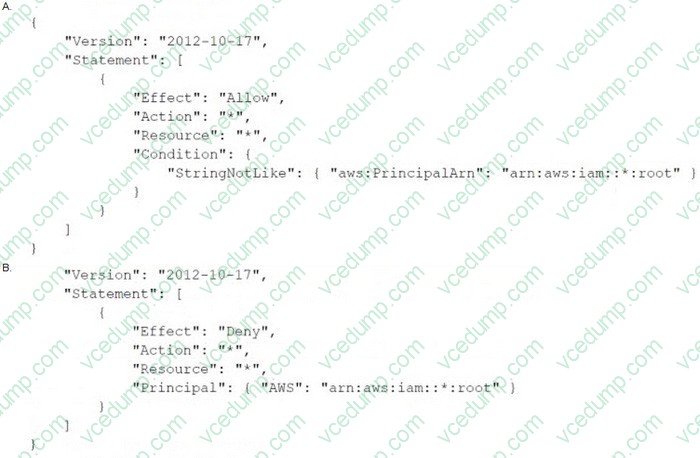
A. Option A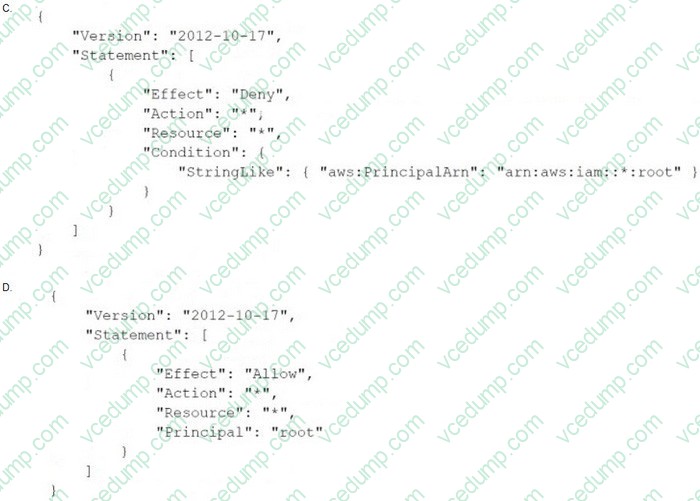
B. Option B
C. Option C
D. Option D -
Question 314:
A DevOps team manages infrastructure for an application. The application uses long- running processes to process items from an Amazon Simple Queue Service (Amazon SQS) queue. The application is deployed to an Auto Scaling group.
The application recently experienced an issue where items were taking significantly longer to process. The queue exceeded the expected size, which prevented various business processes from functioning properly. The application records all logs to a third-party tool.
The team is currently subscribed to an Amazon Simple Notification Service (Amazon SNS) topic that the team uses for alerts. The team needs to be alerted if the queue exceeds the expected size.
Which solution will meet these requirements with the MOST operational efficiency?
A. Create an Amazon CloudWatch metric alarm with a period of 1 hour and a static threshold to alarm if the average of the ApproximateNumberOfMessagesDelayed metric is greater than the expected value. Configure the alarm to notify the SNS topic.
B. Create an Amazon CloudWatch metric alarm with a period of 1 hour and a static threshold to alarm if the sum of the ApproximateNumberOfMessagesVisible metric is greater than the expected value. Configure the alarm to notify the SNS topic.
C. Create an AWS Lambda function that retrieves the ApproximateNumberOfMessages SQS queue attribute value and publishes it as a new CloudWatch custom metric. Create an Amazon EventBridge rule that is scheduled to run every 5 minutes and that invokes the Lambda function. Configure a CloudWatch metrics alarm with a period of 1 hour and a static threshold to alarm if the sum of the new custom metric is greater than the expected value.
D. Create an AWS Lambda function that checks the ApproximateNumberOfMessagesDelayed SQS queue attribute and compares the value to a defined expected size in the function. Create an Amazon EventBridge rule that is scheduled to run every 5 minutes and that invokes the Lambda function. When the ApproximateNumberOfMessagesDelayed SQS queue attribute exceeds the expected size, send a notification the SNS topic. -
Question 315:
A company is developing a new application. The application uses AWS Lambda functions for its compute tier. The company must use a canary deployment for any changes to the Lambda functions. Automated rollback must occur if any failures are reported. The company's DevOps team needs to create the infrastructure as code (IaC) and the CI/CD pipeline for this solution.
Which combination of steps will meet these requirements? (Choose three.)
A. Create an AWS CloudFormation template for the application. Define each Lambda function in the template by using the AWS::Lambda::Function resource type. In the template, include a version for the Lambda function by using the AWS::Lambda::Version resource type. Declare the CodeSha256 property. Configure an AWS::Lambda::Alias resource that references the latest version of the Lambda function.
B. Create an AWS Serverless Application Model (AWS SAM) template for the application. Define each Lambda function in the template by using the AWS::Serverless::Function resource type. For each function, include configurations for the AutoPublishAlias property and the DeploymentPreference property. Configure the deployment configuration type to LambdaCanary10Percent10Minutes.
C. Create an AWS CodeCommit repository. Create an AWS CodePipeline pipeline. Use the CodeCommit repository in a new source stage that starts the pipeline. Create an AWS CodeBuild project to deploy the AWS Serverless Application Model (AWS SAM) template. Upload the template and source code to the CodeCommit repository. In the CodeCommit repository, create a buildspec.yml file that includes the commands to build and deploy the SAM application.
D. Create an AWS CodeCommit repository. Create an AWS CodePipeline pipeline. Use the CodeCommit repository in a new source stage that starts the pipeline. Create an AWS CodeDeploy deployment group that is configured for canary deployments with a DeploymentPreference type of Canary10Percent10Minutes. Upload the AWS CloudFormation template and source code to the CodeCommit repository. In the CodeCommit repository, create an appspec.yml file that includes the commands to deploy the CloudFormation template.
E. Create an Amazon CloudWatch composite alarm for all the Lambda functions. Configure an evaluation period and dimensions for Lambda. Configure the alarm to enter the ALARM state if any errors are detected or if there is insufficient data.
F. Create an Amazon CloudWatch alarm for each Lambda function. Configure the alarms to enter the ALARM state if any errors are detected. Configure an evaluation period, dimensions for each Lambda function and version, and the namespace as AWS/Lambda on the Errors metric. -
Question 316:
A company uses an organization in AWS Organizations to manage its AWS accounts. The company's DevOps team has developed an AWS Lambda function that calls the Organizations API to create new AWS accounts.
The Lambda function runs in the organization's management account. The DevOps team needs to move the Lambda function from the management account to a dedicated AWS account. The DevOps team must ensure that the Lambda function has the ability to create new AWS accounts only in Organizations before the team deploys the Lambda function to the new account.
Which solution will meet these requirements?
A. In the management account, create a new IAM role that has the necessary permission to create new accounts in Organizations. Allow the role to be assumed by the Lambda execution role in the new AWS account. Update the Lambda function code to assume the role when the Lambda function creates new AWS accounts. Update the Lambda execution role to ensure that it has permission to assume the new role.
B. In the management account, turn on delegated administration for Organizations. Create a new delegation policy that grants the new AWS account permission to create new AWS accounts in Organizations. Ensure that the Lambda execution role has the organizations:CreateAccount permission.
C. In the management account, create a new IAM role that has the necessary permission to create new accounts in Organizations. Allow the role to be assumed by the Lambda service principal. Update the Lambda function code to assume the role when the Lambda function creates new AWS accounts. Update the Lambda execution role to ensure that it has permission to assume the new role.
D. In the management account, enable AWS Control Tower. Turn on delegated administration for AWS Control Tower. Create a resource policy that allows the new AWS account to create new AWS accounts in AWS Control Tower. Update the Lambda function code to use the AWS Control Tower API in the new AWS account. Ensure that the Lambda execution role has the controltower:CreateManagedAccount permission. -
Question 317:
A company wants to set up a continuous delivery pipeline. The company stores application code in a private GitHub repository. The company needs to deploy the application components to Amazon Elastic Container Service (Amazon ECS). Amazon EC2, and AWS Lambda. The pipeline must support manual approval actions.
Which solution will meet these requirements?
A. Use AWS CodePipeline with Amazon ECS. Amazon EC2, and Lambda as deploy providers.
B. Use AWS CodePipeline with AWS CodeDeploy as the deploy provider.
C. Use AWS CodePipeline with AWS Elastic Beanstalk as the deploy provider.
D. Use AWS CodeDeploy with GitHub integration to deploy the application. -
Question 318:
A company recently launched multiple applications that use Application Load Balancers. Application response time often slows down when the applications experience problems A DevOps engineer needs to Implement a monitoring solution that alerts the company when the applications begin to perform slowly The DevOps engineer creates an Amazon Simple Notification Semce (Amazon SNS) topic and subscribe the company's email address to the topic
What should the DevOps engineer do next to meet the requirements?
A. Create an Amazon EventBridge rule that invokes an AWS Lambda function to query the applications on a 5-minute interval Configure the Lambda function to publish a notification to the SNS topic when the applications return errors.
B. Create an Amazon CloudWatch Synthetics canary that runs a custom script to query the applications on a 5-minute interval. Configure the canary to use the SNS topic when the applications return errors.
C. Create an Amazon CloudWatch alarm that uses the AWS/AppljcabonELB namespace RequestCountPerTarget metric Configure the CloudWatch alarm to send a notification when the number of connections becomes greater than the configured number of threads that the application supports Configure the CloudWatch alarm to use the SNS topic.
D. Create an Amazon CloudWatch alarm that uses the AWS/ApplicationELB namespace RequestCountPerTarget metric Configure the CloudWatch alarm to send a notification when the average response time becomes greater than the longest response time that the application supports Configure the CloudWatch alarm to use the SNS topic -
Question 319:
A DevOps engineer is researching the least expensive way to implement an image batch processing cluster on AWS. The application cannot run in Docker containers and must run on Amazon EC2. The batch job stores checkpoint data on an NFS volume and can tolerate interruptions. Configuring the cluster software from a generic EC2 Linux image takes 30 minutes.
What is the MOST cost-effective solution?
A. Use Amazon EFS for checkpoint data. To complete the job, use an EC2 Auto Scaling group and an On-Demand pricing model to provision EC2 instances temporarily.
B. Use GlusterFS on EC2 instances for checkpoint data. To run the batch job, configure EC2 instances manually. When the job completes, shut down the instances manually.
C. Use Amazon EFS for checkpoint data. Use EC2 Fleet to launch EC2 Spot Instances, and utilize user data to configure the EC2 Linux instance on startup.
D. Use Amazon EFS for checkpoint data. Use EC2 Fleet to launch EC2 Spot Instances. Create a custom AMI for the cluster and use the latest AMI when creating instances. -
Question 320:
A company has developed an AWS Lambda function that handles orders received through an API. The company is using AWS CodeDeploy to deploy the Lambda function as the final stage of a CI/CD pipeline. A DevOps engineer has noticed there are intermittent failures of the ordering API for a few seconds after deployment. After some investigation the DevOps engineer believes the failures are due to database changes not having fully propagated before the Lambda function is invoked
How should the DevOps engineer overcome this?
A. Add a BeforeAllowTraffic hook to the AppSpec file that tests and waits for any necessary database changes before traffic can flow to the new version of the Lambda function.
B. Add an AfterAlIowTraffic hook to the AppSpec file that forces traffic to wait for any pending database changes before allowing the new version of the Lambda function to respond.
C. Add a BeforeAllowTraffic hook to the AppSpec file that tests and waits for any necessary database changes before deploying the new version of the Lambda function.
D. Add a validateService hook to the AppSpec file that inspects incoming traffic and rejects the payload if dependent services such as the database are not yet ready.
Related Exams:
-
AIF-C01
Amazon AWS Certified AI Practitioner (AIF-C01) -
AIP-C01
AWS Certified Generative AI Developer - Professional -
ANS-C00
AWS Certified Advanced Networking - Specialty (ANS-C00) -
ANS-C01
AWS Certified Advanced Networking - Specialty (ANS-C01) -
AXS-C01
AWS Certified Alexa Skill Builder - Specialty (AXS-C01) -
BDS-C00
AWS Certified Big Data - Speciality (BDS-C00) -
CLF-C02
AWS Certified Cloud Practitioner (CLF-C02) -
DAS-C01
AWS Certified Data Analytics - Specialty (DAS-C01) -
DATA-ENGINEER-ASSOCIATE
AWS Certified Data Engineer - Associate (DEA-C01) -
DBS-C01
AWS Certified Database - Specialty (DBS-C01)
Tips on How to Prepare for the Exams
Nowadays, the certification exams become more and more important and required by more and more enterprises when applying for a job. But how to prepare for the exam effectively? How to prepare for the exam in a short time with less efforts? How to get a ideal result and how to find the most reliable resources? Here on Vcedump.com, you will find all the answers. Vcedump.com provide not only Amazon exam questions, answers and explanations but also complete assistance on your exam preparation and certification application. If you are confused on your DOP-C02 exam preparations and Amazon certification application, do not hesitate to visit our Vcedump.com to find your solutions here.