CFA-LEVEL-1 Exam Details
-
Exam Code
:CFA-LEVEL-1 -
Exam Name
:CFA Level I - Chartered Financial Analyst -
Certification
:CFA Institute Certifications -
Vendor
:CFA Institute -
Total Questions
:3960 Q&As -
Last Updated
:Jun 04, 2026
CFA Institute CFA-LEVEL-1 Online Questions & Answers
-
Question 3481:
Past experience of a large manufacturing firm with administering a test to recent college graduates who had applied for a job revealed that the mean test score was 500, and the standard deviation was 50. The distribution of the test scores was normal. Based on this experience, management is considering placing a person whose scores is in the upper 6 percent of the distribution directly into a responsible position. What is the lowest score a college graduate must earn to qualify for a responsible position?
A. None of these answers
B. 460
C. 625
D. 578
E. 50 -
Question 3482:
Which of the following companies has the highest degree of financial leverage? Choose the best answer. Firm A EBIT: $10,000,000 Interest Paid: $750,000 Total Operating Expenses: $25,000,000 Fixed Operating Expenses: $19,750,000 Firm B EBIT: $8,970,000 Interest Paid: $88,000 Total Operating Expenses: $20,050,000 Fixed Operating Expenses: $17,000,000 Firm C EBIT: $10,500,000 Interest Paid: $1,050,000 Total Operating Expenses: $50,000,000 Fixed Operating Expenses: $35,000,000 Firm D EBIT: $10,000,000 Interest Paid: $750,000 Total Operating Expenses: $50,000,000 Fixed Operating Expenses: $41,000,000 Firm E EBIT: $5,195,000 Interest Paid: $400,000 Total Operating Expenses: $35,000,000 Fixed Operating Expenses: $9,875,000
A. Firm A
B. Firm E
C. Firm B
D. Firm C
E. Firm D
F. Firm A and D have identical DFL's -
Question 3483:
Clay Industries, a large industrial firm, is examining its capital structure. The firm is financed according to the following schedule based on market values:
50% debt
40% common stock
10% perpetual preferred stock
Additionally, consider the following information:
Yield on outstanding debt: 8.50%
Tax rate: 35%
Annual preferred dividend: $2. 55
Preferred stock price: $25. 97
Return on equity: 16. 75%
Dividend payout ratio: 50%
Cost of common stock: 14. 25%
Using this information, what is the Weighted Average Cost of Capital for Clay Industries?
A. 8.97%
B. 9.37%
C. 9.45%
D. 9.25%
E. 9.37%
F. None of these answers -
Question 3484:
The accumulated depreciation account should show
A. total depreciation for fixed assets since the business was formed
B. current depreciation expense plus estimated depreciation for next year
C. total depreciation for fixed assets still in use
D. only the depreciation expense recognized during the current year -
Question 3485:
The probability that events A and B do not occur simultaneously equals 0.77. The probability of neither A nor B occurring equals 0.38. If P(A) equals 0.26, the probability of B occurring equals ________.
A. 0.43
B. 0.59
C. 0.62
D. 0.21 -
Question 3486:
If you deposit $5,000 into an account paying 9% per year, compounded monthly, how much do you have in the account in 10 years?
A. $5,403. 52
B. $12,001.66
C. $9,116. 87
D. $2,039.69
E. $12,256. 79 -
Question 3487:
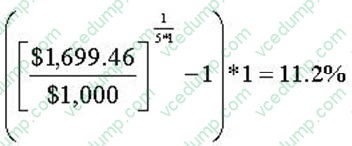
An investor buys a 15-year, 10 percent annual pay coupon bond for $1,000. He plans to hold the bond for 5 years while reinvesting the coupons at 12 percent. At the end of the 5-year period he feels he can sell the bond to yield 9 percent. What is the expected realized (horizon) yield?
A. 10.0%.
B. 11.8%.
C. 11.2%.
D. 12. 2%. -
Question 3488:
Vanderheiden Inc. is considering two average-risk alternative ways of producing its patented polo shirts. Process S has a cost of $8,000 and will produce net cash flows of $5,000 per year for 2 years. Process L will cost $11,500 and will produce cash flows of $4,000 per year for 4 years. The company has a contract that requires it to produce the shirts for 4 years, but the patent will expire after 4 years, so the shirts will not be produced after 4 years. Inflation is expected to be zero during the next 4 years. If cash inflows occur at the end of each year, and if Vanderheiden's cost of capital is 10 percent, by what amount will the better project increase Vanderheiden's value?
A. $1,179.46
B. $1,237. 76
C. $677. 69
D. $1,312. 31
E. $1,098.89 -
Question 3489:
An increase in the tax rate ________ the optimal debt-to-equity ratio. It ________ the after-tax cost of debt. Assume all else equal.
A. this answer cannot be generated because "tax" is not a factor in the optimal debt-to-equity ratio
B. increases; increases
C. this answer cannot be generated because "tax" is not a factor in after-tax cost of debt
D. decreases; increases
E. increases; decreases
F. decreases; decreases -
Question 3490:
When merchandise inventory is purchased under a periodic system, which account is debited?
A. Accounts Payable
B. Cash
C. Merchandise Inventory
D. Purchases

Tips on How to Prepare for the Exams
Nowadays, the certification exams become more and more important and required by more and more enterprises when applying for a job. But how to prepare for the exam effectively? How to prepare for the exam in a short time with less efforts? How to get a ideal result and how to find the most reliable resources? Here on Vcedump.com, you will find all the answers. Vcedump.com provide not only CFA Institute exam questions, answers and explanations but also complete assistance on your exam preparation and certification application. If you are confused on your CFA-LEVEL-1 exam preparations and CFA Institute certification application, do not hesitate to visit our Vcedump.com to find your solutions here.