312-50V12 Exam Details
-
Exam Code
:312-50V12 -
Exam Name
:EC-Council Certified Ethical Hacker (C|EH v12) -
Certification
:EC-COUNCIL Certifications -
Vendor
:EC-COUNCIL -
Total Questions
:596 Q&As -
Last Updated
:May 30, 2026
EC-COUNCIL 312-50V12 Online Questions & Answers
-
Question 181:
George, an employee of an organization, is attempting to access restricted websites from an official computer. For this purpose, he used an anonymizer that masked his real IP address and ensured complete and continuous anonymity for all
his online activities.
Which of the following anonymizers helps George hide his activities?
A. https://www.baidu.com
B. https://www.guardster.com
C. https://www.wolframalpha.com
D. https://karmadecay.com -
Question 182:
Attacker Simon targeted the communication network of an organization and disabled the security controls of NetNTLMvl by modifying the values of LMCompatibilityLevel, NTLMMinClientSec, and RestrictSendingNTLMTraffic. He then extracted all the non- network logon tokens from all the active processes to masquerade as a legitimate user to launch further attacks. What is the type of attack performed by Simon?
A. Internal monologue attack
B. Combinator attack
C. Rainbow table attack
D. Dictionary attack -
Question 183:
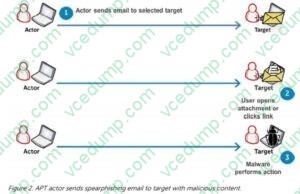
Harry, a professional hacker, targets the IT infrastructure of an organization. After preparing for the attack, he attempts to enter the target network using techniques such as sending spear-phishing emails and exploiting vulnerabilities on publicly available servers. Using these techniques, he successfully deployed malware on the target system to establish an outbound connection. What is the APT lifecycle phase that Harry is currently executing?
A. Preparation
B. Cleanup
C. Persistence
D. initial intrusion -
Question 184:
What is the following command used for? net use \targetipc$ "" /u:""
A. Grabbing the etc/passwd file
B. Grabbing the SAM
C. Connecting to a Linux computer through Samba.
D. This command is used to connect as a null session
E. Enumeration of Cisco routers -
Question 185:
You need to deploy a new web-based software package for your organization. The package requires three separate servers and needs to be available on the Internet. What is the recommended architecture in terms of server placement?
A. All three servers need to be placed internally
B. A web server facing the Internet, an application server on the internal network, a database server on the internal network
C. A web server and the database server facing the Internet, an application server on the internal network
D. All three servers need to face the Internet so that they can communicate between themselves -
Question 186:
Which of the following is a passive wireless packet analyzer that works on Linux-based systems?
A. Burp Suite
B. OpenVAS
C. tshark
D. Kismet -
Question 187:
Which of the following tools is used to detect wireless LANs using the 802.11a/b/g/n WLAN standards on a linux platform?
A. Kismet
B. Abel
C. Netstumbler
D. Nessus -
Question 188:
When you are testing a web application, it is very useful to employ a proxy tool to save every request and response. You can manually test every request and analyze the response to find vulnerabilities. You can test parameter and headers
manually to get more precise results than if using web vulnerability scanners.
What proxy tool will help you find web vulnerabilities?
A. Maskgen
B. Dimitry
C. Burpsuite
D. Proxychains -
Question 189:
An attacker scans a host with the below command. Which three flags are set?
# nmap -sX host.domain.com
A. This is SYN scan. SYN flag is set.
B. This is Xmas scan. URG, PUSH and FIN are set.
C. This is ACK scan. ACK flag is set.
D. This is Xmas scan. SYN and ACK flags are set. -
Question 190:
John, a security analyst working for an organization, found a critical vulnerability on the organization's LAN that allows him to view financial and personal information about the rest of the employees. Before reporting the vulnerability, he examines the information shown by the vulnerability for two days without disclosing any information to third parties or other internal employees. He does so out of curiosity about the other employees and may take advantage of this information later. What would John be considered as?
A. Cybercriminal
B. Black hat
C. White hat
D. Gray hat
Related Exams:
-
112-51
EC-Council Certified Network Defense Essentials (NDE) -
212-055
Sun Certified Programmer for the Java 2 Platform.SE 5.0 -
212-77
EC-Council Certified Linux Security -
212-81
EC-Council Certified Encryption Specialist (ECES) -
212-82
EC-Council Certified Cybersecurity Technician (C|CT) -
212-89
EC Council Certified Incident Handler (ECIH v3) -
312-38
EC-Council Certified Network Defender (CND) -
312-39
EC-Council Certified SOC Analyst (CSA) -
312-40
EC-Council Certified Cloud Security Engineer (CCSE) -
312-49
ECCouncil Computer Hacking Forensic Investigator (V9)
Tips on How to Prepare for the Exams
Nowadays, the certification exams become more and more important and required by more and more enterprises when applying for a job. But how to prepare for the exam effectively? How to prepare for the exam in a short time with less efforts? How to get a ideal result and how to find the most reliable resources? Here on Vcedump.com, you will find all the answers. Vcedump.com provide not only EC-COUNCIL exam questions, answers and explanations but also complete assistance on your exam preparation and certification application. If you are confused on your 312-50V12 exam preparations and EC-COUNCIL certification application, do not hesitate to visit our Vcedump.com to find your solutions here.