156-215.81.20 Exam Details
-
Exam Code
:156-215.81.20 -
Exam Name
:Check Point Certified Security Administrator - R81.20 (CCSA) -
Certification
:Checkpoint Certifications -
Vendor
:CheckPoint -
Total Questions
:677 Q&As -
Last Updated
:May 26, 2026
CheckPoint 156-215.81.20 Online Questions & Answers
-
Question 511:
A Cleanup rule:
A. logs connections that would otherwise be dropped without logging by default.
B. drops packets without logging connections that would otherwise be dropped and logged by default.
C. logs connections that would otherwise be accepted without logging by default.
D. drops packets without logging connections that would otherwise be accepted and logged by default. -
Question 512:
Fill in the blank: Once a certificate is revoked from the Security Gateway by the Security Management Server, the certificate information is _____.
A. Stored on the Security Management Server.
B. Stored on the Certificate Revocation List.
C. Sent to the Internal Certificate Authority.
D. Sent to the Security Administrator. -
Question 513:
When a packet arrives at the gateway, the gateway checks it against the rules in the top Policy Layer, sequentially from top to bottom, and enforces the first rule that matches a packet. Which of the following statements about the order of rule enforcement is true?
A. If the Action is Accept, the gateway allows the packet to pass through the gateway.
B. If the Action is Drop, the gateway continues to check rules in the next Policy Layer down.
C. If the Action is Accept, the gateway continues to check rules in the next Policy Layer down.
D. If the Action is Drop, the gateway applies the Implicit Clean-up Rule for that Policy Layer. -
Question 514:
Which of the following is NOT a type of Endpoint Identity Agent?
A. Terminal
B. Light
C. Full
D. Custom -
Question 515:
Vanessa is firewall administrator in her company; her company is using Check Point firewalls on central and remote locations, which are managed centrally by R80 Security Management Server. One central location has an installed R77.30 Gateway on Open server. Remote location is using Check Point UTM-1 570 series appliance with R71. Which encryption is used in Secure Internal Communication (SIC) between central management and firewall on each location?
A. On central firewall AES128 encryption is used for SIC, on Remote firewall 3DES encryption is used for SIC.
B. On both firewalls, the same encryption is used for SIC. This is AES-GCM-256.
C. The Firewall Administrator can choose which encryption suite will be used by SIC.
D. On central firewall AES256 encryption is used for SIC, on Remote firewall AES128 encryption is used for SIC. -
Question 516:
The CDT utility supports which of the following?
A. Major version upgrades to R77.30
B. Only Jumbo HFA's and hotfixes
C. Only major version upgrades to R80.10
D. All upgrades -
Question 517:
Which of the following is NOT a tracking option? (Select three)
A. Partial log
B. Log
C. Network log
D. Full log -
Question 518:
Fill in the blank: The R80 feature ________ permits blocking specific IP addresses for a specified time period.
A. Block Port Overflow
B. Local Interface Spoofing
C. Suspicious Activity Monitoring
D. Adaptive Threat Prevention -
Question 519:
Tina is a new administrator who is currently reviewing the new Check Point R80 Management console interface. In the Gateways view, she is reviewing the Summary screen as in the screenshot below. What as an 'Open Server'?
A. Check Point software deployed on a non-Check Point appliance.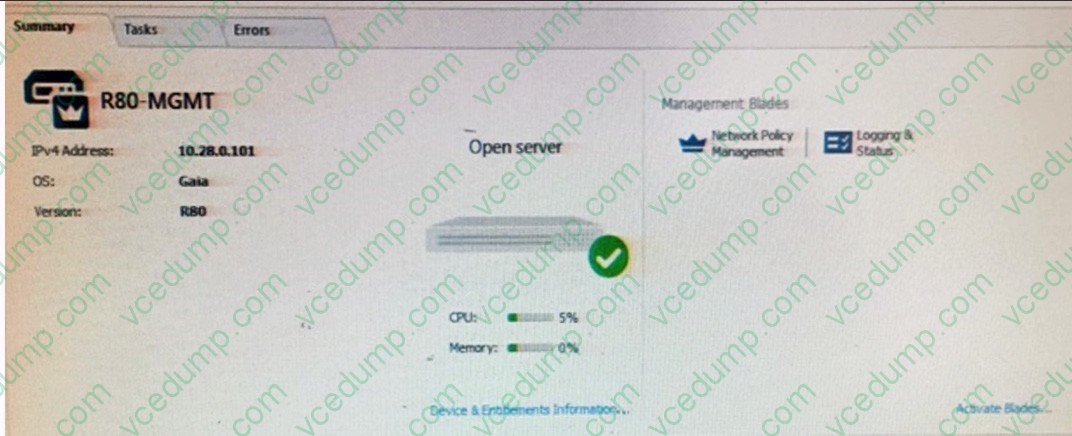
B. The Open Server Consortium approved Server Hardware used for the purpose of Security and Availability.
C. A check Point Management Server deployed using the Open Systems Interconnection (OSI) Server and Security deployment model.
D. A check Point Management Server software using the Open SSL. -
Question 520:
Rugged appliances are small appliances with ruggedized hardware and like Quantum Spark appliance they use which operating system?
A. Gaia iOS
B. Red Hat Enterprise Linux version 4
C. Centos Unix
D. Gaia embedded

Related Exams:
-
156-110
Check Point Certified Security Principles Associate (CCSPA) -
156-115.80
Check Point Certified Security Master - R80 -
156-215
Check Point Security Administration NGX -
156-215.1
Check Point Certified Security Administrator NGX -
156-215.70
Check Point Certified Security Administrator R70 -
156-215.71
Check Point Certified Security Administrator R71 -
156-215.75
Check Point Certified Security Administrator -
156-215.80
Check Point Certified Security Administrator (CCSA) -
156-215.81
Check Point Certified Security Administrator - R81 (CCSA) -
156-215.81.20
Check Point Certified Security Administrator - R81.20 (CCSA)
Tips on How to Prepare for the Exams
Nowadays, the certification exams become more and more important and required by more and more enterprises when applying for a job. But how to prepare for the exam effectively? How to prepare for the exam in a short time with less efforts? How to get a ideal result and how to find the most reliable resources? Here on Vcedump.com, you will find all the answers. Vcedump.com provide not only CheckPoint exam questions, answers and explanations but also complete assistance on your exam preparation and certification application. If you are confused on your 156-215.81.20 exam preparations and CheckPoint certification application, do not hesitate to visit our Vcedump.com to find your solutions here.