A user attempts to create a quorum disk for a host cluster. Volume parameters are: Size = 1000 kB
Name 1MB_Vol However, the volume creation fails. What caused the process to fail?
-
A
Quorum disks cannot have an 8kB block size
-
B
-
C
-
D
XtremIO volumes cannot be quorum disks
Reveal answer details
Close answer details
Correct answerB
ExplanationThe volume size must be specified in MB, GB, TB, and not in KB. Incorrect Answers:
D: Quorum disks on XtremIO
The SAN Volume Controller cluster will select disks that are presented by the XtremIO storage system as quorum disks. To maintain availability for the cluster, ideally each quorum disk should reside on a separate disk subsystem. The quorum device can be any disk device that is shared between two or more nodes. EMC Symmetrix, VNX series, or XtremIO devices are commonly used for this purpose. References:
https://vcdx133.com/2014/09/14/emc-xtremio-provisioning-a-lun/
You need to design an Oracle solution for a customer. Which XtremIO best practices should be used in Oracle environments?
-
A
Use a 512 byte LUN sector size for databases. Use Eager Zeroed Thick formatting for ESXi
-
B
Use a 4 kB LUN sector size for databases. Use Lazy Zeroed Thick formatting for ESXi
-
C
Align data on 4 kB boundaries. Use Thin formatting on ESXi
-
D
Align data on 4 kB boundaries. Use Lazy Zeroed Thick formatting on ESXi
Reveal answer details
Close answer details
Correct answerA
ExplanationThe default setting for XtremIO volumes is 512e. It is recommended not to alter this in order to use 4K
Advanced Format for Oracle Database deployments. There are no performance ramifications when using 512e volumes in conjunction with an Oracle database. On the contrary, 4K Advanced Format is rejected by many elements of the Oracle and Linux operating system stack. References:
https://www.emc.com/collateral/white-papers/h13497-oracle-best-practices-xtremio-wp.pdf,
page 20
A customer has an existing Oracle environment they are considering moving over to XtremIO from VMAX for improved performance. The customer wants to know the expected deduplication and compression savings they can achieve with XtremIO. Which tool is appropriate for conducting this assessment?
-
A
-
B
-
C
-
D
Reveal answer details
Close answer details
Correct answerD
ExplanationMiTrend has been available for EMC Employees and Partners for years, but it's a valuable tool that Customers can take advantage of also. And the price is awesome. It's FREE ! Use it for VNX, Clariion, VMAX, and many more. References:
http://www.pragmaticio.com/2014/11/mitrend-self-service-performance-analysis-for-emc-vnx/
What are common storage array mechanisms?
-
A
-
B
Post-processing and metadata logging
-
C
RAID and metadata log structuring
-
D
Metadata logging and RAID
Reveal answer details
Close answer details
Correct answerB
ExplanationXtremIO's snapshot technology is implemented by leveraging the content-aware capabilities of the system (Inline Data Reduction), optimized for SSD media, with a unique metadata tree structure. XtremIO leverages a proprietary flash-optimized data protection algorithm (XtremIO Data Protection or XDP), which provides performance that is superior to any existing RAID algorithm. References:
Introduction to the EMC XtremIO STORAGE ARRAY (April 2015), page 33
A customer is considering XtremIO storage for their current Virtual Desktop Infrastructure (VDI) deployment. The customer wants information on the benefits of an XtremIO solution. What are the benefits of an XtremIO solution for this environment?
-
A
Latency is less than 1 ms for all large I/O sizes, deduplication with compression, and scales linearly
-
B
Latency is less than 1 ms for large I/O sizes, deduplication and compression, and no reduction in power and cooling costs
-
C
Latency is less than 1 ms for small I/O sizes, scales linearly, and slightly higher cost/IOP/GB than hybrid arrays
-
D
Latency is less than 1 ms for small I/O sizes, deduplication and compression, and scales linearly
Reveal answer details
Close answer details
Correct answerA
ExplanationStorage capacity and performance scale linearly, such that two X-Bricks supply twice the IOPS, four X-
Bricks supply four times the IOPS, six X-Bricks supply six times the IOPS and eight X-Bricks supply eight times the IOPS of the single X- Brick configuration. However, the latency remains consistently low (less than 1ms) as the system scales out. The sub-millisecond latency is validated by actual test results, and is determined according to the worst-case scenario. References:
Introduction to the EMC XtremIO STORAGE ARRAY (April 2015), page 37
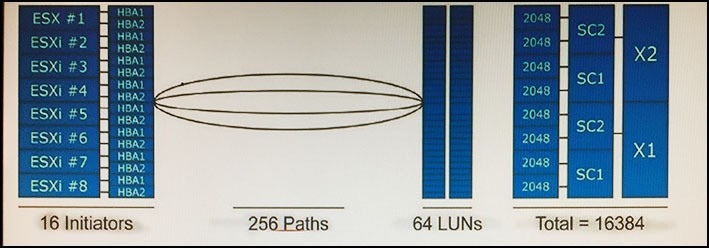 As shown in the exhibit, a customer's environment is configured as follows: Dual X-Brick cluster 8 ESXi hosts with 2 HBAs Each ESXi hosts has 8 LUNs Each LUN is visible through 4 paths What should be the host queue depth setting per path?
-
A
-
B
-
C
-
D
Reveal answer details
Close answer details
Correct answerC
ExplanationThe queue depth is per LUN, and not per initiator. Here there are 64 LUNs, each visible through 4 paths, which would indicate that 256 is a good choice for the queue depth setting. Note: As a general advice, for optimal operation with XtremIO storage, consider the following: Set the queue depth to 256. References:
https://www.emc.com/collateral/white-paper/h14583-wp-best-practice-sql-server-xtremio.pdf
A customer is interested in transitioning their traditional infrastructure to the Cloud by implementing ViPR software-defined storage in an XtremIO environment. Which capabilities will EMC ViPR software-defined storage provide to XtremIO?
-
A
Delivers SaaS
Centralized management and monitoring Chargeback and billing capabilities
-
B
Chargeback reporting capability
Centralizes reactive monitoring capability
Policy-driven configuration management
-
C
Automatically grows storage volumes
Slows growth of data Centralized auto-deletes of aging files
-
D
Creates virtual storage pools
Automates disaster recovery
Replaces chargeback capabilities
Reveal answer details
Close answer details
Correct answerA
ExplanationEMC ViPR Controller is a software-defined storage platform that abstracts, pools and automates a data center's underlying physical storage infrastructure. It provides data center administrators with a single control plane for heterogeneous storage systems. ViPR enables software-defined data centers by providing features including:
* Comprehensive and customizable platform reporting capabilities that include capacity metering, chargeback, and performance monitoring through the included ViPR SolutionPack References:
Introduction to the EMC XtremIO STORAGE ARRAY (April 2015), page 60
Which values are required to enter a generic workload into the XtremIO Sizing Tool?
-
A
Capacity, IOPs, R/W ratio
-
B
IOPs, I/O size, bandwidth
-
C
-
D
Bandwidth, I/O size, latency
Reveal answer details
Close answer details
Correct answerC
ExplanationIDC outlines a criteria some criteria for selecting a testing tool:
* Generate workloads
* Capture results for analysis:
Throughput
IOPS
Latency References:
http://emc.co/collateral/technical-documentation/h15280-euc-xendesktop-vsphere-xtremio-
sg.pdf, page 87 (http://info.xtremio.com/rs/xtremio/images/IDC_Flash_Array_Test_Guide.pdf,)
page 7
Question 9
Multiple choice
You have conducted a meeting with a company's Chief Technology Officer (CTO). The CTO wants an XtremIO solution to meet their business needs. The CTO wants you to review the proposed solution with their desktop administrator to identify any additional requirements. What are two key considerations to discuss with the desktop administrator?
-
A
Rapid desktop deployment and operational ease of use
-
B
Application response time and rapid boot times
-
C
Sufficient capacity and performance
-
D
Ease of management and ability to customize end-user desktops
Reveal answer details
Close answer details
Question 10
Single choice
What is considered typical performance for an XtremIO single X-Brick cluster?
-
A
Small block writes: 200k-250k IOPs. Large block reads: up to 2.5 GB/s
-
B
Small block writes: 200k-250k IOPs. Large block writes: up to 2.5 GB/s
-
C
Small block reads: 200k-250k IOPs. Large block writes: up to 2.5 GB/s
-
D
Small block reads: 200k-250k IOPs. Large block reads: up to 2.5 GB/s
Reveal answer details
Close answer details
Correct answerC
ExplanationChoose an EMC XtremIO system and scale out linearly by adding more XtremIO X-Bricks. 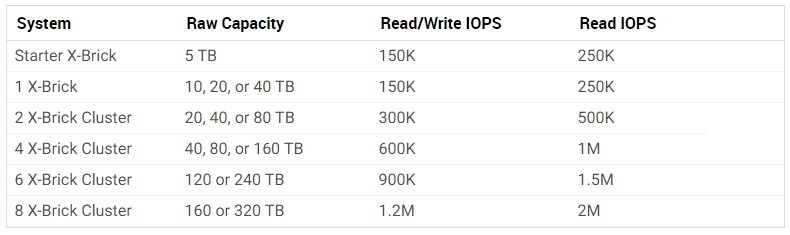 References:
https://store.emc.com/en-us/Product-Family/EMC-XtremIO-Products/EMC-XtremIO-All-Flash-Scale-Out-Array/p/EMC-XtremIO-Flash-Scale-Out
Question 11
Single choice
When using XtremIO storage with Solaris (SPARC), what is the EMC recommended I/O size that will deliver sequential I/O more efficiently to XtremIO?
-
A
-
B
-
C
-
D
Reveal answer details
Close answer details
Correct answerC
ExplanationEMC recommended setting for Solaris include that the /etc/system file be modified to include the following parameter:
* Set maximum IO size set maxphys = 0x400000
This also requires increase of the maximum I/O size for the disk driver. The corresponding entry and file for this change are different for different Solaris versions, as follows: For Solaris 10 (SPARC): File: /kernel/drv/ssd.conf Setting: ssd_max_xfer_size=0x400000; For Solaris 10 (x86):
File: /kernel/drv/sd.conf
Setting: sd_max_xfer_size=0x400000; Etc. References:
EMC Host Connectivity Guide for Oracle Solaris, page 167 (https://www.emc.com/collateral/TechnicalDocument/docu5132.pdf)
|