How should the control host be configured when using Enginuity Consistency Assist (ECA) for consistent activation of TimeFinder/Clone session?
-
A
PowerPath must be installed on the host
-
B
A dedicated channel to the gatekeeper devices
-
C
Access to only the source devices
-
D
Access to only the target devices
Reveal answer details
Close answer details
Correct answerB
ExplanationExplanation: 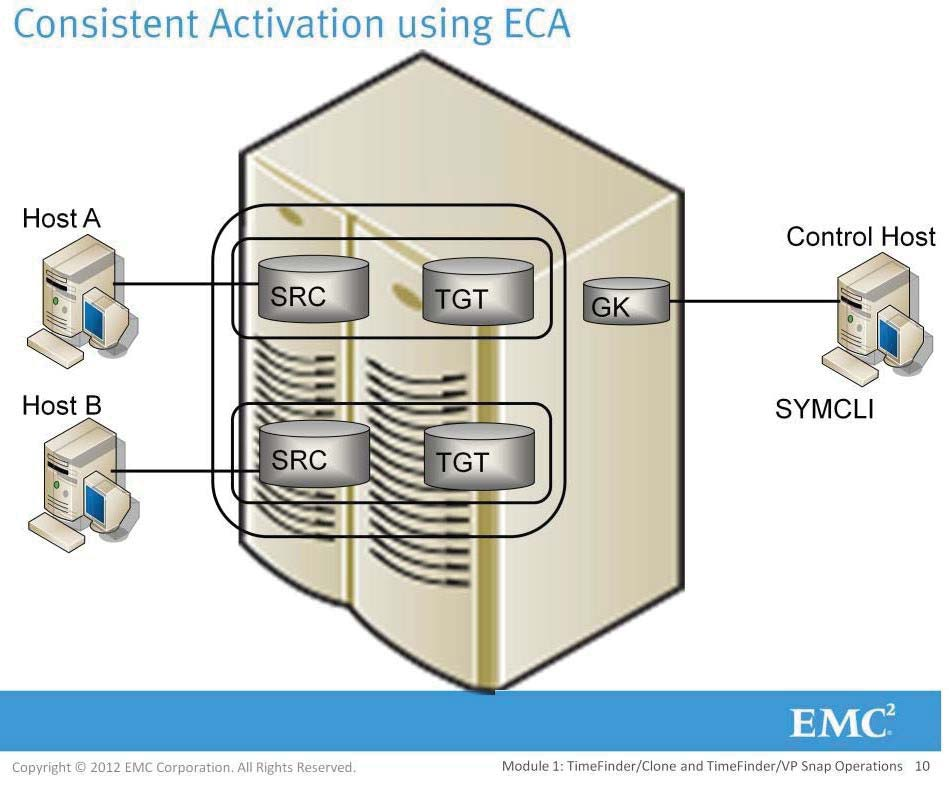 For consistent activation, there should be a control host with access to only Gatekeeper (GK) devices, or a separate HBA on the production host with access only to GKs and not data devices. This is to ensure that in write intensive environments SYMAPI will be able to freeze and then thaw I/O to the production devices within the ECA window, regardless of the number of outstanding I/Os held by the host HBA accessing the data devices.
BCM
What is suppressed when scripting SYMCU commands using the -nop option?
-
A
Confirmation questions to the command screen
-
B
Informational messages to the command screen
-
C
Error messages to the command screen
-
D
All outputs to the command screen
Reveal answer details
Close answer details
The storage on a Symmetrix VMAX is divided into four static tiers: - TierA contains RAID 5 (3+1) Enterprise Flash Drives (EFDs)
- TierB contains 2-Way-Mir 15K RPM Fibre Channel drives
- TierC contains RAID 5 (7+1) 10K RPM Fibre Channel drives
- TierD contains RAID 6 (6+2) SATA drives Which is a valid FAST policy?
-
A
10% TierA, 40% TierB, 20% TierC, 30% TierD
-
B
10% TierA, 50% TierB, 20% TierC
-
C
15% TierA, 50% TierB, 50% TierD
-
D
20% TierA, 30% TierB, 30% TierC, 30% TierD
Reveal answer details
Close answer details
Correct answerC
ExplanationExplanation: 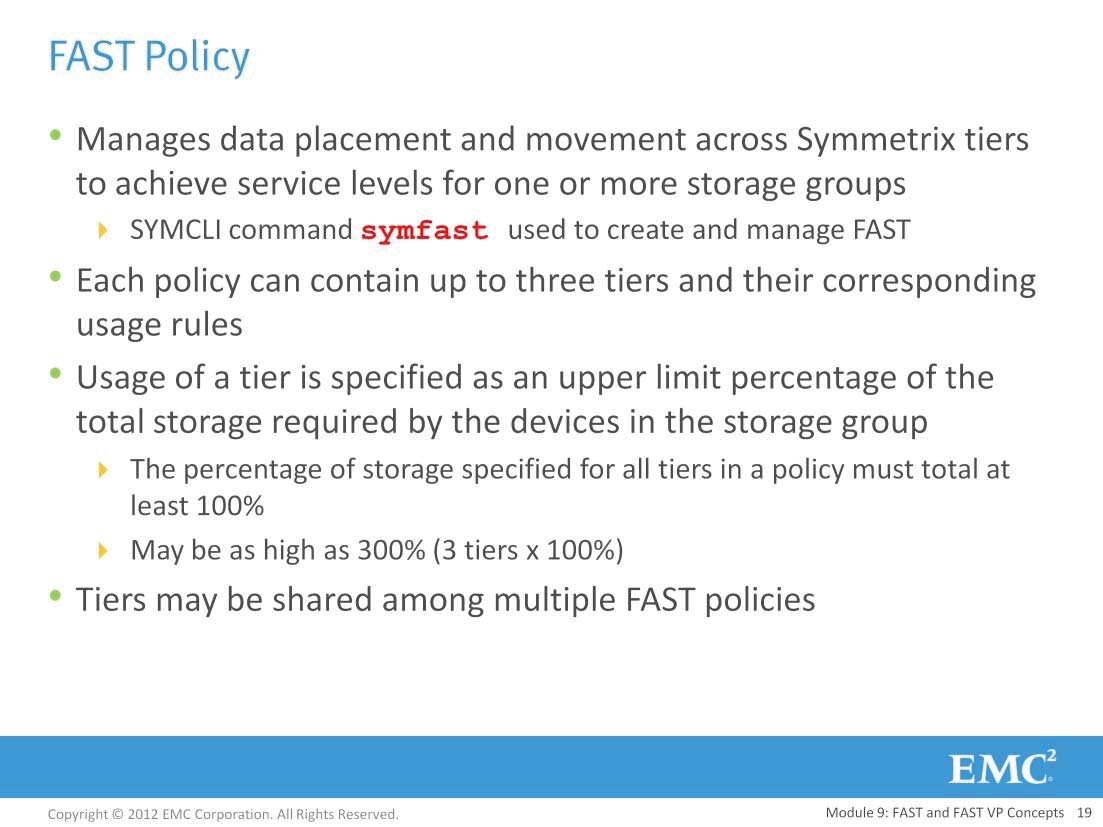 A FAST policy groups between one and three tiers and assigns an upper usage limit for each Symmetrix tier. The upper limit specifies how much capacity of a storage group associated with the policy can reside on that particular Symmetrix tier.
FAST policies may include storage tiers of only one type disk group provisioning (DP) or virtual provisioning (VP). The first tier added to a policy will determine the type of tiers that can subsequently be added. The usage limit for each tier must be between 1 percent and 100 percent. When combined, the upper usage limit for all thin storage tiers in the policy must total at least 100 percent, but may be greater than 100 percent. Creating a policy with a total upper usage limit greater than 100 percent allows flexibility with the configuration of a storage group whereby data may be moved between tiers without necessarily having to move a corresponding amount of other data within the same storage group. Multiple FAST policies may reuse the same tier, allowing different usage limits to be applied to different storage groups for the same tier.
A Symmetrix VMAX storage array will support up to 256 FAST policies. Each FAST policy name may be up to 32 alpha-numeric characters, hyphens (-), and underscores (_). Policy names are not case-sensitive.
Refer to the exhibit 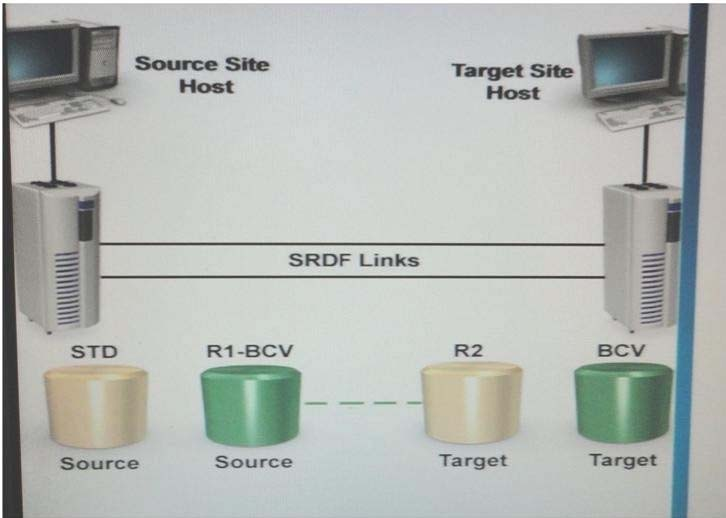 What is the correct state for the Standard and Rl-BCV prior to issuing a symreplicate start command?
-
A
-
B
-
C
-
D
Reveal answer details
Close answer details
Refer to the exhibit. 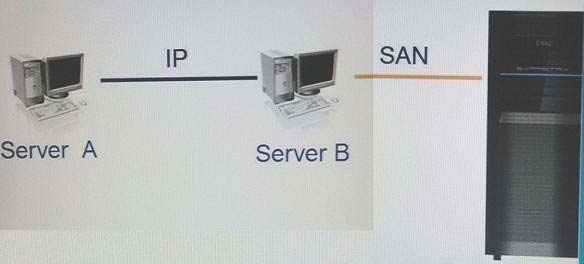 You are in the process of implementing Symmetrix Management Console in the configuration shown in the exhibit Server A can access Server B over an IP network, Server B has access to the Symmetrix array over the SAN. Which licenses key(s) should you implement on Server A?
-
A
-
B
Base, SMC, and SYMAPI server keys
-
C
Base and SYMAPI server keys
-
D
Reveal answer details
Close answer details
What is the maximum number of TimeFinder/Snap sessions that can be created from a single source?
-
A
-
B
-
C
-
D
Reveal answer details
Close answer details
You have been asked to create a configuration for a single engine Symmetric V-Max array with 8 DAEs and 64 drivers. They would like to have the data devices with RAID 5(7+1) protection. What would be the largest number of members you would recommend for a stripped metavolume?
-
A
-
B
-
C
-
D
Reveal answer details
Close answer details
A symclone create command is issued and the clone session has not yet been activated. The storage administrator wants to know the state of the clone target device. What would it be at this time?
-
A
-
B
-
C
-
D
Reveal answer details
Close answer details
Correct answerC
ExplanationExplanation: 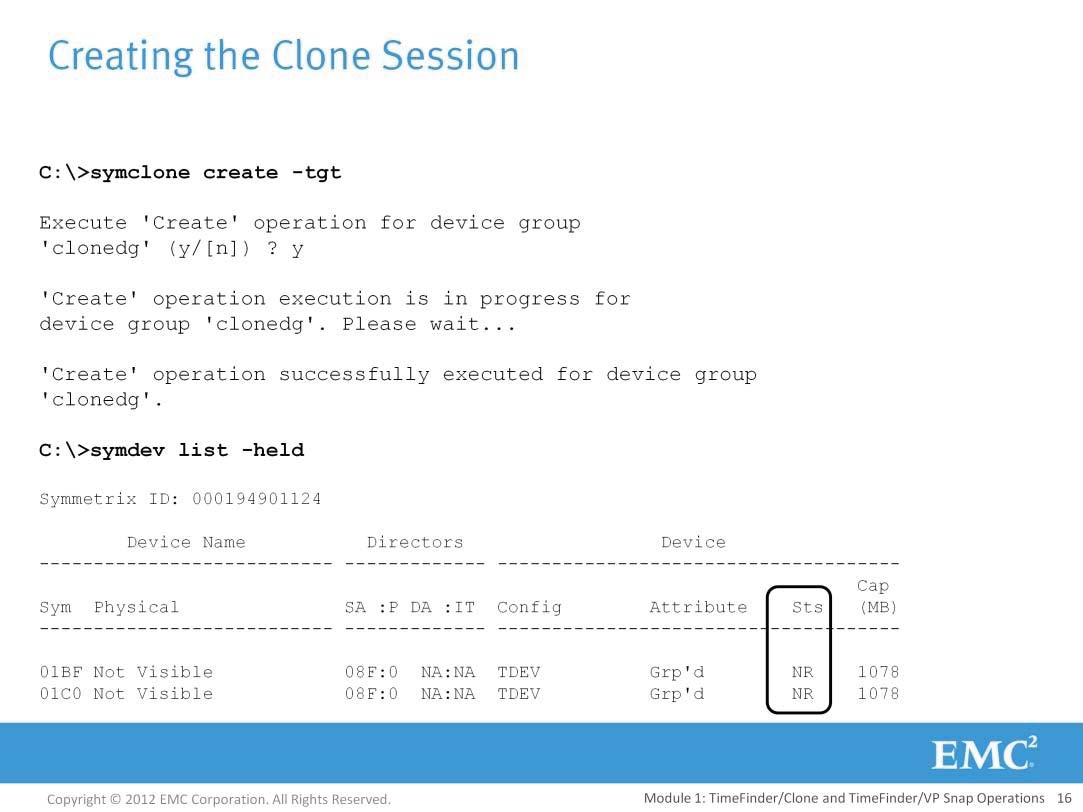 The symclone create action defines the clone copy session requirements and sets the track protection bitmap on the source device to detect which tracks are being accessed by the target host or written to by the source host. The target device is made Not Ready to its host and placed on hold status for clone copy session activity.
This prevents other control operations from using the device. The clone copy does not become accessible to its host until the copy session is activated. The output has been edited to fit the slide. Note that the target devices have been moved to a Not Ready state (NR) upon Clone session creation. They will be in a held state until the Clone session is terminated.
Which feature extends the cache space available for SRDF/A session cycles by off-loading some or all of its cycle data from cache to preconfigured disk storage?
-
A
Multi-Session Consistency
-
B
-
C
-
D
Reveal answer details
Close answer details
Correct answerC
ExplanationExplanation: 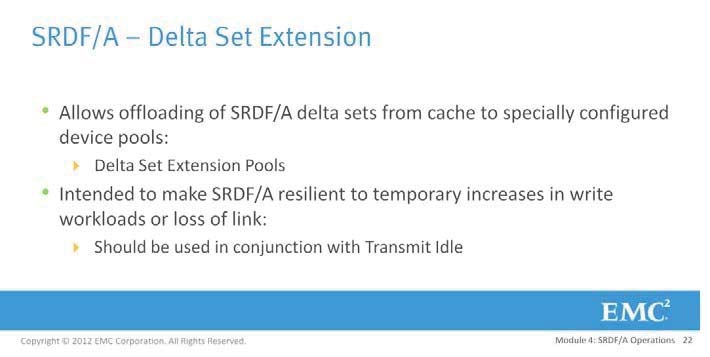 Delta Set Extension (DSE), extends the cache space available for SRDF/A session cycles by off loading some or all of its cycle data from cache to preconfigured disk storage, or pools, which are similar to SAVE device pools.
BCM
Question 10
Single choice
What is the maximum volume size configurable on a V-Max?
-
A
-
B
-
C
-
D
Reveal answer details
Close answer details
Question 11
Single choice
A customer wants to deploy SRDF/S between a pair of Symmetrix VMAX arrays. The R1/R2 devices will be RAID-1 protected. Two RAID-1 BCVs will be concurrently established with the R1 device. How many mirror positions will remain for the R1 devices in this configuration?
-
A
-
B
-
C
-
D
Reveal answer details
Close answer details
Correct answerC
ExplanationExplanation: 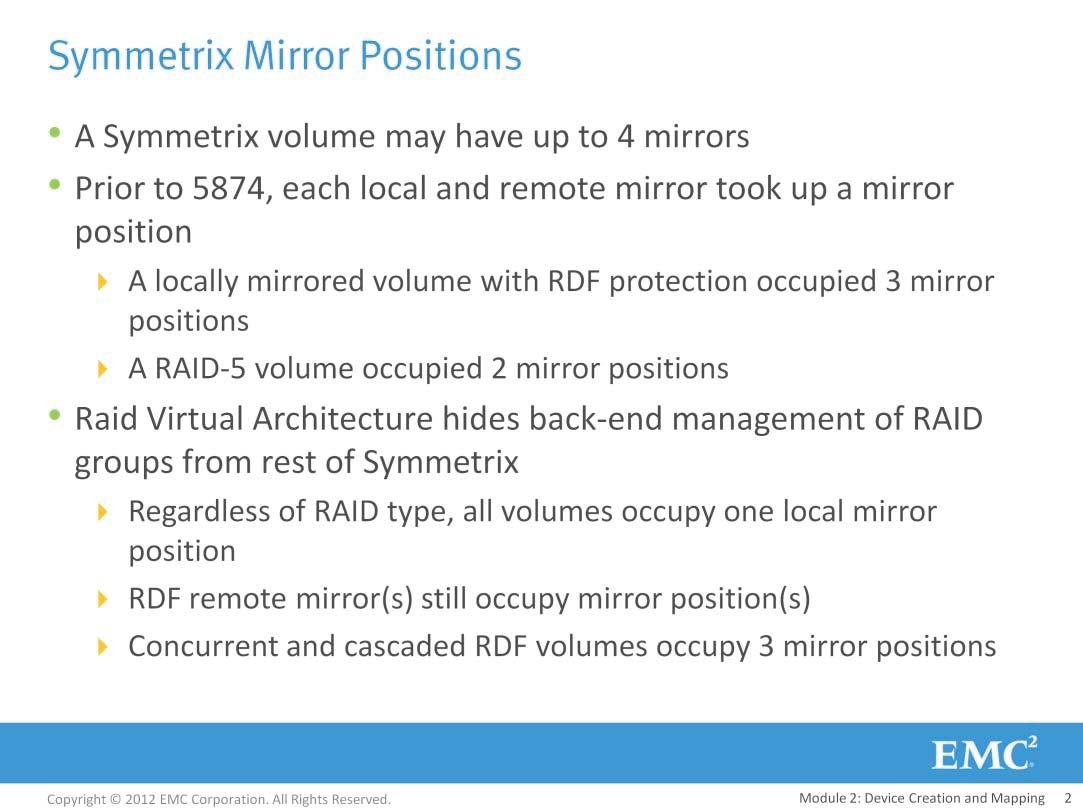 Each Symmetrix logical volume is allowed up to 4 mirrors. Prior to Enginuity 5874, local mirrors and parity RAID mirrors would occupy a second mirror position.
This limited the number of remote mirrors and TimeFinder/Mirror BCVs these volumes could be joined to. Starting with Enginuity 5874, RAID virtual architecture (RVA) virtualizes mirror positions. This means that backend management of RAID groups is hidden from rest of Enginuity. Remote mirrors still occupy a mirror position but local mirrors no longer occupy a mirror position irrespective of their protection type. Also, TimeFinder/Mirror was discontinued and replaced with TimeFinder/Clone starting 5874. Thus the 4 mirror limit is no longer a limiting factor
Question 12
Single choice
A customer is planning to migrate data belonging to two applications (A and B) from an older array to a new Symmetrix VMAX. Both migrations will run in parallel.
However, it is necessary to transfer data from application A (session A) as fast as possible. The data from application B (session B) can be transferred at a slower rate. Which settings should be used to run the two sessions?
-
A
Session A should be assigned to a Fibre Channel director with a ceiling setting of 10 Session B should be assigned to a different director with a ceiling value of
100
-
B
The pace for session A should be set to 9
The pace for session B should be set to 0
-
C
Session A should be assigned to a Fibre Channel director with a ceiling setting of 100 Session B should be assigned to a different director with a ceiling value of 10
-
D
The pace of session A should be set to 0
The pace for session B should be set to 9
Reveal answer details
Close answer details
Correct answerD
ExplanationExplanation: 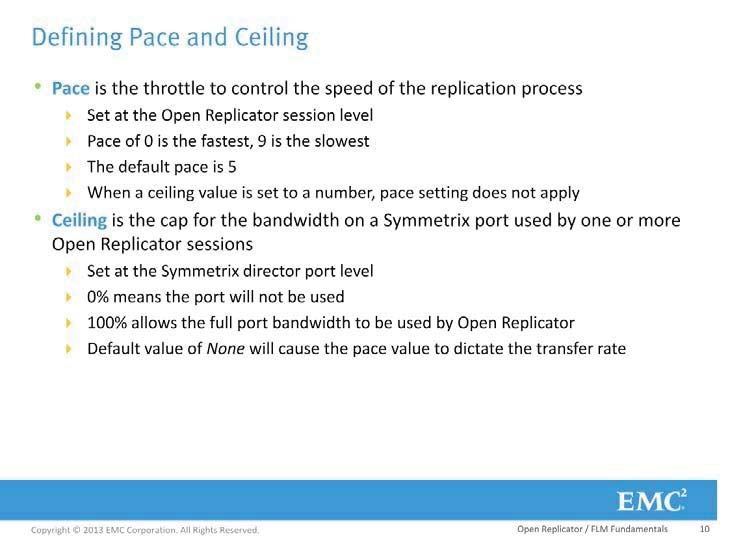 Throttling allows users to limit SAN bandwidth usage by Open Replicator. If left unchecked, Open Replicator consumes the full bandwidth of the SAN. It performs very fast, which could be a problem if the SAN is being shared by hosts performing I/O to the local volumes on the Controlling Array.
Pace values range from zero (0) to nine (9). A pace of zero (0) means that the session is not throttled at all.
The default pace for an Open Replicator session is five (5). Ceiling values range from zero percent (0%) to one hundred percent (100%). A zero percent (0%) setting on the port indicates the port will not be used for Open Replicator. A one hundred percent (100%) setting on the port allows Open Replicator full bandwidth usage, if necessary. The default ceiling value is None, which means that an Open Replicator session will be regulated by the Pace setting.
OR-FLM
Question 13
Single choice
Auto meta feature has been enabled on a Symmetrix with the symconfigure command: set symmetrix auto_meta=ENABLE, min_auto_meta_size=65520, auto_meta_member_size=16380, config=concatenated; What is the smallest device creation request that will trigger an automatic creation of a concatenated meta device?
-
A
-
B
-
C
-
D
Reveal answer details
Close answer details
Correct answerC
ExplanationExplanation: 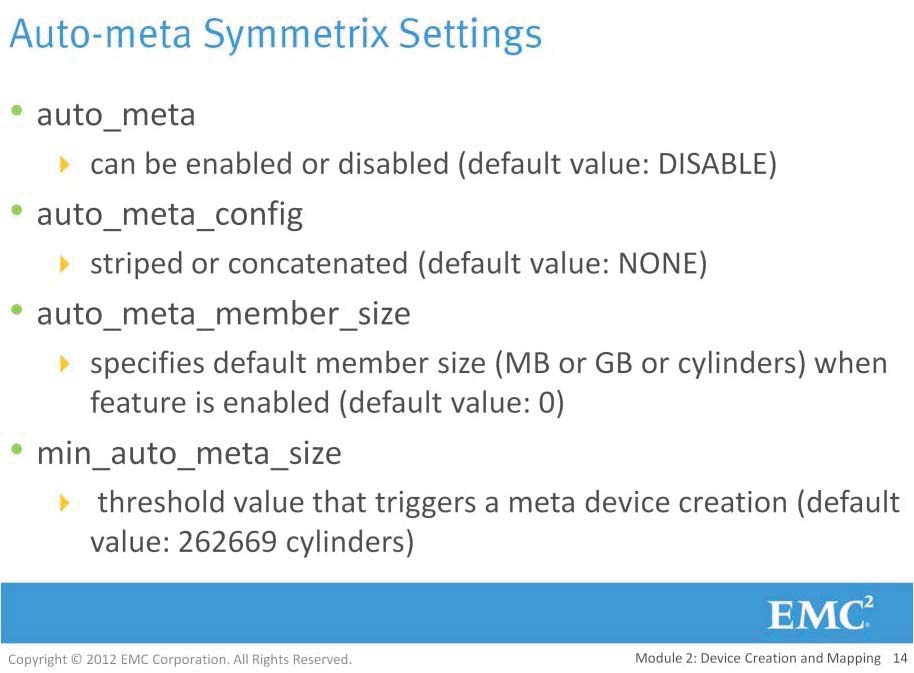 The min_auto_meta_size specifies the size threshold that triggers auto meta creation. When users try to create a device greater than min_auto_meta_size, and auto_meta is enabled, a meta will be created.
SCM
Question 14
Single choice
Which of these protection types offers the best protection?
-
A
-
B
-
C
-
D
Reveal answer details
Close answer details
Correct answerA
ExplanationExplanation: 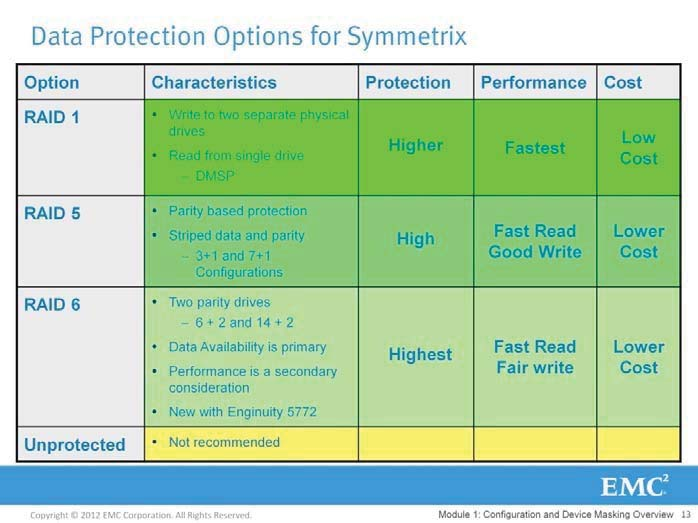 RAID 5 is based on the industry standard algorithm and can be configured with three data and one parity, or seven data and one parity. While the latter will provide more capacity per $, there is a greater performance impact when in degraded mode where a drive has failed and all surviving drives must be read in order to rebuild the missing data. RAID 6 is focused on availability. With the new larger capacity disk drives, rebuild times may take multiple days increasing the exposure to a second disk failure. Random read performance is similar across all protection types, assuming you are comparing the same number of drives. The major difference is write performance. With mirrored devices for every host write there are two writes on the backend. With RAID 5, each host write results in two reads and two writes. For RAID 6, each host write results in three reads and three writes. Other data protection schemes include remote replication using SRDF.
SCM
Question 15
Single choice
Which component of the Symmetrix VMAX runs the scripts to change the configuration of an array?
-
A
-
B
-
C
-
D
Symmetrix Service Processor
Reveal answer details
Close answer details
Correct answerD
ExplanationExplanation: The Config Manager architecture allows it to run Symwin scripts on the Symmetrix service processor. Configuration change requests are generated either by the symconfigure SYMCLI command or a SYMAPI library call generated by a user making a request through the Symmetrix Management Console (SMC) GUI.
These requests are converted by SYMAPI on the host to Symmetrix syscalls and transmitted to the Symmetrix through the channel interconnect. The Symmetrix front end routes the requests to the service processor, which invokes Symmwin procedures to perform the requested changes to the Symmetrix. Since these scripts are the same ones that a Customer Services Engineer would employ to configure the Symmetrix, Config Manager is able to do almost everything that is possible through Symwin scripts.
Question 16
Single choice
Refer to the exhibit. 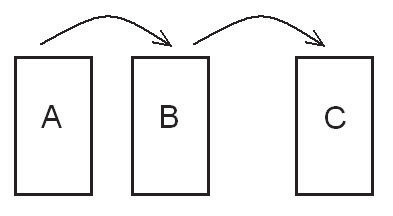 A customer wants to implement cascaded TimeFinder/Clone.
Clone sessions between devices A <--> B and B <--> C have been created.
The A <--> B Clone session has been activated. What should be the state of the A <--> B Clone session before activating the B <--> C Clone session?
-
A
-
B
-
C
-
D
Reveal answer details
Close answer details
Correct answerA
ExplanationExplanation: 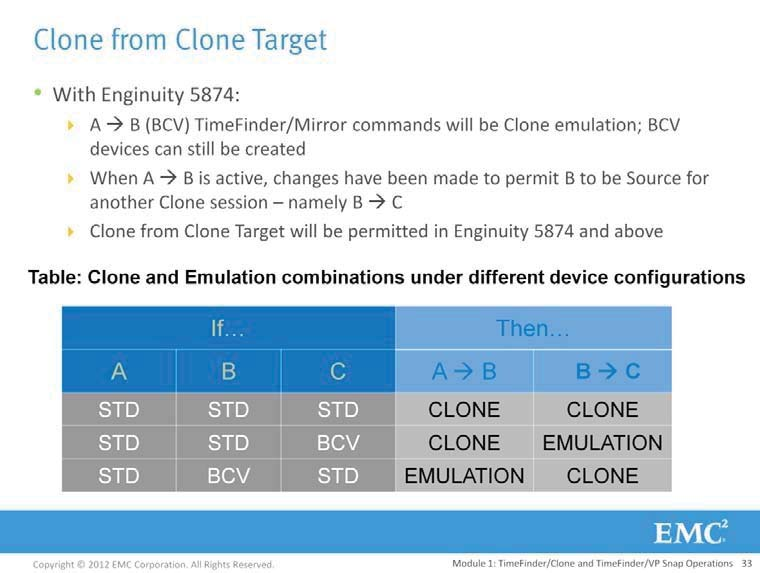 With the new feature, A > B, and B > C can be simultaneously in a Pre Copy mode. So data can flow from A > B and then on from B > C. Hence the term
Cascaded TimeFinder/Clone. When both clone sessions have completed one precopy cycle, A > B can be activated. After A > B reach the copied state, B > C session can be activated.
BCM
Question 17
Single choice
Which file contains the parameter that can change the default behavior of SYMCLI operations, and there control actions?
-
A
-
B
-
C
-
D
Reveal answer details
Close answer details
Question 18
Single choice
What is an accurate statement about dynamic Symmetrix tiers?
-
A
Involves less management overhead than static tiers
-
B
May be used with FAST VP and FAST
-
C
Required for use with FAST VP but not FAST
-
D
Mixes technology (FC, SATA, and EFD) but not RAID protection
Reveal answer details
Close answer details
Correct answerA
ExplanationExplanation: 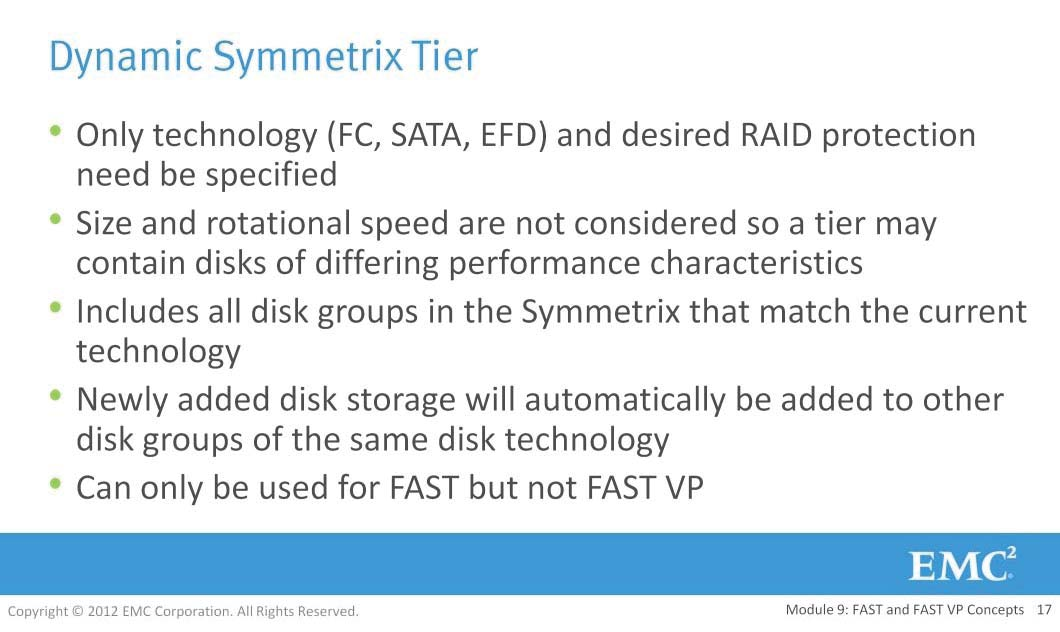 There are two types of Symmetrix tiers: dynamic and static. A dynamic tier automatically includes all disk groups currently in the array that match the tier technology. This type of tier will expand to accommodate any newly added disk groups. Dynamic tiers are easy to set up and involve less management overhead but since it allows disk groups of varying speeds to be part of a tier, it is difficult to get predictable performance from a particular tier. Static tiers allow for better performance predictability as a result of FAST moves and are preferable to dynamic tiers.
FAST VP cannot run on dynamic Symmetrix tiers.
SCM
Question 19
Single choice
Which operations are permitted as part of the Open Replicator DM license?
-
A
Cold Pull, Hot Push, Hot Pull
-
B
Cold Pull, Hot Push, Cold Push
-
C
Hot Pull, Hot Push, Cold Push
-
D
Hot Pull, Cold Pull, Hot Push, Cold Push
Reveal answer details
Close answer details
Correct answerB
ExplanationExplanation: 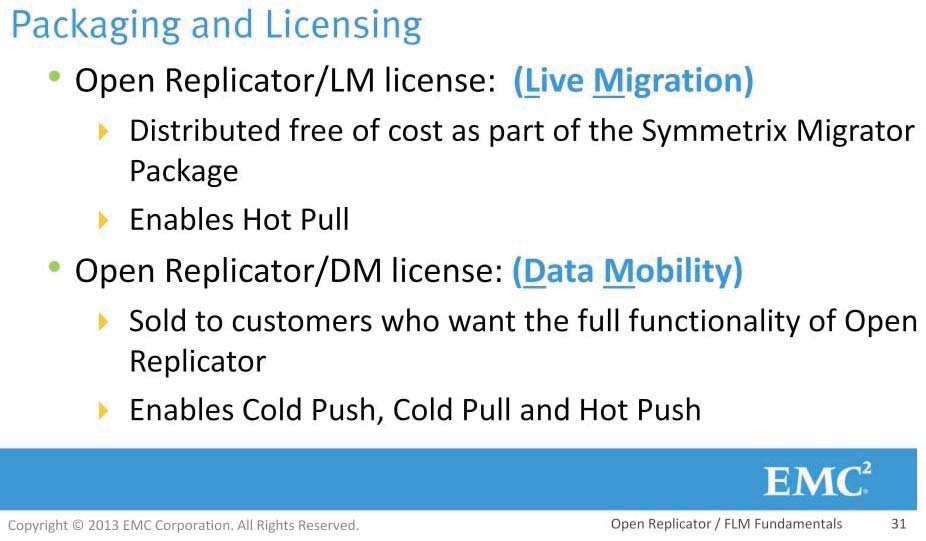 The Open Replicator/LM license enables Hot Pull. This comes free of charge with the Symmetrix Migrator Package.
The Open Replicator/DM license enables the other three Open Replicator actions, namely, Cold Push, Cold Pull and Hot Push.
BCM
Question 20
Single choice
With which transfer modes can the recreate option be used?
-
A
-
B
-
C
-
D
Reveal answer details
Close answer details
Correct answerA
ExplanationExplanation: 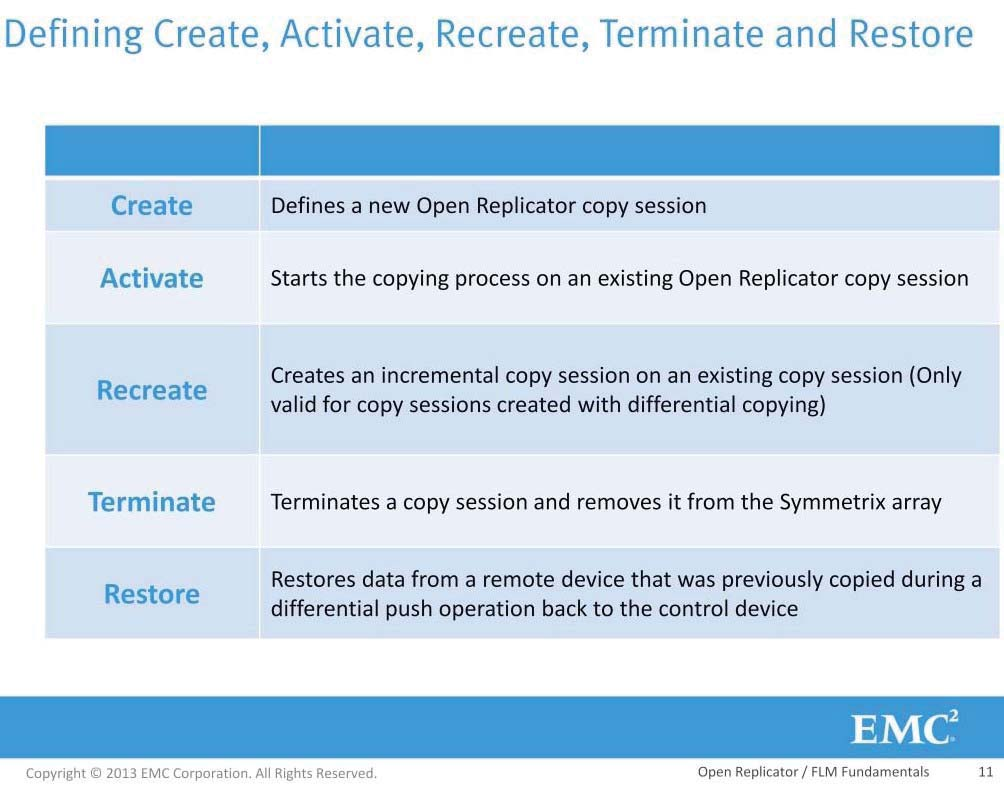 The recreate option is an incremental copy session. Incremental copy sessions are ONLY available for PUSH operations. 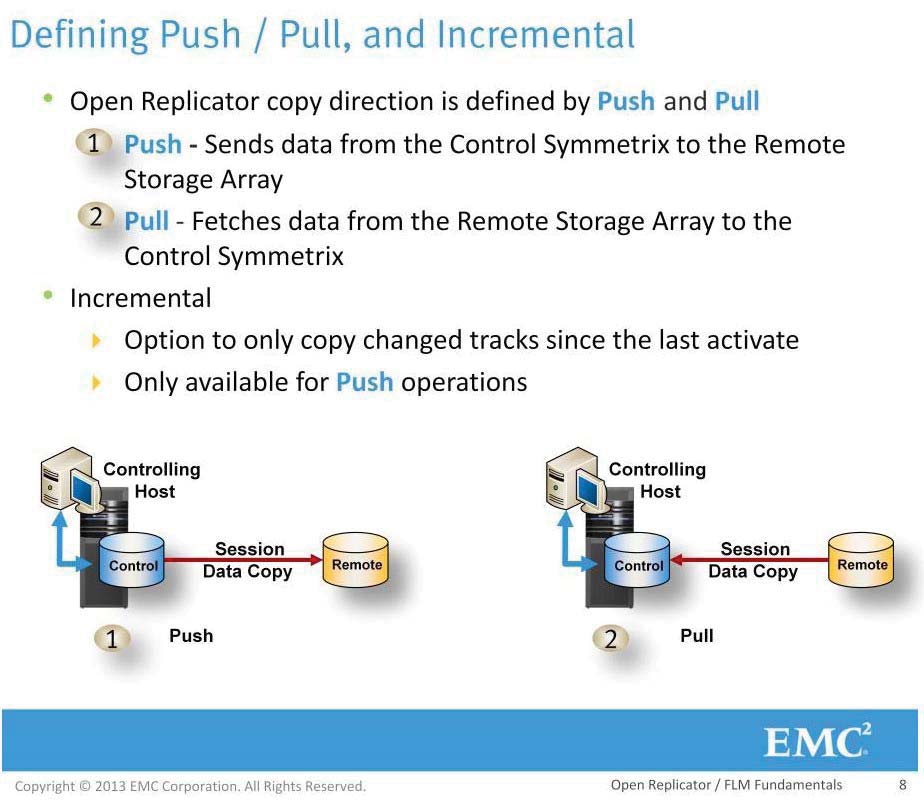 OR-FLM
Question 21
Single choice
Under which condition will Enquiry remove the Consistency Exempt attribute from the RDF mirror?
-
A
-
B
-
C
-
D
Reveal answer details
Close answer details
Question 22
Single choice
TimeFinder/Snap virtual devices will be used as the control devices in an Open Replicator implementation. What should be the state of the virtual devices to create an Open Replication session?
-
A
-
B
-
C
-
D
Reveal answer details
Close answer details
Question 23
Single choice
If a customer wants to restrict certain thin pools from reaching their capacity limit, which option would the customer use?
-
A
-
B
-
C
-
D
Set utilization threshold
Reveal answer details
Close answer details
Question 24
Single choice
What is the state of the standard and BCV devices after a Full Time/Finder "Establish" has been installed?
-
A
Standard is Read Only and BCV is Read Only
-
B
Standard is Read Only and BCV is Not Ready
-
C
Standard is Read/Write and BCV is Not Ready
-
D
Standard is Read/Write and BCV is Read/Write
Reveal answer details
Close answer details
Question 25
Single choice
How does Enginuity Consistency Assist (ECA) differ from power path?
-
A
ECA supports TimeFinder/Clone only; power path supports TimeFinder/Clone and TimeFinder/Snap.
-
B
ECA cannot support I/O for multiple hosts, but power path can.
-
C
ECA supports I/O at the Symmetix level power path support I/O at the host level
-
D
ECA supports I/O at the host level power path support I/O at the Symmetric level
Reveal answer details
Close answer details
|