Preview real exam questions, verified answers and available explanations before choosing a study plan.
Question 1
Single choice
You have a Fabric workspace named Workspace1 that contains a lakehouse named Lakehouse1.
In Workspace1, you create a data pipeline named Pipeline1.
You have CSV files stored in an Azure Storage account.
You need to add an activity to Pipeline1 that will copy data from the CSV files to Lakehouse1. The activity must support Power Query M formula language expressions.
Which type of activity should you add?
A
Dataflow
B
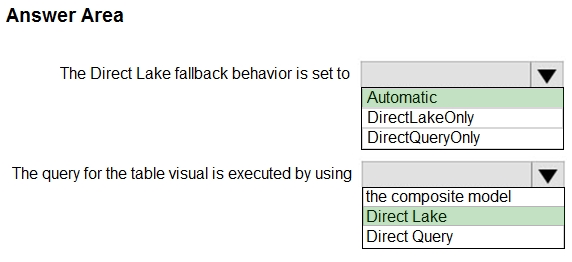
Notebook
C
Script
D
Copy data
Reveal answer detailsClose answer details
Correct answerA
Question 2
Single choice
You need to design a data preparation process that preserves raw source data and also provides cleansed tables for reporting. Which approach should you use?
A
Overwrite raw files each time a report is refreshed.
B
Keep a raw layer and create a curated layer for reporting.
C
Store all business rules only in visual-level filters.
D
Delete intermediate data as soon as a notebook finishes.
Reveal answer detailsClose answer details
Correct answerB
Explanation
A raw layer plus a curated layer is a sound preparation pattern because it separates preservation from presentation. The raw layer keeps the ingested source data available for reconciliation, reloads, troubleshooting, and audit comparisons. The curated layer applies cleansing, standardization, and business rules so semantic models and reports consume data that is ready for analysis.
Overwriting raw files during report refresh removes the original evidence needed to understand later discrepancies. Keeping all business rules in visual filters scatters transformation logic across reports and makes consistency nearly impossible to prove. Deleting intermediate data immediately after a notebook finishes may save storage, but it can make failures and unexpected results much harder to diagnose. A layered approach also supports incremental improvement: teams can refine curated outputs while retaining a stable record of what was received from each source. That balance is why the raw and curated pattern is preferred for governed analytics.
Question 3
Single choice
You are loading a dimension table that tracks the current description for each product. Historical product descriptions are not required. Which behavior should the load process implement?
A
Update the existing product row when the description changes and insert a row for a new product.
B
Insert a new row for every change and keep all prior versions active.
C
Delete all fact data when any product attribute changes.
D
Store product descriptions only in the report title.
Reveal answer detailsClose answer details
Correct answerA
Explanation
When historical product descriptions are not required, the load should update the existing dimension row when the description changes and insert a row when a product appears for the first time. That behavior keeps the dimension focused on current-state reporting. Users who group by product description will see the latest value without needing to choose among multiple historical versions.
Inserting a new row for every changed description is used when the business needs to preserve attribute history, such as reporting sales by the product description that was valid at the transaction date. That is not requested here. Deleting fact data because a dimension attribute changes would destroy transaction history and break analytical integrity. Storing descriptions in a report title removes them from the model and prevents normal filtering or grouping. Updating existing rows for changed attributes and inserting only new business keys keeps the dimension simple, current, and aligned with the stated requirement.
Question 4
Multiple choice
You have a Fabric tenant that contains a semantic model named Model1. Model1 contains a fact table with millions of rows of shipment data.
You need to enable partitioning to improve the query performance and manageability of Model1.
Which two tools can you use to achieve the goal? Each correct answer presents a complete solution.
NOTE: Each correct answer is worth one point.
A
Tabular Editor
B
DAX Studio
C
Microsoft Power BI Desktop
D
the Microsoft Power BI service
E
Microsoft SQL Server Management Studio (SSMS)
Reveal answer detailsClose answer details
Correct answersA, E
Explanation
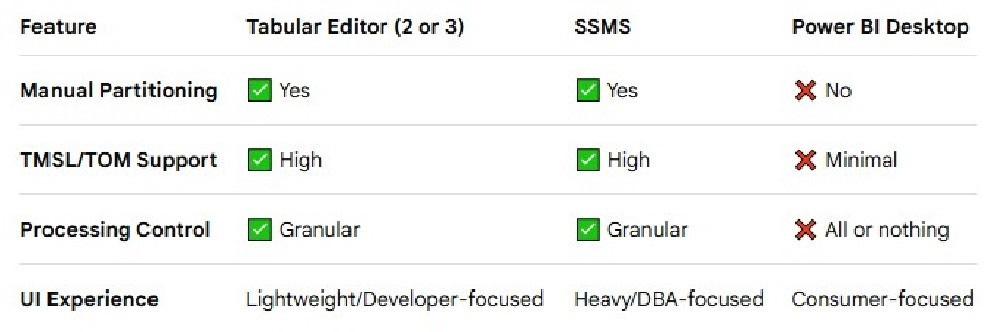
The Tabular Editor and SSMS are the superior choices for managing large-scale semantic models in Microsoft Fabric. Power BI Desktop is limited because it lacks a native interface for manual partition management outside of basic Incremental Refresh.
Here is the breakdown of why and how to use these tools to optimize your million-row fact table.
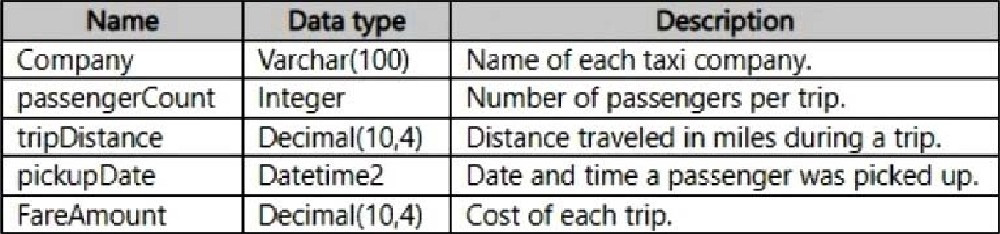
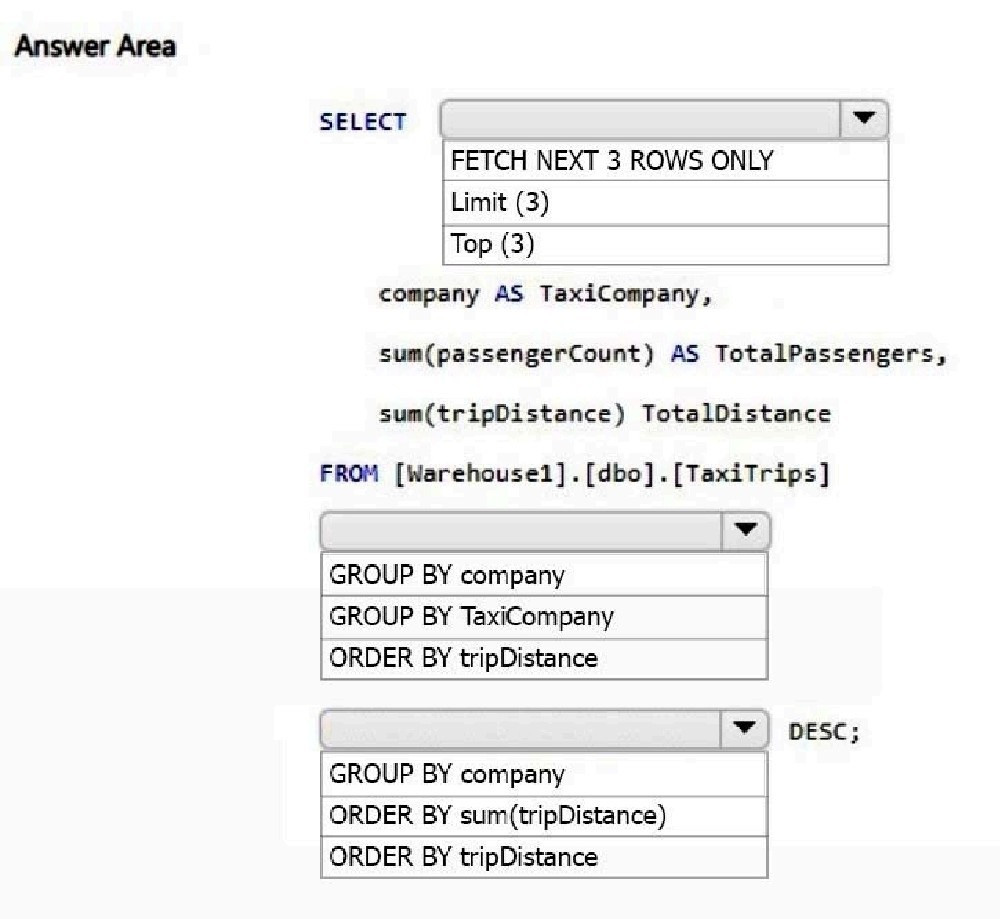
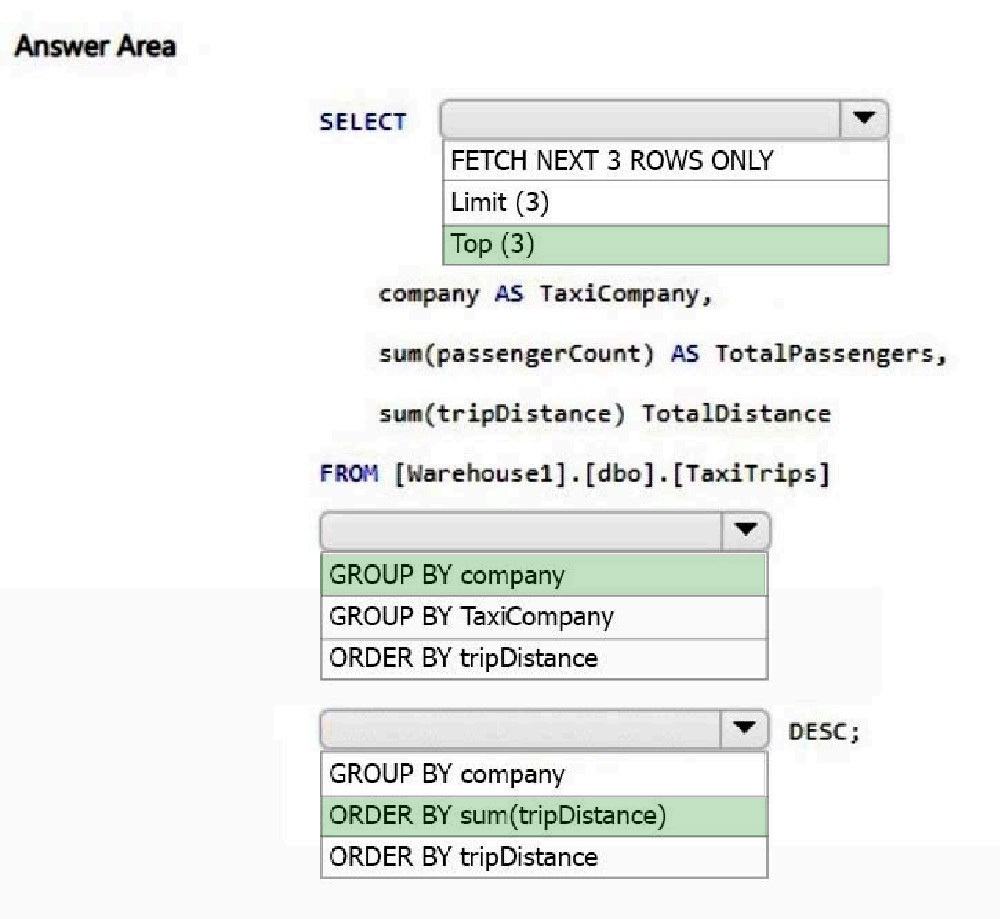
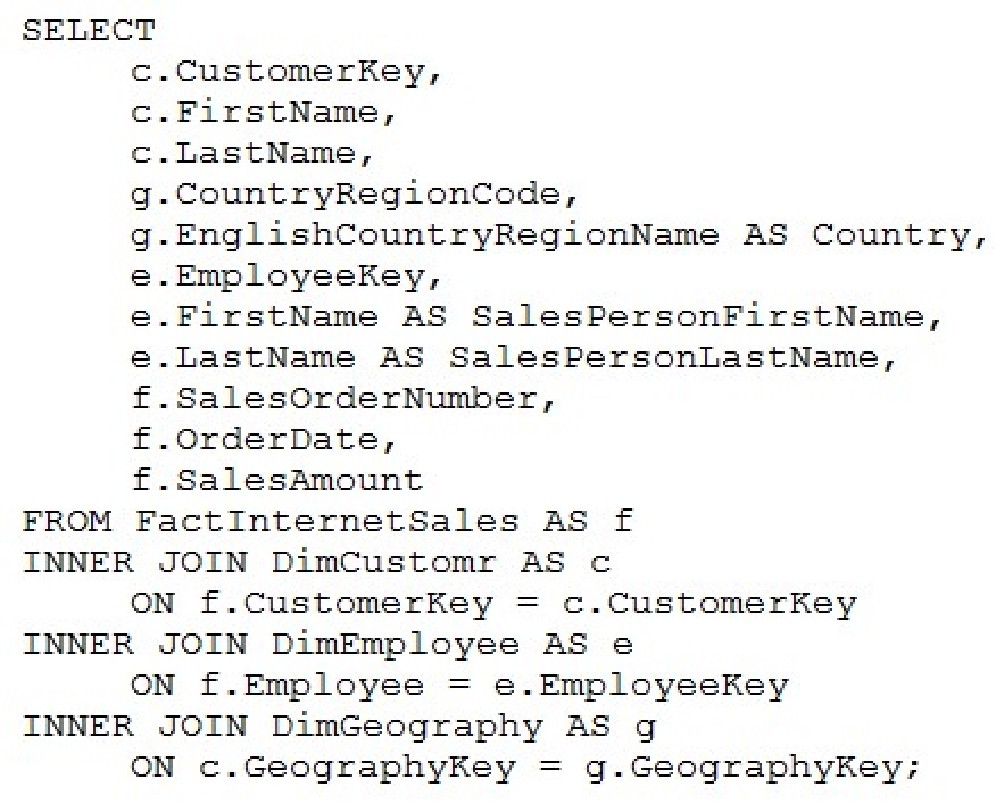
You have a T-SQL query named Query1 that contains the following statements.
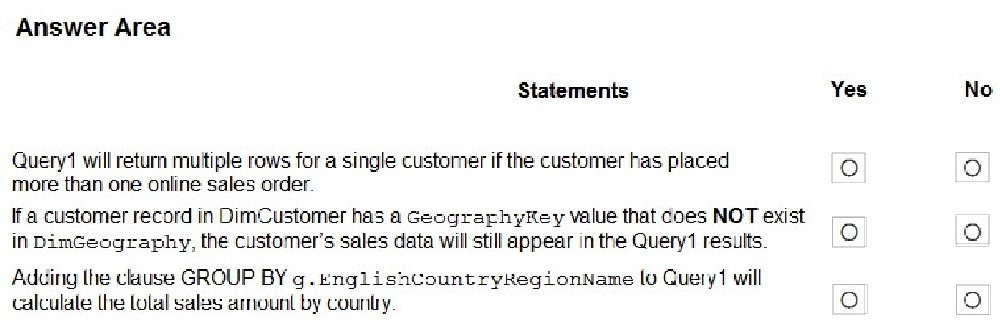
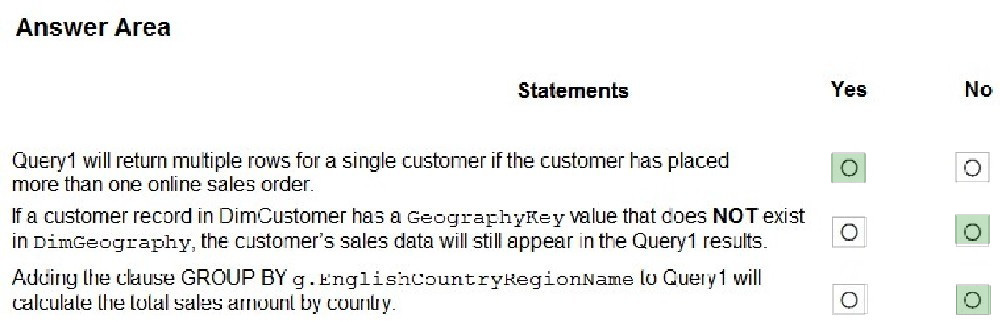
For each of the following statements, select Yes if the statement is true. Otherwise, select No.
NOTE: Each correct selection is worth one point.
Reveal answer detailsClose answer details
Question 7
Single choice
You are implementing row-level restrictions in a semantic model. Which validation should you perform before releasing the report?
A
Test the report experience as a user assigned to the restricted role.
B
Verify only that the report background color is approved.
C
Remove all relationships from the model.
D
Give all users administrator access during testing.
Reveal answer detailsClose answer details
Correct answerA
Explanation
Row-level restrictions should be validated by testing the report as a user assigned to the restricted role. Security rules can look correct in the model but still produce unexpected results because of relationships, role membership, slicers, or report design. Viewing the report through the restricted user's effective permissions confirms what data that person can actually see before the report is released.
Checking only the background color does not test data access. Removing all relationships would change the model and could invalidate the behavior being tested. Giving every user administrator access during testing defeats the security boundary and could expose data broadly. Proper validation focuses on the user experience under the intended role, including whether totals, detail rows, slicers, and drill paths respect the row-level rule. That approach gives the team confidence that the model enforces the regional or user-specific restriction in practice.
This validation should include both summary and detail views, because a role might appear correct at a high level while still exposing restricted drillthrough records.
Question 8
Single choice
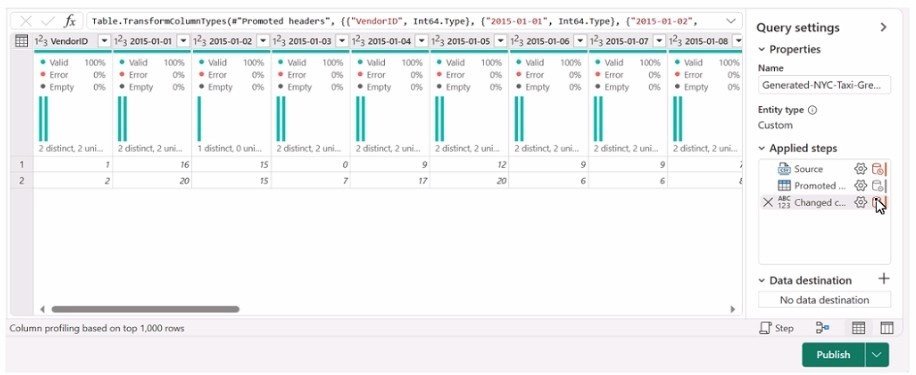
You have a Fabric workspace named Workspace1 that contains a data flow named Dataflow1. Dataflow1 contains a query that returns the data shown in the following exhibit.
You need to transform the date columns into attribute-value pairs, where columns become rows.
You select the VendorlD column.
Which transformation should you select from the context menu of the VendorlD column?
A
Group by
B
Unpivot columns
C
Unpivot other columns
D
Split column
E
Remove other columns
Reveal answer detailsClose answer details
Correct answerC
Question 9
Single choice
You are analyzing customer purchases in a Fabric notebook by using PySpark.
You have the following DataFrames: transactions: Contains five columns named transaction_id, customer_id, product_id, amount, and date and has 10 million rows, with each row representing a transaction. customers: Contains customer details in 1,000 rows and three columns named customer_id, name, and country.
You need to join the DataFrames on the customer_id column. The solution must minimize data shuffling.
You write the following code.
from pyspark.sql import functions as F results = Which code should you run to populate the results DataFrame?
The correct code to populate the results DataFrame with minimal data shuffling is Option A. Using the broadcast function in PySpark is a way to minimize data movement by broadcasting the smaller DataFrame (customers) to each node in the cluster. This is ideal when one DataFrame is much smaller than the other, as in this case with customers. References: You can refer to the official Apache Spark documentation for more details on joins and the broadcast hint.
Question 10
Hotspot
HOTSPOT
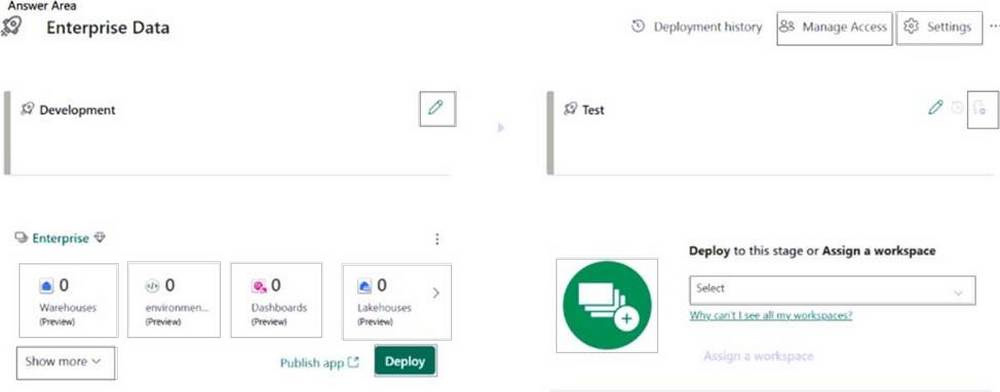
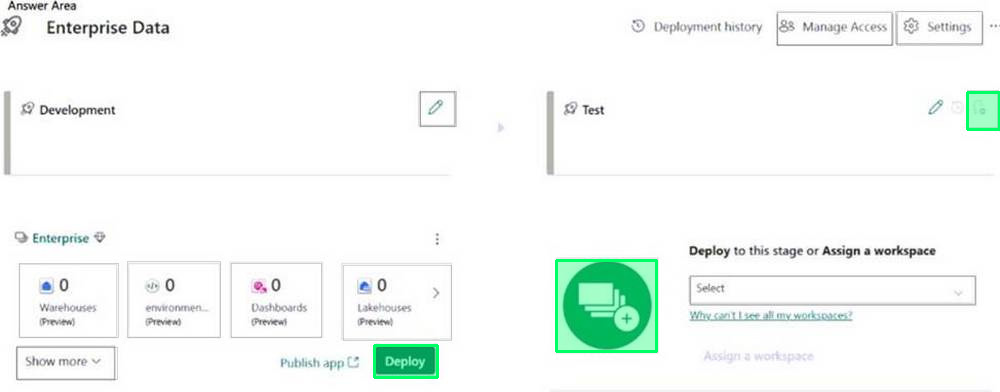
You have a Fabric tenant that contains a workspace named Enterprise. Enterprise contains a semantic model named Model1. Model1 contains a date parameter named Date1 that was created in Power Query.
You build a deployment pipeline named Enterprise Data that includes two stages named Development and Test. You assign the Enterprise workspace to the Development stage.
You need to perform the following actions:
Create a workspace named Enterprise [Test] and assign the workspace to the Test stage. Configure a rule that will modify the value of Date1 when changes are deployed to the Test stage.
Which two settings should you use? To answer, select the appropriate settings in the answer area.
NOTE: Each correct answer is worth one point.
Reveal answer detailsClose answer details
Case study
Case Study 2
This is a case study. Case studies are not timed separately. You can use as much exam time as you would like to complete each case. However, there may be additional case studies and sections on this exam. You must manage your time to ensure that you are able to complete all questions included on this exam in the time provided.
To answer the questions included in a case study, you will need to reference information that is provided in the case study. Case studies might contain exhibits and other resources that provide more information about the scenario that is
described in the case study. Each question is independent of the other questions in this case study.
At the end of this case study, a review screen will appear. This screen allows you to review your answers and to make changes before you move to the next section of the exam. After you begin a new section, you cannot return to this section.
To start the case study
To display the first question in this case study, click the Next button. Use the buttons in the left pane to explore the content of the case study before you answer the questions. Clicking these buttons displays information such as business
requirements, existing environment, and problem statements. If the case study has an All Information tab, note that the information displayed is identical to the information displayed on the subsequent tabs. When you are ready to answer a question, click the Question button to return to the question.
Overview Contoso, Ltd. is a US-based health supplements company. Contoso has two divisions named Sales and Research. The Sales division contains two departments named Online Sales and Retail Sales. The Research division assigns internally developed product lines to individual teams of researchers and analysts.
Existing Environment
Identity Environment Contoso has a Microsoft Entra tenant named contoso.com. The tenant contains two groups named ResearchReviewersGroup1 and ResearchReviewersGroup2.
Data Environment Contoso has the following data environment: The Sales division uses a Microsoft Power BI Premium capacity. The semantic model of the Online Sales department includes a fact table named Orders that uses Import made. In the system of origin, the OrderID value represents the sequence in which orders are created. The Research department uses an on-premises, third-party data warehousing product. Fabric is enabled for contoso.com. An Azure Data Lake Storage Gen2 storage account named storage1 contains Research division data for a product line named Productline1. The data is in the delta format. A Data Lake Storage Gen2 storage account named storage2 contains Research division data for a product line named Productline2. The data is in the CSV format.
Requirements
Planned Changes Contoso plans to make the following changes: Enable support for Fabric in the Power BI Premium capacity used by the Sales division. Make all the data for the Sales division and the Research division available in Fabric. For the Research division, create two Fabric workspaces named Productline1ws and Productine2ws. In Productline1ws, create a lakehouse named Lakehouse1. In Lakehouse1, create a shortcut to storage1 named ResearchProduct.
Data Analytics Requirements Contoso identifies the following data analytics requirements: All the workspaces for the Sales division and the Research division must support all Fabric experiences. The Research division workspaces must use a dedicated, on-demand capacity that has per-minute billing. The Research division workspaces must be grouped together logically to support OneLake data hub filtering based on the department name. For the Research division workspaces, the members of ResearchReviewersGroup1 must be able to read lakehouse and warehouse data and shortcuts by using SQL endpoints. For the Research division workspaces, the members of ResearchReviewersGroup2 must be able to read lakehouse data by using Lakehouse explorer. All the semantic models and reports for the Research division must use version control that supports branching.
Data Preparation Requirements Contoso identifies the following data preparation requirements: The Research division data for Productline1 must be retrieved from Lakehouse1 by using Fabric notebooks. All the Research division data in the lakehouses must be presented as managed tables in Lakehouse explorer.
Semantic Model Requirements Contoso identifies the following requirements for implementing and managing semantic models: The number of rows added to the Orders table during refreshes must be minimized. The semantic models in the Research division workspaces must use Direct Lake mode.
General Requirements Contoso identifies the following high-level requirements that must be considered for all solutions: Follow the principle of least privilege when applicable. Minimize implementation and maintenance effort when possible.
Question 11
Testlet 2Hotspot
HOTSPOT
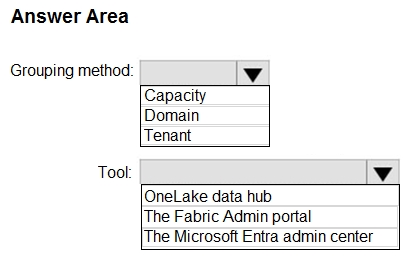
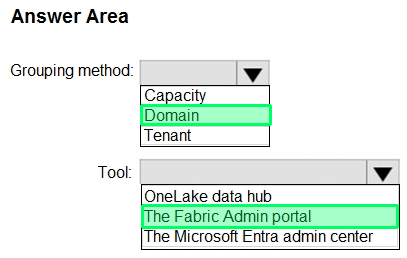
You need to recommend a solution to group the Research division workspaces.
What should you include in the recommendation? To answer, select the appropriate options in the answer area.
NOTE: Each correct selection is worth one point.
Reveal answer detailsClose answer details
Question 12
Single choice
Note: This question is part of a series of questions that present the same scenario. Each question in the series contains a unique solution that might meet the stated goals. Some question sets might have more than one correct solution, while others might not have a correct solution.
After you answer a question in this section, you will NOT be able to return to it. As a result, these questions will not appear in the review screen.
You have a Fabric tenant that contains a new semantic model in OneLake.
You use a Fabric notebook to read the data into a Spark DataFrame.
You need to evaluate the data to calculate the min, max, mean, and standard deviation values for all the string and numeric columns.
Solution: You use the following PySpark expression:
df .sumary ()
Does this meet the goal?
A
Yes
B
No
Reveal answer detailsClose answer details
Correct answerA
Explanation
Yes, the df.summary() method does meet the goal. This method is used to compute specified statistics for numeric and string columns. By default, it provides statistics such as count, mean, stddev, min, and max. References: The PySpark API documentation details the summary() function and the statistics it provides.
Question 13
Single choice
A data model contains a fact table with order rows and a product dimension. You need a report slicer that filters orders by product category. What should you configure?
A
A relationship between the product dimension and the order fact table.
B
A separate report for every product category.
C
A calculated column that stores a screenshot of the slicer.
D
A workspace role named Product Category.
Reveal answer detailsClose answer details
Correct answerA
Explanation
A relationship between the product dimension and the order fact table is needed so product category can filter order rows. The product dimension stores attributes such as category and product name, while the fact table stores individual order events and measures. When the relationship connects the two tables, a slicer using product category can filter the related facts and produce the intended order totals.
Creating a separate report for every product category duplicates report design and does not provide flexible filtering. A calculated column containing a screenshot has no analytical relationship to the data. A workspace role named Product Category would describe permissions or membership, not model filter behavior. Slicers operate through fields, relationships, and filter context in the model. The dimension-to-fact relationship is therefore the structural requirement that lets the category selection affect the order data correctly.
That structure also avoids hard-coding category logic in individual visuals, so the same product slicer can be reused across pages and reports consistently.
Question 14
Single choice
You have a Microsoft Power Bl semantic model. You need to identify any surrogate key columns in the model that have the Summarize By property set to a value other than to None. The solution must minimize effort.
What should you use?
A
DAX Formatter in DAX Studio
B
Model view in Microsoft Power Bl Desktop
C
Model explorer in Microsoft Power Bl Desktop
D
Best Practice Analyzer in Tabular Editor
Reveal answer detailsClose answer details
Correct answerD
Explanation
To identify surrogate key columns with the "Summarize By" property set to a value other than "None," the Best Practice Analyzer in Tabular Editor is the most efficient tool. The Best Practice Analyzer can analyze the entire model and provide a report on all columns that do not meet a specified best practice, such as having the "Summarize By" property set correctly for surrogate key columns. Here's how you would proceed: Open your Power BI model in Tabular Editor. Go to the Advanced Scripting window. Write or use an existing script that checks the "Summarize By" property of each column. Execute the script to get a report on the surrogate key columns that do not have their "Summarize By" property set to "None". You can then review and adjust the properties of the columns directly within the Tabular Editor. References: The functionality of the Best Practice Analyzer in Tabular Editor is documented in the community and learning resources for Power BI.
Question 15
Single choice
You have a Fabric tenant that contains a lakehouse named lakehouse1. Lakehouse1 contains a table named Table1.
You are creating a new data pipeline.
You plan to copy external data to Table1. The schema of the external data changes regularly.
You need the copy operation to meet the following requirements:
1. Replace Table1 with the schema of the external data. 2. Replace all the data in Table1 with the rows in the external data.
You add a Copy data activity to the pipeline.
What should you do for the Copy data activity?
A
From the Source tab, add additional columns.
B
From the Destination tab, set Table action to Overwrite.
C
From the Settings tab, select Enable staging
D
From the Source tab, select Enable partition discovery
E
From the Source tab, select Recursively
Reveal answer detailsClose answer details
Correct answerB
Explanation
For the Copy data activity, from the Destination tab, setting Table action to Overwrite (B) will ensure that Table1 is replaced with the schema and rows of the external data, meeting the requirements of replacing both the schema and data of the destination table. References: Information about Copy data activity and table actions in Azure Data Factory, which can be applied to data pipelines in Fabric, is available in the Azure Data Factory documentation.
Question 16
Drag & drop
DRAG DROP
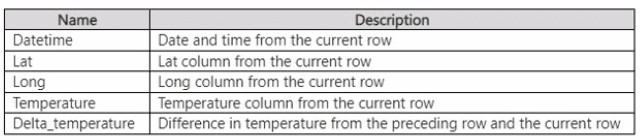
You have a Fabric eventhouse named Eventhousel that contains a table named Weatherdata. A sample of the data in Weatherdata is shown in the following table.
You plan to use a KQL queryset to manipulate the data in Eventhouse1. The result set must have the following columns.
You need to build the query.
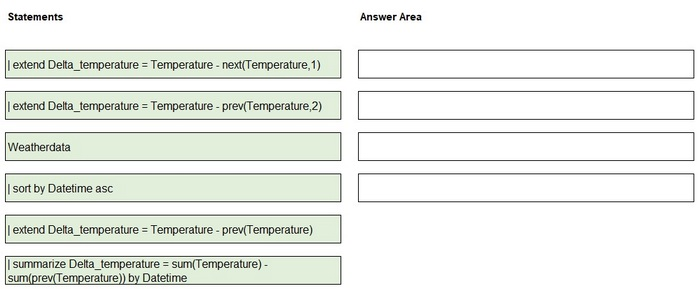
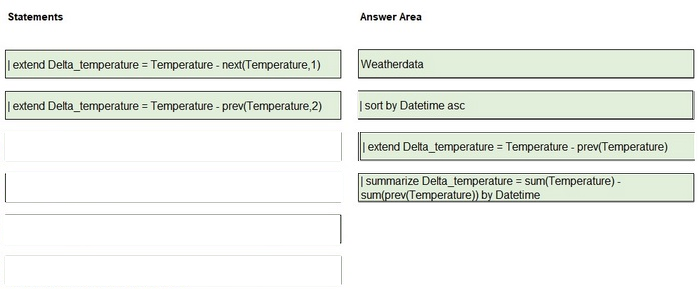
Which four KQL statements should you use in sequence? To answer, move the appropriate statements from the list of statements to the answer area and arrange them in the correct order.
Reveal answer detailsClose answer details
Question 17
Hotspot
HOTSPOT
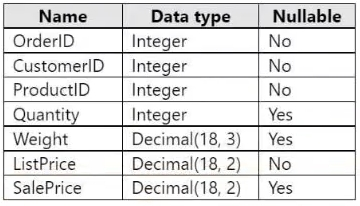
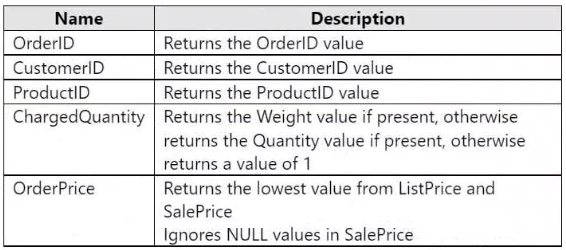
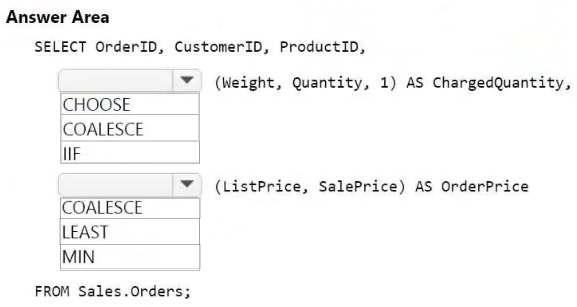
You have a Fabric warehouse that contains a table named Sales.Orders. Sales.Orders contains the following columns.
You need to write a T-SQL query that will return the following columns.
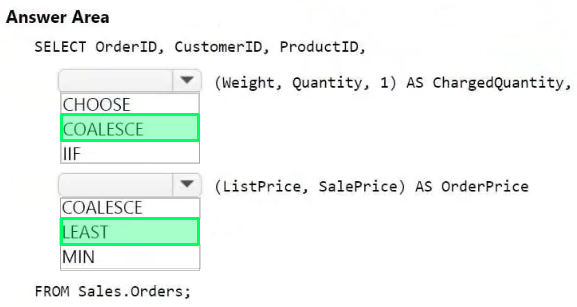
How should you complete the code? To answer, select the appropriate options in the answer area.
NOTE: Each correct selection is worth one point.
Reveal answer detailsClose answer details
Question 18
Single choice
You have a Fabric tenant that contains a data pipeline.
You need to ensure that the pipeline runs every four hours on Mondays and Fridays.
To what should you set Repeat for the schedule?
A
Daily
B
By the minute
C
Weekly
D
Hourly
Reveal answer detailsClose answer details
Correct answerC
Explanation
You should set Repeat for the schedule to Weekly (C). This allows you to specify the pipeline to run on specific days of the week, in this case, every four hours on Mondays and Fridays. References: Scheduling options for data pipelines are available in the Azure Data Factory documentation, which includes details on configuring recurring triggers.
Question 19
Single choice
You have a Fabric tenant that uses a Microsoft tower Bl Premium capacity. You need to enable scale-out for a semantic model.
What should you do first?
A
At the semantic model level, set Large dataset storage format to Off.
B
At the tenant level, set Create and use Metrics to Enabled.
C
At the semantic model level, set Large dataset storage format to On.
D
At the tenant level, set Data Activator to Enabled.
Reveal answer detailsClose answer details
Correct answerC
Explanation
To enable scale-out for a semantic model, you should first set Large dataset storage format to On (C) at the semantic model level. This configuration is necessary to handle larger datasets effectively in a scaled-out environment. References: Guidance on configuring large dataset storage formats for scale-out is available in the Power BI documentation.
Question 20
Single choice
You are the administrator of a Fabric workspace that contains a lakehouse named Lakehouse1. Lakehouse1 contains the following tables:
1. Table1: A Delta table created by using a shortcut 2. Table2: An external table created by using Spark 3. Table3: A managed table
You plan to connect to Lakehouse1 by using its SQL endpoint.
What will you be able to do after connecting to Lakehouse1?
A
ReadTable3.
B
Update the data Table3.
C
ReadTable2.
D
Update the data in Table1.
Reveal answer detailsClose answer details
Correct answerD
Question 21
Hotspot
HOTSPOT
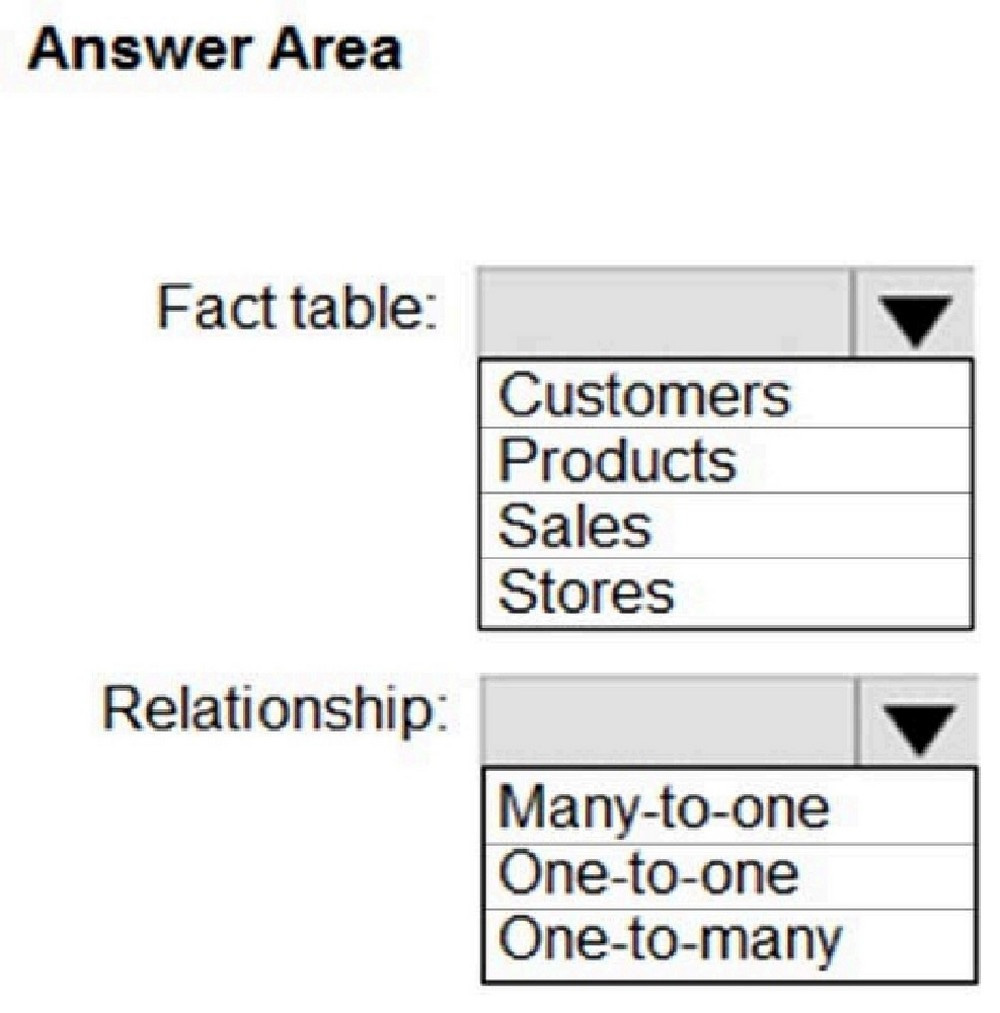
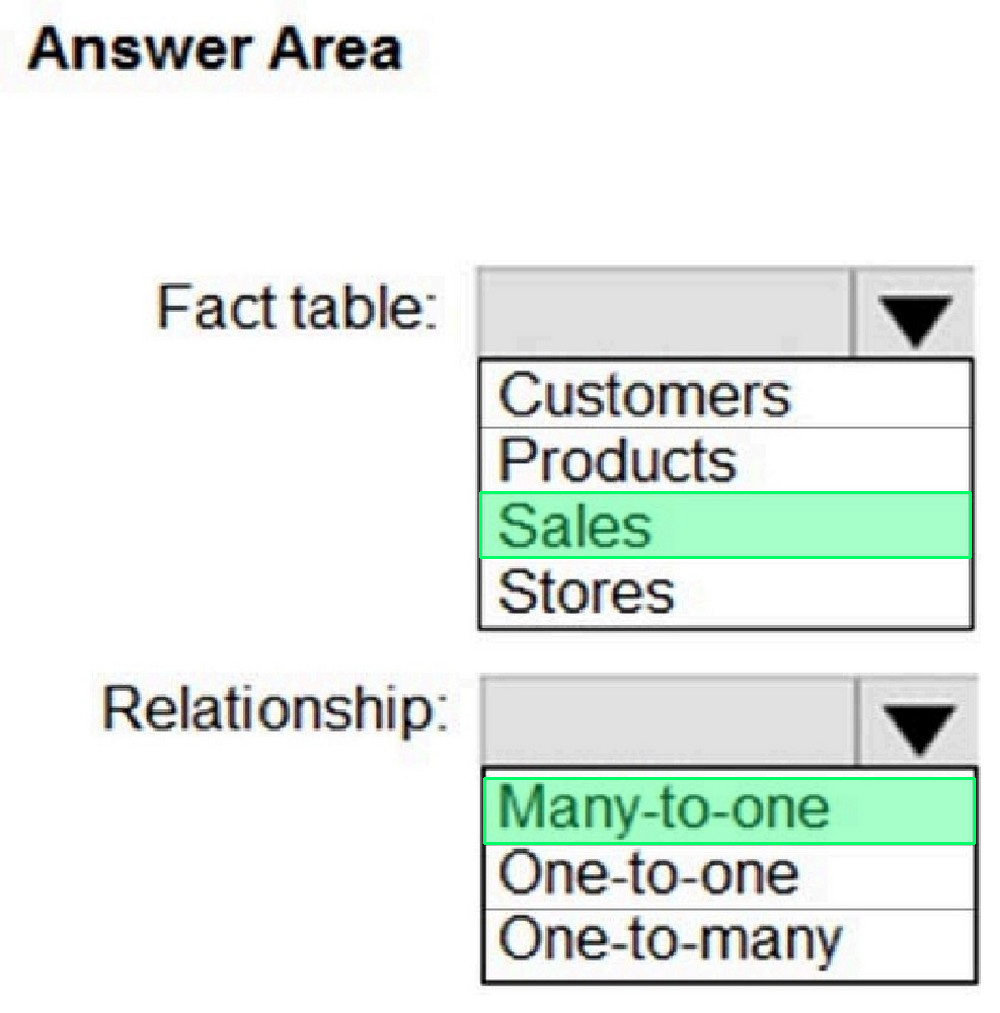
You have a Fabric workspace that contains a large warehouse. You plan to create a lakehouse named Lakehouse1 for a sales dataset. Lakehouse1 will contain the following tables:
1. Sales: Contains sales transactions. 2. Stores: Contains a unique list of store names and locations - Loyalty: Contains a list of customers and their preferred stores - Customers: Contains a unique list of customer names and addresses - Products: Contains a unique list of available products and their descriptions.
You need to configure a star schema for Lakehouse1.
Which table should you define as the fact table, and which type of relationship should you configure from the Sales table to the Customers table? To answer, select the appropriate options in the answer area.
NOTE: Each correct selection is worth one point.
Reveal answer detailsClose answer details
Question 22
Single choice
Note: This question is part of a series of questions that present the same scenario. Each question in the series contains a unique solution that might meet the stated goals. Some question sets might have more than one correct solution, while others might not have a correct solution.
After you answer a question in this section, you will NOT be able to return to it. As a result, these questions will not appear in the review screen.
You have a Fabric tenant that contains a new semantic model in OneLake.
You use a Fabric notebook to read the data into a Spark DataFrame.
You need to evaluate the data to calculate the min, max, mean, and standard deviation values for all the string and numeric columns.
Solution: You use the following PySpark expression:
df.explain().show()
Does this meet the goal?
A
Yes
B
No
Reveal answer detailsClose answer details
Correct answerB
Question 23
Single choice
You have a Fabric tenant. You are creating a Fabric Data Factory pipeline.
You have a stored procedure that returns the number of active customers and their average sales for the current month.
You need to add an activity that will execute the stored procedure in a warehouse. The returned values must be available to the downstream activities of the pipeline.
Which type of activity should you add?
A
Script
B
Copy data
C
Switch
D
Append variable
Reveal answer detailsClose answer details
Correct answerA
Explanation
In a Fabric Data Factory pipeline, to execute a stored procedure and make the returned values available for downstream activities, the Lookup activity is used. This activity can retrieve a dataset from a data store and pass it on for further processing. Here's how you would use the Lookup activity in this context: Add a Lookup activity to your pipeline. Configure the Lookup activity to use the stored procedure by providing the necessary SQL statement or stored procedure name. In the settings, specify that the activity should use the stored procedure mode. Once the stored procedure executes, the Lookup activity will capture the results and make them available in the pipeline's memory. Downstream activities can then reference the output of the Lookup activity.
References: The functionality and use of Lookup activity within Azure Data Factory is documented in Microsoft's official documentation for Azure Data Factory, under the section for pipeline activities.
Question 24
Single choice
You have a Fabric tenant that contains a lakehouse named Lakehouse1. Lakehouse1 contains a subfolder named Subfolder1 that contains CSV files. You need to convert the CSV files into the delta format that has V-Order optimization enabled.
What should you do from Lakehouse explorer?
A
Use the Load to Tables feature.
B
Create a new shortcut in the Files section.
C
Create a new shortcut in the Tables section.
D
Use the Optimize feature.
Reveal answer detailsClose answer details
Correct answerA
Explanation
To convert CSV files into the delta format with Z-Order optimization enabled, you should use the Optimize feature (D) from Lakehouse Explorer. This will allow you to optimize the file organization for the most efficient querying. References: The process for converting and optimizing file formats within a lakehouse is discussed in the lakehouse management documentation.
Question 25
Single choice
Note: This question is part of a series of questions that present the same scenario. Each question in the series contains a unique solution that might meet the stated goals. Some question sets might have more than one correct solution, while others might not have a correct solution.
After you answer a question in this section, you will NOT be able to return to it. As a result, these questions will not appear in the review screen.
You have a Fabric tenant that contains a semantic model named Model1.
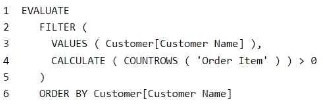
You discover that the following query performs slowly against Model1.
You need to reduce the execution time of the query.
Solution: You replace line 4 by using the following code:
ISEMPTY ( RELATEDTABLE ( 'Order Item' ) ) Does this meet the goal?
A
Yes
B
No
Reveal answer detailsClose answer details
Correct answerB
Question 26
Single choice
You have a Fabric tenant that contains a warehouse named DW1 and a lakehouse named LH1. DW1 contains a table named Sales.Product. LH1 contains a table named Sales.Orders.
You plan to schedule an automated process that will create a new point-in-time (PIT) table named Sales.ProductOrder in DW1. Sales.ProductOrder will be built by using the results of a query that will join Sales.Product and Sales.Orders.
You need to ensure that the types of columns in Sales.ProductOrder match the column types in the source tables. The solution must minimize the number of operations required to create the new table.
Which operation should you use?
A
Create table as select (CTAS)
B
Insert into
C
Create materialized view as select
D
Create table as clone of
Reveal answer detailsClose answer details
Correct answerA
Question 27
Hotspot
HOTSPOT
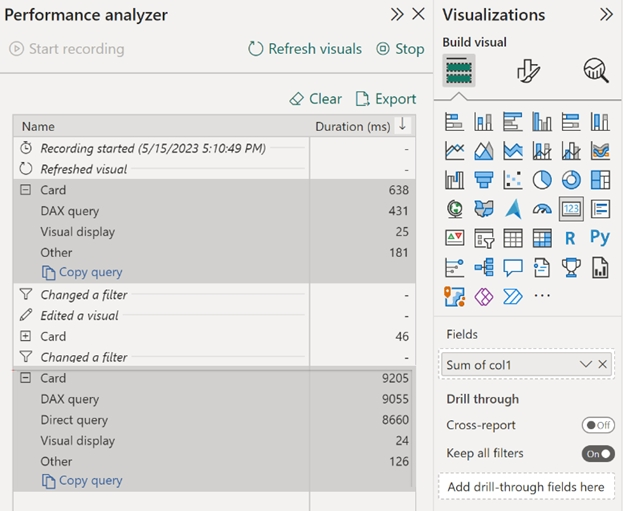
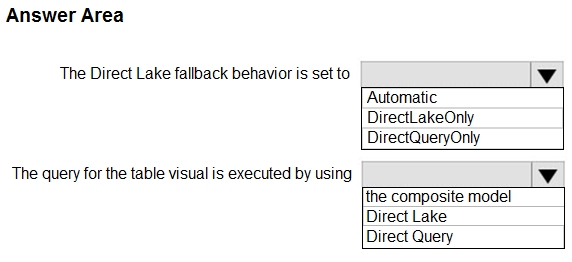
You have a Microsoft Power B1 report and a semantic model that uses Direct Lake mode.
From Power Si Desktop, you open Performance analyzer as shown in the following exhibit.
Use the drop-down menus to select the answer choice that completes each statement based on the information presented in the graphic. NOTE: Each correct selection is worth one point.
Reveal answer detailsClose answer details
Question 28
Single choice
Note: This question is part of a series of questions that present the same scenario. Each question in the series contains a unique solution that might meet the stated goals. Some question sets might have more than one correct solution, while others might not have a correct solution.
After you answer a question in this section, you will NOT be able to return to it. As a result, these questions will not appear in the review screen.
You have a Fabric tenant that contains a takehouse named lakehouse1. Lakehouse1 contains a Delta table named Customer.
When you query Customer, you discover that the query is slow to execute. You suspect that maintenance was NOT performed on the table.
You need to identify whether maintenance tasks were performed on Customer.
Solution: You run the following Spark SQL statement:
DESCRIBE HISTORY customer
Does this meet the goal?
A
Yes
B
No
Reveal answer detailsClose answer details
Correct answerA
Explanation
Yes, the DESCRIBE HISTORY statement does meet the goal. It provides information on the history of operations, including maintenance tasks, performed on a Delta table. References: The functionality of the DESCRIBE HISTORY statement can be verified in the Delta Lake documentation.
Question 29
Single choice
You have a Fabric workspace named Workspace1 and a user named User1.
You need to ensure that User1 can perform the following tasks in Workspace1: 1. Create dashboards. 2. Publish semantic models. 3. Create and publish reports. The solution must follow the principle of least privilege.
Which workspace role should you assign to User1?
A
Contributor
B
Member
C
Viewer
D
Admin
Reveal answer detailsClose answer details
Correct answerA
Explanation
The most appropriate role for this user is the Contributor role. In Microsoft Fabric, workspace roles are hierarchical. The Contributor role provides the exact balance of creation and publishing permissions without granting the administrative overhead or broad sharing powers found in higher roles.
The Contributor role is specifically designed for data creators. It allows the user to perform all requested tasks while maintaining "least privilege" by restricting administrative control. Included Permissions Create and Publish: Users can upload or create semantic models, reports, and dashboards. Edit Content: They can modify existing items within the workspace they have access to.
Interact with Fabric items: They can create, read, update, and delete items like Data Pipelines, Notebooks, and Lakehouses.
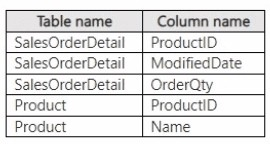
You have a Fabric workspace that contains a warehouse named DW1. DW1 contains the following tables and columns.
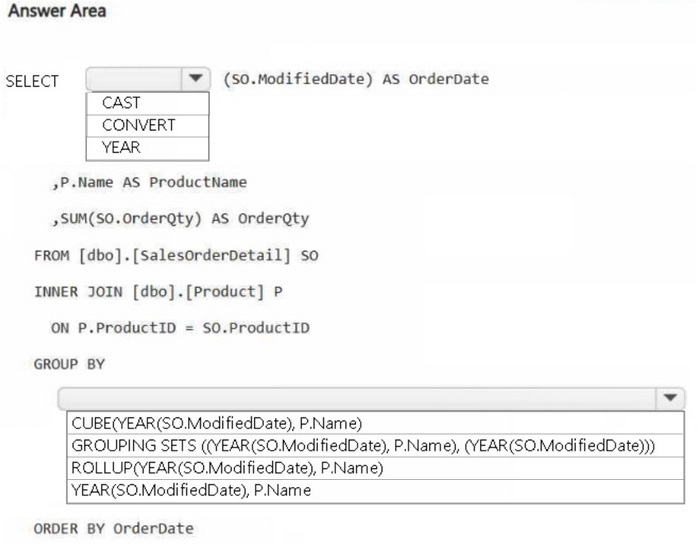
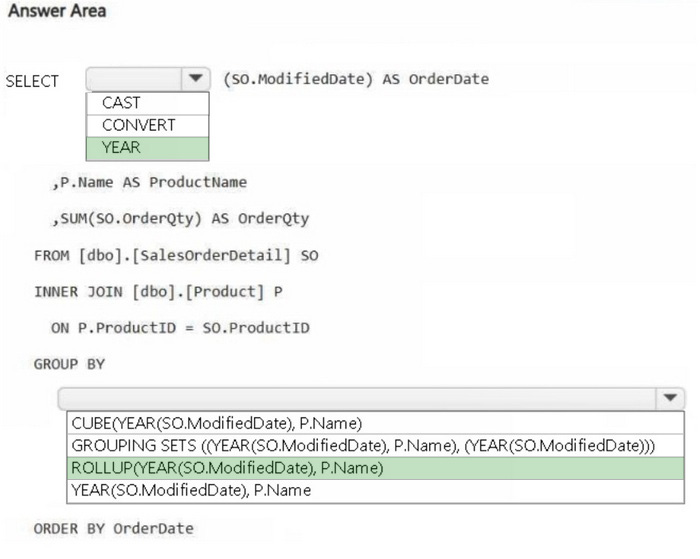
You need to summarize order quantities by year and product. The solution must include the yearly sum of order quantities for all the products in each row. How should you complete the T-SQL statement? To answer, select the appropriate options in the answer area.
NOTE: Each correct selection is worth one point.
Reveal answer detailsClose answer details
Question 31
Hotspot
HOTSPOT
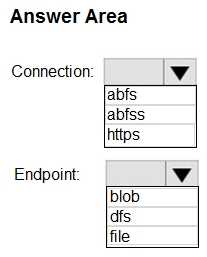
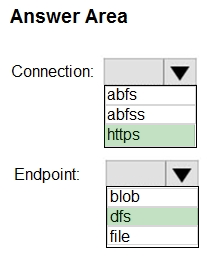
You have a Fabric workspace named Workspace1 and an Azure Data Lake Storage Gen2 account named storage1. Workspace1 contains a lakehouse named Lakehouse1.
You need to create a shortcut to storage1 in Lakehouse1.
Which connection and endpoint should you specify? To answer, select the appropriate options in the answer area.
NOTE: Each correct selection is worth one point.
Reveal answer detailsClose answer details
Question 32
Single choice
A data pipeline loads sales data and then refreshes a semantic model. The model should refresh only if the load succeeds. What should you configure?
A
A dependency so the refresh activity runs after a successful load activity.
B
A report bookmark that hides the refresh status.
C
A semantic model display folder.
D
A visual interaction between two report charts.
Reveal answer detailsClose answer details
Correct answerA
Explanation
The semantic model refresh should run only after the sales data load succeeds, so the process needs a success dependency between the load activity and the refresh activity. That dependency prevents the model from refreshing against incomplete, stale, or failed data. It also makes the pipeline behavior clear to operators because the downstream step is tied to the upstream result.
A report bookmark stores a report navigation or filter state and cannot control data processing. A semantic model display folder organizes fields for authors but has no effect on refresh sequencing. Visual interactions determine how selections in one visual affect another visual on a report page, not how pipeline activities run. The problem is orchestration, so the control belongs in the data pipeline. A success path protects the model refresh from running at the wrong time and makes failures easier to diagnose.
This sequencing also protects user trust. A refreshed model that includes only part of a load can publish misleading totals even when the report itself is unchanged.
Question 33
Single choice
You have a Fabric tenant.
You plan to create a data pipeline named Pipeline1. Pipeline1 will include two activities that will execute in sequence.
You need to ensure that a failure of the first activity will NOT block the second activity.
Which conditional path should you configure between the first activity and the second activity?
A
Upon Failure
B
Upon Completion
C
Upon Skip
D
Upon Skip
Reveal answer detailsClose answer details
Correct answerB
Question 34
Drag & drop
DRAG DROP
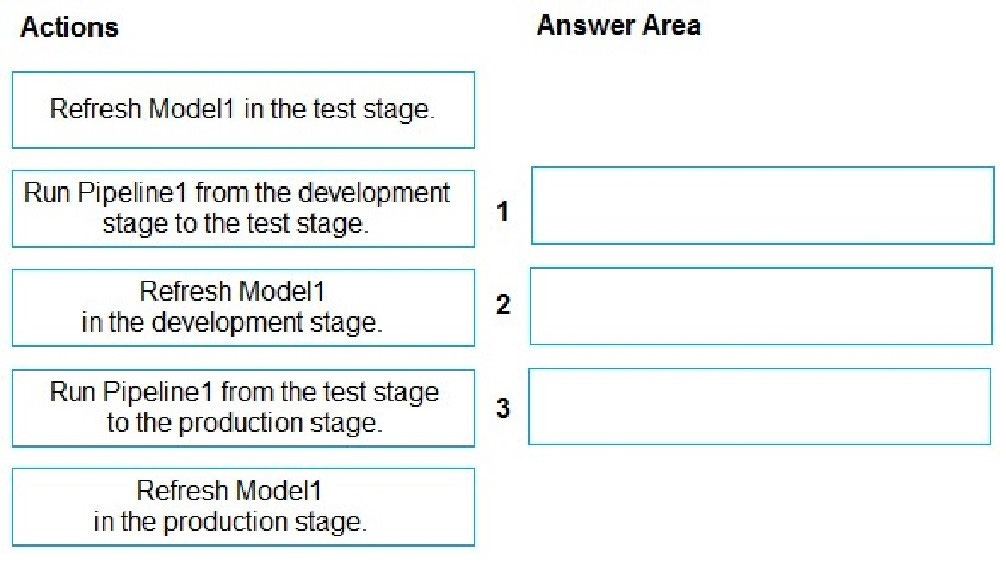
You have three Fabric workspaces named Workspace1, Workspace2, and Workspace3. Workspace1 contains a report named Report1 and a semantic model named Model1 in Import mode.
You perform the following actions:
1. Create a deployment pipeline named Pipeline1 that has three stages named development, test, and production. 2. Assign Workspace1 to the development stage of Pipeline1. 3. Assign Workspace2 to the test stage of Pipeline1. 4. Assign Workspace3 to the production stage of Pipeline1. 5. Modify Model1.
You need to ensure that changes to Model1 are available in the production stage as quickly as possible. The solution must NOT affect the availability of Report1.
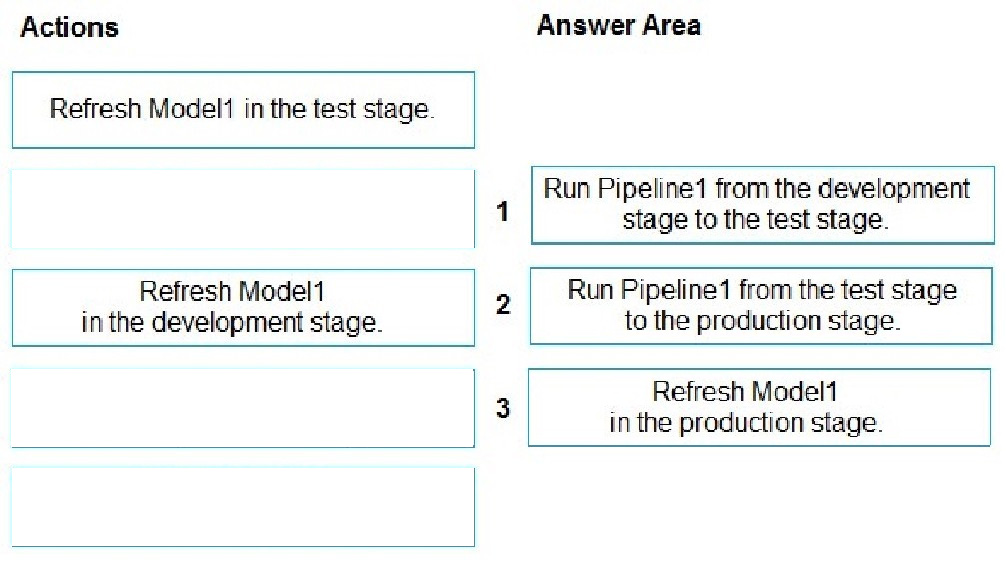
Which three actions should you perform in sequence? To answer, move the appropriate actions from the list of actions to the answer area and arrange them in the correct order.
Reveal answer detailsClose answer details
Explanation
To ensure changes reach production quickly without causing report downtime, you must use the deployment pipeline's built-in promotion tools combined with a selective refresh strategy.
Step 1: Run Pipeline1 from the development stage to the test stage Deploy from Development to Test Select Workspace1 (Development). Click Deploy to push the modified model to Workspace2 (Test).
Step 2: Run Pipeline1 from the test stage to the production stage Deploy from Test to Production Select Workspace2 (Test). Click Deploy to push the model to Workspace3 (Production). This updates the metadata (schema) of the model immediately.
Step 3: Refresh Model1 in the production stage. Perform a Data Refresh in Production Trigger a Refresh on the model within Workspace3. Import models must be refreshed to show new data/changes. The "old" version of the report remains viewable until the refresh completes.
This is a case study. Case studies are not timed separately. You can use as much exam time as you would like to complete each case. However, there may be additional case studies and sections on this exam. You must manage your time to ensure that you are able to complete all questions included on this exam in the time provided.
To answer the questions included in a case study, you will need to reference information that is provided in the case study. Case studies might contain exhibits and other resources that provide more information about the scenario that is
described in the case study. Each question is independent of the other questions in this case study.
At the end of this case study, a review screen will appear. This screen allows you to review your answers and to make changes before you move to the next section of the exam. After you begin a new section, you cannot return to this section.
To start the case study
To display the first question in this case study, click the Next button. Use the buttons in the left pane to explore the content of the case study before you answer the questions. Clicking these buttons displays information such as business
requirements, existing environment, and problem statements. If the case study has an All Information tab, note that the information displayed is identical to the information displayed on the subsequent tabs. When you are ready to answer a question, click the Question button to return to the question.
Overview Contoso, Ltd. is a US-based health supplements company. Contoso has two divisions named Sales and Research. The Sales division contains two departments named Online Sales and Retail Sales. The Research division assigns internally developed product lines to individual teams of researchers and analysts.
Existing Environment
Identity Environment Contoso has a Microsoft Entra tenant named contoso.com. The tenant contains two groups named ResearchReviewersGroup1 and ResearchReviewersGroup2.
Data Environment Contoso has the following data environment: The Sales division uses a Microsoft Power BI Premium capacity. The semantic model of the Online Sales department includes a fact table named Orders that uses Import made. In the system of origin, the OrderID value represents the sequence in which orders are created. The Research department uses an on-premises, third-party data warehousing product. Fabric is enabled for contoso.com. An Azure Data Lake Storage Gen2 storage account named storage1 contains Research division data for a product line named Productline1. The data is in the delta format. A Data Lake Storage Gen2 storage account named storage2 contains Research division data for a product line named Productline2. The data is in the CSV format.
Requirements
Planned Changes Contoso plans to make the following changes: Enable support for Fabric in the Power BI Premium capacity used by the Sales division. Make all the data for the Sales division and the Research division available in Fabric. For the Research division, create two Fabric workspaces named Productline1ws and Productine2ws. In Productline1ws, create a lakehouse named Lakehouse1. In Lakehouse1, create a shortcut to storage1 named ResearchProduct.
Data Analytics Requirements Contoso identifies the following data analytics requirements: All the workspaces for the Sales division and the Research division must support all Fabric experiences. The Research division workspaces must use a dedicated, on-demand capacity that has per-minute billing. The Research division workspaces must be grouped together logically to support OneLake data hub filtering based on the department name. For the Research division workspaces, the members of ResearchReviewersGroup1 must be able to read lakehouse and warehouse data and shortcuts by using SQL endpoints. For the Research division workspaces, the members of ResearchReviewersGroup2 must be able to read lakehouse data by using Lakehouse explorer. All the semantic models and reports for the Research division must use version control that supports branching.
Data Preparation Requirements Contoso identifies the following data preparation requirements: The Research division data for Productline1 must be retrieved from Lakehouse1 by using Fabric notebooks. All the Research division data in the lakehouses must be presented as managed tables in Lakehouse explorer.
Semantic Model Requirements Contoso identifies the following requirements for implementing and managing semantic models: The number of rows added to the Orders table during refreshes must be minimized. The semantic models in the Research division workspaces must use Direct Lake mode.
General Requirements Contoso identifies the following high-level requirements that must be considered for all solutions: Follow the principle of least privilege when applicable. Minimize implementation and maintenance effort when possible.
Question 35
Testlet 2Single choice
You need to recommend which type of Fabric capacity SKU meets the data analytics requirements for the Research division.
What should you recommend?
A
A
B
EM
C
P
D
F
Reveal answer detailsClose answer details
Correct answerD
Question 36
Hotspot
HOTSPOT
You have a Fabric tenant that contains a lakehouse.
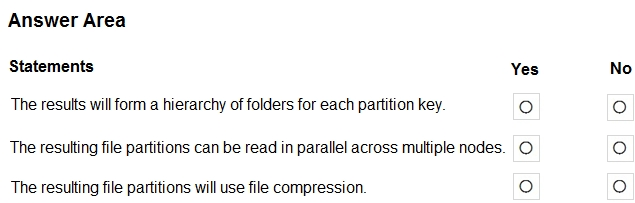
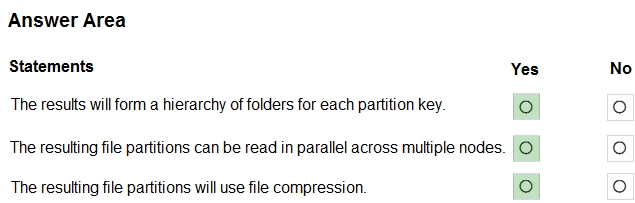
You are using a Fabric notebook to save a large DataFrame by using the following code.
For each of the following statements, select Yes if the statement is true. Otherwise, select No.
NOTE: Each correct selection is worth one point.
Reveal answer detailsClose answer details
Question 37
Single choice
A company is planning a Fabric analytics solution for finance and operations. Finance data must be available only to the finance analytics team, while shared operational metrics must be reused by both teams. Which design should you recommend?
A
Use one workspace for all data and grant all analysts Contributor access.
B
Use separate workspaces for restricted finance assets and shared operational assets, with access assigned through security groups.
C
Store all data in personal workspaces and publish reports from those workspaces.
D
Give report consumers direct edit access to all semantic models so they can build their own reports.
Reveal answer detailsClose answer details
Correct answerB
Explanation
The recommended design separates the sensitive finance workspace boundary from the shared operational metrics boundary. Finance data has a narrower audience, so it should live in an area where membership, permissions, endorsement, and lifecycle controls can be managed for that team specifically. Shared operational metrics can then be placed in a separate governed workspace or shared asset area so both teams can reuse them without receiving unnecessary access to finance-only data.
Using security groups is also important because it lets access follow team membership instead of requiring repeated user-by-user changes. A single workspace with broad Contributor access would mix restricted and shared assets and grant edit permissions beyond what many users need. Personal workspaces are unsuitable for governed enterprise analytics because ownership and continuity become weak. Giving report consumers direct edit rights to semantic models also breaks least privilege; consumers normally need read or build capabilities, not broad model modification rights.
Question 38
Hotspot
HOTSPOT
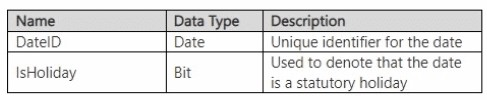
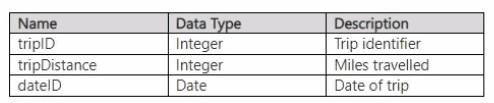
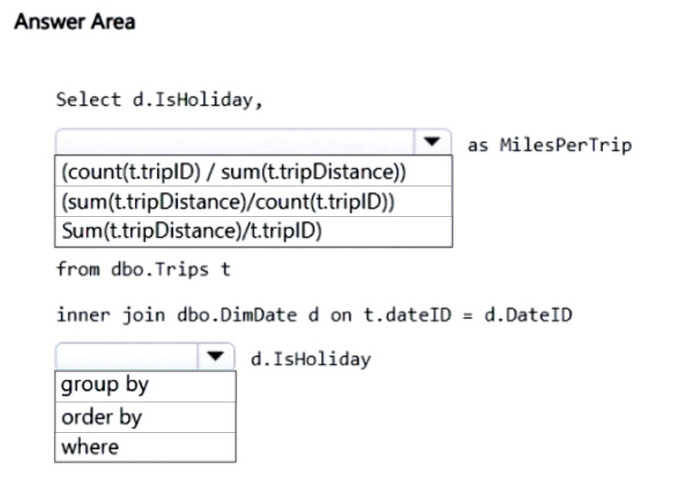
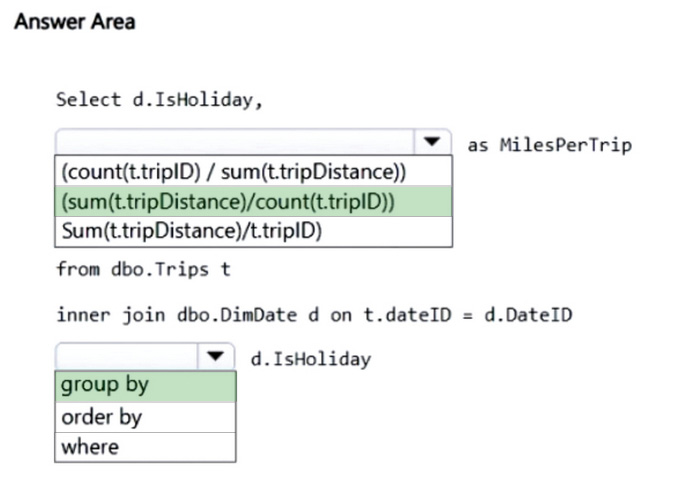
You have a Fabric warehouse that contains two tables named DimDate and Trips.
DimDate contains the following fields.
Trips contains the following fields.
You need to compare the average miles per trip for statutory holidays versus non-statutory holidays.
How should you complete the T-SQL statement? To answer, select the appropriate options in the answer area.
NOTE: Each correct selection is worth one point.
Reveal answer detailsClose answer details
MICROSOFT
Implementing Analytics Solutions Using Microsoft Fabric
You have a Fabric workspace named Workspace1 that contains a lakehouse named Lakehouse1.
In Workspace1, you create a data pipeline named Pipeline1.
You have CSV files stored in an Azure Storage account.
You need to add an activity to Pipeline1 that will copy data from the CSV files to Lakehouse1. The activity must support Power Query M formula language expressions.
Which type of activity should you add?
A.
Dataflow
B.
Notebook
C.
Script
D.
Copy data
Correct Answer: A
QUESTION 2
You need to design a data preparation process that preserves raw source data and also provides cleansed tables for reporting. Which approach should you use?
A.
Overwrite raw files each time a report is refreshed.
B.
Keep a raw layer and create a curated layer for reporting.
C.
Store all business rules only in visual-level filters.
D.
Delete intermediate data as soon as a notebook finishes.
Correct Answer: B
Explanation
Explanation/Reference:
A raw layer plus a curated layer is a sound preparation pattern because it separates preservation from presentation. The raw layer keeps the ingested source data available for reconciliation, reloads, troubleshooting, and audit comparisons. The curated layer applies cleansing, standardization, and business rules so semantic models and reports consume data that is ready for analysis.
Overwriting raw files during report refresh removes the original evidence needed to understand later discrepancies. Keeping all business rules in visual filters scatters transformation logic across reports and makes consistency nearly impossible to prove. Deleting intermediate data immediately after a notebook finishes may save storage, but it can make failures and unexpected results much harder to diagnose. A layered approach also supports incremental improvement: teams can refine curated outputs while retaining a stable record of what was received from each source. That balance is why the raw and curated pattern is preferred for governed analytics.
QUESTION 3
You are loading a dimension table that tracks the current description for each product. Historical product descriptions are not required. Which behavior should the load process implement?
A.
Update the existing product row when the description changes and insert a row for a new product.
B.
Insert a new row for every change and keep all prior versions active.
C.
Delete all fact data when any product attribute changes.
D.
Store product descriptions only in the report title.
Correct Answer: A
Explanation
Explanation/Reference:
When historical product descriptions are not required, the load should update the existing dimension row when the description changes and insert a row when a product appears for the first time. That behavior keeps the dimension focused on current-state reporting. Users who group by product description will see the latest value without needing to choose among multiple historical versions.
Inserting a new row for every changed description is used when the business needs to preserve attribute history, such as reporting sales by the product description that was valid at the transaction date. That is not requested here. Deleting fact data because a dimension attribute changes would destroy transaction history and break analytical integrity. Storing descriptions in a report title removes them from the model and prevents normal filtering or grouping. Updating existing rows for changed attributes and inserting only new business keys keeps the dimension simple, current, and aligned with the stated requirement.
QUESTION 4
You have a Fabric tenant that contains a semantic model named Model1. Model1 contains a fact table with millions of rows of shipment data.
You need to enable partitioning to improve the query performance and manageability of Model1.
Which two tools can you use to achieve the goal? Each correct answer presents a complete solution.
NOTE: Each correct answer is worth one point.
A.
Tabular Editor
B.
DAX Studio
C.
Microsoft Power BI Desktop
D.
the Microsoft Power BI service
E.
Microsoft SQL Server Management Studio (SSMS)
Correct Answer: AE
Explanation
Explanation/Reference:
The Tabular Editor and SSMS are the superior choices for managing large-scale semantic models in Microsoft Fabric. Power BI Desktop is limited because it lacks a native interface for manual partition management outside of basic Incremental Refresh.
Here is the breakdown of why and how to use these tools to optimize your million-row fact table.
You have a T-SQL query named Query1 that contains the following statements.
For each of the following statements, select Yes if the statement is true. Otherwise, select No.
NOTE: Each correct selection is worth one point.
Correct Answer:
QUESTION 7
You are implementing row-level restrictions in a semantic model. Which validation should you perform before releasing the report?
A.
Test the report experience as a user assigned to the restricted role.
B.
Verify only that the report background color is approved.
C.
Remove all relationships from the model.
D.
Give all users administrator access during testing.
Correct Answer: A
Explanation
Explanation/Reference:
Row-level restrictions should be validated by testing the report as a user assigned to the restricted role. Security rules can look correct in the model but still produce unexpected results because of relationships, role membership, slicers, or report design. Viewing the report through the restricted user's effective permissions confirms what data that person can actually see before the report is released.
Checking only the background color does not test data access. Removing all relationships would change the model and could invalidate the behavior being tested. Giving every user administrator access during testing defeats the security boundary and could expose data broadly. Proper validation focuses on the user experience under the intended role, including whether totals, detail rows, slicers, and drill paths respect the row-level rule. That approach gives the team confidence that the model enforces the regional or user-specific restriction in practice.
This validation should include both summary and detail views, because a role might appear correct at a high level while still exposing restricted drillthrough records.
QUESTION 8
You have a Fabric workspace named Workspace1 that contains a data flow named Dataflow1. Dataflow1 contains a query that returns the data shown in the following exhibit.
You need to transform the date columns into attribute-value pairs, where columns become rows.
You select the VendorlD column.
Which transformation should you select from the context menu of the VendorlD column?
A.
Group by
B.
Unpivot columns
C.
Unpivot other columns
D.
Split column
E.
Remove other columns
Correct Answer: C
QUESTION 9
You are analyzing customer purchases in a Fabric notebook by using PySpark.
You have the following DataFrames: transactions: Contains five columns named transaction_id, customer_id, product_id, amount, and date and has 10 million rows, with each row representing a transaction. customers: Contains customer details in 1,000 rows and three columns named customer_id, name, and country.
You need to join the DataFrames on the customer_id column. The solution must minimize data shuffling.
You write the following code.
from pyspark.sql import functions as F results = Which code should you run to populate the results DataFrame?
The correct code to populate the results DataFrame with minimal data shuffling is Option A. Using the broadcast function in PySpark is a way to minimize data movement by broadcasting the smaller DataFrame (customers) to each node in the cluster. This is ideal when one DataFrame is much smaller than the other, as in this case with customers. References: You can refer to the official Apache Spark documentation for more details on joins and the broadcast hint.
QUESTION 10
HOTSPOT
You have a Fabric tenant that contains a workspace named Enterprise. Enterprise contains a semantic model named Model1. Model1 contains a date parameter named Date1 that was created in Power Query.
You build a deployment pipeline named Enterprise Data that includes two stages named Development and Test. You assign the Enterprise workspace to the Development stage.
You need to perform the following actions:
Create a workspace named Enterprise [Test] and assign the workspace to the Test stage. Configure a rule that will modify the value of Date1 when changes are deployed to the Test stage.
Which two settings should you use? To answer, select the appropriate settings in the answer area.
NOTE: Each correct answer is worth one point.
Correct Answer:
Case Study 2
Case Study Questions
This is a case study. Case studies are not timed separately. You can use as much exam time as you would like to complete each case. However, there may be additional case studies and sections on this exam. You must manage your time to ensure that you are able to complete all questions included on this exam in the time provided.
To answer the questions included in a case study, you will need to reference information that is provided in the case study. Case studies might contain exhibits and other resources that provide more information about the scenario that is
described in the case study. Each question is independent of the other questions in this case study.
At the end of this case study, a review screen will appear. This screen allows you to review your answers and to make changes before you move to the next section of the exam. After you begin a new section, you cannot return to this section.
To start the case study
To display the first question in this case study, click the Next button. Use the buttons in the left pane to explore the content of the case study before you answer the questions. Clicking these buttons displays information such as business
requirements, existing environment, and problem statements. If the case study has an All Information tab, note that the information displayed is identical to the information displayed on the subsequent tabs. When you are ready to answer a question, click the Question button to return to the question.
Overview Contoso, Ltd. is a US-based health supplements company. Contoso has two divisions named Sales and Research. The Sales division contains two departments named Online Sales and Retail Sales. The Research division assigns internally developed product lines to individual teams of researchers and analysts.
Existing Environment
Identity Environment Contoso has a Microsoft Entra tenant named contoso.com. The tenant contains two groups named ResearchReviewersGroup1 and ResearchReviewersGroup2.
Data Environment Contoso has the following data environment: The Sales division uses a Microsoft Power BI Premium capacity. The semantic model of the Online Sales department includes a fact table named Orders that uses Import made. In the system of origin, the OrderID value represents the sequence in which orders are created. The Research department uses an on-premises, third-party data warehousing product. Fabric is enabled for contoso.com. An Azure Data Lake Storage Gen2 storage account named storage1 contains Research division data for a product line named Productline1. The data is in the delta format. A Data Lake Storage Gen2 storage account named storage2 contains Research division data for a product line named Productline2. The data is in the CSV format.
Requirements
Planned Changes Contoso plans to make the following changes: Enable support for Fabric in the Power BI Premium capacity used by the Sales division. Make all the data for the Sales division and the Research division available in Fabric. For the Research division, create two Fabric workspaces named Productline1ws and Productine2ws. In Productline1ws, create a lakehouse named Lakehouse1. In Lakehouse1, create a shortcut to storage1 named ResearchProduct.
Data Analytics Requirements Contoso identifies the following data analytics requirements: All the workspaces for the Sales division and the Research division must support all Fabric experiences. The Research division workspaces must use a dedicated, on-demand capacity that has per-minute billing. The Research division workspaces must be grouped together logically to support OneLake data hub filtering based on the department name. For the Research division workspaces, the members of ResearchReviewersGroup1 must be able to read lakehouse and warehouse data and shortcuts by using SQL endpoints. For the Research division workspaces, the members of ResearchReviewersGroup2 must be able to read lakehouse data by using Lakehouse explorer. All the semantic models and reports for the Research division must use version control that supports branching.
Data Preparation Requirements Contoso identifies the following data preparation requirements: The Research division data for Productline1 must be retrieved from Lakehouse1 by using Fabric notebooks. All the Research division data in the lakehouses must be presented as managed tables in Lakehouse explorer.
Semantic Model Requirements Contoso identifies the following requirements for implementing and managing semantic models: The number of rows added to the Orders table during refreshes must be minimized. The semantic models in the Research division workspaces must use Direct Lake mode.
General Requirements Contoso identifies the following high-level requirements that must be considered for all solutions: Follow the principle of least privilege when applicable. Minimize implementation and maintenance effort when possible.
QUESTION 11
HOTSPOT
You need to recommend a solution to group the Research division workspaces.
What should you include in the recommendation? To answer, select the appropriate options in the answer area.
NOTE: Each correct selection is worth one point.
Correct Answer:
QUESTION 12
Note: This question is part of a series of questions that present the same scenario. Each question in the series contains a unique solution that might meet the stated goals. Some question sets might have more than one correct solution, while others might not have a correct solution.
After you answer a question in this section, you will NOT be able to return to it. As a result, these questions will not appear in the review screen.
You have a Fabric tenant that contains a new semantic model in OneLake.
You use a Fabric notebook to read the data into a Spark DataFrame.
You need to evaluate the data to calculate the min, max, mean, and standard deviation values for all the string and numeric columns.
Solution: You use the following PySpark expression:
df .sumary ()
Does this meet the goal?
A.
Yes
B.
No
Correct Answer: A
Explanation
Explanation/Reference:
Yes, the df.summary() method does meet the goal. This method is used to compute specified statistics for numeric and string columns. By default, it provides statistics such as count, mean, stddev, min, and max. References: The PySpark API documentation details the summary() function and the statistics it provides.
QUESTION 13
A data model contains a fact table with order rows and a product dimension. You need a report slicer that filters orders by product category. What should you configure?
A.
A relationship between the product dimension and the order fact table.
B.
A separate report for every product category.
C.
A calculated column that stores a screenshot of the slicer.
D.
A workspace role named Product Category.
Correct Answer: A
Explanation
Explanation/Reference:
A relationship between the product dimension and the order fact table is needed so product category can filter order rows. The product dimension stores attributes such as category and product name, while the fact table stores individual order events and measures. When the relationship connects the two tables, a slicer using product category can filter the related facts and produce the intended order totals.
Creating a separate report for every product category duplicates report design and does not provide flexible filtering. A calculated column containing a screenshot has no analytical relationship to the data. A workspace role named Product Category would describe permissions or membership, not model filter behavior. Slicers operate through fields, relationships, and filter context in the model. The dimension-to-fact relationship is therefore the structural requirement that lets the category selection affect the order data correctly.
That structure also avoids hard-coding category logic in individual visuals, so the same product slicer can be reused across pages and reports consistently.
QUESTION 14
You have a Microsoft Power Bl semantic model. You need to identify any surrogate key columns in the model that have the Summarize By property set to a value other than to None. The solution must minimize effort.
What should you use?
A.
DAX Formatter in DAX Studio
B.
Model view in Microsoft Power Bl Desktop
C.
Model explorer in Microsoft Power Bl Desktop
D.
Best Practice Analyzer in Tabular Editor
Correct Answer: D
Explanation
Explanation/Reference:
To identify surrogate key columns with the "Summarize By" property set to a value other than "None," the Best Practice Analyzer in Tabular Editor is the most efficient tool. The Best Practice Analyzer can analyze the entire model and provide a report on all columns that do not meet a specified best practice, such as having the "Summarize By" property set correctly for surrogate key columns. Here's how you would proceed: Open your Power BI model in Tabular Editor. Go to the Advanced Scripting window. Write or use an existing script that checks the "Summarize By" property of each column. Execute the script to get a report on the surrogate key columns that do not have their "Summarize By" property set to "None". You can then review and adjust the properties of the columns directly within the Tabular Editor. References: The functionality of the Best Practice Analyzer in Tabular Editor is documented in the community and learning resources for Power BI.
QUESTION 15
You have a Fabric tenant that contains a lakehouse named lakehouse1. Lakehouse1 contains a table named Table1.
You are creating a new data pipeline.
You plan to copy external data to Table1. The schema of the external data changes regularly.
You need the copy operation to meet the following requirements:
1. Replace Table1 with the schema of the external data. 2. Replace all the data in Table1 with the rows in the external data.
You add a Copy data activity to the pipeline.
What should you do for the Copy data activity?
A.
From the Source tab, add additional columns.
B.
From the Destination tab, set Table action to Overwrite.
C.
From the Settings tab, select Enable staging
D.
From the Source tab, select Enable partition discovery
E.
From the Source tab, select Recursively
Correct Answer: B
Explanation
Explanation/Reference:
For the Copy data activity, from the Destination tab, setting Table action to Overwrite (B) will ensure that Table1 is replaced with the schema and rows of the external data, meeting the requirements of replacing both the schema and data of the destination table. References: Information about Copy data activity and table actions in Azure Data Factory, which can be applied to data pipelines in Fabric, is available in the Azure Data Factory documentation.
QUESTION 16
DRAG DROP
You have a Fabric eventhouse named Eventhousel that contains a table named Weatherdata. A sample of the data in Weatherdata is shown in the following table.
You plan to use a KQL queryset to manipulate the data in Eventhouse1. The result set must have the following columns.
You need to build the query.
Which four KQL statements should you use in sequence? To answer, move the appropriate statements from the list of statements to the answer area and arrange them in the correct order.
Correct Answer:
QUESTION 17
HOTSPOT
You have a Fabric warehouse that contains a table named Sales.Orders. Sales.Orders contains the following columns.
You need to write a T-SQL query that will return the following columns.
How should you complete the code? To answer, select the appropriate options in the answer area.
NOTE: Each correct selection is worth one point.
Correct Answer:
QUESTION 18
You have a Fabric tenant that contains a data pipeline.
You need to ensure that the pipeline runs every four hours on Mondays and Fridays.
To what should you set Repeat for the schedule?
A.
Daily
B.
By the minute
C.
Weekly
D.
Hourly
Correct Answer: C
Explanation
Explanation/Reference:
You should set Repeat for the schedule to Weekly (C). This allows you to specify the pipeline to run on specific days of the week, in this case, every four hours on Mondays and Fridays. References: Scheduling options for data pipelines are available in the Azure Data Factory documentation, which includes details on configuring recurring triggers.
QUESTION 19
You have a Fabric tenant that uses a Microsoft tower Bl Premium capacity. You need to enable scale-out for a semantic model.
What should you do first?
A.
At the semantic model level, set Large dataset storage format to Off.
B.
At the tenant level, set Create and use Metrics to Enabled.
C.
At the semantic model level, set Large dataset storage format to On.
D.
At the tenant level, set Data Activator to Enabled.
Correct Answer: C
Explanation
Explanation/Reference:
To enable scale-out for a semantic model, you should first set Large dataset storage format to On (C) at the semantic model level. This configuration is necessary to handle larger datasets effectively in a scaled-out environment. References: Guidance on configuring large dataset storage formats for scale-out is available in the Power BI documentation.
QUESTION 20
You are the administrator of a Fabric workspace that contains a lakehouse named Lakehouse1. Lakehouse1 contains the following tables:
1. Table1: A Delta table created by using a shortcut 2. Table2: An external table created by using Spark 3. Table3: A managed table
You plan to connect to Lakehouse1 by using its SQL endpoint.
What will you be able to do after connecting to Lakehouse1?
A.
ReadTable3.
B.
Update the data Table3.
C.
ReadTable2.
D.
Update the data in Table1.
Correct Answer: D
QUESTION 21
HOTSPOT
You have a Fabric workspace that contains a large warehouse. You plan to create a lakehouse named Lakehouse1 for a sales dataset. Lakehouse1 will contain the following tables:
1. Sales: Contains sales transactions. 2. Stores: Contains a unique list of store names and locations - Loyalty: Contains a list of customers and their preferred stores - Customers: Contains a unique list of customer names and addresses - Products: Contains a unique list of available products and their descriptions.
You need to configure a star schema for Lakehouse1.
Which table should you define as the fact table, and which type of relationship should you configure from the Sales table to the Customers table? To answer, select the appropriate options in the answer area.
NOTE: Each correct selection is worth one point.
Correct Answer:
QUESTION 22
Note: This question is part of a series of questions that present the same scenario. Each question in the series contains a unique solution that might meet the stated goals. Some question sets might have more than one correct solution, while others might not have a correct solution.
After you answer a question in this section, you will NOT be able to return to it. As a result, these questions will not appear in the review screen.
You have a Fabric tenant that contains a new semantic model in OneLake.
You use a Fabric notebook to read the data into a Spark DataFrame.
You need to evaluate the data to calculate the min, max, mean, and standard deviation values for all the string and numeric columns.
Solution: You use the following PySpark expression:
df.explain().show()
Does this meet the goal?
A.
Yes
B.
No
Correct Answer: B
QUESTION 23
You have a Fabric tenant. You are creating a Fabric Data Factory pipeline.
You have a stored procedure that returns the number of active customers and their average sales for the current month.
You need to add an activity that will execute the stored procedure in a warehouse. The returned values must be available to the downstream activities of the pipeline.
Which type of activity should you add?
A.
Script
B.
Copy data
C.
Switch
D.
Append variable
Correct Answer: A
Explanation
Explanation/Reference:
In a Fabric Data Factory pipeline, to execute a stored procedure and make the returned values available for downstream activities, the Lookup activity is used. This activity can retrieve a dataset from a data store and pass it on for further processing. Here's how you would use the Lookup activity in this context: Add a Lookup activity to your pipeline. Configure the Lookup activity to use the stored procedure by providing the necessary SQL statement or stored procedure name. In the settings, specify that the activity should use the stored procedure mode. Once the stored procedure executes, the Lookup activity will capture the results and make them available in the pipeline's memory. Downstream activities can then reference the output of the Lookup activity.
References: The functionality and use of Lookup activity within Azure Data Factory is documented in Microsoft's official documentation for Azure Data Factory, under the section for pipeline activities.
QUESTION 24
You have a Fabric tenant that contains a lakehouse named Lakehouse1. Lakehouse1 contains a subfolder named Subfolder1 that contains CSV files. You need to convert the CSV files into the delta format that has V-Order optimization enabled.
What should you do from Lakehouse explorer?
A.
Use the Load to Tables feature.
B.
Create a new shortcut in the Files section.
C.
Create a new shortcut in the Tables section.
D.
Use the Optimize feature.
Correct Answer: A
Explanation
Explanation/Reference:
To convert CSV files into the delta format with Z-Order optimization enabled, you should use the Optimize feature (D) from Lakehouse Explorer. This will allow you to optimize the file organization for the most efficient querying. References: The process for converting and optimizing file formats within a lakehouse is discussed in the lakehouse management documentation.
QUESTION 25
Note: This question is part of a series of questions that present the same scenario. Each question in the series contains a unique solution that might meet the stated goals. Some question sets might have more than one correct solution, while others might not have a correct solution.
After you answer a question in this section, you will NOT be able to return to it. As a result, these questions will not appear in the review screen.
You have a Fabric tenant that contains a semantic model named Model1.
You discover that the following query performs slowly against Model1.
You need to reduce the execution time of the query.
Solution: You replace line 4 by using the following code:
ISEMPTY ( RELATEDTABLE ( 'Order Item' ) ) Does this meet the goal?
A.
Yes
B.
No
Correct Answer: B
QUESTION 26
You have a Fabric tenant that contains a warehouse named DW1 and a lakehouse named LH1. DW1 contains a table named Sales.Product. LH1 contains a table named Sales.Orders.
You plan to schedule an automated process that will create a new point-in-time (PIT) table named Sales.ProductOrder in DW1. Sales.ProductOrder will be built by using the results of a query that will join Sales.Product and Sales.Orders.
You need to ensure that the types of columns in Sales.ProductOrder match the column types in the source tables. The solution must minimize the number of operations required to create the new table.
Which operation should you use?
A.
Create table as select (CTAS)
B.
Insert into
C.
Create materialized view as select
D.
Create table as clone of
Correct Answer: A
QUESTION 27
HOTSPOT
You have a Microsoft Power B1 report and a semantic model that uses Direct Lake mode.
From Power Si Desktop, you open Performance analyzer as shown in the following exhibit.
Use the drop-down menus to select the answer choice that completes each statement based on the information presented in the graphic. NOTE: Each correct selection is worth one point.
Correct Answer:
QUESTION 28
Note: This question is part of a series of questions that present the same scenario. Each question in the series contains a unique solution that might meet the stated goals. Some question sets might have more than one correct solution, while others might not have a correct solution.
After you answer a question in this section, you will NOT be able to return to it. As a result, these questions will not appear in the review screen.
You have a Fabric tenant that contains a takehouse named lakehouse1. Lakehouse1 contains a Delta table named Customer.
When you query Customer, you discover that the query is slow to execute. You suspect that maintenance was NOT performed on the table.
You need to identify whether maintenance tasks were performed on Customer.
Solution: You run the following Spark SQL statement:
DESCRIBE HISTORY customer
Does this meet the goal?
A.
Yes
B.
No
Correct Answer: A
Explanation
Explanation/Reference:
Yes, the DESCRIBE HISTORY statement does meet the goal. It provides information on the history of operations, including maintenance tasks, performed on a Delta table. References: The functionality of the DESCRIBE HISTORY statement can be verified in the Delta Lake documentation.
QUESTION 29
You have a Fabric workspace named Workspace1 and a user named User1.
You need to ensure that User1 can perform the following tasks in Workspace1: 1. Create dashboards. 2. Publish semantic models. 3. Create and publish reports. The solution must follow the principle of least privilege.
Which workspace role should you assign to User1?
A.
Contributor
B.
Member
C.
Viewer
D.
Admin
Correct Answer: A
Explanation
Explanation/Reference:
The most appropriate role for this user is the Contributor role. In Microsoft Fabric, workspace roles are hierarchical. The Contributor role provides the exact balance of creation and publishing permissions without granting the administrative overhead or broad sharing powers found in higher roles.
The Contributor role is specifically designed for data creators. It allows the user to perform all requested tasks while maintaining "least privilege" by restricting administrative control. Included Permissions Create and Publish: Users can upload or create semantic models, reports, and dashboards. Edit Content: They can modify existing items within the workspace they have access to.
Interact with Fabric items: They can create, read, update, and delete items like Data Pipelines, Notebooks, and Lakehouses.
You have a Fabric workspace that contains a warehouse named DW1. DW1 contains the following tables and columns.
You need to summarize order quantities by year and product. The solution must include the yearly sum of order quantities for all the products in each row. How should you complete the T-SQL statement? To answer, select the appropriate options in the answer area.
NOTE: Each correct selection is worth one point.
Correct Answer:
QUESTION 31
HOTSPOT
You have a Fabric workspace named Workspace1 and an Azure Data Lake Storage Gen2 account named storage1. Workspace1 contains a lakehouse named Lakehouse1.
You need to create a shortcut to storage1 in Lakehouse1.
Which connection and endpoint should you specify? To answer, select the appropriate options in the answer area.
NOTE: Each correct selection is worth one point.
Correct Answer:
QUESTION 32
A data pipeline loads sales data and then refreshes a semantic model. The model should refresh only if the load succeeds. What should you configure?
A.
A dependency so the refresh activity runs after a successful load activity.
B.
A report bookmark that hides the refresh status.
C.
A semantic model display folder.
D.
A visual interaction between two report charts.
Correct Answer: A
Explanation
Explanation/Reference:
The semantic model refresh should run only after the sales data load succeeds, so the process needs a success dependency between the load activity and the refresh activity. That dependency prevents the model from refreshing against incomplete, stale, or failed data. It also makes the pipeline behavior clear to operators because the downstream step is tied to the upstream result.
A report bookmark stores a report navigation or filter state and cannot control data processing. A semantic model display folder organizes fields for authors but has no effect on refresh sequencing. Visual interactions determine how selections in one visual affect another visual on a report page, not how pipeline activities run. The problem is orchestration, so the control belongs in the data pipeline. A success path protects the model refresh from running at the wrong time and makes failures easier to diagnose.
This sequencing also protects user trust. A refreshed model that includes only part of a load can publish misleading totals even when the report itself is unchanged.
QUESTION 33
You have a Fabric tenant.
You plan to create a data pipeline named Pipeline1. Pipeline1 will include two activities that will execute in sequence.
You need to ensure that a failure of the first activity will NOT block the second activity.
Which conditional path should you configure between the first activity and the second activity?
A.
Upon Failure
B.
Upon Completion
C.
Upon Skip
D.
Upon Skip
Correct Answer: B
QUESTION 34
DRAG DROP
You have three Fabric workspaces named Workspace1, Workspace2, and Workspace3. Workspace1 contains a report named Report1 and a semantic model named Model1 in Import mode.
You perform the following actions:
1. Create a deployment pipeline named Pipeline1 that has three stages named development, test, and production. 2. Assign Workspace1 to the development stage of Pipeline1. 3. Assign Workspace2 to the test stage of Pipeline1. 4. Assign Workspace3 to the production stage of Pipeline1. 5. Modify Model1.
You need to ensure that changes to Model1 are available in the production stage as quickly as possible. The solution must NOT affect the availability of Report1.
Which three actions should you perform in sequence? To answer, move the appropriate actions from the list of actions to the answer area and arrange them in the correct order.
Correct Answer:
Explanation
Explanation/Reference:
To ensure changes reach production quickly without causing report downtime, you must use the deployment pipeline's built-in promotion tools combined with a selective refresh strategy.
Step 1: Run Pipeline1 from the development stage to the test stage Deploy from Development to Test Select Workspace1 (Development). Click Deploy to push the modified model to Workspace2 (Test).
Step 2: Run Pipeline1 from the test stage to the production stage Deploy from Test to Production Select Workspace2 (Test). Click Deploy to push the model to Workspace3 (Production). This updates the metadata (schema) of the model immediately.
Step 3: Refresh Model1 in the production stage. Perform a Data Refresh in Production Trigger a Refresh on the model within Workspace3. Import models must be refreshed to show new data/changes. The "old" version of the report remains viewable until the refresh completes.
This is a case study. Case studies are not timed separately. You can use as much exam time as you would like to complete each case. However, there may be additional case studies and sections on this exam. You must manage your time to ensure that you are able to complete all questions included on this exam in the time provided.
To answer the questions included in a case study, you will need to reference information that is provided in the case study. Case studies might contain exhibits and other resources that provide more information about the scenario that is
described in the case study. Each question is independent of the other questions in this case study.
At the end of this case study, a review screen will appear. This screen allows you to review your answers and to make changes before you move to the next section of the exam. After you begin a new section, you cannot return to this section.
To start the case study
To display the first question in this case study, click the Next button. Use the buttons in the left pane to explore the content of the case study before you answer the questions. Clicking these buttons displays information such as business
requirements, existing environment, and problem statements. If the case study has an All Information tab, note that the information displayed is identical to the information displayed on the subsequent tabs. When you are ready to answer a question, click the Question button to return to the question.
Overview Contoso, Ltd. is a US-based health supplements company. Contoso has two divisions named Sales and Research. The Sales division contains two departments named Online Sales and Retail Sales. The Research division assigns internally developed product lines to individual teams of researchers and analysts.
Existing Environment
Identity Environment Contoso has a Microsoft Entra tenant named contoso.com. The tenant contains two groups named ResearchReviewersGroup1 and ResearchReviewersGroup2.
Data Environment Contoso has the following data environment: The Sales division uses a Microsoft Power BI Premium capacity. The semantic model of the Online Sales department includes a fact table named Orders that uses Import made. In the system of origin, the OrderID value represents the sequence in which orders are created. The Research department uses an on-premises, third-party data warehousing product. Fabric is enabled for contoso.com. An Azure Data Lake Storage Gen2 storage account named storage1 contains Research division data for a product line named Productline1. The data is in the delta format. A Data Lake Storage Gen2 storage account named storage2 contains Research division data for a product line named Productline2. The data is in the CSV format.
Requirements
Planned Changes Contoso plans to make the following changes: Enable support for Fabric in the Power BI Premium capacity used by the Sales division. Make all the data for the Sales division and the Research division available in Fabric. For the Research division, create two Fabric workspaces named Productline1ws and Productine2ws. In Productline1ws, create a lakehouse named Lakehouse1. In Lakehouse1, create a shortcut to storage1 named ResearchProduct.
Data Analytics Requirements Contoso identifies the following data analytics requirements: All the workspaces for the Sales division and the Research division must support all Fabric experiences. The Research division workspaces must use a dedicated, on-demand capacity that has per-minute billing. The Research division workspaces must be grouped together logically to support OneLake data hub filtering based on the department name. For the Research division workspaces, the members of ResearchReviewersGroup1 must be able to read lakehouse and warehouse data and shortcuts by using SQL endpoints. For the Research division workspaces, the members of ResearchReviewersGroup2 must be able to read lakehouse data by using Lakehouse explorer. All the semantic models and reports for the Research division must use version control that supports branching.
Data Preparation Requirements Contoso identifies the following data preparation requirements: The Research division data for Productline1 must be retrieved from Lakehouse1 by using Fabric notebooks. All the Research division data in the lakehouses must be presented as managed tables in Lakehouse explorer.
Semantic Model Requirements Contoso identifies the following requirements for implementing and managing semantic models: The number of rows added to the Orders table during refreshes must be minimized. The semantic models in the Research division workspaces must use Direct Lake mode.
General Requirements Contoso identifies the following high-level requirements that must be considered for all solutions: Follow the principle of least privilege when applicable. Minimize implementation and maintenance effort when possible.
QUESTION 35
You need to recommend which type of Fabric capacity SKU meets the data analytics requirements for the Research division.
What should you recommend?
A.
A
B.
EM
C.
P
D.
F
Correct Answer: D
QUESTION 36
HOTSPOT
You have a Fabric tenant that contains a lakehouse.
You are using a Fabric notebook to save a large DataFrame by using the following code.
For each of the following statements, select Yes if the statement is true. Otherwise, select No.
NOTE: Each correct selection is worth one point.
Correct Answer:
QUESTION 37
A company is planning a Fabric analytics solution for finance and operations. Finance data must be available only to the finance analytics team, while shared operational metrics must be reused by both teams. Which design should you recommend?
A.
Use one workspace for all data and grant all analysts Contributor access.
B.
Use separate workspaces for restricted finance assets and shared operational assets, with access assigned through security groups.
C.
Store all data in personal workspaces and publish reports from those workspaces.
D.
Give report consumers direct edit access to all semantic models so they can build their own reports.
Correct Answer: B
Explanation
Explanation/Reference:
The recommended design separates the sensitive finance workspace boundary from the shared operational metrics boundary. Finance data has a narrower audience, so it should live in an area where membership, permissions, endorsement, and lifecycle controls can be managed for that team specifically. Shared operational metrics can then be placed in a separate governed workspace or shared asset area so both teams can reuse them without receiving unnecessary access to finance-only data.
Using security groups is also important because it lets access follow team membership instead of requiring repeated user-by-user changes. A single workspace with broad Contributor access would mix restricted and shared assets and grant edit permissions beyond what many users need. Personal workspaces are unsuitable for governed enterprise analytics because ownership and continuity become weak. Giving report consumers direct edit rights to semantic models also breaks least privilege; consumers normally need read or build capabilities, not broad model modification rights.
QUESTION 38
HOTSPOT
You have a Fabric warehouse that contains two tables named DimDate and Trips.
DimDate contains the following fields.
Trips contains the following fields.
You need to compare the average miles per trip for statutory holidays versus non-statutory holidays.
How should you complete the T-SQL statement? To answer, select the appropriate options in the answer area.