Preview real exam questions, verified answers and available explanations before choosing a study plan.
Question 1
Hotspot
HOTSPOT
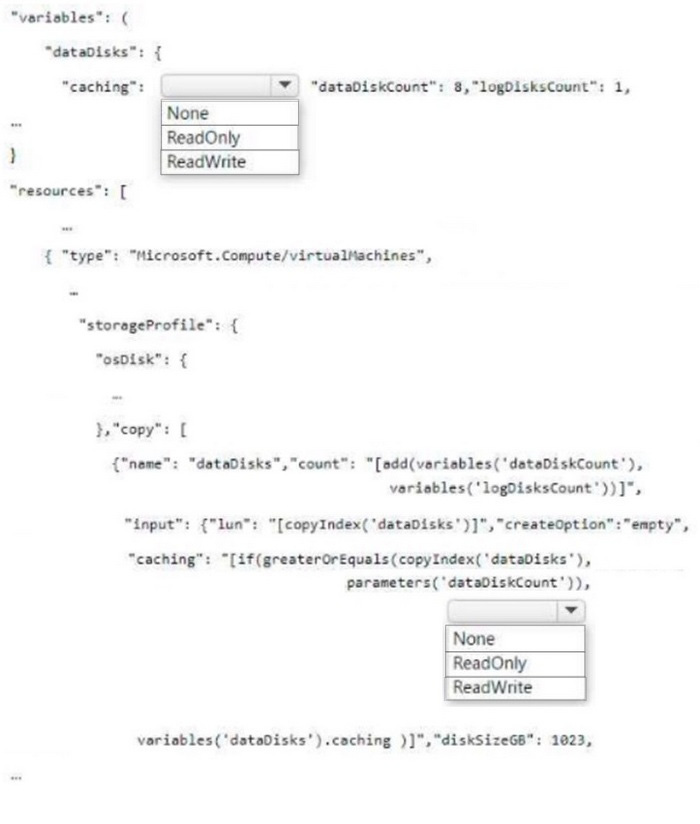
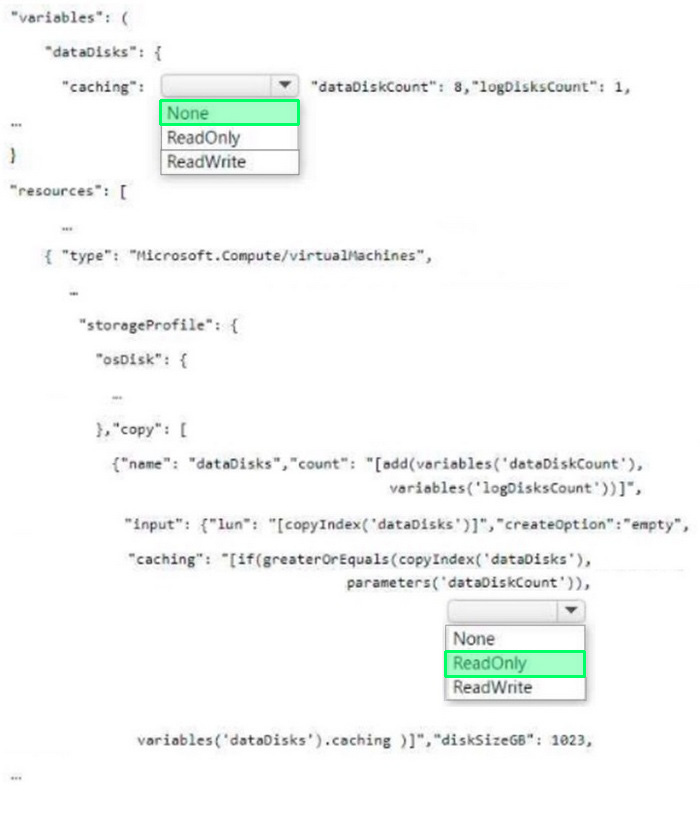
You need to use an Azure Resource Manager (ARM) template to deploy an Azure virtual machine that will host a Microsoft SQL Server instance. The solution must maximize disk I/O performance for the SQL Server database and log files.
How should you complete the template? To answer, select the appropriate options in the answer area.
NOTE: Each correct selection is worth one point.
Reveal answer detailsClose answer details
Explanation
Box 1: None Set host caching to none for log file disks.
Box 2: ReadOnly Set host caching to read-only for data file disks.
Do not enable read/write caching on disks that contain SQL Server data or log files.
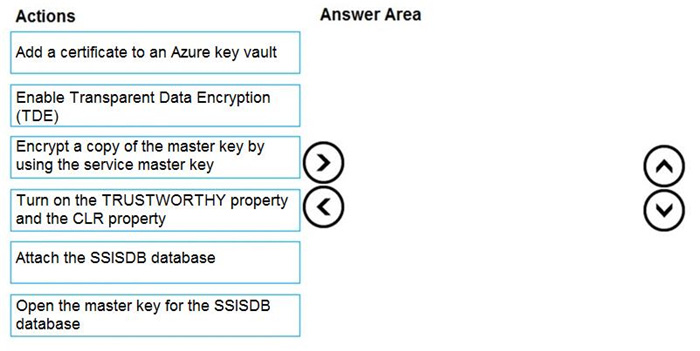
You have SQL Server 2019 on an Azure virtual machine that contains an SSISDB database.
A recent failure causes the master database to be lost.
You discover that all Microsoft SQL Server integration Services (SSIS) packages fail to run on the virtual machine.
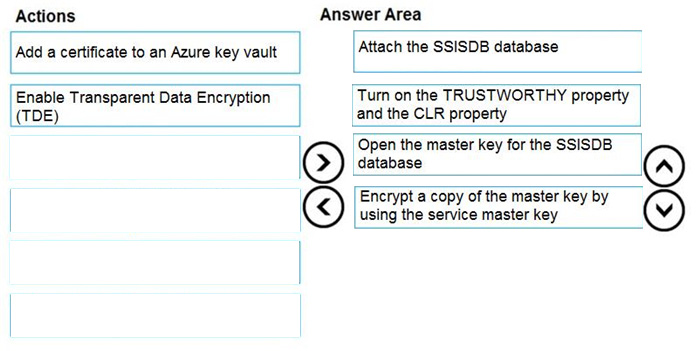
Which four actions should you perform in sequence to resolve the issue? To answer, move the appropriate actions from the list of actions to the answer area and arrange them in the correct.
Reveal answer detailsClose answer details
Explanation
Step 1: Attach the SSISDB database
Step 2: Turn on the TRUSTWORTHY property and the CLR property If you are restoring the SSISDB database to an SQL Server instance where the SSISDB catalog was never created, enable common language runtime (clr)
Step 3: Open the master key for the SSISDB database Restore the master key by this method if you have the original password that was used to create SSISDB.
open master key decryption by password = 'LS1Setup!' --'Password used when creating SSISDB' Alter Master Key Add encryption by Service Master Key
Step 4: Encrypt a copy of the mater key by using the service master key
Litware, Inc. is a renewable energy company that has a main office in Boston. The main office hosts a sales department and the primary datacenter for the company.
Physical Locations
Existing Environment
Litware has a manufacturing office and a research office is separate locations near Boston. Each office has its own datacenter and internet connection.
The manufacturing and research datacenters connect to the primary datacenter by using a VPN.
Network Environment
The primary datacenter has an ExpressRoute connection that uses both Microsoft peering and private peering. The private peering connects to an Azure virtual network named HubVNet.
Identity Environment
Litware has a hybrid Azure Active Directory (Azure AD) deployment that uses a domain named litwareinc.com. All Azure subscriptions are associated to the litwareinc.com Azure AD tenant.
Database Environment
The sales department has the following database workload:
1. An on-premises named SERVER1 hosts an instance of Microsoft SQL Server 2012 and two 1-TB databases. 2. A logical server named SalesSrv01A contains a geo-replicated Azure SQL database named SalesSQLDb1. SalesSQLDb1 is in an elastic pool named SalesSQLDb1Pool. SalesSQLDb1 uses database firewall rules and contained database users. 3. An application named SalesSQLDb1App1 uses SalesSQLDb1.
The manufacturing office contains two on-premises SQL Server 2016 servers named SERVER2 and SERVER3. The servers are nodes in the same Always On availability group. The availability group contains a database named ManufacturingSQLDb1
Database administrators have two Azure virtual machines in HubVnet named VM1 and VM2 that run Windows Server 2019 and are used to manage all the Azure databases.
Licensing Agreement
Litware is a Microsoft Volume Licensing customer that has License Mobility through Software Assurance.
Current Problems
SalesSQLDb1 experiences performance issues that are likely due to out-of-date statistics and frequent blocking queries.
Requirements
Planned Changes
Litware plans to implement the following changes:
1. Implement 30 new databases in Azure, which will be used by time-sensitive manufacturing apps that have varying usage patterns. Each database will be approximately 20 GB. 2. Create a new Azure SQL database named ResearchDB1 on a logical server named ResearchSrv01. ResearchDB1 will contain Personally Identifiable Information (PII) data. 3. Develop an app named ResearchApp1 that will be used by the research department to populate and access ResearchDB1. 4. Migrate ManufacturingSQLDb1 to the Azure virtual machine platform. 5. Migrate the SERVER1 databases to the Azure SQL Database platform.
Technical Requirements
Litware identifies the following technical requirements:
1. Maintenance tasks must be automated. 2. The 30 new databases must scale automatically. 3. The use of an on-premises infrastructure must be minimized. 4. Azure Hybrid Use Benefits must be leveraged for Azure SQL Database deployments. 5. All SQL Server and Azure SQL Database metrics related to CPU and storage usage and limits must be analyzed by using Azure built-in functionality.
Security and Compliance Requirements
Litware identifies the following security and compliance requirements:
1. Store encryption keys in Azure Key Vault. 2. Retain backups of the PII data for two months. 3. Encrypt the PII data at rest, in transit, and in use. 4. Use the principle of least privilege whenever possible. 5. Authenticate database users by using Active Directory credentials. 6. Protect Azure SQL Database instances by using database-level firewall rules. 7. Ensure that all databases hosted in Azure are accessible from VM1 and VM2 without relying on public endpoints.
Business Requirements
Litware identifies the following business requirements:
1. Meet an SLA of 99.99% availability for all Azure deployments. 2. Minimize downtime during the migration of the SERVER1 databases. 3. Use the Azure Hybrid Use Benefits when migrating workloads to Azure. 4. Once all requirements are met, minimize costs whenever possible.
Question 3
Testlet 1Drag & drop
DRAG DROP
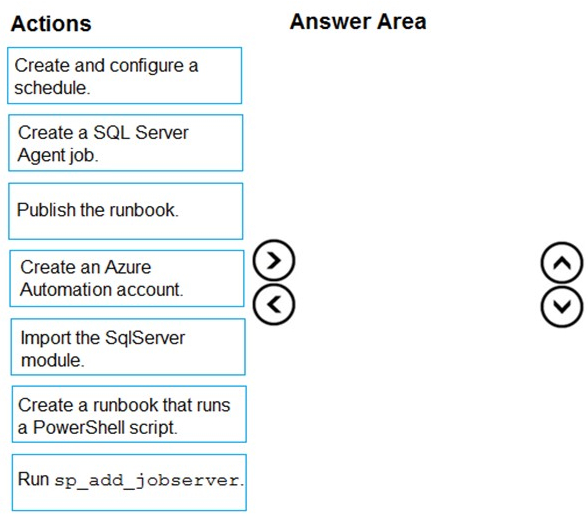
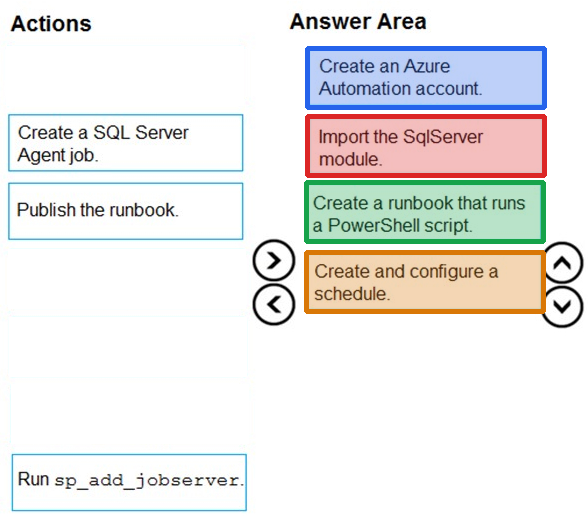
You need to implement statistics maintenance for SalesSQLDb1. The solution must meet the technical requirements.
Which four actions should you perform in sequence? To answer, move the appropriate actions from the list of actions to the answer area and arrange them in the correct order.
Reveal answer detailsClose answer details
Explanation
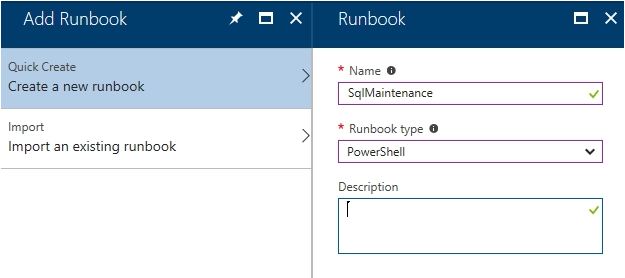
Automating Azure SQL DB index and statistics maintenance using Azure Automation: 1. Create Azure automation account (Step 1) 2. Import SQLServer module (Step 2) 3. Add Credentials to access SQL DB This will use secure way to hold login name and password that will be used to access Azure SQL DB 4. Add a runbook to run the maintenance (Step 3) Steps: 1. Click on "runbooks" at the left panel and then click "add a runbook" 2. Choose "create a new runbook" and then give it a name and choose "Powershell" as the type of the runbook and then click on "create"
5. Schedule task (Step 4) Steps: 1. Click on Schedules 2. Click on "Add a schedule" and follow the instructions to choose existing schedule or create a new schedule.
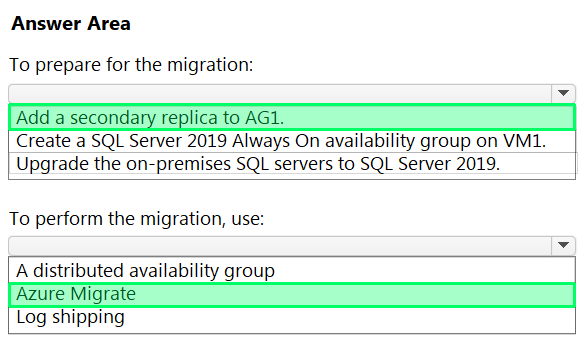
You have two on-premises servers that run Windows Server 2019 and host a Microsoft SQL Server 2017 Always On availability group named AG1. AG1 contains a single database named DB1.
You have an Azure subscription. The subscription contains a virtual machine named VM1 that runs Linux.
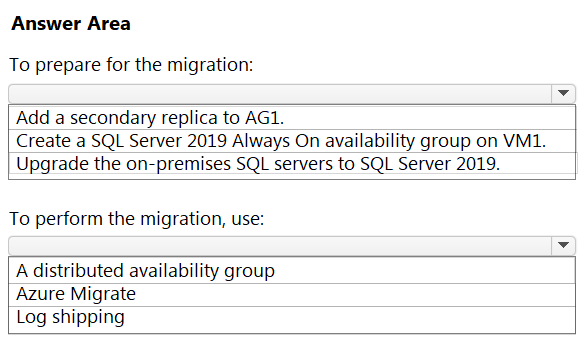
You need to migrate DB1 to a SQL Server 2019 instance on VM1. The solution must minimize the downtime of DB1 during the migration.
What should you do? To answer, select the appropriate options in the answer area.
NOTE: Each correct selection is worth one point.
Reveal answer detailsClose answer details
Explanation
Box 1: Add a secondary replica to AG1. Migrate an availability group to SQL Server on Azure VM
To ensure the migrated server is synchronized with the source server, stop the SQL Server service on every replica in the availability group, starting with secondary replicas (in SQL Server Configuration Manager > Services) while ensuring the disks hosting SQL data are online.
Incorrect: * Upgrade to SQL Server 2019 No need to upgrade to SQL Server 2019
* Create a SQL Server 2019 Always ON available group on VM1.
You do that afterwards. After the migration, enable Always On availability groups for the database.
Box 2: Azure Migrate You can migrate your SQL Server Always On availability group to SQL Server on Azure VMs using the Azure Migrate: Server Migration tool. Using the migration tool, you will be able to migrate each replica in the availability group to an Azure VM hosting SQL Server, as well as the cluster metadata, availability group metadata and other necessary high availability components.
Litware, Inc. is a renewable energy company that has a main office in Boston. The main office hosts a sales department and the primary datacenter for the company.
Physical Locations
Existing Environment
Litware has a manufacturing office and a research office is separate locations near Boston. Each office has its own datacenter and internet connection.
The manufacturing and research datacenters connect to the primary datacenter by using a VPN.
Network Environment
The primary datacenter has an ExpressRoute connection that uses both Microsoft peering and private peering. The private peering connects to an Azure virtual network named HubVNet.
Identity Environment
Litware has a hybrid Azure Active Directory (Azure AD) deployment that uses a domain named litwareinc.com. All Azure subscriptions are associated to the litwareinc.com Azure AD tenant.
Database Environment
The sales department has the following database workload:
1. An on-premises named SERVER1 hosts an instance of Microsoft SQL Server 2012 and two 1-TB databases. 2. A logical server named SalesSrv01A contains a geo-replicated Azure SQL database named SalesSQLDb1. SalesSQLDb1 is in an elastic pool named SalesSQLDb1Pool. SalesSQLDb1 uses database firewall rules and contained database users. 3. An application named SalesSQLDb1App1 uses SalesSQLDb1.
The manufacturing office contains two on-premises SQL Server 2016 servers named SERVER2 and SERVER3. The servers are nodes in the same Always On availability group. The availability group contains a database named ManufacturingSQLDb1
Database administrators have two Azure virtual machines in HubVnet named VM1 and VM2 that run Windows Server 2019 and are used to manage all the Azure databases.
Licensing Agreement
Litware is a Microsoft Volume Licensing customer that has License Mobility through Software Assurance.
Current Problems
SalesSQLDb1 experiences performance issues that are likely due to out-of-date statistics and frequent blocking queries.
Requirements
Planned Changes
Litware plans to implement the following changes:
1. Implement 30 new databases in Azure, which will be used by time-sensitive manufacturing apps that have varying usage patterns. Each database will be approximately 20 GB. 2. Create a new Azure SQL database named ResearchDB1 on a logical server named ResearchSrv01. ResearchDB1 will contain Personally Identifiable Information (PII) data. 3. Develop an app named ResearchApp1 that will be used by the research department to populate and access ResearchDB1. 4. Migrate ManufacturingSQLDb1 to the Azure virtual machine platform. 5. Migrate the SERVER1 databases to the Azure SQL Database platform.
Technical Requirements
Litware identifies the following technical requirements:
1. Maintenance tasks must be automated. 2. The 30 new databases must scale automatically. 3. The use of an on-premises infrastructure must be minimized. 4. Azure Hybrid Use Benefits must be leveraged for Azure SQL Database deployments. 5. All SQL Server and Azure SQL Database metrics related to CPU and storage usage and limits must be analyzed by using Azure built-in functionality.
Security and Compliance Requirements
Litware identifies the following security and compliance requirements:
1. Store encryption keys in Azure Key Vault. 2. Retain backups of the PII data for two months. 3. Encrypt the PII data at rest, in transit, and in use. 4. Use the principle of least privilege whenever possible. 5. Authenticate database users by using Active Directory credentials. 6. Protect Azure SQL Database instances by using database-level firewall rules. 7. Ensure that all databases hosted in Azure are accessible from VM1 and VM2 without relying on public endpoints.
Business Requirements
Litware identifies the following business requirements:
1. Meet an SLA of 99.99% availability for all Azure deployments. 2. Minimize downtime during the migration of the SERVER1 databases. 3. Use the Azure Hybrid Use Benefits when migrating workloads to Azure. 4. Once all requirements are met, minimize costs whenever possible.
Question 7
Testlet 1Hotspot
HOTSPOT
You need to recommend a configuration for ManufacturingSQLDb1 after the migration to Azure. The solution must meet the business requirements.
What should you include in the recommendation? To answer, select the appropriate options in the answer area.
NOTE: Each correct selection is worth one point.
Reveal answer detailsClose answer details
Explanation
Scenario: Business Requirements Litware identifies business requirements include: meet an SLA of 99.99% availability for all Azure deployments.
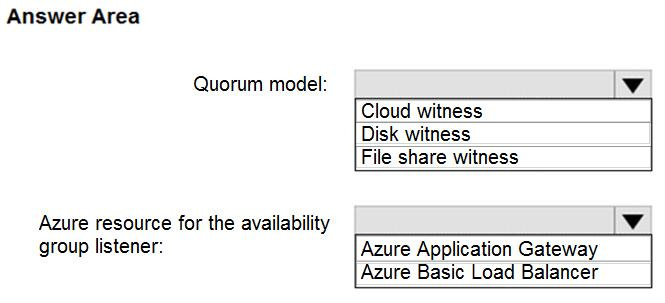
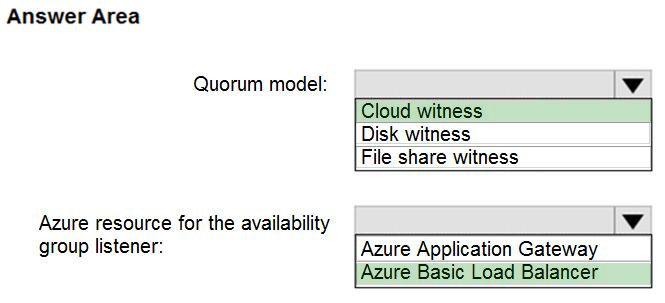
Box 1: Cloud witness If you have a Failover Cluster deployment, where all nodes can reach the internet (by extension of Azure), it is recommended that you configure a Cloud Witness as your quorum witness resource.
Box 2: Azure Basic Load Balancer Microsoft guarantees that a Load Balanced Endpoint using Azure Standard Load Balancer, serving two or more Healthy Virtual Machine Instances, will be available 99.99% of the time.
Note: There are two main options for setting up your listener: external (public) or internal. The external (public) listener uses an internet facing load balancer and is associated with a public Virtual IP (VIP) that is accessible over the internet. An internal listener uses an internal load balancer and only supports clients within the same Virtual Network.
You have an Azure subscription that contains the resources shown in the following table.
You need to configure a connection between VM1 and MI1. The solution must meet the following requirements:
1. The connection must be encrypted. 2. Network latency must be minimized.
What should you implement?
A
a site-to-site VPN
B
virtual network peering
C
private endpoints
D
service endpoints
Reveal answer detailsClose answer details
Correct answerC
Question 9
Single choice
Note: This question is part of a series of questions that present the same scenario. Each question in the series contains a unique solution that might meet the stated goals. Some question sets might have more than one correct solution, while others might not have a correct solution.
After you answer a question in this section, you will NOT be able to return to it. As a result, these questions will not appear in the review screen.
You have two Azure SQL Database servers named Server1 and Server2. Each server contains an Azure SQL database named Database1.
You need to restore Database1 from Server1 to Server2. The solution must replace the existing Database1 on Server2.
Solution: You restore Database1 from Server1 to the Server2 by using the RESTORE Transact-SQL command and the REPLACE option.
Does this meet the goal?
A
Yes
B
No
Reveal answer detailsClose answer details
Correct answerB
Explanation
There is no REPLACE option in Azure SQL Database, or even there is no restore option with T-SQL. https://learn.microsoft.com/en-us/azure/azure-sql/database/recovery-using-backups?view=azuresql-db&tabs=azure-portal
Question 10
Single choice
You have SQL Server on an Azure virtual machine that contains a database named DB1.
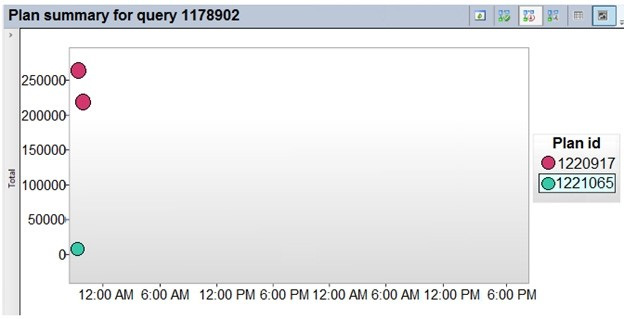
You view a plan summary that shows the duration in milliseconds of each execution of query 1178902 as shown in the following exhibit:
What should you do to ensure that the query uses the execution plan which executes in the least amount of time?
A
Force the query execution plan for plan 1221065.
B
Run the DBCC FREEPROCCACHE command.
C
Force the query execution plan for plan 1220917.
D
Disable parameter sniffing.
Reveal answer detailsClose answer details
Correct answerA
Explanation
As per exhibit, the execution plan 1221065 has lower execution time compared to plan 1220917.
ADatum Corporation is a financial services company that has a main office in New York City.
Existing Environment. Licensing Agreement
ADatum has a Microsoft Volume Licensing agreement that includes Software Assurance.
Existing Environment. Network Infrastructure
ADatum has an on-premises datacenter and an Azure subscription named Sub1.
Sub1 contains a virtual network named Network1 in the East US Azure region.
The datacenter is connected to Network1 by using a Site-to-Site (S2S) VPN.
Existing Environment. Identity Environment
The on-premises network contains an Active Directory Domain Services (AD DS) forest.
The forest contains a single domain named corp.adatum.com.
The corp.adatum.com domain syncs with a Microsoft Entra tenant named adatum.com.
Existing Environment. Database Environment
The datacenter contains the servers shown in the following table.
DB1 and DB2 are used for transactional and analytical workloads by an application named App1.
App1 runs on Microsoft Entra hybrid joined servers that run Windows Server 2022. App1 uses Kerberos authentication.
DB3 stores compliance data used by two applications named App2 and App3.
DB3 performance is monitored by using Extended Events sessions, with the event_file target set to a file share on a local disk of SVR3.
Resource allocation for DB3 is managed by using Resource Governor.
Requirements. Planned Changes
ADatum plans to implement the following changes:
1. Deploy an Azure SQL managed instance named Instance1 to Network1. 2. Migrate DB1 and DB2 to Instance1. 3. Migrate DB3 to Azure SQL Database. 4. Following the migration of DB1 and DB2, hand over database development to remote developers who use Microsoft Entra joined Windows 11 devices. 5. Following the migration of DB3, configure the database to be part of an auto-failover group.
Requirements. Availability Requirements
ADatum identifies the following post-migration availability requirements:
1. For DB1 and DB2, offload analytical workloads to a read-only database replica in the same Azure region. 2. Ensure that if a regional disaster occurs, DB1 and DB2 can be recovered from backups. 3. After the migration, App1 must maintain access to DB1 and DB2. 4. For DB3, manage potential performance issues caused by resource demand changes by App2 and App3. 5. Ensure that DB3 will still be accessible following a planned failover. 6. Ensure that DB3 can be restored if the logical server is deleted. 7. Minimize downtime during the migration of DB1 and DB2.
Requirements. Security Requirements
ADatum identifies the following security requirements for after the migration:
1. Ensure that only designated developers who use Microsoft Entra joined Windows 11 devices can access DB1 and DB2 remotely. 2. Ensure that all changes to DB3, including ones within individual transactions, are audited and recorded.
Requirements. Management Requirements
ADatum identifies the following post-migration management requirements:
1. Continue using Extended Events to monitor DB3. 2. In Azure SQL Database, automate the management of DB3 by using elastic jobs that have database-scoped credentials.
Requirements. Business Requirements
ADatum identifies the following business requirements:
1. Minimize costs whenever possible, without affecting other requirements. 2. Minimize administrative effort.
Question 12
Testlet 5Single choice
You need to recommend a solution to meet the security requirements and the business requirements for DB3.
What should you recommend as the first step of the solution?
A
Run the sp_addarticle stored procedure.
B
Run the ALTER TABLE statement and specify the ENABLE CHANGE_TRACKING Clause.
C
Run the ALTER DATABASE statement and specify the SET CHANGE_TRACKING = ON Clause.
D
Run the sys.sp_cdc_enable_db stored procedure.
Reveal answer detailsClose answer details
Correct answerD
Question 13
Single choice
You have an on-premises Microsoft SQL Server 2019 instance named SQL1 that hosts a database named db1. You have an Azure subscription that contains an Azure SQL managed instance named MI1 and an Azure Storage account named storage1.
You plan to migrate db1 to MI1 by using the backup and restore process.
You need to ensure that you can back up db1 to storage1. The solution must meet the following requirements:
1. Use block blob storage. 2. Maximize security.
What should you do on storage1?
A
Generate a shared access signature (SAS)
B
Create an access policy.
C
Rotate the storage keys.
D
Enable infrastructure encryption.
Reveal answer detailsClose answer details
Correct answerA
Explanation
o ensure that you can back up db1 to storage1 and meet the requirements, you should generate a shared access signature (SAS) on storage 1. A SAS is a URI that grants restricted access rights to storage objects. By using a SAS URI, you can delegate access to resources in your storage account, such as a container or a blob, without exposing your account key.
Option B is incorrect because creating an access policy does not provide block blob storage or maximize security. Option C is incorrect because rotating the storage keys does not address the requirements for using block blob storage and maximizing security. Option D is incorrect because enabling infrastructure encryption does not address the requirement for using block blob storage.
Question 14
Hotspot
HOTSPOT
You have an Azure subscription.
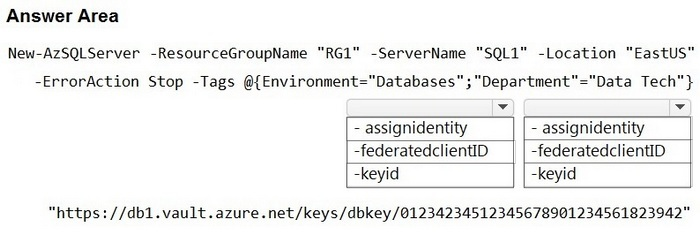
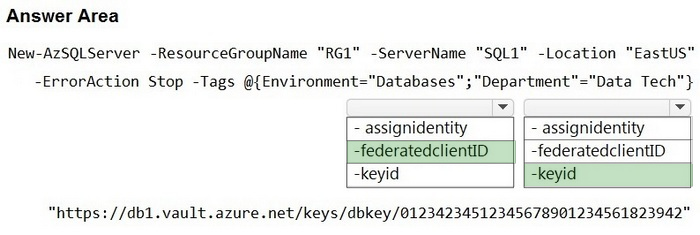
You need to deploy a logical SQL server by using PowerShell. The solution must ensure that the logical SQL server can create Azure AD users and provide Transparent Data Encryption (TDE) with a customer-managed key.
How should you complete the command? To answer, select the appropriate options in the answer area.
NOTE: Each correct selection is worth one point.
Reveal answer detailsClose answer details
Explanation
Box 1: -AssignIdentity The New-AzSqlServer cmdlet creates an Azure SQL Database server.
Parameter -AssignIdentity Generate and assign an Azure Active Directory Identity for this server for use with key management services like Azure KeyVault.
Box 2: KeyId Parameter -KeyId The Azure Key Vault URI that is used for encryption.
Example: Create a new Azure SQL Database server with TDE CMK
You have an Azure subscription that contains three instances of SQL Server on Azure Virtual Machines.
You plan to implement a disaster recovery solution.
You need to be able to perform disaster recovery drills regularly. The solution must meet the following requirements:
1. Minimize administrative effort for the recovery drills. 2. Isolate the recovery environment from the production environment
What should you use?
A
native Microsoft SQL Server backup
B
Azure Site Recovery
C
Recovery Services vaults
D
Azure Backup
Reveal answer detailsClose answer details
Correct answerB
Explanation
Set up disaster recovery for SQL Server You can protect the SQL Server back end of an application. You do so by using a combination of SQL Server business continuity and disaster recovery (BCDR) technologies and Azure Site Recovery.
SQL Server disaster recovery capabilities include:
Failover clustering Always On availability groups Database mirroring Log shipping Active geo-replication Auto-failover groups
Note: Azure Recovery Services contributes to your BCDR strategy:
Site Recovery service: Site Recovery helps ensure business continuity by keeping business apps and workloads running during outages. Site Recovery replicates workloads running on physical and virtual machines (VMs) from a primary site to a secondary location. When an outage occurs at your primary site, you fail over to a secondary location, and access apps from there. After the primary location is running again, you can fail back to it.
Backup service: The Azure Backup service keeps your data safe and recoverable.
Site Recovery can manage replication for:
Azure VMs replicating between Azure regions Replication from Azure Public Multi-Access Edge Compute (MEC) to the region Replication between two Azure Public MECs On-premises VMs, Azure Stack VMs, and physical servers
You are building a database in an Azure Synapse Analytics serverless SQL pool.
You have data stored in Parquet files in an Azure Data Lake Storage Gen2 container.
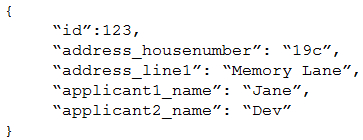
Records are structured as shown in the following sample.
The records contain two applicants at most.
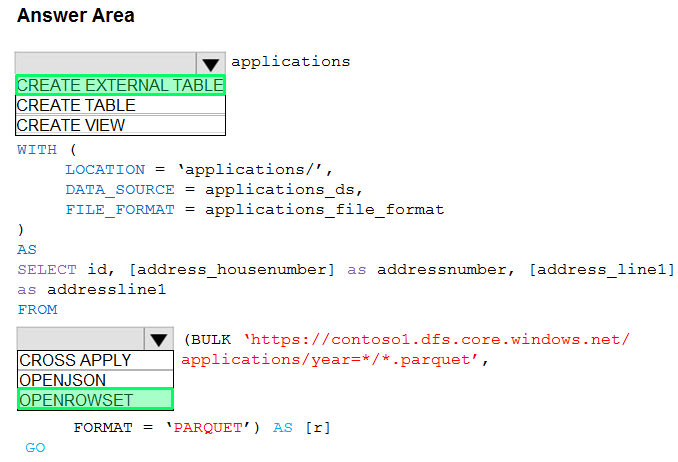
You need to build a table that includes only the address fields.
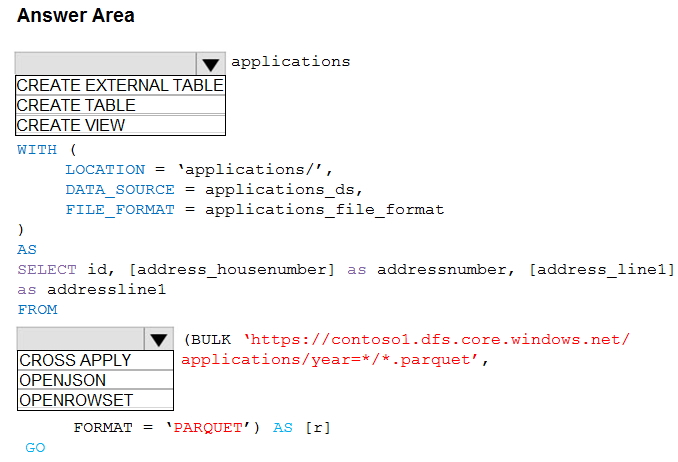
How should you complete the Transact-SQL statement? To answer, select the appropriate options in the answer area.
NOTE: Each correct selection is worth one point.
Reveal answer detailsClose answer details
Explanation
Box 1: CREATE EXTERNAL TABLE An external table points to data located in Hadoop, Azure Storage blob, or Azure Data Lake Storage. External tables are used to read data from files or write data to files in Azure Storage. With Synapse SQL, you can use external tables to read external data using dedicated SQL pool or serverless SQL pool.
Box 2. OPENROWSET When using serverless SQL pool, CETAS is used to create an external table and export query results to Azure Storage Blob or Azure Data Lake Storage Gen2.
Example: AS SELECT decennialTime, stateName, SUM(population) AS population FROM OPENROWSET(BULK ' https://azureopendatastorage.blob.core.windows.net/censusdatacontainer/release/us_population_county/year=*/*.parquet',FORMAT='PARQUET')AS[r] GROUP BY decennialTime, stateName GO
You are building an Azure Stream Analytics job to retrieve game data.
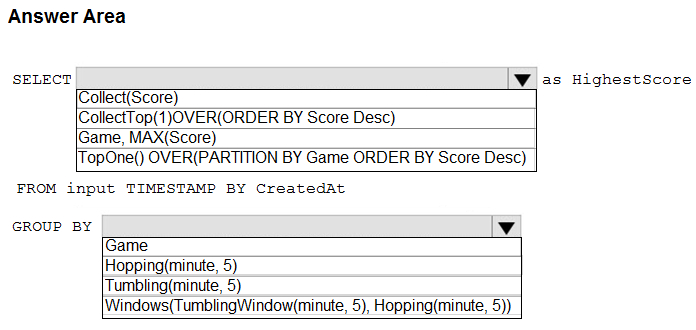
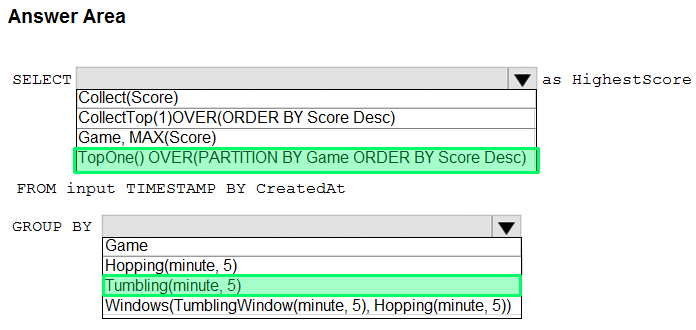
You need to ensure that the job returns the highest scoring record for each five-minute time interval of each game.
How should you complete the Stream Analytics query? To answer, select the appropriate options in the answer area.
NOTE: Each correct selection is worth one point.
Reveal answer detailsClose answer details
Explanation
Box 1: TopOne() OVER(PARTITION BY Game ORDER BY Score Desc) TopOne returns the top-rank record, where rank defines the ranking position of the event in the window according to the specified ordering. Ordering/ranking is based on event columns and can be specified in ORDER BY clause.
Analytic Function Syntax: TopOne() OVER ([<PARTITION BY clause>] ORDER BY (<column name> [ASC |DESC])+ <LIMIT DURATION clause> [<WHEN clause>])
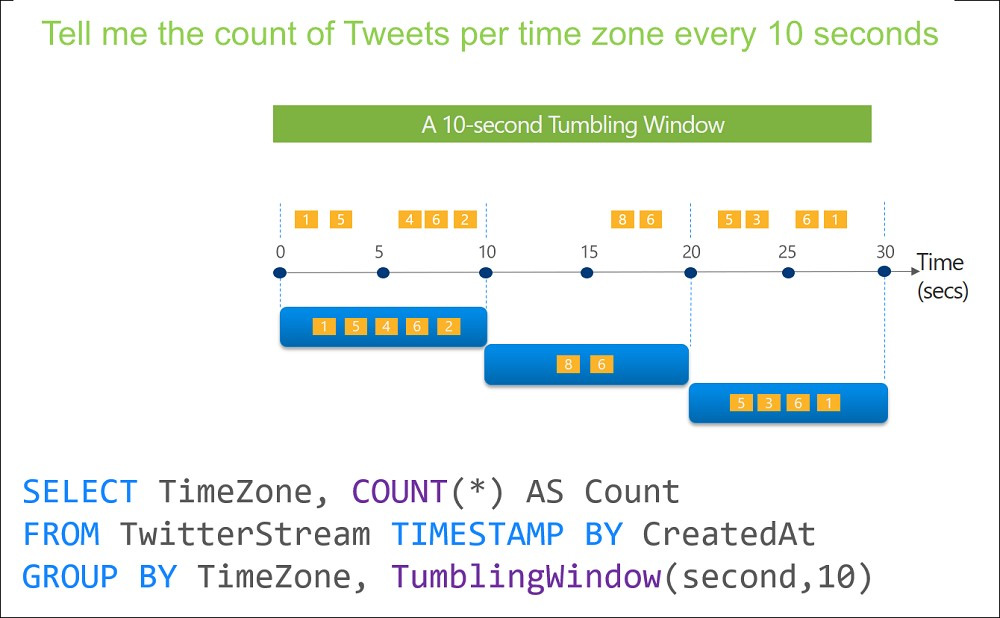
Box 2: Tumbling(minute 5) Tumbling window functions are used to segment a data stream into distinct time segments and perform a function against them, such as the example below. The key differentiators of a Tumbling window are that they repeat, do not overlap, and an event cannot belong to more than one tumbling window.
Contoso, Ltd. is a financial data company that has 100 employees. The company delivers financial data to customers.
Active Directory
Contoso has a hybrid Azure Active Directory (Azure AD) deployment that syncs to on-premises Active Directory.
Database Environment
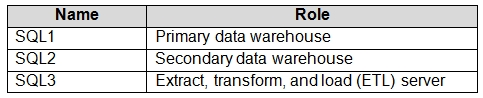
Contoso has SQL Server 2017 on Azure virtual machines shown in the following table.
SQL1 and SQL2 are in an Always On availability group and are actively queried. SQL3 runs jobs, provides historical data, and handles the delivery of data to customers.
The on-premises datacenter contains a PostgreSQL server that has a 50-TB database.
Current Business Model
Contoso uses Microsoft SQL Server Integration Services (SSIS) to create flat files for customers. The customers receive the files by using FTP.
Requirements
Planned Changes
Contoso plans to move to a model in which they deliver data to customer databases that run as platform as a service (PaaS) offerings. When a customer establishes a service agreement with Contoso, a separate resource group that contains an Azure SQL database will be provisioned for the customer. The database will have a complete copy of the financial data. The data to which each customer will have access will depend on the service agreement tier. The customers can change tiers by changing their service agreement.
The estimated size of each PaaS database is 1 TB.
Contoso plans to implement the following changes:
1. Move the PostgreSQL database to Azure Database for PostgreSQL during the next six months. 2. Upgrade SQL1, SQL2, and SQL3 to SQL Server 2019 during the next few months. 3. Start onboarding customers to the new PaaS solution within six months.
Business Goals
Contoso identifies the following business requirements:
1. Use built-in Azure features whenever possible. 2. Minimize development effort whenever possible. 3. Minimize the compute costs of the PaaS solutions. 4. Provide all the customers with their own copy of the database by using the PaaS solution. 5. Provide the customers with different table and row access based on the customer's service agreement. 6. In the event of an Azure regional outage, ensure that the customers can access the PaaS solution with minimal downtime. The solution must provide automatic failover. 7. Ensure that users of the PaaS solution can create their own database objects but he prevented from modifying any of the existing database objects supplied by Contoso.
Technical Requirements
Contoso identifies the following technical requirements:
1. Users of the PaaS solution must be able to sign in by using their own corporate Azure AD credentials or have Azure AD credentials supplied to them by Contoso. The solution must avoid using the internal Azure AD of Contoso to minimize guest users. 2. All customers must have their own resource group, Azure SQL server, and Azure SQL database. The deployment of resources for each customer must be done in a consistent fashion. 3. Users must be able to review the queries issued against the PaaS databases and identify any new objects created. 4. Downtime during the PostgreSQL database migration must be minimized.
Monitoring Requirements
Contoso identifies the following monitoring requirements:
1. Notify administrators when a PaaS database has a higher than average CPU usage. 2. Use a single dashboard to review security and audit data for all the PaaS databases. 3. Use a single dashboard to monitor query performance and bottlenecks across all the PaaS databases. 4. Monitor the PaaS databases to identify poorly performing queries and resolve query performance issues automatically whenever possible.
PaaS Prototype
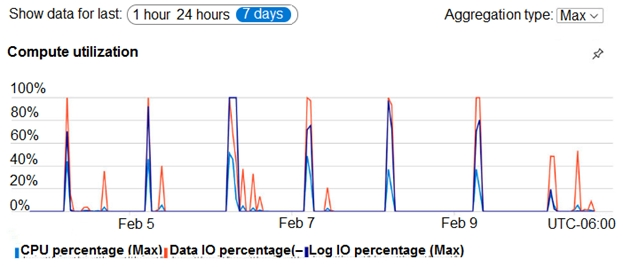
During prototyping of the PaaS solution in Azure, you record the compute utilization of a customer's Azure SQL database as shown in the following exhibit.
Role Assignments
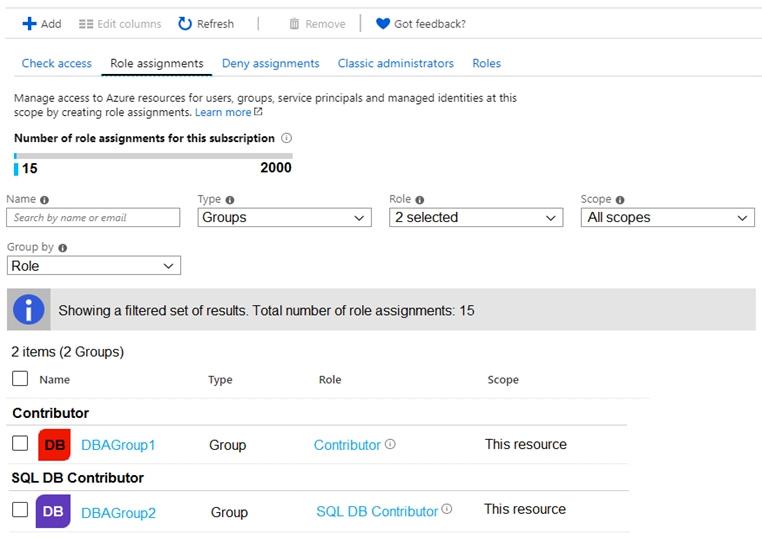
For each customer's Azure SQL Database server, you plan to assign the roles shown in the following exhibit.
Question 18
Testlet 2Single choice
You need to implement a solution to notify the administrators. The solution must meet the monitoring requirements.
What should you do?
A
Create an Azure Monitor alert rule that has a static threshold and assign the alert rule to an action group.
B
Add a diagnostic setting that logs QueryStoreRuntimeStatistics and streams to an Azure event hub.
C
Add a diagnostic setting that logs Timeouts and streams to an Azure event hub.
D
Create an Azure Monitor alert rule that has a dynamic threshold and assign the alert rule to an action group.
Contoso, Ltd. is a clothing retailer based in Seattle. The company has 2,000 retail stores across the United States and an emerging online presence.
The network contains an Active Directory forest named contoso.com. The forest is integrated with an Azure Active Directory (Azure AD) tenant named contoso.com. Contoso has an Azure subscription associated to the contoso.com Azure AD tenant.
Existing Environment
Transactional Data
Contoso has three years of customer, transaction, operational, sourcing, and supplier data comprised of 10 billion records stored across multiple on-premises Microsoft SQL Server servers. The SQL Server instances contain data from various operations systems. The data is loaded into the instances by using SQL Server Integration Services (SSIS) packages.
You estimate that combining all product sales transactions into a company-wide sales transactions dataset will result in a single table that contains 5 billion rows, with one row per transaction.
Most queries targeting the sales transactions data will be used to identify which products were sold in retail stores and which products were sold online during different time periods. Sales transaction data that is older than three years will be removed monthly.
You plan to create a retail store table that will contain the address of each retail store. The table will be approximately 2 MB. Queries for retail store sales will include the retail store addresses.
You plan to create a promotional table that will contain a promotion ID. The promotion ID will be associated to a specific product. The product will be identified by a product ID. The table will be approximately 5 GB.
Streaming Twitter Data
The ecommerce department at Contoso develops an Azure logic app that captures trending Twitter feeds referencing the company's products and pushes the products to Azure Event Hubs.
Planned Changes and Requirements
Planned Changes
Contoso plans to implement the following changes:
1. Load the sales transaction dataset to Azure Synapse Analytics. 2. Integrate on-premises data stores with Azure Synapse Analytics by using SSIS packages. 3. Use Azure Synapse Analytics to analyze Twitter feeds to assess customer sentiments about products.
Sales Transaction Dataset Requirements
Contoso identifies the following requirements for the sales transaction dataset:
1. Partition data that contains sales transaction records. Partitions must be designed to provide efficient loads by month. Boundary values must belong to the partition on the right. 2. Ensure that queries joining and filtering sales transaction records based on product ID complete as quickly as possible. 3. Implement a surrogate key to account for changes to the retail store addresses. 4. Ensure that data storage costs and performance are predictable. 5. Minimize how long it takes to remove old records.
Customer Sentiment Analytics Requirements
Contoso identifies the following requirements for customer sentiment analytics:
1. Allow Contoso users to use PolyBase in an Azure Synapse Analytics dedicated SQL pool to query the content of the data records that host the Twitter feeds. Data must be protected by using row-level security (RLS). The users must be authenticated by using their own Azure AD credentials. 2. Maximize the throughput of ingesting Twitter feeds from Event Hubs to Azure Storage without purchasing additional throughput or capacity units. 3. Store Twitter feeds in Azure Storage by using Event Hubs Capture. The feeds will be converted into Parquet files. 4. Ensure that the data store supports Azure AD-based access control down to the object level. 5. Minimize administrative effort to maintain the Twitter feed data records. 6. Purge Twitter feed data records that are older than two years.
Data Integration Requirements
Contoso identifies the following requirements for data integration:
1. Use an Azure service that leverages the existing SSIS packages to ingest on-premises data into datasets stored in a dedicated SQL pool of Azure Synapse Analytics and transform the data. 2. Identify a process to ensure that changes to the ingestion and transformation activities can be version-controlled and developed independently by multiple data engineers.
Question 19
Testlet 4Single choice
You need to implement the surrogate key for the retail store table. The solution must meet the sales transaction dataset requirements.
What should you create?
A
a table that has a FOREIGN KEY constraint
B
a table the has an IDENTITY property
C
a user-defined SEQUENCE object
D
a system-versioned temporal table
Reveal answer detailsClose answer details
Correct answerB
Explanation
Scenario: Contoso requirements for the sales transaction dataset include: Implement a surrogate key to account for changes to the retail store addresses.
A surrogate key on a table is a column with a unique identifier for each row. The key is not generated from the table data. Data modelers like to create surrogate keys on their tables when they design data warehouse models. You can use the IDENTITY property to achieve this goal simply and effectively without affecting load performance.
You plan to deploy three instances of SQL Server on Azure Virtual Machines that will each contain 20 databases.
You need to recommend a solution that meets the following requirements:
1. Ensures that the deployment is highly available 2. Minimizes administrative effort to manage users, logins, permissions, and SQL Server Agent jobs
across the instances
What should you include in the recommendation? To answer, select the appropriate options in the answer area.
NOTE: Each correct selection is worth one point.
Reveal answer detailsClose answer details
Question 21
Single choice
You need to recommend a disaster recovery solution for an on-premises Microsoft SQL Server database. The solution must meet the following requirements:
1. Support real-time data replication to a different geographic region. 2. Use Azure as a disaster recovery target. 3. Minimize costs and administrative effort.
What should you include in the recommendation?
A
database mirroring on an instance of SQL Server on Azure Virtual Machines
B
availability groups for SQL Server on Azure Virtual Machines
C
an Azure SQL Managed Instance link
D
transactional replication to an Azure SQL Managed Instance
Reveal answer detailsClose answer details
Correct answerD
Explanation
Transactional replication is a feature of Azure SQL Managed Instance and SQL Server that enables you to replicate data from a table in Azure SQL Managed Instance or a SQL Server instance to tables placed on remote databases. This feature allows you to synchronize multiple tables in different databases.D
You can use transactional replication to push changes made in an Azure SQL Managed Instance to:
1. A SQL Server database - on-premises or on Azure VM 2. A database in Azure SQL Database 3. An instance database in Azure SQL Managed Instance
Incorrect:
Not A: Operates within the same location.
Database mirroring is a solution for increasing the availability of a SQL Server database.
Database mirroring maintains two copies of a single database that must reside on different server instances of SQL Server Database Engine. Typically, these server instances reside on computers in different locations.
Not B: Always On availability group on SQL Server on Azure VMs - only within a single region Always On availability groups on Azure Virtual Machines are similar to Always On availability groups on-premises, and rely on the underlying Windows Server Failover Cluster.
VM redundancy To increase redundancy and high availability, SQL Server VMs should either be in the same availability set, or different availability zones.
Placing a set of VMs in the same availability set protects from outages within a data center caused by equipment failure (VMs within an Availability Set do not share resources) or from updates (VMs within an availability set are not updated at the same time).
Availability Zones protect against the failure of an entire data center, with each Zone representing a set of data centers within a region.
You have the following Azure Data Factory pipelines:
1. Ingest Data from System1 2. Ingest Data from System2 3. Populate Dimensions 4. Populate Facts
Ingest Data from System1 and Ingest Data from System2 have no dependencies. Populate Dimensions must execute after Ingest Data from System1 and Ingest Data from System2. Populate Facts must execute after the Populate Dimensions pipeline. All the pipelines must execute every eight hours.
What should you do to schedule the pipelines for execution?
A
Add a schedule trigger to all four pipelines.
B
Add an event trigger to all four pipelines.
C
Create a parent pipeline that contains the four pipelines and use an event trigger.
D
Create a parent pipeline that contains the four pipelines and use a schedule trigger.
You have an Azure subscription that contains the resources shown in the following table.
You need to configure a connection between VM1 and MIL The solution must meet the following requirements:
1. The connection must be encrypted. 2. Network latency must be minimized.
What should you implement?
A
virtual network peering
B
private endpoints
C
service endpoints
D
a site-to-site VPN
Reveal answer detailsClose answer details
Correct answerB
Question 25
Hotspot
HOTSPOT
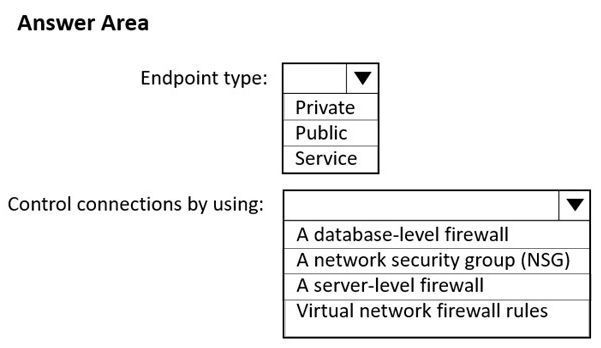
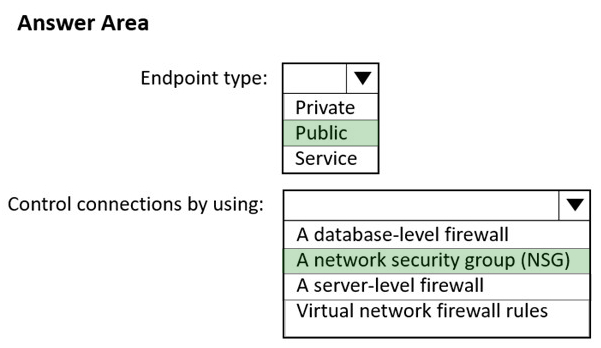
You have an Azure subscription that contains an Azure SQL managed instance named SQL1.
You use the Microsoft Power BI service.
You need to configure connectivity from the Power BI service to SQL1. The solution must ensure that only the Power BI service can initiate connections to SQL1.
Which type of endpoint should you use for SQL1, and what should you use to control the connections to SQL1? To answer, select the appropriate options in the answer area.
NOTE: Each correct selection is worth one point.
Reveal answer detailsClose answer details
Explanation
Box 1: Public Public endpoint for a managed instance enables data access to your managed instance from outside the virtual network. You're able to access your managed instance from multi-tenant Azure services like Power BI, Azure App Service, or an on-premises network. By using the public endpoint on a managed instance, you don't need to use a VPN, which can help avoid VPN throughput issues.
Box 2: A network security group Allow public endpoint traffic on the network security group 1. If you have the configuration page of the managed instance still open, navigate to the Overview tab. Otherwise, go back to your SQL managed instance resource. Select the Virtual network/subnet link, which will take you to the Virtual network configuration page.
2. Select the Subnets tab on the left configuration pane of your Virtual network, and make note of the SECURITY GROUP for your managed instance.
3. Go back to your resource group that contains your managed instance. You should see the Network security group name noted above. Select the name to go into the network security group configuration page.
4. Select the Inbound security rules tab, and Add a rule that has higher priority than the deny_all_inbound rule with the following settings:
You are creating a new notebook in Azure Databricks that will support R as the primary language but will also support Scala and SQL.
Which switch should you use to switch between languages?
A
\\[<language>]
B
%<language>
C
\\[<language>]
D
@<language>
Reveal answer detailsClose answer details
Correct answerB
Explanation
You can override the default language by specifying the language magic command %<language> at the beginning of a cell. The supported magic commands are: %python, %r, %scala, and %sql.
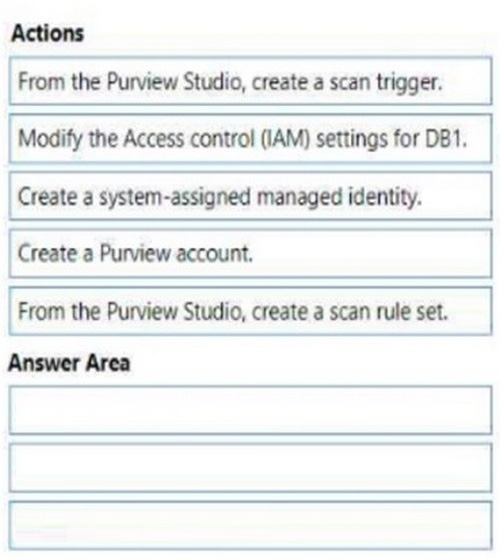
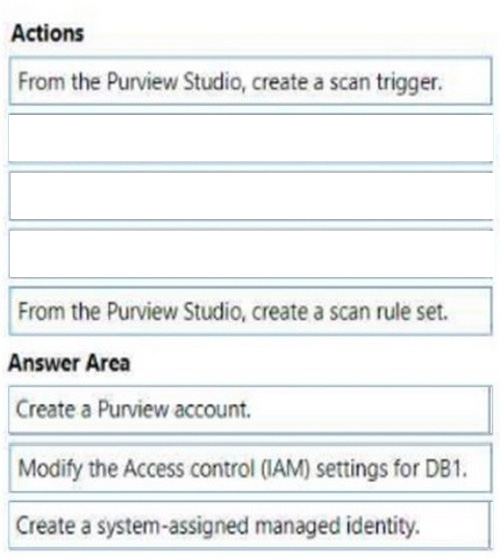
You have an Azure subscription that contains an Azure SQL database named DB1.
You plan to perform a classification scan of DB1 by using Azure Purview.
You need to ensure that you can register DB1.
Which three actions should you perform in sequence? To answer, move the appropriate actions from the list of actions to the answer area and arrange them in the correct order.
Reveal answer detailsClose answer details
Explanation
Step 1: Create a Purview account. Prerequisites An Azure account with an active subscription. Create an account for free. An active Microsoft Purview account. You'll need to be a Data Source Administrator and Data Reader to register a source and manage it in the Microsoft Purview governance portal.
Step 2: Modify the Access control (IAM) settings for DB1. A collection is a tool that the Microsoft Purview Data Map uses to group assets, sources, and other artifacts into a hierarchy for discoverability and to manage access control. All accesses to the Microsoft Purview governance portal's resources are managed from collections in the Microsoft Purview Data Map
Step 3: Create a system-assigned managed identity. Authentication for a scan To scan your data source, you'll need to configure an authentication method in the Azure SQL Database.
The following options are supported:
* System-assigned managed identity (Recommended) - This is an identity associated directly with your Microsoft Purview account that allows you to authenticate directly with other Azure resources without needing to manage a go-between user or credential set.
Note: This question is part of a series of questions that present the same scenario. Each question in the series contains a unique solution that might meet the stated goals. Some question sets might have more than one correct solution, while others might not have a correct solution.
After you answer a question in this section, you will NOT be able to return to it. As a result, these questions will not appear in the review screen.
You have SQL Server 2019 on an Azure virtual machine.
You are troubleshooting performance issues for a query in a SQL Server instance.
To gather more information, you query sys.dm_exec_requests and discover that the wait type is PAGELATCH_UP and the wait_resource is 2:3:905856.
You need to improve system performance.
Solution: You change the data file for the master database to autogrow by 10 percent.
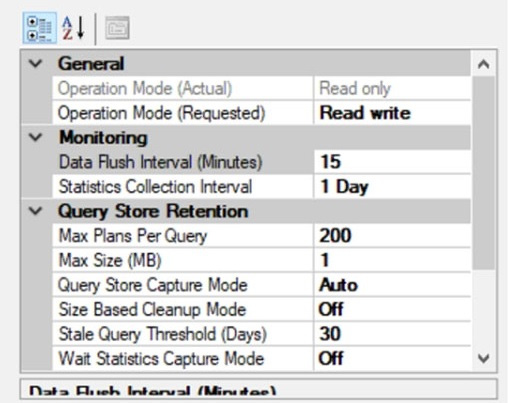
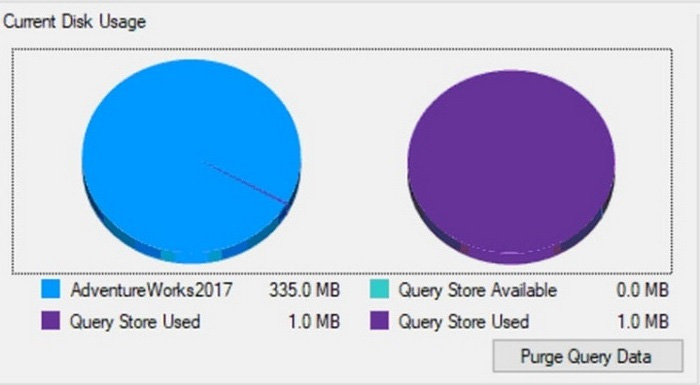
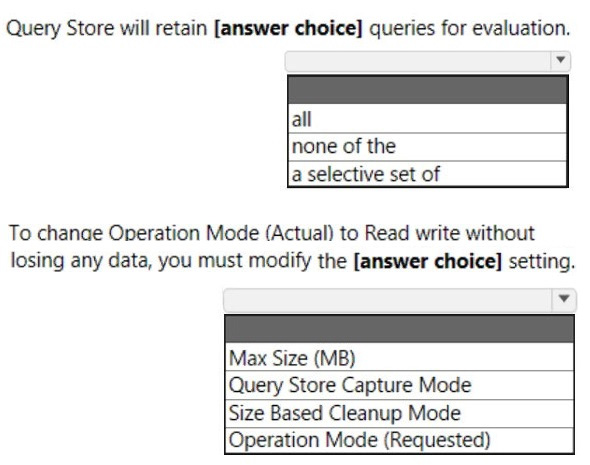
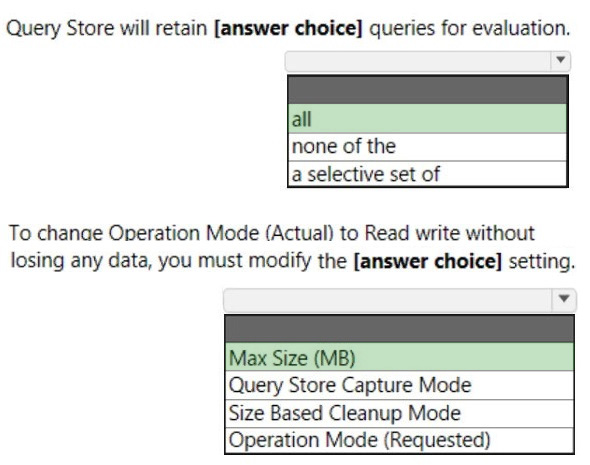
You have a database on a SQL Server on Azure Virtual Machines instance.
The current state of Query Store for the database is shown in the following exhibit.
Use the drop-down menus to select the answer choice that completes each statement based on the information presented in the graphic.
NOTE: Each correct selection is worth one point.
Reveal answer detailsClose answer details
Question 30
Multiple choice
You have an Azure SQL Database elastic pool that contains 10 databases.
You receive the following alert.
Msg 1132, Level 16, state 1, Line 1 The elastic pool has reached its storage limit. The storage used for the elastic pool cannot exceed (76800) MBs.
You need to resolve the alert. The solution must minimize administrative effort.
Which three actions can you perform? Each correct answer presents a complete solution.
NOTE: Each correct selection is worth one point.
A
Increase the maximum storage of the elastic pool.
B
Delete data from a database.
C
Remove a database from the pool.
D
Enable data compression.
E
Shrink individual databases.
Reveal answer detailsClose answer details
Correct answersA, C, E
Explanation
A: Change elastic pool storage size * vCore-based purchasing model Storage can be provisioned up to the max size limit:
For storage in the Standard or General Purpose service tiers, increase or decrease size in 10-GB increments For storage in the Premium or Business Critical service tiers, increase or decrease size in 250-GB increments Storage for an elastic pool can be provisioned by increasing or decreasing its max size.
* DTU-based purchasing model The eDTU price for an elastic pool includes a certain amount of storage at no additional cost. Extra storage beyond the included amount can be provisioned for an additional cost up to the max size limit in increments of 250 GB up to 1 TB, and then in increments of 256 GB beyond 1 TB.
C: You can add or remove databases to/from the pool.
E: Under some circumstances, you may need to shrink a database to reclaim unused space. Reclaim unused allocated space Shrink commands impact database performance while running, and if possible should be run during periods of low usage.
You have an Azure subscription that contains an instance of SQL Server on an Azure virtual machine named SQLVM1 and a user named User1. SQLVM1 hosts a database named DB1.
You need to ensure that User1 can create a scheduled task to perform a full backup of DB1. The solution must use the principle of least privilege.
Which built-in database role should you assign to User1?
A
db_owner
B
SQLAgentReaderRole
C
SQLAgentUserRole
D
SQLAgentOperatorRole
Reveal answer detailsClose answer details
Correct answerC
Question 32
Hotspot
HOTSPOT
You have an Azure SQL database named DB 1 in the General Purpose service tier.
You need to monitor DB 1 by using SQL Insights.
What should you include in the solution? To answer, select the appropriate options in the answer area.
NOTE: Each correct selection is worth one point.
Reveal answer detailsClose answer details
Explanation
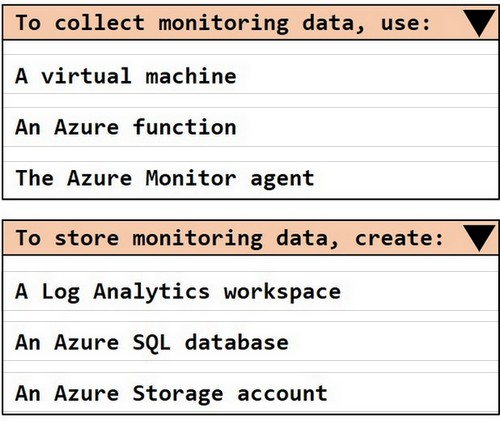
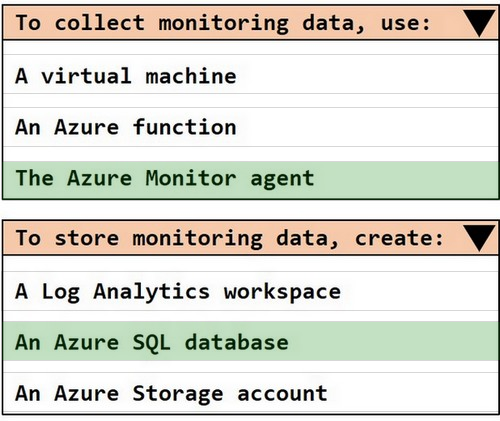
Box 1 = Azure Monitor Agent
Box 2 = An Azure SQL database https://docs.microsoft.com/en-us/azure/azure-sql/database/sql-database-paas-overview?view=azuresql
Question 33
Single choice
You have an Azure SQL managed instance.
You need to gather the last execution of a query plan and its runtime statistics. The solution must minimize the impact on currently running queries.
You need to ensure that DB1 will support automatic failover without data loss if a datacenter fails. The solution must minimize costs.
Which deployment option and pricing tier should you configure?
A
Azure SQL Database Premium
B
Azure SQL Database Basic
C
Azure SQL Database managed instance General Purpose
D
Azure SQL Database Hyperscale
Reveal answer detailsClose answer details
Correct answerA
Explanation
By default, the cluster of nodes for the premium availability model is created in the same datacenter. With the introduction of Azure Availability Zones, SQL Database can place different replicas of the Business Critical database to different availability zones in the same region. To eliminate a single point of failure, the control ring is also duplicated across multiple zones as three gateway rings (GW). The routing to a specific gateway ring is controlled by Azure Traffic Manager (ATM). Because the zone redundant configuration in the Premium or Business Critical service tiers does not create additional database redundancy, you can enable it at no extra cost. By selecting a zone redundant configuration, you can make your Premium or Business Critical databases resilient to a much larger set of failures, including catastrophic datacenter outages, without any changes to the application logic. You can also convert any existing Premium or Business Critical databases or pools to the zone redundant configuration.
Incorrect Answers: Note: There are several versions of this question with different incorrect answer options. Other incorrect answers you may see on the exam include:
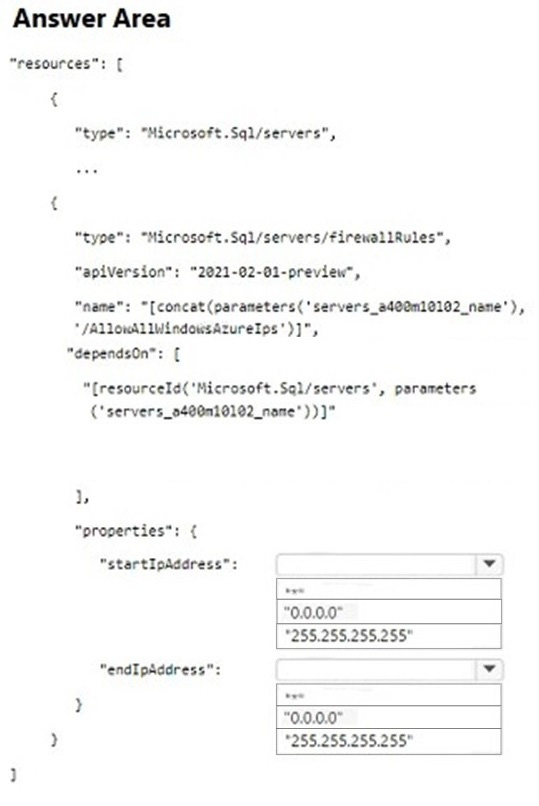
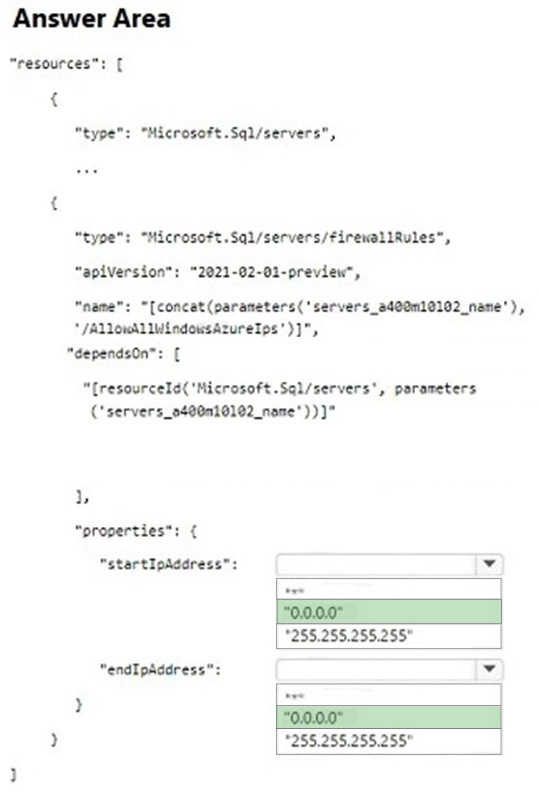
You need to deploy a logical SQL server by using an Azure Resource Manager (ARM) template. The solution must ensure that the server will allow inbound connectivity from any Azure resource.
How should you complete the template? To answer, select the appropriate options in the answer area.
NOTE: Each correct selection is worth one point.
Reveal answer detailsClose answer details
Explanation
Box 1: "0.0.0.0" startIpAddress The start IP address of the firewall rule. Must be IPv4 format. Use value '0.0.0.0' for all Azure-internal IP addresses.
SQL server firewall rules should not permit start and end IP addresses to be 0.0.0.0. Adding a rule with range 0.0.0.0 to 0.0.0.0 is the same as enabling the "Allow access to Azure services" setting, which allows all connections from Azure, including from other subscriptions. Disabling this setting helps prevent malicious Azure users from connecting to your database and accessing sensitive data.
Box 2: "0.0.0.0" endIpAddress The end IP address of the firewall rule. Must be IPv4 format. Must be greater than or equal to startIpAddress. Use value '0.0.0.0' for all Azure-internal IP addresses.
References: https://docs.fugue.co/FG_R00221.html
Question 36
Multiple choice
You have 40 Azure SQL databases, each for a different customer. All the databases reside on the same Azure SQL Database server.
You need to ensure that each customer can only connect to and access their respective database.
Which two actions should you perform? Each correct answer presents part of the solution.
NOTE: Each correct selection is worth one point.
A
Implement row-level security (RLS).
B
Create users in each database.
C
Configure the database firewall.
D
Configure the server firewall.
E
Create logins in the master database.
F
Implement Always Encrypted.
Reveal answer detailsClose answer details
Correct answersB, C
Explanation
To ensure that each customer can only connect to and access their respective database in Azure SQL, you should perform the following two actions:
B. Create users in each database: Creating separate users for each customer in their respective databases allows you to control access at the database level. Each user will have its own set of permissions and can only connect to and access their assigned database.
C. Configure the database firewall: The database firewall provides an additional layer of security by controlling the incoming connections to the Azure SQL Database server. By configuring the database firewall, you can define IP address ranges or individual IP addresses that are allowed to connect to each database. This ensures that only authorized connections from specific sources can access the databases.
Therefore, the correct actions to perform are B. Create users in each database and C. Configure the database firewall.
Question 37
Drag & drop
DRAG DROP
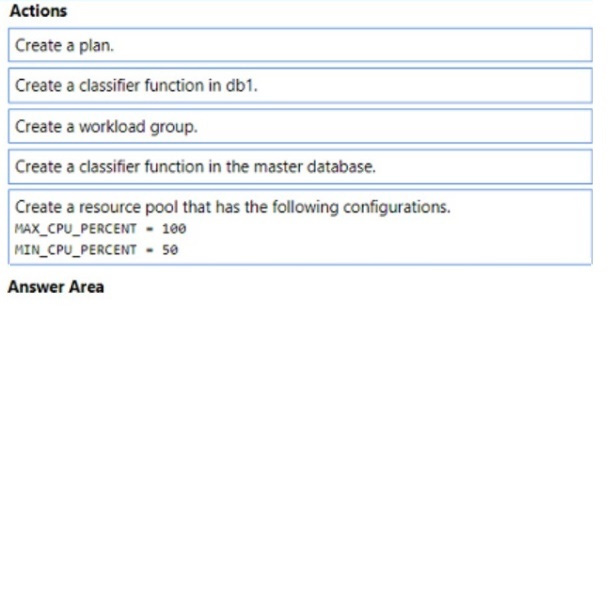
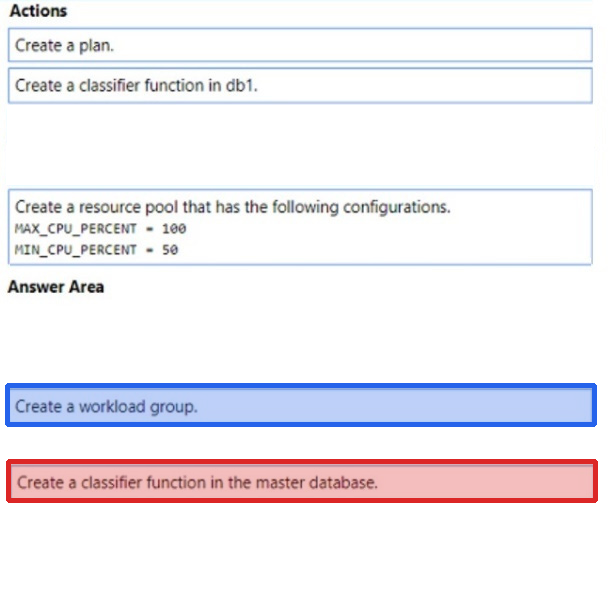
You have an Azure subscription that contains an Azure SQL managed instance, a database named db1, and an Azure web app named Appl. Appl uses db1.
You need to enable Resource Governor for a App1. The solution must meet the following requirements:
1. App1 must be able to consume all available CPU resources. 2. App1 must have at least half of the available CPU resources always available.
Which three actions should you perform in sequence? To answer. move the appropriate actions from the list of actions to the answer area and arrange them in the correct order.
NOTE: More than one order of answer choices is correct. You will receive credit for any of the correct orders you select.
Reveal answer detailsClose answer details
Question 38
Single choice
You deploy a database to an Azure SQL Database managed instance.
You need to prevent read queries from blocking queries that are trying to write to the database.
Which database option should set?
A
PARAMETERIZATION to FORCED
B
PARAMETERIZATION to SIMPLE
C
Delayed Durability to Forced
D
READ_COMMITTED_SNAPSHOT to ON
Reveal answer detailsClose answer details
Correct answerD
Explanation
In SQL Server, you can also minimize locking contention while protecting transactions from dirty reads of uncommitted data modifications using either: 1. The READ COMMITTED isolation level with the READ_COMMITTED_SNAPSHOT database option set to ON. 2. The SNAPSHOT isolation level.
If READ_COMMITTED_SNAPSHOT is set to ON (the default on SQL Azure Database), the Database Engine uses row versioning to present each statement with a transactionally consistent snapshot of the data as it existed at the start of the statement. Locks are not used to protect the data from updates by other transactions.
Incorrect Answers: A: When the PARAMETERIZATION database option is set to SIMPLE, the SQL Server query optimizer may choose to parameterize the queries. This means that any literal values that are contained in a query are substituted with parameters. This process is referred to as simple parameterization. When SIMPLE parameterization is in effect, you cannot control which queries are parameterized and which queries are not.
B: You can specify that all queries in a database be parameterized by setting the PARAMETERIZATION database option to FORCED. This process is referred to as forced parameterization.
C: Delayed transaction durability is accomplished using asynchronous log writes to disk. Transaction log records are kept in a buffer and written to disk when the buffer fills or a buffer flushing event takes place. Delayed transaction durability reduces both latency and contention within the system.
Some of the cases in which you could benefit from using delayed transaction durability are: 1. You can tolerate some data loss. 2. You are experiencing a bottleneck on transaction log writes. 3. Your workloads have a high contention rate.
Litware, Inc. is a renewable energy company that has a main office in Boston. The main office hosts a sales department and the primary datacenter for the company.
Physical Locations
Existing Environment
Litware has a manufacturing office and a research office is separate locations near Boston. Each office has its own datacenter and internet connection.
The manufacturing and research datacenters connect to the primary datacenter by using a VPN.
Network Environment
The primary datacenter has an ExpressRoute connection that uses both Microsoft peering and private peering. The private peering connects to an Azure virtual network named HubVNet.
Identity Environment
Litware has a hybrid Azure Active Directory (Azure AD) deployment that uses a domain named litwareinc.com. All Azure subscriptions are associated to the litwareinc.com Azure AD tenant.
Database Environment
The sales department has the following database workload:
1. An on-premises named SERVER1 hosts an instance of Microsoft SQL Server 2012 and two 1-TB databases. 2. A logical server named SalesSrv01A contains a geo-replicated Azure SQL database named SalesSQLDb1. SalesSQLDb1 is in an elastic pool named SalesSQLDb1Pool. SalesSQLDb1 uses database firewall rules and contained database users. 3. An application named SalesSQLDb1App1 uses SalesSQLDb1.
The manufacturing office contains two on-premises SQL Server 2016 servers named SERVER2 and SERVER3. The servers are nodes in the same Always On availability group. The availability group contains a database named ManufacturingSQLDb1
Database administrators have two Azure virtual machines in HubVnet named VM1 and VM2 that run Windows Server 2019 and are used to manage all the Azure databases.
Licensing Agreement
Litware is a Microsoft Volume Licensing customer that has License Mobility through Software Assurance.
Current Problems
SalesSQLDb1 experiences performance issues that are likely due to out-of-date statistics and frequent blocking queries.
Requirements
Planned Changes
Litware plans to implement the following changes:
1. Implement 30 new databases in Azure, which will be used by time-sensitive manufacturing apps that have varying usage patterns. Each database will be approximately 20 GB. 2. Create a new Azure SQL database named ResearchDB1 on a logical server named ResearchSrv01. ResearchDB1 will contain Personally Identifiable Information (PII) data. 3. Develop an app named ResearchApp1 that will be used by the research department to populate and access ResearchDB1. 4. Migrate ManufacturingSQLDb1 to the Azure virtual machine platform. 5. Migrate the SERVER1 databases to the Azure SQL Database platform.
Technical Requirements
Litware identifies the following technical requirements:
1. Maintenance tasks must be automated. 2. The 30 new databases must scale automatically. 3. The use of an on-premises infrastructure must be minimized. 4. Azure Hybrid Use Benefits must be leveraged for Azure SQL Database deployments. 5. All SQL Server and Azure SQL Database metrics related to CPU and storage usage and limits must be analyzed by using Azure built-in functionality.
Security and Compliance Requirements
Litware identifies the following security and compliance requirements:
1. Store encryption keys in Azure Key Vault. 2. Retain backups of the PII data for two months. 3. Encrypt the PII data at rest, in transit, and in use. 4. Use the principle of least privilege whenever possible. 5. Authenticate database users by using Active Directory credentials. 6. Protect Azure SQL Database instances by using database-level firewall rules. 7. Ensure that all databases hosted in Azure are accessible from VM1 and VM2 without relying on public endpoints.
Business Requirements
Litware identifies the following business requirements:
1. Meet an SLA of 99.99% availability for all Azure deployments. 2. Minimize downtime during the migration of the SERVER1 databases. 3. Use the Azure Hybrid Use Benefits when migrating workloads to Azure. 4. Once all requirements are met, minimize costs whenever possible.
Question 39
Testlet 1Multiple choice
You need to identify the cause of the performance issues on SalesSQLDb1.
Which two dynamic management views should you use? Each correct answer presents part of the solution.
NOTE: Each correct selection is worth one point.
A
sys.dm_pdw_nodes_tran_locks
B
sys.dm_exec_compute_node_errors
C
sys.dm_exec_requests
D
sys.dm_cdc_errors
E
sys.dm_pdw_nodes_os_wait_stats
F
sys.dm_tran_locks
Reveal answer detailsClose answer details
Correct answersA, F
Explanation
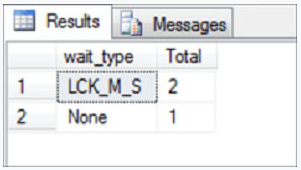
SalesSQLDb1 experiences performance issues that are likely due to out-of-date statistics and frequent blocking queries. Seeing a Count of All Active SQL Server Wait Types. Sometimes we're trying to diagnose a problem and we want to know if we're seeing a large number of wait types occurring. We can do this using sys.dm_exec_requests because the current wait type being experienced is presented. Therefore, if we filter out any background or sleeping tasks, we can get a picture of what the waits are for active requests and we can also see if we have a problem. Here's the query: SELECT COALESCE(wait_type, 'None') AS wait_type, COUNT(*) AS Total
FROM sys.dm_exec_requests - WHERE NOT status IN ('Background', 'Sleeping')
GROUP BY wait_type - ORDER BY Total DESC; Here is an example of the query output:
We see that we have two LCK_M_S wait types. This is the wait type we get when we have requests waiting on obtaining a shared lock. We can then query along with sys.dm_tran_locks to determine what types of locks these active requests were trying to obtain: SELECT L.request_session_id, L.resource_type, L.resource_subtype, L.request_mode, L.request_type
FROM sys.dm_tran_locks AS L JOIN sys.dm_exec_requests AS DER ON L.request_session_id = DER.session_id WHERE DER.wait_type = 'LCK_M_S'; Incorrect: Not A: Azure SQL database does not have sys.dm_pdw_nodes_tran_locks. Not E: Azure SQL database does not have sys.dm_pdw_nodes_os_wait_stats.
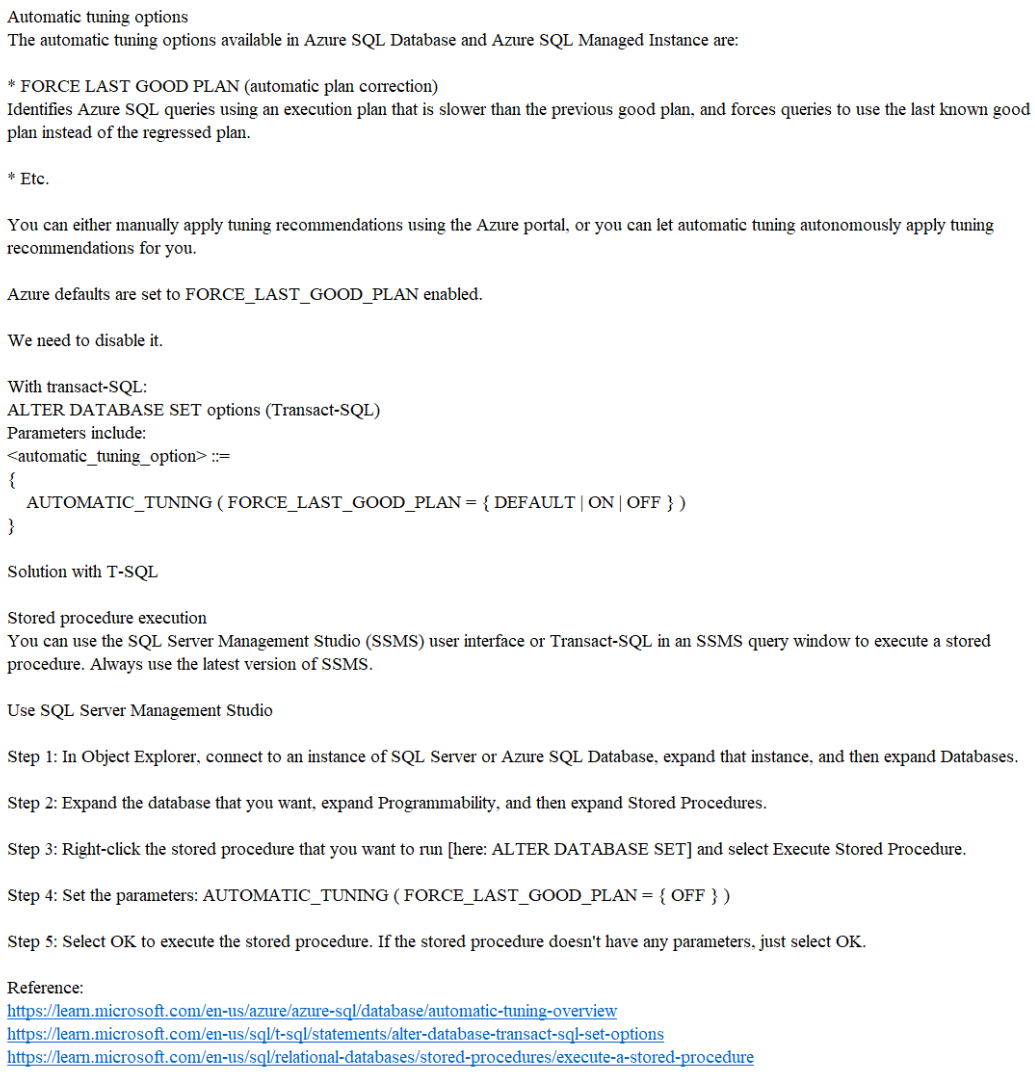
You need prevent db1 from reverting to the last known good query plan.
To complete this task, sign in to the virtual machine. You may need to use SQL Server Management Studio and the Azure portal.
Reveal model answerClose model answer
Question 41
Multiple choice
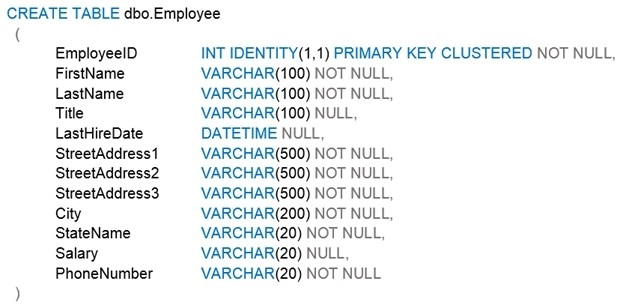
A data engineer creates a table to store employee information for a new application. All employee names are in the US English alphabet. All addresses are locations in the United States. The data engineer uses the following statement to create the table.
You need to recommend changes to the data types to reduce storage and improve performance.
Which two actions should you recommend? Each correct answer presents part of the solution.
NOTE: Each correct selection is worth one point.
A
Change Salary to the money data type.
B
Change PhoneNumber to the float data type.
C
Change LastHireDate to the datetime2(7) data type.
D
Change PhoneNumber to the bigint data type.
E
Change LastHireDate to the date data type.
Reveal answer detailsClose answer details
Correct answersA, E
Question 42
Single choice
Note: This question is part of a series of questions that present the same scenario. Each question in the series contains a unique solution that might meet the stated goals. Some question sets might have more than one correct solution, while others might not have a correct solution.
After you answer a question in this section, you will NOT be able to return to it. As a result, these questions will not appear in the review screen.
You have SQL Server 2019 on an Azure virtual machine.
You are troubleshooting performance issues for a query in a SQL Server instance.
To gather more information, you query sys.dm_exec_requests and discover that the wait type is PAGELATCH_UP and the wait_resource is 2:3:905856.
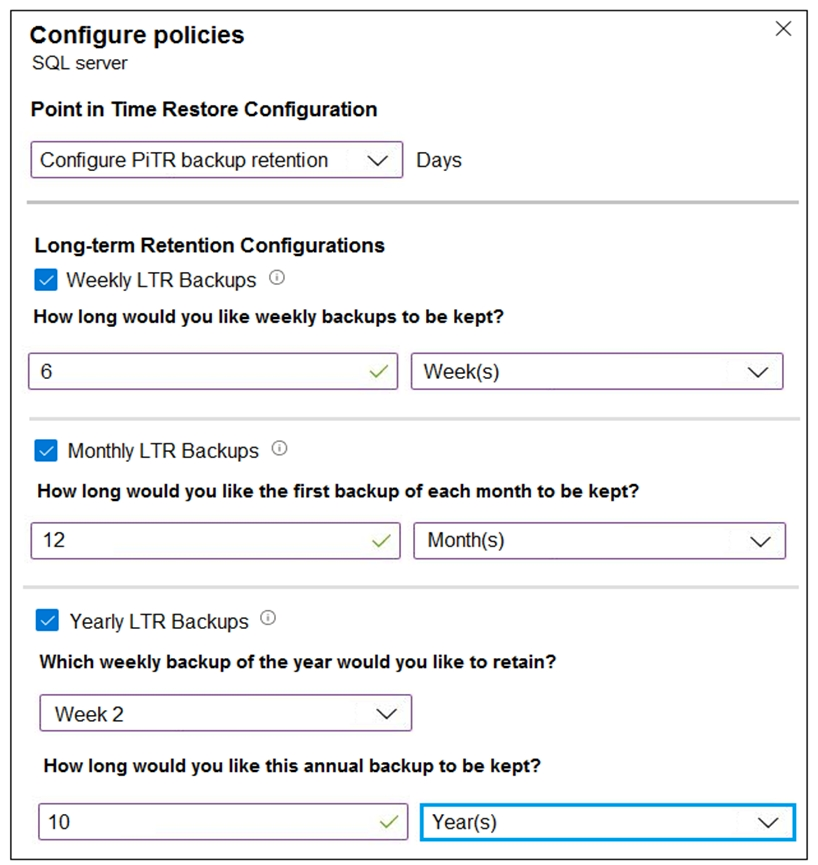
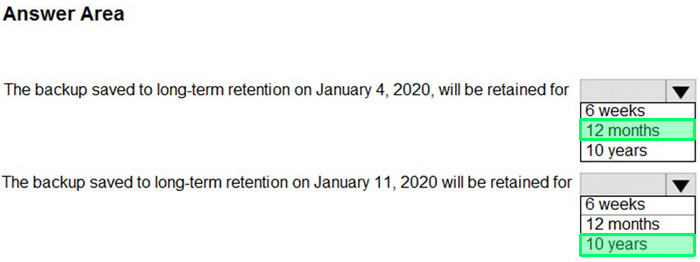
You configure a long-term retention policy for an Azure SQL database as shown in the exhibit. (Click the Exhibit tab.)
The first weekly backup occurred on January 4, 2020. The dates for the first 10 weekly backups are:
1. January 4, 2020 2. January 11, 2020 3. January 18, 2020
4. January 25, 2020 5. February 1, 2020 6. February 8, 2020 7. February 15, 2020 8. February 22, 2020 9. February 29, 2020 10. March 7, 2020
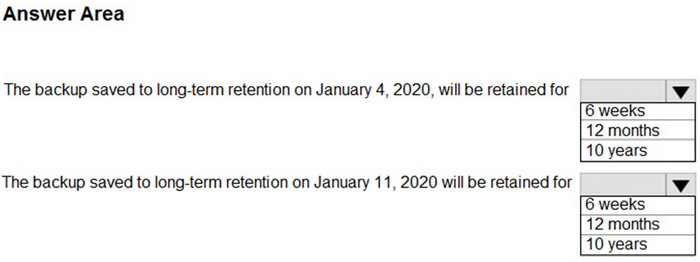
Use the drop-down menus to select the answer choice that completes each statement based on the information presented in the graphic.
NOTE: Each correct selection is worth one point.
Reveal answer detailsClose answer details
Question 44
Single choice
You have 10 Azure virtual machines that have SQL Server installed.
You need to implement a backup strategy to ensure that you can restore specific databases to other SQL Server instances. The solution must provide centralized management of the backups.
What should you include in the backup strategy?
A
Automated Backup in the SQL virtual machine settings
B
Azure Backup
C
Azure Site Recovery
D
SQL Server Agent jobs
Reveal answer detailsClose answer details
Correct answerB
Explanation
Azure Backup provides an Enterprise class backup capability for SQL Server on Azure VMs. All backups are stored and managed in a Recovery Services vault. There are several advantages that this solution provides, especially for Enterprises.
You have an on-premises datacenter that contains a 2-TB Microsoft SQL Server 2019 database named DB1.
You need to recommend a solution to migrate DB1 to an Azure SQL managed instance. The solution must minimize downtime and administrative effort.
What should you include in the recommendation?
A
Log Replay Service (LRS)
B
log shipping
C
transactional replication
D
SQL Data Sync
Reveal answer detailsClose answer details
Correct answerA
Explanation
Migration overview: SQL Server to Azure SQL Managed Instance
We recommend the following migration tools: * Log Replay Service This cloud service is enabled for SQL Managed Instance based on SQL Server log-shipping technology. It's a migration option for customers who can provide full, differential, and log database backups to Azure Storage. Log Replay Service is used to restore backup files from Azure Blob Storage to SQL Managed Instance.
* Etc.
The following table lists alternative migration tools: * Transactional replication
Replicate data from source SQL Server database tables to SQL Managed Instance by providing a publisher-subscriber type migration option while maintaining transactional consistency.
* Etc.
Compare migration options Compare migration options to choose the path that's appropriate to your business needs.
The following table compares the recommended migration options: * Log Replay Service - Migrate individual line-of-business application databases. - More control is needed for database migrations.
Considerations: - The migration entails making full database backups on SQL Server and copying backup files to Azure Blob Storage. Log Replay Service is used to restore backup files from Azure Blob Storage to SQL Managed Instance. - Databases being restored during the migration process will be in a restoring mode and can't be used for read or write workloads until the process is complete.
* Etc.
The following table compares the alternative migration options: * Transactional replication - Migrate by continuously publishing changes from source database tables to target SQL Managed Instance database tables. - Do full or partial database migrations of selected tables (subset of a database).
Considerations: - Setup is relatively complex compared to other migration options. - Provides a continuous replication option to migrate data (without taking the databases offline).
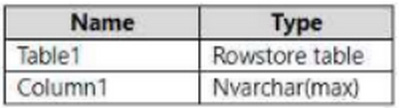
You have an Azure SOI database named SQLDb1 that contains the resources shown in the following table.
Column1 contains JSON data.
You need to compress Column1. The solution must minimize the amount of storage used.
What should you use?
A
the COMPRESS() function
B
columnstore archive compression
C
row compression
D
columnstore compression
Reveal answer detailsClose answer details
Correct answerA
Explanation
The COMPRESS (Transact-SQL) function compresses the input expression, using the GZIP algorithm.
The function returns a byte array of type varbinary(max).
Syntax: COMPRESS ( expression )
Arguments expression A
binary(n) char(n) nchar(n) nvarchar(max) nvarchar(n) varbinary(max) varbinary(n) varchar(max) or
varchar(n) expression
Incorrect: The max size for a column of type NVARCHAR(MAX) is 2 GByte of storage. Since NVARCHAR uses 2 bytes per character, that's approx. 1 billion characters.
A table cannot be enabled for compression when the maximum row size plus the compression overhead exceeds the maximum row size of 8060 bytes. For example, a table that has the columns c1 CHAR(8000) and c2 CHAR(53) cannot be compressed because of the additional compression overhead.
Compression has no effect on Nvarchar columns, except for Page compression.
You have an Azure subscription. The subscription contains an instance of SQL Server on Azure Virtual Machines named SQL1 and an Azure Automation account named account1.
You need to configure account1 to restart the SQL Server Agent service if the service stops.
Which setting should you configure?
A
Start/Stop VM
B
Change tracking
C
Update management
D
State configuration (DSC)
Reveal answer detailsClose answer details
Correct answerD
Question 51
Drag & drop
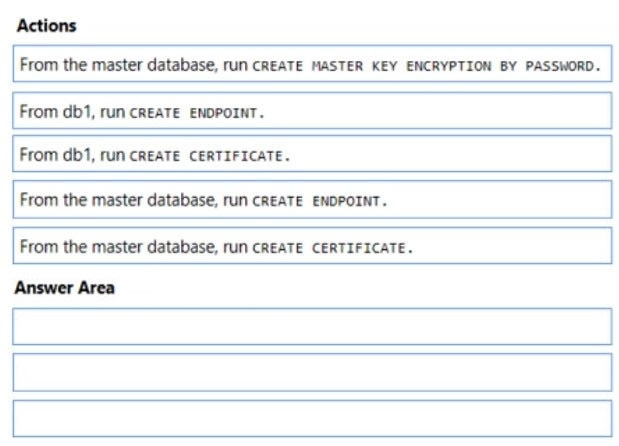
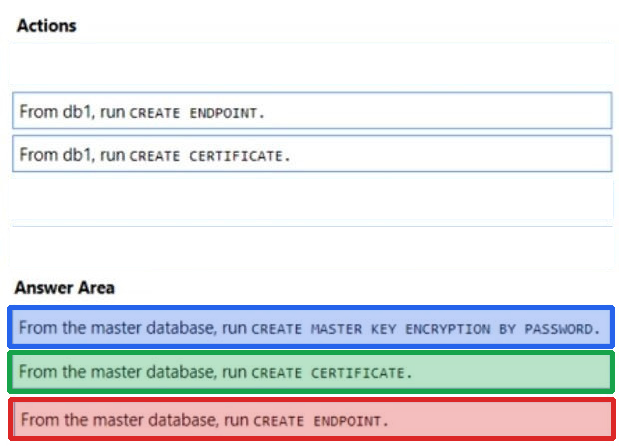
DRAG DROP
You have two instances of SQL Server on Azure virtual Machines named VM1 and VM2. VM1 hosts a database named dbl.
You plan to create a database availability group (DAG) for dbl. The solution must use certificate authentication between VM1 and VM2.
You need to configure authentication for the outbound connections of VM1.
Which three actions should you perform in sequence? To answer, move the appropriate actions from the list of actions to the answer area and arrange them in the correct order.
Reveal answer detailsClose answer details
Question 52
Hotspot
HOTSPOT
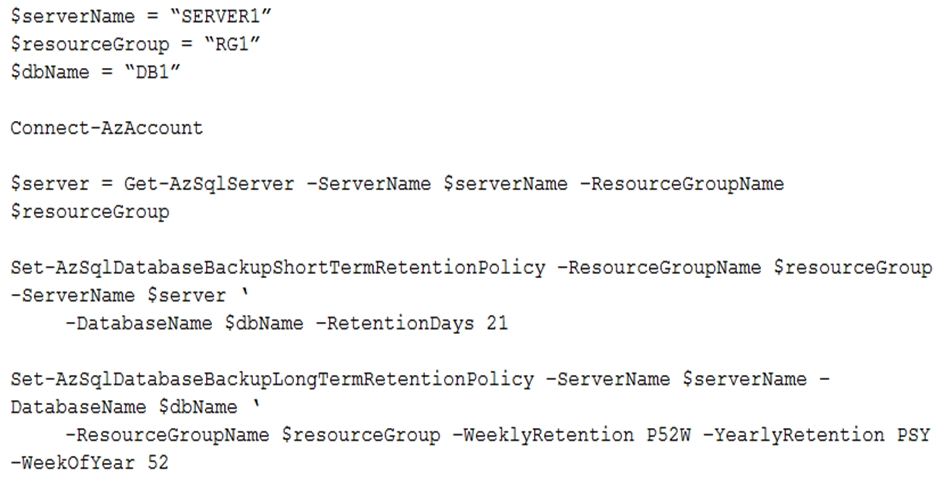
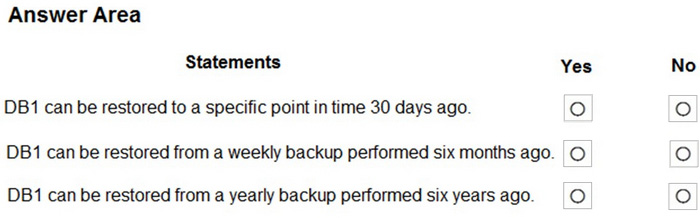
You have an Azure SQL database.
You run the following PowerShell script.
For each of the following statements, select Yes if the statement is true. Otherwise, select No.
You have an instance of SQL Server on Azure Virtual Machines named VM1.
You plan to schedule a SQL Server Agent job that will rebuild indexes of the databases hosted on VM1.
You need to configure the account that will be used by the agent. The solution must use the principle of least privilege.
Which operating system user right should you assign to the account?
A
Increase scheduling priority
B
Log on as a service
C
Profile system performance
D
Log on as a batch job
Reveal answer detailsClose answer details
Correct answerD
Explanation
To configure a SQL Server Agent job on an instance of SQL Server on Azure Virtual Machines (VMs) to rebuild indexes of the databases hosted on the VM, you need to assign the Log on as a batch job user right to the account that will be used by the agent.
Therefore, the correct answer is D. Log on as a batch job.
Question 54
Single choice
You have an Azure SQL managed instance named SQLMI1 that hosts 10 databases.
You need to implement alerts by using Azure Monitor. The solution must meet the following requirements:
1. Minimize costs. 2. Aggregate Intelligent Insights telemetry from each database.
What should you do?
A
From the Diagnostic settings of each database, select Send to Log Analytics.
B
From the Diagnostic settings of each database, select Stream to an event hub.
C
From the Diagnostic settings of SQLMI1, select Send to Log Analytics.
D
From the Diagnostic settings of SQLMI1, select Stream to an event hub.
You need to use an Azure Resource Manager (ARM) template to deploy an Azure virtual machine that will host a Microsoft SQL Server instance. The solution must maximize disk I/O performance for the SQL Server database and log files.
How should you complete the template? To answer, select the appropriate options in the answer area.
NOTE: Each correct selection is worth one point.
Correct Answer:
Explanation
Explanation/Reference:
Box 1: None Set host caching to none for log file disks.
Box 2: ReadOnly Set host caching to read-only for data file disks.
Do not enable read/write caching on disks that contain SQL Server data or log files.
You have SQL Server 2019 on an Azure virtual machine that contains an SSISDB database.
A recent failure causes the master database to be lost.
You discover that all Microsoft SQL Server integration Services (SSIS) packages fail to run on the virtual machine.
Which four actions should you perform in sequence to resolve the issue? To answer, move the appropriate actions from the list of actions to the answer area and arrange them in the correct.
Correct Answer:
Explanation
Explanation/Reference:
Step 1: Attach the SSISDB database
Step 2: Turn on the TRUSTWORTHY property and the CLR property If you are restoring the SSISDB database to an SQL Server instance where the SSISDB catalog was never created, enable common language runtime (clr)
Step 3: Open the master key for the SSISDB database Restore the master key by this method if you have the original password that was used to create SSISDB.
open master key decryption by password = 'LS1Setup!' --'Password used when creating SSISDB' Alter Master Key Add encryption by Service Master Key
Step 4: Encrypt a copy of the mater key by using the service master key
Litware, Inc. is a renewable energy company that has a main office in Boston. The main office hosts a sales department and the primary datacenter for the company.
Physical Locations
Existing Environment
Litware has a manufacturing office and a research office is separate locations near Boston. Each office has its own datacenter and internet connection.
The manufacturing and research datacenters connect to the primary datacenter by using a VPN.
Network Environment
The primary datacenter has an ExpressRoute connection that uses both Microsoft peering and private peering. The private peering connects to an Azure virtual network named HubVNet.
Identity Environment
Litware has a hybrid Azure Active Directory (Azure AD) deployment that uses a domain named litwareinc.com. All Azure subscriptions are associated to the litwareinc.com Azure AD tenant.
Database Environment
The sales department has the following database workload:
1. An on-premises named SERVER1 hosts an instance of Microsoft SQL Server 2012 and two 1-TB databases. 2. A logical server named SalesSrv01A contains a geo-replicated Azure SQL database named SalesSQLDb1. SalesSQLDb1 is in an elastic pool named SalesSQLDb1Pool. SalesSQLDb1 uses database firewall rules and contained database users. 3. An application named SalesSQLDb1App1 uses SalesSQLDb1.
The manufacturing office contains two on-premises SQL Server 2016 servers named SERVER2 and SERVER3. The servers are nodes in the same Always On availability group. The availability group contains a database named ManufacturingSQLDb1
Database administrators have two Azure virtual machines in HubVnet named VM1 and VM2 that run Windows Server 2019 and are used to manage all the Azure databases.
Licensing Agreement
Litware is a Microsoft Volume Licensing customer that has License Mobility through Software Assurance.
Current Problems
SalesSQLDb1 experiences performance issues that are likely due to out-of-date statistics and frequent blocking queries.
Requirements
Planned Changes
Litware plans to implement the following changes:
1. Implement 30 new databases in Azure, which will be used by time-sensitive manufacturing apps that have varying usage patterns. Each database will be approximately 20 GB. 2. Create a new Azure SQL database named ResearchDB1 on a logical server named ResearchSrv01. ResearchDB1 will contain Personally Identifiable Information (PII) data. 3. Develop an app named ResearchApp1 that will be used by the research department to populate and access ResearchDB1. 4. Migrate ManufacturingSQLDb1 to the Azure virtual machine platform. 5. Migrate the SERVER1 databases to the Azure SQL Database platform.
Technical Requirements
Litware identifies the following technical requirements:
1. Maintenance tasks must be automated. 2. The 30 new databases must scale automatically. 3. The use of an on-premises infrastructure must be minimized. 4. Azure Hybrid Use Benefits must be leveraged for Azure SQL Database deployments. 5. All SQL Server and Azure SQL Database metrics related to CPU and storage usage and limits must be analyzed by using Azure built-in functionality.
Security and Compliance Requirements
Litware identifies the following security and compliance requirements:
1. Store encryption keys in Azure Key Vault. 2. Retain backups of the PII data for two months. 3. Encrypt the PII data at rest, in transit, and in use. 4. Use the principle of least privilege whenever possible. 5. Authenticate database users by using Active Directory credentials. 6. Protect Azure SQL Database instances by using database-level firewall rules. 7. Ensure that all databases hosted in Azure are accessible from VM1 and VM2 without relying on public endpoints.
Business Requirements
Litware identifies the following business requirements:
1. Meet an SLA of 99.99% availability for all Azure deployments. 2. Minimize downtime during the migration of the SERVER1 databases. 3. Use the Azure Hybrid Use Benefits when migrating workloads to Azure. 4. Once all requirements are met, minimize costs whenever possible.
QUESTION 3
DRAG DROP
You need to implement statistics maintenance for SalesSQLDb1. The solution must meet the technical requirements.
Which four actions should you perform in sequence? To answer, move the appropriate actions from the list of actions to the answer area and arrange them in the correct order.
Correct Answer:
Explanation
Explanation/Reference:
Automating Azure SQL DB index and statistics maintenance using Azure Automation: 1. Create Azure automation account (Step 1) 2. Import SQLServer module (Step 2) 3. Add Credentials to access SQL DB This will use secure way to hold login name and password that will be used to access Azure SQL DB 4. Add a runbook to run the maintenance (Step 3) Steps: 1. Click on "runbooks" at the left panel and then click "add a runbook" 2. Choose "create a new runbook" and then give it a name and choose "Powershell" as the type of the runbook and then click on "create"
5. Schedule task (Step 4) Steps: 1. Click on Schedules 2. Click on "Add a schedule" and follow the instructions to choose existing schedule or create a new schedule.
You have two on-premises servers that run Windows Server 2019 and host a Microsoft SQL Server 2017 Always On availability group named AG1. AG1 contains a single database named DB1.
You have an Azure subscription. The subscription contains a virtual machine named VM1 that runs Linux.
You need to migrate DB1 to a SQL Server 2019 instance on VM1. The solution must minimize the downtime of DB1 during the migration.
What should you do? To answer, select the appropriate options in the answer area.
NOTE: Each correct selection is worth one point.
Correct Answer:
Explanation
Explanation/Reference:
Box 1: Add a secondary replica to AG1. Migrate an availability group to SQL Server on Azure VM
To ensure the migrated server is synchronized with the source server, stop the SQL Server service on every replica in the availability group, starting with secondary replicas (in SQL Server Configuration Manager > Services) while ensuring the disks hosting SQL data are online.
Incorrect: * Upgrade to SQL Server 2019 No need to upgrade to SQL Server 2019
* Create a SQL Server 2019 Always ON available group on VM1.
You do that afterwards. After the migration, enable Always On availability groups for the database.
Box 2: Azure Migrate You can migrate your SQL Server Always On availability group to SQL Server on Azure VMs using the Azure Migrate: Server Migration tool. Using the migration tool, you will be able to migrate each replica in the availability group to an Azure VM hosting SQL Server, as well as the cluster metadata, availability group metadata and other necessary high availability components.
Litware, Inc. is a renewable energy company that has a main office in Boston. The main office hosts a sales department and the primary datacenter for the company.
Physical Locations
Existing Environment
Litware has a manufacturing office and a research office is separate locations near Boston. Each office has its own datacenter and internet connection.
The manufacturing and research datacenters connect to the primary datacenter by using a VPN.
Network Environment
The primary datacenter has an ExpressRoute connection that uses both Microsoft peering and private peering. The private peering connects to an Azure virtual network named HubVNet.
Identity Environment
Litware has a hybrid Azure Active Directory (Azure AD) deployment that uses a domain named litwareinc.com. All Azure subscriptions are associated to the litwareinc.com Azure AD tenant.
Database Environment
The sales department has the following database workload:
1. An on-premises named SERVER1 hosts an instance of Microsoft SQL Server 2012 and two 1-TB databases. 2. A logical server named SalesSrv01A contains a geo-replicated Azure SQL database named SalesSQLDb1. SalesSQLDb1 is in an elastic pool named SalesSQLDb1Pool. SalesSQLDb1 uses database firewall rules and contained database users. 3. An application named SalesSQLDb1App1 uses SalesSQLDb1.
The manufacturing office contains two on-premises SQL Server 2016 servers named SERVER2 and SERVER3. The servers are nodes in the same Always On availability group. The availability group contains a database named ManufacturingSQLDb1
Database administrators have two Azure virtual machines in HubVnet named VM1 and VM2 that run Windows Server 2019 and are used to manage all the Azure databases.
Licensing Agreement
Litware is a Microsoft Volume Licensing customer that has License Mobility through Software Assurance.
Current Problems
SalesSQLDb1 experiences performance issues that are likely due to out-of-date statistics and frequent blocking queries.
Requirements
Planned Changes
Litware plans to implement the following changes:
1. Implement 30 new databases in Azure, which will be used by time-sensitive manufacturing apps that have varying usage patterns. Each database will be approximately 20 GB. 2. Create a new Azure SQL database named ResearchDB1 on a logical server named ResearchSrv01. ResearchDB1 will contain Personally Identifiable Information (PII) data. 3. Develop an app named ResearchApp1 that will be used by the research department to populate and access ResearchDB1. 4. Migrate ManufacturingSQLDb1 to the Azure virtual machine platform. 5. Migrate the SERVER1 databases to the Azure SQL Database platform.
Technical Requirements
Litware identifies the following technical requirements:
1. Maintenance tasks must be automated. 2. The 30 new databases must scale automatically. 3. The use of an on-premises infrastructure must be minimized. 4. Azure Hybrid Use Benefits must be leveraged for Azure SQL Database deployments. 5. All SQL Server and Azure SQL Database metrics related to CPU and storage usage and limits must be analyzed by using Azure built-in functionality.
Security and Compliance Requirements
Litware identifies the following security and compliance requirements:
1. Store encryption keys in Azure Key Vault. 2. Retain backups of the PII data for two months. 3. Encrypt the PII data at rest, in transit, and in use. 4. Use the principle of least privilege whenever possible. 5. Authenticate database users by using Active Directory credentials. 6. Protect Azure SQL Database instances by using database-level firewall rules. 7. Ensure that all databases hosted in Azure are accessible from VM1 and VM2 without relying on public endpoints.
Business Requirements
Litware identifies the following business requirements:
1. Meet an SLA of 99.99% availability for all Azure deployments. 2. Minimize downtime during the migration of the SERVER1 databases. 3. Use the Azure Hybrid Use Benefits when migrating workloads to Azure. 4. Once all requirements are met, minimize costs whenever possible.
QUESTION 7
HOTSPOT
You need to recommend a configuration for ManufacturingSQLDb1 after the migration to Azure. The solution must meet the business requirements.
What should you include in the recommendation? To answer, select the appropriate options in the answer area.
NOTE: Each correct selection is worth one point.
Correct Answer:
Explanation
Explanation/Reference:
Scenario: Business Requirements Litware identifies business requirements include: meet an SLA of 99.99% availability for all Azure deployments.
Box 1: Cloud witness If you have a Failover Cluster deployment, where all nodes can reach the internet (by extension of Azure), it is recommended that you configure a Cloud Witness as your quorum witness resource.
Box 2: Azure Basic Load Balancer Microsoft guarantees that a Load Balanced Endpoint using Azure Standard Load Balancer, serving two or more Healthy Virtual Machine Instances, will be available 99.99% of the time.
Note: There are two main options for setting up your listener: external (public) or internal. The external (public) listener uses an internet facing load balancer and is associated with a public Virtual IP (VIP) that is accessible over the internet. An internal listener uses an internal load balancer and only supports clients within the same Virtual Network.
You have an Azure subscription that contains the resources shown in the following table.
You need to configure a connection between VM1 and MI1. The solution must meet the following requirements:
1. The connection must be encrypted. 2. Network latency must be minimized.
What should you implement?
A.
a site-to-site VPN
B.
virtual network peering
C.
private endpoints
D.
service endpoints
Correct Answer: C
QUESTION 9
Note: This question is part of a series of questions that present the same scenario. Each question in the series contains a unique solution that might meet the stated goals. Some question sets might have more than one correct solution, while others might not have a correct solution.
After you answer a question in this section, you will NOT be able to return to it. As a result, these questions will not appear in the review screen.
You have two Azure SQL Database servers named Server1 and Server2. Each server contains an Azure SQL database named Database1.
You need to restore Database1 from Server1 to Server2. The solution must replace the existing Database1 on Server2.
Solution: You restore Database1 from Server1 to the Server2 by using the RESTORE Transact-SQL command and the REPLACE option.
Does this meet the goal?
A.
Yes
B.
No
Correct Answer: B
Explanation
Explanation/Reference:
There is no REPLACE option in Azure SQL Database, or even there is no restore option with T-SQL. https://learn.microsoft.com/en-us/azure/azure-sql/database/recovery-using-backups?view=azuresql-db&tabs=azure-portal
QUESTION 10
You have SQL Server on an Azure virtual machine that contains a database named DB1.
You view a plan summary that shows the duration in milliseconds of each execution of query 1178902 as shown in the following exhibit:
What should you do to ensure that the query uses the execution plan which executes in the least amount of time?
A.
Force the query execution plan for plan 1221065.
B.
Run the DBCC FREEPROCCACHE command.
C.
Force the query execution plan for plan 1220917.
D.
Disable parameter sniffing.
Correct Answer: A
Explanation
Explanation/Reference:
As per exhibit, the execution plan 1221065 has lower execution time compared to plan 1220917.
ADatum Corporation is a financial services company that has a main office in New York City.
Existing Environment. Licensing Agreement
ADatum has a Microsoft Volume Licensing agreement that includes Software Assurance.
Existing Environment. Network Infrastructure
ADatum has an on-premises datacenter and an Azure subscription named Sub1.
Sub1 contains a virtual network named Network1 in the East US Azure region.
The datacenter is connected to Network1 by using a Site-to-Site (S2S) VPN.
Existing Environment. Identity Environment
The on-premises network contains an Active Directory Domain Services (AD DS) forest.
The forest contains a single domain named corp.adatum.com.
The corp.adatum.com domain syncs with a Microsoft Entra tenant named adatum.com.
Existing Environment. Database Environment
The datacenter contains the servers shown in the following table.
DB1 and DB2 are used for transactional and analytical workloads by an application named App1.
App1 runs on Microsoft Entra hybrid joined servers that run Windows Server 2022. App1 uses Kerberos authentication.
DB3 stores compliance data used by two applications named App2 and App3.
DB3 performance is monitored by using Extended Events sessions, with the event_file target set to a file share on a local disk of SVR3.
Resource allocation for DB3 is managed by using Resource Governor.
Requirements. Planned Changes
ADatum plans to implement the following changes:
1. Deploy an Azure SQL managed instance named Instance1 to Network1. 2. Migrate DB1 and DB2 to Instance1. 3. Migrate DB3 to Azure SQL Database. 4. Following the migration of DB1 and DB2, hand over database development to remote developers who use Microsoft Entra joined Windows 11 devices. 5. Following the migration of DB3, configure the database to be part of an auto-failover group.
Requirements. Availability Requirements
ADatum identifies the following post-migration availability requirements:
1. For DB1 and DB2, offload analytical workloads to a read-only database replica in the same Azure region. 2. Ensure that if a regional disaster occurs, DB1 and DB2 can be recovered from backups. 3. After the migration, App1 must maintain access to DB1 and DB2. 4. For DB3, manage potential performance issues caused by resource demand changes by App2 and App3. 5. Ensure that DB3 will still be accessible following a planned failover. 6. Ensure that DB3 can be restored if the logical server is deleted. 7. Minimize downtime during the migration of DB1 and DB2.
Requirements. Security Requirements
ADatum identifies the following security requirements for after the migration:
1. Ensure that only designated developers who use Microsoft Entra joined Windows 11 devices can access DB1 and DB2 remotely. 2. Ensure that all changes to DB3, including ones within individual transactions, are audited and recorded.
Requirements. Management Requirements
ADatum identifies the following post-migration management requirements:
1. Continue using Extended Events to monitor DB3. 2. In Azure SQL Database, automate the management of DB3 by using elastic jobs that have database-scoped credentials.
Requirements. Business Requirements
ADatum identifies the following business requirements:
1. Minimize costs whenever possible, without affecting other requirements. 2. Minimize administrative effort.
QUESTION 12
You need to recommend a solution to meet the security requirements and the business requirements for DB3.
What should you recommend as the first step of the solution?
A.
Run the sp_addarticle stored procedure.
B.
Run the ALTER TABLE statement and specify the ENABLE CHANGE_TRACKING Clause.
C.
Run the ALTER DATABASE statement and specify the SET CHANGE_TRACKING = ON Clause.
D.
Run the sys.sp_cdc_enable_db stored procedure.
Correct Answer: D
QUESTION 13
You have an on-premises Microsoft SQL Server 2019 instance named SQL1 that hosts a database named db1. You have an Azure subscription that contains an Azure SQL managed instance named MI1 and an Azure Storage account named storage1.
You plan to migrate db1 to MI1 by using the backup and restore process.
You need to ensure that you can back up db1 to storage1. The solution must meet the following requirements:
1. Use block blob storage. 2. Maximize security.
What should you do on storage1?
A.
Generate a shared access signature (SAS)
B.
Create an access policy.
C.
Rotate the storage keys.
D.
Enable infrastructure encryption.
Correct Answer: A
Explanation
Explanation/Reference:
o ensure that you can back up db1 to storage1 and meet the requirements, you should generate a shared access signature (SAS) on storage 1. A SAS is a URI that grants restricted access rights to storage objects. By using a SAS URI, you can delegate access to resources in your storage account, such as a container or a blob, without exposing your account key.
Option B is incorrect because creating an access policy does not provide block blob storage or maximize security. Option C is incorrect because rotating the storage keys does not address the requirements for using block blob storage and maximizing security. Option D is incorrect because enabling infrastructure encryption does not address the requirement for using block blob storage.
QUESTION 14
HOTSPOT
You have an Azure subscription.
You need to deploy a logical SQL server by using PowerShell. The solution must ensure that the logical SQL server can create Azure AD users and provide Transparent Data Encryption (TDE) with a customer-managed key.
How should you complete the command? To answer, select the appropriate options in the answer area.
NOTE: Each correct selection is worth one point.
Correct Answer:
Explanation
Explanation/Reference:
Box 1: -AssignIdentity The New-AzSqlServer cmdlet creates an Azure SQL Database server.
Parameter -AssignIdentity Generate and assign an Azure Active Directory Identity for this server for use with key management services like Azure KeyVault.
Box 2: KeyId Parameter -KeyId The Azure Key Vault URI that is used for encryption.
Example: Create a new Azure SQL Database server with TDE CMK
You have an Azure subscription that contains three instances of SQL Server on Azure Virtual Machines.
You plan to implement a disaster recovery solution.
You need to be able to perform disaster recovery drills regularly. The solution must meet the following requirements:
1. Minimize administrative effort for the recovery drills. 2. Isolate the recovery environment from the production environment
What should you use?
A.
native Microsoft SQL Server backup
B.
Azure Site Recovery
C.
Recovery Services vaults
D.
Azure Backup
Correct Answer: B
Explanation
Explanation/Reference:
Set up disaster recovery for SQL Server You can protect the SQL Server back end of an application. You do so by using a combination of SQL Server business continuity and disaster recovery (BCDR) technologies and Azure Site Recovery.
SQL Server disaster recovery capabilities include:
Failover clustering Always On availability groups Database mirroring Log shipping Active geo-replication Auto-failover groups
Note: Azure Recovery Services contributes to your BCDR strategy:
Site Recovery service: Site Recovery helps ensure business continuity by keeping business apps and workloads running during outages. Site Recovery replicates workloads running on physical and virtual machines (VMs) from a primary site to a secondary location. When an outage occurs at your primary site, you fail over to a secondary location, and access apps from there. After the primary location is running again, you can fail back to it.
Backup service: The Azure Backup service keeps your data safe and recoverable.
Site Recovery can manage replication for:
Azure VMs replicating between Azure regions Replication from Azure Public Multi-Access Edge Compute (MEC) to the region Replication between two Azure Public MECs On-premises VMs, Azure Stack VMs, and physical servers
You are building a database in an Azure Synapse Analytics serverless SQL pool.
You have data stored in Parquet files in an Azure Data Lake Storage Gen2 container.
Records are structured as shown in the following sample.
The records contain two applicants at most.
You need to build a table that includes only the address fields.
How should you complete the Transact-SQL statement? To answer, select the appropriate options in the answer area.
NOTE: Each correct selection is worth one point.
Correct Answer:
Explanation
Explanation/Reference:
Box 1: CREATE EXTERNAL TABLE An external table points to data located in Hadoop, Azure Storage blob, or Azure Data Lake Storage. External tables are used to read data from files or write data to files in Azure Storage. With Synapse SQL, you can use external tables to read external data using dedicated SQL pool or serverless SQL pool.
Box 2. OPENROWSET When using serverless SQL pool, CETAS is used to create an external table and export query results to Azure Storage Blob or Azure Data Lake Storage Gen2.
Example: AS SELECT decennialTime, stateName, SUM(population) AS population FROM OPENROWSET(BULK ' https://azureopendatastorage.blob.core.windows.net/censusdatacontainer/release/us_population_county/year=*/*.parquet',FORMAT='PARQUET')AS[r] GROUP BY decennialTime, stateName GO
You are building an Azure Stream Analytics job to retrieve game data.
You need to ensure that the job returns the highest scoring record for each five-minute time interval of each game.
How should you complete the Stream Analytics query? To answer, select the appropriate options in the answer area.
NOTE: Each correct selection is worth one point.
Correct Answer:
Explanation
Explanation/Reference:
Box 1: TopOne() OVER(PARTITION BY Game ORDER BY Score Desc) TopOne returns the top-rank record, where rank defines the ranking position of the event in the window according to the specified ordering. Ordering/ranking is based on event columns and can be specified in ORDER BY clause.
Analytic Function Syntax: TopOne() OVER ([<PARTITION BY clause>] ORDER BY (<column name> [ASC |DESC])+ <LIMIT DURATION clause> [<WHEN clause>])
Box 2: Tumbling(minute 5) Tumbling window functions are used to segment a data stream into distinct time segments and perform a function against them, such as the example below. The key differentiators of a Tumbling window are that they repeat, do not overlap, and an event cannot belong to more than one tumbling window.
Contoso, Ltd. is a financial data company that has 100 employees. The company delivers financial data to customers.
Active Directory
Contoso has a hybrid Azure Active Directory (Azure AD) deployment that syncs to on-premises Active Directory.
Database Environment
Contoso has SQL Server 2017 on Azure virtual machines shown in the following table.
SQL1 and SQL2 are in an Always On availability group and are actively queried. SQL3 runs jobs, provides historical data, and handles the delivery of data to customers.
The on-premises datacenter contains a PostgreSQL server that has a 50-TB database.
Current Business Model
Contoso uses Microsoft SQL Server Integration Services (SSIS) to create flat files for customers. The customers receive the files by using FTP.
Requirements
Planned Changes
Contoso plans to move to a model in which they deliver data to customer databases that run as platform as a service (PaaS) offerings. When a customer establishes a service agreement with Contoso, a separate resource group that contains an Azure SQL database will be provisioned for the customer. The database will have a complete copy of the financial data. The data to which each customer will have access will depend on the service agreement tier. The customers can change tiers by changing their service agreement.
The estimated size of each PaaS database is 1 TB.
Contoso plans to implement the following changes:
1. Move the PostgreSQL database to Azure Database for PostgreSQL during the next six months. 2. Upgrade SQL1, SQL2, and SQL3 to SQL Server 2019 during the next few months. 3. Start onboarding customers to the new PaaS solution within six months.
Business Goals
Contoso identifies the following business requirements:
1. Use built-in Azure features whenever possible. 2. Minimize development effort whenever possible. 3. Minimize the compute costs of the PaaS solutions. 4. Provide all the customers with their own copy of the database by using the PaaS solution. 5. Provide the customers with different table and row access based on the customer's service agreement. 6. In the event of an Azure regional outage, ensure that the customers can access the PaaS solution with minimal downtime. The solution must provide automatic failover. 7. Ensure that users of the PaaS solution can create their own database objects but he prevented from modifying any of the existing database objects supplied by Contoso.
Technical Requirements
Contoso identifies the following technical requirements:
1. Users of the PaaS solution must be able to sign in by using their own corporate Azure AD credentials or have Azure AD credentials supplied to them by Contoso. The solution must avoid using the internal Azure AD of Contoso to minimize guest users. 2. All customers must have their own resource group, Azure SQL server, and Azure SQL database. The deployment of resources for each customer must be done in a consistent fashion. 3. Users must be able to review the queries issued against the PaaS databases and identify any new objects created. 4. Downtime during the PostgreSQL database migration must be minimized.
Monitoring Requirements
Contoso identifies the following monitoring requirements:
1. Notify administrators when a PaaS database has a higher than average CPU usage. 2. Use a single dashboard to review security and audit data for all the PaaS databases. 3. Use a single dashboard to monitor query performance and bottlenecks across all the PaaS databases. 4. Monitor the PaaS databases to identify poorly performing queries and resolve query performance issues automatically whenever possible.
PaaS Prototype
During prototyping of the PaaS solution in Azure, you record the compute utilization of a customer's Azure SQL database as shown in the following exhibit.
Role Assignments
For each customer's Azure SQL Database server, you plan to assign the roles shown in the following exhibit.
QUESTION 18
You need to implement a solution to notify the administrators. The solution must meet the monitoring requirements.
What should you do?
A.
Create an Azure Monitor alert rule that has a static threshold and assign the alert rule to an action group.
B.
Add a diagnostic setting that logs QueryStoreRuntimeStatistics and streams to an Azure event hub.
C.
Add a diagnostic setting that logs Timeouts and streams to an Azure event hub.
D.
Create an Azure Monitor alert rule that has a dynamic threshold and assign the alert rule to an action group.
Contoso, Ltd. is a clothing retailer based in Seattle. The company has 2,000 retail stores across the United States and an emerging online presence.
The network contains an Active Directory forest named contoso.com. The forest is integrated with an Azure Active Directory (Azure AD) tenant named contoso.com. Contoso has an Azure subscription associated to the contoso.com Azure AD tenant.
Existing Environment
Transactional Data
Contoso has three years of customer, transaction, operational, sourcing, and supplier data comprised of 10 billion records stored across multiple on-premises Microsoft SQL Server servers. The SQL Server instances contain data from various operations systems. The data is loaded into the instances by using SQL Server Integration Services (SSIS) packages.
You estimate that combining all product sales transactions into a company-wide sales transactions dataset will result in a single table that contains 5 billion rows, with one row per transaction.
Most queries targeting the sales transactions data will be used to identify which products were sold in retail stores and which products were sold online during different time periods. Sales transaction data that is older than three years will be removed monthly.
You plan to create a retail store table that will contain the address of each retail store. The table will be approximately 2 MB. Queries for retail store sales will include the retail store addresses.
You plan to create a promotional table that will contain a promotion ID. The promotion ID will be associated to a specific product. The product will be identified by a product ID. The table will be approximately 5 GB.
Streaming Twitter Data
The ecommerce department at Contoso develops an Azure logic app that captures trending Twitter feeds referencing the company's products and pushes the products to Azure Event Hubs.
Planned Changes and Requirements
Planned Changes
Contoso plans to implement the following changes:
1. Load the sales transaction dataset to Azure Synapse Analytics. 2. Integrate on-premises data stores with Azure Synapse Analytics by using SSIS packages. 3. Use Azure Synapse Analytics to analyze Twitter feeds to assess customer sentiments about products.
Sales Transaction Dataset Requirements
Contoso identifies the following requirements for the sales transaction dataset:
1. Partition data that contains sales transaction records. Partitions must be designed to provide efficient loads by month. Boundary values must belong to the partition on the right. 2. Ensure that queries joining and filtering sales transaction records based on product ID complete as quickly as possible. 3. Implement a surrogate key to account for changes to the retail store addresses. 4. Ensure that data storage costs and performance are predictable. 5. Minimize how long it takes to remove old records.
Customer Sentiment Analytics Requirements
Contoso identifies the following requirements for customer sentiment analytics:
1. Allow Contoso users to use PolyBase in an Azure Synapse Analytics dedicated SQL pool to query the content of the data records that host the Twitter feeds. Data must be protected by using row-level security (RLS). The users must be authenticated by using their own Azure AD credentials. 2. Maximize the throughput of ingesting Twitter feeds from Event Hubs to Azure Storage without purchasing additional throughput or capacity units. 3. Store Twitter feeds in Azure Storage by using Event Hubs Capture. The feeds will be converted into Parquet files. 4. Ensure that the data store supports Azure AD-based access control down to the object level. 5. Minimize administrative effort to maintain the Twitter feed data records. 6. Purge Twitter feed data records that are older than two years.
Data Integration Requirements
Contoso identifies the following requirements for data integration:
1. Use an Azure service that leverages the existing SSIS packages to ingest on-premises data into datasets stored in a dedicated SQL pool of Azure Synapse Analytics and transform the data. 2. Identify a process to ensure that changes to the ingestion and transformation activities can be version-controlled and developed independently by multiple data engineers.
QUESTION 19
You need to implement the surrogate key for the retail store table. The solution must meet the sales transaction dataset requirements.
What should you create?
A.
a table that has a FOREIGN KEY constraint
B.
a table the has an IDENTITY property
C.
a user-defined SEQUENCE object
D.
a system-versioned temporal table
Correct Answer: B
Explanation
Explanation/Reference:
Scenario: Contoso requirements for the sales transaction dataset include: Implement a surrogate key to account for changes to the retail store addresses.
A surrogate key on a table is a column with a unique identifier for each row. The key is not generated from the table data. Data modelers like to create surrogate keys on their tables when they design data warehouse models. You can use the IDENTITY property to achieve this goal simply and effectively without affecting load performance.
You plan to deploy three instances of SQL Server on Azure Virtual Machines that will each contain 20 databases.
You need to recommend a solution that meets the following requirements:
1. Ensures that the deployment is highly available 2. Minimizes administrative effort to manage users, logins, permissions, and SQL Server Agent jobs
across the instances
What should you include in the recommendation? To answer, select the appropriate options in the answer area.
NOTE: Each correct selection is worth one point.
Correct Answer:
QUESTION 21
You need to recommend a disaster recovery solution for an on-premises Microsoft SQL Server database. The solution must meet the following requirements:
1. Support real-time data replication to a different geographic region. 2. Use Azure as a disaster recovery target. 3. Minimize costs and administrative effort.
What should you include in the recommendation?
A.
database mirroring on an instance of SQL Server on Azure Virtual Machines
B.
availability groups for SQL Server on Azure Virtual Machines
C.
an Azure SQL Managed Instance link
D.
transactional replication to an Azure SQL Managed Instance
Correct Answer: D
Explanation
Explanation/Reference:
Transactional replication is a feature of Azure SQL Managed Instance and SQL Server that enables you to replicate data from a table in Azure SQL Managed Instance or a SQL Server instance to tables placed on remote databases. This feature allows you to synchronize multiple tables in different databases.D
You can use transactional replication to push changes made in an Azure SQL Managed Instance to:
1. A SQL Server database - on-premises or on Azure VM 2. A database in Azure SQL Database 3. An instance database in Azure SQL Managed Instance
Incorrect:
Not A: Operates within the same location.
Database mirroring is a solution for increasing the availability of a SQL Server database.
Database mirroring maintains two copies of a single database that must reside on different server instances of SQL Server Database Engine. Typically, these server instances reside on computers in different locations.
Not B: Always On availability group on SQL Server on Azure VMs - only within a single region Always On availability groups on Azure Virtual Machines are similar to Always On availability groups on-premises, and rely on the underlying Windows Server Failover Cluster.
VM redundancy To increase redundancy and high availability, SQL Server VMs should either be in the same availability set, or different availability zones.
Placing a set of VMs in the same availability set protects from outages within a data center caused by equipment failure (VMs within an Availability Set do not share resources) or from updates (VMs within an availability set are not updated at the same time).
Availability Zones protect against the failure of an entire data center, with each Zone representing a set of data centers within a region.
You have the following Azure Data Factory pipelines:
1. Ingest Data from System1 2. Ingest Data from System2 3. Populate Dimensions 4. Populate Facts
Ingest Data from System1 and Ingest Data from System2 have no dependencies. Populate Dimensions must execute after Ingest Data from System1 and Ingest Data from System2. Populate Facts must execute after the Populate Dimensions pipeline. All the pipelines must execute every eight hours.
What should you do to schedule the pipelines for execution?
A.
Add a schedule trigger to all four pipelines.
B.
Add an event trigger to all four pipelines.
C.
Create a parent pipeline that contains the four pipelines and use an event trigger.
D.
Create a parent pipeline that contains the four pipelines and use a schedule trigger.
You have an Azure subscription that contains the resources shown in the following table.
You need to configure a connection between VM1 and MIL The solution must meet the following requirements:
1. The connection must be encrypted. 2. Network latency must be minimized.
What should you implement?
A.
virtual network peering
B.
private endpoints
C.
service endpoints
D.
a site-to-site VPN
Correct Answer: B
QUESTION 25
HOTSPOT
You have an Azure subscription that contains an Azure SQL managed instance named SQL1.
You use the Microsoft Power BI service.
You need to configure connectivity from the Power BI service to SQL1. The solution must ensure that only the Power BI service can initiate connections to SQL1.
Which type of endpoint should you use for SQL1, and what should you use to control the connections to SQL1? To answer, select the appropriate options in the answer area.
NOTE: Each correct selection is worth one point.
Correct Answer:
Explanation
Explanation/Reference:
Box 1: Public Public endpoint for a managed instance enables data access to your managed instance from outside the virtual network. You're able to access your managed instance from multi-tenant Azure services like Power BI, Azure App Service, or an on-premises network. By using the public endpoint on a managed instance, you don't need to use a VPN, which can help avoid VPN throughput issues.
Box 2: A network security group Allow public endpoint traffic on the network security group 1. If you have the configuration page of the managed instance still open, navigate to the Overview tab. Otherwise, go back to your SQL managed instance resource. Select the Virtual network/subnet link, which will take you to the Virtual network configuration page.
2. Select the Subnets tab on the left configuration pane of your Virtual network, and make note of the SECURITY GROUP for your managed instance.
3. Go back to your resource group that contains your managed instance. You should see the Network security group name noted above. Select the name to go into the network security group configuration page.
4. Select the Inbound security rules tab, and Add a rule that has higher priority than the deny_all_inbound rule with the following settings:
You are creating a new notebook in Azure Databricks that will support R as the primary language but will also support Scala and SQL.
Which switch should you use to switch between languages?
A.
\\[<language>]
B.
%<language>
C.
\\[<language>]
D.
@<language>
Correct Answer: B
Explanation
Explanation/Reference:
You can override the default language by specifying the language magic command %<language> at the beginning of a cell. The supported magic commands are: %python, %r, %scala, and %sql.
You have an Azure subscription that contains an Azure SQL database named DB1.
You plan to perform a classification scan of DB1 by using Azure Purview.
You need to ensure that you can register DB1.
Which three actions should you perform in sequence? To answer, move the appropriate actions from the list of actions to the answer area and arrange them in the correct order.
Correct Answer:
Explanation
Explanation/Reference:
Step 1: Create a Purview account. Prerequisites An Azure account with an active subscription. Create an account for free. An active Microsoft Purview account. You'll need to be a Data Source Administrator and Data Reader to register a source and manage it in the Microsoft Purview governance portal.
Step 2: Modify the Access control (IAM) settings for DB1. A collection is a tool that the Microsoft Purview Data Map uses to group assets, sources, and other artifacts into a hierarchy for discoverability and to manage access control. All accesses to the Microsoft Purview governance portal's resources are managed from collections in the Microsoft Purview Data Map
Step 3: Create a system-assigned managed identity. Authentication for a scan To scan your data source, you'll need to configure an authentication method in the Azure SQL Database.
The following options are supported:
* System-assigned managed identity (Recommended) - This is an identity associated directly with your Microsoft Purview account that allows you to authenticate directly with other Azure resources without needing to manage a go-between user or credential set.
Note: This question is part of a series of questions that present the same scenario. Each question in the series contains a unique solution that might meet the stated goals. Some question sets might have more than one correct solution, while others might not have a correct solution.
After you answer a question in this section, you will NOT be able to return to it. As a result, these questions will not appear in the review screen.
You have SQL Server 2019 on an Azure virtual machine.
You are troubleshooting performance issues for a query in a SQL Server instance.
To gather more information, you query sys.dm_exec_requests and discover that the wait type is PAGELATCH_UP and the wait_resource is 2:3:905856.
You need to improve system performance.
Solution: You change the data file for the master database to autogrow by 10 percent.
You have a database on a SQL Server on Azure Virtual Machines instance.
The current state of Query Store for the database is shown in the following exhibit.
Use the drop-down menus to select the answer choice that completes each statement based on the information presented in the graphic.
NOTE: Each correct selection is worth one point.
Correct Answer:
QUESTION 30
You have an Azure SQL Database elastic pool that contains 10 databases.
You receive the following alert.
Msg 1132, Level 16, state 1, Line 1 The elastic pool has reached its storage limit. The storage used for the elastic pool cannot exceed (76800) MBs.
You need to resolve the alert. The solution must minimize administrative effort.
Which three actions can you perform? Each correct answer presents a complete solution.
NOTE: Each correct selection is worth one point.
A.
Increase the maximum storage of the elastic pool.
B.
Delete data from a database.
C.
Remove a database from the pool.
D.
Enable data compression.
E.
Shrink individual databases.
Correct Answer: ACE
Explanation
Explanation/Reference:
A: Change elastic pool storage size * vCore-based purchasing model Storage can be provisioned up to the max size limit:
For storage in the Standard or General Purpose service tiers, increase or decrease size in 10-GB increments For storage in the Premium or Business Critical service tiers, increase or decrease size in 250-GB increments Storage for an elastic pool can be provisioned by increasing or decreasing its max size.
* DTU-based purchasing model The eDTU price for an elastic pool includes a certain amount of storage at no additional cost. Extra storage beyond the included amount can be provisioned for an additional cost up to the max size limit in increments of 250 GB up to 1 TB, and then in increments of 256 GB beyond 1 TB.
C: You can add or remove databases to/from the pool.
E: Under some circumstances, you may need to shrink a database to reclaim unused space. Reclaim unused allocated space Shrink commands impact database performance while running, and if possible should be run during periods of low usage.
You have an Azure subscription that contains an instance of SQL Server on an Azure virtual machine named SQLVM1 and a user named User1. SQLVM1 hosts a database named DB1.
You need to ensure that User1 can create a scheduled task to perform a full backup of DB1. The solution must use the principle of least privilege.
Which built-in database role should you assign to User1?
A.
db_owner
B.
SQLAgentReaderRole
C.
SQLAgentUserRole
D.
SQLAgentOperatorRole
Correct Answer: C
QUESTION 32
HOTSPOT
You have an Azure SQL database named DB 1 in the General Purpose service tier.
You need to monitor DB 1 by using SQL Insights.
What should you include in the solution? To answer, select the appropriate options in the answer area.
NOTE: Each correct selection is worth one point.
Correct Answer:
Explanation
Explanation/Reference:
Box 1 = Azure Monitor Agent
Box 2 = An Azure SQL database https://docs.microsoft.com/en-us/azure/azure-sql/database/sql-database-paas-overview?view=azuresql
QUESTION 33
You have an Azure SQL managed instance.
You need to gather the last execution of a query plan and its runtime statistics. The solution must minimize the impact on currently running queries.
You need to ensure that DB1 will support automatic failover without data loss if a datacenter fails. The solution must minimize costs.
Which deployment option and pricing tier should you configure?
A.
Azure SQL Database Premium
B.
Azure SQL Database Basic
C.
Azure SQL Database managed instance General Purpose
D.
Azure SQL Database Hyperscale
Correct Answer: A
Explanation
Explanation/Reference:
By default, the cluster of nodes for the premium availability model is created in the same datacenter. With the introduction of Azure Availability Zones, SQL Database can place different replicas of the Business Critical database to different availability zones in the same region. To eliminate a single point of failure, the control ring is also duplicated across multiple zones as three gateway rings (GW). The routing to a specific gateway ring is controlled by Azure Traffic Manager (ATM). Because the zone redundant configuration in the Premium or Business Critical service tiers does not create additional database redundancy, you can enable it at no extra cost. By selecting a zone redundant configuration, you can make your Premium or Business Critical databases resilient to a much larger set of failures, including catastrophic datacenter outages, without any changes to the application logic. You can also convert any existing Premium or Business Critical databases or pools to the zone redundant configuration.
Incorrect Answers: Note: There are several versions of this question with different incorrect answer options. Other incorrect answers you may see on the exam include:
You need to deploy a logical SQL server by using an Azure Resource Manager (ARM) template. The solution must ensure that the server will allow inbound connectivity from any Azure resource.
How should you complete the template? To answer, select the appropriate options in the answer area.
NOTE: Each correct selection is worth one point.
Correct Answer:
Explanation
Explanation/Reference:
Box 1: "0.0.0.0" startIpAddress The start IP address of the firewall rule. Must be IPv4 format. Use value '0.0.0.0' for all Azure-internal IP addresses.
SQL server firewall rules should not permit start and end IP addresses to be 0.0.0.0. Adding a rule with range 0.0.0.0 to 0.0.0.0 is the same as enabling the "Allow access to Azure services" setting, which allows all connections from Azure, including from other subscriptions. Disabling this setting helps prevent malicious Azure users from connecting to your database and accessing sensitive data.
Box 2: "0.0.0.0" endIpAddress The end IP address of the firewall rule. Must be IPv4 format. Must be greater than or equal to startIpAddress. Use value '0.0.0.0' for all Azure-internal IP addresses.
References: https://docs.fugue.co/FG_R00221.html
QUESTION 36
You have 40 Azure SQL databases, each for a different customer. All the databases reside on the same Azure SQL Database server.
You need to ensure that each customer can only connect to and access their respective database.
Which two actions should you perform? Each correct answer presents part of the solution.
NOTE: Each correct selection is worth one point.
A.
Implement row-level security (RLS).
B.
Create users in each database.
C.
Configure the database firewall.
D.
Configure the server firewall.
E.
Create logins in the master database.
F.
Implement Always Encrypted.
Correct Answer: BC
Explanation
Explanation/Reference:
To ensure that each customer can only connect to and access their respective database in Azure SQL, you should perform the following two actions:
B. Create users in each database: Creating separate users for each customer in their respective databases allows you to control access at the database level. Each user will have its own set of permissions and can only connect to and access their assigned database.
C. Configure the database firewall: The database firewall provides an additional layer of security by controlling the incoming connections to the Azure SQL Database server. By configuring the database firewall, you can define IP address ranges or individual IP addresses that are allowed to connect to each database. This ensures that only authorized connections from specific sources can access the databases.
Therefore, the correct actions to perform are B. Create users in each database and C. Configure the database firewall.
QUESTION 37
DRAG DROP
You have an Azure subscription that contains an Azure SQL managed instance, a database named db1, and an Azure web app named Appl. Appl uses db1.
You need to enable Resource Governor for a App1. The solution must meet the following requirements:
1. App1 must be able to consume all available CPU resources. 2. App1 must have at least half of the available CPU resources always available.
Which three actions should you perform in sequence? To answer. move the appropriate actions from the list of actions to the answer area and arrange them in the correct order.
NOTE: More than one order of answer choices is correct. You will receive credit for any of the correct orders you select.
Correct Answer:
QUESTION 38
You deploy a database to an Azure SQL Database managed instance.
You need to prevent read queries from blocking queries that are trying to write to the database.
Which database option should set?
A.
PARAMETERIZATION to FORCED
B.
PARAMETERIZATION to SIMPLE
C.
Delayed Durability to Forced
D.
READ_COMMITTED_SNAPSHOT to ON
Correct Answer: D
Explanation
Explanation/Reference:
In SQL Server, you can also minimize locking contention while protecting transactions from dirty reads of uncommitted data modifications using either: 1. The READ COMMITTED isolation level with the READ_COMMITTED_SNAPSHOT database option set to ON. 2. The SNAPSHOT isolation level.
If READ_COMMITTED_SNAPSHOT is set to ON (the default on SQL Azure Database), the Database Engine uses row versioning to present each statement with a transactionally consistent snapshot of the data as it existed at the start of the statement. Locks are not used to protect the data from updates by other transactions.
Incorrect Answers: A: When the PARAMETERIZATION database option is set to SIMPLE, the SQL Server query optimizer may choose to parameterize the queries. This means that any literal values that are contained in a query are substituted with parameters. This process is referred to as simple parameterization. When SIMPLE parameterization is in effect, you cannot control which queries are parameterized and which queries are not.
B: You can specify that all queries in a database be parameterized by setting the PARAMETERIZATION database option to FORCED. This process is referred to as forced parameterization.
C: Delayed transaction durability is accomplished using asynchronous log writes to disk. Transaction log records are kept in a buffer and written to disk when the buffer fills or a buffer flushing event takes place. Delayed transaction durability reduces both latency and contention within the system.
Some of the cases in which you could benefit from using delayed transaction durability are: 1. You can tolerate some data loss. 2. You are experiencing a bottleneck on transaction log writes. 3. Your workloads have a high contention rate.
Litware, Inc. is a renewable energy company that has a main office in Boston. The main office hosts a sales department and the primary datacenter for the company.
Physical Locations
Existing Environment
Litware has a manufacturing office and a research office is separate locations near Boston. Each office has its own datacenter and internet connection.
The manufacturing and research datacenters connect to the primary datacenter by using a VPN.
Network Environment
The primary datacenter has an ExpressRoute connection that uses both Microsoft peering and private peering. The private peering connects to an Azure virtual network named HubVNet.
Identity Environment
Litware has a hybrid Azure Active Directory (Azure AD) deployment that uses a domain named litwareinc.com. All Azure subscriptions are associated to the litwareinc.com Azure AD tenant.
Database Environment
The sales department has the following database workload:
1. An on-premises named SERVER1 hosts an instance of Microsoft SQL Server 2012 and two 1-TB databases. 2. A logical server named SalesSrv01A contains a geo-replicated Azure SQL database named SalesSQLDb1. SalesSQLDb1 is in an elastic pool named SalesSQLDb1Pool. SalesSQLDb1 uses database firewall rules and contained database users. 3. An application named SalesSQLDb1App1 uses SalesSQLDb1.
The manufacturing office contains two on-premises SQL Server 2016 servers named SERVER2 and SERVER3. The servers are nodes in the same Always On availability group. The availability group contains a database named ManufacturingSQLDb1
Database administrators have two Azure virtual machines in HubVnet named VM1 and VM2 that run Windows Server 2019 and are used to manage all the Azure databases.
Licensing Agreement
Litware is a Microsoft Volume Licensing customer that has License Mobility through Software Assurance.
Current Problems
SalesSQLDb1 experiences performance issues that are likely due to out-of-date statistics and frequent blocking queries.
Requirements
Planned Changes
Litware plans to implement the following changes:
1. Implement 30 new databases in Azure, which will be used by time-sensitive manufacturing apps that have varying usage patterns. Each database will be approximately 20 GB. 2. Create a new Azure SQL database named ResearchDB1 on a logical server named ResearchSrv01. ResearchDB1 will contain Personally Identifiable Information (PII) data. 3. Develop an app named ResearchApp1 that will be used by the research department to populate and access ResearchDB1. 4. Migrate ManufacturingSQLDb1 to the Azure virtual machine platform. 5. Migrate the SERVER1 databases to the Azure SQL Database platform.
Technical Requirements
Litware identifies the following technical requirements:
1. Maintenance tasks must be automated. 2. The 30 new databases must scale automatically. 3. The use of an on-premises infrastructure must be minimized. 4. Azure Hybrid Use Benefits must be leveraged for Azure SQL Database deployments. 5. All SQL Server and Azure SQL Database metrics related to CPU and storage usage and limits must be analyzed by using Azure built-in functionality.
Security and Compliance Requirements
Litware identifies the following security and compliance requirements:
1. Store encryption keys in Azure Key Vault. 2. Retain backups of the PII data for two months. 3. Encrypt the PII data at rest, in transit, and in use. 4. Use the principle of least privilege whenever possible. 5. Authenticate database users by using Active Directory credentials. 6. Protect Azure SQL Database instances by using database-level firewall rules. 7. Ensure that all databases hosted in Azure are accessible from VM1 and VM2 without relying on public endpoints.
Business Requirements
Litware identifies the following business requirements:
1. Meet an SLA of 99.99% availability for all Azure deployments. 2. Minimize downtime during the migration of the SERVER1 databases. 3. Use the Azure Hybrid Use Benefits when migrating workloads to Azure. 4. Once all requirements are met, minimize costs whenever possible.
QUESTION 39
You need to identify the cause of the performance issues on SalesSQLDb1.
Which two dynamic management views should you use? Each correct answer presents part of the solution.
NOTE: Each correct selection is worth one point.
A.
sys.dm_pdw_nodes_tran_locks
B.
sys.dm_exec_compute_node_errors
C.
sys.dm_exec_requests
D.
sys.dm_cdc_errors
E.
sys.dm_pdw_nodes_os_wait_stats
F.
sys.dm_tran_locks
Correct Answer: AF
Explanation
Explanation/Reference:
SalesSQLDb1 experiences performance issues that are likely due to out-of-date statistics and frequent blocking queries. Seeing a Count of All Active SQL Server Wait Types. Sometimes we're trying to diagnose a problem and we want to know if we're seeing a large number of wait types occurring. We can do this using sys.dm_exec_requests because the current wait type being experienced is presented. Therefore, if we filter out any background or sleeping tasks, we can get a picture of what the waits are for active requests and we can also see if we have a problem. Here's the query: SELECT COALESCE(wait_type, 'None') AS wait_type, COUNT(*) AS Total
FROM sys.dm_exec_requests - WHERE NOT status IN ('Background', 'Sleeping')
GROUP BY wait_type - ORDER BY Total DESC; Here is an example of the query output:
We see that we have two LCK_M_S wait types. This is the wait type we get when we have requests waiting on obtaining a shared lock. We can then query along with sys.dm_tran_locks to determine what types of locks these active requests were trying to obtain: SELECT L.request_session_id, L.resource_type, L.resource_subtype, L.request_mode, L.request_type
FROM sys.dm_tran_locks AS L JOIN sys.dm_exec_requests AS DER ON L.request_session_id = DER.session_id WHERE DER.wait_type = 'LCK_M_S'; Incorrect: Not A: Azure SQL database does not have sys.dm_pdw_nodes_tran_locks. Not E: Azure SQL database does not have sys.dm_pdw_nodes_os_wait_stats.
You need prevent db1 from reverting to the last known good query plan.
To complete this task, sign in to the virtual machine. You may need to use SQL Server Management Studio and the Azure portal.
Correct Answer:
QUESTION 41
A data engineer creates a table to store employee information for a new application. All employee names are in the US English alphabet. All addresses are locations in the United States. The data engineer uses the following statement to create the table.
You need to recommend changes to the data types to reduce storage and improve performance.
Which two actions should you recommend? Each correct answer presents part of the solution.
NOTE: Each correct selection is worth one point.
A.
Change Salary to the money data type.
B.
Change PhoneNumber to the float data type.
C.
Change LastHireDate to the datetime2(7) data type.
D.
Change PhoneNumber to the bigint data type.
E.
Change LastHireDate to the date data type.
Correct Answer: AE
QUESTION 42
Note: This question is part of a series of questions that present the same scenario. Each question in the series contains a unique solution that might meet the stated goals. Some question sets might have more than one correct solution, while others might not have a correct solution.
After you answer a question in this section, you will NOT be able to return to it. As a result, these questions will not appear in the review screen.
You have SQL Server 2019 on an Azure virtual machine.
You are troubleshooting performance issues for a query in a SQL Server instance.
To gather more information, you query sys.dm_exec_requests and discover that the wait type is PAGELATCH_UP and the wait_resource is 2:3:905856.
You configure a long-term retention policy for an Azure SQL database as shown in the exhibit. (Click the Exhibit tab.)
The first weekly backup occurred on January 4, 2020. The dates for the first 10 weekly backups are:
1. January 4, 2020 2. January 11, 2020 3. January 18, 2020
4. January 25, 2020 5. February 1, 2020 6. February 8, 2020 7. February 15, 2020 8. February 22, 2020 9. February 29, 2020 10. March 7, 2020
Use the drop-down menus to select the answer choice that completes each statement based on the information presented in the graphic.
NOTE: Each correct selection is worth one point.
Correct Answer:
QUESTION 44
You have 10 Azure virtual machines that have SQL Server installed.
You need to implement a backup strategy to ensure that you can restore specific databases to other SQL Server instances. The solution must provide centralized management of the backups.
What should you include in the backup strategy?
A.
Automated Backup in the SQL virtual machine settings
B.
Azure Backup
C.
Azure Site Recovery
D.
SQL Server Agent jobs
Correct Answer: B
Explanation
Explanation/Reference:
Azure Backup provides an Enterprise class backup capability for SQL Server on Azure VMs. All backups are stored and managed in a Recovery Services vault. There are several advantages that this solution provides, especially for Enterprises.
You have an on-premises datacenter that contains a 2-TB Microsoft SQL Server 2019 database named DB1.
You need to recommend a solution to migrate DB1 to an Azure SQL managed instance. The solution must minimize downtime and administrative effort.
What should you include in the recommendation?
A.
Log Replay Service (LRS)
B.
log shipping
C.
transactional replication
D.
SQL Data Sync
Correct Answer: A
Explanation
Explanation/Reference:
Migration overview: SQL Server to Azure SQL Managed Instance
We recommend the following migration tools: * Log Replay Service This cloud service is enabled for SQL Managed Instance based on SQL Server log-shipping technology. It's a migration option for customers who can provide full, differential, and log database backups to Azure Storage. Log Replay Service is used to restore backup files from Azure Blob Storage to SQL Managed Instance.
* Etc.
The following table lists alternative migration tools: * Transactional replication
Replicate data from source SQL Server database tables to SQL Managed Instance by providing a publisher-subscriber type migration option while maintaining transactional consistency.
* Etc.
Compare migration options Compare migration options to choose the path that's appropriate to your business needs.
The following table compares the recommended migration options: * Log Replay Service - Migrate individual line-of-business application databases. - More control is needed for database migrations.
Considerations: - The migration entails making full database backups on SQL Server and copying backup files to Azure Blob Storage. Log Replay Service is used to restore backup files from Azure Blob Storage to SQL Managed Instance. - Databases being restored during the migration process will be in a restoring mode and can't be used for read or write workloads until the process is complete.
* Etc.
The following table compares the alternative migration options: * Transactional replication - Migrate by continuously publishing changes from source database tables to target SQL Managed Instance database tables. - Do full or partial database migrations of selected tables (subset of a database).
Considerations: - Setup is relatively complex compared to other migration options. - Provides a continuous replication option to migrate data (without taking the databases offline).
You have an Azure SOI database named SQLDb1 that contains the resources shown in the following table.
Column1 contains JSON data.
You need to compress Column1. The solution must minimize the amount of storage used.
What should you use?
A.
the COMPRESS() function
B.
columnstore archive compression
C.
row compression
D.
columnstore compression
Correct Answer: A
Explanation
Explanation/Reference:
The COMPRESS (Transact-SQL) function compresses the input expression, using the GZIP algorithm.
The function returns a byte array of type varbinary(max).
Syntax: COMPRESS ( expression )
Arguments expression A
binary(n) char(n) nchar(n) nvarchar(max) nvarchar(n) varbinary(max) varbinary(n) varchar(max) or
varchar(n) expression
Incorrect: The max size for a column of type NVARCHAR(MAX) is 2 GByte of storage. Since NVARCHAR uses 2 bytes per character, that's approx. 1 billion characters.
A table cannot be enabled for compression when the maximum row size plus the compression overhead exceeds the maximum row size of 8060 bytes. For example, a table that has the columns c1 CHAR(8000) and c2 CHAR(53) cannot be compressed because of the additional compression overhead.
Compression has no effect on Nvarchar columns, except for Page compression.
You have an Azure subscription. The subscription contains an instance of SQL Server on Azure Virtual Machines named SQL1 and an Azure Automation account named account1.
You need to configure account1 to restart the SQL Server Agent service if the service stops.
Which setting should you configure?
A.
Start/Stop VM
B.
Change tracking
C.
Update management
D.
State configuration (DSC)
Correct Answer: D
QUESTION 51
DRAG DROP
You have two instances of SQL Server on Azure virtual Machines named VM1 and VM2. VM1 hosts a database named dbl.
You plan to create a database availability group (DAG) for dbl. The solution must use certificate authentication between VM1 and VM2.
You need to configure authentication for the outbound connections of VM1.
Which three actions should you perform in sequence? To answer, move the appropriate actions from the list of actions to the answer area and arrange them in the correct order.
Correct Answer:
QUESTION 52
HOTSPOT
You have an Azure SQL database.
You run the following PowerShell script.
For each of the following statements, select Yes if the statement is true. Otherwise, select No.
You have an instance of SQL Server on Azure Virtual Machines named VM1.
You plan to schedule a SQL Server Agent job that will rebuild indexes of the databases hosted on VM1.
You need to configure the account that will be used by the agent. The solution must use the principle of least privilege.
Which operating system user right should you assign to the account?
A.
Increase scheduling priority
B.
Log on as a service
C.
Profile system performance
D.
Log on as a batch job
Correct Answer: D
Explanation
Explanation/Reference:
To configure a SQL Server Agent job on an instance of SQL Server on Azure Virtual Machines (VMs) to rebuild indexes of the databases hosted on the VM, you need to assign the Log on as a batch job user right to the account that will be used by the agent.
Therefore, the correct answer is D. Log on as a batch job.
QUESTION 54
You have an Azure SQL managed instance named SQLMI1 that hosts 10 databases.
You need to implement alerts by using Azure Monitor. The solution must meet the following requirements:
1. Minimize costs. 2. Aggregate Intelligent Insights telemetry from each database.
What should you do?
A.
From the Diagnostic settings of each database, select Send to Log Analytics.
B.
From the Diagnostic settings of each database, select Stream to an event hub.
C.
From the Diagnostic settings of SQLMI1, select Send to Log Analytics.
D.
From the Diagnostic settings of SQLMI1, select Stream to an event hub.