Preview real exam questions, verified answers and available explanations before choosing a study plan.
Question 1
Single choice
Note: This question is part of a series of questions that present the same scenario. Each question in the series contains a unique solution that might meet the stated goals. Some question sets might have more than one correct solution, while others might not have a correct solution.
After you answer a question in this section, you will NOT be able to return to it. As a result, these questions will not appear in the review screen.
You are using Azure Machine Learning to run an experiment that trains a classification model.
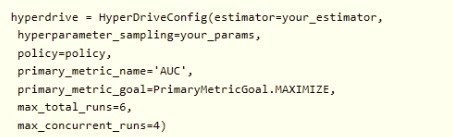
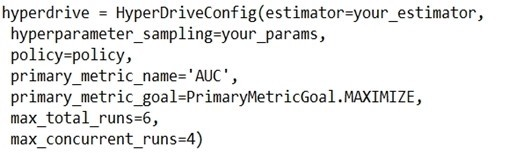
You want to use Hyperdrive to find parameters that optimize the AUC metric for the model. You configure a HyperDriveConfig for the experiment by running the following code:
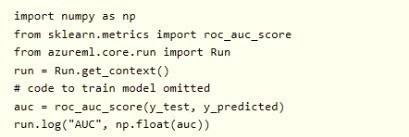
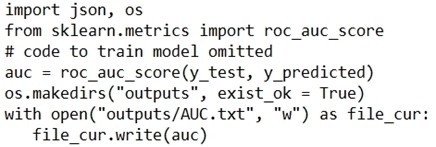
You plan to use this configuration to run a script that trains a random forest model and then tests it with validation data. The label values for the validation data are stored in a variable named y_test variable, and the predicted probabilities from the model are stored in a variable named y_predicted.
Solution: Run the following code:
Does the solution meet the goal?
A
Yes
B
No
Reveal answer detailsClose answer details
Correct answerA
Question 2
Hotspot
HOTSPOT
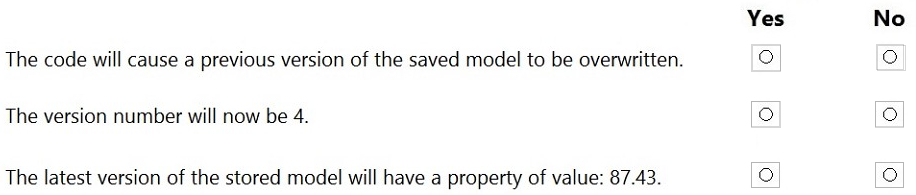
You register the following versions of a model.
You use the Azure ML Python SDK to run a training experiment. You use a variable named run to reference the experiment run.
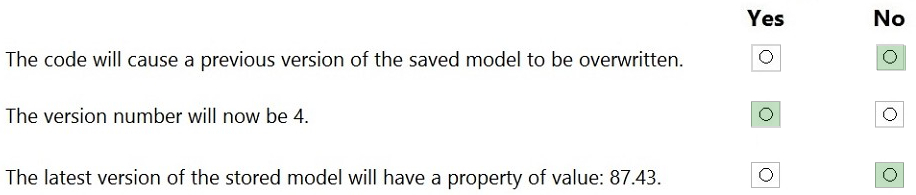
After the run has been submitted and completed, you run the following code:
For each of the following statements, select Yes if the statement is true. Otherwise, select No.
An MLflow model is already registered. You plan to customize how the deployment does inference.
You need to deploy the MLflow model to a batch endpoint for batch inferencing.
What should you create first?
A
scoring script
B
deployment
C
environment
D
deployment definition
Reveal answer detailsClose answer details
Correct answerA
Question 4
Single choice
Note: This question is part of a series of questions that present the same scenario. Each question in the series contains a unique solution that might meet the stated goals. Some question sets might have more than one correct solution, while others might not have a correct solution.
After you answer a question in this section, you will NOT be able to return to it. As a result, these questions will not appear in the review screen.
You have an Azure Machine Learning workspace that includes an AmlCompute cluster and a batch endpoint.
You clone a repository that contains an MLflow model to your local computer.
You need to ensure that you can deploy the model to the batch endpoint.
Solution: Create a data asset in the workspace.
Does the solution meet the goal?
A
Yes
B
No
Reveal answer detailsClose answer details
Correct answerB
Question 5
Multiple choice
You are analyzing a dataset by using Azure Machine Learning Studio.
You need to generate a statistical summary that contains the p-value and the unique count for each feature column.
Which two modules can you use? Each correct answer presents a complete solution.
NOTE: Each correct selection is worth one point.
A
Computer Linear Correlation
B
Export Count Table
C
Execute Python Script
D
Convert to Indicator Values
E
Summarize Data
Reveal answer detailsClose answer details
Correct answersC, E
Question 6
Single choice
You make use of Azure Machine Learning Studio to create a binary classification model.
You are preparing to carry out a parameter sweep of the model to tune hyperparameters. You have to make sure that the sweep allows for every possible combination of hyperparameters to be iterated. Also, the computing resources needed to carry out the sweep must be reduced.
Which of the following actions should you take?
A
You should consider making use of the Selective grid sweep mode.
B
You should consider making use of the Measured grid sweep mode.
C
You should consider making use of the Entire grid sweep mode.
D
You should consider making use of the Random grid sweep mode.
Reveal answer detailsClose answer details
Correct answerD
Explanation
Maximum number of runs on random grid: This option also controls the number of iterations over a random sampling of parameter values, but the values are not generated randomly from the specified range; instead, a matrix is created of all possible combinations of parameter values and a random sampling is taken over the matrix. This method is more efficient and less prone to regional oversampling or undersampling.
If you are training a model that supports an integrated parameter sweep, you can also set a range of seed values to use and iterate over the random seeds as well. This is optional, but can be useful for avoiding bias introduced by seed selection.
C: Entire grid: When you select this option, the module loops over a grid predefined by the system, to try different combinations and identify the best learner. This option is useful for cases where you don't know what the best parameter settings might be and want to try all possible combination of values.
You are a data scientist in a company that provides data science for professional sporting events. Models will use global and local market data to meet the following business goals:
1. Understand sentiment of mobile device users at sporting events based on audio from crowd reactions. 2. Assess a user's tendency to respond to an advertisement. 3. Customize styles of ads served on mobile devices. 4. Use video to detect penalty events
Current environment
1. Media used for penalty event detection will be provided by consumer devices. Media may include images and videos captured during the sporting event and shared using social media. The images and videos will have varying sizes and formats. 2. The data available for model building comprises of seven years of sporting event media. The sporting event media includes; recorded video transcripts or radio commentary, and logs from related social media feeds captured during the sporting events. 3. Crowd sentiment will include audio recordings submitted by event attendees in both mono and stereo formats.
Penalty detection and sentiment
1. Data scientists must build an intelligent solution by using multiple machine learning models for penalty event detection. 2. Data scientists must build notebooks in a local environment using automatic feature engineering and model building in machine learning pipelines. 3. Notebooks must be deployed to retrain by using Spark instances with dynamic worker allocation. 4. Notebooks must execute with the same code on new Spark instances to recode only the source of the data. 5. Global penalty detection models must be trained by using dynamic runtime graph computation during training. 6. Local penalty detection models must be written by using BrainScript. 7. Experiments for local crowd sentiment models must combine local penalty detection data. 8. Crowd sentiment models must identify known sounds such as cheers and known catch phrases. Individual crowd sentiment models will detect similar sounds. 9. All shared features for local models are continuous variables. 10. Shared features must use double precision. Subsequent layers must have aggregate running mean and standard deviation metrics available.
Advertisements
During the initial weeks in production, the following was observed:
1. Ad response rated declined. 2. Drops were not consistent across ad styles. 3. The distribution of features across training and production data are not consistent
Analysis shows that, of the 100 numeric features on user location and behavior, the 47 features that come from location sources are being used as raw features. A suggested experiment to remedy the bias and variance issue is to engineer 10 linearly uncorrelated features.
1. Initial data discovery shows a wide range of densities of target states in training data used for crowd sentiment models. 2. All penalty detection models show inference phases using a Stochastic Gradient Descent (SGD) are running too slow.
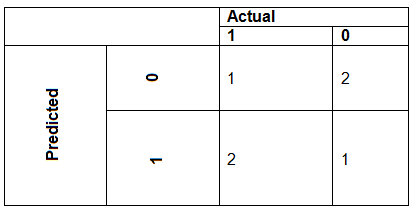
3. Audio samples show that the length of a catch phrase varies between 25%-47% depending on region 4. The performance of the global penalty detection models shows lower variance but higher bias when comparing training and validation sets. Before implementing any feature changes, you must confirm the bias and variance using all training and validation cases. 5. 6. Ad response models must be trained at the beginning of each event and applied during the sporting event. 7. Market segmentation models must optimize for similar ad response history. 8. Sampling must guarantee mutual and collective exclusively between local and global segmentation models that share the same features. 9. Local market segmentation models will be applied before determining a user's propensity to respond to an advertisement. 10. Ad response models must support non-linear boundaries of features. 11. The ad propensity model uses a cut threshold is 0.45 and retrains occur if weighted Kappa deviated from 0.1 +/- 5%. 12. The ad propensity model uses cost factors shown in the following diagram:
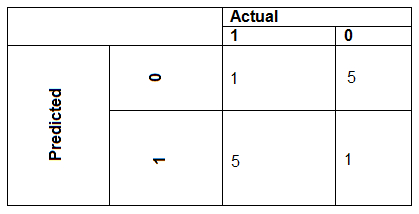
The ad propensity model uses proposed cost factors shown in the following diagram:
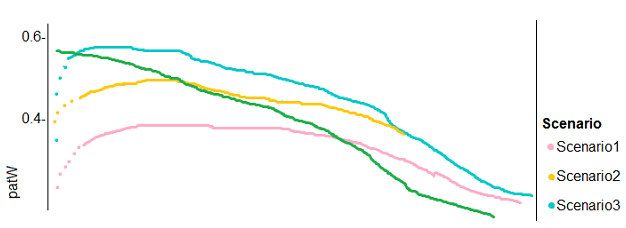
Performance curves of current and proposed cost factor scenarios are shown in the following diagram:
Question 7
Testlet 1Drag & drop
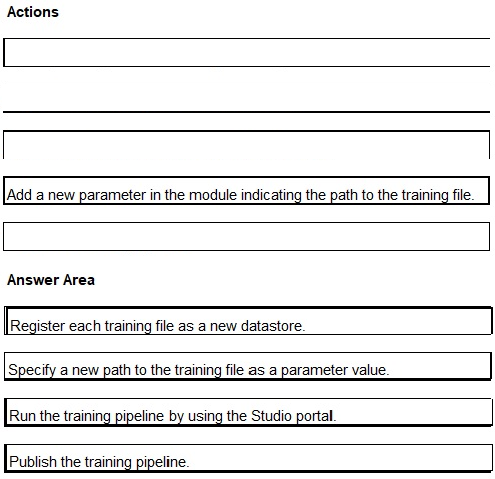
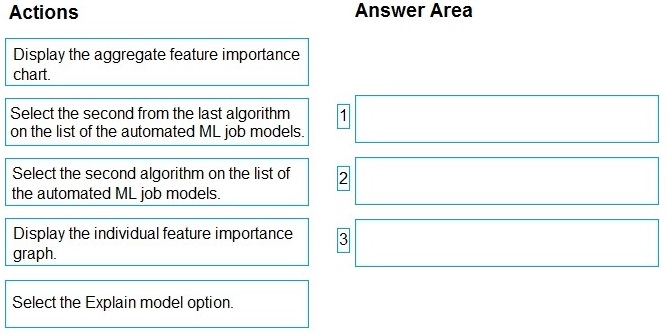
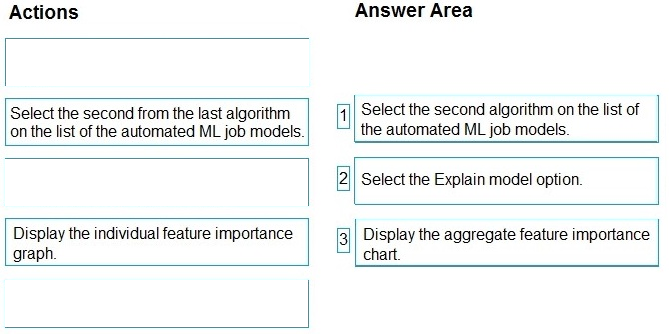
DRAG DROP
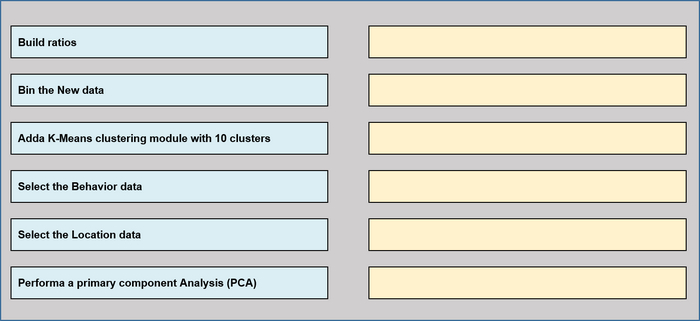
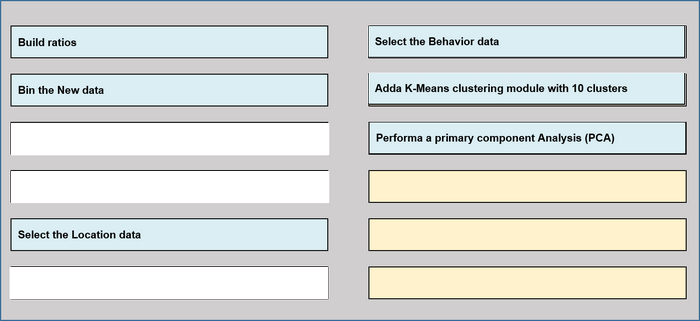
You need to modify the inputs for the global penalty event model to address the bias and variance issue.
Which three actions should you perform in sequence? To answer, move the appropriate actions from the list of actions to the answer area and arrange them in the correct order.
Reveal answer detailsClose answer details
Question 8
Single choice
An organization creates and deploys a multi-class image classification deep learning model that uses a set of labeled photographs.
The software engineering team reports there is a heavy inferencing load for the prediction web services during the summer. The production web service for the model fails to meet demand despite having a fully-utilized compute cluster where the web service is deployed.
You need to improve performance of the image classification web service with minimal downtime and minimal administrative effort.
What should you advise the IT Operations team to do?
A
Create a new compute cluster by using larger VM sizes for the nodes, redeploy the web service to that cluster, and update the DNS registration for the service endpoint to point to the new cluster.
B
Increase the node count of the compute cluster where the web service is deployed.
C
Increase the minimum node count of the compute cluster where the web service is deployed.
D
Increase the VM size of nodes in the compute cluster where the web service is deployed.
Reveal answer detailsClose answer details
Correct answerB
Explanation
The Azure Machine Learning SDK does not provide support scaling an AKS cluster. To scale the nodes in the cluster, use the UI for your AKS cluster in the Azure Machine Learning studio. You can only change the node count, not the VM size of the cluster.
You plan to use automated machine learning to train a natural language processing model for multi-class classification.
You need to provide a dataset for training the model.
How should you format the data?
A
Exactly one text column and one or more label columns
B
One or more text columns and exactly one label column
C
One or more text columns and one or more label columns
D
Exactly one text column and exactly one label column
Reveal answer detailsClose answer details
Correct answerB
Question 10
Hotspot
HOTSPOT
You manage an Azure Machine Learning workspace. You configure an automated machine learning regression training job by using the Azure Machine Learning Python SDK v2.
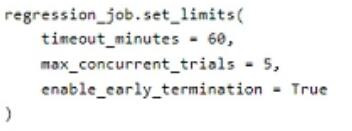
You configure the regression job by using the following script:
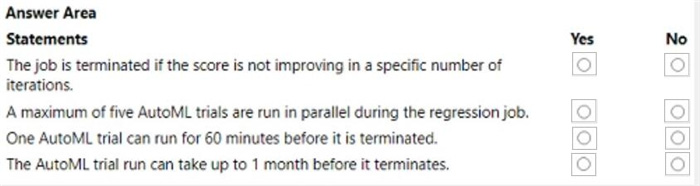
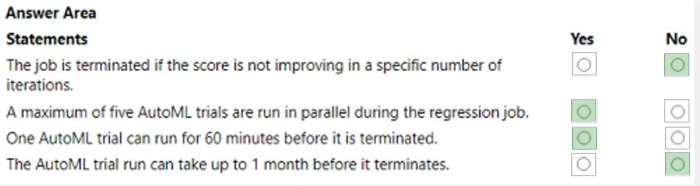
For each of the following statements, select Yes if the statement is true. Otherwise, select No.
Reveal answer detailsClose answer details
Explanation
Explanation:
Box 1: No enable_early_termination is set to TRUE, but max_trials is not defined.
Exit criteria There are a few options you can define in the set_limits() function to end your experiment prior to job completion.
* enable_early_termination Whether to end the job if the score is not improving in the short term.
* max_trials The maximum number of trials/runs each with a different combination of algorithm and hyperparameters to try during an AutoML job. If not specified, the default is 1000 trials. If using enable_early_termination the number of trials used can be smaller.
Box 2: Yes * max_concurrent_trials is here set to 5. Represents the maximum number of trials (children jobs) that would be executed in parallel. It's a good practice to match this number with the number of nodes your cluster
Box 3: Yes * trial_timeout_minutes is here set to 60. Maximum time in minutes that each trial (child job) can run for before it terminates. If not specified, a value of 1 month or 43200 minutes is used
You train and register a machine learning model. You create a batch inference pipeline that uses the model to generate predictions from multiple data files.
You must publish the batch inference pipeline as a service that can be scheduled to run every night.
You need to select an appropriate compute target for the inference service.
Which compute target should you use?
A
Azure Machine Learning compute instance
B
Azure Machine Learning compute cluster
C
Azure Kubernetes Service (AKS)-based inference cluster
D
Azure Container Instance (ACI) compute target
Reveal answer detailsClose answer details
Correct answerB
Explanation
Azure Machine Learning compute clusters is used for Batch inference. Run batch scoring on serverless compute. Supports normal and low-priority VMs. No support for real-time inference.
You are a data scientist for Fabrikam Residences, a company specializing in quality private and commercial property in the Unites States. Fabrikam Residences is considering expanding into Europe and has asked you to investigate prices for private residences in major European cities. You use Azure Machine Learning Studio to measure the median value of properties. You produce a regression model to predict property prices by using the Linear Regression and Bayesian Linear Regression modules.
Datasets
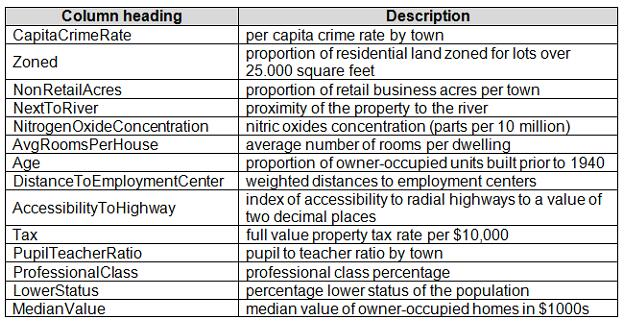
There are two datasets in CSV format that contain property details for two cities, London and Paris. You add both files to Azure Machine Learning Studio as separate datasets to the starting point for an experiment. Both datasets contain the following columns:
An initial investigation shows that the datasets are identical in structure apart from the MedianValue column. The smaller Paris dataset contains the MedianValue in text format, whereas the larger London dataset contains the MedianValue in numerical format.
Data issues
Missing values
The AccessibilityToHighway column in both datasets contains missing values. The missing data must be replaced with new data so that it is modeled conditionally using the other variables in the data before filling in the missing values.
Columns in each dataset contain missing and null values. The datasets also contain many outliers. The Age column has a high proportion of outliers. You need to remove the rows that have outliers in the Age column. The MedianValue and AvgRoomsInHouse columns both hold data in numeric format. You need to select a feature selection algorithm to analyze the relationship between the two columns in more detail.
Model fit
The model shows signs of overfitting. You need to produce a more refined regression model that reduces the overfitting.
Experiment requirements
You must set up the experiment to cross-validate the Linear Regression and Bayesian Linear Regression modules to evaluate performance. In each case, the predictor of the dataset is the column named MedianValue. You must ensure that the datatype of the MedianValue column of the Paris dataset matches the structure of the London dataset.
You must prioritize the columns of data for predicting the outcome. You must use non-parametric statistics to measure relationships.
You must a feature selection algorithm to analyze the relationship between the MediaValue and AvgRoomsinHouse columns.
Model training
Permutation Feature Importance
Given a trained model and a test dataset, you must compute the Permutation Feature Importance scores of feature variables. You must be determined the absolute fit for the model.
Hyperparameters
You must configure hyperparameters in the model learning process to speed the learning phase. In addition, this configuration should cancel the lowest performing runs at each evaluation interval, thereby directing effort and resources towards models that are more likely to be successful.
You are concerned that the model might not efficiently use compute resources in hyperparameter tuning. You also are concerned that the model might prevent an increase in the overall tuning time. Therefore, must implement an early stopping criterion on models that provides savings without terminating promising jobs.
Testing
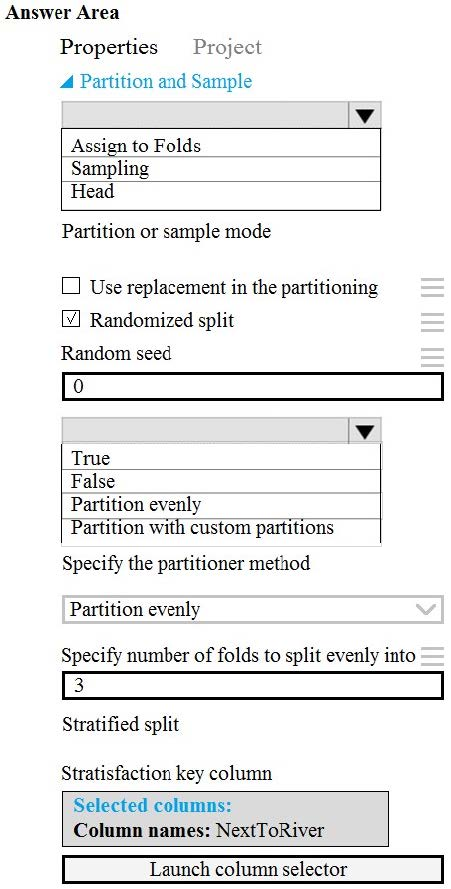
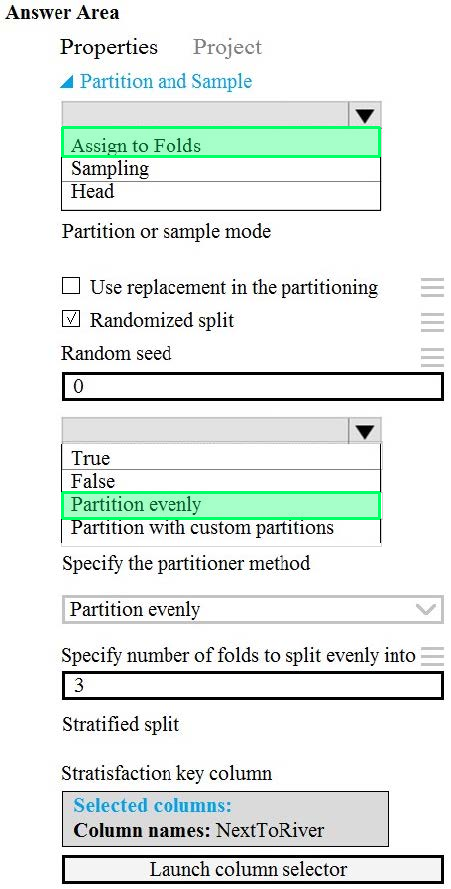
You must produce multiple partitions of a dataset based on sampling using the Partition and Sample module in Azure Machine Learning Studio.
Cross-validation
You must create three equal partitions for cross-validation. You must also configure the cross-validation process so that the rows in the test and training datasets are divided evenly by properties that are near each city's main river. You must complete this task before the data goes through the sampling process.
Linear regression module
When you train a Linear Regression module, you must determine the best features to use in a model. You can choose standard metrics provided to measure performance before and after the feature importance process completes. The distribution of features across multiple training models must be consistent.
Data visualization
You need to provide the test results to the Fabrikam Residences team. You create data visualizations to aid in presenting the results.
You must produce a Receiver Operating Characteristic (ROC) curve to conduct a diagnostic test evaluation of the model. You need to select appropriate methods for producing the ROC curve in Azure Learning Studio to compare the Two-Class Decision Forest and the Two-Class Decision Jungle modules with one another.
Question 12
Testlet 2Drag & drop
DRAG DROP
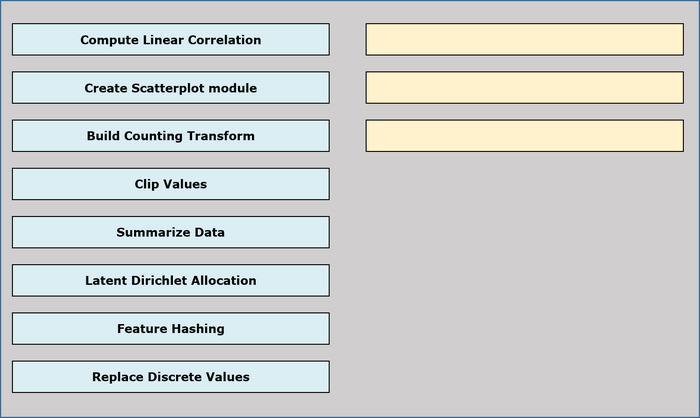
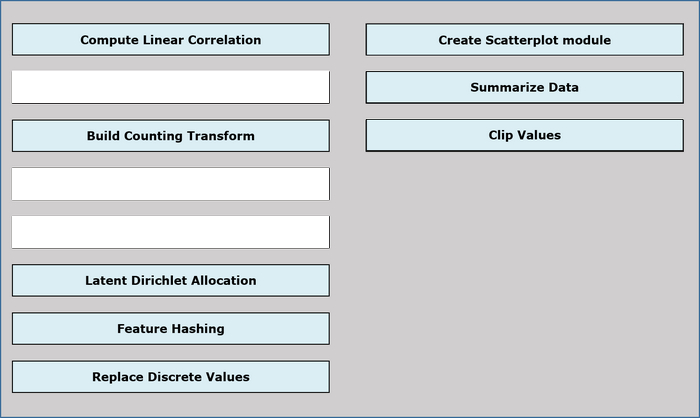
You need to visually identify whether outliers exist in the Age column and quantify the outliers before the outliers are removed.
Which three Azure Machine Learning Studio modules should you use in sequence? To answer, move the
appropriate modules from the list of modules to the answer area and arrange them in the correct order.
Reveal answer detailsClose answer details
Explanation
You can use the Clip Values module in Azure Machine Learning Studio, to identify and optionally replace data values that are above or below a specified threshold. This is useful when you want to remove outliers or replace them with a mean, a constant, or other substitute value.
You are building a regression model for estimating the number of calls during an event.
You need to determine whether the feature values achieve the conditions to build a Poisson regression model.
Which two conditions must the feature set contain? Each correct answer presents part of the solution.
NOTE: Each correct selection is worth one point.
A
The label data must be a negative value.
B
The label data must be whole numbers.
C
The label data must be non-discrete.
D
The label data must be a positive value.
E
The label data can be positive or negative.
Reveal answer detailsClose answer details
Correct answersB, D
Explanation
Poisson regression is intended for use in regression models that are used to predict numeric values, typically counts. Therefore, you should use this module to create your regression model only if the values you are trying to predict fit the following conditions: 1. The response variable has a Poisson distribution. 2. Counts cannot be negative. The method will fail outright if you attempt to use it with negative labels. 3. A Poisson distribution is a discrete distribution; therefore, it is not meaningful to use this method with non-whole numbers.
You plan to create a speech recognition deep learning model.
The model must support the latest version of Python.
You need to recommend a deep learning framework for speech recognition to include in the Data Science Virtual Machine (DSVM).
What should you recommend?
A
Rattle
B
TensorFlow
C
Weka
D
Scikit-learn
Reveal answer detailsClose answer details
Correct answerB
Explanation
TensorFlow is an open source library for numerical computation and large-scale machine learning. It uses Python to provide a convenient front-end API for building applications with the framework TensorFlow can train and run deep neural networks for handwritten digit classification, image recognition, word embeddings, recurrent neural networks, sequence-to-sequence models for machine translation, natural language processing, and PDE (partial differential equation) based simulations.
Incorrect Answers: A: Rattle is the R analytical tool that gets you started with data analytics and machine learning. C: Weka is used for visual data mining and machine learning software in Java. D: Scikit-learn is one of the most useful library for machine learning in Python. It is on NumPy, SciPy and matplotlib, this library contains a lot of effiecient tools for machine learning and statistical modeling including classification, regression, clustering and dimensionality reduction.
Note: This question is part of a series of questions that present the same scenario. Each question in the series contains a unique solution that might meet the stated goals. Some question sets might have more than one correct solution, while others might not have a correct solution.
After you answer a question in this section, you will NOT be able to return to it. As a result, these questions will not appear in the review screen.
You train and register a machine learning model.
You plan to deploy the model as a real-time web service. Applications must use key-based authentication to use the model.
You need to deploy the web service.
Solution:
Create an AciWebservice instance. Set the value of the auth_enabled property to False. Set the value of the token_auth_enabled property to True. Deploy the model to the service.
Does the solution meet the goal?
A
Yes
B
No
Reveal answer detailsClose answer details
Correct answerB
Explanation
Instead use only auth_enabled = TRUE
Note: Key-based authentication. Web services deployed on AKS have key-based auth enabled by default. ACI-deployed services have key-based auth disabled by default, but you can enable it by setting auth_enabled = TRUE when creating the ACI web service. The following is an example of creating an ACI deployment configuration with key-based auth enabled.
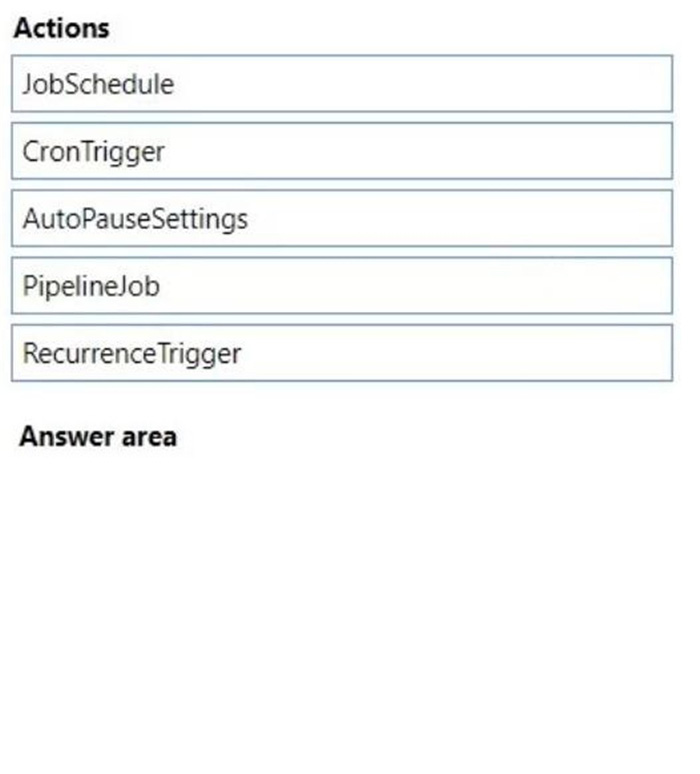
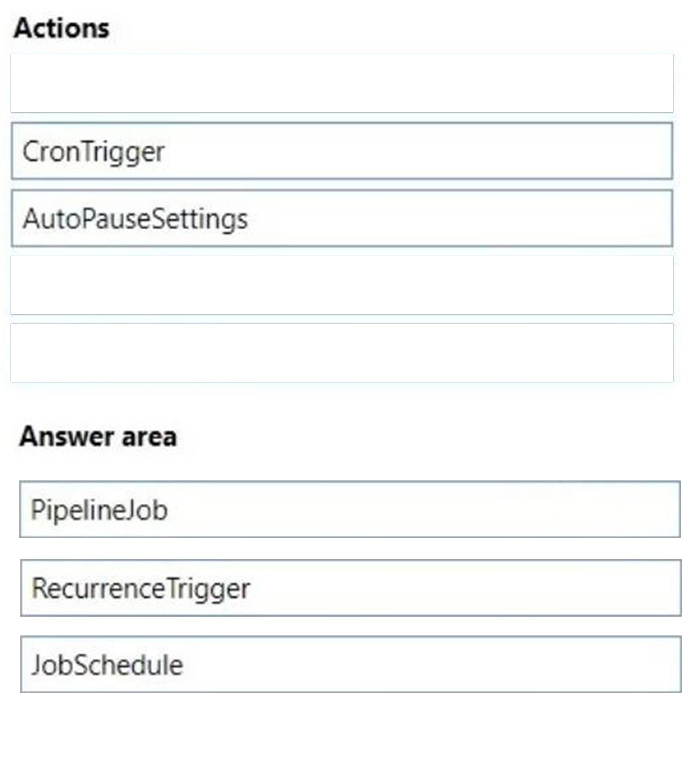
You manage an Azure Machine Learning workspace by using the Python SDK v2.
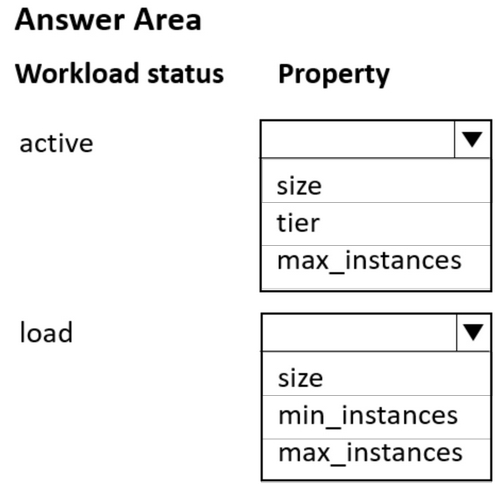
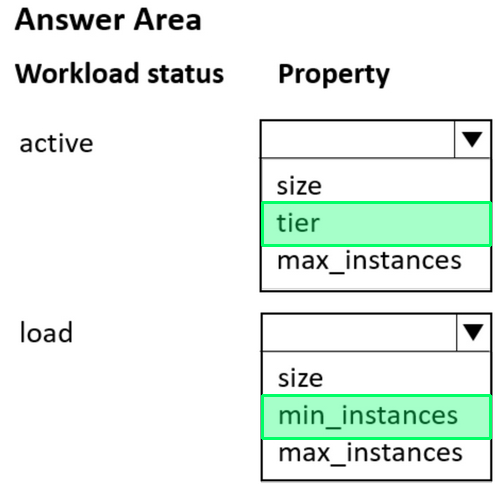
You must create a compute cluster in the workspace. The compute cluster must run workloads and property handle interruptions. You start by calculating the maximum amount of compute resources required by the workloads and size the cluster to match the calculations.
The cluster definition includes the following properties and values:
The cost of the compute resources must be minimized when a workload is active or idle. Cluster property changes must not affect the maximum amount of compute resources available to the workloads run on the cluster.
You need to modify the cluster properties to minimize the cost of compute resources.
Which properties should you modify? To answer, select the appropriate options in the answer area.
NOTE: Each correct selection is worth one point.
Reveal answer detailsClose answer details
Question 17
Hotspot
HOTSPOT
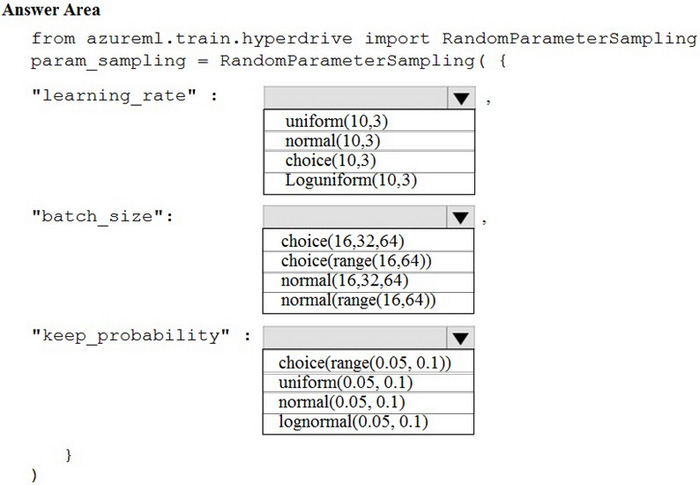
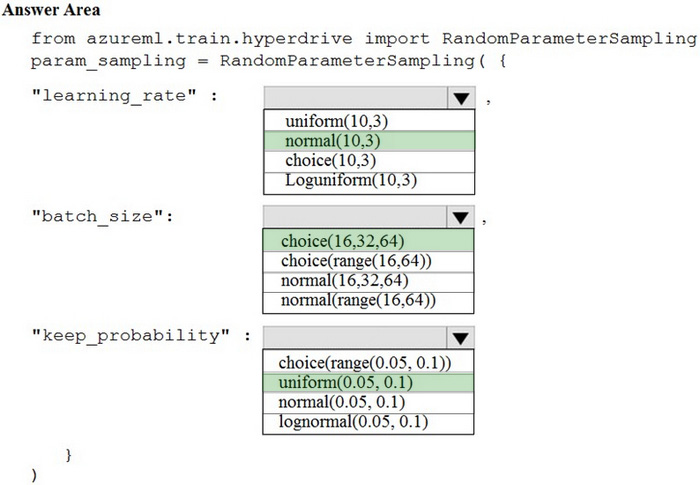
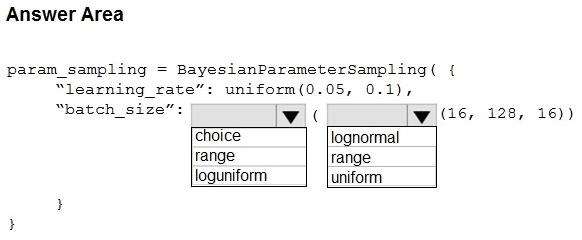
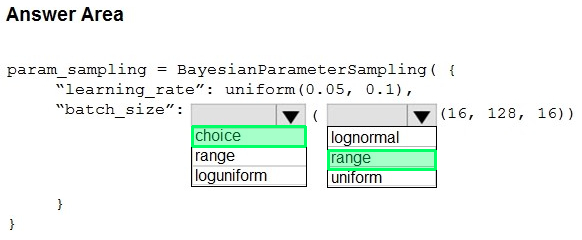
You are using the Azure Machine Learning Service to automate hyperparameter exploration of your neural network classification model.
You must define the hyperparameter space to automatically tune hyperparameters using random sampling according to following requirements:
1. The learning rate must be selected from a normal distribution with a mean value of 10 and a standard deviation of 3. 2. Batch size must be 16, 32 and 64. 3. Keep probability must be a value selected from a uniform distribution between the range of 0.05 and 0.1.
You need to use the param_sampling method of the Python API for the Azure Machine Learning Service.
How should you complete the code segment? To answer, select the appropriate options in the answer area.
NOTE: Each correct selection is worth one point.
Reveal answer detailsClose answer details
Explanation
In random sampling, hyperparameter values are randomly selected from the defined search space. Random sampling allows the search space to include both discrete and continuous hyperparameters.
You are a data scientist working for a hotel booking website company. You use the Azure Machine Learning service to train a model that identifies fraudulent transactions. You must deploy the model as an Azure Machine Learning online endpoint by using the Azure Machine Learning Python SDK v2. The deployed model must return real-time predictions of fraud based on transaction data input.
You need to create the script that is specified as the scoring_script parameter for the CodeConfiguration class used to deploy the model.
What should the entry script do?
A
Register the model with appropriate tags and properties.
B
Create a Conda environment for the online endpoint compute and install the necessary Python packages.
C
Load the model and use it to predict labels from input data.
D
Start a node on the inference cluster where the model is deployed.
E
Specify the number of cores and the amount of memory required for the online endpoint compute.
Reveal answer detailsClose answer details
Correct answerC
Question 19
Multiple choice
You create an MLflow model
You must deploy the model to Azure Machine Learning for batch inference.
You need to create the batch deployment.
Which two components should you use? Each correct answer presents a complete solution.
NOTE: Each correct selection is worth one point
A
Compute target
B
Kubernetes online endpoint
C
Model files
D
Online endpoint
E
Environment
Reveal answer detailsClose answer details
Correct answersA, C
Question 20
Single choice
You manage an Azure Machine Learning workspace. You have an environment for training jobs which uses an existing Docker image. A new version of the Docker image is available.
You need to use the latest version of the Docker image for the environment configuration by using the Azure Machine Learning SDK v2-What should you do?
A
Modify the conda.file to specify the new version of the Docker image.
B
Use the Environment class to create a new version of the environment.
C
Use the create.or.update method to change the tag of the image.
D
Change the description parameter of the environment configuration.
Reveal answer detailsClose answer details
Correct answerB
Question 21
Single choice
You are building a recurrent neural network to perform a binary classification.
You review the training loss, validation loss, training accuracy, and validation accuracy for each training epoch. You need to analyze model performance.
You need to identify whether the classification model is overfitted.
Which of the following is correct?
A
The training loss stays constant and the validation loss stays on a constant value and close to the training loss value when training the model.
B
The training loss decreases while the validation loss increases when training the model.
C
The training loss stays constant and the validation loss decreases when training the model.
D
The training loss increases while the validation loss decreases when training the model.
Reveal answer detailsClose answer details
Correct answerB
Explanation
An overfit model is one where performance on the train set is good and continues to improve, whereas performance on the validation set improves to a point and then begins to degrade.
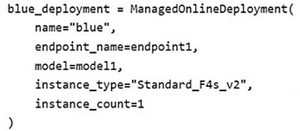
You have an Azure Machine Learning workspace named Workspace1. Workspace1 has a registered MLflow model named model1 with PyFunc flavor.
You plan to deploy model1 to an online endpoint named endpoint1 without egress connectivity by using Azure Machine Learning Python SDK v2.
You have the following code:
You need to add a parameter to the ManagedOnlineDeployment object to ensure the model deploys successfully.
Solution: Add the scoring_script parameter.
Does the solution meet the goal?
A
Yes
B
No
Reveal answer detailsClose answer details
Correct answerB
Question 23
Drag & drop
DRAG DROP
You have an Azure AI Foundry project named Projects.
You are developing a web classification Prompt flow named Flow1 in Project1.
The current input of Flow1 is defined as follows.
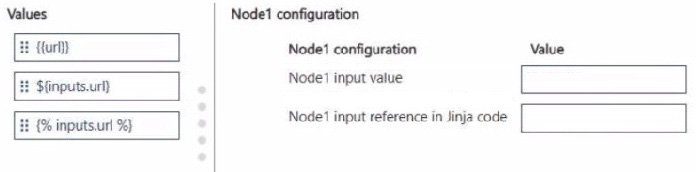
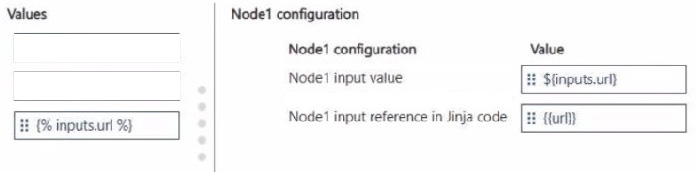
You plan to add a large language model (LLM) node named Node1 to Flow1. Node1 will use an input named url of type string to classify the URL provided as Flow1 input.
In Node1, you will add Jinja code to reference the value of its url input.
You need to ensure Node1 classifies the provided URL values as the Flow1 input.
How should you configure Node1? To answer, move the appropriate values to the correct Node1 configurations. You may use each value once, more than once, or not at all. You may need to move the split bar between panes or scroll to view content.
Reveal answer detailsClose answer details
Question 24
Single choice
Note: This question is part of a series of questions that present the same scenario. Each question in the series contains a unique solution that might meet the stated goals. Some question sets might have more than one correct solution, while others might not have a correct solution.
After you answer a question in this section, you will NOT be able to return to it. As a result, these questions will not appear in the review screen.
You have an Azure Machine Learning workspace that includes an AmlCompute cluster and a batch endpoint.
You clone a repository that contains an MLflow model to your local computer.
You need to ensure that you can deploy the model to the batch endpoint.
Solution: Create a datastore in the workspace.
Does the solution meet the goal?
A
Yes
B
No
Reveal answer detailsClose answer details
Correct answerB
Question 25
Hotspot
HOTSPOT
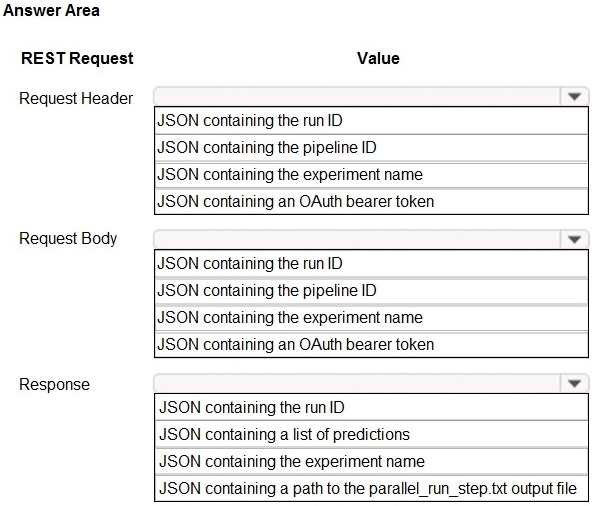
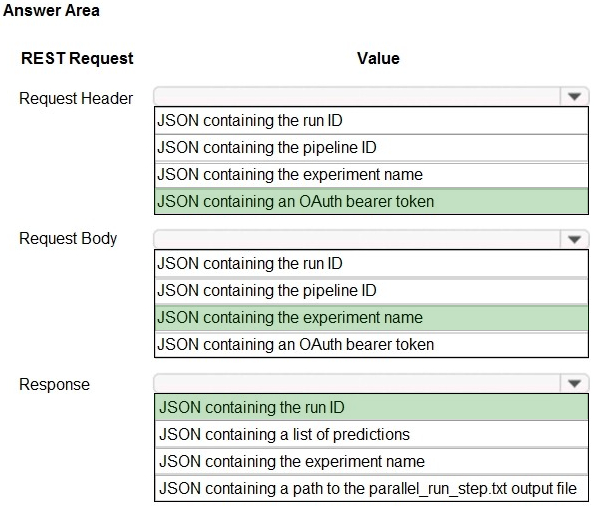
You publish a batch inferencing pipeline that will be used by a business application. The application developers need to know which information should be submitted to and returned by the REST interface for the published pipeline.
You need to identify the information required in the REST request and returned as a response from the published pipeline.
Which values should you use in the REST request and to expect in the response? To answer, select the appropriate options in the answer area.
NOTE: Each correct selection is worth one point.
Reveal answer detailsClose answer details
Explanation
Box 1: JSON containing an OAuth bearer token Specify your authentication header in the request. To run the pipeline from the REST endpoint, you need an OAuth2 Bearer-type authentication header.
Box 2: JSON containing the experiment name Add a JSON payload object that has the experiment name.
Box 3: JSON containing the run ID Make the request to trigger the run. Include code to access the Id key from the response dictionary to get the value of the run ID.
Question 26
Single choice
You create an Azure Machine Learning workspace. You train an MLflow-formatted regression model by using tabular structured data.
You must use a Responsible Al dashboard to assess the model.
You need to use the Azure Machine Learning studio Ul to generate the Responsible A dashboard.
What should you do first?
A
Deploy the model to a managed online endpoint.
B
Register the model with the workspace.
C
Create the model explanations.
D
Convert the model from the MLflow format to a custom format.
Reveal answer detailsClose answer details
Correct answerB
Question 27
Hotspot
HOTSPOT
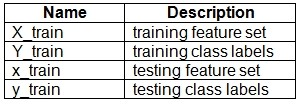
You have a dataset created for multiclass classification tasks that contains a normalized numerical feature set with 10,000 data points and 150 features.
You use 75 percent of the data points for training and 25 percent for testing. You are using the scikit-learn machine learning library in Python. You use X to denote the feature set and Y to denote class labels.
You create the following Python data frames:
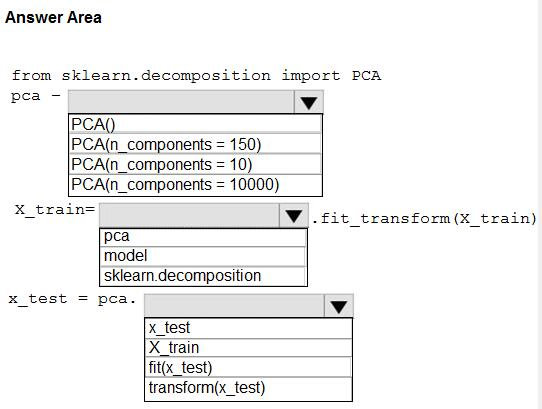
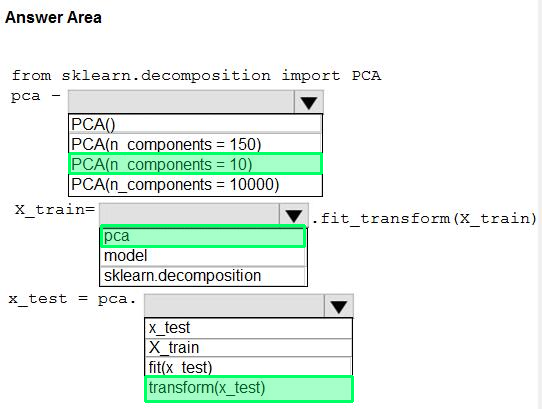
You need to apply the Principal Component Analysis (PCA) method to reduce the dimensionality of the feature set to 10 features in both training and testing sets.
How should you complete the code segment? To answer, select the appropriate options in the answer area.
NOTE: Each correct selection is worth one point.
Reveal answer detailsClose answer details
Explanation
Box 1: PCA(n_components = 10) Need to reduce the dimensionality of the feature set to 10 features in both training and testing sets.
You plan to develop a RAG solution from PDF files by creating a vector index.
You need to select the location of the data you plan to index.
Which two data sources can you use? (Choose two.)
A
Azure Data Lake Storage Gen2
B
Data in Azure AI Foundry
C
OneLake in Microsoft Fabric
D
Azure Blob Storage
Reveal answer detailsClose answer details
Correct answersA, D
Question 29
Single choice
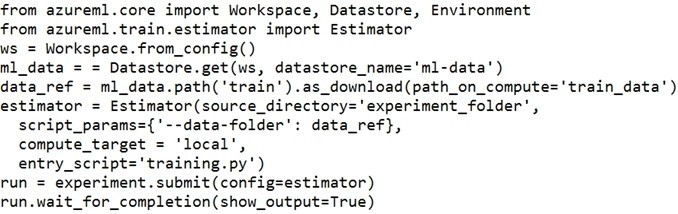
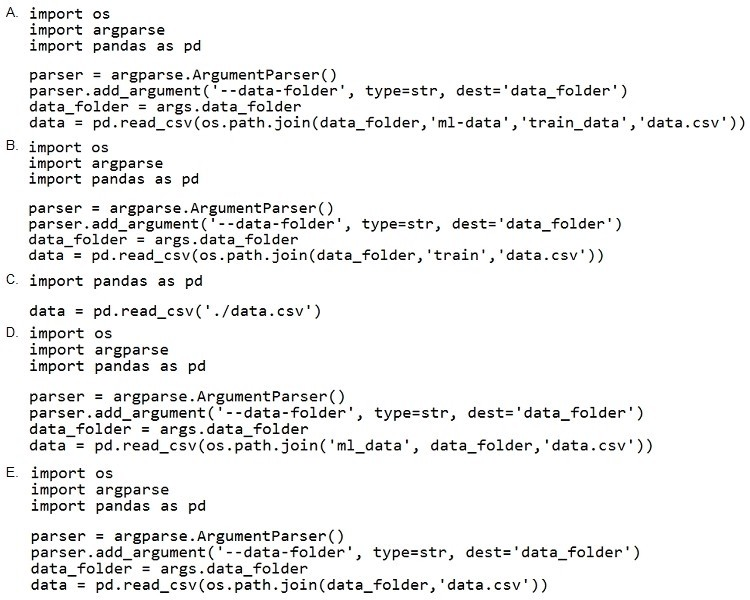
You define a datastore named ml-data for an Azure Storage blob container. In the container, you have a folder named train that contains a file named data.csv. You plan to use the file to train a model by using the Azure Machine Learning SDK.
You plan to train the model by using the Azure Machine Learning SDK to run an experiment on local compute.
You define a DataReference object by running the following code:
You need to load the training data.
Which code segment should you use?
A
Option A
B
Option B
C
Option C
D
Option D
E
Option E
Reveal answer detailsClose answer details
Correct answerE
Explanation
Example: data_folder = args.data_folder # Load Train and Test data train_data = pd.read_csv(os.path.join(data_folder, 'data.csv'))
You are in the process of constructing a regression model.
You would like to make it a Poisson regression model. To achieve your goal, the feature values need to meet certain conditions.
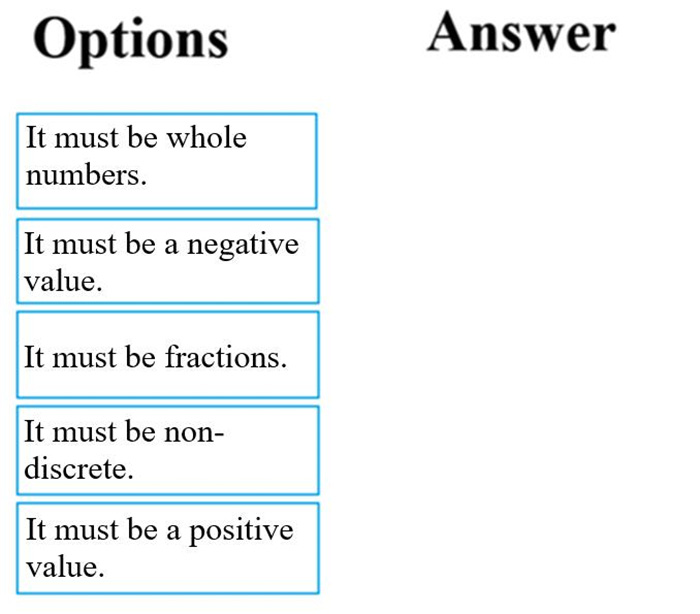
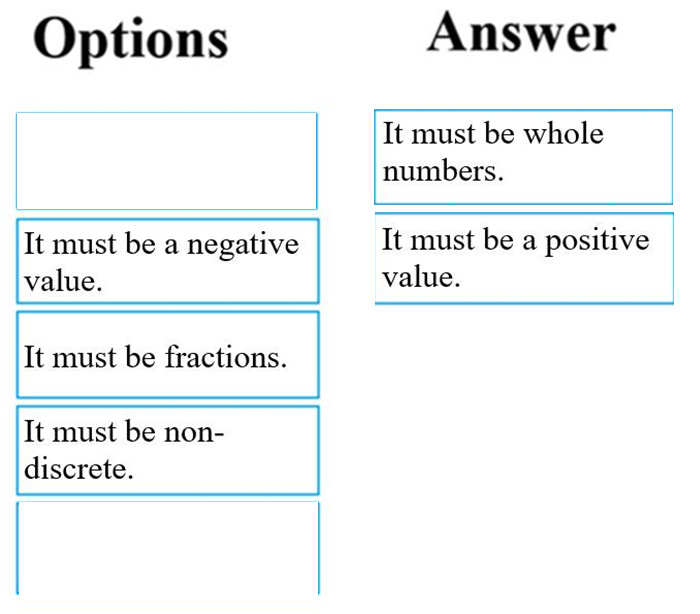
Which of the following are relevant conditions with regards to the label data? Answer by dragging the correct options from the list to the answer area.
Reveal answer detailsClose answer details
Explanation
Poisson regression is intended for use in regression models that are used to predict numeric values, typically counts. Therefore, you should use this module to create your regression model only if the values you are trying to predict fit the following conditions: The response variable has a Poisson distribution. Counts cannot be negative. The method will fail outright if you attempt to use it with negative labels. A Poisson distribution is a discrete distribution; therefore, it is not meaningful to use this method with non- whole numbers.
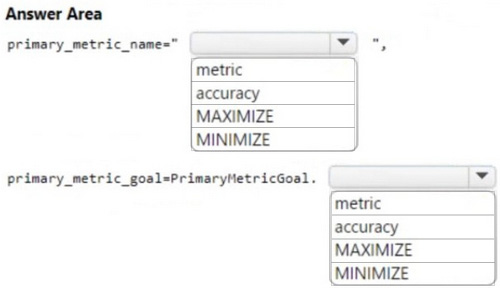
You train a machine learning model by using Azure Machine Learning.
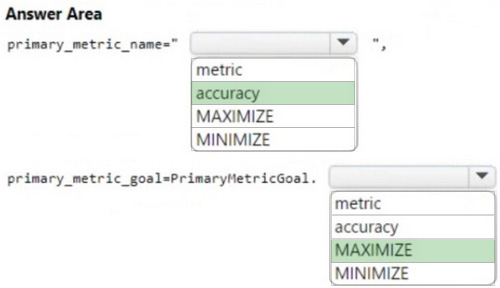
You use the following training script in Python to log an accuracy value:
You must use a Python script to define a sweep job.
You need to provide the primary metric and goal you want hyperparameter tuning to optimize.
How should you complete the Python script? To answer, select the appropriate options in the answer area.
NOTE: Each correct selection is worth one point.
Reveal answer detailsClose answer details
Question 32
Single choice
You train a machine learning model.
You must deploy the model as a real-time inference service for testing. The service requires low CPU utilization and less than 48 MB of RAM. The compute target for the deployed service must initialize automatically while minimizing cost and administrative overhead.
Which compute target should you use?
A
Azure Container Instance (ACI)
B
attached Azure Databricks cluster
C
Azure Kubernetes Service (AKS) inference cluster
D
Azure Machine Learning compute cluster
Reveal answer detailsClose answer details
Correct answerA
Explanation
Azure Container Instances (ACI) are suitable only for small models less than 1 GB in size. Use it for low-scale CPU-based workloads that require less than 48 GB of RAM. Note: Microsoft recommends using single-node Azure Kubernetes Service (AKS) clusters for dev-test of larger models.
You have an Azure Machine Learning workspace. You plan to tune model hyperparameters by using a sweep job.
You need to find a sampling method that supports early termination of low-performance jobs and continuous hyperpara meters.
Solution: Use the Bayesian sampling method over the hyperparameter space.
Does the solution meet the goal?
A
Yes
B
No
Reveal answer detailsClose answer details
Correct answerA
Question 34
Hotspot
HOTSPOT
You plan to implement an Azure Machine Learning solution.
You have the following requirements:
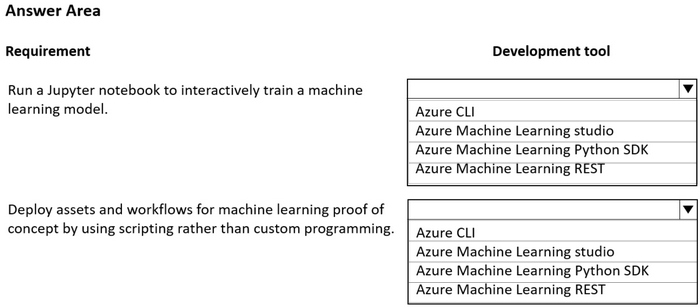
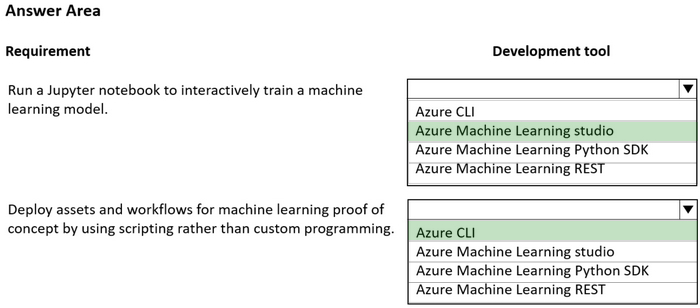
1. Run a Jupyter notebook to interactively train a machine learning model. 2. Deploy assets and workflows for machine learning proof of concept by using scripting rather than custom programming.
You need to select a development technique for each requirement.
Which development technique should you use? To answer, select the appropriate options in the answer area.
NOTE: Each correct selection is worth one point.
Reveal answer detailsClose answer details
Question 35
Single choice
You plan to use a Python script to run an Azure Machine Learning experiment. The script creates a reference to the experiment run context, loads data from a file, identifies the set of unique values for the label column, and completes the experiment run:
from azureml.core import Run import pandas as pd
run = Run.get_context() data = pd.read_csv('data.csv') label_vals = data['label'].unique() # Add code to record metrics here run.complete()
The experiment must record the unique labels in the data as metrics for the run that can be reviewed later.
You must add code to the script to record the unique label values as run metrics at the point indicated by the comment.
Solution: Replace the comment with the following code:
for label_val in label_vals: run.log('Label Values', label_val) Does the solution meet the goal?
A
Yes
B
No
Reveal answer detailsClose answer details
Correct answerA
Explanation
The run_log function is used to log the contents in label_vals:
for label_val in label_vals: run.log('Label Values', label_val)
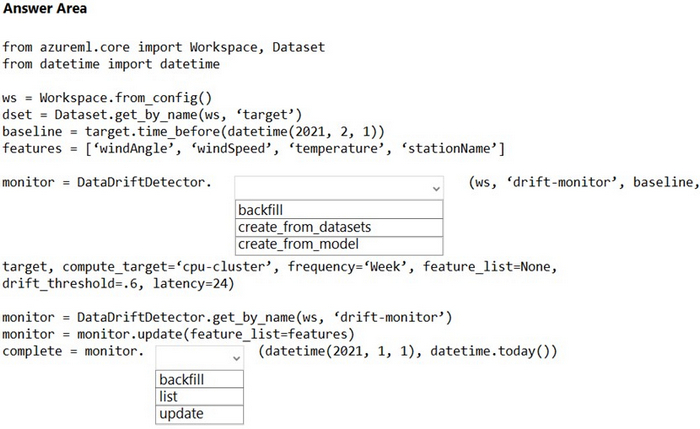
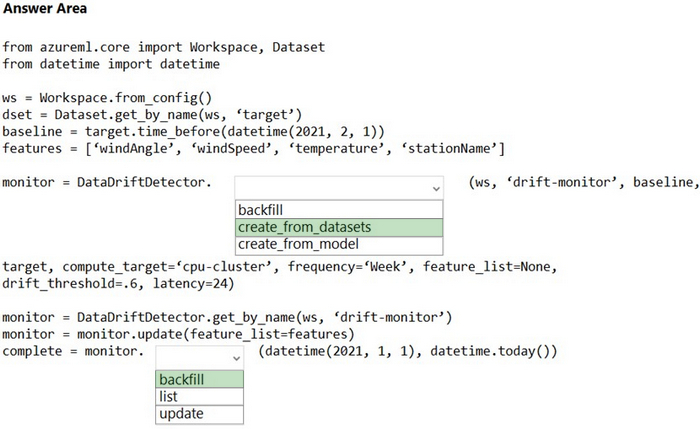
You need to detect data drift between a baseline dataset and a subsequent target dataset by using the
DataDriftDetector class.
How should you complete the code segment? To answer, select the appropriate options in the answer area.
NOTE: Each correct selection is worth one point.
Reveal answer detailsClose answer details
Explanation
Box 1: create_from_datasets The create_from_datasets method creates a new DataDriftDetector object from a baseline tabular dataset and a target time series dataset.
Box 2: backfill The backfill method runs a backfill job over a given specified start and end date.
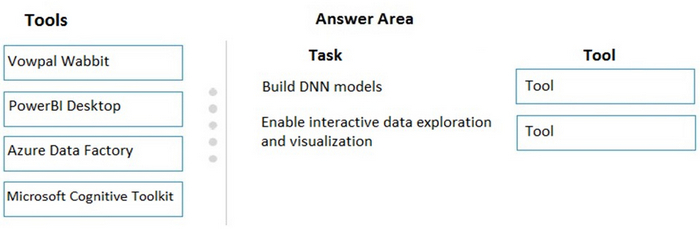
You configure a Deep Learning Virtual Machine for Windows.
You need to recommend tools and frameworks to perform the following:
1. Build deep neural network (DNN) models 2. Perform interactive data exploration and visualization
Which tools and frameworks should you recommend? To answer, drag the appropriate tools to the correct tasks. Each tool may be used once, more than once, or not at all. You may need to drag the split bar between panes or scroll to view content.
NOTE: Each correct selection is worth one point.
Reveal answer detailsClose answer details
Explanation
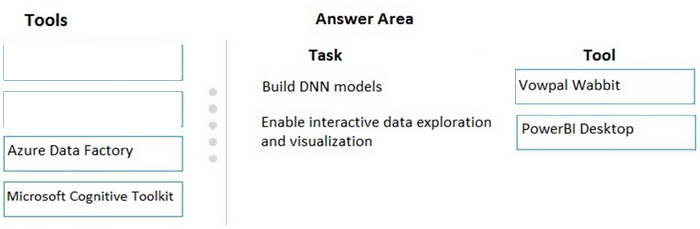
Box 1: Vowpal Wabbit Use the Train Vowpal Wabbit Version 8 module in Azure Machine Learning Studio (classic), to create a machine learning model by using Vowpal Wabbit.
Box 2: PowerBI Desktop Power BI Desktop is a powerful visual data exploration and interactive reporting tool BI is a name given to a modern approach to business decision making in which users are empowered to find, explore, and share insights from data across the enterprise.
You are developing a machine learning model by using Azure Machine Learning. You are using multiple text files in tabular format for model data. You have the following requirements:
1. You must use AutoML jobs to train the model. 2. You must use data from specified columns. 3. The data concept must support lazy evaluation.
You need to load data into a Pandas dataframe.
Which data concept should you use?
A
Data asset
B
URI
C
Datastore
D
MLTable
Reveal answer detailsClose answer details
Correct answerD
Question 41
Single choice
Note: This question is part of a series of questions that present the same scenario. Each question in the series contains a unique solution that might meet the stated goals. Some question sets might have more than one correct solution, while others might not have a correct solution.
After you answer a question in this section, you will NOT be able to return to it. As a result, these questions will not appear in the review screen.
You are a data scientist using Azure Machine Learning Studio.
You need to normalize values to produce an output column into bins to predict a target column.
Solution: Apply a Quantiles normalization with a QuantileIndex normalization.
Does the solution meet the goal?
A
Yes
B
No
Reveal answer detailsClose answer details
Correct answerB
Explanation
Use the Entropy MDL binning mode which has a target column.
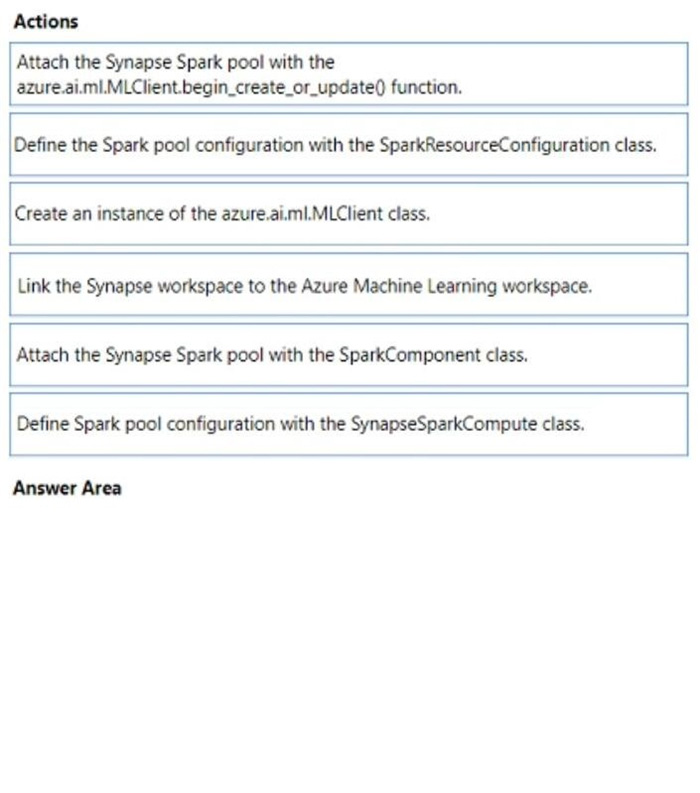
You create an Azure Machine Learning workspace and an Azure Synapse Analytics workspace with a Spark pool. The workspaces are contained within the same Azure subscription.
You must manage the Synapse Spark pool from the Azure Machine Learning workspace.
You need to attach the Synapse Spark pool in Azure Machine Learning by using the Python SDK v2.
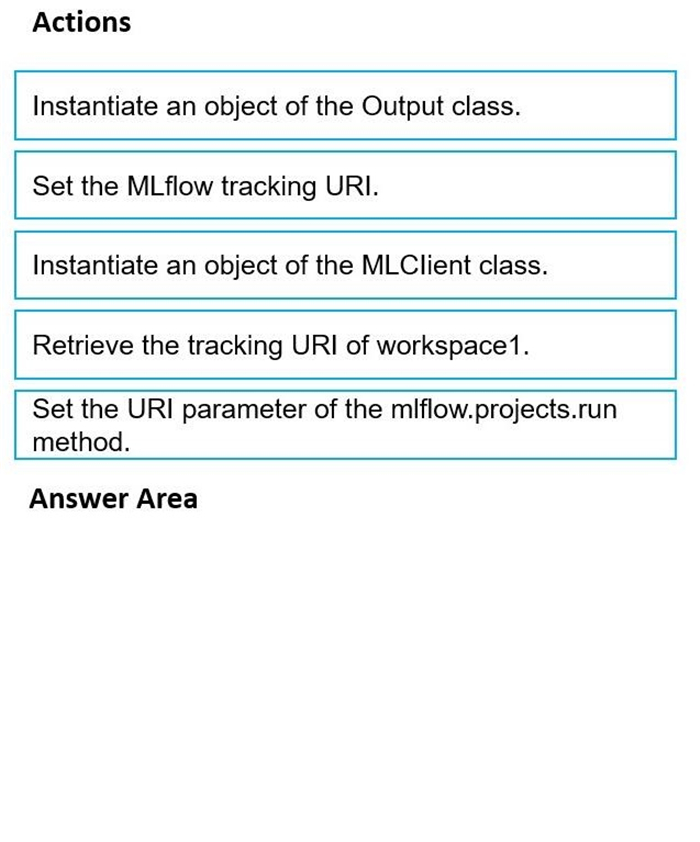
Which three actions should you perform in sequence? To answer, move the appropriate actions from the list of actions to the answer area and arrange them in the correct order.
Reveal answer detailsClose answer details
Explanation
Explanation:
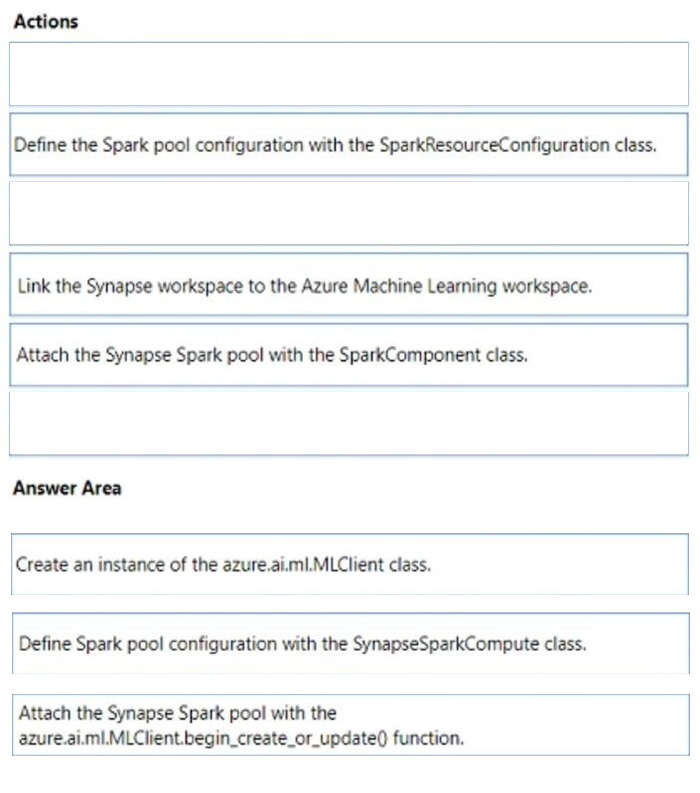
Step 1: Create an instance of azure.ai.ml.MLClient class First create an instance of azure.ai.ml.MLClient class.
Details: Attach and manage a Synapse Spark pool in Azure Machine Learning
Azure Machine Learning Python SDK (preview) provides convenient functions for attaching and managing Synapse Spark pool, using Python code in Azure Machine Learning Notebooks.
To attach a Synapse Compute using Python SDK, first create an instance of azure.ai.ml.MLClient class (Step 1). This provides convenient functions for interaction with Azure Machine Learning services. The following code sample uses azure.identity.DefaultAzureCredential for connecting to a workspace in resource group of a specified Azure subscription. In the following code sample, define the SynapseSparkCompute with the parameters (Step 2):
name - user-defined name of the new attached Synapse Spark pool. resource_id - resource ID of the Synapse Spark pool created earlier in the Azure Synapse Analytics workspace. An azure.ai.ml.MLClient.begin_create_or_update() function call attaches the defined Synapse Spark pool to the Azure Machine Learning workspace. (Step 3)
Step 2: Define the Spark pool with the SynapseSparkCompute class. from azure.ai.ml import MLClient (Step 1 prerequisite) from azure.ai.ml.entities import SynapseSparkCompute (Step 2 prerequisite) from azure.identity import DefaultAzureCredential subscription_id = "<SUBSCRIPTION_ID>" resource_group = "<RESOURCE_GROUP>" workspace_name = "<AML_WORKSPACE_NAME>" ml_client = MLClient( DefaultAzureCredential(), subscription_id, resource_group, workspace_name ) (Step 1)
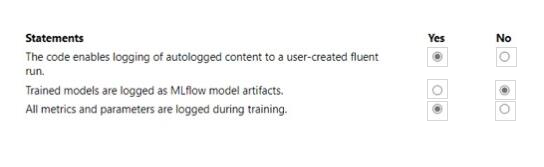
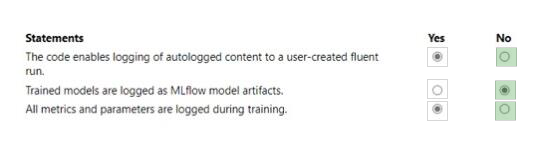
You manage an Azure Machine Learning workspace. You submit a training job with the Azure Machine Learning Python SDK v2. You must use MLflow to log metrics, model parameters, and model artifacts automatically when training a model.
For each of the following statements, select Yes if the statement is true. Otherwise, select No.
Reveal answer detailsClose answer details
Question 44
Single choice
Note: This question is part of a series of questions that present the same scenario. Each question in the series contains a unique solution that might meet the stated goals. Some question sets might have more than one correct solution, while others might not have a correct solution.
After you answer a question in this section, you will NOT be able to return to it. As a result, these questions will not appear in the review screen.
You train and register a machine learning model.
You plan to deploy the model as a real-time web service. Applications must use key-based authentication to use the model.
You need to deploy the web service.
Solution:
Create an AciWebservice instance. Set the value of the ssl_enabled property to True. Deploy the model to the service.
Does the solution meet the goal?
A
Yes
B
No
Reveal answer detailsClose answer details
Correct answerB
Explanation
Instead use only auth_enabled = TRUE
Note: Key-based authentication. Web services deployed on AKS have key-based auth enabled by default. ACI-deployed services have key-based auth disabled by default, but you can enable it by setting auth_enabled = TRUE when creating the ACI web service. The following is an example of creating an ACI deployment configuration with key-based auth enabled.
Note: This question is part of a series of questions that present the same scenario. Each question in the series contains a unique solution that might meet the stated goals. Some question sets might have more than one correct solution, while others might not have a correct solution.
After you answer a question in this section, you will NOT be able to return to it. As a result, these questions will not appear in the review screen.
You train a classification model by using a logistic regression algorithm.
You must be able to explain the model's predictions by calculating the importance of each feature, both as an overall global relative importance value and as a measure of local importance for a specific set of predictions.
You need to create an explainer that you can use to retrieve the required global and local feature importance values.
Solution: Create a MimicExplainer. Does the solution meet the goal?
A
Yes
B
No
Reveal answer detailsClose answer details
Correct answerA
Question 46
Single choice
You have been tasked with creating a new Azure pipeline via the Machine Learning designer.
You have to makes sure that the pipeline trains a model using data in a comma-separated values (CSV) file that is published on a website. A dataset for the file for this file does not exist.
Data from the CSV file must be ingested into the designer pipeline with the least amount of administrative effort as possible.
Which of the following actions should you take?
A
You should make use of the Convert to TXT module.
B
You should add the Copy Data object to the pipeline.
C
You should add the Import Data object to the pipeline.
D
You should add the Dataset object to the pipeline.
Reveal answer detailsClose answer details
Correct answerC
Question 47
Hotspot
HOTSPOT
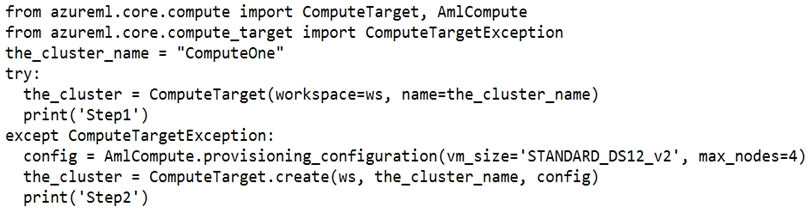
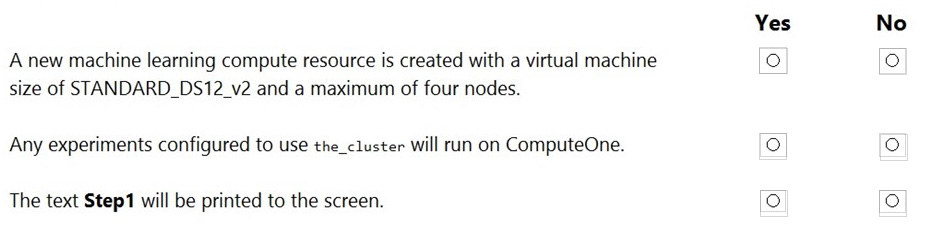
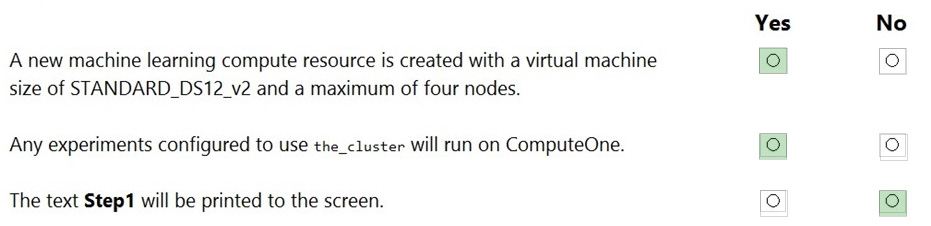
You create an Azure Machine Learning compute target named ComputeOne by using the STANDARD_D1 virtual machine image.
You define a Python variable named was that references the Azure Machine Learning workspace. You run the following Python code:
For each of the following statements, select Yes if the statement is true. Otherwise, select No.
NOTE: Each correct selection is worth one point.
Reveal answer detailsClose answer details
Explanation
Box 1:Yes ComputeTargetException class: An exception related to failures when creating, interacting with, or configuring a compute target. This exception is commonly raised for failures attaching a compute target, missing headers, and unsupported configuration values.
Create(workspace, name, provisioning_configuration) Provision a Compute object by specifying a compute type and related configuration.
This method creates a new compute target rather than attaching an existing one.
Box 2: Yes
Box 3: No The line before print('Step1') will fail.
Note: This question is part of a series of questions that present the same scenario. Each question in the series contains a unique solution that might meet the stated goals. Some question sets might have more than one correct solution, while others might not have a correct solution.
After you answer a question in this section, you will NOT be able to return to it. As a result, these questions
will not appear in the review screen.
You are creating a new experiment in Azure Machine Learning Studio.
One class has a much smaller number of observations than the other classes in the training set.
You need to select an appropriate data sampling strategy to compensate for the class imbalance.
Solution: You use the Stratified split for the sampling mode.
Does the solution meet the goal?
A
Yes
B
No
Reveal answer detailsClose answer details
Correct answerB
Explanation
Instead use the Synthetic Minority Oversampling Technique (SMOTE) sampling mode.
Note: SMOTE is used to increase the number of underepresented cases in a dataset used for machine learning. SMOTE is a better way of increasing the number of rare cases than simply duplicating existing cases.
You use the Two-Class Neural Network module in Azure Machine Learning Studio to build a binary classification model. You use the Tune Model Hyperparameters module to tune accuracy for the model.
You need to select the hyperparameters that should be tuned using the Tune Model Hyperparameters module.
Which two hyperparameters should you use? Each correct answer presents part of the solution.
NOTE: Each correct selection is worth one point.
A
Number of hidden nodes
B
Learning Rate
C
The type of the normalizer
D
Number of learning iterations
E
Hidden layer specification
Reveal answer detailsClose answer details
Correct answersD, E
Explanation
D: For Number of learning iterations, specify the maximum number of times the algorithm should process the training cases. E: For Hidden layer specification, select the type of network architecture to create. Between the input and output layers you can insert multiple hidden layers. Most predictive tasks can be accomplished easily with only one or a few hidden layers. References: https://docs.microsoft.com/en-us/azure/machine-learning/studio-module-reference/two- class-neural-network
Case study
Case Study 2
Overview
You are a data scientist for Fabrikam Residences, a company specializing in quality private and commercial property in the Unites States. Fabrikam Residences is considering expanding into Europe and has asked you to investigate prices for private residences in major European cities. You use Azure Machine Learning Studio to measure the median value of properties. You produce a regression model to predict property prices by using the Linear Regression and Bayesian Linear Regression modules.
Datasets
There are two datasets in CSV format that contain property details for two cities, London and Paris. You add both files to Azure Machine Learning Studio as separate datasets to the starting point for an experiment. Both datasets contain the following columns:
An initial investigation shows that the datasets are identical in structure apart from the MedianValue column. The smaller Paris dataset contains the MedianValue in text format, whereas the larger London dataset contains the MedianValue in numerical format.
Data issues
Missing values
The AccessibilityToHighway column in both datasets contains missing values. The missing data must be replaced with new data so that it is modeled conditionally using the other variables in the data before filling in the missing values.
Columns in each dataset contain missing and null values. The datasets also contain many outliers. The Age column has a high proportion of outliers. You need to remove the rows that have outliers in the Age column. The MedianValue and AvgRoomsInHouse columns both hold data in numeric format. You need to select a feature selection algorithm to analyze the relationship between the two columns in more detail.
Model fit
The model shows signs of overfitting. You need to produce a more refined regression model that reduces the overfitting.
Experiment requirements
You must set up the experiment to cross-validate the Linear Regression and Bayesian Linear Regression modules to evaluate performance. In each case, the predictor of the dataset is the column named MedianValue. You must ensure that the datatype of the MedianValue column of the Paris dataset matches the structure of the London dataset.
You must prioritize the columns of data for predicting the outcome. You must use non-parametric statistics to measure relationships.
You must a feature selection algorithm to analyze the relationship between the MediaValue and AvgRoomsinHouse columns.
Model training
Permutation Feature Importance
Given a trained model and a test dataset, you must compute the Permutation Feature Importance scores of feature variables. You must be determined the absolute fit for the model.
Hyperparameters
You must configure hyperparameters in the model learning process to speed the learning phase. In addition, this configuration should cancel the lowest performing runs at each evaluation interval, thereby directing effort and resources towards models that are more likely to be successful.
You are concerned that the model might not efficiently use compute resources in hyperparameter tuning. You also are concerned that the model might prevent an increase in the overall tuning time. Therefore, must implement an early stopping criterion on models that provides savings without terminating promising jobs.
Testing
You must produce multiple partitions of a dataset based on sampling using the Partition and Sample module in Azure Machine Learning Studio.
Cross-validation
You must create three equal partitions for cross-validation. You must also configure the cross-validation process so that the rows in the test and training datasets are divided evenly by properties that are near each city's main river. You must complete this task before the data goes through the sampling process.
Linear regression module
When you train a Linear Regression module, you must determine the best features to use in a model. You can choose standard metrics provided to measure performance before and after the feature importance process completes. The distribution of features across multiple training models must be consistent.
Data visualization
You need to provide the test results to the Fabrikam Residences team. You create data visualizations to aid in presenting the results.
You must produce a Receiver Operating Characteristic (ROC) curve to conduct a diagnostic test evaluation of the model. You need to select appropriate methods for producing the ROC curve in Azure Learning Studio to compare the Two-Class Decision Forest and the Two-Class Decision Jungle modules with one another.
Question 50
Testlet 2Drag & drop
DRAG DROP
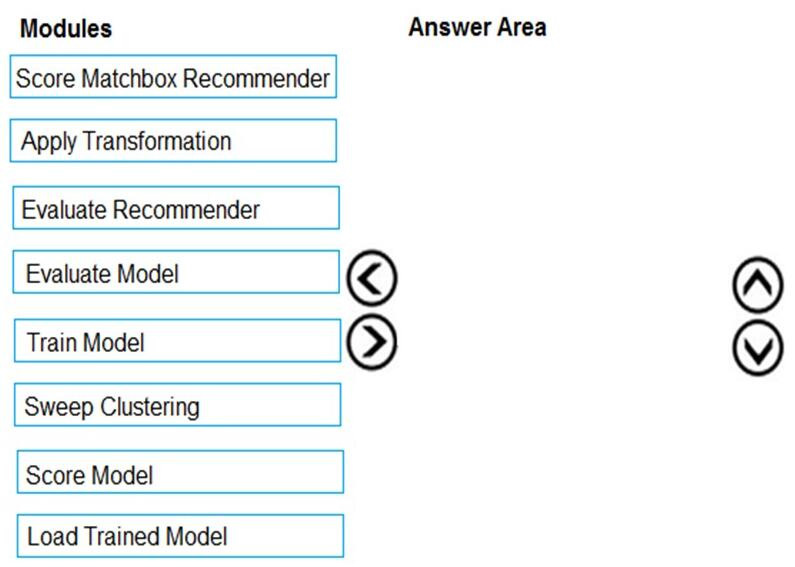
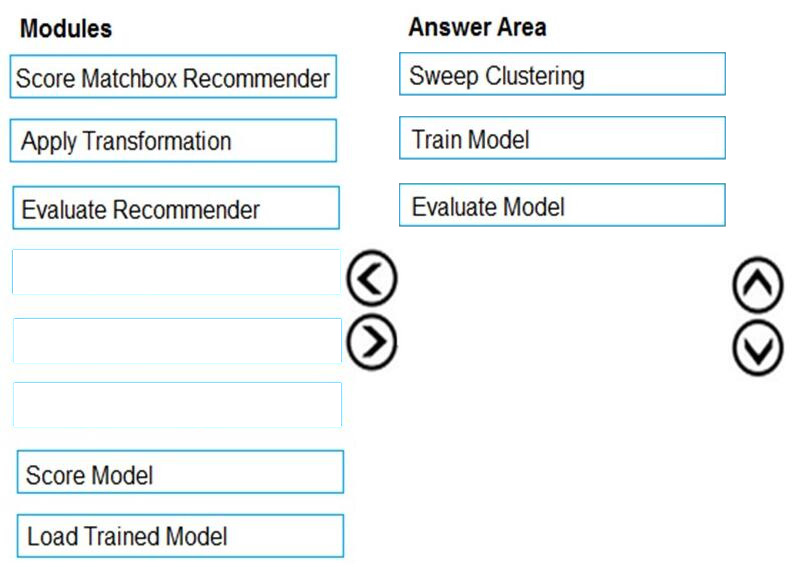
You need to produce a visualization for the diagnostic test evaluation according to the data visualization requirements.
Which three modules should you recommend be used in sequence? To answer, move the appropriate modules from the list of modules to the answer area and arrange them in the correct order.
Reveal answer detailsClose answer details
Explanation
Step 1: Sweep Clustering Start by using the "Tune Model Hyperparameters" module to select the best sets of parameters for each of the models we're considering.
One of the interesting things about the "Tune Model Hyperparameters" module is that it not only outputs the results from the Tuning, it also outputs the Trained Model.
Step 2: Train Model
Step 3: Evaluate Model
Scenario: You need to provide the test results to the Fabrikam Residences team. You create data visualizations to aid in presenting the results.
You must produce a Receiver Operating Characteristic (ROC) curve to conduct a diagnostic test evaluation of the model. You need to select appropriate methods for producing the ROC curve in Azure Machine Learning Studio to compare the Two-Class Decision Forest and the Two-Class Decision Jungle modules with one another.
You use Azure Machine Learning to deploy a model as a real-time web service.
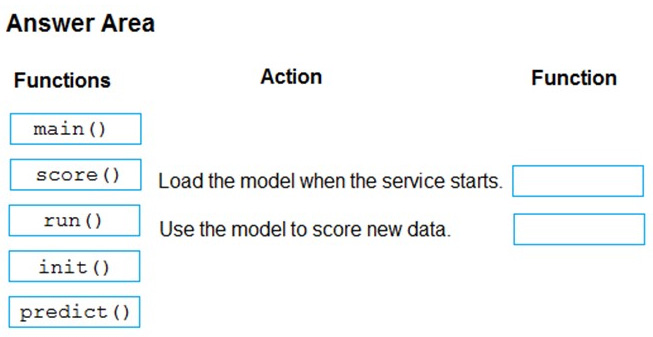
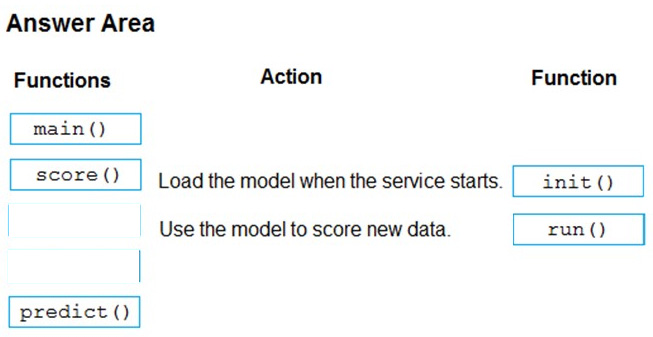
You need to create an entry script for the service that ensures that the model is loaded when the service starts and is used to score new data as it is received.
Which functions should you include in the script? To answer, drag the appropriate functions to the correct actions. Each function may be used once, more than once, or not at all. You may need to drag the split bar between panes or scroll to view content.
NOTE: Each correct selection is worth one point.
Reveal answer detailsClose answer details
Explanation
Box 1: init() The entry script has only two required functions, init() and run(data). These functions are used to initialize the service at startup and run the model using request data passed in by a client. The rest of the script handles loading and running the model(s).
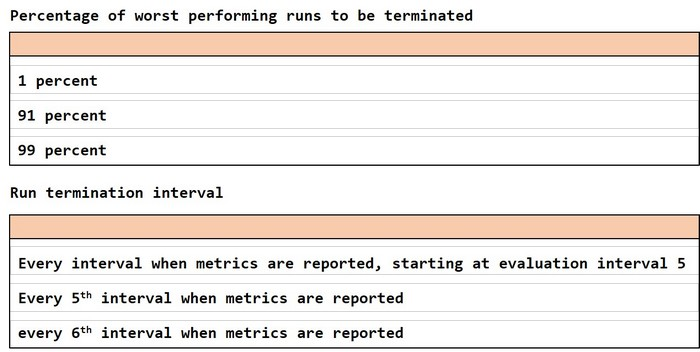
You use Azure Machine Learning to implement hyperparameter tuning with a Bandit early termination policy.
The policy uses a slack_factor set to 01. an evaluation interval set to 1, and an evaluation delay set to b.
You need to evaluate the outcome of the early termination policy
What should you evaluate? To answer, select the appropriate options m the answer area.
NOTE: Each correct selection is worth one point.
Reveal answer detailsClose answer details
Question 53
Drag & drop
DRAG DROP
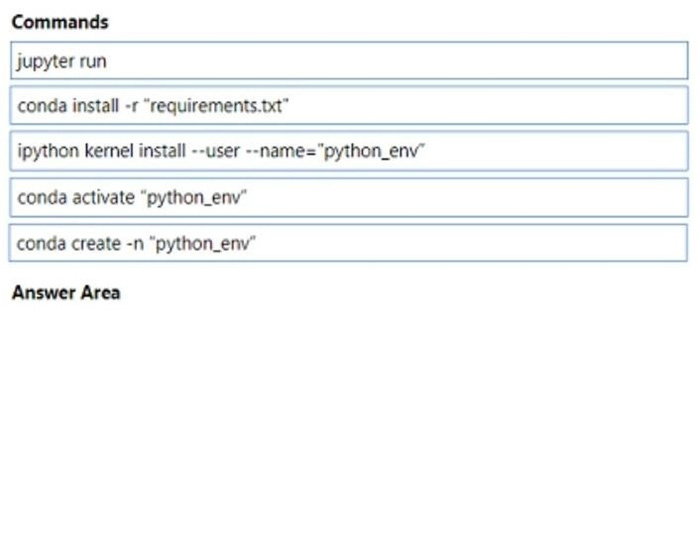
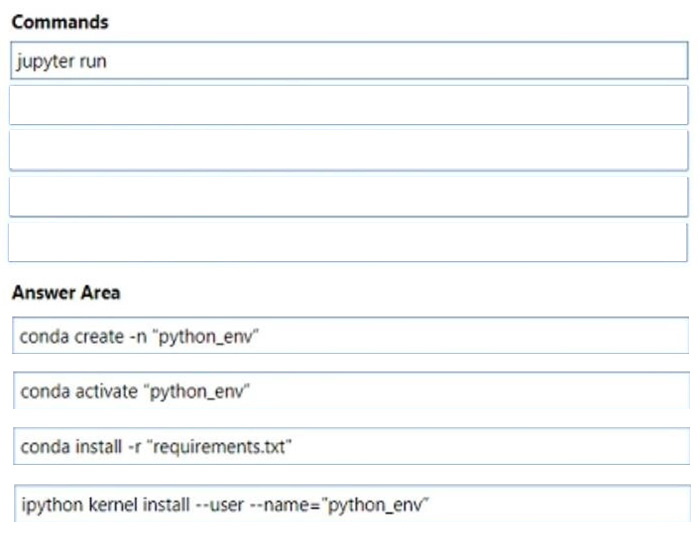
You manage an Azure Machine Learning workspace named workspace1 with a compute instance named compute1. You connect to compute1 by using a terminal window from workspace1. You create a file named "requirements.txt" containing Python dependencies to include Jupyter.
You need to add a new Jupyter kernel to compute1.
Which four commands should you use? To answer, move the appropriate actions from the list of actions to the answer area and arrange them in the correct order.
Reveal answer detailsClose answer details
Explanation
Explanation:
Step 1: conda create --n python_env
Add new kernels To add a new Jupyter kernel to the compute instance:
1. Use the terminal window to create a new environment. For example, the code below creates newenv:
conda create --name newenv
Step 2: conda activate python_env
2. Activate the environment. For example, after creating newenv:
conda activate newenv
Step 3: conda install -r "requirements.txt" 3. Install pip and ipykernel package to the new environment and create a kernel for that conda env
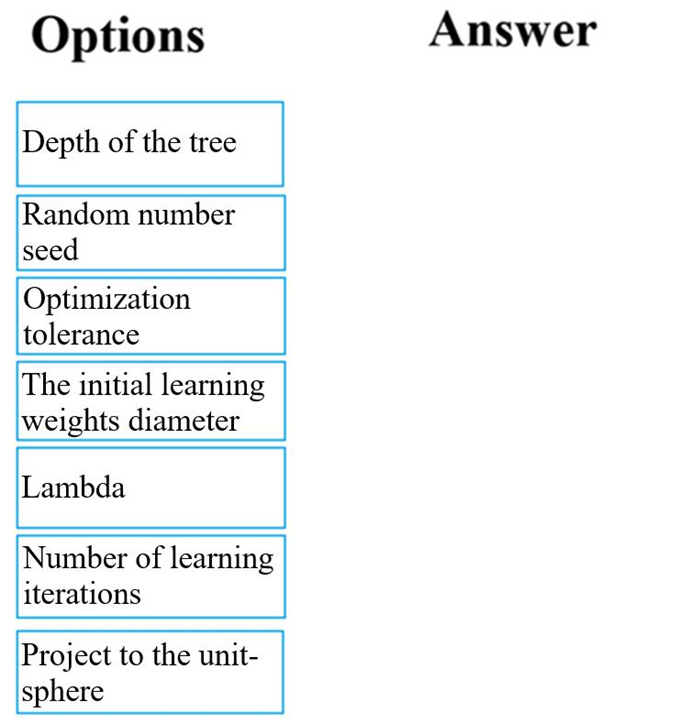
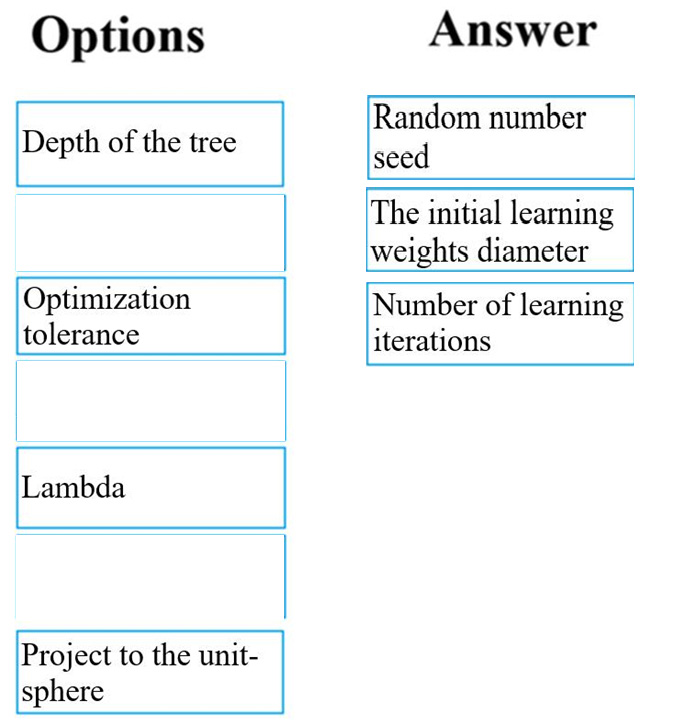
You build a binary classification model using the Azure Machine Learning Studio Two-Class Neural Network module.
You are preparing to configure the Tune Model Hyperparameters module for the purpose of tuning
accuracy for the model.
Which of the following are valid parameters for the Two-Class Neural Network module? Answer by dragging the correct options from the list to the answer area.
Note: This question is part of a series of questions that present the same scenario. Each question in the series contains a unique solution that might meet the stated goals. Some question sets might have more than one correct solution, while others might not have a correct solution.
After you answer a question in this section, you will NOT be able to return to it. As a result, these questions will not appear in the review screen.
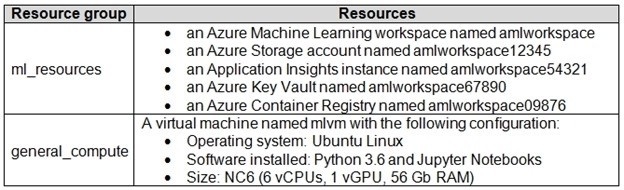
An IT department creates the following Azure resource groups and resources:
The IT department creates an Azure Kubernetes Service (AKS)-based inference compute target named aks-cluster in the Azure Machine Learning workspace.
You have a Microsoft Surface Book computer with a GPU. Python 3.6 and Visual Studio Code are installed.
You need to run a script that trains a deep neural network (DNN) model and logs the loss and accuracy metrics.
Solution: Install the Azure ML SDK on the Surface Book. Run Python code to connect to the workspace and then run the training script as an experiment on local compute.
You are creating a new experiment in Azure Machine Learning Studio. You have a small dataset that has missing values in many columns. The data does not require the application of predictors for each column. You plan to use the Clean Missing Data.
You need to select a data cleaning method.
Which method should you use?
A
Replace using Probabilistic PCA
B
Normalization
C
Synthetic Minority Oversampling Technique (SMOTE)
D
Replace using MICE
Reveal answer detailsClose answer details
Correct answerA
Explanation
Replace using Probabilistic PCA: Compared to other options, such as Multiple Imputation using Chained Equations (MICE), this option has the advantage of not requiring the application of predictors for each column. Instead, it approximates the covariance for the full dataset. Therefore, it might offer better performance for datasets that have missing values in many columns.
You plan to use the Hyperdrive feature of Azure Machine Learning to determine the optimal hyperparameter values when training a model.
You must use Hyperdrive to try combinations of the following hyperparameter values:
1. learning_rate: any value between 0.001 and 0.1 2. batch_size: 16, 32, or 64
You need to configure the search space for the Hyperdrive experiment.
Which two parameter expressions should you use? Each correct answer presents part of the solution.
NOTE: Each correct selection is worth one point.
A
a choice expression for learning_rate
B
a uniform expression for learning_rate
C
a normal expression for batch_size
D
a choice expression for batch_size
E
a uniform expression for batch_size
Reveal answer detailsClose answer details
Correct answersB, D
Explanation
B: Continuous hyperparameters are specified as a distribution over a continuous range of values. Supported distributions include: uniform(low, high) - Returns a value uniformly distributed between low and high
D: Discrete hyperparameters are specified as a choice among discrete values. choice can be: 1. one or more comma-separated values 2. a range object 3. any arbitrary list object
You create an Azure Machine Learning workspace. The workspace contains a dataset named sample_dataset, a compute instance, and a compute cluster.
You must create a two-stage pipeline that will prepare data in the dataset and then train and register a model based on the prepared data.
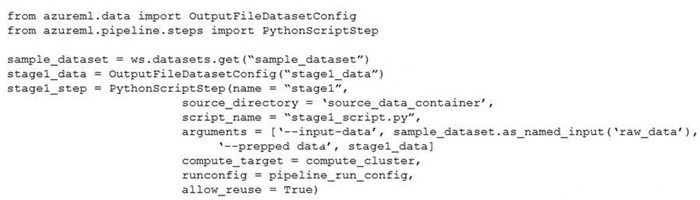
The first stage of the pipeline contains the following code:
You need to identify the location containing the output of the first stage of the script that you can use as input for the second stage.
Which storage location should you use?
A
workspaceblobstore datastore
B
workspacefilestore datastore
C
compute instance
D
compute_cluster
Reveal answer detailsClose answer details
Correct answerA
Explanation
The OutputFileDatasetConfig allows you to specify how you want a particular local path on the compute target to be uploaded to the specified destination.
Parameters Name
destination The destination to copy the output to. If set to None, we will copy the output to the workspaceblobstore datastore, under the path /dataset/{run-id}/{output-name}, where run-id is the Run's ID and the output- name is the output name from the name parameter above. T
Note: This question is part of a series of questions that present the same scenario. Each question in the series contains a unique solution that might meet the stated goals. Some question sets might have more than one correct solution, while others might not have a correct solution.
After you answer a question in this section, you will NOT be able to return to it. As a result, these questions will not appear in the review screen.
You create an Azure Machine Learning service datastore in a workspace. The datastore contains the following files:
You need to create a dataset named training_data and load the data from all files into a single data frame by using the following code:
Solution: Run the following code:
Does the solution meet the goal?
A
Yes
B
No
Reveal answer detailsClose answer details
Correct answerA
Explanation
Use two file paths. Use Dataset.Tabular_from_delimeted as the data isn't cleansed.
Note: A TabularDataset represents data in a tabular format by parsing the provided file or list of files. This provides you with the ability to materialize the data into a pandas or Spark DataFrame so you can work with familiar data preparation and training libraries without having to leave your notebook. You can create a TabularDataset object from .csv, .tsv, .parquet, .jsonl files, and from SQL query results. References: https://docs.microsoft.com/en-us/azure/machine-learning/how-to-create-register-datasets
Question 60
Single choice
You have an Azure subscription named Sub1 that contains: 1. A registered MLflow model named Model1 2. An online endpoint named Endpoint1
Outbound network connectivity from Endpoint1 is blocked.
You need to deploy Model1 to Endpoint1.
What should you do first?
A
In Workspace1, create a linked service
B
In Sub1, create an Azure Machine Learning registry.
C
In Workspace1, create a package.
D
In Workspace1, create a package.
E
In Sub1, create a private endpoint.
Reveal answer detailsClose answer details
Correct answerE
Case study
Case Study 2
Overview
You are a data scientist for Fabrikam Residences, a company specializing in quality private and commercial property in the Unites States. Fabrikam Residences is considering expanding into Europe and has asked you to investigate prices for private residences in major European cities. You use Azure Machine Learning Studio to measure the median value of properties. You produce a regression model to predict property prices by using the Linear Regression and Bayesian Linear Regression modules.
Datasets
There are two datasets in CSV format that contain property details for two cities, London and Paris. You add both files to Azure Machine Learning Studio as separate datasets to the starting point for an experiment. Both datasets contain the following columns:
An initial investigation shows that the datasets are identical in structure apart from the MedianValue column. The smaller Paris dataset contains the MedianValue in text format, whereas the larger London dataset contains the MedianValue in numerical format.
Data issues
Missing values
The AccessibilityToHighway column in both datasets contains missing values. The missing data must be replaced with new data so that it is modeled conditionally using the other variables in the data before filling in the missing values.
Columns in each dataset contain missing and null values. The datasets also contain many outliers. The Age column has a high proportion of outliers. You need to remove the rows that have outliers in the Age column. The MedianValue and AvgRoomsInHouse columns both hold data in numeric format. You need to select a feature selection algorithm to analyze the relationship between the two columns in more detail.
Model fit
The model shows signs of overfitting. You need to produce a more refined regression model that reduces the overfitting.
Experiment requirements
You must set up the experiment to cross-validate the Linear Regression and Bayesian Linear Regression modules to evaluate performance. In each case, the predictor of the dataset is the column named MedianValue. You must ensure that the datatype of the MedianValue column of the Paris dataset matches the structure of the London dataset.
You must prioritize the columns of data for predicting the outcome. You must use non-parametric statistics to measure relationships.
You must a feature selection algorithm to analyze the relationship between the MediaValue and AvgRoomsinHouse columns.
Model training
Permutation Feature Importance
Given a trained model and a test dataset, you must compute the Permutation Feature Importance scores of feature variables. You must be determined the absolute fit for the model.
Hyperparameters
You must configure hyperparameters in the model learning process to speed the learning phase. In addition, this configuration should cancel the lowest performing runs at each evaluation interval, thereby directing effort and resources towards models that are more likely to be successful.
You are concerned that the model might not efficiently use compute resources in hyperparameter tuning. You also are concerned that the model might prevent an increase in the overall tuning time. Therefore, must implement an early stopping criterion on models that provides savings without terminating promising jobs.
Testing
You must produce multiple partitions of a dataset based on sampling using the Partition and Sample module in Azure Machine Learning Studio.
Cross-validation
You must create three equal partitions for cross-validation. You must also configure the cross-validation process so that the rows in the test and training datasets are divided evenly by properties that are near each city's main river. You must complete this task before the data goes through the sampling process.
Linear regression module
When you train a Linear Regression module, you must determine the best features to use in a model. You can choose standard metrics provided to measure performance before and after the feature importance process completes. The distribution of features across multiple training models must be consistent.
Data visualization
You need to provide the test results to the Fabrikam Residences team. You create data visualizations to aid in presenting the results.
You must produce a Receiver Operating Characteristic (ROC) curve to conduct a diagnostic test evaluation of the model. You need to select appropriate methods for producing the ROC curve in Azure Learning Studio to compare the Two-Class Decision Forest and the Two-Class Decision Jungle modules with one another.
Question 61
Testlet 2Drag & drop
DRAG DROP
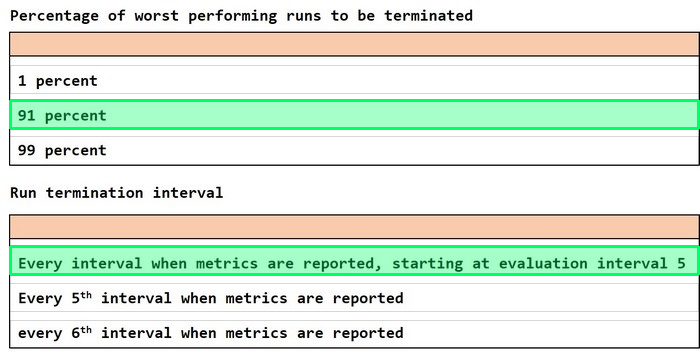
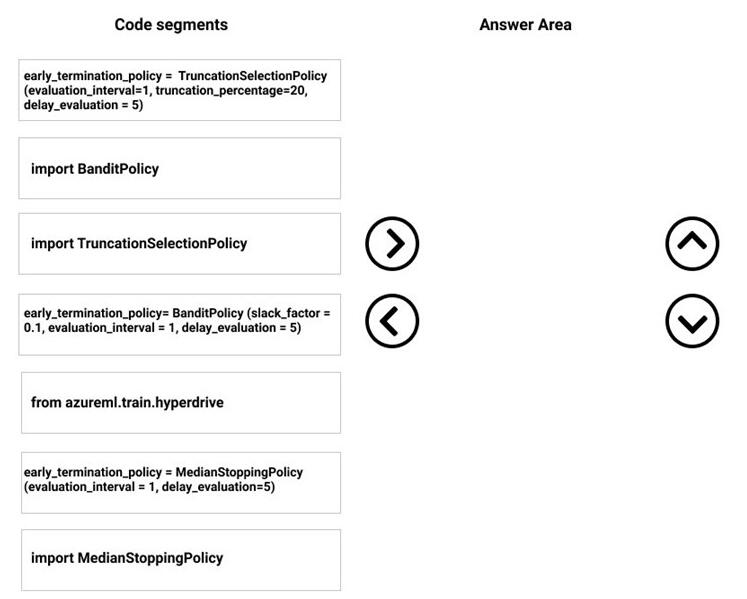
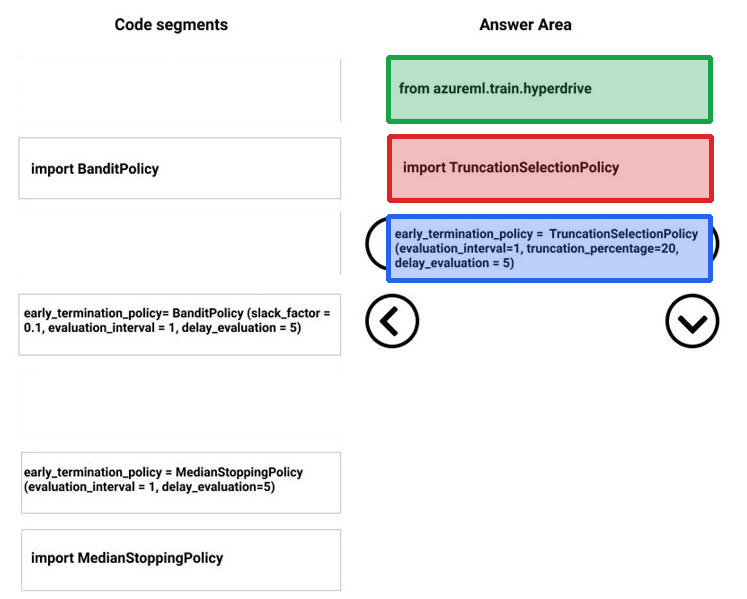
You need to implement early stopping criteria as stated in the model training requirements.
Which three code segments should you use to develop the solution? To answer, move the appropriate code segments from the list of code segments to the answer area and arrange them in the correct order.
NOTE: More than one order of answer choices is correct. You will receive the credit for any of the correct orders you select.
Reveal answer detailsClose answer details
Explanation
Step 1: from azureml.train.hyperdrive
Step 2: Import TruncationCelectionPolicy Truncation selection cancels a given percentage of lowest performing runs at each evaluation interval. Runs are compared based on their performance on the primary metric and the lowest X% are terminated.
Scenario: You must configure hyperparameters in the model learning process to speed the learning phase. In addition, this configuration should cancel the lowest performing runs at each evaluation interval, thereby directing effort and resources towards models that are more likely to be successful.
Example: from azureml.train.hyperdrive import TruncationSelectionPolicy early_termination_policy = TruncationSelectionPolicy(evaluation_interval=1, truncation_percentage=20, delay_evaluation=5) In this example, the early termination policy is applied at every interval starting at evaluation interval 5. A run will be terminated at interval 5 if its performance at interval 5 is in the lowest 20% of performance of all runs at interval 5.
Incorrect Answers: Median: Median stopping is an early termination policy based on running averages of primary metrics reported by the runs. This policy computes running averages across all training runs and terminates runs whose performance is worse than the median of the running averages.
Slack: Bandit is a termination policy based on slack factor/slack amount and evaluation interval. The policy early terminates any runs where the primary metric is not within the specified slack factor / slack amount with respect to the best performing training run.
You choose the uri_folder data type as an output of a pipeline component.
You need to define the data access mode that is supported by your configuration.
Which mode should you define?
A
eval_upload
B
rw_mount
C
download
D
ro_mount
Reveal answer detailsClose answer details
Correct answerB
Question 63
Single choice
You are a data scientist working for a hotel booking website company. You use the Azure Machine Learning service to train a model that identifies fraudulent transactions.
You must deploy the model as an Azure Machine Learning real-time web service using the Model.deploy method in the Azure Machine Learning SDK. The deployed web service must return real-time predictions of fraud based on transaction data input.
You need to create the script that is specified as the entry_script parameter for the InferenceConfig class used to deploy the model.
What should the entry script do?
A
Register the model with appropriate tags and properties.
B
Create a Conda environment for the web service compute and install the necessary Python packages.
C
Load the model and use it to predict labels from input data.
D
Start a node on the inference cluster where the web service is deployed.
E
Specify the number of cores and the amount of memory required for the inference compute.
Reveal answer detailsClose answer details
Correct answerC
Explanation
The entry script receives data submitted to a deployed web service and passes it to the model. It then takes the response returned by the model and returns that to the client. The script is specific to your model. It must understand the data that the model expects and returns.
The two things you need to accomplish in your entry script are:
Loading your model (using a function called init()) Running your model on input data (using a function called run())
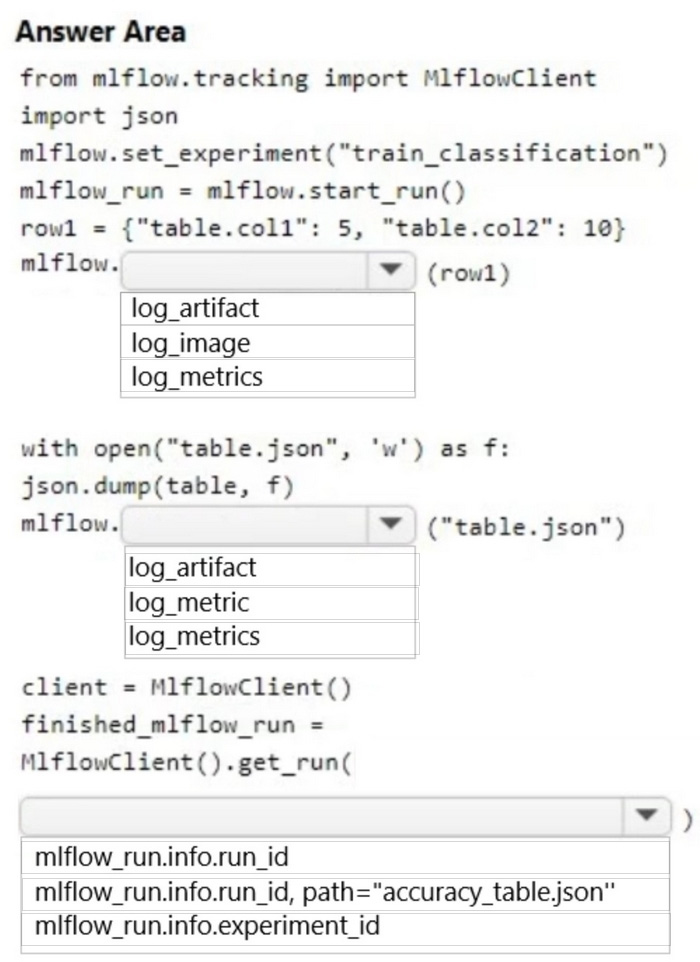
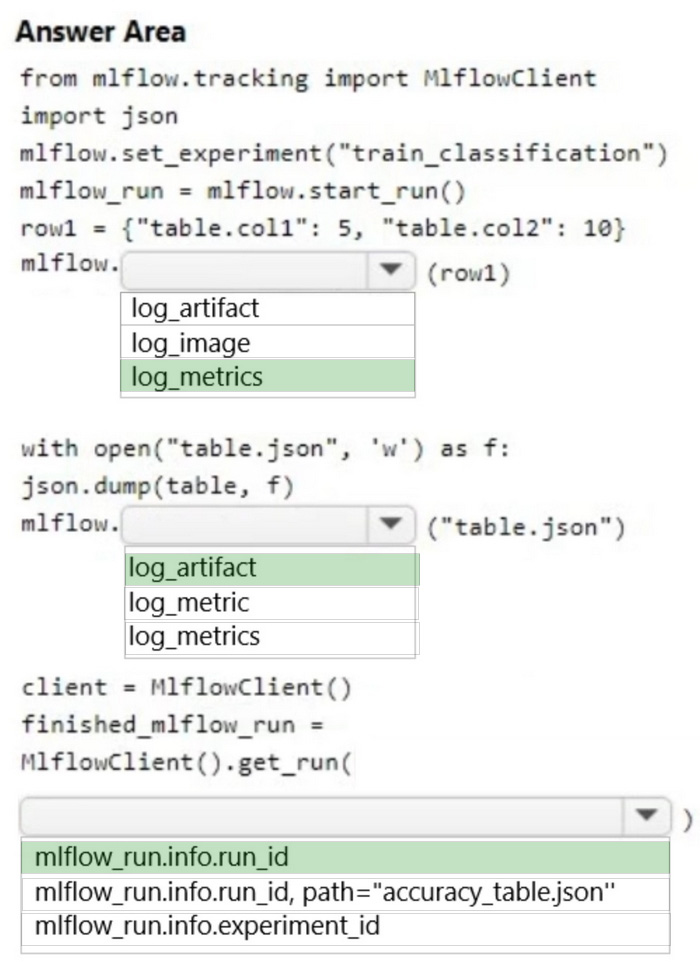
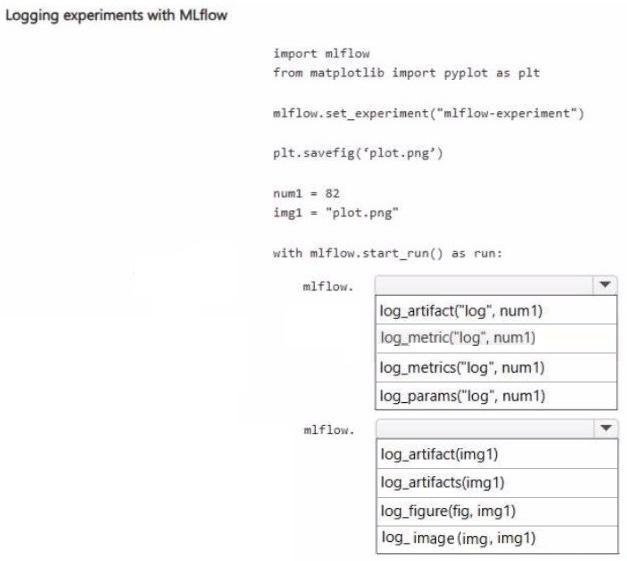
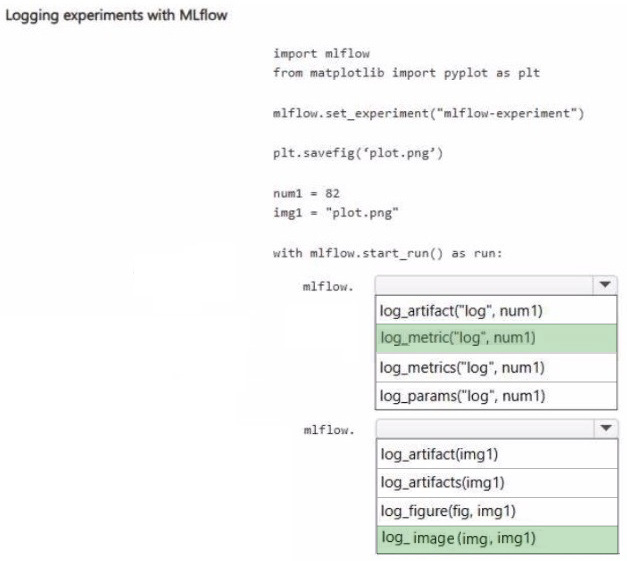
You monitor an Azure Machine Learning classification training experiment named train-classification on Azure Notebooks.
You must store a table named table as an artifact in Azure Machine Learning Studio during model training.
You need to collect and list the metrics by using MLfow.
how should you complete the code segment? To answer, select the appropriate option in the answer area.
NOTE: Each correct selection is worth on* point.
Reveal answer detailsClose answer details
Question 65
Hotspot
HOTSPOT
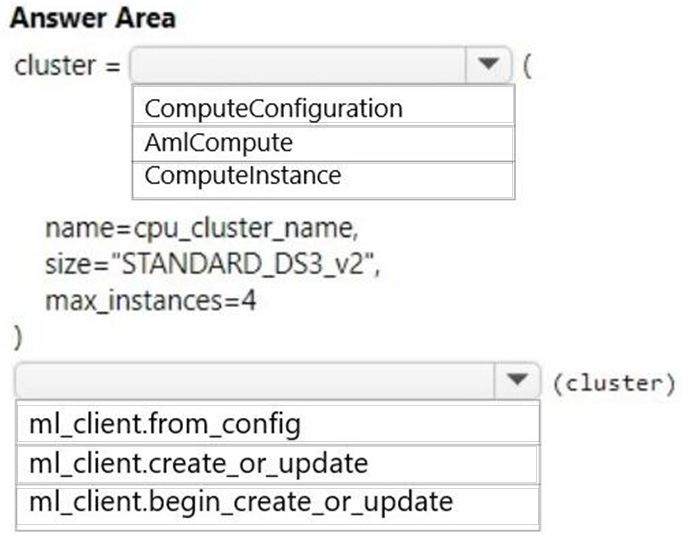
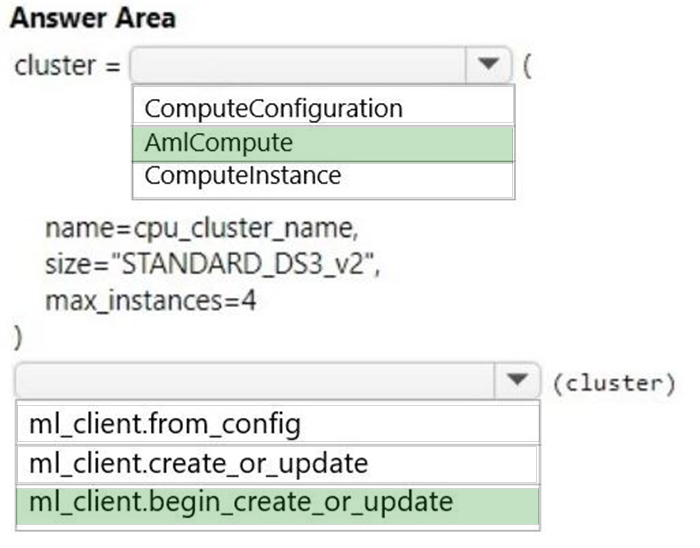
You create a new Azure Machine Learning workspace with a compute cluster.
You need to create the compute cluster asynchronously by using the Azure Machine Learning Python SDK v2.
How should you complete the code segment? To answer, select the appropriate options in the answer area.
NOTE: Each correct selection is worth one point.
Reveal answer detailsClose answer details
Explanation
Explanation:
Box 1: AmlCompute To create a persistent Azure Machine Learning Compute resource in Python, specify the size and max_instances properties. Azure Machine Learning then uses smart defaults for the other properties.
You can also configure several advanced properties when you create Azure Machine Learning Compute. The properties allow you to create a persistent cluster of fixed size, or within an existing Azure Virtual Network in your subscription. See the AmlCompute class for details.
You use a training pipeline in the Azure Machine Learning designer. You register a datastore named ds1. The datastore contains multiple training data files. You use the Import Data module with the configured datastore.
You need to retrain a model on a different set of data files.
Which four actions should you perform in sequence? To answer, move the appropriate actions from the list of actions to the answer area and arrange them in the correct order.
Reveal answer detailsClose answer details
Question 67
Single choice
Note: This question is part of a series of questions that present the same scenario. Each question in the series contains a unique solution that might meet the stated goals. Some question sets might have more than one correct solution, while others might not have a correct solution.
After you answer a question in this section, you will NOT be able to return to it. As a result, these questions will not appear in the review screen.
You are using Azure Machine Learning to run an experiment that trains a classification model.
You want to use Hyperdrive to find parameters that optimize the AUC metric for the model. You configure a HyperDriveConfig for the experiment by running the following code:
You plan to use this configuration to run a script that trains a random forest model and then tests it with validation data. The label values for the validation data are stored in a variable named y_test variable, and the predicted probabilities from the model are stored in a variable named y_predicted.
You need to add logging to the script to allow Hyperdrive to optimize hyperparameters for the AUC metric.
Solution: Run the following code:
Does the solution meet the goal?
A
Yes
B
No
Reveal answer detailsClose answer details
Correct answerB
Explanation
Use a solution with logging.info(message) instead.
You have a deployment of an Azure OpenAI Service base model. You plan to fine-tune the model.
You need to prepare a file that contains training data.
Which file format should you use?
A
JSON
B
TSV
C
JSONL
D
CSV
Reveal answer detailsClose answer details
Correct answerC
Case study
Case Study 1
Case Study Questions
Overview
You are a data scientist in a company that provides data science for professional sporting events. Models will use global and local market data to meet the following business goals:
1. Understand sentiment of mobile device users at sporting events based on audio from crowd reactions. 2. Assess a user's tendency to respond to an advertisement. 3. Customize styles of ads served on mobile devices. 4. Use video to detect penalty events
Current environment
1. Media used for penalty event detection will be provided by consumer devices. Media may include images and videos captured during the sporting event and shared using social media. The images and videos will have varying sizes and formats. 2. The data available for model building comprises of seven years of sporting event media. The sporting event media includes; recorded video transcripts or radio commentary, and logs from related social media feeds captured during the sporting events. 3. Crowd sentiment will include audio recordings submitted by event attendees in both mono and stereo formats.
Penalty detection and sentiment
1. Data scientists must build an intelligent solution by using multiple machine learning models for penalty event detection. 2. Data scientists must build notebooks in a local environment using automatic feature engineering and model building in machine learning pipelines. 3. Notebooks must be deployed to retrain by using Spark instances with dynamic worker allocation. 4. Notebooks must execute with the same code on new Spark instances to recode only the source of the data. 5. Global penalty detection models must be trained by using dynamic runtime graph computation during training. 6. Local penalty detection models must be written by using BrainScript. 7. Experiments for local crowd sentiment models must combine local penalty detection data. 8. Crowd sentiment models must identify known sounds such as cheers and known catch phrases. Individual crowd sentiment models will detect similar sounds. 9. All shared features for local models are continuous variables. 10. Shared features must use double precision. Subsequent layers must have aggregate running mean and standard deviation metrics available.
Advertisements
During the initial weeks in production, the following was observed:
1. Ad response rated declined. 2. Drops were not consistent across ad styles. 3. The distribution of features across training and production data are not consistent
Analysis shows that, of the 100 numeric features on user location and behavior, the 47 features that come from location sources are being used as raw features. A suggested experiment to remedy the bias and variance issue is to engineer 10 linearly uncorrelated features.
1. Initial data discovery shows a wide range of densities of target states in training data used for crowd sentiment models. 2. All penalty detection models show inference phases using a Stochastic Gradient Descent (SGD) are running too slow.
3. Audio samples show that the length of a catch phrase varies between 25%-47% depending on region 4. The performance of the global penalty detection models shows lower variance but higher bias when comparing training and validation sets. Before implementing any feature changes, you must confirm the bias and variance using all training and validation cases. 5. 6. Ad response models must be trained at the beginning of each event and applied during the sporting event. 7. Market segmentation models must optimize for similar ad response history. 8. Sampling must guarantee mutual and collective exclusively between local and global segmentation models that share the same features. 9. Local market segmentation models will be applied before determining a user's propensity to respond to an advertisement. 10. Ad response models must support non-linear boundaries of features. 11. The ad propensity model uses a cut threshold is 0.45 and retrains occur if weighted Kappa deviated from 0.1 +/- 5%. 12. The ad propensity model uses cost factors shown in the following diagram:
The ad propensity model uses proposed cost factors shown in the following diagram:
Performance curves of current and proposed cost factor scenarios are shown in the following diagram:
Question 69
Testlet 1Single choice
You need to implement a feature engineering strategy for the crowd sentiment local models.
What should you do?
A
Apply an analysis of variance (ANOVA).
B
Apply a Pearson correlation coefficient.
C
Apply a Spearman correlation coefficient.
D
Apply a linear discriminant analysis.
Reveal answer detailsClose answer details
Correct answerD
Explanation
The linear discriminant analysis method works only on continuous variables, not categorical or ordinal variables.
Linear discriminant analysis is similar to analysis of variance (ANOVA) in that it works by comparing the means of the variables.
Scenario: Data scientists must build notebooks in a local environment using automatic feature engineering and model building in machine learning pipelines. Experiments for local crowd sentiment models must combine local penalty detection data. All shared features for local models are continuous variables.
Incorrect Answers: B: The Pearson correlation coefficient, sometimes called Pearson's R test, is a statistical value that measures the linear relationship between two variables. By examining the coefficient values, you can infer something about the strength of the relationship between the two variables, and whether they are positively correlated or negatively correlated.
C: Spearman's correlation coefficient is designed for use with non-parametric and non-normally distributed data. Spearman's coefficient is a nonparametric measure of statistical dependence between two variables, and is sometimes denoted by the Greek letter rho. The Spearman's coefficient expresses the degree to which two variables are monotonically related. It is also called Spearman rank correlation, because it can be used with ordinal variables.
The Python script named script.py reads an argument named training_data.
The training_data argument specifies the path to the training data in a file named dataset1.csv.
You plan to run the script.py Python script as a command job that trains a machine learning model.
You need to provide the command to pass the path for the dataset as a parameter value when you submit the script as a training job.
Solution: python script.py --training_data dataset1,csv Does the solution meet the goal?
A
Yes
B
No
Reveal answer detailsClose answer details
Correct answerA
Question 71
Multiple choice
You plan to use the Hyperdrive feature of Azue Machine Learning to determine the optimal hyperparameter values when training a model.
You must use Hyperdrive to try combinations of the following hyperparameter values. You must not apply an early termination policy.
1. learning_rate: any value between 0.001 and 0.1 2. batch_size: 16, 32, or 64
You need to configure the sampling method for the Hyperdrive experiment.
Which two sampling methods can you use? Each correct answer is a complete solution.
NOTE: Each correct selection is worth one point.
A
No sampling
B
Grid sampling
C
Bayesian sampling
D
Random sampling
Reveal answer detailsClose answer details
Correct answersC, D
Explanation
C: Bayesian sampling is based on the Bayesian optimization algorithm and makes intelligent choices on the hyperparameter values to sample next. It picks the sample based on how the previous samples performed, such that the new sample improves the reported primary metric. Bayesian sampling does not support any early termination policy
D: In random sampling, hyperparameter values are randomly selected from the defined search space. Random sampling allows the search space to include both discrete and continuous hyperparameters.
Incorrect Answers: B: Grid sampling can be used if your hyperparameter space can be defined as a choice among discrete values and if you have sufficient budget to exhaustively search over all values in the defined search space. Additionally, one can use automated early termination of poorly performing runs, which reduces wastage of resources.
Example, the following space has a total of six samples: from azureml.train.hyperdrive import GridParameterSampling from azureml.train.hyperdrive import choice param_sampling = GridParameterSampling( { "num_hidden_layers": choice(1, 2, 3), "batch_size": choice(16, 32) } )
You use Azure Machine Learning Studio to build a machine learning experiment.
You need to divide data into two distinct datasets.
Which module should you use?
A
Split Data
B
Load Trained Model
C
Assign Data to Clusters
D
Group Data into Bins
Reveal answer detailsClose answer details
Correct answerA
Question 73
Drag & drop
DRAG DROP
You manage an Azure Machine Learning workspace named workspace1 and a Data Science Virtual Machine (DSVM) named DSMV1.
You must run an experiment on DSMV1 by using a Jupyter notebook and Python SDK v2 code. You must store metrics and artifacts in workspace1. You start by creating Python SDK v2 code to import all required packages.
You need to implement the Python SDK v2 code to store metrics and artifacts in workspace1.
Which three actions should you perform in sequence? To answer, move the appropriate actions from the list of actions to the answer area and arrange them in the correct order.
Reveal answer detailsClose answer details
Explanation
Explanation:
Step 1: Retrieve the tracking URI of workspace1
Configure MLflow tracking URI To connect MLflow to an Azure Machine Learning workspace, you need the tracking URI for the workspace. Each workspace has its own tracking URI and it has the protocol azureml://.
1. Get the tracking URI for your workspace (Step 1) a. Login and configure your workspace b. You can get the tracking URI using the az ml workspace command: az ml workspace show --query mlflow_tracking_uri
2. Configuring the tracking URI: (Step 2) Then the method set_tracking_uri() points the MLflow tracking URI to that URI.
mlflow.set_tracking_uri(mlflow_tracking_uri)
Step 2: Set the MLflow tracking URI.
Track DSVM runs Add the following code to your notebook (or script) to set the Azure Machine Learning workspace object.
Step 3: Set the URI parameter of the mlflow.projects.run method. Now that your environment is connected to your workspace in Azure Machine Learning, you can start to work with it.
You can run any project from a Git URI or from a local directory using the mlflow run command-line tool, or the mlflow.projects.run() Python API. These APIs also allow submitting the project for remote execution on Databricks and Kubernetes.
Running Projects MLflow provides two ways to run projects: the mlflow run command-line tool, or the mlflow.projects.run() Python API. Both tools take the following parameters:
* Project URI A directory on the local file system or a Git repository path, specified as a URI of the form https://<repo>(touseHTTPS)oruser@host:path(touseGitoverSSH).TorunagainstanMLprojectfilelocatedinasubdirectoryoftheproject,adda'#'totheendoftheURIargument,followedbytherelativepathfromtheproject'srootdirectorytothesubdirectorycontainingthedesiredproject.
Note: Track ML experiments and models with MLflow Tracking refers to process of saving all experiment's related information that you may find relevant for every experiment you run.
Why MLflow Azure Machine Learning workspaces are MLflow-compatible, which means you can use MLflow to track runs, metrics, parameters, and artifacts with your Azure Machine Learning workspaces.
You plan to use the Azure AI Foundry portal to fine-tune a base Azure OpenAI Service model that can accept both text and images as input.
You need to choose the suitable model.
Which model should you choose?
A
gpt-35-turbo
B
davinci-002
C
gpt-4
D
gpt-4o
Reveal answer detailsClose answer details
Correct answerC
Question 75
Single choice
You plan to deliver a hands-on workshop to several students. The workshop will focus on creating data visualizations using Python. Each student will use a device that has internet access.
Student devices are not configured for Python development. Students do not have administrator access to install software on their devices. Azure subscriptions are not available for students.
You need to ensure that students can run Python-based data visualization code.
Which Azure tool should you use?
A
Anaconda Data Science Platform
B
Azure BatchAl
C
Azure Notebooks
D
Azure Machine Learning Service
Reveal answer detailsClose answer details
Correct answerC
Explanation
References: https://notebooks.azure.com/
Question 76
Single choice
You are evaluating a completed binary classification machine learning model.
You need to use the precision as the valuation metric.
Note: This question is part of a series of questions that present the same scenario. Each question in the series contains a unique solution that might meet the stated goals. Some question sets might have more than one correct solution, while others might not have a correct solution.
After you answer a question in this section, you will NOT be able to return to it. As a result, these questions will not appear in the review screen.
An IT department creates the following Azure resource groups and resources:
The IT department creates an Azure Kubernetes Service (AKS)-based inference compute target named aks-cluster in the Azure Machine Learning workspace.
You have a Microsoft Surface Book computer with a GPU. Python 3.6 and Visual Studio Code are installed.
You need to run a script that trains a deep neural network (DNN) model and logs the loss and accuracy metrics.
Solution: Install the Azure ML SDK on the Surface Book. Run Python code to connect to the workspace. Run the training script as an experiment on the aks-cluster compute target.
Does the solution meet the goal?
A
Yes
B
No
Reveal answer detailsClose answer details
Correct answerB
Explanation
Need to attach the mlvm virtual machine as a compute target in the Azure Machine Learning workspace.
You create a multi-class image classification deep learning model.
The model must be retrained monthly with the new image data fetched from a public web portal. You create an Azure Machine Learning pipeline to fetch new data, standardize the size of images, and retrain the model.
You need to use the Azure Machine Learning Python SDK v2 to configure the schedule for the pipeline. The schedule should be defined by using the frequency and interval properties, with frequency set to "month" and interval set to "1".
Which three classes should you instantiate in sequence? To answer, move the appropriate actions from the list of actions to the answer area and arrange them in the correct order.
Reveal answer detailsClose answer details
Explanation
Explanation:
Step 1: PipelineJob Schedule machine learning pipeline jobs To run a pipeline job on a recurring basis, you'll need to create a schedule. A Schedule associates a job, and a trigger. The trigger can either be cron that use cron expression to describe the wait between runs or recurrence that specify using what frequency to trigger job. In each case, you need to define a pipeline job first.
You manage an Azure OpenAI Service deployment of the gpt-4o-mini base model.
You plan to fine-tune the deployed model by using OpenAI Python code.
In the code, you import all required Python libraries and create a sample training dataset.
You need to complete the next section of the code to estimate the cost of fine-tuning by using the sample training dataset.
How should you complete the code section? To answer, select the appropriate options in the answer area.
NOTE: Each correct selection is worth one point.
Reveal answer detailsClose answer details
Question 82
Single choice
You are reviewing model benchmarks in Azure AI Foundry.
You must use a large language model benchmark that measures linguistic correctness.
Which benchmark metric should you focus on?
A
Fluency
B
Coherence
C
Precision
D
Accuracy
Reveal answer detailsClose answer details
Correct answerA
Question 83
Hotspot
HOTSPOT
You are implementing hyperparameter tuning for a model training from a notebook. The notebook is in an Azure Machine Learning workspace. You add code that imports all relevant Python libraries.
You must configure Bayesian sampling over the search space for the num_hidden_layers and batch_size hyperparameters.
You need to complete the following Python code to configure Bayesian sampling.
Which code segments should you use? To answer, select the appropriate options in the answer area
NOTE: Each correct selection is worth one point.
Reveal answer detailsClose answer details
Question 84
Drag & drop
DRAG DROP
You plan to explore demographic data for home ownership in various cities. The data is in a CSV file with the following format:
You need to run an experiment in your Azure Machine Learning workspace to explore the data and log the results. The experiment must log the following information:
1. the number of observations in the dataset 2. a box plot of income by home_owner 3. a dictionary containing the city names and the average income for each city
You need to use the appropriate logging methods of the experiment's run object to log the required information.
How should you complete the code? To answer, drag the appropriate code segments to the correct locations. Each code segment may be used once, more than once, or not at all. You may need to drag the split bar between panes or scroll to view content.
NOTE: Each correct selection is worth one point.
Reveal answer detailsClose answer details
Explanation
Box 1: log The number of observations in the dataset.
run.log(name, value, description='') Scalar values: Log a numerical or string value to the run with the given name. Logging a metric to a run causes that metric to be stored in the run record in the experiment. You can log the same metric multiple times within a run, the result being considered a vector of that metric.
Example: run.log("accuracy", 0.95)
Box 2: log_image A box plot of income by home_owner.
log_image Log an image to the run record. Use log_image to log a .PNG image file or a matplotlib plot to the run. These images will be visible and comparable in the run record.
Example: run.log_image("ROC", plot=plt)
Box 3: log_table A dictionary containing the city names and the average income for each city.
log_table: Log a dictionary object to the run with the given name.
Question 85
Drag & drop
DRAG DROP
You set up a machine learning workflow as an automated process. You have an Owner role in an Azure subscription that contains the Azure Machine Learning workspace.
You must set up an authentication method that allows an automated process to authenticate to the workspace without requiring user interaction.
You need to set up the authentication for the Azure Machine Learning workspace.
Which three actions should you perform in sequence? To answer, move the appropriate actions from the list of actions to the answer area and arrange them in the correct order.
NOTE: More than one order of answer choices is correct. You will receive credit for any of the correct orders you select.
Reveal answer detailsClose answer details
Question 86
Single choice
Note: This question is part of a series of questions that present the same scenario. Each question in the series contains a unique solution that might meet the stated goals. Some question sets might have more than one correct solution, while others might not have a correct solution.
After you answer a question in this section, you will NOT be able to return to it. As a result, these questions will not appear in the review screen.
You are analyzing a numerical dataset which contains missing values in several columns.
You must clean the missing values using an appropriate operation without affecting the dimensionality of the feature set.
You need to analyze a full dataset to include all values.
Solution: Use the Last Observation Carried Forward (LOCF) method to impute the missing data points.
Does the solution meet the goal?
A
Yes
B
No
Reveal answer detailsClose answer details
Correct answerB
Explanation
Instead use the Multiple Imputation by Chained Equations (MICE) method. Replace using MICE: For each missing value, this option assigns a new value, which is calculated by using a method described in the statistical literature as "Multivariate Imputation using Chained Equations" or "Multiple Imputation by Chained Equations". With a multiple imputation method, each variable with missing data is modeled conditionally using the other variables in the data before filling in the missing values.
Note: Last observation carried forward (LOCF) is a method of imputing missing data in longitudinal studies. If a person drops out of a study before it ends, then his or her last observed score on the dependent variable is used for all subsequent (i.e., missing) observation points. LOCF is used to maintain the sample size and to reduce the bias caused by the attrition of participants in a study.
You create an Azure Machine Learning workspace. You are training a classification model with no-code AutoML in Azure Machine Learning studio.
The model must predict if a client of a financial institution will subscribe to a fixed-term deposit. You must identify the feature that has the most influence on the predictions of the model for the second highest scoring algorithm. You must minimize the effort and time to identify the feature.
You need to complete the identification.
Which three actions should you perform in sequence? To answer, move the appropriate actions from the list of actions to the answer area and arrange them in the correct order.
Reveal answer detailsClose answer details
Question 88
Multiple choice
You are training machine learning models in Azure Machine Learning. You use Hyperdrive to tune the hyperparameter.
In previous model training and tuning runs, many models showed similar performance.
You need to select an early termination policy that meets the following requirements:
1. accounts for the performance of all previous runs when evaluating the current run 2. avoids comparing the current run with only the best performing run to date
Which two early termination policies should you use? Each correct answer presents part of the solution.
NOTE: Each correct selection is worth one point.
A
Median stopping
B
Bandit
C
Default
D
Truncation selection
Reveal answer detailsClose answer details
Correct answersA, D
Explanation
The Median Stopping policy computes running averages across all runs and cancels runs whose best performance is worse than the median of the running averages.
If no policy is specified, the hyperparameter tuning service will let all training runs execute to completion.
You have an Azure Machine Learning (ML) model deployed to an online endpoint.
You need to review container logs from the endpoint by using Azure ML Python SDK v2. The logs must include the console log from the inference server, with print/log statements from the model's scoring script.
What should you do first?
A
Connect by using SSH to the inference server.
B
Create an instance of the MLCIient class.
C
Connect by using Docker tools to the inference server.
D
Create an instance of the OnlineDeploymentOperations class.
Reveal answer detailsClose answer details
Correct answerB
Explanation
Get container logs To see log output from container, use the get_logs method as follows:
Note (B, not D): OnlineDeploymentOperations Class You should not instantiate this class directly. Instead, you should create an MLClient instance that instantiates it for you and attaches it as an attribute.
You are in the process of carrying out feature engineering on a dataset.
You want to add a feature to the dataset and fill the column value.
Recommendation: You must make use of the Join Data Azure Machine Learning Studio module.
Will the requirements be satisfied?
A
Yes
B
No
Reveal answer detailsClose answer details
Correct answerB
Question 91
Hotspot
HOTSPOT
You have an Azure Machine Learning workspace.
You plan to set up logging and tracking experiments by using MLflow Tracking.
You need to log the accuracy as a numerical value and the training loss as a plot.
How should you complete the commands? To answer, select the appropriate options in the answer area.
NOTE: Each correct selection is worth one point.
Reveal answer detailsClose answer details
Question 92
Multiple choice
You are attaching an Azure Databricks-based compute resource to an Azure Machine Learning development workspace.
You need to configure parameters to attach the resource.
Which three parameters should you use? Each correct answer presents part of the solution.
NOTE: Each correct selection is worth one point.
A
Workspace name
B
Compute name
C
Workspace user credentials
D
Workspace resource ID
E
Access token
Reveal answer detailsClose answer details
Correct answersA, B, E
Case study
Case Study 2
Overview
You are a data scientist for Fabrikam Residences, a company specializing in quality private and commercial property in the Unites States. Fabrikam Residences is considering expanding into Europe and has asked you to investigate prices for private residences in major European cities. You use Azure Machine Learning Studio to measure the median value of properties. You produce a regression model to predict property prices by using the Linear Regression and Bayesian Linear Regression modules.
Datasets
There are two datasets in CSV format that contain property details for two cities, London and Paris. You add both files to Azure Machine Learning Studio as separate datasets to the starting point for an experiment. Both datasets contain the following columns:
An initial investigation shows that the datasets are identical in structure apart from the MedianValue column. The smaller Paris dataset contains the MedianValue in text format, whereas the larger London dataset contains the MedianValue in numerical format.
Data issues
Missing values
The AccessibilityToHighway column in both datasets contains missing values. The missing data must be replaced with new data so that it is modeled conditionally using the other variables in the data before filling in the missing values.
Columns in each dataset contain missing and null values. The datasets also contain many outliers. The Age column has a high proportion of outliers. You need to remove the rows that have outliers in the Age column. The MedianValue and AvgRoomsInHouse columns both hold data in numeric format. You need to select a feature selection algorithm to analyze the relationship between the two columns in more detail.
Model fit
The model shows signs of overfitting. You need to produce a more refined regression model that reduces the overfitting.
Experiment requirements
You must set up the experiment to cross-validate the Linear Regression and Bayesian Linear Regression modules to evaluate performance. In each case, the predictor of the dataset is the column named MedianValue. You must ensure that the datatype of the MedianValue column of the Paris dataset matches the structure of the London dataset.
You must prioritize the columns of data for predicting the outcome. You must use non-parametric statistics to measure relationships.
You must a feature selection algorithm to analyze the relationship between the MediaValue and AvgRoomsinHouse columns.
Model training
Permutation Feature Importance
Given a trained model and a test dataset, you must compute the Permutation Feature Importance scores of feature variables. You must be determined the absolute fit for the model.
Hyperparameters
You must configure hyperparameters in the model learning process to speed the learning phase. In addition, this configuration should cancel the lowest performing runs at each evaluation interval, thereby directing effort and resources towards models that are more likely to be successful.
You are concerned that the model might not efficiently use compute resources in hyperparameter tuning. You also are concerned that the model might prevent an increase in the overall tuning time. Therefore, must implement an early stopping criterion on models that provides savings without terminating promising jobs.
Testing
You must produce multiple partitions of a dataset based on sampling using the Partition and Sample module in Azure Machine Learning Studio.
Cross-validation
You must create three equal partitions for cross-validation. You must also configure the cross-validation process so that the rows in the test and training datasets are divided evenly by properties that are near each city's main river. You must complete this task before the data goes through the sampling process.
Linear regression module
When you train a Linear Regression module, you must determine the best features to use in a model. You can choose standard metrics provided to measure performance before and after the feature importance process completes. The distribution of features across multiple training models must be consistent.
Data visualization
You need to provide the test results to the Fabrikam Residences team. You create data visualizations to aid in presenting the results.
You must produce a Receiver Operating Characteristic (ROC) curve to conduct a diagnostic test evaluation of the model. You need to select appropriate methods for producing the ROC curve in Azure Learning Studio to compare the Two-Class Decision Forest and the Two-Class Decision Jungle modules with one another.
Question 93
Testlet 2Hotspot
HOTSPOT
You need to identify the methods for dividing the data according to the testing requirements.
Which properties should you select? To answer, select the appropriate options in the answer area.
NOTE: Each correct selection is worth one point.
Reveal answer detailsClose answer details
Explanation
Scenario: Testing You must produce multiple partitions of a dataset based on sampling using the Partition and Sample module in Azure Machine Learning Studio.
Box 1: Assign to folds Use Assign to folds option when you want to divide the dataset into subsets of the data. This option is also useful when you want to create a custom number of folds for cross-validation, or to split rows into several groups.
Not Head: Use Head mode to get only the first n rows. This option is useful if you want to test a pipeline on a small number of rows, and don't need the data to be balanced or sampled in any way.
Not Sampling: The Sampling option supports simple random sampling or stratified random sampling. This is useful if you want to create a smaller representative sample dataset for testing.
Box 2: Partition evenly Specify the partitioner method: Indicate how you want data to be apportioned to each partition, using these options: Partition evenly: Use this option to place an equal number of rows in each partition. To specify the number of output partitions, type a whole number in the Specify number of folds to split evenly into text box.
Note: This question is part of a series of questions that present the same scenario. Each question in the series contains a unique solution that might meet the stated goals. Some question sets might have more than one correct solution, while others might not have a correct solution.
After you answer a question in this section, you will NOT be able to return to it. As a result, these questions will not appear in the review screen.
You are using Azure Machine Learning to run an experiment that trains a classification model.
You want to use Hyperdrive to find parameters that optimize the AUC metric for the model. You configure a HyperDriveConfig for the experiment by running the following code:
You plan to use this configuration to run a script that trains a random forest model and then tests it with validation data. The label values for the validation data are stored in a variable named y_test variable, and the predicted probabilities from the model are stored in a variable named y_predicted.
Solution: Run the following code:
Does the solution meet the goal?
A.
Yes
B.
No
Correct Answer: A
QUESTION 2
HOTSPOT
You register the following versions of a model.
You use the Azure ML Python SDK to run a training experiment. You use a variable named run to reference the experiment run.
After the run has been submitted and completed, you run the following code:
For each of the following statements, select Yes if the statement is true. Otherwise, select No.
An MLflow model is already registered. You plan to customize how the deployment does inference.
You need to deploy the MLflow model to a batch endpoint for batch inferencing.
What should you create first?
A.
scoring script
B.
deployment
C.
environment
D.
deployment definition
Correct Answer: A
QUESTION 4
Note: This question is part of a series of questions that present the same scenario. Each question in the series contains a unique solution that might meet the stated goals. Some question sets might have more than one correct solution, while others might not have a correct solution.
After you answer a question in this section, you will NOT be able to return to it. As a result, these questions will not appear in the review screen.
You have an Azure Machine Learning workspace that includes an AmlCompute cluster and a batch endpoint.
You clone a repository that contains an MLflow model to your local computer.
You need to ensure that you can deploy the model to the batch endpoint.
Solution: Create a data asset in the workspace.
Does the solution meet the goal?
A.
Yes
B.
No
Correct Answer: B
QUESTION 5
You are analyzing a dataset by using Azure Machine Learning Studio.
You need to generate a statistical summary that contains the p-value and the unique count for each feature column.
Which two modules can you use? Each correct answer presents a complete solution.
NOTE: Each correct selection is worth one point.
A.
Computer Linear Correlation
B.
Export Count Table
C.
Execute Python Script
D.
Convert to Indicator Values
E.
Summarize Data
Correct Answer: CE
QUESTION 6
You make use of Azure Machine Learning Studio to create a binary classification model.
You are preparing to carry out a parameter sweep of the model to tune hyperparameters. You have to make sure that the sweep allows for every possible combination of hyperparameters to be iterated. Also, the computing resources needed to carry out the sweep must be reduced.
Which of the following actions should you take?
A.
You should consider making use of the Selective grid sweep mode.
B.
You should consider making use of the Measured grid sweep mode.
C.
You should consider making use of the Entire grid sweep mode.
D.
You should consider making use of the Random grid sweep mode.
Correct Answer: D
Explanation
Explanation/Reference:
Maximum number of runs on random grid: This option also controls the number of iterations over a random sampling of parameter values, but the values are not generated randomly from the specified range; instead, a matrix is created of all possible combinations of parameter values and a random sampling is taken over the matrix. This method is more efficient and less prone to regional oversampling or undersampling.
If you are training a model that supports an integrated parameter sweep, you can also set a range of seed values to use and iterate over the random seeds as well. This is optional, but can be useful for avoiding bias introduced by seed selection.
C: Entire grid: When you select this option, the module loops over a grid predefined by the system, to try different combinations and identify the best learner. This option is useful for cases where you don't know what the best parameter settings might be and want to try all possible combination of values.
You are a data scientist in a company that provides data science for professional sporting events. Models will use global and local market data to meet the following business goals:
1. Understand sentiment of mobile device users at sporting events based on audio from crowd reactions. 2. Assess a user's tendency to respond to an advertisement. 3. Customize styles of ads served on mobile devices. 4. Use video to detect penalty events
Current environment
1. Media used for penalty event detection will be provided by consumer devices. Media may include images and videos captured during the sporting event and shared using social media. The images and videos will have varying sizes and formats. 2. The data available for model building comprises of seven years of sporting event media. The sporting event media includes; recorded video transcripts or radio commentary, and logs from related social media feeds captured during the sporting events. 3. Crowd sentiment will include audio recordings submitted by event attendees in both mono and stereo formats.
Penalty detection and sentiment
1. Data scientists must build an intelligent solution by using multiple machine learning models for penalty event detection. 2. Data scientists must build notebooks in a local environment using automatic feature engineering and model building in machine learning pipelines. 3. Notebooks must be deployed to retrain by using Spark instances with dynamic worker allocation. 4. Notebooks must execute with the same code on new Spark instances to recode only the source of the data. 5. Global penalty detection models must be trained by using dynamic runtime graph computation during training. 6. Local penalty detection models must be written by using BrainScript. 7. Experiments for local crowd sentiment models must combine local penalty detection data. 8. Crowd sentiment models must identify known sounds such as cheers and known catch phrases. Individual crowd sentiment models will detect similar sounds. 9. All shared features for local models are continuous variables. 10. Shared features must use double precision. Subsequent layers must have aggregate running mean and standard deviation metrics available.
Advertisements
During the initial weeks in production, the following was observed:
1. Ad response rated declined. 2. Drops were not consistent across ad styles. 3. The distribution of features across training and production data are not consistent
Analysis shows that, of the 100 numeric features on user location and behavior, the 47 features that come from location sources are being used as raw features. A suggested experiment to remedy the bias and variance issue is to engineer 10 linearly uncorrelated features.
1. Initial data discovery shows a wide range of densities of target states in training data used for crowd sentiment models. 2. All penalty detection models show inference phases using a Stochastic Gradient Descent (SGD) are running too slow.
3. Audio samples show that the length of a catch phrase varies between 25%-47% depending on region 4. The performance of the global penalty detection models shows lower variance but higher bias when comparing training and validation sets. Before implementing any feature changes, you must confirm the bias and variance using all training and validation cases. 5. 6. Ad response models must be trained at the beginning of each event and applied during the sporting event. 7. Market segmentation models must optimize for similar ad response history. 8. Sampling must guarantee mutual and collective exclusively between local and global segmentation models that share the same features. 9. Local market segmentation models will be applied before determining a user's propensity to respond to an advertisement. 10. Ad response models must support non-linear boundaries of features. 11. The ad propensity model uses a cut threshold is 0.45 and retrains occur if weighted Kappa deviated from 0.1 +/- 5%. 12. The ad propensity model uses cost factors shown in the following diagram:
The ad propensity model uses proposed cost factors shown in the following diagram:
Performance curves of current and proposed cost factor scenarios are shown in the following diagram:
QUESTION 7
DRAG DROP
You need to modify the inputs for the global penalty event model to address the bias and variance issue.
Which three actions should you perform in sequence? To answer, move the appropriate actions from the list of actions to the answer area and arrange them in the correct order.
Correct Answer:
QUESTION 8
An organization creates and deploys a multi-class image classification deep learning model that uses a set of labeled photographs.
The software engineering team reports there is a heavy inferencing load for the prediction web services during the summer. The production web service for the model fails to meet demand despite having a fully-utilized compute cluster where the web service is deployed.
You need to improve performance of the image classification web service with minimal downtime and minimal administrative effort.
What should you advise the IT Operations team to do?
A.
Create a new compute cluster by using larger VM sizes for the nodes, redeploy the web service to that cluster, and update the DNS registration for the service endpoint to point to the new cluster.
B.
Increase the node count of the compute cluster where the web service is deployed.
C.
Increase the minimum node count of the compute cluster where the web service is deployed.
D.
Increase the VM size of nodes in the compute cluster where the web service is deployed.
Correct Answer: B
Explanation
Explanation/Reference:
The Azure Machine Learning SDK does not provide support scaling an AKS cluster. To scale the nodes in the cluster, use the UI for your AKS cluster in the Azure Machine Learning studio. You can only change the node count, not the VM size of the cluster.
You plan to use automated machine learning to train a natural language processing model for multi-class classification.
You need to provide a dataset for training the model.
How should you format the data?
A.
Exactly one text column and one or more label columns
B.
One or more text columns and exactly one label column
C.
One or more text columns and one or more label columns
D.
Exactly one text column and exactly one label column
Correct Answer: B
QUESTION 10
HOTSPOT
You manage an Azure Machine Learning workspace. You configure an automated machine learning regression training job by using the Azure Machine Learning Python SDK v2.
You configure the regression job by using the following script:
For each of the following statements, select Yes if the statement is true. Otherwise, select No.
Correct Answer:
Explanation
Explanation/Reference:
Explanation:
Box 1: No enable_early_termination is set to TRUE, but max_trials is not defined.
Exit criteria There are a few options you can define in the set_limits() function to end your experiment prior to job completion.
* enable_early_termination Whether to end the job if the score is not improving in the short term.
* max_trials The maximum number of trials/runs each with a different combination of algorithm and hyperparameters to try during an AutoML job. If not specified, the default is 1000 trials. If using enable_early_termination the number of trials used can be smaller.
Box 2: Yes * max_concurrent_trials is here set to 5. Represents the maximum number of trials (children jobs) that would be executed in parallel. It's a good practice to match this number with the number of nodes your cluster
Box 3: Yes * trial_timeout_minutes is here set to 60. Maximum time in minutes that each trial (child job) can run for before it terminates. If not specified, a value of 1 month or 43200 minutes is used
You train and register a machine learning model. You create a batch inference pipeline that uses the model to generate predictions from multiple data files.
You must publish the batch inference pipeline as a service that can be scheduled to run every night.
You need to select an appropriate compute target for the inference service.
Which compute target should you use?
A.
Azure Machine Learning compute instance
B.
Azure Machine Learning compute cluster
C.
Azure Kubernetes Service (AKS)-based inference cluster
D.
Azure Container Instance (ACI) compute target
Correct Answer: B
Explanation
Explanation/Reference:
Azure Machine Learning compute clusters is used for Batch inference. Run batch scoring on serverless compute. Supports normal and low-priority VMs. No support for real-time inference.
You are a data scientist for Fabrikam Residences, a company specializing in quality private and commercial property in the Unites States. Fabrikam Residences is considering expanding into Europe and has asked you to investigate prices for private residences in major European cities. You use Azure Machine Learning Studio to measure the median value of properties. You produce a regression model to predict property prices by using the Linear Regression and Bayesian Linear Regression modules.
Datasets
There are two datasets in CSV format that contain property details for two cities, London and Paris. You add both files to Azure Machine Learning Studio as separate datasets to the starting point for an experiment. Both datasets contain the following columns:
An initial investigation shows that the datasets are identical in structure apart from the MedianValue column. The smaller Paris dataset contains the MedianValue in text format, whereas the larger London dataset contains the MedianValue in numerical format.
Data issues
Missing values
The AccessibilityToHighway column in both datasets contains missing values. The missing data must be replaced with new data so that it is modeled conditionally using the other variables in the data before filling in the missing values.
Columns in each dataset contain missing and null values. The datasets also contain many outliers. The Age column has a high proportion of outliers. You need to remove the rows that have outliers in the Age column. The MedianValue and AvgRoomsInHouse columns both hold data in numeric format. You need to select a feature selection algorithm to analyze the relationship between the two columns in more detail.
Model fit
The model shows signs of overfitting. You need to produce a more refined regression model that reduces the overfitting.
Experiment requirements
You must set up the experiment to cross-validate the Linear Regression and Bayesian Linear Regression modules to evaluate performance. In each case, the predictor of the dataset is the column named MedianValue. You must ensure that the datatype of the MedianValue column of the Paris dataset matches the structure of the London dataset.
You must prioritize the columns of data for predicting the outcome. You must use non-parametric statistics to measure relationships.
You must a feature selection algorithm to analyze the relationship between the MediaValue and AvgRoomsinHouse columns.
Model training
Permutation Feature Importance
Given a trained model and a test dataset, you must compute the Permutation Feature Importance scores of feature variables. You must be determined the absolute fit for the model.
Hyperparameters
You must configure hyperparameters in the model learning process to speed the learning phase. In addition, this configuration should cancel the lowest performing runs at each evaluation interval, thereby directing effort and resources towards models that are more likely to be successful.
You are concerned that the model might not efficiently use compute resources in hyperparameter tuning. You also are concerned that the model might prevent an increase in the overall tuning time. Therefore, must implement an early stopping criterion on models that provides savings without terminating promising jobs.
Testing
You must produce multiple partitions of a dataset based on sampling using the Partition and Sample module in Azure Machine Learning Studio.
Cross-validation
You must create three equal partitions for cross-validation. You must also configure the cross-validation process so that the rows in the test and training datasets are divided evenly by properties that are near each city's main river. You must complete this task before the data goes through the sampling process.
Linear regression module
When you train a Linear Regression module, you must determine the best features to use in a model. You can choose standard metrics provided to measure performance before and after the feature importance process completes. The distribution of features across multiple training models must be consistent.
Data visualization
You need to provide the test results to the Fabrikam Residences team. You create data visualizations to aid in presenting the results.
You must produce a Receiver Operating Characteristic (ROC) curve to conduct a diagnostic test evaluation of the model. You need to select appropriate methods for producing the ROC curve in Azure Learning Studio to compare the Two-Class Decision Forest and the Two-Class Decision Jungle modules with one another.
QUESTION 12
DRAG DROP
You need to visually identify whether outliers exist in the Age column and quantify the outliers before the outliers are removed.
Which three Azure Machine Learning Studio modules should you use in sequence? To answer, move the
appropriate modules from the list of modules to the answer area and arrange them in the correct order.
Correct Answer:
Explanation
Explanation/Reference:
You can use the Clip Values module in Azure Machine Learning Studio, to identify and optionally replace data values that are above or below a specified threshold. This is useful when you want to remove outliers or replace them with a mean, a constant, or other substitute value.
You are building a regression model for estimating the number of calls during an event.
You need to determine whether the feature values achieve the conditions to build a Poisson regression model.
Which two conditions must the feature set contain? Each correct answer presents part of the solution.
NOTE: Each correct selection is worth one point.
A.
The label data must be a negative value.
B.
The label data must be whole numbers.
C.
The label data must be non-discrete.
D.
The label data must be a positive value.
E.
The label data can be positive or negative.
Correct Answer: BD
Explanation
Explanation/Reference:
Poisson regression is intended for use in regression models that are used to predict numeric values, typically counts. Therefore, you should use this module to create your regression model only if the values you are trying to predict fit the following conditions: 1. The response variable has a Poisson distribution. 2. Counts cannot be negative. The method will fail outright if you attempt to use it with negative labels. 3. A Poisson distribution is a discrete distribution; therefore, it is not meaningful to use this method with non-whole numbers.
You plan to create a speech recognition deep learning model.
The model must support the latest version of Python.
You need to recommend a deep learning framework for speech recognition to include in the Data Science Virtual Machine (DSVM).
What should you recommend?
A.
Rattle
B.
TensorFlow
C.
Weka
D.
Scikit-learn
Correct Answer: B
Explanation
Explanation/Reference:
TensorFlow is an open source library for numerical computation and large-scale machine learning. It uses Python to provide a convenient front-end API for building applications with the framework TensorFlow can train and run deep neural networks for handwritten digit classification, image recognition, word embeddings, recurrent neural networks, sequence-to-sequence models for machine translation, natural language processing, and PDE (partial differential equation) based simulations.
Incorrect Answers: A: Rattle is the R analytical tool that gets you started with data analytics and machine learning. C: Weka is used for visual data mining and machine learning software in Java. D: Scikit-learn is one of the most useful library for machine learning in Python. It is on NumPy, SciPy and matplotlib, this library contains a lot of effiecient tools for machine learning and statistical modeling including classification, regression, clustering and dimensionality reduction.
Note: This question is part of a series of questions that present the same scenario. Each question in the series contains a unique solution that might meet the stated goals. Some question sets might have more than one correct solution, while others might not have a correct solution.
After you answer a question in this section, you will NOT be able to return to it. As a result, these questions will not appear in the review screen.
You train and register a machine learning model.
You plan to deploy the model as a real-time web service. Applications must use key-based authentication to use the model.
You need to deploy the web service.
Solution:
Create an AciWebservice instance. Set the value of the auth_enabled property to False. Set the value of the token_auth_enabled property to True. Deploy the model to the service.
Does the solution meet the goal?
A.
Yes
B.
No
Correct Answer: B
Explanation
Explanation/Reference:
Instead use only auth_enabled = TRUE
Note: Key-based authentication. Web services deployed on AKS have key-based auth enabled by default. ACI-deployed services have key-based auth disabled by default, but you can enable it by setting auth_enabled = TRUE when creating the ACI web service. The following is an example of creating an ACI deployment configuration with key-based auth enabled.
You manage an Azure Machine Learning workspace by using the Python SDK v2.
You must create a compute cluster in the workspace. The compute cluster must run workloads and property handle interruptions. You start by calculating the maximum amount of compute resources required by the workloads and size the cluster to match the calculations.
The cluster definition includes the following properties and values:
The cost of the compute resources must be minimized when a workload is active or idle. Cluster property changes must not affect the maximum amount of compute resources available to the workloads run on the cluster.
You need to modify the cluster properties to minimize the cost of compute resources.
Which properties should you modify? To answer, select the appropriate options in the answer area.
NOTE: Each correct selection is worth one point.
Correct Answer:
QUESTION 17
HOTSPOT
You are using the Azure Machine Learning Service to automate hyperparameter exploration of your neural network classification model.
You must define the hyperparameter space to automatically tune hyperparameters using random sampling according to following requirements:
1. The learning rate must be selected from a normal distribution with a mean value of 10 and a standard deviation of 3. 2. Batch size must be 16, 32 and 64. 3. Keep probability must be a value selected from a uniform distribution between the range of 0.05 and 0.1.
You need to use the param_sampling method of the Python API for the Azure Machine Learning Service.
How should you complete the code segment? To answer, select the appropriate options in the answer area.
NOTE: Each correct selection is worth one point.
Correct Answer:
Explanation
Explanation/Reference:
In random sampling, hyperparameter values are randomly selected from the defined search space. Random sampling allows the search space to include both discrete and continuous hyperparameters.
You are a data scientist working for a hotel booking website company. You use the Azure Machine Learning service to train a model that identifies fraudulent transactions. You must deploy the model as an Azure Machine Learning online endpoint by using the Azure Machine Learning Python SDK v2. The deployed model must return real-time predictions of fraud based on transaction data input.
You need to create the script that is specified as the scoring_script parameter for the CodeConfiguration class used to deploy the model.
What should the entry script do?
A.
Register the model with appropriate tags and properties.
B.
Create a Conda environment for the online endpoint compute and install the necessary Python packages.
C.
Load the model and use it to predict labels from input data.
D.
Start a node on the inference cluster where the model is deployed.
E.
Specify the number of cores and the amount of memory required for the online endpoint compute.
Correct Answer: C
QUESTION 19
You create an MLflow model
You must deploy the model to Azure Machine Learning for batch inference.
You need to create the batch deployment.
Which two components should you use? Each correct answer presents a complete solution.
NOTE: Each correct selection is worth one point
A.
Compute target
B.
Kubernetes online endpoint
C.
Model files
D.
Online endpoint
E.
Environment
Correct Answer: AC
QUESTION 20
You manage an Azure Machine Learning workspace. You have an environment for training jobs which uses an existing Docker image. A new version of the Docker image is available.
You need to use the latest version of the Docker image for the environment configuration by using the Azure Machine Learning SDK v2-What should you do?
A.
Modify the conda.file to specify the new version of the Docker image.
B.
Use the Environment class to create a new version of the environment.
C.
Use the create.or.update method to change the tag of the image.
D.
Change the description parameter of the environment configuration.
Correct Answer: B
QUESTION 21
You are building a recurrent neural network to perform a binary classification.
You review the training loss, validation loss, training accuracy, and validation accuracy for each training epoch. You need to analyze model performance.
You need to identify whether the classification model is overfitted.
Which of the following is correct?
A.
The training loss stays constant and the validation loss stays on a constant value and close to the training loss value when training the model.
B.
The training loss decreases while the validation loss increases when training the model.
C.
The training loss stays constant and the validation loss decreases when training the model.
D.
The training loss increases while the validation loss decreases when training the model.
Correct Answer: B
Explanation
Explanation/Reference:
An overfit model is one where performance on the train set is good and continues to improve, whereas performance on the validation set improves to a point and then begins to degrade.
You have an Azure Machine Learning workspace named Workspace1. Workspace1 has a registered MLflow model named model1 with PyFunc flavor.
You plan to deploy model1 to an online endpoint named endpoint1 without egress connectivity by using Azure Machine Learning Python SDK v2.
You have the following code:
You need to add a parameter to the ManagedOnlineDeployment object to ensure the model deploys successfully.
Solution: Add the scoring_script parameter.
Does the solution meet the goal?
A.
Yes
B.
No
Correct Answer: B
QUESTION 23
DRAG DROP
You have an Azure AI Foundry project named Projects.
You are developing a web classification Prompt flow named Flow1 in Project1.
The current input of Flow1 is defined as follows.
You plan to add a large language model (LLM) node named Node1 to Flow1. Node1 will use an input named url of type string to classify the URL provided as Flow1 input.
In Node1, you will add Jinja code to reference the value of its url input.
You need to ensure Node1 classifies the provided URL values as the Flow1 input.
How should you configure Node1? To answer, move the appropriate values to the correct Node1 configurations. You may use each value once, more than once, or not at all. You may need to move the split bar between panes or scroll to view content.
Correct Answer:
QUESTION 24
Note: This question is part of a series of questions that present the same scenario. Each question in the series contains a unique solution that might meet the stated goals. Some question sets might have more than one correct solution, while others might not have a correct solution.
After you answer a question in this section, you will NOT be able to return to it. As a result, these questions will not appear in the review screen.
You have an Azure Machine Learning workspace that includes an AmlCompute cluster and a batch endpoint.
You clone a repository that contains an MLflow model to your local computer.
You need to ensure that you can deploy the model to the batch endpoint.
Solution: Create a datastore in the workspace.
Does the solution meet the goal?
A.
Yes
B.
No
Correct Answer: B
QUESTION 25
HOTSPOT
You publish a batch inferencing pipeline that will be used by a business application. The application developers need to know which information should be submitted to and returned by the REST interface for the published pipeline.
You need to identify the information required in the REST request and returned as a response from the published pipeline.
Which values should you use in the REST request and to expect in the response? To answer, select the appropriate options in the answer area.
NOTE: Each correct selection is worth one point.
Correct Answer:
Explanation
Explanation/Reference:
Box 1: JSON containing an OAuth bearer token Specify your authentication header in the request. To run the pipeline from the REST endpoint, you need an OAuth2 Bearer-type authentication header.
Box 2: JSON containing the experiment name Add a JSON payload object that has the experiment name.
Box 3: JSON containing the run ID Make the request to trigger the run. Include code to access the Id key from the response dictionary to get the value of the run ID.
QUESTION 26
You create an Azure Machine Learning workspace. You train an MLflow-formatted regression model by using tabular structured data.
You must use a Responsible Al dashboard to assess the model.
You need to use the Azure Machine Learning studio Ul to generate the Responsible A dashboard.
What should you do first?
A.
Deploy the model to a managed online endpoint.
B.
Register the model with the workspace.
C.
Create the model explanations.
D.
Convert the model from the MLflow format to a custom format.
Correct Answer: B
QUESTION 27
HOTSPOT
You have a dataset created for multiclass classification tasks that contains a normalized numerical feature set with 10,000 data points and 150 features.
You use 75 percent of the data points for training and 25 percent for testing. You are using the scikit-learn machine learning library in Python. You use X to denote the feature set and Y to denote class labels.
You create the following Python data frames:
You need to apply the Principal Component Analysis (PCA) method to reduce the dimensionality of the feature set to 10 features in both training and testing sets.
How should you complete the code segment? To answer, select the appropriate options in the answer area.
NOTE: Each correct selection is worth one point.
Correct Answer:
Explanation
Explanation/Reference:
Box 1: PCA(n_components = 10) Need to reduce the dimensionality of the feature set to 10 features in both training and testing sets.
You plan to develop a RAG solution from PDF files by creating a vector index.
You need to select the location of the data you plan to index.
Which two data sources can you use? (Choose two.)
A.
Azure Data Lake Storage Gen2
B.
Data in Azure AI Foundry
C.
OneLake in Microsoft Fabric
D.
Azure Blob Storage
Correct Answer: AD
QUESTION 29
You define a datastore named ml-data for an Azure Storage blob container. In the container, you have a folder named train that contains a file named data.csv. You plan to use the file to train a model by using the Azure Machine Learning SDK.
You plan to train the model by using the Azure Machine Learning SDK to run an experiment on local compute.
You define a DataReference object by running the following code:
You need to load the training data.
Which code segment should you use?
A.
Option A
B.
Option B
C.
Option C
D.
Option D
E.
Option E
Correct Answer: E
Explanation
Explanation/Reference:
Example: data_folder = args.data_folder # Load Train and Test data train_data = pd.read_csv(os.path.join(data_folder, 'data.csv'))
You are in the process of constructing a regression model.
You would like to make it a Poisson regression model. To achieve your goal, the feature values need to meet certain conditions.
Which of the following are relevant conditions with regards to the label data? Answer by dragging the correct options from the list to the answer area.
Correct Answer:
Explanation
Explanation/Reference:
Poisson regression is intended for use in regression models that are used to predict numeric values, typically counts. Therefore, you should use this module to create your regression model only if the values you are trying to predict fit the following conditions: The response variable has a Poisson distribution. Counts cannot be negative. The method will fail outright if you attempt to use it with negative labels. A Poisson distribution is a discrete distribution; therefore, it is not meaningful to use this method with non- whole numbers.
You train a machine learning model by using Azure Machine Learning.
You use the following training script in Python to log an accuracy value:
You must use a Python script to define a sweep job.
You need to provide the primary metric and goal you want hyperparameter tuning to optimize.
How should you complete the Python script? To answer, select the appropriate options in the answer area.
NOTE: Each correct selection is worth one point.
Correct Answer:
QUESTION 32
You train a machine learning model.
You must deploy the model as a real-time inference service for testing. The service requires low CPU utilization and less than 48 MB of RAM. The compute target for the deployed service must initialize automatically while minimizing cost and administrative overhead.
Which compute target should you use?
A.
Azure Container Instance (ACI)
B.
attached Azure Databricks cluster
C.
Azure Kubernetes Service (AKS) inference cluster
D.
Azure Machine Learning compute cluster
Correct Answer: A
Explanation
Explanation/Reference:
Azure Container Instances (ACI) are suitable only for small models less than 1 GB in size. Use it for low-scale CPU-based workloads that require less than 48 GB of RAM. Note: Microsoft recommends using single-node Azure Kubernetes Service (AKS) clusters for dev-test of larger models.
You have an Azure Machine Learning workspace. You plan to tune model hyperparameters by using a sweep job.
You need to find a sampling method that supports early termination of low-performance jobs and continuous hyperpara meters.
Solution: Use the Bayesian sampling method over the hyperparameter space.
Does the solution meet the goal?
A.
Yes
B.
No
Correct Answer: A
QUESTION 34
HOTSPOT
You plan to implement an Azure Machine Learning solution.
You have the following requirements:
1. Run a Jupyter notebook to interactively train a machine learning model. 2. Deploy assets and workflows for machine learning proof of concept by using scripting rather than custom programming.
You need to select a development technique for each requirement.
Which development technique should you use? To answer, select the appropriate options in the answer area.
NOTE: Each correct selection is worth one point.
Correct Answer:
QUESTION 35
You plan to use a Python script to run an Azure Machine Learning experiment. The script creates a reference to the experiment run context, loads data from a file, identifies the set of unique values for the label column, and completes the experiment run:
from azureml.core import Run import pandas as pd
run = Run.get_context() data = pd.read_csv('data.csv') label_vals = data['label'].unique() # Add code to record metrics here run.complete()
The experiment must record the unique labels in the data as metrics for the run that can be reviewed later.
You must add code to the script to record the unique label values as run metrics at the point indicated by the comment.
Solution: Replace the comment with the following code:
for label_val in label_vals: run.log('Label Values', label_val) Does the solution meet the goal?
A.
Yes
B.
No
Correct Answer: A
Explanation
Explanation/Reference:
The run_log function is used to log the contents in label_vals:
for label_val in label_vals: run.log('Label Values', label_val)
You need to detect data drift between a baseline dataset and a subsequent target dataset by using the
DataDriftDetector class.
How should you complete the code segment? To answer, select the appropriate options in the answer area.
NOTE: Each correct selection is worth one point.
Correct Answer:
Explanation
Explanation/Reference:
Box 1: create_from_datasets The create_from_datasets method creates a new DataDriftDetector object from a baseline tabular dataset and a target time series dataset.
Box 2: backfill The backfill method runs a backfill job over a given specified start and end date.
You configure a Deep Learning Virtual Machine for Windows.
You need to recommend tools and frameworks to perform the following:
1. Build deep neural network (DNN) models 2. Perform interactive data exploration and visualization
Which tools and frameworks should you recommend? To answer, drag the appropriate tools to the correct tasks. Each tool may be used once, more than once, or not at all. You may need to drag the split bar between panes or scroll to view content.
NOTE: Each correct selection is worth one point.
Correct Answer:
Explanation
Explanation/Reference:
Box 1: Vowpal Wabbit Use the Train Vowpal Wabbit Version 8 module in Azure Machine Learning Studio (classic), to create a machine learning model by using Vowpal Wabbit.
Box 2: PowerBI Desktop Power BI Desktop is a powerful visual data exploration and interactive reporting tool BI is a name given to a modern approach to business decision making in which users are empowered to find, explore, and share insights from data across the enterprise.
You are developing a machine learning model by using Azure Machine Learning. You are using multiple text files in tabular format for model data. You have the following requirements:
1. You must use AutoML jobs to train the model. 2. You must use data from specified columns. 3. The data concept must support lazy evaluation.
You need to load data into a Pandas dataframe.
Which data concept should you use?
A.
Data asset
B.
URI
C.
Datastore
D.
MLTable
Correct Answer: D
QUESTION 41
Note: This question is part of a series of questions that present the same scenario. Each question in the series contains a unique solution that might meet the stated goals. Some question sets might have more than one correct solution, while others might not have a correct solution.
After you answer a question in this section, you will NOT be able to return to it. As a result, these questions will not appear in the review screen.
You are a data scientist using Azure Machine Learning Studio.
You need to normalize values to produce an output column into bins to predict a target column.
Solution: Apply a Quantiles normalization with a QuantileIndex normalization.
Does the solution meet the goal?
A.
Yes
B.
No
Correct Answer: B
Explanation
Explanation/Reference:
Use the Entropy MDL binning mode which has a target column.
You create an Azure Machine Learning workspace and an Azure Synapse Analytics workspace with a Spark pool. The workspaces are contained within the same Azure subscription.
You must manage the Synapse Spark pool from the Azure Machine Learning workspace.
You need to attach the Synapse Spark pool in Azure Machine Learning by using the Python SDK v2.
Which three actions should you perform in sequence? To answer, move the appropriate actions from the list of actions to the answer area and arrange them in the correct order.
Correct Answer:
Explanation
Explanation/Reference:
Explanation:
Step 1: Create an instance of azure.ai.ml.MLClient class First create an instance of azure.ai.ml.MLClient class.
Details: Attach and manage a Synapse Spark pool in Azure Machine Learning
Azure Machine Learning Python SDK (preview) provides convenient functions for attaching and managing Synapse Spark pool, using Python code in Azure Machine Learning Notebooks.
To attach a Synapse Compute using Python SDK, first create an instance of azure.ai.ml.MLClient class (Step 1). This provides convenient functions for interaction with Azure Machine Learning services. The following code sample uses azure.identity.DefaultAzureCredential for connecting to a workspace in resource group of a specified Azure subscription. In the following code sample, define the SynapseSparkCompute with the parameters (Step 2):
name - user-defined name of the new attached Synapse Spark pool. resource_id - resource ID of the Synapse Spark pool created earlier in the Azure Synapse Analytics workspace. An azure.ai.ml.MLClient.begin_create_or_update() function call attaches the defined Synapse Spark pool to the Azure Machine Learning workspace. (Step 3)
Step 2: Define the Spark pool with the SynapseSparkCompute class. from azure.ai.ml import MLClient (Step 1 prerequisite) from azure.ai.ml.entities import SynapseSparkCompute (Step 2 prerequisite) from azure.identity import DefaultAzureCredential subscription_id = "<SUBSCRIPTION_ID>" resource_group = "<RESOURCE_GROUP>" workspace_name = "<AML_WORKSPACE_NAME>" ml_client = MLClient( DefaultAzureCredential(), subscription_id, resource_group, workspace_name ) (Step 1)
You manage an Azure Machine Learning workspace. You submit a training job with the Azure Machine Learning Python SDK v2. You must use MLflow to log metrics, model parameters, and model artifacts automatically when training a model.
For each of the following statements, select Yes if the statement is true. Otherwise, select No.
Correct Answer:
QUESTION 44
Note: This question is part of a series of questions that present the same scenario. Each question in the series contains a unique solution that might meet the stated goals. Some question sets might have more than one correct solution, while others might not have a correct solution.
After you answer a question in this section, you will NOT be able to return to it. As a result, these questions will not appear in the review screen.
You train and register a machine learning model.
You plan to deploy the model as a real-time web service. Applications must use key-based authentication to use the model.
You need to deploy the web service.
Solution:
Create an AciWebservice instance. Set the value of the ssl_enabled property to True. Deploy the model to the service.
Does the solution meet the goal?
A.
Yes
B.
No
Correct Answer: B
Explanation
Explanation/Reference:
Instead use only auth_enabled = TRUE
Note: Key-based authentication. Web services deployed on AKS have key-based auth enabled by default. ACI-deployed services have key-based auth disabled by default, but you can enable it by setting auth_enabled = TRUE when creating the ACI web service. The following is an example of creating an ACI deployment configuration with key-based auth enabled.
Note: This question is part of a series of questions that present the same scenario. Each question in the series contains a unique solution that might meet the stated goals. Some question sets might have more than one correct solution, while others might not have a correct solution.
After you answer a question in this section, you will NOT be able to return to it. As a result, these questions will not appear in the review screen.
You train a classification model by using a logistic regression algorithm.
You must be able to explain the model's predictions by calculating the importance of each feature, both as an overall global relative importance value and as a measure of local importance for a specific set of predictions.
You need to create an explainer that you can use to retrieve the required global and local feature importance values.
Solution: Create a MimicExplainer. Does the solution meet the goal?
A.
Yes
B.
No
Correct Answer: A
QUESTION 46
You have been tasked with creating a new Azure pipeline via the Machine Learning designer.
You have to makes sure that the pipeline trains a model using data in a comma-separated values (CSV) file that is published on a website. A dataset for the file for this file does not exist.
Data from the CSV file must be ingested into the designer pipeline with the least amount of administrative effort as possible.
Which of the following actions should you take?
A.
You should make use of the Convert to TXT module.
B.
You should add the Copy Data object to the pipeline.
C.
You should add the Import Data object to the pipeline.
D.
You should add the Dataset object to the pipeline.
Correct Answer: C
QUESTION 47
HOTSPOT
You create an Azure Machine Learning compute target named ComputeOne by using the STANDARD_D1 virtual machine image.
You define a Python variable named was that references the Azure Machine Learning workspace. You run the following Python code:
For each of the following statements, select Yes if the statement is true. Otherwise, select No.
NOTE: Each correct selection is worth one point.
Correct Answer:
Explanation
Explanation/Reference:
Box 1:Yes ComputeTargetException class: An exception related to failures when creating, interacting with, or configuring a compute target. This exception is commonly raised for failures attaching a compute target, missing headers, and unsupported configuration values.
Create(workspace, name, provisioning_configuration) Provision a Compute object by specifying a compute type and related configuration.
This method creates a new compute target rather than attaching an existing one.
Box 2: Yes
Box 3: No The line before print('Step1') will fail.
Note: This question is part of a series of questions that present the same scenario. Each question in the series contains a unique solution that might meet the stated goals. Some question sets might have more than one correct solution, while others might not have a correct solution.
After you answer a question in this section, you will NOT be able to return to it. As a result, these questions
will not appear in the review screen.
You are creating a new experiment in Azure Machine Learning Studio.
One class has a much smaller number of observations than the other classes in the training set.
You need to select an appropriate data sampling strategy to compensate for the class imbalance.
Solution: You use the Stratified split for the sampling mode.
Does the solution meet the goal?
A.
Yes
B.
No
Correct Answer: B
Explanation
Explanation/Reference:
Instead use the Synthetic Minority Oversampling Technique (SMOTE) sampling mode.
Note: SMOTE is used to increase the number of underepresented cases in a dataset used for machine learning. SMOTE is a better way of increasing the number of rare cases than simply duplicating existing cases.
You use the Two-Class Neural Network module in Azure Machine Learning Studio to build a binary classification model. You use the Tune Model Hyperparameters module to tune accuracy for the model.
You need to select the hyperparameters that should be tuned using the Tune Model Hyperparameters module.
Which two hyperparameters should you use? Each correct answer presents part of the solution.
NOTE: Each correct selection is worth one point.
A.
Number of hidden nodes
B.
Learning Rate
C.
The type of the normalizer
D.
Number of learning iterations
E.
Hidden layer specification
Correct Answer: DE
Explanation
Explanation/Reference:
D: For Number of learning iterations, specify the maximum number of times the algorithm should process the training cases. E: For Hidden layer specification, select the type of network architecture to create. Between the input and output layers you can insert multiple hidden layers. Most predictive tasks can be accomplished easily with only one or a few hidden layers. References: https://docs.microsoft.com/en-us/azure/machine-learning/studio-module-reference/two- class-neural-network
Case Study 2
Case Study Questions
Overview
You are a data scientist for Fabrikam Residences, a company specializing in quality private and commercial property in the Unites States. Fabrikam Residences is considering expanding into Europe and has asked you to investigate prices for private residences in major European cities. You use Azure Machine Learning Studio to measure the median value of properties. You produce a regression model to predict property prices by using the Linear Regression and Bayesian Linear Regression modules.
Datasets
There are two datasets in CSV format that contain property details for two cities, London and Paris. You add both files to Azure Machine Learning Studio as separate datasets to the starting point for an experiment. Both datasets contain the following columns:
An initial investigation shows that the datasets are identical in structure apart from the MedianValue column. The smaller Paris dataset contains the MedianValue in text format, whereas the larger London dataset contains the MedianValue in numerical format.
Data issues
Missing values
The AccessibilityToHighway column in both datasets contains missing values. The missing data must be replaced with new data so that it is modeled conditionally using the other variables in the data before filling in the missing values.
Columns in each dataset contain missing and null values. The datasets also contain many outliers. The Age column has a high proportion of outliers. You need to remove the rows that have outliers in the Age column. The MedianValue and AvgRoomsInHouse columns both hold data in numeric format. You need to select a feature selection algorithm to analyze the relationship between the two columns in more detail.
Model fit
The model shows signs of overfitting. You need to produce a more refined regression model that reduces the overfitting.
Experiment requirements
You must set up the experiment to cross-validate the Linear Regression and Bayesian Linear Regression modules to evaluate performance. In each case, the predictor of the dataset is the column named MedianValue. You must ensure that the datatype of the MedianValue column of the Paris dataset matches the structure of the London dataset.
You must prioritize the columns of data for predicting the outcome. You must use non-parametric statistics to measure relationships.
You must a feature selection algorithm to analyze the relationship between the MediaValue and AvgRoomsinHouse columns.
Model training
Permutation Feature Importance
Given a trained model and a test dataset, you must compute the Permutation Feature Importance scores of feature variables. You must be determined the absolute fit for the model.
Hyperparameters
You must configure hyperparameters in the model learning process to speed the learning phase. In addition, this configuration should cancel the lowest performing runs at each evaluation interval, thereby directing effort and resources towards models that are more likely to be successful.
You are concerned that the model might not efficiently use compute resources in hyperparameter tuning. You also are concerned that the model might prevent an increase in the overall tuning time. Therefore, must implement an early stopping criterion on models that provides savings without terminating promising jobs.
Testing
You must produce multiple partitions of a dataset based on sampling using the Partition and Sample module in Azure Machine Learning Studio.
Cross-validation
You must create three equal partitions for cross-validation. You must also configure the cross-validation process so that the rows in the test and training datasets are divided evenly by properties that are near each city's main river. You must complete this task before the data goes through the sampling process.
Linear regression module
When you train a Linear Regression module, you must determine the best features to use in a model. You can choose standard metrics provided to measure performance before and after the feature importance process completes. The distribution of features across multiple training models must be consistent.
Data visualization
You need to provide the test results to the Fabrikam Residences team. You create data visualizations to aid in presenting the results.
You must produce a Receiver Operating Characteristic (ROC) curve to conduct a diagnostic test evaluation of the model. You need to select appropriate methods for producing the ROC curve in Azure Learning Studio to compare the Two-Class Decision Forest and the Two-Class Decision Jungle modules with one another.
QUESTION 50
DRAG DROP
You need to produce a visualization for the diagnostic test evaluation according to the data visualization requirements.
Which three modules should you recommend be used in sequence? To answer, move the appropriate modules from the list of modules to the answer area and arrange them in the correct order.
Correct Answer:
Explanation
Explanation/Reference:
Step 1: Sweep Clustering Start by using the "Tune Model Hyperparameters" module to select the best sets of parameters for each of the models we're considering.
One of the interesting things about the "Tune Model Hyperparameters" module is that it not only outputs the results from the Tuning, it also outputs the Trained Model.
Step 2: Train Model
Step 3: Evaluate Model
Scenario: You need to provide the test results to the Fabrikam Residences team. You create data visualizations to aid in presenting the results.
You must produce a Receiver Operating Characteristic (ROC) curve to conduct a diagnostic test evaluation of the model. You need to select appropriate methods for producing the ROC curve in Azure Machine Learning Studio to compare the Two-Class Decision Forest and the Two-Class Decision Jungle modules with one another.
You use Azure Machine Learning to deploy a model as a real-time web service.
You need to create an entry script for the service that ensures that the model is loaded when the service starts and is used to score new data as it is received.
Which functions should you include in the script? To answer, drag the appropriate functions to the correct actions. Each function may be used once, more than once, or not at all. You may need to drag the split bar between panes or scroll to view content.
NOTE: Each correct selection is worth one point.
Correct Answer:
Explanation
Explanation/Reference:
Box 1: init() The entry script has only two required functions, init() and run(data). These functions are used to initialize the service at startup and run the model using request data passed in by a client. The rest of the script handles loading and running the model(s).
You use Azure Machine Learning to implement hyperparameter tuning with a Bandit early termination policy.
The policy uses a slack_factor set to 01. an evaluation interval set to 1, and an evaluation delay set to b.
You need to evaluate the outcome of the early termination policy
What should you evaluate? To answer, select the appropriate options m the answer area.
NOTE: Each correct selection is worth one point.
Correct Answer:
QUESTION 53
DRAG DROP
You manage an Azure Machine Learning workspace named workspace1 with a compute instance named compute1. You connect to compute1 by using a terminal window from workspace1. You create a file named "requirements.txt" containing Python dependencies to include Jupyter.
You need to add a new Jupyter kernel to compute1.
Which four commands should you use? To answer, move the appropriate actions from the list of actions to the answer area and arrange them in the correct order.
Correct Answer:
Explanation
Explanation/Reference:
Explanation:
Step 1: conda create --n python_env
Add new kernels To add a new Jupyter kernel to the compute instance:
1. Use the terminal window to create a new environment. For example, the code below creates newenv:
conda create --name newenv
Step 2: conda activate python_env
2. Activate the environment. For example, after creating newenv:
conda activate newenv
Step 3: conda install -r "requirements.txt" 3. Install pip and ipykernel package to the new environment and create a kernel for that conda env
You build a binary classification model using the Azure Machine Learning Studio Two-Class Neural Network module.
You are preparing to configure the Tune Model Hyperparameters module for the purpose of tuning
accuracy for the model.
Which of the following are valid parameters for the Two-Class Neural Network module? Answer by dragging the correct options from the list to the answer area.
Note: This question is part of a series of questions that present the same scenario. Each question in the series contains a unique solution that might meet the stated goals. Some question sets might have more than one correct solution, while others might not have a correct solution.
After you answer a question in this section, you will NOT be able to return to it. As a result, these questions will not appear in the review screen.
An IT department creates the following Azure resource groups and resources:
The IT department creates an Azure Kubernetes Service (AKS)-based inference compute target named aks-cluster in the Azure Machine Learning workspace.
You have a Microsoft Surface Book computer with a GPU. Python 3.6 and Visual Studio Code are installed.
You need to run a script that trains a deep neural network (DNN) model and logs the loss and accuracy metrics.
Solution: Install the Azure ML SDK on the Surface Book. Run Python code to connect to the workspace and then run the training script as an experiment on local compute.
You are creating a new experiment in Azure Machine Learning Studio. You have a small dataset that has missing values in many columns. The data does not require the application of predictors for each column. You plan to use the Clean Missing Data.
You need to select a data cleaning method.
Which method should you use?
A.
Replace using Probabilistic PCA
B.
Normalization
C.
Synthetic Minority Oversampling Technique (SMOTE)
D.
Replace using MICE
Correct Answer: A
Explanation
Explanation/Reference:
Replace using Probabilistic PCA: Compared to other options, such as Multiple Imputation using Chained Equations (MICE), this option has the advantage of not requiring the application of predictors for each column. Instead, it approximates the covariance for the full dataset. Therefore, it might offer better performance for datasets that have missing values in many columns.
You plan to use the Hyperdrive feature of Azure Machine Learning to determine the optimal hyperparameter values when training a model.
You must use Hyperdrive to try combinations of the following hyperparameter values:
1. learning_rate: any value between 0.001 and 0.1 2. batch_size: 16, 32, or 64
You need to configure the search space for the Hyperdrive experiment.
Which two parameter expressions should you use? Each correct answer presents part of the solution.
NOTE: Each correct selection is worth one point.
A.
a choice expression for learning_rate
B.
a uniform expression for learning_rate
C.
a normal expression for batch_size
D.
a choice expression for batch_size
E.
a uniform expression for batch_size
Correct Answer: BD
Explanation
Explanation/Reference:
B: Continuous hyperparameters are specified as a distribution over a continuous range of values. Supported distributions include: uniform(low, high) - Returns a value uniformly distributed between low and high
D: Discrete hyperparameters are specified as a choice among discrete values. choice can be: 1. one or more comma-separated values 2. a range object 3. any arbitrary list object
You create an Azure Machine Learning workspace. The workspace contains a dataset named sample_dataset, a compute instance, and a compute cluster.
You must create a two-stage pipeline that will prepare data in the dataset and then train and register a model based on the prepared data.
The first stage of the pipeline contains the following code:
You need to identify the location containing the output of the first stage of the script that you can use as input for the second stage.
Which storage location should you use?
A.
workspaceblobstore datastore
B.
workspacefilestore datastore
C.
compute instance
D.
compute_cluster
Correct Answer: A
Explanation
Explanation/Reference:
The OutputFileDatasetConfig allows you to specify how you want a particular local path on the compute target to be uploaded to the specified destination.
Parameters Name
destination The destination to copy the output to. If set to None, we will copy the output to the workspaceblobstore datastore, under the path /dataset/{run-id}/{output-name}, where run-id is the Run's ID and the output- name is the output name from the name parameter above. T
Note: This question is part of a series of questions that present the same scenario. Each question in the series contains a unique solution that might meet the stated goals. Some question sets might have more than one correct solution, while others might not have a correct solution.
After you answer a question in this section, you will NOT be able to return to it. As a result, these questions will not appear in the review screen.
You create an Azure Machine Learning service datastore in a workspace. The datastore contains the following files:
You need to create a dataset named training_data and load the data from all files into a single data frame by using the following code:
Solution: Run the following code:
Does the solution meet the goal?
A.
Yes
B.
No
Correct Answer: A
Explanation
Explanation/Reference:
Use two file paths. Use Dataset.Tabular_from_delimeted as the data isn't cleansed.
Note: A TabularDataset represents data in a tabular format by parsing the provided file or list of files. This provides you with the ability to materialize the data into a pandas or Spark DataFrame so you can work with familiar data preparation and training libraries without having to leave your notebook. You can create a TabularDataset object from .csv, .tsv, .parquet, .jsonl files, and from SQL query results. References: https://docs.microsoft.com/en-us/azure/machine-learning/how-to-create-register-datasets
QUESTION 60
You have an Azure subscription named Sub1 that contains: 1. A registered MLflow model named Model1 2. An online endpoint named Endpoint1
Outbound network connectivity from Endpoint1 is blocked.
You need to deploy Model1 to Endpoint1.
What should you do first?
A.
In Workspace1, create a linked service
B.
In Sub1, create an Azure Machine Learning registry.
C.
In Workspace1, create a package.
D.
In Workspace1, create a package.
E.
In Sub1, create a private endpoint.
Correct Answer: E
Case Study 2
Case Study Questions
Overview
You are a data scientist for Fabrikam Residences, a company specializing in quality private and commercial property in the Unites States. Fabrikam Residences is considering expanding into Europe and has asked you to investigate prices for private residences in major European cities. You use Azure Machine Learning Studio to measure the median value of properties. You produce a regression model to predict property prices by using the Linear Regression and Bayesian Linear Regression modules.
Datasets
There are two datasets in CSV format that contain property details for two cities, London and Paris. You add both files to Azure Machine Learning Studio as separate datasets to the starting point for an experiment. Both datasets contain the following columns:
An initial investigation shows that the datasets are identical in structure apart from the MedianValue column. The smaller Paris dataset contains the MedianValue in text format, whereas the larger London dataset contains the MedianValue in numerical format.
Data issues
Missing values
The AccessibilityToHighway column in both datasets contains missing values. The missing data must be replaced with new data so that it is modeled conditionally using the other variables in the data before filling in the missing values.
Columns in each dataset contain missing and null values. The datasets also contain many outliers. The Age column has a high proportion of outliers. You need to remove the rows that have outliers in the Age column. The MedianValue and AvgRoomsInHouse columns both hold data in numeric format. You need to select a feature selection algorithm to analyze the relationship between the two columns in more detail.
Model fit
The model shows signs of overfitting. You need to produce a more refined regression model that reduces the overfitting.
Experiment requirements
You must set up the experiment to cross-validate the Linear Regression and Bayesian Linear Regression modules to evaluate performance. In each case, the predictor of the dataset is the column named MedianValue. You must ensure that the datatype of the MedianValue column of the Paris dataset matches the structure of the London dataset.
You must prioritize the columns of data for predicting the outcome. You must use non-parametric statistics to measure relationships.
You must a feature selection algorithm to analyze the relationship between the MediaValue and AvgRoomsinHouse columns.
Model training
Permutation Feature Importance
Given a trained model and a test dataset, you must compute the Permutation Feature Importance scores of feature variables. You must be determined the absolute fit for the model.
Hyperparameters
You must configure hyperparameters in the model learning process to speed the learning phase. In addition, this configuration should cancel the lowest performing runs at each evaluation interval, thereby directing effort and resources towards models that are more likely to be successful.
You are concerned that the model might not efficiently use compute resources in hyperparameter tuning. You also are concerned that the model might prevent an increase in the overall tuning time. Therefore, must implement an early stopping criterion on models that provides savings without terminating promising jobs.
Testing
You must produce multiple partitions of a dataset based on sampling using the Partition and Sample module in Azure Machine Learning Studio.
Cross-validation
You must create three equal partitions for cross-validation. You must also configure the cross-validation process so that the rows in the test and training datasets are divided evenly by properties that are near each city's main river. You must complete this task before the data goes through the sampling process.
Linear regression module
When you train a Linear Regression module, you must determine the best features to use in a model. You can choose standard metrics provided to measure performance before and after the feature importance process completes. The distribution of features across multiple training models must be consistent.
Data visualization
You need to provide the test results to the Fabrikam Residences team. You create data visualizations to aid in presenting the results.
You must produce a Receiver Operating Characteristic (ROC) curve to conduct a diagnostic test evaluation of the model. You need to select appropriate methods for producing the ROC curve in Azure Learning Studio to compare the Two-Class Decision Forest and the Two-Class Decision Jungle modules with one another.
QUESTION 61
DRAG DROP
You need to implement early stopping criteria as stated in the model training requirements.
Which three code segments should you use to develop the solution? To answer, move the appropriate code segments from the list of code segments to the answer area and arrange them in the correct order.
NOTE: More than one order of answer choices is correct. You will receive the credit for any of the correct orders you select.
Correct Answer:
Explanation
Explanation/Reference:
Step 1: from azureml.train.hyperdrive
Step 2: Import TruncationCelectionPolicy Truncation selection cancels a given percentage of lowest performing runs at each evaluation interval. Runs are compared based on their performance on the primary metric and the lowest X% are terminated.
Scenario: You must configure hyperparameters in the model learning process to speed the learning phase. In addition, this configuration should cancel the lowest performing runs at each evaluation interval, thereby directing effort and resources towards models that are more likely to be successful.
Example: from azureml.train.hyperdrive import TruncationSelectionPolicy early_termination_policy = TruncationSelectionPolicy(evaluation_interval=1, truncation_percentage=20, delay_evaluation=5) In this example, the early termination policy is applied at every interval starting at evaluation interval 5. A run will be terminated at interval 5 if its performance at interval 5 is in the lowest 20% of performance of all runs at interval 5.
Incorrect Answers: Median: Median stopping is an early termination policy based on running averages of primary metrics reported by the runs. This policy computes running averages across all training runs and terminates runs whose performance is worse than the median of the running averages.
Slack: Bandit is a termination policy based on slack factor/slack amount and evaluation interval. The policy early terminates any runs where the primary metric is not within the specified slack factor / slack amount with respect to the best performing training run.
You choose the uri_folder data type as an output of a pipeline component.
You need to define the data access mode that is supported by your configuration.
Which mode should you define?
A.
eval_upload
B.
rw_mount
C.
download
D.
ro_mount
Correct Answer: B
QUESTION 63
You are a data scientist working for a hotel booking website company. You use the Azure Machine Learning service to train a model that identifies fraudulent transactions.
You must deploy the model as an Azure Machine Learning real-time web service using the Model.deploy method in the Azure Machine Learning SDK. The deployed web service must return real-time predictions of fraud based on transaction data input.
You need to create the script that is specified as the entry_script parameter for the InferenceConfig class used to deploy the model.
What should the entry script do?
A.
Register the model with appropriate tags and properties.
B.
Create a Conda environment for the web service compute and install the necessary Python packages.
C.
Load the model and use it to predict labels from input data.
D.
Start a node on the inference cluster where the web service is deployed.
E.
Specify the number of cores and the amount of memory required for the inference compute.
Correct Answer: C
Explanation
Explanation/Reference:
The entry script receives data submitted to a deployed web service and passes it to the model. It then takes the response returned by the model and returns that to the client. The script is specific to your model. It must understand the data that the model expects and returns.
The two things you need to accomplish in your entry script are:
Loading your model (using a function called init()) Running your model on input data (using a function called run())
You monitor an Azure Machine Learning classification training experiment named train-classification on Azure Notebooks.
You must store a table named table as an artifact in Azure Machine Learning Studio during model training.
You need to collect and list the metrics by using MLfow.
how should you complete the code segment? To answer, select the appropriate option in the answer area.
NOTE: Each correct selection is worth on* point.
Correct Answer:
QUESTION 65
HOTSPOT
You create a new Azure Machine Learning workspace with a compute cluster.
You need to create the compute cluster asynchronously by using the Azure Machine Learning Python SDK v2.
How should you complete the code segment? To answer, select the appropriate options in the answer area.
NOTE: Each correct selection is worth one point.
Correct Answer:
Explanation
Explanation/Reference:
Explanation:
Box 1: AmlCompute To create a persistent Azure Machine Learning Compute resource in Python, specify the size and max_instances properties. Azure Machine Learning then uses smart defaults for the other properties.
You can also configure several advanced properties when you create Azure Machine Learning Compute. The properties allow you to create a persistent cluster of fixed size, or within an existing Azure Virtual Network in your subscription. See the AmlCompute class for details.
You use a training pipeline in the Azure Machine Learning designer. You register a datastore named ds1. The datastore contains multiple training data files. You use the Import Data module with the configured datastore.
You need to retrain a model on a different set of data files.
Which four actions should you perform in sequence? To answer, move the appropriate actions from the list of actions to the answer area and arrange them in the correct order.
Correct Answer:
QUESTION 67
Note: This question is part of a series of questions that present the same scenario. Each question in the series contains a unique solution that might meet the stated goals. Some question sets might have more than one correct solution, while others might not have a correct solution.
After you answer a question in this section, you will NOT be able to return to it. As a result, these questions will not appear in the review screen.
You are using Azure Machine Learning to run an experiment that trains a classification model.
You want to use Hyperdrive to find parameters that optimize the AUC metric for the model. You configure a HyperDriveConfig for the experiment by running the following code:
You plan to use this configuration to run a script that trains a random forest model and then tests it with validation data. The label values for the validation data are stored in a variable named y_test variable, and the predicted probabilities from the model are stored in a variable named y_predicted.
You need to add logging to the script to allow Hyperdrive to optimize hyperparameters for the AUC metric.
Solution: Run the following code:
Does the solution meet the goal?
A.
Yes
B.
No
Correct Answer: B
Explanation
Explanation/Reference:
Use a solution with logging.info(message) instead.
You have a deployment of an Azure OpenAI Service base model. You plan to fine-tune the model.
You need to prepare a file that contains training data.
Which file format should you use?
A.
JSON
B.
TSV
C.
JSONL
D.
CSV
Correct Answer: C
Case Study 1
Case Study Questions
Case Study Questions
Overview
You are a data scientist in a company that provides data science for professional sporting events. Models will use global and local market data to meet the following business goals:
1. Understand sentiment of mobile device users at sporting events based on audio from crowd reactions. 2. Assess a user's tendency to respond to an advertisement. 3. Customize styles of ads served on mobile devices. 4. Use video to detect penalty events
Current environment
1. Media used for penalty event detection will be provided by consumer devices. Media may include images and videos captured during the sporting event and shared using social media. The images and videos will have varying sizes and formats. 2. The data available for model building comprises of seven years of sporting event media. The sporting event media includes; recorded video transcripts or radio commentary, and logs from related social media feeds captured during the sporting events. 3. Crowd sentiment will include audio recordings submitted by event attendees in both mono and stereo formats.
Penalty detection and sentiment
1. Data scientists must build an intelligent solution by using multiple machine learning models for penalty event detection. 2. Data scientists must build notebooks in a local environment using automatic feature engineering and model building in machine learning pipelines. 3. Notebooks must be deployed to retrain by using Spark instances with dynamic worker allocation. 4. Notebooks must execute with the same code on new Spark instances to recode only the source of the data. 5. Global penalty detection models must be trained by using dynamic runtime graph computation during training. 6. Local penalty detection models must be written by using BrainScript. 7. Experiments for local crowd sentiment models must combine local penalty detection data. 8. Crowd sentiment models must identify known sounds such as cheers and known catch phrases. Individual crowd sentiment models will detect similar sounds. 9. All shared features for local models are continuous variables. 10. Shared features must use double precision. Subsequent layers must have aggregate running mean and standard deviation metrics available.
Advertisements
During the initial weeks in production, the following was observed:
1. Ad response rated declined. 2. Drops were not consistent across ad styles. 3. The distribution of features across training and production data are not consistent
Analysis shows that, of the 100 numeric features on user location and behavior, the 47 features that come from location sources are being used as raw features. A suggested experiment to remedy the bias and variance issue is to engineer 10 linearly uncorrelated features.
1. Initial data discovery shows a wide range of densities of target states in training data used for crowd sentiment models. 2. All penalty detection models show inference phases using a Stochastic Gradient Descent (SGD) are running too slow.
3. Audio samples show that the length of a catch phrase varies between 25%-47% depending on region 4. The performance of the global penalty detection models shows lower variance but higher bias when comparing training and validation sets. Before implementing any feature changes, you must confirm the bias and variance using all training and validation cases. 5. 6. Ad response models must be trained at the beginning of each event and applied during the sporting event. 7. Market segmentation models must optimize for similar ad response history. 8. Sampling must guarantee mutual and collective exclusively between local and global segmentation models that share the same features. 9. Local market segmentation models will be applied before determining a user's propensity to respond to an advertisement. 10. Ad response models must support non-linear boundaries of features. 11. The ad propensity model uses a cut threshold is 0.45 and retrains occur if weighted Kappa deviated from 0.1 +/- 5%. 12. The ad propensity model uses cost factors shown in the following diagram:
The ad propensity model uses proposed cost factors shown in the following diagram:
Performance curves of current and proposed cost factor scenarios are shown in the following diagram:
QUESTION 69
You need to implement a feature engineering strategy for the crowd sentiment local models.
What should you do?
A.
Apply an analysis of variance (ANOVA).
B.
Apply a Pearson correlation coefficient.
C.
Apply a Spearman correlation coefficient.
D.
Apply a linear discriminant analysis.
Correct Answer: D
Explanation
Explanation/Reference:
The linear discriminant analysis method works only on continuous variables, not categorical or ordinal variables.
Linear discriminant analysis is similar to analysis of variance (ANOVA) in that it works by comparing the means of the variables.
Scenario: Data scientists must build notebooks in a local environment using automatic feature engineering and model building in machine learning pipelines. Experiments for local crowd sentiment models must combine local penalty detection data. All shared features for local models are continuous variables.
Incorrect Answers: B: The Pearson correlation coefficient, sometimes called Pearson's R test, is a statistical value that measures the linear relationship between two variables. By examining the coefficient values, you can infer something about the strength of the relationship between the two variables, and whether they are positively correlated or negatively correlated.
C: Spearman's correlation coefficient is designed for use with non-parametric and non-normally distributed data. Spearman's coefficient is a nonparametric measure of statistical dependence between two variables, and is sometimes denoted by the Greek letter rho. The Spearman's coefficient expresses the degree to which two variables are monotonically related. It is also called Spearman rank correlation, because it can be used with ordinal variables.
The Python script named script.py reads an argument named training_data.
The training_data argument specifies the path to the training data in a file named dataset1.csv.
You plan to run the script.py Python script as a command job that trains a machine learning model.
You need to provide the command to pass the path for the dataset as a parameter value when you submit the script as a training job.
Solution: python script.py --training_data dataset1,csv Does the solution meet the goal?
A.
Yes
B.
No
Correct Answer: A
QUESTION 71
You plan to use the Hyperdrive feature of Azue Machine Learning to determine the optimal hyperparameter values when training a model.
You must use Hyperdrive to try combinations of the following hyperparameter values. You must not apply an early termination policy.
1. learning_rate: any value between 0.001 and 0.1 2. batch_size: 16, 32, or 64
You need to configure the sampling method for the Hyperdrive experiment.
Which two sampling methods can you use? Each correct answer is a complete solution.
NOTE: Each correct selection is worth one point.
A.
No sampling
B.
Grid sampling
C.
Bayesian sampling
D.
Random sampling
Correct Answer: CD
Explanation
Explanation/Reference:
C: Bayesian sampling is based on the Bayesian optimization algorithm and makes intelligent choices on the hyperparameter values to sample next. It picks the sample based on how the previous samples performed, such that the new sample improves the reported primary metric. Bayesian sampling does not support any early termination policy
D: In random sampling, hyperparameter values are randomly selected from the defined search space. Random sampling allows the search space to include both discrete and continuous hyperparameters.
Incorrect Answers: B: Grid sampling can be used if your hyperparameter space can be defined as a choice among discrete values and if you have sufficient budget to exhaustively search over all values in the defined search space. Additionally, one can use automated early termination of poorly performing runs, which reduces wastage of resources.
Example, the following space has a total of six samples: from azureml.train.hyperdrive import GridParameterSampling from azureml.train.hyperdrive import choice param_sampling = GridParameterSampling( { "num_hidden_layers": choice(1, 2, 3), "batch_size": choice(16, 32) } )
You use Azure Machine Learning Studio to build a machine learning experiment.
You need to divide data into two distinct datasets.
Which module should you use?
A.
Split Data
B.
Load Trained Model
C.
Assign Data to Clusters
D.
Group Data into Bins
Correct Answer: A
QUESTION 73
DRAG DROP
You manage an Azure Machine Learning workspace named workspace1 and a Data Science Virtual Machine (DSVM) named DSMV1.
You must run an experiment on DSMV1 by using a Jupyter notebook and Python SDK v2 code. You must store metrics and artifacts in workspace1. You start by creating Python SDK v2 code to import all required packages.
You need to implement the Python SDK v2 code to store metrics and artifacts in workspace1.
Which three actions should you perform in sequence? To answer, move the appropriate actions from the list of actions to the answer area and arrange them in the correct order.
Correct Answer:
Explanation
Explanation/Reference:
Explanation:
Step 1: Retrieve the tracking URI of workspace1
Configure MLflow tracking URI To connect MLflow to an Azure Machine Learning workspace, you need the tracking URI for the workspace. Each workspace has its own tracking URI and it has the protocol azureml://.
1. Get the tracking URI for your workspace (Step 1) a. Login and configure your workspace b. You can get the tracking URI using the az ml workspace command: az ml workspace show --query mlflow_tracking_uri
2. Configuring the tracking URI: (Step 2) Then the method set_tracking_uri() points the MLflow tracking URI to that URI.
mlflow.set_tracking_uri(mlflow_tracking_uri)
Step 2: Set the MLflow tracking URI.
Track DSVM runs Add the following code to your notebook (or script) to set the Azure Machine Learning workspace object.
Step 3: Set the URI parameter of the mlflow.projects.run method. Now that your environment is connected to your workspace in Azure Machine Learning, you can start to work with it.
You can run any project from a Git URI or from a local directory using the mlflow run command-line tool, or the mlflow.projects.run() Python API. These APIs also allow submitting the project for remote execution on Databricks and Kubernetes.
Running Projects MLflow provides two ways to run projects: the mlflow run command-line tool, or the mlflow.projects.run() Python API. Both tools take the following parameters:
* Project URI A directory on the local file system or a Git repository path, specified as a URI of the form https://<repo>(touseHTTPS)oruser@host:path(touseGitoverSSH).TorunagainstanMLprojectfilelocatedinasubdirectoryoftheproject,adda'#'totheendoftheURIargument,followedbytherelativepathfromtheproject'srootdirectorytothesubdirectorycontainingthedesiredproject.
Note: Track ML experiments and models with MLflow Tracking refers to process of saving all experiment's related information that you may find relevant for every experiment you run.
Why MLflow Azure Machine Learning workspaces are MLflow-compatible, which means you can use MLflow to track runs, metrics, parameters, and artifacts with your Azure Machine Learning workspaces.
You plan to use the Azure AI Foundry portal to fine-tune a base Azure OpenAI Service model that can accept both text and images as input.
You need to choose the suitable model.
Which model should you choose?
A.
gpt-35-turbo
B.
davinci-002
C.
gpt-4
D.
gpt-4o
Correct Answer: C
QUESTION 75
You plan to deliver a hands-on workshop to several students. The workshop will focus on creating data visualizations using Python. Each student will use a device that has internet access.
Student devices are not configured for Python development. Students do not have administrator access to install software on their devices. Azure subscriptions are not available for students.
You need to ensure that students can run Python-based data visualization code.
Which Azure tool should you use?
A.
Anaconda Data Science Platform
B.
Azure BatchAl
C.
Azure Notebooks
D.
Azure Machine Learning Service
Correct Answer: C
Explanation
Explanation/Reference:
References: https://notebooks.azure.com/
QUESTION 76
You are evaluating a completed binary classification machine learning model.
You need to use the precision as the valuation metric.
Note: This question is part of a series of questions that present the same scenario. Each question in the series contains a unique solution that might meet the stated goals. Some question sets might have more than one correct solution, while others might not have a correct solution.
After you answer a question in this section, you will NOT be able to return to it. As a result, these questions will not appear in the review screen.
An IT department creates the following Azure resource groups and resources:
The IT department creates an Azure Kubernetes Service (AKS)-based inference compute target named aks-cluster in the Azure Machine Learning workspace.
You have a Microsoft Surface Book computer with a GPU. Python 3.6 and Visual Studio Code are installed.
You need to run a script that trains a deep neural network (DNN) model and logs the loss and accuracy metrics.
Solution: Install the Azure ML SDK on the Surface Book. Run Python code to connect to the workspace. Run the training script as an experiment on the aks-cluster compute target.
Does the solution meet the goal?
A.
Yes
B.
No
Correct Answer: B
Explanation
Explanation/Reference:
Need to attach the mlvm virtual machine as a compute target in the Azure Machine Learning workspace.
You create a multi-class image classification deep learning model.
The model must be retrained monthly with the new image data fetched from a public web portal. You create an Azure Machine Learning pipeline to fetch new data, standardize the size of images, and retrain the model.
You need to use the Azure Machine Learning Python SDK v2 to configure the schedule for the pipeline. The schedule should be defined by using the frequency and interval properties, with frequency set to "month" and interval set to "1".
Which three classes should you instantiate in sequence? To answer, move the appropriate actions from the list of actions to the answer area and arrange them in the correct order.
Correct Answer:
Explanation
Explanation/Reference:
Explanation:
Step 1: PipelineJob Schedule machine learning pipeline jobs To run a pipeline job on a recurring basis, you'll need to create a schedule. A Schedule associates a job, and a trigger. The trigger can either be cron that use cron expression to describe the wait between runs or recurrence that specify using what frequency to trigger job. In each case, you need to define a pipeline job first.
You manage an Azure OpenAI Service deployment of the gpt-4o-mini base model.
You plan to fine-tune the deployed model by using OpenAI Python code.
In the code, you import all required Python libraries and create a sample training dataset.
You need to complete the next section of the code to estimate the cost of fine-tuning by using the sample training dataset.
How should you complete the code section? To answer, select the appropriate options in the answer area.
NOTE: Each correct selection is worth one point.
Correct Answer:
QUESTION 82
You are reviewing model benchmarks in Azure AI Foundry.
You must use a large language model benchmark that measures linguistic correctness.
Which benchmark metric should you focus on?
A.
Fluency
B.
Coherence
C.
Precision
D.
Accuracy
Correct Answer: A
QUESTION 83
HOTSPOT
You are implementing hyperparameter tuning for a model training from a notebook. The notebook is in an Azure Machine Learning workspace. You add code that imports all relevant Python libraries.
You must configure Bayesian sampling over the search space for the num_hidden_layers and batch_size hyperparameters.
You need to complete the following Python code to configure Bayesian sampling.
Which code segments should you use? To answer, select the appropriate options in the answer area
NOTE: Each correct selection is worth one point.
Correct Answer:
QUESTION 84
DRAG DROP
You plan to explore demographic data for home ownership in various cities. The data is in a CSV file with the following format:
You need to run an experiment in your Azure Machine Learning workspace to explore the data and log the results. The experiment must log the following information:
1. the number of observations in the dataset 2. a box plot of income by home_owner 3. a dictionary containing the city names and the average income for each city
You need to use the appropriate logging methods of the experiment's run object to log the required information.
How should you complete the code? To answer, drag the appropriate code segments to the correct locations. Each code segment may be used once, more than once, or not at all. You may need to drag the split bar between panes or scroll to view content.
NOTE: Each correct selection is worth one point.
Correct Answer:
Explanation
Explanation/Reference:
Box 1: log The number of observations in the dataset.
run.log(name, value, description='') Scalar values: Log a numerical or string value to the run with the given name. Logging a metric to a run causes that metric to be stored in the run record in the experiment. You can log the same metric multiple times within a run, the result being considered a vector of that metric.
Example: run.log("accuracy", 0.95)
Box 2: log_image A box plot of income by home_owner.
log_image Log an image to the run record. Use log_image to log a .PNG image file or a matplotlib plot to the run. These images will be visible and comparable in the run record.
Example: run.log_image("ROC", plot=plt)
Box 3: log_table A dictionary containing the city names and the average income for each city.
log_table: Log a dictionary object to the run with the given name.
QUESTION 85
DRAG DROP
You set up a machine learning workflow as an automated process. You have an Owner role in an Azure subscription that contains the Azure Machine Learning workspace.
You must set up an authentication method that allows an automated process to authenticate to the workspace without requiring user interaction.
You need to set up the authentication for the Azure Machine Learning workspace.
Which three actions should you perform in sequence? To answer, move the appropriate actions from the list of actions to the answer area and arrange them in the correct order.
NOTE: More than one order of answer choices is correct. You will receive credit for any of the correct orders you select.
Correct Answer:
QUESTION 86
Note: This question is part of a series of questions that present the same scenario. Each question in the series contains a unique solution that might meet the stated goals. Some question sets might have more than one correct solution, while others might not have a correct solution.
After you answer a question in this section, you will NOT be able to return to it. As a result, these questions will not appear in the review screen.
You are analyzing a numerical dataset which contains missing values in several columns.
You must clean the missing values using an appropriate operation without affecting the dimensionality of the feature set.
You need to analyze a full dataset to include all values.
Solution: Use the Last Observation Carried Forward (LOCF) method to impute the missing data points.
Does the solution meet the goal?
A.
Yes
B.
No
Correct Answer: B
Explanation
Explanation/Reference:
Instead use the Multiple Imputation by Chained Equations (MICE) method. Replace using MICE: For each missing value, this option assigns a new value, which is calculated by using a method described in the statistical literature as "Multivariate Imputation using Chained Equations" or "Multiple Imputation by Chained Equations". With a multiple imputation method, each variable with missing data is modeled conditionally using the other variables in the data before filling in the missing values.
Note: Last observation carried forward (LOCF) is a method of imputing missing data in longitudinal studies. If a person drops out of a study before it ends, then his or her last observed score on the dependent variable is used for all subsequent (i.e., missing) observation points. LOCF is used to maintain the sample size and to reduce the bias caused by the attrition of participants in a study.
You create an Azure Machine Learning workspace. You are training a classification model with no-code AutoML in Azure Machine Learning studio.
The model must predict if a client of a financial institution will subscribe to a fixed-term deposit. You must identify the feature that has the most influence on the predictions of the model for the second highest scoring algorithm. You must minimize the effort and time to identify the feature.
You need to complete the identification.
Which three actions should you perform in sequence? To answer, move the appropriate actions from the list of actions to the answer area and arrange them in the correct order.
Correct Answer:
QUESTION 88
You are training machine learning models in Azure Machine Learning. You use Hyperdrive to tune the hyperparameter.
In previous model training and tuning runs, many models showed similar performance.
You need to select an early termination policy that meets the following requirements:
1. accounts for the performance of all previous runs when evaluating the current run 2. avoids comparing the current run with only the best performing run to date
Which two early termination policies should you use? Each correct answer presents part of the solution.
NOTE: Each correct selection is worth one point.
A.
Median stopping
B.
Bandit
C.
Default
D.
Truncation selection
Correct Answer: AD
Explanation
Explanation/Reference:
The Median Stopping policy computes running averages across all runs and cancels runs whose best performance is worse than the median of the running averages.
If no policy is specified, the hyperparameter tuning service will let all training runs execute to completion.
You have an Azure Machine Learning (ML) model deployed to an online endpoint.
You need to review container logs from the endpoint by using Azure ML Python SDK v2. The logs must include the console log from the inference server, with print/log statements from the model's scoring script.
What should you do first?
A.
Connect by using SSH to the inference server.
B.
Create an instance of the MLCIient class.
C.
Connect by using Docker tools to the inference server.
D.
Create an instance of the OnlineDeploymentOperations class.
Correct Answer: B
Explanation
Explanation/Reference:
Get container logs To see log output from container, use the get_logs method as follows:
Note (B, not D): OnlineDeploymentOperations Class You should not instantiate this class directly. Instead, you should create an MLClient instance that instantiates it for you and attaches it as an attribute.
You are in the process of carrying out feature engineering on a dataset.
You want to add a feature to the dataset and fill the column value.
Recommendation: You must make use of the Join Data Azure Machine Learning Studio module.
Will the requirements be satisfied?
A.
Yes
B.
No
Correct Answer: B
QUESTION 91
HOTSPOT
You have an Azure Machine Learning workspace.
You plan to set up logging and tracking experiments by using MLflow Tracking.
You need to log the accuracy as a numerical value and the training loss as a plot.
How should you complete the commands? To answer, select the appropriate options in the answer area.
NOTE: Each correct selection is worth one point.
Correct Answer:
QUESTION 92
You are attaching an Azure Databricks-based compute resource to an Azure Machine Learning development workspace.
You need to configure parameters to attach the resource.
Which three parameters should you use? Each correct answer presents part of the solution.
NOTE: Each correct selection is worth one point.
A.
Workspace name
B.
Compute name
C.
Workspace user credentials
D.
Workspace resource ID
E.
Access token
Correct Answer: ABE
Case Study 2
Case Study Questions
Overview
You are a data scientist for Fabrikam Residences, a company specializing in quality private and commercial property in the Unites States. Fabrikam Residences is considering expanding into Europe and has asked you to investigate prices for private residences in major European cities. You use Azure Machine Learning Studio to measure the median value of properties. You produce a regression model to predict property prices by using the Linear Regression and Bayesian Linear Regression modules.
Datasets
There are two datasets in CSV format that contain property details for two cities, London and Paris. You add both files to Azure Machine Learning Studio as separate datasets to the starting point for an experiment. Both datasets contain the following columns:
An initial investigation shows that the datasets are identical in structure apart from the MedianValue column. The smaller Paris dataset contains the MedianValue in text format, whereas the larger London dataset contains the MedianValue in numerical format.
Data issues
Missing values
The AccessibilityToHighway column in both datasets contains missing values. The missing data must be replaced with new data so that it is modeled conditionally using the other variables in the data before filling in the missing values.
Columns in each dataset contain missing and null values. The datasets also contain many outliers. The Age column has a high proportion of outliers. You need to remove the rows that have outliers in the Age column. The MedianValue and AvgRoomsInHouse columns both hold data in numeric format. You need to select a feature selection algorithm to analyze the relationship between the two columns in more detail.
Model fit
The model shows signs of overfitting. You need to produce a more refined regression model that reduces the overfitting.
Experiment requirements
You must set up the experiment to cross-validate the Linear Regression and Bayesian Linear Regression modules to evaluate performance. In each case, the predictor of the dataset is the column named MedianValue. You must ensure that the datatype of the MedianValue column of the Paris dataset matches the structure of the London dataset.
You must prioritize the columns of data for predicting the outcome. You must use non-parametric statistics to measure relationships.
You must a feature selection algorithm to analyze the relationship between the MediaValue and AvgRoomsinHouse columns.
Model training
Permutation Feature Importance
Given a trained model and a test dataset, you must compute the Permutation Feature Importance scores of feature variables. You must be determined the absolute fit for the model.
Hyperparameters
You must configure hyperparameters in the model learning process to speed the learning phase. In addition, this configuration should cancel the lowest performing runs at each evaluation interval, thereby directing effort and resources towards models that are more likely to be successful.
You are concerned that the model might not efficiently use compute resources in hyperparameter tuning. You also are concerned that the model might prevent an increase in the overall tuning time. Therefore, must implement an early stopping criterion on models that provides savings without terminating promising jobs.
Testing
You must produce multiple partitions of a dataset based on sampling using the Partition and Sample module in Azure Machine Learning Studio.
Cross-validation
You must create three equal partitions for cross-validation. You must also configure the cross-validation process so that the rows in the test and training datasets are divided evenly by properties that are near each city's main river. You must complete this task before the data goes through the sampling process.
Linear regression module
When you train a Linear Regression module, you must determine the best features to use in a model. You can choose standard metrics provided to measure performance before and after the feature importance process completes. The distribution of features across multiple training models must be consistent.
Data visualization
You need to provide the test results to the Fabrikam Residences team. You create data visualizations to aid in presenting the results.
You must produce a Receiver Operating Characteristic (ROC) curve to conduct a diagnostic test evaluation of the model. You need to select appropriate methods for producing the ROC curve in Azure Learning Studio to compare the Two-Class Decision Forest and the Two-Class Decision Jungle modules with one another.
QUESTION 93
HOTSPOT
You need to identify the methods for dividing the data according to the testing requirements.
Which properties should you select? To answer, select the appropriate options in the answer area.
NOTE: Each correct selection is worth one point.
Correct Answer:
Explanation
Explanation/Reference:
Scenario: Testing You must produce multiple partitions of a dataset based on sampling using the Partition and Sample module in Azure Machine Learning Studio.
Box 1: Assign to folds Use Assign to folds option when you want to divide the dataset into subsets of the data. This option is also useful when you want to create a custom number of folds for cross-validation, or to split rows into several groups.
Not Head: Use Head mode to get only the first n rows. This option is useful if you want to test a pipeline on a small number of rows, and don't need the data to be balanced or sampled in any way.
Not Sampling: The Sampling option supports simple random sampling or stratified random sampling. This is useful if you want to create a smaller representative sample dataset for testing.
Box 2: Partition evenly Specify the partitioner method: Indicate how you want data to be apportioned to each partition, using these options: Partition evenly: Use this option to place an equal number of rows in each partition. To specify the number of output partitions, type a whole number in the Specify number of folds to split evenly into text box.