A company uses AWS WAF to protect its cloud infrastructure. A DevOps engineer needs to give an operations team the ability to analyze log messages from AWS WAF. The operations team needs to be able to create alarms for specific patterns in the log output. Which solution will meet these requirements with the LEAST operational overhead?
-
A
Create an Amazon CloudWatch Logs log group. Configure the appropriate AWS WAF web ACL to send log messages to the log group. Instruct the operations team to create CloudWatch metric filters.
-
B
Create an Amazon OpenSearch Service cluster and appropriate indexes. Configure an Amazon Kinesis Data Firehose delivery stream to stream log data to the indexes. Use OpenSearch Dashboards to create filters and widgets.
-
C
Create an Amazon S3 bucket for the log output. Configure AWS WAF to send log outputs to the S3 bucket. Instruct the operations team to create AWS Lambda functions that detect each desired log message pattern. Configure the Lambda functions to publish to an Amazon Simple Notification Service (Amazon SNS) topic.
-
D
Create an Amazon S3 bucket for the log output. Configure AWS WAF to send log outputs to the S3 bucket. Use Amazon Athena to create an external table definition that fits the log message pattern.
Instruct the operations team to write SQL queries and to create Amazon CloudWatch metric filters for the Athena queries.
Reveal answer details
Close answer details
Correct answerA
Explanationhttps://docs.aws.amazon.com/waf/latest/developerguide/web-acl-creating.html
A company is using an Amazon Aurora cluster as the data store for its application. The Aurora cluster is configured with a single DB instance. The application performs read and write operations on the database by using the cluster's instance endpoint. The company has scheduled an update to be applied to the cluster during an upcoming maintenance window. The cluster must remain available with the least possible interruption during the maintenance window. What should a DevOps engineer do to meet these requirements?
-
A
Add a reader instance to the Aurora cluster. Update the application to use the Aurora cluster endpoint for write operations. Update the Aurora cluster's reader endpoint for reads.
-
B
Add a reader instance to the Aurora cluster. Create a custom ANY endpoint for the cluster. Update the application to use the Aurora cluster's custom ANY endpoint for read and write operations.
-
C
Turn on the Multi-AZ option on the Aurora cluster. Update the application to use the Aurora cluster endpoint for write operations. Update the Aurora cluster's reader endpoint for reads.
-
D
Turn on the Multi-AZ option on the Aurora cluster. Create a custom ANY endpoint for the cluster.
Update the application to use the Aurora cluster's custom ANY endpoint for read and write operations.
Reveal answer details
Close answer details
A company has a search application that has a web interface. The company uses Amazon CloudFront, Application Load Balancers (ALBs), and Amazon EC2 instances in an Auto Scaling group with a desired capacity of 3. The company uses prebaked AMIs. The application starts in 1 minute. The application queries an Amazon OpenSearch Service cluster. The application is deployed to multiple Availability Zones.
Because of compliance requirements, the application needs to have a disaster recovery (DR) environment in a separate AWS Region. The company wants to minimize the ongoing cost of the DR environment and requires an RTO and an RPO of under 30 minutes. The company has created an ALB in the DR Region. Which solution will meet these requirements?
-
A
Add the new ALB as an origin in the CloudFront distribution. Configure origin failover functionality.
Copy the AMI to the DR Region. Create a launch template and an Auto Scaling group with a desired capacity of 0 in the DR Region. Create a new OpenSearch Service cluster in the DR Region. Set up cross-cluster replication for the cluster.
-
B
Create a new CloudFront distribution in the DR Region and add the new ALB as an origin. Use Amazon Route 53 DNS for Regional failover. Copy the AMI to the DR Region.
Create a launch template and an Auto Scaling group with a desired capacity of 0 in the DR Region.
Reconfigure the OpenSearch Service cluster as a Multi-AZ with Standby deployment. Ensure that the standby nodes are in the DR Region.
-
C
Create a new CloudFront distribution in the DR Region and add the new ALB as an origin. Use Amazon Route 53 DNS for Regional failover. Copy the AMI to the DR Region.
Create a launch template and an Auto Scaling group with a desired capacity of 3 in the DR Region.
Reconfigure the OpenSearch Service cluster as a Multi-AZ with Standby deployment. Ensure that the standby nodes are in the DR Region.
-
D
Add the new ALB as an origin in the CloudFront distribution. Configure origin failover functionality.
Copy the AMI to the DR Region. Create a launch template and an Auto Scaling group with a desired capacity of 3 in the DR Region. Create a new OpenSearch Service cluster in the DR Region. Set up cross-cluster replication for the cluster.
Reveal answer details
Close answer details
A company uses an Amazon Elastic Kubernetes Service (Amazon EKS) cluster to host its machine learning (ML) application. As the ML model and the container image size grow, the time that new pods take to start up has increased to several minutes. A DevOps engineer needs to reduce the startup time to seconds. The solution must also reduce the startup time to seconds when the pod runs on nodes that were recently added to the cluster. The DevOps engineer creates an Amazon EventBridge rule that invokes an automation in AWS Systems Manager. The automation prefetches the container images from an Amazon Elastic Container Registry (Amazon ECR) repository when new images are pushed to the repository. The DevOps engineer also configures tags to be applied to the cluster and the node groups. What should the DevOps engineer do next to meet the requirements?
-
A
Create an IAM role that has a policy that allows EventBridge to use Systems Manager to run commands in the EKS cluster's control plane nodes. Create a Systems Manager State Manager association that uses the control plane nodes' tags to prefetch corresponding container images.
-
B
Create an IAM role that has a policy that allows EventBridge to use Systems Manager to run commands in the EKS cluster's nodes. Create a Systems Manager State Manager association that uses the nodes' machine size to prefetch corresponding container images.
-
C
Create an IAM role that has a policy that allows EventBridge to use Systems Manager to run commands in the EKS cluster's nodes. Create a Systems Manager State Manager association that uses the nodes' tags to prefetch corresponding container images.
-
D
Create an IAM role that has a policy that allows EventBridge to use Systems Manager to run commands in the EKS cluster's control plane nodes. Create a Systems Manager State Manager association that uses the nodes' tags to prefetch corresponding container images.
Reveal answer details
Close answer details
A company runs a workload on Amazon EC2 instances. The company needs a control that requires the use of Instance Metadata Service Version 2 (IMDSv2) on all EC2 instances in the AWS account. If an EC2 instance does not prevent the use of Instance Metadata Service Version 1 (IMDSv1), the EC2 instance must be terminated. Which solution will meet these requirements?
-
A
Set up AWS Config in the account. Use a managed rule to check EC2 instances. Configure the rule to remediate the findings by using AWS Systems Manager Automation to terminate the instance.
-
B
Create a permissions boundary that prevents the ec2:Runlnstance action if the ec2:MetadataHttpTokens condition key is not set to a value of required. Attach the permissions boundary to the IAM role that was used to launch the instance.
-
C
Set up Amazon Inspector in the account. Configure Amazon Inspector to activate deep inspection for EC2 instances. Create an Amazon EventBridge rule for an Inspector2 finding. Set an AWS Lambda function as the target to terminate the instance.
-
D
Create an Amazon EventBridge rule for the EC2 instance launch successful event. Send the event to an AWS Lambda function to inspect the EC2 metadata and to terminate the instance.
Reveal answer details
Close answer details
A company has several AWS accounts. An Amazon Connect instance runs in each account. The company uses an Amazon EventBridge default event bus in each account for event handling.
A DevOps team needs to receive all the Amazon Connect events in a single DevOps account. Which solution meets these requirements?
-
A
Update the resource-based policy of the default event bus in each account to allow the DevOps account to replay events. Configure an EventBridge rule in the DevOps account that matches Amazon Connect events and has a target of the default event bus in the other accounts.
-
B
Update the resource-based policy of the default event bus in each account to allow the DevOps account to receive events. Configure an EventBridge rule in the DevOps account that matches Amazon Connect events and has a target of the default event bus in the other accounts.
-
C
Update the resource-based policy of the default event bus in the DevOps account to allow events to be received from the accounts. Configure an EventBridge rule in each account that matches Amazon Connect events and has a target of the DevOps account's default event bus.
-
D
Update the resource-based policy of the default event bus in the DevOps account to allow events to be replayed by the accounts. Configure an EventBridge rule in each account that matches Amazon Connect events and has a target of the DevOps account's default event bus.
Reveal answer details
Close answer details
A company runs a microservices application on Amazon EKS. Users report delays accessing an account summary feature during peak hours. CloudWatch metrics and logs show normal CPU and memory utilization on EKS nodes. The DevOps engineer cannot identify where delays occur within the microservices. Which solution will meet these requirements?
-
A
Deploy the AWS X-Ray daemon as a DaemonSet in the EKS cluster. Use the X-Ray SDK to instrument the application code. Redeploy the application.
-
B
Enable CloudWatch Container Insights for the EKS cluster. Use the Container Insights data to diagnose delays.
-
C
Create alarms based on existing CloudWatch metrics. Set up SNS email alerts.
-
D
Increase the timeout settings in the application code for network operations.
Reveal answer details
Close answer details
A company has a file-reading application that saves files to a database running on Amazon EC2 instances.
Regulations require daily file deletions from EC2 instances and deletion of database records older than 60 days. Database record deletion must occur after file deletion. The company needs email notifications for
any deletion script failures. Which solution will meet these requirements with the LEAST development effort?
-
A
Use AWS Systems Manager State Manager to automatically invoke an Automation document at the specified time daily. Configure the Automation document to run deletion scripts sequentially via run command. Create an EventBridge rule to send failure notifications to Amazon SNS.
-
B
Use AWS Systems Manager State Manager to automatically invoke an Automation document at the specified time daily. Configure the Automation document to run deletion scripts sequentially. Add a conditional check for errors as the last step and send failure notifications via Amazon SES.
-
C
Create an EventBridge rule to invoke a Lambda function at the specified time. Configure the Lambda function to run deletion scripts sequentially and send failure notifications via SNS.
-
D
Create an EventBridge rule to invoke a Lambda function at the specified time. Configure the Lambda function to run deletion scripts sequentially and send failure notifications via SES.
Reveal answer details
Close answer details
A company is building a web and mobile application that uses a serverless architecture powered by AWS Lambda and Amazon API Gateway. The company wants to fully automate the backend Lambda deployment based on code that is pushed to the appropriate environment branch in an AWS CodeCommit repository. The deployment must have the following: 1. Separate environment pipelines for testing and production
2. Automatic deployment that occurs for test environments only Which steps should be taken to meet these requirements?
-
A
Configure a new AWS CodePipeline service. Create a CodeCommit repository for each environment.
Set up CodePipeline to retrieve the source code from the appropriate repository. Set up the deployment step to deploy the Lambda functions with AWS CloudFormation.
-
B
Create two AWS CodePipeline configurations for test and production environments. Configure the production pipeline to have a manual approval step. Create a CodeCommit repository for each environment. Set up each CodePipeline to retrieve the source code from the appropriate repository. Set up the deployment step to deploy the Lambda functions with AWS CloudFormation.
-
C
Create two AWS CodePipeline configurations for test and production environments. Configure the production pipeline to have a manual approval step. Create one CodeCommit repository with a branch for each environment. Set up each CodePipeline to retrieve the source code from the appropriate branch in the repository. Set up the deployment step to deploy the Lambda functions with AWS CloudFormation.
-
D
Create an AWS CodeBuild configuration for test and production environments. Configure the production pipeline to have a manual approval step. Create one CodeCommit repository with a branch for each environment. Push the Lambda function code to an Amazon S3 bucket. Set up the deployment step to deploy the Lambda functions from the S3 bucket.
Reveal answer details
Close answer details
Correct answerC
ExplanationC is correct: <Separate environment pipelines for testing and production> means codepipeline <code that is pushed to the appropriate environment branch in an AWS CodeCommit repository.> means code
CodeCommit A: no mention of creating Separate env for test and dev
B: <Create a CodeCommit repository for each environment> should not do this. We should create a branch for each env
D: no mention of code pipelines
Question 10
Multiple choice
A company deploys a web application on Amazon EC2 instances that are behind an Application Load Balancer (ALB). The company stores the application code in an AWS CodeCommit repository. When code is merged to the main branch, an AWS Lambda function invokes an AWS CodeBuild project. The CodeBuild project packages the code, stores the packaged code in AWS CodeArtifact, and invokes AWS Systems Manager Run Command to deploy the packaged code to the EC2 instances. Previous deployments have resulted in defects, EC2 instances that are not running the latest version of the packaged code, and inconsistencies between instances. Which combination of actions should a DevOps engineer take to implement a more reliable deployment solution? (Select TWO.)
-
A
Create a pipeline in AWS CodePipeline that uses the CodeCommit repository as a source provider.
Configure pipeline stages that run the CodeBuild project in parallel to build and test the application. In the pipeline, pass the CodeBuild project output artifact to an AWS CodeDeploy action.
-
B
Create a pipeline in AWS CodePipeline that uses the CodeCommit repository as a source provider.
Create separate pipeline stages that run a CodeBuild project to build and then test the application. In the pipeline, pass the CodeBuild project output artifact to an AWS CodeDeploy action.
-
C
Create an AWS CodeDeploy application and a deployment group to deploy the packaged code to the EC2 instances. Configure the ALB for the deployment group.
-
D
Create individual Lambda functions that use AWS CodeDeploy instead of Systems Manager to run build, test, and deploy actions.
-
E
Create an Amazon S3 bucket. Modify the CodeBuild project to store the packages in the S3 bucket instead of in CodeArtifact. Use deploy actions in CodeDeploy to deploy the artifact to the EC2 instances.
Reveal answer details
Close answer details
Question 11
Single choice
A DevOps engineer wants to deploy a serverless web application that is based on AWS Lambda. The deployment must meet the following requirements: 1. Provide staging and production environments.
2. Restrict developers from accessing the production environment.
3. Avoid hardcoding passwords in the Lambda functions.
4. Store source code in AWS CodeCommit. 5. Use AWS CodePipeline to automate the deployment. What is the MOST operationally efficient solution that meets these requirements?
-
A
Create separate staging and production accounts to segregate deployment targets. Use AWS Key Management Service (AWS KMS) to store environment-specific values. Use CodePipeline to automate deployments with AWS CodeDeploy.
-
B
Create separate staging and production accounts to segregate deployment targets. Use Lambda environment variables to store environment-specific values. Use CodePipeline to automate deployments with AWS CodeDeploy.
-
C
Define tagging conventions for staging and production environments to segregate deployment targets.
Use AWS Key Management Service (AWS KMS) to store environment-specific values. Use CodePipeline to automate deployments with AWS CodeDeploy.
-
D
Define tagging conventions for staging and production environments to segregate deployment targets.
Use Lambda environment variables to store environment-specific values. Use CodePipeline to automate deployments with AWS CodeDeploy.
Reveal answer details
Close answer details
Question 12
Single choice
Which statement is true about configuring proxy support for Amazon Inspector agent on Linuxbased systems?
-
A
Amazon Inspector proxy support on Linux-based systems is achieved through installing proxyenabled version of the agent which comes with pre-configured files that you need to edit to match your environment.
-
B
Amazon Inspector agent does NOT support the use of proxy on Linux-based systems.
-
C
Amazon Inspector proxy configuration on Linux-based system is included in awsagent.env file under / etc/init.d/
-
D
Amazon Inspector agent proxy settings on Linux-based systems are configured through WinHTTP proxy.
Reveal answer details
Close answer details
Correct answerC
ExplanationTo install an AWS agent on an EC2 instance that uses a proxy server Create a file called awsagent.env and save it in the /etc/init.d/ directory. Edit awsagent.env to include these environment variables in the following format:
export https_proxy=
https://hostname:port
export http_proxy=
http://hostname:portexportno_proxy=123.456.789.111 References:
https://docs.aws.amazon.com/inspector/latest/userguide/inspector_agents-on-win.html#inspectoragent-proxy
Question 13
Single choice
A company operates sensitive workloads across the AWS accounts that are in the company's organization in AWS Organizations. The company uses an IP address range to delegate IP addresses for Amazon VPC CIDR blocks and all non-cloud hardware. The company needs a solution that prevents principals that are outside the company's IP address range from performing AWS actions in the organization's accounts. Which solution will meet these requirements?
-
A
Configure AWS Firewall Manager for the organization. Create an AWS Network Firewall policy that allows only source traffic from the company's IP address range. Set the policy scope to all accounts in the organization.
-
B
In Organizations, create an SCP that denies source IP addresses that are outside of the company's IP address range. Attach the SCP to the organization's root.
-
C
Configure Amazon GuardDuty for the organization. Create a GuardDuty trusted IP address list for the company's IP range. Activate the trusted IP list for the organization.
-
D
In Organizations, create an SCP that allows source IP addresses that are inside of the company's IP address range. Attach the SCP to the organization's root.
Reveal answer details
Close answer details
Question 14
Single choice
A company is developing a microservices-based application on AWS. The application consists of AWS Lambda functions and Amazon Elastic Container Service (Amazon ECS) services that need to be deployed frequently. A DevOps engineer needs to implement a consistent deployment solution across all components of the application. The solution must automate the deployments, minimize downtime during updates, and manage configuration data for the application. Which solution will meet these requirements with the LEAST deployment effort?
-
A
Use AWS CloudFormation to define and provision the Lambda functions and ECS services. Implement stack updates with resource replacement for all components. Use AWS Secrets Manager to manage the configuration data.
-
B
Use AWS CodeDeploy to manage deployments for the Lambda functions and ECS services.
Implement canary deployments for the Lambda functions. Implement blue/green deployments for the ECS services. Use AWS Systems Manager Parameter Store to manage the configuration data.
-
C
Use AWS Step Functions to orchestrate deployments for the Lambda functions and ECS services. Use canary deployments for the Lambda functions and ECS services in a different AWS Region. Use AWS Systems Manager Parameter Store to manage the configuration data.
-
D
Use AWS Systems Manager to manage deployments for the Lambda functions and ECS services.
Implement all-at-once deployments for the Lambda functions. Implement rolling updates for the ECS services. Use AWS Secrets Manager to manage the configuration data.
Reveal answer details
Close answer details
Question 15
Single choice
A company wants to migrate its content sharing web application hosted on Amazon EC2 to a serverless architecture. The company currently deploys changes to its application by creating a new Auto Scaling group of EC2 instances and a new Elastic Load Balancer, and then shifting the traffic away using an Amazon Route 53 weighted routing policy. For its new serverless application, the company is planning to use Amazon API Gateway and AWS Lambda. The company will need to update its deployment processes to work with the new application. It will also need to retain the ability to test new features on a small number of users before rolling the features out to the entire user base. Which deployment strategy will meet these requirements?
-
A
Use AWS CDK to deploy API Gateway and Lambda functions. When code needs to be changed, update the AWS CloudFormation stack and deploy the new version of the APIs and Lambda functions.
Use a Route 53 failover routing policy for the canary release strategy.
-
B
Use AWS CloudFormation to deploy API Gateway and Lambda functions using Lambda function versions. When code needs to be changed, update the CloudFormation stack with the new Lambda code and update the API versions using a canary release strategy.
Promote the new version when testing is complete.
-
C
Use AWS Elastic Beanstalk to deploy API Gateway and Lambda functions. When code needs to be changed, deploy a new version of the API and Lambda functions. Shift traffic gradually using an Elastic Beanstalk blue/green deployment.
-
D
Use AWS OpsWorks to deploy API Gateway in the service layer and Lambda functions in a custom layer. When code needs to be changed, use OpsWorks to perform a blue/green deployment and shift traffic gradually.
Reveal answer details
Close answer details
Correct answerB
Explanationhttps://docs.aws.amazon.com/serverless-application-model/latest/developerguide/automating-updates-to-serverless-apps.html
Question 16
Single choice
A company runs hundreds of EC2 instances with new instances launched/terminated hourly. Security requires all running instances to have an instance profile attached. A default profile exists and must be attached automatically to any instance missing one. Which solution meets this requirement?
-
A
EventBridge rule for RunInstances API calls, invoke Lambda to attach default profile.
-
B
AWS Config with ec2-instance-profile-attached managed rule, automatic remediation using Systems Manager Automation runbook to attach profile.
-
C
EventBridge rule for StartInstances API calls, invoke Systems Manager Automation runbook to attach profile.
-
D
AWS Config iam-role-managed-policy-check managed rule, automatic remediation with Lambda to attach profile.
Reveal answer details
Close answer details
Question 17
Single choice
A company wants to decrease the time it takes to develop new features. The company uses AWS CodeBuild and AWS CodeDeploy to build and deploy its applications. The company uses AWS CodePipeline to deploy each microservice with its own CI/CD pipeline. The company needs more visibility into the average time between the release of new features and the average time to recover after a failed deployment. Which solution will provide this visibility with the LEAST configuration effort?
-
A
Program an AWS Lambda function that creates Amazon CloudWatch custom metrics with information about successful runs and failed runs for each pipeline. Create an Amazon EventBridge rule to invoke the Lambda function every 5 minutes. Use the metrics to build a CloudWatch dashboard.
-
B
Program an AWS Lambda function that creates Amazon CloudWatch custom metrics with information about successful runs and failed runs for each pipeline. Create an Amazon EventBridge rule to invoke the Lambda function after every successful run and after every failed run. Use the metrics to build a CloudWatch dashboard.
-
C
Program an AWS Lambda function that writes information about successful runs and failed runs to Amazon DynamoDB. Create an Amazon EventBridge rule to invoke the Lambda function after every successful run and after every failed run. Build an Amazon QuickSight dashboard to show the information from DynamoDB.
-
D
Program an AWS Lambda function that writes information about successful runs and failed runs to Amazon DynamoDB. Create an Amazon EventBridge rule to invoke the Lambda function every 5 minutes. Build an Amazon QuickSight dashboard to show the information from DynamoDB.
Reveal answer details
Close answer details
Question 18
Single choice
A company has a single Developer writing code for an automated deployment pipeline. The Developer is storing source code in an Amazon S3 bucket for each project. The company wants to add more Developers to the team but is concerned about code conflicts and lost work. The company also wants to build a test environment to deploy newer versions of code for testing and allow Developers to automatically deploy to both environments when code is changed in the repository. What is the MOST efficient way to meet these requirements?
-
A
Create an AWS CodeCommit repository for each project, use the main branch for production code, and create a testing branch for code deployed to testing. Use feature branches to develop new features and pull requests to merge code to testing and main branches.
-
B
Create another S3 bucket for each project for testing code, and use an AWS Lambda function to promote code changes between testing and production buckets. Enable versioning on all buckets to prevent code conflicts.
-
C
Create an AWS CodeCommit repository for each project, and use the main branch for production and test code with different deployment pipelines for each environment. Use feature branches to develop new features.
-
D
Enable versioning and branching on each S3 bucket, use the main branch for production code, and create a testing branch for code deployed to testing. Have Developers use each branch for developing in each environment.
Reveal answer details
Close answer details
Question 19
Single choice
A company uses AWS Directory Service for Microsoft Active Directory as its identity provider (IdP). The company requires all infrastructure to be defined and deployed by AWS CloudFormation. A DevOps engineer needs to create a fleet of Windows-based Amazon EC2 instances to host an application. The DevOps engineer has created a CloudFormation template that contains an EC2 launch template, IAM role, EC2 security group, and EC2 Auto Scaling group. The DevOps engineer must implement a solution that joins all EC2 instances to the domain of the AWS Managed Microsoft AD directory. Which solution will meet these requirements with the MOST operational efficiency?
-
A
In the CloudFormation template, create an AWS::SSM::Document resource that joins the EC2 instance
to the AWS Managed Microsoft AD domain by using the parameters for the existing directory. Update the launch template to include the SSMAssociation property to use the new SSM document. Attach the AmazonSSMManagedlnstanceCore and AmazonSSMDirectoryServiceAccess AWS managed policies to the IAM role that the EC2 instances use.
-
B
In the CloudFormation template, update the launch template to include specific tags that propagate on
launch. Create an AWS::SSM::Association resource to associate the AWS-
JoinDirectoryServiceDomain Automation runbook with the EC2 instances that have the specified tags.
Define the required parameters to join the AWS Managed Microsoft AD directory. Attach the AmazonSSMManagedlnstanceCore and AmazonSSMDirectoryServiceAccess AWS managed policies to the IAM role that the EC2 instances use.
-
C
Store the existing AWS Managed Microsoft AD domain connection details in AWS Secrets Manager. In
the CloudFormation template, create an AWS::SSM::Association resource to associate the AWS-
CreateManagedWindowslnstanceWithApproval Automation runbook with the EC2 Auto Scaling group.
Pass the ARNs for the parameters from Secrets Manager to join the domain. Attach the AmazonSSMDirectoryServiceAccess and SecretsManagerReadWrite AWS managed policies to the IAM role that the EC2 instances use.
-
D
Store the existing AWS Managed Microsoft AD domain administrator credentials in AWS Secrets Manager. In the CloudFormation template, update the EC2 launch template to include user data.
Configure the user data to pull the administrator credentials from Secrets Manager and to join the AWS Managed Microsoft AD domain. Attach the AmazonSSMManagedlnstanceCore and SecretsManagerReadWrite AWS managed policies to the IAM role that the EC2 instances use.
Reveal answer details
Close answer details
Correct answerB
ExplanationTo meet the requirements, the DevOps engineer needs to create a solution that joins all EC2 instances to the domain of the AWS Managed Microsoft AD directory with the most operational efficiency. The DevOps engineer can use AWS Systems Manager Automation to automate the domain join process using an existing runbook called AWS-JoinDirectoryServiceDomain. This runbook can join Windows instances to an AWS Managed Microsoft AD or Simple AD directory by using PowerShell commands. The DevOps engineer can create an AWS::SSM::Association resource in the CloudFormation template to associate the
runbook with the EC2 instances that have specific tags. The tags can be defined in the launch template and propagated on launch to the EC2 instances. The DevOps engineer can also define the required parameters for the runbook, such as the directory ID, directory name, and organizational unit. The DevOps engineer can attach the AmazonSSMManagedlnstanceCore and AmazonSSMDirectoryServiceAccess AWS managed policies to the IAM role that the EC2 instances use. These policies grant the necessary permissions for Systems Manager and Directory Service operations.
Question 20
Multiple choice
A company is building a new pipeline by using AWS CodePipeline and AWS CodeBuild in a build account.
The pipeline consists of two stages. The first stage is a CodeBuild job to build and package an AWS Lambda function. The second stage consists of deployment actions that operate on two different AWS accounts a development environment account and a production environment account. The deployment stages use the AWS Cloud Format ion action that CodePipeline invokes to deploy the infrastructure that the Lambda function requires. A DevOps engineer creates the CodePipeline pipeline and configures the pipeline to encrypt build artifacts by using the AWS Key Management Service (AWS KMS) AWS managed key for Amazon S3 (the aws/s3 key). The artifacts are stored in an S3 bucket When the pipeline runs, the Cloud Formation actions fail with an access denied error. Which combination of actions must the DevOps engineer perform to resolve this error? (Select TWO.)
-
A
Create an S3 bucket in each AWS account for the artifacts Allow the pipeline to write to the S3 buckets.
Create a CodePipeline S3 action to copy the artifacts to the S3 bucket in each AWS account Update the CloudFormation actions to reference the artifacts S3 bucket in the production account.
-
B
Create a customer managed KMS key Configure the KMS key policy to allow the IAM roles used by the CloudFormation action to perform decrypt operations Modify the pipeline to use the customer managed KMS key to encrypt artifacts.
-
C
Create an AWS managed KMS key Configure the KMS key policy to allow the development account and the production account to perform decrypt operations. Modify the pipeline to use the KMS key to encrypt artifacts.
-
D
In the development account and in the production account create an IAM role for CodePipeline.
Configure the roles with permissions to perform CloudFormation operations and with permissions to retrieve and decrypt objects from the artifacts S3 bucket. In the CodePipeline account configure the CodePipeline CloudFormation action to use the roles.
-
E
In the development account and in the production account create an IAM role for CodePipeline Configure the roles with permissions to perform CloudFormation operations and with permissions to retrieve and decrypt objects from the artifacts S3 bucket. In the CodePipelme account modify the artifacts S3 bucket policy to allow the roles access Configure the CodePipeline CloudFormation action to use the roles.
Reveal answer details
Close answer details
Question 21
Single choice
What is the default maximum number of Roles per AWS account?
-
A
-
B
-
C
-
D
Reveal answer details
Close answer details
Correct answerB
ExplanationThe default maximum number of Roles per AWS account is 250. References:
http://docs.aws.amazon.com/IAM/latest/UserGuide/LimitationsOnEntities.htm
Question 22
Multiple choice
A company uses an organization in AWS Organizations to manage multiple AWS accounts. The company needs an automated process across all AWS accounts to isolate any compromised Amazon EC2 instances when the instances receive a specific tag. Which combination of steps will meet these requirements? (Choose two.)
-
A
Use AWS CloudFormation StackSets to deploy the CloudFormation stacks in all AWS accounts.
-
B
Create an SCP that has a Deny statement for the ec2:* action with a condition of "aws:RequestTag/ isolation": false.
-
C
Attach the SCP to the root of the organization.
-
D
Create an AWS CloudFormation template that creates an EC2 instance role that has no IAM policies attached. Configure the template to have a security group that has an explicit Deny rule on all traffic.
Use the CloudFormation template to create an AWS Lambda function that attaches the IAM role to instances. Configure the Lambda function to add a network ACL. Set up an Amazon EventBridge rule to invoke the Lambda function when a specific tag is applied to a compromised EC2 instance.
-
E
Create an AWS CloudFormation template that creates an EC2 instance role that has no IAM policies attached. Configure the template to have a security group that has no inbound rules or outbound rules.
Use the CloudFormation template to create an AWS Lambda function that attaches the IAM role to instances. Configure the Lambda function to replace any existing security groups with the new security group. Set up an Amazon EventBridge rule to invoke the Lambda function when a specific tag is applied to a compromised EC2 instance.
Reveal answer details
Close answer details
Question 23
Single choice
A company manages a web application that runs on Amazon EC2 instances behind an Application Load Balancer (ALB). The EC2 instances run in an Auto Scaling group across multiple Availability Zones. The application uses an Amazon RDS for MySQL DB instance to store the data. The company has configured Amazon Route 53 with an alias record that points to the ALB. A new company guideline requires a geographically isolated disaster recovery (DR> site with an RTO of 4
hours and an RPO of 15 minutes. Which DR strategy will meet these requirements with the LEAST change to the application stack?
-
A
Launch a replica environment of everything except Amazon RDS in a different Availability Zone Create an RDS read replica in the new Availability Zone: and configure the new stack to point to the local RDS DB instance. Add the new stack to the Route 53 record set by using a hearth check to configure a failover routing policy.
-
B
Launch a replica environment of everything except Amazon RDS in a different AWS.
Region Create an RDS read replica in the new Region and configure the new stack to point to the local RDS DB instance. Add the new stack to the Route 53 record set by using a health check to configure a latency routing policy.
-
C
Launch a replica environment of everything except Amazon RDS ma different AWS Region. In the
event of an outage copy and restore the latest RDS snapshot from the primary. Region to the DR
Region Adjust the Route 53 record set to point to the ALB in the DR Region.
-
D
Launch a replica environment of everything except Amazon RDS in a different AWS Region. Create an RDS read replica in the new Region and configure the new environment to point to the local RDS DB instance. Add the new stack to the Route 53 record set by using a health check to configure a failover routing policy. In the event of an outage promote the read replica to primary.
Reveal answer details
Close answer details
Question 24
Single choice
An application runs on Amazon EC2 instances behind an Application Load Balancer (ALB). A DevOps engineer is using AWS CodeDeploy to release a new version. The deployment fails during the AlIowTraffic lifecycle event, but a cause for the failure is not indicated in the deployment logs. What would cause this?
-
A
The appspec. yml file contains an invalid script that runs in the AllowTraffic lifecycle hook.
-
B
The user who initiated the deployment does not have the necessary permissions to interact with the
ALB.
-
C
The health checks specified for the ALB target group are misconfigured.
-
D
The CodeDeploy agent was not installed in the EC2 instances that are pad of the ALB target group.
Reveal answer details
Close answer details
Correct answerC
ExplanationThis failure is typically due to incorrectly configured health checks in Elastic Load Balancing for the Classic Load Balancer, Application Load Balancer, or Network Load Balancer used to manage traffic for the deployment group. To resolve the issue, review and correct any errors in the health check configuration for the load balancer.
https://docs.aws.amazon.com/codedeploy/latest/userguide/troubleshooting-deployments.html#troubleshooting-deployments-allowtraffic-no-logs
Question 25
Single choice
Consider the portion of a CloudTrail log file below. Which type of event is being captured? "eventTime":"2016-07-16T17:35:32Z",
"eventSource":"signin.amazonaws.com",
"eventName":"ConsoleLogin",
"awsRegion":"us-west-1",
"sourceIPAddress":"192.1.2.10",
...
-
A
-
B
-
C
-
D
Reveal answer details
Close answer details
Correct answerA
ExplanationCloudTrail records attempts to sign into the AWS Management Console, the AWS Discussion Forums and the AWS Support Center. Note, however, that CloudTrail does not record root sign-in failures. References:
http://docs.aws.amazon.com/awscloudtrail/latest/userguide/cloudtrail-event-reference-awsconsole-sign-in-events.html
Question 26
Single choice
A company plans to use Amazon CloudWatch to monitor its Amazon EC2 instances. The company needs to stop EC2 instances when the average of the NetworkPacketsIn metric is less than 5 for at least 3 hours in a 12-hour time window. The company must evaluate the metric every hour. The EC2 instances must continue to run if there is missing data for the NetworkPacketsIn metric during the evaluation period. A DevOps engineer creates a CloudWatch alarm for the NetworkPacketsIn metric. The DevOps engineer configures a threshold value of 5 and an evaluation period of 1 hour. Which set of additional actions should the DevOps engineer take to meet these requirements?
-
A
Configure the Datapoints to Alarm value to be 3 out of 12. Configure the alarm to treat missing data as breaching the threshold. Add an AWS Systems Manager action to stop the instance when the alarm enters the ALARM state.
-
B
Configure the Datapoints to Alarm value to be 3 out of 12. Configure the alarm to treat missing data as not breaching the threshold. Add an EC2 action to stop the instance when the alarm enters the ALARM state.
-
C
Configure the Datapoints to Alarm value to be 9 out of 12. Configure the alarm to treat missing data as breaching the threshold. Add an EC2 action to stop the instance when the alarm enters the ALARM state.
-
D
Configure the Datapoints to Alarm value to be 9 out of 12. Configure the alarm to treat missing data as not breaching the threshold. Add an AWS Systems Manager action to stop the instance when the alarm enters the ALARM state.
Reveal answer details
Close answer details
Correct answerB
ExplanationTo meet the requirements, the DevOps engineer needs to configure the CloudWatch alarm to stop the EC2 instances when the average of the NetworkPacketsIn metric is less than 5 for at least 3 hours in a 12-hour time window. This means that the alarm should trigger when 3 out of 12 datapoints are below the threshold of 5. The alarm should also treat missing data as not breaching the threshold, so that the EC2 instances continue to run if there is no data for the metric during the evaluation period. The DevOps engineer can add an EC2 action to stop the instance when the alarm enters the ALARM state, which is a built-in action type for CloudWatch alarms.
Question 27
Single choice
A company uses Amazon EC2 as its primary compute platform. A DevOps team wants to audit the company's EC2 instances to check whether any prohibited applications have been installed on the EC2 instances. Which solution will meet these requirements with the MOST operational efficiency?
-
A
Configure AWS Systems Manager on each instance. Use AWS Systems Manager Inventory. Use Systems Manager resource data sync to synchronize and store findings in an Amazon S3 bucket.
Create an AWS Lambda function that runs when new objects are added to the S3 bucket. Configure the Lambda function to identify prohibited applications.
-
B
Configure AWS Systems Manager on each instance. Use Systems Manager Inventory Create AWS Config rules that monitor changes from Systems Manager Inventory to identify prohibited applications.
-
C
Configure AWS Systems Manager on each instance. Use Systems Manager Inventory. Filter a trail in AWS CloudTrail for Systems Manager Inventory events to identify prohibited applications.
-
D
Designate Amazon CloudWatch Logs as the log destination for all application instances. Run an automated script across all instances to create an inventory of installed applications. Configure the script to forward the results to CloudWatch Logs. Create a CloudWatch alarm that uses filter patterns to search log data to identify prohibited applications.
Reveal answer details
Close answer details
Question 28
Single choice
A company has an application that includes AWS Lambda functions. The Lambda functions run Python code that is stored in an AWS CodeCommit repository. The company has recently experienced failures in the production environment because of an error in the Python code. An engineer has written unit tests for the Lambda functions to help avoid releasing any future defects into the production environment. The company's DevOps team needs to implement a solution to integrate the unit tests into an existing AWS CodePipeline pipeline. The solution must produce reports about the unit tests for the company to view. Which solution will meet these requirements?
-
A
Associate the CodeCommit repository with Amazon CodeGuru Reviewer. Create a new AWS CodeBuild project. In the CodePipeline pipeline, configure a test stage that uses the new CodeBuild project. Create a buildspec.yml file in the CodeCommit repository. In the buildspec yml file, define the actions to run a CodeGuru review.
-
B
Create a new AWS CodeBuild project. In the CodePipeline pipeline, configure a test stage that uses the new CodeBuild project. Create a CodeBuild report group. Create a buildspec.yml file in the CodeCommit repository. In the buildspec.yml file, define the actions to run the unit tests with an output of JUNITXML in the build phase section. Configure the test reports to be uploaded to the new CodeBuild report group.
-
C
Create a new AWS CodeArtifact repository. Create a new AWS CodeBuild project. In the CodePipeline pipeline, configure a test stage that uses the new CodeBuild project. Create an appspec.yml file in the original CodeCommit repository. In the appspec.yml file, define the actions to run the unit tests with an output of CUCUMBERJSON in the build phase section. Configure the tests reports to be sent to the new CodeArtifact repository.
-
D
Create a new AWS CodeBuild project. In the CodePipeline pipeline, configure a test stage that uses the new CodeBuild project. Create a new Amazon S3 bucket. Create a buildspec.yml file in the CodeCommit repository. In the buildspec yml file, define the actions to run the unit tests with an output of HTML in the phases section. In the reports section, upload the test reports to the S3 bucket.
Reveal answer details
Close answer details
Correct answerB
ExplanationB is correct: for unit test, we need codebuild
A: codeguru is for code analysis, not unit test
C: This option mentions pushing reports to CodeArtifact repository, which is incorrect
D: This option push reports to S3, which is incorrect. We should upload report to codebuild report group
Question 29
Multiple choice
A DevOps engineer is working on a project that is hosted on Amazon Linux and has failed a security review. The DevOps manager has been asked to review the company buildspec. yaml die for an AWS CodeBuild project and provide recommendations. The buildspec. yaml file is configured as follows: 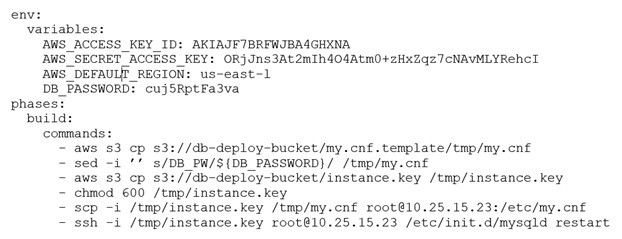 What changes should be recommended to comply with AWS security best practices? (Select THREE.)
-
A
Add a post-build command to remove the temporary files from the container before termination to ensure they cannot be seen by other CodeBuild users.
-
B
Update the CodeBuild project role with the necessary permissions and then remove the AWS credentials from the environment variable.
-
C
Store the db_password as a SecureString value in AWS Systems Manager Parameter Store and then remove the db_password from the environment variables.
-
D
Move the environment variables to the 'db.-deploy-bucket `Amazon S3 bucket, add a prebuild stage to
download then export the variables.
-
E
Use AWS Systems Manager run command versus sec and ssh commands directly to the instance.
Reveal answer details
Close answer details
Correct answersB, C, E
ExplanationB. Update the CodeBuild project role with the necessary permissions and then remove the AWS
credentials from the environment variable. C. Store the DB_PASSWORD as a SecureString value in AWS Systems Manager Parameter Store and then remove the DB_PASSWORD from the environment variables.
E. Use AWS Systems Manager run command versus scp and ssh commands directly to the instance.
Question 30
Single choice
A DevOps engineer is setting up a container-based architecture. The engineer has decided to use AWS CloudFormation to automatically provision an Amazon ECS cluster and an Amazon EC2 Auto Scaling group to launch the EC2 container instances. After successfully creating the CloudFormation stack, the engineer noticed that, even though the ECS cluster and the EC2 instances were created successfully and the stack finished the creation, the EC2 instances were associating with a different cluster. How should the DevOps engineer update the CloudFormation template to resolve this issue?
-
A
Reference the EC2 instances in the AWS::ECS::Cluster resource and reference the ECS cluster in the
AWS::ECS::Service resource.
-
B
Reference the ECS cluster in the AWS::AutoScaling::LaunchConfiguration resource of the UserData
property.
-
C
Reference the ECS cluster in the AWS::EC2::Instance resource of the UserData property.
-
D
Reference the ECS cluster in the AWS::CloudFormation::CustomResource resource to trigger an AWS
Lambda function that registers the EC2 instances with the appropriate ECS cluster.
Reveal answer details
Close answer details
Correct answerB
ExplanationB is correct: <even though the ECS cluster and the EC2 instances were created successfully and the stack finished the creation, the EC2 instances were associating with a different cluster> means we need to link
the auto scaling group to the ECS cluster
A: incorrect. AWS::ECS::Cluster creates an ECS cluster. AWS::ECS::Service creates its services.
However, it does not link the EC2 auto scaling group to the ECS cluster
C: incorrect. AWS::EC2::Instance creates an EC2 instance
D: incorrect. AWS::CloudFormation::CustomResource creates CustomResource
Question 31
Single choice
A company's security team discovers that IAM access keys were potentially exposed. The DevOps team wants to implement a solution that will automatically disable any keys that are suspected of being compromised. The solution also must provide a notification to the security team. Which solution will accomplish this?
-
A
Create an Amazon EventBridge (Amazon CloudWatch Events) event for Amazon Macie. Create an Amazon Simple Notification Service (Amazon SNS) topic with two subscriptions: one to notify the security team and another to invoke an AWS Lambda function that disables the access keys.
-
B
Enable Amazon GuardDuty and set up an Amazon EventBridge (Amazon CloudWatch Events) rule
event for GuardDuty. Create an Amazon Simple Notification Service (Amazon SNS) topic with two
subscriptions: one to notify the security team and another to invoke an AWS Lambda function that disables the access keys.
-
C
Run an Amazon EvetBridge (Amazon CloudWatch Events) rule every 5 minutes to invoke an AWS Lambda function that checks to see if the compromised tag for any access key is set to true. If the tag is set to true, notify the security team and disable the access keys.
-
D
Set up AWS Config and create an AWS CloudTrail event for AWS Config. Create an an Amazon Simple Notification Service (Amazon SNS) topic with two subscriptions: one to notify the security team and another to invoke an AWS Lambda function that disables the access keys.
Reveal answer details
Close answer details
Correct answerC
ExplanationReferences:
https://docs.aws.amazon.com/AmazonCloudWatch/latest/events/RunLambdaSchedule.html
Question 32
Multiple choice
A DevOps engineer is deploying a new version of a company's application in an AWS CodeDeploy deployment group associated with its Amazon EC2 instances. After some time, the deployment fails. The engineer realizes that all the events associated with the specific deployment ID are in a Skipped status and code was not deployed in the instances associated with the deployment group. What are valid reasons for this failure? (Select TWO.).
-
A
The networking configuration does not allow the EC2 instances to reach the internet via a NAT gateway or internet gateway and the CodeDeploy endpoint cannot be reached.
-
B
The IAM user who triggered the application deployment does not have permission to interact with the CodeDeploy endpoint.
-
C
The target EC2 instances were not properly registered with the CodeDeploy endpoint.
-
D
An instance profile with proper permissions was not attached to the target EC2 instances.
-
E
The appspec. yml file was not included in the application revision.
Reveal answer details
Close answer details
Correct answersA, D
Explanationhttps://docs.aws.amazon.com/codedeploy/latest/userguide/troubleshooting-deployments.html#troubleshooting-skipped-lifecycle-events
Question 33
Single choice
A company has multiple development groups working in a single shared AWS account. The Senior Manager of the groups wants to be alerted via a third-party API call when the creation of resources approaches the service limits for the account. Which solution will accomplish this with the LEAST amount of development effort?
-
A
Create an Amazon CloudWatch Event rule that runs periodically and targets an AWS Lambda function.
Within the Lambda function, evaluate the current state of the AWS environment and compare deployed resource values to resource limits on the account.
Notify the Senior Manager if the account is approaching a service limit.
-
B
Deploy an AWS Lambda function that refreshes AWS Trusted Advisor checks, and configure an Amazon CloudWatch Events rule to run the Lambda function periodically.
Create another CloudWatch Events rule with an event pattern matching Trusted Advisor events and a target Lambda function. In the target Lambda function, notify the Senior Manager.
-
C
Deploy an AWS Lambda function that refreshes AWS Personal Health Dashboard checks, and configure an Amazon CloudWatch Events rule to run the Lambda function periodically. Create another
CloudWatch Events rule with an event pattern matching Personal Health Dashboard events and a target Lambda function. In the target Lambda function, notify the Senior Manager.
-
D
Add an AWS Config custom rule that runs periodically, checks the AWS service limit status, and streams notifications to an Amazon SNS topic. Deploy an AWS Lambda function that notifies the Senior Manager, and subscribe the Lambda function to the SNS topic.
Reveal answer details
Close answer details
Correct answerB
ExplanationTo meet the requirements, the company needs to create a solution that alerts the Senior Manager when the creation of resources approaches the service limits for the account with the least amount of development effort. The company can use AWS Trusted Advisor, which is a service that provides best practice recommendations for cost optimization, performance, security, and service limits. The company can deploy an AWS Lambda function that refreshes Trusted Advisor checks, and configure an Amazon CloudWatch Events rule to run the Lambda function periodically. This will ensure that Trusted Advisor checks are up to date and reflect the current state of the account. The company can then create another CloudWatch Events rule with an event pattern matching Trusted Advisor events and a target Lambda function. The event pattern can filter for events related to service limit checks and their status. The target Lambda function can notify the Senior Manager via a third-party API call if the event indicates that the account is approaching or exceeding a service limit.
Question 34
Multiple choice
A company's application teams use AWS CodeCommit repositories for their applications. The application teams have repositories in multiple AWS accounts. All accounts are in an organization in AWS Organizations. Each application team uses AWS IAM Identity Center (AWS Single Sign-On) configured with an external
IdP to assume a developer IAM role. The developer role allows the application teams to use Git to work with the code in the repositories. A security audit reveals that the application teams can modify the main branch in any repository. A DevOps engineer must implement a solution that allows the application teams to modify the main branch of only the repositories that they manage. Which combination of steps will meet these requirements? (Choose three.) 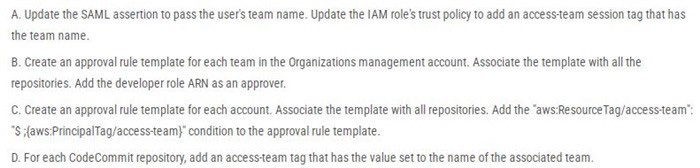 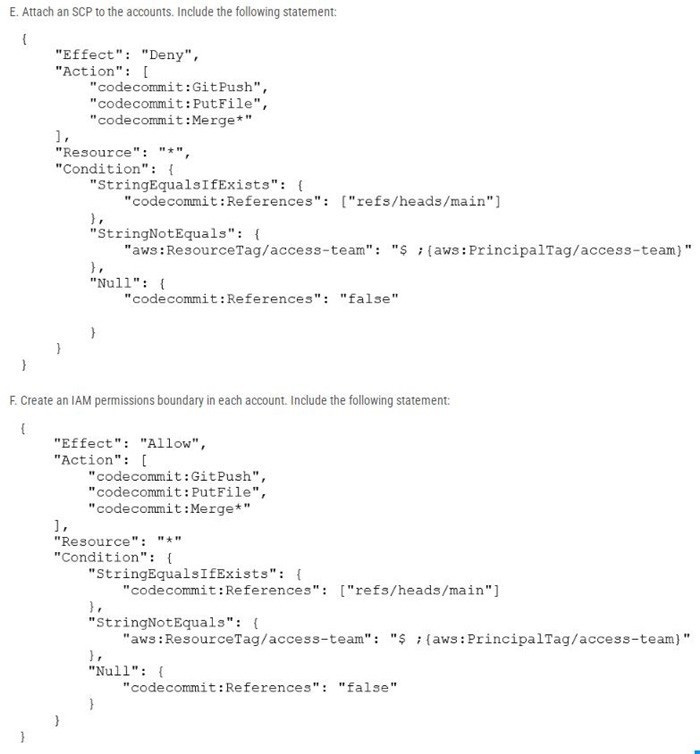
-
A
-
B
-
C
-
D
-
E
-
F
Reveal answer details
Close answer details
Question 35
Single choice
A company is using Amazon S3 buckets to store important documents. The company discovers that some
S3 buckets are not encrypted. Currently, the company's IAM users can create new S3 buckets without encryption. The company is implementing a new requirement that all S3 buckets must be encrypted. A DevOps engineer must implement a solution to ensure that server-side encryption is enabled on all existing S3 buckets and all new S3 buckets. The encryption must be enabled on new S3 buckets as soon as the S3 buckets are created.
The default encryption type must be 256-bit Advanced Encryption Standard (AES-256). Which solution will meet these requirements?
-
A
Create an AWS Lambda function that is invoked periodically by an Amazon EventBridge scheduled rule. Program the Lambda function to scan all current S3 buckets for encryption status and to set AES- 256 as the default encryption for any S3 bucket that does not have an encryption configuration.
-
B
Set up and activate the s3-bucket-server-side-encryption-enabled AWS Config managed rule.
Configure the rule to use the AWS-EnableS3BucketEncryption AWS Systems Manager Automation runbook as the remediation action.
Manually run the re-evaluation process to ensure that existing S3 buckets are compliant.
-
C
Create an AWS Lambda function that is invoked by an Amazon EventBridge event rule. Define the rule with an event pattern that matches the creation of new S3 buckets. Program the Lambda function to parse the EventBridge event, check the configuration of the S3 buckets from the event, and set AES- 256 as the default encryption.
-
D
Configure an IAM policy that denies the s3:CreateBucket action if the s3:x-amz-server-side-encryption condition key has a value that is not AES-256. Create an IAM group for all the company's IAM users.
Associate the IAM policy with the IAM group.
Reveal answer details
Close answer details
Question 36
Single choice
A company uses Amazon RDS for Microsoft SQL Server as its primary database. They need high
availability within and across AWS Regions, with an RPO <1 min and RTO <10 min. Route 53 CNAME is
used for the DB endpoint and must redirect to standby during failover. Which solution meets these requirements?
-
A
Deploy an Amazon RDS for SQL Server Multi-AZ DB cluster with cross-Region read replicas. Use automation to promote replica and update Route 53.
-
B
Deploy RDS Multi-AZ with snapshots copied every 5 minutes; use Lambda to restore snapshot and
update Route 53 on failover.
-
C
Deploy Single-AZ RDS and use AWS DMS to continuously replicate to another Region.
Use CloudWatch alarms for failover notification.
-
D
Deploy Single-AZ RDS and use AWS Backup for cross-Region backups every 30 seconds. Use automation to restore and update Route 53 during failover.
Reveal answer details
Close answer details
Question 37
Single choice
When specifying multiple variable names and values for a playbook on the command line, which of the following is the correct syntax?
-
A
ansible-playbook playbook.yml -e `host="foo" pkg="bar"'
-
B
ansible-playbook playbook.yml -e `host: "foo", pkg: "bar"'
-
C
ansible-playbook playbook.yml -e `host="foo"' -e `pkg="bar"'
-
D
ansible-playbook playbook.yml --extra-vars "host=foo", "pkg=bar"
Reveal answer details
Close answer details
Correct answerA
ExplanationVariables are passed in a single command line parameter, `-e' or `--extra-vars'. They are sent as a single string to the playbook and are space delimited. Because of the space delimeter, variable values must be encapsulated in quotes.
Additionally, proper JSON or YAML can be passed, such as: `-e `{"key": "name", "array": ["value1",
"value2"]}'. References:
http://docs.ansible.com/ansible/playbooks_variables.html#passing-variables-on-the-commandline
Question 38
Single choice
Which command will start an assessment run?
-
A
aws inspector start-assessment-run --assessment-template-arn<template-arn>
-
B
aws inspector start-assessment-run --assessment-run-name examplerun --assessment-target<target-
arn>
-
C
aws inspector start-assessment-run --assessment-run-name examplerun
-
D
aws inspector start-assessment-run --assessment-run-name examplerun --assessment-
duration<duration-in-seconds>
Reveal answer details
Close answer details
Correct answerA
Explanationstart-assessment-run command requires --assessment-template-arn, other parameters are optional start-assessment-run
--assessment-template-arn <value>
[--assessment-run-name <value>]
[--cli-input-json <value>]
[--generate-cli-skeleton <value>] References:
http://docs.aws.amazon.com/cli/latest/reference/inspector/start-assessment-run.html
Question 39
Single choice
A company uses an Amazon Aurora PostgreSQL global database that has two secondary AWS Regions.
A DevOps engineer has configured the database parameter group to guarantee an RPO of 60 seconds.
Write operations on the primary cluster are occasionally blocked because of the RPO setting. The DevOps engineer needs to reduce the frequency of blocked write operations. Which solution will meet these requirements?
-
A
Add an additional secondary cluster to the global database.
-
B
Enable write forwarding for the global database.
-
C
Remove one of the secondary clusters from the global database.
-
D
Configure synchronous replication for the global database.
Reveal answer details
Close answer details
Question 40
Single choice
A company hosts its staging website using an Amazon EC2 instance backed with Amazon EBS storage.
The company wants to recover quickly with minimal data losses in the event of network connectivity issues or power failures on the EC2 instance. Which solution will meet these requirements?
-
A
Add the instance to an EC2 Auto Scaling group with the minimum, maximum, and desired capacity set to 1.
-
B
Add the instance to an EC2 Auto Scaling group with a lifecycle hook to detach the EBS volume when the EC2 instance shuts down or terminates.
-
C
Create an Amazon CloudWatch alarm for the StatusCheckFailed System metric and select the EC2 action to recover the instance.
-
D
Create an Amazon CloudWatch alarm for the StatusCheckFailed Instance metric and select the EC2 action to reboot the instance.
Reveal answer details
Close answer details
Correct answerC
Explanationhttps://docs.aws.amazon.com/AWSEC2/latest/UserGuide/ec2-instance-recover.html
Question 41
Single choice
A media company has several thousand Amazon EC2 instances in an AWS account. The company is using Slack and a shared email inbox for team communications and important updates. A DevOps engineer needs to send all AWS-scheduled EC2 maintenance notifications to the Slack channel and the shared inbox. The solution must include the instances' Name and Owner tags. Which solutions will meet these requirements?
-
A
Integrate AWS Trusted Advisor with AWS Config. Configure a custom AWS Config rule to invoke an AWS Lambda function to publish notifications to an Amazon Simple Notification Service (Amazon SNS) topic. Subscribe a Slack channel endpoint and the shared inbox to the topic.
-
B
Use Amazon EventBridge (Amazon CloudWatch Events) to monitor for AWS Health events. Configure the maintenance events to target an Amazon Simple Notification Service (Amazon SNS) topic.
Subscribe an AWS Lambda function to the SNS topic to send notifications to the Slack channel and the shared inbox.
-
C
Create an AWS Lambda function that sends EC2 maintenance notifications to the Slack channel and the shared inbox. Monitor EC2 health events by using Amazon CloudWatch metrics. Configure a CloudWatch alarm that invokes the Lambda function when a maintenance notification is received.
-
D
Configure AWS Support integration with AWS CloudTrail. Create a CloudTrail lookup event to invoke an AWS Lambda function to pass EC2 maintenance notifications to Amazon Simple Notification Service (Amazon SNS). Configure Amazon SNS to target the Slack channel and the shared inbox.
Reveal answer details
Close answer details
Question 42
Single choice
You have just recently deployed an application on EC2 instances behind an ELB. After a couple of weeks, customers are complaining on receiving errors from the application. You want to diagnose the errors and are trying to get errors from the ELB access logs. But the ELB access logs are empty. What is the reason for this.
-
A
You do not have the appropriate permissions to access the logs
-
B
You do not have your CloudWatch metrics correctly configured
-
C
ELB Access logs are only available for a maximum of one week
-
D
Access logging is an optional feature of Elastic Load Balancing that is disabled by default
Reveal answer details
Close answer details
Correct answerD
ExplanationClastic Load Balancing provides access logs that capture detailed information about requests sent to your load balancer. Cach log contains information such as the time the request was received, the client's IP address, latencies, request paths, and server responses. You can use these access logs to analyze traffic patterns and to troubleshoot issues. Access logging is an optional feature of Elastic Load Balancing that is disabled by default. After you enable access logging for your load balancer. Clastic Load Balancing captures the logs and stores them in the Amazon S3 bucket that you specify. You can disable access logging at any time.
Question 43
Single choice
A company uses an organization in AWS Organizations to manage several AWS accounts that the company's developers use. The company requires all data to be encrypted in transit. Multiple Amazon S3 buckets that were created in developer accounts allow unencrypted connections. A DevOps engineer must enforce encryption of data in transit for all existing S3 buckets that are created in accounts in the organization. Which solution will meet these requirements?
-
A
Use AWS CloudFormation StackSets to deploy an AWS Network Firewall firewall to each account.
Route all outbound requests from the AWS environment through the firewall. Deploy a policy to block access to all outbound requests on port 80.
-
B
Use AWS CloudFormation StackSets to deploy an AWS Network Firewall firewall to each account.
Route all inbound requests to the AWS environment through the firewall. Deploy a policy to block access to all inbound requests on port 80.
-
C
Turn on AWS Config for the organization. Deploy a conformance pack that uses the s3-bucket-ssl-requests-only managed rule and an AWS Systems Manager Automation runbook. Use a runbook that adds a bucket policy statement to deny access to an S3 bucket when the value of the aws:SecureTransport condition key is false.
-
D
Turn on AWS Config for the organization. Deploy a conformance pack that uses the s3-bucket-ssl-requests-only managed rule and an AWS Systems Manager Automation runbook. Use a runbook that adds a bucket policy statement to deny access to an S3 bucket when the value of the s3:x-amz-server-side-encryption-aws-kms-key-id condition key is null.
Reveal answer details
Close answer details
Correct answerC
Explanations3:x-amz-server-side-encryption-aws-kms-key-id --> To require that a particular AWS KMS key be used to encrypt the objects in a bucket.
Question 44
Multiple choice
A company has set up AWS CodeArtifact repositories with public upstream repositories. The company's development team consumes open source dependencies from the repositories in the company's internal network. The company's security team recently discovered a critical vulnerability in the most recent version of a package that the development team consumes. The security team has produced a patched version to fix the vulnerability. The company needs to prevent the vulnerable version from being downloaded. The company also needs to allow the security team to publish the patched version. Which combination of steps will meet these requirements? (Choose two.)
-
A
Update the status of the affected CodeArtifact package version to unlisted.
-
B
Update the status of the affected CodeArtifact package version to deleted.
-
C
Update the status of the affected CodeArtifact package version to archived.
-
D
Update the CodeArtifact package origin control settings to allow direct publishing and to block upstream operations.
-
E
Update the CodeArtifact package origin control settings to block direct publishing and to allow upstream operations.
Reveal answer details
Close answer details
Question 45
Single choice
A company has a guideline that every Amazon EC2 instance must be launched from an AMI that the company's security team produces Every month the security team sends an email message with the latest approved AMIs to all the development teams. The development teams use AWS CloudFormation to deploy their applications. When developers launch a new service they have to search their email for the latest AMIs that the security department sent. A DevOps engineer wants to automate the process that the security team uses to provide the AMI IDs to the development teams. What is the MOST scalable solution that meets these requirements?
-
A
Direct the security team to use CloudFormation to create new versions of the AMIs and to list! the AMI ARNs in an encrypted Amazon S3 object as part of the stack's Outputs Section Instruct the developers to use a cross-stack reference to load the encrypted S3 object and obtain the most recent AMI ARNs.
-
B
Direct the security team to use a CloudFormation stack to create an AWS CodePipeline pipeline that builds new AMIs and places the latest AMI ARNs in an encrypted Amazon S3 object as part of the pipeline output Instruct the developers to use a cross-stack reference within their own CloudFormation template to obtain the S3 object location and the most recent AMI ARNs.
-
C
Direct the security team to use Amazon EC2 Image Builder to create new AMIs and to place the AMI ARNs as parameters in AWS Systems Manager Parameter Store Instruct the developers to specify a parameter of type SSM in their CloudFormation stack to obtain the most recent AMI ARNs from Parameter Store.
-
D
Direct the security team to use Amazon EC2 Image Builder to create new AMIs and to create an Amazon Simple Notification Service (Amazon SNS) topic so that every development team can receive notifications. When the development teams receive a notification instruct them to write an AWS Lambda function that will update their CloudFormation stack with the most recent AMI ARNs.
Reveal answer details
Close answer details
Correct answerC
Explanationhttps://docs.aws.amazon.com/AWSCloudFormation/latest/UserGuide/dynamic-references.html
Question 46
Single choice
A company uses AWS Organizations to manage multiple accounts. Information security policies require that all unencrypted Amazon EBS volumes be marked as non-compliant. A DevOps engineer needs to automatically deploy the solution and ensure that this compliance check is always present. With solution will accomplish this?
-
A
Create an AWS CloudFormation template that defines an AWS Inspector rule to check whether EBS encryption is enabled. Save the template to an Amazon S3 bucket that has been shared with all accounts within the company. Update the account creation script pointing to the CloudFormation template in Amazon S3.
-
B
Create an AWS Config organizational rule to check whether EBS encryption is enabled and deploy the rule using the AWS CLI. Create and apply an SCP to prohibit stopping and deleting AWS Config across the organization.
-
C
Create an SCP in Organizations. Set the policy to prevent the launch of Amazon EC2 instances without encryption on the EBS volumes using a conditional expression. Apply the SCP to all AWS accounts.
Use Amazon Athena to analyze the AWS CloudTrail output, looking for events that deny an ec2:RunInstances action.
-
D
Deploy an IAM role to all accounts from a single trusted account. Build a pipeline with AWS CodePipeline with a stage in AWS Lambda to assume the IAM role, and list all EBS volumes in the account. Publish a report to Amazon S3.
Reveal answer details
Close answer details
Question 47
Single choice
An online retail company based in the United States plans to expand its operations to Europe and Asia in the next six months. Its product currently runs on Amazon EC2 instances behind an Application Load Balancer. The instances run in an Amazon EC2 Auto Scaling group across multiple Availability Zones. All data is stored in an Amazon Aurora database instance. When the product is deployed in multiple regions, the company wants a single product catalog across all regions, but for compliance purposes, its customer information and purchases must be kept in each region. How should the company meet these requirements with the LEAST amount of application changes?
-
A
Use Amazon Redshift for the product catalog and Amazon DynamoDB tables for the customer information and purchases.
-
B
Use Amazon DynamoDB global tables for the product catalog and regional tables for the customer information and purchases.
-
C
Use Aurora with read replicas for the product catalog and additional local Aurora instances in each region for the customer information and purchases.
-
D
Use Aurora for the product catalog and Amazon DynamoDB global tables for the customer information and purchases.
Reveal answer details
Close answer details
Question 48
Single choice
A company manages 500 AWS accounts that are in an organization in AWS Organizations. The company discovers many unattached Amazon Elastic Block Store (Amazon EBS) volumes in all the accounts. The company wants to automatically tag the unattached EBS volumes for investigation. A DevOps engineer needs to deploy an AWS Lambda function to all the AWS accounts. The Lambda function must run every 30 minutes to tag all the EBS volumes that have been unattached for a period of 7 days or more. Which solution will meet these requirements in the MOST operationally efficient manner?
-
A
Configure a delegated administrator account for the organization. Create an AWS CloudFormation template that contains the Lambda function. Use CloudFormation StackSets to deploy the CloudFormation template from the delegated administrator account to all the member accounts in the organization. Create an Amazon EventBridge event bus in the delegated administrator account to invoke the Lambda function in each member account every 30 minutes.
-
B
Create a cross-account IAM role in the organization's member accounts. Attach the AWSLambda_FullAccess policy and the AWSCloudFormationFullAccess policy to the role. Create an AWS CloudFormation template that contains the Lambda function and an Amazon EventBridge scheduled rule to invoke the Lambda function every 30 minutes. Create a custom script in the organization's management account that assumes the role and deploys the CloudFormation template to the member accounts.
-
C
Configure a delegated administrator account for the organization. Create an AWS CloudFormation template that contains the Lambda function and an Amazon EventBridge scheduled rule to invoke the Lambda function every 30 minutes.
Use CloudFormation StackSets to deploy the CloudFormation template from the delegated administrator account to all the member accounts in the organization
-
D
Create a cross-account IAM role in the organization's member accounts. Attach the AmazonS3FullAccess policy and the AWSCodeDeployDeployerAccess policy to the role. Use AWS CodeDeploy to assume the role to deploy the Lambda function from the organization's management account. Configure an Amazon EventBridge scheduled rule in the member accounts to invoke the Lambda function every 30 minutes.
Reveal answer details
Close answer details
Question 49
Single choice
A DevOps engineer manages a large commercial website that runs on Amazon EC2. The website uses Amazon Kinesis Data Streams to collect and process web togs. The DevOps engineer manages the Kinesis consumer application, which also runs on Amazon EC2. Sudden increases of data cause the Kinesis consumer application to (all behind and the Kinesis data streams drop records before the records can be processed. The DevOps engineer must implement a solution to improve stream handling. Which solution meets these requirements with the MOST operational efficiency?
-
A
Modify the Kinesis consumer application to store the logs durably in Amazon S3 Use Amazon EMR to process the data directly on Amazon S3 to derive customer insights Store the results in Amazon S3.
-
B
Horizontally scale the Kinesis consumer application by adding more EC2 instances based on the Amazon CloudWatch GetRecords IteratorAgeMilliseconds metric Increase the retention period of the Kinesis data streams.
-
C
Convert the Kinesis consumer application to run as an AWS Lambda function. Configure the Kinesis data streams as the event source for the Lambda function to process the data streams
-
D
Increase the number of shards in the Kinesis data streams to increase the overall throughput so that the consumer application processes the data faster.
Reveal answer details
Close answer details
Correct answerB
Explanationhttps://docs.aws.amazon.com/streams/latest/dev/monitoring-with-cloudwatch.html
GetRecords.IteratorAgeMilliseconds -The age of the last record in all GetRecords calls made against a Kinesis stream, measured over the specified time period. Age is the difference between the current time and when the last record of the GetRecords call was written to the stream. The Minimum and Maximum statistics can be used to track the progress of Kinesis consumer applications. A value of zero indicates that the records being read are completely caught up.
Question 50
Multiple choice
A company's DevOps engineer is creating an AWS Lambda function to process notifications from an Amazon Simple Notification Service (Amazon SNS) topic. The Lambda function will process the notification messages and will write the contents of the notification messages to an Amazon RDS Multi-AZ DB instance. During testing a database administrator accidentally shut down the DB instance. While the database was down the company lost several of the SNS notification messages that were delivered during that time. The DevOps engineer needs to prevent the loss of notification messages in the future Which solutions will meet this requirement? (Select TWO.)
-
A
Replace the RDS Multi-AZ DB instance with an Amazon DynamoDB table.
-
B
Configure an Amazon Simple Queue Service (Amazon SQS) queue as a destination of the Lambda function.
-
C
Configure an Amazon Simple Queue Service (Amazon SQS> dead-letter queue for the SNS topic.
-
D
Subscribe an Amazon Simple Queue Service (Amazon SQS) queue to the SNS topic Configure the Lambda function to process messages from the SQS queue.
-
E
Replace the SNS topic with an Amazon EventBridge event bus Configure an EventBridge rule on the new event bus to invoke the Lambda function for each event.
Reveal answer details
Close answer details
Correct answersC, D
ExplanationThese solutions will meet the requirement because they will prevent the loss of notification messages in the future. An Amazon SQS queue is a service that provides a reliable, scalable, and secure message queue for asynchronous communication between distributed components. You can use an SQS queue to buffer messages from an SNS topic and ensure that they are delivered and processed by a Lambda function, even if the function or the database is temporarily unavailable. Option C will configure an SQS dead-letter queue for the SNS topic. A dead-letter queue is a queue that receives messages that could not be delivered to any subscriber after a specified number of retries. You can use a dead-letter queue to store and analyze failed messages, or to reprocess them later. This way, you can avoid losing messages that could not be delivered to the Lambda function due to network errors, throttling, or other issues. Option
D will subscribe an SQS queue to the SNS topic and configure the Lambda function to process messages from the SQS queue. This will decouple the SNS topic from the Lambda function and provide more flexibility and control over the message delivery and processing. You can use an SQS queue to store messages from the SNS topic until they are ready to be processed by the Lambda function, and also to retry processing in case of failures. This way, you can avoid losing messages that could not be processed by the Lambda function due to database errors, timeouts, or other issues.
Question 51
Single choice
A security review has identified that an AWS CodeBuild project is downloading a database population script from an Amazon S3 bucket using an unauthenticated request. The security team does not allow unauthenticated requests to S3 buckets for this project. How can this issue be corrected in the MOST secure manner?
-
A
Add the bucket name to the AllowedBuckets section of the CodeBuild project settings.Update the build spec to use the AWS CLI to download the database population script.
-
B
Modify the S3 bucket settings to enable HTTPS basic authentication and specify a token. Update the build spec to use cURL to pass the token and download the database population script.
-
C
Remove unauthenticated access from the S3 bucket with a bucket policy. Modify the service role for the CodeBuild project to include Amazon S3 access. Use the AWS CLI to download the database population script.
-
D
Remove unauthenticated access from the S3 bucket with a bucket policy. Use the AWS CLI to download the database population script using an IAM access key and a secret access key.
Reveal answer details
Close answer details
Correct answerC
ExplanationA bucket policy is a resource-based policy that defines who can access a specific S3 bucket and what actions they can perform on it. By removing unauthenticated access from the bucket policy, you can prevent anyone without valid credentials from accessing the bucket. A service role is an IAM role that allows an AWS service, such as CodeBuild, to perform actions on your behalf. By modifying the service role for the CodeBuild project to include Amazon S3 access, you can grant the project permission to read and write objects in the S3 bucket. The AWS CLI is a command-line tool that allows you to interact with AWS services, such as S3, using commands in your terminal. By using the AWS CLI to download the database population script, you can leverage the service role credentials and encryption to secure the data transfer. For more information, you can refer to these web pages: [Using bucket policies and user policies -Amazon Simple Storage Service] [Create a service role for CodeBuild -AWS CodeBuild] [AWS Command Line Interface]
Question 52
Multiple choice
A company uses Amazon Redshift as its data warehouse solution. The company wants to create a dashboard to view changes to the Redshift users and the queries the users perform. Which combination of steps will meet this requirement? (Select TWO.)
-
A
Create an Amazon CloudWatch log group. Create an AWS CloudTrail trail that writes to the CloudWatch log group.
-
B
Create a new Amazon S3 bucket. Configure default audit logging on the Redshift cluster. Configure the S3 bucket as the target.
-
C
Configure the Redshift cluster database audit logging to include user activity logs.
Configure Amazon CloudWatch as the target.
-
D
Create an Amazon CloudWatch dashboard that has a log widget. Configure the widget to display user details from the Redshift logs.
-
E
Create an AWS Lambda function that uses Amazon Athena to query the Redshift logs.
Create an Amazon CloudWatch dashboard that has a custom widget type that uses the Lambda function.
Reveal answer details
Close answer details
Question 53
Single choice
A company builds a container image in an AWS CodeBuild project by running Docker commands. After the container image is built, the CodeBuild project uploads the container image to an Amazon S3 bucket. The CodeBuild project has an IAM service role that has permissions to access the S3 bucket. A DevOps engineer needs to replace the S3 bucket with an Amazon Elastic Container Registry (Amazon ECR) repository to store the container images.
The DevOps engineer creates an ECR private image repository in the same AWS Region of the CodeBuild project.
The DevOps engineer adjusts the IAM service role with the permissions that are necessary to work with the new ECR repository. The DevOps engineer also places new repository information into the docker build command and the docker push command that are used in the buildspec.yml file. When the CodeBuild project runs a build job, the job fails when the job tries to access the ECR repository. Which solution will resolve the issue of failed access to the ECR repository?
-
A
Update the buildspec.yml file to log in to the ECR repository by using the aws ecr get-login-password AWS CLI command to obtain an authentication token.
Update the docker login command to use the authentication token to access the ECR repository.
-
B
Add an environment variable of type SECRETS_MANAGER to the CodeBuild project.
In the environment variable, include the ARN of the CodeBuild project's IAM service role.
Update the buildspec.yml file to use the new environment variable to log in with the docker login command to access the ECR repository.
-
C
Update the ECR repository to be a public image repository.
Add an ECR repository policy that allows the IAM service role to have access.
-
D
Update the buildspec.yml file to use the AWS CLI to assume the IAM service role for ECR operations.
Add an ECR repository policy that allows the IAM service role to have access.
Reveal answer details
Close answer details
Correct answerA
ExplanationUpdate the buildspec.yml file to log in to the ECR repository by using the aws ecr get-login-password AWS CLI command to obtain an authentica-tion token. Update the docker login command to use the authentication token to access the ECR repository. This is the correct solution. The aws ecr get-login- password AWS CLI command retrieves and displays an authentication token that can be used to log in to an ECR repository. The docker login command can use this token as a password to authenticate with the ECR repository. This way, the CodeBuild project can push and pull images from the ECR repository without any errors. For more information, see Using Amazon ECR with the AWS CLI and get-login-password.
Question 54
Multiple choice
A company uses the AWS Cloud Development Kit (AWS CDK) to define its application. The company uses a pipeline that consists of AWS CodePipeline and AWS CodeBuild to deploy the CDK application. The company wants to introduce unit tests to the pipeline to test various infrastructure components. The company wants to ensure that a deployment proceeds if no unit tests result in a failure. Which combination of steps will enforce the testing requirement in the pipeline? (Choose two.)
-
A
Update the CodeBuild build phase commands to run the tests then to deploy the application. Set the OnFailure phase property to ABORT.
-
B
Update the CodeBuild build phase commands to run the tests then to deploy the application. Add the -- rollback true flag to the cdk deploy command.
-
C
Update the CodeBuild build phase commands to run the tests then to deploy the application. Add the -- require-approval any-change flag to the cdk deploy command.
-
D
Create a test that uses the AWS CDK assertions module. Use the template.hasResourceProperties assertion to test that resources have the expected properties.
-
E
Create a test that uses the cdk diff command. Configure the test to fail if any resources have changed.
Reveal answer details
Close answer details
Question 55
Multiple choice
A company is performing vulnerability scanning for all Amazon EC2 instances across many accounts. The accounts are in an organization in AWS Organizations. Each account's VPCs are attached to a shared transit gateway. The VPCs send traffic to the internet through a central egress VPC. The company has enabled Amazon Inspector in a delegated administrator account and has enabled scanning for all member accounts. A DevOps engineer discovers that some EC2 instances are listed in the "not scanning" tab in Amazon Inspector. Which combination of actions should the DevOps engineer take to resolve this issue? (Choose three.)
-
A
Verify that AWS Systems Manager Agent is installed and is running on the EC2 instances that Amazon Inspector is not scanning.
-
B
Associate the target EC2 instances with security groups that allow outbound communication on port 443 to the AWS Systems Manager service endpoint.
-
C
Grant inspector:StartAssessmentRun permissions to the IAM role that the DevOps engineer is using.
-
D
Configure EC2 Instance Connect for the EC2 instances that Amazon Inspector is not scanning.
-
E
Associate the target EC2 instances with instance profiles that grant permissions to communicate with
AWS Systems Manager.
-
F
Create a managed-instance activation. Use the Activation Code and the Activation ID to register the
EC2 instances.
Reveal answer details
Close answer details
Correct answersA, B, E
Explanationhttps://docs.aws.amazon.com/inspector/latest/user/scanning-ec2.html
Question 56
Single choice
A company uses AWS Organizations to manage its AWS accounts. The company has a root OU that has a child OU. The root OU has an SCP that allows all actions on all resources. The child OU has an SCP that allows all actions for Amazon DynamoDB and AWS Lambda, and denies all other actions. The company has an AWS account that is named vendor-data in the child OU. A DevOps engineer has an IAM user that is attached to the Administrator Access IAM policy in the vendor-data account. The DevOps engineer attempts to launch an Amazon EC2 instance in the vendor-data account but receives an access denied error. Which change should the DevOps engineer make to launch the EC2 instance in the vendor-data account?
-
A
Attach the AmazonEC2FullAccess IAM policy to the IAM user.
-
B
Create a new SCP that allows all actions for Amazon EC2. Attach the SCP to the vendor-data account.
-
C
Update the SCP in the child OU to allow all actions for Amazon EC2.
-
D
Create a new SCP that allows all actions for Amazon EC2. Attach the SCP to the root OU.
Reveal answer details
Close answer details
Correct answerC
ExplanationC is correct:
A: We need to modify SCP not IAM policy
B: SCP is attached to OUs, not account
D: This option changes nothing, as the roout OU has already allowed all actions
Question 57
Single choice
A company has many applications. Different teams in the company developed the applications by using multiple languages and frameworks. The applications run on premises and on different servers with different operating systems. Each team has its own release protocol and process. The company wants to reduce the complexity of the release and maintenance of these applications. The company is migrating its technology stacks, including these applications, to AWS. The company wants centralized control of source code, a consistent and automatic delivery pipeline, and as few maintenance tasks as possible on the underlying infrastructure. What should a DevOps engineer do to meet these requirements?
-
A
Create one AWS CodeCommit repository for all applications. Put each application's code in different branch. Merge the branches, and use AWS CodeBuild to build the applications. Use AWS CodeDeploy to deploy the applications to one centralized application server.
-
B
Create one AWS CodeCommit repository for each of the applications Use AWS CodeBuild to build the applications one at a time. Use AWS CodeDeploy to deploy the applications to one centralized application server.
-
C
Create one AWS CodeCommit repository for each of the applications. Use AWS CodeBuild to build the applications one at a time to create one AMI for each server. Use AWS CloudFormation StackSets to automatically provision and decommission Amazon EC2 fleets by using these AMIs.
-
D
Create one AWS CodeCommit repository for each of the applications. Use AWS CodeBuild to build one Docker image for each application in Amazon Elastic Container Registry (Amazon ECR). Use AWS CodeDeploy to deploy the applications to Amazon Elastic Container Service (Amazon ECS) on infrastructure that AWS Fargate manages.
Reveal answer details
Close answer details
Question 58
Single choice
A company hosts applications in its AWS account Each application logs to an individual Amazon CloudWatch log group. The company's CloudWatch costs for ingestion are increasing A DevOps engineer needs to Identify which applications are the source of the increased logging costs. Which solution Will meet these requirements?
-
A
Use CloudWatch metrics to create a custom expression that Identifies the CloudWatch log groups that have the most data being written to them.
-
B
Use CloudWatch Logs Insights to create a set of queries for the application log groups to Identify the number of logs written for a period of time
-
C
Use AWS Cost Explorer to generate a cost report that details the cost for CloudWatch usage
-
D
Use AWS CloudTrail to filter for CreateLogStream events for each application
Reveal answer details
Close answer details
Correct answerC
ExplanationA comprehensive and detailed explanation is: Option A is incorrect because using CloudWatch metrics to create a custom expression that identifies the CloudWatch log groups that have the most data being written to them is not a valid solution. CloudWatch metrics do not provide information about the size or volume of data being ingested by CloudWatch logs.
CloudWatch metrics only provide information about the number of events, bytes, and errors that occur within a log group or stream. Moreover, creating a custom expression with CloudWatch metrics would require using the search_web tool, which is not necessary for this use case.
Option B is incorrect because using CloudWatch Logs Insights to create a set of queries for the application log groups to identify the number of logs written for a period of time is not a valid solution. CloudWatch Logs Insights can help analyze and filter log events based on patterns and expressions, but it does not provide information about the cost or billing of CloudWatch logs. CloudWatch Logs Insights also charges based on the amount of data scanned by each query, which could increase the logging costs further.
Option C is correct because using AWS Cost Explorer to generate a cost report that details the cost for CloudWatch usage is a valid solution. AWS Cost Explorer is a tool that helps visualize, understand, and manage AWS costs and usage over time. AWS Cost Explorer can generate custom reports that show the breakdown of costs by service, region, account, tag, or any other dimension. AWS Cost Explorer can also filter and group costs by usage type, which can help identify the specific CloudWatch log groups that are the source of the increased logging costs.
Option D is incorrect because using AWS CloudTrail to filter for CreateLogStream events for each application is not a valid solution. AWS CloudTrail is a service that records API calls and account activity for AWS services, including CloudWatch logs. However, AWS CloudTrail does not provide information about the cost or billing of CloudWatch logs. Filtering for CreateLogStream events would only show when a new log stream was created within a log group, but not how much data was ingested or stored by that log stream.
References:
CloudWatch Metrics
CloudWatch Logs Insights
AWS Cost Explorer
AWS CloudTrail
Question 59
Single choice
A company uses AWS CloudFormation to deploy application environments. A deployment failed due to manual modifications in stack resources. The DevOps engineer wants to detect manual modifications and alert the DevOps lead with the least effort. Which solution meets these requirements?
-
A
Create an SNS topic and subscribe the DevOps lead via email. Create an AWS Config managed rule
with CLOUDFORMATION_STACK_DRIFT_DETECTION_CHECK. Create an EventBridge rule on NON_COMPLIANT resources and set SNS as target.
-
B
Tag all CloudFormation resources, create a custom AWS Config rule via SDK that flags manual changes as NON_COMPLIANT, create an EventBridge rule and Lambda to send email notifications.
-
C
Create an SNS topic, subscribe the DevOps lead, create a Config managed rule CLOUDFORMATION_STACK_DRIFT_DETECTION_CHECK. Create an EventBridge rule on COMPLIANT resources, set SNS as target.
-
D
Create an AWS Config managed rule CLOUDFORMATION_STACK_DRIFT_DETECTION_CHECK. Create an EventBridge rule on NON_COMPLIANT resources, and a Lambda to send email notifications.
Reveal answer details
Close answer details
Question 60
Single choice
Which services can be used as optional components of setting up a new Trail in CloudTrail?
-
A
-
B
-
C
-
D
Reveal answer details
Close answer details
Correct answerC
ExplanationKey Management Service: The use of AWS KMS is an optional element of CloudTrail, but it allows additional encryption to be added to your Log files when stored on S3 Simple Notification Service: Amazon SNS is also an optional component for CloudTrail, but it allows for you to create notifications, for example when a new log file is delivered to S3 SNS could notify someone or a team via an e-mail. Or it could be used in conjunction with CloudWatch when metric thresholds have been reached. CloudWatch Logs: Again, this is another optional component, but AWS CloudTrail allows you to deliver its logs to AWS Cloudwatch Logs as well as S3 for specific monitoring metrics to take place. References:
https://cloudacademy.com/amazon-web-services/aws-cloudtrail-introduction-course/how-doesaws-cloudtrail-work.html
Question 61
Single choice
To override an allow in an IAM policy, you set the Effect element to ______.
-
A
-
B
-
C
-
D
Reveal answer details
Close answer details
Correct answerC
ExplanationBy default, access to resources is denied. To allow access to a resource, you must set the Effect element to Allow. To override an allow (for example, to override an allow that is otherwise in force), you set the Effect element to Deny. References:
http://docs.aws.amazon.com/IAM/latest/UserGuide/
AccessPolicyLanguage_ElementDescriptions.html
Question 62
Multiple choice
Your application stores sensitive information on an EBS volume attached to your EC2 instance. How can you protect your information? (Choose two.)
-
A
Unmount the EBS volume, take a snapshot and encrypt the snapshot. Re-mount the Amazon EBS volume.
-
B
It is not possible to encrypt an EBS volume, you must use a lifecycle policy to transfer data to S3 for encryption.
-
C
Copy the unencrypted snapshot and check the box to encrypt the new snapshot. Volumes restored from this encrypted snapshot will also be encrypted.
-
D
Create and mount a new, encrypted Amazon EBS volume. Move the data to the new volume. Delete the old Amazon EBS volume.
Reveal answer details
Close answer details
Correct answersC, D
ExplanationThese steps are given in the AWS documentation
To migrate data between encrypted and unencrypted volumes 1) Create your destination volume (encrypted or unencrypted, depending on your need).
2) Attach the destination volume to the instance that hosts the data to migrate.
3) Make the destination volume available by following the procedures in Making an Amazon EBS Volume
Available for Use. For Linux instances, you can create a mount point at /mnt/destination and mount the destination volume there.
4) Copy the data from your source directory to the destination volume. It may be most convenient to use a bulk-copy utility for this.
To encrypt a volume's data by means of snapshot copying 1) Create a snapshot of your unencrypted CBS volume. This snapshot is also unencrypted.
2) Copy the snapshot while applying encryption parameters. The resulting target snapshot is encrypted.
3) Restore the encrypted snapshot to a new volume, which is also encrypted.
Question 63
Multiple choice
A company runs an application with an Amazon EC2 and on-premises configuration. A DevOps engineer needs to standardize patching across both environments. Company policy dictates that patching only
happens during non-business hours. Which combination of actions will meet these requirements? (Choose three.)
-
A
Add the physical machines into AWS Systems Manager using Systems Manager Hybrid Activations.
-
B
Attach an IAM role to the EC2 instances, allowing them to be managed by AWS Systems Manager.
-
C
Create IAM access keys for the on-premises machines to interact with AWS Systems Manager.
-
D
Run an AWS Systems Manager Automation document to patch the systems every hour.
-
E
Use Amazon EventBridge scheduled events to schedule a patch window.
-
F
Use AWS Systems Manager Maintenance Windows to schedule a patch window.
Reveal answer details
Close answer details
Correct answersA, B, F
Explanationhttps://docs.aws.amazon.com/systems-manager/latest/userguide/sysman-managed-instance-activation.html
Question 64
Single choice
A company runs a website by using an Amazon Elastic Container Service (Amazon ECS) service that is connected to an Application Load Balancer (ALB). The service was in a steady state with tasks responding to requests successfully. A DevOps engineer updated the task definition with a new container image and deployed the new task definition to the service. The DevOps engineer noticed that the service is frequently stopping and starting new tasks because the ALB health checks are failing. What should the DevOps engineer do to troubleshoot the failed deployment?
-
A
Ensure that a security group associated with the service allows traffic from the ALB.
-
B
Increase the ALB health check grace period for the service.
-
C
Increase the service minimum healthy percent setting.
-
D
Decrease the ALB health check interval.
Reveal answer details
Close answer details
Question 65
Single choice
A DevOps team uses AWS CodePipeline, AWS CodeBuild, and AWS CodeDeploy to deploy an application. The application is a REST API that uses AWS Lambda functions and Amazon API Gateway Recent deployments have introduced errors that have affected many customers. The DevOps team needs a solution that reverts to the most recent stable version of the application when an error is detected. The solution must affect the fewest customers possible. Which solution Will meet these requirements With the MOST operational efficiency?
-
A
Set the deployment configuration in CodeDepIoy to LambdaAlIAtOnce Configure automatic rollbacks on the deployment group Create an Amazon CloudWatch alarm that detects HTTP Bad Gateway errors on API Gateway Configure the deployment group to roll back when the number of alarms meets the alarm threshold
-
B
Set the deployment configuration in CodeDeploy to LambdaCanary10Percent10Minutes.
Configure automatic rollbacks on the deployment group Create an Amazon CloudWatch alarm that detects HTTP Bad Gateway errors on API Gateway Configure the deployment group to roll back when the number of alarms meets the alarm threshold
-
C
Set the deployment configuration in CodeDeploy to LambdaAllAtOnce Configure manual rollbacks on the deployment group. Create an Amazon Simple Notification Service (Amazon SNS) topc to send notifications every time a deployrnent fads. Configure the SNS topc to Invoke a new Lambda function that stops the current deployment and starts the most recent successful deployment
-
D
Set the deployment configuration in CodeDeploy to LambdaCanaryIOPercentIOMinutes Configure manual rollbacks on the deployment group Create a metric filter on an Amazon CloudWatch log group for API Gateway to monitor HTTP Bad Gateway errors. Configure the metric filter to Invoke a new Lambda function that stops the current eployment and starts the most recent successful deployment
Reveal answer details
Close answer details
Correct answerB
ExplanationOption A is incorrect because setting the deployment configuration to LambdaAllAtOnce means that the new version of the application will be deployed to all Lambda functions at once, affecting all customers.
This does not meet the requirement of affecting the fewest customers possible. Moreover, configuring automatic rollbacks on the deployment group is not operationally efficient, as it requires manual intervention to fix the errors and redeploy the application. Option B is correct because setting the deployment configuration to LambdaCanary10Percent10Minutes means that the new version of the application will be deployed to 10 percent of the Lambda functions first, and then to the remaining 90 percent after 10 minutes. This minimizes the impact of errors on customers, as only 10 percent of them will be affected by a faulty deployment. Configuring automatic rollbacks on the deployment group also meets the requirement of reverting to the most recent stable version of the application when an error is detected. Creating a CloudWatch alarm that detects HTTP Bad Gateway errors on API Gateway is a valid way to monitor the health of the application and trigger a rollback if needed.
Option C is incorrect because setting the deployment configuration to LambdaAllAtOnce means that the new version of the application will be deployed to all Lambda functions at once, affecting all customers.
This does not meet the requirement of affecting the fewest customers possible. Moreover, configuring manual rollbacks on the deployment group is not operationally efficient, as it requires human intervention to stop the current deployment and start a new one. Creating an SNS topic to send notifications every time a deployment fails is not sufficient to detect errors in the application, as it does not monitor the API Gateway responses. Option D is incorrect because configuring manual rollbacks on the deployment group is not operationally efficient, as it requires human intervention to stop the current deployment and start a new one. Creating a metric filter on a CloudWatch log group for API Gateway to monitor HTTP Bad Gateway errors is a valid way to monitor the health of the application, but invoking a new Lambda function to perform a rollback is unnecessary and complex, as CodeDeploy already provides automatic rollback functionality.
References:
AWS CodeDeploy Deployment Configurations
[AWS CodeDeploy Rollbacks]
Amazon CloudWatch Alarms
Question 66
Multiple choice
A company has multiple member accounts that are part of an organization in AWS Organizations. The security team needs to review every Amazon EC2 security group and their inbound and outbound rules.
The security team wants to programmatically retrieve this information from the member accounts using an AWS Lambda function in the management account of the organization. Which combination of access changes will meet these requirements? (Choose three.)
-
A
Create a trust relationship that allows users in the member accounts to assume the management account IAM role.
-
B
Create a trust relationship that allows users in the management account to assume the IAM roles of the member accounts.
-
C
Create an IAM role in each member account that has access to the AmazonEC2ReadOnlyAccess managed policy.
-
D
Create an I AM role in each member account to allow the sts:AssumeRole action against the
management account IAM role's ARN.
-
E
Create an I AM role in the management account that allows the sts:AssumeRole action against the
member account IAM role's ARN.
-
F
Create an IAM role in the management account that has access to the AmazonEC2ReadOnlyAccess managed policy.
Reveal answer details
Close answer details
Correct answersB, C, E
Explanationhttps://aws.amazon.com/premiumsupport/knowledge-center/lambda-function-assume-iam-role/
https://kreuzwerker.de/post/aws-multi-account-setups-reloaded
Question 67
Multiple choice
A company uses AWS Organizations to manage multiple AWS accounts. The accounts are in an OU that has a policy attached to allow all actions. The company is migrating several Git repositories to a specified AWS CodeConnections supported Git provider. The Git repositories manage AWS CloudFormation stacks for application infrastructure that the company deploys across multiple AWS Regions. The company wants a DevOps team to integrate CodeConnections into the CloudFormation stacks. The DevOps team must ensure that company staff members can integrate only with the specified Git provider. The deployment process must be highly available across Regions. Which combination of steps will meet these requirements? (Select THREE.)
-
A
Add a new SCP statement to the OU that denies the CodeConnections CreatingConnections action where the provider type is not the specified Git provider.
-
B
Add a new SCP statement to the OU that allows the CodeConnections CreatingConnections action where the provider type is the specified Git provider.
-
C
Use CodeConnections to configure a single CodeConnections connection to each Git repository.
-
D
Use CodeConnections to create a CodeConnections connection from each Region where the company operates to each Git repository.
-
E
Use CodeConnections to create a CodeConnections repository link. Update each CloudFormation stack to sync from the Git repository.
-
F
For each Git repository, create a pipeline in AWS CodePipeline that has the Git repository set as the source and a CloudFormation deployment stage.
Reveal answer details
Close answer details
Question 68
Single choice
A DevOps engineer needs a resilient CI/CD pipeline that builds container images, stores them in ECR, scans images for vulnerabilities, and is resilient to outages in upstream source image repositories. Which solution meets this?
-
A
Create a private ECR repo, scan images on push, replicate images from upstream repos with a replication rule.
-
B
Create a public ECR repo to cache images from upstream repos, create a private repo to store images, scan images on push.
-
C
Create a public ECR repo, configure a pull-through cache rule, create a private repo to store images, enable basic scanning.
-
D
Create a private ECR repo, enable basic scanning, create a pull-through cache rule.
Reveal answer details
Close answer details
Question 69
Single choice
A company has an application that runs on Amazon EC2 instances that are in an Auto Scaling group.
When the application starts up. the application needs to process data from an Amazon S3 bucket before the application can start to serve requests. The size of the data that is stored in the S3 bucket is growing. When the Auto Scaling group adds new instances, the application now takes several minutes to download and process the data before the application can serve requests. The company must reduce the time that elapses before new EC2 instances are ready to serve requests. Which solution is the MOST cost-effective way to reduce the application startup time?
-
A
Configure a warm pool for the Auto Scaling group with warmed EC2 instances in the Stopped state.
Configure an autoscaling:EC2_INSTANCE_LAUNCHING lifecycle hook on the Auto Scaling group.
Modify the application to complete the lifecycle hook when the application is ready to serve requests.
-
B
Increase the maximum instance count of the Auto Scaling group. Configure an autoscaling:EC2_INSTANCE_LAUNCHING lifecycle hook on the Auto Scaling group.
Modify the application to complete the lifecycle hook when the application is ready to serve requests.
-
C
Configure a warm pool for the Auto Scaling group with warmed EC2 instances in the Running state.
Configure an autoscaling:EC2_INSTANCE_LAUNCHING lifecycle hook on the Auto Scaling group.
Modify the application to complete the lifecycle hook when the application is ready to serve requests.
-
D
Increase the maximum instance count of the Auto Scaling group. Configure an autoscaling:EC2_INSTANCE_LAUNCHING lifecycle hook on the Auto Scaling group.
Modify the application to complete the lifecycle hook and to place the new instance in the Standby state when the application is ready to serve requests.
Reveal answer details
Close answer details
Correct answerA
ExplanationOption A is the most cost-effective solution. By configuring a warm pool of EC2 instances in the Stopped state, the company can reduce the time it takes for new instances to be ready to serve requests. When the Auto Scaling group launches a new instance, it can attach the stopped EC2 instance from the warm pool.
The instance can then be started up immediately, rather than having to wait for the data to be downloaded and processed. This reduces the overall startup time for the application.
Question 70
Single choice
A DevOps engineer is creating an AWS CloudFormation template to deploy a web service. The web service will run on Amazon EC2 instances in a private subnet behind an Application Load Balancer (ALB).
The DevOps engineer must ensure that the service can accept requests from clients that have IPv6 addresses. What should the DevOps engineer do with the CloudFormation template so that IPv6 clients can access the web service?
-
A
Add an IPv6 CIDR block to the VPC and the private subnet for the EC2 instances. Create route table entries for the IPv6 network, use EC2 instance types that support IPv6, and assign IPv6 addresses to each EC2 instance.
-
B
Assign each EC2 instance an IPv6 Elastic IP address. Create a target group, and add the EC2 instances as targets. Create a listener on port 443 of the ALB, and associate the target group with the
ALB.
-
C
Replace the ALB with a Network Load Balancer (NLB). Add an IPv6 CIDR block to the VPC and subnets for the NLB, and assign the NLB an IPv6 Elastic IP address.
-
D
Add an IPv6 CIDR block to the VPC and subnets for the ALB. Create a listener on port 443. and specify the dualstack IP address type on the ALB. Create a target group, and add the EC2 instances as targets. Associate the target group with the ALB.
Reveal answer details
Close answer details
Correct answerD
Explanationit involves adding an IPv6 CIDR block to the VPC and subnets for the ALB and specifying the dualstack IP address type on the ALB listener. This allows the ALB to listen on both IPv4 and IPv6 addresses, and forward requests to the EC2 instances that are added as targets to the target group associated with the ALB.
|