If the metering tool supports multi-tenancy and integrates with the cloud portal, what should be considered?
-
A
Only permit local user access for security reasons
-
B
Metering tool should not integrate with tenant authentication
-
C
Metering server access should be allowed for all tenants
-
D
Role-based access for security reasons
Reveal answer details
Close answer details
Correct answerD
ExplanationThe cost of collecting the metrics, and the balance between the value they provide and the impact on application operation. If metering code cannot be incorporated into existing components or roles, and you need to increase the number of instances of components or roles just to carry out metering, you might increase costs beyond the savings or income available from metering.
References:
https://msdn.microsoft.com/en-us/library/dn589796.aspx
A cloud architect is tasked with designing a backup using the Remote with Cloud Gateway Deployment Model. What is a design consideration?
-
A
Replication settings should be driven by organizational requirements around RPO
-
B
Backup servers are required to communicate with cloud storage interfaces
-
C
Larger initial backup sets may take long times to complete delivery
-
D
Gateways must contain backup software to offload backup server tasks
Reveal answer details
Close answer details
An organization uses Microsoft Active Directory (AD) for service authentication in their private cloud.
They want to use the same authentication source for services in the public cloud. External employees access services in both clouds and need to authenticate with AD. The organization wants to minimize and secure network traffic. Which solution will address these requirements?
-
A
External users connect with IPsec VPN Place AD controllers in the private cloud only
-
B
Configure perimeter firewalls to allow AD traffic Place AD controllers in the private and public clouds
-
C
Connect the two clouds through IPsec VPN Place AD controllers in the private cloud only
-
D
Connect the two clouds through IPsec VPN Place AD controllers in the private and public clouds
Reveal answer details
Close answer details
An organization wants to deploy a CMP solution in a private cloud. What requirements influence the sizing of the underlying cloud management infrastructure?
-
A
Size of the service portal and catalog
-
B
CMP version and functions it provides
-
C
Type of services and cost of each service
-
D
High availability and performance
Reveal answer details
Close answer details
Which services are typically offered by cloud service providers?
-
A
Bundled storage, applications, operating systems
-
B
Operating environment, virtualization, applications
-
C
Software, platform, infrastructure
-
D
Compute, storage, connectivity
Reveal answer details
Close answer details
Case 1
Refer to the exhibit. 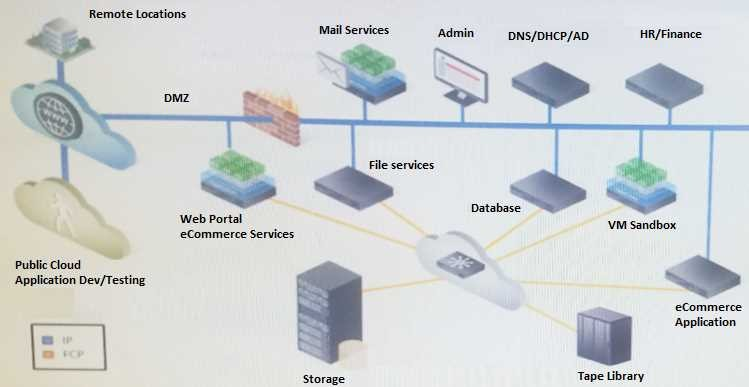 Your company recently negotiated several contracts with new customers to use its proprietary eCommerce system. As a result, the customer base has grown rapidly, which has introduced several challenges and requirements.
Business requirements:
Applications need to scale quickly Metrics and reporting to anticipate business trends and efficient use of resources External customers are looking to license the eCommerce application Other considerations: Applications need to be recorded for the public cloud Address security vulnerabilities for customer data in the cloud Refer to Case 1.
You are tasked with designing a cloud. You review the existing infrastructure and business requirements.
You select a CI solution to replace the existing Platform 2.0 infrastructure. Before presenting this solution to the company, you must calculate the 3-year TCO using the following criteria: Hardware maintenance = $ 35,000
Software maintenance = $ 20,000
Storage = $ 2,000 (2TB @ $ 1/GB) What is the correct TCO value?
-
A
-
B
-
C
-
D
Reveal answer details
Close answer details
What are key benefits of ITaaS compared to traditional IT processes?
-
A
Tiered services, integrated inventory management, and SLA-driven profit model
-
B
Service catalog, SLA-driven management, and chargeback
-
C
Strong policies, DevOps, and software licensing
-
D
Ticket-based service model, cost, and chargeback
Reveal answer details
Close answer details
Correct answerB
Explanation* In the ITaas model, corporate IT offers a menu of SaaS, PaaS and IaaS options for business users via a centralized service catalog. Business users are free to pick and choose cloud services that corporate IT has vetted, or provide themselves. These users can make informed decisions based on service pricing and SLAs, and can in many cases can provision services on their own.
* ITaas can be implemented through new consumption models leveraging self-service catalogs offering both internal and external services; providing IT financial transparency for costs and pricing; offering
consumerized IT ?such as bring your own device (BYoD) ?to meet the needs of users. All of which simplify and encourage consumption of services.
* A service-level agreement (SLA) is a part of a standardized service contract where a service is formally defined. Particular aspects of the service ?scope, quality, responsibilities ?are agreed between the service provider and the service user.
References:
http://leverhawk.com/is-itaas-really-a-new-concept-20130628321
Case 1
Refer to the exhibit. 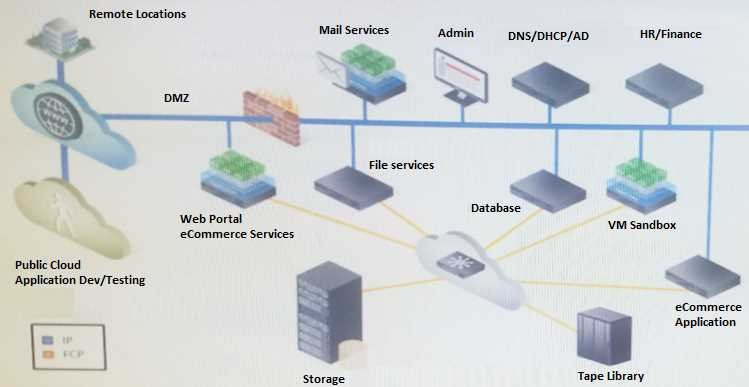 Your company recently negotiated several contracts with new customers to use its proprietary eCommerce system. As a result, the customer base has grown rapidly, which has introduced several challenges and requirements.
Business requirements:
Applications need to scale quickly Metrics and reporting to anticipate business trends and efficient use of resources External customers are looking to license the eCommerce application Other considerations: Applications need to be recorded for the public cloud Address security vulnerabilities for customer data in the cloud Refer to Case 1.
You must design the compute scalability functions for your administrator in a Do-It-Yourself private cloud.
You want to use manual processes to move services between hosts to avoid outages. Which method provides this function?
-
A
Add more virtual machines to the existing pool
-
B
Define a compute pool as known unit of consumption
-
C
Add resources to the existing servers in the compute pool
-
D
Define storage limits in a consumption pool
Reveal answer details
Close answer details
You are designing a cloud to support an Oracle OLTP environment. What is the recommended read/write ratio to use in this environment?
-
A
-
B
-
C
-
D
Reveal answer details
Close answer details
Question 10
Single choice
SPECIAL INSTRUCTIONS REMINDER
The remaining questions are associated with two cases. Each case has an introductory, descriptive passage (case text) that describes background information and requirements for a specific cloud based design. And each case has a set of six related, randomized questions. You will need to read the case text in order to answer the related questions correctly.
Given that there are two cases with six scored questions each, the total number of case-based scored questions is 12.
When you display each questions you can easily review the related case text in a pop-up window by clicking on the "Case" icon (shown below)
Case 4
Refer to the exhibit. 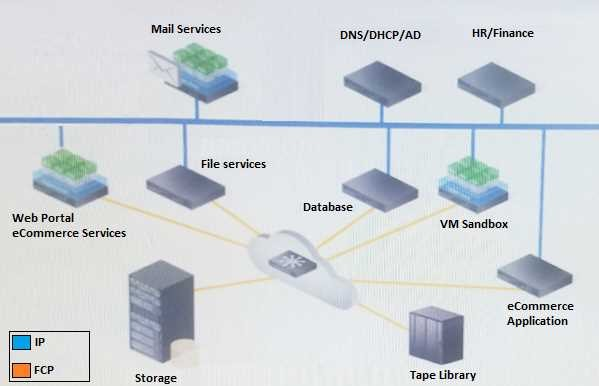 Your company is currently using a traditional SAN storage network. The server infrastructure is partially virtualized. There is a public cloud in place that is used to test development and application migration to cloud.
Business requirements:
Consolidate the network, storage, and compute resources Simplify network management and storage
provisioning Maintain application performance
Need to share resources to reduce cost and improve efficiency Other considerations: Monitoring of protection SLAs
All transactions must be logged for auditing review Users are validated using internal credentials Refer to Case 4.
You are sizing the compute capacity nodes in a hyper-converged infrastructure solution. Each node has 35 TB of storage capacity. You have calculated the total cloud storage requirement to be 700 TB. What is the minimum number of nodes required?
-
A
-
B
-
C
-
D
Reveal answer details
Close answer details
Question 11
Single choice
SPECIAL INSTRUCTIONS REMINDER
The remaining questions are associated with two cases. Each case has an introductory, descriptive passage (case text) that describes background information and requirements for a specific cloud based design. And each case has a set of six related, randomized questions. You will need to read the case text in order to answer the related questions correctly.
Given that there are two cases with six scored questions each, the total number of case-based scored questions is 12.
When you display each questions you can easily review the related case text in a pop-up window by clicking on the "Case" icon (shown below) Case 4
Refer to the exhibit. 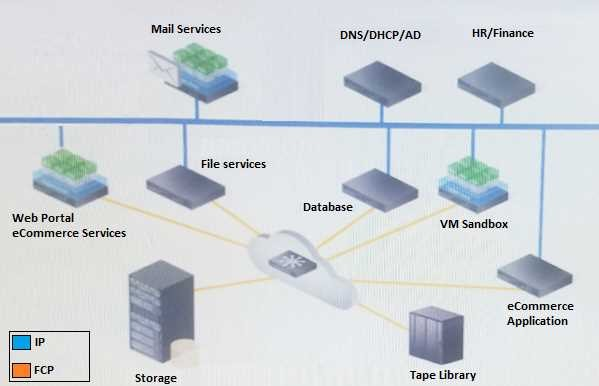 Your company is currently using a traditional SAN storage network. The server infrastructure is partially virtualized. There is a public cloud in place that is used to test development and application migration to cloud.
Business requirements:
Consolidate the network, storage, and compute resources Simplify network management and storage
provisioning Maintain application performance
Need to share resources to reduce cost and improve efficiency Other considerations: Monitoring of protection SLAs
All transactions must be logged for auditing review Users are validated using internal credentials Refer to Case 4.
You are designing the network components for a Do-It-Yourself private cloud solution. You want to restrict domain events and minimize traffic disruptions between nodes. Which compute to storage connectivity solution provides this function?
-
A
-
B
-
C
-
D
Reveal answer details
Close answer details
Question 12
Single choice
Case 1
Refer to the exhibit. 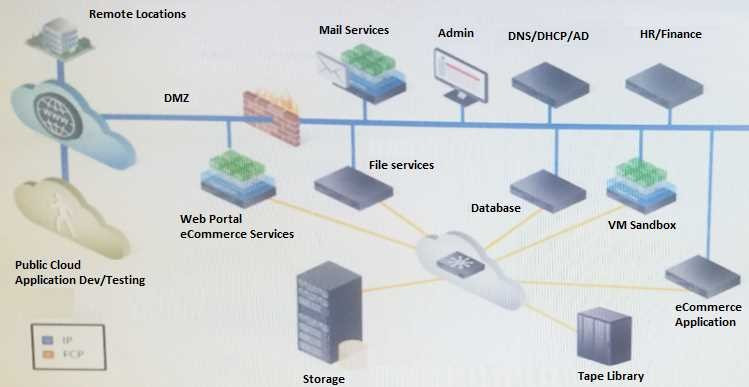 Your company recently negotiated several contracts with new customers to use its proprietary eCommerce system. As a result, the customer base has grown rapidly, which has introduced several challenges and requirements.
Business requirements:
Applications need to scale quickly Metrics and reporting to anticipate business trends and efficient use of resources External customers are looking to license the eCommerce application Other considerations: Applications need to be recorded for the public cloud Address security vulnerabilities for customer data in the cloud Refer to Case 1.
You are designing the application development platform for the cloud and are considering using a PaaS Solution. You must ensure that monitoring is included in the platform. Which key metrics need to be available from the PaaS Solution that you select?
-
A
Queue length and storage utilization
-
B
Storage utilization and account login
-
C
Account login and response time
-
D
Response time and queue length
Reveal answer details
Close answer details
|