A company runs an ecommerce application on premises on Microsoft SQL Server. The company is planning to migrate the application to the AWS Cloud. The application code contains complex T-SQL queries and stored procedures. The company wants to minimize database server maintenance and operating costs after the migration is completed. The company also wants to minimize the need to rewrite code as part of the migration effort. Which solution will meet these requirements?
-
A
Migrate the database to Amazon Aurora PostgreSQL. Turn on Babelfish.
-
B
Migrate the database to Amazon S3. Use Amazon Redshift Spectrum for query processing.
-
C
Migrate the database to Amazon RDS for SQL Server. Turn on Kerberos authentication.
-
D
Migrate the database to an Amazon EMR cluster that includes multiple primary nodes.
Reveal answer details
Close answer details
Correct answerA
ExplanationExplanation: Correct Answer: A
Explanation from Amazon documents:
Amazon Aurora PostgreSQL is a fully managed relational database service that is compatible with PostgreSQL. Aurora PostgreSQL offers up to three times better performance than standard PostgreSQL, as well as high availability, scalability, security, and durability. Aurora PostgreSQL also supports Babelfish, which is a new feature that enables Aurora to understand queries from applications written for Microsoft SQL Server. Babelfish allows you to migrate your SQL Server databases to Aurora PostgreSQL with minimal or no code changes, and run complex T-SQL queries and stored procedures on Aurora PostgreSQL.
Migrating the database to Amazon Aurora PostgreSQL and turning on Babelfish will meet the requirements of minimizing database server maintenance and operating costs, and minimizing the need to rewrite code as part of the migration effort. This solution will allow the company to benefit from the performance, reliability, and cost-efficiency of Aurora PostgreSQL, while preserving the compatibility and functionality of SQL Server. The company will also avoid the hassle and expense of managing and licensing SQL Server on premises or on AWS.
Therefore, option A is the correct solution to meet the requirements.
Option B is not suitable because Amazon S3 is an object storage service that is not designed for OLTP workloads. Amazon Redshift Spectrum is a feature that allows you to query data in S3 using Amazon Redshift, but it is not compatible with SQL Server or T-SQL.
Option C is not optimal because Amazon RDS for SQL Server is a managed relational database service that supports SQL Server, but it does not offer the same performance, scalability, or cost savings as Aurora PostgreSQL. Kerberos authentication is a security feature that does not affect the migration effort or the operating costs.
Option D is not suitable because Amazon EMR is a big data processing service that runs Apache Hadoop and Spark clusters, not relational databases. EMR does not support SQL Server or T-SQL, and it is not optimized for OLTP workloads.
A Database Specialist is creating Amazon DynamoDB tables, Amazon CloudWatch alarms, and associated infrastructure for an Application team using a development AWS account.
The team wants a deployment method that will standardize the core solution components while managing environment-specific settings separately, and wants to minimize rework due to configuration errors. Which process should the Database Specialist recommend to meet these requirements?
-
A
Organize common and environmental-specific parameters hierarchically in the AWS Systems Manager Parameter Store, then reference the parameters dynamically from an AWS CloudFormation template.
Deploy the CloudFormation stack using the environment name as a parameter.
-
B
Create a parameterized AWS CloudFormation template that builds the required objects.
Keep separate environment parameter files in separate Amazon S3 buckets. Provide an AWS CLI command that deploys the CloudFormation stack directly referencing the appropriate parameter bucket.
-
C
Create a parameterized AWS CloudFormation template that builds the required objects.
Import the template into the CloudFormation interface in the AWS Management Console.
Make the required changes to the parameters and deploy the CloudFormation stack.
-
D
Create an AWS Lambda function that builds the required objects using an AWS SDK.
Set the required parameter values in a test event in the Lambda console for each environment that the Application team can modify, as needed. Deploy the infrastructure by triggering the test event in the console.
Reveal answer details
Close answer details
Correct answerA
Explanationhttps://aws.amazon.com/blogs/mt/integrating-aws-cloudformation-with-aws-systems-manager-parameter-store/
A company's database specialist disabled TLS on an Amazon DocumentDB cluster to perform benchmarking tests. A few days after this change was implemented, a database specialist trainee accidentally deleted multiple tables. The database specialist restored the database from available snapshots. An hour after restoring the cluster, the database specialist is still unable to connect to the new cluster endpoint. What should the database specialist do to connect to the new, restored Amazon DocumentDB cluster?
-
A
Change the restored cluster's parameter group to the original cluster's custom parameter group.
-
B
Change the restored cluster's parameter group to the Amazon DocumentDB default parameter group.
-
C
Configure the interface VPC endpoint and associate the new Amazon DocumentDB cluster.
-
D
Run the syncInstances command in AWS DataSync.
Reveal answer details
Close answer details
Correct answerA
ExplanationExplanation: You can't modify the parameter settings of the default parameter groups. You can use a DB parameter group to act as a container for engine configuration values that are applied to one or more DB instances. If you create a DB instance without specifying a DB parameter group, the DB instance uses a default DB parameter group. Each default DB parameter group contains database engine defaults and Amazon RDS system defaults. You can't modify the parameter settings of a default parameter group.
Instead, you create your own parameter group where you choose your own parameter settings. Not all DB engine parameters can be changed in a parameter group that you create.
A business's mission-critical production workload is being operated on a 500 GB Amazon Aurora MySQL DB cluster. A database engineer must migrate the workload without causing data loss to a new Amazon Aurora Serverless MySQL DB cluster. Which approach will result in the LEAST amount of downtime and the LEAST amount of application impact?
-
A
Modify the existing DB cluster and update the Aurora configuration to Serverless.
-
B
Create a snapshot of the existing DB cluster and restore it to a new Aurora Serverless DB cluster.
-
C
Create an Aurora Serverless replica from the existing DB cluster and promote it to primary when the replica lag is minimal.
-
D
Replicate the data between the existing DB cluster and a new Aurora Serverless DB cluster by using AWS Database Migration Service (AWS DMS) with change data capture (CDC) enabled.
Reveal answer details
Close answer details
Correct answerD
ExplanationExplanation:
https://medium.com/@souri29/how-to-migrate-from-amazon-rds-aurora-or-mysql-to-amazon-aurora-serverless-55f9a4a74078
A database professional maintains a fleet of Amazon RDS database instances that are configured to utilize the default database parameter group. A database expert must connect a custom parameter group with certain database instances. When will the instances be allocated to this new parameter group once the database specialist performs this change?
-
A
Instantaneously after the change is made to the parameter group
-
B
In the next scheduled maintenance window of the DB instances
-
C
After the DB instances are manually rebooted
-
D
Within 24 hours after the change is made to the parameter group
Reveal answer details
Close answer details
Correct answerC
ExplanationExplanation: When you associate a new DB parameter group with a DB instance, the modified static and dynamic parameters are applied only after the DB instance is rebooted.
A company is using AWS CloudFormation to provision and manage infrastructure resources, including a production database. During a recent CloudFormation stack update, a database specialist observed that changes were made to a database resource that is named ProductionDatabase. The company wants to prevent changes to only ProductionDatabase during future stack updates. Which stack policy will meet this requirement? 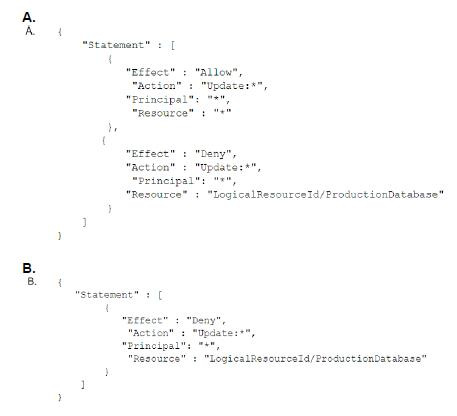 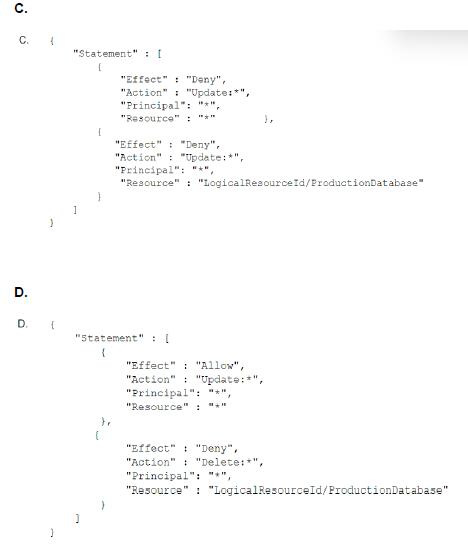
-
A
-
B
-
C
-
D
Reveal answer details
Close answer details
A company just migrated to Amazon Aurora PostgreSQL from an on-premises Oracle database. After the migration, the company discovered there is a period of time every day around 3:00 PM where the response time of the application is noticeably slower. The company has narrowed down the cause of this issue to the database and not the application. Which set of steps should the Database Specialist take to most efficiently find the problematic PostgreSQL query?
-
A
Create an Amazon CloudWatch dashboard to show the number of connections, CPU usage, and disk space consumption. Watch these dashboards during the next slow period.
-
B
Launch an Amazon EC2 instance, and install and configure an open-source PostgreSQL monitoring tool that will run reports based on the output error logs.
-
C
Modify the logging database parameter to log all the queries related to locking in the database and then check the logs after the next slow period for this information.
-
D
Enable Amazon RDS Performance Insights on the PostgreSQL database. Use the metrics to identify any queries that are related to spikes in the graph during the next slow period.
Reveal answer details
Close answer details
A company has a production Amazon Aurora Db cluster that serves both online transaction processing (OLTP) transactions and compute-intensive reports. The reports run for 10% of the total cluster uptime while the OLTP transactions run all the time. The company has benchmarked its workload and determined that a six-node Aurora DB cluster is appropriate for the peak workload.
The company is now looking at cutting costs for this DB cluster, but needs to have a sufficient number of nodes in the cluster to support the workload at different times. The workload has not changed since the previous benchmarking exercise. How can a Database Specialist address these requirements with minimal user involvement?
-
A
Split up the DB cluster into two different clusters: one for OLTP and the other for reporting. Monitor and set up replication between the two clusters to keep data consistent.
-
B
Review all evaluate the peak combined workload. Ensure that utilization of the DB cluster node is at an acceptable level. Adjust the number of instances, if necessary.
-
C
Use the stop cluster functionality to stop all the nodes of the DB cluster during times of minimal workload. The cluster can be restarted again depending on the workload at the time.
-
D
Set up automatic scaling on the DB cluster. This will allow the number of reader nodes to adjust automatically to the reporting workload, when needed.
Reveal answer details
Close answer details
A company is due for renewing its database license. The company wants to migrate its 80 TB transactional database system from on-premises to the AWS Cloud. The migration should incur the least possible downtime on the downstream database applications. The company's network infrastructure has limited network bandwidth that is shared with other applications. Which solution should a database specialist use for a timely migration?
-
A
Perform a full backup of the source database to AWS Snowball Edge appliances and ship them to be loaded to Amazon S3. Use AWS DMS to migrate change data capture (CDC) data from the source database to Amazon S3. Use a second AWS DMS task to migrate all the S3 data to the target database.
-
B
Perform a full backup of the source database to AWS Snowball Edge appliances and ship them to be loaded to Amazon S3. Periodically perform incremental backups of the source database to be shipped in another Snowball Edge appliance to handle syncing change data capture (CDC) data from the source to the target database.
-
C
Use AWS DMS to migrate the full load of the source database over a VPN tunnel using the internet for its primary connection. Allow AWS DMS to handle syncing change data capture (CDC) data from the source to the target database.
-
D
Use the AWS Schema Conversion Tool (AWS SCT) to migrate the full load of the source database over a VPN tunnel using the internet for its primary connection. Allow AWS SCT to handle syncing change data capture (CDC) data from the source to the target database.
Reveal answer details
Close answer details
Correct answerA
ExplanationExplanation: https://docs.aws.amazon.com/dms/latest/userguide/CHAP_Target.S3.html Using Amazon S3 as a target for AWS Database Migration Service
Question 10
Single choice
A stock market analysis firm maintains two locations: one in the us-east-1 Region and another in the eu-west-2 Region. The business want to build an AWS database solution capable of providing rapid and accurate updates. Dashboards with advanced analytical queries are used to present data in the eu-west-2 office. Because the corporation will use these dashboards to make purchasing choices, they must have less than a second to obtain application data. Which solution satisfies these criteria and gives the MOST CURRENT dashboard?
-
A
Deploy an Amazon RDS DB instance in us-east-1 with a read replica instance in eu-west-2. Create an Amazon ElastiCache cluster in eu-west-2 to cache data from the read replica to generate the dashboards.
-
B
Use an Amazon DynamoDB global table in us-east-1 with replication into eu-west-2.
Use multi-active replication to ensure that updates are quickly propagated to eu-west-2.
-
C
Use an Amazon Aurora global database. Deploy the primary DB cluster in us-east-1.
Deploy the secondary DB cluster in eu-west-2. Configure the dashboard application to read from the secondary cluster.
-
D
Deploy an Amazon RDS for MySQL DB instance in us-east-1 with a read replica instance in eu-west-2.
Configure the dashboard application to read from the read replica.
Reveal answer details
Close answer details
Correct answerC
ExplanationExplanation: Amazon Aurora global databases span multiple AWS Regions, enabling low latency global reads and providing fast recovery from the rare outage that might affect an entire AWS Region. An Aurora global database has a primary DB cluster in one Region, and up to five secondary DB clusters in different Regions.
https://docs.aws.amazon.com/AmazonRDS/latest/AuroraUserGuide/aurora-global-database.html
Question 11
Single choice
A corporation wishes to move a 1 TB Oracle database from its current location to an Amazon Aurora PostgreSQL DB cluster. The database specialist at the firm noticed that the Oracle database stores 100 GB of large binary objects (LOBs) across many tables. The Oracle database supports LOBs up to 500 MB in size and an average of 350 MB. AWS DMS was picked by the Database Specialist to transfer the data with the most replication instances. How should the database specialist improve the transfer of the database to AWS DMS?
-
A
Create a single task using full LOB mode with a LOB chunk size of 500 MB to migrate the data and LOBs together
-
B
Create two tasks: task1 with LOB tables using full LOB mode with a LOB chunk size of 500 MB and task2 without LOBs
-
C
Create two tasks: task1 with LOB tables using limited LOB mode with a maximum LOB size of 500 MB and task 2 without LOBs
-
D
Create a single task using limited LOB mode with a maximum LOB size of 500 MB to migrate data and LOBs together
Reveal answer details
Close answer details
Correct answerC
Explanationhttps://docs.aws.amazon.com/dms/latest/userguide/CHAP_BestPractices.html#CHAP_Bes
tPractices.LOBS, "AWS DMS migrates LOB data in two phases: 1. AWS DMS creates a new row in the target table and populates the row with all data except the associated LOB value. 2.AWS DMS updates the row in the target table with the LOB data." This means that we would need two tasks, one per phase and use limited LOB mode for best performance.
Question 12
Single choice
A company has a 20 TB production Amazon Aurora DB cluster. The company runs a large batch job overnight to load data into the Aurora DB cluster. To ensure the company's development team has the most up-to-date data for testing, a copy of the DB cluster must be available in the shortest possible time after the batch job completes. How should this be accomplished?
-
A
Use the AWS CLI to schedule a manual snapshot of the DB cluster. Restore the snapshot to a new DB cluster using the AWS CLI.
-
B
Create a dump file from the DB cluster. Load the dump file into a new DB cluster.
-
C
Schedule a job to create a clone of the DB cluster at the end of the overnight batch process.
-
D
Set up a new daily AWS DMS task that will use cloning and change data capture (CDC) on the DB cluster to copy the data to a new DB cluster. Set up a time for the AWS DMS stream to stop when the new cluster is current.
Reveal answer details
Close answer details
Question 13
Single choice
A financial organization must ensure that the most current 90 days of MySQL database backups are accessible. Amazon RDS for MySQL DB instances are used to host all MySQL databases. A database expert must create a solution that satisfies the criteria for backup retention with the least amount of development work feasible. Which strategy should the database administrator take?
-
A
Use AWS Backup to build a backup plan for the required retention period. Assign the DB instances to the backup plan.
-
B
Modify the DB instances to enable the automated backup option. Select the required backup retention period.
-
C
Automate a daily cron job on an Amazon EC2 instance to create MySQL dumps, transfer to Amazon
S3, and implement an S3 Lifecycle policy to meet the retention requirement.
-
D
Use AWS Lambda to schedule a daily manual snapshot of the DB instances. Delete snapshots that exceed the retention requirement.
Reveal answer details
Close answer details
Correct answerA
Explanationhttps://docs.aws.amazon.com/AmazonRDS/latest/UserGuide/USER_WorkingWithAutomat
edBackups.html
Question 14
Single choice
A company is looking to migrate a 1 TB Oracle database from on-premises to an Amazon Aurora PostgreSQL DB cluster. The company's Database Specialist discovered that the Oracle database is storing 100 GB of large binary objects (LOBs) across multiple tables. The Oracle database has a maximum LOB size of 500 MB with an average LOB size of 350 MB. The Database Specialist has chosen AWS DMS to migrate the data with the largest replication instances. How should the Database Specialist optimize the database migration using AWS DMS?
-
A
Create a single task using full LOB mode with a LOB chunk size of 500 MB to migrate the data and LOBs together
-
B
Create two tasks: task1 with LOB tables using full LOB mode with a LOB chunk size of 500 MB and task2 without LOBs
-
C
Create two tasks: task1 with LOB tables using limited LOB mode with a maximum LOB size of 500 MB and task 2 without LOBs
-
D
Create a single task using limited LOB mode with a maximum LOB size of 500 MB to migrate data and LOBs together
Reveal answer details
Close answer details
Question 15
Single choice
A financial company wants to store sensitive user data in an Amazon Aurora PostgreSQL DB cluster. The database will be accessed by multiple applications across the company. The company has mandated that all communications to the database be encrypted and the server identity must be validated. Any non-SSL-based connections should be disallowed access to the database. Which solution addresses these requirements?
-
A
Set the rds.force_ssl=0 parameter in DB parameter groups. Download and use the Amazon RDS certificate bundle and configure the PostgreSQL connection string with sslmode=allow.
-
B
Set the rds.force_ssl=1 parameter in DB parameter groups. Download and use the Amazon RDS certificate bundle and configure the PostgreSQL connection string with sslmode=disable.
-
C
Set the rds.force_ssl=0 parameter in DB parameter groups. Download and use the Amazon RDS certificate bundle and configure the PostgreSQL connection string with sslmode=verify-ca.
-
D
Set the rds.force_ssl=1 parameter in DB parameter groups. Download and use the Amazon RDS certificate bundle and configure the PostgreSQL connection string with sslmode=verify-full.
Reveal answer details
Close answer details
Correct answerD
ExplanationPostgreSQL: sslrootcert=rds-cert.pem sslmode=[verify-ca | verify-full] Reference:
https://forums.aws.amazon.com/message.jspa?messageID=734076
Question 16
Single choice
A company's development team needs to have production data restored in a staging AWS account. The production database is running on an Amazon RDS for PostgreSQL Multi-AZ DB instance, which has AWS KMS encryption enabled using the default KMS key. A database specialist planned to share the most recent automated snapshot with the staging account, but discovered that the option to share snapshots is disabled in the AWS Management Console. What should the database specialist do to resolve this?
-
A
Disable automated backups in the DB instance. Share both the automated snapshot and the default KMS key with the staging account. Restore the snapshot in the staging account and enable automated backups.
-
B
Copy the automated snapshot specifying a custom KMS encryption key. Share both the copied snapshot and the custom KMS encryption key with the staging account. Restore the snapshot to the staging account within the same Region.
-
C
Modify the DB instance to use a custom KMS encryption key. Share both the automated snapshot and the custom KMS encryption key with the staging account. Restore the snapshot in the staging account.
-
D
Copy the automated snapshot while keeping the default KMS key. Share both the snapshot and the default KMS key with the staging account. Restore the snapshot in the staging account.
Reveal answer details
Close answer details
Correct answerB
ExplanationExplanation:
https://aws.amazon.com/premiumsupport/knowledge-center/rds-snapshots-share-account/
Question 17
Single choice
A Database Specialist is working with a company to launch a new website built on Amazon Aurora with several Aurora Replicas. This new website will replace an on-premises website connected to a legacy relational database. Due to stability issues in the legacy database, the company would like to test the resiliency of Aurora. Which action can the Database Specialist take to test the resiliency of the Aurora DB cluster?
-
A
Stop the DB cluster and analyze how the website responds
-
B
Use Aurora fault injection to crash the master DB instance
-
C
Remove the DB cluster endpoint to simulate a master DB instance failure
-
D
Use Aurora Backtrack to crash the DB cluster
Reveal answer details
Close answer details
Correct answerB
Explanationhttps://docs.aws.amazon.com/AmazonRDS/latest/AuroraUserGuide/AuroraMySQL.Managi
ng.FaultInjectionQueries.html
"You can test the fault tolerance of your Amazon Aurora DB cluster by using fault injection queries. Fault injection queries are issued as SQL commands to an Amazon Aurora instance and they enable you to schedule a simulated occurrence of one of the following events: A crash of a writer or reader DB instance
A failure of an Aurora Replica A disk failure Disk congestion.
When a fault injection query specifies a crash, it forces a crash of the Aurora DB instance. The other fault injection queries result in simulations of failure events, but don't cause the event to occur. When you submit a fault injection query, you also specify an amount of time for the failure event simulation to occur for."
Question 18
Single choice
An online advertising website uses an Amazon DynamoDB table with on-demand capacity mode as its data store. The website also has a DynamoDB Accelerator (DAX) cluster in the same VPC as its web application server. The application needs to perform infrequent writes and many strongly consistent reads from the data store by querying the DAX cluster. During a performance audit, a systems administrator notices that the application can look up items by using the DAX cluster. However, the QueryCacheHits metric for the DAX cluster consistently shows 0 while the QueryCacheMisses metric continuously keeps growing in Amazon CloudWatch. What is the MOST likely reason for this occurrence?
-
A
A VPC endpoint was not added to access DynamoDB.
-
B
Strongly consistent reads are always passed through DAX to DynamoDB.
-
C
DynamoDB is scaling due to a burst in traffic, resulting in degraded performance.
-
D
A VPC endpoint was not added to access CloudWatch.
Reveal answer details
Close answer details
Correct answerB
Explanationhttps://docs.aws.amazon.com/amazondynamodb/latest/developerguide/DAX.concepts.html "If the request specifies strongly consistent reads, DAX passes the request through to DynamoDB. The results from DynamoDB are not cached in DAX. Instead, they are simply returned to the application."
Question 19
Single choice
A business uses Amazon EC2 instances in VPC A to serve an internal file-sharing application. This application is supported by an Amazon ElastiCache cluster in VPC B that is peering with VPC A. The corporation migrates the instances of its applications from VPC A to VPC B. The file-sharing application is no longer able to connect to the ElastiCache cluster, as shown by the logs. What is the best course of action for a database professional to take in order to remedy this issue?
-
A
Create a second security group on the EC2 instances. Add an outbound rule to allow traffic from the ElastiCache cluster security group.
-
B
Delete the ElastiCache security group. Add an interface VPC endpoint to enable the EC2 instances to connect to the ElastiCache cluster.
-
C
Modify the ElastiCache security group by adding outbound rules that allow traffic to VPC CIDR blocks from the ElastiCache cluster.
-
D
Modify the ElastiCache security group by adding an inbound rule that allows traffic from the EC2 instances security group to the ElastiCache cluster.
Reveal answer details
Close answer details
Correct answerD
ExplanationExplanation:
https://docs.aws.amazon.com/vpc/latest/peering/vpc-peering-security-groups.html
Question 20
Multiple choice
A business is launching a new Amazon RDS for SQL Server database instance. The organization wishes to allow auditing of the SQL Server database. Which measures should a database professional perform in combination to achieve this requirement? (Select two.)
-
A
Create a service-linked role for Amazon RDS that grants permissions for Amazon RDS to store audit logs on Amazon S3.
-
B
Set up a parameter group to configure an IAM role and an Amazon S3 bucket for audit log storage.
Associate the parameter group with the DB instance.
-
C
Disable Multi-AZ on the DB instance, and then enable auditing. Enable Multi-AZ after auditing is enabled.
-
D
Disable automated backup on the DB instance, and then enable auditing. Enable automated backup after auditing is enabled.
-
E
Set up an options group to configure an IAM role and an Amazon S3 bucket for audit log storage.
Associate the options group with the DB instance.
Reveal answer details
Close answer details
Correct answersA, E
Explanationhttps://docs.aws.amazon.com/AmazonRDS/latest/UserGuide/Appendix.SQLServer.Options
.Audit.html
https://docs.aws.amazon.com/AmazonRDS/latest/UserGuide/security_iam_service-with-
iam.html
Question 21
Single choice
A company plans to use AWS Database Migration Service (AWS DMS) to migrate its database from one Amazon EC2 instance to another EC2 instance as a full load task. The company wants the database to be inactive during the migration. The company will use a dms.t3.medium instance to perform the migration and will use the default settings for the migration. Which solution will MOST improve the performance of the data migration?
-
A
Increase the number of tables that are loaded in parallel.
-
B
Drop all indexes on the source tables.
-
C
Change the processing mode from the batch optimized apply option to transactional mode.
-
D
Enable Multi-AZ on the target database while the full load task is in progress.
Reveal answer details
Close answer details
Correct answerB
Explanationhttps://docs.aws.amazon.com/dms/latest/userguide/CHAP_BestPractices.html#CHAP_Bes
tPractices.Performance For a full load task, we recommend that you drop primary key indexes, secondary indexes, referential integrity constraints, and data manipulation language (DML) triggers. Or you can delay their creation until after the full load tasks are complete. You don't need indexes during a full load task, and indexes incur maintenance overhead if they are present. Because the full load task loads groups of tables at a time, referential integrity constraints are violated. Similarly, insert, update, and delete triggers can cause errors, for example if a row insert is triggered for a previously bulk loaded table. Other types of triggers also affect performance due to added processing.
https://docs.aws.amazon.com/dms/latest/userguide/CHAP_BestPractices.html
Question 22
Single choice
A database specialist is designing the database for a software-as-a-service (SaaS) version of an employee information application. In the current architecture, the change history of employee records is stored in a single table in an Amazon RDS for Oracle database. Triggers on the employee table populate the history table with historical records. This architecture has two major challenges. First, there is no way to guarantee that the records have not been changed in the history table. Second, queries on the history table are slow because of the large size of the table and the need to run the queries against a large subset of data in the table. The database specialist must design a solution that prevents modification of the historical records. The solution also must maximize the speed of the queries. Which solution will meet these requirements?
-
A
Migrate the current solution to an Amazon DynamoDB table. Use DynamoDB Streams to keep track of changes. Use DynamoDB Accelerator (DAX) to improve query performance.
-
B
Write employee record history to Amazon Quantum Ledger Database (Amazon QLDB) for historical records and to an Amazon OpenSearch Service domain for queries.
-
C
Use Amazon Aurora PostgreSQL to store employee record history in a single table. Use Aurora Auto Scaling to provision more capacity.
-
D
Build a solution that uses an Amazon Redshift cluster for historical records. Query the Redshift cluster directly as needed.
Reveal answer details
Close answer details
Correct answerB
ExplanationCorrect Answer: B
Explanation from Amazon documents:
Amazon Quantum Ledger Database (Amazon QLDB) is a fully managed ledger database that provides a transparent, immutable, and cryptographically verifiable transaction log of all your application changes.
Amazon QLDB tracks each and every application data change and maintains a complete and verifiable history of changes over time 1. This makes it ideal for storing historical records that need to be tamper-proof and auditable. Amazon QLDB also supports PartiQL, a SQL-compatible query language that lets you query data using familiar SQL operators 2.
Amazon OpenSearch Service (successor to Amazon Elasticsearch Service) is a fully managed service that makes it easy to deploy, operate, and scale OpenSearch, an open source search and analytics engine.
Amazon OpenSearch Service lets you store, search, and analyze large volumes of data quickly and at low cost 3. You can use Amazon OpenSearch Service to index and query your employee record history data stored in Amazon QLDB using the QLDB Streams feature. This way, you can leverage the powerful search and analytics capabilities of OpenSearch Service to run fast and flexible queries on your historical data.
Therefore, option B is the best solution that meets the requirements of preventing modification of the historical records and maximizing the speed of the queries.
Option A is not suitable because DynamoDB is a key-value and document database that does not provide a ledger-like transaction log.
Option C is not suitable because Aurora PostgreSQL is a relational database that does not guarantee immutability of the historical records.
Option D is not suitable because Redshift is a data warehouse that is optimized for analytical queries on large datasets, not for storing and querying individual records.
Question 23
Single choice
A company migrated one of its business-critical database workloads to an Amazon Aurora Multi-AZ DB cluster. The company requires a very low RTO and needs to improve the application recovery time after database failovers. Which approach meets these requirements?
-
A
Set the max_connections parameter to 16,000 in the instance-level parameter group.
-
B
Modify the client connection timeout to 300 seconds.
-
C
Create an Amazon RDS Proxy database proxy and update client connections to point to the proxy endpoint.
-
D
Enable the query cache at the instance level.
Reveal answer details
Close answer details
Correct answerC
ExplanationAmazon RDS Proxy allows applications to pool and share connections established with the database, improving database efficiency and application scalability. With RDS Proxy, failover times for Aurora and RDS databases are reduced by up to 66% and database credentials, authentication, and access can be managed through integration with AWS Secrets Manager and AWS Identity and Access Management (IAM).
https://aws.amazon.com/rds/proxy/
Question 24
Single choice
A company is running an Amazon RDS for MySQL Multi-AZ DB instance for a business-critical workload.
RDS encryption for the DB instance is disabled. A recent security audit concluded that all business-critical applications must encrypt data at rest. The company has asked its database specialist to formulate a plan to accomplish this for the DB instance. Which process should the database specialist recommend?
-
A
Create an encrypted snapshot of the unencrypted DB instance. Copy the encrypted snapshot to Amazon S3. Restore the DB instance from the encrypted snapshot using Amazon S3.
-
B
Create a new RDS for MySQL DB instance with encryption enabled. Restore the unencrypted snapshot to this DB instance.
-
C
Create a snapshot of the unencrypted DB instance. Create an encrypted copy of the snapshot. Restore the DB instance from the encrypted snapshot.
-
D
Temporarily shut down the unencrypted DB instance. Enable AWS KMS encryption in the AWS Management Console using an AWS managed CMK. Restart the DB instance in an encrypted state.
Reveal answer details
Close answer details
Correct answerC
Explanationhttps://docs.aws.amazon.com/AmazonRDS/latest/UserGuide/Overview.Encryption.html#Ov
erview.Encryption.Limitations
Question 25
Single choice
Developers have requested a new Amazon Redshift cluster so they can load new third-party marketing data. The new cluster is ready and the user credentials are given to the developers. The developers indicate that their copy jobs fail with the following error message: "Amazon Invalid operation: S3ServiceException:Access Denied,Status 403,Error AccessDenied." The developers need to load this data soon, so a database specialist must act quickly to solve this issue. What is the MOST secure solution?
-
A
Create a new IAM role with the same user name as the Amazon Redshift developer user ID. Provide the IAM role with read-only access to Amazon S3 with the assume role action.
-
B
Create a new IAM role with read-only access to the Amazon S3 bucket and include the assume role action. Modify the Amazon Redshift cluster to add the IAM role.
-
C
Create a new IAM role with read-only access to the Amazon S3 bucket with the assume role action.
Add this role to the developer IAM user ID used for the copy job that ended with an error message.
-
D
Create a new IAM user with access keys and a new role with read-only access to the Amazon S3 bucket. Add this role to the Amazon Redshift cluster. Change the copy job to use the access keys created.
Reveal answer details
Close answer details
Correct answerB
Explanationhttps://docs.aws.amazon.com/redshift/latest/gsg/rs-gsg-create-an-iam-role.html
"Now that you have created the new role, your next step is to attach it to your cluster. You can attach the role when you launch a new cluster or you can attach it to an existing cluster. In the next step, you attach the role to a new cluster." https://docs.aws.amazon.com/redshift/latest/dg/copy-usage_notes-access-
permissions.html
Question 26
Single choice
A company is running its line of business application on AWS, which uses Amazon RDS for MySQL at the persistent data store. The company wants to minimize downtime when it migrates the database to Amazon Aurora. Which migration method should a Database Specialist use?
-
A
Take a snapshot of the RDS for MySQL DB instance and create a new Aurora DB cluster with the option to migrate snapshots.
-
B
Make a backup of the RDS for MySQL DB instance using the mysqldump utility, create a new Aurora DB cluster, and restore the backup.
-
C
Create an Aurora Replica from the RDS for MySQL DB instance and promote the Aurora DB cluster.
-
D
Create a clone of the RDS for MySQL DB instance and promote the Aurora DB cluster.
Reveal answer details
Close answer details
Correct answerC
Explanationhttps://aws.amazon.com/blogs/database/best-practices-for-migrating-rds-for-mysql-databases-to-amazon-aurora/
https://docs.aws.amazon.com/AmazonRDS/latest/AuroraUserGuide/AuroraPostgreSQL.Migrating.html#AuroraPostgreSQL.Migrating.RDSPostgreSQL.Replica
Question 27
Single choice
A small startup company is looking to migrate a 4 TB on-premises MySQL database to AWS using an Amazon RDS for MySQL DB instance. Which strategy would allow for a successful migration with the LEAST amount of downtime?
-
A
Deploy a new RDS for MySQL DB instance and configure it for access from the on-premises data center. Use the mysqldump utility to create an initial snapshot from the on-premises MySQL server, and copy it to an Amazon S3 bucket. Import the snapshot into the DB instance utilizing the MySQL utilities running on an Amazon EC2 instance. Immediately point the application to the DB instance.
-
B
Deploy a new Amazon EC2 instance, install the MySQL software on the EC2 instance, and configure networking for access from the on-premises data center. Use the mysqldump utility to create a snapshot of the on-premises MySQL server. Copy the snapshot into the EC2 instance and restore it into the EC2 MySQL instance. Use AWS DMS to migrate data into a new RDS for MySQL DB instance.
Point the application to the DB instance.
-
C
Deploy a new Amazon EC2 instance, install the MySQL software on the EC2 instance, and configure networking for access from the on-premises data center. Use the mysqldump utility to create a snapshot of the on-premises MySQL server. Copy the snapshot into an Amazon S3 bucket and import the snapshot into a new RDS for MySQL DB instance using the MySQL utilities running on an EC2 instance. Point the application to the DB instance.
-
D
Deploy a new RDS for MySQL DB instance and configure it for access from the on-premises data center. Use the mysqldump utility to create an initial snapshot from the on-premises MySQL server, and copy it to an Amazon S3 bucket. Import the snapshot into the DB instance using the MySQL utilities running on an Amazon EC2 instance. Establish replication into the new DB instance using MySQL replication. Stop application access to the on-premises MySQL server and let the remaining transactions replicate over. Point the application to the DB instance.
Reveal answer details
Close answer details
Question 28
Single choice
A company runs online transaction processing (OLTP) workloads on an Amazon RDS for PostgreSQL Multi-AZ DB instance. The company recently conducted tests on the database after business hours, and the tests generated additional database logs. As a result, free storage of the DB instance is low and is expected to be exhausted in 2 days. The company wants to recover the free storage that the additional logs consumed. The solution must not result in downtime for the database. Which solution will meet these requirements?
-
A
Modify the rds.log_retention_period parameter to 0. Reboot the DB instance to save the changes.
-
B
Modify the rds.log_retention_period parameter to 1440. Wait up to 24 hours for database logs to be deleted.
-
C
Modify the temp file_limit parameter to a smaller value to reclaim space on the DB instance.
-
D
Modify the rds.log_retention_period parameter to 1440. Reboot the DB instance to save the changes.
Reveal answer details
Close answer details
Correct answerB
ExplanationExplanation: Correct Answer: B
Explanation from Amazon documents:
The rds.log_retention_period parameter specifies how long your RDS for PostgreSQL DB instance keeps its log files. The default setting is 3 days (4,320 minutes), but you can set this value to anywhere from 1 day (1,440 minutes) to 7 days (10,080 minutes)123. By reducing the log retention period, you can free up storage space on your DB instance without affecting its availability or performance. To modify the rds.log_retention_period parameter, you need to use a custom DB parameter group for your RDS for PostgreSQL instance. You can modify the parameter value using the AWS Management Console, the AWS CLI, or the RDS API1. The parameter change is applied immediately, but it may take up to 24 hours for the database logs to be deleted 2. Therefore, you do not need to reboot the DB instance to save the changes or to reclaim the storage space.
Therefore, option B is the correct solution to meet the requirements.
Option A is incorrect because setting the rds.log_retention_period parameter to 0 disables log retention and prevents you from viewing or downloading any database logs 1. Rebooting the DB instance is also unnecessary and may cause downtime.
Option C is incorrect because the temp file_limit parameter controls the maximum size of temporary files that a session can generate, not the size of database logs. Modifying this parameter will not reclaim any storage space on the DB instance. Option D is incorrect because rebooting the DB instance is not required to save the changes or to reclaim the storage space.
Question 29
Single choice
A business is transferring a database from one AWS Region to another using an Amazon RDS for SQL Server DB instance. The organization wishes to keep database downtime to a minimum throughout the transfer. Which migration strategy should the organization use for this cross-regional move?
-
A
Back up the source database using native backup to an Amazon S3 bucket in the same Region. Then restore the backup in the target Region.
-
B
Back up the source database using native backup to an Amazon S3 bucket in the same Region. Use Amazon S3 Cross-Region Replication to copy the backup to an S3 bucket in the target Region. Then restore the backup in the target Region.
-
C
Configure AWS Database Migration Service (AWS DMS) to replicate data between the source and the target databases. Once the replication is in sync, terminate the DMS task.
-
D
Add an RDS for SQL Server cross-Region read replica in the target Region. Once the replication is in sync, promote the read replica to master.
Reveal answer details
Close answer details
Correct answerC
Explanationhttps://docs.aws.amazon.com/AmazonRDS/latest/UserGuide/USER_ReadRepl.XRgn.html
With Amazon RDS, you can create a MariaDB, MySQL, Oracle, or PostgreSQL read replica in a different AWS Region from the source DB instance. Creating a cross-Region read replica isn't supported for SQL Server on Amazon RDS.
Question 30
Single choice
A database specialist is planning to migrate a 4 TB Microsoft SQL Server DB instance from on premises to Amazon RDS for SQL Server. The database is primarily used for nightly batch processing. Which RDS storage option meets these requirements MOST cost-effectively?
-
A
General Purpose SSD storage
-
B
-
C
-
D
Throughput Optimized hard disk drives (HDD)
Reveal answer details
Close answer details
Correct answerA
ExplanationExplanation: General Purpose SSD storage is a cost-effective storage option that is ideal for a broad range of workloads running on medium-sized DB instances 1. General Purpose storage is best suited for development and testing environments 1. Since the database is primarily used for nightly batch processing, it does not require high I/O performance or low latency that Provisioned IOPS storage offers 12. Magnetic storage and Throughput Optimized HDD are not recommended for new storage needs, and they have lower storage limits than General Purpose SSD and Provisioned IOPS SSD1. Therefore, General Purpose SSD storage meets the requirements most cost-effectively.
Question 31
Multiple choice
A database specialist is launching a test graph database using Amazon Neptune for the first time. The database specialist needs to insert millions of rows of test observations from a .csv file that is stored in Amazon S3. The database specialist has been using a series of API calls to upload the data to the Neptune DB instance. Which combination of steps would allow the database specialist to upload the data faster? (Choose three.)
-
A
Ensure Amazon Cognito returns the proper AWS STS tokens to authenticate the Neptune DB instance to the S3 bucket hosting the CSV file.
-
B
Ensure the vertices and edges are specified in different .csv files with proper header column formatting.
-
C
Use AWS DMS to move data from Amazon S3 to the Neptune Loader.
-
D
Curl the S3 URI while inside the Neptune DB instance and then run the addVertex or addEdge commands.
-
E
Ensure an IAM role for the Neptune DB instance is configured with the appropriate permissions to allow access to the file in the S3 bucket.
-
F
Create an S3 VPC endpoint and issue an HTTP POST to the database's loader endpoint.
Reveal answer details
Close answer details
Correct answersB, E, F
ExplanationExplanation: Correct Answer: B, E, F
Explanation from Amazon documents:
To upload data faster to a Neptune DB instance from a .csv file stored in Amazon S3, the database specialist should use the Neptune Bulk Loader, which is a feature that allows you to load data from external files directly into a Neptune DB instance 1. The Neptune Bulk Loader is faster and has less overhead than the API calls, such as SPARQL INSERT statements or Gremlin addV and addE steps 2. The Neptune Bulk Loader supports both RDF and Gremlin data formats 1.
To use the Neptune Bulk Loader, the database specialist needs to do the following13: Ensure the vertices and edges are specified in different .csv files with proper header column formatting.
This is required for the Gremlin data format, which uses two .csv files: one for vertices and one for edges.
The first row of each file must contain the column names, which must match the property names of the graph elements. The files must also have a column named ~id for vertices and ~from and ~to for edges, which specify the unique identifiers of the graph elements 1. Ensure an IAM role for the Neptune DB instance is configured with the appropriate permissions to allow access to the file in the S3 bucket. This is required for the Neptune DB instance to read the data from the S3 bucket. The IAM role must have a trust policy that allows Neptune to assume the role, and a permissions policy that allows access to the S3 bucket and objects 3.
Create an S3 VPC endpoint and issue an HTTP POST to the database's loader endpoint. This is required for the Neptune DB instance to communicate with the S3 bucket without going through the public internet.
The S3 VPC endpoint must be in the same VPC as the Neptune DB instance. The HTTP POST request must specify the source parameter as the S3 URI of the .csv file, and optionally other parameters such as format, failOnError, parallelism, etc 1. Therefore, option B, E, and F are the correct steps to upload the data faster.
Option A is not necessary because Amazon Cognito is not used for authenticating the Neptune DB instance to the S3 bucket.
Option C is not suitable because AWS DMS is not designed for loading graph data into Neptune.
Option D is not efficient because curling the S3 URI and running the addVertex or addEdge commands will be slower and more costly than using the Neptune Bulk Loader.
Question 32
Single choice
A database specialist must create nightly backups of an Amazon DynamoDB table in a mission-critical workload as part of a disaster recovery strategy. Which backup methodology should the database specialist use to MINIMIZE management overhead?
-
A
Install the AWS CLI on an Amazon EC2 instance. Write a CLI command that creates a backup of the DynamoDB table. Create a scheduled job or task that executes the command on a nightly basis.
-
B
Create an AWS Lambda function that creates a backup of the DynamoDB table. Create an Amazon CloudWatch Events rule that executes the Lambda function on a nightly basis.
-
C
Create a backup plan using AWS Backup, specify a backup frequency of every 24 hours, and give the plan a nightly backup window.
-
D
Configure DynamoDB backup and restore for an on-demand backup frequency of every 24 hours.
Reveal answer details
Close answer details
Correct answerC
Explanationhttps://docs.aws.amazon.com/amazondynamodb/latest/developerguide/CreateBackup.html#:~:text=If%20you%20don%27t%20want%20to%20create%20scheduling%20scripts%20and%20cleanup%20jobs%2C%20you%20can%20use%20AWS%20Backup%20to%20create%20backup%20plans%20with%20schedules%20and%20retention%20policies%20for%20your%20DynamoDB%20tables.%20AWS%20Backup%20runs%20the%20backups%20and%20deletes%20them%20when%20they%20expire.%20For%20more%20information%2C%20see%20the%20AWS%20Backup%20Developer%
20Guide.
https://docs.aws.amazon.com/amazondynamodb/latest/developerguide/backuprestore_Ho
wItWorks.html
Question 33
Single choice
Application developers have reported that an application is running slower as more users are added. The application database is running on an Amazon Aurora DB cluster with an Aurora Replica. The application is written to take advantage of read scaling through reader endpoints. A database specialist looks at the performance metrics of the database and determines that, as new users were added to the database, the primary instance CPU utilization steadily increased while the Aurora Replica CPU utilization remained steady. How can the database specialist improve database performance while ensuring minimal downtime?
-
A
Modify the Aurora DB cluster to add more replicas until the overall load stabilizes. Then, reduce the number of replicas once the application meets service level objectives.
-
B
Modify the primary instance to a larger instance size that offers more CPU capacity.
-
C
Modify a replica to a larger instance size that has more CPU capacity. Then, promote the modified replica.
-
D
Restore the Aurora DB cluster to one that has an instance size with more CPU capacity. Then, swap the names of the old and new DB clusters.
Reveal answer details
Close answer details
Question 34
Single choice
In North America, a business launched a mobile game that swiftly expanded to 10 million daily active players. The game's backend is hosted on AWS and makes considerable use of a TTL-configured Amazon DynamoDB table. When an item is added or changed, its TTL is set to 600 seconds plus the current epoch time. The game logic is reliant on the purging of outdated data in order to compute rewards points properly. At times, items from the table are read that are many hours beyond their TTL expiration. How should a database administrator resolve this issue?
-
A
Use a client library that supports the TTL functionality for DynamoDB.
-
B
Include a query filter expression to ignore items with an expired TTL.
-
C
Set the ConsistentRead parameter to true when querying the table.
-
D
Create a local secondary index on the TTL attribute.
Reveal answer details
Close answer details
Correct answerB
Explanationhttps://docs.aws.amazon.com/amazondynamodb/latest/developerguide/howitworks-ttl.html
Question 35
Single choice
A company stores critical data for a department in Amazon RDS for MySQL DB instances. The department was closed for 3 weeks and notified a database specialist that access to the RDS DB instances should not be granted to anyone during this time. To meet this requirement, the database specialist stopped all the DB instances used by the department but did not select the option to create a snapshot. Before the 3 weeks expired, the database specialist discovered that users could connect to the database successfully. What could be the reason for this?
-
A
When stopping the DB instance, the option to create a snapshot should have been selected.
-
B
When stopping the DB instance, the duration for stopping the DB instance should have been selected.
-
C
Stopped DB instances will automatically restart if the number of attempted connections exceeds the threshold set.
-
D
Stopped DB instances will automatically restart if the instance is not manually started after 7 days.
Reveal answer details
Close answer details
Correct answerD
ExplanationExplanation:
https://aws.amazon.com/premiumsupport/knowledge-center/rds-stop-seven-days/
Question 36
Single choice
A financial company is hosting its web application on AWS. The application's database is hosted on Amazon RDS for MySQL with automated backups enabled. The application has caused a logical corruption of the database, which is causing the application to become unresponsive. The specific time of the corruption has been identified, and it was within the backup retention period. How should a database specialist recover the database to the most recent point before corruption?
-
A
Use the point-in-time restore capability to restore the DB instance to the specified time. No changes to the application connection string are required.
-
B
Use the point-in-time restore capability to restore the DB instance to the specified time. Change the application connection string to the new, restored DB instance.
-
C
Restore using the latest automated backup. Change the application connection string to the new, restored DB instance.
-
D
Restore using the appropriate automated backup. No changes to the application connection string are required.
Reveal answer details
Close answer details
Correct answerB
ExplanationThe point-in-time restore capability of Amazon RDS for MySQL allows you to create a new DB instance with the same configuration as the original one, but with data restored to a specific time within your backup retention period. You can specify any time within your backup retention period, up to the last five minutes of your DB instance's usage 1. This feature is useful for recovering from logical corruption or user errors that affect your database.
However, when you use the point-in-time restore capability, you are creating a new DB instance with a different endpoint. Therefore, you need to change the application connection string to point to the new, restored DB instance. You can also delete or rename the original DB instance if you no longer need it1
Question 37
Single choice
A company is running critical applications on AWS. Most of the application deployments use Amazon Aurora MySQL for the database stack. The company uses AWS CloudFormation to deploy the DB instances. The company's application team recently implemented a CI/CD pipeline. A database engineer needs to integrate the database deployment CloudFormation stack with the newly built CllCD platform. Updates to the CloudFormation stack must not update existing production database resources. Which CloudFormation stack policy action should the database engineer implement to meet these requirements?
-
A
Use a Deny statement for the Update:Modify action on the production database resources.
-
B
Use a Deny statement for the action on the production database resources.
-
C
Use a Deny statement for the Update:Delete action on the production database resources.
-
D
Use a Deny statement for the Update:Replace action on the production database resources.
Reveal answer details
Close answer details
Correct answerD
ExplanationExplanation: Correct Answer: D
Explanation from Amazon documents:
A CloudFormation stack policy is a JSON document that defines the update actions that can be performed on designated resources in a CloudFormation stack. A stack policy can be used to prevent accidental updates or deletions of stack resources, such as a production database.
The Update:Replace action is an update action that replaces an existing resource with a new one during a stack update. This action can cause data loss or downtime for the resource. To prevent this action from affecting the production database resources, the database engineer should use a Deny statement for the Update:Replace action on the production database resources in the stack policy. This statement will override any Allow statements for the same action and resource, and protect the production database
resources from being replaced during a stack update. Therefore, option D is the correct stack policy action to meet the requirements.
Option A is incorrect because the Update:Modify action is not a valid update action for a stack policy. The valid update actions are Update:Replace, Update:Skip, and Delete.
Option B is incorrect because it does not specify a valid update action for the Deny statement.
Option C is incorrect because the Update:Delete action is not a valid update action for a stack policy. The valid update actions are Update:Replace, Update:Skip, and Delete.
Question 38
Multiple choice
A company has multiple applications serving data from a secure on-premises database. The company is migrating all applications and databases to the AWS Cloud. The IT Risk and Compliance department requires that auditing be enabled on all secure databases to capture all log ins, log outs, failed logins, permission changes, and database schema changes. A Database Specialist has recommended Amazon Aurora MySQL as the migration target, and leveraging the Advanced Auditing feature in Aurora. Which events need to be specified in the Advanced Auditing configuration to satisfy the minimum auditing requirements? (Choose three.)
-
A
-
B
-
C
-
D
-
E
-
F
Reveal answer details
Close answer details
Correct answersA, B, C
ExplanationConnect - logins / DCL - authorizations (grant,revoke), DDL - schema updates
Question 39
Single choice
A large ecommerce company uses Amazon DynamoDB to handle the transactions on its web portal.
Traffic patterns throughout the year are usually stable; however, a large event is planned. The company
knows that traffic will increase by up to 10 times the normal load over the 3-day event. When sale prices are published during the event, traffic will spike rapidly. How should a Database Specialist ensure DynamoDB can handle the increased traffic?
-
A
Ensure the table is always provisioned to meet peak needs
-
B
Allow burst capacity to handle the additional load
-
C
Set an AWS Application Auto Scaling policy for the table to handle the increase in traffic
-
D
Preprovision additional capacity for the known peaks and then reduce the capacity after the event
Reveal answer details
Close answer details
Correct answerD
Explanationhttps://docs.aws.amazon.com/amazondynamodb/latest/developerguide/bp-partition-key-design.html#bp-partition-key-throughput-bursting
"DynamoDB provides some flexibility in your per-partition throughput provisioning by providing burst capacity. Whenever you're not fully using a partition's throughput, DynamoDB reserves a portion of that unused capacity for later bursts of throughput to handle usage spikes. DynamoDB currently retains up to 5 minutes (300 seconds) of unused read and write capacity. During an occasional burst of read or write activity, these extra capacity units can be consumed quickly--even faster than the per-second provisioned throughput capacity that you've defined for your table. DynamoDB can also consume burst capacity for background maintenance and other tasks without prior notice. Note that these burst capacity details might change in the future."
Question 40
Single choice
A company recently acquired a new business. A database specialist must migrate an unencrypted 12 TB
Amazon RDS for MySQL DB instance to a new AWS account. The database specialist needs to minimize the amount of time required to migrate the database. Which solution meets these requirements?
-
A
Create a snapshot of the source DB instance in the source account. Share the snapshot with the destination account. In the target account, create a DB instance from the snapshot.
-
B
Use AWS Resource Access Manager to share the source DB instance with the destination account.
Create a DB instance in the destination account using the shared resource.
-
C
Create a read replica of the DB instance. Give the destination account access to the read replica. In the destination account, create a snapshot of the shared read replica and provision a new RDS for MySQL
DB instance.
-
D
Use mysqldump to back up the source database. Create an RDS for MySQL DB instance in the destination account. Use the mysql command to restore the backup in the destination database.
Reveal answer details
Close answer details
Correct answerA
ExplanationExplanation: Sharing an unencrypted manual DB snapshot enables authorized AWS accounts to directly restore a DB instance from the snapshot instead of taking a copy of it and restoring from that.
https://docs.aws.amazon.com/AmazonRDS/latest/UserGuide/USER_ShareSnapshot.html
However
Resource Access Manager could not share non-Aurora cluster.
https://docs.aws.amazon.com/ram/latest/userguide/shareable.html
Question 41
Single choice
A financial company has allocated an Amazon RDS MariaDB DB instance with large storage capacity to accommodate migration efforts. Post-migration, the company purged unwanted data from the instance.
The company now want to downsize storage to save money. The solution must have the least impact on production and near-zero downtime. Which solution would meet these requirements?
-
A
Create a snapshot of the old databases and restore the snapshot with the required storage
-
B
Create a new RDS DB instance with the required storage and move the databases from the old instances to the new instance using AWS DMS
-
C
Create a new database using native backup and restore
-
D
Create a new read replica and make it the primary by terminating the existing primary
Reveal answer details
Close answer details
Correct answerB
ExplanationExplanation:
https://aws.amazon.com/premiumsupport/knowledge-center/rds-db-storage-size/
Use AWS Database Migration Service (AWS DMS) for minimal downtime.
Question 42
Single choice
A company has an application that uses an Amazon DynamoDB table as its data store. During normal business days, the throughput requirements from the application are uniform and consist of 5 standard write calls per second to the DynamoDB table. Each write call has 2 KB of data. For 1 hour each day, the company runs an additional automated job on the DynamoDB table that makes 20 write requests per second. No other application writes to the DynamoDB table. The DynamoDB table does not have to meet any additional capacity requirements. How should a database specialist configure the DynamoDB table's capacity to meet these requirements MOST cost-effectively?
-
A
Use DynamoDB provisioned capacity with 5 WCUs and auto scaling.
-
B
Use DynamoDB provisioned capacity with 5 WCUs and a write-through cache that DynamoDB Accelerator (DAX) provides.
-
C
Use DynamoDB provisioned capacity with 10 WCUs and auto scaling.
-
D
Use DynamoDB provisioned capacity with 10 WCUs and no auto scaling.
Reveal answer details
Close answer details
Correct answerC
Explanationhttps://docs.aws.amazon.com/amazondynamodb/latest/developerguide/HowItWorks.Read
WriteCapacityMode.html
Question 43
Single choice
An ecommerce company is running AWS Database Migration Service (AWS DMS) to replicate an on-premises Microsoft SQL Server database to Amazon RDS for SQL Server. The company has set up an AWS Direct Connect connection from its on-premises data center to AWS. During the migration, the company's security team receives an alarm that is related to the migration. The security team mandates that the DMS replication instance must not be accessible from public IP addresses. What should a database specialist do to meet this requirement?
-
A
Set up a VPN connection to encrypt the traffic over the Direct Connect connection.
-
B
Modify the DMS replication instance by disabling the publicly accessible option.
-
C
Delete the DMS replication instance. Recreate the DMS replication instance with the publicly accessible option disabled.
-
D
Create a new replication VPC subnet group with private subnets. Modify the DMS replication instance by selecting the newly created VPC subnet group.
Reveal answer details
Close answer details
Correct answerC
ExplanationExplanation:
https://aws.amazon.com/premiumsupport/knowledge-center/dms-disable-public-access/
Question 44
Single choice
A company wants to build a new invoicing service for its cloud-native application on AWS. The company has a small development team and wants to focus on service feature development and minimize operations and maintenance as much as possible. The company expects the service to handle billions of requests and millions of new records every day. The service feature requirements, including data access patterns are well-defined. The service has an availability target of 99.99% with a milliseconds latency requirement. The database for the service will be the system of record for invoicing data. Which database solution meets these requirements at the LOWEST cost?
-
A
-
B
Amazon Aurora PostgreSQL Serverless
-
C
Amazon RDS for PostgreSQL
-
D
Reveal answer details
Close answer details
Correct answerD
ExplanationExplanation: Known patterns, minimum maintenance, miliseconds latency
Question 45
Single choice
A company is looking to move an on-premises IBM Db2 database running AIX on an IBM POWER7 server.
Due to escalating support and maintenance costs, the company is exploring the option of moving the workload to an Amazon Aurora PostgreSQL DB cluster. What is the quickest way for the company to gather data on the migration compatibility?
-
A
Perform a logical dump from the Db2 database and restore it to an Aurora DB cluster. Identify the gaps and compatibility of the objects migrated by comparing row counts from source and target tables.
-
B
Run AWS DMS from the Db2 database to an Aurora DB cluster. Identify the gaps and compatibility of the objects migrated by comparing the row counts from source and target tables.
-
C
Run native PostgreSQL logical replication from the Db2 database to an Aurora DB cluster to evaluate the migration compatibility.
-
D
Run the AWS Schema Conversion Tool (AWS SCT) from the Db2 database to an Aurora DB cluster.
Create a migration assessment report to evaluate the migration compatibility.
Reveal answer details
Close answer details
Correct answerD
ExplanationReferences:
https://docs.aws.amazon.com/SchemaConversionTool/latest/userguide/Schema-
Conversion- Tool.pdf Converts DB/DW schema from source to target (including procedures / views / secondary indexes / FK and constraints) Mainly for heterogeneous DB migrations and DW migrations
Question 46
Single choice
A manufacturing company stores its inventory details in an Amazon DynamoDB table in the us-east-2
Region. According to new compliance and regulatory policies, the company is required to back up all of its tables nightly and store these backups in the us-west-2 Region for disaster recovery for 1 year. Which solution MOST cost-effectively meets these requirements?
-
A
Convert the existing DynamoDB table into a global table and create a global table replica in the us-west-2 Region.
-
B
Use AWS Backup to create a backup plan. Configure cross-Region replication in the plan and assign the DynamoDB table to this plan
-
C
Create an on-demand backup of the DynamoDB table and restore this backup in the us-west-2
Region.
-
D
Enable Amazon S3 Cross-Region Replication (CRR) on the S3 bucket where DynamoDB on-demand backups are stored.
Reveal answer details
Close answer details
Correct answerB
ExplanationAWS Backup is a fully managed service that simplifies data protection across AWS services, in the cloud, and on premises. You can use AWS Backup to create backup plans that define how and when your backups are created, how long they are stored, and where they are replicated 1. You can also use AWS Backup to monitor and audit your backup activity.
Using AWS Backup to create a backup plan and configure cross-Region replication is a cost-effective solution for the company's requirements, as it can automate the nightly backup of the DynamoDB table and store the backups in the us-west-2 Region for one year. You can specify the source and destination Regions, the backup vault, and the retention period for your cross-Region replication rule in your backup plan 2. You can also assign your DynamoDB table to your backup plan by using a resource assignment 3.
Question 47
Multiple choice
A financial services company is using AWS Database Migration Service (AWS OMS) to migrate Its databases from on-premises to AWS. A database administrator is working on replicating a database to AWS from on-premises using full load and change data capture (CDC). During the CDC replication, the database administrator observed that the target latency was high and slowly increasing. What could be the root causes for this high target latency? (Select TWO.)
-
A
There was ongoing maintenance on the replication instance
-
B
The source endpoint was changed by modifyng the task
-
C
Loopback changes had affected the source and target instances-
-
D
There was no primary key or index in the target database.
-
E
There were resource bottlenecks in the replication instance
Reveal answer details
Close answer details
Correct answersD, E
ExplanationTarget latency is the amount of time that AWS DMS takes to apply changes from the source database to the target database 1. High target latency can indicate performance issues or replication errors in the AWS
DMS task.
One possible cause of high target latency is the lack of a primary key or index in the target database. A primary key or index helps AWS DMS identify and apply changes to the corresponding rows in the target database. Without a primary key or index, AWS DMS has to scan the entire table to find the matching rows, which can increase the target latency and consume more CPU and memory resources 2.
Another possible cause of high target latency is the resource bottlenecks in the replication instance. The replication instance is the compute resource that runs the AWS DMS task and connects to the source and target endpoints. If the replication instance is under-provisioned or overloaded, it can affect the replication performance and cause high target latency. Some factors that can contribute to resource bottlenecks are insufficient network bandwidth, low disk space, high CPU utilization, or large transaction sizes 3.
Question 48
Single choice
A company has two separate AWS accounts: one for the business unit and another for corporate analytics.
The company wants to replicate the business unit data stored in Amazon RDS for MySQL in us-east-1 to its corporate analytics Amazon Redshift environment in us-west-1. The company wants to use AWS DMS with Amazon RDS as the source endpoint and Amazon Redshift as the target endpoint. Which action will allow AVS DMS to perform the replication?
-
A
Configure the AWS DMS replication instance in the same account and Region as Amazon Redshift.
-
B
Configure the AWS DMS replication instance in the same account as Amazon Redshift and in the same Region as Amazon RDS.
-
C
Configure the AWS DMS replication instance in its own account and in the same Region as Amazon Redshift.
-
D
Configure the AWS DMS replication instance in the same account and Region as Amazon RDS.
Reveal answer details
Close answer details
Correct answerA
Explanationhttps://docs.aws.amazon.com/dms/latest/userguide/CHAP_Target.Redshift.html
Question 49
Multiple choice
A company is using Amazon Redshift. A database specialist needs to allow an existing Redshift cluster to access data from other Redshift clusters. Amazon RDS for PostgreSQL databases, and AWS Glue Data Catalog tables. Which combination of steps will meet these requirements with the MOST operational efficiency? (Choose three.)
-
A
Take a snapshot of the required tables from the other Redshift clusters. Restore the snapshot into the existing Redshift cluster.
-
B
Create external tables in the existing Redshift database to connect to the AWS Glue Data Catalog tables.
-
C
Unload the RDS tables and the tables from the other Redshift clusters into Amazon S3.
Run COPY commands to load the tables into the existing Redshift cluster.
-
D
Use federated queries to access data in Amazon RDS.
-
E
Use data sharing to access data from the other Redshift clusters.
-
F
Use AWS Glue jobs to transfer the AWS Glue Data Catalog tables into Amazon S3.
Create external tables in the existing Redshift database to access this data.
Reveal answer details
Close answer details
Correct answersB, D, E
ExplanationExplanation: Correct Answer: B, D, E
Explanation from Amazon documents:
To allow an existing Redshift cluster to access data from other Redshift clusters, Amazon RDS for PostgreSQL databases, and AWS Glue Data Catalog tables, the database specialist should use the following features123: Create external tables in the existing Redshift database to connect to the AWS Glue Data Catalog tables.
This feature allows you to query data stored in Amazon S3 using the AWS Glue Data Catalog as the metadata store. You can create external tables in your Redshift database that reference the data catalog tables and use SQL to query the data in S3. This feature is operationally efficient because it does not require moving or copying the data from S3 to Redshift1. Use federated queries to access data in Amazon RDS. This feature allows you to query and join data from one or more Amazon RDS for PostgreSQL and Amazon Aurora PostgreSQL databases with data already in your Amazon Redshift cluster. You can use SQL to query the RDS databases directly from your Redshift cluster without having to load or unload any data. This feature is operationally efficient because it reduces data movement and storage costs, and simplifies data access and analysis 2.
Use data sharing to access data from the other Redshift clusters. This feature allows you to securely share live data across different Redshift clusters without the complexity and delays associated with data copies and data movement. You can share data within or across AWS accounts using a consumer-producer model. The producer cluster grants privileges on one or more schemas, called datashares, to the consumer clusters. The consumer clusters can then query the shared data in the producer cluster as if it were local tables. This feature is operationally efficient because it enables real-time and transactionally consistent data access, and eliminates data duplication and stale data issues 3. Therefore, option B, D, and E are the correct steps to meet the requirements with the most operational efficiency. Option A is not efficient because it involves taking and restoring snapshots, which can be time-consuming and costly.
Option C is not efficient because it involves unloading and loading data between S3 and Redshift, which can also incur additional time and cost.
Option F is not necessary because it involves transferring the AWS Glue Data Catalog tables into S3, which can be avoided by using external tables to connect to the data catalog tables directly.
|