A data analysis team has noticed that their Databricks SQL queries are running too slowly when connected to their always-on SQL endpoint. They claim that this issue is present when many members of the team are running small queries simultaneously. They ask the data engineering team for help. The data engineering team notices that each of the team's queries uses the same SQL endpoint. Which of the following approaches can the data engineering team use to improve the latency of the team's queries?
-
A
They can increase the cluster size of the SQL endpoint.
-
B
They can increase the maximum bound of the SQL endpoint's scaling range.
-
C
They can turn on the Auto Stop feature for the SQL endpoint.
-
D
They can turn on the Serverless feature for the SQL endpoint.
-
E
They can turn on the Serverless feature for the SQL endpoint and change the Spot Instance Policy to
"Reliability Optimized."
Reveal answer details
Close answer details
Correct answerB
ExplanationMany simultaneous small queries create a concurrency problem on the shared SQL endpoint. Increasing the maximum bound of its scaling range allows the endpoint to add more clusters as concurrent demand rises, so more queries can be served in parallel. Increasing one cluster's size targets per-query resources rather than concurrent throughput.
Which of the following describes a benefit of creating an external table from Parquet rather than CSV when using a CREATE TABLE AS SELECT statement?
-
A
Parquet files can be partitioned
-
B
CREATE TABLE AS SELECT statements cannot be used on files
-
C
Parquet files have a well-defined schema
-
D
Parquet files have the ability to be optimized
-
E
Parquet files will become Delta tables
Reveal answer details
Close answer details
Correct answerC
ExplanationParquet stores schema information with its data, giving the source a well-defined structure that CREATE TABLE AS SELECT can interpret consistently. CSV is text-oriented and does not carry the same embedded schema definition. Using Parquet does not automatically convert the result into Delta, and partitioning is not exclusive to Parquet.
Which SQL operation transforms rows into columns?
-
A
-
B
-
C
-
D
-
E
Reveal answer details
Close answer details
Correct answerC
ExplanationPIVOT rotates distinct row values into output columns, usually while aggregating values for the resulting intersections. This is the row-to-column transformation requested. UNPIVOT performs the reverse direction by turning columns into rows, while renaming does not alter the orientation of the data.
A data engineer is migrating pipeline tasks to reduce operational toil. The workspace used Unity Catalog and is in a region that supports serverless. The engineer wants Databricks to auto-select instance types, manage scaling, apply Photon, and handle runtime upgrades automatically for job runs. How should the data engineer meet this requirement while adhering to Databricks constraints?
-
A
Run the job on a serverless compute for workflows configuration, ensuring Unity Catalog is enabled and regional support is available.
-
B
Use a Pro SQL warehouse and schedule Python notebook tasks to execute as pipeline steps.
-
C
Create a job with a single-task job cluster and manually set instance families and min/max workers.
-
D
Use an all-purpose cluster with cluster policies to enforce standard sizes and enable autoscaling.
Reveal answer details
Close answer details
Correct answerA
ExplanationServerless compute for workflows delegates instance selection, scaling, Photon application, and runtime upgrades to Databricks for each job run. The stated workspace already meets the key constraints: Unity Catalog is enabled and the region supports serverless. Configuring the job for serverless workflows therefore supplies the requested automation without manual cluster sizing or policies.
What is the role of a Silver table in the medallion architecture?
-
A
Store machine learning results
-
B
-
C
Store cleaned and enriched data
-
D
Store final dashboard-ready aggregates
-
E
Reveal answer details
Close answer details
Correct answerC
ExplanationThe Silver layer sits between raw ingestion and business-facing outputs. It takes Bronze data through cleaning, validation, deduplication, and enrichment so downstream consumers receive refined records, while final dashboard aggregates and business metrics are generally produced later.
A data engineering team is using Kafka to capture event data and then ingest it into Databricks. The team wants to be able to see these historical events. Medallion architecture is already in place. The team wants to be mindful of costs. Where should this historical event data be stored?
-
A
-
B
-
C
-
D
Reveal answer details
Close answer details
Correct answerC
ExplanationThe Bronze layer preserves ingested event records in their raw or near-raw form, making it the appropriate place to retain Kafka history before cleansing. Silver is intended for refined data and Gold for consumer-level outputs. Keeping the original events in Bronze also avoids unnecessary transformations for archival access.
What are the transformations typically included in building the Bronze layer?
-
A
Include columns Load date/time, process ID
-
B
Business rules and transformations
-
C
Perform extensive data cleansing
-
D
Aggregate data from multiple sources
Reveal answer details
Close answer details
Correct answerA
ExplanationBronze ingestion keeps source data close to its original form, so its typical additions are operational metadata such as load date/time and process ID. Those columns support traceability of ingestion. Extensive cleansing, business-rule application, and cross-source aggregation belong in later refinement layers.
A data engineer needs to access the view created by the sales team, using a shared cluster. The data engineer has been provided usage permissions on the catalog and schema. In order to access the view created by sales team. What are the minimum permissions the data engineer would require in addition?
-
A
Needs SELECT permission on the VIEW and the underlying TABLE.
-
B
Needs SELECT permission only on the VIEW
-
C
Needs ALL PRIVILEGES on the VIEW
-
D
Needs ALL PRIVILEGES at the SCHEMA level
Reveal answer details
Close answer details
Correct answerB
ExplanationThe engineer already has the required usage permissions on the catalog and schema, so the remaining permission must apply to the object being queried. Granting SELECT on the view authorizes reads through that view. The engineer does not also need SELECT on its underlying table, and broader ALL PRIVILEGES grants would exceed the stated minimum.
A dataset has been defined using Delta Live Tables and includes an expectations clause: CONSTRAINT valid_timestamp EXPECT (timestamp > '2020-01-01') ON VIOLATION FAIL UPDATE What is the expected behavior when a batch of data containing data that violates these constraints is processed?
-
A
Records that violate the expectation are dropped from the target dataset and recorded as invalid in the
event log.
-
B
Records that violate the expectation cause the job to fail.
-
C
Records that violate the expectation are dropped from the target dataset and loaded into a quarantine table.
-
D
Records that violate the expectation are added to the target dataset and recorded as invalid in the
event log.
-
E
Records that violate the expectation are added to the target dataset and flagged as invalid in a field added to the target dataset.
Reveal answer details
Close answer details
Correct answerB
ExplanationON VIOLATION FAIL UPDATE makes the expectation a blocking quality rule. If an input record fails the timestamp condition, processing does not merely retain or discard that record and continue; the violation causes the pipeline update, and therefore the job processing the batch, to fail.
Question 10
Single choice
Which of the following describes when to use the CREATE STREAMING LIVE TABLE (formerly CREATE INCREMENTAL LIVE TABLE) syntax over the CREATE LIVE TABLE syntax when creating Delta Live Tables (DLT) tables using SQL?
-
A
CREATE STREAMING LIVE TABLE should be used when the subsequent step in the DLT pipeline is static.
-
B
CREATE STREAMING LIVE TABLE should be used when data needs to be processed incrementally.
-
C
CREATE STREAMING LIVE TABLE is redundant for DLT and it does not need to be used.
-
D
CREATE STREAMING LIVE TABLE should be used when data needs to be processed through complicated aggregations.
-
E
CREATE STREAMING LIVE TABLE should be used when the previous step in the DLT pipeline is static.
Reveal answer details
Close answer details
Correct answerB
ExplanationCREATE STREAMING LIVE TABLE declares a table whose incoming data is processed incrementally. It is appropriate when the pipeline should handle newly arriving records as updates rather than recomputing the complete dataset as a static table. Whether adjacent pipeline steps are static does not define this choice.
Question 11
Single choice
A data engineer has a single-task Job that runs each morning before they begin working. After identifying an upstream data issue, they need to set up another task to run a new notebook prior to the original task. Which of the following approaches can the data engineer use to set up the new task?
-
A
They can clone the existing task in the existing Job and update it to run the new notebook.
-
B
They can create a new task in the existing Job and then add it as a dependency of the original task.
-
C
They can create a new task in the existing Job and then add the original task as a dependency of the new task.
-
D
They can create a new job from scratch and add both tasks to run concurrently.
-
E
They can clone the existing task to a new Job and then edit it to run the new notebook.
Reveal answer details
Close answer details
Correct answerB
ExplanationThe new notebook must run first, so it should become a new task in the existing Job and be configured as a dependency of the original task. That dependency creates the required execution order: the upstream task runs before the original downstream task. Making the original task a dependency would reverse that direction.
Question 12
Single choice
A data engineer triggers a scheduled job but finds that the new run was not executed. The run history shows the run was skipped with a concurrency-related queue message. Which configuration should the engineer investigate?
-
A
The SQL warehouse permissions for the task
-
B
The task-level timeout_seconds configuration
-
C
The job-level max_concurrent_runs setting and whether queueing is enabled
-
D
The cluster spot-instance availability in the cloud provider
Reveal answer details
Close answer details
Correct answerC
ExplanationA concurrency queue message indicates that admission of the new run was governed at the job level. The engineer should inspect max_concurrent_runs to determine whether another active run consumed the allowed capacity, then check whether queueing is enabled to hold excess runs instead of skipping them.
Question 13
Single choice
An engineering manager uses a Databricks SQL query to monitor ingestion latency for each data source.
The manager checks the results of the query every day, but they are manually rerunning the query each day and waiting for the results. Which of the following approaches can the manager use to ensure the results of the query are updated each day?
-
A
They can schedule the query to refresh every 1 day from the SQL endpoint's page in Databricks SQL.
-
B
They can schedule the query to refresh every 12 hours from the SQL endpoint's page in Databricks
SQL.
-
C
They can schedule the query to refresh every 1 day from the query's page in Databricks SQL.
-
D
They can schedule the query to run every 1 day from the Jobs UI.
-
E
They can schedule the query to run every 12 hours from the Jobs UI.
Reveal answer details
Close answer details
Correct answerC
ExplanationThe refresh belongs to the query itself, so its schedule is configured from that query's page in Databricks SQL. Setting the query to refresh every 1 day produces a newly executed result for the manager each day. The SQL endpoint supplies compute, but its page is not where this query-specific daily schedule is defined.
Question 14
Single choice
A data engineer needs to combine sales data from an on-premises PostgreSQL database with customer data in Azure Synapse for a comprehensive report. The goal is to avoid data duplication and ensure up-to-date information. How should the data engineer achieve this using Databricks?
-
A
Export data from both sources to CSV files and upload them to Databricks
-
B
Use Lakehouse Federation to query both data sources directly
-
C
Manually synchronize data from both sources into a single database
-
D
Develop custom ETL pipelines to ingest data into Databricks
Reveal answer details
Close answer details
Correct answerB
ExplanationLakehouse Federation allows queries to reach the PostgreSQL and Azure Synapse sources directly. Because the report reads current data where it resides, the engineer avoids copying and synchronizing duplicate datasets in Databricks. This directly supports a combined view while eliminating the maintenance and freshness problems introduced by exported files or custom ingestion pipelines.
Question 15
Single choice
A data engineer is building a PySpark ingestion pipeline in a local IDE and must execute heavy DataFrame transformations on a remote Databricks cluster for scale while stepping through business logic locally. The workspace uses Unity Catalog and a cluster running Databricks Runtime 15.4 LTS. The engineer also plans to register UDFs. What should the data engineer do to avoid runtime issues during development with Databricks Connect?
-
A
Match the local Python minor version to the cluster's Python minor version when using UDF's, and use a Databricks Connect package compatible with the cluster's Runtime version
-
B
Use any local Python version as long as the PySpark minor version matches, because the cluster's Python version is isolated from the client.
-
C
Use serverless, because Databricks Connect does not support assigned or shared clusters.
-
D
Disable Unity Catalog on the workspace because it conflicts with remote execution through Databricks Connect.
Reveal answer details
Close answer details
Correct answerA
ExplanationDatabricks Connect sends DataFrame work to the remote cluster, so the client package must be compatible with the cluster's Databricks Runtime version. UDF execution also crosses the local-to-remote boundary; matching the local and cluster Python minor versions avoids serialization and runtime incompatibilities. Both alignments are needed for reliable local development.
Question 16
Single choice
A data engineer needs to apply custom logic to identify employees with more than 5 years of experience in array column employees in table stores. The custom logic should create a new column exp_employees that is an array of all of the employees with more than 5 years of experience for each row. In order to apply this custom logic at scale, the data engineer wants to use the FILTER higher-order function. Which of the following code blocks successfully completes this task? 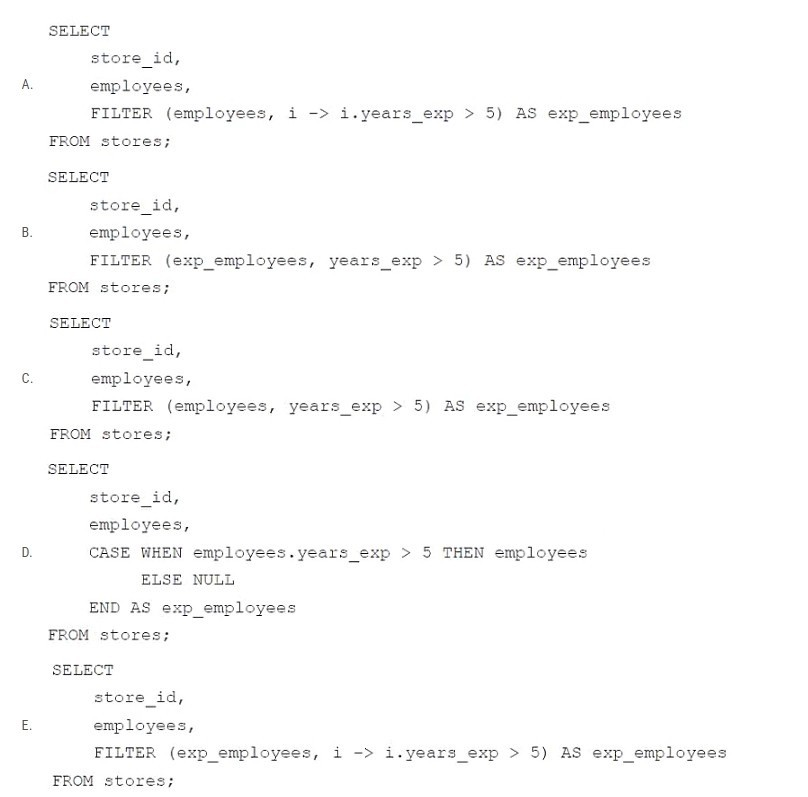
-
A
-
B
-
C
-
D
-
E
Reveal answer details
Close answer details
Correct answerA
ExplanationOption A passes the employees array to FILTER and supplies a lambda, i -> i.years_exp > 5. The lambda evaluates each employee element and retains only those whose experience exceeds five years, producing the required array under the exp_employees alias for every store row.
Question 17
Single choice
A data engineer wants to create a SQL UDF that converts text to lowercase. Which of the following code blocks correctly creates this SQL UDF in Databricks SQL?
-
A
CREATE FUNCTION to_lowercase(text STRING)
AS RETURN lower(text);
-
B
CREATE OR REPLACE FUNCTION to_lowercase(text STRING)
RETURNS STRING
RETURN lower(text);
-
C
CREATE FUNCTION to_lowercase(text STRING)
RETURNS STRING
BEGIN RETURN lower(text);
END;
-
D
CREATE FUNCTION to_lowercase(text STRING)
RETURNS STRING
RETURN upper(text);
-
E
CREATE TEMP FUNCTION to_lowercase AS 'lower(text)';
Reveal answer details
Close answer details
Correct answerB
ExplanationThe function definition must declare its parameter, its STRING return type, and an expression that produces the result. CREATE OR REPLACE FUNCTION supports creating or updating the function, while RETURN lower(text) performs the requested lowercase conversion. Calling upper(text) would reverse the intended behavior.
Question 18
Multiple choice
A data engineer needs to compute metrics such as: rolling 7-day sales percent of total revenue top-N most profitable categories. Which two approaches are appropriate for implementing these metrics with PySpark DataFrames? (Choose two.)
-
A
Using RDD aggregations for better performance.
-
B
Using mapPartitions to manually implement rolling windows.
-
C
Using window functions for rolling and ranking calculations.
-
D
Collecting the DataFrame to the driver for faster iterative processing.
-
E
Using joins and groupBy to compute percent-of-total metrics.
Reveal answer details
Close answer details
Correct answersC, E
ExplanationWindow functions preserve row context while defining ordered or partitioned windows, which supports rolling seven-day calculations and ranking categories for top-N results. For percent-of-total metrics, groupBy can calculate totals at the required grain and a join can attach those totals to the relevant rows or groups before computing each percentage.
Question 19
Single choice
Which of the following is a benefit of the Databricks Lakehouse Platform embracing open source technologies?
-
A
Cloud-specific integrations
-
B
-
C
-
D
Ability to scale workloads
-
E
Reveal answer details
Close answer details
Correct answerE
ExplanationOpen source technologies use openly available formats and interfaces rather than tying data and workloads exclusively to one provider's proprietary implementation. This gives an organization more freedom to move or integrate its assets with other tools, which directly supports avoiding vendor lock-in.
Question 20
Single choice
A data engineer has developed a Python notebook in a Databricks workspace and has configured it to run as a scheduled Job to process daily sales data. How are the storage and execution of this notebook managed within the Databricks architecture?
-
A
The notebook is stored securely and encrypted in the control plane, and the code executes in the compute plane when the job runs.
-
B
The notebook is stored securely and encrypted in the compute plane, and the code executes in the control plane when the job runs.
-
C
The notebook is stored securely and encrypted in Unity Catalog, and the code executes in Delta Lake when the job runs.
-
D
The notebook is stored unencrypted in the workspace storage bucket, and the code executes on the cluster driver node in the compute plane when the job runs.
Reveal answer details
Close answer details
Correct answerA
ExplanationThe notebook is stored securely and encrypted in the control plane, which manages workspace artifacts and job definitions. When the scheduled job starts, its code executes on resources in the compute plane, where the data processing occurs. This separation keeps notebook storage and orchestration in the control plane while assigning execution to compute.
Question 21
Single choice
A data engineer must deliver a trustworthy customer 360 dataset in Databricks for data scientists and BI teams. The engineer plans to join deduplicated customer records with cleaned transaction data, enforce schema and data quality checks, and create a conformed "customer_transactions" view. Later, highly aggregated, domain-specific tables (for weekly spend and executive summaries) will be produced for dashboards. Where should the engineer build the conformed "customer_transactions" dataset, and where should the aggregated, report-ready tables reside?
-
A
Build both "customer_transactions" and aggregated, report-ready tables in Silver to keep the model simpler.
-
B
Build "customer_transactions" in Bronze and put the aggregated, report-ready tables in Silver.
-
C
Build "customer_transactions" in Gold and put the aggregated, report-ready tables in Silver.
-
D
Build "customer_transactions" in Silver and put the aggregated, report-ready tables in Gold.
Reveal answer details
Close answer details
Correct answerD
ExplanationThe conformed customer_transactions dataset belongs in Silver because it joins cleaned, deduplicated customer and transaction records and applies schema and quality controls while remaining reusable. The weekly spend and executive tables belong in Gold because they are aggregated, domain-specific, report-ready products built for dashboards and business consumption.
Question 22
Single choice
A data engineer has written a function in a Databricks Notebook to calculate the population of bacteria in a given medium. def calculate_population_of_bacteria (intital_population, exponential_factor):
return future_population = intital_population ** exponential_factor Analysts use this function in the notebook and sometimes provide input arguments of the wrong data type, which can cause errors during execution. Which Databricks feature will help the data engineer quickly identify if an incorrect data type has been provided as input?
-
A
The Spark User interface has a debug tab that contains the variables that are used in this session.
-
B
The Databricks debugger enables breakpoints that will raise an error if the wrong data type is submitted.
-
C
The Databricks debugger enables the use of a variable explorer to see at a glance the value of the variables.
-
D
The Data Engineer should add print statements to find out what the variable is.
Reveal answer details
Close answer details
Correct answerC
ExplanationThe debugger's variable explorer provides a consolidated view of variables and their current values during debugging. This lets the engineer inspect the arguments supplied to the function and quickly recognize a value whose data type is inappropriate for the calculation. Breakpoints pause execution, but they do not inherently create automatic wrong-type validation.
Question 23
Single choice
A Lakeflow Jobs workflow fails at the last task because of an error in a notebook task. This workflow is scheduled to run daily. The data engineer fixes the notebook and wants to rerun the pipeline. This workflow is very compute-intensive and expensive to run. Which action should the data engineer take in order to minimize downtime and compute cost?
-
A
-
B
-
C
Re-run the entire workflow
-
D
Switch to another cluster
Reveal answer details
Close answer details
Correct answerB
ExplanationA repair run resumes the corrected workflow by rerunning the failed task and any work that must follow it, while preserving successful upstream results where applicable. Because the failure occurred at the final task, this avoids repeating the expensive compute-intensive stages and minimizes both recovery time and additional cost.
Question 24
Single choice
A data engineer is standardizing repository layouts for multiple teams adopting Databricks Asset Bundles. The engineer wants to ensure every project has a single authoritative configuration file at the repository root that defines the bundle name, targets, workspace settings, permissions, and resource mappings (for jobs and pipelines). What strategy should the data engineer use to meet the goal?
-
A
Place multiple databricks.yml files under each subfolder (for example, jobs/pipelines/, workspace/) and merge them at deploy time using the include mapping.
-
B
Place exactly one databricks.yml at the repository root; it is the main configuration file and may reference additional configuration files via the include mapping.
-
C
Place a databricks.yml in a databricks/hidden folder at the repository root; only hidden locations are valid for bundle configs.
-
D
Place a databricks.yaml at the repository root and optional databricks.yml in subfolders; the CLI prefers .yaml over.yml when both exist.
Reveal answer details
Close answer details
Correct answerB
ExplanationThe repository root should contain exactly one authoritative databricks.yml as the bundle's main configuration file. It establishes the bundle identity and can define targets, workspace settings, permissions, and resource mappings. When configuration is split for maintainability, the root file may reference additional files through include without creating competing main files.
Question 25
Single choice
What is stored in a Databricks customer's cloud account?
-
A
-
B
Cluster management metadata
-
C
Databricks web application
-
D
Reveal answer details
Close answer details
Correct answerA
ExplanationThe customer's cloud account holds the organization's data. In the classic architecture, platform services such as the Databricks web application and cluster-management metadata belong to the control plane rather than being the customer data stored in that account. This separation makes Data the applicable item.
Question 26
Single choice
Which single Databricks CLI command deploys local bundle assets to the target workspace specified in the configuration file?
-
A
databricks bundle init && databricks bundle deployment
-
B
databricks bundle plan && databricks bundle run
-
C
-
D
databricks bundle validate
Reveal answer details
Close answer details
Correct answerC
ExplanationDatabricks bundle deploy is the command that applies the local bundle definition and assets to the configured target workspace. Validation only checks configuration, initialization creates a bundle project, and running concerns execution after deployment; none of those operations substitutes for deploying the assets.
Question 27
Single choice
A data engineer has a PySpark DataFrame events_df which contains a nested device struct, which itself includes a nested location struct, as shown:  The goal is to flatten the nested fields into root-level columns while keeping the event identifiers and timestamp. Which PySpark expression achieves this?
-
A
-
B
-
C
-
D
Reveal answer details
Close answer details
Correct answerA
ExplanationNested struct fields are addressed with dot notation in a DataFrame select. Selecting event_id and event_ts alongside device.id, device.model, device.location.latitude, and device.location.longitude projects the nested values as output columns while preserving the event identifiers and timestamp.
Question 28
Single choice
Which of the following must be specified when creating a new Delta Live Tables pipeline?
-
A
A key-value pair configuration
-
B
The preferred DBU/hour cost
-
C
A path to cloud storage location for the written data
-
D
A location of a target database for the written data
-
E
At least one notebook library to be executed
Reveal answer details
Close answer details
Correct answerE
ExplanationA Delta Live Tables pipeline needs executable source logic that defines the datasets and transformations it will run. At least one notebook library supplies that pipeline code, so it is required when the pipeline is created. Optional configuration pairs, cost preferences, storage paths, and target-database choices do not replace executable pipeline definitions.
Question 29
Single choice
What is the functionality of AutoLoader in Databricks?
-
A
Auto Loader automatically ingests and processes new files from cloud storage, handling both batch and streaming data with support for schema evolution.
-
B
Auto Loader automatically ingests and processes new files from cloud storage, handling batch and streaming data with no support for schema evolution.
-
C
Auto Loader automatically ingests and processes new files from cloud storage, handling only streaming data with no support for schema evolution.
-
D
Auto Loader automatically ingests and processes new files from cloud storage, handling batch data with support for schema evolution.
Reveal answer details
Close answer details
Correct answerA
ExplanationAuto Loader discovers and incrementally processes new files arriving in cloud storage. It supports both continuously streaming ingestion and bounded batch-style workloads, while its schema capabilities can accommodate supported evolution as file structures change. Removing schema evolution or restricting it to one workload mode would omit key functionality.
Question 30
Single choice
In which of the following scenarios should a data engineer use the MERGE INTO command instead of the INSERT INTO command?
-
A
When the location of the data needs to be changed
-
B
When the target table is an external table
-
C
When the source table can be deleted
-
D
When the target table cannot contain duplicate records
-
E
When the source is not a Delta table
Reveal answer details
Close answer details
Correct answerD
ExplanationINSERT INTO appends source rows without matching them against rows already in the target. MERGE INTO can compare source and target keys, update a matching record, and insert only a nonmatching record. That matched-versus-unmatched behavior is needed when the target cannot contain duplicate records.
Question 31
Single choice
A data engineer streams customer orders into a Kafka topic (orders_topic) and is currently writing the ingestion script of a DLT pipeline. The data engineer needs to ingest the data from Kafka brokers to DLT using Databricks. What is the correct code for ingesting the data? 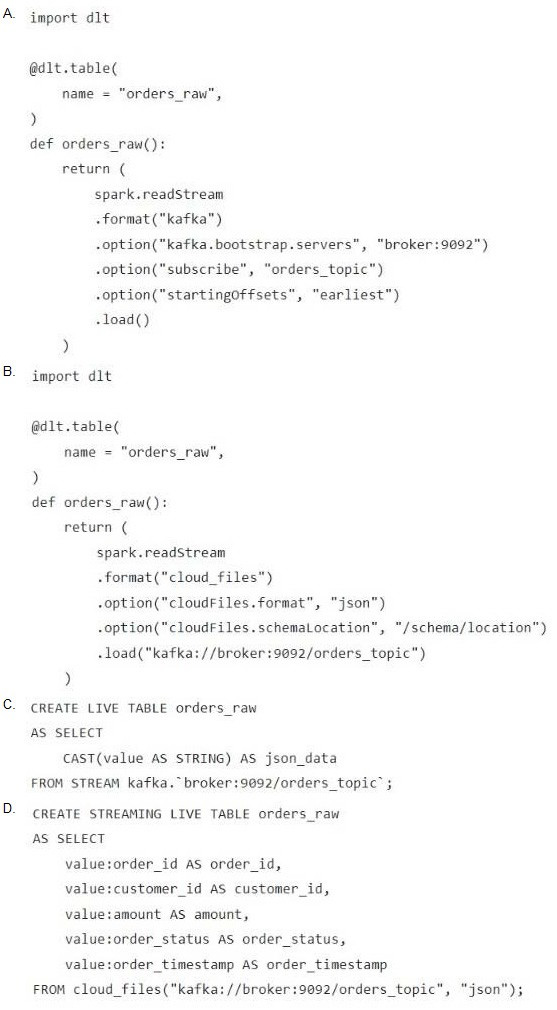
-
A
-
B
-
C
-
D
Reveal answer details
Close answer details
Correct answerA
ExplanationOption A creates a DLT table function and returns a streaming DataFrame built with spark.readStream. It selects the Kafka source, supplies the broker through kafka.bootstrap.servers, subscribes to orders_topic, and requests the earliest starting offsets before loading the stream. These settings directly connect the DLT ingestion table to the Kafka topic.
Question 32
Single choice
Which command removes unused data files in Delta tables?
-
A
-
B
-
C
-
D
-
E
Reveal answer details
Close answer details
Correct answerD
ExplanationVACUUM removes data files that are no longer referenced by the current Delta table state and are eligible for cleanup. This reclaims storage occupied by obsolete files. DELETE removes logical table rows, while OPTIMIZE reorganizes active small files rather than cleaning up unused ones.
Question 33
Single choice
A data engineer is running a Spark SQL job on Databricks and notices that joins between a small lookup table and a large fact table are slow. The data engineer wants Spark to automatically send the small lookup table to all executors to speed up the join. Which configuration parameter should the data engineer adjust?
-
A
spark.sql.shuffle.partitions
-
B
-
C
spark.sql.autoBroadcastJoinThreshold
-
D
spark.default.parallelism
Reveal answer details
Close answer details
Correct answerC
Explanationspark.sql.autoBroadcastJoinThreshold controls the estimated table size below which Spark may automatically choose a broadcast join. Adjusting it so the lookup table qualifies allows Spark to distribute that small table to executors. The large fact table can then be joined locally without a full two-sided shuffle, improving the slow join.
Question 34
Single choice
A data engineer has a Job with multiple tasks that runs nightly. Each of the tasks runs slowly because the clusters take a long time to start. Which of the following actions can the data engineer perform to improve the start up time for the clusters used for the Job?
-
A
They can use endpoints available in Databricks SQL
-
B
They can use jobs clusters instead of all-purpose clusters
-
C
They can configure the clusters to be single-node
-
D
They can use clusters that are from a cluster pool
-
E
They can configure the clusters to autoscale for larger data sizes
Reveal answer details
Close answer details
Correct answerD
ExplanationA cluster pool maintains ready-to-use instances that a job cluster can acquire, reducing the provisioning delay experienced when every task must wait for new resources. This directly addresses slow cluster startup. Autoscaling responds to workload size after startup and therefore does not solve the stated delay.
Question 35
Single choice
A data engineer needs to apply custom logic to string column city in table stores for a specific use case. In order to apply this custom logic at scale, the data engineer wants to create a SQL user-defined function (UDF). Which of the following code blocks creates this SQL UDF? 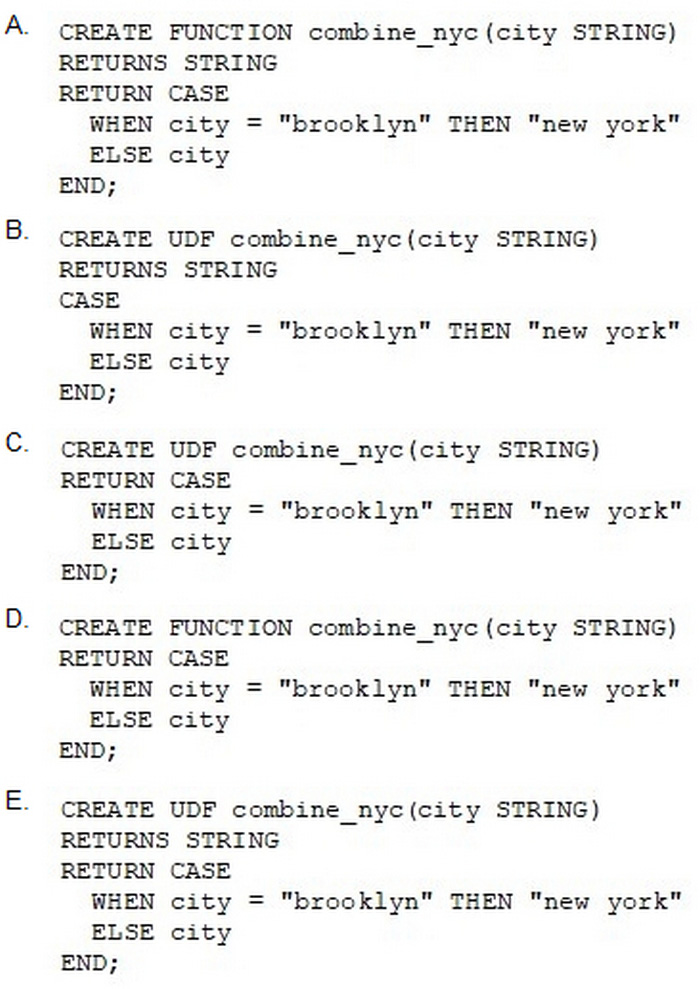
-
A
-
B
-
C
-
D
-
E
Reveal answer details
Close answer details
Correct answerA
ExplanationOption A uses the SQL function declaration structure required here: CREATE FUNCTION, a typed city STRING parameter, RETURNS STRING, and a returned expression. Its RETURN CASE expression converts Brooklyn to New York and otherwise returns the original city value.
Question 36
Single choice
A data engineering team uses Declarative Automation Bundles (formerly Databricks Asset Bundles) to deploy the same codebase across dev, test, and prod environments. The team wants environment-specific behavior to be applied only through bundle configuration, without modifying notebooks, job definitions, or deployment logic during promotion. Which approach applies environment-specific configuration while meeting this requirement?
-
A
Use separate Git branches per environment so each branch can contain environment-specific configuration values.
-
B
Define bundle variables and reference them from bundle resources, then override variable values per environment using bundle targets.
-
C
Parameterize environment-specific values inside notebooks and set those parameters when each job run is triggered.
-
D
Deploy the same bundle once and edit job settings in the workspace UI for each environment after deployment.
Reveal answer details
Close answer details
Correct answerB
ExplanationBundle variables separate configurable values from the resource definitions that consume them. Jobs, pipelines, and other resources reference those variables once, while each dev, test, or prod target overrides the values appropriate to its environment. Promotion can therefore use the same notebooks, resource definitions, and deployment logic, with behavior determined entirely by target configuration.
Question 37
Single choice
A data engineer wants to create a data entity from a couple of tables. The data entity must be used by other data engineers in other sessions. It also must be saved to a physical location. Which of the following data entities should the data engineer create?
-
A
-
B
-
C
-
D
-
E
Reveal answer details
Close answer details
Correct answerE
ExplanationA table is persistent across sessions and stores its data at a physical location. Those two properties allow other data engineers to use the entity later without depending on the creator's active session. A temporary view is session-scoped, while a regular view represents a saved query and does not itself satisfy the requirement to store physical data.
Question 38
Single choice
A data engineer is designing a Databricks Job that includes a Notebook task for data cleansing and a SQL Query task for generating a summary report. The summary report must only execute after the cleansing task completes successfully. How should the dependency be configured in the Lakeflow Jobs task graph?
-
A
Select the cleansing task as a 'Run if' dependency in the summary report task configuration.
-
B
Set both tasks to run on the same schedule with a five-minute start delay for the report.
-
C
Configure the cleansing task to use an 'On Failure' trigger to start the summary report.
-
D
Place both tasks in the same notebook and use a standard Python function call.
Reveal answer details
Close answer details
Correct answerA
ExplanationThe summary report has a success dependency on the cleansing task, so the dependency belongs in the report task's configuration. Selecting cleansing and using the appropriate Run if condition makes the task graph wait for successful completion before allowing the SQL Query task to execute.
Question 39
Single choice
Which of the following benefits is provided by the array functions from Spark SQL?
-
A
An ability to work with data in a variety of types at once
-
B
An ability to work with data within certain partitions and windows
-
C
An ability to work with time-related data in specified intervals
-
D
An ability to work with complex, nested data ingested from JSON files
-
E
An ability to work with an array of tables for procedural automation
Reveal answer details
Close answer details
Correct answerD
ExplanationArray functions operate on array-valued fields, including arrays nested inside complex records. This structure commonly appears when JSON files are ingested because JSON can contain nested objects and lists. The functions therefore make it practical to inspect, filter, transform, or otherwise work with complex, nested JSON data.
Question 40
Single choice
A data engineer is troubleshooting two different pipeline failures: Pipeline A fails with a java.lang.OutOfMemoryError is immediately thrown after the command display(df.collect()) is called on a 100GB dataset. Pipeline B fails during a wide transformation (a join of two large tables) with an ExecutorLostFailure error message, indicating executor memory exhaustion during shuffle. Which action should the data engineer take to fix these two issues?
-
A
For Pipeline A, switch to a Storage Optimized cluster; for Pipeline B, use a Compute Optimized cluster.
-
B
For Pipeline A, increase the spark.driver.memory; for Pipeline B, increase the spark.sql.shuffle.partitions or executor memory.
-
C
For Pipeline A, increase the number of executors; for Pipeline B, increase the driver memory.
-
D
For both pipelines, enable Adaptive Query Execution (AQE) as it automatically manages memory allocation for both the driver and executors.
Reveal answer details
Close answer details
Correct answerB
Explanationcollect() brings the entire 100GB result to the driver, so Pipeline A exhausts driver memory and requires more spark.driver.memory or avoidance of full collection. Pipeline B fails on executors during a shuffle-heavy join; increasing spark.sql.shuffle.partitions reduces data per shuffle task, while additional executor memory raises the available task memory.
Question 41
Single choice
Which of the following describes the relationship between Bronze tables and raw data?
-
A
Bronze tables contain less data than raw data files.
-
B
Bronze tables contain more truthful data than raw data.
-
C
Bronze tables contain aggregates while raw data is unaggregated.
-
D
Bronze tables contain a less refined view of data than raw data.
-
E
Bronze tables contain raw data with a schema applied.
Reveal answer details
Close answer details
Correct answerE
ExplanationThe Bronze layer preserves the source data in its raw form while placing it into a table structure. Applying a schema gives columns and types to those ingested values without implying the cleansing, validation, or aggregation associated with later layers. Bronze tables therefore contain raw data with a schema applied.
Question 42
Single choice
A Delta Live Table pipeline includes two datasets defined using streaming live table. Three datasets are
defined against Delta Lake table sources using live table. The table is configured to run in Production mode using the Continuous Pipeline Mode. What is the expected outcome after clicking Start to update the pipeline assuming previously unprocessed data exists and all definitions are valid?
-
A
All datasets will be updated once and the pipeline will shut down. The compute resources will be terminated.
-
B
All datasets will be updated at set intervals until the pipeline is shut down. The compute resources will persist to allow for additional testing.
-
C
All datasets will be updated once and the pipeline will shut down. The compute resources will persist to allow for additional testing.
-
D
All datasets will be updated at set intervals until the pipeline is shut down. The compute resources will be deployed for the update and terminated when the pipeline is stopped.
Reveal answer details
Close answer details
Correct answerD
ExplanationContinuous Pipeline Mode repeatedly processes available updates and remains active until explicitly stopped; it is not a one-time pipeline run. Accordingly, both streaming and table-backed datasets are updated at intervals. Production compute is deployed to perform that work and is terminated when the running pipeline is stopped.
Question 43
Single choice
A Delta Live Table pipeline includes two datasets defined using STREAMING LIVE TABLE. Three datasets are defined against Delta Lake table sources using LIVE TABLE. The table is configured to run in Production mode using the Continuous Pipeline Mode. Assuming previously unprocessed data exists and all definitions are valid, what is the expected outcome after clicking Start to update the pipeline?
-
A
All datasets will be updated at set intervals until the pipeline is shut down. The compute resources will persist to allow for additional testing.
-
B
All datasets will be updated once and the pipeline will persist without any processing.The compute resources will persist but go unused.
-
C
All datasets will be updated at set intervals until the pipeline is shut down. The compute resources will be deployed for the update and terminated when the pipeline is stopped.
-
D
All datasets will be updated once and the pipeline will shut down. The compute resources will be terminated.
-
E
All datasets will be updated once and the pipeline will shut down. The compute resources will persist to allow for additional testing.
Reveal answer details
Close answer details
Correct answerC
ExplanationContinuous Pipeline Mode keeps processing rather than performing a single update and then shutting down. Consequently, all valid datasets are updated at intervals until the pipeline is stopped. In Production mode, compute is deployed for pipeline processing and is terminated when that continuously running pipeline is stopped.
Question 44
Single choice
What is the structure of an Asset Bundle?
-
A
A Docker image containing runtime environments and the source code of the assets
-
B
A compressed archive (ZIP) that solely contains workspace assets without any accompanying metadata
-
C
A single plain text file enumerating the names of assets to be migrated to a new workspace
-
D
A YAML configuration file that specifies the artifacts, resources, and configurations for the project
Reveal answer details
Close answer details
Correct answerD
ExplanationAn Asset Bundle is described through YAML configuration that declares the project artifacts, deployable resources, targets, and related settings. This configuration provides version-controlled metadata for deploying and managing the project consistently. It is not merely packaged source code, a runtime container, or an archive lacking resource and environment definitions.
|



