How are privileges inherited in Unity Catalog across the hierarchy levels of metastore, catalog, schema, and table/view?
-
A
Privileges granted at a higher level (such as a catalog) automatically apply to all child objects (schemas and tables) unless overridden by more specific permissions at a lower level.
-
B
Privileges are only inherited from the metastore level, and no inheritance occurs between catalogs, schemas, or tables.
-
C
Privileges must be granted individually for each object, regardless of their position in the hierarchy, to ensure secure access control.
-
D
Privileges granted at the schema level have no impact on tables or views in that schema unless directly applied to them.
Reveal answer details
Close answer details
Correct answerA
ExplanationUnity Catalog's hierarchy allows a privilege granted on a parent object to apply to its descendants. A catalog-level grant therefore reaches child schemas and their tables or views, while lower-level permissions can provide more specific control. This avoids requiring the same applicable privilege to be repeated independently on every child object.
A data analyst is preparing a quarterly analytics dashboard in Databricks and needs to share it with external stakeholders who are not members of the Databricks workspace. The stakeholders should be able to view the dashboard securely without being granted workspace access or edit permissions. Which approach should the analyst use to meet the requirements?
-
A
Enable external sharing by publishing the dashboard, turning on embedded credentials, and sharing the link with stakeholders.
-
B
Add the external stakeholders as workspace admins in the Databricks environment and grant them CAN MANAGE permissions on the dashboard.
-
C
Assign the stakeholders to the All workspace users group and provide them with CAN EDIT permissions on the dashboard, even if they are not currently members of the workspace.
-
D
Export the dashboard as a PDF file and email it to the stakeholders, since Databricks dashboards offer an export-to-PDF feature.
Reveal answer details
Close answer details
Correct answerA
ExplanationPublishing the dashboard with external sharing creates a viewing path for stakeholders who are not workspace members. Embedded credentials allow the published dashboard to run its data queries without granting those viewers workspace access, and the shared link provides consumption without edit permissions. Making external viewers workspace admins or editors would violate the access boundary.
A data analyst needs to programmatically mark a Unity Catalog table, sales_data, as certified so that it is discoverable as a trusted asset across their organization. Which SQL command can be used to meet the requirement?
-
A
SET TAG ON TABLE sales_data `system.Certified`;
-
B
ALTER TABLE sales_data SET TAGS ('certified' = 'true');
-
C
GRANT CERTIFY ON TABLE sales_data TO analyst_group;
-
D
ALTER TABLE sales_data SET COMMENT 'Certified dataset';
Reveal answer details
Close answer details
Correct answerA
ExplanationUnity Catalog provides predefined system tags for standardized governance and data discovery. The system.Certified system tag identifies an asset as certified and trusted across the organization. Applying this system tag to sales_data provides the built-in certification signal used by Unity Catalog. A custom certified = true tag can categorize an object but does not mark it with the official Certified trust signal.
A data analyst needs to share a certified dataset containing approved public economic indicators with an external research institution. The institution does not have access to the Databricks workspace. The dataset is managed in Unity Catalog and has already been reviewed and tagged appropriately. The analyst's requirements are: Share the dataset securely and read-only Ensure the institution receives only the specified tables Avoid giving access to the full catalog or workspace Maintain auditability and governance using Unity Catalog. How should the analyst share the dataset?
-
A
Grant the external users access to Unity Catalog by adding their emails to the workspace.
-
B
Use COPY INTO to export the dataset into a managed Delta table, then use Unity Catalog's GRANT SELECT to provide access to the institution.
-
C
Use the GRANT SELECT command to give the external group's principal access to the table.
-
D
Create a Delta Share, add the required table, define a recipient, and ensure that a Unity Catalog metastore admin or privileged user in the recipient's workspace grants appropriate access permissions to their users.
Reveal answer details
Close answer details
Correct answerD
ExplanationDelta Sharing is designed to provide governed, read-only data access to recipients outside the provider's workspace. The analyst creates a Delta Share, adds only the required tables, and defines the institution as a recipient. Access remains scoped and auditable, while an authorized administrator on the recipient side grants its users appropriate permissions.
A data analyst is working in a Databricks workspace with Unity Catalog enabled. While using a shared SQL Warehouse, the analyst runs the following query: SELECT * FROM sales_data; This query results in a "TABLE_OR_VIEW_NOT_FOUND" error, even though: The table sales_data exists in the reporting schema of the corp_data catalog. The analyst has SELECT and USAGE privileges on the corp_data.reporting.sales_data table. Another user running the same query in a notebook attached to a cluster is able to retrieve results without fully qualifying the table. Which action helps the analyst to resolve the issue without rewriting the query?
-
A
Set the spark.databricks.sql.initial.catalog.namespace Spark configuration in the cluster attached to the SQL Warehouse.
-
B
Run the following command to set the default catalog and schema for the current session: USE CATALOG corp_data; USE SCHEMA reporting;
-
C
Modify the workspace-level catalog default so that all SQL Warehouses automatically point to corp_data.reporting.
-
D
Set spark.sql.default.database to corp_data.reporting.sales_data in the SQL Warehouse runtime configuration.
Reveal answer details
Close answer details
Correct answerB
ExplanationAn unqualified name is resolved against the current catalog and schema of the SQL session. Running USE CATALOG corp_data followed by USE SCHEMA reporting sets that namespace, so sales_data resolves to corp_data.reporting.sales_data without changing the SELECT statement. Table privileges alone do not establish the session's name-resolution context.
A data engineering team has created a Structured Streaming pipeline that processes data in micro-batches and populates gold-level tables. The microbatches are triggered every minute. A data analyst has created a dashboard based on this gold-level data. The project stakeholders want to see the results in the dashboard updated within one minute or less of new data becoming available within the gold-level tables. Which of the following cautions should the data analyst share prior to setting up the dashboard to complete this task?
-
A
The required compute resources could be costly
-
B
The gold-level tables are not appropriately clean for business reporting
-
C
The streaming data is not an appropriate data source for a dashboard
-
D
The streaming cluster is not fault tolerant
-
E
The dashboard cannot be refreshed that quickly
Reveal answer details
Close answer details
Correct answerA
ExplanationRefreshing a dashboard within one minute of each gold-table update requires compute to be available and queries to execute at a similarly frequent cadence. That repeated or continuously ready computation can increase resource consumption and cost. The gold layer and streaming source are otherwise compatible with dashboard reporting.
Which statement about visualizations is true?
-
A
All visualizations must use the same data in order to be included in the same Databricks SQL dashboard.
-
B
Line charts are the preferred visualization type for categorical data.
-
C
Different visualizations can be used to tell different stories about the data.
-
D
There is no difference between the bar chart and a histogram in Databricks SQL.
Reveal answer details
Close answer details
Correct answerC
ExplanationVisualization types emphasize different relationships in the same or different datasets. A line chart can highlight change over an ordered dimension, while bars, counters, tables, and other forms can emphasize comparisons or summaries. Choosing different visualizations therefore allows an analyst to tell different supported stories about the data.
A data analysis team is working with the table_bronze SQL table as a source for one of its most complex projects. A stakeholder of the project notices that some of the downstream data is duplicative. The analysis team identifies table_bronze as the source of the duplication. Which of the following queries can be used to deduplicate the data from table_bronze and write it to a new table table_silver?
-
A
CREATE TABLE table_silver AS
SELECT DISTINCT *
FROM table_bronze;
-
B
CREATE TABLE table_silver AS
INSERT *
FROM table_bronze;
-
C
CREATE TABLE table_silver AS
MERGE DEDUPLICATE *
FROM table_bronze;
-
D
INSERT INTO TABLE table_silver
SELECT * FROM table_bronze;
-
E
INSERT OVERWRITE TABLE table_silver
SELECT * FROM table_bronze;
Reveal answer details
Close answer details
Correct answerA
ExplanationSELECT DISTINCT * eliminates duplicate complete rows from table_bronze. Wrapping that query in CREATE TABLE table_silver AS materializes the deduplicated result as a new table in one statement. A plain INSERT or INSERT OVERWRITE copies the selected rows but provides no DISTINCT operation to remove duplicates.
A data analyst has been asked to configure an alert for a query that returns the income in the accounts_receivable table for a date range. The date range is configurable using a Date query parameter. The Alert does not work. Which of the following describes why the Alert does not work?
-
A
Alerts don't work with queries that access tables.
-
B
Queries that return results based on dates cannot be used with Alerts.
-
C
The wrong query parameter is being used. Alerts only work with Date and Time query parameters.
-
D
Queries that use query parameters cannot be used with Alerts.
-
E
The wrong query parameter is being used. Alerts only work with dropdown list query parameters, not dates.
Reveal answer details
Close answer details
Correct answerD
ExplanationThe alert depends on evaluating a query result automatically, but a query that requires a query parameter cannot be used with Alerts in this scenario. The failure follows from parameter use itself, not from reading a table or returning date-based data. Changing the parameter from Date to another parameter type would not remove that restriction.
Question 10
Single choice
A data analyst is processing a complex aggregation on a table with zero null values and their query returns the following result: 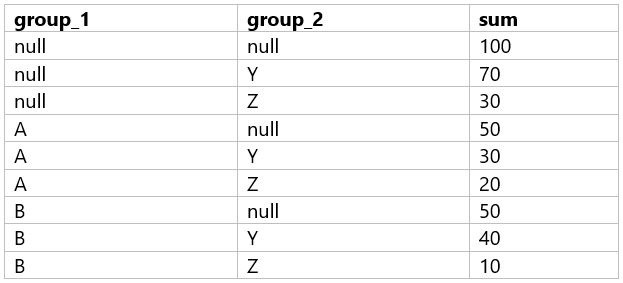 Which of the following queries did the analyst run to obtain the above result? 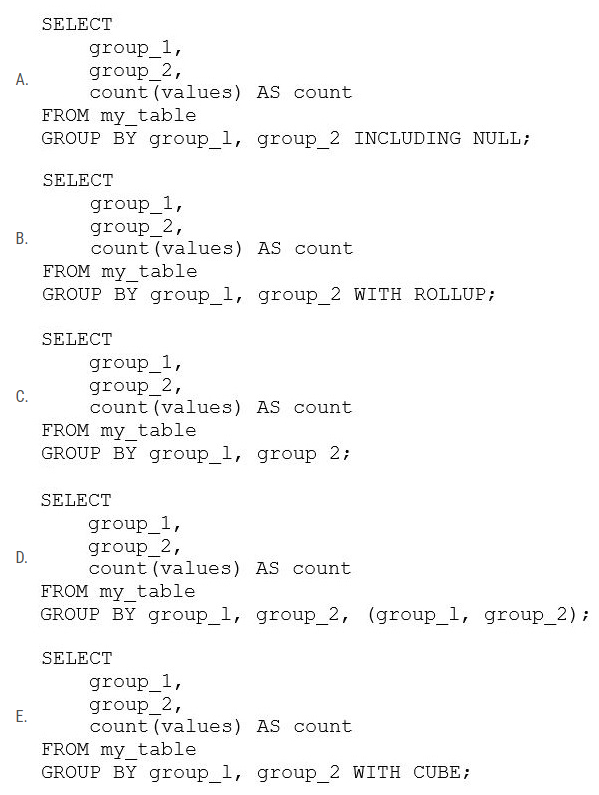
-
A
-
B
-
C
-
D
-
E
Reveal answer details
Close answer details
Correct answerE
ExplanationOption E uses WITH CUBE on group_1 and group_2. A cube calculates the detailed pairs, subtotals for each value of group_1, subtotals for each value of group_2, and the grand total. Those aggregation levels account for rows where either grouping column or both grouping columns are represented by NULL despite no source nulls.
Question 11
Single choice
Which of the following statements about a refresh schedule is incorrect?
-
A
A query can be refreshed anywhere from 1 minute to 2 weeks.
-
B
Refresh schedules can be configured in the Query Editor.
-
C
A query being refreshed on a schedule does not use a SQL Warehouse (formerly known as SQL Endpoint).
-
D
A refresh schedule is not the same as an alert.
-
E
You must have workspace administrator privileges to configure a refresh schedule.
Reveal answer details
Close answer details
Correct answerC
ExplanationA refresh schedule can be configured for a query without requiring workspace administrator privileges. Users with the appropriate permissions on the query and required resources can configure scheduled refreshes. A refresh schedule periodically reruns a query and is distinct from an alert, which evaluates query results against a condition and can send notifications when that condition is met.
Question 12
Single choice
After running DESCRIBE EXTENDED accounts.customers;, the following was returned: 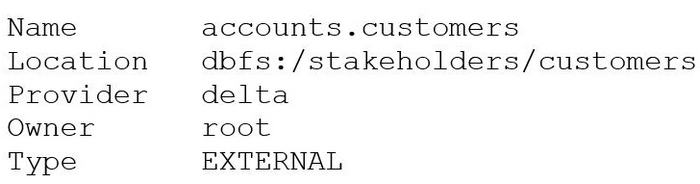 Now, a data analyst runs the following command: DROP TABLE accounts.customers; Which of the following describes the result of running this command?
-
A
Running SELECT * FROM delta.`dbfs:/stakeholders/customers`
-
B
Running SELECT * FROM accounts.customers will return all rows in the table.
-
C
All files with the .customers extension are deleted.
-
D
The accounts.customers table is removed from the metastore, and the underlying data files are deleted.
-
E
The accounts.customers table is removed from the metastore, but the underlying data files are untouched.
Reveal answer details
Close answer details
Correct answerE
ExplanationThe DESCRIBE EXTENDED output shows that accounts.customers is an EXTERNAL Delta table. Dropping an external table removes only its metadata from the metastore; it does not delete the underlying data stored at dbfs:/stakeholders/customers. Therefore, the table can no longer be queried by its registered table name, but the Delta files remain at the original location and can still be accessed directly or used to recreate the table.
Question 13
Single choice
A managed table and an unmanaged (external) table were both created in Databricks SQL, and data were ingested into each table. Later, both tables were dropped. What is the status of data for each of those tables?
-
A
The data in both tables were deleted.
-
B
The data in the managed table were deleted, and the data in the unmanaged (external) table were left untouched.
-
C
The data in the unmanaged (external) table were deleted and the data in the managed table were left untouched, for both tables the metadata was the same.
-
D
The data in both tables were left untouched.
Reveal answer details
Close answer details
Correct answerB
ExplanationA managed table places both its metadata and data lifecycle under the metastore's management, so dropping it removes its associated data. An unmanaged, or external, table points to data whose lifecycle remains outside table management. Dropping that table removes its metadata but leaves the external data untouched.
Question 14
Single choice
A data architect has informed a data analyst team that its organization will now use a data design pattern that will logically organize data in a lakehouse, with the goal of incrementally and progressively improving the structure and quality of data as it flows through each layer of the architecture. Which term is used to describe this data design pattern?
-
A
-
B
-
C
-
D
Reveal answer details
Close answer details
Correct answerA
ExplanationMedallion architecture organizes lakehouse data into progressive layers that improve structure and quality as data moves forward, commonly from raw ingestion through validated data to consumption-ready models. Change data feed tracks row changes, Delta Lake is a storage technology, and data mesh is an organizational data ownership pattern.
Question 15
Single choice
A data analyst wants to implement a use case that requires managing both structured and unstructured data. How will Unity Catalog help in this scenario?
-
A
It allows for the management of both structured data and unstructured data through objects such as tables and volumes.
-
B
It requires all unstructured data to be converted into Delta Lake format before it can be managed.
-
C
It can catalog data coming from relational databases, excluding files and non-tabular data.
-
D
It manages structured data in tabular format and unstructured files like images in blob storage.
Reveal answer details
Close answer details
Correct answerA
ExplanationUnity Catalog can govern different kinds of data through distinct securable objects. Structured records can be represented as tables, while non-tabular files can be managed through volumes. This gives the analyst one governance framework for both structured and unstructured data without requiring every file to be converted into a table.
Question 16
Single choice
A data analyst created and is the owner of the managed table my_table. They now want to change ownership of the table to a single other user using Data Explorer. Which of the following approaches can the analyst use to complete the task?
-
A
Edit the Owner field in the table page by removing their own account
-
B
Edit the Owner field in the table page by selecting All Users
-
C
Edit the Owner field in the table page by selecting the new owner's account
-
D
Edit the Owner field in the table page by selecting the Admins group
-
E
Edit the Owner field in the table page by removing all access
Reveal answer details
Close answer details
Correct answerC
ExplanationOwnership is transferred by changing the table's Owner field to the specific account that should become the new owner. Selecting that user's account directly establishes the requested single-user ownership. Removing the current account without naming a replacement or selecting a group would not implement the requested transfer.
Question 17
Single choice
A data analyst needs to quickly estimate the number of unique user sessions in a dataset containing billions of records on Databricks SQL. Due to performance constraints, the analyst must ensure the query runs efficiently and delivers results with acceptable accuracy. What is the primary advantage of using APPROX_COUNT_DISTINCT instead of COUNT_DISTINCT in this scenario?
-
A
APPROX_COUNT_DISTINCT provides exact counts, while COUNT DISTINCT only provides estimates.
-
B
APPROX_COUNT_DISTINCT can only be used with string columns, while COUNT DISTINCT works with numeric columns.
-
C
APPROX_COUNT_DISTINCT uses the HyperLogLog++ algorithm to provide fast approximate counts with configurable accuracy (default 5% relative standard deviation).
-
D
APPROX_COUNT_DISTINCT requires less memory by storing only the first 1000 unique values.
Reveal answer details
Close answer details
Correct answerC
ExplanationAPPROX_COUNT_DISTINCT uses HyperLogLog++ to estimate cardinality without tracking every distinct session value exactly. That algorithm reduces the work needed for billions of records and therefore returns an approximate result faster. Its accuracy is configurable, with a default relative standard deviation of 5%, which fits the stated tolerance for acceptable rather than exact accuracy.
Question 18
Single choice
A data analyst needs to programmatically mark the sales_data table in Unity Catalog as deprecated so that users across their organization can clearly see that it is no longer recommended for use. Which SQL command should they use?
-
A
ALTER TABLE sales_data SET TAGS ('deprecated' = 'true');
-
B
UPDATE TABLE sales_data ADD COMMENT 'Deprecated dataset';
-
C
ALTER TABLE sales_data SET TBLPROPERTIES ('system. certification_status'='deprecated');
-
D
ALTER TABLE sales_data SET TAGS ('system.certification_status' = 'deprecated');
Reveal answer details
Close answer details
Correct answerD
ExplanationALTER TABLE sales_data SET TAGS ('system.certification_status' = 'deprecated') updates the table's system certification tag to the recognized deprecated state. This makes the status programmatically visible to users discovering the dataset. A comment or custom deprecated tag supplies text or metadata but does not set the designated certification status.
Question 19
Single choice
A data analyst team is building reliable, production-grade data pipelines on Databricks. They require a solution that allows them to define data transformations declaratively, automatically enforce data quality expectations, and handle errors without manual intervention. Which Databricks capability addresses these requirements?
-
A
-
B
Lakeflow Spark Declarative Pipelines
-
C
-
D
Reveal answer details
Close answer details
Correct answerB
ExplanationLakeflow Spark Declarative Pipelines lets the team declare transformations and pipeline relationships while the service manages execution. It also supports data quality expectations and automated handling of pipeline errors, matching the production requirements as one capability. Jobs orchestrate tasks, and Connect focuses on bringing data from source systems.
Question 20
Single choice
A data analyst has set up a SQL query to run every four hours on a SQL endpoint, but the SQL endpoint is taking too long to start up with each run. Which of the following changes can the data analyst make to reduce the start-up time for the endpoint while managing costs?
-
A
Reduce the SQL endpoint cluster size
-
B
Increase the SQL endpoint cluster size
-
C
Turn off the Auto stop feature
-
D
Increase the minimum scaling value
-
E
Use a Serverless SQL endpoint
Reveal answer details
Close answer details
Correct answerE
ExplanationA serverless SQL endpoint removes the need to wait for a conventional endpoint cluster to start for every scheduled execution. It is therefore suited to an intermittent query that runs every four hours, reducing startup delay while avoiding the cost of keeping compute continuously active merely to eliminate that delay.
Question 21
Single choice
A data analyst needs to use the Databricks Lakehouse Platform to quickly create SQL queries and data visualizations. It is a requirement that the compute resources in the platform can be made serverless, and it is expected that data visualizations can be placed within a dashboard. Which of the following Databricks Lakehouse Platform services/capabilities meets all of these requirements?
-
A
-
B
-
C
-
D
Databricks Machine Learning
-
E
Reveal answer details
Close answer details
Correct answerE
ExplanationDatabricks SQL combines an SQL query environment with visualizations and dashboards, and its compute can be provided through serverless SQL resources. Those capabilities satisfy all three requirements in one service: rapid SQL development, dashboard-ready charts, and a serverless compute option.
Question 22
Single choice
In which of the following situations should a data analyst use higher-order functions?
-
A
When custom logic needs to be applied to simple, unnested data
-
B
When custom logic needs to be converted to Python-native code
-
C
When custom logic needs to be applied at scale to array data objects
-
D
When built-in functions are taking too long to perform tasks
-
E
When built-in functions need to run through the Catalyst Optimizer
Reveal answer details
Close answer details
Correct answerC
ExplanationHigher-order functions apply custom expressions to elements inside collection values such as arrays. They let array data objects be transformed, filtered, or aggregated at scale without converting the logic into separate Python-native processing. Simple unnested columns can ordinarily use standard scalar functions and do not require this collection-oriented mechanism.
Question 23
Single choice
Which of the following benefits of using Databricks SQL is provided by Data Explorer?
-
A
It can be used to run UPDATE queries to update any tables in a database.
-
B
It can be used to view metadata and data, as well as view/change permissions.
-
C
It can be used to produce dashboards that allow data exploration.
-
D
It can be used to make visualizations that can be shared with stakeholders.
-
E
It can be used to connect to third party BI cools.
Reveal answer details
Close answer details
Correct answerB
ExplanationData Explorer is designed for inspecting data objects and their governance information. An analyst can view table data and metadata, inspect permissions, and change permissions when authorized. Query updates, dashboard construction, visualization authoring, and third-party BI connectivity belong to other parts of the SQL workflow.
Question 24
Single choice
A data engineer is working with a nested array column products in table transactions. They want to expand the table so each unique item in products for each row has its own row where the transaction_id column is duplicated as necessary. They are using the following incomplete command: 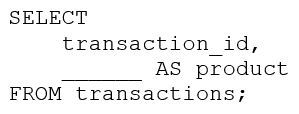 Which of the following lines of code can they use to fill in the blank in the above code block so that it successfully completes the task?
-
A
-
B
-
C
-
D
-
E
Reveal answer details
Close answer details
Correct answerB
Explanationexplode(products) converts the products array into a set of output rows, emitting one row for each array element. Every emitted row retains the other selected values from its source record, so transaction_id is repeated as needed and each product becomes the aliased product column. flatten changes array nesting but does not generate rows.
|