Preview real exam questions, verified answers and available explanations before choosing a study plan.
Question 1
Drag & drop
DRAG DROP
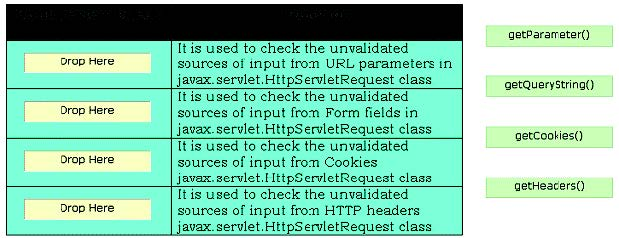
Security code review identifies the unvalidated input calls made by an attacker and avoids those calls to be processed by the server. It performs various review checks on the stained calls of servlet for identifying unvalidated input from the attacker. Choose the appropriate review checks and drop them in front of their respective functions.
Reveal answer detailsClose answer details
Explanation
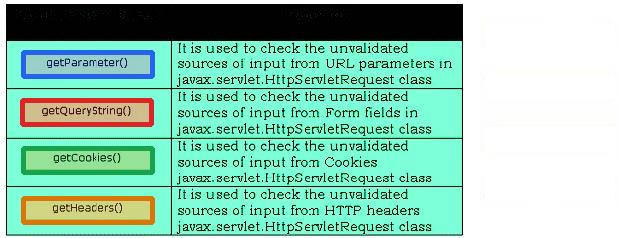
The various security code review checks performed on the stained calls of servlet are as follows: getParameter(): It is used to check the unvalidated sources of input from URL parameters in javax.servlet.HttpServletRequest class. getQueryString(): It is used to check the unvalidated sources of input from Form fields in javax.servlet.HttpServletRequest class. getCookies(): It is used to check the unvalidated sources of input from Cookies javax.servlet.HttpServletRequest class. getHeaders(): It is used to check the unvalidated sources of input from HTTP headers javax.servlet.HttpServletRequest class.
Question 2
Single choice
Which of the following elements sets up a requirement to receive the constrained requests over a protected layer connection, such as TLS (Transport Layer Security)?
A
User data constraint
B
Authorization constraint
C
Web resource collection
D
Accounting constraint
Reveal answer detailsClose answer details
Correct answerA
Explanation
User data constraint is a security constraint element summarized in the Java Servlet Specification 2.4. It sets up a requirement to receive the constrained requests over a protected layer connection, such as TLS (Transport Layer Security). The user data constraint offers guarantee (NONE, INTEGRAL, and CONFEDENTIAL) for the transportation of data between client and server. If a request does not have user data constraint, the container accepts the request after it is received on a connection. Answer: C is incorrect. Web resource collection is a set of URL patterns and HTTP operations that define all resources required to be protected. It is a security constraint element summarized in the Java Servlet Specification v2.4. The Web resource collection includes the following elements: URL patterns HTTP methods Answer: B is incorrect. Authorization constraint is a security constraint element summarized in the Java Servlet Specification 2.4. It sets up a requirement for authentication and names the authorization roles that can access the URL patterns and HTTP methods as defined by the security constraint. In the absence of a security constraint, the container accepts the request without requiring any user authentication. If no authorization role is specified in the authorization constraint, the container cannot access constrained requests. The wildcard character "*" specifies all authorization role names that are defined in the deployment descriptor. Answer: D is incorrect. It is not a security constraint element.
Question 3
Single choice
Which of the following refers to the ability to ensure that the data is not modified or tampered with?
A
Integrity
B
Availability
C
Non-repudiation
D
Confidentiality
Reveal answer detailsClose answer details
Correct answerA
Explanation
Integrity refers to the ability to ensure that the data is not modified or tampered with. Integrity means that data cannot be modified without authorization. Integrity is violated when an employee accidentally or with malicious intent deletes important data files, when a computer virus infects a computer, when an employee is able to modify his own salary in a payroll database, when an unauthorized user vandalizes a Web site, when someone is able to cast a very large number of votes in an online poll, and so on. Answer: D is incorrect. Confidentiality is the property of preventing disclosure of information to unauthorized individuals or systems. Breaches of confidentiality take many forms. Permitting someone to look over your shoulder at your computer screen while you have confidential data displayed on it could be a breach of confidentiality. If a laptop computer containing sensitive information about a company's employees is stolen or sold, it could result in a breach of confidentiality. Answer: B is incorrect. Availability means that data must be available whenever it is needed. Answer: C is incorrect. Non-repudiation is the concept of ensuring that a party in a dispute cannot refuse to acknowledge, or refute the validity of a statement or contract. As a service, it provides proof of the integrity and origin of data. Although this concept can be applied to any transmission, including television and radio, by far the most common application is in the verification and trust of signatures.
Question 4
Single choice
Which of the following is NOT a responsibility of a data owner?
A
Approving access requests
B
Ensuring that the necessary security controls are in place
C
Delegating responsibility of the day-to-day maintenance of the data protection mechanisms to the data custodian
D
Maintaining and protecting data
Reveal answer detailsClose answer details
Correct answerD
Explanation
It is not a responsibility of a data owner. The data custodian (information custodian) is responsible for maintaining and protecting the data. Answer: B, A, and C are incorrect. All of these are responsibilities of a data owner. The roles and responsibilities of a data owner are as follows: The data owner (information owner) is usually a member of management, in charge of a specific business unit, and is ultimately responsible for the protection and use of a specific subset of information. The data owner decides upon the classification of the data that he is responsible for and alters that classification if the business needs arise. This person is also responsible for ensuring that the necessary security controls are in place, ensuring that proper access rights are being used, defining security requirements per classification and backup requirements, approving any disclosure activities, and defining user access criteria. The data owner approves access requests or may choose to delegate this function to business unit managers. And it is the data owner who will deal with security violations pertaining to the data he is responsible for protecting. The data owner, who obviously has enough on his plate, delegates responsibility of the day-to-day maintenance of the data protection mechanisms to the data custodian.
Question 5
Single choice
Which of the following components of configuration management involves periodic checks to determine the consistency and completeness of accounting information and to verify that all configuration management policies are being followed?
A
Configuration Identification
B
Configuration Auditing
C
Configuration Control
D
Configuration Status Accounting
Reveal answer detailsClose answer details
Correct answerB
Explanation
Configuration auditing is a component of configuration management, which involves periodic checks to establish the consistency and completeness of accounting information and to confirm that all configuration management policies are being followed. Configuration audits are broken into functional and physical configuration audits. They occur either at delivery or at the moment of effecting the change. A functional configuration audit ensures that functional and performance attributes of a configuration item are achieved, while a physical configuration audit ensures that a configuration item is installed in accordance with the requirements of its detailed design documentation. Answer: D is incorrect. The configuration status accounting procedure is the ability to record and report on the configuration baselines associated with each configuration item at any moment of time. It supports the functional and physical attributes of software at various points in time, and performs systematic control of accounting to the identified attributes for the purpose of maintaining software integrity and traceability throughout the software development life cycle. Answer: C is incorrect. Configuration control is a procedure of the Configuration management. Configuration control is a set of processes and approval stages required to change a configuration item's attributes and to re-baseline them. It supports the change of the functional and physical attributes of software at various points in time, and performs systematic control of changes to the identified attributes. Answer: A is incorrect. Configuration identification is the process of identifying the attributes that define every aspect of a configuration item. A configuration item is a product (hardware and/or software) that has an end-user purpose. These attributes are recorded in configuration documentation and baselined. Baselining an attribute forces formal configuration change control processes to be effected in the event that these attributes are changed.
Question 6
Single choice
Which of the following is designed to detect unwanted attempts at accessing, manipulating, and disabling of computer systems through the Internet?
A
DAS
B
IPsec
C
IDS
D
ACL
Reveal answer detailsClose answer details
Correct answerC
Explanation
An Intrusion detection system (IDS) is software and/or hardware designed to detect unwanted attempts at accessing, manipulating, and/or disabling of computer systems, mainly through a network, such as the Internet. These attempts may take the form of attacks, as examples, by crackers, malware and/or disgruntled employees. An IDS cannot directly detect attacks within properly encrypted traffic. An intrusion detection system is used to detect several types of malicious behaviors that can compromise the security and trust of a computer system. This includes network attacks against vulnerable services, data driven attacks on applications, host based attacks such as privilege escalation, unauthorized logins and access to sensitive files, and malware (viruses, trojan horses, and worms). Answer: D is incorrect. Access Control List (ACL) is the most commonly used object in Cisco IOS. It filters packets or network traffic by controlling whether routed packets are forwarded or blocked at the router's interfaces. According to the criteria specified within the access lists, router determines whether the packets to be forwarded or dropped. Access control list criteria could be the source or destination address of the traffic or other information. The types of Cisco ACLs are Standard IP, Extended IP, IPX, Appletalk, etc. Answer: B is incorrect. Internet Protocol Security (IPSec) is a method of securing data. It secures traffic by using encryption and digital signing. It enhances the security of data as if an IPSec packet is captured, its contents cannot be read. IPSec also provides sender verification that ensures the certainty of the datagram's origin to the receiver. Answer: A is incorrect. Direct-attached storage (DAS) is a digital storage system that is directly attached to a server or workstation, without using a storage network.
Question 7
Multiple choice
What NIACAP certification levels are recommended by the certifier? Each correct answer represents a complete solution. Choose all that apply.
A
Comprehensive Analysis
B
Maximum Analysis
C
Detailed Analysis
D
Minimum Analysis
E
Basic Security Review
F
Basic System Review
Reveal answer detailsClose answer details
Correct answersA, C, D, E
Explanation
NIACAP has four levels of certification. These levels ensure that the appropriate C&A are performed for varying schedule and budget limitations. The certifier must analyze the system's business functions. The certifier determines the degree of confidentiality, integrity, availability, and accountability, and then recommends one of the following NIACAP certification levels: Level 1 - Basic Security Review Level 2 - Minimum Analysis Level 3 - Detailed Analysis Level 4 - Comprehensive Analysis Answer: B and F are incorrect. No such types of levels exist.
Question 8
Multiple choice
The NIST ITL Cloud Research Team defines some primary and secondary technologies as the fundamental elements of cloud computing in its "Effectively and Securely Using the Cloud Computing Paradigm" presentation. Which of the following technologies are included in the primary technologies? Each correct answer represents a complete solution. Choose all that apply.
A
Web application framework
B
Free and open source software
C
SOA
D
Virtualization
Reveal answer detailsClose answer details
Correct answersB, C, D
Explanation
The primary technologies defined by the NIST ITL Cloud Research Team in its "Effectively and Securely Using the Cloud Computing Paradigm" presentation are as follows: Virtualization Grid technology SOA (Service Oriented Architecture) Distributed computing Broadband network Browser as a platform Free and open source software Answer: A is incorrect. It is defined as the secondary technology.
Question 9
Multiple choice
Which of the following activities are performed by the 'Do' cycle component of PDCA (plan-do- check-act)? Each correct answer represents a complete solution. Choose all that apply.
A
It detects and responds to incidents properly.
B
It determines controls and their objectives.
C
It manages resources that are required to achieve a goal.
D
It performs security awareness training.
E
It operates the selected controls.
Reveal answer detailsClose answer details
Correct answersA, C, D, E
Explanation
The 'Do' cycle component performs the following activities: It operates the selected controls. It detects and responds to incidents properly. It performs security awareness training. It manages resources that are required to achieve a goal. Answer: B is incorrect. This activity is performed by the 'Plan' cycle component of PDCA.
Question 10
Single choice
Which of the following disaster recovery tests includes the operations that shut down at the primary site, and are shifted to the recovery site according to the disaster recovery plan?
A
Structured walk-through test
B
Full-interruption test
C
Parallel test
D
Simulation test
Reveal answer detailsClose answer details
Correct answerB
Explanation
A full-interruption test includes the operations that shut down at the primary site and are shifted to the recovery site according to the disaster recovery plan. It operates just like a parallel test. The full-interruption test is very expensive and difficult to arrange. Sometimes, it causes a major disruption of operations if the test fails. Answer: A is incorrect. The structured walk-through test is also known as the table-top exercise. In structured walk-through test, the team members walkthrough the plan to identify and correct weaknesses and how they will respond to the emergency scenarios by stepping in the course of the plan. It is the most effective and competent way to identify the areas of overlap in the plan before conducting more challenging training exercises. Answer: C is incorrect. A parallel test includes the next level in the testing procedure, and relocates the employees to an alternate recovery site and implements site activation procedures. These employees present with their disaster recovery responsibilities as they would for an actual disaster. The disaster recovery sites have full responsibilities to conduct the day-to-day organization's business. Answer: D is incorrect. A simulation test is a method used to test the disaster recovery plans. It operates just like a structured walk-through test. In the simulation test, the members of a disaster recovery team present with a disaster scenario and then, discuss on appropriate responses. These suggested responses are measured and some of them are taken by the team. The range of the simulation test should be defined carefully for avoiding excessive disruption of normal business activities.
Question 11
Fill in the blank
Fill in the blank with an appropriate phrase. A is defined as any activity that has an effect on defining, designing, building, or executing a task, requirement, or procedure.
A. technical effort
Reveal answer detailsClose answer details
Accepted answerA
Explanation
A technical effort is described as any activity, which has an effect on defining, designing, building, or implementing a task, requirement, or procedure. The technical effort is an element of technical management that is required to progress efficiently and effectively from a business need to the deployment and operation of the system.
Question 12
Single choice
There are seven risks responses that a project manager can choose from.
Which risk response is appropriate for both positive and negative risk events?
A
Acceptance
B
Transference
C
Sharing
D
Mitigation
Reveal answer detailsClose answer details
Correct answerA
Explanation
Only acceptance is appropriate for both positive and negative risk events. Often sharing is used for low probability and low impact risk events regardless of the positive or negative effects the risk event may bring the project. Acceptance response is a part of Risk Response planning process. Acceptance response delineates that the project plan will not be changed to deal with the risk. Management may develop a contingency plan if the risk does occur. Acceptance response to a risk event is a strategy that can be used for risks that pose either threats or opportunities. Acceptance response can be of two types: Passive acceptance: It is a strategy in which no plans are made to try or avoid or mitigate the risk. Active acceptance: Such responses include developing contingency reserves to deal with risks, in case they occur. Acceptance is the only response for both threats and opportunities. Answer: C is incorrect. Sharing is a positive risk response that shares an opportunity for all parties involved in the risk event. Answer: B is incorrect. Transference is a negative risk event that transfers the risk ownership to a third party, such as vendor, through a contractual relationship. Answer: D is incorrect. Mitigation is a negative risk event that seeks to lower the probability and/or impact of a risk event.
Question 13
Multiple choice
The service-oriented modeling framework (SOMF) provides a common modeling notation to address alignment between business and IT organizations. Which of the following principles does the SOMF concentrate on? Each correct answer represents a part of the solution. Choose all that apply.
A
Architectural components abstraction
B
SOA value proposition
C
Business traceability
D
Disaster recovery planning
E
Software assets reuse
Reveal answer detailsClose answer details
Correct answersA, B, C, E
Explanation
The service-oriented modeling framework (SOMF) concentrates on the following principles: Business traceability Architectural best-practices traceability Technological traceability SOA value proposition Software assets reuse SOA integration strategies Technological abstraction and generalization Architectural components abstraction Answer: D is incorrect. The service-oriented modeling framework (SOMF) does not concentrate on it.
Question 14
Multiple choice
Which of the following are the principle duties performed by the BIOS during POST (power-on-self-test)? Each correct answer represents a part of the solution. Choose all that apply.
A
It provides a user interface for system's configuration.
B
It identifies, organizes, and selects boot devices.
C
It delegates control to other BIOS, if it is required.
D
It discovers size and verifies system memory.
E
It verifies the integrity of the BIOS code itself.
F
It interrupts the execution of all running programs.
Reveal answer detailsClose answer details
Correct answersA, B, C, D, E
Explanation
The principle duties performed by the BIOS during POST (power-on-self-test) are as follows: It verifies the integrity of the BIOS code itself. It discovers size and verifies system memory. It discovers, initializes, and catalogs all system hardware. It delegates control to other BIOS if it is required. It provides a user interface for system's configuration. It identifies, organizes, and selects boot devices. It executes the bootstrap program. Answer: F is incorrect. The BIOS does not interrupt the execution of all running programs.
Question 15
Single choice
Which of the following attacks causes software to fail and prevents the intended users from accessing software?
A
Enabling attack
B
Reconnaissance attack
C
Sabotage attack
D
Disclosure attack
Reveal answer detailsClose answer details
Correct answerC
Explanation
A sabotage attack is an attack that causes software to fail. It also prevents the intended users from accessing software. A sabotage attack is referred to as a denial of service (DoS) or compromise of availability. Answer: B is incorrect. The reconnaissance attack enables an attacker to collect information about software and operating environment. Answer: D is incorrect. The disclosure attack exposes the revealed data to an attacker. Answer: A is incorrect. The enabling attack delivers an easy path for other attacks.
Question 16
Single choice
John works as a security manager for SoftTech Inc. He is working with his team on the disaster recovery management plan. One of his team members has a doubt related to the most cost effective DRP testing plan. According to you, which of the following disaster recovery testing plans is the most cost-effective and efficient way to identify areas of overlap in the plan before conducting more demanding training exercises?
A
Full-scale exercise
B
Walk-through drill
C
Structured walk-through test
D
Evacuation drill
Reveal answer detailsClose answer details
Correct answerC
Explanation
The structured walk-through test is also known as the table-top exercise. In structured walk-through test, the team members walkthrough the plan to identify and correct weaknesses and how they will respond to the emergency scenarios by stepping in the course of the plan. It is the most effective and competent way to identify the areas of overlap in the plan before conducting more challenging training exercises. Answer: A is incorrect. In full-scale exercise, the critical systems run at an alternate site. Answer: B is incorrect. The emergency management group and response teams actually perform their emergency response functions by walking through the test, without actually initiating recovery procedures. But it is not much cost effective. Answer: D is incorrect. It is a test performed when personnel walks through the evacuation route to a designated area where procedures for accounting for the personnel are tested.
Question 17
Single choice
In which of the following types of tests are the disaster recovery checklists distributed to the members of disaster recovery team and asked to review the assigned checklist?
A
Parallel test
B
Simulation test
C
Full-interruption test
D
Checklist test
Reveal answer detailsClose answer details
Correct answerD
Explanation
A checklist test is a test in which the disaster recovery checklists are distributed to the members of the disaster recovery team. All members are asked to review the assigned checklist. The checklist test is a simple test and it is easy to conduct this test. It allows to accomplish the following three goals: It ensures that the employees are aware of their responsibilities and they have the refreshed knowledge. It provides an individual with an opportunity to review the checklists for obsolete information and update any items that require modification during the changes in the organization. It ensures that the assigned members of disaster recovery team are still working for the organization. Answer: B is incorrect. A simulation test is a method used to test the disaster recovery plans. It operates just like a structured walk-through test. In the simulation test, the members of a disaster recovery team present with a disaster scenario and then, discuss on appropriate responses. These suggested responses are measured and some of them are taken by the team. The range of the simulation test should be defined carefully for avoiding excessive disruption of normal business activities. Answer: A is incorrect. A parallel test includes the next level in the testing procedure, and relocates the employees to an alternate recovery site and implements site activation procedures. These employees present with their disaster recovery responsibilities as they would for an actual disaster. The disaster recovery sites have full responsibilities to conduct the day-to-day organization's business. Answer: C is incorrect. A full-interruption test includes the operations that shut down at the primary site and are shifted to the recovery site according to the disaster recovery plan. It operates just like a parallel test. The full-interruption test is very expensive and difficult to arrange. Sometimes, it causes a major disruption of operations if the test fails.
Question 18
Multiple choice
Which of the following are the responsibilities of the owner with regard to data in an information classification program? Each correct answer represents a complete solution. Choose three.
A
Reviewing the classification assignments at regular time intervals and making changes as the business needs change.
B
Running regular backups and routinely testing the validity of the backup data.
C
Delegating the responsibility of the data protection duties to a custodian.
D
Determining what level of classification the information requires.
Reveal answer detailsClose answer details
Correct answersA, C, D
Explanation
The following are the responsibilities of the owner with regard to data in an information classification program: Determining what level of classification the information requires. Reviewing the classification assignments at regular time intervals and making changes as the business needs change. Delegating the responsibility of the data protection duties to a custodian. An information owner can be an executive or a manager of an organization. He will be responsible for the asset of information that must be protected. Answer: B is incorrect. Running regular backups and routinely testing the validity of the backup data is the responsibility of a custodian.
Question 19
Single choice
A Web-based credit card company had collected financial and personal details of Mark before issuing him a credit card. The company has now provided Mark's financial and personal details to another company.
Which of the following Internet laws has the credit card issuing company violated?
A
Trademark law
B
Security law
C
Privacy law
D
Copyright law
Reveal answer detailsClose answer details
Correct answerC
Explanation
The credit card issuing company has violated the Privacy law. According to the Internet Privacy law, a company cannot provide their customer's financial and personal details to other companies. Answer: A is incorrect. Trademark laws facilitate the protection of trademarks around the world. Answer: B is incorrect. There is no law such as Security law. Answer: D is incorrect. The Copyright law protects original works or creations of authorship including literary, dramatic, musical, artistic, and certain other intellectual works.
Question 20
Single choice
In which of the following cryptographic attacking techniques does an attacker obtain encrypted messages that have been encrypted using the same encryption algorithm?
A
Chosen plaintext attack
B
Chosen ciphertext attack
C
Ciphertext only attack
D
Known plaintext attack
Reveal answer detailsClose answer details
Correct answerC
Explanation
In a ciphertext only attack, an attacker obtains encrypted messages that have been encrypted using the same encryption algorithm.
Question 21
Single choice
Which of the following strategies is used to minimize the effects of a disruptive event on a company, and is created to prevent interruptions to normal business activity?
A
Continuity of Operations Plan
B
Contingency Plan
C
Disaster Recovery Plan
D
Business Continuity Plan
Reveal answer detailsClose answer details
Correct answerD
Explanation
BCP is a strategy to minimize the consequence of the instability and to allow for the continuation of business processes. The goal of BCP is to minimize the effects of a disruptive event on a company, and is formed to avoid interruptions to normal business activity. Business Continuity Planning (BCP) is the creation and validation of a practiced logistical plan for how an organization will recover and restore partially or completely interrupted critical (urgent) functions within a predetermined time after a disaster or extended disruption. The logistical plan is called a business continuity plan. Answer: B is incorrect. A contingency plan is a plan devised for a specific situation when things could go wrong. Contingency plans are often devised by governments or businesses who want to be prepared for anything that could happen. Contingency plans include specific strategies and actions to deal with specific variances to assumptions resulting in a particular problem, emergency, or state of affairs. They also include a monitoring process and "triggers" for initiating planned actions. They are required to help governments, businesses, or individuals to recover from serious incidents in the minimum time with minimum cost and disruption. Answer: C is incorrect. Disaster recovery planning is a subset of a larger process known as business continuity planning and should include planning for resumption of applications, data, hardware, communications (such as networking), and other IT infrastructure. A business continuity plan (BCP) includes planning for non-IT related aspects such as key personnel, facilities, crisis communication, and reputation protection, and should refer to the disaster recovery plan (DRP) for IT-related infrastructure recovery/continuity. Answer: A is incorrect. The Continuity Of Operation Plan (COOP) refers to the preparations and institutions maintained by the United States government, providing survival of federal government operations in the case of catastrophic events. It provides procedures and capabilities to sustain an organization's essential. COOP is the procedure documented to ensure persistent critical operations throughout any period where normal operations are unattainable.
Question 22
Single choice
What component of the change management system is responsible for evaluating, testing, and documenting changes created to the project scope?
A
Project Management Information System
B
Integrated Change Control
C
Configuration Management System
D
Scope Verification
Reveal answer detailsClose answer details
Correct answerC
Explanation
The change management system is comprised of several components that guide the change request through the process. When a change request is made that will affect the project scope. The Configuration Management System evaluates the change request and documents the features and functions of the change on the project scope.
Question 23
Multiple choice
"Enhancing the Development Life Cycle to Produce Secure Software" summarizes the tools and practices that are helpful in producing secure software. What are these tools and practices? Each correct answer
represents a complete solution. Choose three.
A
Leverage attack patterns
B
Compiler security checking and enforcement
C
Tools to detect memory violations
D
Safe software libraries
E
Code for reuse and maintainability
Reveal answer detailsClose answer details
Correct answersB, C, D
Explanation
The tools and practices that are helpful in producing secure software are summarized in the report "Enhancing the Development Life Cycle to Produce Secure Software". The tools and practices are as follows: Compiler security checking and enforcement Safe software libraries Runtime error checking and safety enforcement Tools to detect memory violations Code obfuscation Answer: A and E are incorrect. These are secure coding principles and practices of defensive coding.
Question 24
Single choice
Which of the following is the duration of time and a service level within which a business process must be restored after a disaster in order to avoid unacceptable consequences associated with a break in business continuity?
A
RTO
B
RTA
C
RPO
D
RCO
Reveal answer detailsClose answer details
Correct answerA
Explanation
The Recovery Time Objective (RTO) is the duration of time and a service level within which a business process must be restored after a disaster or disruption in order to avoid unacceptable consequences associated with a break in business continuity. It includes the time for trying to fix the problem without a recovery, the recovery itself, tests and the communication to the users. Decision time for user representative is not included. The business continuity timeline usually runs parallel with an incident management timeline and may start at the same, or different, points. In accepted business continuity planning methodology, the RTO is established during the Business Impact Analysis (BIA) by the owner of a process (usually in conjunction with the Business Continuity planner). The RTOs are then presented to senior management for acceptance. The RTO attaches to the business process and not the resources required to support the process. Answer: B is incorrect. The Recovery Time Actual (RTA) is established during an exercise, actual event, or predetermined based on recovery methodology the technology support team develops. This is the time frame the technology support takes to deliver the recovered infrastructure to the business. Answer: D is incorrect. The Recovery Consistency Objective (RCO) is used in Business Continuity Planning in addition to Recovery Point Objective (RPO) and Recovery Time Objective (RTO). It applies data consistency objectives to Continuous Data Protection services. Answer: C is incorrect. The Recovery Point Objective (RPO) describes the acceptable amount of data loss measured in time. It is the point in time to which data must be recovered as defined by the organization. The RPO is generally a definition of what an organization determines is an "acceptable loss" in a disaster situation. If the RPO of a company is 2 hours and the time it takes to get the data back into production is 5 hours, the RPO is still 2 hours. Based on this RPO the data must be restored to within 2 hours of the disaster.
Question 25
Single choice
You work as a project manager for BlueWell Inc. You with your team are using a method or a (technical) process that conceives the risks even if all theoretically possible safety measures would be applied. One of your team member wants to know that what is a residual risk.
What will you reply to your team member?
A
It is a risk that remains because no risk response is taken.
B
It is a risk that can not be addressed by a risk response.
C
It is a risk that will remain no matter what type of risk response is offered.
D
It is a risk that remains after planned risk responses are taken.
Reveal answer detailsClose answer details
Correct answerD
Explanation
Residual risks are generally smaller risks that remain in the project after larger risks have been addressed. The residual risk is the risk or danger of an action or an event, a method or a (technical) process that still conceives these dangers even if all theoretically possible safety measures would be applied. The formula to calculate residual risk is (inherent risk) x (control risk) where inherent risk is (threats vulnerability). Answer: B is incorrect. This is not a valid statement about residual risks. Answer: C is incorrect. This is not a valid statement about residual risks. Answer: A is incorrect. This is not a valid statement about residual risks.
Question 26
Multiple choice
Which of the following are Service Level Agreement (SLA) structures as defined by ITIL? Each correct answer represents a complete solution. Choose all that apply.
A
Component Based
B
Service Based
C
Segment Based
D
Customer Based
E
Multi-Level
Reveal answer detailsClose answer details
Correct answersB, D, E
Explanation
ITIL defines 3 types of Service Level Agreement (SLA) structures, which are as follows: 1.Customer Based: It covers all services used by an individual customer group. 2.Service Based: It is one service for all customers. 3.Multi-Level: Some examples of Multi-Level SLA are 3 Tier SLA encompassing Corporate and Customer & Service Layers. Answer: C and A are incorrect. There are no such SLA structures as Segment Based and Component Based.
Question 27
Single choice
Which of the following documents is defined as a source document, which is most useful for the ISSE when classifying the needed security functionality?
A
Information Protection Policy (IPP)
B
IMM
C
System Security Context
D
CONOPS
Reveal answer detailsClose answer details
Correct answerA
Explanation
The Information Protection Policy (IPP) is defined as a source document, which is most useful for the ISSE when classifying the needed security functionality. The IPP document consists of the threats to the information management and the security services and controls needed to respond to those threats. Answer: B is incorrect. The IMM is the source document describing the customer's needs based on identifying users, processes, and information. Answer: C is incorrect. The System Security Context is the output of SE and ISSEP. It is the translation of the requirements into system parameters and possible measurement concepts that meet the defined requirements. Answer: D is incorrect. The Concept of Operations (CONOPS) is a document describing the characteristics of a proposed system from the viewpoint of an individual who will use that system. It is used to communicate the quantitative and qualitative system characteristics to all stakeholders. CONOPS are widely used in the military or in government services, as well as other fields. A CONOPS generally evolves from a concept and is a description of how a set of capabilities may be employed to achieve desired objectives or a particular end state for a specific scenario.
Question 28
Single choice
Gary is the project manager for his project. He and the project team have completed the qualitative risk analysis process and are about to enter the quantitative risk analysis process when Mary, the project sponsor, wants to know what quantitative risk analysis will review.
Which of the following statements best defines what quantitative risk analysis will review?
A
The quantitative risk analysis process will analyze the effect of risk events that may substantially impact the project's competing demands.
B
The quantitative risk analysis reviews the results of risk identification and prepares the project for risk response management.
C
The quantitative risk analysis seeks to determine the true cost of each identified risk event and the probability of each risk event to determine the risk exposure.
D
The quantitative risk analysis process will review risk events for their probability and impact on the project objectives.
Reveal answer detailsClose answer details
Correct answerA
Explanation
Once the risk events have passed through qualitative risk analysis, then the risk events must be reviewed to determine the effect of the risks on the project's competing demands. Answer: D is incorrect. While the quantitative risk analysis process will review the risk events for probability and impact, this statement does not answer the question as completely as answer option A. Answer: C is incorrect. The quantitative risk analysis process does not review every risk identified - only the risks which require further analysis. Answer: B is incorrect. Quantitative risk analysis process does not begin the risk response process. Its goal is to determine the effect of certain risk events on the project's competing demands.
Question 29
Single choice
How can you calculate the Annualized Loss Expectancy (ALE) that may occur due to a threat?
A
Single Loss Expectancy (SLE) X Annualized Rate of Occurrence (ARO)
B
Single Loss Expectancy (SLE)/ Exposure Factor (EF)
C
Asset Value X Exposure Factor (EF)
D
Exposure Factor (EF)/Single Loss Expectancy (SLE)
Reveal answer detailsClose answer details
Correct answerA
Explanation
The Annualized Loss Expectancy (ALE) that occurs due to a threat can be calculated by multiplying the Single Loss Expectancy (SLE) with the Annualized Rate of Occurrence (ARO). Annualized Loss Expectancy (ALE) = Single Loss Expectancy (SLE) X Annualized Rate of Occurrence (ARO) Annualized Rate of Occurrence (ARO) is a number that represents the estimated frequency in which a threat is expected to occur. It is calculated based upon the probability of the event occurring and the number of employees that could make that event occur. Single Loss Expectancy (SLE) is the value in dollars that is assigned to a single event. SLE can be calculated by the following formula: SLE = Asset Value ($) X Exposure Factor (EF) The Exposure Factor (EF) represents the % of assets loss caused by a threat. The EF is required to calculate Single Loss Expectancy (SLE).
Question 30
Single choice
Which of the following models uses a directed graph to specify the rights that a subject can transfer to an object or that a subject can take from another subject?
A
Take-Grant Protection Model
B
Biba Integrity Model
C
Bell-LaPadula Model
D
Access Matrix
Reveal answer detailsClose answer details
Correct answerA
Explanation
The take-grant protection model is a formal model used in the field of computer security to establish or disprove the safety of a given computer system that follows specific rules. It shows that for specific systems the question of safety is decidable in linear time, which is in general undecidable. The model represents a system as directed graph, where vertices are either subjects or objects. The edges between them are labeled and the label indicates the rights that the source of the edge has over the destination. Two rights occur in every instance of the model: take and grant. They play a special role in the graph rewriting rules describing admissible changes of the graph. Answer: D is incorrect. The access matrix is a straightforward approach that provides access rights to subjects for objects. Answer: C is incorrect. The Bell-LaPadula model deals only with the confidentiality of classified material. It does not address integrity or availability. Answer: B is incorrect. The integrity model was developed as an analog to the Bell- LaPadula confidentiality model and then became more sophisticated to address additional integrity requirements.
Question 31
Multiple choice
A number of security patterns for Web applications under the DARPA contract have been developed by Kienzle, Elder, Tyree, and Edwards-Hewitt. Which of the following patterns are applicable to aspects of authentication in Web applications?b Each correct answer represents a complete solution. Choose all that apply.
A
Authenticated session
B
Secure assertion
C
Partitioned application
D
Password authentication
E
Account lockout
F
Password propagation
Reveal answer detailsClose answer details
Correct answersA, D, E, F
Explanation
The various patterns applicable to aspects of authentication in the Web applications are as follows: Account lockout: It implements a limit on the incorrect password attempts to protect an account from automated password-guessing attacks. Authenticated session: It allows a user to access more than one access-restricted Web page without re-authenticating every page. It also integrates user authentication into the basic session model. Password authentication: It provides protection against weak passwords, automated password-guessing attacks, and mishandling of passwords. Password propagation: It offers a choice by requiring that a user's authentication credentials be verified by the database before providing access to that user's data. Answer: B and C are incorrect. Secure assertion and partitioned application patterns are applicable to software assurance in general.
Question 32
Single choice
Which of the following terms related to risk management represents the estimated frequency at which a threat is expected to occur?
A
Single Loss Expectancy (SLE)
B
Annualized Rate of Occurrence (ARO)
C
Safeguard
D
Exposure Factor (EF)
Reveal answer detailsClose answer details
Correct answerB
Explanation
The Annualized Rate of Occurrence (ARO) is a number that represents the estimated frequency at which a threat is expected to occur. It is calculated based upon the probability of the event occurring and the number of employees that could make that event occur. Answer: D is incorrect. The Exposure Factor (EF) represents the % of assets loss caused by a threat. The EF is required to calculate the Single Loss Expectancy (SLE). Answer: A is incorrect. The Single Loss Expectancy (SLE) is the value in dollars that is assigned to a single event. SLE = Asset Value ($) X Exposure Factor (EF) Answer: C is incorrect. Safeguard acts as a countermeasure for reducing the risk associated with a specific threat or a group of threats.
Question 33
Single choice
Which of the following NIST documents provides a guideline for identifying an information system as a National Security System?
A
NIST SP 800-37
B
NIST SP 800-59
C
NIST SP 800-53
D
NIST SP 800-60
E
NIST SP 800-53A
Reveal answer detailsClose answer details
Correct answerB
Explanation
NIST has developed a suite of documents for conducting Certification & Accreditation (C&A). These documents are as follows: NIST Special Publication 800-37: This document is a guide for the security certification and accreditation of Federal Information Systems. NIST Special Publication 800-53: This document provides a guideline for security controls for Federal Information Systems. NIST Special Publication 800-53A. This document consists of techniques and procedures for verifying the effectiveness of security controls in Federal Information System. NIST Special Publication 800-59: This document is a guideline for identifying an information system as a National Security System. NIST Special Publication 800-60: This document is a guide for mapping types of information and information systems to security objectives and risk levels.
Question 34
Multiple choice
The organization level is the Tier 1 and it addresses risks from an organizational perspective. What are the various Tier 1 activities? Each correct answer represents a complete solution. Choose all that apply.
A
The organization plans to use the degree and type of oversight, to ensure that the risk management strategy is being effectively carried out.
B
The level of risk tolerance.
C
The techniques and methodologies an organization plans to employ, to evaluate information system-related security risks.
D
The RMF primarily operates at Tier 1.
Reveal answer detailsClose answer details
Correct answersA, B, C
Explanation
The Organization Level is the Tier 1, and it addresses risks from an organizational perspective. It includes the following points: The techniques and methodologies an organization plans to employ, to evaluate information system-related security risks. During risk assessment, the methods and procedures the organization plans to use, to evaluate the significance of the risks identified. The types and extent of risk mitigation measures the organization plans to employ, to address identified risks. The level of risk tolerance. According to the environment of operation, how the organization plans to monitor risks on an ongoing basis, given the inevitable changes to organizational information system. The organization plans to use the degree and type of oversight, in order to ensure that the risk management strategy is being effectively carried out.Answer: D is incorrect. The RMF primarily operates at Tier 3.
Question 35
Multiple choice
Digital rights management (DRM) consists of compliance and robustness rules. Which of the following features does the robustness rule have? Each correct answer represents a complete solution. Choose three.
A
It specifies the various levels of robustness that are needed for asset security.
B
It specifies minimum techniques for asset security.
C
It specifies the behaviors of the DRM implementation and applications accessing the implementation.
D
It contains assets, such as device key, content key, algorithm, and profiling data.
Reveal answer detailsClose answer details
Correct answersA, B, D
Explanation
The DRM (digital rights management) technology includes the following rules: 1. Compliance rule: This rule specifies the behaviors of the DRM implementation, and applications that are accessing the implementation. The compliance rule specifies the following elements: Definition of specific license rights Device requirements Revocation of license path or penalties when the implementation is not robust enough or noncompliant 2.Robustness rule: This rule has the following features: It specifies the various levels of robustness that are needed for asset security. It contains assets, such as device key, content key, algorithm, and profiling data. It specifies minimum techniques for asset security.
Question 36
Multiple choice
Which of the following characteristics are described by the DIAP Information Readiness Assessment function? Each correct answer represents a complete solution. Choose all that apply.
A
It provides for entry and storage of individual system data.
B
It performs vulnerability/threat analysis assessment.
C
It provides data needed to accurately assess IA readiness.
D
It identifies and generates IA requirements.
Reveal answer detailsClose answer details
Correct answersB, C, D
Explanation
The characteristics of the DIAP Information Readiness Assessment function are as follows: It provides data needed to accurately assess IA readiness. It identifies and generates IA requirements. It performs vulnerability/threat analysis assessment. Answer: A is incorrect. It is a function performed by the ASSET system.
Question 37
Single choice
Audit trail or audit log is a chronological sequence of audit records, each of which contains evidence directly pertaining to and resulting from the execution of a business process or system function. Under which of the following controls does audit control come?
A
Reactive controls
B
Detective controls
C
Protective controls
D
Preventive controls
Reveal answer detailsClose answer details
Correct answerB
Explanation
Audit trail or audit log comes under detective controls. Detective controls are the audit controls that are not needed to be restricted. Any control that performs a monitoring activity can likely be defined as a Detective Control. For example, it is possible that mistakes, either intentional or unintentional, can be made. Therefore, an additional Protective control is that these companies must have their financial results audited by an independent Certified Public Accountant. The role of this accountant is to act as an auditor. In fact, any auditor acts as a Detective control. If the organization in question has not properly followed the rules, a diligent auditor should be able to detect the deficiency which indicates that some control somewhere has failed. Answer: A is incorrect. Reactive or corrective controls typically work in response to a detective control, responding in such a way as to alert or otherwise correct an unacceptable condition. Using the example of account rules, either the internal Audit Committee or the SEC itself, based on the report generated by the external auditor, will take some corrective action. In this way, they are acting as a Corrective or Reactive control. Answer: C and D are incorrect. Protective or preventative controls serve to proactively define and possibly enforce acceptable behaviors. As an example, a set of common accounting rules are defined and must be followed by any publicly traded company. Each quarter, any particular company must publicly state its current financial standing and accounting as reflected by an application of these rules. These accounting rules and the SEC requirements serve as protective or preventative controls.
Question 38
Single choice
Which of the following US Acts emphasized a "risk-based policy for cost-effective security" and makes mandatory for agency program officials, chief information officers, and inspectors general (IGs) to conduct annual reviews of the agency's information security program and report the results to Office of Management and Budget?
A
Federal Information Security Management Act of 2002 (FISMA)
B
The Electronic Communications Privacy Act of 1986 (ECPA)
C
The Equal Credit Opportunity Act (ECOA)
D
The Fair Credit Reporting Act (FCRA)
Reveal answer detailsClose answer details
Correct answerA
Explanation
The Federal Information Security Management Act of 2002 ("FISMA", 44 U.S.C. 3541, et seq.) is a United States federal law enacted in 2002 as Title III of the E-Government Act of 2002 (Pub.L. 107-347, 116 Stat. 2899). The act recognized the importance of information security to the economic and national security interests of the United States. The act requires each federal agency to develop, document, and implement an agency-wide program to provide information security for the information and information systems that support the operations and assets of the agency, including those provided or managed by another agency, contractor, or other source. FISMA has brought attention within the federal government to cybersecurity and explicitly emphasized a "risk-based policy for cost-effective security". FISMA requires agency program officials, chief information officers, and inspectors general (IGs) to conduct annual reviews of the agency's information security program and report the results to Office of Management and Budget (OMB). OMB uses this data to assist in its oversight responsibilities and to prepare this annual report to Congress on agency compliance with the act. Answer: C is incorrect. The Equal Credit Opportunity Act (ECOA) is a United States law (codified at 15 U.S.C. 1691 et seq.), enacted in 1974, that makes it unlawful for any creditor to discriminate against any applicant, with respect to any aspect of a credit transaction, on the basis of race, color, religion, national origin, sex, marital status, or age; to the fact that all or part of the applicant's income derives from a public assistance program; or to the fact that the applicant has in good faith exercised any right under the Consumer Credit Protection Act. The law applies to any person who, in the ordinary course of business, regularly participates in a credit decision, including banks, retailers, bankcard companies, finance companies, and credit unions. Answer: B is incorrect. The Electronic Communications Privacy Act of 1986 (ECPA Pub. L. 99-508, Oct. 21, 1986, 100 Stat. 1848, 18 U.S.C. 2510) was enacted by the United States Congress to extend government restrictions on wire taps from telephone calls to include transmissions of electronic data by computer. Specifically, ECPA was an amendment to Title III of the Omnibus Crime Control and Safe Streets Act of 1968 (the Wiretap Statute), which was primarily designed to prevent unauthorized government access to private electronic communications. The ECPA also added new provisions prohibiting access to stored electronic communications, i.e., the Stored Communications Act,18 U.S.C. 2701-2712. Answer: D is incorrect. The Fair Credit Reporting Act (FCRA) is an American federal law (codified at 15 U.S.C. 1681 et seq.) that regulates the collection, dissemination, and use of consumer information, including consumer credit information. Along with the Fair Debt Collection Practices Act (FDCPA), it forms the base of consumer credit rights in the United States. It was originally passed in 1970, and is enforced by the US Federal Trade Commission.
Question 39
Single choice
Rob is the project manager of the IDLK Project for his company. This project has a budget of $5,600,000 and is expected to last 18 months. Rob has learned that a new law may affect how the project is allowed to proceed - even though the organization has already invested over $750,000 in the project.
What risk response is the most appropriate for this instance?
A
Transference
B
Enhance
C
Mitigation
D
Acceptance
Reveal answer detailsClose answer details
Correct answerD
Explanation
At this point all that Rob can likely do is accepting the risk event. Because this is an external risk, there is little that Rob can do other than document the risk and share the new with management and the project stakeholders. If the law is passed then Rob can choose the most appropriate way for the project to continue. Acceptance response is a part of Risk Response planning process. Acceptance response delineates that the project plan will not be changed to deal with the risk. Management may develop a contingency plan if the risk does occur. Acceptance response to a risk event is a strategy that can be used for risks that pose either threats or opportunities. Acceptance response can be of two types: Passive acceptance: It is a strategy in which no plans are made to try or avoid or mitigate the risk. Active acceptance: Such responses include developing contingency reserves to deal with risks, in case they occur. Acceptance is the only response for both threats and opportunities. Answer: B is incorrect. Mitigation aims to lower the probability and/or impact of the risk event. Answer: C is incorrect. Transference transfers the ownership of the risk event to a third party, usually through a contractual agreement. Answer: D is incorrect. Enhance is a risk response that tries to increase the probability and/or impact of the positive risk event.
Question 40
Single choice
Which of the following SDLC phases consists of the given security controls: Misuse Case Modeling Security Design and Architecture Review Threat and Risk Modeling Security Requirements and Test Cases Generation?
A
Deployment
B
Requirements Gathering
C
Maintenance
D
Design
Reveal answer detailsClose answer details
Correct answerD
Explanation
The various security controls in the SDLC design phase are as follows: Misuse Case Modeling: It is important that the inverse of the misuse cases be modeled to understand and address the security aspects of the software. The requirements traceability matrix can be used to track the misuse cases to the functionality of the software. Security Design and Architecture Review: This control can be introduced when the teams are engaged in the "functional" design and architecture review of the software. Threat and Risk Modeling: Threat modeling determines the attack surface of the software by examining its functionality for trust boundaries, data flow, entry points, and exit points. Risk modeling is performed by ranking the threats as they pertain to the users organization's business objectives, compliance and regulatory requirements and security exposures. Security Requirements and Test Cases Generation: All the above three security controls, i.e., Misuse Case Modeling, Security Design and Architecture Review, and Threat and Risk Modeling are used to produce the security requirements.
Question 41
Single choice
FITSAF stands for Federal Information Technology Security Assessment Framework. It is a methodology for assessing the security of information systems.
Which of the following FITSAF levels shows that the procedures and controls have been implemented?
A
Level 2
B
Level 3
C
Level 5
D
Level 1
E
Level 4
Reveal answer detailsClose answer details
Correct answerB
Explanation
The following are the five levels of FITSAF based on SEI's Capability Maturity Model (CMM): Level 1: The first level reflects that an asset has documented a security policy. Level 2: The second level shows that the asset has documented procedures and controls to implement the policy. Level 3: The third level indicates that these procedures and controls have been implemented. Level 4: The fourth level shows that the procedures and controls are tested and reviewed. Level 5: The fifth level is the final level and shows that the asset has procedures and controls fully integrated into a comprehensive program.
Question 42
Multiple choice
Which of the following process areas does the SSE-CMM define in the 'Project and Organizational Practices' category? Each correct answer represents a complete solution. Choose all that apply.
A
Provide Ongoing Skills and Knowledge
B
Verify and Validate Security
C
Manage Project Risk
D
Improve Organization's System Engineering Process
Reveal answer detailsClose answer details
Correct answersA, C, D
Explanation
Project and Organizational Practices include the following process areas: PA12: Ensure Quality PA13: Manage Configuration PA14: Manage Project Risk PA15: Monitor and Control Technical Effort PA16: Plan Technical Effort PA17: Define Organization's System Engineering Process PA18: Improve Organization's System Engineering Process PA19: Manage Product Line Evolution PA20: Manage Systems Engineering Support Environment PA21: Provide Ongoing Skills and Knowledge PA22: Coordinate with Suppliers
Question 43
Multiple choice
What are the subordinate tasks of the Initiate and Plan IA C&A phase of the DIACAP process? Each correct answer represents a complete solution. Choose all that apply.
A
Initiate IA implementation plan
B
Develop DIACAP strategy
C
Assign IA controls.
D
Assemble DIACAP team
E
Register system with DoD Component IA Program.
F
Conduct validation activity.
Reveal answer detailsClose answer details
Correct answersA, B, C, D, E
Explanation
The Department of Defense Information Assurance Certification and Accreditation Process (DIACAP) is a process defined by the United States Department of Defense (DoD) for managing risk. The subordinate tasks of the Initiate and Plan IA C&A phase are as follows: Register system with DoD Component IA Program. Assign IA controls. Assemble DIACAP team. Develop DIACAP strategy. Initiate IA implementation plan. Answer: F is incorrect. Validation activities are conducted in the second phase of the DIACAP process, i.e., Implement and Validate Assigned IA
Question 44
Multiple choice
Which of the following are the responsibilities of a custodian with regard to data in an information classification program? Each correct answer represents a complete solution. Choose three.
A
Performing data restoration from the backups when necessary
B
Running regular backups and routinely testing the validity of the backup data
C
Determining what level of classification the information requires
D
Controlling access, adding and removing privileges for individual users
Reveal answer detailsClose answer details
Correct answersA, B, D
Explanation
The owner of information delegates the responsibility of protecting that information to a custodian. The following are the responsibilities of a custodian with regard to data in an information classification program: Running regular backups and routinely testing the validity of the backup data Performing data restoration from the backups when necessary Controlling access, adding and removing privileges for individual users Answer: C is incorrect. Determining what level of classification the information requires is the responsibility of the owner.
Question 45
Multiple choice
The Information System Security Officer (ISSO) and Information System Security Engineer (ISSE) play the role of a supporter and advisor, respectively. Which of the following statements are true about ISSO and ISSE? Each correct answer represents a complete solution. Choose all that apply.
A
An ISSE manages the security of the information system that is slated for Certification & Accreditation (C&A).
B
An ISSE provides advice on the continuous monitoring of the information system.
C
An ISSO manages the security of the information system that is slated for Certification & Accreditation (C&A).
D
An ISSE provides advice on the impacts of system changes.
E
An ISSO takes part in the development activities that are required to implement system changes.
Reveal answer detailsClose answer details
Correct answersB, C, D
Explanation
An Information System Security Officer (ISSO) plays the role of a supporter. The responsibilities of an Information System Security Officer (ISSO) are as follows: Manages the security of the information system that is slated for Certification & Accreditation (C&A). Insures the information systems configuration with the agency's information security policy. Supports the information system owner/information owner for the completion of security-related responsibilities. Takes part in the formal configuration management process. Prepares Certification & Accreditation (C&A) packages. An Information System Security Engineer (ISSE) plays the role of an advisor. The responsibilities of an Information System Security Engineer are as follows: Provides view on the continuous monitoring of the information system. Provides advice on the impacts of system changes. Takes part in the configuration management process. Takes part in the development activities that are required to implement system changes. Follows approved system changes.
Question 46
Single choice
Which of the following statements about the availability concept of Information security management is true?
A
It ensures that modifications are not made to data by unauthorized personnel or processes.
B
It determines actions and behaviors of a single individual within a system.
C
It ensures reliable and timely access to resources.
D
It ensures that unauthorized modifications are not made to data by authorized personnel or processes.
Reveal answer detailsClose answer details
Correct answerC
Explanation
The concept of availability ensures reliable and timely access to data or resources. In other words, availability ensures that the systems are up and running when needed. The availability concept also ensures that the security services are in working order. Answer: A and D are incorrect. The concept of integrity ensures that modifications are not made to data by unauthorized personnel or processes. It also ensures that unauthorized modifications are not made to data by authorized personnel or processes. Answer: B is incorrect. Accountability determines the actions and behaviors of an individual within a system, and identifies that particular individual. Audit trails and logs support accountability.
Question 47
Single choice
Which of the following allows multiple operating systems (guests) to run concurrently on a host computer?
A
Emulator
B
Hypervisor
C
Grid computing
D
CP/CMS
Reveal answer detailsClose answer details
Correct answerB
Explanation
A hypervisor is a virtualization technique that allows multiple operating systems (guests) to run concurrently on a host computer. It is also called the virtual machine monitor (VMM). The hypervisor provides a virtual operating platform to the guest operating systems and checks their execution process. It provides isolation to the host's resources. The hypervisor is installed on server hardware. Answer: A is incorrect. Emulator duplicates the functions of one system using a different system, so that the second system behaves like the first system. Answer: D is incorrect. CP/CMS is a time-sharing operating system of the late 60s and early 70s, and it is known for its excellent performance and advanced features. Answer: C is incorrect. Grid computing refers to the combination of computer resources from multiple administrative domains to achieve a common goal.
Question 48
Single choice
Which of the following phases of NIST SP 800-37 C&A methodology examines the residual risk for acceptability, and prepares the final security accreditation package?
A
Security Accreditation
B
Initiation
C
Continuous Monitoring
D
Security Certification
Reveal answer detailsClose answer details
Correct answerA
Explanation
The various phases of NIST SP 800-37 C&A are as follows: Phase 1: Initiation-This phase includes preparation, notification and resource identification. It performs the security plan analysis, update, and acceptance. Phase 2: Security Certification-The Security certification phase evaluates the controls and documentation. Phase 3: Security Accreditation-The security accreditation phase examines the residual risk for acceptability, and prepares the final security accreditation package. Phase 4: Continuous Monitoring-This phase monitors the configuration management and control, ongoing security control verification, and status reporting and documentation.
Question 49
Single choice
Which of the following testing methods verifies the interfaces between components against a software design?
A
Regression testing
B
Integration testing
C
Black-box testing
D
Unit testing
Reveal answer detailsClose answer details
Correct answerB
Explanation
Integration testing is a software testing that seeks to verify the interfaces between components against a software design. Software components may be integrated in an iterative way or all together ("big bang"). Normally the former is considered a better practice since it allows interface issues to be localized more quickly and fixed. Integration testing works to expose defects in the interfaces and interaction between the integrated components (modules). Progressively larger groups of tested software components corresponding to elements of the architectural design are integrated and tested until the software works as a system. Answer: A is incorrect. Regression testing focuses on finding defects after a major code change has occurred. Specifically, it seeks to uncover software regressions, or old bugs that have come back. Such regressions occur whenever software functionality that was previously working correctly stops working as intended. Typically, regressions occur as an unintended consequence of program changes, when the newly developed part of the software collides with the previously existing code. Answer: D is incorrect. Unit testing refers to tests that verify the functionality of a specific section of code, usually at the function level. In an object-oriented environment, this is usually at the class level, and the minimal unit tests include the constructors and destructors. These types of tests are usually written by developers as they work on code (white-box style), to ensure that the specific function is working as expected. One function might have multiple tests, to catch corner cases or other branches in the code. Unit testing alone cannot verify the functionality of a piece of software, but rather is used to assure that the building blocks the software uses work independently of each other. Answer: C is incorrect. The black-box testing uses external descriptions of the software, including specifications, requirements, and design to derive test cases. These tests can be functional or non-functional, though usually functional. The test designer selects valid and invalid inputs and determines the correct output. There is no knowledge of the test object's internal structure. This method of test design is applicable to all levels of software testing: unit, integration, functional testing, system and acceptance. The higher the level, and hence the bigger and more complex the box, the more one is forced to use black box testing to simplify. While this method can uncover unimplemented parts of the specification, one cannot be sure that all existent paths are tested.
Question 50
Drag & drop
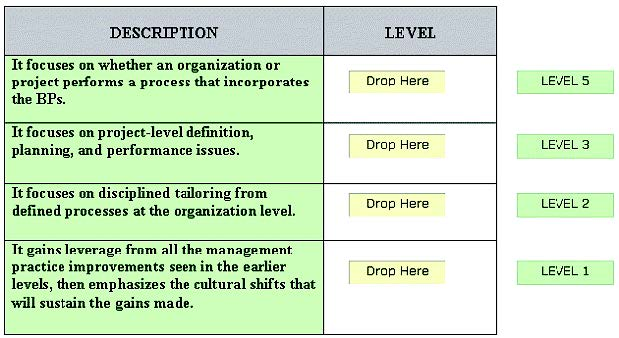
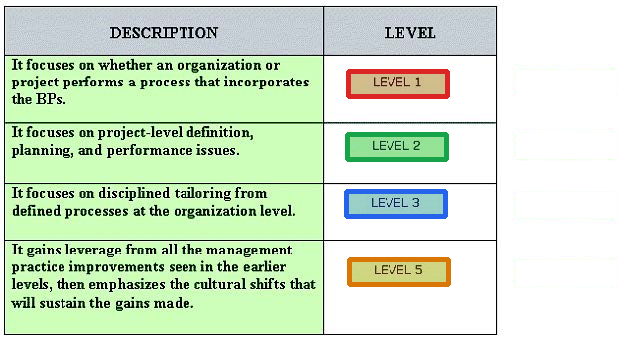
DRAG DROP
the various SSE-CMM levels at the appropriate places.
Reveal answer detailsClose answer details
Explanation
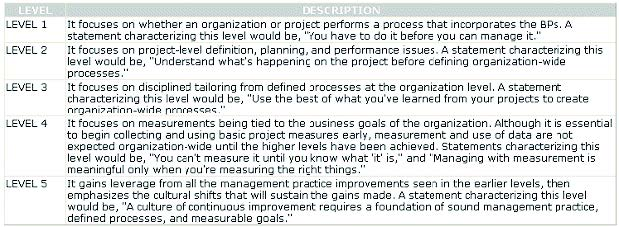
The various SSE-CMM levels are described in the table below:
Question 51
Single choice
In which of the following deployment models of cloud is the cloud infrastructure operated exclusively for an organization?
A
Public cloud
B
Community cloud
C
Private cloud
D
Hybrid cloud
Reveal answer detailsClose answer details
Correct answerC
Explanation
In private cloud, the cloud infrastructure is operated exclusively for an organization.
The private cloud infrastructure is administered by the organization or a third party, and exists on premise and off premise.
Question 52
Single choice
Which of the following penetration testing techniques automatically tests every phone line in an exchange and tries to locate modems that are attached to the network?
A
Demon dialing
B
Sniffing
C
Social engineering
D
Dumpster diving
Reveal answer detailsClose answer details
Correct answerA
Explanation
The demon dialing technique automatically tests every phone line in an exchange and tries to locate modems that are attached to the network. Information about these modems can then be used to attempt external unauthorized access. Answer: B is incorrect. In sniffing, a protocol analyzer is used to capture data packets that are later decoded to collect information such as passwords or infrastructure configurations. Answer: D is incorrect. Dumpster diving technique is used for searching paper disposal areas for unshredded or otherwise improperly disposed-of reports. Answer: C is incorrect. Social engineering is the most commonly used technique of all, getting information (like passwords) just by asking for them.
Question 53
Single choice
Which of the following techniques is used to identify attacks originating from a botnet?
A
Passive OS fingerprinting
B
Recipient filtering
C
IFilter
D
BPF-based filter
Reveal answer detailsClose answer details
Correct answerA
Explanation
Passive OS fingerprinting can identify attacks originating from a botnet. Network Administrators can configure the firewall to take action on a botnet attack by using information obtained from passive OS fingerprinting. Passive OS fingerprinting (POSFP) allows the sensor to determine the operating system used by the hosts. The sensor examines the traffic flow between two hosts and then stores the operating system of those two hosts along with their IP addresses. In order to determine the type of operating system, the sensor analyzes TCP SYN and SYN ACK packets that are traveled on the network. The sensor computes the attack relevance rating to determine the relevancy of victim attack using the target host OS. After it, the sensor modifies the alert's risk rating or filters the alert for the attack. Passive OS fingerprinting is also used to improve the alert output by reporting some information, such as victim OS, relevancy to the victim in the alert, and source of the OS identification. Answer: D is incorrect. A BPF- based filter is used to limit the number of packets seen by tcpdump; this renders the output more usable on networks with a high volume of traffic. Answer: B is incorrect. Recipient filtering is used to block messages on the basis of whom they are sent to. Answer: C is incorrect. IFilters are used to extract contents from files that are crawled. IFilters also remove application-specific formatting before the content of a document is indexed by the search engine.
Question 54
Single choice
Which of the following cryptographic system services ensures that information will not be disclosed to any unauthorized person on a local network?
A
Authentication
B
Integrity
C
Non-repudiation
D
Confidentiality
Reveal answer detailsClose answer details
Correct answerD
Explanation
The confidentiality service of a cryptographic system ensures that information will not be disclosed to any unauthorized person on a local network.
ISC
Certified Secure Software Lifecycle Professional (CSSLP)
Security code review identifies the unvalidated input calls made by an attacker and avoids those calls to be processed by the server. It performs various review checks on the stained calls of servlet for identifying unvalidated input from the attacker. Choose the appropriate review checks and drop them in front of their respective functions.
Correct Answer:
Explanation
Explanation/Reference:
The various security code review checks performed on the stained calls of servlet are as follows: getParameter(): It is used to check the unvalidated sources of input from URL parameters in javax.servlet.HttpServletRequest class. getQueryString(): It is used to check the unvalidated sources of input from Form fields in javax.servlet.HttpServletRequest class. getCookies(): It is used to check the unvalidated sources of input from Cookies javax.servlet.HttpServletRequest class. getHeaders(): It is used to check the unvalidated sources of input from HTTP headers javax.servlet.HttpServletRequest class.
QUESTION 2
Which of the following elements sets up a requirement to receive the constrained requests over a protected layer connection, such as TLS (Transport Layer Security)?
A.
User data constraint
B.
Authorization constraint
C.
Web resource collection
D.
Accounting constraint
Correct Answer: A
Explanation
Explanation/Reference:
User data constraint is a security constraint element summarized in the Java Servlet Specification 2.4. It sets up a requirement to receive the constrained requests over a protected layer connection, such as TLS (Transport Layer Security). The user data constraint offers guarantee (NONE, INTEGRAL, and CONFEDENTIAL) for the transportation of data between client and server. If a request does not have user data constraint, the container accepts the request after it is received on a connection. Answer: C is incorrect. Web resource collection is a set of URL patterns and HTTP operations that define all resources required to be protected. It is a security constraint element summarized in the Java Servlet Specification v2.4. The Web resource collection includes the following elements: URL patterns HTTP methods Answer: B is incorrect. Authorization constraint is a security constraint element summarized in the Java Servlet Specification 2.4. It sets up a requirement for authentication and names the authorization roles that can access the URL patterns and HTTP methods as defined by the security constraint. In the absence of a security constraint, the container accepts the request without requiring any user authentication. If no authorization role is specified in the authorization constraint, the container cannot access constrained requests. The wildcard character "*" specifies all authorization role names that are defined in the deployment descriptor. Answer: D is incorrect. It is not a security constraint element.
QUESTION 3
Which of the following refers to the ability to ensure that the data is not modified or tampered with?
A.
Integrity
B.
Availability
C.
Non-repudiation
D.
Confidentiality
Correct Answer: A
Explanation
Explanation/Reference:
Integrity refers to the ability to ensure that the data is not modified or tampered with. Integrity means that data cannot be modified without authorization. Integrity is violated when an employee accidentally or with malicious intent deletes important data files, when a computer virus infects a computer, when an employee is able to modify his own salary in a payroll database, when an unauthorized user vandalizes a Web site, when someone is able to cast a very large number of votes in an online poll, and so on. Answer: D is incorrect. Confidentiality is the property of preventing disclosure of information to unauthorized individuals or systems. Breaches of confidentiality take many forms. Permitting someone to look over your shoulder at your computer screen while you have confidential data displayed on it could be a breach of confidentiality. If a laptop computer containing sensitive information about a company's employees is stolen or sold, it could result in a breach of confidentiality. Answer: B is incorrect. Availability means that data must be available whenever it is needed. Answer: C is incorrect. Non-repudiation is the concept of ensuring that a party in a dispute cannot refuse to acknowledge, or refute the validity of a statement or contract. As a service, it provides proof of the integrity and origin of data. Although this concept can be applied to any transmission, including television and radio, by far the most common application is in the verification and trust of signatures.
QUESTION 4
Which of the following is NOT a responsibility of a data owner?
A.
Approving access requests
B.
Ensuring that the necessary security controls are in place
C.
Delegating responsibility of the day-to-day maintenance of the data protection mechanisms to the data custodian
D.
Maintaining and protecting data
Correct Answer: D
Explanation
Explanation/Reference:
It is not a responsibility of a data owner. The data custodian (information custodian) is responsible for maintaining and protecting the data. Answer: B, A, and C are incorrect. All of these are responsibilities of a data owner. The roles and responsibilities of a data owner are as follows: The data owner (information owner) is usually a member of management, in charge of a specific business unit, and is ultimately responsible for the protection and use of a specific subset of information. The data owner decides upon the classification of the data that he is responsible for and alters that classification if the business needs arise. This person is also responsible for ensuring that the necessary security controls are in place, ensuring that proper access rights are being used, defining security requirements per classification and backup requirements, approving any disclosure activities, and defining user access criteria. The data owner approves access requests or may choose to delegate this function to business unit managers. And it is the data owner who will deal with security violations pertaining to the data he is responsible for protecting. The data owner, who obviously has enough on his plate, delegates responsibility of the day-to-day maintenance of the data protection mechanisms to the data custodian.
QUESTION 5
Which of the following components of configuration management involves periodic checks to determine the consistency and completeness of accounting information and to verify that all configuration management policies are being followed?
A.
Configuration Identification
B.
Configuration Auditing
C.
Configuration Control
D.
Configuration Status Accounting
Correct Answer: B
Explanation
Explanation/Reference:
Configuration auditing is a component of configuration management, which involves periodic checks to establish the consistency and completeness of accounting information and to confirm that all configuration management policies are being followed. Configuration audits are broken into functional and physical configuration audits. They occur either at delivery or at the moment of effecting the change. A functional configuration audit ensures that functional and performance attributes of a configuration item are achieved, while a physical configuration audit ensures that a configuration item is installed in accordance with the requirements of its detailed design documentation. Answer: D is incorrect. The configuration status accounting procedure is the ability to record and report on the configuration baselines associated with each configuration item at any moment of time. It supports the functional and physical attributes of software at various points in time, and performs systematic control of accounting to the identified attributes for the purpose of maintaining software integrity and traceability throughout the software development life cycle. Answer: C is incorrect. Configuration control is a procedure of the Configuration management. Configuration control is a set of processes and approval stages required to change a configuration item's attributes and to re-baseline them. It supports the change of the functional and physical attributes of software at various points in time, and performs systematic control of changes to the identified attributes. Answer: A is incorrect. Configuration identification is the process of identifying the attributes that define every aspect of a configuration item. A configuration item is a product (hardware and/or software) that has an end-user purpose. These attributes are recorded in configuration documentation and baselined. Baselining an attribute forces formal configuration change control processes to be effected in the event that these attributes are changed.
QUESTION 6
Which of the following is designed to detect unwanted attempts at accessing, manipulating, and disabling of computer systems through the Internet?
A.
DAS
B.
IPsec
C.
IDS
D.
ACL
Correct Answer: C
Explanation
Explanation/Reference:
An Intrusion detection system (IDS) is software and/or hardware designed to detect unwanted attempts at accessing, manipulating, and/or disabling of computer systems, mainly through a network, such as the Internet. These attempts may take the form of attacks, as examples, by crackers, malware and/or disgruntled employees. An IDS cannot directly detect attacks within properly encrypted traffic. An intrusion detection system is used to detect several types of malicious behaviors that can compromise the security and trust of a computer system. This includes network attacks against vulnerable services, data driven attacks on applications, host based attacks such as privilege escalation, unauthorized logins and access to sensitive files, and malware (viruses, trojan horses, and worms). Answer: D is incorrect. Access Control List (ACL) is the most commonly used object in Cisco IOS. It filters packets or network traffic by controlling whether routed packets are forwarded or blocked at the router's interfaces. According to the criteria specified within the access lists, router determines whether the packets to be forwarded or dropped. Access control list criteria could be the source or destination address of the traffic or other information. The types of Cisco ACLs are Standard IP, Extended IP, IPX, Appletalk, etc. Answer: B is incorrect. Internet Protocol Security (IPSec) is a method of securing data. It secures traffic by using encryption and digital signing. It enhances the security of data as if an IPSec packet is captured, its contents cannot be read. IPSec also provides sender verification that ensures the certainty of the datagram's origin to the receiver. Answer: A is incorrect. Direct-attached storage (DAS) is a digital storage system that is directly attached to a server or workstation, without using a storage network.
QUESTION 7
What NIACAP certification levels are recommended by the certifier? Each correct answer represents a complete solution. Choose all that apply.
A.
Comprehensive Analysis
B.
Maximum Analysis
C.
Detailed Analysis
D.
Minimum Analysis
E.
Basic Security Review
F.
Basic System Review
Correct Answer: ACDE
Explanation
Explanation/Reference:
NIACAP has four levels of certification. These levels ensure that the appropriate C&A are performed for varying schedule and budget limitations. The certifier must analyze the system's business functions. The certifier determines the degree of confidentiality, integrity, availability, and accountability, and then recommends one of the following NIACAP certification levels: Level 1 - Basic Security Review Level 2 - Minimum Analysis Level 3 - Detailed Analysis Level 4 - Comprehensive Analysis Answer: B and F are incorrect. No such types of levels exist.
QUESTION 8
The NIST ITL Cloud Research Team defines some primary and secondary technologies as the fundamental elements of cloud computing in its "Effectively and Securely Using the Cloud Computing Paradigm" presentation. Which of the following technologies are included in the primary technologies? Each correct answer represents a complete solution. Choose all that apply.
A.
Web application framework
B.
Free and open source software
C.
SOA
D.
Virtualization
Correct Answer: BCD
Explanation
Explanation/Reference:
The primary technologies defined by the NIST ITL Cloud Research Team in its "Effectively and Securely Using the Cloud Computing Paradigm" presentation are as follows: Virtualization Grid technology SOA (Service Oriented Architecture) Distributed computing Broadband network Browser as a platform Free and open source software Answer: A is incorrect. It is defined as the secondary technology.
QUESTION 9
Which of the following activities are performed by the 'Do' cycle component of PDCA (plan-do- check-act)? Each correct answer represents a complete solution. Choose all that apply.
A.
It detects and responds to incidents properly.
B.
It determines controls and their objectives.
C.
It manages resources that are required to achieve a goal.
D.
It performs security awareness training.
E.
It operates the selected controls.
Correct Answer: ACDE
Explanation
Explanation/Reference:
The 'Do' cycle component performs the following activities: It operates the selected controls. It detects and responds to incidents properly. It performs security awareness training. It manages resources that are required to achieve a goal. Answer: B is incorrect. This activity is performed by the 'Plan' cycle component of PDCA.
QUESTION 10
Which of the following disaster recovery tests includes the operations that shut down at the primary site, and are shifted to the recovery site according to the disaster recovery plan?
A.
Structured walk-through test
B.
Full-interruption test
C.
Parallel test
D.
Simulation test
Correct Answer: B
Explanation
Explanation/Reference:
A full-interruption test includes the operations that shut down at the primary site and are shifted to the recovery site according to the disaster recovery plan. It operates just like a parallel test. The full-interruption test is very expensive and difficult to arrange. Sometimes, it causes a major disruption of operations if the test fails. Answer: A is incorrect. The structured walk-through test is also known as the table-top exercise. In structured walk-through test, the team members walkthrough the plan to identify and correct weaknesses and how they will respond to the emergency scenarios by stepping in the course of the plan. It is the most effective and competent way to identify the areas of overlap in the plan before conducting more challenging training exercises. Answer: C is incorrect. A parallel test includes the next level in the testing procedure, and relocates the employees to an alternate recovery site and implements site activation procedures. These employees present with their disaster recovery responsibilities as they would for an actual disaster. The disaster recovery sites have full responsibilities to conduct the day-to-day organization's business. Answer: D is incorrect. A simulation test is a method used to test the disaster recovery plans. It operates just like a structured walk-through test. In the simulation test, the members of a disaster recovery team present with a disaster scenario and then, discuss on appropriate responses. These suggested responses are measured and some of them are taken by the team. The range of the simulation test should be defined carefully for avoiding excessive disruption of normal business activities.
QUESTION 11
Fill in the blank with an appropriate phrase. A is defined as any activity that has an effect on defining, designing, building, or executing a task, requirement, or procedure.
A. technical effort
Correct Answer: A
Explanation
Explanation/Reference:
A technical effort is described as any activity, which has an effect on defining, designing, building, or implementing a task, requirement, or procedure. The technical effort is an element of technical management that is required to progress efficiently and effectively from a business need to the deployment and operation of the system.
QUESTION 12
There are seven risks responses that a project manager can choose from.
Which risk response is appropriate for both positive and negative risk events?
A.
Acceptance
B.
Transference
C.
Sharing
D.
Mitigation
Correct Answer: A
Explanation
Explanation/Reference:
Only acceptance is appropriate for both positive and negative risk events. Often sharing is used for low probability and low impact risk events regardless of the positive or negative effects the risk event may bring the project. Acceptance response is a part of Risk Response planning process. Acceptance response delineates that the project plan will not be changed to deal with the risk. Management may develop a contingency plan if the risk does occur. Acceptance response to a risk event is a strategy that can be used for risks that pose either threats or opportunities. Acceptance response can be of two types: Passive acceptance: It is a strategy in which no plans are made to try or avoid or mitigate the risk. Active acceptance: Such responses include developing contingency reserves to deal with risks, in case they occur. Acceptance is the only response for both threats and opportunities. Answer: C is incorrect. Sharing is a positive risk response that shares an opportunity for all parties involved in the risk event. Answer: B is incorrect. Transference is a negative risk event that transfers the risk ownership to a third party, such as vendor, through a contractual relationship. Answer: D is incorrect. Mitigation is a negative risk event that seeks to lower the probability and/or impact of a risk event.
QUESTION 13
The service-oriented modeling framework (SOMF) provides a common modeling notation to address alignment between business and IT organizations. Which of the following principles does the SOMF concentrate on? Each correct answer represents a part of the solution. Choose all that apply.
A.
Architectural components abstraction
B.
SOA value proposition
C.
Business traceability
D.
Disaster recovery planning
E.
Software assets reuse
Correct Answer: ABCE
Explanation
Explanation/Reference:
The service-oriented modeling framework (SOMF) concentrates on the following principles: Business traceability Architectural best-practices traceability Technological traceability SOA value proposition Software assets reuse SOA integration strategies Technological abstraction and generalization Architectural components abstraction Answer: D is incorrect. The service-oriented modeling framework (SOMF) does not concentrate on it.
QUESTION 14
Which of the following are the principle duties performed by the BIOS during POST (power-on-self-test)? Each correct answer represents a part of the solution. Choose all that apply.
A.
It provides a user interface for system's configuration.
B.
It identifies, organizes, and selects boot devices.
C.
It delegates control to other BIOS, if it is required.
D.
It discovers size and verifies system memory.
E.
It verifies the integrity of the BIOS code itself.
F.
It interrupts the execution of all running programs.
Correct Answer: ABCDE
Explanation
Explanation/Reference:
The principle duties performed by the BIOS during POST (power-on-self-test) are as follows: It verifies the integrity of the BIOS code itself. It discovers size and verifies system memory. It discovers, initializes, and catalogs all system hardware. It delegates control to other BIOS if it is required. It provides a user interface for system's configuration. It identifies, organizes, and selects boot devices. It executes the bootstrap program. Answer: F is incorrect. The BIOS does not interrupt the execution of all running programs.
QUESTION 15
Which of the following attacks causes software to fail and prevents the intended users from accessing software?
A.
Enabling attack
B.
Reconnaissance attack
C.
Sabotage attack
D.
Disclosure attack
Correct Answer: C
Explanation
Explanation/Reference:
A sabotage attack is an attack that causes software to fail. It also prevents the intended users from accessing software. A sabotage attack is referred to as a denial of service (DoS) or compromise of availability. Answer: B is incorrect. The reconnaissance attack enables an attacker to collect information about software and operating environment. Answer: D is incorrect. The disclosure attack exposes the revealed data to an attacker. Answer: A is incorrect. The enabling attack delivers an easy path for other attacks.
QUESTION 16
John works as a security manager for SoftTech Inc. He is working with his team on the disaster recovery management plan. One of his team members has a doubt related to the most cost effective DRP testing plan. According to you, which of the following disaster recovery testing plans is the most cost-effective and efficient way to identify areas of overlap in the plan before conducting more demanding training exercises?
A.
Full-scale exercise
B.
Walk-through drill
C.
Structured walk-through test
D.
Evacuation drill
Correct Answer: C
Explanation
Explanation/Reference:
The structured walk-through test is also known as the table-top exercise. In structured walk-through test, the team members walkthrough the plan to identify and correct weaknesses and how they will respond to the emergency scenarios by stepping in the course of the plan. It is the most effective and competent way to identify the areas of overlap in the plan before conducting more challenging training exercises. Answer: A is incorrect. In full-scale exercise, the critical systems run at an alternate site. Answer: B is incorrect. The emergency management group and response teams actually perform their emergency response functions by walking through the test, without actually initiating recovery procedures. But it is not much cost effective. Answer: D is incorrect. It is a test performed when personnel walks through the evacuation route to a designated area where procedures for accounting for the personnel are tested.
QUESTION 17
In which of the following types of tests are the disaster recovery checklists distributed to the members of disaster recovery team and asked to review the assigned checklist?
A.
Parallel test
B.
Simulation test
C.
Full-interruption test
D.
Checklist test
Correct Answer: D
Explanation
Explanation/Reference:
A checklist test is a test in which the disaster recovery checklists are distributed to the members of the disaster recovery team. All members are asked to review the assigned checklist. The checklist test is a simple test and it is easy to conduct this test. It allows to accomplish the following three goals: It ensures that the employees are aware of their responsibilities and they have the refreshed knowledge. It provides an individual with an opportunity to review the checklists for obsolete information and update any items that require modification during the changes in the organization. It ensures that the assigned members of disaster recovery team are still working for the organization. Answer: B is incorrect. A simulation test is a method used to test the disaster recovery plans. It operates just like a structured walk-through test. In the simulation test, the members of a disaster recovery team present with a disaster scenario and then, discuss on appropriate responses. These suggested responses are measured and some of them are taken by the team. The range of the simulation test should be defined carefully for avoiding excessive disruption of normal business activities. Answer: A is incorrect. A parallel test includes the next level in the testing procedure, and relocates the employees to an alternate recovery site and implements site activation procedures. These employees present with their disaster recovery responsibilities as they would for an actual disaster. The disaster recovery sites have full responsibilities to conduct the day-to-day organization's business. Answer: C is incorrect. A full-interruption test includes the operations that shut down at the primary site and are shifted to the recovery site according to the disaster recovery plan. It operates just like a parallel test. The full-interruption test is very expensive and difficult to arrange. Sometimes, it causes a major disruption of operations if the test fails.
QUESTION 18
Which of the following are the responsibilities of the owner with regard to data in an information classification program? Each correct answer represents a complete solution. Choose three.
A.
Reviewing the classification assignments at regular time intervals and making changes as the business needs change.
B.
Running regular backups and routinely testing the validity of the backup data.
C.
Delegating the responsibility of the data protection duties to a custodian.
D.
Determining what level of classification the information requires.
Correct Answer: ACD
Explanation
Explanation/Reference:
The following are the responsibilities of the owner with regard to data in an information classification program: Determining what level of classification the information requires. Reviewing the classification assignments at regular time intervals and making changes as the business needs change. Delegating the responsibility of the data protection duties to a custodian. An information owner can be an executive or a manager of an organization. He will be responsible for the asset of information that must be protected. Answer: B is incorrect. Running regular backups and routinely testing the validity of the backup data is the responsibility of a custodian.
QUESTION 19
A Web-based credit card company had collected financial and personal details of Mark before issuing him a credit card. The company has now provided Mark's financial and personal details to another company.
Which of the following Internet laws has the credit card issuing company violated?
A.
Trademark law
B.
Security law
C.
Privacy law
D.
Copyright law
Correct Answer: C
Explanation
Explanation/Reference:
The credit card issuing company has violated the Privacy law. According to the Internet Privacy law, a company cannot provide their customer's financial and personal details to other companies. Answer: A is incorrect. Trademark laws facilitate the protection of trademarks around the world. Answer: B is incorrect. There is no law such as Security law. Answer: D is incorrect. The Copyright law protects original works or creations of authorship including literary, dramatic, musical, artistic, and certain other intellectual works.
QUESTION 20
In which of the following cryptographic attacking techniques does an attacker obtain encrypted messages that have been encrypted using the same encryption algorithm?
A.
Chosen plaintext attack
B.
Chosen ciphertext attack
C.
Ciphertext only attack
D.
Known plaintext attack
Correct Answer: C
Explanation
Explanation/Reference:
In a ciphertext only attack, an attacker obtains encrypted messages that have been encrypted using the same encryption algorithm.
QUESTION 21
Which of the following strategies is used to minimize the effects of a disruptive event on a company, and is created to prevent interruptions to normal business activity?
A.
Continuity of Operations Plan
B.
Contingency Plan
C.
Disaster Recovery Plan
D.
Business Continuity Plan
Correct Answer: D
Explanation
Explanation/Reference:
BCP is a strategy to minimize the consequence of the instability and to allow for the continuation of business processes. The goal of BCP is to minimize the effects of a disruptive event on a company, and is formed to avoid interruptions to normal business activity. Business Continuity Planning (BCP) is the creation and validation of a practiced logistical plan for how an organization will recover and restore partially or completely interrupted critical (urgent) functions within a predetermined time after a disaster or extended disruption. The logistical plan is called a business continuity plan. Answer: B is incorrect. A contingency plan is a plan devised for a specific situation when things could go wrong. Contingency plans are often devised by governments or businesses who want to be prepared for anything that could happen. Contingency plans include specific strategies and actions to deal with specific variances to assumptions resulting in a particular problem, emergency, or state of affairs. They also include a monitoring process and "triggers" for initiating planned actions. They are required to help governments, businesses, or individuals to recover from serious incidents in the minimum time with minimum cost and disruption. Answer: C is incorrect. Disaster recovery planning is a subset of a larger process known as business continuity planning and should include planning for resumption of applications, data, hardware, communications (such as networking), and other IT infrastructure. A business continuity plan (BCP) includes planning for non-IT related aspects such as key personnel, facilities, crisis communication, and reputation protection, and should refer to the disaster recovery plan (DRP) for IT-related infrastructure recovery/continuity. Answer: A is incorrect. The Continuity Of Operation Plan (COOP) refers to the preparations and institutions maintained by the United States government, providing survival of federal government operations in the case of catastrophic events. It provides procedures and capabilities to sustain an organization's essential. COOP is the procedure documented to ensure persistent critical operations throughout any period where normal operations are unattainable.
QUESTION 22
What component of the change management system is responsible for evaluating, testing, and documenting changes created to the project scope?
A.
Project Management Information System
B.
Integrated Change Control
C.
Configuration Management System
D.
Scope Verification
Correct Answer: C
Explanation
Explanation/Reference:
The change management system is comprised of several components that guide the change request through the process. When a change request is made that will affect the project scope. The Configuration Management System evaluates the change request and documents the features and functions of the change on the project scope.
QUESTION 23
"Enhancing the Development Life Cycle to Produce Secure Software" summarizes the tools and practices that are helpful in producing secure software. What are these tools and practices? Each correct answer
represents a complete solution. Choose three.
A.
Leverage attack patterns
B.
Compiler security checking and enforcement
C.
Tools to detect memory violations
D.
Safe software libraries
E.
Code for reuse and maintainability
Correct Answer: BCD
Explanation
Explanation/Reference:
The tools and practices that are helpful in producing secure software are summarized in the report "Enhancing the Development Life Cycle to Produce Secure Software". The tools and practices are as follows: Compiler security checking and enforcement Safe software libraries Runtime error checking and safety enforcement Tools to detect memory violations Code obfuscation Answer: A and E are incorrect. These are secure coding principles and practices of defensive coding.
QUESTION 24
Which of the following is the duration of time and a service level within which a business process must be restored after a disaster in order to avoid unacceptable consequences associated with a break in business continuity?
A.
RTO
B.
RTA
C.
RPO
D.
RCO
Correct Answer: A
Explanation
Explanation/Reference:
The Recovery Time Objective (RTO) is the duration of time and a service level within which a business process must be restored after a disaster or disruption in order to avoid unacceptable consequences associated with a break in business continuity. It includes the time for trying to fix the problem without a recovery, the recovery itself, tests and the communication to the users. Decision time for user representative is not included. The business continuity timeline usually runs parallel with an incident management timeline and may start at the same, or different, points. In accepted business continuity planning methodology, the RTO is established during the Business Impact Analysis (BIA) by the owner of a process (usually in conjunction with the Business Continuity planner). The RTOs are then presented to senior management for acceptance. The RTO attaches to the business process and not the resources required to support the process. Answer: B is incorrect. The Recovery Time Actual (RTA) is established during an exercise, actual event, or predetermined based on recovery methodology the technology support team develops. This is the time frame the technology support takes to deliver the recovered infrastructure to the business. Answer: D is incorrect. The Recovery Consistency Objective (RCO) is used in Business Continuity Planning in addition to Recovery Point Objective (RPO) and Recovery Time Objective (RTO). It applies data consistency objectives to Continuous Data Protection services. Answer: C is incorrect. The Recovery Point Objective (RPO) describes the acceptable amount of data loss measured in time. It is the point in time to which data must be recovered as defined by the organization. The RPO is generally a definition of what an organization determines is an "acceptable loss" in a disaster situation. If the RPO of a company is 2 hours and the time it takes to get the data back into production is 5 hours, the RPO is still 2 hours. Based on this RPO the data must be restored to within 2 hours of the disaster.
QUESTION 25
You work as a project manager for BlueWell Inc. You with your team are using a method or a (technical) process that conceives the risks even if all theoretically possible safety measures would be applied. One of your team member wants to know that what is a residual risk.
What will you reply to your team member?
A.
It is a risk that remains because no risk response is taken.
B.
It is a risk that can not be addressed by a risk response.
C.
It is a risk that will remain no matter what type of risk response is offered.
D.
It is a risk that remains after planned risk responses are taken.
Correct Answer: D
Explanation
Explanation/Reference:
Residual risks are generally smaller risks that remain in the project after larger risks have been addressed. The residual risk is the risk or danger of an action or an event, a method or a (technical) process that still conceives these dangers even if all theoretically possible safety measures would be applied. The formula to calculate residual risk is (inherent risk) x (control risk) where inherent risk is (threats vulnerability). Answer: B is incorrect. This is not a valid statement about residual risks. Answer: C is incorrect. This is not a valid statement about residual risks. Answer: A is incorrect. This is not a valid statement about residual risks.
QUESTION 26
Which of the following are Service Level Agreement (SLA) structures as defined by ITIL? Each correct answer represents a complete solution. Choose all that apply.
A.
Component Based
B.
Service Based
C.
Segment Based
D.
Customer Based
E.
Multi-Level
Correct Answer: BDE
Explanation
Explanation/Reference:
ITIL defines 3 types of Service Level Agreement (SLA) structures, which are as follows: 1.Customer Based: It covers all services used by an individual customer group. 2.Service Based: It is one service for all customers. 3.Multi-Level: Some examples of Multi-Level SLA are 3 Tier SLA encompassing Corporate and Customer & Service Layers. Answer: C and A are incorrect. There are no such SLA structures as Segment Based and Component Based.
QUESTION 27
Which of the following documents is defined as a source document, which is most useful for the ISSE when classifying the needed security functionality?
A.
Information Protection Policy (IPP)
B.
IMM
C.
System Security Context
D.
CONOPS
Correct Answer: A
Explanation
Explanation/Reference:
The Information Protection Policy (IPP) is defined as a source document, which is most useful for the ISSE when classifying the needed security functionality. The IPP document consists of the threats to the information management and the security services and controls needed to respond to those threats. Answer: B is incorrect. The IMM is the source document describing the customer's needs based on identifying users, processes, and information. Answer: C is incorrect. The System Security Context is the output of SE and ISSEP. It is the translation of the requirements into system parameters and possible measurement concepts that meet the defined requirements. Answer: D is incorrect. The Concept of Operations (CONOPS) is a document describing the characteristics of a proposed system from the viewpoint of an individual who will use that system. It is used to communicate the quantitative and qualitative system characteristics to all stakeholders. CONOPS are widely used in the military or in government services, as well as other fields. A CONOPS generally evolves from a concept and is a description of how a set of capabilities may be employed to achieve desired objectives or a particular end state for a specific scenario.
QUESTION 28
Gary is the project manager for his project. He and the project team have completed the qualitative risk analysis process and are about to enter the quantitative risk analysis process when Mary, the project sponsor, wants to know what quantitative risk analysis will review.
Which of the following statements best defines what quantitative risk analysis will review?
A.
The quantitative risk analysis process will analyze the effect of risk events that may substantially impact the project's competing demands.
B.
The quantitative risk analysis reviews the results of risk identification and prepares the project for risk response management.
C.
The quantitative risk analysis seeks to determine the true cost of each identified risk event and the probability of each risk event to determine the risk exposure.
D.
The quantitative risk analysis process will review risk events for their probability and impact on the project objectives.
Correct Answer: A
Explanation
Explanation/Reference:
Once the risk events have passed through qualitative risk analysis, then the risk events must be reviewed to determine the effect of the risks on the project's competing demands. Answer: D is incorrect. While the quantitative risk analysis process will review the risk events for probability and impact, this statement does not answer the question as completely as answer option A. Answer: C is incorrect. The quantitative risk analysis process does not review every risk identified - only the risks which require further analysis. Answer: B is incorrect. Quantitative risk analysis process does not begin the risk response process. Its goal is to determine the effect of certain risk events on the project's competing demands.
QUESTION 29
How can you calculate the Annualized Loss Expectancy (ALE) that may occur due to a threat?
A.
Single Loss Expectancy (SLE) X Annualized Rate of Occurrence (ARO)
B.
Single Loss Expectancy (SLE)/ Exposure Factor (EF)
C.
Asset Value X Exposure Factor (EF)
D.
Exposure Factor (EF)/Single Loss Expectancy (SLE)
Correct Answer: A
Explanation
Explanation/Reference:
The Annualized Loss Expectancy (ALE) that occurs due to a threat can be calculated by multiplying the Single Loss Expectancy (SLE) with the Annualized Rate of Occurrence (ARO). Annualized Loss Expectancy (ALE) = Single Loss Expectancy (SLE) X Annualized Rate of Occurrence (ARO) Annualized Rate of Occurrence (ARO) is a number that represents the estimated frequency in which a threat is expected to occur. It is calculated based upon the probability of the event occurring and the number of employees that could make that event occur. Single Loss Expectancy (SLE) is the value in dollars that is assigned to a single event. SLE can be calculated by the following formula: SLE = Asset Value ($) X Exposure Factor (EF) The Exposure Factor (EF) represents the % of assets loss caused by a threat. The EF is required to calculate Single Loss Expectancy (SLE).
QUESTION 30
Which of the following models uses a directed graph to specify the rights that a subject can transfer to an object or that a subject can take from another subject?
A.
Take-Grant Protection Model
B.
Biba Integrity Model
C.
Bell-LaPadula Model
D.
Access Matrix
Correct Answer: A
Explanation
Explanation/Reference:
The take-grant protection model is a formal model used in the field of computer security to establish or disprove the safety of a given computer system that follows specific rules. It shows that for specific systems the question of safety is decidable in linear time, which is in general undecidable. The model represents a system as directed graph, where vertices are either subjects or objects. The edges between them are labeled and the label indicates the rights that the source of the edge has over the destination. Two rights occur in every instance of the model: take and grant. They play a special role in the graph rewriting rules describing admissible changes of the graph. Answer: D is incorrect. The access matrix is a straightforward approach that provides access rights to subjects for objects. Answer: C is incorrect. The Bell-LaPadula model deals only with the confidentiality of classified material. It does not address integrity or availability. Answer: B is incorrect. The integrity model was developed as an analog to the Bell- LaPadula confidentiality model and then became more sophisticated to address additional integrity requirements.
QUESTION 31
A number of security patterns for Web applications under the DARPA contract have been developed by Kienzle, Elder, Tyree, and Edwards-Hewitt. Which of the following patterns are applicable to aspects of authentication in Web applications?b Each correct answer represents a complete solution. Choose all that apply.
A.
Authenticated session
B.
Secure assertion
C.
Partitioned application
D.
Password authentication
E.
Account lockout
F.
Password propagation
Correct Answer: ADEF
Explanation
Explanation/Reference:
The various patterns applicable to aspects of authentication in the Web applications are as follows: Account lockout: It implements a limit on the incorrect password attempts to protect an account from automated password-guessing attacks. Authenticated session: It allows a user to access more than one access-restricted Web page without re-authenticating every page. It also integrates user authentication into the basic session model. Password authentication: It provides protection against weak passwords, automated password-guessing attacks, and mishandling of passwords. Password propagation: It offers a choice by requiring that a user's authentication credentials be verified by the database before providing access to that user's data. Answer: B and C are incorrect. Secure assertion and partitioned application patterns are applicable to software assurance in general.
QUESTION 32
Which of the following terms related to risk management represents the estimated frequency at which a threat is expected to occur?
A.
Single Loss Expectancy (SLE)
B.
Annualized Rate of Occurrence (ARO)
C.
Safeguard
D.
Exposure Factor (EF)
Correct Answer: B
Explanation
Explanation/Reference:
The Annualized Rate of Occurrence (ARO) is a number that represents the estimated frequency at which a threat is expected to occur. It is calculated based upon the probability of the event occurring and the number of employees that could make that event occur. Answer: D is incorrect. The Exposure Factor (EF) represents the % of assets loss caused by a threat. The EF is required to calculate the Single Loss Expectancy (SLE). Answer: A is incorrect. The Single Loss Expectancy (SLE) is the value in dollars that is assigned to a single event. SLE = Asset Value ($) X Exposure Factor (EF) Answer: C is incorrect. Safeguard acts as a countermeasure for reducing the risk associated with a specific threat or a group of threats.
QUESTION 33
Which of the following NIST documents provides a guideline for identifying an information system as a National Security System?
A.
NIST SP 800-37
B.
NIST SP 800-59
C.
NIST SP 800-53
D.
NIST SP 800-60
E.
NIST SP 800-53A
Correct Answer: B
Explanation
Explanation/Reference:
NIST has developed a suite of documents for conducting Certification & Accreditation (C&A). These documents are as follows: NIST Special Publication 800-37: This document is a guide for the security certification and accreditation of Federal Information Systems. NIST Special Publication 800-53: This document provides a guideline for security controls for Federal Information Systems. NIST Special Publication 800-53A. This document consists of techniques and procedures for verifying the effectiveness of security controls in Federal Information System. NIST Special Publication 800-59: This document is a guideline for identifying an information system as a National Security System. NIST Special Publication 800-60: This document is a guide for mapping types of information and information systems to security objectives and risk levels.
QUESTION 34
The organization level is the Tier 1 and it addresses risks from an organizational perspective. What are the various Tier 1 activities? Each correct answer represents a complete solution. Choose all that apply.
A.
The organization plans to use the degree and type of oversight, to ensure that the risk management strategy is being effectively carried out.
B.
The level of risk tolerance.
C.
The techniques and methodologies an organization plans to employ, to evaluate information system-related security risks.
D.
The RMF primarily operates at Tier 1.
Correct Answer: ABC
Explanation
Explanation/Reference:
The Organization Level is the Tier 1, and it addresses risks from an organizational perspective. It includes the following points: The techniques and methodologies an organization plans to employ, to evaluate information system-related security risks. During risk assessment, the methods and procedures the organization plans to use, to evaluate the significance of the risks identified. The types and extent of risk mitigation measures the organization plans to employ, to address identified risks. The level of risk tolerance. According to the environment of operation, how the organization plans to monitor risks on an ongoing basis, given the inevitable changes to organizational information system. The organization plans to use the degree and type of oversight, in order to ensure that the risk management strategy is being effectively carried out.Answer: D is incorrect. The RMF primarily operates at Tier 3.
QUESTION 35
Digital rights management (DRM) consists of compliance and robustness rules. Which of the following features does the robustness rule have? Each correct answer represents a complete solution. Choose three.
A.
It specifies the various levels of robustness that are needed for asset security.
B.
It specifies minimum techniques for asset security.
C.
It specifies the behaviors of the DRM implementation and applications accessing the implementation.
D.
It contains assets, such as device key, content key, algorithm, and profiling data.
Correct Answer: ABD
Explanation
Explanation/Reference:
The DRM (digital rights management) technology includes the following rules: 1. Compliance rule: This rule specifies the behaviors of the DRM implementation, and applications that are accessing the implementation. The compliance rule specifies the following elements: Definition of specific license rights Device requirements Revocation of license path or penalties when the implementation is not robust enough or noncompliant 2.Robustness rule: This rule has the following features: It specifies the various levels of robustness that are needed for asset security. It contains assets, such as device key, content key, algorithm, and profiling data. It specifies minimum techniques for asset security.
QUESTION 36
Which of the following characteristics are described by the DIAP Information Readiness Assessment function? Each correct answer represents a complete solution. Choose all that apply.
A.
It provides for entry and storage of individual system data.
B.
It performs vulnerability/threat analysis assessment.
C.
It provides data needed to accurately assess IA readiness.
D.
It identifies and generates IA requirements.
Correct Answer: BCD
Explanation
Explanation/Reference:
The characteristics of the DIAP Information Readiness Assessment function are as follows: It provides data needed to accurately assess IA readiness. It identifies and generates IA requirements. It performs vulnerability/threat analysis assessment. Answer: A is incorrect. It is a function performed by the ASSET system.
QUESTION 37
Audit trail or audit log is a chronological sequence of audit records, each of which contains evidence directly pertaining to and resulting from the execution of a business process or system function. Under which of the following controls does audit control come?
A.
Reactive controls
B.
Detective controls
C.
Protective controls
D.
Preventive controls
Correct Answer: B
Explanation
Explanation/Reference:
Audit trail or audit log comes under detective controls. Detective controls are the audit controls that are not needed to be restricted. Any control that performs a monitoring activity can likely be defined as a Detective Control. For example, it is possible that mistakes, either intentional or unintentional, can be made. Therefore, an additional Protective control is that these companies must have their financial results audited by an independent Certified Public Accountant. The role of this accountant is to act as an auditor. In fact, any auditor acts as a Detective control. If the organization in question has not properly followed the rules, a diligent auditor should be able to detect the deficiency which indicates that some control somewhere has failed. Answer: A is incorrect. Reactive or corrective controls typically work in response to a detective control, responding in such a way as to alert or otherwise correct an unacceptable condition. Using the example of account rules, either the internal Audit Committee or the SEC itself, based on the report generated by the external auditor, will take some corrective action. In this way, they are acting as a Corrective or Reactive control. Answer: C and D are incorrect. Protective or preventative controls serve to proactively define and possibly enforce acceptable behaviors. As an example, a set of common accounting rules are defined and must be followed by any publicly traded company. Each quarter, any particular company must publicly state its current financial standing and accounting as reflected by an application of these rules. These accounting rules and the SEC requirements serve as protective or preventative controls.
QUESTION 38
Which of the following US Acts emphasized a "risk-based policy for cost-effective security" and makes mandatory for agency program officials, chief information officers, and inspectors general (IGs) to conduct annual reviews of the agency's information security program and report the results to Office of Management and Budget?
A.
Federal Information Security Management Act of 2002 (FISMA)
B.
The Electronic Communications Privacy Act of 1986 (ECPA)
C.
The Equal Credit Opportunity Act (ECOA)
D.
The Fair Credit Reporting Act (FCRA)
Correct Answer: A
Explanation
Explanation/Reference:
The Federal Information Security Management Act of 2002 ("FISMA", 44 U.S.C. 3541, et seq.) is a United States federal law enacted in 2002 as Title III of the E-Government Act of 2002 (Pub.L. 107-347, 116 Stat. 2899). The act recognized the importance of information security to the economic and national security interests of the United States. The act requires each federal agency to develop, document, and implement an agency-wide program to provide information security for the information and information systems that support the operations and assets of the agency, including those provided or managed by another agency, contractor, or other source. FISMA has brought attention within the federal government to cybersecurity and explicitly emphasized a "risk-based policy for cost-effective security". FISMA requires agency program officials, chief information officers, and inspectors general (IGs) to conduct annual reviews of the agency's information security program and report the results to Office of Management and Budget (OMB). OMB uses this data to assist in its oversight responsibilities and to prepare this annual report to Congress on agency compliance with the act. Answer: C is incorrect. The Equal Credit Opportunity Act (ECOA) is a United States law (codified at 15 U.S.C. 1691 et seq.), enacted in 1974, that makes it unlawful for any creditor to discriminate against any applicant, with respect to any aspect of a credit transaction, on the basis of race, color, religion, national origin, sex, marital status, or age; to the fact that all or part of the applicant's income derives from a public assistance program; or to the fact that the applicant has in good faith exercised any right under the Consumer Credit Protection Act. The law applies to any person who, in the ordinary course of business, regularly participates in a credit decision, including banks, retailers, bankcard companies, finance companies, and credit unions. Answer: B is incorrect. The Electronic Communications Privacy Act of 1986 (ECPA Pub. L. 99-508, Oct. 21, 1986, 100 Stat. 1848, 18 U.S.C. 2510) was enacted by the United States Congress to extend government restrictions on wire taps from telephone calls to include transmissions of electronic data by computer. Specifically, ECPA was an amendment to Title III of the Omnibus Crime Control and Safe Streets Act of 1968 (the Wiretap Statute), which was primarily designed to prevent unauthorized government access to private electronic communications. The ECPA also added new provisions prohibiting access to stored electronic communications, i.e., the Stored Communications Act,18 U.S.C. 2701-2712. Answer: D is incorrect. The Fair Credit Reporting Act (FCRA) is an American federal law (codified at 15 U.S.C. 1681 et seq.) that regulates the collection, dissemination, and use of consumer information, including consumer credit information. Along with the Fair Debt Collection Practices Act (FDCPA), it forms the base of consumer credit rights in the United States. It was originally passed in 1970, and is enforced by the US Federal Trade Commission.
QUESTION 39
Rob is the project manager of the IDLK Project for his company. This project has a budget of $5,600,000 and is expected to last 18 months. Rob has learned that a new law may affect how the project is allowed to proceed - even though the organization has already invested over $750,000 in the project.
What risk response is the most appropriate for this instance?
A.
Transference
B.
Enhance
C.
Mitigation
D.
Acceptance
Correct Answer: D
Explanation
Explanation/Reference:
At this point all that Rob can likely do is accepting the risk event. Because this is an external risk, there is little that Rob can do other than document the risk and share the new with management and the project stakeholders. If the law is passed then Rob can choose the most appropriate way for the project to continue. Acceptance response is a part of Risk Response planning process. Acceptance response delineates that the project plan will not be changed to deal with the risk. Management may develop a contingency plan if the risk does occur. Acceptance response to a risk event is a strategy that can be used for risks that pose either threats or opportunities. Acceptance response can be of two types: Passive acceptance: It is a strategy in which no plans are made to try or avoid or mitigate the risk. Active acceptance: Such responses include developing contingency reserves to deal with risks, in case they occur. Acceptance is the only response for both threats and opportunities. Answer: B is incorrect. Mitigation aims to lower the probability and/or impact of the risk event. Answer: C is incorrect. Transference transfers the ownership of the risk event to a third party, usually through a contractual agreement. Answer: D is incorrect. Enhance is a risk response that tries to increase the probability and/or impact of the positive risk event.
QUESTION 40
Which of the following SDLC phases consists of the given security controls: Misuse Case Modeling Security Design and Architecture Review Threat and Risk Modeling Security Requirements and Test Cases Generation?
A.
Deployment
B.
Requirements Gathering
C.
Maintenance
D.
Design
Correct Answer: D
Explanation
Explanation/Reference:
The various security controls in the SDLC design phase are as follows: Misuse Case Modeling: It is important that the inverse of the misuse cases be modeled to understand and address the security aspects of the software. The requirements traceability matrix can be used to track the misuse cases to the functionality of the software. Security Design and Architecture Review: This control can be introduced when the teams are engaged in the "functional" design and architecture review of the software. Threat and Risk Modeling: Threat modeling determines the attack surface of the software by examining its functionality for trust boundaries, data flow, entry points, and exit points. Risk modeling is performed by ranking the threats as they pertain to the users organization's business objectives, compliance and regulatory requirements and security exposures. Security Requirements and Test Cases Generation: All the above three security controls, i.e., Misuse Case Modeling, Security Design and Architecture Review, and Threat and Risk Modeling are used to produce the security requirements.
QUESTION 41
FITSAF stands for Federal Information Technology Security Assessment Framework. It is a methodology for assessing the security of information systems.
Which of the following FITSAF levels shows that the procedures and controls have been implemented?
A.
Level 2
B.
Level 3
C.
Level 5
D.
Level 1
E.
Level 4
Correct Answer: B
Explanation
Explanation/Reference:
The following are the five levels of FITSAF based on SEI's Capability Maturity Model (CMM): Level 1: The first level reflects that an asset has documented a security policy. Level 2: The second level shows that the asset has documented procedures and controls to implement the policy. Level 3: The third level indicates that these procedures and controls have been implemented. Level 4: The fourth level shows that the procedures and controls are tested and reviewed. Level 5: The fifth level is the final level and shows that the asset has procedures and controls fully integrated into a comprehensive program.
QUESTION 42
Which of the following process areas does the SSE-CMM define in the 'Project and Organizational Practices' category? Each correct answer represents a complete solution. Choose all that apply.
A.
Provide Ongoing Skills and Knowledge
B.
Verify and Validate Security
C.
Manage Project Risk
D.
Improve Organization's System Engineering Process
Correct Answer: ACD
Explanation
Explanation/Reference:
Project and Organizational Practices include the following process areas: PA12: Ensure Quality PA13: Manage Configuration PA14: Manage Project Risk PA15: Monitor and Control Technical Effort PA16: Plan Technical Effort PA17: Define Organization's System Engineering Process PA18: Improve Organization's System Engineering Process PA19: Manage Product Line Evolution PA20: Manage Systems Engineering Support Environment PA21: Provide Ongoing Skills and Knowledge PA22: Coordinate with Suppliers
QUESTION 43
What are the subordinate tasks of the Initiate and Plan IA C&A phase of the DIACAP process? Each correct answer represents a complete solution. Choose all that apply.
A.
Initiate IA implementation plan
B.
Develop DIACAP strategy
C.
Assign IA controls.
D.
Assemble DIACAP team
E.
Register system with DoD Component IA Program.
F.
Conduct validation activity.
Correct Answer: ABCDE
Explanation
Explanation/Reference:
The Department of Defense Information Assurance Certification and Accreditation Process (DIACAP) is a process defined by the United States Department of Defense (DoD) for managing risk. The subordinate tasks of the Initiate and Plan IA C&A phase are as follows: Register system with DoD Component IA Program. Assign IA controls. Assemble DIACAP team. Develop DIACAP strategy. Initiate IA implementation plan. Answer: F is incorrect. Validation activities are conducted in the second phase of the DIACAP process, i.e., Implement and Validate Assigned IA
QUESTION 44
Which of the following are the responsibilities of a custodian with regard to data in an information classification program? Each correct answer represents a complete solution. Choose three.
A.
Performing data restoration from the backups when necessary
B.
Running regular backups and routinely testing the validity of the backup data
C.
Determining what level of classification the information requires
D.
Controlling access, adding and removing privileges for individual users
Correct Answer: ABD
Explanation
Explanation/Reference:
The owner of information delegates the responsibility of protecting that information to a custodian. The following are the responsibilities of a custodian with regard to data in an information classification program: Running regular backups and routinely testing the validity of the backup data Performing data restoration from the backups when necessary Controlling access, adding and removing privileges for individual users Answer: C is incorrect. Determining what level of classification the information requires is the responsibility of the owner.
QUESTION 45
The Information System Security Officer (ISSO) and Information System Security Engineer (ISSE) play the role of a supporter and advisor, respectively. Which of the following statements are true about ISSO and ISSE? Each correct answer represents a complete solution. Choose all that apply.
A.
An ISSE manages the security of the information system that is slated for Certification & Accreditation (C&A).
B.
An ISSE provides advice on the continuous monitoring of the information system.
C.
An ISSO manages the security of the information system that is slated for Certification & Accreditation (C&A).
D.
An ISSE provides advice on the impacts of system changes.
E.
An ISSO takes part in the development activities that are required to implement system changes.
Correct Answer: BCD
Explanation
Explanation/Reference:
An Information System Security Officer (ISSO) plays the role of a supporter. The responsibilities of an Information System Security Officer (ISSO) are as follows: Manages the security of the information system that is slated for Certification & Accreditation (C&A). Insures the information systems configuration with the agency's information security policy. Supports the information system owner/information owner for the completion of security-related responsibilities. Takes part in the formal configuration management process. Prepares Certification & Accreditation (C&A) packages. An Information System Security Engineer (ISSE) plays the role of an advisor. The responsibilities of an Information System Security Engineer are as follows: Provides view on the continuous monitoring of the information system. Provides advice on the impacts of system changes. Takes part in the configuration management process. Takes part in the development activities that are required to implement system changes. Follows approved system changes.
QUESTION 46
Which of the following statements about the availability concept of Information security management is true?
A.
It ensures that modifications are not made to data by unauthorized personnel or processes.
B.
It determines actions and behaviors of a single individual within a system.
C.
It ensures reliable and timely access to resources.
D.
It ensures that unauthorized modifications are not made to data by authorized personnel or processes.
Correct Answer: C
Explanation
Explanation/Reference:
The concept of availability ensures reliable and timely access to data or resources. In other words, availability ensures that the systems are up and running when needed. The availability concept also ensures that the security services are in working order. Answer: A and D are incorrect. The concept of integrity ensures that modifications are not made to data by unauthorized personnel or processes. It also ensures that unauthorized modifications are not made to data by authorized personnel or processes. Answer: B is incorrect. Accountability determines the actions and behaviors of an individual within a system, and identifies that particular individual. Audit trails and logs support accountability.
QUESTION 47
Which of the following allows multiple operating systems (guests) to run concurrently on a host computer?
A.
Emulator
B.
Hypervisor
C.
Grid computing
D.
CP/CMS
Correct Answer: B
Explanation
Explanation/Reference:
A hypervisor is a virtualization technique that allows multiple operating systems (guests) to run concurrently on a host computer. It is also called the virtual machine monitor (VMM). The hypervisor provides a virtual operating platform to the guest operating systems and checks their execution process. It provides isolation to the host's resources. The hypervisor is installed on server hardware. Answer: A is incorrect. Emulator duplicates the functions of one system using a different system, so that the second system behaves like the first system. Answer: D is incorrect. CP/CMS is a time-sharing operating system of the late 60s and early 70s, and it is known for its excellent performance and advanced features. Answer: C is incorrect. Grid computing refers to the combination of computer resources from multiple administrative domains to achieve a common goal.
QUESTION 48
Which of the following phases of NIST SP 800-37 C&A methodology examines the residual risk for acceptability, and prepares the final security accreditation package?
A.
Security Accreditation
B.
Initiation
C.
Continuous Monitoring
D.
Security Certification
Correct Answer: A
Explanation
Explanation/Reference:
The various phases of NIST SP 800-37 C&A are as follows: Phase 1: Initiation-This phase includes preparation, notification and resource identification. It performs the security plan analysis, update, and acceptance. Phase 2: Security Certification-The Security certification phase evaluates the controls and documentation. Phase 3: Security Accreditation-The security accreditation phase examines the residual risk for acceptability, and prepares the final security accreditation package. Phase 4: Continuous Monitoring-This phase monitors the configuration management and control, ongoing security control verification, and status reporting and documentation.
QUESTION 49
Which of the following testing methods verifies the interfaces between components against a software design?
A.
Regression testing
B.
Integration testing
C.
Black-box testing
D.
Unit testing
Correct Answer: B
Explanation
Explanation/Reference:
Integration testing is a software testing that seeks to verify the interfaces between components against a software design. Software components may be integrated in an iterative way or all together ("big bang"). Normally the former is considered a better practice since it allows interface issues to be localized more quickly and fixed. Integration testing works to expose defects in the interfaces and interaction between the integrated components (modules). Progressively larger groups of tested software components corresponding to elements of the architectural design are integrated and tested until the software works as a system. Answer: A is incorrect. Regression testing focuses on finding defects after a major code change has occurred. Specifically, it seeks to uncover software regressions, or old bugs that have come back. Such regressions occur whenever software functionality that was previously working correctly stops working as intended. Typically, regressions occur as an unintended consequence of program changes, when the newly developed part of the software collides with the previously existing code. Answer: D is incorrect. Unit testing refers to tests that verify the functionality of a specific section of code, usually at the function level. In an object-oriented environment, this is usually at the class level, and the minimal unit tests include the constructors and destructors. These types of tests are usually written by developers as they work on code (white-box style), to ensure that the specific function is working as expected. One function might have multiple tests, to catch corner cases or other branches in the code. Unit testing alone cannot verify the functionality of a piece of software, but rather is used to assure that the building blocks the software uses work independently of each other. Answer: C is incorrect. The black-box testing uses external descriptions of the software, including specifications, requirements, and design to derive test cases. These tests can be functional or non-functional, though usually functional. The test designer selects valid and invalid inputs and determines the correct output. There is no knowledge of the test object's internal structure. This method of test design is applicable to all levels of software testing: unit, integration, functional testing, system and acceptance. The higher the level, and hence the bigger and more complex the box, the more one is forced to use black box testing to simplify. While this method can uncover unimplemented parts of the specification, one cannot be sure that all existent paths are tested.
QUESTION 50
DRAG DROP
the various SSE-CMM levels at the appropriate places.
Correct Answer:
Explanation
Explanation/Reference:
The various SSE-CMM levels are described in the table below:
QUESTION 51
In which of the following deployment models of cloud is the cloud infrastructure operated exclusively for an organization?
A.
Public cloud
B.
Community cloud
C.
Private cloud
D.
Hybrid cloud
Correct Answer: C
Explanation
Explanation/Reference:
In private cloud, the cloud infrastructure is operated exclusively for an organization.
The private cloud infrastructure is administered by the organization or a third party, and exists on premise and off premise.
QUESTION 52
Which of the following penetration testing techniques automatically tests every phone line in an exchange and tries to locate modems that are attached to the network?
A.
Demon dialing
B.
Sniffing
C.
Social engineering
D.
Dumpster diving
Correct Answer: A
Explanation
Explanation/Reference:
The demon dialing technique automatically tests every phone line in an exchange and tries to locate modems that are attached to the network. Information about these modems can then be used to attempt external unauthorized access. Answer: B is incorrect. In sniffing, a protocol analyzer is used to capture data packets that are later decoded to collect information such as passwords or infrastructure configurations. Answer: D is incorrect. Dumpster diving technique is used for searching paper disposal areas for unshredded or otherwise improperly disposed-of reports. Answer: C is incorrect. Social engineering is the most commonly used technique of all, getting information (like passwords) just by asking for them.
QUESTION 53
Which of the following techniques is used to identify attacks originating from a botnet?
A.
Passive OS fingerprinting
B.
Recipient filtering
C.
IFilter
D.
BPF-based filter
Correct Answer: A
Explanation
Explanation/Reference:
Passive OS fingerprinting can identify attacks originating from a botnet. Network Administrators can configure the firewall to take action on a botnet attack by using information obtained from passive OS fingerprinting. Passive OS fingerprinting (POSFP) allows the sensor to determine the operating system used by the hosts. The sensor examines the traffic flow between two hosts and then stores the operating system of those two hosts along with their IP addresses. In order to determine the type of operating system, the sensor analyzes TCP SYN and SYN ACK packets that are traveled on the network. The sensor computes the attack relevance rating to determine the relevancy of victim attack using the target host OS. After it, the sensor modifies the alert's risk rating or filters the alert for the attack. Passive OS fingerprinting is also used to improve the alert output by reporting some information, such as victim OS, relevancy to the victim in the alert, and source of the OS identification. Answer: D is incorrect. A BPF- based filter is used to limit the number of packets seen by tcpdump; this renders the output more usable on networks with a high volume of traffic. Answer: B is incorrect. Recipient filtering is used to block messages on the basis of whom they are sent to. Answer: C is incorrect. IFilters are used to extract contents from files that are crawled. IFilters also remove application-specific formatting before the content of a document is indexed by the search engine.
QUESTION 54
Which of the following cryptographic system services ensures that information will not be disclosed to any unauthorized person on a local network?
A.
Authentication
B.
Integrity
C.
Non-repudiation
D.
Confidentiality
Correct Answer: D
Explanation
Explanation/Reference:
The confidentiality service of a cryptographic system ensures that information will not be disclosed to any unauthorized person on a local network.