Which of the following characteristics about mortgage mutual funds is CORRECT?
-
A
typically monthly distributions of interest
-
B
if interest rates fall, the mutual fund's net asset value per unit (NAVPU) will decline
-
C
suitable only for high risk investors
-
D
risk-free where the mortgages are National Housing Act (NHA) insured
Reveal answer details
Close answer details
Correct answerA
ExplanationA is correct because mortgage mutual funds typically pay monthly distributions of interest to their investors, as they invest in mortgages that generate regular interest income. If interest rates fall, the mutual fund's net asset value per unit (NAVPU) will increase (B), not decline, as the value of the existing mortgages in the fund will rise. Mortgage mutual funds are suitable for low to moderate risk investors (C), not only for high risk investors, as they provide stable income and capital preservation. Mortgage mutual funds are not risk-free (D), even if the mortgages are National Housing Act (NHA) insured, as they still face credit risk, interest rate risk, and liquidity risk.
What items are typically classified as current assets on the statement of financial position?
-
A
Cash, accounts receivable, and retained earnings
-
B
Cash, accrued charges, and accounts receivable
-
C
Cash, accounts receivable, and inventories
-
D
Cash, inventories, and depreciation
Reveal answer details
Close answer details
Correct answerC
ExplanationCurrent assets on a statement of financial position include items that are expected to be converted to cash or used within one year, such as cash, accounts receivable, and inventories. The feedback from the document states: "Typical current asset accounts include cash, representing the total amount in all of the company's deposit accounts; inventories, representing the finished and unfinished products which have not yet been sold; and
accounts receivable." References:
Chapter 9 - Understanding Financial StatementsLearning Domain: Understanding Investment Products
and Portfolios
Which statement best describes one of the main differences between short and long transactions?
-
A
In a long transaction, the investor must pay the broker the cost of repurchasing the shares
-
B
Short transactions are more common than long transactions
-
C
Short sales must result in a decline in the price of the stock that is sold short
-
D
Investors using long transactions anticipate a price increase in the security
Reveal answer details
Close answer details
Correct answerD
ExplanationLong transactions involve buying a security with the expectation that its price will increase, while short transactions involve borrowing and selling a security with the hope of buying it back at a lower price. The feedback from the document states: "Short transactions are a common feature of the capital markets, although not as common as long transactions
- the transactions taken by investors who anticipate a price increase in the security. Investors who short sell stocks must first borrow the shares. They must also declare their short transactions." References:
Chapter 7 - Types of Investment Products and How They Are TradedLearning Domain: Understanding Investment Products and Portfolios
Russell is a Dealing Representative with Wealth Quest Strategies Ltd., a mutual fund dealer and member of the Mutual Fund Dealers Association of Canada (MFDA). Russell is developing his website to include sales content on a Target Date Fund. Which of the following is Russell permitted to include on his website about the Target Date Fund?
-
A
the asset mix through the life of the fund until the future date ii. the expected decline in the fund's risk level as the fund reaches its target date iii. the guaranteed return that the client will receive on the future date iv. a graphic illustration of the fund's promised growth on target date
-
B
-
C
-
D
-
E
Reveal answer details
Close answer details
Correct answerA
ExplanationA target date fund is a type of mutual fund that adjusts its asset allocation and risk level according to a predetermined future date, such as retirement or college education. A target date fund typically starts with a higher proportion of stocks and a lower proportion of bonds and cash, and gradually shifts to a more conservative mix as the target date approaches. This is called the fund's glide path, which shows the asset mix through the life of the fund until the future date. Russell is permitted to include this information on his website, as it is factual and relevant to the fund's characteristics and suitability. Russell is also permitted to include information about the expected decline in the fund's risk level as the fund reaches its target date, as this is part of the fund's objective and strategy. However, Russell is not permitted to include any information that implies or suggests that the target date fund offers a guaranteed return or a promised growth on the future date, as this would be misleading and inaccurate. Target date funds are not guaranteed investments, and their performance depends on the market conditions and the fund manager's decisions. Russell must not make any false or exaggerated claims about the target date fund's benefits or returns on his website. Canadian Investment Funds Course, Chapter 7: Know Your Product1
Which of the following is included when calculating a country's gross domestic product (GDP)?
-
A
total income of all employed individuals
-
B
the cost of all goods produced
-
C
the market value of goods and services sold to final users
-
D
the value of work done by volunteers
Reveal answer details
Close answer details
Correct answerC
ExplanationGross domestic product (GDP) is a measure of the total economic activity in a country. It is calculated by adding up the market value of all the final goods and services produced within a country's borders in a given period of time, usually a year or a quarter. Final goods and services are those that are sold to the end users, such as consumers, businesses, or the government, and are not used as inputs for further production. For example, a loaf of bread sold to a consumer is a final good, but the flour used to make the bread is not. The market value of goods and services is the price that buyers are willing to pay for them in the market. This reflects the value added by the producers at each stage of production and avoids double counting. For example, if a farmer sells wheat for $10 to a miller, who then sells flour for $20 to a baker, who then sells bread for $30 to a consumer, the value added at each stage is $10, $10, and $10, respectively. The total value added is $30, which is equal to the market value of the final good (bread).
Therefore, GDP only includes the market value of final goods and services and excludes intermediate goods and services.
Canadian Investment Funds Course, Unit 4, Section 4.1; 5; 6; 7; 8
Your employer has a contributory group RRSP under which he matches employee contributions, up to a maximum of 5% of salary. Which of the following statements about a group registered retirement savings plan (RRSP) is CORRECT?
-
A
It is more costly and time consuming to administer than traditional pension plans.
-
B
If you leave your employer, your group RRSP stays with the employer.
-
C
You need to wait until you file your taxes to receive your contribution tax deduction.
-
D
The employer chooses the plan provider.
Reveal answer details
Close answer details
Correct answerD
ExplanationA group RRSP is a retirement savings plan sponsored by an employer that allows employees to contribute through regular payroll deductions and benefit from tax advantages and possible employer matching. The employer is responsible for choosing the plan provider, which is the financial institution that administers the group RRSP and offers a range of investment options for the employees to choose from. The employer may also negotiate lower fees and better services with the plan provider than what individual RRSPs can offer. Therefore, statement D is correct.
The other statements are incorrect for the following reasons: Statement A: A group RRSP is less costly and time consuming to administer than traditional pension plans, as it does not require actuarial valuations, funding requirements, or regulatory filings. Statement B: If you leave your employer, your group RRSP does not stay with the employer. You can transfer your group RRSP to an individual RRSP or another registered plan without tax consequences, as long as there are no locked-in provisions. Statement C: You do not need to wait until you file your taxes to receive your contribution tax deduction. Your contributions are deducted from your gross income before tax is calculated, so you receive an immediate tax benefit on your paycheque.
Canadian Investment Funds Course, Unit 9, Section 9.1
Jeff is a new client. He is 50 years old with modest savings in the low six figures, and wants to reinvest his portfolio to ensure that he can retire comfortably at age 65. In his meeting with Jeff, the advisor uncovered some of Jeff's biases. Jeff displayed several strong emotional biases along with a few weak cognitive biases. What should the advisor do?
-
A
The advisor should moderate and adapt to Jeff's cognitive biases
-
B
The advisor should moderate and adapt to Jeff's emotional biases
-
C
The advisor should moderate Jeff's emotional biases
-
D
The advisor should adapt to Jeff's cognitive biases
Reveal answer details
Close answer details
Correct answerB
ExplanationGiven Jeff's low wealth level and strong emotional biases, the advisor should moderate and adapt to these emotional biases to ensure suitable investment recommendations. The feedback from the document states:
"Jeff has a relatively low level of wealth and strong emotional biases; that's why the advisor should moderate and adapt to Jeff's emotional biases." References:
Chapter 5 - Behavioural FinanceLearning Domain: The Know Your Client Communication Process
At the close of business, a mutual fund has total assets of $180 million and total liabilities of $15 million.
There are 15 million units outstanding. What is the fund's net asset value per unit (NAVPU)?
-
A
-
B
-
C
-
D
Reveal answer details
Close answer details
Correct answerB
ExplanationNAVPU is calculated by dividing net assets by the number of units outstanding. Net Assets = $180 million ? $15 million = $165 million Therefore, Option B is correct.
Which of the following is a conflict of interest that should be AVOIDED?
-
A
Arilla's client, Gwen, wants to co-invest with Arilla in units of a real estate limited partnership.
-
B
Davu's client, Ester, wants him to refer her to an accountant to help her with filing her tax return.
-
C
Fred's client, Hildie, wants to buy a life insurance policy and Fred is dually licensed as an Insurance Agent.
-
D
Jamal's client, Laila, wants to buy the Focus Canadian Growth Fund that pays Jamal trailer fees.
Reveal answer details
Close answer details
Correct answerA
ExplanationA conflict of interest is a situation in which a person's personal interests conflict with their professional duties or responsibilities. A conflict of interest should be avoided or disclosed to prevent harm to the client or the registrant. In this case, Arilla's client, Gwen, wants to co-invest with Arilla in units of a real estate limited partnership. This is a conflict of interest because Arilla may have a personal interest in the investment that could influence her advice to Gwen or affect her ability to act in Gwen's best interest. For example, Arilla may benefit from the investment at Gwen's expense, or she may have access to information that Gwen does not have. Therefore, this is a conflict of interest that should be avoided by Arilla.
She should decline Gwen's offer and explain that it would compromise her professional obligations and fiduciary duty to Gwen.
Canadian Investment Funds Course, Unit 2, Section 2.3
Question 10
Single choice
Using historical market data, which investment strategy's purchasing power is least susceptible to inflation risk?
-
A
A diversified portfolio of equities
-
B
Laddered GIC strategy with maximum maturities of five years
-
C
Mixed-maturity Government of Canada bond portfolio
-
D
Balanced allocation of equities and corporate bonds
Reveal answer details
Close answer details
Question 11
Single choice
Lior is considering an investment that gains exposure to companies that trade on the Toronto Stock Exchange (TSX). He is not sure what the differences are between a Canadian equity fund and a Canadian dividend fund. What would you tell him?
-
A
Equity funds are more appropriate than dividend funds if Lior requires a steady flow of income.
-
B
Dividend funds generate tax-preferred income while income from equity funds is fully taxable.
-
C
Dividend funds tend to be less volatile and lower risk than equity funds.
-
D
Equity funds hold common shares while dividend funds hold only preferred shares.
Reveal answer details
Close answer details
Correct answerC
ExplanationThe answer that you should tell Lior is that dividend funds tend to be less volatile and lower risk than equity funds. A dividend fund is a type of equity fund that invests primarily in dividend-paying stocks, which are shares of companies that distribute a portion of their earnings to shareholders on a regular basis. A dividend fund provides income and capital appreciation to investors, as well as tax advantages for eligible dividends paid by Canadian corporations. A dividend fund tends to be less volatile and lower risk than an equity fund that invests in non-dividend-paying stocks or growth stocks, which are shares of companies that reinvest their earnings into expanding their business rather than paying dividends. This is because dividend-paying stocks are usually issued by well-established and profitable companies that have stable cash flows and earnings, which make them more resilient to market fluctuations and economic downturns.
Therefore, option C is correct regarding what you should tell Lior. The other options are not correct or relevant to what you should tell Lior.
Option A is false because equity funds are not more appropriate than dividend funds if Lior requires a steady flow of income; rather, dividend funds are more suitable for income-
oriented investors who want to receive regular dividends from their investments.
Option B is false because dividend funds do not generate tax-preferred income while income from equity funds is fully taxable; rather, both types of funds generate taxable income for investors, but eligible
dividends from Canadian corporations may qualify for a lower tax rate than other types of income due to the dividend tax credit.
Option D is false because equity funds do not hold common shares while dividend funds hold only preferred shares; rather, both types of funds hold common shares, but dividend funds focus on common
shares that pay dividends, while equity funds may also hold common shares that do not pay dividends or pay low dividends.
References:
[Dividend Funds | GetSmarterAboutMoney.ca], [Equity Funds | GetSmarterAboutMoney.ca], [Dividend Tax
Credit | GetSmarterAboutMoney.ca]
Question 12
Single choice
Max, a financial advisor, has invited his client, Natalia, for an annual review of her retirement plan.
However, Natalia does not want to come for a meeting, as she is comfortable with her current portfolio asset allocation and does not think that a review is required at this point. What bias is Natalia demonstrating?
-
A
-
B
-
C
-
D
Reveal answer details
Close answer details
Correct answerA
ExplanationThe status quo bias is the tendency for investors to resist change and prefer their current situation, even when a review or adjustment may be beneficial. Natalia refuses to attend a portfolio review because she is comfortable with her current allocation and does not see the need for change.
Endowment bias relates to overvaluing owned assets.
Overconfidence is excessive belief in one's own ability.
Availability bias is reliance on easily recalled information.
Thus, Natalia is demonstrating status quo bias.
Question 13
Single choice
What is often a requirement of maintaining licensing as a mutual fund sales representative?
-
A
Satisfying continuing education requirements.
-
B
Choosing a product specialization.
-
C
Keeping assets under management above minimum thresholds.
-
D
Passing annual proficiency exams.
Reveal answer details
Close answer details
Question 14
Single choice
As per CIRO policy, what is a required step after receiving an emailed client complaint regarding dissatisfaction with a product?
-
A
Acknowledge the complaint in writing
-
B
Make contact to collect additional information
-
C
-
D
Send a copy of the complaint to CIRO
Reveal answer details
Close answer details
Correct answerA
ExplanationCIRO requires member firms to have clear complaint handling procedures. The first step after receiving a written or emailed complaint is to acknowledge it in writing. Firms must confirm receipt, explain the complaint process, and provide expected timelines for resolution. Other steps such as escalation, investigation, and potential arbitration or OBSI involvement may follow, but acknowledgment in writing is the mandatory initial requirement.
Question 15
Single choice
An investor seeks an equity investment that will mirror the performance of the energy sector in Canada.
She desires a low-cost, flexible alternative that can quickly be bought or sold. Which product is most suited to her needs?
-
A
Energy-sector index mutual fund
-
B
Exchange-traded fund of energy sector stocks
-
C
Direct investment in energy sector stocks
-
D
Energy sector segregated fund
Reveal answer details
Close answer details
Correct answerB
ExplanationExchange-traded funds (ETFs) are traded on exchanges, offering flexibility and lower costs compared to index mutual funds, making them ideal for tracking the energy sector. The feedback from the document states: "Like stocks, and unlike index mutual funds, ETFs are traded on an exchange and can be bought and sold throughout the trading day. In this way, ETFs provide investors with a flexible way to participate in the performance of the underlying assets without having to acquire the assets directly, incurring high transaction costs. MERs on ETFs also tend to be lower than on other index and actively managed products." References: Chapter 13 - Alternative Managed ProductsLearning Domain: Understanding Alternative Managed Products
Question 16
Single choice
What risk type is prevalent regardless of the level of portfolio diversification or hedging?
-
A
-
B
-
C
-
D
Reveal answer details
Close answer details
Correct answerA
ExplanationMarket risk (systematic risk) cannot be eliminated by diversification or hedging; it affects all securities in the market (e.g., recessions, geopolitical events, interest rate changes).
Default risk (B) relates to specific issuers of debt.
Unique risk (C) is company-specific and can be diversified away.
Question 17
Single choice
The following chart outlines data for various fund managers: 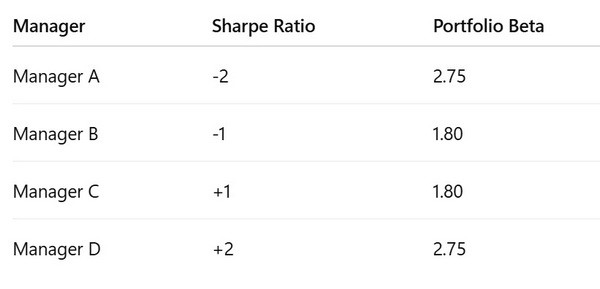 Which manager likely has the highest return for a given level of risk?
-
A
-
B
-
C
-
D
Reveal answer details
Close answer details
Correct answerC
ExplanationThe correct answer is C. Manager D, because the Sharpe ratio is the primary measure used to evaluate risk-adjusted return, which is return earned per unit of total risk. The Investment Funds in Canada curriculum defines the Sharpe ratio as a tool that "measures how much excess return a portfolio generates relative to the risk taken." A higher Sharpe ratio indicates superior risk-adjusted performance. Manager D has the highest Sharpe ratio (+2) among all managers listed, meaning this manager generated the greatest excess return for each unit of risk, regardless of the portfolio's beta. Although Manager D has a higher beta (2.75), beta measures systematic market risk, not total volatility. The Sharpe ratio already accounts for total risk (standard deviation), making it the preferred comparison metric when the question asks for return for a given level of risk. Manager C has a positive Sharpe ratio (+1) but lower than Manager
D, indicating inferior risk-adjusted performance. Managers A and B both have negative Sharpe ratios, which the CIFC text explains means the portfolio underperformed the risk-free rate, making them clearly inferior choices. The CIFC curriculum stresses that when comparing managers across different risk profiles, "the Sharpe ratio is the most appropriate measure." Since Manager D delivers the highest risk-adjusted return, Option C is the correct and fully CIFC-verified answer.
Question 18
Single choice
What action does an investor take when making a long margin purchase of common shares at market?
-
A
The investor buys common shares using entirely their own funds at the current price available
-
B
The investor places an order to buy when the price of common shares reaches or drops below a specified level
-
C
The investor buys common shares using borrowed funds at the current price available
-
D
The investor borrows common shares and then sells them in anticipation of a decline in the price of the common shares
Reveal answer details
Close answer details
Correct answerC
ExplanationA long margin purchase means buying securities partly with borrowed funds from the dealer . The investor pays part of the purchase price (the margin), while the dealer lends the balance .
This differs from:
A (cash purchase): uses only own funds.
B (limit order): unrelated, based on price conditions.
D (short sale): selling borrowed shares, not buying.
Correct action = buying shares on borrowed funds at market price.
Question 19
Single choice
Ayan wants to make a registered retirement savings plan (RRSP) contribution and deduct it from his Year
1 income. What is the deadline for this contribution (assume that it is NOT a leap year)?
-
A
-
B
-
C
-
D
Reveal answer details
Close answer details
Question 20
Single choice
A mutual fund sales representative receives a client's purchase order for equity mutual funds and confirms that the order is appropriate based on the client's recorded investment knowledge and risk tolerance. The client explains that she had inherited the funds from a family member. The client states her investment objective to be long term. The representative records this information and processes the order. What the representative doesn't know is that the client has recently lost her job and is living on unemployment insurance. What step did the representative need to take in order to uphold her duty of care?
-
A
The representative should have applied the test of suitability to the unsolicited order
-
B
The representative should have verified that the client's KYC information was updated before applying the suitability test
-
C
The representative should have probed the client's understanding of equity funds
-
D
The representative should have applied due diligence in matching the order to the client's KYC information
Reveal answer details
Close answer details
Correct answerB
ExplanationThe representative failed to verify that the client's KYC information was current, which is critical for assessing suitability, especially given the client's recent job loss. The feedback from the document states: "Standard A - Duty of Care starts with the Know Your Client rule. It is impossible to apply due diligence and assess the suitability of an investment if the client's information has not been updated. Client account documentation should reflect all material information about the client's current status, and should be updated to reflect any material change to the client's status in order to assure suitability of investment recommendations." References:
Chapter 18 - Applying Ethical Standards to What You Have LearnedLearning Domain: Ethics, Compliance and Mutual Fund Regulations
Question 21
Single choice
You are concerned about upcoming weakness in the Canadian dollar. Which type of fund should you invest in?
-
A
A specialty fund that uses derivatives to hedge the value of its portfolio
-
B
An international fund that hedges its foreign currency risk
-
C
A global fund that hedges its foreign currency risk
-
D
A global fund that does not hedge its foreign currency risk
Reveal answer details
Close answer details
Correct answerD
ExplanationA global fund that does not hedge foreign currency risk benefits from a weakening Canadian dollar, as the value of foreign investments increases in Canadian dollar terms. The feedback from the document states: "Global mutual funds are attractive in that they can provide a hedge against a decline in the relative value of the Canadian dollar... It is important for mutual fund sales representatives to know whether their global mutual funds hedge foreign exchange risk, because some clients will want to bear that risk themselves, while others will not." References:
Chapter 12 - Riskier Mutual Fund ProductsLearning Domain: Analysis of Mutual Funds
Question 22
Single choice
Which of the followings describes segregated funds?
-
A
Segregated funds have high returns, high management fees, and cannot be redeemed until the maturity date of the contract.
-
B
Segregated funds flow through capital losses to investors because the investors are the owners of the underlying fund.
-
C
Segregated funds offer some protection of the capital invested but there is an added cost for the protection.
-
D
Segregated funds are subject to securities regulation because they are distributed by mutual fund dealing representatives.
Reveal answer details
Close answer details
Correct answerC
ExplanationSegregated funds offer some protection of the capital invested but there is an added cost for the protection. Segregated funds are contracts issued by life insurance companies that invest in underlying funds, similar to mutual funds. Segregated funds have a maturity guarantee and a death benefit guarantee, which ensure that the investor or their beneficiary will receive a certain percentage of their initial investment, regardless of market fluctuations. However, these guarantees come at a cost, which is reflected in higher management fees and insurance fees than mutual funds. Segregated funds do not have high returns, as they depend on the performance of the underlying funds. Segregated funds can be redeemed before the maturity date of the contract, but they may be subject to early redemption fees or market value adjustments. Segregated funds do not flow through capital losses to investors, as they are not considered owners of the underlying fund. Segregated funds are subject to insurance regulation, not securities regulation, because they are distributed by life insurance agents.
References:
Segregated Funds
Question 23
Single choice
Julia is looking for a mutual fund that will give her growth with moderate volatility. Her dealing representative has suggested the Laurentian Fund. The mutual fund's mandate limits the amount of equity exposure in the portfolio to 60%. Also, the portfolio must hold between 40 - 60% in fixed income at all times. The mutual fund distributes interest, dividends, and capital gains to its unitholders. What type of mutual fund is the Laurentian Fund?
-
A
-
B
-
C
-
D
Reveal answer details
Close answer details
Correct answerB
ExplanationA balanced mutual fund is a type of fund that invests in a mix of equities and fixed income securities, with the aim of achieving both growth and income objectives. A balanced fund typically has a target asset allocation that is specified in its mandate, and may vary within a certain range depending on market conditions. A balanced fund may also distribute interest, dividends, and capital gains to its unitholders. The Laurentian Fund is an example of a balanced fund, as it limits its equity exposure to 60% and holds between 40 - 60% in fixed income at all times.
Question 24
Single choice
A fund manager who utilizes an interest rate anticipation philosophy forecasts a rise in interest rates. What change in asset allocation should he implement?
-
A
Increase long-term bond and low coupon bond holdings
-
B
Increase long-term and high coupon bond holdings
-
C
Increase short-term T-bill and low coupon bond holdings
-
D
Increase short-term T-bill and high coupon bond holdings
Reveal answer details
Close answer details
Correct answerD
ExplanationWhen anticipating rising interest rates, a fund manager using an interest rate anticipation philosophy should reduce interest rate sensitivity by increasing holdings in short-term T-bills and high coupon bonds, which are less affected by rate increases. The feedback from the document states: "Interest rate anticipation is a fixed-income investing philosophy that involves moving between long-term government bonds and very short-term T-bills, based on a forecast of interest rates over a certain time horizon. Price sensitivity to interest rate movements increases as the term to maturity increases and the coupon decreases. Therefore, to avoid a large capital loss if interest rates rise, the fund manager would decrease the fund's interest rate sensitivity." References:
Chapter 15 - Selecting a Mutual FundLearning Domain: Evaluating and Selecting Mutual Funds
Question 25
Single choice
Who is responsible for regulating mutual fund activities?
-
A
-
B
-
C
-
D
Reveal answer details
Close answer details
Correct answerB
ExplanationMutual fund activities in Canada are regulated by administrative bodies, specifically provincial and territorial securities regulators, acting collectively through the Canadian Securities Administrators (CSA).
The Investment Funds in Canada course explains that securities regulation in Canada is not federal, but rather administered at the provincial and territorial level through securities commissions such as the Ontario Securities Commission (OSC) and the Autorite des marches financiers (AMF) in Quebec. These administrative bodies create, administer, and enforce securities legislation, including rules governing mutual fund distribution, disclosure, registration, and conduct. National Instruments such as NI 81-102 (Mutual Funds) and NI 31-103 (Registration Requirements) are developed through the CSA and enforced by these regulators.
The federal government does not directly regulate mutual funds. Transfer agents perform record-keeping functions only, and stock exchanges regulate listed securities, not mutual fund operations. The CIFC curriculum clearly emphasizes that securities regulation is carried out by administrative authorities, not political or commercial bodies. Therefore, Option B is the correct and fully CIFC-verified answer.
Question 26
Single choice
Tristan is evaluating different mutual fund options for his client. What mutual fund option would be the most expensive to buy in dollar terms?
-
A
Purchase $1500 at 3% front-end load
-
B
Purchase $1000 at 4% front-end load
-
C
Purchase $5000 at 1% front-end load
-
D
Purchase $3000 at 2% front-end load
Reveal answer details
Close answer details
Correct answerC
ExplanationA front-end load is a sales charge paid at the time of purchase, calculated as a percentage of the investment amount.
A. $1,500 x 3% = $45
B. $1,000 x 4% = $40
C. $5,000 x 1% = $50
D. $3,000 x 2% = $60
# Most expensive = $60 (Option D)
Correction: Answer = D. Purchase $3,000 at 2% front-end load
Question 27
Single choice
Iliana owns 1,000 participating preferred shares in the First Canadian Bank. Which of the following features are characteristic of her investment?
-
A
Iliana has the right to purchase more preferred shares in the company before common shareholders.
-
B
Iliana is able to vote at the annual general meeting and elect members of the board of directors.
-
C
Iliana can convert her preferred shares to common shares at a fixed price and within a specified time period.
-
D
Iliana has a right to share in the bank's net profits over and above the specified dividend rate.
Reveal answer details
Close answer details
Correct answerD
ExplanationParticipating preferred shares are a type of preferred shares that give the holder a right to share in the issuer's net profits over and above the specified dividend rate. This means that participating preferred shareholders may receive additional dividends if the issuer performs well. Iliana owns participating preferred shares in the First Canadian Bank, which means she has a right to share in the bank's net profits over and above the specified dividend rate.
References:
Investment Funds in Canada (IFC) | Canadian Securities Institute
Question 28
Single choice
Jabir begins the registration process with his new dealer Prosper Wealth Inc. Jabir is excited about his new career and eager to start calling clients, opening new accounts, and selling investments. Which of the following CORRECTLY describes when Jabir will be eligible to open new client accounts and sell investments?
-
A
Upon employment with the dealer
-
B
Upon registration application by the dealer
-
C
Upon passing the proficiency course
-
D
Upon formal confirmation from the regulator
Reveal answer details
Close answer details
Correct answerD
ExplanationJabir will be eligible to open new client accounts and sell investments only upon formal confirmation from the regulator. Before he can start his activities as a dealing representative, he must complete the registration process, which includes passing the proficiency course, applying for registration through his dealer, and obtaining approval from the securities regulator in his jurisdiction.
References:
Guide to Broker-Dealer Registration
Question 29
Single choice
Which organization regulates mutual and investment funds?
-
A
Investment Industry Regulatory Organization of Canada (IIROC)
-
B
-
C
-
D
Reveal answer details
Close answer details
Correct answerB
ExplanationSecurities commissions are responsible for regulating mutual and investment funds in Canada. The feedback from the document confirms: "The responsibility of regulating mutual funds lies with the securities commissions." References:
Chapter 2 - Overview of the Canadian Financial MarketplaceLearning Domain: An Introduction to the Mutual Funds Marketplace
Question 30
Single choice
As it pertains to fixed-income securities, which yield metric factors in cash flows relative to ongoing bond prices rather than the initial amount invested?
-
A
-
B
-
C
-
D
Reveal answer details
Close answer details
Question 31
Single choice
Natasha currently owns 2 mutual funds: a bond fund and a Canadian equity fund. She would like to use one of them as her registered retirement savings plan (RRSP) contribution for the year.
From a tax efficiency perspective, which mutual fund should she contribute?
-
A
-
B
-
C
either since it makes no difference
-
D
it depends on her marginal tax rate
Reveal answer details
Close answer details
Correct answerB
ExplanationThe bond fund should be contributed to Natasha's RRSP from a tax efficiency perspective, because interest income from bonds is fully taxable at her marginal tax rate outside of an RRSP. By contributing the bond fund to her RRSP, Natasha can defer paying tax on the interest income until she withdraws it from her RRSP in retirement, when she may be in a lower tax bracket. The equity fund should be kept outside of her RRSP, because dividends and capital gains from equities receive preferential tax treatment compared to interest income. Dividends qualify for the dividend tax credit and capital gains are only 50% taxable.
Furthermore, equities tend to have higher returns than bonds over the long term, which means that Natasha would have more after-tax income by keeping them outside of her RRSP.
References:
Registered Retirement Savings Plan (RRSP), Does it pay to invest in an RRSP? Here's the math
Question 32
Single choice
What is the likely economic impact of a rise in nominal and real GDP, mainly due to higher prices?
-
A
-
B
-
C
Business activity increase
-
D
Inflationary rate decrease
Reveal answer details
Close answer details
Correct answerC
ExplanationA rise in both nominal and real GDP, even when driven mainly by higher prices, generally indicates an increase in overall business activity, making Option C the correct answer. The Investment Funds in Canada course explains that nominal GDP measures output using current prices, while real GDP adjusts for inflation to reflect actual growth in economic output.
If both nominal and real GDP rise, this suggests that the economy is producing more goods and services, not merely experiencing price increases. Increased production typically results in higher employment, greater corporate revenues, and expanded economic activity.
Option A is incorrect because rising GDP-especially when price pressures exist-often leads to higher, not lower, interest rates as central banks attempt to control inflation.
Option B is incorrect because living standards improve primarily when real GDP growth exceeds inflation, not when growth is mainly price-driven.
Option D is incorrect because higher prices indicate inflationary pressures, not a decrease. The CIFC curriculum emphasizes that GDP growth is a primary indicator of economic expansion and business activity. Therefore, Option C is the correct and fully CIFC-aligned answer.
Question 33
Single choice
Zara buys a future contract with an underlying value of $100,000 worth of stocks. She is required to deposit $1,750 of margin. Two weeks later, the underlying value of the stocks is $101,900. What is Zara's total return?
-
A
-
B
-
C
-
D
Reveal answer details
Close answer details
Question 34
Single choice
What purpose does it serve for non-money market mutual funds to hold money market instruments?
-
A
Money market instruments primarily generate investment income that provides investors with preferential tax treatment.
-
B
If the portfolio manager has an immediate need for cash, money market instruments are relatively easy to liquidate.
-
C
They are purchased by non-money market funds to satisfy the regulatory requirement of fund diversification.
-
D
They ensure that the fair market value of a mutual fund will not drop below a minimal market value.
Reveal answer details
Close answer details
Correct answerB
ExplanationThe purpose of holding money market instruments for non-money market mutual funds is to provide liquidity for the fund. If the portfolio manager has an immediate need for cash, such as to pay expenses or meet redemption requests, money market instruments are relatively easy to liquidate because they have short maturities and low credit risk. Money market instruments do not primarily generate investment income that provides investors with preferential tax treatment, as interest income from money market instruments is fully taxable at the investor's marginal tax rate. Money market instruments are not purchased by non-money market funds to satisfy the regulatory requirement of fund diversification, as there is no such requirement for mutual funds. Money market instruments do not ensure that the fair market value of a mutual fund will not drop below a minimal market value, as money market instruments can also fluctuate in value depending on interest rate changes and supply and demand factors.
References:
Money Market Instruments
Question 35
Single choice
Francis wants to redeem his US Asset Allocation Fund as he needs the money for a down payment for a home purchase. The current proceeds from the redemption are USD $27,859, and the current CAD/USD exchange rate is 0.7353.
How much will Francis receive in Canadian dollars when he redeems the Funds? Please round your answer to the nearest dollar.
-
A
-
B
-
C
-
D
Reveal answer details
Close answer details
Correct answerA
ExplanationA is correct because Francis will receive $37,888 in Canadian dollars when he redeems the Funds. This is calculated by dividing the current proceeds from the redemption in US dollars by the current CAD/USD exchange rate and rounding to the nearest dollar. That is,
Question 36
Single choice
A fund manager has diversified the equity portfolio he manages in order to reduce the potential negative impact of unfavorable information relating to any one stock. What type of risk has he reduced?
-
A
-
B
-
C
-
D
Reveal answer details
Close answer details
Correct answerD
ExplanationUnique risk, also known as firm-specific risk, is reduced through diversification, as it relates to volatility caused by information specific to individual securities. The feedback from the document states: "If a security's price is affected by new information, and if new information arrives frequently, then its price will tend to be volatile and so will the returns that it generates. This source of volatility is specific to a given security and is known as unique risk. Diversifying a portfolio reduces unique risk." References:
Chapter 15 - Selecting a Mutual FundLearning Domain: Evaluating and Selecting Mutual Funds
Question 37
Single choice
Clinton is meeting with his advisor Zaydin to discuss the best ways to regularly invest from his paydays.
Clinton is concerned that he may be unable to commit to regular contributions versus lump-sum deposits. Why would Zaydin recommend an accumulation plan to his client?
-
A
-
B
-
C
Increases market timing opportunities
-
D
Reveal answer details
Close answer details
Correct answerA
ExplanationAn accumulation plan, such as a Pre-Authorized Chequing (PAC) plan, is recommended primarily to encourage investment discipline, which is why Option A is correct. The Investment Funds in Canada text explains that accumulation plans "encourage investors to save regularly and consistently over time," helping clients overcome behavioural challenges such as procrastination or irregular saving habits. By investing automatically from each payday, clients commit to a structured saving process without needing to decide repeatedly whether to invest. This aligns with the CIFC emphasis on behavioural finance, which notes that disciplined, systematic investing often leads to better long-term outcomes than sporadic lump-sum investing.
Reduced fees are not guaranteed under accumulation plans, making Option B incorrect. Accumulation plans do not improve market timing; in fact, CIFC explicitly warns that attempting to time the market is
ineffective, making Option C incorrect. NAVPS is determined by fund assets and liabilities and is not lowered by contribution methods, so
Option D is also incorrect.
The course further explains that accumulation plans complement dollar-cost averaging, which reduces emotional decision-making and smooths market volatility over time. Therefore, the key benefit-and the reason Zaydin would recommend the plan-is investment discipline.
Question 38
Single choice
Quinton, a Dealing Representative, meets with his client Banji. Banji's Know Your Client (KYC) indicates that her risk profile is "medium''. Banji currently has $35,000 in her account which is invested 50% in the Middleton Balanced Fund and 50% in the Hector Growth Fund. She tells Quinton that she would like to contribute an additional $10,000 to purchase the Prospect Labour-Sponsored Fund. Which of the following statements about Banji's proposed transaction is CORRECT?
-
A
Quinton can proceed with the purchase of the Prospect Labour-Sponsored Fund because it is suitable for Banji based on her current KYC.
-
B
Quinton should update Banji's risk profile to "high" so that he can proceed with the purchase of the Prospect Labour-Sponsored Fund.
-
C
Quinton should not proceed with the purchase of the Prospect Labour-Sponsored Fund because it is not suitable for Banji based on her current KYC.
-
D
Quinton must provide Banji with full disclosure about the risks so that he can proceed with the purchase of the Prospect Labour-Sponsored Fund.
Reveal answer details
Close answer details
Correct answerC
ExplanationA labour-sponsored investment fund (LSIF) is a type of mutual fund that invests in small and medium-sized businesses that are not publicly traded. LSIFs are sponsored by labour unions or associations and offer tax credits to investors. However, LSIFs are also very risky and illiquid investments that may not be suitable for investors with a medium risk profile, such as Banji. Therefore, Quinton should not proceed with the purchase of the Prospect Labour-Sponsored Fund because it is not suitable for Banji based on her current KYC. Therefore, C is the correct answer.
References:
Labour-Sponsored Investment Funds (LSIFs): Definition and How They Work - Investopedia, Canadian Investment Funds Course (CIFC) | IFSE Institute
Question 39
Single choice
A client wishes to deal with one registered representative for both banking services and mutual fund investments. The client would also like advice on determining where best to place their money to enhance their overall tax situation as they approach buying a home. Which individual is best suited for this service if the client's goal is to build a long-term advisor-client relationship?
-
A
Senior account manager working at a credit union.
-
B
Financial planner working at the insurance arm of a wealth management firm.
-
C
Dealing representative at a large financial conglomerate offering several specialized business lines.
-
D
Investment representative at a Robo-Advisor offering deposit products.
Reveal answer details
Close answer details
Question 40
Single choice
Your client, Helen, just received her non-registered account statement which states that one of her mutual funds made an interest income distribution during the year. She asks you how she will be taxed on the distribution. What do you tell Helen?
-
A
She will pay taxes on 50% of the distribution.
-
B
She will pay taxes at her top marginal tax rate.
-
C
She will pay taxes on the grossed-up amount of the income.
-
D
She will pay taxes at her average tax rate.
Reveal answer details
Close answer details
Correct answerB
ExplanationInterest income distribution is a type of income that a mutual fund pays to its investors from the interest earned on its fixed-income investments, such as bonds and mortgages. Interest income distribution is taxed as ordinary income at the investor's top marginal tax rate, which is the highest tax rate that applies to their income bracket. Therefore, B is the correct answer.
References:
Interest Income and Taxes - Fidelity, Topic No. 403, Interest Received | Internal Revenue Service
Question 41
Single choice
Reginald is a Dealing Representative, who feels pressure from management at the beginning of every calendar year, to open new registered retirement savings plans (RRSPs) and generate RRSP contributions. It is the end of February, and Reginald is close to reaching his personal sales objectives. He just finished an appointment with a prospective new client, Orel. Orel wants to open a tax-free savings account (TFSA) to build emergency savings. However, Reginald recommended to Orel that he should first contribute to an RRSP, and then use the tax savings for a TFSA contribution.
With regards to account suitability, what can be said about Reginald's advice?
-
A
Reginald is putting the client's interest first by informing Orel why he should change his investment strategy.
-
B
Based on Orel's stated need, recommending an RRSP contribution is unsuitable.
-
C
Recommending an investment solution that addresses two needs, is putting Reginald's client's interest first.
-
D
By convincing Orel to contribute to an RRSP, instead of a TFSA, Reginald has put his client's interest first.
Reveal answer details
Close answer details
Correct answerB
ExplanationOrel's goal is to build emergency savings, which means he needs a flexible and accessible account that does not penalize withdrawals. A TFSA is more suitable for this purpose, as it allows tax-free withdrawals at any time and does not affect other income-tested benefits. An RRSP, on the other hand, is designed for long-term retirement savings, and withdrawals are subject to income tax and withholding tax. Moreover, RRSP withdrawals reduce the contribution room permanently, and may affect eligibility for government benefits such as the Canada Child Benefit or the Guaranteed Income Supplement. References:
Canadian Investment Funds Course (CIFC) - Module 3: Registered Plans - Section 3.1: Registered Retirement Savings Plan (RRSP)1 and Section 3.2: Tax-Free Savings Account (TFSA)2 1: (https://www.ifse.ca/wp-content/uploads/2021/08/CIFC-Module-3.pdf)
2: (https://www.ifse.ca/wp-content/uploads/2021/08/CIFC-Module-3.pdf)
Question 42
Single choice
A fund manager is selling industrial sector stocks and using the proceeds to overweight the portfolio in financial services stocks to take advantage of her belief of changes in the business cycle. What equity investing philosophy describes this approach?
-
A
-
B
-
C
-
D
Growth at a reasonable price
Reveal answer details
Close answer details
Correct answerC
ExplanationSector rotation is an equity investing strategy where portfolio weightings are shifted among sectors to reflect expected changes in the business cycle. The Investment Funds in Canada course explains that different sectors perform better at different economic stages. For example, financial services often outperform during economic expansion, while industrials may lag during certain cycle transitions. The fund manager's decision to reduce exposure to industrial stocks and increase exposure to financial services based on economic expectations is a textbook example of sector rotation. Growth investing focuses on earnings expansion, momentum investing follows price trends, and growth at a reasonable price blends valuation with growth - none of which describe sector-based reallocations driven by macroeconomic analysis.
Question 43
Single choice
Exchange traded funds (ETFs) that track an index and index mutual funds have many similarities.
However, what is a major difference between these two products?
-
A
While ETFs are prone to tracking errors, index funds are perfectly aligned with their underlying index.
-
B
ETFs can be purchased continuously throughout the trading day while index funds can only be bought or sold at the end of the day.
-
C
The market price of ETFs always matches the underlying basket of securities while there can be a discrepancy in pricing index funds.
-
D
ETFs do not have management fees since they are exchange traded while index funds do incur such fees.
Reveal answer details
Close answer details
Correct answerB
ExplanationETFs can be purchased continuously throughout the trading day while index funds can only be bought or sold at the end of the day. This is because ETFs are traded on a stock exchange like stocks, while index funds are traded directly with the fund company like mutual funds. This difference gives ETFs more liquidity and flexibility than index funds, as investors can buy and sell ETFs at any time during market hours at the prevailing market price. Index funds, on the other hand, are priced only once a day at the end of the day based on the net asset value per unit (NAVPU) of the fund. Both ETFs and index funds are prone to tracking errors (A), which are the differences between the performance of the fund and the performance of the underlying index. Tracking errors can be caused by various factors, such as fees, expenses, dividends, rebalancing, and market conditions. The market price of ETFs does not always match the underlying basket of securities (C), as it is determined by supply and demand in the market.
There can be a discrepancy between the market price and the NAVPU of an ETF, which is called the premium or discount. Index funds, on the other hand, are priced based on the NAVPU of the fund, which reflects the value of the underlying securities. Both ETFs and index funds have management fees (D), as they are both types of mutual funds that incur costs for managing and operating the fund. However, ETFs usually have lower management fees than index funds, as they are more passive and have lower turnover and distribution costs.
Question 44
Single choice
Daisy is a Dealing Representative registered in the province of Saskatchewan only. Daisy's client, Orville, a resident of Lloydminster, Saskatchewan is a retiree who presently has a $1,000,000 with her dealer, Easy Ride Financial. Orville is now planning to move to Vegreville, Alberta next month. Easy Ride Financial is registered in Alberta and Saskatchewan. Neither Easy Ride Financial nor Daisy have any clients who are resident in Alberta. Which of the following should Daisy do if she wants to continue to service Orville's account?
-
A
Request approval from the Mutual Fund Dealers Association of Canada to be eligible to be a registered Dealing Representative in Alberta
-
B
Daisy could seek permission from her dealer to request a client mobility exemption with the Alberta Securities Commission.
-
C
Daisy will need to forfeit her registration in Saskatchewan if she wants to be registered in Alberta to keep Orville as a client.
-
D
Register with a different mutual fund dealer that is registered in Alberta so she can keep Orville as a client.
Reveal answer details
Close answer details
Correct answerB
ExplanationDaisy could seek permission from her dealer to request a client mobility exemption with the Alberta Securities Commission. This exemption allows a registered individual in one jurisdiction to service a client who moves to another jurisdiction, without having to register in the new jurisdiction, subject to certain conditions. Some of these conditions are that the individual must be registered with a dealer that is registered in both jurisdictions, the individual must not have more than five clients in the new jurisdiction, and the individual must notify the regulator in the new jurisdiction of the exemption.
References:
Client Mobility Exemption
Question 45
Single choice
What decision accounts for most of the success or failure of a portfolio?
-
A
-
B
-
C
-
D
Reveal answer details
Close answer details
Correct answerD
ExplanationResearch and the CSC curriculum stress that asset allocation is the single most important factor in determining portfolio performance, more than market timing or security selection. Proper asset mix (equities, fixed income, cash) accounts for most portfolio success or failure.
Question 46
Single choice
What type of investment account has the option to open it with rights of survivorship?
-
A
-
B
-
C
-
D
Reveal answer details
Close answer details
Correct answerC
ExplanationRights of survivorship means that if one account holder dies, their share of the assets automatically transfers to the surviving holder(s). This feature is available in joint non-registered accounts. Registered accounts (A) (e.g., RRSP, TFSA) are individual accounts and cannot be opened jointly with rights of survivorship. Trust accounts (B) follow trust law, not survivorship rules.
Corporate accounts (D) belong to the company, not individuals.
Question 47
Single choice
Last year at age 70, Gregory opened a registered retirement income fund (RRIF). Recently, Gregory unexpectedly received a large cash gift and presently does not need to depend on any payments from his RRIF. He contacts his financial advisor Eric for guidance. Which of the following statements by his financial advisor would be CORRECT?
-
A
Periodic contributions to a RRIF are permitted until Gregory reaches the age of 71.
-
B
Withdrawals become mandatory within the first year of the plan being started.
-
C
Gregory's account will be subjected to no maximum withdrawal limit but to an annual minimum withdrawal.
-
D
Gregory must have attained the minimum age of 71 to open a RRIF.
Reveal answer details
Close answer details
Correct answerC
ExplanationAccording to the Canadian Investment Funds Course, a registered retirement income fund (RRIF) is a type of registered plan that provides a stream of income in retirement. A RRIF can be opened at any age, but it must be established by the end of the year the annuitant turns 71. A RRIF cannot accept any contributions, but it can receive transfers from other registered plans, such as RRSPs, PRPPs, RPPs, or other RRIFs. A RRIF has no maximum withdrawal limit, meaning that the annuitant can withdraw any amount from the plan at any time. However, a RRIF has a minimum withdrawal requirement, which is calculated based on the annuitant's age or the age of their spouse or common-law partner. The minimum withdrawal must be paid out in the year following the year the RRIF is opened and every year thereafter. The minimum withdrawal is taxable as income in the year of receipt. Therefore, the correct answer is C. Gregory's account will be subjected to no maximum withdrawal limit but to an annual minimum withdrawal.
1: Canadian Investment Funds Course - IFSE Institute 2 (Unit 9: Retirement)
Question 48
Single choice
Nelson is a Dealing Representative with True Wealth Advisors Inc., a mutual fund dealer. Nelson follows proper procedures related to his firm's Relationship Disclosure Information (RDI). Which of the following CORRECTLY describes how Nelson is permitted to evidence that he satisfied his RDI obligation?
-
A
Nelson may retain a copy of the RDI in the client file with detailed notes to confirm that he provided and explained the RDI to the client.
-
B
Nelson may deliver the RDI to clients who request it and keep detailed notes of the clients who were provided with the RDI.
-
C
Nelson can formalize his relationship under the RDI using a Letter of Engagement that specifies duties, responsibilities, and level of service.
-
D
Nelson can record detailed notes which confirm that he provided and explained the Fund Facts to the client within 2 days of the RDI.
Reveal answer details
Close answer details
Correct answerA
ExplanationRelationship Disclosure Information (RDI) is a document that provides important information about the nature and scope of the relationship between a registered firm and its clients. It covers topics such as the products and services offered by the firm, the fees and charges applicable to the client's account, the risks associated with investing, the conflict of interest management policies of the firm, and the dispute resolution services available to the client. According to Section 14.2 of National Instrument 31-103
Registration Requirements, Exemptions and Ongoing Registrant Obligations (NI 31-103), registered firms must provide RDI to their clients before they purchase or sell securities for them or advise them to do so.
Registered firms must also update RDI in a timely manner if there are any significant changes to it. To evidence that they have satisfied their RDI obligation, registered firms may retain a copy of the RDI in the client file with detailed notes to confirm that they have provided and explained RDI to their clients. This is one of the acceptable methods suggested by Alberta Securities Commission (ASC) in its presentation on RDI1. Delivering RDI only upon request or using a letter of engagement are not sufficient methods to comply with NI 31-103. Providing and explaining Fund Facts is a separate obligation under NI 31-101
Mutual Fund Distribution Rules.
References:
Relationship Disclosure Information August 2021, Relationship Disclosure Information, Relationship
Disclosure Information
Question 49
Single choice
A mutual fund representative meets with a young family whose net worth/level of wealth is categorized as low, but they have the potential to become wealthy. In general, the family seems susceptible to believing that market events are predictable. Also, the family has a stronger impulse to avoid losses than earn gains. How might the mutual fund representative effectively address each of the two biases, respectively?
-
A
Moderate the first bias and adapt to the second.
-
B
Conform to the first bias and moderate the second.
-
C
Conform to both biases identified.
-
D
Moderate both biases identified.
Reveal answer details
Close answer details
Question 50
Single choice
Zofia has held units of the ABC Monthly Income fund for many years and has reinvested all distributions by purchasing additional units. During this period, she received $2,500 in reinvested dividends. She originally purchased $10,000 of fund units, and after several years, the portfolio value rose to $15,000. What is the tax consequence if Zofia decides to sell her units?
-
A
The capital gain will be $5,000.
-
B
The NAVPS will be increased by the amount of the cumulative distributions.
-
C
The cumulative distributions will be taxed separately as an investment dividend when she sells her units.
-
D
The adjusted cost base would be $12,500.
Reveal answer details
Close answer details
Correct answerD
ExplanationWhen distributions from a mutual fund are reinvested (rather than taken in cash), they are not taxed again at the time of reinvestment. Instead, they increase the adjusted cost base (ACB) of the investment. This is important because when the investor eventually sells the mutual fund units, the capital gain (or loss) is calculated as: Capital Gain = Proceeds of Disposition - Adjusted Cost Base - Expenses Incurred to Sell In Zofia's case: Original investment = $10,000 Reinvested distributions = $2,500 (which increases the ACB) Therefore, ACB = $10,000 + $2,500 = $12,500 Proceeds of sale = $15,000
Capital gain = $15,000 - $12,500 = $2,500
Thus, the correct answer is D, because $12,500 is the adjusted cost base and the capital gain on sale would be $2,500, not $5,000. This is clearly stated in the Investment Funds in Canada material where it explains that reinvested distributions increase the investor's ACB and are not separately taxed at the time of disposition.
Question 51
Single choice
What term describes the range of possible future outcomes on the price of a security?
-
A
-
B
-
C
-
D
Reveal answer details
Close answer details
Correct answerB
ExplanationRisk refers to the potential volatility in returns or the range of possible future outcomes on the price of a security. This concept captures the uncertainty associated with a security's future value, a fundamental aspect of investment analysis. The feedback from the document states: "Risk is the potential volatility in returns or the range of possible future outcomes on the price of a security." References:
Chapter 1 - The Role of the Mutual Fund Sales RepresentativeLearning Domain: An Introduction to the Mutual Funds Marketplace
Question 52
Single choice
Which of the following statements about standard deviation is CORRECT?
-
A
Indicates how much an investment's performance fluctuates around its average historical return.
-
B
A standard deviation greater than one indicates a higher level of volatility than the market.
-
C
Measures the systematic risk of an investment relative to a benchmark index.
-
D
Standard deviation is also referred to as beta.
Reveal answer details
Close answer details
Correct answerA
ExplanationThe correct answer is A. Indicates how much an investment's performance fluctuates around its average historical return.
Standard deviation is a measure of how spread out the data points are from the mean value. It is calculated as the square root of the variance, which is the average of the squared differences from the mean. Standard deviation can be used to assess the volatility or risk of an investment by showing how much the returns deviate from the expected or average return. A higher standard deviation means that the investment has a wider range of possible outcomes, which implies more uncertainty and risk. A lower standard deviation means that the investment has a narrower range of possible outcomes, which implies more stability and consistency.
B. A standard deviation greater than one indicates a higher level of volatility than the market. This statement is incorrect because the standard deviation of an investment is not directly comparable to the standard deviation of the market, unless they have the same mean return. The standard deviation of an investment only measures the absolute variation of the returns, not the relative variation to the market. A better measure of the relative volatility of an investment to the market is beta, which is the ratio of the covariance of the investment and the market to the variance of the market.
C. Measures the systematic risk of an investment relative to a benchmark index. This statement is incorrect because the standard deviation of an investment does not distinguish between the systematic risk and the unsystematic risk. The systematic risk is the risk that affects the entire market or a large segment of the market, such as inflation, interest rates, or political events. The unsystematic risk is the risk that affects a specific investment or a small group of investments, such as management decisions, product quality, or lawsuits.
The standard deviation of an investment captures both types of risk, whereas the beta of an investment only captures the systematic risk.
D. Standard deviation is also referred to as beta. This statement is incorrect because standard deviation
and beta are different measures of risk. Standard deviation measures the absolute variation of the returns of an investment, whereas beta measures the relative variation of the returns of an investment to the market. Standard deviation is a measure of total risk, whereas beta is a measure of systematic risk.
Question 53
Single choice
What criteria does the independent review committee use to determine if a potential conflict of interest, such as interfund trading, should be approved?
-
A
Will the action achieve a fair and reasonable result for the fund?
-
B
Will the action contravene National Instrument 81-102?
-
C
Will the action contravene a unitholder's statutory rights?
-
D
Will the action require unitholder approval?
Reveal answer details
Close answer details
Correct answerA
ExplanationThe independent review committee approves actions involving conflicts of interest only if they achieve a fair and reasonable result for the fund. The feedback from the document states: "The Independent Review Committee will only approve actions where a conflict of interest arises if certain requirements are met, including, most importantly, the action achieves a fair and reasonable result for the fund." References:
Chapter 10 - The Modern Mutual FundLearning Domain: The Modern Mutual Fund
Question 54
Single choice
What bias results in investors valuing an asset that they own over an asset that another individual owns?
-
A
-
B
-
C
-
D
Reveal answer details
Close answer details
Correct answerB
ExplanationEndowment bias leads investors to overvalue assets they own compared to similar assets they do not own.
The feedback from the document states: "People who are subject to endowment bias place more value on an asset they hold property rights to than on an asset they do not hold property rights to." References:
Chapter 5 - Behavioural FinanceLearning Domain: The Know Your Client Communication Process
Question 55
Single choice
The Canadian Investor Protection Fund provides what amount of maximum protection for eligible customer losses due to a dealer member's insolvency?
-
A
-
B
-
C
-
D
Reveal answer details
Close answer details
Correct answerD
ExplanationThe correct answer is D. $1,000,000. The Investment Funds in Canada curriculum explains that the Canadian Investor Protection Fund (CIPF) provides protection to eligible customers if a CIRO (formerly IIROC or MFDA) dealer member becomes insolvent.
CIPF coverage applies to losses of property such as cash, securities, and other investment assets that were held by the dealer on behalf of clients. The CIFC text clearly states that coverage is provided up to $1 million per account category, such as general accounts and registered accounts. It is important to note that CIPF does not protect against market losses, poor investment performance, or unsuitable advice. Its sole purpose is to restore client property when it is missing due to dealer insolvency. The other amounts listed are incorrect and do not reflect current CIFC standards. The $1 million limit ensures investor confidence in the Canadian investment system and is a key component of investor protection.
Therefore, Option D is the correct and fully verified answer under the Investment Funds in Canada framework.
Question 56
Single choice
Reagan has accepted a role to be the Chief Revenue Officer of a charitable organization. She is currently registered as a Dealing Representative for Sunshine Financial Services. Which of the following would apply to her?
-
A
The dealer will closely monitor her sales activities to ensure any clients from the charity are not getting a discount on potential fees.
-
B
Holding both positions at the same time is a violation of securities industry rules and regulations .
-
C
Reagan is not required to inform her dealer of this outside activity if none of her colleagues from the charity become clients.
-
D
The regulator will limit her from providing financial services to anyone associated with the charity.
Reveal answer details
Close answer details
Correct answerC
ExplanationThis answer is correct because according to FINRA Rule 3270, a registered representative must notify their firm in writing of any outside business activity (OBA) that involves compensation or the reasonable expectation of compensation from another person, or that may be viewed by customers or the public as part of the member's business. However, if the OBA does not involve any of these factors, then the notification is not required. In this case, Reagan's role as the Chief Revenue Officer of a charitable organization may not involve any compensation or any connection to her securities business, especially if none of her colleagues from the charity become clients. Therefore, she is not required to inform her dealer of this outside activity. References:
Outside Business Activities and Private Securities Transactions, Selling Away in Securities: Understanding FINRA Rule 3270
Question 57
Single choice
Terri, 30 years old, is the marketing manager at Provincial Winery with an average annual income of $60,000. Her spouse Yvette, 28 years old, is a project manager with a telecommunications firm earning
$70,000 per year. You are helping them to organize their investments and are trying to assess their financial resources. Which of the following is the best question to ask?
-
A
Do you have any children?
-
B
Do you have pension plans at work?
-
C
When do you need the money?
-
D
What is your investment experience?
Reveal answer details
Close answer details
Correct answerB
ExplanationOne of the steps in the Know Your Client (KYC) rule is to assess the client's financial resources, which include their income, assets, liabilities, and net worth. Asking about pension plans at work is a relevant question to determine the client's sources of income and potential retirement savings. Pension plans can also affect the client's risk tolerance and investment objectives, as they may provide a stable and guaranteed income in the future. Asking about children, money needs, and investment experience are also important questions, but they relate to other aspects of the KYC rule, such as personal circumstances, time horizon, and investment knowledge.
References:
Canadian Investment Funds Course (CIFC) Study Guide, Chapter 1: The Investment Funds Industry, Section 1.4: The Know Your Client (KYC) Rule, page 1-111 Know Your Client (KYC) Definition -
Investopedia
Question 58
Single choice
When reviewing a company's balance sheets, what ratio best determines whether their borrowing is excessive?
-
A
The cash flow from operations / total debt ratio.
-
B
-
C
The interest coverage ratio.
-
D
The price / earnings ratio.
Reveal answer details
Close answer details
Question 59
Single choice
You are meeting a potential client, William, for the first time. He is a high net worth individual and you are keen to get his business. Which of the following would you consider the most important to create an impressive first impression on your potential client?
-
A
-
B
-
C
-
D
Reveal answer details
Close answer details
Correct answerA
ExplanationYour body language would be the most important to create an impressive first impression on your potential client. Body language is the non-verbal communication that includes your posture, gestures, facial expressions, eye contact, and physical distance. Body language can convey your confidence, enthusiasm, professionalism, and trustworthiness. According to research, body language accounts for 55% of the impact of a first impression, while tone of voice accounts for 38% and words account for only 7%. The other statements are less important than body language. Volume of your voice is part of your tone of voice, which can affect how your words are perceived by your potential client. However, volume alone is not enough to create an impressive first impression; you also need to consider your pitch, pace, and
intonation. Your words are what you say to your potential client, which can include your introduction, your value proposition, and your questions. Your words are important to convey your message and establish rapport with your potential client. However, your words have less impact than your body language and tone of voice on your first impression. Tone of your voice is how you say your words, which can include your volume, pitch, pace, and intonation. Your tone of voice can influence how your potential client feels about you and your message. However, your tone of voice has less impact than your body language on your first impression.
References:
Unit 10: Sales Process, [The Importance Of Body Language In First Impressions]
Question 60
Single choice
In a mutual fund dealer, who is the person responsible for establishing and maintaining compliance policies and procedures as well as monitoring and assessing compliance?
-
A
the chief executive officer
-
B
the ultimate designated person
-
C
-
D
the chief compliance officer
Reveal answer details
Close answer details
Correct answerD
ExplanationIn a mutual fund dealer, the chief compliance officer (CCO) is the person responsible for establishing and maintaining compliance policies and procedures as well as monitoring and assessing compliance by the dealer and its representatives. The CCO must report to the board of directors or senior management of the dealer and must meet certain proficiency requirements, such as passing the Mutual Fund Dealers Compliance Exam. The CCO is also accountable to the securities regulators and self-regulatory organizations for any compliance issues or breaches.
References:
Guide to Broker-Dealer Registration
Question 61
Single choice
Melanie is saving for a home renovation that she plans to undertake in two years. Which investment objective is most consistent with this goal?
-
A
-
B
-
C
-
D
Reveal answer details
Close answer details
Correct answerC
ExplanationWhen funds will be needed within a relatively short period, preserving capital is typically the primary objective. Investments focused on aggressive growth or speculation may expose the investor to unnecessary market risk. Therefore, Option C is correct.
Question 62
Single choice
The following table shows Sabrina's earned income for the past few years: Sabrina has always maximized her RRSP contributions, so she has no carry-forward room available.
If the maximum contribution limit for Year 3 is $24,270, what is her RRSP contribution room for Year 3?
-
A
-
B
-
C
-
D
Reveal answer details
Close answer details
Correct answerB
ExplanationSabrina's RRSP contribution room for Year 3 is $24,270. This is because the maximum contribution limit for Year 3 is $24,270 and Sabrina has always maximized her RRSP contributions, so she has no carry-forward room available.
Canadian Investment Funds Course, Chapter 5: Registered Plans
Question 63
Single choice
Your client, Cosmo, recently inherited $50,000 from his uncle. He wants to use this money towards his retirement savings. Cosmo is a 50-year old, self-employed carpenter and he earns on average $65,000 per year. He has a registered retirement savings plan (RRSP) with the bank worth $425,000 and a tax-free savings account (TFSA) worth $46,000. He started saving when he was 25 years old and has always made his own investment decisions. His money is mostly invested in balanced funds. He feels most comfortable with these types of mutual funds since they offer potential investment growth but without being
too aggressive. Cosmo has no other assets. What additional information do you need about Cosmo to fulfill your know your client obligation?
-
A
-
B
-
C
-
D
Reveal answer details
Close answer details
Correct answerC
ExplanationTo fulfill the know your client (KYC) obligation, an advisor must collect and document information about the client's personal and financial situation, investment objectives, risk tolerance, and investment knowledge.
The KYC rule is a regulatory requirement that ensures that the advisor understands the client's needs and goals, and provides suitable recommendations that match the client's profile. In this case, Cosmo has provided some information about his personal and financial situation, such as his age, occupation, income, assets, and inheritance. He has also given some indication of his investment objectives, such as saving for retirement, and his investment knowledge, such as making his own investment decisions and preferring balanced funds. However, he has not disclosed his risk tolerance, which is his willingness and ability to accept fluctuations in the value of his investments. Risk tolerance is an important factor that affects the choice of investment strategies and products. Therefore, to complete the KYC process, the advisor needs to obtain additional information about Cosmo's risk tolerance.
References:
Canadian Investment Funds Course (CIFC) Study Guide, Chapter 1: The Investment Funds Industry, Section 1.4: The Know Your Client (KYC) Rule, page 1-111 Know Your Client (KYC) Definition -
Investopedia2
Question 64
Single choice
Barend is a Dealing Representative with Planvest Group Inc., a mutual fund dealer and member of the Mutual Fund Dealers Association of Canada (MFDA). Which of the following CORRECTLY describes Barend's obligation for conflicts of interest?
-
A
Barend must identify material conflicts of interest and implement controls on behalf of the firm.
-
B
Barend must disclose material conflicts of interest that cannot be addressed in the best interest of the client.
-
C
Barend must avoid material conflicts of interest that cannot be addressed in the best interest of the client.
-
D
Barend must identify material conflicts of interest and promptly report the conflicts of interest to clients.
Reveal answer details
Close answer details
Correct answerB
ExplanationA conflict of interest is a situation where an individual or a firm has competing or incompatible interests that may affect their ability to act fairly, honestly, and in the best interest of their clients. A material conflict of interest is a conflict of interest that a reasonable person would expect to know about and that may influence the client's decision to enter into or maintain a business relationship with the individual or the firm. According to the MFDA rules, Barend has an obligation to identify and address material conflicts of interest in a manner that prioritizes the client's interest over his own or the firm's interest 1. If a material conflict of interest cannot be addressed in the best interest of the client, Barend must disclose it to the client before opening an account, providing advice, or executing a transaction. The disclosure must be clear, meaningful, and timely, and it must explain the nature and extent of the conflict of interest and how it could affect the client's interests 2. Barend must also obtain the client's written consent to proceed with the account opening, advice, or transaction despite the conflict of interest. Barend must avoid material conflicts of interest that are prohibited by law or that would result in a breach of his fiduciary duty to the client.
Barend must also report any material conflicts of interest to his firm and comply with the firm's policies and procedures for managing conflicts of interest 3.
References:
MFDA Rule 2.1.4 - Conflicts of Interest1 MFDA Policy No. 2 - Minimum Standards for Account Supervision2 MFDA Policy No. 9 - Disclosure of Conflicts of Interest (Outside Business Activities)3
Question 65
Single choice
What is the most substantial reward for providing excellent customer service as a mutual fund sales representative?
-
A
Improves product knowledge.
-
B
Increases referral business.
-
C
Promotes the firm's initiatives.
-
D
Protects the integrity of the industry.
Reveal answer details
Close answer details
Question 66
Single choice
Thomas, a resident of Ontario, is a full-time university student. He does food delivery to supplement his income. During the school year, he works on weekends and works full-time during his summer break.
Thomas' pensionable earnings were $16,000 for the year. How much must Thomas contribute to CPP when CPP contribution rate is 5.95%?
-
A
-
B
-
C
-
D
Reveal answer details
Close answer details
Correct answerB
ExplanationThomas must contribute to CPP based on his pensionable earnings, which are his income from employment or self-employment that are subject to CPP. However, he can deduct a basic exemption amount from his pensionable earnings, which is $3,500 for the year. Therefore, his contributory earnings are:
16,000#3,500=12,500
The CPP contribution rate is 5.95% for employees and self-employed workers. Therefore, Thomas must contribute:
12,500x5.95%=743.75
Canadian Investment Funds Course (CIFC) Study Guide, Chapter 6: Registered Plans, Section 6.3:
Canada Pension Plan (CPP), page 6-101
Canada Pension Plan - How much could you receive - Canada.ca2
Question 67
Single choice
Which of the following are obligations on mutual fund dealing representatives imposed by The Proceeds of Crime (Money Laundering) and Terrorist Financing Act?
-
A
record-keeping of large transactions, account-related information, and other relevant records
-
B
reporting all financial transactions to the Financial Transactions and Reports Analysis Centre of Canada (FINTRAC)
-
C
enhancing public awareness of matters related to money laundering and terrorist financing
-
D
confirming client identity each time before concluding any transaction
Reveal answer details
Close answer details
Question 68
Single choice
Which type of fixed income fund has a short duration, with the objectives of preserving capital and generating better current income than a money market fund?
-
A
-
B
-
C
-
D
Reveal answer details
Close answer details
Correct answerC
ExplanationA short-term bond fund combines characteristics of money market and bond funds, aiming to preserve capital while generating higher income than a money market fund due to its short duration. The feedback from the document states: "A short-term bond fund is part money market fund and part bond fund. You would expect its investment objectives to reflect this combination. A short-term bond fund's objectives are to preserve capital and generate better current income than is likely from a money market fund. Although there is some capital gain potential, you would not expect this to be a key objective given the short duration of this type of fixed-income fund." References:
Chapter 11 - Conservative Mutual Fund ProductsLearning Domain: Analysis of Mutual Funds
Question 69
Single choice
Which of the following statements is true when comparing fund of funds to traditional mutual funds?
-
A
Fund of funds have higher fees than traditional mutual funds since there are two sets of management fees.
-
B
Fund of funds have more asset class options available and lower fees than traditional mutual funds.
-
C
Since fund of funds invest primarily outside Canada, they will have higher fees than traditional mutual funds.
-
D
Fund of funds have more fee structure options available and lower fees than traditional mutual funds.
Reveal answer details
Close answer details
Correct answerA
ExplanationA fund of funds is a mutual fund that invests in other mutual funds. This means that there are two levels of management fees: one for the fund of funds itself and one for the underlying funds. Therefore, fund of funds have higher fees than traditional mutual funds that invest directly in securities.
Question 70
Single choice
How is a $10,000 withdrawal from a registered retirement savings plan (RRSP) taxed?
-
A
-
B
As a deduction against other income
-
C
-
D
Based on the type of investment income type
Reveal answer details
Close answer details
Correct answerA
ExplanationWithdrawals from an RRSP are taxed as regular income at the plan holder's marginal tax rate, regardless of the type of income earned within the plan. The feedback from the document states: "Contributions withdrawn from an RRSP are taxed as regular income at the plan holder's marginal tax rate." References:
Chapter 6 - Tax and Retirement PlanningLearning Domain: The Know Your Client Communication Process
Question 71
Single choice
When calculating an individual's annual RRSP contribution limit, what adjustments can be made to the base calculation?
-
A
Add the Past Service Pension Adjustment.
-
B
Deduct unused contribution room.
-
C
-
D
Deduct the Pension Adjustment and Past Service Pension Adjustment.
Reveal answer details
Close answer details
Question 72
Single choice
Which of the following statements about nominee name accounts is TRUE?
-
A
The dealer is the registered owner of the account and holds funds in trust for the client.
-
B
Discretionary trading on a client's account, without specific instructions, is permitted.
-
C
Holding accounts in nominee name means the client no longer needs to provide any trading instructions.
-
D
A Limited Trading Authorization (LTA) is necessary since the dealer, and not the client, is the registered owner of the mutual funds.
Reveal answer details
Close answer details
Correct answerA
ExplanationA nominee name account is a type of account where the dealer, not the client, is the registered owner of the mutual funds held in the account. The dealer holds the funds in trust for the client and acts as the nominee for the client. The client is the beneficial owner of the funds and retains all the rights and benefits associated with the ownership. The dealer is responsible for maintaining the records of the client's transactions and holdings, and for providing the client with confirmations, statements, and tax slips.
Question 73
Single choice
Which investor's needs would be BEST met with an income trust?
-
A
Tina wants a product that guarantees the return of at least 75% of her capital upon maturity of the contract or upon her death.
-
B
Leanne wants a product that employs alternative strategies such as leverage and short selling to amplify returns.
-
C
Gary wants to invest in a product which provides a consistent cash flow of interest, royalties, and lease payments passed along to unitholders.
-
D
Phil wants to invest in a product where the performance is linked to that of an underlying asset and the issuer is obligated to repay his principal at maturity.
Reveal answer details
Close answer details
Correct answerC
ExplanationAn income trust is an investment trust that holds income-producing assets, such as debt instruments, royalty interests, or real properties. It can be structured as either a personal investment fund or a commercial trust with publicly traded closed-end fund shares. The main attraction of income trusts, in addition to certain tax preferences for some investors, is their stated goal of paying out consistent cash flows for investors, which is especially attractive when cash yields on bonds are low12 References:
Canadian Investment Funds Course (CIFC) - Module 2: Investment Products - Section 2.3: Income Trusts3 and web search results from search_web(query="income trust")12 3: (https://www.ifse.ca/wp-content/uploads/2021/08/CIFC-Module-2.pdf)
Question 74
Single choice
What is Widget Inc.'s gross profit?
Widget Inc. Earnings Statement
Sales: $200,000
Cost of Goods Sold: $80,000
Selling & General Expenses: $40,000
Depreciation: $5,000
Total Expenses: $30,000
Net Earnings: $40,000
-
A
-
B
-
C
-
D
Reveal answer details
Close answer details
Correct answerC
ExplanationGross profit is calculated as sales minus the cost of goods sold. For Widget Inc.: $200,000 - $80,000 =
$120,000. The feedback from the document states:
"Sales are reduced by the expenses that were incurred in order to generate the goods sold (cost of goods sold). These expenses include the cost of inventories used to produce the goods as well as the labour that went into their production. The sales revenue, net of the cost of producing those goods, is known as gross profit. In this case, gross profit = $200,000 - $80,000 = $120,000." References:
Chapter 9 - Understanding Financial StatementsLearning Domain: Understanding Investment Products
and Portfolios
Question 75
Single choice
Rank the decisions made by a portfolio manager in order of importance for the success of the portfolio.
-
A
Sector weighting, security selection, asset allocation
-
B
Asset allocation, security selection, sector weighting
-
C
Security selection, sector weighting, asset allocation
-
D
Asset allocation, sector weighting, security selection
Reveal answer details
Close answer details
Correct answerD
ExplanationAsset allocation is the most critical decision for portfolio success, followed by sector weighting and then security selection. The feedback from the document states: "The single most important decision, one that accounts for most of the success or failure of a portfolio, is the asset allocation decision, which is the selection of the classes of securities to be held and in what proportion to hold them. The next most important decision is the selection of the specific industries from which stocks will be selected: the portfolio's sector weighting. The final decision is the security selection: the choice of which individual companies within the industry or sector to invest in." References:
Chapter 8 - Constructing Investment PortfoliosLearning Domain: Understanding Investment Products and Portfolios
Question 76
Single choice
Your client, Mrs. DaSousa, would like to diversify her portfolio by investing in a global equity fund. What should you advise her about the foreign currency risk?
-
A
The fund manager can hedge the exchange risk by buying foreign currency through futures contracts
-
B
The value of the fund will go up if the Canadian dollar increases in value against the foreign currency
-
C
The foreign exchange risk will be offset by the lower liquidity risk
-
D
The fund may provide a hedge against the Canadian dollar
Reveal answer details
Close answer details
Correct answerD
ExplanationGlobal equity funds can act as a hedge against a decline in the Canadian dollar's value, increasing the investment's value in Canadian dollars if the foreign currency strengthens. The feedback from the document states: "Global mutual funds are attractive because they can provide a hedge against a decline in the relative value of the Canadian dollar. For example: if investors buy a Japanese fund, and then the value of the Canadian dollar falls relative to the yen, the Canadian dollar value of that investment will increase even if the value of the fund's units in yen has remained unchanged." References:
Chapter 12 - Riskier Mutual Fund ProductsLearning Domain: Analysis of Mutual Funds
|