What is done by individual worker who, instead of checking for defects, checks for errors that will cause defects?
-
A
-
B
-
C
-
D
Reveal answer details
Close answer details
Correct answerC
ExplanationSource inspection is performed by the individual worker to identify errors at the source-before they result in defects. Rather than checking the final product, the focus is on preventing defects by detecting error conditions early in the process.
Which of the following stock location systems would you use in a repetitive manufacturing, lean environment?
-
A
-
B
-
C
-
D
Reveal answer details
Close answer details
Correct answerC
ExplanationIn a repetitive manufacturing, lean environment, point-of-use storage is ideal because it places materials exactly where they are needed on the production floor. This reduces material handling, waste, and movement, all of which align with lean principles.
Which of the following statements correctly describes the relationship between the strategic plan and the business plan?
-
A
These are two names for the same plan.
-
B
The strategic plan constrains the business plan.
-
C
The two plans are developed independently.
-
D
The two plans are the output of a single process.
Reveal answer details
Close answer details
Correct answerB
ExplanationThe strategic plan sets the long-term direction and goals of the organization, while the business plan translates those strategies into more detailed, actionable plans. Therefore, the business plan must align with and operate within the constraints set by the strategic plan.
Which of the following techniques would a group use to prioritize problems?
-
A
-
B
-
C
-
D
Cause-and-effect diagrams
Reveal answer details
Close answer details
Correct answerB
ExplanationPareto analysis is a technique used to prioritize problems by identifying the most significant issues based on their frequency or impact, often following the 80/20 rule - where 80% of problems come from 20% of causes. This helps teams focus on the most critical issues first.
In Company XYZ, transaction-costing capability has been Integrated into the shop floor reporting system. A batch of 20 units was started in production. At the fourth operation, 20 units are reported as complete. At the fifth operation, 25 units are reported as complete. When all operations are complete, 20 units are checked into the stockroom.
If the error at the fifth operation is undetected, which of the following conditions will be true?
-
A
Stockroom inventory balance will be incorrect.
-
B
Operator efficiency for the fifth operation will be overstated.
-
C
Units in process will be understated.
-
D
Work-in-process (WIP) cost will be understated.
Reveal answer details
Close answer details
Correct answerB
ExplanationIf 25 units are incorrectly reported as completed at the fifth operation when only 20 units actually exist, it will falsely inflate the reported output for that step. This leads to an overstatement of operator efficiency, as the system assumes more work was completed than actually occurred.
Master Production schedule:
-
A
A statement of which end items are to be produced, the quantity of each, and the dates they are to be completed
-
B
Drives the MRP system by providing the initial input for the items needed
-
C
-
D
None of the above is true
Reveal answer details
Close answer details
Correct answerC
ExplanationThe Master Production Schedule (MPS) is:
✅
A. A statement of which end items (finished products) are to be produced, how many, and when B. The primary input to the MRP system, driving the planning of components and materials needed to
✅
meet the schedule
The primary reason for tracing a component with scheduling problems to Its master production schedule (MPS) item is to:
-
A
revise the rough-cut capacity plan.
-
B
reschedule a related component on the shop floor.
-
C
check the accuracy of the bills for the MPS items.
-
D
determine if a customer order will be impacted.
Reveal answer details
Close answer details
Correct answerD
ExplanationTracing a problematic component back to its MPS item helps identify whether any customer orders tied to that item might be delayed or affected, allowing planners to take corrective action proactively.
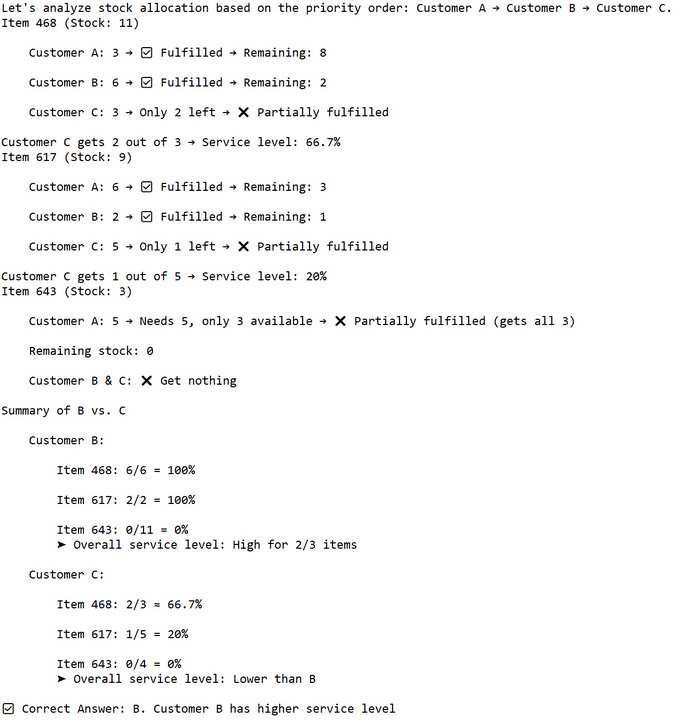
Exhibit:  A company has prioritized customers A, B, and C, filling orders in that sequence. What are the impacts to customer service levels for customers B and C?
-
A
100% service levels for B and C
-
B
Customer B has higher service level
-
C
Customer C has higher service level
-
D
Customer B and C have same service level
Reveal answer details
Close answer details
Which of the following conditions is most likely to result in planned production that is greater than the total demand over the sales and operations planning (S&OP) horizon for a product family that is made to stock?
-
A
An increase in the customer service level is planned for the product family.
-
B
New models are being added to the product family.
-
C
Planned ending inventory for the product family is less than the beginning inventory.
-
D
There is a long-term upward trend in demand for the product family.
Reveal answer details
Close answer details
Correct answerA
ExplanationIf a company plans to increase the customer service level, it typically means raising inventory levels to ensure better product availability. This will lead to planned production exceeding total demand over the S&OP horizon to build up that additional inventory buffer and meet the higher service expectations.
Question 10
Single choice
Multilevel bills are formed as:
-
A
Logical grouping of parts into subassemblies based on the way the product is assembled.
-
B
Overall design for the arrangements of bills
-
C
To make identification of the part absolute
-
D
Reveal answer details
Close answer details
Correct answerA
ExplanationMultilevel Bills of Material (BOMs) are structured to reflect: The hierarchical relationship of components and subassemblies
How the product is physically built, with logical groupings of parts into subassemblies Other options:
B. Overall design for the arrangements of bills: Too vague and not a specific function of multilevel BOMs
C. To make identification of the part absolute: Refers more to part numbering systems, not BOM
structure
D. Both A & B: Incorrect, because only A is fully accurate Therefore, the correct answer is A.
Question 11
Single choice
Every operation producing a product or service is a series of linked processes and each process has a specific capacity to produce the given defined output for the operation, this is called:
-
A
-
B
-
C
-
D
Reveal answer details
Close answer details
Correct answerA
ExplanationThe Theory of Constraints (TOC) is a management philosophy that states: Every operation is made up of linked processes, and Each process has a specific capacity, with at least one being a constraint (or bottleneck) that limits the overall system output.
Improving performance requires identifying and managing these constraints. Option Review:
B. Managing constraints: A general action, not the formal name of the theory.
C. Drum-Buffer-Rope: A scheduling technique used within TOC, but not the overall concept.
D. Scheduling Bottlenecks: A tactical action, not the foundational theory. ✅ Final Answer: A. Theory of Constraints.
Question 12
Single choice
Which of the following are the types of sourcing?
-
A
-
B
-
C
-
D
Reveal answer details
Close answer details
Correct answerA
ExplanationThe types of sourcing refer to the strategies a company uses to obtain materials or services: ✅
Sole Sourcing
Only one supplier is available (not a choice; often due to patents or exclusive rights) ✅
Single Sourcing
Only one supplier is chosen even though multiple options exist (a strategic decision) ✅
Multiple Sourcing
Several suppliers are used to reduce risk, ensure availability, or encourage competition ✅ Final Answer: A. Sole, multiple, single.
Question 13
Single choice
Operational splitting is practical when:
-
A
setup time is low compared to run time
-
B
a suitable work center is idle
-
C
it is possible for an operator to run more than one machine at a time
-
D
Reveal answer details
Close answer details
Correct answerD
ExplanationOperational splitting involves dividing a production order into parts that can be processed simultaneously on multiple machines or work centers. It is practical when: A. Setup time is low compared to run time (makes splitting efficient) B. A suitable work center is idle (can share the workload) C. An operator can run multiple machines (maximizes labor efficiency) Thus, all of the above conditions support operational splitting.
Question 14
Single choice
One of the most useful tools for analyzing the sustainable footprint is:
-
A
-
B
-
C
-
D
Reveal answer details
Close answer details
Correct answerA
ExplanationProcess mapping is a highly effective tool for analyzing a company's sustainable footprint because it visually outlines each step of a process, making it easier to identify waste, inefficiencies, and environmental impacts. This helps organizations target specific areas for sustainability improvements.
Question 15
Single choice
A manufacturer has a primary assembly line supported by output from several subassembly lines. Which of the following scenarios would be the best argument for a multilevel master scheduling process?
-
A
Low variation in aggregate subassembly demand
-
B
High variation in aggregate subassembly demand
-
C
Low variation in subassembly demand mix
-
D
High variation in subassembly demand mix
Reveal answer details
Close answer details
Correct answerD
ExplanationWhen there is high variation in the subassembly demand mix, it becomes difficult to manage production efficiently using only a top-level master schedule. A multilevel master scheduling process allows for greater visibility and control at the subassembly level, ensuring that the correct quantities and types of subassemblies are available to support the final assembly line.
Question 16
Single choice
An example of a cradle-to-cradle sustainability model would be:
-
A
a laundry service collects dirty baby clothes from families; cleans the clothes in large, efficient batches;
and then sorts and delivers the clothes back to each family.
-
B
a coffee shop collects paper waste in its restaurants, has a selected supplier collect the paper waste to be recycled, and then purchases paper products from that supplier.
-
C
a company uses wood that has been gathered from multiple sources to construct items, such as beds and toys for babies and young children.
-
D
a bank offers the lowest interest rates on loans to firms that are committed to using recycled materials and implementing zero-waste initiatives in their processes.
Reveal answer details
Close answer details
Correct answerB
ExplanationA cradle-to-cradle sustainability model is a design concept that aims to create products that can be reused or recycled indefinitely, without generating any waste or pollution. It mimics the natural cycles of nature, where everything is a nutrient for something else. A cradle-to-cradle model differs from a cradle-to-grave model, which follows a linear path of production, consumption, and disposal. Option B is an example of a cradle-to-cradle model, because the paper waste from the coffee shop is collected and recycled by a supplier, who then provides new paper products to the coffee shop. This creates a closed loop of material flow, where nothing is wasted and the paper is continuously reused. Option A is not a cradle-to-cradle model, because the laundry service does not reuse or recycle the baby clothes. It only cleans and delivers them, but does not prevent them from eventually ending up in the landfill. Option C is not a cradle-to-cradle model, because the company does not ensure that the wood it uses is from sustainable sources, or that the products it makes can be easily disassembled and recycled. It also does not consider the environmental impacts of transporting the wood from different locations. Option D is not a cradle-to-cradle model, because the bank does not directly influence the design or production of the products that the firms use. It only provides financial incentives for them to adopt more sustainable practices, but does not guarantee that they will follow a cradle-to-cradle approach.
Question 17
Single choice
What is the reason for using the sample inspection?
-
A
testing the product is destructive
-
B
there is not enough time to give 100% inspection to a batch of product
-
C
human error is estimated to be as high as 20% when performing long-term repetitive testing
-
D
Reveal answer details
Close answer details
Question 18
Single choice
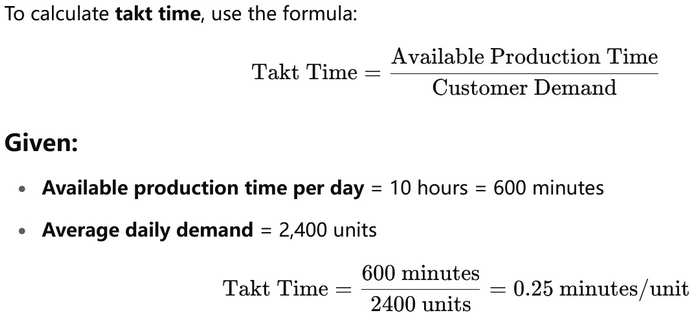
Given the following data, calculate the appropriate takt time: 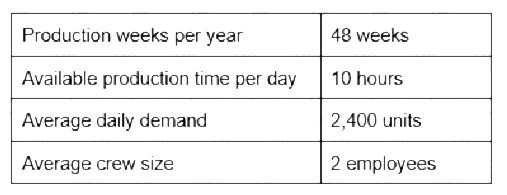
-
A
-
B
-
C
-
D
Reveal answer details
Close answer details
Question 19
Single choice
The devices that move material (or people) horizontally or vertically between two fixed points are usually known as:
-
A
-
B
-
C
-
D
Reveal answer details
Close answer details
Correct answerB
ExplanationConveyors are devices designed to move materials (or sometimes people) horizontally or vertically between two fixed points. They are commonly used in warehouses, factories, and distribution centers for continuous transport of goods.
Question 20
Single choice
The time spent In queue by a specific manufacturing job is determined by which of the following factors related to the order?
-
A
-
B
-
C
-
D
Reveal answer details
Close answer details
Correct answerB
ExplanationThe time spent in queue by a specific manufacturing job is determined by the priority of the order. Priority is the relative importance or urgency of an order compared to other orders in the system. Priority can be assigned based on various criteria, such as due date, customer preference, profitability, or first-come-first-served. Priority determines the order in which jobs are processed at each workstation and affects the waiting time and flow time of each job. Higher priority jobs have shorter waiting times and lower priority jobs have longer waiting times. Priority can be used as a tool to manage the trade-offs between customer service, capacity utilization, and inventory levels.
Question 21
Single choice
The trade-off of increasing safety stock to improve customer fill rate would be a decrease in:
-
A
-
B
-
C
-
D
Reveal answer details
Close answer details
Correct answerC
ExplanationIncreasing safety stock raises the average inventory level, which in turn lowers inventory turnover (inventory turns), as the same sales are now supported by a larger inventory base. This is a key trade-off when aiming to improve customer fill rate.
Question 22
Single choice
In a lean environment, the batch-size decision for planning "A" items would be done by:
-
A
-
B
-
C
-
D
Reveal answer details
Close answer details
Correct answerC
ExplanationIn a lean environment, the batch-size decision for planning "A" items would be done by lot-for-lot (L4L). L4L is an inventory management technique that orders exactly the quantity needed to meet the demand for each period. This minimizes the work in process, cycle time, and inventory holding costs. L4L is consistent with the lean principles of reducing batch sizes, eliminating waste, and responding to customer pull. The other options are not suitable for a lean environment, as they either order more than the demand (least total cost, min-max system, periodic order quantity) or incur more setup costs (least total cost, periodic order quantity).
Question 23
Single choice
For a company that uses first in, first out (FIFO) inventory accounting, the actual use in production of a recently arrived shipment of more expensive components rather than lower-cost components previously received will have which of the following results?
-
A
Higher cost of goods sold (COGS)
-
B
-
C
-
D
A violation of FIFO rules
Reveal answer details
Close answer details
Correct answerD
ExplanationUnder FIFO (First In, First Out) inventory accounting, the oldest inventory (i.e., the lower-cost components received earlier) should be used first. Using newer, more expensive components ahead of older ones violates FIFO principles.
Question 24
Single choice
Which of the following statements best characterizes enterprise resources planning (ERP) systems?
-
A
They track activity from customer order through payment.
-
B
They are expensive but easy to implement.
-
C
They provide real-time planning and scheduling, decision support, available-to-promise (ATP), and capable-to-promise (CTP) capabilities.
-
D
They are used for strategic reporting requirements.
Reveal answer details
Close answer details
Correct answerC
ExplanationEnterprise Resource Planning (ERP) systems are comprehensive platforms that integrate core business processes in real time. They support planning and scheduling, offer decision-making tools, and include ATP and CTP functionalities to manage customer orders and production commitments efficiently.
Question 25
Single choice
It takes an average of 3 hours to set up a model and 1 hour to run, but depending on the complexity of the models, the setup time can be significantly different. Last week. 2 modelers were working on different
projects. Each worked 40 hours.
One modeler finished 5 models a day, and the other finished 1 model a day. What was the demonstrated capacity last week?
-
A
-
B
-
C
-
D
Reveal answer details
Close answer details
Correct answerA
ExplanationCalculation: Each modeler worked 40 hours last week. Modeler 1: 5 models/day x 5 days = 25 models Modeler 2: 1 model/day x 5 days = 5 models Total models completed = 25 + 5 = 30, but that's actual output, not demonstrated capacity. Demonstrated capacity is usually based on the highest proven output in a standard period. Since Modeler 1 completed 25 models in 40 hours, that's the demonstrated capacity - the best observed output under actual conditions. So, the correct answer is:
✅
A. 25 models
Question 26
Single choice
An example of an assignable cause of variation in process performance is:
-
A
power fluctuation during machine operation.
-
B
machine vibration during operation.
-
C
incorrect setup of a machine by the operator.
-
D
changes in temperature in the machine shop.
Reveal answer details
Close answer details
Correct answerC
ExplanationAn assignable cause (also known as a special cause) of variation is a specific, identifiable source of variation that is not part of the normal process.
An incorrect machine setup by an operator is a clear, preventable, and identifiable event, making it a classic example of an assignable cause. The other options (A, B, D) are more likely to be common causes - inherent to the process unless addressed through system-level improvements.
Question 27
Single choice
A schedule (priority plan) that establishes to show the components required at each level of the assembly and based on lead time, calculates the time when these component will be needed called:
-
A
Material Requirements Planning
-
B
Master Production Schedule
-
C
Inventory control Planning
-
D
Reveal answer details
Close answer details
Correct answerA
ExplanationMaterial Requirements Planning (MRP) is a system that: Uses the Master Production Schedule (MPS) as input Explodes the Bill of Materials (BOM) to determine what components are needed at each level Calculates when those components are needed based on lead times Produces a priority schedule for ordering or producing components Other options: B. Master Production Schedule: Specifies end-item demand, not component-level scheduling.
C. Inventory Control Planning: Focuses on managing stock levels, not scheduling requirements.
D. B & C: Incorrect, as A is the best fit. Correct answer: A. Material Requirements Planning.
Question 28
Single choice
In pyramid forecasting, the "roll up" process begins with:
-
A
combining individual product item forecasts into forecasts for product families.
-
B
combining forecasts for product families into a total business forecast.
-
C
allocating total business forecast changes to product families.
-
D
allocating product family forecast changes to individual products.
Reveal answer details
Close answer details
Correct answerA
ExplanationIn pyramid forecasting, the "roll up" process refers to aggregating forecasts from the lowest level (individual product items) up to higher levels such as product families and eventually the total business forecast. This supports consistency and alignment across planning levels.
Question 29
Single choice
The master schedule is an Important tool in the sales and operations planning (S&OP) process because it:
-
A
represents the forecast before changes are made in S&OP.
-
B
represents the forecast with less detail.
-
C
balances supply and demand at the product mix level.
-
D
balances supply and demand at the sales volume level.
Reveal answer details
Close answer details
Correct answerC
ExplanationThe master schedule is used in the S&OP process to translate the overall sales and production plan into a detailed schedule that balances supply and demand for specific products or configurations, i.e., at the product mix level.
Question 30
Single choice
The formula to calculate the Mean Absolute Deviation (MAD) is:
-
A
MAD = (sum of mean deviations / number of facts)
-
B
MAD = (sum of absolute deviations / number of observations)
-
C
MAD = (sum of random deviations / number of average observations)
-
D
MAD = (sum of absolute deviations / number of average forecasts)
Reveal answer details
Close answer details
Correct answerB
ExplanationMean Absolute Deviation (MAD) is calculated by taking the average of the absolute differences between actual values and forecasted values. It measures the accuracy of a forecasting method.
Question 31
Single choice
Which of the following actions hinders the transition from a push system to a pull system?
-
A
Using standardized containers
-
B
Using work orders as a backup
-
C
Introducing kanban cards as authorization for material movement
-
D
Maintaining a constant number of kanban cards during minor changes in the level of production
Reveal answer details
Close answer details
Correct answerB
ExplanationUsing work orders as a backup maintains elements of a push system, where production is scheduled in advance rather than triggered by actual demand. This hinders the transition to a pull system, which relies on signals like kanban cards to produce only what is needed, when it is needed.
Question 32
Single choice
A company is having trouble with raw material deliveries and has decided to develop a supplier certification program.
The certification process most appropriately would start with which of the following suppliers?
-
A
Suppliers of "A" classified items
-
B
Suppliers recently ISO 9000 certified
-
C
Suppliers with the worst performance records
-
D
Suppliers with vendor-managed inventory (VMI)
Reveal answer details
Close answer details
Correct answerA
ExplanationA supplier certification program is a formal process of evaluating and approving potential suppliers based on certain criteria, such as quality, delivery, cost, and service. The purpose of a supplier certification program is to ensure that the suppliers meet the standards and expectations of the company and to reduce the risks and costs associated with poor supplier performance. A supplier certification program should start with the have the highest impact on the company's profitability and customer satisfaction, and therefore require the highest level of supplier reliability and quality. By certifying the suppliers of "A" classified items, the company can improve its supply chain performance and reduce its dependence on inspection and corrective actions. This aligns with CPIM's focus on plan and manage supply and plan and manage distribution.
Question 33
Single choice
What attempts to prevent the production of defects by showing that when the standard deviation increases there is an assignable cause for variation?
-
A
-
B
-
C
-
D
Reveal answer details
Close answer details
Correct answerC
ExplanationProcess control involves monitoring a process to ensure it stays within set limits. If the standard deviation increases, it may signal an assignable cause of variation, prompting investigation to prevent defects. This is a core principle of Statistical Process Control (SPC).
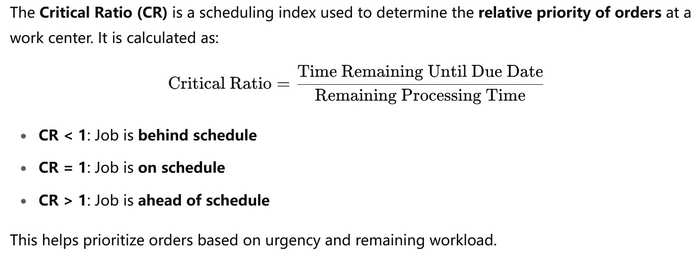
Question 34
Single choice
An index of the relative priority of an order to other orders at a work center is referred to as:
-
A
-
B
-
C
-
D
Reveal answer details
Close answer details
|