Why would a firm generally choose to finance temporary assets with short-term debt?
-
A
Matching the maturities of assets and liabilities reduces risk.
-
B
Short-term interest rates have traditionally been more stable than long-term interest rates.
-
C
A firm that borrows heavily long term is more apt to be unable to repay the debt than a firm that borrows heavily short term.
-
D
Financing requirements remain constant.
Reveal answer details
Close answer details
Correct answerA
ExplanationExplanation:
Choice "a" is correct. Matching the maturities of current assets with liabilities as they come due is designed to ensure liquidity and reduce risk of cash shortages. Temporary assets (such as inventories, generally, and seasonal inventories, specifically) might be financed with short term debt such that the earnings from the sales of those temporary assets could be used to liquidate the related obligations as they come due and ensure that cash is available to meet cash flow requirements.
Choice "b" is incorrect. Interest rate risks would likely motivate a firm to use longer term financing than short-term financing.
Choice "c" is incorrect. Matching cash inflows with cash outflows are more influential in determining a firm's ability to repay debt rather than the length of the obligation.
Choice "d" is incorrect. Long-term rather than short-term debt promotes consistent finance charges. The requirements for financing itself are driven by business practice, not by the maturity of financial instruments used.
Price owns 2,000 shares of ABC Corp.'s $10 cumulative preferred stock. During its first year of operations, cash dividends of $5 per share were declared on the preferred stock but were never paid. In the second year, dividends on the preferred stock were neither declared nor paid.
If ABC is dissolved, which of the following statements is correct?
-
A
ABC will be liable to Price as an unsecured creditor for $10,000.
-
B
ABC will be liable to Price as a secured creditor for $20,000.
-
C
Price will have priority over the claims of ABC's bond owners.
-
D
Price will have priority over the claims of ABC's unsecured judgment creditors.
Reveal answer details
Close answer details
Correct answerA
ExplanationExplanation:
Choice "a" is correct. After a dividend is declared but not paid on cumulative preferred stock, the unpaid dividend ranks with other "unsecured" debts.
Choice "b" is incorrect. The unpaid dividend ranks as an "unsecured" not a "secured" debt and Price has no right to a dividend for the second year because no dividend was declared that year.
Choice "c" is incorrect. As an "unsecured" creditor, Price does not have priority over the company's bondholders.
Choice "d" is incorrect. The "unsecured" creditors will share in the "unsecured" category as a whole and not with any priority within the class.
The continual process of re-evaluating the strategic plans includes all of the following significant questions a firm should be concerned with, except:
-
A
Has the firm been able to attain or maintain competitive advantage?
-
B
Is the firm able to be profitable under the current strategy?
-
C
Does the current strategy continue to be aligned with the established goals of the firm?
-
D
Has the firm been able to adapt to the preferences of its employees?
Reveal answer details
Close answer details
Correct answerD
ExplanationExplanation:
Choice "d" is correct. Although the firm needs to be flexible with respect to changes in many situations and then adapt to them, the ability to adapt to the preferences of its employees is not nearly as significant to the process as the other three choices, which are crucial to the success of the strategic plan.
Choices "a", "b", and "c" are incorrect because they are all significant questions a firm should be concerned with when re-evaluating the strategic plan.
According to the FASB conceptual framework, predictive value is an ingredient of: 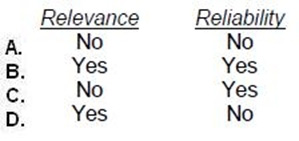
-
A
-
B
-
C
-
D
Reveal answer details
Close answer details
Correct answerD
ExplanationExplanation:
Choice "d" is correct. Yes - No. Predictive value is an ingredient of relevance but not of reliability. Memorize:
Bud's relevance to "PFT."
Bud's reliability to "VRN."
Which of the following statements is true regarding the risk assessment component of internal control?
-
A
An auditor evaluates an entity's risk assessment because it is a component of overall audit risk in a financial statement audit.
-
B
An auditor's evaluation of an entity's risk assessment may not be applicable to the audit of every entity.
-
C
An auditor evaluates an entity's risk assessment to understand how management addresses risks relevant to financial reporting.
-
D
An auditor need not consider an entity's risk assessment because he or she is primarily concerned with audit risk in a financial statement audit.
Reveal answer details
Close answer details
Correct answerC
ExplanationExplanation:
Choice "c" is correct. The auditor needs to understand how management addresses risks relevant to financial reporting in order to properly plan the audit.
Choice "a" is incorrect. An entity's risk assessment differs from an auditor's assessment of audit risk.
The entity is concerned with managing risks that affect entity objectives (financial reporting, operations, and compliance) whereas the auditor is concerned with the risk that material misstatements could occur in the financial statements.
Choice "b" is incorrect. The five components of internal control are applicable to the audit of every entity.
Choice "d" is incorrect. The auditor needs to understand how management addresses risks relevant to financial reporting in order to properly plan the audit.
An accountant's standard report on a compilation of a projection should not include a statement that:
-
A
There will usually be differences between the forecasted and actual results.
-
B
The hypothetical assumptions used in the projection are reasonable in the circumstances.
-
C
The accountant has no responsibility to update the report for future events and circumstances.
-
D
The compilation of a projection is limited in scope.
Reveal answer details
Close answer details
Correct answerB
ExplanationExplanation:
Choice "b" is correct. An accountant's standard report on a compilation of a projection does not include a statement that the hypothetical assumptions used in the projection are reasonable in the circumstances. Choice "a" is incorrect. An accountant's standard report on a compilation of a projection does state that there will usually be differences between the forecasted and actual results.
Choice "c" is incorrect. An accountant's standard report on a compilation of a projection does state that the accountant has no responsibility to update the report for future events and circumstances.
Choice "d" is incorrect. An accountant's standard report on a compilation of a projection does state that the compilation of a projection is limited in scope ("A compilation is limited to presenting in the form of a projection information that is the representation of management and does not include evaluation of the support for the assumptions underlying the projection.")
Tom and Joan Moore, both CPAs, filed a joint 1994 federal income tax return showing $70,000 in taxable income. During 1994, Tom's daughter Laura, age 16, resided with Tom. Laura had no income of her own and was Tom's dependent.
Determine the amount of income or loss, if any that should be included on page one of the Moores' 1994
Form 1040.
Tom's 1994 wages were $53,000. In addition, Tom's employer provided group-term life insurance on Tom's life in excess of $50,000. The value of such excess coverage was $2,000.
-
A
-
B
-
C
-
D
-
E
-
F
-
G
-
H
-
I
-
J
-
K
-
L
-
M
-
N
-
O
Reveal answer details
Close answer details
Correct answerN
ExplanationExplanation:
"N" is correct. The value of employer-provided group term life insurance for which the face amount exceeds $50,000 is taxable income to the insured employee and the $53,000 in wages would both be included on page one, Form 1040.
Management of ABC Industries, an issuer as defined under the Sarbanes-Oxley Act, believes it has eliminated a material weakness previously noted in its assessment of internal control, and has hired Henna and Company, CPAs, to attest to the improvements in internal control. Which of the following is true of this engagement?
-
A
It is required by PCAOB standards.
-
B
It is only required if ABC Industries elects to have an audit in accordance with PCAOB standards.
-
C
ABC's management must provide a written report to accompany Henna and Company's report.
-
D
It is required by generally accepted auditing standards.
Reveal answer details
Close answer details
Correct answerC
ExplanationExplanation:
Choice "c" is correct. ABC's management must provide a written report to accompany Henna and Company's report.
Choices "a" and "d" are incorrect. An engagement to report on whether a previously reported internal control weakness continues to exist is a voluntary engagement, not required by professional standards.
Choice "b" is incorrect. An engagement to report on whether a previously reported internal control weakness continues to exist is a voluntary engagement, not required by professional standards. In addition, as an issuer, ABC must have an audit in accordance with PCAOB standards.
The benefits of debt financing over equity financing are likely to be highest in which of the following situations?
-
A
High marginal tax rates and few noninterest tax benefits.
-
B
Low marginal tax rates and few noninterest tax benefits.
-
C
High marginal tax rates and many noninterest tax benefits.
-
D
Low marginal tax rates and many noninterest tax benefits.
Reveal answer details
Close answer details
Correct answerA
ExplanationExplanation:
Choice "a" is correct. The benefits of debt financing over equity financing are likely to be highest if marginal tax rates are high (because interest on debt is deductible for tax purposes) and if there are few noninterest tax benefits (because there is little or no reason to depart from debt financing).
Choice "b" is incorrect. The benefits of debt financing over equity financing are likely to be highest if marginal tax rates are high, not low (because interest on debt is deductible for tax purposes), and if there are few noninterest tax benefits.
Choice "c" is incorrect. The benefits of debt financing over equity financing are likely to be highest if marginal tax rates are high (because interest on debt is deductible for tax purposes) and if there are few, not many, noninterest tax benefits.
Choice "d" is incorrect. The benefits of debt financing over equity financing are likely to be highest if marginal tax rates are high, not low (because interest on debt is deductible for tax purposes), and if there are few, not many, noninterest tax benefits.
Question 10
Single choice
ABC Co. processes payroll transactions for a retailer. Cook, CPA, is engaged to express an opinion on a description of ABC's internal controls placed in operation as of a specific date. These controls are relevant to the retailer's internal control, so Cook's report may be useful in providing the retailer's independent auditor with information necessary to plan a financial statement audit. Cook's report should:
-
A
Contain a disclaimer of opinion on the operating effectiveness of ABC's controls.
-
B
State whether ABC's controls were suitably designed to achieve the retailer's objectives.
-
C
Identify ABC's controls relevant to specific financial statement assertions.
-
D
Disclose Cook's assessed level of control risk for ABC.
Reveal answer details
Close answer details
Correct answerA
ExplanationExplanation:
Choice "a" is correct. There are two types of reports on the processing of transactions by service organizations: "reports on controls placed in operation" and "reports on controls placed in operation and tests of operating effectiveness." The former do not include tests of operating effectiveness and, therefore, are not intended to provide the user auditor with a basis for reducing the assessment of control risk.
Accordingly, such reports should include a disclaimer of opinion regarding the operating effectiveness of the controls.
Choice "b" is incorrect. The report should contain an indication that the controls were suitably designed to achieve specified control objectives, but it does not provide any assurance regarding the achievement of the user organization's (in this case, the retailer's) objectives.
Choice "c" is incorrect. The service auditor (Cook) is not required to identify the service organization's (i.e., ABC's) controls relevant to specific financial statement assertions because this is not a financial statement audit.
Choice "d" is incorrect. The service auditor (Cook) is not required to disclose the assessed level of control risk for the service organization (ABC).
Question 11
Single choice
Which one of the following financial instruments generally provides the largest source of short-term credit for small firms?
-
A
-
B
-
C
-
D
Reveal answer details
Close answer details
Correct answerC
ExplanationExplanation:
Choice "c" is correct. Trade credit generally provides the largest source of short-term credit for small firms.
Choices "a", "b", and "d" are incorrect, per the above Explanation.
Question 12
Single choice
If the Federal Reserve wanted to implement an expansionary monetary policy, which one of the following actions would the Federal Reserve take?
-
A
Raise the reserve requirement and the discount rate.
-
B
Purchase additional U.S. government securities and lower the discount rate.
-
C
Raise the discount rate and sell U.S. government securities.
-
D
Lower the discount rate and raise the reserve requirement.
Reveal answer details
Close answer details
Correct answerB
ExplanationExplanation:
Choice "b" is correct. Fed purchases of government securities increase the money supply (putting money into circulation), and lowering the discount rate encourages borrowing by member banks and increases the money supply. Hence, these measures would help implement an expansionary monetary policy.
Choice "a" is incorrect. Raising the reserve requirement and the discount rate would have the opposite effect of decreasing the money supply.
Choice "c" is incorrect. Raising the discount rate and selling government securities would reduce the money supply.
Choice "d" is incorrect. Raising the reserve requirement would decrease the money supply, but lowering the discount rate would increase the money supply.
Question 13
Single choice
The principle measure of non-diversifiable risk included in the CAPM formula is the beta coefficient. The beta coefficient measures the volatility or risk inherent in an investment by:
-
A
Computing the ratio of changes in earnings per share to changes in sales.
-
B
Computing the ratio of stock price to earnings per share.
-
C
Computing the ratio of percentage changes in a stock's price to percentage changes in overall market values during the same period.
-
D
Computing the ratio of percentage changes in the expected value of alpha equivalents to derivative fluctuations.
Reveal answer details
Close answer details
Correct answerC
ExplanationExplanation:
Choice "c" is correct. The beta coefficient represents the measure of a particular stock's percentage change compared to the percentage change in the market over the same period. The equation for the beta coefficient is as follows: % Δ in Stock Price
% Δ in Market price Choice "a" is incorrect. The percentage change in earnings per share related to a percentage change in sales represents the degree of combined leverage.
Choice "b" is incorrect. The ratio of stock price to earnings per share is the price earnings ratio.
Choice "d" is incorrect. Choice "d" represents a word salad distracter of nonsense terms.
Question 14
Single choice
March, CPA, is engaged by ABC Corp., a client, to audit the financial statements of XYZ Corp., a company that is not March's client. ABC expects to present XYZ's audited financial statements with March's auditor's report to 1st Federal Bank to obtain financing in ABC's attempt to purchase XYZ. In these circumstances, March's auditor's report would usually be addressed to:
-
A
ABC Corp., the client that engaged March.
-
B
XYZ Corp., the entity audited by March.
-
C
-
D
Both ABC Corp. and 1st Federal Bank.
Reveal answer details
Close answer details
Correct answerA
ExplanationExplanation:
Choice "a" is correct. The auditors should address their report to the entity that engaged them. In this case, ABC Corp. engaged the auditor to perform an acquisition audit and the report should be addressed to Monday.
Choice "b" is incorrect. XYZ Corp. did not engage the auditors and thus the report should not be addressed to them.
Choices "c" and "d" are incorrect. Even though the bank will be relying on the audited financial statements in determining whether to make the loan, the bank did not directly engage the auditing firm and accordingly, the report should not be addressed to them.
Question 15
Single choice
Which of the following control activities is not usually performed in the vouchers payable department?
-
A
Determining the mathematical accuracy of the vendor's invoice.
-
B
Having an authorized person approve the voucher.
-
C
Controlling the mailing of the check and remittance advice.
-
D
Matching the receiving report with the purchase order.
Reveal answer details
Close answer details
Correct answerC
ExplanationExplanation:
Choice "c" is correct. Internal control is enhanced if check mailing is performed by the treasury (cash disbursements) department.
Choice "a" is incorrect. Mathematical accuracy of the vendor's invoice is usually verified in the vouchers payable department.
Choice "b" is incorrect. Voucher approval by an authorized person is usually performed in the vouchers payable department.
Choice "d" is incorrect. Matching the receiving report with the purchase order is usually performed in the vouchers payable department.
Question 16
Single choice
A firm's target or optimal capital structure is consistent with which one of the following?
-
A
-
B
-
C
-
D
Minimum weighted average cost of capital.
Reveal answer details
Close answer details
Correct answerD
ExplanationExplanation:
Choice "d" is correct. Minimum weighted average cost of capital is consistent with a firm's target or optimal capital structure.
Choice "a" is incorrect. Minimum cost of debt is a component of minimum weighted average cost of capital.
Choice "b" is incorrect. Minimum risk results in a cost of capital heavily weighted in equity.
Choice "c" is incorrect. Minimum cost of equity results in a cost of capital heavily weighted in debt.
Question 17
Single choice
An auditor would least likely initiate a discussion with those charged with governance concerning:
-
A
The methods used to account for significant unusual transactions.
-
B
The maximum dollar amount of misstatements that could exist without causing the financial statements to be materially misstated.
-
C
Indications of fraud and illegal acts committed by a corporate officer that were discovered by the auditor.
-
D
Disagreements with management as to accounting principles that were resolved during the current year's audit.
Reveal answer details
Close answer details
Correct answerB
ExplanationExplanation:
Choice "b" is correct. The auditor's consideration of materiality is a matter of professional judgment and is influenced by the auditor's perception of the needs of a reasonable person who will rely on the financial statements. Materiality assessments are not typically discussed with those charged with governance.
Choice "a" is incorrect. The auditor should communicate with those charged with governance about the appropriateness of significant accounting policies, such as the methods used to account for significant unusual transactions.
Choice "c" is incorrect. The auditor should inform those charged with governance of illegal acts that come to the auditor's attention during the course of the audit. Fraud involving senior management should also be reported directly to those charged with governance.
Choice "d" is incorrect. The auditor should discuss with those charged with governance any disagreements with management, whether or not they were satisfactorily resolved, about matters that individually or in the aggregate could be significant to the entity's financial statements or the auditor's report.
Question 18
Single choice
Parker, whose spouse died during the preceding year, has not remarried. Parker maintains a home for a dependent child. What is Parker's most advantageous filing status?
-
A
-
B
-
C
Married filing separately.
-
D
Qualifying widow(er) with dependent child.
Reveal answer details
Close answer details
Correct answerD
ExplanationExplanation:
Choice "d" is correct. A qualifying widow(er) is a taxpayer who may use the joint tax return standard deduction and rates (but not the exemption for the deceased spouse) for each of two taxable years following the year of death of his or her spouse, unless he or she remarries. The surviving spouse must maintain a household that, for the whole entire taxable year, was the principal place of abode of a son, stepson, daughter, or stepdaughter (whether by blood or adoption). The surviving spouse must also be entitled to a dependency exemption for such individual. Parker may file as a qualifying widow(er) since her spouse died in the previous tax year, she did not remarry and she maintained a home for a dependent child. Since, qualifying widow(er) is the most advantageous status and Parker qualifies, Parker would file as a qualifying widow(er).
Choice "a" is incorrect. Even though Parker would qualify as single, filing single would give Parker a high tax liability than the qualifying widow(er) status and therefore is not most advantageous.
Choice "b" is incorrect. Parker would not qualify as head of household for the first two years after the death of Parker's spouse because one of the requirements for Head of Household status is that the taxpayer is NOT a surviving spouse. (Also, note that the likely reason for this requirement is that filing as Head of Household status would give the qualifying surviving spouse taxpayer a higher tax liability than the Qualifying Widow(er) status, which would be less advantageous.).
Choice "c" is incorrect. Parker would not qualify to file married filing separately.
Question 19
Single choice
The ABC Company is planning a $200,000 equipment investment, which has an estimated five-year life with no estimated salvage value. The company has projected the following annual cash flows for the investment. 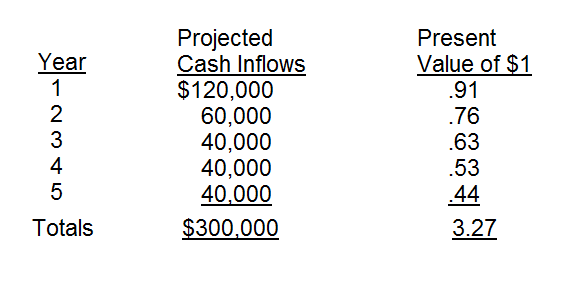 The net present value for the investment is:
-
A
-
B
-
C
-
D
Reveal answer details
Close answer details
Correct answerA
ExplanationExplanation:
Choice "a" is correct. $18,800 net present value. The net present value of an investment is calculated as the present value of the cash inflows minus the present value of the cash outflows. In this case, there is only one cash outflow (at the purchase date), and that amount ($200,000) is already at present value (or, is multiplied by a present value factor of 1.0). 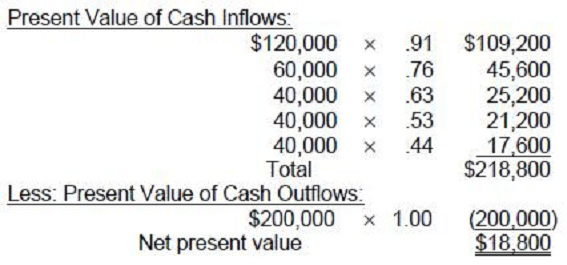
Question 20
Single choice
When markets are perfectly competitive, consumers:
-
A
Have goods and services produced at the lowest cost in the long run.
-
B
Must choose the brands they buy solely on the basis of informational advertising.
-
C
Do not receive any consumer surplus unless producers choose to overproduce.
-
D
Must search for the lowest price for the products they buy.
Reveal answer details
Close answer details
Correct answerA
ExplanationExplanation:
Choice "a" is correct. Since price is barely sufficient to give a firm a normal profit and stay in business, the consumer obtains the product at as low a price as is economically feasible. In addition, every firm is forced to produce at the most efficient output rate.
Choice "b" is incorrect. Brand differentiation is present in monopolistic competition, not perfect competition.
Choice "c" is incorrect. This is a far-out distractor.
Choice "d" is incorrect. Also far out. Individual consumers are also price takers at the market equilibrium price.
Question 21
Single choice
An organization would usually offer credit terms of 2/10, net 30 when:
-
A
The organization can borrow funds at a rate less than the annual interest cost.
-
B
The cost of capital approaches the prime rate.
-
C
Most competitors are not offering discounts, and the organization has a surplus of cash.
-
D
Most competitors are offering the same terms, and the organization has a shortage of cash.
Reveal answer details
Close answer details
Correct answerD
ExplanationExplanation:
Choice "d" is correct. Offering favorable credit terms is usually a response to either competitive forces in the market or to improve cash flow.
Choice "a" is incorrect, although the payment terms of AR is a form of borrowing (or lending) to customers, companies are more likely to extend credit terms because of competitive pressures rather than because it represents a cheaper form of borrowing.
Choice "b" is incorrect. The cost of capital at (or approaching) the prime rate is irrelevant without additional information.
Choice "c" is incorrect. If most competitors are not offering discounts or credit terms, there is no reason to offer them. Also, if there is a surplus of cash, there is no reason to accelerate accounts receivable collection by offering credit terms.
Question 22
Single choice
Which of the following should be reported as a prior period adjustment? 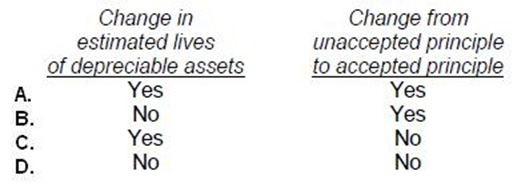
-
A
-
B
-
C
-
D
Reveal answer details
Close answer details
Correct answerB
ExplanationExplanation:
Choice "b" is correct. No - Yes Change in estimated lives of depreciable assets is a "change in estimate." They affect only current and future periods (not "prior periods," not retained earnings).
Change from unaccepted principle to accepted principle is an example of an error of a prior period that should be reported as a "prior period adjustment."
Question 23
Single choice
Heather, Erika, and Shelby are members in ABC LLC. Heather works 40 hours per week and Erika and Shelby work 20 hours per week. Heather contributed $30,000 to the LLC and Erika and Shelby contributed $60,000 each. Erika and Shelby have each originated 45% of the LLC's business and Heather has originated the other 10%.
If ABC were a general partnership, who controls management?
-
A
Heather, because she works the most.
-
B
Erika and Shelby equally because they contributed the most.
-
C
Heather, Erika, and Shelby equally because of state law.
-
D
Erika and Shelby, because they originate most of the work.
Reveal answer details
Close answer details
Correct answerC
ExplanationExplanation:
Choice "c" is correct.
Rule: Absent an agreement to the contrary, partners have equal management authority.
Choices "a", "b", and "d" are incorrect, per the above rule.
Question 24
Single choice
ABC Co. is investing in a machine with a 3-year life. The machine is expected to reduce annual cash operating costs by $30,000 in each of the first 2 years and by $20,000 in year 3. Present values of an annuity of $1 at 14% are: 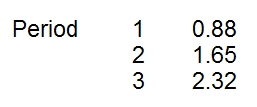 Using a 14% cost of capital, what is the present value of these future savings?
-
A
-
B
-
C
-
D
Reveal answer details
Close answer details
Correct answerC
ExplanationExplanation:
Choice "c" is correct. The facts of the question provide annuity factors, yet the question only provides one
"annuity" - the $30,000 for the first two years. Therefore, to calculate the present value of the savings for years 1 and 2, the factor for the present value of an annuity of $1 for two periods (1.65) is used. To calculate the present value of the savings for year 3, the factor for the lump sum of a present value of $1 for three periods is required; however, it is not directly provided. The factor must be calculated as the
difference between the factors for the present value of an annuity of $1 for three periods (2.32) and for two periods (1.65), or .67.  Review your knowledge of how the annuity and lump sum factors work together, as follows: 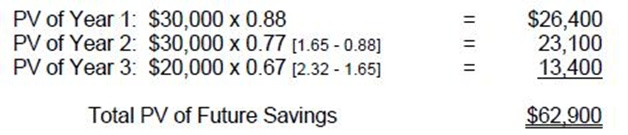
Question 25
Single choice
On December 1, 1992, Michaels, a self-employed cash basis taxpayer, borrowed $100,000 to use in her business. The loan was to be repaid on November 30, 1993. Michaels paid the entire interest of $12,000 on December 1, 1992. What amount of interest was deductible on Michaels' 1993 income tax return?
-
A
-
B
-
C
-
D
Reveal answer details
Close answer details
Correct answerB
ExplanationExplanation:
Choice "b" is correct. Prepaid interest must be prorated over the time for which payment is made. This is true for both cash and accrual basis taxpayers. The loan is for 1 month in 1992 and 11 months in 1993.
Therefore, 1/12 of the interest is deductible in 1992 and 11/12, or $11,000 is deductible in 1993.
Choices "a", "c", and "d" are incorrect. Prepaid interest must be prorated over the time for which payment is made. This is true for both cash and accrual basis taxpayers.
Question 26
Single choice
For effective internal accounting control, the accounts payable department should compare the information on each vendor's invoice with the:
-
A
Receiving report and the purchase order.
-
B
Receiving report and the voucher.
-
C
Vendor's packing slip and the purchase order.
-
D
Vendor's packing slip and the voucher.
Reveal answer details
Close answer details
Correct answerA
ExplanationExplanation:
Choice "a" is correct. For effective internal accounting control, the accounts payable department should compare the information on each vendor's invoice with the receiving report and the purchase order to assure that goods were received and that the purchase was properly authorized.
Choices "b", "c", and "d" are incorrect. Vendor packing slips and internally generated vouchers do not provide assurance that goods were received and that the purchase was properly authorized.
Question 27
Single choice
In a decision analysis situation, which one of the following costs is generally not relevant to the decision?
-
A
-
B
-
C
-
D
Reveal answer details
Close answer details
Correct answerC
ExplanationExplanation:
Choice "c" is correct. Historical cost is generally not relevant in a decision analysis situation.
All of the following costs are relevant in a decision analysis situation: A. Incremental cost
B. Avoidable cost
D. Opportunity cost
Question 28
Single choice
Comfort letters ordinarily are: 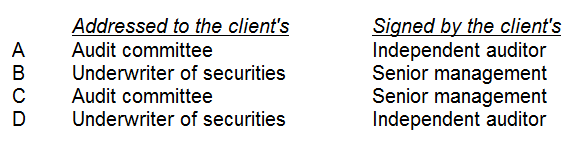
-
A
-
B
-
C
-
D
Reveal answer details
Close answer details
Correct answerD
ExplanationExplanation:
Choice "d" is correct. A comfort letter is a letter from the independent auditor to the named underwriter just before the registration of the client's securities.
Choices "a", "b", and "c" are incorrect, based on the above explanation.
Question 29
Single choice
The ABC Corporation is considering the acquisition of a new machine. The machine can be purchased for
$90,000; it will cost $6,000 to transport to ABC's plant and $9,000 to install. It is estimated that the machine
will last 10 years, and it is expected to have an estimated salvage value of $5,000. Over its 10-year life, the machine is expected to produce 2,000 units per year with a selling price of $500 and combined material and labor costs of $450 per unit. Federal tax regulations permit machines of this type to be depreciated using the straight-line method over 5 years with no estimated salvage value. ABC has a marginal tax rate of 40 percent. What is the net cash outflow at the beginning of the first year that ABC Corporation should use in a capital budgeting analysis?
-
A
-
B
-
C
-
D
Reveal answer details
Close answer details
Correct answerD
ExplanationExplanation:
Choice "d" is correct. $(105,000) net cash outflow at the beginning of the first year. 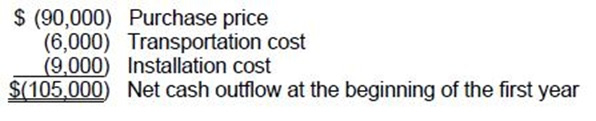
Question 30
Single choice
The apparent authority of a partner to bind the partnership in dealing with third parties:
-
A
Will be effectively limited by a formal resolution of the partners of which third parties are aware.
-
B
Will be effectively limited by a formal resolution of the partners of which third parties are unaware.
-
C
Would permit a partner to submit a claim against the partnership to arbitration.
-
D
Must be derived from the express powers and purposes contained in the partnership agreement.
Reveal answer details
Close answer details
Correct answerA
ExplanationExplanation: Choice "a" is correct. This is really an agency question on apparent authority. Apparent authority is authority that a third party reasonably believes an agent has. If the third party is aware of a restriction on the agent's authority, the third party cannot reasonably believe that the agent has the restricted authority.
Choice "b" is incorrect. A formal resolution of the partners will not be effective to destroy authority if a third party is aware of the resolution, but not if the third party is unaware of the resolution.
Choice "c" is incorrect. Submitting a claim to arbitration is an extraordinary act. A partner has apparent authority only to enter into transactions apparently carrying on in the usual way the business of the partnership. There is no apparent authority to enter into an extraordinary transaction.
Choice "d" is incorrect. Apparent authority is derived from what a reasonable person believes concerning the authority of a partner based on the partnership's actions toward the third party; authority derived from
the express powers and purposes contained in the partnership agreement is actual authority.
Question 31
Single choice
ABC, Inc. manufactures and sells television sets. All sales are finalized on credit with terms of 2/10, n/30.
Seventy percent of ABC customers take discounts and pay on day 10, while the remaining 30% pay on day 30. What is the average collection period in days?
-
A
-
B
-
C
-
D
Reveal answer details
Close answer details
Correct answerB
ExplanationExplanation:
Choice "b" is correct. The average collection period represents the weighted average of the periods that accounts receivable are outstanding and is computed as follows: 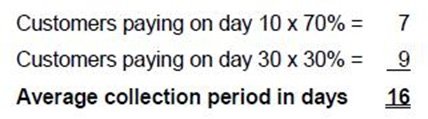 Choice "a" is incorrect, per the above computation.
Choice "c" is incorrect. This proposed solution mismatches the percentages and the days and represents the sum of the products of 30 x 70 % and 10 x 30%.
Choice "d" is incorrect. This proposed solution is purely the sum of the two customer payment patterns presented, 10 and 30.
Question 32
Single choice
Which of the following statements represents a quality control requirement under Government Auditing Standards?
-
A
A CPA who conducts government audits is required to undergo an annual external quality control review when an appropriate internal quality control system is not in place.
-
B
A CPA seeking to enter into a contract to perform an audit should provide the CPA's most recent external quality control review report to the party contracting for the audit.
-
C
An external quality control review of a CPA's practice should include a review of the audit documentation for each government audit performed since the prior external quality control review.
-
D
A CPA who conducts government audits may not make the CPA's external quality control review report available to the public.
Reveal answer details
Close answer details
Correct answerB
ExplanationExplanation:
Choice "b" is correct. Audit organizations seeking to enter into a contract to perform an audit in accordance with government auditing standards should provide their most recent external quality control review report to the party contracting for the audit.
Choice "a" is incorrect. Each audit organization conducting audits in accordance with governmental auditing standards should have an appropriate internal quality control system in place and undergo an
external quality control review.
Choice "c" is incorrect. It is not necessary to review all government audits performed since the last external quality control review. Reviewers should select audits that provide a reasonable cross-section of engagements performed since the last review.
Choice "d" is incorrect. It is recommended that the report be made available to the public.
Question 33
Single choice
Advertising costs may be accrued or deferred to provide an appropriate expense in each period for: 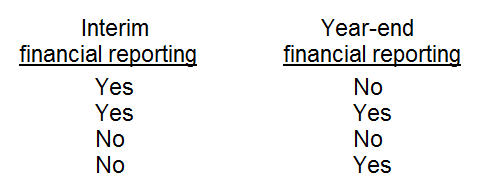
-
A
-
B
-
C
-
D
Reveal answer details
Close answer details
Correct answerB
ExplanationExplanation:
Choice "b" is correct. Yes - Yes.
Advertising costs may be accrued or deferred to provide an appropriate expense in each period for both
"interim" and "year-end" financial reporting.
Question 34
Single choice
Under the Revised Model Business Corporation Act, a merger of two public corporations usually requires all of the following, except:
-
A
-
B
An affirmative vote by the holders of a majority of each corporation's voting shares.
-
C
Receipt of voting stock by all stockholders of the original corporations.
-
D
Approval by the board of directors of each corporation.
Reveal answer details
Close answer details
Correct answerC
ExplanationExplanation:
Choice "c" is correct. A merger can be effected by giving some parties cash or property; not everyone need
receive voting shares.
Choice "a" is incorrect. The merger must be pursuant to a formal plan.
Choice "b" is incorrect. The majority of each corporation generally must approve a merger.
Choice "d" is incorrect. A plan of merger must be approved by the boards of the merging corporations.
Question 35
Single choice
The theory underlying the cost of capital is primarily concerned with the cost of:
-
A
Long-term funds and old funds.
-
B
Short-term funds and new funds.
-
C
Long-term funds and new funds.
-
D
Any combination of old or new, short-term or long-term funds.
Reveal answer details
Close answer details
Correct answerD
ExplanationExplanation:
Choice "d" is correct. The cost of capital considers the cost of all funds - whether they are short-term, long-term, new or old.
Choices "a", "b", and "c" are incorrect, per above Explanation.
Question 36
Single choice
Snow, CPA, was engaged by ABC Co., a nonissuer, to examine and report on management's written assertion about the effectiveness of ABC's internal control over financial reporting. Snow's report should state that:
-
A
Because of inherent limitations of any internal control, errors or fraud may occur and not be detected.
-
B
Management's assertion is based on criteria established by the American Institute of Certified Public Accountants.
-
C
The results of Snow's tests will form the basis for Snow's opinion on the fairness of ABC's financial statements in conformity with GAAP.
-
D
The purpose of the engagement is to enable Snow to plan an audit and determine the nature, timing, and extent of tests to be performed.
Reveal answer details
Close answer details
Correct answerA
ExplanationExplanation:
Choice "a" is correct. The practitioner's report should include a paragraph stating that because of the inherent limitations of any internal control, errors and fraud may occur and not be detected.
Choice "b" is incorrect. The examination is performed in accordance with standards established by the AICPA, but management's assertion may be based on criteria established by some other recognized body.
Choice "c" is incorrect. An examination (an attestation engagement) of management's assertion on the effectiveness of an entity's internal control over financial reporting does not provide a sufficient basis for an opinion on the fairness of the financial statements.
Choice "d" is incorrect. An examination of management's assertion on the effectiveness of an entity's internal control over financial reporting is performed solely to report on that assertion, and not to plan an audit.
Question 37
Single choice
A company enters into an agreement with a firm who will factor the company's accounts receivable. The factor agrees to buy the company's receivables, which average $100,000 per month and have an average collection period of 30 days. The factor will advance up to 80 percent of the face value of receivables at an annual rate of 10 percent and charge a fee of 2 percent on all receivables purchased. The controller of the company estimates that the company would save $18,000 in collection expenses over the year.
Fees and interest are not deducted in advance.
Assuming a 360-day year, what is the annual cost of financing?
-
A
-
B
-
C
-
D
Reveal answer details
Close answer details
Correct answerD
ExplanationExplanation:
Choice "d" is correct. 17.5% annual cost of financing. 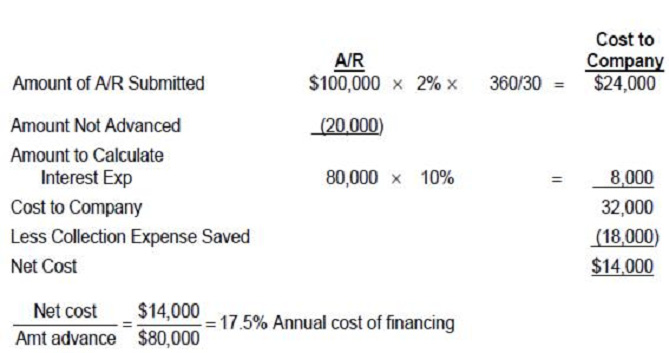
Question 38
Single choice
When an auditor believes there is substantial doubt about the ability of an entity to continue as a going concern, all of the following should be included in the audit documentation, except:
-
A
The conditions that gave rise to the substantial doubt.
-
B
The auditor's conclusion about whether substantial doubt remains or is alleviated.
-
C
Management's conclusion regarding whether substantial doubt remains or is alleviated.
-
D
The effect of the auditor's conclusion on the auditor's report.
Reveal answer details
Close answer details
Correct answerC
ExplanationExplanation:
Choice "c" is correct. Whether substantial doubt remains or is alleviated is a judgment call made by the auditor, and there is no requirement to document management's opinion on the matter.
Choices "a", "b", and "d" are incorrect. When an auditor believes there is substantial doubt about the ability of an entity to continue as a going concern, the conditions that gave rise to the substantial doubt, the auditor's conclusion about whether substantial doubt remains or is alleviated, and the effect of the auditor's conclusion on the auditor's report should all be documented.
Question 39
Single choice
ABC Inc. is considering the purchase of a new machine that will cost $150,000. The machine has an estimated useful life of three years. Assume for simplicity that the equipment will be fully depreciated 30, 40, and 30 percent in each of the three years, respectively. The new machine will have a $10,000 resale value at the end of its estimated useful life. The machine is expected to save the company $85,000 per year in operating expenses. ABC uses a 40 percent estimated income tax rate and a 16 percent hurdle rate to evaluate capital projects. Discount rates for a 16 percent rate are as follows. 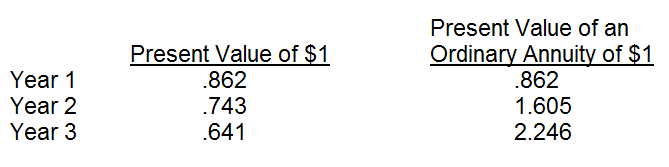 What is the net present value of this project?
-
A
-
B
-
C
-
D
Reveal answer details
Close answer details
Correct answerB
ExplanationExplanation: Choice "b" is correct. $13,278 net present value. 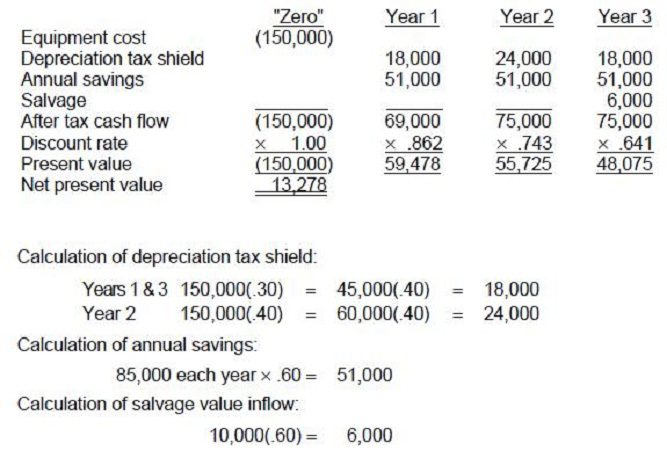
Question 40
Single choice
An increase in sales collections resulting from an increased cash discount for prompt payment would be expected to cause a(n):
-
A
Increase in the operating cycle.
-
B
Increase in the average collection period.
-
C
Decrease in the cash conversion cycle.
-
D
Increase in bad debt losses.
Reveal answer details
Close answer details
Correct answerC
ExplanationExplanation:
Choice "c" is correct. An increase in sales collections would decrease the cash conversion cycle.
Choice "a" is incorrect because the operating cycle (as well as the cash conversion cycle) would decrease.
Choice "b" is incorrect, as the average collection period would decrease. Choice "d" is incorrect. Bad debt losses would decrease from an increase in sales collections.
Question 41
Single choice
Which of the following most likely would be detected by an auditor's review of a client's sales cut-off?
-
A
Shipments lacking sales invoices and shipping documents.
-
B
Excessive write-offs of accounts receivable.
-
C
Unrecorded sales at year-end.
-
D
Lapping of year-end accounts receivable.
Reveal answer details
Close answer details
Correct answerC
ExplanationExplanation:
Choice "c" is correct. A sales cut-off test is used to detect unrecorded sales (shipments where no invoice has been generated) or sales allocated to the wrong period (January sales included in December by "holding the books open"). Choice "a" is incorrect. A sales cut-off test relies on shipping documents to test the "cut-off" of sales invoices. Shipping documents are selected and the corresponding sale is examined to determine whether it was recorded in the proper period. A cut-off test is unlikely to detect the omission of shipping documents, since transactions without such documentation would have no chance of being selected for testing.
Choices "b" and "d" are incorrect. Sales cut-off testing generally does not involve tests related to accounts receivable.
Question 42
Single choice
When the shipping department returns nonconforming goods to a vendor, the purchasing department should send to the accounting department the:
-
A
-
B
-
C
-
D
Reveal answer details
Close answer details
Correct answerB
ExplanationExplanation:
Choice "b" is correct. When nonconforming goods are returned to a vendor, the purchasing department should send a debit memo to the accounting department to ensure that the accounts payable balance is reduced appropriately.
Choice "a" is incorrect. The unpaid voucher is sent from the accounts payable department to the treasurer's department for payment when conforming goods are received.
Choice "c" is incorrect. The vendor invoice is sent to the accounting department when conforming goods are received.
Choice "d" is incorrect. A credit memo is generally used to reduce accounts receivable, not accounts payable.
Question 43
Single choice
Dough Distributors has decided to increase its daily muffin purchases by 100 boxes. A box of muffins costs
$2 and sells for $3 through regular stores. Any boxes not sold through regular stores are sold through Dough's thrift store for $1. Dough assigns the following probabilities to selling additional boxes:  What is the expected value of Dough's decision to buy 100 additional boxes of muffins?
-
A
-
B
-
C
-
D
Reveal answer details
Close answer details
Correct answerC
ExplanationExplanation:
Choice "c" is correct. The expected value of a decision is computed by multiplying the probability of each outcome by its value or profit. Each outcome is then added.
There is a 60% probability that Dough will sell 60 of the 100 additional boxes through regular stores and that means that Dough would have a 60% chance of making a profit of $20 (60 boxes at a $1 profit ($3 - $2) sold through the regular stores and 40 boxes at a $1 loss ($1 - $2) sold through the thrift stores).
There is a 40% probability that Dough will have a profit of $40 (100 boxes at a $1 profit through the regular store sales and zero boxes sold at a loss through the thrift store). 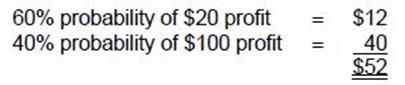 Choice "a" is incorrect. The expected value of a decision is computed by multiplying the probability of each outcome by its value or profit.
Choice "b" is incorrect. The expected value of a decision is computed by multiplying the probability of each outcome by its value or profit.
Choice "d" is incorrect. The expected value of a decision is computed by multiplying the probability of each outcome by its value or profit.
Question 44
Single choice
Which of the following procedures would an auditor most likely perform for year-end accounts receivable confirmations when the auditor did not receive replies to second requests?
-
A
Review the cash receipts journal for the month prior to the year-end.
-
B
Intensify the study of the internal control structure concerning the revenue cycle.
-
C
Increase the assessed level of detection risk for the existence assertion.
-
D
Inspect the shipping records documenting the merchandise sold to the debtors.
Reveal answer details
Close answer details
Correct answerD
ExplanationExplanation:
Choice "d" is correct. When an auditor does not receive replies to second requests on year-end accounts receivable confirmations, the auditor would most likely perform alternate procedures to support the existence of the receivables. These procedures include inspection of the shipping records to determine that the merchandise was actually sold to the debtors.
Choice "a" is incorrect. Alternate procedures would also include reviewing the cash receipts journal for the months subsequent to year-end. Reviewing the cash receipts journal for the month prior to year-end would provide no evidence regarding the existence of a year-end receivable, which obviously had not been paid by year-end.
Choice "b" is incorrect. Intensifying the study of the internal control structure concerning the revenue cycle would provide no additional evidence related to the specific accounts receivable confirmations that were not returned.
Choice "c" is incorrect. Increasing the assessed level of detection risk for the existence assertion would provide no additional evidence related to the specific accounts receivable confirmations that were not returned by the customer. (By sending out confirmations, the auditor is already performing substantive tests).
Question 45
Single choice
Which of the following statements is correct regarding a review engagement of a nonissuer's financial statements performed in accordance with the Statements on Standards for Accounting and Review Services (SSARS)?
-
A
An accountant must establish an understanding with the client in an engagement letter.
-
B
An accountant must obtain an understanding of the client's internal control when performing a review.
-
C
A review provides an accountant with a basis for expressing limited assurance on the financial statements.
-
D
A review report contains an accountant's opinion of the financial statements taken as a whole.
Reveal answer details
Close answer details
Correct answerC
ExplanationExplanation:
Choice "c" is correct. A review report is issued when inquiry and analytical procedures provide a reasonable basis for the expression of limited assurance on the financial statements.
Choice "a" is incorrect. While the accountant is required to establish an understanding with the client, preferably in writing, an engagement letter is not required.
Choice "b" is incorrect. When performing a review under SSARS, the accountant is not required to obtain an understanding of the client's internal control.
Choice "d" is incorrect. A review results in the expression of limited assurance that no material modifications are necessary for the financial statements to be in conformity with generally accepted accounting principles. The limited nature of the work performed during a review does not provide sufficient evidence for an opinion on the financial statements taken as a whole.
Question 46
Single choice
An auditor's analytical procedures most likely would be facilitated if the entity:
-
A
Segregates obsolete inventory before the physical inventory count.
-
B
Uses a standard cost system that produces variance reports.
-
C
Corrects material weaknesses in internal control before the beginning of the audit.
-
D
Develops its data from sources solely within the entity.
Reveal answer details
Close answer details
Correct answerB
ExplanationExplanation:
Choice "b" is correct. An auditor's analytical procedures are facilitated when an entity uses a standard cost system with variance reports because the comparison of actual to budget will already have been performed. In addition, it is likely that management will already be aware of significant variations from budget and will be better able to address any questions the auditor may have.
Choice "a" is incorrect. Segregation of obsolete inventory would not be an important factor in determining whether analytical procedures would be effective.
Choice "c" is incorrect. Correction of internal control weaknesses prior to the beginning of the audit would
not affect analytical procedures.
Choice "d" is incorrect. Analytical procedures using data developed solely within the entity are not as reliable as analytical procedures using data developed externally.
Question 47
Single choice
ABC Co. is reviewing the following data relating to an energy saving investment proposal:  What would be the annual savings needed to make the investment realize a 12% yield?
-
A
-
B
-
C
-
D
Reveal answer details
Close answer details
Correct answerC
ExplanationExplanation:
Choice "c" is correct. The annual savings needed to make the investment realize a 12% yield is where the present value of the cash savings/inflows equals the present value of the net cash outflows. Use algebra to calculate the annual savings, as follows: 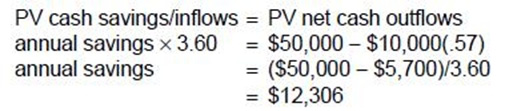 Choice "a" is incorrect. The annual savings needed to make the investment realize a 12% yield is where the present value of the cash savings/inflows equal the present value of the net cash outflows.
Choice "b" is incorrect. Subtract the present value of $10,000 due in 5 years at 12%, or $10,000 x .57 =
$5,700. Do not subtract the entire $10,000.
Choice "d" is incorrect. Subtract the present value of the $10,000 residual value from the $50,000 cost.
Question 48
Single choice
The effect of a change in accounting principle that is inseparable from the effect of a change in accounting estimate should be reported:
-
A
By restating the financial statements of all prior periods presented.
-
B
As a correction of an error.
-
C
As a component of income from continuing operations, in the period of change and future periods if the change affects both.
-
D
As a separate disclosure after income from continuing operations, in the period of change and future periods if the change affects both.
Reveal answer details
Close answer details
Correct answerC
ExplanationExplanation:
Choice "c" is correct. A change in accounting principle that is inseparable from a change in accounting estimate should now be reported as a change in estimate and thus as a component of income from continuing operations, in the period of change and future periods if the change affects both.
Distinguishing between a change in accounting principle and a change in accounting estimate is sometimes difficult. For example, a company may change from deferring and amortizing a cost to recording it as an expense when incurred because future benefits of the cost have become doubtful. The new accounting method is adopted, therefore, in partial or complete recognition of the change in estimated future benefits. The effect of the change in principle is inseparable from the effect of the change in estimate. Changes of this type are often related to the continuing process of obtaining additional information and revising estimates and are therefore considered as changes in estimates.
Choice "a" is incorrect. Restating the financial statements of all prior periods would be done in the case of prior period adjustments (corrections of errors), changes in accounting principle (retrospective application), and changes in accounting entity (retrospective application).
Choice "b" is incorrect. Correction of an error would be treated as a prior period adjustment.
Choice "d" is incorrect. Separate disclosure after income from continuing operations would be done in the case of extraordinary items or discontinued operations. However, this disclosure would not be made "in the period of change and future periods if the change affects both" but only in the period of the extraordinary item or discontinued operation.
Question 49
Single choice
The auditor's report on internal controls and compliance with laws and regulations in accordance with Government Auditing Standards (the Yellow Book), is required to include: I. The scope of the auditor's testing of internal controls.
II. Uncorrected misstatements that were determined by management to be immaterial.
-
A
-
B
-
C
-
D
Reveal answer details
Close answer details
Correct answerA
ExplanationExplanation:
Choice "a" is correct. The scope of the auditor's testing of internal controls is required to be included in the auditor's report on internal controls and compliance with laws and regulations in accordance with Government Auditing Standards (the Yellow Book).
Choices "b" and "c" are incorrect. Immaterial uncorrected misstatements are not included in the auditor's report on internal controls and compliance with laws and regulations.
Choice "d" is incorrect. The scope of the auditor's testing of internal controls is required to be included in the auditor's report on internal controls and compliance with laws and regulations in accordance with Government Auditing Standards (the Yellow Book).
Question 50
Single choice
Analytical procedures performed in the overall review stage of an audit suggest that several accounts have unexpected relationships. The results of these procedures most likely would indicate that:
-
A
Irregularities exist among the relevant account balances.
-
B
Internal control activities are not operating effectively.
-
C
Additional tests of details are required.
-
D
The communication with those charged with governance should be revised.
Reveal answer details
Close answer details
Correct answerC
ExplanationExplanation:
Choice "c" is correct. If analytical procedures suggest unexpected relationships, the auditor would perform additional tests of details of the accounts involved.
Choice "a" is incorrect. The identification of unexpected relationships as a result of analytical procedures does not necessarily mean that irregularities exist in the relevant account balances, although this is a possible Explanation: .
Choice "b" is incorrect. The identification of unexpected relationships as a result of analytical procedures does not necessarily mean that internal control activities are not operating effectively, although this is a possible Explanation: .
Choice "d" is incorrect. The identification of unexpected relationships as a result of analytical procedures does not necessarily mean that communication with those charged with governance should be revised, although this is a possible consequence.
Question 51
Single choice
ABC outlet, a relatively new store, is a cafe that offers customers the opportunity to browse the Internet or play computer games at their tables while they drink coffee. The customer pays a fee based on the amount of time spent signed on to the computer. The store also sells books, tee shirts, and computer accessories.
ABC has been paying all of its bills on the last day of the payment period, thus forfeiting all supplier discounts. Shown below are data on ABC's two major vendors, including average monthly purchases and credit terms. 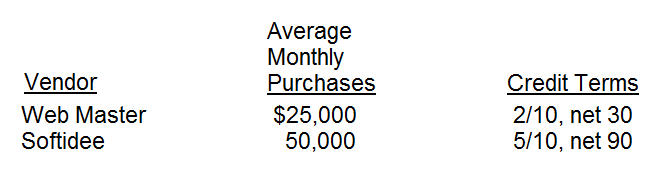 Assuming a 360-day year and that ABC continues paying on the last day of the credit period, the company's weighted annual interest rate for trade credit (ignoring the effects of compounding) for these two vendors is:
-
A
-
B
-
C
-
D
Reveal answer details
Close answer details
Correct answerB
ExplanationExplanation:
Choice "b" is correct. 28% weighted annual interest rate.
This question pertains to a complex computation of effective rates on lost discounts for multiple terms and multiple balances. The computation of the annual percentage cost of the lost discount is equal to the effective rate of interest for the period (for example 2/10, net 30 is 2% interest charge/ 98% proceeds) times the number of times this period occurs in a year (for example 2/10, net 20 is 360 days per year divided by 20 day period during which the lost discount is used or 18 times). Extension of this logic to the referenced question involves allocating the computed annual rates to the relative balances of the outstanding payables as follows: 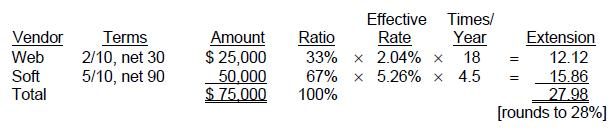
Question 52
Single choice
An auditor's plan to examine long-term debt most likely would include steps that require:
-
A
Comparing the carrying amount of the debt to its year-end market value.
-
B
Correlating interest expense recorded for the period with outstanding debt.
-
C
Verifying the existence of the holders of the debt by direct confirmation.
-
D
Inspecting the accounts payable subsidiary ledger for unrecorded long-term debt.
Reveal answer details
Close answer details
Correct answerB
ExplanationExplanation:
Choice "b" is correct. An auditor's plan to examine long-term debt most likely would include steps that require correlating interest expense recorded for the period with outstanding debt. This is an analytical procedure that would provide evidence regarding the reasonableness of the interest expense balance.
Choice "a" is incorrect. This question was released prior to the issuance of FAS 107, which requires disclosure of the fair values of financial instruments. Accordingly, the auditor now needs to audit the year-end market values of long-term debt. Choice "a" is still not the best answer, however, since the auditor would not need to compare the carrying amount to the year-end market value. (Both values are shown, as FAS 107 does not require that debt securities be written down to (a lower) market value.)
Choice "c" is incorrect. Generally the existence of the holders of the debt is not verified.
Choice "d" is incorrect. Inspecting the accounts payable subsidiary ledger would be included in the audit of accounts payable, not long-term debt.
Question 53
Single choice
The most reliable procedure for an auditor to use to test the existence of a client's inventory at an outside location would be to:
-
A
Observe physical counts of the inventory items.
-
B
Trace the total on the inventory listing to the general ledger inventory account.
-
C
Obtain a confirmation from the client indicating inventory ownership.
-
D
Analytically compare the current-year inventory balance to the prior-year balance.
Reveal answer details
Close answer details
Correct answerA
ExplanationExplanation:
Choice "a" is correct. The auditor's personal observation is generally one of the most reliable forms of evidence. Observing physical inventory counts provides reliable evidence that the inventory actually exists.
Choice "b" is incorrect. Tracing totals from the inventory listing to the general ledger inventory account provides evidence of completeness, not existence.
Choice "c" is incorrect. A confirmation from the client indicating ownership provides some evidence regarding rights and obligations, but does not provide evidence of existence.
Choice "d" is incorrect. Analytical comparisons of current year to prior year inventory balances might provide some evidence regarding completeness, existence, and valuation, but this is not as reliable a procedure for verifying existence, as is the auditor's direct personal observation.
Question 54
Single choice
Which of the following securities are corporate debt securities? 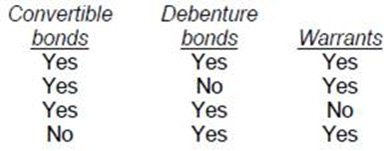
-
A
-
B
-
C
-
D
Reveal answer details
Close answer details
Correct answerC
ExplanationExplanation:
Choice "c" is correct.
Rules: Bonds are debt securities. Thus, convertible bonds and debenture bonds are debt securities. A warrant is a contractual right to purchase stock, which constitutes a share of corporate equity.
Choices "a", "b", and "d" are incorrect, per the above rules.
Question 55
Single choice
Starr, a self-employed individual, purchased a piece of equipment for use in Starr's business. The costs associated with the acquisition of the equipment were: 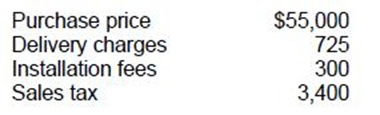 What is the depreciable basis of the equipment?
-
A
-
B
-
C
-
D
Reveal answer details
Close answer details
Correct answerD
ExplanationExplanation:
Choice "d" is correct. The rules for depreciable basis in tax are generally the same as the GAAP rules for capitalizing an asset. The depreciable basis is the cost associated with the purchase of the asset and with getting the asset ready for its intended use. Further improvements are also capitalized, and the basis is reduced for any accumulated depreciation. In this case, the cost of obtaining the equipment and getting the equipment ready for its intended use includes all the items shown above, as follows: 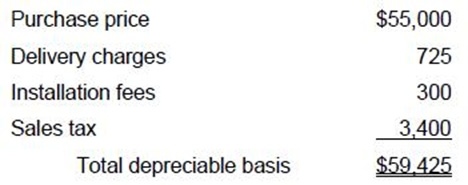 Choice "a" is incorrect. The costs of delivery charges, installation, and sales tax are all part of the cost of obtaining the asset and getting the asset ready for its intended use. All of these charges are included in the depreciable basis of the equipment.
Choice "b" is incorrect. The costs of delivery charges and installation are both part of the cost of obtaining the asset and getting the asset ready for its intended use. These charges are included in the depreciable basis of the equipment.
Choice "c" is incorrect. The cost of installation is part of the cost getting the asset ready for its intended use. This charge is included in the depreciable basis of the equipment.
Question 56
Single choice
On March 15, 1992, ABC Co. paid property taxes of $90,000 on its office building for the calendar year
1992. On April 1, 1992, ABC paid $150,000 for unanticipated repairs to its office equipment. The repairs will benefit operations for the remainder of 1992. What is the total amount of these expenses that ABC should include in its quarterly income statement for the three months ended June 30, 1992?
-
A
-
B
-
C
-
D
Reveal answer details
Close answer details
Correct answerC
ExplanationExplanation:
Rule: Actual and estimated expenditures benefiting all interim periods equally should be expensed ratably throughout the year.  Choice "c" is correct. $72,500 total expense for the three months ended June 30, 1992.
Question 57
Single choice
In the pharmaceutical industry where a diabetic must have insulin no matter what the cost, the diabetic's demand is considered to be:
-
A
-
B
-
C
-
D
Reveal answer details
Close answer details
Correct answerB
ExplanationExplanation:
Choice "b" is correct. When a good is demanded, no matter the price, demand is described as perfectly inelastic. The demand "curve" is a vertical line at the quantity demand with price making no difference.
Choices "a" and "c" are incorrect. There is no such thing as perfect elasticity. However, the more elastic demand is, the greater the change in quantity demand for price changes.
Choice "d" is incorrect. Insulin is an example of perfectly inelastic.
Question 58
Single choice
In evaluating an entity's accounting estimates, one of an auditor's objectives is to determine whether the estimates are:
-
A
-
B
Consistent with industry guidelines.
-
C
Based on objective assumptions.
-
D
Reasonable in the circumstances.
Reveal answer details
Close answer details
Correct answerD
ExplanationExplanation:
Choice "d" is correct. In evaluating an entity's accounting estimates, one of an auditor's objectives is to determine whether the estimates are reasonable in the circumstances and in conformity with GAAP.
Choice "a" is incorrect. Most estimates are subjective in nature and thus subject to bias.
Choice "b" is incorrect. Industry guidelines generally do not determine the amount of an accounting estimate, which is developed in accordance with GAAP.
Choice "c" is incorrect. Estimates are generally not based upon objective assumptions; rather, they are uncertain in nature, pending the outcome of future events.
Question 59
Single choice
Which of the following statements describes the same characteristic for both an S corporation and a C corporation?
-
A
Both corporations can have more than 100 shareholders.
-
B
Both corporations have the disadvantage of double taxation.
-
C
Shareholders can contribute property into a corporation without being taxed.
-
D
Shareholders can be either citizens of the United States or foreign countries.
Reveal answer details
Close answer details
Correct answerC
ExplanationExplanation:
Choice "c" is correct. Either entity's shareholders may contribute property to the corporations without being taxed and may contribute such property as an exchange for stock as appraised by the directors.
Choice "a" is incorrect. An S corporation may not have more than 100 shareholders, although a C corporation may have as many shareholders as desired.
Choice "b" is incorrect. Only the C corporation is subject to the double taxation disadvantage.
Choice "d" is incorrect. Only an S corporation is prohibited from having foreign country shareholders.
Question 60
Single choice
ABC Corp. wants to acquire the entire business of XYZ Corp. Which of the following methods of business combination will best satisfy ABC's objectives without requiring the approval of the shareholders of either corporation?
-
A
A merger of XYZ into ABC, whereby XYZ shareholders receive cash or ABC shares.
-
B
A sale of all the assets of XYZ, outside the regular course of business, to ABC, for cash.
-
C
An acquisition of all the shares of XYZ through a compulsory share exchange for ABC shares.
-
D
A cash tender offer, whereby ABC acquires at least 90% of XYZ's shares, followed by a short-form merger of XYZ into ABC.
Reveal answer details
Close answer details
Correct answerD
ExplanationExplanation:
Choice "d" is correct. A parent corporation owning 90% or more of a subsidiary may merge the subsidiary (short form merger) into the parent without the approval of the shareholders of either corporation or the approval of the subsidiary's board.
Choices "a", "b", and "c" all require at least one of the corporations to follow the general procedure for fundamental corporate changes (i.e., board resolution notice, approval by majority shares, and filing).
Question 61
Single choice
Fanny and John each own and manage their own companies. Fanny's business is manufacturing freight boxes of all types, and John's business is selling freight boxes to different industries. They decide to combine their expertise and knowledge to produce and sell freight boxes specifically designed for the new airline company that just formed in their city. Which of the following best describes the business formed by the parties?
-
A
-
B
A limited liability partnership.
-
C
-
D
Reveal answer details
Close answer details
Correct answerD
ExplanationExplanation:
Choice "d" is correct. A joint venture is formed for a single business undertaking such as building and designing freight containers to be sold specifically to one company. Each company coming together in this joint venture has its own business outside of this one endeavor.
Choice "a" is incorrect. A general partnership is more broad in its business purpose than a joint venture is.
Choice "b" is incorrect. A limited liability partnership is primarily designed for professionals who want to work as partners but with limited personal liability.
Choice "c" is incorrect. Sole proprietorships have only one person in the business.
Question 62
Single choice
Under the Revised Model Business Corporation Act, a dissenting stockholder's appraisal right generally applies to which of the following corporate actions? 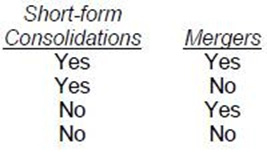
-
A
-
B
-
C
-
D
Reveal answer details
Close answer details
Correct answerA
ExplanationExplanation:
Choice "a" is correct. "Yes-Yes." Rule: Shareholders who are dissatisfied with the terms of a merger, consolidation or sale of assets are permitted to compel the corporation to buy their shares at fair market value. This is known as the right of appraisal or the dissenting right.
Rule: A short-form merger is when a parent mergers a 90% or more owned subsidiary into the parent. In this case, only the shareholders of the subsidiary have dissenting rights.
Choices "b", "c", and "d" are incorrect, per the above rules.
Question 63
Single choice
Several sources of GAAP consulted by an auditor are in conflict as to the application of an accounting principle. Which of the following should the auditor consider the most authoritative?
-
A
FASB Technical Bulletins.
-
B
AICPA Accounting Interpretations.
-
C
FASB Statements of Financial Accounting Concepts.
-
D
AICPA Technical Practice Aids.
Reveal answer details
Close answer details
Correct answerA
ExplanationExplanation:
Choice "a" is correct. The most authoritative pronouncements (first floor) are FASB Statements, FASB Staff Positions, FASB Statement 133 Implementation Issues, FASB Interpretations, AICPA APB opinions, and AICPA Accounting Research Bulletins. When these pronouncements do not provide appropriate guidance, the next level of pronouncements (second floor) are AICPA Industry Audit and Accounting Guides, AICPA Statements of Position, and FASB Technical Bulletins. Choice "b" is incorrect. AICPA Accounting Interpretations are not as authoritative as FASB Technical Bulletins, since they are on the fourth floor.
Choices "c" and "d" are incorrect. FASB Concepts Statements and AICPA Technical Practice Aids are among the least authoritative of accounting literature (fifth floor).
Question 64
Single choice
Which of the following sales should be reported as a capital gain?
-
A
-
B
Real property subdivided and sold by a dealer.
-
C
-
D
Government bonds sold by an individual investor.
Reveal answer details
Close answer details
Correct answerD
ExplanationExplanation:
Choice "d" is correct. Government bonds held by an individual investor are considered capital assets in the hands of the investor. When these types of security investments are sold, the resulting gain or loss is reported as capital.
Choice "a" is incorrect. In this case, we must assume that the BEST answer is option "d" (as that option would ALWAYS result in capital gain or loss treatment) and that the examiners are assuming that the equipment is depreciable equipment that has been used in a business for over one year. [If the equipment had been considered a personal asset by the examiners and had sold for a gain, it would also be a capital asset that sold for a capital gain, and there would be two correct answers. Remember that the correct answer is the option that best answers the question.] Depreciable equipment used in a business and held for over one year falls under the category of Section 1245 property. When Section 1245 assets are sold at a gain, all the accumulated depreciation on the asset is recaptured as ordinary income (the same category as the depreciation expense was deducted against), and any remaining gain (typically, in practice, this is not the case, though, as the asset would have had to sell for an amount greater than its purchase price) is capital gain under Code Section 1231. [Note that Section 1245 applies only to gains. If the asset had sold for a loss, the loss would have been ordinary under Section 1231.]
Choice "b" is incorrect. Real property sold by a dealer is considered inventory and results in ordinary income or ordinary losses upon sale. Inventory is not a capital asset and is not afforded the capital gain benefits.
Choice "c" is incorrect. Inventory is not a capital asset and is not afforded the capital gain benefits. The sale of inventory results in ordinary income or loss (e.g., gross profit on sales) being reported on the tax return, as inventory is an asset held for sale in the ordinary course of business.
Question 65
Single choice
A company has total costs of $100,000, of which 40% is variable costs. What is the operating leverage?
-
A
-
B
-
C
-
D
Reveal answer details
Close answer details
Correct answerC
ExplanationExplanation:
Choice "c" is correct. A shortcut computation for operating leverage is the ratio of fixed costs to variable costs. If total cost is $100,000 and variable cost is 40% of total costs (or $40,000), then fixed costs must be 60% (or $60,000). Operating leverage is then calculated as follows:
$60,000/$40,000 = 1.5 Choice "a" is incorrect. .4 is obtained by dividing $100,000 into the variable cost of $40,000.
Choice "b" is incorrect. .6 is obtained by dividing total costs into fixed costs.
Choice "d" is incorrect. 2.5 is obtained by dividing total costs by variable costs.
Question 66
Single choice
Because of the pervasive effects of laws and regulations on the financial statements of governmental units, an auditor should obtain written management representations acknowledging that management has:
-
A
Identified and disclosed all laws and regulations that have a direct and material effect on its financial statements.
-
B
Implemented internal controls designed to detect all illegal acts.
-
C
Expressed both positive and negative assurance to the auditor that the entity complied with all laws and regulations.
-
D
Employed internal auditors who can report their findings, opinions, and conclusions objectively without fear of political repercussion.
Reveal answer details
Close answer details
Correct answerA
ExplanationExplanation:
Choice "a" is correct. The auditor should obtain written representation that management has disclosed all laws and regulations that have a direct and material effect on its financial statements. Choice "b" is incorrect. Management need not acknowledge that it has implemented internal control activities to detect all illegal acts.
Choice "c" is incorrect. Management should state that it is responsible for compliance with all laws and regulations.
Choice "d" is incorrect. Management need not employ internal auditors.
Question 67
Single choice
The capital budgeting model that is generally considered the best model for long-range decision-making is the:
-
A
-
B
Accounting rate of return model.
-
C
Unadjusted rate of return model.
-
D
Discounted cash flow model.
Reveal answer details
Close answer details
Correct answerD
ExplanationExplanation:
Choice "d" is correct. The discounted cash flow model is the best for long-term decisions. Discounted cash flow methods include NPV, IRR, and profitability index.
Choice "a" is incorrect. Payback and bailout payback do not consider the time value of money or the return after the initial investment is recovered. The difference between the two methods is that bailout payback takes salvage value into account in calculating cash flows.
Choice "b" is incorrect. Accounting rate of return is based on accrual income rather than cash flows. It does not consider the time value of money and is considered inferior to the discounted cash flow methods.
Choice "c" is incorrect. There is no unadjusted rate of return model.
Question 68
Single choice
Which of the following procedures would an auditor most likely perform to test controls relating to management's assertion about the completeness of cash receipts for cash sales at a retail outlet?
-
A
Observe the consistency of the employees' use of cash registers and tapes.
-
B
Inquire about employees' access to recorded but undeposited cash.
-
C
Trace the deposits in the cash receipts journal to the cash balance in the general ledger.
-
D
Compare the cash balance in the general ledger with the bank confirmation request.
Reveal answer details
Close answer details
Correct answerA
ExplanationExplanation:
Choice "a" is correct. Observing the consistent use of cash registers and tapes by employees would provide evidence to the auditor regarding the controls over the completeness of cash receipts.
Choices "b", "c", and "d" are incorrect. The completeness assertion relates to the recording of all transactions. Inquiries about access to recorded cash, tracing from the cash receipts journal, and testing the general ledger balance do not provide evidence regarding possible unrecorded transactions.
Question 69
Single choice
Which of the following may not own shares in an S corporation?
-
A
-
B
-
C
-
D
Reveal answer details
Close answer details
Correct answerD
ExplanationExplanation:
Choice "d" is correct. Shareholders must be individuals, estates, or certain trusts. Corporations are not permitted to be shareholders of an S corporation.
Choices "a", "b", and "c" are incorrect, per the above Explanation.
Question 70
Single choice
Which of the following audit procedures is best for identifying unrecorded trade accounts payable?
-
A
Reviewing cash disbursements recorded subsequent to the balance sheet date to determine whether the related payables apply to the prior period.
-
B
Investigating payables recorded just prior to and just subsequent to the balance sheet date to determine whether they are supported by receiving reports.
-
C
Examining unusual relationships between monthly accounts payable balances and recorded cash payments.
-
D
Reconciling vendors' statements to the file of receiving reports to identify items received just prior to the balance sheet date.
Reveal answer details
Close answer details
Correct answerA
ExplanationExplanation:
Choice "a" is correct. When performing a search for unrecorded payables, an auditor most likely would examine cash disbursements recorded after the balance sheet date to determine whether the payables related to the prior period have been included in the accounts payable trial balance.
Choice "b" is incorrect. Investigating payables already recorded does not provide any evidence concerning unrecorded payables.
Choice "c" is incorrect. While a high level of cash payments compared with a low level of payable balances may be indicative of unrecorded payables, comparing these amounts would not be the most effective method for identifying unrecorded payables.
Choice "d" is incorrect. Comparing vendor statements to receiving reports is an audit step not involving the accounts payable balances; this step, therefore, provides no information about accounts payable.
Question 71
Single choice
Which of the following is true regarding the comparison of managerial to financial accounting?
-
A
Managerial accounting is generally more precise.
-
B
Managerial accounting has a past focus and financial accounting has a future focus.
-
C
The emphasis on managerial accounting is relevance and the emphasis on financial accounting is timeliness.
-
D
Managerial accounting need not follow generally accepted accounting principles (GAAP) while financial accounting must follow them.
Reveal answer details
Close answer details
Correct answerD
ExplanationExplanation:
Choice "d" is correct. Public companies must follow GAAP for (external) financial reporting purposes.
GAAP need not be followed for (internal) managerial accounting purposes.
Choice "a" is incorrect. Financial accounting is generally more precise.
Choice "b" is incorrect. Managerial accounting has a future focus, while financial accounting focuses on reporting past results.
Choice "c" is incorrect. The emphasis of financial accounting is providing useful information to financial statement users (including the characteristic of relevance), while the emphasis of managerial accounting is providing timely information to management decision makers.
Question 72
Single choice
Porter was unemployed for part of the year. Porter received $35,000 of wages, $4,000 from a state unemployment compensation plan, and $2,000 from his former employer's company-paid supplemental unemployment benefit plan. What is the amount of Porter's gross income?
-
A
-
B
-
C
-
D
Reveal answer details
Close answer details
Correct answerD
ExplanationExplanation:
RULE: Gross income includes all income unless it is specifically excluded in the tax code.
Choice "d" is correct. Wages and all unemployment compensation are not excluded from being taxable;
therefore, there are included in the taxpayer's gross income for tax purposes. 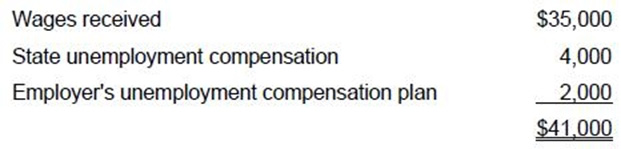 Choice "a" is incorrect. All forms of unemployment compensation are included as part of gross income.
Choice "b" is incorrect. The $4,000 of state unemployment compensation received is included as part of gross income.
Choice "c" is incorrect. The $2,000 of his former employer's company-paid supplemental unemployment benefit plan is included as part of gross income.
Question 73
Single choice
Which one of the following would increase the working capital of a firm?
-
A
Purchase of a new plant financed by a 20-year mortgage.
-
B
Cash collection of accounts receivable.
-
C
Payment of a 20-year mortgage payable with cash.
-
D
Refinancing a short-term note payable with a two-year note payable.
Reveal answer details
Close answer details
Correct answerD
ExplanationExplanation:
Choice "d" is correct. Refinancing a short-term note payable with a two-year note payable would increase the working capital of a firm.  Choice "a" is incorrect. The purchase of a new plant (fixed asset) financed by a 20-year mortgage (long term debt with a one-year current portion) would reduce working capital because current liabilities would be increased.
Choice "b" is incorrect. The cash collection of accounts receivable has no effect on working capital-cash increases by the amount that A/R decreases.
Choice "c" is incorrect. The payment of a 20-year mortgage payable (long-term debt) would reduce cash and have no effect on current liabilities, thereby reducing working capital.
Question 74
Single choice
Prospective financial information presented in the format of historical financial statements that omit either gross profit or net income is deemed to be a:
-
A
-
B
-
C
-
D
Reveal answer details
Close answer details
Correct answerA
ExplanationExplanation:
Choice "a" is correct. "Partial presentations" are presentations of prospective financial information which would not ordinarily be appropriate for general use because they omit one or more of these essential elements: (a) sales or gross revenue, (b) gross profit or cost of sales, (c) unusual or infrequently occurring items, (d) provision for income taxes, (e) discontinued operations or extraordinary items, (f) income from continuing operations, (g) net income, (h) earnings per share, and (i) significant changes in financial position.
Choices "b", "c", and "d" are incorrect. Projected balance sheets, financial forecasts and financial projections are forms of prospective financial statements.
Question 75
Single choice
When reporting on conditions relating to an entity's internal control observed during an audit of the financial statements of a nonissuer, the auditor should include a:
-
A
Description of tests performed to search for material weaknesses.
-
B
Statement of positive assurance on internal control.
-
C
Paragraph describing the inherent limitations of internal control.
-
D
Restriction on the use of the report.
Reveal answer details
Close answer details
Correct answerD
ExplanationExplanation:
Choice "d" is correct. When reporting on conditions relating to an entity's internal control observed during an audit of the financial statements, the auditor should include a restriction on the use of the report.
Choice "a" is incorrect. The auditor would not include a description of tests performed to search for material weaknesses since the auditor is not in fact obligated to search for them.
Choices "b" and "c" are incorrect. An auditor would make a statement of positive assurance on internal control and include a paragraph describing the inherent limitations of internal control in conjunction with an engagement to report on internal control. These comments would not be made when reporting on an entity's internal control in conjunction with an audit of the financial statements of a nonissuer.
Question 76
Single choice
According to the FASB conceptual framework, comprehensive income includes which of the following? 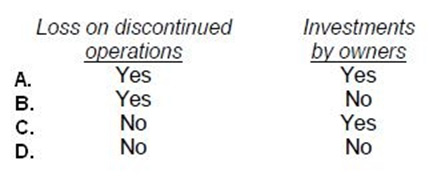
-
A
-
B
-
C
-
D
Reveal answer details
Close answer details
Correct answerB
ExplanationExplanation:
Choice "b" is correct. Comprehensive income is the change in equity of a business during a period from transactions and other events and circumstances from non-owner sources. It includes all changes in equity except those resulting from investments by owners and distributions to owners. SFAC 6 para 70.
Question 77
Single choice
On August 31, 1992, ABC Co. decided to change from the FIFO periodic inventory system to the weighted average periodic inventory system. ABC is on a calendar year basis. The cumulative effect of the change is determined:
-
A
-
B
-
C
During the eight months ending August 31, 1992, by a weighted average of the purchases.
-
D
During 1992 by a weighted average of the purchases.
Reveal answer details
Close answer details
Correct answerA
ExplanationExplanation:
Rule: The cumulative effect of a change in accounting principle equals the difference between retained earnings at the beginning of period of the change and what retained earnings would have been if the change was applied to all affected prior periods.
Choice "a" is correct. As of January 1, 1992, the beginning of the year. This assumes that the company is not presenting comparative financial statements. If comparative financial statements are presented, then the adjustment is made to the beginning retained earnings of the earliest year presented.
Choice "b" is incorrect. The cumulative effect of the change is not determined as of the date the decision is made.
Choices "c" and "d" are incorrect. The cumulative effect of the change is not determined by a weighted average.
Question 78
Single choice
Goddard has used the FIFO method of inventory valuation since it began operations in 1987. Goddard decided to change to the weighted-average method for determining inventory costs at the beginning of
1990. The following schedule shows year-end inventory balances under the FIFO and weighted-average methods: 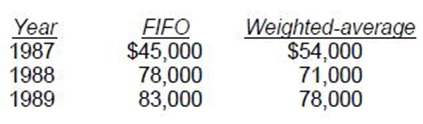 What amount, before income taxes, should be reported in the 1990 retained earnings statement as the cumulative effect of the change in accounting principle?
-
A
-
B
-
C
-
D
Reveal answer details
Close answer details
Correct answerA
ExplanationExplanation:
Choice "a" is correct. $5,000 decrease.
The cumulative effect of change in accounting principle is determined as of the beginning of the year of change if comparative financial statements are not presented. In this case, the year of change is 1990, so the cumulative effect is the difference in inventory as of the end of 1989. [Note that inventory is a balance sheet item, so the change is based on the balances at the end of the last year the prior method was used.
Had this question shown annual income statement amounts of cost of goods sold, we would have had to look at all the past years in the aggregate.] This will allow us to arrive at the adjustment to obtain the amount of retained earnings that would have been reported at the beginning of the period of change if the new accounting principle had been used for all prior periods. 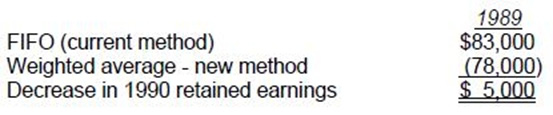
Question 79
Single choice
All of the following are characteristics of the strategic planning process, except the:
-
A
Emphasis on both the short and long run.
-
B
Review of the attributes and behavior of the organization's competition.
-
C
Analysis and review of departmental budgets.
-
D
Analysis of consumer demand.
Reveal answer details
Close answer details
Correct answerC
ExplanationExplanation:
Choice "c" is correct. Analysis and review of departmental budgets is not a part of the strategic planning process. Budgets are operational and much more specific than the things that are part of strategic planning.
Choices "a", "b", and "d" are incorrect. All of these are part of the strategic planning process:
A. Emphasis on both the short and long run.
B. A review of competition.
D. Analysis of consumer demand.
Question 80
Single choice
In the first audit of a client, an auditor was not able to gather sufficient evidence about the consistent application of accounting principles between the current and prior year, as well as the amounts of assets or liabilities at the beginning of the current year. This was due to the client's record retention policies. If the amounts in question could materially affect current operating results, the auditor would:
-
A
Be unable to express an opinion on the current year's results of operations and cash flows.
-
B
Express a qualified opinion on the financial statements because of a client-imposed scope limitation.
-
C
Withdraw from the engagement and refuse to be associated with the financial statements.
-
D
Specifically state that the financial statements are not comparable to the prior year due to an uncertainty.
Reveal answer details
Close answer details
Correct answerA
ExplanationExplanation:
Choice "a" is correct. Since the auditor was unable to gather sufficient evidence on the beginning balances of the balance sheet accounts, the auditor would be unable to express an opinion on the current year's results of operations and cash flows. The auditor could express an opinion on the statement of financial position.
Choice "b" is incorrect. Since the scope limitation could have a pervasive effect on the financial statements (affecting all assets and liabilities), a disclaimer of opinion (and not merely a qualified opinion) is required on the income statement and statement of cash flows. An opinion may be expressed on the year-end statement of financial position.
Choice "c" is incorrect. The auditor does not need to withdraw from the engagement and refuse to be associated with the financial statements.
Choice "d" is incorrect. An uncertainty does not exist. The auditor can express an opinion on one of the financial statements.
Question 81
Single choice
Ordinarily, the predecessor auditor permits the successor auditor to review the predecessor's audit documentation relating to: 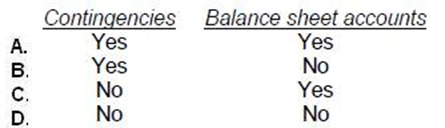
-
A
-
B
-
C
-
D
Reveal answer details
Close answer details
Correct answerA
ExplanationExplanation:
Choice "a" is correct. Ordinarily, the predecessor auditor permits the successor auditor to review the predecessor's audit documentation relating to matters of continuing accounting and auditing significance, including both contingencies and balance sheet accounts. Contingencies have continuing significance as they may continue to affect the current year financial statements (either by remaining as contingencies or by being resolved); balance sheet accounts from the prior year-end have continuing significance since they
are the opening balances for the current year. Choices "b", "c", and "d" are incorrect, per above explanation.
Question 82
Single choice
For capital budgeting purposes, management would select a high hurdle rate of return for certain projects because management:
-
A
Wants to use equity funding exclusively.
-
B
Believes bank loans are riskier than capital investments.
-
C
Believes capital investment proposals involve average risk.
-
D
Wants to factor risk into its consideration of projects.
Reveal answer details
Close answer details
Correct answerD
ExplanationExplanation:
Choice "d" is correct. Management would select a high hurdle rate for certain projects to factor risk into its consideration of projects. The higher hurdle rate discounts future cash flows more, creating a smaller present value. By "devaluing" the cash flows of certain projects, risk has been compensated for.
Choices "a" and "b" are incorrect. The method and cost of funding are independent of the hurdle rate for screening investments.
Choice "c" is incorrect. If capital investment proposals involve average risk, no adjustment upward is needed for risk.
Question 83
Single choice
When there has been a change in accounting principles, but the effect of the change on the comparability of the financial statements is not material, the auditor should:
-
A
Refer to the change in an explanatory paragraph.
-
B
Explicitly concur that the change is preferred.
-
C
Not refer to consistency in the auditor's report.
-
D
Refer to the change in the opinion paragraph.
Reveal answer details
Close answer details
Correct answerC
ExplanationExplanation:
Choice "c" is correct. If an accounting change has no material effect on the comparability of the financial statements, the auditor does not need to recognize the change in the current year's audit report.
Choice "a" is incorrect. The change would only be referred to in an explanatory paragraph if the effect were material.
Choice "b" is incorrect. The auditor does not explicitly concur with the change in the report.
Choice "d" is incorrect. Even if the change had a material effect, the opinion paragraph would not be affected. The explanatory paragraph would follow the opinion paragraph.
Question 84
Single choice
Which one of the following provides a spontaneous source of financing for a firm?
-
A
-
B
-
C
-
D
Reveal answer details
Close answer details
Correct answerA
ExplanationExplanation:
Choice "a" is correct. Accounts payable provide a spontaneous source of financing for a firm.
Choice "b" is incorrect. Accounts receivable take time to factor. Choices "c" and "d" are incorrect.
Each of the following take time to issue:
C. Debentures.
D. Preferred stock.
Question 85
Single choice
Which of the following audit procedures is best for identifying unrecorded trade accounts payable?
-
A
Examining unusual relationships between monthly accounts payable balances and recorded cash payments.
-
B
Reconciling vendors' statements to the file of receiving reports to identify items received just prior to the balance sheet date.
-
C
Reviewing cash disbursements recorded subsequent to the balance sheet date to determine whether the related payables apply to the prior period.
-
D
Investigating payables recorded just prior to and just subsequent to the balance sheet date to determine whether they are supported by receiving reports.
Reveal answer details
Close answer details
Correct answerC
ExplanationExplanation:
Choice "c" is correct. Unrecorded trade accounts payable are best identified by reviewing cash disbursements recorded subsequent to the balance sheet date to determine whether the related payables apply to the prior period.
Choice "a" is incorrect. There is not usually a predictable relationship between accounts payable and cash payments, because management can pay cash or incur additional liabilities at its discretion.
Choice "b" is incorrect. Reconciling vendors' statements to the file of receiving reports would not identify unrecorded payables, as the vendor statement would still agree with the receiving report even if the payable were not recorded.
Choice "d" is incorrect. Investigating payables already recorded would not help identify unrecorded trade payables.
Question 86
Single choice
In 1990, ABC Corp., a closely held corporation, was formed by Adams, Frank, and Berg as incorporators and stockholders. Adams, Frank, and Berg executed a written voting agreement which provided that they would vote for each other as directors and officers. In 1994, stock in the corporation was offered to the public. This resulted in an additional 300 stockholders. After the offering, Adams holds 25%, Frank holds 15%, and Berg holds 15% of all issued and outstanding stock. Adams, Frank, and Berg have been directors and officers of the corporation since the corporation was formed. Regular meetings of the board of directors and annual stockholders meetings have been held.
For this question refer to the formation of ABC Corp. and the rights and duties of its stockholders, directors, and officers. ABC Corp.'s day-to-day business ordinarily would be operated by its:
-
A
-
B
-
C
Reveal answer details
Close answer details
Correct answerC
ExplanationExplanation:
Choice "c" is correct. Stockholders have no day-to-day control; management power of a corporation is vested in the directors, but they usually delegate day-to-day management duties to the officers.
Question 87
Single choice
Heather, Erika, and Shelby are members in ABC LLC. Heather dies.
Absent an agreement to the contrary, what is the result?
-
A
-
B
-
C
The LLC is dissolved unless the other members consent to continue.
-
D
The LLC continues as though nothing happened.
Reveal answer details
Close answer details
Correct answerC
ExplanationExplanation:
Choice "c" is correct. Absent an agreement to the contrary, if a member of an LLC dies, the LLC is dissolved unless the other members consent to continue.
Choice "a" is incorrect, because the LLC does not have to dissolve upon the death of a member.
Choice "b" is incorrect, because the LLC does not cease to exist immediately.
Choice "d" is incorrect, because the LLC does not continue unless the members consent to continue.
Question 88
Single choice
ABC, Inc. is interested in measuring its overall cost of capital and has gathered the following data. Under the terms described below, the company can sell unlimited amounts of all instruments. - ABC can raise cash by selling $1,000, 8 percent, 20-year bonds with annual interest payments.
In selling the issue, an average premium of $30 per bond would be received, and the firm must pay floatation costs of $30 per bond. The after-tax cost of funds is estimated to be 4.8 percent.
- ABC can sell 8 percent preferred stock at par value, $105 per share. The cost of issuing and selling the
preferred stock is expected to be $5 per share.
- ABC' common stock is currently selling for $100 per share. The firm expects to pay cash dividends of $7
per share next year, and the dividends are expected to remain constant. The stock will have to be underpriced by $3 per share, and floatation costs are expected to amount to $5 per share.
- ABC expects to have available $100,000 of retained earnings in the coming year; once these retained
earnings are exhausted, the firm will use new common stock as the form of common stock equity financing.
- ABC' preferred capital structure is: Long-term debt 30%
Preferred stock 20
Common stock 50 The cost of funds from retained earnings for ABC, Inc. is:
-
A
-
B
-
C
-
D
Reveal answer details
Close answer details
Correct answerA
ExplanationExplanation:
Choice "a" is correct. 7.0 percent cost of funds from retained earnings.
The cost of retained earnings is equal to the rate of return required by the firm's common shareholders (or, in effect, the return "lost" by them when the firm chooses to fund with retained earnings). While oftentimes this rate is somewhat subjective, we are given the facts to exactly answer the question in this case. The stock is currently selling for $100/share, and the dividend is given at $7/share.
$7 / $100 = 7%
Choices "b", "c", and "d" are incorrect, per the above Explanation/calculation.
Question 89
Single choice
Green, CPA, was engaged to audit the financial statements of ABC Co. after its fiscal year had ended. The timing of Green's appointment as auditor and the start of fieldwork made confirmation of accounts receivable by direct communication with the debtors ineffective. However, Green applied other procedures and was satisfied as to the reasonableness of the account balances. Green's auditor's report most likely contained a(an):
-
A
-
B
Unqualified opinion with an explanatory paragraph.
-
C
Qualified opinion due to a scope limitation.
-
D
Qualified opinion due to a departure from generally accepted auditing standards.
Reveal answer details
Close answer details
Correct answerA
ExplanationExplanation:
Choice "a" is correct. There is a presumption that the auditor will request the confirmation of accounts receivable during an audit unless accounts receivable are immaterial, the use of confirmations would be ineffective, or the assessed inherent risk is so low that the evidence expected to be provided by analytical procedures or other substantive tests of details would be sufficient. In this example, the confirmation of accounts receivable by direct communication with the debtors would be ineffective. If Green was able to apply alternative audit procedures and was satisfied as to the reasonableness of the account balances, then an unqualified opinion could be issued.
Choice "b" is incorrect. Since Green was satisfied as far as the accounts receivable balances, there is no need to add an explanatory paragraph.
Choice "c" is incorrect. Since Green was able to perform alternative procedures and was satisfied as far as the reasonableness of the account balances, there is no scope limitation.
Choice "d" is incorrect. Since Green was able to perform alternative procedures and was satisfied as far as the reasonableness of the account balances, there is no departure from generally accepted auditing standards.
Question 90
Single choice
ABC, Inc. offers credit terms of 2/10, net 30 for its customers. Sixty percent of ABC's customers take the
10. The remainder of ABC's customers pay on day
30. How many days' sales are in ABC's accounts receivable?
-
A
-
B
-
C
-
D
Reveal answer details
Close answer details
Correct answerC
ExplanationExplanation:
Choice "c" is correct. Days' sales in accounts receivable is normally calculated as Days' sales = Ending accounts receivable / Average daily sales. However, that formula will not work in this case because the necessary information is not provided. However, enough information about payments is provided so that the total days' sales can be determined on a weighted average basis. In this question, nobody pays before the 10th day and 60% of the customers pay on the 10th day, so there are 10 x .60, or 6 day's sales there.
The other 40% of the customers pay on the 30th day so there are 30 x .40, or 12 day's sales there. The total is 18 days sales. Choice "a" is incorrect. This answer is apparently calculated from just the 60% of the customers who pay on the 10th day. The others have to be included also.
Choice "b" is incorrect. This answer is apparently calculated from just the 40% of the customers who pay on the 30th day. The others have to be included also.
Choice "d" is incorrect. This answer is apparently calculated by as the difference between the 30th day and the 10th day. The answer does not take into account how many customers pay when.
Question 91
Single choice
An auditor is engaged to report on selected financial data that are included in a client-prepared document containing audited financial statements. Under these circumstances, the report on the selected data should:
-
A
Be limited to data derived from the audited financial statements.
-
B
Be distributed only to senior management and the board of directors.
-
C
State that the presentation is a comprehensive basis of accounting other than GAAP.
-
D
Indicate that the data are not fairly stated in all material respects.
Reveal answer details
Close answer details
Correct answerA
ExplanationExplanation:
Choice "a" is correct. An auditor's report on selected information included in a client-prepared document containing audited financial statements should be limited to data derived from audited financial statements.
Choice "b" is incorrect. It is not necessary to limit distribution of such a report.
Choice "c" is incorrect. Selected financial data is not an "other comprehensive basis of accounting."
Choice "d" is incorrect. The auditor indicates whether the selected financial data is fairly stated, in all material respects, in relation to the financial statements from which it has been derived.
Question 92
Single choice
If a firm borrows $500,000 at 10 percent and is required to maintain $50,000 as a minimum compensating balance at the bank, what is the effective interest rate on the loan?
-
A
-
B
-
C
-
D
Reveal answer details
Close answer details
Correct answerA
ExplanationExplanation:
Choice "a" is correct. 11.1% effective interest rate on loan.  This question pertains to the computation of the effective rate of interest on a $500,000 note with a 10% stated rate that requires a $50,000 compensating balance. The answer computes the effective rate at 11.1% by taking the ratio of the amount paid $50,000 to the funds available $450,000 ($500,000 -$50,000). Why would the $50,000 in interest payments not also be deducted in arriving at the effective rate?
The simple answer is that the note is not discounted by the interest. It is only subject to the compensating balance.
The borrower receives $500,000 in proceeds but must hold out $50,000 and pay back $550,000, principal
+ interest, to the lender. At the conclusion of the loan, the compensating balance requirement is removed.
Question 93
Single choice
If the objective of a test of details is to detect overstatements of sales, the auditor should trace transactions from the:
-
A
Cash receipts journal to the sales journal.
-
B
Sales journal to the cash receipts journal.
-
C
Source documents to the accounting records.
-
D
Accounting records to the source documents.
Reveal answer details
Close answer details
Correct answerD
ExplanationExplanation:
Choice "d" is correct. If the objective of a test of details is to detect overstatements of sales (existence assertion), the auditor should trace transactions from the accounting records (i.e., sales journal) to the source documents (e.g., customer order, sales order, shipping documents, etc.).
Choices "a" and "c" are incorrect. Tracing from the supporting documents to the accounting records gives assurance as to the completeness assertion (all sales are properly included).
Choice "b" is incorrect. Tracing from the sales journal to the cash receipts journal only shows whether cash has been received for the sale. Failure to find a related cash receipt may indicate simply that the sale was made on account.
Question 94
Single choice
Which of the following is not correct about the purchasing power parity theory of explaining changes in exchange rates?
-
A
Purchasing power of a common currency in different economies for similar products will remain the same.
-
B
Inflationary forces on foreign and domestic currencies will cause the exchange rates to automatically adjust to ensure that a common currency will have identical or similar purchasing power in each economy for similar goods.
-
C
Interest rates include a premium or discount that ensures purchasing power parity.
-
D
The purchasing power parity theory is presented in both absolute and relative form.
Reveal answer details
Close answer details
Correct answerC
ExplanationExplanation:
Choice "c" is correct. The purchasing power parity theory holds that inflation will cause exchange rates to automatically adjust to ensure that an equal amount of a common currency will purchase similar goods in separate economies. The International Fischer effect considers the premium or discount on interest rates as an indicator of inflation.
Choice "a" is incorrect. The basic idea underlying the purchasing power parity theory is that the purchasing power of a common currency in different economies for similar products will remain the same and that inflation in any particular economy will cause exchange rates to adjust until parity is consistently achieved.
Choice "b" is incorrect. The purchasing power parity theory holds that inflationary forces on foreign and domestic currencies will cause the exchange rates to automatically adjust to ensure that a common currency will have identical or similar purchasing power in each economy for similar goods.
Choice "d" is incorrect. The purchasing power parity theory is presented as both an absolute theory of parity determination regardless of market imperfections and as a relative concept that considers market imperfections.
Question 95
Single choice
Fred Berk bought a plot of land with a cash payment of $40,000 and a mortgage of $50,000. In addition, Berk paid $200 for a title insurance policy. Berk's basis in this land is:
-
A
-
B
-
C
-
D
Reveal answer details
Close answer details
Correct answerD
ExplanationExplanation:
Choice "d" is correct. $90,200 is Berk's basis in the land.
Rule: The basis of the property acquired will be the property's cost consisting of the amount of cash paid plus any amount of related debt assumed. Cost will be adjusted to reflect any additional costs incurred in purchasing the property. 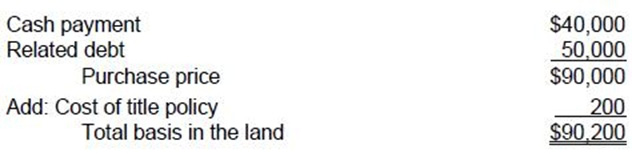 Choices "a", "b", and "c" are incorrect, per the above rule.
Question 96
Single choice
An auditor would be most likely to identify a contingent liability by obtaining a (an):
-
A
Accounts payable confirmation.
-
B
Transfer agent confirmation.
-
C
Standard bank confirmation.
-
D
Related party transaction confirmation.
Reveal answer details
Close answer details
Correct answerC
ExplanationExplanation:
Choice "c" is correct. An auditor would be most likely to identify a contingent liability by obtaining a standard bank confirmation, which has an "exceptions and comments" box that specifically discloses contingent liabilities as endorser of loans, for open letters of credit, etc.
Choice "a" is incorrect. Confirmations of accounts payable relate to existing liabilities, not to contingent liabilities. They are not always performed and rarely disclose contingencies.
Choice "b" is incorrect. Transfer agent confirmations relate to purchase and sale of securities. They are not always used and rarely disclose contingencies.
Choice "d" is incorrect. Confirmations of related party transactions relate to transactions that have already occurred. They are not always used and rarely disclose contingencies.
Question 97
Single choice
Which of the following documents would most likely contain specific rules for the management of a business corporation?
-
A
Articles of incorporation.
-
B
-
C
Certificate of authority.
-
D
Reveal answer details
Close answer details
Correct answerB
ExplanationExplanation:
Choice "b" is correct. The bylaws are adopted by the incorporators or directors, are not required to be filed, and generally will contain rules desired regarding the operation of the corporation.
Choice "a" is incorrect. Articles of incorporation are filed with the state and contain information regarding the formation of the corporation.
Choice "c" is incorrect. A certificate of authority is filed with the foreign state that a business wishes to do business in and with permission from that state.
Choice "d" is incorrect. A shareholder agreement is a contract between shareholders for any rights or duties agreed upon between the parties.
Question 98
Single choice
Juan is a limited partner in ABC, Limited Partnership. Juan visited XYZ, Inc., a local supplier of dog food claiming to be a "partner" in the partnership and negotiated a distribution contract between the supplier and limited partnership on behalf of the partnership.
As a result of these actions, Juan:
-
A
Has limited liability as a limited partner in reference to all creditors.
-
B
Has limited liability as a limited partner to all creditors except XYZ, Inc.
-
C
Has full personal liability to all creditors.
-
D
Reveal answer details
Close answer details
Correct answerB
ExplanationExplanation:
Choice "b" is correct.
Rule: A limited partner will be considered a general partner with full personal liability only to those that the limited partner transacts with as if he were a general partner. Limited partners have no right to participate in management, such as negotiating contracts on behalf of the limited partnership. The limited partner will retain his status and limited liability to all others that the limited partner has not transacted with on behalf of the partnership.
Choices "a", "c", and "d" are incorrect, per the above rule.
Question 99
Single choice
In testing for unrecorded retirements of equipment, an auditor most likely would:
-
A
Select items of equipment from the accounting records and then locate them during the plant tour.
-
B
Compare depreciation journal entries with similar prior-year entries in search of fully depreciated equipment.
-
C
Inspect items of equipment observed during the plant tour and then trace them to the equipment subsidiary ledger.
-
D
Scan the general journal for unusual equipment additions and excessive debits to repairs and maintenance expense.
Reveal answer details
Close answer details
Correct answerA
ExplanationExplanation:
Choice "a" is correct. Tracing (old) equipment recorded in the books to the actual equipment during a plant tour is a control which tests for unrecorded retirements.
Choice "b" is incorrect. Determining which assets are fully depreciated does not tell you which ones are retired, as fully depreciated assets may continue to be used.
Choice "c" is incorrect. Selecting items from the plant tour and then tracing them to the equipment subsidiary ledger will provide evidence that all equipment is recorded. It will not detect whether recorded equipment has been retired. (This step is backwards.)
Choice "d" is incorrect. Scanning the general journal for unusual equipment additions and excessive debits to repairs and maintenance expense provides evidence regarding fixed asset additions, not retirements.
Question 100
Single choice
Which of the following statements is a basic element of the auditor's standard report?
-
A
The disclosures provide reasonable assurance that the financial statements are free of material misstatement.
-
B
The auditor evaluated the overall internal control.
-
C
An audit includes assessing significant estimates made by management.
-
D
The financial statements are consistent with those of the prior period.
Reveal answer details
Close answer details
Correct answerC
ExplanationExplanation:
Choice "c" is correct. The auditor's standard audit report includes a statement that "An audit includes assessing...significant estimates made by management..."
Choice "a" is incorrect. The standard audit report does not state that disclosures provide reasonable assurance that the financial statements are free of material misstatement. The correct statement is: "...standards require that we plan and perform the audit to obtain reasonable assurance that the financial statements are free of material misstatement."
Choice "b" is incorrect. The standard audit report does not state that the auditor evaluated the overall internal control. The correct statement is "An audit includes...evaluating the overall financial statement presentation." Internal control is not mentioned in the standard audit report.
Choice "d" is incorrect. The standard audit report does not state "The financial statements are consistent with those of the prior period." According to the second standard of reporting, consistency is implicitly reported. Only if there is an inconsistency is an explicit statement included.
|