What happens when you attempt to compile and run the following code? #include <iostream> #include <string> using namespace std;
int main() {string s1[]= {"How" , "to" }; s1[0].swap(s1[1]); for (int i=0; i<2; i++) { cout << s1[i]; } return( 0 ); }
-
A
-
B
-
C
-
D
Reveal answer details
Close answer details
What is the output of the program?
#include <iostream> using namespace std; #define SQR(x)(x*x) int main(int argc, char *argv[]) { int x, y=2; x = SQR(y); cout << x << ", " <<y; return 0; }
-
A
-
B
-
C
-
D
Reveal answer details
Close answer details
What happens when you attempt to compile and run the following code? #include <iostream> using namespace std; int main(){ int i = 1; for(i=10; i>-1; i/=2) { if(!i) break; } cout << i; return 0; }
-
A
-
B
-
C
-
D
Reveal answer details
Close answer details
Which code, inserted at line 12, generates the output "5b"? #include <iostream> using namespace std; namespace myNamespace1 {int var = 5; } namespace myNamespace2 {char var = 'b'; } int main () { //insert code here return 0; }
-
A
cout << myNamespace1::var << var;
-
B
-
C
cout << myNamespace1::var << myNamespace2::var;
-
D
Reveal answer details
Close answer details
What happens when you attempt to compile and run the following code? #include <iostream>
class complex{ double re; double im; public: complex() : re(0),im(0) {} complex(double x) { re=x,im=x;}; complex(double x,double y) { re=x,im=y;} void print() { cout << re << " " << im;} }; int main(){ complex c1(1,2); c1.print(); return 0; }
-
A
-
B
-
C
-
D
Reveal answer details
Close answer details
What happens when you attempt to compile and run the following code? #include <iostream> #include <string>
using namespace std;
struct Person {
string name;
int age;
};
class First
{
Person *person;
public:
First() {person = new Person;
person?>name = "John";
person?>age = 30;
}
void Print(){
cout<<person?>name << " "<< person?>age;
}
};
int main()
{
First t;
t.Print();
}
-
A
-
B
-
C
-
D
It prints: John 30John 30
Reveal answer details
Close answer details
Question 7
Multiple choice
Which of the following can be checked in a switch?
case statement?
-
A
-
B
-
C
-
D
Reveal answer details
Close answer details
Question 8
Multiple choice
Which of the following statements are correct?
-
A
A function can be defined inside another function
-
B
A function may have any number of return statements each returning different values.
-
C
A function can return floating point value
-
D
In a function two return statements should never occur.
Reveal answer details
Close answer details
What is the output of the program? #include <iostream>
#include <string>
using namespace std;
int main()
{
string s1[]= {"H" , "t" }; string s;
for (int i=0; i<2; i++) {
s = s1[i];
s.insert(1,"ow");
cout << s;
}
return( 0 );
}
-
A
-
B
-
C
-
D
Reveal answer details
Close answer details
Question 10
Single choice
What happens when you attempt to compile and run the following code? #include <iostream>
using namespace std; int main() { int i, j; for(i = 0; i < 2; i++) { for(j = i; j < i + 1; j++) if(j == i) continue; else break; } cout << j; return 0; }
-
A
-
B
-
C
-
D
Reveal answer details
Close answer details
Question 11
Single choice
What happens when you attempt to compile and run the following code? #include <iostream> using namespace std; void fun(char*); int main() {char t[4]={'0', '1', '2', '3'}; fun(&t[0]); return 0; } void fun(char *a)
{ cout << *a; }
-
A
-
B
-
C
-
D
Reveal answer details
Close answer details
Question 12
Single choice
What happens when you attempt to compile and run the following code? #include <iostream> using namespace std; int main() {float x=3.5,y=1.6; int i,j=2; i = x + j + y; cout << i; return 0; }
-
A
-
B
-
C
-
D
Reveal answer details
Close answer details
Question 13
Single choice
What happens when you attempt to compile and run the following code? #include <iostream>
#include <string>
using namespace std;
class A {
int x;
protected:
int y;
public:
int z;
};
class B : private A {
string name;
public:
void set() {
x = 1;
}
void Print() {
cout << x;
}
};
int main () {
B b;
b.set();
b.Print();
return 0;
}
-
A
-
B
-
C
-
D
Reveal answer details
Close answer details
Question 14
Single choice
What happens when you attempt to compile and run the following code? #include <iostream>
#include <string>
using namespace std;
class A {
protected:
int y;
public:
int x,z;
A() : x(2), y(2), z(1) { z = x + y; }
A(int a, int b) : x(a), y(b) { z = x + y;}
void Print() { cout << z; }
};
class B : public A {
public:
int y;
B() : A() {}
B(int a, int b) : A(a,b) {}
void Print() { cout << z; } };
int main () {
A b;
b.Print();
return 0;
}
-
A
-
B
-
C
-
D
Reveal answer details
Close answer details
Question 15
Single choice
What happens when you attempt to compile and run the following code? #include <iostream> #include <string> using namespace std;
struct Person { string name; int age; }; class First {Person *person; public: First() {person = new Person; person?>name = "John"; person?>age = 30; } void Print(){ cout<<person?>name << " "<< person?>age; } }; int main() {First t[2]; for (int i=0; i<2; i++) t[i].Print(); }
-
A
-
B
-
C
-
D
It prints: John 30John 30
Reveal answer details
Close answer details
Question 16
Multiple choice
Which definitions are correct?
-
A
-
B
-
C
-
D
Reveal answer details
Close answer details
Question 17
Multiple choice
Which code, inserted at line 8, generates the output "100"? #include <iostream> using namespace std; int fun(int); int main() {int *x = new int; *x=10; //insert code here
return 0; } int fun(int i) {return i*i; }
-
A
-
B
-
C
-
D
Reveal answer details
Close answer details
Question 18
Single choice
What happens when you attempt to compile and run the following code? #include <iostream> using namespace std; namespace myNamespace1 {int x = 5; int y = 10; } namespace myNamespace2 {float x = 3.14; float y = 1.5; } int main () { namespace newname = myNamespace1; using namespace newname; cout << x << " "; cout << y; return 0; }
-
A
-
B
-
C
-
D
Reveal answer details
Close answer details
Question 19
Single choice
What happens when you attempt to compile and run the following code? #include <iostream> using namespace std; int main() {int *t;
t = new int[2]; for (int i=0; i<2; i++) { t[i]=0; } cout << t[1]; }
-
A
-
B
-
C
-
D
Reveal answer details
Close answer details
Question 20
Single choice
What happens when you attempt to compile and run the following code? #include <iostream> using namespace std; class A { public : void print() { cout << "A "; } }; class B { public : void print() { cout << "B "; } }; int main() { B sc[2]; B *bc = (B*)sc; for (int i=0; i<2;i++) (bc++)->print(); return 0; }
-
A
-
B
-
C
-
D
Reveal answer details
Close answer details
Question 21
Single choice
What happens when you attempt to compile and run the following code? 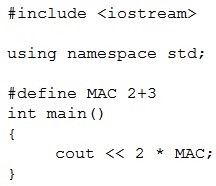
-
A
-
B
-
C
-
D
Reveal answer details
Close answer details
Question 22
Single choice
What happens when you attempt to compile and run the following code? 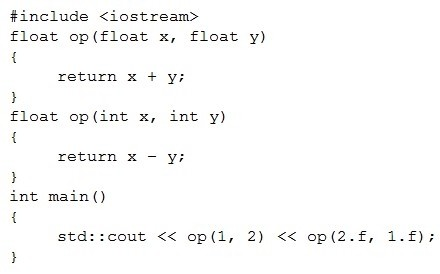
-
A
-
B
-
C
-
D
Reveal answer details
Close answer details
Question 23
Single choice
What happens when you attempt to compile and run the following code? #include <iostream> using namespace std; class First {public: void Print(){ cout<<"from First";} }; class Second:public First {public: void Print(){ cout<< "from Second";} }; void fun(First *obj); int main() {First FirstObject; fun(&FirstObject); Second SecondObject; fun(&SecondObject);
} void fun(First *obj) {obj?>Print(); }
-
A
-
B
It prints: from Firstfrom First
-
C
It prints: from Firstfrom Second
-
D
It prints: from Secondfrom Second
Reveal answer details
Close answer details
Question 24
Single choice
What happens when you attempt to compile and run the following code? #include <iostream> using namespace std; class A {public: void Print(){ cout<<"A";} }; class B:public A {public: virtual void Print(){ cout<< "B";} };
int main() {A *obj; A ob1; obj = &ob1; obj?>Print(); B ob2; obj = &ob2; obj?>Print(); }
-
A
-
B
-
C
-
D
Reveal answer details
Close answer details
Question 25
Single choice
What happens when you attempt to compile and run the following code? #include <iostream> using namespace std; int main() {int i=5; switch(i) {case 1: cout<<"Hello"; break; case 2: cout<<"world"; break; case 3: break; default: cout<<"End"; } return 0; }
-
A
-
B
-
C
-
D
Reveal answer details
Close answer details
Question 26
Single choice
What happens when you attempt to compile and run the following code? #include <iostream> using namespace std; class A {public: virtual void Print(){ cout<<"A";} }; class B:public A {public: void Print(){ cout<< "B";} }; int main() {A *obj; A ob1; obj = &ob1;
obj?>Print(); B ob2; obj = &ob2; obj?>Print(); }
-
A
-
B
-
C
-
D
Reveal answer details
Close answer details
Question 27
Multiple choice
How could you pass arguments to functions?
-
A
-
B
-
C
-
D
Reveal answer details
Close answer details
Question 28
Single choice
What happens when you attempt to compile and run the following code? #include <iostream> using namespace std; class complex{ double re; double im; public: complex() : re(0),im(0) {} complex(double x) { re=x,im=x;}; complex(double x,double y) { re=x,im=y;} void print() { cout << re << " " << im;} }; int main(){ complex c1; c1.print(); return 0; }
-
A
-
B
-
C
-
D
Reveal answer details
Close answer details
Question 29
Single choice
What happens when you attempt to compile and run the following code? #include <iostream> using namespace std; int main() {int a=5; cout << ((a < 5) ? 9.9 : 9); }
-
A
-
B
-
C
-
D
Reveal answer details
Close answer details
Question 30
Single choice
What is the output of the program given below? #include <iostream> using namespace std; int main (int argc, const char * argv[]) {int i=10; {int i=0; cout<<i; } {i=5; cout << i; } cout<<i; return 0; }
-
A
-
B
-
C
-
D
Reveal answer details
Close answer details
Question 31
Single choice
What is the output of the program if characters 't', 'e', 's' and 't' enter are supplied as input? #include <iostream> #include <string> using namespace std; int main()
string s; getline( cin, s ); cout << s << " " << s.length(); return( 0 ); }
-
A
-
B
-
C
-
D
Reveal answer details
Close answer details
Question 32
Single choice
What happens when you attempt to compile and run the following code? #include <iostream> using namespace std; int main (int argc, const char * argv[])
{ int tab[5]={1,2,3}; for (int i=0; i<5; i++) cout <<tab[i]; return 0; }
-
A
-
B
-
C
-
D
Reveal answer details
Close answer details
Question 33
Single choice
What happens when you attempt to compile and run the following code? 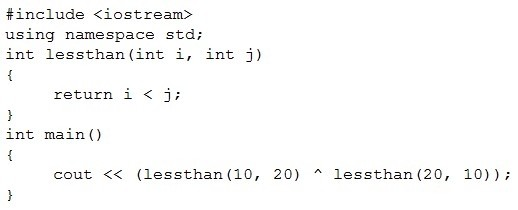
-
A
-
B
It causes a compilation error
-
C
-
D
Reveal answer details
Close answer details
Question 34
Single choice
If there is one, point out an error in the program #include <iostream> using namespace std; int main() {int i=1; for(;;) {cout<<i++; if(i>5) break; } return 0; }
-
A
-
B
-
C
-
D
Reveal answer details
Close answer details
Question 35
Single choice
What happens when you attempt to compile and run the following code? #include <iostream> #include <string> using namespace std; class A { public:
A() { cout << "A no parameters";} A(string s) { cout << "A string parameter";} A(A &a) { cout << "A object A parameter";} }; class B : public A { public: B() { cout << "B no parameters";} B(string s) { cout << "B string parameter";} }; int main () { A a2("Test"); B b1("Alan"); B b2(b1); return 0; }
-
A
It prints: A no parametersA no parametersB string parameter
-
B
It prints: A string parameterA no parametersB string parameterA object A parameter
-
C
It prints: A no parametersB string parameter
-
D
It prints: A no parametersA no parameters
Reveal answer details
Close answer details
Question 36
Single choice
What happens when you attempt to compile and run the following code? #include <iostream>
using namespace std;
class Base {
static int age;
public:
Base () {};
~Base () {};
void setAge(int a=20) {age = a;}
void Print() { cout << age;}
};
int Base::age=0;
int main () {
Base a;
a.setAge(10);
a.Print();
a.setAge();
a.Print();
return 0;
}
-
A
-
B
-
C
-
D
Reveal answer details
Close answer details
Question 37
Multiple choice
Which code lines inserted independently instead of the comment will make the following program work correctly? (Choose three.) 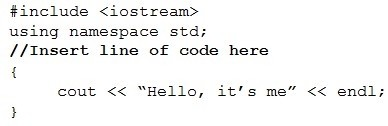
-
A
int main (int argc, char *argv[])
-
B
int main (int c, char *v[])
-
C
-
D
Reveal answer details
Close answer details
Question 38
Single choice
What happens when you attempt to compile and run the following code? #include <iostream> using namespace std; int main()
{ int i = 0; do { i++; if (i==3) break; cout<<i; } while(i < 5); return 0; }
-
A
-
B
-
C
-
D
Reveal answer details
Close answer details
Question 39
Single choice
What is the output of the program? #include <iostream>
#include <string>
using namespace std;
struct t {
int tab[2];
};
class First
{
struct t u;
public:
First() {
u.tab[0] = 1;
u.tab[1] = 0;
}
void Print(){
cout << u.tab[0] << " " << u.tab[1];
}
};
int main()
{
First t;
t.Print();
}
-
A
-
B
-
C
-
D
Reveal answer details
Close answer details
|